UPSC CSE 2026 Essay Paper Discussion

YEAR ASKED IN

2018

Practice UPSC 2018 previous year questions on Anantam IAS: 100 Prelims MCQs and 80 Mains Q&A with answer keys, explanations and topic-wise links.

Prelims MCQs 100

  1. Consider the following: 1. Birds 2. Dust blowing 3. Rain 4. Wind blowing Which…

    Consider the following: 1. Birds 2. Dust blowing 3. Rain 4. Wind blowing Which of the above spread plant diseases?

    1. A1 and 3 only
    2. B3 and 4 only
    3. C1, 2 and 4 only
    4. D1, 2, 3 and 4
    Answer and explanation

    Correct answer: D

    All of the listed factors - birds, dust blowing, rain, and wind blowing - can contribute to the spread of plant diseases

    Statement 1 is correct: Birds can act as vectors, carrying and spreading plant pathogens from one location to another through their feathers, feet, or droppings.

    Statement 2 is correct: Dust and soil particles blown by the wind can carry and spread plant diseases, especially fungal spores and bacterial cells.

    Statement 3 is correct: Rain can splash and disperse plant pathogens, such as fungi and bacteria, from the soil or infected plant parts to uninfected plants.

    Statement 4 is correct: Wind can transport and spread airborne plant pathogens, such as fungal spores and bacterial cells, over long distances.

  2. With reference to the election of the President of India, consider the following statements:…

    With reference to the election of the President of India, consider the following statements: 1. The value of the vote of each MLA varies from State to State. 2. The value of the vote of MPs of the Lok Sabha is more than the value of the vote of MPs of the Rajya Sabha. Which of the following statements given above is/are Correct?

    1. A1 and 2
    2. B2 only
    3. C1 only
    4. DNeither 1 nor 2
    Answer and explanation

    Correct answer: C

    Statement 1 is correct: The value of the vote of each MLA varies from State to State. The value of an MLA's vote is based on the population of their state relative to the number of MLAs in the state assembly. States with larger populations have a higher value per MLA vote.

    Statement 2 is incorrect: Both MPs (Lok Sabha and Rajya Sabha) have the same value for their vote in the presidential election.

    Hence, the correct answer is option (c) 1 only.

  3. In which one of the following States is Pakhui Wildlife Sanctuary located?

    In which one of the following States is Pakhui Wildlife Sanctuary located?

    1. AArunachal Pradesh
    2. BManipur
    3. CMeghalaya
    4. DNagaland
    Answer and explanation

    Correct answer: A

    The Pakhui Wildlife Sanctuary, located in Arunachal Pradesh, is part of the Kameng Elephant Reserve and is contiguous with the Pakke Tiger Reserve. It is known for its rich biodiversity and dense forests, making it a critical habitat for various wildlife species. The Bhareli (Pakke) and Bamadi rivers flow through the sanctuary, supporting its diverse ecosystem. Several indigenous tribes, including the Nyishi and Apatani, reside in the region, coexisting with the forest and its resources.

    ![Wildlife Santuaries in Arunachal pradesh](https://d39jluplm5thpx.cloudfront.net//Wildlife_in_Arunachal_pradesh_fecb54d006.PNG)

  4. After the Santhal Uprising subsided, what was/were the measure/measures taken by the colonial government?…

    After the Santhal Uprising subsided, what was/were the measure/measures taken by the colonial government? 1. The territories called `Santhal Paraganas' were created. 2. It became illegal for a Santhal to transfer land to a non-Santhal. Select the correct answer using the code given below:

    1. A1 only
    2. B2 only
    3. CBoth 1 and 2
    4. DNeither 1 nor 2
    Answer and explanation

    Correct answer: C

    - Santhals were the agricultural people settled in Rajmahal Hills of Jharkhand. - They are native to the Indian states of predominantly Jharkhand, West Bengal and Odisha.

    Creation of Santhal Paraganas: A separate administrative unit called the Santhal Paraganas was established in 1855. This aimed to isolate the Santhal community from the rest of the population and potentially prevent further uprisings.

    Restriction on Land Transfer: The Santhal Parganas Tenancy Act was passed in 1876. This act made it illegal for a Santhal to sell or transfer land to a non-Santhal. This aimed to protect the Santhal community's economic interests and prevent further exploitation by outsiders called 'Dikus'.

  5. With reference to Pradhan Mantri Kaushal Vikas Yojana, consider the following statements 1. It…

    With reference to Pradhan Mantri Kaushal Vikas Yojana, consider the following statements 1. It is the flagship scheme of the Ministry of Labour and Employment. 2. It, among other things, will also impart training in soft skills, entrepreneurship, financial and digital literacy. 3. It aims to align the competencies of the unregulated workforce of the country to the National Skill Qualification Framework. Which of the statements given above is/are correct?

    1. A1 and 3 only
    2. B2 only
    3. C2 and 3 only
    4. D1, 2 and 3
    Answer and explanation

    Correct answer: C

    Statement 1 is Incorrect. The Ministry of Skill Development and Entrepreneurship (MSDE) is responsible for PMKVY, not the Ministry of Labour and Employment.

    Statement 2 is Correct. PMKVY goes beyond technical skills training and incorporates soft skills, entrepreneurship, financial literacy, and digital literacy to make participants more employable.

    Statement 3 is Correct. A core objective of PMKVY is to bridge the gap between the skills of the unregulated workforce and industry requirements by aligning them with the National Skill Qualification Framework (NSQF). This standardization helps ensure a minimum level of competency and improves employment opportunities.

  6. Consider the following phenomena : 1. Light is affected by gravity. 2. The Universe…

    Consider the following phenomena : 1. Light is affected by gravity. 2. The Universe is constantly expanding. 3. Matter warps its surrounding space-time. Which of the above is/are the prediction/predictions of Albert Einstein's General Theory of Relativity, often discussed in media?

    1. A1 and 2 only
    2. B3 only
    3. C1, 2 and 3
    4. D1 and 2
    Answer and explanation

    Correct answer: C

    Statement 1 is correct: According to Einstein's General Theory of Relativity, gravity can bend light. This phenomenon is known as gravitational lensing.

    Statement 2 is correct: The General Theory of Relativity led to the prediction of an expanding universe, which has been confirmed by observational evidence.

    Statement 3 is correct: According to the General Theory of Relativity, the presence of matter and energy warps the fabric of space and time around it, which is the underlying cause of the gravitational force.

    So, all three statements are correct.

  7. With reference to cultural history of India, consider the following statements : 1. Most…

    With reference to cultural history of India, consider the following statements : 1. Most of the Tyagaraja Kritis are devotional songs in praise of Lord Krishna. 2. Tyagaraja created several new ragas. 3. Annamacharya and Tyagaraja are contemporaries. 4. Annamacharya kirtanas are devotional songs in praise of Lord Venkateshwara. Which of the statements given above are correct?

    1. A1 and 3 only
    2. B2 and 4 only
    3. C1, 2 and 3
    4. D2, 3 and 4
    Answer and explanation

    Correct answer: B

    Incorrect (1) Most of Thyagaraja's kritis (compositions) are devotional songs in praise of Lord Rama, not Krishna.

    Correct (2) Tyagaraja is credited with creating several new ragas (melodic scales) in Carnatic music.

    Incorrect (3) Annamacharya and Tyagaraja were not contemporaries. Annamacharya lived in the 15th century, while Tyagaraja lived in the 18th-19th century.

    Correct (4) Annamacharya's kirtanas (devotional songs) are indeed known for praising Lord Venkateshwara, a form of Vishnu.

  8. Consider the following statements : 1. As per the Right to Education (RTE) Act,…

    Consider the following statements : 1. As per the Right to Education (RTE) Act, to be eligible for appointment as a teacher in a State, a person would be required to possess the minimum qualifications laid down by the concerned State Council of Teacher Education. 2. As per the RTE Act, for teaching primary classes, a candidate is required to pass a Teacher Eligibility Test conducted in accordance with the National Council of Teacher Education guidelines. 3. In India, more than 90% of teacher education institutions are directly under the State Governments. Which of the statements given above is/are correct?

    1. A1 and 2
    2. B2 only
    3. C1 and 3
    4. D3 only
    Answer and explanation

    Correct answer: B

    Statement 1 is incorrect: As per the RTE Act, the minimum qualification for teachers is set by the National Council for Teacher Education (NCTE), not the state council.

    Statement 2 is correct: The RTE Act mandates that candidates must pass the Teacher Eligibility Test (TET) to qualify for teaching primary classes. The NCTE sets the guidelines for conducting this test.

    Statement 3 is incorrect: According to the All India Survey on Higher Education (AISHE) 2019-20, approximately 67% of teacher education institutions in India are privately managed, while only around 33% are government-run.

    Hence, the correct answer is option (b) 2 only.

  9. Which of the following led to the introduction of English Education in India? 1.…

    Which of the following led to the introduction of English Education in India? 1. Charter Act of 1813 2. General Committee of Public Instruction, 1823 3. Orientalist and Anglicist Controversy Select the correct answer using the code given below

    1. A1, 2 and 3
    2. B2 only
    3. C1 and 3 only
    4. D1 and 2
    Answer and explanation

    Correct answer: A

    Statement 1 is Correct: The Charter Act of 1813 was the first official measure by the British Parliament to sanction an annual sum of one lakh rupees for the promotion of education and modern sciences in India. Statement 2 is Correct: The General Committee of Public Instruction was established in 1823 to implement the educational grant of 1813 and to guide the educational policy of the East India Company. Statement 3 is Correct: The controversy between Orientalists (who favored traditional Indian learning) and Anglicists (who favored Western education in English) led to the adoption of English as the medium of instruction via Lord Macaulay's Minute of 1835.

  10. “3D printing” has applications in which of the following? 1. Preparation of confectionery items…

    "3D printing" has applications in which of the following? 1. Preparation of confectionery items 2. Manufacture of bionic ears 3. Automotive industry 4. Reconstructive surgeries 5. Data processing technologies Select the correct answer using the code given below:

    1. A1, 3 and 4 only
    2. B2, 3 and 5 only
    3. C1 and 4 only
    4. D1, 2, 3, 4 and 5
    Answer and explanation

    Correct answer: D

    3D printing, also known as additive manufacturing, is a process of making three dimensional solid objects from a digital file. It is used in a wide range of industries and has various applications.

    It can be used to create intricate and customized shapes in confectionery items like chocolates, candies, and other desserts.

    It has been used to create customized bionic ears for people with hearing impairments.

    It is used in the automotive industry for rapid prototyping, manufacturing of customized parts, and even some production of vehicle components.

    It is used in reconstructive surgeries to create patient-specific implants, prosthetics, and surgical guides.

    It can be used to create specialized components and parts for data processing technologies, such as computer hardware.

    Therefore, all the five statements are correct.

  11. Consider the following items: 1. Cereal grains hulled 2. Chicken eggs cooked 3. Fish…

    Consider the following items: 1. Cereal grains hulled 2. Chicken eggs cooked 3. Fish processed and canned 4. Newspapers containing advertising material Which of the above items is/are exempted under GST (Goods and Services Tax)?

    1. A1 only
    2. B2 and 3 only
    3. C1, 2, 3 and 4
    4. D1, 2 and 4 only
    Answer and explanation

    Correct answer: D

    Statement 1 is Correct: Cereal grains that are hulled (meaning the outer husk is removed, such as shelled or rolled grains) are exempted from GST under HSN code 1104, provided they are not sold in branded unit containers. This exemption ensures that basic food staples remain affordable.

    Statement 2 is Correct: According to GST Council notifications (HSN 0407), birds' eggs in shell, whether fresh, preserved, or cooked, are specifically exempted from GST. This classification keeps basic protein sources outside the tax net.

    Statement 3 is Incorrect: While fresh, chilled, or frozen fish is exempt from GST, fish that has been processed and canned (HSN 1604) is considered a value-added product. Such processed items are subject to GST (typically at a rate of 5%).

    Statement 4 is Correct: Newspapers, journals, and periodicals (HSN 4902) are exempt from GST. The law explicitly states that this exemption applies whether or not they contain advertising material, ensuring the free and affordable flow of information.

  12. With reference to the provisions made under the National Food Security Act, 2013 consider…

    With reference to the provisions made under the National Food Security Act, 2013 consider the following statements: 1. The families coming under the category of 'below poverty line (BPL)' only are eligible to receive subsidised grains. 2. The eldest woman in a household, of age 18 years or above, shall be the head of the household for the purpose of issuance of a ration card. 3. Pregnant women and lactating mothers are entitled to a take-home ration' of 1600 calories per day during pregnancy and for six months thereafter. Which of the statements given above is/are correct?

    1. A1 and 2
    2. B2 only
    3. C1 and 3
    4. D3 only
    Answer and explanation

    Correct answer: B

    Statement 1 is incorrect: In 2013, NFSA was enacted to provide food security to 67% of the population in the form of highly subsidized food grains at Rs. 2 and 3 per Kg for wheat and rice respectively. Beneficiaries are identified using Socio-economic Caste Census (SECC) methodology so even non-BPL will also benefit.

    Statement 2 is correct: Under the NFSA, to issue ration cards the eldest woman of a household aged 18 years or above would be considered as head. Hence, this statement is correct.

    Statement 3 is incorrect: Pregnant women and lactating mothers are entitled to a nutritious take home ration of 600 Calories and a maternity benefit of at least Rs 6,000 for six months, says the official act.

  13. Consider the following events: 1. The first democratically elected communist party government formed in…

    Consider the following events: 1. The first democratically elected communist party government formed in a State in India. 2. India's then largest bank, 'Imperial Bank of India', was renamed 'State Bank of India'. 3. Air India was nationalised and became the national carrier. 4. Goa became a part of independent India. Which of the following is the correct chronological sequence of the above events?

    1. A4 - 1 - 2 - 3
    2. B3 - 2 - 1 - 4
    3. C4 - 2 - 1 - 3
    4. D3 - 1 -2 - 4
    Answer and explanation

    Correct answer: B

    The correct chronological sequence is determined by the following historical events:

    1. Air India Nationalisation (1953): Air India was nationalised following the enactment of the Air Corporations Act, 1953. The Government of India acquired a majority stake in the airline from the Tata Group, establishing it as the national carrier.

    2. Renaming of Imperial Bank to SBI (1955): Based on the recommendations of the All India Rural Credit Survey Committee (Gorewala Committee), the State Bank of India Act was passed. On July 1, 1955, the Imperial Bank of India was renamed the State Bank of India (SBI).

    3. First Communist Government in a State (1957): In the 1957 Kerala Legislative Assembly elections, the Communist Party of India (CPI) won a majority. E.M.S. Namboodiripad formed the government, marking the first time a Communist party was democratically elected to power in an Indian state.

    4. Goa becoming part of India (1961): Goa was liberated from Portuguese rule on December 19, 1961, through 'Operation Vijay'. Following its liberation, Goa (along with Daman and Diu) was incorporated into India as a Union Territory by the 12th Constitutional Amendment Act, 1962. It attained full statehood much later, on May 30, 1987.

    Chronological Order: 3 (1953) - 2 (1955) - 1 (1957) - 4 (1961).

  14. Which of the following has/have shrunk immensely/dried up in the recent past due to…

    Which of the following has/have shrunk immensely/dried up in the recent past due to human activities? 1. Aral Sea 2. Black Sea 3. Lake Baikal

    1. A1 and 3
    2. B2 and 3
    3. C2 only
    4. D1 only
    Answer and explanation

    Correct answer: D

    * Aral Sea: The Aral Sea was once one of the world's largest inland lakes, but due to extensive water diversion for irrigation projects, particularly from the Amu Darya and Syr Darya rivers, it has shrunk by over 75% since the 1960s. This has led to severe environmental, economic, and social consequences, including increased salinity, loss of marine life, and desertification.

    ![Aral Sea](https://d39jluplm5thpx.cloudfront.net//Aral_sea_e3f90f7bf4.PNG)

    * Black Sea: While the Black Sea faces environmental challenges such as pollution, biodiversity loss, and reduced oxygen levels in deep waters, it has not experienced significant drying like the Aral Sea.

    * Lake Baikal: Lake Baikal in Russia is the deepest and oldest freshwater lake in the world, containing about 20% of the world's unfrozen freshwater supply. Although it experiences natural fluctuations in water levels, it has not undergone severe drying like the Aral Sea.

    Thus, the correct answer is option (d).

  15. Which one of the following is a very significant aspect of the Champaran Satyagraha?

    Which one of the following is a very significant aspect of the Champaran Satyagraha?

    1. AActive all-India participation of lawyers, students and women in the National Movement
    2. BActive involvement of Dalit and Tribal communities of India in the National Movement
    3. CJoining of peasant unrest to India's National Movement
    4. DDrastic decrease in the cultivation of plantation crops and commercial crops
    Answer and explanation

    Correct answer: C

    The Champaran Satyagraha (1917) was Mahatma Gandhi's first experiment with Satyagraha in India. It was launched to address the grievances of peasants in Bihar who were forced by European planters under the 'Tinkathia system' to cultivate indigo on 3/20th of their land. The most significant aspect of this movement was the joining of peasant unrest to the Indian National Movement. This marked a fundamental shift in the struggle for independence, transitioning it from an urban, middle-class intellectual movement to a mass-based movement that included the rural peasantry. While the movement was localized, its success provided Gandhi with a national platform and demonstrated the efficacy of non-violent resistance.

  16. “Momentum for Change: Climate Neutral Now” is an initiative launched by

    "Momentum for Change: Climate Neutral Now" is an initiative launched by

    1. AThe Intergovernmental Panel on Climate Change
    2. BThe UNEP Secretariat
    3. CThe UNFCCC Secretariat
    4. DThe World Meteorological Organisation
    Answer and explanation

    Correct answer: C

    The United Nations Framework Convention on Climate Change (UNFCCC) Secretariat launched the Climate Neutral Now initiative in 2015 to encourage individuals, businesses, and governments to take voluntary action towards climate neutrality.

    In 2016, the Secretariat introduced a new pillar under its "Momentum for Change" initiative, focusing on Climate Neutral Now as part of broader efforts to highlight and promote successful climate action worldwide.

    Climate neutrality is a three-step process, which requires individuals, companies, and governments to: 1. Measure their climate footprint (greenhouse gas emissions). 2. Reduce emissions as much as possible through sustainable practices and efficiency improvements. 3. Offset unavoidable emissions using UN-certified emission reductions (CERs).

    This initiative aligns with global efforts to meet the Paris Agreement goals, fostering greater accountability and proactive engagement in combating climate change.

  17. When the alarm of your smartphone rings in the morning, you wake up and…

    When the alarm of your smartphone rings in the morning, you wake up and tap it to stop the alarm which causes your geyser to be switched on automatically. The smart mirror in your bathroom shows the day's weather and also indicates the level of water in your overhead tank. After you take some groceries from your refrigerator for making breakfast, it recognises the shortage of stock in it and places an order for the supply of fresh grocery items. When you step out of your house and lock the door, all lights, fans, geysers and AC machines get switched off automatically. On your way to the office, your car warns you about traffic congestion ahead and suggests an alternative route, and if you are late for a meeting, it sends a- message to your office accordingly. In the context of emerging communication technologies, which one of the following term best applies to the above scenario?

    1. ABorder Gateway Protocol
    2. BInternet of Things
    3. CInternet Protocol
    4. DVirtual Private Network
    Answer and explanation

    Correct answer: B

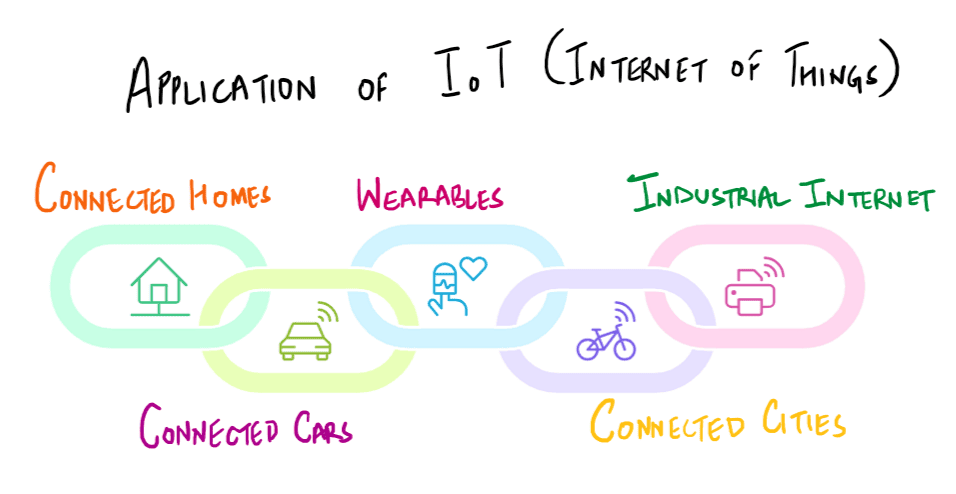
    The scenario described involves various devices (smartphone, geyser, smart mirror, refrigerator, car, etc.) communicating with each other and with the user, and automatically performing tasks based on certain triggers. This is characteristic of the Internet of Things (IoT).
    ![Internet of Things](https://d39jluplm5thpx.cloudfront.net//Io_T_0dcf142180.PNG)

    Option B is correct: Internet of Things (IoT) is a system of interrelated computing devices, mechanical and digital machines, objects, animals or people that are provided with unique identifiers (UIDs) and the ability to transfer data over a network without requiring human-to-human or human-to-computer interaction.

    Option A is incorrect: Border Gateway Protocol is a protocol used to exchange routing information across the internet and is not relevant to the scenario described.

    Option C is incorrect: Internet Protocol is a set of rules for sending and receiving messages at the Internet address level, but it doesn't cover the broad range of device intercommunication described in the scenario.

    Option D is incorrect: A Virtual Private Network is a technology for using the internet or another intermediate network to connect computers to isolated remote computer networks that would otherwise be inaccessible, which also doesn't fit the scenario.

  18. Very recently, in which of the following countries have lakhs of people either suffered…

    Very recently, in which of the following countries have lakhs of people either suffered from severe famine/acute malnutrition or died due to starvation caused by war/ethnic conflicts?

    1. AAngola and Zambia
    2. BMorocco and Tunisia
    3. CVenezuela and Colombia
    4. DYemen and South Sudan
    Answer and explanation

    Correct answer: D

    Yemen and South Sudan faced severe humanitarian crises and famine conditions around 2017-2018 due to prolonged armed conflicts. In Yemen, the Saudi-led military intervention against Houthi rebels, coupled with air and naval blockades, severely restricted the import of food and medicine, leading to widespread starvation. In South Sudan, a civil war that began in 2013 between government and opposition forces displaced millions and disrupted agricultural production, resulting in the United Nations formally declaring a famine in parts of the country in early 2017.

  19. Consider the following statements: 1. Capital Adequacy Ratio (CAR) is the amount that banks…

    Consider the following statements: 1. Capital Adequacy Ratio (CAR) is the amount that banks have to maintain in the form of their own funds to offset any loss that banks incur if the account-holders fail to repay dues. 2. CAR is decided by each individual bank. Which of the statements given above is/are correct?

    1. A1 only
    2. B2 only
    3. CBoth 1 and 2
    4. DNeither 1 nor 2
    Answer and explanation

    Correct answer: A

    Statement 1 is correct. Capital Adequacy Ratio (CAR): This is a crucial regulatory tool used by central banks to ensure banks have sufficient capital reserves to absorb potential financial losses. It acts as a buffer to protect depositors' funds in case of loan defaults or other financial risks.

    Statement 2 is Incorrect. CAR is not decided by individual banks. The CAR is mandated and regulated by the central bank of a country, in India's case, the Reserve Bank of India (RBI). The RBI sets a minimum CAR that all banks operating in the country must adhere to. This ensures a level playing field and safeguards the financial system's stability.

  20. Consider the following: 1. Areca nut 2. Barley 3. Coffee 4. Finger millet 5.…

    Consider the following: 1. Areca nut 2. Barley 3. Coffee 4. Finger millet 5. Groundnut 6. Sesamum 7. Turmeric The Cabinet Committee on Economic Affairs has announced the Minimum Support Price for which of the above?

    1. A1, 2, 3 and 7 only
    2. B2, 4, 5 and 6 only
    3. C1, 3, 4, 5 and 6 only
    4. D1, 2, 3, 4, 5, 6 and 7
    Answer and explanation

    Correct answer: B

    The Cabinet Committee on Economic Affairs (CCEA) announces the Minimum Support Price (MSP) for 22 mandated crops and the Fair and Remunerative Price (FRP) for Sugarcane.

    Statement 1 is Incorrect: Areca nut is a plantation crop and is not included in the list of 22 mandated crops for which MSP is announced.

    Statement 2 is Correct: Barley is one of the seven cereals (Paddy, Wheat, Maize, Sorghum, Pearl millet, Barley, and Finger millet) for which MSP is announced.

    Statement 3 is Incorrect: Coffee is a plantation/beverage crop and does not fall under the MSP regime.

    Statement 4 is Correct: Finger millet (also known as Ragi) is a cereal crop included in the mandated list for MSP.

    Statement 5 is Correct: Groundnut is one of the seven oilseeds (Groundnut, Rapeseed-Mustard, Soyabean, Sesamum, Sunflower, Safflower, and Nigerseed) covered under MSP.

    Statement 6 is Correct: Sesamum is an oilseed crop for which the government officially announces MSP.

    Statement 7 is Incorrect: Turmeric is a spice and is not among the 22 mandated crops for which MSP is announced by the CCEA.

  21. In spite of being a high saving economy, capital formation may not result in…

    In spite of being a high saving economy, capital formation may not result in a significant increase in output due to -

    1. Aweak administrative machinery
    2. Billiteracy
    3. Chigh population density
    4. Dhigh capital-output ratio
    Answer and explanation

    Correct answer: D

    Capital Formation: This refers to the addition to the existing stock of physical and human capital in an economy.

    High Savings: High savings provide the necessary funds for investment. However, savings alone do not guarantee growth; the efficiency with which those savings are converted into output is crucial.

    Capital-Output Ratio (COR): This ratio indicates the amount of capital required to produce one unit of output. - A low ratio means capital is efficient. - A high ratio means capital is inefficient (more capital is needed for the same amount of output).

    Why (D) is correct: Even if an economy saves and invests heavily (capital formation), if the Capital-Output Ratio is high, the resulting increase in output (GDP) will be low. This often happens due to technological backwardness, poor infrastructure, or inefficient management of resources.

  22. Consider the following statements: 1. The Reserve Bank of India manages and services Government…

    Consider the following statements: 1. The Reserve Bank of India manages and services Government of India Securities but not any State Government Securities. 2. Treasury bills are issued by the Government of India and there are no treasury bills issued by the State Governments. 3. Treasury bills are issued at a discount from the par value. Which of the statements given above is/are correct?

    1. A1 and 2 only
    2. B3 Only
    3. C2 and 3 only
    4. D1, 2 and 3
    Answer and explanation

    Correct answer: C

    Statement 1 is incorrect: The Reserve Bank of India (RBI) manages and services both Central (Government of India) and State Government securities. RBI acts as a debt manager for both levels of government under agreements with the states.

    Statement 2 is correct: Treasury Bills (T-bills) are issued only by the Government of India, not by the State Governments. States instead issue State Development Loans (SDLs) for their borrowing needs.

    Statement 3 is correct: Treasury Bills are zero-coupon instruments — they are issued at a discount to the par (face) value and redeemed at par on maturity. The difference represents the interest earned.

  23. Consider the following statements: Human capital formation as a concept is better explained in…

    Consider the following statements: Human capital formation as a concept is better explained in terms of a process, which enables 1. individuals of a country to accumulate more capital. 2. increasing the knowledge, skill levels and capacities of the people of the country. 3. accumulation of tangible wealth. 4. accumulation of intangible wealth. Which of the statements given above is/are correct?

    1. A1 and 2
    2. B2 and 4 only
    3. C2 only
    4. D1, 3 and 4
    Answer and explanation

    Correct answer: B

    Statement 1 is Incorrect: The term 'capital' in this context usually refers to physical or financial capital (like machinery or money), whereas human capital formation specifically focuses on the qualitative development of human beings. Statement 2 is Correct: Human capital formation is defined as the process of acquiring and increasing the number of persons who have the skills, education, and experience essential for the economic development of a country. Statement 3 is Incorrect: Tangible wealth refers to physical assets such as land, buildings, and gold. Human capital is an intangible asset and does not include the accumulation of physical goods. Statement 4 is Correct: Human capital is considered a form of intangible wealth because it represents the stock of knowledge, skills, and health embodied in the population, which lacks physical substance but has significant economic value.

  24. Increase in absolute and per capita real GNP do not connote a higher level…

    Increase in absolute and per capita real GNP do not connote a higher level of economic development, if -

    1. Aindustrial output fails to keep pace with agricultural output.
    2. Bagricultural output fails to keep pace with industrial output.
    3. Cpoverty and unemployment increase.
    4. Dimports grow faster than exports.
    Answer and explanation

    Correct answer: C

    Economic Growth vs. Economic Development: An increase in absolute and per capita real GNP signifies economic growth, which means the overall production of goods and services in a country is expanding.

    Economic development is a broader concept that goes beyond just increasing production. It encompasses factors like 1. Improved living standards for citizens 2. Reduction in poverty and unemployment 3. Increased literacy and education levels 4. Improved healthcare and infrastructure

    If poverty and unemployment are increasing even with economic growth (GNP increase), it suggests the benefits of growth are not being shared widely. This indicates a lack of true economic development.

  25. If a commodity is provided free to the public by the Government, then

    If a commodity is provided free to the public by the Government, then

    1. Athe opportunity cost is zero.
    2. Bthe opportunity cost is ignored.
    3. Cthe opportunity cost is transferred from the consumers of the product to the Government.
    4. Dthe opportunity cost is transferred from the consumers of the product to the tax-paying public.
    Answer and explanation

    Correct answer: D

    Opportunity cost: It refers to the potential benefit an individual or entity gives up when choosing one option over another. In simpler terms, it's what you miss out on by making a specific choice.

    Free commodity by the government: When the government provides a good or service for free, it doesn't eliminate the opportunity cost. The resources used to provide that free good could have been used for something else.

    Taxpayers bear the burden: The resources for "free" public goods come from somewhere, usually taxpayer money. So, the opportunity cost isn't eliminated, it's simply shifted. Taxpayers give up the potential use of those resources in exchange for a free good or service.

    In essence, while the individual consumer might not directly pay for the good, the cost is still there and borne by the tax-paying public.

  26. With reference to digital payments, consider the following statements: 1. BHIM app allows the…

    With reference to digital payments, consider the following statements: 1. BHIM app allows the user to transfer money to anyone with a UPI-enabled bank account. 2. While a chip-pin debit card has four factors of authentication, BHIM app has only two factors of authentication. Which of the statements given above is/are correct?

    1. A1 only
    2. B2 only
    3. CBoth 1 and 2
    4. DNeither 1 nor 2
    Answer and explanation

    Correct answer: A

    Statement 1 is correct: Bharat Interface for Money (BHIM) is a payment app that lets you make simple, easy, and quick transactions using Unified Payments Interface (UPI). You can make direct bank payments to anyone on UPI using their UPI ID or scanning their QR with the BHIM app. You can also request money through the app from a UPI ID.

    Statement 2 is not correct: From a consumer point of view, three levels of authentication are required in this app.

    1. The device ID and mobile number, 2. The bank account which you are linking to this app, and 3. The UPI Pin which is needed to complete the transaction.

    There are three factors of authentication versus a normal net banking app or a chip-in debit card which will only have two factors of authentication.

  27. Consider the following statements 1. The Fiscal Responsibility and Budget Management (FRBM) Review Committee…

    Consider the following statements 1. The Fiscal Responsibility and Budget Management (FRBM) Review Committee Report has recommended a debt to GDP ratio of 60% for the general (combined) government by 2023, comprising 40% for the Central Government and 20% for the State Governments. 2. The Central Government has domestic liabilities of 21% of GDP as compared to 49% of GDP of the State Governments. 3. As per the Constitution of India, it is mandatory for a State to take the Central Government's consent for raising any loan if the former owes any outstanding liabilities to the latter. Which of the statements given above is/are correct?

    1. A1 only
    2. B2 and 3 only
    3. C1 and 3 only
    4. D1, 2 and 3
    Answer and explanation

    Correct answer: C

    Statement 1 is correct. The Fiscal Responsibility and Budget Management (FRBM) Review Committee Report indeed recommended a debt-to-GDP ratio of 60% for the general (combined) government by 2023, with 40% for the Central Government and 20% for the State Governments. This recommendation aimed to ensure fiscal discipline and sustainability.

    Statement 2 is not correct. The Central Government has domestic liabilities of 46.1% of GDP (2016-17) and as a percentage of GDP, States liabilities increased to 23.2 per cent at end-March 2016.

    Statement 3 is correct. The Constitution of India empowers State Governments to borrow only from domestic sources (Article 293(1)). Further, as long as a State has outstanding borrowings from the Central Government, it is required to obtain the Central Government's prior approval before incurring debt (Article 293 (3)).

  28. Consider the following statements 1. The Food Safety and Standards Act, 2006 replaced the…

    Consider the following statements 1. The Food Safety and Standards Act, 2006 replaced the Prevention of Food Adulteration Act, 1954. 2. The Food Safety and Standards Authority of India (FSSAI) is under the charge of Director General of Health Services in the Union Ministry of Health and Family Welfare. Which of the statements given above is/are correct?

    1. A1 only
    2. B2 only
    3. CBoth 1 and 2
    4. DNeither 1 nor 2
    Answer and explanation

    Correct answer: A

    Statement 1 is Correct: The Food Safety and Standards Act, of 2006 did supersede the Prevention of Food Adulteration Act, of 1954. It established a more comprehensive framework for ensuring food safety and regulating the food industry in India.

    Statement 2 is Incorrect: The Food Safety and Standards Authority of India (FSSAI) is an autonomous body, not under the direct control of the Director General of Health Services. While the Ministry of Health and Family Welfare oversees FSSAI, it functions independently with its own governing board and chairperson.

    Therefore, the correct answer is option (a) 1 only.

  29. Which one of the following best describes the term “Merchant Discount Rate” sometimes seen…

    Which one of the following best describes the term "Merchant Discount Rate" sometimes seen in the news?

    1. AThe incentive is given by a bank to a merchant for accepting payments through debit cards pertaining to that bank.
    2. BThe amount paid back by banks to their customers when they use debit cards for financial transactions for purchasing goods or services.
    3. CThe charge to a merchant by a bank for accepting payments from his customers through the bank's debit cards.
    4. DThe incentive given by the Government, to merchants for promoting digital payments by their customers through Point of Sale PoS machines and debit cards.
    Answer and explanation

    Correct answer: C

    The Merchant Discount Rate (MDR) is a fee levied on merchants by payment processors for accepting debit and credit card transactions. It's typically a percentage of the transaction value. So, when a customer uses a debit card at a store, the store pays a fee to the bank that processes the transaction. Hence, option C is the correct answer.

    ![Merchant Rate Discount Process](https://d39jluplm5thpx.cloudfront.net//MDR_process_09dba55b08.PNG)

  30. With reference to the Parliament of India, which of the following Parliamentary Committees scrutinizes…

    With reference to the Parliament of India, which of the following Parliamentary Committees scrutinizes and reports to the House whether the powers to make regulations, rules, sub-rules, by-laws, etc. conferred by the Constitution or delegated by the Parliament are being properly exercised by the Executive within the scope of such delegation?

    1. ACommittee on Government Assurances
    2. BCommittee on Subordinate Legislation
    3. CRules Committee
    4. DBusiness Advisory Committee
    Answer and explanation

    Correct answer: B

    The Committee on Subordinate Legislation (CSL) is specifically tasked with scrutinizing and reporting on the exercise of delegated powers by the executive branch. They ensure the government is acting within the legal boundaries set by Parliament when creating rules, regulations, etc.

    Committee on Government Assurances (A) focuses on tracking the implementation of assurances, and promises made by the government in Parliament.

    Rules Committee (C) deals with framing rules for the smooth functioning of the Houses of Parliament (Lok Sabha and Rajya Sabha).

    Business Advisory Committee (D) allocates time for different kinds of legislative and other business of the House.

    Therefore, only the Committee on Subordinate Legislation directly addresses the scrutiny of delegated powers.

Mains Q&A 80
