UPSC CSE 2026 Essay Paper Discussion

Daily Digest · Wednesday

22 July 2026 Current Affairs for UPSC

10 current affairs published on Wednesday, 22 July 2026

22 July 2026 Current Affairs for UPSC — every Why-in-News article AnantamIAS published on Wednesday, 22 July 2026, broken down with Why in News?, the exact GS paper it feeds, sub-topic mapping, MCQ-ready facts and a UPSC-style practice question. 10 articles in total, covering Polity, Economy, Environment, S&T, IR, Geography, History, Society and Internal Security — the same Why-in-News + GS-paper-mapping + practice-question format the Compass uses across every daily digest on the site.

Daily current affairs for UPSC is where new material enters your prep stream. Read this 22 July 2026 digest end-to-end in 25–35 minutes, attempt the practice question at the foot of each article (it's MCQ for some, 10/15-marker for others), then bookmark the entries that fall inside your active revision window. Everything stays cross-linked: tap any subject pill to jump to that subject's hub, or use the table of contents above to skip straight to a specific story.

Use this page three ways. Read sequentially for a one-sitting scan of everything that mattered on 22 July 2026. Download the 22 July 2026 PDF below for offline study or print revision. Or use the July 2026 Current Affairs compilation to see this day in the month's full context. For the previous day's reading, see 21 July 2026 Current Affairs; the next day's is 23 July 2026 Current Affairs.

Why we publish daily current affairs separately from the monthly compilation: daily is learning, monthly is revision. Use the daily page to add fresh material to your notes the day it breaks; come back to the July 2026 compilation 60 days before Prelims when the noise has settled and only the lasting takeaway is worth re-reading.

Campus Biodiversity Registers: Turning Universities into Living Observatories

Open article →Download PDF

Why in News?

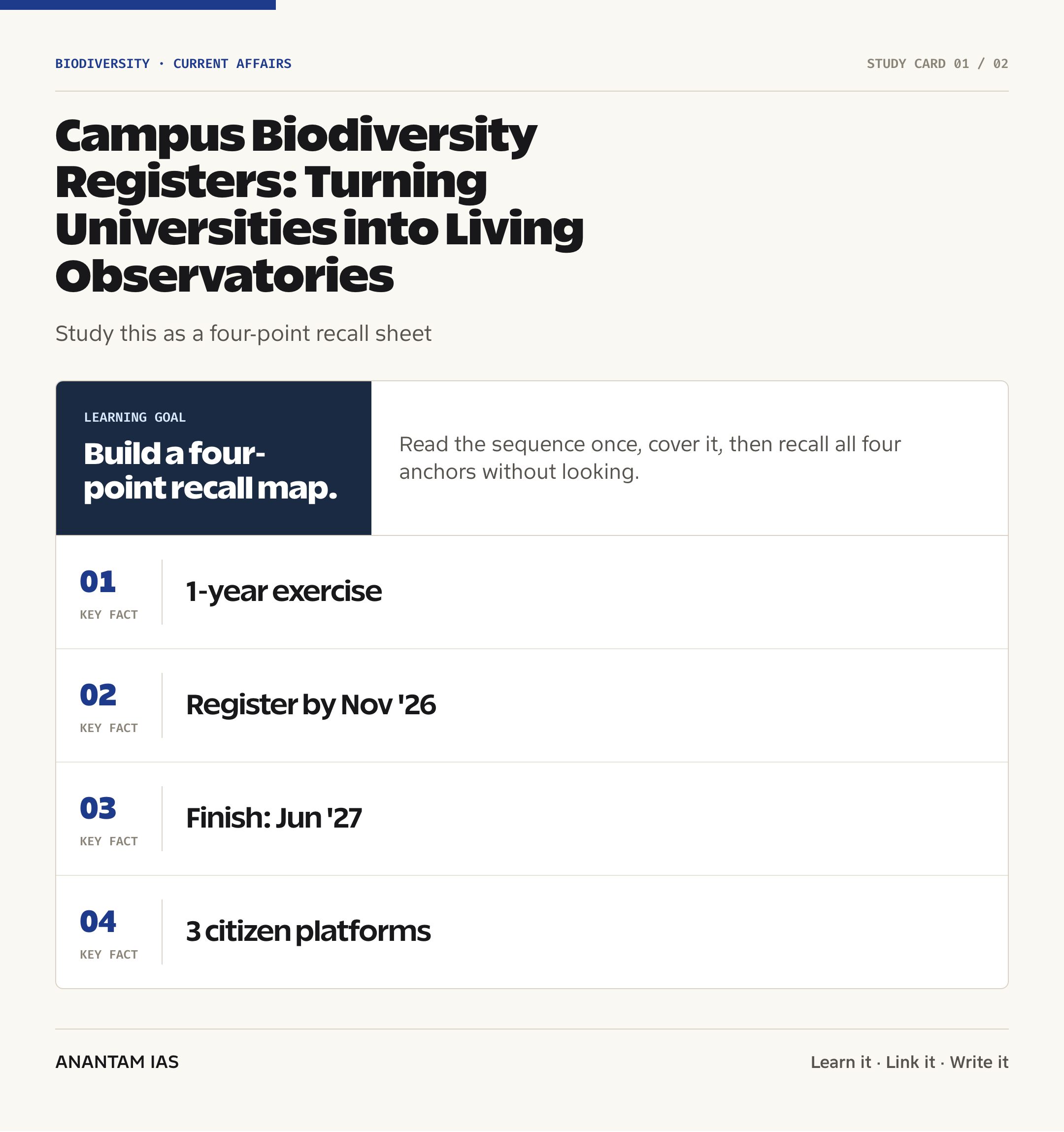
The National Biodiversity Authority (NBA) and the Mysuru-based Nature Conservation Foundation (NCF) have launched a nationwide initiative to help colleges and universities prepare a Campus Biodiversity Register (CBR) for each participating institution. The Hindu reported the launch on 22 July 2026.

The year-long exercise will turn campuses into local observation sites where students, faculty and staff record plants, animals, fungi and other life forms. Institutions may register until November 2026, and the documentation phase is expected to conclude in June 2027.

  • The initiative is inspired by the People’s Biodiversity Register (PBR), but its immediate unit of documentation is an educational campus rather than the jurisdiction of a local body.
  • Participants will use iNaturalist, eBird and SeasonWatch, along with organised surveys, campus walks and routine observations.
  • The project treats college and university grounds as possible urban biodiversity refuges for trees, birds, butterflies, insects, reptiles, mammals, fungi and other organisms.
  • The observations are expected to support wider biodiversity databases and give institutions a baseline for campus planning and conservation.
  • NCF programme manager Devica Ranade framed the exercise as a way to notice easily overlooked campus life, from wall geckos and moths to ants and other small organisms.

The development matters in the context of:

  • India’s urban expansion can fragment habitats, while older and less intensively built campuses may retain tree cover, water bodies, scrub, soil biota and ecological corridors.
  • A species list becomes useful only when observations are georeferenced, dated, verified and repeated; a one-time inventory can’t reveal ecological change by itself.
  • Campus participation can widen biodiversity literacy, but the data must connect with statutory local institutions if it is to strengthen decentralised biodiversity governance.
Campus Biodiversity Registers: Turning Universities into Living Observatories — quick facts

UPSC Relevance

Prelims Relevance

  • The National Biodiversity Authority is a statutory body under the Biological Diversity Act, 2002 and functions at the national level.
  • India’s biodiversity-governance structure operates through the NBA, State Biodiversity Boards or Union Territory Biodiversity Councils, and local Biodiversity Management Committees.
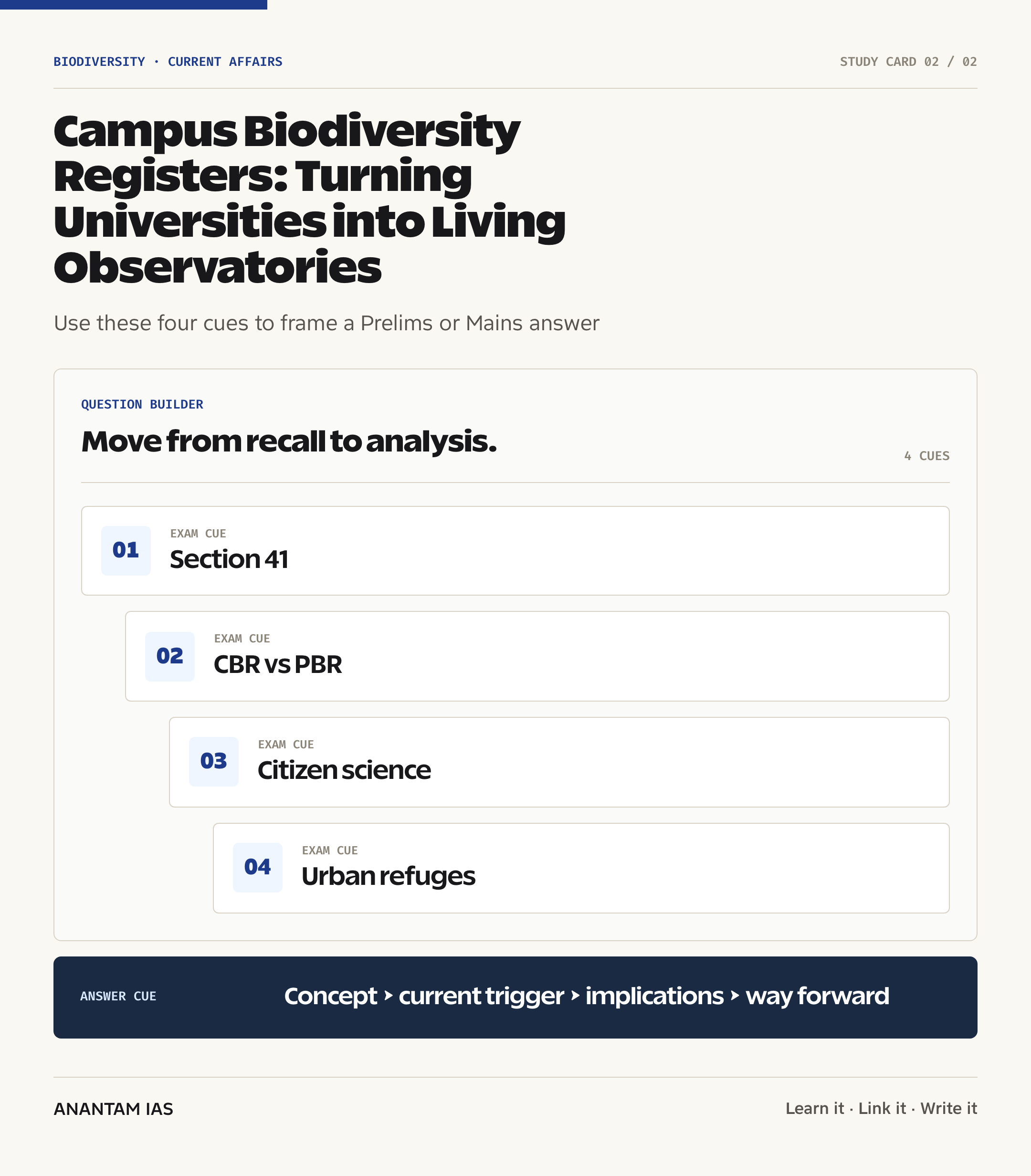
  • Under Section 41 of the amended Act, specified rural and urban local bodies must constitute Biodiversity Management Committees for conservation, sustainable use and documentation of biological diversity.
  • A People’s Biodiversity Register records biological resources and associated traditional knowledge within a geographic jurisdiction; it is prepared through the BMC framework.
  • The Biological Diversity Rules, 2024 empower the NBA to specify electronic or manual PBR formats and procedures for documentation, periodic updating, secure maintenance and information sharing.
  • A Campus Biodiversity Register is an institutional citizen-science inventory inspired by the PBR model; it shouldn’t automatically be treated as a statutory PBR.
  • eBird focuses on bird observations, SeasonWatch tracks seasonal changes in trees, and iNaturalist supports observations across many taxonomic groups.
  • Citizen science involves public participation in scientific observation or data collection, usually under shared protocols and with expert or community validation.

Mains Relevance

GS Paper 3

  • Biodiversity conservation: campuses as small urban habitats, ecological stepping stones and long-term monitoring sites.
  • Environmental governance: the relationship between national guidance, State Biodiversity Boards, BMCs, PBRs and voluntary institutional inventories.
  • Science and technology: citizen-science platforms, open biodiversity data, validation, geospatial records and responsible data governance.
  • Urban ecology: using baseline evidence to guide landscaping, construction, lighting, pesticide use, water-body management and habitat restoration.

GS Paper 2

  • Participatory governance: educational institutions can connect young citizens with local bodies and public conservation institutions.
  • Institutional capacity: clear protocols, training and accountability are needed so participation produces credible evidence rather than a ceremonial green audit.

Essay

  • What citizens learn to notice, institutions become more capable of protecting.
  • A university can be both a place of formal learning and a long-term observatory of ecological change.

Background and Context

What a Campus Biodiversity Register Records

A CBR is a structured inventory of life within an institution’s grounds, supported by evidence that can be revisited and updated.

  • The basic record should identify the species or taxon, observation date, location, habitat and observer, along with a photograph, sound or other supporting evidence where feasible.
  • Coverage can include trees, shrubs, herbs, birds, mammals, reptiles, amphibians, insects, spiders, fungi and less visible groups, rather than only ornamental plants and conspicuous birds.
  • Habitat information matters as much as a species name. A pond edge, old tree, unmanaged patch, garden, wall crevice and leaf-litter bed support different ecological communities.
  • Repeated observations can show seasonality, breeding, migration, flowering and fruiting, while a single checklist supplies only a baseline snapshot.
  • The project can also record pressures such as invasive alien species, pesticide use, excessive night lighting, tree removal, waste, traffic, feral animals and shrinking water bodies.
  • A credible register should distinguish native, introduced, cultivated, invasive and unidentified organisms and retain uncertainty instead of forcing doubtful species-level identifications.
Campus Biodiversity Registers: Turning Universities into Living Observatories — exam lens

The Statutory PBR Framework

The campus project borrows its decentralised spirit from PBRs, whose legal home is the Biological Diversity Act rather than a university’s internal administration.

  • The Biological Diversity Act framework creates national, state and local institutions to pursue conservation, sustainable use and fair sharing of benefits arising from biological resources.
  • Section 41 of the Act requires Biodiversity Management Committees at the specified local-body levels and assigns them conservation, sustainable-use and documentation functions.
  • The statutory scope includes habitats, landraces, folk varieties, cultivars, domesticated animal breeds, aquatic life, microorganisms and traditional knowledge associated with biodiversity.
  • The Biological Diversity Rules, 2024 replaced the 2004 central rules and authorise the NBA to set PBR formats, updating procedures, secure maintenance and information-sharing processes.
  • The Rules also assign the NBA a support role for the preparation, validation and maintenance of biodiversity registers through State Boards or UT Councils, or directly where required.
  • A local PBR is connected to consultation and access-and-benefit-sharing institutions. A campus list doesn’t acquire that status merely because it uses similar fields or citizen-science observations.

CBR and PBR: Similar Method, Different Authority

The distinction prevents a useful education project from being overstated and helps channel campus data into the correct public system.

  • Both registers favour place-based documentation, participation, local observation and periodic revision rather than biodiversity knowledge held only in distant expert databases.
  • A CBR is centred on the grounds and community of a college or university; a statutory PBR covers the territory and community knowledge linked to a competent local-body BMC.
  • Campus students and experts can contribute observations to a PBR process, but the BMC and relevant State Board or UT Council retain their prescribed public roles.
  • Sensitive information needs care. Precise locations of threatened species, nesting sites or valuable biological resources may invite disturbance, collection or commercial interest if released without safeguards.
  • Associated traditional knowledge can’t be treated as free, anonymous data. Documentation should respect prior informed consent, attribution and benefit-sharing safeguards.
  • The most productive model is a documented pathway through which verified campus observations can inform local BMC updates without collapsing institutional and statutory registers into one another.

How Citizen-Science Platforms Help

Digital platforms can standardise submissions and connect local observations with larger datasets, but they don’t remove the need for survey design and verification.

  • iNaturalist accepts observations across many groups and supports community identification; photographs and metadata can make records auditable.
  • eBird structures bird checklists by place, time and effort, which can support distribution and seasonal analyses when observers follow its protocols.
  • SeasonWatch, an NCF citizen-science programme, tracks leafing, flowering and fruiting in common trees and can reveal changes in phenology over time.
  • Platform records can suffer from spatial bias, uneven observer effort, duplicate observations and a preference for attractive or easily identified species.
  • A campus should combine open participation with fixed routes, repeat counts, seasonal sampling and expert review so data become comparable across months and years.
  • Students must be trained in ethical field practice: don’t handle wildlife unnecessarily, disturb nests, damage plants, trespass or share sensitive coordinates casually.

Why Campuses Matter in Urban Ecology

Campuses can’t replace large natural ecosystems, yet they can protect small habitats and connections within heavily built landscapes.

  • Mature trees, wetlands, grass patches and low-disturbance corners can provide food, shelter, nesting sites and movement routes for urban-adapted and visiting species.
  • The value of a campus depends on its surrounding landscape. A green patch near a lake, ridge, river, forest remnant or park may function as an ecological stepping stone.
  • Species-rich landscaping is not the same as planting many ornamental trees. Native vegetation, structural diversity, soil health and water availability often matter more than a raw plantation count.
  • A CBR can make routine decisions evidence-based: retaining old trees, controlling invasive plants, reducing pesticides, shielding lights, restoring ponds and timing maintenance outside breeding seasons.
  • Students can compare local observations with the broader idea of India’s biodiversity hotspots, while recognising that a campus isn’t called a global hotspot merely because it supports many species.
  • The register can also strengthen climate adaptation by identifying shade, permeable ground, water-retaining habitats and vegetation that moderates heat without reducing biodiversity to carbon storage alone.

Risks That Can Turn a Register into a Token Exercise

The project will matter only if institutions treat the register as a recurring management tool rather than a one-time publication for accreditation or publicity.

  • A long species list can conceal weak evidence, taxonomic errors and repeated entries. Quality assurance should record who verified each identification and at what confidence level.
  • Observer participation may decline after launch. Credit-bearing field projects, nature clubs, faculty coordinators and annual handovers can protect continuity as student cohorts change.
  • Comparisons among campuses can be misleading when area, habitat, season and survey effort differ. Reporting should include sampling effort and campus context, not rank institutions by species totals alone.
  • Data collection without management response breeds cynicism. Every register should identify a few measurable actions, responsible offices, timelines and follow-up indicators.
  • Construction and landscaping decisions can still override biodiversity evidence unless the register is linked to estate planning, procurement, environmental committees and approval processes.
  • Open data should follow a graded-access approach so general records remain useful while ecologically or culturally sensitive information receives stronger protection.

From Inventory to Long-Term Monitoring

A register becomes scientifically valuable when later cohorts can repeat the work and distinguish ecological change from changes in observer effort.

  • Each campus should first map broad habitat units such as built areas, gardens, woodland, scrub, grass, water bodies and unmanaged patches, then sample every unit instead of surveying only pleasant walking routes.
  • A fixed seasonal calendar can combine monsoon, winter and summer surveys. The timing should reflect local ecology because breeding, flowering, migration and insect activity don’t peak in the same month everywhere.
  • Permanent photo points, tree tags and repeatable transects can show habitat change even when a species is missed. Records of absence require special care because failure to detect isn’t proof that a species has disappeared.
  • Institutions should preserve original photographs, audio, checklists and verification notes with stable identifiers. A polished report without its underlying evidence can’t be audited or reliably updated.
  • Baseline indicators may include native-species richness, invasive cover, canopy continuity, pond condition, nesting activity and pesticide exposure. Indicators should guide action without reducing a complex ecosystem to one score.
  • Partnerships with nearby colleges, natural-history groups, taxonomists and the State Biodiversity Board can fill expertise gaps, especially for fungi, insects, grasses and other groups often overlooked in popular surveys.
  • An annual public summary can explain what changed, what remains uncertain and which management decisions followed. This closes the loop between observation, interpretation and conservation action.

Way Forward

Adopt a Common Minimum Protocol

  • Define mandatory metadata, taxonomic confidence, habitat categories, survey effort and update frequency while allowing campuses to add locally relevant fields.
  • Publish a clear note explaining the CBR-PBR distinction and the route for sharing validated observations with BMCs and State Boards.

Build Scientific and Institutional Continuity

  • Train faculty coordinators and rotating student teams in identification, field ethics, data cleaning and repeatable survey design.
  • Create annual audits that report both ecological trends and actions taken, with raw claims traceable to observations.

Turn Records into Campus Decisions

  • Require biodiversity evidence before tree felling, major construction, wetland alteration, pesticide procurement and large lighting changes.
  • Set practical habitat targets such as retaining old trees, restoring native understorey, reducing invasive species and protecting nesting seasons.

Protect Knowledge and Sensitive Species

  • Use consent and attribution safeguards for community knowledge, and restrict precise locations where publication could increase ecological harm.
  • Let BMCs and State Boards guide any transfer of campus records into statutory databases and access-related decisions.

Conclusion

Campus Biodiversity Registers can make conservation concrete by turning ordinary places into living observatories. Their strongest contribution will be a generation of students trained to notice patterns, verify evidence and connect ecological knowledge with everyday institutional choices.

But participation alone isn’t enough. The initiative needs repeatable protocols, taxonomic review, sensitive-data safeguards and a formal bridge to BMCs and PBR processes. A campus inventory should complement statutory biodiversity governance, not impersonate it.

If institutions update the register and act on its findings, the project can move beyond species counting towards long-term stewardship of urban habitats and ecological change.

UPSC Practice Questions

Prelims MCQ 1

With reference to biodiversity registers in India, consider the following statements:

  1. Biodiversity Management Committees are constituted under Section 41 of the Biological Diversity Act, 2002.
  2. The National Biodiversity Authority may specify electronic or manual formats for People’s Biodiversity Registers.
  3. Every Campus Biodiversity Register automatically has the legal status of a People’s Biodiversity Register.

How many of the above statements are correct?

(a) Only one (b) Only two (c) All three (d) None

Answer: (b) Only two

Explanation:

Statements 1 and 2 are correct. Statement 3 is incorrect: a CBR is an institution-focused citizen-science inventory, while a statutory PBR belongs to the BMC-led local governance framework. Campus data can support that process but doesn’t acquire statutory status automatically.

Prelims MCQ 2

Which one of the following correctly matches the citizen-science platform with its principal use?

(a) eBird – recording only flowering and fruiting in trees (b) SeasonWatch – monitoring seasonal changes in trees (c) iNaturalist – recording only bird migration (d) PBR – a global mobile application for species photographs

Answer: (b) SeasonWatch – monitoring seasonal changes in trees

Explanation:

SeasonWatch tracks tree phenology, including leafing, flowering and fruiting. eBird is structured around bird observations, while iNaturalist supports observations across many groups. A PBR is a biodiversity-governance record, not a global observation app.

UPSC Mains Questions

  1. Campus Biodiversity Registers can broaden citizen science and improve urban ecological management, but they shouldn’t be confused with statutory People’s Biodiversity Registers. Examine their respective roles and suggest a mechanism for credible data-sharing between universities and Biodiversity Management Committees. (250 words)
  2. Educational campuses can function as biodiversity refuges within expanding cities, yet species documentation alone doesn’t ensure conservation. Discuss the scientific, institutional and ethical safeguards needed to convert campus inventories into long-term ecological stewardship. (250 words)

Sources: National Biodiversity Authority and The Hindu.

Frequently Asked Questions

What is a Campus Biodiversity Register?

A Campus Biodiversity Register is a structured record of plants, animals, fungi and other organisms observed within a college or university campus. It can include dates, locations, habitats, photographs and repeat observations. Its purpose is to build a baseline for education, monitoring and better campus management.

Who launched the nationwide CBR initiative?

The National Biodiversity Authority and the Mysuru-based Nature Conservation Foundation launched the nationwide initiative. The Hindu reported it on 22 July 2026. The exercise is designed for colleges and universities across India and will involve students, faculty and staff in documenting campus biodiversity.

What is the project timeline?

Educational institutions can register until November 2026. The year-long documentation exercise is expected to conclude in June 2027. Participating campuses will use organised surveys, nature walks and everyday observations to build the skills and information required to compile their own registers.

Is a CBR the same as a PBR?

No. A CBR focuses on an educational campus and is a citizen-science and management tool inspired by the PBR model. A People’s Biodiversity Register belongs to the statutory BMC-led framework for a local-body jurisdiction and also covers biological resources and associated traditional knowledge.

Which platforms will participants use?

The project identifies iNaturalist, eBird and SeasonWatch. iNaturalist supports observations across many biological groups, eBird structures bird records, and SeasonWatch tracks seasonal changes in trees. Campuses still need common survey protocols and expert review because platform uploads alone don’t guarantee representative or accurate data.

How can a register improve campus conservation?

A regularly updated register can identify important trees, ponds, nesting areas, native vegetation, invasive species and ecological pressures. Institutions can use this evidence when planning construction, lighting, pesticide use and landscaping. The key test is whether observations lead to assigned actions, timelines and repeat monitoring.
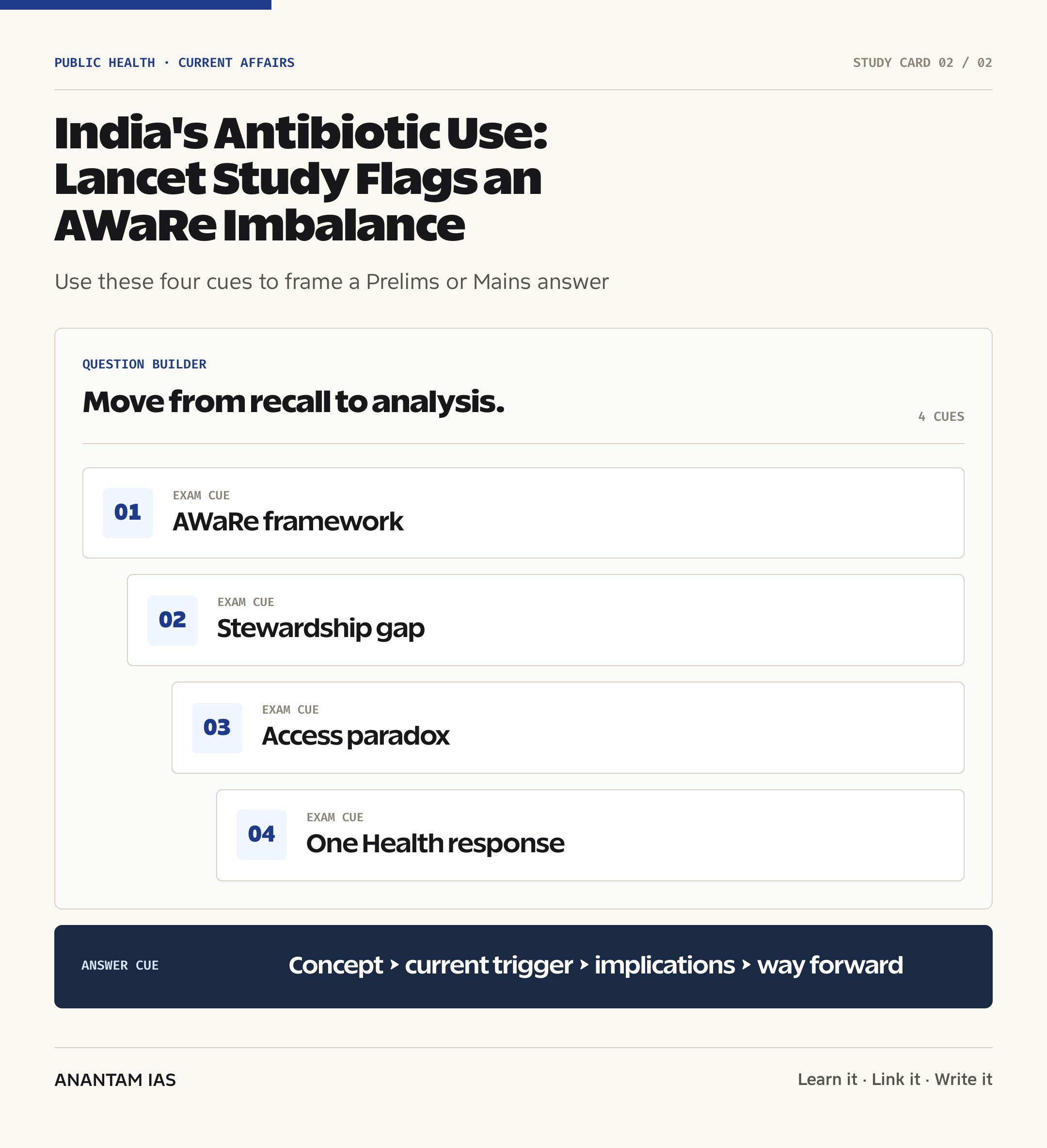
India’s Antibiotic Use: Lancet Study Flags an AWaRe Imbalance

Open article →Download PDF

Why in News?

A study published in The Lancet Public Health has estimated country-specific levels of antibiotic need using the WHO AWaRe framework. For India, it identifies a mismatch between the amount and mix of antibiotics used: overall consumption and Watch use exceed the modelled requirement, while Access and Reserve use falls below it.

The finding matters because antimicrobial resistance (AMR) isn’t only a problem of excessive consumption. Patients can face inappropriate exposure to broad-spectrum drugs at one end and inadequate access to the correct first-line or last-resort treatment at the other. Sound policy must address both errors together.

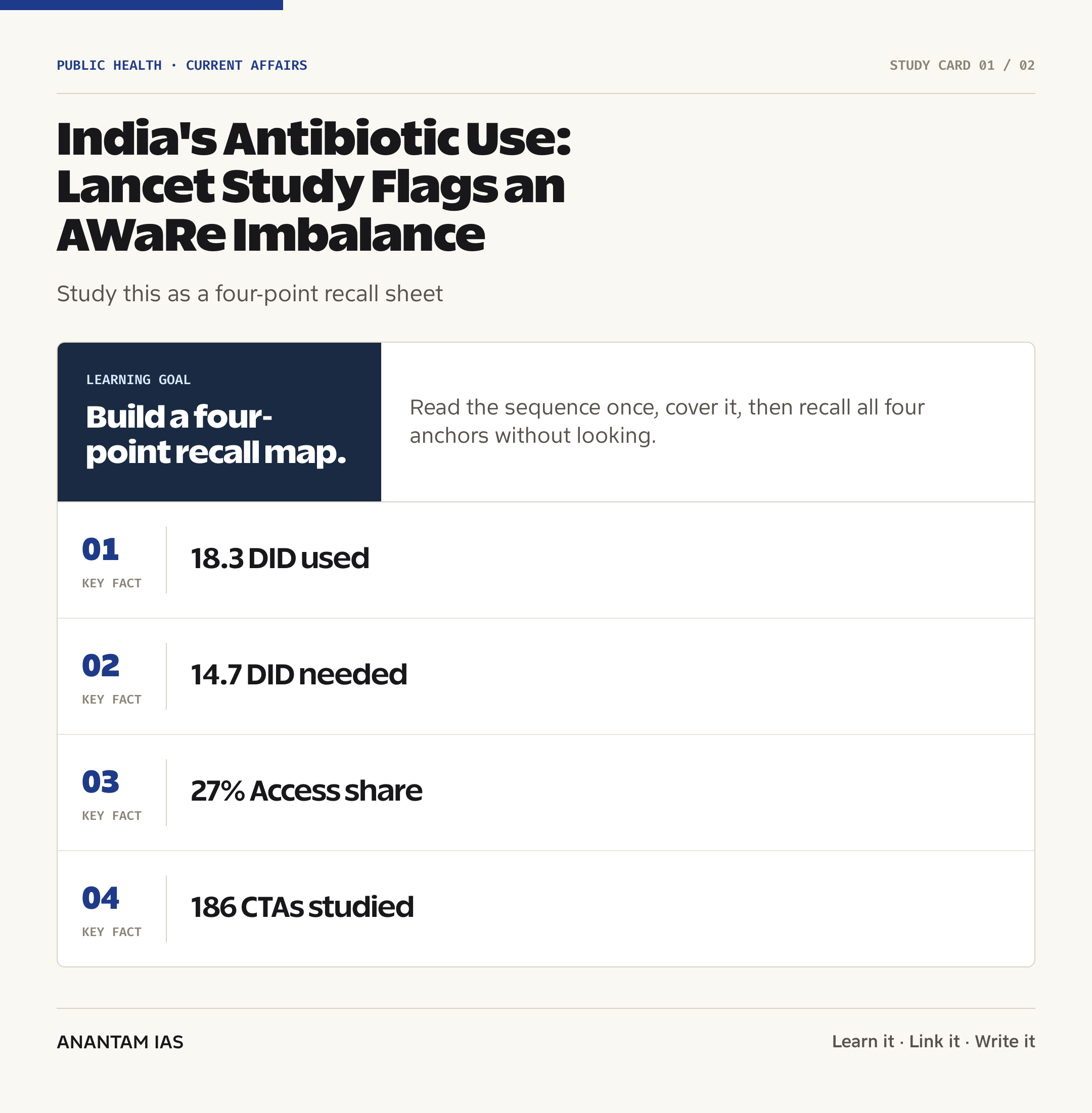
  • India’s estimated optimal total was 14.7 defined daily doses per 1,000 inhabitants per day, compared with reported actual use of 18.3.
  • Estimated optimal Access use was 7.8 DID, while actual use was 4.5 DID.
  • Estimated optimal Watch use was 6.0 DID, while actual use was 9.3 DID.
  • Estimated optimal Reserve use was 0.99 DID, while actual use was 0.19 DID.
  • Only 27% of India’s reported antibiotic use came from the Access group, against a modelled requirement of 52.3%.

The development matters in the context of:

  • The study reframes antibiotic stewardship as choosing the right drug, dose and duration, not merely cutting aggregate use.
  • India’s high infectious-disease and resistance burden can create a legitimate need for some Watch and Reserve antibiotics, so blunt volume caps may harm access.
  • The findings connect public health, medicine regulation, diagnostics, hospital governance and the One Health approach.
India's Antibiotic Use: Lancet Study Flags an AWaRe Imbalance — quick facts

UPSC Relevance

Prelims Relevance

  • The AWaRe classification was introduced by WHO in 2017 and is updated through its essential-medicines process.
  • Access antibiotics are generally preferred first- or second-choice treatments for common bacterial infections and have lower resistance potential than Watch drugs.
  • Watch antibiotics have higher resistance potential and should be priority targets for stewardship and monitoring.
  • Reserve antibiotics are last-resort options for confirmed or suspected multidrug-resistant infections; they must remain accessible under tight controls.
  • A defined daily dose (DDD) is WHO’s standard technical unit for drug-consumption measurement; it isn’t an individual patient’s prescribed dose.
  • DID expresses defined daily doses per 1,000 inhabitants per day and permits population-level comparison.
  • The UN General Assembly’s 2030 target calls for at least 70% of global human antibiotic consumption to come from the Access group.
  • The Global Antimicrobial Resistance and Use Surveillance System (GLASS) supports standardized reporting of resistance and antimicrobial use.
  • India’s NAP-AMR 2.0 covers 2025-29 and uses a One Health, multi-sector response.

Mains Relevance

GS Paper 2

  • Public-health governance challenges in aligning prescribing, diagnostics, drug access and hospital stewardship with evidence-based treatment guidelines.
  • The state’s role in securing equitable access to effective antibiotics while regulating irrational prescriptions, non-prescription sales and poor-quality medicines.

GS Paper 3

  • AMR as a One Health risk linking human medicine, livestock, aquaculture, food systems, pharmaceutical effluent and environmental transmission.
  • Use of surveillance, microbiology, rapid diagnostics and digital prescribing data to conserve the effectiveness of existing antibiotics.

Essay

  • The right to health requires both restraint against unnecessary medicine and reliable access to essential medicine.
  • A common resource can be exhausted through individually rational choices: antibiotic effectiveness as a form of shared biological infrastructure.

Background and Context

What the Lancet study measured

The study developed the first global framework for estimating an appropriate AWaRe mix from health need rather than treating low consumption or high consumption as inherently good or bad.

  • Researchers covered 186 countries, territories and areas, representing about 99.8% of the world’s population, and modelled need for the 2019 reference year.
  • Countries were grouped by comparable infection burden, resistance patterns, health-care access and socioeconomic conditions.
  • Within each peer group, places combining relatively low antibiotic use with low infection-related mortality helped form a benchmark frontier.
  • The model estimated Watch need from infections for which WHO guidance recommends Watch drugs, and Reserve need from resistance burdens that make last-resort treatment relevant.
  • Access need was estimated as the residual requirement after accounting for Watch and Reserve need. This produces a policy benchmark, not a prescription for an individual patient.
  • Across all 186 settings, the study estimated about 43 billion antibiotic treatment days were needed in 2019. About 77% of optimal global use would be Access drugs, close to the UN target.
  • Among settings with observed-use data, 72% used more antibiotics overall than their estimated optimum and 99% used more Watch antibiotics. At the same time, 42% used fewer Access and 52% fewer Reserve drugs than estimated, showing why excess and scarcity must be measured together.
India's Antibiotic Use: Lancet Study Flags an AWaRe Imbalance — exam lens

Reading India's numbers correctly

India’s totals show a compositional problem: patients may be exposed to the wrong class even where genuine infection-related need remains high.

  • At 18.3 DID, observed overall use was about 24% above the study’s modelled 14.7 DID requirement. The comparison signals potential excess but doesn’t prove that every prescription above the benchmark was inappropriate.
  • Observed Watch use of 9.3 DID was around 55% above the estimated 6.0 DID need. Common Watch agents in India include ceftriaxone, azithromycin, ciprofloxacin and piperacillin-tazobactam.
  • Observed Access use of 4.5 DID was about 42% below estimated need of 7.8 DID. This may reflect substitution of broad-spectrum treatment where a narrower first-line option would work, alongside access failures for some patients.
  • Observed Reserve use of 0.19 DID was far below estimated need of 0.99 DID. Low Reserve use isn’t automatically success if patients with documented resistant infections cannot obtain the drug that can still work.
  • The reported AWaRe components don’t sum to total use because actual consumption also includes antibiotics categorized as not recommended or not classified. That residual is itself a stewardship concern.
  • India’s estimated optimal Access share was 52.3%, below the global 70% goal. The difference reflects country-specific disease and resistance needs, but India’s actual 27% share still falls well short of both reference points.

The AWaRe framework

The WHO AWaRe system translates stewardship into a practical hierarchy for procurement, prescribing and monitoring.

  • Access drugs should be widely available, affordable and quality-assured because they cover many common infections with generally lower resistance-selection potential.
  • Watch drugs remain clinically necessary for defined syndromes and resistance patterns, but their higher resistance potential makes them key targets for prior authorization, review and consumption audits.
  • Reserve doesn’t mean unavailable. It means protected access for highly specific cases, backed by culture results or a strong suspicion of multidrug resistance and specialist oversight where feasible.
  • WHO also identifies some antibiotic combinations as not recommended when evidence-based indications or high-quality guideline support are lacking.
  • AWaRe classification describes stewardship priority, not an absolute ladder of drug strength. A Watch antibiotic can be the correct first choice for a particular infection under the AWaRe antibiotic book.
  • The 2030 70% Access target is a population-level monitoring goal and shouldn’t replace diagnosis or local treatment guidelines.

What Indian hospital evidence shows

The global model is consistent with earlier Indian facility-level evidence of heavy empirical and broad-spectrum use.

  • The NCDC multicentric point-prevalence survey for 2021-22 covered 20 tertiary hospitals across 15 states and two Union Territories.
  • Nearly three in four hospitalized patients surveyed were receiving an antibiotic: 57% of prescriptions were Watch, 38% Access and 2% Reserve.
  • Only 6% of prescriptions were based on microbiological evidence, indicating that most treatment began without culture confirmation.
  • About 55% of prescriptions were for prophylaxis rather than treatment, opening room to tighten surgical prophylaxis duration and perioperative protocols.
  • Duplicate coverage was recorded for gram-negative and anaerobic organisms, which can add toxicity and cost without improving outcomes when combinations aren’t clinically justified.
  • Point-prevalence data offer a one-time facility snapshot and are not identical to national consumption estimates. Their value lies in revealing prescribing-process weaknesses that aggregate sales data cannot show.
  • High use of injectable drugs also deserves review because route of administration affects staffing, infection risks and cost. The survey reported 86.5% of antibiotics were administered intravenously, while antibiotic exposure varied widely across hospitals, cautioning against a single national remedy for every facility.

Why misuse and poor access coexist

India’s antibiotic problem is shaped by fragmented care, uneven laboratory capacity and incentives across both public and private markets.

  • Empirical prescribing is sometimes necessary before test results arrive, especially in sepsis, but weak diagnostic access can turn an emergency exception into routine broad-spectrum use.
  • Non-prescription sale, patient demand, incomplete medical histories and pressure for a rapid cure can encourage antibiotic use for viral or self-limiting illness.
  • Small hospitals may lack microbiologists, antibiograms and stewardship teams, while delayed referrals can push clinicians toward broader drugs as defensive treatment.
  • At the same time, price, supply-chain gaps and registration constraints can keep some Reserve agents and diagnostics beyond the reach of patients who genuinely need them.
  • Poor infection prevention, limited vaccination, unsafe water and sanitation, and health-care-associated infections increase the underlying demand for antibiotics.
  • Use of medically important antimicrobials in animals and release of resistant organisms or active residues into the environment connect clinical stewardship to the wider AMR challenge.

Policy architecture and governance

India has moved from a general AMR strategy toward a newer implementation framework, but outcome measurement must reach prescriptions, laboratories and supply chains.

  • The Union Health Ministry launched National Action Plan on AMR 2.0 for 2025-29, retaining a multi-sector One Health approach.
  • Its implementation priorities include awareness and training, laboratory capacity, surveillance, infection control and optimized antimicrobial use.
  • The NCDC National AMR Surveillance Network and ICMR’s surveillance and stewardship work can connect resistance profiles with prescribing decisions and national procurement.
  • Hospitals need local antibiograms, which summarize susceptibility patterns of bacteria isolated in that facility, because resistance varies across places and patient populations.
  • Regulation under prescription-only schedules must be paired with affordable clinical care. Enforcement without access may shift patients to informal or delayed treatment rather than produce rational use.
  • The study’s benchmark can support national and state dashboards, but it should be triangulated with GLASS-compatible consumption data, cultures, outcomes and facility audits.

Limits of the benchmark

The estimates are a powerful planning tool, but they are modelled counterfactuals rather than direct clinical judgments on each prescription.

  • The analysis uses a 2019 reference year; subsequent resistance trends, health-system shocks and changing guidelines can alter both need and actual consumption.
  • Cross-country sales and consumption datasets differ in coverage of public, private, hospital and community sectors, which affects comparability.
  • A defined daily dose is a standardized measurement unit and may differ from doses prescribed to children, patients with renal impairment or people with severe infections.
  • Peer-group benchmarking assumes that countries with relatively low use and low infection mortality offer an attainable reference, but unmeasured differences can remain.
  • National averages can hide unequal access: an urban hospital may overuse Watch drugs while a rural district lacks an effective Access antibiotic for the same syndrome.
  • Policy should track clinical outcomes and resistance alongside volume. A lower DID isn’t a success if treatable bacterial infections go untreated or mortality rises.

Way Forward

Make diagnosis drive treatment

  • Expand affordable culture and susceptibility testing, rapid diagnostics and sample-transport networks, with clear rules for de-escalating empirical therapy after results arrive.
  • Use facility-specific antibiograms and standard treatment guidelines in prescribing software, order forms and pharmacy review.

Institutionalize stewardship

  • Require major hospitals to maintain multidisciplinary antimicrobial stewardship programmes with audit, feedback, dose review and stop dates.
  • Measure the Access share, Watch DID, Reserve appropriateness and not-recommended combinations without rewarding indiscriminate cuts.

Protect access and quality

  • Align essential-medicines procurement with syndrome burden so Access drugs don’t stock out and protected Reserve medicines reach eligible patients quickly.
  • Strengthen prescription-only enforcement, pharmacovigilance and quality testing while expanding affordable consultation so regulation doesn’t deepen treatment exclusion.

Reduce the need for antibiotics

  • Invest in vaccination, WASH, infection prevention and control, hospital hygiene and safe food systems to prevent infections before antibiotics are needed.
  • Implement One Health surveillance across humans, animals, food and the environment, including controls on pharmaceutical effluent and inappropriate farm use.

Conclusion

The Lancet study’s clearest lesson is that more access and less misuse aren’t competing goals. India needs fewer unnecessary Watch prescriptions, more reliable first-line Access treatment and guarded but timely Reserve access for patients with resistant infections.

An AWaRe target becomes useful only when it changes bedside decisions. Diagnostics, local resistance data, stewardship teams, procurement and infection prevention must work as one system, with patient outcomes checked alongside consumption ratios.

India’s NAP-AMR 2.0 provides the policy frame. The next test is measurable execution across public hospitals, private clinics, pharmacies, laboratories, farms and wastewater systems.

UPSC Practice Questions

Prelims MCQ 1

With reference to the WHO AWaRe classification of antibiotics, consider the following statements:

  1. Access antibiotics are generally first- or second-choice options for common infections and have lower resistance potential than Watch antibiotics.
  2. Watch antibiotics must never be prescribed as first-choice therapy for any clinical syndrome.
  3. Reserve antibiotics should remain accessible for selected multidrug-resistant infections under strict stewardship.

How many of the above statements are correct?

(a) Only one (b) Only two (c) All three (d) None

Answer: (b) Only two

Explanation:

Statements 1 and 3 are correct. Watch antibiotics have higher resistance potential and need close monitoring, but WHO guidance can recommend a Watch drug for a defined syndrome. AWaRe isn’t an absolute ban on first-choice Watch use.

Prelims MCQ 2

Which one of the following best explains a defined daily dose (DDD) in antibiotic-use surveillance?

(a) The exact dose prescribed to every adult patient (b) The maximum legally permitted daily dose (c) A standardized technical unit used to compare drug consumption (d) The minimum dose that prevents antimicrobial resistance

Answer: (c) A standardized technical unit used to compare drug consumption

Explanation:

DDD is a standardized WHO measurement unit for the assumed average maintenance dose of a medicine for its main indication in adults. It supports population comparisons but isn’t necessarily the dose prescribed to an individual.

UPSC Mains Questions

  1. India’s antibiotic challenge combines excessive broad-spectrum use with inadequate access to appropriate first-line and last-resort drugs. Examine this paradox through the AWaRe framework, and suggest health-system reforms that can improve stewardship without denying effective treatment.
  2. Antimicrobial resistance is a governance problem extending beyond hospitals and prescriptions. Discuss the roles of surveillance, diagnostics, infection prevention, pharmaceutical regulation and One Health coordination in implementing India’s National Action Plan on AMR 2.0.

Sources: The Lancet Public Health and The Indian Express.

Frequently Asked Questions

What is the WHO AWaRe classification?

WHO groups antibiotics into Access, Watch and Reserve categories to guide stewardship. Access drugs are preferred for many common infections; Watch drugs have higher resistance potential and need closer monitoring; Reserve drugs are protected last-resort options for selected resistant infections. The system supports procurement, prescribing audits and population-level consumption targets.

What did the Lancet study find for India?

The study estimated India’s optimal total use at 14.7 DID, compared with actual use of 18.3 DID. Actual Access use was below estimated need, Watch use was above it and Reserve use was below it. This points to both unnecessary broad-spectrum exposure and gaps in access to appropriate treatment.

Does low Reserve antibiotic use mean good stewardship?

Not by itself. Reserve antibiotics should be tightly protected, but they must be available when a patient has a documented or strongly suspected multidrug-resistant infection. Very low use can reflect successful prevention and stewardship, or it can reflect delayed diagnosis, unaffordability, stock-outs and lack of access to effective treatment.

What does DID measure?

DID means defined daily doses per 1,000 inhabitants per day. It is a standardized population-level measure used to compare drug consumption across time and places. It doesn’t equal the prescribed dose for every patient, and it must be interpreted alongside age, disease burden, resistance, sector coverage and clinical outcomes.

What is the global Access antibiotic target?

At the 2024 UN high-level meeting on AMR, member states endorsed a target that at least 70% of global human antibiotic use should come from the WHO Access group by 2030. Country context still matters because infection and resistance burdens differ, so the target informs monitoring rather than individual prescriptions.

How can India reduce Watch antibiotic overuse?

India can expand microbiology and rapid diagnostics, use local antibiograms, enforce standard treatment guidelines, audit prescriptions and review empirical therapy when test results arrive. Reliable supplies of Access drugs, tighter control of unsupported combinations, better infection prevention and affordable clinical care are also needed so patients aren’t pushed toward irrational self-medication.

Right to Legal Aid: Supreme Court Orders Retrial in Death Penalty Case

Open article →Download PDF

Why in News?

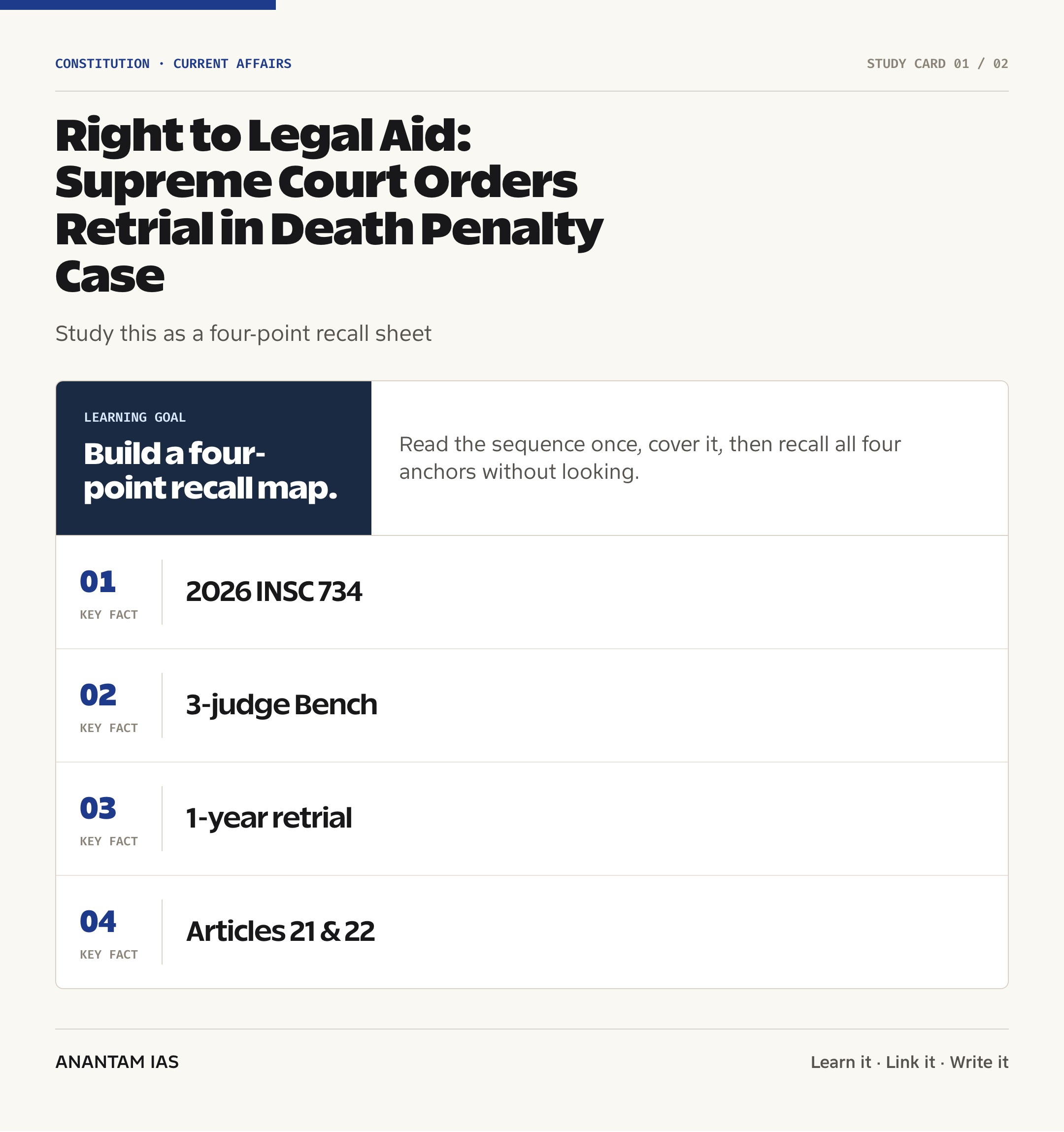
The Supreme Court of India reaffirmed the right to legal aid in Dr. Abdul Hameed v. State of Rajasthan, 2026 INSC 734, delivered on 21 July 2026. It set aside Hameed’s conviction and death sentence in the 1996 Samleti bus-blast case because he had faced the trial without effective legal representation.

The three-judge Bench of Justices Vikram Nath, Sanjay Karol and Sandeep Mehta ordered a de novo trial, meaning a fresh trial from the prosecution-evidence stage. The Court did not pronounce Hameed innocent; it held that a conviction, especially one carrying capital punishment, cannot rest on a process vitiated by denial of a meaningful defence.

  • The trial-court record showed that Hameed had no counsel during the evidentiary trial and cross-examined prosecution witnesses himself.
  • The case involved voluminous oral, documentary and forensic evidence, identification evidence, alleged confessions and recoveries, making professional defence assistance indispensable.
  • The Court directed a Special Court at Jaipur to make every effort to complete the fresh trial within one year of assignment.
  • If Hameed cannot engage counsel, the Rajasthan State Legal Services Authority must appoint a lead lawyer with at least ten years’ standing, assisted by a lawyer with at least seven years’ standing.
  • The ruling treats fair-trial safeguards as substantive constitutional guarantees, not procedural formalities that can be relaxed because an alleged offence is grave.

The development matters in the context of:

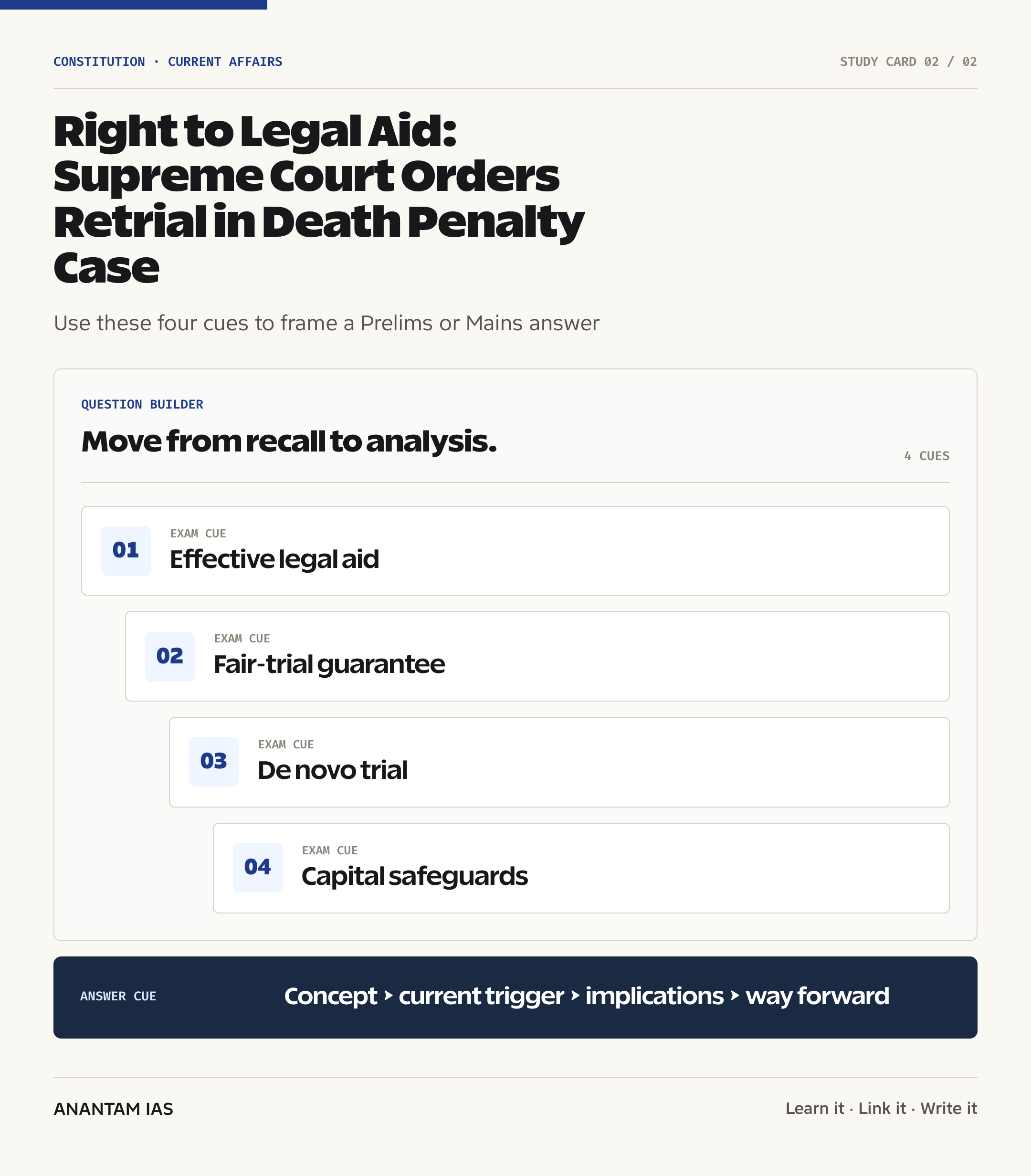
  • The judgment connects effective representation with life and personal liberty under Article 21 and the right to consult and be defended by a legal practitioner under Article 22.
  • It balances the accused’s rights with the claims of victims and society: the flawed conviction was erased, but prosecution may continue through a constitutionally compliant retrial.
  • It is especially important for capital cases, where deficient defence can distort both the finding of guilt and the presentation of mitigating circumstances at sentencing.
Right to Legal Aid: Supreme Court Orders Retrial in Death Penalty Case — quick facts

UPSC Relevance

Prelims Relevance

  • Article 21 protects life and personal liberty except according to procedure established by law; judicial interpretation requires that procedure to be fair, just and reasonable.
  • Article 22(1) says an arrested person shall not be denied the right to consult and be defended by a legal practitioner of choice.
  • Article 39A, a Directive Principle in Part IV, directs the State to secure equal justice and provide free legal aid so economic or other disabilities don’t deny access to justice.
  • Section 303 of the CrPC recognised the right of a person accused before a criminal court to be defended by a pleader of choice.
  • Section 304 of the CrPC required a Sessions Court to assign a pleader at State expense when an unrepresented accused lacked sufficient means.
  • Section 386(b) of the CrPC empowered an appellate court hearing an appeal from conviction to reverse the finding and sentence and order a retrial.
  • Under Section 12 of the Legal Services Authorities Act, 1987, a person in custody is among the categories eligible for legal services; Section 13 governs entitlement.
  • A de novo trial is an exceptional remedy used when a fundamental defect makes the earlier trial unsafe; it is not a device for the prosecution to fill ordinary gaps in its case.
  • The case citation is 2026 INSC 734, and the appeal was Criminal Appeal Nos. 1827-1829 of 2019.

Mains Relevance

GS Paper 2

  • Fundamental rights and due process: how Articles 21 and 22 convert legal representation into an enforceable condition of a fair criminal trial.
  • Directive Principles and institutions: Article 39A, the Legal Services Authorities Act and the responsibility of courts and State Legal Services Authorities.
  • Judiciary and governance: trial-court vigilance, quality of legal-aid counsel, accountability for procedural failure and time-bound corrective remedies.

GS Paper 4

  • Ethics of public institutions: restraint, impartiality and fidelity to process when public outrage creates pressure for swift punishment.
  • Justice to all stakeholders: protecting the accused from wrongful conviction without extinguishing the victims’ claim to a lawful adjudication.

Essay

  • The legitimacy of punishment depends as much on the fairness of the process as on the result.
  • Constitutional safeguards are tested most severely when allegations provoke fear and public anger.
  • Equal justice requires capable assistance, not merely formal access to a lawyer.

Background and Context

What the Supreme Court found

The constitutional defect was established from the court record, the accused’s direct response and the absence of any proof of State-provided assistance.

  • Hameed told the Supreme Court through video conferencing on 6 March 2025 that he had neither engaged private counsel nor received a legal-aid lawyer during the trial.
  • The State did not dispute that no lawyer had been appointed through the legal services authority, and no material showed that the trial court tried to appoint an amicus curiae.
  • Proceeding sheets did not show counsel at any stage; witness depositions showed that the accused cross-examined witnesses himself.
  • There was no record of a conscious and voluntary waiver after the consequences of proceeding without counsel had been explained to him.
  • The Court said physical presence of an accused is insufficient. Representation must be real, effective and meaningful, allowing the accused to understand proceedings, exercise rights and present a defence.
Right to Legal Aid: Supreme Court Orders Retrial in Death Penalty Case — exam lens

Constitutional foundation of legal aid

India’s legal-aid guarantee is built from enforceable Fundamental Rights, a Directive Principle and statutory duties that operate together.

  • Article 21 is the core fair-procedure guarantee. A criminal conviction can be legitimate only when guilt is determined through a fair process, not simply when a court reaches a conclusion on evidence.
  • Article 22(1) expressly protects an arrested person’s right to consult and be defended by a legal practitioner of choice. The present judgment assessed observance in substance, not as a paper formality.
  • Article 39A instructs the State to secure equal justice and free legal aid. It addresses the risk that poverty, custody, disability or social disadvantage may make nominal equality meaningless.
  • The legal-aid system in India works through NALSA, State Legal Services Authorities, High Court and District committees under the Legal Services Authorities Act, 1987.
  • The duty is not exhausted by attaching any available lawyer to the file. In a complex capital prosecution, competence, preparation and continuity determine whether assistance is meaningful.

Statutory safeguards in criminal procedure

The Code of Criminal Procedure translated constitutional protection into courtroom duties relevant to the original trial and the ordered retrial.

  • Under Sections 303 and 304 of the CrPC, an accused may be defended by a pleader of choice, while an indigent unrepresented accused in a Sessions trial must receive a pleader at State expense.
  • The obligation lies on the court. The Supreme Court rejected any attempt to fault the accused for not correcting the trial court’s failure to secure appropriate legal aid.
  • Effective cross-examination matters because it tests identification, reliability, contradictions, recoveries, scientific evidence and the chain of circumstances. A later appellate reading cannot recreate opportunities lost when evidence was first recorded.
  • Section 386(b) gives an appellate court power to order retrial after reversing a conviction. The Court relied on this remedial logic but stressed that retrial is exceptional and must be required to avert a failure of justice.
  • The fresh court may examine the accused under Section 313 CrPC after prosecution evidence and must allow a reasonable opportunity to lead defence evidence.

Why the Court chose retrial

The Bench considered three possible remedies and selected the one that repaired the constitutional injury without prematurely terminating prosecution.

  • An appellate reappraisal of the existing record was rejected because that record had been created without effective defence assistance. Affirming guilt from it would preserve the very defect under challenge.
  • Immediate acquittal solely for denial of counsel was also rejected because the allegations concerned a grave public-transport bombing. Fairness to society required that the charges be tested lawfully.
  • A de novo trial was selected to restore the accused’s opportunity to test prosecution evidence while preserving the prosecution’s chance to establish its case.
  • The Court drew on Mohd. Hussain v. State (NCT of Delhi), which treats retrial as rare but permissible when indispensable to avert failure of justice and balance fair-trial rights with public justice.
  • It also referred to Suk Das v. Union Territory of Arunachal Pradesh, Tyron Nazareth v. State of Goa and Naveen v. State of Madhya Pradesh on legal assistance and the meaning of a real, impartial trial.

Special safeguards for the fresh trial

The detailed directions turn the constitutional holding into operational safeguards rather than leaving legal aid as an abstract promise.

  • The Acting Chief Justice of the Rajasthan High Court must designate a Special Court at Jaipur led by a Rajasthan Higher Judicial Service officer with at least seven years’ Sessions-trial experience.
  • The matter restarts from recording prosecution evidence; witnesses must be summoned afresh and Hameed must receive a full opportunity to cross-examine them.
  • If privately chosen counsel isn’t available, the Rajasthan State Legal Services Authority must fund an experienced two-lawyer defence team: a lead counsel of ten years’ standing and an assistant of seven years’ standing.
  • The defence must receive prosecution documents without avoidable delay and sufficient preparation time; the trial should proceed day to day as far as practicable, with reasons recorded for necessary adjournments.
  • Hameed remains in judicial custody but may seek bail on its own merits. The Special Court must remain uninfluenced by findings in the judgments that were set aside.

Capital punishment and heightened procedural care

A death sentence magnifies the cost of every defect because both conviction and sentencing demand searching adversarial scrutiny.

  • The Rajasthan High Court had earlier found that death was imposed on the same day as conviction without counsel present at sentencing or a meaningful opportunity to present mitigating circumstances.
  • An amicus curiae was appointed only after the High Court remanded the sentencing issue. The Supreme Court found that the deeper problem covered the entire evidentiary trial.
  • The ruling complements the rarest of rare doctrine: narrowing capital punishment isn’t enough if the process used to determine guilt lacks a capable defence.
  • The Court noted that Hameed had spent almost 29 years in custody and nearly 12 years under the shadow of death, yet delay could not justify sustaining a constitutionally defective conviction.
  • Public outrage over a serious offence calls for greater judicial discipline, because the standard of proof and the right to test evidence cannot vary with the popularity of an accusation.

Scope and limits of the ruling

The judgment separates Hameed’s procedural claim from the evidence-based outcomes concerning the other accused.

  • The order is case-specific. It does not declare that every defect in representation automatically requires retrial or acquittal.
  • Hameed’s conviction and sentence were set aside, but he was not acquitted; the Special Court must decide the case afresh on evidence and law.
  • Pappu alias Salim was separately acquitted because the prosecution failed to establish his guilt beyond reasonable doubt, not because his trial lacked counsel.
  • The Supreme Court also declined to disturb the High Court’s acquittal of six other accused, applying the reinforced or double presumption of innocence after acquittal.
  • The case illustrates remedial proportionality: courts must identify the precise constitutional defect and choose relief that repairs it while respecting the rights of the accused, victims and society.

Evolution of the Supreme Court doctrine

The decision develops a long line of cases that moved free legal aid from charity to a judicially enforceable element of fair procedure.

  • In Hussainara Khatoon v. Home Secretary, State of Bihar, the Court connected free legal services with reasonable, fair and just procedure under Article 21, especially for indigent persons facing loss of liberty.
  • In Khatri (II) v. State of Bihar, it stressed that the State’s duty is not postponed until trial. Legal assistance must be available when an accused is first produced before a magistrate and at later stages where liberty is at stake.
  • In Suk Das v. Union Territory of Arunachal Pradesh, the Court rejected the idea that an uninformed accused had silently waived legal aid. A right cannot be meaningfully waived when the person was never told it existed.
  • The present judgment adds an operational test: judges must examine whether representation was competent and meaningful in light of case complexity, possible punishment, access to material and the real opportunity to cross-examine witnesses.
  • This evolution shifts institutional focus from the formal question, ‘Was a lawyer named?’ to the constitutional question, ‘Could the accused actually defend against the State’s case?’

Way Forward

Make legal aid effective from the first hearing

  • Trial courts should record whether the accused has counsel, needs legal aid or has knowingly waived representation only after receiving a clear explanation in a language the accused understands.
  • Legal Services Authorities should maintain trained criminal-defence panels with special experience requirements for murder, terrorism and capital cases.
  • Counsel must be appointed early enough to study the record, consult the accused and prepare cross-examination; appointment on the day of evidence is not meaningful assistance.

Monitor quality, continuity and resources

  • Courts should use periodic representation checklists covering conferences with the accused, access to documents, preparation time and unexplained changes of counsel.
  • State authorities should provide fair fees, investigators, interpreters and expert assistance where complex evidence makes these necessary for an effective defence.
  • High Courts can audit capital-case records before confirmation to detect missing counsel, inadequate sentencing hearings or untested evidence before defects become irreversible.

Protect speed without sacrificing fairness

  • Day-to-day hearings and limited adjournments can reduce delay, but schedules must preserve adequate defence preparation and meaningful cross-examination.
  • Digital case records, timely disclosure and verified witness-contact systems can make old-case retrials more workable without lowering evidentiary standards.
  • Legal-aid performance should be evaluated by the quality of representation and case outcomes, not only by the number of lawyers assigned or matters closed.

Conclusion

The Supreme Court’s ruling makes a simple constitutional point with difficult consequences: the State cannot seek the gravest punishment through a trial in which the accused was left to defend himself. Articles 21 and 22 demand a real opportunity to understand, test and answer the prosecution case.

By ordering a fresh trial instead of treating either conviction or acquittal as automatic, the Court protected both individual liberty and public justice. The institutional lesson is that competent legal aid must begin before evidence is recorded; appellate correction decades later is costly for the accused, victims and the credibility of the justice system.

UPSC Practice Questions

Prelims MCQ 1

With reference to constitutional and statutory safeguards for legal representation, consider the following statements:

  1. Article 22(1) protects an arrested person’s right to consult and be defended by a legal practitioner of choice.
  2. Article 39A forms part of the Fundamental Rights in Part III of the Constitution.
  3. Section 304 of the Code of Criminal Procedure required a Sessions Court to assign a pleader at State expense when an unrepresented accused lacked sufficient means.

How many of the above statements are correct?

(a) Only one (b) Only two (c) All three (d) None

Answer: (b) Only two

Explanation:

Statements 1 and 3 are correct. Article 39A is a Directive Principle in Part IV, not a Fundamental Right in Part III.

Prelims MCQ 2

Which one of the following best describes a de novo criminal trial ordered by an appellate court?

(a) Automatic acquittal followed by a new prosecution for the same offence (b) A fresh adjudication ordered exceptionally to cure a fundamental trial defect (c) Reconsideration limited only to the quantum of sentence (d) Review of a conviction exclusively on the existing defective evidence record

Answer: (b) A fresh adjudication ordered exceptionally to cure a fundamental trial defect

Explanation:

A de novo trial is an exceptional corrective remedy. In this case, evidence must be recorded afresh with effective counsel and a full opportunity for cross-examination.

UPSC Mains Questions

  1. Effective legal aid is not a welfare concession but an essential condition of a fair criminal trial. Discuss with reference to Articles 21, 22 and 39A, statutory safeguards, and the Supreme Court’s reasoning in Dr. Abdul Hameed v. State of Rajasthan. (15 marks, 250 words)
  2. How should appellate courts balance an accused’s right to fair procedure with victims’ rights and society’s interest when a serious criminal conviction is vitiated by denial of counsel? Examine the constitutional basis and limits of ordering a de novo trial. (15 marks, 250 words)
  3. Capital punishment demands heightened procedural fairness at both conviction and sentencing. Analyse the duties of trial courts and Legal Services Authorities in ensuring competent, continuous and meaningful defence representation. (10 marks, 150 words)

Sources: Supreme Court of India and The Indian Express.

Frequently Asked Questions

What did the Supreme Court decide?

The Court set aside Abdul Hameed’s conviction and death sentence because his trial lacked effective legal representation. It ordered a fresh trial from the prosecution-evidence stage before a designated Special Court at Jaipur. The ruling did not acquit Hameed or decide the evidence against him on merits.

Why is legal aid part of fair trial?

Counsel helps an accused understand charges, test witnesses, raise legal objections, examine technical evidence and present a defence. Articles 21 and 22 protect fair procedure and representation, while Article 39A directs the State to secure equal justice and free legal aid. A lawyer’s nominal presence alone may not satisfy these duties.

What is a de novo trial?

A de novo trial is a fresh adjudication ordered when a fundamental defect has undermined the earlier process. It is an exceptional remedy, not a routine second chance for the prosecution. Here, prosecution evidence must be recorded afresh so the accused’s lawyers can cross-examine witnesses and present a meaningful defence.

Was Abdul Hameed acquitted?

No. His conviction and sentence were set aside for lack of a constitutionally fair trial, but the allegations remain to be adjudicated afresh. He will remain in judicial custody during the retrial, subject to his right to apply for bail before the Special Court on independent merits.

Which provisions govern free legal aid?

Articles 21, 22(1) and 39A provide the constitutional framework. Sections 303 and 304 of the Code of Criminal Procedure governed defence by counsel and State-funded counsel in Sessions trials. The Legal Services Authorities Act, 1987 establishes NALSA and State, High Court, District and Taluk-level institutions for legal services.

Why does the ruling matter in death cases?

A death sentence is irreversible and requires heightened care in testing guilt and presenting mitigating circumstances. The ruling makes clear that gravity cannot lower fair-trial standards. Courts must proactively ensure experienced, prepared and continuous representation before evidence is recorded and again when sentence is considered.

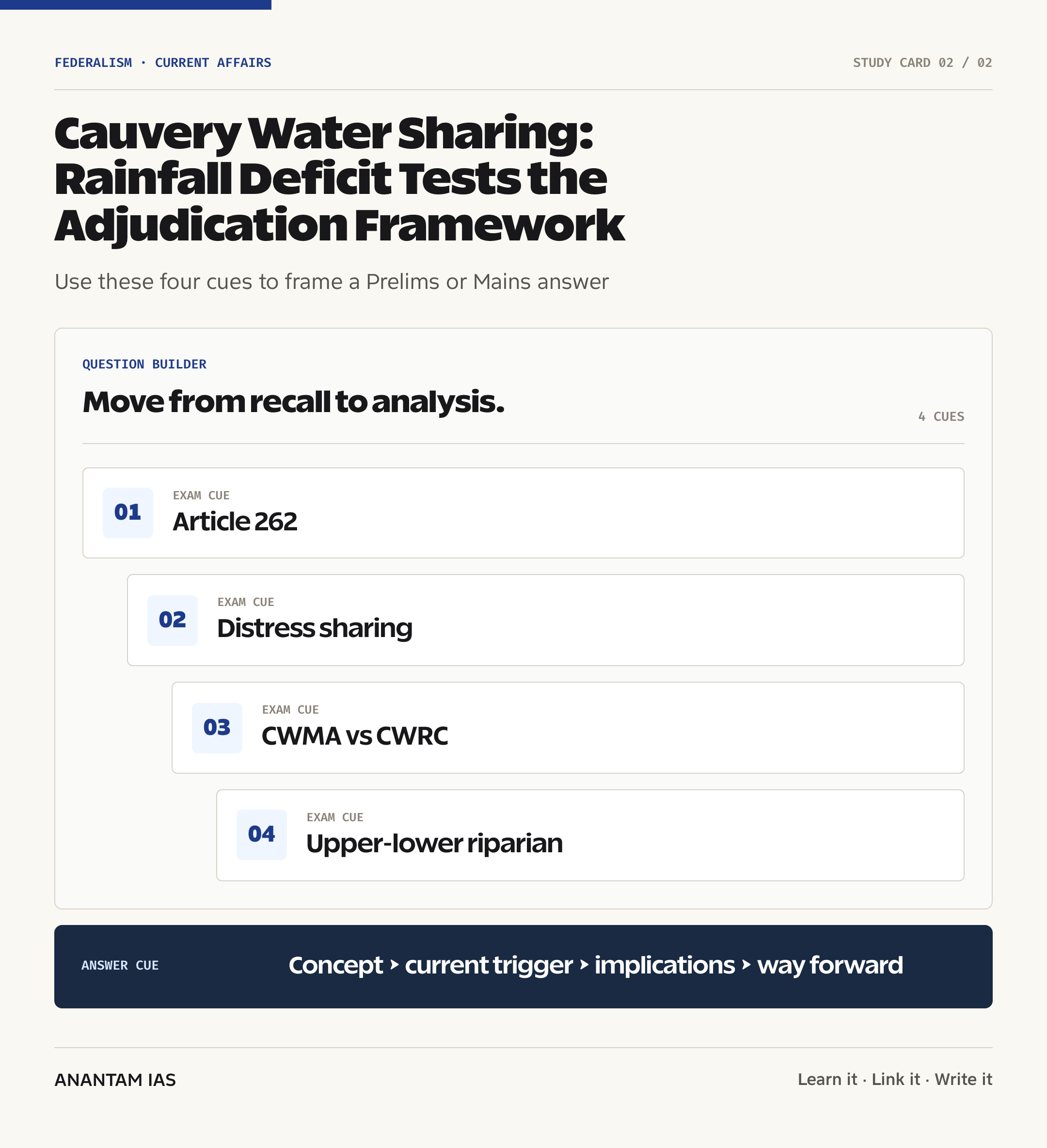
Cauvery Water Sharing: Rainfall Deficit Tests the Adjudication Framework

Open article →Download PDF

Why in News?

The Cauvery Water Management Authority (CWMA) was scheduled to meet in New Delhi on 22 July 2026 to review a sharp early-monsoon water deficit in the basin. The review matters because the Cauvery arrangement is not a voluntary political bargain: it implements a tribunal award modified by the Supreme Court in 2018.

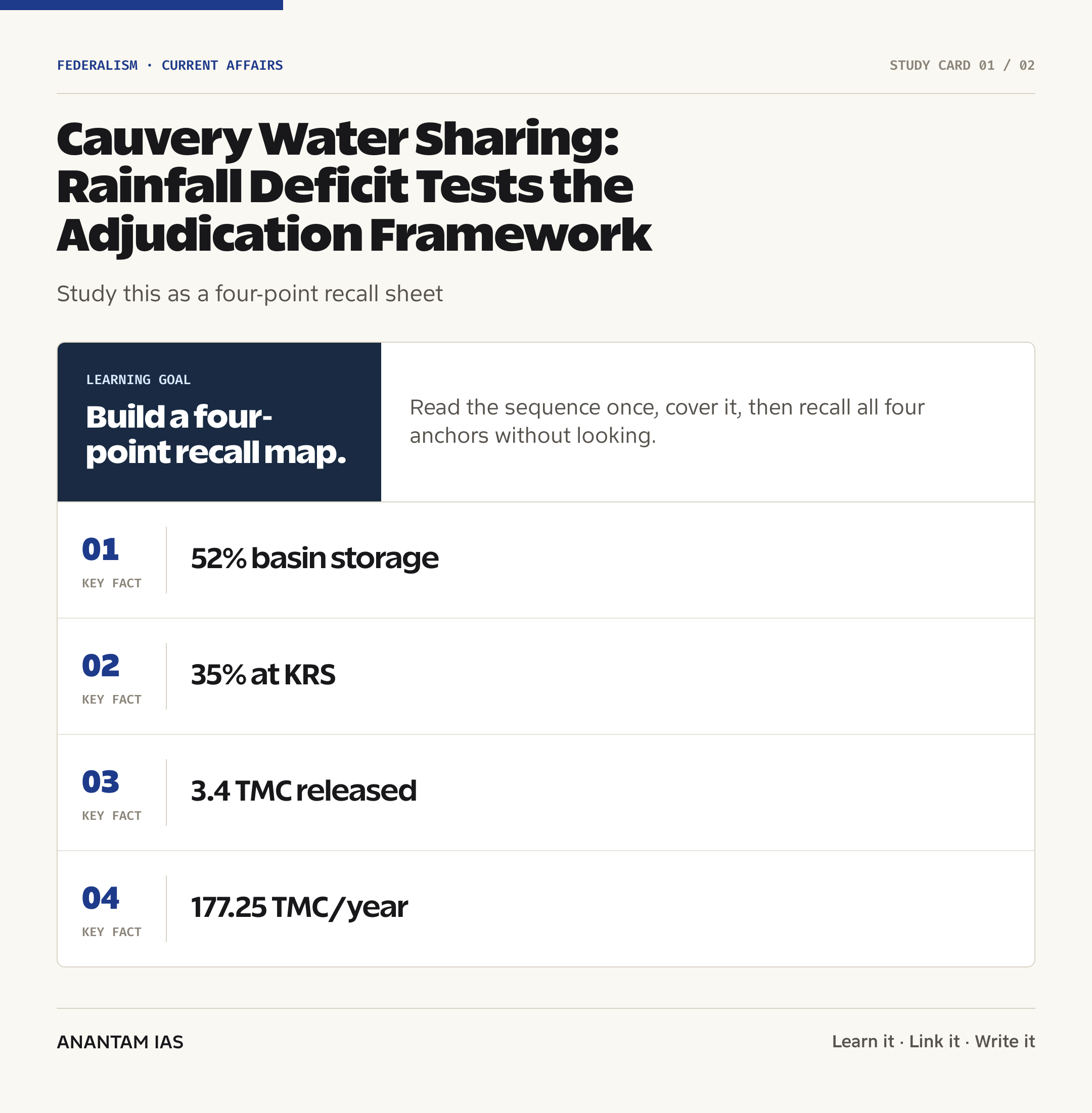
The Hindu reported that cumulative storage in Karnataka’s four principal Cauvery reservoirs was only 52% of full capacity. Against a reported stipulated flow of 28.3 TMC ft at Biligundlu from 1 June to 19 July, only 3.4 TMC ft had been recorded, placing drinking-water needs, irrigation claims and downstream entitlements in direct tension.

  • Karnataka as a whole had an estimated 35% rainfall deficit, while Kodagu, the river’s source region and a major catchment, had a reported 45% deficit.
  • Storage across Harangi, Hemavati, Krishnaraja Sagara and Kabini stood at about 52% of combined capacity.
  • Storage at Krishnaraja Sagara (KRS) was about 35% of capacity, with an inflow of only 775 cusecs on 21 July.
  • The Karnataka government said the available reservoir water would be reserved for drinking purposes and not released for irrigation at that stage.
  • The preceding CWRC review had assessed the hydrological position; the CWMA’s earlier meeting on 23 June had asked basin States to use stored water judiciously, particularly for drinking needs.

The development matters in the context of:

  • The episode tests whether cooperative federalism can convert a legally binding allocation into a credible distress-sharing decision before crop losses and urban shortages harden State positions.
  • A rainfall shortfall does not automatically cancel scheduled releases. The CWMA must identify the distress, assess its extent from data and decide proportionate adjustments under the 2018 scheme.
  • The dispute joins three kinds of claims: upstream storage security in Karnataka, downstream irrigation and delta needs in Tamil Nadu, and basin-wide domestic, ecological and livelihood requirements.
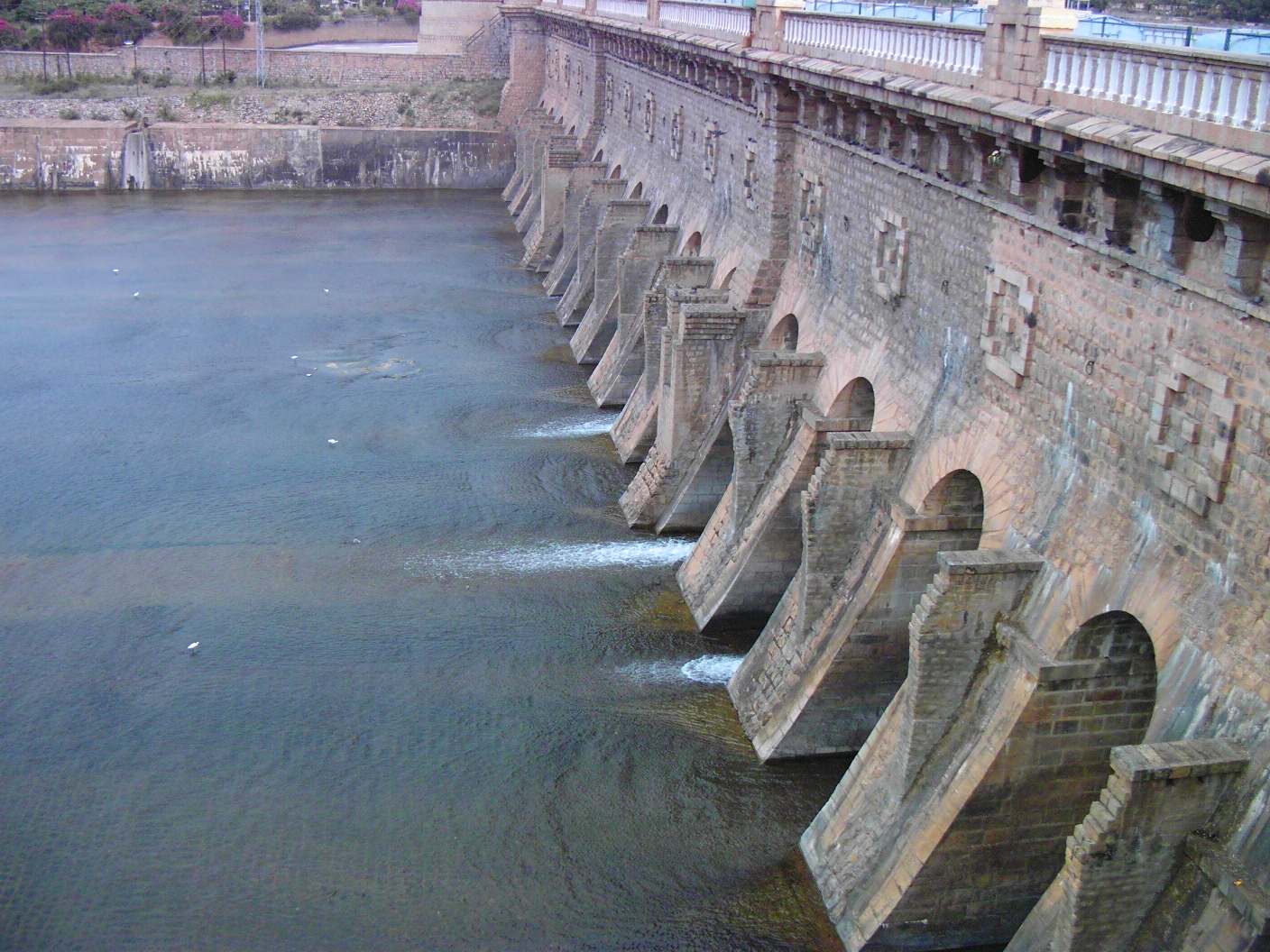
Krishna Raja Sagara dam across the Cauvery in Karnataka
Krishna Raja Sagara is one of the key reservoirs monitored in Cauvery basin operations. Photo: Vaishu2, Public domain (Wikimedia Commons)
Cauvery Water Sharing: Rainfall Deficit Tests the Adjudication Framework — quick facts

UPSC Relevance

Prelims Relevance

  • Article 262 permits Parliament to provide for adjudication of inter-State river-water disputes and to exclude the jurisdiction of courts over such disputes.
  • Entry 17 of the State List covers water, subject to Entry 56 of the Union List concerning Union regulation and development of inter-State rivers in the public interest.
  • The Inter-State River Water Disputes Act, 1956 provides the statutory route for reference to a tribunal; Section 6A empowers the Union to frame a scheme to implement a tribunal decision.
  • The Union constituted the Cauvery Water Disputes Tribunal in 1990; its final award came in 2007 and was notified in 2013.
  • The Supreme Court judgment of 16 February 2018 modified the allocation, and the Union notified the Cauvery Water Management Scheme on 1 June 2018.
  • The scheme created the CWMA as the apex implementation body and the Cauvery Water Regulation Committee (CWRC) as its technical and regulatory support mechanism.
  • The principal Karnataka-Tamil Nadu measuring point is Biligundlu on the inter-State border; Mettur reservoir is the critical downstream storage for Tamil Nadu.
  • A TMC ft is one thousand million cubic feet, about 28.317 million cubic metres; a cusec is one cubic foot per second.
  • The adjudicated framework is based on a basin yield of 740 TMC ft at 50% dependability, while actual operation must respond to rainfall, inflows, storage and demand.

Mains Relevance

GS Paper 2

  • Federalism: inter-State rivers show why constitutionally divided powers need permanent institutions, trusted data and enforceable coordination.
  • Dispute resolution: distinguish adjudication by a tribunal and the Supreme Court from day-to-day implementation by the CWMA and CWRC.
  • Governance: evaluate whether transparent distress criteria can reduce recurring litigation and political escalation.

GS Paper 3

  • Water resources: connect monsoon variability, reservoir operations, crop planning, urban demand and environmental flows.
  • Disaster resilience: treat drought as a basin-wide risk requiring demand management, not only emergency release orders.
  • Agriculture: examine how water-intensive cropping and poorly coordinated sowing amplify distress-year conflict.

Essay

  • Rivers ignore political borders, but institutions cannot ignore political trust.
  • Cooperative federalism is tested most severely when a common resource becomes scarce.
  • Climate variability turns old allocation disputes into recurring governance challenges.

Background and Context

Cauvery Basin and the Upstream-Downstream Relationship

The Cauvery is a shared monsoon-fed river system in which storage decisions upstream quickly affect irrigation, drinking water and ecosystems downstream.

  • The river rises at Talakaveri in Kodagu, crosses Karnataka and Tamil Nadu, serves the Karaikal region of Puducherry, and drains into the Bay of Bengal.
  • Major tributaries include the Kabini, Hemavati, Harangi, Shimsha, Arkavathy, Bhavani and Amaravati; Kerala is a basin State through the Kabini, Bhavani and Pambar sub-basins.
  • Karnataka’s Harangi, Hemavati, KRS and Kabini reservoirs regulate much of the upper-basin flow, while Mettur supports irrigation and water supply in Tamil Nadu.
  • The Biligundlu gauge and discharge station records flows near the Karnataka-Tamil Nadu border. Recorded flow includes regulated releases and contributions from uncontrolled catchments, so it isn’t identical to a dam-gate release figure.
  • For physical geography, revise the basin through the published Cauvery River notes, including its course, tributaries and delta.
Cauvery Water Sharing: Rainfall Deficit Tests the Adjudication Framework — exam lens

From Tribunal Award to the 2018 Binding Framework

The present arrangement combines a specialized tribunal’s adjudication, Supreme Court modification and a Union-notified implementation scheme.

  • After negotiations failed, the Union constituted the Cauvery Water Disputes Tribunal in 1990 under the 1956 Act; the tribunal delivered its final award in 2007.
  • The award was published in the Gazette in 2013. Under Section 6 of the 1956 Act, a published decision is final and binding and has the same force as an order or decree of the Supreme Court.
  • In civil appeals, the Supreme Court modified the shares in 2018. The operative annual allocation at 50% dependable yield is Karnataka 284.75 TMC ft, Tamil Nadu 404.25 TMC ft, Kerala 30 TMC ft and Puducherry 7 TMC ft.
  • The balance of the assessed 740 TMC ft includes 10 TMC ft for environmental protection and 4 TMC ft for inevitable escapages to the sea.
  • Karnataka must make available 177.25 TMC ft annually at Biligundlu in a normal year. This is an inter-State delivery obligation within the full allocation, not Tamil Nadu’s entire 404.25 TMC ft share.
  • The detailed constitutional route and tribunal process are covered in Inter-State Water Disputes in India.

CWMA and CWRC: Different Roles

The two bodies form a decision-and-execution chain rather than competing authorities.

  • The CWMA is the apex body charged with implementing the award as modified by the Supreme Court, including reservoir guidance, releases, carry-over storage and environmental flows.
  • The CWRC monitors rainfall, storage, inflows, outflows, withdrawals and State demands, and supports or carries out the Authority’s operational directions.
  • At the start of the irrigation year on 1 June, States submit water indents. The Authority assesses them against cropping patterns, carry-over storage and likely inflows.
  • Important reservoirs are to be operated in an integrated manner under CWMA guidance for each ten-day period, rather than as isolated State assets.
  • The Authority may call for hydrological and water-use data. A common, near-real-time data system is essential because disputed figures can turn a technical deficit into a political confrontation.

How Distress Sharing Is Supposed to Work

The scheme recognizes hydrological distress, but it assigns the finding and adjustment to a basin institution rather than to unilateral State declarations.

  • The normal schedule rests on a 740 TMC ft yield at 50% dependability. Actual rainfall and inflow can depart sharply from that statistical benchmark.
  • The CWMA, through the CWRC and with help from the Central Water Commission and State agencies, must identify whether a distress condition exists and determine its extent.
  • A diminution in flows is to be shared among party States, keeping their allocated shares in view. This supports proportionate burden-sharing rather than placing the full shock on either the upper or lower riparian.
  • The CWRC watches monsoon performance in ten-day intervals. The CWMA may revise an earlier release order as rainfall, storage and inflow data change.
  • The reported 28.3 TMC ft due by 19 July is an intra-season benchmark; the enduring annual normal-year obligation remains 177.25 TMC ft at Biligundlu.
  • The full case history and allocation logic are available in the site’s Cauvery Water Dispute guide.

Drinking Water Priority Is Important but Not Unlimited

Human consumption receives high priority, yet a State’s drinking-water claim must still be considered within the adjudicated basin framework.

  • The Supreme Court treated drinking water as a primary consideration and added 4.75 TMC ft to Karnataka’s allocation for drinking and domestic needs, including Bengaluru.
  • The 2018 scheme directs the Authority to track domestic and industrial use alongside irrigation demand and cropping patterns.
  • Karnataka’s decision to conserve current storage for drinking water identifies a serious need, but it doesn’t by itself rewrite downstream entitlements or formally determine basin distress.
  • Tamil Nadu’s claim is also not limited to irrigation: downstream cities, rural settlements, livestock, industry and ecological functions depend on the river system.
  • The workable legal position is priority plus proportionality: protect essential consumption, verify demands, recognize the shared scarcity and let CWMA issue an evidence-based adjustment.

What the July Review Must Resolve

The immediate task is to convert a contested shortage into a reasoned, time-bound operating decision without prejudging the rest of the monsoon.

  • First, the Authority needs a verified basin water balance: carry-over storage on 1 June, rainfall departure by catchment, reservoir inflows and outflows, Biligundlu flows, current withdrawals and likely inflows for the next ten-day period.
  • Second, it must test the reasonableness of State indents. Drinking supply, standing crops and minimum ecological needs carry different urgency, but every claim should be supported by demand and use data rather than broad assertions.
  • Third, CWMA must state whether the evidence establishes basin distress, how severe it is and how the burden will be shared. A reasoned finding gives both States a common legal and factual reference point.
  • Fourth, any reduced release should have a review date and trigger. Early-season projections can change quickly if Kodagu and other catchments receive rain, so a provisional order is safer than treating July conditions as the final water-year position.
  • Finally, the direction should explain compliance in measurable terms: the required flow at Biligundlu, the relevant interval, reporting duties and the consequences of deviation. Clarity improves enforceability and reduces room for competing political interpretations.

Federalism Lessons from the 2026 Deficit

Cauvery shows that adjudication can settle shares, but only cooperative administration can manage a changing monsoon.

  • Water is primarily a State subject under Entry 17, yet inter-State rivers bring in Parliament’s competence under Entry 56 and the special dispute mechanism under Article 262.
  • The arrangement reflects cooperative federalism: the Union provides the statutory institution, States supply data and operate reservoirs, and all parties are bound by the adjudicated allocation.
  • Its weak point is not the absence of law but the gap between legal entitlement and hydrological availability. A fixed annual share still needs adaptive, transparent operational decisions.
  • Political incentives reward visible defence of one State’s farmers or cities. Basin governance asks governments to explain why some sacrifices are unavoidable and how those sacrifices are distributed.
  • For a wider conceptual frame, connect this dispute with cooperative and competitive federalism.

Why the Current Figures Need Careful Reading

Headline percentages describe different parts of the water system and shouldn’t be treated as interchangeable.

  • A 35% State-wide rainfall deficit is not the same as rainfall deficiency inside every Cauvery sub-catchment; the reported 45% Kodagu deficit is more directly relevant to upper-basin inflows.
  • Combined storage at 52% of full capacity doesn’t show usable live storage, dead storage, reservoir-wise variation or competing committed demands.
  • KRS at 35% and inflow at 775 cusecs signal stress at one critical reservoir, but CWMA must assess the full system, including other reservoirs and downstream contributions.
  • The gap between 3.4 TMC ft recorded and 28.3 TMC ft stipulated is large, but a lawful distress response still requires verified data, a basin-level finding and an Authority decision.
  • Good answers separate reported real-time data from durable legal facts such as the annual allocation, institutional powers and distress-sharing rule.

Way Forward

Publish a Common Hydrological Balance Sheet

  • Release a ten-day public dashboard showing basin rainfall, reservoir-wise live storage, inflows, outflows, Biligundlu flow and approved State indents.
  • Use harmonized measurements audited by the CWC so arguments focus on allocation choices rather than competing data sets.

Adopt a Transparent Distress Formula

  • Pre-agree triggers for normal, watch, distress and severe-distress conditions using rainfall, storage and projected inflow.
  • Translate the scheme’s proportionality principle into an announced release path, with reasons for any departure and periodic review as the monsoon changes.

Manage Demand Across the Basin

  • Coordinate sowing advisories with credible seasonal water availability and discourage expansion of water-intensive crops during low-inflow years.
  • Reduce urban leakage, expand wastewater reuse, protect tanks and wetlands, and improve micro-irrigation so every drought doesn’t become only a reservoir-release dispute.

Protect Essential and Ecological Uses

  • Ring-fence verified minimum drinking-water requirements across all basin States while avoiding inflated demand projections.
  • Keep the adjudicated environmental flow visible in operational decisions; scarcity cannot make the river ecosystem a residual claimant.

Strengthen Cooperative Compliance

  • Hold regular CWMA meetings before acute conflict develops and publish reasoned directions, dissenting State positions and compliance data.
  • Use litigation for genuine legal questions, while leaving routine ten-day operations to the specialist bodies created for that purpose.

Conclusion

The July 2026 deficit is more than a storage story. It is a test of whether adjudication, science and federal negotiation can work together when the river carries less water than the normal-year schedule assumes.

A durable response cannot be either mechanical release enforcement or unilateral retention. The credible middle path is a CWMA-led, data-backed distress determination that protects essential drinking needs, shares scarcity fairly and preserves the authority of the binding settlement.

Over time, basin States must reduce the gap between demand and dependable supply. Better crop choices, urban efficiency, ecosystem protection and transparent reservoir management are as important as the legal allocation itself.

UPSC Practice Questions

Prelims MCQ 1

With reference to the institutional framework for the Cauvery water dispute, consider the following statements:

  1. The Cauvery Water Management Authority was constituted under a scheme framed using Section 6A of the Inter-State River Water Disputes Act, 1956.
  2. The Cauvery Water Regulation Committee is the apex adjudicatory body that can alter the annual water allocation among basin States.
  3. Biligundlu is the principal gauge site for measuring flows at the Karnataka-Tamil Nadu border.

How many of the above statements are correct?

(a) Only one (b) Only two (c) All three (d) None

Answer: (b) Only two

Explanation:

Statements 1 and 3 are correct. The CWMA is the apex implementation authority. The CWRC supports monitoring and regulation; it is not an adjudicatory body empowered to rewrite annual allocations.

Prelims MCQ 2

Which constitutional provision specifically enables Parliament to provide for adjudication of disputes concerning waters of inter-State rivers?

(a) Article 249 (b) Article 252 (c) Article 262 (d) Article 263

Answer: (c) Article 262

Explanation:

Article 262 authorizes Parliament to create a legal mechanism for adjudicating inter-State river-water disputes and to exclude court jurisdiction over such disputes by law.

UPSC Mains Questions

  1. The Cauvery dispute shows that adjudicating water shares is easier than governing scarcity. Examine how the CWMA framework seeks to reconcile binding allocations, drinking-water priority and proportionate distress sharing in India’s federal system. (15 marks, 250 words)
  2. Inter-State river governance requires both credible hydrological data and political trust. Discuss the institutional and demand-side reforms needed to reduce recurring Cauvery conflicts during deficient monsoons. (15 marks, 250 words)
  3. Differentiate the constitutional, adjudicatory and implementation roles of Article 262, the Inter-State River Water Disputes Act, water tribunals, the Supreme Court, CWMA and CWRC with reference to the Cauvery basin. (10 marks, 150 words)

Sources: Supreme Court of India, Cauvery Water Management Scheme judgment and The Hindu.

Frequently Asked Questions

What triggered the July 2026 CWMA review?

Deficient rainfall, weak inflows and low reservoir storage in Karnataka’s Cauvery basin triggered the review. The Hindu reported combined storage at 52% of capacity and only 3.4 TMC ft recorded at Biligundlu against a reported 28.3 TMC ft benchmark for 1 June to 19 July.

What is the CWMA?

The Cauvery Water Management Authority is the apex implementation body created under the Union’s 2018 Cauvery Water Management Scheme. It implements the tribunal award as modified by the Supreme Court, guides integrated reservoir operations, assesses distress and orders releases with technical support from the CWRC and other agencies.

How is CWRC different from CWMA?

The Cauvery Water Regulation Committee performs the technical and operational support role. It monitors rainfall, storage, inflows, releases and demands, and gives effect to CWMA directions. The CWMA takes the higher-level implementation decisions; neither body can casually rewrite the adjudicated annual shares.

Does drought automatically stop Cauvery releases?

No. The scheme allows adjustment when water availability falls, but CWMA must identify the distress and its extent using basin data. The resulting diminution is to be shared among party States with their allocated shares in view. A unilateral State announcement isn’t itself the formal distress decision.

What is Karnataka’s normal-year delivery obligation?

Following the Supreme Court’s 2018 modification, Karnataka must make 177.25 TMC ft available annually at Biligundlu in a normal year. This border delivery is part of Tamil Nadu’s wider 404.25 TMC ft allocation, not the entirety of that allocation. Operations are reviewed in ten-day intervals.

Why is Cauvery a federalism issue?

Water is largely a State subject, but an inter-State river links the actions and needs of several governments. Article 262, Parliament’s 1956 law, the tribunal, the Supreme Court-modified award and the CWMA scheme together create a shared framework in which States retain operational roles but cannot treat the river as an exclusively local resource.

India’s Clean-Energy Transition: From Capacity Milestone to Grid Readiness

Open article →Download PDF

Why in News?

During a press conference in New Delhi on 21 July 2026, UN Climate Change Executive Secretary Simon Stiell described clean energy as a source of economic competitiveness, energy security and strategic autonomy for India. He called for faster investment in electricity grids and storage, wider electrification and sustained engagement with the UN climate process.

The Hindu reported the clean-energy emphasis during Stiell’s India visit. The official UN Climate Change remarks linked India’s early non-fossil installed-capacity milestone to the harder implementation phase: converting new capacity into dependable electricity, manufacturing strength, cleaner air, resilience and development gains.

  • Stiell noted that non-fossil sources had crossed half of India’s installed electricity capacity five years before the 2030 deadline in its updated climate commitment.
  • The Central Electricity Authority (CEA) recorded 297,369 MW of non-fossil capacity out of 548,858 MW on 30 June 2026, a share of 54.18%.
  • He identified grids, storage and electrification as the next investment priorities rather than treating capacity addition as the finish line.
  • The Turkish COP31 Presidency has announced an Action Agenda objective of raising electricity’s share of final energy demand to 35% by 2035; this is a COP action objective, not an Indian national target.
  • Stiell also stressed delivery of international climate finance, including adaptation finance and the wider pathway towards $1.3 trillion a year for developing countries.

The development matters in the context of:

  • India’s transition has moved from proving that renewable capacity can scale to ensuring that variable generation can be transmitted, balanced and delivered when demand rises.
  • A higher clean-capacity share doesn’t automatically produce the same generation share; output depends on availability, resource conditions, plant load factors, transmission and dispatch.
  • Grid investment connects energy security with climate implementation.
India's Clean-Energy Transition: From Capacity Milestone to Grid Readiness — quick facts

UPSC Relevance

Prelims Relevance

  • India’s updated NDC commits to about 50% cumulative electric power installed capacity from non-fossil sources by 2030; this refers to capacity, not electricity generation.
  • The government’s separate 500 GW non-fossil capacity objective for 2030 was announced as part of the Panchamrit commitments; it shouldn’t be confused with the percentage formulation in the NDC.
  • Non-fossil capacity includes renewable energy, large hydro and nuclear power; it isn’t identical to solar and wind capacity alone.
  • Installed capacity is measured in MW or GW, while electricity generated over time is measured in MWh, GWh or billion units.
  • Storage power is measured in MW or GW, while its energy-holding capability is measured in MWh or GWh; their ratio indicates discharge duration.
  • Major storage routes include battery energy storage systems (BESS) and pumped-storage hydropower, or PSP.

Mains Relevance

GS Paper 3

  • Energy infrastructure: transmission, distribution, storage, forecasting and flexible resources required for reliable renewable integration.
  • Environmental policy: the difference between installed-capacity achievement and actual decarbonisation of electricity generation and final energy use.
  • Indian economy: clean manufacturing, import vulnerability, investment costs, jobs and the financial health of distribution companies.
  • Disaster resilience: adaptation finance and climate-resilient grids as protection against heat, floods, cyclones and demand shocks.

GS Paper 2

  • International relations: climate multilateralism, equity and India’s negotiating interest in predictable finance and technology access.
  • Global governance: the shift from headline COP pledges to implementation through national policy, public finance and non-state actors.

Essay

  • The energy transition is an infrastructure transformation, not simply a substitution of one fuel with another.

Background and Context

What the Capacity Milestone Means

India has met the percentage component of its 2030 non-fossil capacity commitment early, but the milestone describes the power system’s asset base rather than its delivered electricity.

  • India crossed the 50% non-fossil installed-capacity threshold in June 2025, according to the Ministry of New and Renewable Energy; Stiell called this achievement five years early.
  • The CEA’s official June 2026 report placed total installed capacity at 548.858 GW and non-fossil capacity at 297.369 GW.
  • The non-fossil category also contains biomass, waste-to-energy and small hydro. It is broader than the common shorthand of solar plus wind.
  • India’s solar-energy expansion is the largest component of the new non-fossil base, but a diversified portfolio can reduce exposure to any single resource profile.
  • The government’s 500 GW by 2030 ambition is an absolute-capacity objective. It remains a distinct policy benchmark even though the NDC’s 50% capacity share has already been crossed.
India's Clean-Energy Transition: From Capacity Milestone to Grid Readiness — exam lens

Capacity Is Not Generation

The distinction between rated power and electricity produced is central to reading India’s energy-transition statistics correctly.

  • Generation is the electricity produced over a period and is expressed in MWh, GWh or billion units; one billion unit equals one terawatt-hour.
  • A 1 GW solar fleet doesn’t generate 1 GW continuously because sunlight varies by hour, season, cloud cover and location. Coal, nuclear and hydro plants also face maintenance, fuel, water and dispatch constraints.
  • A technology’s capacity factor compares actual output with the maximum possible output over the same period. Different capacity factors mean capacity shares and generation shares diverge.
  • So the 54.18% figure must not be rewritten as ‘54.18% of India’s electricity is generated from non-fossil sources.’ The official figure is explicitly an installed-capacity share.
  • Decarbonisation depends on actual clean generation, reduced fossil dispatch, efficient demand and electrification of transport, industry and buildings, not capacity addition alone.

Why Grids Become the Binding Constraint

As variable renewable capacity grows, the grid must move electricity across regions and balance supply and demand continuously.

  • Solar output is concentrated in daylight hours, while evening demand can remain high. This creates steep ramping needs when solar output falls.
  • Renewable-rich regions may produce more power than local networks can evacuate. New interstate and intrastate transmission must arrive in step with generation to avoid congestion and curtailment.
  • The distribution network is the last-mile constraint. Rooftop solar, electric vehicles and batteries can reverse or reshape power flows that older feeders weren’t designed to manage.
  • Distributed energy resources can support the grid when smart inverters, time-based tariffs, aggregation and consumer protection are designed together.
  • Grid resilience also has a climate dimension: substations, lines and control systems must withstand extreme heat, floods, cyclones and wildfire risk.

Storage Adds Time to the Power System

Storage shifts electricity across time, supplies flexibility and reduces the need to match every unit of generation with immediate consumption.

  • BESS can respond rapidly for frequency control, peak shifting, renewable firming, congestion relief and backup, but economics depend on duration, cycling and revenue stacking.
  • Pumped-storage projects move water to a higher reservoir when electricity is available and release it through turbines later; they can offer long-duration storage but need suitable sites and careful environmental appraisal.
  • The MNRE storage overview, citing CEA’s National Electricity Plan 2023, projects a requirement of 82.37 GWh in 2026-27 and 411.4 GWh in 2031-32.
  • Those figures are planning requirements, not statements of storage already installed. The 2031-32 projection comprises 175.18 GWh from PSP and 236.22 GWh from BESS.
  • The Ministry of Power’s 2025-26 annual report says the Union government is supporting 43.85 GWh of BESS through two viability-gap-funding arrangements; supported or awarded capacity isn’t the same as commissioned capacity.
  • Storage procurement should specify both power and energy, because MW defines discharge rate while MWh determines how long that output can be sustained.

Electrification Links Supply with Final Demand

Clean power produces wider climate and security gains only when electricity displaces fossil fuels in transport, industry, buildings and other end uses.

  • The COP31 Action Agenda objective cited by Stiell seeks to raise electricity’s share of global final energy demand to 35% by 2035.
  • This shouldn’t be presented as a new Indian NDC commitment. It is an international action-agenda objective announced by the Turkish COP31 Presidency.
  • Electric vehicles can reduce oil exposure when their charging is coordinated with clean generation and grid capacity; unmanaged charging can add stress to local peaks.
  • The climate value of electrification depends on the marginal electricity source. Faster clean generation, transmission and storage must accompany demand-side conversion.
  • For India, the co-benefits include cleaner urban air, lower exposure to volatile imported fuels and new domestic markets for electrical equipment and clean technology.

Climate Finance and the COP31 Implementation Test

The central multilateral question is whether developing countries can obtain affordable capital for both low-carbon infrastructure and protection from worsening climate impacts.

  • Stiell said developed countries must triple adaptation finance and deliver $300 billion a year by 2035 as part of a clear pathway towards $1.3 trillion annually.
  • The figures should be read in their UN climate-finance context: the $300 billion goal is the core developed-country-led mobilisation level, while $1.3 trillion is the wider developing-country finance pathway involving all sources.
  • India needs mitigation capital for grids, storage, clean industry and transport, but also adaptation finance for heat action, water security, climate-resilient agriculture, coasts and disaster preparedness.
  • The quality of finance matters. High-cost foreign-currency debt can worsen fiscal and exchange-rate risk, while grants and concessional finance are especially important for adaptation, where revenue streams are weak.
  • The climate-finance framework rests on equity and capability, while the Paris Agreement combines nationally determined action with support, transparency and periodic ambition cycles.

Economic Opportunity and Transition Risks

Clean energy can strengthen competitiveness, but the gains depend on supply-chain depth, affordable power and a transition that protects workers and consumers.

  • Stiell highlighted India’s technology workforce and manufacturing potential, including opportunities in electrical equipment, green steel and other clean technologies.
  • Coal-dependent districts need advance planning for worker reskilling, municipal revenue, land restoration, pension security and new productive investment. A just transition is place-based, not only sector-wide.
  • Distribution companies must remain financially capable of buying power, maintaining networks and investing in digital systems. Weak utility finances can delay both renewable integration and reliable service.
  • Land acquisition, biodiversity, recycling, mineral supply and community consent remain material constraints. Clean technology has a smaller climate burden than fossil systems, but it isn’t impact-free.
  • The policy standard should be reliable, affordable and progressively cleaner electricity, supported by transparent data on generation, emissions, outages, curtailment and costs.

Way Forward

Plan Generation, Networks and Storage Together

  • Synchronise renewable auctions with transmission readiness, land access, storage procurement and realistic commissioning schedules.
  • Use CEA resource-adequacy planning and state-level demand forecasts to procure the right mix of energy, peak capacity, reserves and duration.

Create Markets for Flexibility

  • Deepen ancillary-service, time-of-day and demand-response mechanisms so flexible resources are paid for the system value they provide.
  • Allow batteries, pumped storage, electric vehicles and aggregated consumer resources to compete under technology-neutral performance rules.

Repair the Distribution Layer

  • Improve feeder data, metering, loss reduction, subsidy payment and cost recovery while protecting basic energy access for vulnerable households.
  • Tie reform support to service-quality outcomes such as fewer outages, faster connections and transparent renewable curtailment.

Seek Better Climate Finance

  • Build bankable public pipelines for adaptation and grid resilience, where social returns are high but commercial cash flows may be limited.
  • Press for predictable grants, concessional funds, guarantees, technology access and fair multilateral-development-bank reform while improving domestic project governance.

Conclusion

India’s early non-fossil capacity milestone is substantial, but it marks the start of the systems phase of the transition. Generation, transmission, distribution, storage and new electrical demand now have to expand as one coordinated architecture.

COP31 can sharpen that implementation agenda, yet international objectives aren’t substitutes for national planning. India should pair competitive clean manufacturing with a resilient grid, financially viable utilities, honest capacity-versus-generation accounting and a fair transition for affected regions.

The decisive question is no longer whether clean capacity can grow. It is whether that capacity can deliver reliable, affordable and low-carbon energy while climate finance also reaches adaptation needs that markets routinely undersupply.

UPSC Practice Questions

Prelims MCQ 1

With reference to India’s non-fossil electricity capacity, consider the following statements:

  1. The category includes renewable energy, large hydro and nuclear power.
  2. A 54% non-fossil installed-capacity share necessarily means 54% of electricity generation is non-fossil.
  3. India’s updated NDC expresses its 2030 non-fossil electricity commitment as a share of cumulative installed capacity.

How many of the above statements are correct?

(a) Only one (b) Only two (c) All three (d) None

Answer: (b) Only two

Explanation:

Statements 1 and 3 are correct. Statement 2 confuses installed capacity, measured in MW or GW, with electricity generated over time. Resource availability, capacity factors, transmission and dispatch cause the shares to differ.

Prelims MCQ 2

Which one of the following correctly distinguishes the ratings of a battery energy storage system?

(a) MW measures stored energy, while MWh measures discharge power (b) MW measures discharge power, while MWh measures energy-holding capability (c) MW and MWh are interchangeable ratings (d) MWh measures only the battery’s charging losses

Answer: (b) MW measures discharge power, while MWh measures energy-holding capability

Explanation:

MW is the instantaneous power rating, while MWh is the quantity of energy available over time. Dividing MWh by MW gives the approximate discharge duration at rated power.

UPSC Mains Questions

  1. India’s early achievement of a majority non-fossil installed-capacity share is necessary but insufficient for power-sector decarbonisation. Examine the difference between capacity and generation, and analyse why grids, storage and distribution reform are now the central transition challenges. (250 words)
  2. Climate finance must support both clean-energy infrastructure and adaptation while avoiding unsustainable debt for developing countries. Discuss India’s priorities in the COP31 implementation agenda and suggest principles for effective international and domestic financing. (250 words)

Sources: UN Climate Change and The Hindu.

Frequently Asked Questions

What did India achieve ahead of 2030?

India crossed the point where non-fossil sources account for at least half of cumulative installed electric-power capacity. The milestone was reached in June 2025, five years before the 2030 date in India’s updated NDC. It refers to installed capacity, not to half of actual electricity generation.

What was India’s non-fossil capacity in June 2026?

CEA’s report for 30 June 2026 recorded 297,369 MW of non-fossil capacity out of 548,858 MW total installed capacity. That equals 54.18%. The non-fossil total includes renewable sources, large hydro and nuclear power, so it is broader than solar and wind alone.

Why doesn’t capacity equal generation?

Capacity is the rated power of installed assets, measured in MW or GW. Generation is electricity produced across time, measured in MWh, GWh or billion units. Solar and wind output varies with resources, while every technology also faces availability and dispatch constraints, so the two percentage shares differ.

Why does a renewable grid need storage?

Storage moves electricity from periods of surplus to periods of higher demand and can supply fast balancing, reserves and congestion relief. Batteries respond quickly, while pumped storage can provide longer duration. Storage complements transmission, forecasting and flexible demand; it doesn’t remove the need for those grid investments.

Is 35% electrification by 2035 India’s target?

No. Simon Stiell referred to a COP31 Action Agenda objective announced by the Turkish COP31 Presidency: electricity should meet 35% of final energy demand by 2035. It is an international action objective and must not be presented as a new target in India’s NDC.

What climate finance figures did Stiell cite?

Stiell called for developed countries to triple adaptation finance and deliver $300 billion annually by 2035 within a pathway towards $1.3 trillion a year for developing countries. The larger figure involves finance from all sources; the quality, concessionality, accessibility and debt impact of that finance remain central concerns.

India’s Emerging AI Law: Autonomy, Consent and Regulatory Sandboxes

Open article →Download PDF

Why in News?

The India AI law debate entered a new phase on 22 July 2026 after The Indian Express reported that the Ministry of Electronics and Information Technology, or MeitY, is examining a standalone statute rather than placing all new provisions under the Information Technology Act, 2000.

The reported design questions concern limits on agentic AI autonomy, consent for synthetic use of a person’s likeness or voice, allocation of model liability, and regulatory sandboxes for high-impact applications. No draft Bill was publicly released with the report, so these elements should be read as proposals under examination, not settled law.

  • The cyber laws division of MeitY has reportedly been asked to analyse gaps in the Information Technology Act, 2000 and rules framed under it.
  • The government is expected to examine how independently an AI agent may act and whether it may retain and reuse data after completing a task.
  • A proposed consent-based framework would address synthetic media made from a person’s image, video or voice without permission.
  • The report says two private-sector legal experts were asked to prepare separate liability frameworks for AI models.
  • Consultation with the Reserve Bank of India and SEBI is reportedly contemplated for sandboxes in finance and public services.

The development matters in the context of:

  • India already regulates synthetic media through the IT Rules, 2021 as amended in 2026; a new statute would have to fit this existing layer rather than start from zero.
  • The central policy challenge is to assign responsibility across the AI value chain without treating every low-risk tool like a system that can affect credit, welfare, policing or critical infrastructure.
  • The issue links innovation policy with privacy, dignity, free speech, consumer protection, cybersecurity and administrative accountability.
India's Emerging AI Law: Autonomy, Consent and Regulatory Sandboxes — quick facts

UPSC Relevance

Prelims Relevance

  • MeitY administers the Information Technology Act, 2000 and the intermediary-rule framework relevant to online AI harms.
  • Agentic AI can plan a sequence of actions, invoke external tools and adapt its steps toward a user-defined objective with limited supervision.
  • Section 79 of the IT Act provides conditional exemption from liability to intermediaries for third-party information when statutory conditions and due diligence are met.
  • The 2026 SGI amendments to the IT Rules took effect on 20 February 2026 and created specific duties concerning realistic synthetic audio, visual and audio-visual information.
  • Under amended Rule 3(3), covered intermediaries must use reasonable technical measures against unlawful SGI and label permissible SGI with provenance mechanisms where technically feasible.
  • A significant social media intermediary must seek a user declaration and use reasonable technical measures to verify whether uploaded content is SGI before publication.
  • The DPDP Act, 2023 excludes personal data made publicly available by the Data Principal from its application; its provisions have a staggered commencement.
  • A regulatory sandbox permits bounded live testing under specified users, duration, safeguards and regulatory supervision; it is not a general exemption from law.
  • The India AI Governance Guidelines organise policy around seven sutras and favour a risk-based, evidence-led, proportional and sectorally enforced approach.

Mains Relevance

GS Paper 2

  • Examine how a standalone AI law can protect privacy, dignity and free expression while preserving procedural safeguards and judicial review.
  • Assess the institutional design needed for coordination among MeitY, sectoral regulators and standards bodies in a cross-sector technology.
  • Analyse accountability when AI is deployed in welfare delivery and public administration, including notice, explanation, human review and remedy.

GS Paper 3

  • Discuss the security and systemic risks created by autonomous AI agents with access to data, payment rails, software tools or critical systems.
  • Evaluate regulatory sandboxes as a way to test high-impact AI while containing consumer, market and cybersecurity risks.
  • Compare platform safe harbour with the more complex responsibility of a model developer or deployer whose system helps generate the disputed output.

Essay

  • Innovation earns legitimacy when human agency remains stronger than machine autonomy.
  • In the digital age, consent concerns not only data collection but also the recreation of identity.
  • Good regulation builds trust by making power traceable, contestable and answerable.

Background and Context

From principle-based guidance to possible legislation

India’s current AI-governance architecture combines existing law, sectoral oversight, voluntary standards and technical safeguards.

  • The India AI Governance Guidelines identify seven principles: trust, people first, innovation over restraint, fairness and equity, accountability, understandable-by-design systems, and safety, resilience and sustainability.
  • The guidelines recommend an AI Governance Group, a Technology and Policy Expert Committee and an AI Safety Institute, while leaving sectoral regulators responsible within their mandates.
  • Their action plan includes reviewing legal gaps, drafting laws as risks evolve and piloting regulatory sandboxes in high-risk domains.
  • A standalone statute would mark a shift from relying mainly on existing technology, data, consumer, criminal and sectoral laws.
India's Emerging AI Law: Autonomy, Consent and Regulatory Sandboxes — exam lens

What makes agentic AI a distinct regulatory problem

A chatbot mainly returns an answer, while an AI agent may take a chain of consequential actions in digital or physical systems.

  • An agent may break a goal into tasks, call an application programming interface, browse records, write code, send instructions or initiate a transaction.
  • Risk rises with the agent’s permissions, persistence and reach, not merely with the size of its underlying model.
  • Data retention creates a second risk: an agent that remembers credentials, health details or work files may reuse them beyond the original context.
  • High-impact uses need human approval gates before irreversible acts such as transferring money, denying a benefit, modifying a public record or controlling critical equipment.
  • Practical controls include least-privilege access, time-limited credentials, action logs, spend limits, secure execution environments, rollback mechanisms and an effective stop control.
  • These controls complement the broader discussion in India’s AI accountability framework for critical infrastructure and cybersecurity.

Deepfake consent beyond a disclosure label

Labelling tells viewers that media is synthetic; consent asks whether the person’s identity could be used to create or circulate it at all.

  • The amended IT Rules define synthetically generated information around realistic synthetic audio, visual or audio-visual depictions of a person or event; pure text alone is outside this special definition.
  • Permitted SGI must carry a clear label and, where technically feasible, permanent metadata or another provenance mechanism identifying it and the generating resource.
  • Covered platforms must prevent unlawful categories such as non-consensual intimate imagery, deceptive impersonation, false electronic records and certain synthetic material involving weapons or explosives.
  • The existing rules focus heavily on platform due diligence, labelling and removal. A consent framework could separately specify permission for capturing, cloning, training on, generating and distributing a person’s likeness or voice.
  • Consent should be specific, informed, purpose-bound and withdrawable; a single acceptance for one advertisement shouldn’t silently authorise reuse in another product or political message.
  • The problem is illustrated by non-consensual AI sexual deepfakes, where dignity and bodily privacy harms can become irreversible before ordinary notice-and-takedown processes finish.

Liability across the AI value chain

AI output can involve several actors, so liability should follow control, knowledge, duty and causal contribution rather than attach automatically to one entity.

  • The developer designs or trains the model, the deployer integrates it into a service, the operator sets the objective, and an intermediary may host or distribute the result.
  • A model provider may control safety testing and capability restrictions; a deployer may control sector data and approval workflows; a user may intentionally prompt deception or bypass safeguards.
  • The classic safe-harbour logic for passive hosting doesn’t map neatly onto systems that generate, rank, transform or act on information, but Section 79 questions still require a fact-specific legal test.
  • A proportionate framework can distinguish ordinary negligence, breach of a statutory duty, reckless deployment and intentional misuse instead of imposing undifferentiated strict liability.
  • Documentation should support attribution: model and system cards, evaluation results, incident logs, tool-call records, version histories and notices to affected persons.
  • For government deployment, accountability can’t be outsourced to a vendor. The public authority must remain answerable for legality, non-discrimination, reasons and an accessible appeal.

How a risk-based regulatory sandbox should work

A sandbox is useful when the regulator needs evidence from controlled deployment before deciding how a rule should apply.

  • The RBI regulatory sandbox allows live testing in a controlled environment, while SEBI’s framework uses limited users, defined test periods and regulator-set conditions.
  • An AI sandbox should begin with a precise use case, risk hypothesis and exit criterion, not a broad permission to experiment on the public.
  • Entry conditions should require impact assessment, lawful data access, cybersecurity testing, red-team results, human oversight and a named accountable officer.
  • Test boundaries should cap users, geography, transaction value, duration, autonomy and the categories of data an agent may retain.
  • Participants need informed notice, an easy opt-out, compensation and grievance routes, while vulnerable people shouldn’t bear disproportionate experimentation risk.
  • A sandbox must not waive core duties under privacy, consumer protection, anti-discrimination, criminal or sectoral law; any relaxation should be specific, temporary and published.

Constitutional and governance safeguards

AI regulation is credible only when it protects people from both private technological power and arbitrary state action.

  • Article 21 protects life and personal liberty, with privacy and dignity central to consent, surveillance, profiling and synthetic-identity harms.
  • Article 19(1)(a) protects speech and expression; restrictions on deceptive or unlawful synthetic media must remain within Article 19(2) and avoid vague over-removal.
  • Article 14 requires non-arbitrary state action, making bias testing and reasoned human review important when an automated system affects rights or benefits.
  • Rules should provide notice, an intelligible explanation, a channel for correction and human reconsideration when a consequential automated decision is challenged.
  • Independent audits must protect trade secrets without making secrecy a shield against regulatory inspection or an affected person’s right to an effective remedy.
  • India’s diversity requires testing across languages, dialects, disability contexts and social groups; imported benchmarks may miss locally concentrated harms.

Way Forward

Define scope before obligations

  • Separate general-purpose models, deployers, agents, high-impact systems and distribution platforms so that duties match actual control.
  • Publish clear thresholds for high-impact use based on rights, safety, scale, reversibility and vulnerability, with periodic review as capabilities change.

Build consent and provenance together

  • Require verifiable permission for cloning an identifiable person’s face or voice, alongside durable labelling and content-provenance signals.
  • Create a rapid, victim-centred process for removal, evidence preservation, account action and remedy in impersonation and intimate-image cases.

Control autonomous action

  • Mandate least privilege, bounded memory, tool allow-lists, transaction caps, monitoring and human confirmation for irreversible high-risk actions.
  • Require pre-deployment evaluation and post-deployment incident reporting, with stronger duties when systems operate in finance, health, welfare or critical infrastructure.

Make sandboxes accountable

  • Coordinate MeitY with RBI, SEBI and other sectoral regulators through common minimum safeguards and domain-specific conditions.
  • Publish sandbox objectives, exemptions, aggregate results and exit decisions so experimentation produces reusable regulatory knowledge.

Conclusion

A standalone AI law can add value if it closes identifiable gaps around autonomous action, synthetic identity, value-chain liability and high-impact testing. Simply adding another broad statute could instead multiply overlap and uncertainty.

The durable approach is risk-based and rights-preserving: keep humans answerable for consequential systems, trace synthetic content, place liability where control lies, and allow experimentation only inside transparent boundaries. That is how India can pair innovation with public trust.

UPSC Practice Questions

Prelims MCQ 1

With reference to India’s framework for synthetically generated information (SGI), consider the following statements:

  1. The SGI-specific definition under the amended IT Rules is limited to audio, visual or audio-visual information meeting the prescribed realism threshold.
  2. Routine good-faith colour correction that doesn’t materially misrepresent the underlying content is excluded from SGI.
  3. Pure text generated by a chatbot is always classified as SGI under the special definition.

How many of the above statements are correct?

(a) Only one (b) Only two (c) All three (d) None

Answer: (b) Only two

Explanation:

Statements 1 and 2 are correct. The amended IT Rules’ SGI definition focuses on realistic synthetic audio, visual and audio-visual content. Text-only output isn’t SGI under that special definition, though unlawful text remains subject to other legal duties.

Prelims MCQ 2

Which one of the following best describes a regulatory sandbox?

(a) A permanent exemption from all laws for technology firms (b) A private laboratory operating without regulatory supervision (c) Controlled live testing under defined boundaries and regulatory oversight (d) A compulsory certification that guarantees a product is risk-free

Answer: (c) Controlled live testing under defined boundaries and regulatory oversight

Explanation:

A regulatory sandbox permits bounded testing with specified users, duration, safeguards and regulator-set conditions. It neither guarantees safety nor creates a blanket immunity from applicable law.

UPSC Mains Questions

  1. A future Indian AI law must govern autonomous action rather than merely regulate model output. Discuss the distinctive risks of agentic AI and suggest a proportionate framework of permissions, human oversight, auditability and liability for high-impact deployments. (15 marks, 250 words)
  2. Deepfake labelling improves transparency but doesn’t fully answer the question of consent. Examine how India can protect likeness, voice, privacy and dignity while preserving legitimate journalism, satire, art and public-interest expression. (15 marks, 250 words)
  3. Regulatory sandboxes can help the state learn from innovation, but they can also transfer experimentation risks to citizens. Evaluate the safeguards needed for sandboxes involving AI in finance and public services. (10 marks, 150 words)

Sources: MeitY: India AI Governance Guidelines and The Indian Express.

Frequently Asked Questions

Is India’s standalone AI law already enacted?

No. The 22 July 2026 report describes issues under government examination, and no draft Bill accompanied it. India already has AI-relevant rules under the IT Act, the amended IT Rules and other laws, but the proposed standalone statute’s final scope, wording and legislative timetable remain unsettled.

What is agentic AI?

Agentic AI is a system that can plan several steps, call external tools, adapt its approach and act toward a high-level goal with limited supervision. Its risk depends heavily on permissions, data access, memory and whether it can make irreversible decisions or transactions.

How are deepfakes regulated now?

The IT Rules, as amended in 2026, impose SGI-specific duties involving prevention of unlawful synthetic content, prominent labelling, provenance mechanisms and stronger verification by significant social media intermediaries. Faster removal duties also apply to specified impersonation, morphed and intimate content.

Why is consent different from labelling?

A label helps an audience recognise that media is synthetic. Consent concerns whether a person’s face, voice or identity could be captured, cloned, generated and distributed for that purpose. A labelled deepfake may still violate privacy, dignity, contract or another applicable law.

Who may be liable for AI harm?

Responsibility may lie with different actors: the developer, model provider, deployer, operator, user or distribution platform. A sound framework would examine each actor’s control, knowledge, duty, safeguards and causal contribution instead of assigning every failure to one participant.

Does a regulatory sandbox waive all laws?

No. A sandbox is a controlled testing arrangement with limited scope, duration, users and regulator-set conditions. Any relaxation should be specific and temporary. Core duties involving privacy, consumer protection, cybersecurity, criminal law and sectoral safeguards should continue to protect participants.

Ken-Betwa Link Project: Engineering Progress and Displacement Costs

Open article →Download PDF

Why in News?

The Ken-Betwa Link Project has entered a decisive implementation phase around the Daudhan dam in Madhya Pradesh. The Indian Express reported in July 2026 that excavation, access works and river-diversion preparations were advancing while families in the proposed submergence zone protested over surveys, compensation, eligibility and relocation.

The immediate issue isn’t only an engineering deadline. It is whether India’s first river link under implementation can reconcile Bundelkhand’s water security with enforceable rehabilitation, livelihood restoration and the protection of the Panna Tiger Reserve landscape.

  • The Indian Express reported that the rehabilitation plan identifies 1,913 affected families in 10 villages, with an estimated population of 8,339.
  • Residents of Daudhan, Palkhua and Sukwaha alleged omissions in household surveys and compensation lists; the district administration said most payments had been made and disputed cases were being reviewed.
  • The Ministry of Jal Shakti said in a late-2025 status update that the Daudhan dam contract had been awarded on 28 November 2024 and preliminary work was underway.
  • The official completion horizon is March 2030, while rehabilitation and resettlement remain part of the project’s initial implementation focus.
  • The controversy makes procedural justice as important as monetary compensation: an omitted name, house or family unit can decide whether a person receives a rehabilitation entitlement.

The development matters in the context of:

  • The project tests whether an inter-basin transfer can treat a river labelled surplus as an ecological system with seasonal flows, not merely a volume available for diversion.
  • It connects water federalism, forest and wildlife clearance, tribal livelihoods, land acquisition and public accountability in one implementation problem.
  • Its outcomes may shape the legitimacy of other links proposed under the National Perspective Plan.
Ken-Betwa Link Project: Engineering Progress and Displacement Costs — quick facts

UPSC Relevance

Prelims Relevance

  • The Ken and Betwa are both tributaries of the Yamuna and form part of the Ganga river system.
  • The Ken-Betwa link is the first project under the National Perspective Plan for interlinking rivers to enter implementation.
  • The National Water Development Agency, established in 1982, undertakes water-balance studies and prepares feasibility and detailed project reports for river links.
  • The project transfers water from the Ken basin to the Betwa basin through the Daudhan reservoir and a roughly 218.7-km link canal.
  • The project area covers Madhya Pradesh and Uttar Pradesh, with major intended benefits in drought-prone Bundelkhand.
  • The Cabinet-approved benefit estimate is 10.62 lakh hectares of annual irrigation and drinking-water supply for about 62 lakh people.
  • The power component comprises 103 MW hydropower and 27 MW solar power.
  • The Daudhan reservoir affects the core and buffer of Panna Tiger Reserve; core-buffer zoning is central to tiger-reserve governance under the Wildlife (Protection) Act, 1972.
  • Land acquisition and rehabilitation are governed by the RFCTLARR Act, 2013, alongside project-specific packages and clearance conditions.

Mains Relevance

GS Paper 3

  • Assess the trade-off between drought mitigation and irrigation benefits on one side and forest submergence, habitat fragmentation and altered river flows on the other.
  • Evaluate cumulative ecological management across the Panna landscape, rather than treating compensatory planting as a complete substitute for mature natural habitat.
  • Examine whether basin planning has adequately tested demand management, groundwater recharge and decentralized storage before a large inter-basin transfer.

GS Paper 2

  • Analyse cooperative federalism through the 2021 agreement among the Union, Madhya Pradesh and Uttar Pradesh and the role of the Ken-Betwa Link Project Authority.
  • Connect rehabilitation disputes with transparent beneficiary lists, Gram Sabha participation, grievance redress and the state’s duty to restore living standards.

GS Paper 1

  • Relate the project’s geography to Bundelkhand’s drought vulnerability, hard-rock terrain, variable monsoon and dependence on rain-fed agriculture.
  • Study development-induced displacement as a change in settlement, access to commons, forest-based livelihoods and social networks.

Essay

  • A project can move water through a canal more easily than it can rebuild a community.
  • Development becomes durable when benefits, ecological costs and displacement risks are measured on the same public ledger.

Background and Context

Project Design and Institutional Architecture

The link is a multipurpose basin-transfer system, not a single canal.

  • The idea moved from feasibility work in the 1990s to a 2005 agreement for preparing a detailed project report and a tripartite implementation agreement on 22 March 2021.
  • The Union Cabinet approved funding and implementation in December 2021; the Cabinet decision placed the estimated cost at ₹44,605 crore at 2020-21 prices.
  • A special-purpose vehicle, the Ken-Betwa Link Project Authority, coordinates implementation. Central support approved in 2021 was ₹39,317 crore, including grant and loan components.
  • The principal works include the Daudhan dam, a roughly 218.7-km Ken-Betwa Link Canal, two powerhouses, and associated projects such as Lower Orr, Kotha Barrage and Bina Complex.
  • Because these components are spread across two states, sequencing matters. Reservoir, canal, command-area and distribution works must become functional together; otherwise completed headworks may not translate into timely water at farms and settlements.
  • The authority model concentrates implementation responsibility, but it also creates a need for clear disclosure of contracts, milestones, cost revisions and compliance. Parliamentary oversight and state-level monitoring remain important even when a special-purpose vehicle executes the works.
  • For broader context, the river-interlinking project guide explains the National Perspective Plan, proposed links and the arguments for and against basin transfers.
Ken-Betwa Link Project: Engineering Progress and Displacement Costs — exam lens

Water and Development Benefits Claimed

The public-purpose case rests on drought relief, irrigation reliability, drinking water and power in Bundelkhand.

  • The Ministry projects 10.62 lakh hectares of annual irrigation: 8.11 lakh hectares in Madhya Pradesh and 2.51 lakh hectares in Uttar Pradesh.
  • The link is expected to provide 194 million cubic metres of water for en-route domestic and industrial supply to about 62 lakh people.
  • The generation plan combines 103 MW of hydropower with 27 MW of solar power, giving a total installed capacity of 130 MW.
  • Potential beneficiaries span districts in both states, including Chhatarpur, Panna, Tikamgarh, Sagar, Damoh and Datia in Madhya Pradesh and Banda, Mahoba, Jhansi and Lalitpur in Uttar Pradesh.
  • Irrigation benefits include both new coverage and the stabilization of existing command areas. That distinction matters because a headline area doesn’t show how much land gains first-time access, how much receives more reliable supply, or how often water will arrive.
  • Drinking-water gains also depend on treatment, storage and village-level pipelines. A bulk allocation of 194 MCM becomes a welfare outcome only when households receive safe and dependable service at an affordable cost.
  • These benefits should be assessed through delivered water, reliable last-mile distribution and equitable access, not only the canal’s physical completion.

River Geography and the Surplus-Deficit Question

Interlinking depends on a contested planning assumption: one basin has transferable water while another faces a deficit.

  • The Ken River rises in Madhya Pradesh, passes through the Panna landscape and joins the Yamuna near Chilla in Uttar Pradesh.
  • The Betwa River also rises in Madhya Pradesh and joins the Yamuna in Uttar Pradesh; the link shifts regulated water within the larger Yamuna-Ganga system.
  • A surplus basin is a planning classification based on assessed availability after specified uses. It doesn’t mean that all high-flow-season water is ecologically expendable.
  • Environmental-flow releases must preserve downstream channel functions, aquatic habitats and livelihood uses across dry and wet seasons.
  • The Ken’s flow is strongly seasonal. A dependable-yield calculation must account for upstream uses, evaporation, reservoir operation and legally required releases rather than treating the entire monsoon pulse as transferable storage.
  • Demand-side alternatives aren’t exact substitutes for every project benefit, but comparing them improves appraisal. Micro-irrigation, tank restoration, aquifer recharge and less water-intensive crops may deliver part of the objective with different costs and risks.
  • Climate variability can change rainfall timing and runoff, so water-balance assumptions require periodic, transparent review during the project’s long operating life.

Panna Tiger Reserve and Clearance Conditions

The ecological cost is concentrated in a nationally important dry-deciduous forest and riverine landscape.

  • A Ministry of Jal Shakti reply estimated total Daudhan reservoir submergence at 9,000 hectares.
  • That official estimate includes 4,141 hectares of Panna Tiger Reserve core, 1,314 hectares of buffer and 2,171 hectares of village land across 10 villages.
  • Environmental clearance and wildlife clearance were issued in 2017 and 2016, respectively, subject to conditions; statutory approval doesn’t erase the duty to comply with each condition during construction and operation.
  • The landscape supports tigers, vultures and gharials. Reservoir formation, roads, construction traffic and habitat change can have effects beyond the land directly submerged.
  • Panna’s conservation significance is also historical: its tiger population was rebuilt after local extinction through reintroduction and intensive protection. That recovery makes habitat security and connectivity a long-term public investment, not an incidental project constraint.
  • A reservoir converts a river-valley habitat into a different aquatic environment. Impacts may include loss of nesting and denning sites, altered sediment movement, barriers to terrestrial movement and changed conditions for downstream river-dependent species.
  • The proposed landscape-management approach connects Panna with adjoining forest divisions and protected areas. The Project Tiger notes explain why core-buffer management and habitat connectivity matter.
  • Compensatory afforestation can add tree cover, but it can’t immediately recreate the structure, species mix and ecological relationships of an established natural forest.

Displacement, Enumeration and Entitlements

Rehabilitation begins with accurate recognition of every affected person, asset and livelihood.

  • The Indian Express reported that the approved plan covers 1,913 families across 10 villages and that Scheduled Tribes form 33.9% of the affected population.
  • Reported disputes concern omitted houses, missing adult family members, disputed land parcels and documentary proof. These aren’t minor clerical gaps because enumeration determines eligibility.
  • The Madhya Pradesh special package reported by the newspaper provides ₹12.5 lakh per eligible adult unit, with a married couple treated as one unit, plus house compensation and a resettlement plot.
  • Officials cited high overall disbursement rates, while residents described unresolved cases. Both can be true: an aggregate completion percentage can conceal severe hardship for the smaller group left outside the register.
  • Eligibility disputes often arise because administrative categories don’t match changing households. Adult children, separated families, widows, migrants and people occupying unrecorded structures may live independently but appear differently in older revenue or family records.
  • The principle of free, prior and informed participation requires information in accessible forms, adequate time to object and decisions taken without pressure created by demolition or the withdrawal of basic services.
  • A credible process needs publicly accessible beneficiary lists, correction windows, reasoned orders on rejected claims and an independent appeals channel before physical eviction.

Why Cash Alone Cannot Restore Livelihoods

Displacement can sever access to common resources, markets and social networks that a compensation schedule doesn’t fully price.

  • Forest-edge households reported dependence on mahua, tendu, amla, honey and fuelwood. These seasonal flows support food, income, credit repayment and cultural life.
  • Moving to a colony may improve electricity or road access but can also raise recurring costs for water, transport and food and place fields or forest produce farther away.
  • The Indian Express found complaints about water access, school disruption, distance to ration shops and weak local demand for relocated businesses at Kawar Karondiya.
  • Resettlement can also redistribute unpaid care work. When water points, schools and ration shops are distant, women and children often absorb the additional time cost, while disrupted schooling can produce losses that no one-time payment repairs.
  • Land values near a project can rise before relocation is complete. A cash award that appears substantial may still be insufficient to purchase comparable cultivable land, construct a house and finance the transition to a new livelihood.
  • Livelihood restoration should measure household income, land access, school attendance, nutrition and public-service availability for several years after relocation.
  • Special safeguards are needed for widows, landless workers, adult dependants, forest-produce collectors and people with weak documentary records, since title-based compensation can miss them.

Legal and Governance Framework

The governing standard is informed participation and improved post-acquisition well-being, not payment followed by removal.

  • The RFCTLARR Act, 2013 provides for social-impact assessment, public hearings, an R&R scheme, awards and institutional monitoring.
  • Its stated objective is a humane, participative and transparent process with fair compensation and adequate rehabilitation so affected people can become partners in development.
  • Where forest-dwelling Scheduled Tribes and other traditional forest dwellers are affected, compliance with the Forest Rights Act, 2006 and meaningful Gram Sabha participation are essential.
  • Environmental clearance reportedly requires rehabilitation and resettlement issues to be completed before commissioning. Compliance should be verified through field conditions, not only expenditure statements.
  • The idea of completion must be substantive: physical movement and payment aren’t enough if potable water, school access, livelihood support or grievance decisions remain pending at the destination.
  • An independent compliance mechanism can reduce conflicts of interest where the same administration faces pressure to meet construction deadlines, certify rehabilitation progress and decide complaints from affected residents.
  • The Centre-state-state arrangement also needs transparent water accounting so that promised benefits, ecological releases and interstate allocations can be audited over time.

Way Forward

Complete a Public Enumeration Audit

  • Conduct a time-bound, village-wise re-verification of people, houses, land and common-resource users with Gram Sabha participation before coercive clearance of habitation.
  • Publish accepted, pending and rejected claims with privacy safeguards, written reasons and a simple independent appeal process.

Make Resettlement Habitable Before Relocation

  • Certify reliable piped water, sanitation, electricity, school access, health care, ration delivery and transport at each colony before families move.
  • Add land-based or livelihood-based options, skill support and transitional income where cash cannot replace agriculture or forest-linked earnings.

Monitor Outcomes, Not Just Payments

  • Create a public dashboard for R&R claims, amenities and livelihood indicators, with social audits by affected communities and periodic third-party review.
  • Track household welfare for at least five years and fund corrective measures when income, schooling or access to services deteriorates.

Enforce Landscape-Level Ecological Safeguards

  • Implement clearance conditions, environmental flows, wildlife passages, catchment treatment and the Panna landscape-management plan through measurable milestones.
  • Publish independent ecological monitoring on habitat quality, river health, vulture nesting, gharial habitat and tiger movement, and adapt operations when thresholds are breached.

Audit the Water-Security Promise

  • Disclose updated basin balances, canal losses, command-area readiness and district-wise delivery so claimed benefits can be compared with actual outcomes.
  • Integrate the link with watershed restoration, efficient irrigation, groundwater recharge and crop planning to reduce dependence on a single large structure.

Conclusion

The Ken-Betwa Link Project may expand irrigation and drinking-water security in drought-prone Bundelkhand, but engineering progress can’t be the sole measure of success. A canal that reaches farms while affected families lose water, schooling or livelihoods would shift scarcity rather than solve it.

The credible path is conditional implementation: verify every claimant, make resettlement sites functional, restore livelihoods, enforce ecological safeguards and publish evidence of water delivery. That approach treats rehabilitation and conservation as core project works, not obstacles outside the construction schedule.

UPSC Practice Questions

Prelims MCQ 1

With reference to the Ken-Betwa Link Project, consider the following statements:

  1. Both the Ken and Betwa are tributaries of the Yamuna.
  2. The project transfers water from the Betwa basin to the Ken basin.
  3. The project’s power component includes hydropower and solar power.

How many of the above statements are correct?

(a) Only one (b) Only two (c) All three (d) None

Answer: (b) Only two

Explanation:

Statements 1 and 3 are correct. The project is designed to transfer water from the Ken basin to the Betwa basin, so statement 2 reverses the direction.

Prelims MCQ 2

Which institution was established to investigate and prepare proposals for interlinking India’s rivers?

(a) Central Water Commission (b) National Water Development Agency (c) Ken-Betwa Link Project Authority (d) National Tiger Conservation Authority

Answer: (b) National Water Development Agency

Explanation:

The National Water Development Agency was established in 1982 to undertake water-balance studies and develop river-link proposals under the National Perspective Plan.

UPSC Mains Questions

  1. The Ken-Betwa Link Project presents river interlinking as a response to regional water scarcity, yet its implementation raises ecological and social costs. Critically examine how basin science, environmental flows and landscape conservation should shape the evaluation of such projects.
  2. Development-induced displacement cannot be addressed through cash compensation alone. Discuss with reference to enumeration errors, common-property resources, livelihood restoration and access to public services in the rehabilitation of families affected by large water projects.
  3. Large interstate water projects are tests of cooperative federalism as well as administrative capacity. Evaluate the institutional mechanisms needed to ensure transparent water accounting, enforceable rehabilitation, independent monitoring and accountable Centre-state coordination.

Sources: Ministry of Jal Shakti, Government of India and The Indian Express.

Frequently Asked Questions

What is the Ken-Betwa Link Project?

It is India’s first river-link project under the National Perspective Plan to enter implementation. It will regulate water through the Daudhan reservoir and carry it from the Ken basin toward the Betwa basin through a roughly 218.7-km canal, with irrigation, drinking-water and power components.

Why is the project important for Bundelkhand?

Bundelkhand faces recurrent drought, variable rainfall and high dependence on rain-fed farming. The government expects the project to provide annual irrigation to 10.62 lakh hectares and drinking water to about 62 lakh people across beneficiary areas in Madhya Pradesh and Uttar Pradesh.

How does the project affect Panna Tiger Reserve?

The government estimates that the Daudhan reservoir will submerge 9,000 hectares, including 4,141 hectares of Panna Tiger Reserve core and 1,314 hectares of its buffer. Construction and reservoir formation can also affect connectivity, river ecology and species beyond the directly submerged area.

How many families are affected?

Official government material identifies about 1,913 affected families across 10 villages. The Indian Express reported an estimated affected population of 8,339 and disputes over omitted residents, houses and family units, showing why transparent enumeration and appeals are central to fair rehabilitation.

Which law governs rehabilitation and resettlement?

The RFCTLARR Act, 2013 provides the central framework for social-impact assessment, public consultation, compensation, rehabilitation schemes and R&R awards. Forest-dwelling communities may also have relevant rights under the Forest Rights Act, 2006, while project-specific packages and clearance conditions add further obligations.

When is Ken-Betwa expected to be completed?

Recent official replies place the planned completion in March 2030. The schedule doesn’t reduce the need to resolve pending claims, establish working amenities at resettlement sites and comply with environmental, forest and wildlife safeguards before commissioning and during long-term operation.

U.S.-Saudi Civil Nuclear Deal: Enrichment and Non-Proliferation Test

Open article →Download PDF

Why in News?

The Indian Express reported on 22 July 2026, citing reports by The Wall Street Journal and Associated Press, that U.S. President Donald Trump had approved a civil nuclear agreement with Saudi Arabia. It said the still-unannounced arrangement was expected to be sent to the U.S. Congress for review.

The reported terms include a 30-year duration, commercial opportunities worth tens of billions of dollars, and a possible Saudi uranium-enrichment plant after a joint review. These are reported or proposed elements, not confirmed legal obligations: no full agreement text or official U.S. announcement of those terms was public in the source material reviewed.

  • The U.S. Department of Energy officially confirmed only that the two governments signed a Joint Declaration on the Completion of Negotiations on Civil Nuclear Cooperation on 18 November 2025.
  • That declaration referred to American nuclear technology, bilateral safeguards and a firm commitment to non-proliferation, but the short DOE release didn’t publish the negotiated text or specify enrichment rights.
  • The Indian Express said American firms could build an enrichment plant only if a future joint U.S.-Saudi study found it justified; this conditional possibility shouldn’t be described as an operating facility or unconditional authorization.
  • A Section 123 Agreement is the U.S. legal framework needed for significant peaceful nuclear exports, including reactors, major components and nuclear material.
  • The central policy question is whether Saudi Arabia may enrich uranium on its territory and, if so, under what limits, consent rights, monitoring and IAEA safeguards.

The development matters in the context of:

  • The case tests whether commercial competition in West Asia can be reconciled with consistent non-proliferation standards.
  • It also separates three layers often conflated in headlines: political approval, completion of bilateral negotiations, and legal entry into force after congressional review.
  • For India, the debate bears on West Asian stability, nuclear-governance precedents and the credibility of differentiated pathways to peaceful nuclear cooperation.
U.S.-Saudi Civil Nuclear Deal: Enrichment and Non-Proliferation Test — quick facts

UPSC Relevance

Prelims Relevance

  • Section 123 of the U.S. Atomic Energy Act, 1954 governs agreements for significant peaceful nuclear cooperation with foreign partners.
  • A 123 Agreement creates a legal framework; it doesn’t itself guarantee a reactor sale, fuel shipment, financing decision or export license.
  • The U.S. Atomic Energy Act requires safeguards, peaceful use, physical protection and U.S. consent controls over the enrichment or reprocessing of U.S.-obligated material.
  • The Act doesn’t automatically require every partner to renounce all domestic enrichment and reprocessing; a broader renunciation is a stronger negotiated condition often called the gold standard.
  • Saudi Arabia ratified the Nuclear Non-Proliferation Treaty in 1988 as a non-nuclear-weapon State and has a comprehensive safeguards agreement with the IAEA in force since 2009.
  • The IAEA safeguards status list dated 30 June 2025 shows no Saudi Small Quantities Protocol entry and no Additional Protocol in force.
  • A Comprehensive Safeguards Agreement verifies that declared nuclear material isn’t diverted from peaceful activity; an Additional Protocol supplies broader information and access relevant to undeclared activity.
  • Commercial light-water-reactor fuel is usually low-enriched uranium; enrichment is dual-use because the same general technology can produce progressively higher concentrations of uranium-235.
  • Reprocessing is different from enrichment: it chemically separates materials, including plutonium, from irradiated nuclear fuel.

Mains Relevance

GS Paper 2

  • International relations: U.S.-Saudi strategic ties, energy diplomacy, competition for reactor markets and the balance of power in West Asia.
  • Global governance: interaction among national export law, congressional oversight, the NPT and IAEA verification.
  • India’s interests: energy security, diaspora and trade links, strategic autonomy and the costs of a regional nuclear arms race.

GS Paper 3

  • Science and technology: the dual-use character of uranium enrichment, fuel-cycle services and safeguards-by-design.
  • Security: proliferation latency, nuclear-material accounting, physical protection and crisis stability.
  • Energy: civilian nuclear power as firm low-carbon electricity for an oil-exporting economy seeking diversification.

Essay

  • Technology can serve development and security at the same time, which makes institutions and verification as important as intent.
  • Rules-based orders retain legitimacy only when similar risks are judged through transparent and consistent standards.

Background and Context

What Has Been Confirmed and What Remains Reported

The documentary record supports a narrower claim than the headline language of a completed and operational nuclear deal.

  • On 18 November 2025, U.S. Energy Secretary Chris Wright and Saudi Energy Minister Prince Abdulaziz bin Salman signed a Joint Declaration stating that negotiations on civil nuclear cooperation had been completed.
  • The official DOE release promised cooperation, bilateral safeguards and non-proliferation, but it contained neither the full agreement nor detailed fuel-cycle clauses.
  • The Indian Express reported in July 2026 that President Trump had formally approved the arrangement, but also said it hadn’t been formally announced and that the White House hadn’t responded to AP’s request for comment.
  • The reported 30-year term and value of tens of billions of dollars should be attributed to the reports, not treated as independently verified government data.
  • The reported enrichment facility is contingent on a joint review. A study or review clause doesn’t establish that construction is approved, that a site exists, or that a permissible enrichment ceiling has been agreed.
  • The distinction also matters for treaty interpretation: a political announcement can describe intent, while only the authenticated agreement text, annexes and side arrangements reveal which promises are binding and how disputes will be handled.
  • Until the text is transmitted and published, claims about Saudi rights, U.S. consent, termination, monitoring or fuel take-back remain unverified details.
U.S.-Saudi Civil Nuclear Deal: Enrichment and Non-Proliferation Test — exam lens

How a Section 123 Agreement Works

A 123 Agreement is an enabling legal framework under U.S. law, not a turnkey reactor contract.

  • The DOE’s official 123 Agreement overview says such an agreement is generally required before significant U.S. nuclear material or equipment can be transferred abroad.
  • The U.S. Department of State negotiates the agreement with technical assistance and concurrence from DOE’s National Nuclear Security Administration and consultation with the Nuclear Regulatory Commission.
  • Section 123 sets nine non-proliferation criteria, including peaceful use, safeguards, physical protection, controls on retransfer and U.S. approval rights over specified enrichment or reprocessing.
  • The President submits the proposed agreement and a Nuclear Proliferation Assessment Statement to Congress. Review procedures depend on whether the agreement meets the statutory criteria or requires an exemption.
  • DOE has described the review period as 90 days of continuous congressional session. Congressional scrutiny is substantive because lawmakers can examine safeguards, proliferation risk and any enrichment compromise.
  • A non-exempt agreement and an agreement that departs from statutory criteria don’t follow identical approval paths. This makes the published legal classification important when assessing the actual role of Congress.
  • Even after entry into force, actual exports may need separate NRC licenses, DOE authorizations, commercial contracts, financing and compliance with other export-control rules.

Why Enrichment Is the Hardest Clause

Uranium enrichment can support reactor fuel production, but the capability also shortens the technical pathway to weapons-usable material.

  • Natural uranium contains only a small share of fissile uranium-235; enrichment raises that share so the material can meet a reactor’s fuel specification.
  • Commercial power reactors typically use low-enriched uranium, often around 3-5% uranium-235, while uranium enriched to 20% or more is categorized as highly enriched uranium.
  • Material commonly called weapons-grade uranium is enriched much further, often around 90%; risk grows before that point because enrichment effort isn’t linear and higher starting enrichment reduces later work.
  • Conversion and enrichment are separate fuel-cycle steps. Conversion prepares uranium in a chemical form suitable for enrichment; enrichment changes the isotopic concentration, after which fuel fabrication produces reactor-ready assemblies.
  • Gas centrifuges and associated know-how are dual-use. The policy issue isn’t whether peaceful enrichment is technically possible, but whether scale, level, stocks and access can be bounded and verified.
  • The U.S. Atomic Energy Act requires consent before U.S.-origin or U.S.-obligated material is enriched or reprocessed, but that isn’t identical to a territorial ban covering every future Saudi-origin material stream.
  • The uranium-enrichment process should be assessed through feed material, centrifuge capacity, enrichment level, inventory, breakout time and verification, not through a peaceful-versus-military label alone.

Saudi Arabia's NPT and IAEA Safeguards Position

Saudi Arabia already has binding non-proliferation duties, but the strength of verification depends on the safeguards instruments in force.

  • As a non-nuclear-weapon State party to the NPT, Saudi Arabia must not manufacture or acquire nuclear weapons and must accept IAEA safeguards on peaceful nuclear material.
  • The Kingdom’s Comprehensive Safeguards Agreement, INFCIRC/746, entered into force on 13 January 2009.
  • Saudi Arabia announced in 2023 that it would rescind its old Small Quantities Protocol, which had held many safeguards procedures in abeyance for states with little nuclear material and no facilities.
  • The IAEA status list as of 30 June 2025 shows Saudi Arabia’s safeguards agreement in force, no SQP entry and no Additional Protocol entry.
  • An Additional Protocol would give the IAEA broader information about the nuclear fuel cycle and broader access to relevant locations, improving its ability to assess possible undeclared material and activity.
  • These instruments perform different jobs. The NPT creates the non-acquisition obligation, the safeguards agreement establishes verification of nuclear material, and the Additional Protocol widens the information and access available to inspectors.
  • A credible agreement should clarify whether Saudi Arabia will bring an Additional Protocol into force before sensitive facilities, material transfers or major construction begin.

The Gold Standard and Regional Precedent

The policy benchmark is the 2009 U.S.-UAE agreement, not the minimum wording that U.S. law alone requires.

  • The United Arab Emirates accepted a legally binding commitment not to possess enrichment or reprocessing facilities or conduct those activities on its territory.
  • That approach became known as the gold standard because it restricts the most proliferation-sensitive parts of the fuel cycle beyond the general floor of Section 123.
  • The Saudi case may create a precedent for other regional states. More permissive terms could lead partners to seek matching rights and weaken incentives to rely on multinational fuel supply.
  • Article IV of the NPT protects peaceful nuclear cooperation in conformity with Articles I and II. It doesn’t remove safeguards duties or compel a supplier state to transfer sensitive technology on terms the supplier considers unsafe.
  • Supporters of a U.S.-Saudi deal argue that American participation brings stronger consent rights, monitoring leverage and supplier accountability than leaving the market to competitors with weaker conditions.
  • Critics answer that accepting indigenous enrichment could normalize proliferation latency, especially in a region marked by Iran’s nuclear dispute and Israel’s policy of nuclear opacity.
  • The best test is verifiability: clear ceilings, intrusive safeguards, long-duration monitoring, procurement controls, consequences for breach and no ambiguity about military use.

Why the Deal Matters for India

India isn’t a party to the Saudi negotiation, but the agreement could affect its energy, diplomatic and nuclear-order interests.

  • India depends on a stable West Asia for energy flows, trade routes, investment and the safety of a large Indian community; a regional enrichment competition would raise strategic and economic risk.
  • The Indian approach to West Asia rests on issue-based partnerships with Saudi Arabia, the UAE, Israel, Iran and the United States rather than bloc alignment.
  • India’s own U.S. civil nuclear pathway was exceptional. India is outside the NPT, but the 2005-08 process involved a civilian-military separation plan, an India-specific IAEA safeguards agreement, U.S. legislation and a Nuclear Suppliers Group waiver.
  • The U.S.-India 123 Agreement entered into force on 6 December 2008. The comparison shows that legal routes can differ, but both require political bargains backed by safeguards and domestic approval.
  • India’s safeguards arrangement is facility-specific because India isn’t an NPT non-nuclear-weapon State. Saudi Arabia’s comprehensive safeguards arise from its different status as an NPT non-nuclear-weapon State, so the two models shouldn’t be treated as interchangeable.
  • India can consistently defend its exceptional record while supporting stronger safeguards by stressing responsible conduct, export controls, non-transfer, civilian facility safeguards and universal, verifiable disarmament.
  • A transparent Saudi settlement can support peaceful nuclear energy and regional confidence. A vague settlement could deepen charges of selective rules within the global nuclear order.

Way Forward

Publish the Full Legal Text

  • The U.S. administration should place the agreement, assessment and side arrangements before Congress so lawmakers and partners can evaluate the actual obligations.
  • Official documents should define duration, termination, consent rights, material coverage and the legal status of every enrichment condition.

Make Verification the Entry Condition

  • Saudi Arabia should bring an IAEA Additional Protocol into force and complete subsidiary arrangements before receiving sensitive material or equipment.
  • Facilities should adopt safeguards-by-design, remote monitoring, timely material accountancy and access arrangements suited to enrichment technology.

Prefer Assured Fuel over National Enrichment

  • Long-term fuel contracts, supplier diversity, strategic inventories and take-back arrangements can give Saudi reactors fuel security without duplicating sensitive capabilities.
  • If enrichment remains under consideration, any approval should specify low enrichment ceilings, limited stocks, no reprocessing, stringent procurement controls and automatic snapback consequences.

Build a Regional Non-Proliferation Compact

  • West Asian states should advance universal safeguards, nuclear safety cooperation, emergency notification and a long-term weapons-of-mass-destruction-free zone dialogue.
  • India should support peaceful nuclear access alongside consistent verification standards and use ties across the region to argue against a competitive fuel-cycle race.

Conclusion

The proposed U.S.-Saudi partnership could help diversify Saudi Arabia’s power system and place American technology under a rules-based export framework. But its credibility will depend less on its reported commercial scale than on the exact treatment of enrichment, safeguards and congressional oversight.

The disciplined conclusion is provisional: negotiations were officially declared complete in November 2025, while the 30-year term and conditional enrichment plant were reported in July 2026 without a published agreement text. Aspirants should distinguish reported design from signed, public and legally effective obligations.

For India, the durable lesson is that access to peaceful nuclear technology and non-proliferation needn’t be opposites. A stable nuclear order requires transparent exceptions, credible verification and equal seriousness about regional security.

UPSC Practice Questions

Prelims MCQ 1

With reference to a U.S. Section 123 Agreement, consider the following statements:

  1. It provides the legal framework for significant peaceful nuclear cooperation.
  2. It automatically prohibits all enrichment and reprocessing anywhere in every partner country.
  3. It is subject to review by the U.S. Congress.

How many of the above statements are correct?

(a) Only one (b) Only two (c) All three (d) None

Answer: (b) Only two

Explanation:

Statements 1 and 3 are correct. Section 123 supplies a legal framework and requires congressional review. Statement 2 is incorrect because the statute requires consent controls over covered material, but a territory-wide renunciation of enrichment and reprocessing is a stronger negotiated condition, not an automatic rule in every agreement.

Prelims MCQ 2

What is the main safeguard value of an IAEA Additional Protocol?

(a) It authorizes a state to manufacture reactor fuel without limits (b) It replaces the Nuclear Non-Proliferation Treaty (c) It gives the IAEA broader information and access relevant to undeclared nuclear activity (d) It transfers export licensing from national authorities to the IAEA

Answer: (c) It gives the IAEA broader information and access relevant to undeclared nuclear activity

Explanation:

An Additional Protocol supplements a safeguards agreement through expanded declarations and access. It improves the IAEA’s ability to assess the absence of undeclared nuclear material and activities; it doesn’t replace the NPT, erase national licensing or grant an unrestricted right to enrichment.

UPSC Mains Questions

  1. A civil nuclear agreement is also an exercise in strategic trust. Examine how uranium-enrichment rights, IAEA safeguards and domestic legislative oversight shape the non-proliferation credibility of the reported U.S.-Saudi nuclear arrangement. (15 marks, 250 words)
  2. The U.S.-Saudi nuclear negotiations illustrate the tension between energy diversification, commercial competition and regional security. Discuss the policy safeguards needed to prevent peaceful nuclear cooperation from creating proliferation latency in West Asia. (15 marks, 250 words)
  3. Compare the international legal setting of the proposed U.S.-Saudi civil nuclear partnership with the U.S.-India civil nuclear agreement. What lessons should India draw for its diplomacy on differentiated access and credible verification? (15 marks, 250 words)

Sources: U.S. Department of Energy and The Indian Express.

Frequently Asked Questions

Has the U.S.-Saudi nuclear agreement been published?

No full agreement text was public in the material reviewed. The U.S. Department of Energy confirmed a November 2025 joint declaration completing negotiations. The Indian Express reported presidential approval and expected congressional transmission in July 2026, but also said the arrangement hadn’t been formally announced.

What is a Section 123 Agreement?

A Section 123 Agreement is the U.S. legal framework for significant peaceful nuclear cooperation with another state. It establishes non-proliferation conditions and enables later licensing, but doesn’t itself guarantee reactor construction, nuclear-material exports, financing or a commercial contract. Congress reviews a proposed agreement under the Atomic Energy Act.

Does the reported deal permit Saudi enrichment?

The Indian Express reported that a Saudi uranium-enrichment plant could be built by American firms if a joint U.S.-Saudi review found it justified. Without the published text, the scope, enrichment ceiling, stock limits, safeguards and U.S. consent terms aren’t confirmed. A conditional study isn’t the same as final construction authorization.

Is Saudi Arabia a member of the NPT?

Yes. Saudi Arabia ratified the NPT in 1988 as a non-nuclear-weapon State. Its comprehensive safeguards agreement with the IAEA entered into force in 2009. The IAEA status list dated June 2025 shows no Saudi Additional Protocol in force, leaving a key verification issue for deeper nuclear cooperation.

Why is an Additional Protocol important?

An IAEA Additional Protocol expands the information a state must provide and the locations inspectors may access. Together with a Comprehensive Safeguards Agreement, it strengthens the IAEA’s capacity to look for undeclared nuclear material and activities across the fuel cycle. It becomes legally binding for a state after entry into force.

Why does the deal matter to India?

India has major energy, trade, diaspora and security interests in West Asia. A tightly safeguarded Saudi program could support clean-energy diversification, while permissive enrichment terms could encourage regional hedging. The case also affects debates over consistent nuclear rules, an issue relevant to India’s own exceptional 2008 civil nuclear settlement.

Manipur KCP-PWG mass surrender: What it means for counter-insurgency

Open article →Download PDF

Why in News?

The Manipur KCP-PWG mass surrender took place on 21 July 2026, when 46 active cadres of the proscribed Kangleipak Communist Party (People’s War Group) laid down arms before Manipur Chief Minister Y. Khemchand Singh at the Mantripukhri Garrison, headquarters of Assam Rifles (South), in Imphal East.

The Ministry of Defence release said the group deposited 28 sophisticated weapons along with magazines, ammunition and explosives. The Hindu reported that some cadres had been in Myanmar, while others operated from the Imphal Valley and were primarily associated with extortion. The event is significant, but it shouldn’t be read as proof that the faction or Manipur’s wider insurgency has ended.

  • A total of 46 active cadres surrendered together, compared with earlier KCP(PWG) surrenders that the Ministry described as groups of about five to twelve.
  • The deposited arsenal included AK and INSAS rifles, .303 rifles, pistols, self-loading rifles, carbines and a rocket-propelled grenade launcher.
  • The cadres were reported to be aged 22 to 53 years, showing that the group included both younger recruits and longer-serving members.
  • None of the 46 was part of an earlier peace agreement, according to the Ministry, making this a fresh exit from the armed network.
  • The surrender followed weeks of outreach by Assam Rifles, Manipur Police, allied agencies and State government officials.

The development matters in the context of:

  • The event matters in the context of counter-insurgency, where reducing recruitment, finance, weapons and local coercion can be as important as battlefield success.
  • It tests whether a surrender-cum-rehabilitation policy can turn a security opening into durable civilian reintegration.
  • The reported Myanmar connection links the development to the wider challenge of the India-Myanmar border, cross-border sanctuaries and intelligence coordination.
  • It also raises a governance question: whether security gains create space for public services, livelihoods and political dialogue without weakening accountability under law.
Manipur KCP-PWG mass surrender: What it means for counter-insurgency — quick facts

UPSC Relevance

Prelims Relevance

  • KCP stands for Kangleipak Communist Party; PWG is the People’s War Group faction discussed in this Manipur development.
  • KCP(PWG) is described as a Meitei insurgent outfit connected to the Imphal Valley; it shouldn’t be confused with the separate Left Wing Extremism history of People’s War and CPI (Maoist).
  • The KCP was founded on 14 April 1980 by Y. Ibohanbi and Ibopishak, according to the Ministry of Defence release.
  • KCP and its factions, wings and front organisations are covered by a UAPA unlawful-association notification issued on 13 November 2023.
  • The relevant power to declare an association unlawful is under Section 3 of the Unlawful Activities (Prevention) Act, 1967.
  • Assam Rifles performs border-guarding and counter-insurgency roles in the Northeast and worked here with Manipur Police and other agencies.
  • The surrender ceremony occurred at Mantripukhri in Imphal East, not at an international border post.
  • The Union scheme for Northeast insurgents combines an immediate grant, stipend, vocational training, weapon incentives and rehabilitation support.
  • The India-Myanmar border is relevant because insurgent movement, camps, arms routes and safe havens can cross an administrative security boundary.

Mains Relevance

GS Paper 3

  • Internal security: insurgent fragmentation, extortion networks, arms recovery, intelligence coordination and the assessment of operational degradation.
  • Border management: cross-border operating spaces, difficult terrain, community links and coordinated action along the India-Myanmar frontier.
  • Counter-insurgency: calibrated force, civilian-first outreach, police legitimacy and rehabilitation as complementary tools.

GS Paper 2

  • Governance and federalism: coordination among the Union, State administration, police, Assam Rifles and rehabilitation agencies.
  • Rule of law: balancing security, due process, victim concerns, accountability and the rights of people returning to civilian life.

Essay

  • Peace is sustained when the cost of returning to violence rises and the dignity of civilian life becomes credible.
  • A surrender ceremony is a moment; reintegration is a long institutional process.
  • Security and development work best as mutually reinforcing public goods, not as substitutes for one another.

Background and Context

What is the KCP-PWG?

The KCP(PWG) is a faction within Manipur’s fragmented Meitei insurgent landscape, and its identity needs to be understood without merging it with unrelated movements elsewhere in India.

  • The Kangleipak Communist Party was founded in 1980 and subsequently split into several factions, reflecting leadership disputes, organisational fragmentation and competing operational networks.
  • The People’s War Group faction operated mainly across valley districts such as Imphal East, Imphal West and Kakching, according to the Ministry’s account.
  • The Hindu described the surrendered cadres as members of a Meitei insurgent outfit; this ethnic and geographic descriptor identifies the organisation but doesn’t implicate the wider community.
  • The news acronym PWG belongs here to a KCP splinter. It shouldn’t be automatically equated with the former Andhra Pradesh-based People’s War organisation in the Left Wing Extremism context.
Manipur KCP-PWG mass surrender: What it means for counter-insurgency — exam lens

What the surrender changes operationally

A mass surrender can reduce a faction’s capacity, but its real effect depends on who surrendered, which networks were disrupted and whether replacements can be recruited.

  • The simultaneous exit of 46 active cadres is larger than the faction’s recent surrender groups and can weaken local command, logistics, intimidation and intelligence-gathering capacity.
  • Recovery of 28 weapons matters because it removes usable firepower and may also produce forensic or logistical leads about supply chains, ammunition and associates.
  • The reported focus on extortion shows how insurgent violence can be sustained through coercive finance imposed on residents, businesses, contractors or public works.
  • A reduction in extortion pressure can improve the operating environment for roads, schools, health services and private livelihoods, but that benefit needs local verification over time.
  • The Ministry itself stopped short of claiming dissolution. A sound assessment should track residual cadres, leadership, financing, recruitment and violent incidents before declaring the network dismantled.
  • Because The Hindu referred to two PWG factions, analysts should avoid treating the surrendering group as a perfectly unified organisation without further verified detail.

Cross-border and valley security context

Manipur’s internal-security environment joins valley-based networks with a difficult international border and the political instability of neighbouring Myanmar.

  • The Hindu reported that some cadres were in Myanmar while others operated from the Imphal Valley, illustrating how personnel and support systems can span different security spaces.
  • The Union’s 2023 UAPA notification records concerns about foreign contacts, camps in neighbouring countries and clandestine procurement of arms and ammunition by listed Meitei extremist organisations.
  • The border challenge isn’t only physical fencing. It includes terrain, mobility, kinship networks, informal trade, arms trafficking and intelligence gaps that require differentiated responses.
  • Recent India-Myanmar border security talks underline the importance of intelligence sharing and territorial assurances alongside local policing.
  • The security risks facing Manipur’s border villages also show why border management must protect civilians and legitimate movement, not treat every border community as a threat.

Counter-insurgency beyond kinetic operations

Counter-insurgency is the coordinated effort to reduce an armed group’s violence, influence, recruitment and support while protecting civilians and restoring legitimate governance.

  • Security operations remain necessary against imminent threats, illegal weapons and coercive networks, but indiscriminate force can create grievances and weaken cooperation.
  • Police-led investigation is essential for evidence, prosecution and everyday legitimacy; specialised forces add intelligence, mobility and area expertise rather than replacing civil administration.
  • The reported role of Assam Rifles, Manipur Police and allied agencies demonstrates an all-agency model in which operational pressure and negotiated outreach support each other.
  • A civilian-first approach means protecting life, preventing collective punishment, maintaining access to services and creating safe channels for individuals who want to leave armed groups.
  • The debate over the AFSPA rollback in the Northeast shows that security footprints should be reviewed against local conditions, police capability and the persistence of violence.

How surrender-cum-rehabilitation works

Surrender is an entry point; rehabilitation is the economic, social, legal and psychological process that helps a former cadre remain in civilian life.

  • The Ministry of Home Affairs says the Northeast surrender-cum-rehabilitation scheme has operated since 1 January 1998 and was revised from 1 April 2018 for six Northeastern States other than Sikkim and Mizoram.
  • The revised framework provides an immediate ₹4 lakh grant kept as a three-year fixed deposit, which may serve as collateral or margin money for a self-employment loan.
  • It also provides a ₹6,000 monthly stipend for three years, incentives for surrendered weapons, vocational training and support for rehabilitation camps.
  • The Centre reimburses 90% of eligible rehabilitation expenditure to Northeastern States under the Security Related Expenditure scheme, according to the official policy note.
  • Screening and case review remain necessary because surrender doesn’t automatically erase criminal liability, victims’ claims or evidence requirements; treatment must follow applicable law and policy.

UAPA status and rule-of-law safeguards

The legal status of the organisation and the rehabilitation of individuals are related but distinct questions under India’s security framework.

  • A 13 November 2023 notification declared the KCP, its armed wing, factions, wings and front organisations unlawful associations under Section 3 of the UAPA.
  • An unlawful association declaration restricts an organisation under the statutory process; it shouldn’t be casually treated as identical to every other designation used in security law.
  • Individual cases should be handled through verified identity, weapon documentation, questioning, evidence preservation and judicial process, alongside any policy-based rehabilitation benefits.
  • Victim-centred peace requires mechanisms for truth, compensation, witness safety and grievance redress, especially where extortion or violence affected civilians.
  • Transparent eligibility criteria reduce resentment among law-abiding citizens and prevent rehabilitation incentives from appearing to reward violence without accountability.

How to judge whether the peace dividend lasts

The success of this surrender should be measured by sustained changes in security and civilian welfare, not only by the size of one ceremony.

  • Security indicators include fewer violent incidents, extortion demands, illegal arms recoveries and recruitment attempts across affected valley districts.
  • Reintegration indicators include training completion, stable work, access to banking, absence of re-recruitment and community acceptance after six months, one year and three years.
  • Governance indicators include resumed infrastructure, regular schooling and health services, faster grievance disposal and greater civilian confidence in police.
  • Border indicators include better intelligence exchange, fewer clandestine arms movements and lawful facilitation of trade and civilian travel where permitted.
  • Peacebuilding must remain sensitive to Manipur’s wider social tensions. A gain against one armed faction doesn’t resolve ethnic mistrust, displacement or political grievances.
  • The most credible official claim is a bounded one: the surrender represents operational degradation of the faction, while lasting peace still requires verification and institutional follow-through.

Way Forward

Complete individual rehabilitation plans

  • Prepare a verified case and needs assessment for each surrenderee covering legal status, education, skills, health, family support, threats and livelihood options.
  • Link training to real district-level demand, apprenticeships and credit rather than providing certificate-only courses with no employment pathway.
  • Use periodic, rights-respecting follow-up to detect re-recruitment, intimidation or financial distress without converting rehabilitation into indefinite surveillance.

Disrupt coercive finance and weapons chains

  • Map extortion collection, intermediaries, digital transfers and contractor pressure through financial intelligence and evidence-led policing.
  • Trace the surrendered weapons and ammunition to identify supply routes, armoury diversion or cross-border procurement while preserving forensic evidence.

Protect civilians and widen trusted exit channels

  • Maintain confidential surrender channels through police, community leaders and civil society, backed by clear information on eligibility, legal consequences and benefits.
  • Protect families, witnesses, former cadres and vulnerable communities from retaliation while ensuring victims can seek redress.

Coordinate the border and the valley

  • Create shared threat pictures among Manipur Police, Assam Rifles, intelligence agencies and border units while defining responsibility for follow-up.
  • Pair targeted border enforcement with local consultation, legal trade routes and development so that security measures don’t isolate border communities.

Report outcomes, not only ceremonies

  • Publish aggregated progress on rehabilitation, employment, weapon verification and recidivism while protecting personal data and operational details.
  • Commission periodic review by State and Union authorities with space for community, victim and independent expert feedback.

Conclusion

The KCP(PWG) surrender is a substantial operational setback for the network because it combines the exit of 46 active cadres with the recovery of 28 weapons. It also shows the value of coordinated outreach by the State administration, police and Assam Rifles.

But a surrender event is neither a peace agreement nor proof of organisational extinction. Its strategic value will depend on whether extortion falls, arms routes are disrupted, remaining cadres disengage and the returnees build stable civilian lives.

For Northeast security, the durable lesson is to combine lawful pressure, credible rehabilitation, border coordination and responsive governance. That mix can shrink the space for armed coercion while expanding the legitimacy of democratic institutions.

UPSC Practice Questions

Prelims MCQ 1

With reference to the KCP(PWG) and India’s security framework, consider the following statements:

  1. KCP(PWG) is a Meitei insurgent faction associated with Manipur.
  2. The 2023 UAPA notification applies only to KCP(PWG) and excludes other KCP factions and front organisations.
  3. The revised Northeast surrender-cum-rehabilitation scheme provides vocational training and incentives for surrendered weapons.

How many of the above statements are correct?

(a) Only one (b) Only two (c) All three (d) None

Answer: (b) Only two

Explanation:

Statements 1 and 3 are correct. The 2023 notification covers KCP along with its factions, wings and front organisations, so statement 2 is incorrect.

Prelims MCQ 2

Which one of the following best describes the strategic purpose of a surrender-cum-rehabilitation policy in an insurgency-affected region?

(a) To replace all criminal proceedings with cash assistance (b) To separate cadres from armed networks and support durable civilian reintegration (c) To transfer the State police’s functions permanently to the armed forces (d) To treat every border resident as a potential insurgent

Answer: (b) To separate cadres from armed networks and support durable civilian reintegration

Explanation:

The policy seeks to weaken armed organisations by enabling exits and reducing the incentive to return, while rehabilitation and legal accountability operate through their respective rules.

UPSC Mains Questions

  1. The mass surrender of KCP(PWG) cadres in Manipur shows that counter-insurgency success can’t be measured only through kinetic operations. Examine the roles of intelligence-led policing, civilian-first outreach and surrender-cum-rehabilitation in converting an operational opening into durable peace.
  2. Insurgent networks in the Northeast often connect local grievances and coercive finance with cross-border mobility. Discuss the administrative, security and diplomatic measures needed to address this challenge while preserving civilian trust and legitimate movement along the India-Myanmar border.
  3. A surrender ceremony is the beginning of reintegration, not its completion. Evaluate how accountability, victim redress, livelihood support, community acceptance and transparent monitoring can be combined to reduce recidivism without rewarding violence or weakening the rule of law.

Sources: PIB, Ministry of Defence and The Hindu.

Frequently Asked Questions

What happened in the KCP-PWG surrender?

On 21 July 2026, 46 active KCP(PWG) cadres surrendered at Mantripukhri Garrison in Imphal East before Manipur Chief Minister Y. Khemchand Singh. They deposited 28 weapons, magazines, ammunition and explosives. The Ministry of Defence called it an unprecedented surrender for this faction, while avoiding a definitive claim that the faction had dissolved.

What does KCP-PWG stand for?

KCP stands for Kangleipak Communist Party, and PWG refers to its People’s War Group faction in this Manipur context. The KCP was founded in 1980 and later split into several entities. This factional label shouldn’t be confused with the separate People’s War organisation associated with the history of Left Wing Extremism.

Why is the surrender operationally important?

The simultaneous exit of 46 active cadres can reduce the faction’s manpower, local intelligence, extortion capacity and territorial reach. Depositing 28 weapons also removes firepower and may reveal supply links. Its lasting effect must be tested through reductions in recruitment, extortion, arms movement and violence over time.

How does Northeast rehabilitation policy support surrenderers?

The revised Union scheme provides a ₹4 lakh immediate grant kept as a three-year fixed deposit, a ₹6,000 monthly stipend for three years, incentives for weapons, vocational training and rehabilitation-camp support. Effective reintegration also needs counselling, documents, employment pathways, family support, community acceptance and lawful case review.

What is Assam Rifles’ role in this case?

Assam Rifles worked with Manipur Police, allied agencies and State officials during weeks of outreach that preceded the surrender. Its regional presence and counter-insurgency experience can support intelligence, access and security, while civil police and the administration remain essential for investigation, legal process, rehabilitation and routine governance.

Does this surrender end insurgency in Manipur?

No. It is a significant operational setback for the KCP(PWG) network, but neither the Ministry nor available reporting establishes the end of the faction or Manipur’s wider insurgency. Remaining cadres, other groups, cross-border links, extortion systems and unresolved social and political grievances require continued, measured attention.

Low-Frequency Ultrasound Against Oral Cancer: What IISc’s Lab Study Shows

Open article →Download PDF

Why in News?

Researchers at the Indian Institute of Science, working with clinicians from MS Ramaiah Medical College and Hospitals, reported that low-frequency ultrasound could selectively trigger death in patient-derived oral-cancer cells under laboratory conditions.

The Indian Express discussed the work as a possible future treatment route, but the paper in Materials Today Bio is an ex vivo and in vitro proof-of-concept. It did not administer ultrasound to patients, demonstrate tumour shrinkage in a living organism, or establish a clinically approved oral-cancer therapy.

  • The study used cells isolated from surgically removed oral tumour samples collected between January 2023 and December 2025, including cancers from different oral sites and stages.
  • A custom device delivered ultrasound at 39 kHz, generally at a 50% duty cycle for two hours, while experiments varied acoustic pressure and exposure time.
  • At 50 kPa and 75 kPa, the paper reported about 25% and 28% apoptosis, respectively, after two hours; normal control cells showed about 5% apoptosis.
  • The proposed vulnerability involves reduced Tropomyosin 2.1, or Tpm2.1, a cytoskeletal mechanosensory protein that helps cells withstand mechanical forces.
  • In a simplified 3D co-culture model, ultrasound also weakened interactions between cancer cells and cancer-associated fibroblasts that can form a stromal barrier around a tumour core.
  • The authors call for testing in organoids, complex tumour models and animals before any claim about safety or effectiveness in patients can be made.

The development matters in the context of:

  • Oral cancer is a major Indian public-health concern associated strongly with smoked and smokeless tobacco, areca nut and alcohol; prevention and early detection remain essential regardless of this experimental result.
  • Current care may combine surgery, radiotherapy and systemic therapy, depending on site, stage and patient factors, but treatment can affect speech, swallowing, appearance and quality of life.
  • The study is relevant to translational research: promising cellular selectivity must survive tests of tissue complexity, dosage, device delivery, toxicity, recurrence and long-term outcomes.
  • It also illustrates mechanobiology, which studies how physical forces and the mechanical properties of cells influence biological behaviour and disease.
Low-Frequency Ultrasound Against Oral Cancer: What IISc's Lab Study Shows — quick facts

UPSC Relevance

Prelims Relevance

  • Ultrasound consists of sound waves above the upper frequency limit of human hearing; frequency, intensity, duty cycle and exposure time shape its biological effects.
  • Low-frequency ultrasound in this study was used as mechanical stimulation, not as a diagnostic image and not as high-intensity focused ultrasound thermal ablation.
  • Apoptosis is regulated cell death; the paper uses the term mechanoptosis for apoptosis induced by mechanical forces in mechanically vulnerable cells.
  • Tropomyosin 2.1 is associated with cytoskeletal rigidity sensing and actin-myosin function; reduced levels correlated with greater ultrasound sensitivity.
  • MicroRNA-21 is a small non-coding RNA. The study found higher miR-21 expression in oral-cancer cells and linked it to reduced Tpm2.1 expression.
  • Focal adhesions connect a cell’s cytoskeleton to the extracellular matrix and participate in mechanotransduction, the conversion of a physical cue into a biochemical response.
  • Myosin IIA supports actomyosin contractility used in cell movement and invasion; its fibre organisation was disrupted after ultrasound exposure in the experiments.
  • Cancer-associated fibroblasts, or CAFs, are stromal cells that can deposit extracellular matrix, influence tumour behaviour and obstruct drug or immune-cell access.
  • A 3D co-culture grows more than one cell type in a spatial model; it is more informative than a simple monolayer but doesn’t reproduce a complete living tumour.
  • Ex vivo research studies cells or tissues removed from an organism, while in vivo research studies effects within a living organism.

Mains Relevance

GS Paper 3

  • Explain how mechanobiology and bioengineering can identify physical vulnerabilities in cancer cells and create new routes for targeted therapy.
  • Assess the translational path from patient-derived cells to organoids, animal studies, device standardisation and phased clinical trials.
  • Examine the role of collaboration among research institutes, hospitals and engineers in converting laboratory science into affordable health technology.

GS Paper 2

  • Connect oral-cancer innovation with prevention, screening, referral and equitable cancer care rather than treating a future device as a substitute for public health.
  • Discuss safeguards for evidence-based communication so that an early laboratory result doesn’t become medical misinformation or encourage patients to delay established care.
  • Evaluate how public research funding can support validation while preserving patient safety, ethics and access in health-technology development.

Essay

  • The distance between a scientific possibility and a public-health solution
  • Innovation is credible when curiosity is matched by evidence and restraint
  • Technology can improve care only when prevention and access advance with it

Background and Context

What the experiment actually tested

The work tested how cultured oral-cancer cells respond to controlled acoustic mechanical forces outside the human body.

  • The team isolated primary cells from fresh, surgically removed oral tumour samples and cultured them at IISc; samples represented oral sites such as the buccal mucosa, gingivobuccal mucosa and alveolus.
  • The paper describes samples from patients across cancer stages I-IV. Individual figures often draw on cells from only two or three patient samples, which matters when judging the breadth of each result.
  • The custom ultrasound apparatus used a Langevin piezoelectric transducer. Cell-culture dishes were partly submerged in degassed water, and pressure at the dish was measured with a hydrophone.
  • The standard setting was 39 kHz, 50% duty cycle and two hours, unless a particular experiment varied time, pressure or duty cycle. These are laboratory parameters, not a recommended dose for a patient.
  • At 50 kPa and 75 kPa, annexin-V testing showed about 25% and 28% apoptosis in oral-cancer cells after two hours. This is evidence of partial cell death, not complete destruction of a tumour.
  • The culture medium stayed near 25°C, with a reported change of about ±1.5°C. That observation supports a mainly mechanical rather than heat-driven effect in this setup.
Low-Frequency Ultrasound Against Oral Cancer: What IISc's Lab Study Shows — exam lens

How mechanical selectivity may work

The proposed selectivity rests on differences in how malignant and normal cells sense and resist physical stress.

  • Cells detect force through the cytoskeleton, focal adhesions and mechanosensitive channels. Healthy cells with intact force-sensing machinery can adapt to moderate stress more effectively.
  • Patient-derived oral-cancer cells showed lower levels of Tpm2.1 than normal controls. Tpm2.1 helps regulate actin-myosin interactions and rigidity sensing.
  • The study found roughly a four-fold rise in miR-21 expression in oral-cancer cells compared with normal cells. The authors connect this oncogenic microRNA with suppression of Tpm2.1.
  • Knocking down Tpm2.1 in normal MCF 10A cells increased their vulnerability to ultrasound, strengthening the proposed link between Tpm2.1 depletion and mechanoptosis.
  • The authors discuss calcium entry through mechanosensitive channels and calpain activity as a plausible route to focal-adhesion breakdown, but the precise pathway needs deeper validation in oral tumours.
  • Normal controls showed about 5% apoptosis, while cancer cells showed about 25-28% under the cited pressure settings. ‘Selective’ doesn’t mean that every cancer cell died or that every normal cell was unaffected.

Effects beyond cell survival

The researchers also examined cell structures and behaviours associated with movement and invasion.

  • Ultrasound reduced the number and area of mature focal adhesions in oral-cancer cells and produced a shrunken morphology, while normal cells showed a different adaptive response.
  • It disassembled myosin IIA fibres, weakening actomyosin contractility that cancer cells use to reshape themselves and move through surrounding material.
  • In collagen-based laboratory assays, treated cancer cells showed reduced migration, gel contraction and invasion. These assays model components of metastatic behaviour but don’t prove reduced metastasis in a person.
  • This distinction matters: an assay can show a lower capacity to migrate through a model matrix, while clinical metastasis also depends on blood vessels, immune interactions, tissue barriers and many molecular signals.
  • The work fits a wider field of targeted biomedical innovation that includes nanomedicine and targeted drug delivery, but ultrasound here acts through physical stimulation rather than carrying a drug.
  • It also differs from CAR T-cell therapy, which engineers immune cells. The comparison shows that ‘precision treatment’ can refer to very different mechanisms and evidence pathways.

What the 3D co-culture adds

A second part of the study modelled interactions between tumour aggregates and cancer-associated fibroblasts on an elastomeric platform.

  • The platform placed 300-500 micrometre tumour aggregates with patient-derived CAFs inside small PDMS wells, allowing time-lapse observation of encapsulation, infiltration and the tumour-stroma interface.
  • CAFs can produce extracellular matrix and form a capsule-like stromal barrier. Such a barrier may limit penetration by drugs and immune cells and can influence tumour organisation.
  • After one hour of ultrasound and eight hours of imaging, the model showed an approximately 80% reduction in CAF capsule intensity in the encapsulation region.
  • CAF invasion speed declined, and the distance travelled by infiltrating CAFs was about half that of untreated controls. CAF intensity at the tumour interface fell by roughly 33%.
  • These numbers describe fluorescent intensity and movement in a simplified laboratory platform; they aren’t measures of drug delivery, immune infiltration or treatment response in a patient.
  • The model isn’t an organoid. The authors describe it as a reductionist co-culture containing cancer cells and CAFs, without immune cells, endothelial cells or the full architecture and physiology of an oral tumour.

Why the normal-cell comparison needs caution

Control choice is central to the claim that the intervention discriminates between malignant and healthy tissue.

  • The experiments used patient-derived normal oral epithelial cells where available, but several analyses also used MCF 10A, a non-tumourigenic breast epithelial cell line, as the normal comparator.
  • The paper itself identifies inadequate access to matched healthy oral mucosal cells as a limitation and recommends adjacent normal oral tissue or tissue collected during suitable dental procedures.
  • A living oral cavity contains nerves, blood vessels, bone, salivary tissue, immune cells and microbiota. A safe acoustic window must protect all relevant tissues, not just cultured epithelial controls.
  • Differences in tumour depth, geometry, stiffness and location could alter acoustic pressure distribution. A setting that works at the bottom of a culture dish may not reproduce its effect through real tissue.
  • Longer-term questions include inflammation, wound healing, recurrence, effects on residual normal tissue and whether mechanical exposure can alter cell dispersal. None was resolved by this study.
  • So the responsible conclusion is selective activity in tested models, followed by a need for independent replication and preclinical safety studies.

From proof-of-concept to possible therapy

Translation would require a staged evidence programme rather than direct adoption of the laboratory apparatus.

  • Researchers first need reproducible results across a larger and clinically diverse bank of patient-derived cells and matched controls, with transparent dose-response and statistical reporting.
  • More realistic systems should include organoids, immune components, vasculature and extracellular matrix, followed by animal models capable of showing tissue-level safety and tumour response.
  • Engineers must establish dosimetry, beam geometry, coupling, treatment duration and real-time monitoring for an intraoral delivery device that can reach irregular lesions without unsafe hotspots.
  • Combination studies can test whether stromal disruption improves penetration of an established drug, but improved fluorescence patterns alone don’t prove a better therapeutic outcome.
  • Human trials would need phased evaluation of safety, dose, efficacy and comparison with standard care. Until those steps succeed, clinicians shouldn’t replace surgery, radiation or systemic therapy with this method.
  • India’s wider biotechnology ecosystem can help link hospital samples, bioengineering, clinical oncology, manufacturing and regulation, while affordability must be designed from the start.

Public-health significance for India

A future targeted treatment would address only one part of India’s oral-cancer challenge.

  • Reducing exposure to smokeless tobacco, smoking, areca nut and harmful alcohol use remains the strongest population-level route to lowering preventable disease.
  • Persistent mouth ulcers, red or white patches, unexplained bleeding, a lump or difficulty swallowing require timely professional evaluation; experimental headlines shouldn’t encourage self-treatment or delay.
  • Primary care and dental systems need stronger risk counselling, visual examination, referral and pathology access, especially for people with prolonged tobacco or areca-nut exposure.
  • Rehabilitation after treatment, including nutrition, speech, swallowing, dental and psychosocial support, is part of quality cancer care, not an optional extra.
  • If ultrasound mechanostimulation reaches clinical use, its value should be judged against standard care through survival, recurrence, function, adverse effects, cost and quality-of-life outcomes.
  • The study’s real present value is scientific: it identifies a testable biomechanical vulnerability and a route for further research, not a treatment available to patients today.

Way Forward

Strengthen biological validation

  • Repeat the findings across more matched oral-cancer and healthy oral samples, stages, anatomical sites and relevant molecular subtypes.
  • Test the Tpm2.1-miR-21 mechanism using complementary genetic and pharmacological methods, and publish the full range of responders and non-responders.

Move through realistic preclinical models

  • Progress from the simplified platform to organoids and multicellular models containing stroma, immune cells, vasculature and clinically realistic extracellular matrix.
  • Use animal studies to assess tissue injury, inflammation, cell dispersal, tumour control, recurrence and interaction with surgery, radiation or medicines.

Standardise the technology

  • Define reproducible frequency, pressure, duty cycle and exposure ranges and map how tissue depth and shape change the delivered acoustic dose.
  • Develop an ergonomic intraoral applicator with monitoring and shut-off safeguards before considering carefully governed early-phase human testing.

Communicate without hype

  • Label the result consistently as a laboratory proof-of-concept and separate observed findings from hypotheses about drug penetration or future clinical benefit.
  • Pair innovation reporting with clear advice that patients should continue evidence-based evaluation and treatment under qualified oncology teams.

Keep prevention and access central

  • Sustain tobacco and areca-nut control, early detection, pathology capacity, referral networks and rehabilitation while experimental therapies are developed.
  • Build affordability, Indian manufacturing and equitable trial recruitment into the translation plan so a successful device doesn’t widen access gaps.

Conclusion

The IISc low-frequency ultrasound study offers a credible mechanobiology hypothesis: oral-cancer cells with weakened force-sensing machinery may be more vulnerable than normal cells to controlled mechanical stimulation. Patient-derived cells, explicit acoustic parameters and a 3D cancer-cell/CAF platform make the proof-of-concept worth following.

But the evidence remains outside the human body and is based on simplified models. It neither cures oral cancer nor establishes that ultrasound is safe and effective in patients. The next scientific test is whether selectivity survives organoid, animal and device-level validation without harming the complex tissues of the mouth.

For public policy, the lesson is two-track: support rigorous translational research, and keep investing in prevention, early diagnosis and accessible standard treatment. Promising science earns trust when its limits are explained as carefully as its possibilities.

UPSC Practice Questions

Prelims MCQ 1

With reference to the IISc study on low-frequency ultrasound and oral-cancer cells, consider the following statements:

  1. It tested cultured patient-derived cancer cells and a simplified 3D co-culture platform.
  2. It linked reduced Tropomyosin 2.1 with greater sensitivity to mechanical stimulation.
  3. It established superior survival outcomes in a randomised clinical trial.

How many of the above statements are correct?

(a) Only one (b) Only two (c) All three (d) None

Answer: (b) Only two

Explanation:

Statements 1 and 2 are correct. The work was an ex vivo and in vitro proof-of-concept. It included no treatment of patients and no randomised clinical trial, so it couldn’t establish survival benefit.

Prelims MCQ 2

Which one of the following best describes mechanoptosis in the study?

(a) Thermal burning of tissue by high-intensity focused ultrasound (b) Imaging a tumour through reflected high-frequency sound waves (c) Apoptosis triggered by mechanical forces in mechanically vulnerable cells (d) Drug release from a capsule dissolved by body heat

Answer: (c) Apoptosis triggered by mechanical forces in mechanically vulnerable cells

Explanation:

Mechanoptosis refers to regulated cell death induced by mechanical stimulation. The IISc team sought a non-thermal effect and associated cancer-cell vulnerability with reduced Tpm2.1-mediated mechanosensing.

UPSC Mains Questions

  1. The IISc study on low-frequency ultrasound and oral-cancer cells shows both the value and the limits of patient-derived laboratory models. Explain its proposed mechanobiological mechanism and evaluate the evidence still required before such a method can enter clinical oncology. (15 marks, 250 words)
  2. Biomedical innovation should be assessed not only by novelty but also by the strength of its translational pathway. Discuss with reference to model complexity, dosimetry, safety, clinical trials, regulatory oversight and affordability in ultrasound-based cancer research. (15 marks, 250 words)
  3. A promising cancer-treatment headline must not displace prevention and established care. Examine how India can support high-risk health research while strengthening tobacco control, early oral-cancer detection, referral, rehabilitation and responsible public communication. (15 marks, 250 words)

Sources: Indian Institute of Science and The Indian Express Explained.

Frequently Asked Questions

Has IISc developed an oral-cancer cure?

No. IISc researchers demonstrated selective effects on cultured patient-derived oral-cancer cells and a simplified 3D co-culture model. They didn’t treat patients or show tumour control in an animal. The method needs organoid studies, animal validation, device development, safety testing and clinical trials before it could become a treatment.

What is low-frequency ultrasound mechanostimulation?

It is the use of low-frequency acoustic waves to apply controlled mechanical forces to cells or tissues. In this study, the researchers used 39 kHz ultrasound and sought a mainly mechanical, non-thermal effect. That laboratory setup is different from diagnostic imaging and from high-intensity focused ultrasound used for thermal ablation.

Why were cancer cells more vulnerable?

The study links vulnerability to reduced Tropomyosin 2.1, a cytoskeletal protein involved in sensing rigidity and resisting mechanical stress. Higher miR-21 expression may suppress this protein. When exposed to ultrasound, mechanically vulnerable cells showed focal-adhesion disruption, loss of myosin organisation and higher apoptosis than normal controls.

Did ultrasound kill every cancer cell?

No. After two hours, the paper reported about 25% apoptosis at 50 kPa and 28% at 75 kPa, compared with roughly 5% in normal controls. These are results from cell cultures under defined conditions. They don’t mean that an entire tumour would disappear or that all normal tissue would be spared.

What did the 3D model demonstrate?

The model brought patient-derived tumour aggregates together with cancer-associated fibroblasts. Ultrasound reduced fibroblast encapsulation, infiltration and accumulation at the tumour interface. But it was a reductionist PDMS co-culture, not an organoid or a living tumour, and it lacked immune and endothelial cells.

Should patients seek this ultrasound treatment now?

No. This experimental method isn’t an established clinical treatment. Anyone with a suspicious oral lesion or a cancer diagnosis should seek prompt evaluation from qualified dental, surgical and oncology professionals and follow evidence-based care. Prevention, early detection and timely treatment remain the practical priorities today.