Join Anantam IAS Channel on Telegram

Daily Digest · Wednesday

25 November 2026 Current Affairs for UPSC

17 current affairs published on Wednesday, 25 November 2026

25 November 2026 Current Affairs for UPSC — every Why-in-News article AnantamIAS published on Wednesday, 25 November 2026, broken down with Why in News?, the exact GS paper it feeds, sub-topic mapping, MCQ-ready facts and a UPSC-style practice question. 17 articles in total, covering Polity, Economy, Environment, S&T, IR, Geography, History, Society and Internal Security — the same Why-in-News + GS-paper-mapping + practice-question format the Compass uses across every daily digest on the site.

Daily current affairs for UPSC is where new material enters your prep stream. Read this 25 November 2026 digest end-to-end in 25–35 minutes, attempt the practice question at the foot of each article (it's MCQ for some, 10/15-marker for others), then bookmark the entries that fall inside your active revision window. Everything stays cross-linked: tap any subject pill to jump to that subject's hub, or use the table of contents above to skip straight to a specific story.

Use this page three ways. Read sequentially for a one-sitting scan of everything that mattered on 25 November 2026. Download the 25 November 2026 PDF below for offline study or print revision. Or use the November 2026 Current Affairs compilation to see this day in the month's full context. For the previous day's reading, see 24 November 2026 Current Affairs; the next day's is 26 November 2026 Current Affairs.

Why we publish daily current affairs separately from the monthly compilation: daily is learning, monthly is revision. Use the daily page to add fresh material to your notes the day it breaks; come back to the November 2026 compilation 60 days before Prelims when the noise has settled and only the lasting takeaway is worth re-reading.

Who pays for climate change is a federal question

Open article →Download PDF

Why in news?

In India, States face the disasters and pay for the recovery, but the Union controls climate laws, disaster funds and much of the revenue from fossil fuels, raising a federal question. 

UPSC Relevance

Prelims – Article 253, Disaster Management Act 2005, SDRF/NDRF.

Mains, GS2 – Issues and challenges pertaining to the federal structure; devolution of powers and finances; Finance Commission

GS3 – Disaster and disaster management; Conservation, environmental degradation. 

States bear the cost 

How the Constitution and laws place climate power with the Union

1. Environment in the Seventh Schedule

  • “Environment” or “climate change” is not a separate entry in any list.
  • Forests and protection of wild animals and birds were moved from the State List to the Concurrent List by the 42nd Amendment, 1976. Water, land, agriculture and public health remain State subjects.
  • Article 48A (DPSP) asks the State to protect the environment. Article 51A(g) makes it a fundamental duty of citizens.

2. Article 253: the treaty route

  • Parliament can make laws on any subject, even in the State List, to implement an international treaty or decision.
  • The Air Act, 1981 and the Environment (Protection) Act, 1986 were made under Article 253 to give effect to the Stockholm Conference, 1972. (The Water Act, 1974 was passed under Article 252, after State resolutions.)
  • Once climate change is treated as a treaty obligation (UNFCCC, Paris Agreement), the Union can claim the whole field.

3. Disaster Management Act, 2005

  • “Disaster” is not mentioned in any of the three Lists. Parliament passed the Act using Concurrent List entries like “social security and social insurance”.
  • It created NDMA (headed by the PM), SDMAs (headed by CMs) and DDMAs. Policy and norms are set largely by the Centre.
  • There is no legal category of “national calamity”. The Union decides whether a disaster is of “severe nature”, which affects how much extra help comes.

4. Money: who collects and who spends

  • Under Article 270(1), cesses and surcharges are kept out of the divisible pool. So States get no share of them.
  • The Clean Environment Cess on coal (Rs 400 per tonne from 2016) went wholly to the Union. In 2017 it was replaced by the GST compensation cess.
  • Fossil fuel taxes, carbon-linked levies and climate finance are largely with the Union, while States spend on relief, rebuilding and adaptation.

Disaster finance architecture in India

FundKey features
State Disaster Response Fund (SDRF)First line of relief. Centre contributes 75% (90% for North-Eastern and Himalayan States). Spent as per Centre’s norms on fixed items.
National Disaster Response Fund (NDRF)Top-up for disasters of “severe nature” after an Inter-Ministerial Central Team assesses losses. Fully funded by the Centre.
Mitigation funds (SDMF / NDMF)Introduced on 15th Finance Commission advice. 80% of disaster funds for response and 20% for mitigation.
Finance CommissionDecides total disaster grants and their sharing among States using a Disaster Risk Index (DRI), along with area, population and past spending.
  • The 16th Finance Commission (2026-31) has recommended about Rs 2.04 lakh crore for disaster response and mitigation, using a refined Disaster Risk Index based on hazard, exposure and vulnerability.
  • It has also recommended adding heatwaves and lightning to the list of notified disasters.
  • Critics say the formula still gives less to small but highly vulnerable hill and North-Eastern States, as population and area carry weight.

What courts have said

CaseYearPrinciple
M.K. Ranjitsinh v Union of India (Great Indian Bustard)2024A right against the adverse effects of climate change under Articles 14 and 21. No single climate law does not mean no such right.
In Re: Climatic Justice in the State of Sikkim (Sikkim HC, suo motu)2026Started after Nepal floods. Court sought climate-risk assessments from all six districts and asked for early warning systems for 40 high-risk glacial lakes. Called for shift from “reactive” disaster management to “anticipatory and participatory” climate governance.

Why this is a problem of federalism

  • Mismatch of power and burden: States carry the cost of floods, landslides and heatwaves, but have little say in climate law and little access to climate revenue.
  • Relief as loans: Help for Wayanad came as a loan, adding to the State’s debt after a disaster it did not cause.
  • Delay and discretion: Central teams, “severe nature” declarations and recovery plans take months or years. Relief norms often do not match real losses.
  • Unfunded State plans: State Action Plans on Climate Change exist, but have no dedicated money.
  • Hill and coastal States hit hardest: Himachal, Uttarakhand, Sikkim, Kerala and Odisha face repeated disasters with small revenue bases.
  • An irony: At global forums India demands “common but differentiated responsibilities” and a Loss and Damage Fund from rich polluters. A similar logic of fairness is weak in sharing costs within India.

Way forward

  • Climate vulnerability in devolution: The Finance Commission can give weight to climate risk in tax devolution, not just in disaster grants, as it did with forest cover.
  • Grants, not loans: Disaster relief should come as grants, within a fixed time after the disaster, with clear timelines.
  • Share climate-linked revenue: Levies on fossil fuels should be shared with States that bear the cost, or a part routed to a State climate fund.
  • Make polluters pay: Use absolute liability and polluter pays more firmly, through the NGT and a possible climate law.
  • A framework climate law: Clear roles for Union, States and local bodies, with a statutory place for States in climate policy, for example through a Climate Council like the GST Council.
  • Anticipatory governance: Risk mapping, early warning systems (especially for glacial lakes), and climate-proof infrastructure, as the Sikkim High Court has stressed.
  • Faster, transparent assessment: Fixed timelines for central teams and objective triggers for declaring severe disasters.

Climate change will make disasters more frequent and costly. If the States that face them have neither the power nor the money to respond, India’s federal design will be tested every monsoon. Sharing both authority and burden is the fair answer.

Practice MCQ

Q1. Consider the following statements:

1. Under Article 253, Parliament can make laws even on State List subjects to implement an international agreement.

2. “Disaster management” is specifically mentioned as an entry in the Concurrent List.

3. Proceeds of cesses levied by the Union are not shared with the States as part of the divisible pool.

Which of the statements given above are correct?

(a) 1 only

(b) 2 and 3 only

(c) 1 and 3 only

(d) 1, 2 and 3

Answer: (c). Statement 2 is incorrect. “Disaster” is not in any of the three Lists. The Disaster Management Act, 2005 relies on Concurrent List entries such as “social security and social insurance”.

Mains Practice Question

“Climate change has turned disaster management in India into a question of fiscal federalism.” Examine the constitutional and financial factors that leave States bearing the cost of climate disasters, and suggest measures for a fairer sharing of the burden. (15 Marks, 250 words)
The Bisleri case and regulatory gaps

Open article →Download PDF

Why in news?

A packaged drinking water sample (not mineral water) from Bisleri’s Goa plant was found to have bromate above the limit – 12 micrograms per litre against the prescribed 10 micrograms.

On appeal, the Referral Food Laboratory found bromate within limits but detected polynuclear aromatic hydrocarbons (PAHs), and declared the sample unsafe. Bisleri says the water is safe; an independent FSSAI-approved lab also found bromate within limits. FSSAI has sanctioned prosecution against Bisleri.

UPSC Relevance

Prelims: Packaged water, bromate, PAHs, microplastics.

Mains: GS3 – Food processing; Environmental pollution.

The Contaminants

FeatureBromatePAHs (Polynuclear Aromatic Hydrocarbons)
NatureInorganic compoundGroup of organic compounds
SourceBy-product of water treatment when ozone used for disinfection reacts with natural bromide in source waterIncomplete burning of coal, oil, wood; enters water via industrial emissions, contaminated soil, old coal-tar linings of pipes and tanks
IARC classGroup 2B – possibly carcinogenicVaries; benzo[a]pyrene is Group 1 – carcinogenic
Health effectsTumours (kidney, thyroid); at high levels, gastrointestinal distress, kidney injury, haemolytic anaemia, hearing lossSome cancer-causing; benzo[a]pyrene metabolites bind to DNA and cause mutations
WHO guideline10 micrograms per litre0.7 micrograms per litre (benzo[a]pyrene)

Types of Packaged Water in India

Packaged Drinking WaterNatural Mineral Water
SourceSurface water, groundwater or seawaterProtected underground sources only
TreatmentFiltration, decantation, reverse osmosis (RO), disinfectionMinimal; stable natural mineral composition retained

Risks from Plastic Bottles

  • Microplastics: Plastic particles smaller than 5 mm. Nanoplastics are even smaller (below 1 micrometre) and hard to detect.
  • Chemical leaching: Antimony (used in making PET bottles), phthalates and other plasticisers can move into water, especially with heat, sunlight or long storage.
  • Endocrine disruption: Some plastic chemicals like phthalates and BPA can interfere with hormones.
  • Regulatory gap: No routine testing standard for microplastics and plastic-derived contaminants in FSSAI or BIS rules.

Regulatory Gaps

  • High failure rate of samples (about 25–37%) shows weak compliance.
  • Slow process – sample collected in September 2025, sanction only in November 2026.
  • Conflicting lab results reduce trust in the testing system.
  • Shortage of Food Safety Officers and accredited labs in many States.
  • No standards for microplastics and leaching from packaging.
  • Poor public tap water quality pushes people towards bottled water.

Way Forward

  • Strengthen State food labs and fill Food Safety Officer posts; use mobile testing labs.
  • Make test results public on a dashboard for consumer awareness.
  • Add microplastics and plastic-derived contaminants to FSSAI and BIS standards.
  • Improve municipal water supply under Jal Jeevan Mission and AMRUT 2.0; set up public refill stations and dispensers.
  • Fast-track food safety cases through dedicated adjudication.
  • Consumers should avoid bottles stored in heat and sunlight.

Practice MCQ

Q1. With reference to contaminants in drinking water, consider the following statements:

1. Bromate can form when ozone is used for disinfecting water containing natural bromide.

2. IARC classifies bromate as carcinogenic to humans (Group 1).

3. Polynuclear aromatic hydrocarbons are formed mainly through incomplete combustion of organic matter.

Which of the statements given above are correct?

(a) 1 and 2 only     (b) 2 and 3 only     (c) 1, 2 and 3     (d) 1 and 3 only

Answer: (d) Statement 2 is incorrect – bromate is Group 2B (possibly carcinogenic). Benzo[a]pyrene, a PAH, is Group 1.

India offers ₹15,000 cr in aid to flood-hit Nepal

Open article →Download PDF

Why in News?

India has announced a ₹15,000-crore development assistance package to Nepal during the first official visit of Nepalese Prime Minister Balendra Shah to India. The package aims to support post-flood reconstruction, infrastructure development and long-term economic cooperation.

The two countries also agreed to advance connectivity, energy cooperation, trade facilitation and resolution of outstanding boundary issues.

UPSC Relevance: GS-2 International Relations: Bilateral Relations, India and Neighbourhood

Mains: India-Nepal Bilateral Relations

Key Highlights of the Bilateral Visit:

The two nations issued a joint vision statement titled ‘Viksit Bharat and Samunnat Nepal: Re-imagining the Partnership’, anchoring future cooperation across multiple pillars: 

  • Financial & Disaster Assistance: India has announced a ₹15,000 crore developmental package following the devastating August floods in the Bhotekoshi River. ₹11,500 crore as a rupee-denominated concessional Line of Credit (LoC) exclusively for energy projects, and ₹3,500 crore as direct grants for post-disaster infrastructure reconstruction.
  • Connectivity & Trade Infrastructure:
    • Railways: Launch of the Sarayu-Kamala Express connecting Ayodhya (India) and Janakpur (Nepal), boosting the Ramayana Circuit and religious tourism.
    • Road & Border: Inauguration of the Dharchula road bridge (Uttarakhand-Nepal) and foundation stone for a new Integrated Check Post (ICP) at Banbasa.
    • Maritime Transit: Nepal granted access for its third-country transit cargo at Deendayal Port (Kandla, Gujarat) and Paradip Port (Odisha), reducing its historical over-reliance on Kolkata/Haldia ports.
  • Energy & Petroleum Cooperation:
    • Foundation stone laid for the 669 MW Lower Arun Hydroelectric Project (being developed by India’s SJVN).
    • Foundation stone laid for the Jhapa petroleum terminal under the planned Siliguri-Jhapa petroleum pipeline.
  • Education & People-to-People Ties: Announcement of an offshore IIT campus in Nepal (expanding India’s educational diplomacy following IIT Madras in Zanzibar and IIT Delhi in Abu Dhabi). Push for spiritual tourism linking Ayodhya, Pashupatinath, and Muktinath.
  • Boundary Resolution: Both Prime Ministers mandated their respective Foreign Secretaries to adopt a “forward-looking” approach to resolve outstanding boundary disputes.

Strategic Importance of Nepal for India:

  • Geostrategic location: Nepal lies between India and China, making it important for India’s Himalayan security, border management and broader China policy.
  • Open border: The 1751-km border, shared across Uttarakhand, Uttar Pradesh, Bihar, West Bengal and Sikkim, facilitates people-to-people movement but also has security implications.
  • Civilisational links: Shared Hindu and Buddhist heritage, including Pashupatinath, Janakpur, Muktinath and Lumbini, strengthens India’s cultural diplomacy.
  • Energy security: Nepal’s hydropower potential offers opportunities for electricity imports, renewable energy cooperation and regional power trade.
  • Neighbourhood First Policy: Nepal is central to India’s regional engagement, subregional connectivity and cooperation under the BBIN framework (Bangladesh, Bhutan, India and Nepal).
  • Water and ecological security: Cooperation over shared Himalayan rivers is important for flood management, irrigation, hydropower and disaster resilience.

 Key Areas of Cooperation between India and Nepal:

India and Nepal share deep historical, cultural, economic and strategic ties. 

  • Political and Diplomatic Cooperation:
    • Neighbourhood First Policy: Nepal is a key pillar of India’s regional diplomacy and Himalayan neighbourhood policy.
    • 1950 Treaty of Peace and Friendship: Provides for mutual recognition of sovereignty and territorial integrity, close security cooperation and reciprocal privileges relating to residence, property, trade and movement.
  • Defence Cooperation: Includes military training, equipment assistance, intelligence sharing and joint exercises such as Exercise Surya Kiran.
  • Trade, Transit and Investment: 
    • India is Nepal’s largest trading partner and largest source of foreign investment. 
    • Bilateral merchandise trade reached approximately US$9.39 billion in FY 2025-26, accounting for over 60% of Nepal’s external goods trade.
    • India provides transit facilities for Nepal’s third-country trade, given its landlocked geography.
  • Connectivity and Infrastructure: India supports Nepal’s access to markets and international trade through:
    • Road connectivity: Terai Roads Project and cross-border bridges.
    • Rail connectivity: Jaynagar-Bardibas and Jogbani-Biratnagar rail links; Raxaul-Kathmandu railway remains a proposed project.
    • Integrated Check Posts (ICPs): Birgunj, Biratnagar and Nepalgunj are operational, facilitating cross-border trade and movement.
  • Energy and Hydropower Cooperation: 
    • The Long-Term Power Trade Agreement (2024) provides for Nepal to export up to 10,000 MW of electricity to India over ten years.
    • Major hydropower projects include: Arun-III (900 MW), Lower Arun, Upper Karnali, Arun-4, West Seti and Phukot-Karnali.
    • Nepal has also begun exporting electricity to Bangladesh through India’s transmission network, creating opportunities for a regional power market.
    • The Motihari-Amlekhgunj petroleum products pipeline, inaugurated in 2019, was South Asia’s first cross-border petroleum products pipeline. It has reduced transportation costs, pilferage and supply delays for Nepal.
  • Water Resources: Shared rivers such as the Kosi, Gandak and Mahakali provide opportunities for cooperation in irrigation, hydropower and flood management. Important bilateral frameworks include: Kosi Agreement (1954; revised in 1966); Gandak Agreement (1959); Mahakali Treaty (1996).
  • Disaster Management: India provided a US$1 billion reconstruction package after Nepal’s 2015 earthquake, comprising grants and concessional credit. India also provided relief and reconstruction assistance following the 2023 Jajarkot earthquake.
  • Cultural and People-to-People Cooperation: Shared Hindu and Buddhist heritage provides a strong foundation for civilisational diplomacy. The Ramayana Circuit, Buddhist Circuit and Ayodhya-Janakpur links promote religious tourism and cultural exchanges. The open border facilitates employment, education, healthcare, pilgrimage and family ties.
image 39

Major Challenges in India-Nepal Relations:

  • Political Trust Deficit: Nepal’s domestic political transitions, perceptions of Indian interference and concerns about the ‘big brother’ approach periodically strain bilateral relations.
  • 1950 Treaty Debate: Sections of Nepal’s political establishment consider the treaty outdated and unequal and seek its revision to reflect contemporary realities and sovereignty concerns.
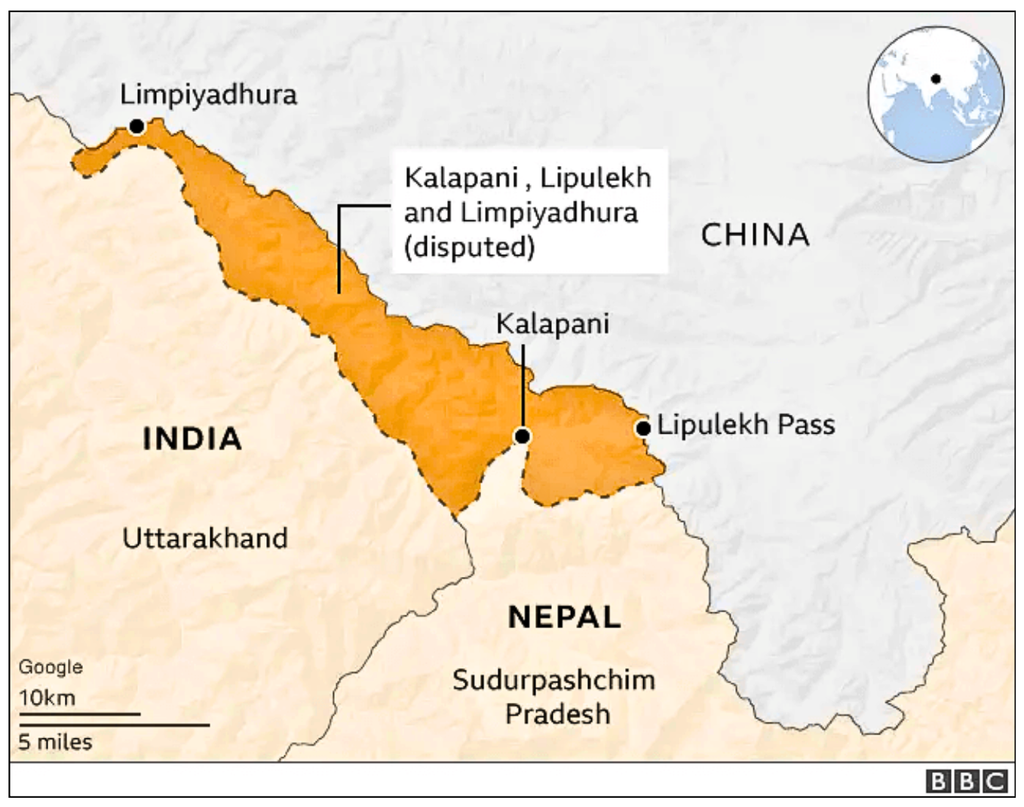
  • Unresolved Boundary Disputes: Differences over Kalapani-Lipulekh-Limpiyadhura in the western sector and Susta in the southern border region periodically generate diplomatic tensions. Nepal’s 2020 revised political map intensified the dispute.
  • Open-Border Vulnerabilities: The 1,751-km open border, while facilitating people-to-people ties, can be exploited for trafficking, smuggling, counterfeit currency and transnational criminal activities.
  • Expanding Chinese Footprint: Nepal’s engagement with China under the Belt and Road Initiative (BRI), including the 2024 Framework for Belt and Road Cooperation, and proposed trans-Himalayan connectivity create strategic concerns for India.
  • Economic Asymmetry: Nepal’s dependence on India for trade, transit, petroleum supplies and market access coexists with a persistent trade deficit and its desire to diversify economic partnerships.
  • Implementation Deficit: Delays in hydropower, railway, transmission and infrastructure projects weaken confidence in development cooperation.
  • Agnipath and Gorkha Recruitment: Nepal’s reservations regarding recruitment under the Agnipath scheme, particularly its four-year service structure and associated employment and pension concerns, have stalled fresh recruitment of Nepali Gorkhas under the scheme since 2022.
  • Water and Flood Management Issues: Differences over embankments, inundation, benefit-sharing and delays in projects such as the Pancheshwar Multipurpose Project constrain cooperation.

Way Forward:

  • Modernise Bilateral Frameworks: Review the 1950 Treaty through mutual consultation to address Nepal’s sovereignty and equality concerns while preserving the benefits of the open-border relationship.
  • Resolve Boundary Disputes: Use joint technical mechanisms, historical documents, maps and diplomatic dialogue to resolve Kalapani-Lipulekh-Limpiyadhura and Susta disputes peacefully.
  • Strengthen Border Management: Introduce better surveillance, intelligence sharing, joint patrolling and modern border infrastructure without restricting legitimate cross-border movement.
  • Accelerate Development Projects: Ensure time-bound implementation of railway, road, ICP, hydropower, transmission and petroleum pipeline projects to strengthen India’s developmental credibility.
  • Deepen Energy Cooperation: Expand hydropower investment and cross-border electricity trade, developing a regional power market involving India, Nepal, Bangladesh and Bhutan.
  • Institutionalise Disaster Cooperation: Strengthen joint flood forecasting, early-warning systems, river-basin management and climate-resilient infrastructure.
  • Respect Strategic Autonomy: Recognise Nepal’s sovereign right to diversify its international partnerships while addressing India’s legitimate security concerns through dialogue.
  • Adopt People-Centric Diplomacy: Engage provincial governments, youth, civil society, businesses, Madhesi communities and border populations. Avoid paternalistic diplomacy and focus on mutually beneficial, demand-driven development.

The future of India-Nepal relations lies in a modern, equal and people-centric partnership based on mutual trust, sovereign equality and shared prosperity.

Practice Mains Question: 

Q. “India-Nepal relations are marked by deep civilisational intimacy but recurring political distrust.” Discuss with reference to recent boundary-related developments.

SAMPADA Survey claims drop in Anaemia prevalence

Open article →Download PDF

Why in News?

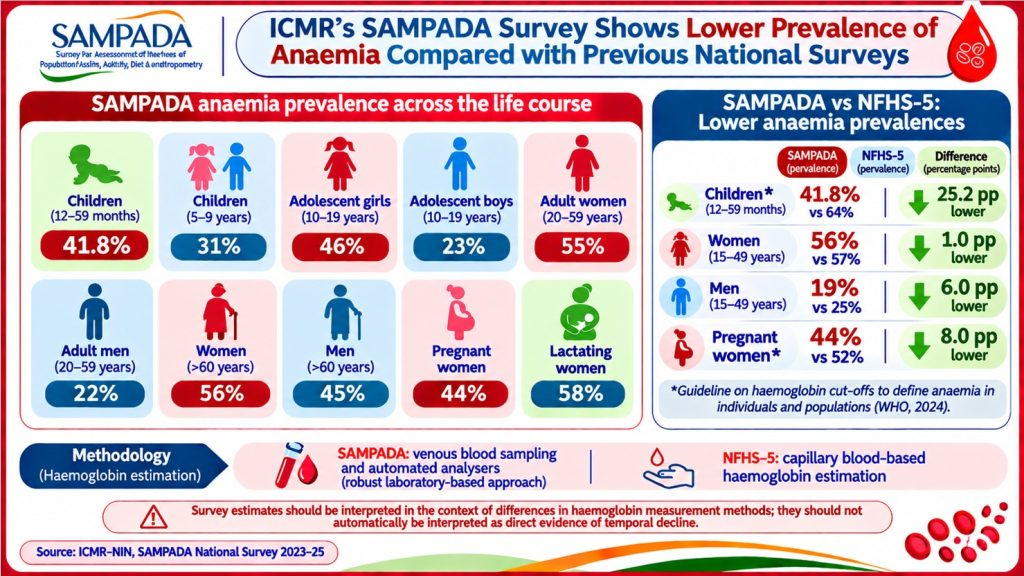
The Ministry of Health and Family Welfare has released findings of the SAMPADA (Survey for Assessment of Markers of Population Health, Activity, Diet and Anthropometry) 2023-25, conducted by the Indian Council of Medical Research (ICMR) and the Department of Health Research (DHR).

UPSC Relevance: GS-2 Social Justice: Health; GS-3 Science and Technology: Diseases 

Prelims: SAMPADA; Anaemia Mukt Bharat 7×7×7 matrix, Govt Schemes, Anaemia Burden, Double Fortified Salt  

About SAMPADA Survey: 

  • Conducted by: Indian Council of Medical Research (ICMR) and the Department of Health Research (DHR).
  • Scale: Covered over 2 lakh individuals across 81,000 households in 183 districts across 35 States and Union Territories. More than 1.7 lakh blood samples were analysed.
  • Significance: Provides nationally representative estimates of anaemia and micronutrient deficiencies across the life course, including older adults, pregnant women and lactating mothers.
  • Evidence gap: It provides a more comprehensive national assessment following the withdrawal of routine anaemia estimates from the NFHS series to facilitate more robust measurement.
image 43

Key Highlights of SAMPADA Survey: 

The survey indicates a broad decline in Anaemia prevalence across demographic groups, with nearly half of the reported cases falling in the “mild” category. 

Demographic GroupNFHS-5 (2019-21)SAMPADA (2023-25)
Children (6-59 months)64.0%41.8%
Pregnant Women52.0%44%
All Women (Reproductive age)57.0%56%
Men25.0%19%

Key observations:

  • Gender disparity: Women experience a significantly higher burden than men, reflecting nutritional, reproductive and socio-economic vulnerabilities.
  • Life-course vulnerability: Anaemia remains prevalent among adolescent girls, pregnant and lactating women, indicating the need for interventions beyond maternal healthcare.
  • Severity: Severe anaemia is below 2% across most age groups, while a substantial proportion of cases are mild. 
  • Micronutrient deficiencies: Vitamin B12 deficiency is widespread, affecting around 65% of adolescent girls and 55-57% of women of reproductive age. Among adolescent girls, overall anaemia prevalence is 46.3%, whereas the coexistence of iron deficiency and anaemia is 26.9%. 

Methodological Shift: From Finger-Prick to Venous Blood Testing

A major contribution of SAMPADA is its adoption of a more accurate diagnostic methodology.

  • Earlier method (NFHS): Haemoglobin estimation relied on capillary blood collected through finger-prick testing and portable photometers. 
  • New method (SAMPADA): Uses venous blood sampling and automated haematology analysers, providing greater accuracy, reproducibility and laboratory quality control.
  • Additional biomarkers: The new survey assessed iron status, folate, Vitamin B12 and inflammatory biomarkers such as C-reactive protein (CRP) and alpha-1-acid glycoprotein (AGP) in a subsample.

Significance: The shift enables better differentiation between anaemia and specific nutritional deficiencies. It also helps identify whether a person requires iron supplementation or investigation of other underlying causes.

Limitation: The change in methodology and diagnostic thresholds means that comparisons with earlier surveys should be interpreted cautiously rather than treating the decline as a direct measure of programme impact.

Why does Anaemia Persist? 

Anaemia is a condition in which haemoglobin levels fall below normal, reducing the oxygen-carrying capacity of blood. Its causes extend beyond iron deficiency.

  • Dietary inadequacy and poor absorption: Cereal-dominated diets, low consumption of bioavailable iron and inadequate Vitamin C intake can reduce iron absorption. Phytates in cereals and pulses inhibit the absorption of non-haem iron, while tea and coffee consumed with meals can further reduce absorption.
  • Menstrual and reproductive health: Heavy menstrual bleeding (menorrhagia), often normalised rather than medically addressed, contributes to chronic iron loss among adolescent girls and women. Pregnancy and lactation further increase nutritional requirements.
  • Infections and parasitic diseases: Hookworm infestation causes chronic intestinal blood loss, while malaria and recurrent infections contribute to anaemia through different mechanisms. Chronic inflammation can also restrict iron availability through increased hepcidin levels.
  • Micronutrient deficiencies: Deficiencies of Vitamin B12 and folate can impair red blood cell production. SAMPADA highlights widespread Vitamin B12 deficiency, although its prevalence should not be equated with its contribution to anaemia.
  • Genetic disorders: Sickle Cell Disease and Thalassaemia cause anaemia through inherited haemoglobin abnormalities and cannot be corrected through routine iron supplementation alone.

India’s Existing Strategy: 

(i) Anaemia Mukt Bharat (AMB): launched in 2018, adopted a 6×6×6 strategy to address anaemia among vulnerable population groups through supplementation, testing and institutional convergence.

(ii) Revised Anaemia Mukt Bharat Abhiyaan Operational Guidelines (June 2026) expanded this into a 7×7×7 framework.

  • Key features:
    • Seven Beneficiary Groups: Children (6-59 months), children (5-9 years), adolescents (10-19 years), pregnant women, lactating mothers, women of reproductive age (20-49 years) and low-birth-weight infants (0-6 months).
    • Seven Interventions: Prophylactic IFA supplementation, anaemia testing, therapeutic management, deworming and delayed cord clamping, Jan Bhagidari, addressing non-nutritional causes and the Eating Right approach.
    • Seven Institutional Mechanisms: Inter-ministerial coordination, National Centre of Excellence and Advanced Research on Anaemia, National AMB Abhiyaan Unit, strengthened supply chains, convergence with other ministries, AMB portal and digital monitoring.
  • T4 Approach:
    • Test: Identify anaemia through haemoglobin testing.
    • Treat: Provide appropriate therapeutic management based on diagnosis.
    • Talk: Improve awareness and treatment compliance through community participation.
    • Track: Digitally monitor beneficiaries, referrals and follow-up.

(iii) Other Supporting Initiatives:

  • POSHAN Abhiyaan: Promotes nutrition awareness, community participation and behavioural change through initiatives such as Poshan Maah and Poshan Pakhwada.
  • Mission Saksham Anganwadi and Poshan 2.0: Integrates supplementary nutrition, maternal and child health and early childhood care.
  • Food Fortification: Fortified rice containing iron, folic acid and Vitamin B12 is distributed through welfare schemes such as PDS, PM POSHAN and ICDS.
  • National Deworming Day: Addresses intestinal worm infestations that contribute to nutritional anaemia.
  • National Sickle Cell Anaemia Elimination Mission: Addresses the genetic dimension of anaemia, particularly in tribal and high-prevalence regions.

Way Forward: Towards Evidence-Based Anaemia Control

  • Targeted public health interventions: Use SAMPADA’s life-course data to prioritise high-burden groups, particularly lactating women, adolescent girls, pregnant women and elderly women, rather than adopting a uniform intervention.
  • Precision diagnosis and treatment: Move beyond haemoglobin-only screening. Use ferritin and other relevant biomarkers, alongside clinical assessment, to distinguish iron-deficiency anaemia from other conditions. 
  • Improve dietary diversity and iron absorption: Promote locally available iron-rich foods such as millets, pulses and green leafy vegetables, along with Vitamin C-rich foods. 
  • Strengthen Behaviour Change Communication: Use ASHA and Anganwadi workers to address misconceptions about IFA supplementation, explain side effects and improve treatment adherence.
  • Address non-nutritional causes: Integrate menstrual health management into school health programmes, strengthen deworming and malaria control, and improve WASH (Water, Sanitation and Hygiene) infrastructure.
  • Strengthen surveillance and accountability: Integrate SAMPADA’s evidence with the Anaemia Mukt Bharat Abhiyaan’s digital tracking system to monitor treatment completion, referrals and recovery rather than merely counting beneficiaries screened.
  • Evaluate fortification programmes: Assess the effectiveness and safety of fortified foods, including iron-fortified rice, while ensuring that fortification complements rather than replaces dietary diversification and clinical management.

SAMPADA marks an important shift in India’s nutrition policy from estimating anaemia prevalence through routine surveys to understanding its underlying causes through improved diagnostics. The challenge now is to translate better evidence into targeted treatment, stronger primary healthcare and sustained behavioural change.

Practice Prelims MCQ:

Q. Consider the following statements regarding the SAMPADA Survey (2023-25):

  1. It uses venous blood sampling and automated analysers for haemoglobin estimation.
  2. It was conducted by ICMR in collaboration with the Department of Health Research.
  3. It found that iron deficiency accounts for all cases of anaemia among women and children.
  4. It provides national-level estimates of anaemia among elderly populations.

Which of the statements given above are correct?

(a) 1 and 2 only
(b) 1, 2 and 4 only
(c) 2 and 3 only
(d) 1, 2, 3 and 4

Answer: (b) 1, 2 and 4 only. Statement 3 is incorrect: Anaemia is multifactorial. It is caused not only by iron deficiency, but also by deficiencies in other micronutrients (like Vitamin B12 and folate), parasitic worm infestations, chronic blood loss (menorrhagia), and genetic blood disorders (such as sickle cell anaemia and thalassemia).

Regional Accounts and Direct Estimation of State Output

Open article →Download PDF

Why in News?

MoSPI released its regional accounts sub-committee report on November 25, 2026, recommending improvements to State and District Domestic Product estimation for the 2022–23 base-year series.

  • The regional accounts report examines production, income and expenditure approaches, along with district estimates, to improve the economic information available to State and Union Territory statistical offices.
  • Its proposals include direct estimation for selected sectors, reduced dependence on fixed ratios and better use of information showing where economic activity actually occurs within individual States.
  • Production and district guidelines had already been published. Expenditure guidelines remained subject to finalisation after stakeholder comments, so the release records a reform process with different stages of completion.
  • Regional output estimates support comparisons of economic activity across States and districts. The location and quality of the underlying records affect what those comparisons can establish.
  • The separate QBUSE classification change concerns how enterprises are grouped. This report examines how economic activity is measured and assigned geographically.

UPSC Relevance

Prelims Relevance

  • SDP and DDP measure economic activity at State and district levels.
  • GSVA is gross value added across sectors within a State.
  • Direct estimation uses observations for the relevant geographical unit.
  • MCA-21 and GST records can be linked to locate enterprise activity.
  • 2022–23 is the selected new national accounts base year.

Mains Relevance

GS Paper 3

  • Economic measurement and reliable regional comparisons.
  • Administrative data as a complement to statistical surveys.

GS Paper 2

  • Centre–State coordination in consistent statistical compilation.

Background and Context

What Regional Accounts Measure

Regional accounts organise economic activity by place using common accounting concepts and carefully defined geographical coverage.

  • Value added measures the contribution created after deducting intermediate inputs from output. Summing value added helps avoid repeatedly counting goods that pass through several enterprises before reaching their final users.
  • The production approach examines activities generating output, while the income approach examines income generated by production. The expenditure approach examines spending on final goods and services within an accounting framework.
  • State and district estimates require evidence at finer geographical levels than national totals. A reliable national aggregate alone cannot reveal how much activity occurred in each State or district.
  • Common methods help make regional comparisons interpretable. Differences in coverage, source quality or estimation procedures can otherwise influence measured gaps alongside actual differences in economic activity.
  • A base-year revision gives compilers an opportunity to update sources and methods. Users should examine the accompanying methodology before interpreting a revised series as evidence of changed economic performance.

How Better Records Locate Economic Activity

The report combines selected direct estimates with better allocation indicators where complete local measurement remains difficult.

  • Allocation-based estimation distributes an aggregate using indicators or ratios. Direct estimation draws on the activity of the geographical unit itself, where suitable records and sector methods permit that calculation.
  • A company’s registered office may lie in a different State from its operating units. The report explains why the registration location in corporate records cannot by itself establish the location of production.
  • The proposed MCA–GST linkage connects company identifiers with GST registrations across States. State-wise outward supplies can then help allocate company aggregates for specified industries covered by the proposed method.
  • This allocation still uses assumptions, including common proportions of intermediate inputs and value added in output across States. Better geographical records improve the indicator while leaving those assumptions open to examination.
  • For Central departmental enterprises, the report supports location-wise salary records from PFMS for allocating net value added. This illustrates how administrative detail can replace a broader distribution rule.

Reading the Recommendations Carefully

Each sector needs its own evidence, and publication of recommendations does not establish uniform implementation across the statistical system.

  • The shift to direct estimation covers selected sectors and subsectors. Other parts retain allocation with improved indicators, so the report should be read as a set of sector-specific methodological changes.
  • State statistical offices need updated enterprise lists, usable administrative records and consistent activity classifications. Gaps in these inputs can weaken comparisons even when the formal compilation guidelines are shared.
  • The report distinguishes completed guidance from expenditure guidance awaiting finalisation. Claims about the new series must identify which method has been recommended, finalised or actually used in published estimates.
  • Output measures describe production within an accounting boundary. Assessing household welfare also needs evidence about distribution, employment and living conditions, because an output total cannot answer each of those questions.
  • As with monthly labour estimates, methodological transparency matters when interpreting changes. Readers need to know whether movement reflects economic activity, revised coverage, source updates or changed estimation procedures.

Way Forward

Make Regional Estimates Traceable

  • Publish method notes identifying direct estimates, allocation indicators and remaining assumptions sector by sector.
  • Maintain enterprise frames and reconcile administrative records across central and State agencies.
  • Explain revisions so users can distinguish changes in measurement from changes in regional economic activity.

Conclusion

  • Regional accounts reform improves the connection between economic activity and the place where it occurs when local records, sector methods and consistent compilation support one another.
  • The MoSPI report provides a methodological reference. Its strongest exam lesson is to examine the data and assumptions behind regional totals before drawing conclusions about growth or welfare.

UPSC Practice Questions

Prelims MCQ 1

With reference to regional accounts, consider the following statements

  1. A company’s State of registration necessarily identifies the location of all its production.
  2. The report proposes direct estimation for selected sectors or subsectors.
  3. GST registrations can help identify a company’s operations across States.

How many of the above statements are correct?

(a) Only one (b) Only two (c) All three (d) None

Answer: (b) Only two

Explanation:

Statements 2 and 3 are correct. A company can operate across States while its registered office is located in one State.

Prelims MCQ 2

Which issue remains when company aggregates are allocated by State-wise outward supplies under the proposed MCA–GST method?

(a) An assumption about common input and value-added proportions across States (b) A requirement that every company operates in only one State (c) Automatic exclusion of all corporate activity (d) Replacement of national accounts with tax collections

Answer: (a) An assumption about common input and value-added proportions across States

Explanation:

The report explains that allocation by outward supplies implicitly assumes common proportions of intermediate consumption and value added in output across States.

UPSC Mains Questions

  1. Explain how improved administrative data can strengthen regional output estimates. Discuss the assumptions that remain when national or enterprise aggregates are allocated across States.
  2. Why should the revision of a national accounts base year be accompanied by transparent regional compilation methods? Discuss with reference to State and district estimates.

Sources: PIB, Ministry of Statistics and Programme Implementation and MoSPI Regional Accounts Sub-Committee Report.

Frequently Asked Questions

What are regional accounts?

Regional accounts estimate economic activity for geographical units such as States and districts. They apply accounting concepts and sector methods to evidence showing where production and related economic activity occur.

What is direct estimation?

Direct estimation uses information for the geographical unit being measured. The report recommends expanding it in selected sectors, while other areas continue to require allocation through improved indicators.

Why link MCA and GST data?

Corporate registration alone may not locate operating activity. Linking corporate identifiers with State-specific GST registrations can help allocate enterprise aggregates using State-wise outward supplies, subject to methodological assumptions.

Were all recommendations implemented on release?

The release described recommendations and different stages of guidance. Production and district guidelines had been published, while final expenditure guidelines were still to follow after stakeholder comments.

Revisiting the Monthly Frequency of PLFS

Open article →Download PDF

Why in News?

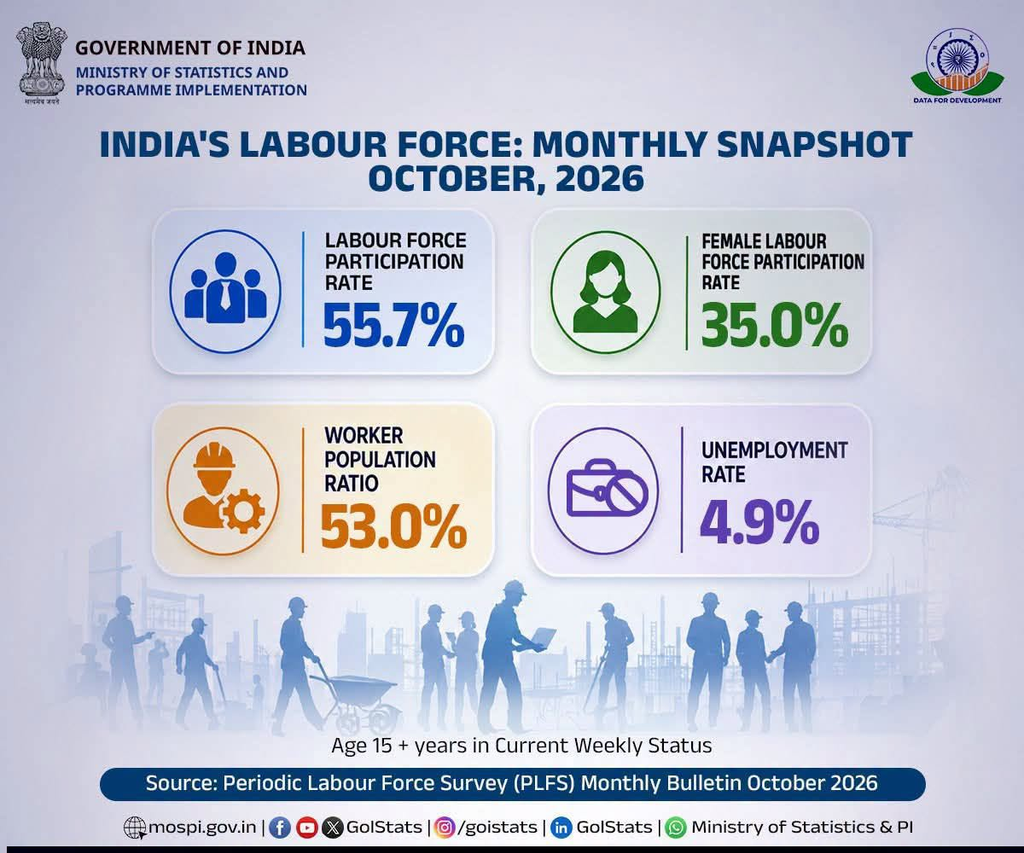
In January 2025, the Ministry of Statistics and Programme Implementation (MoSPI) revamped the Periodic Labour Force Survey (PLFS) to introduce monthly estimates of key labour market indicators for rural and urban India at the national level.

However, an analysis of monthly data from January to October 2026 finds that most month-to-month changes in the Unemployment Rate (UR) and Worker Population Ratio (WPR) are not statistically significant, raising concerns about the balance between data frequency, statistical reliability and survey costs. 

UPSC Relevance: GS-3 Economy: Employment, inclusive growth and labour market reforms. 

Prelims: Periodic Labour Force Survey; Key Labour Market Concepts 
image 45

What is PLFS?

  • Launched: 2017-18 by MoSPI and conducted by the National Statistical Office (NSO), which replaced the erstwhile NSSO as the country’s statistical survey organisation.
  • Purpose: To generate reliable estimates of employment, unemployment and labour force participation, supporting evidence-based employment policies.
  • It provided:
    • Annual estimates (rural + urban) based on Usual Status (1-year reference) and Current Weekly Status (CWS, 7-day reference).
    • Quarterly estimates (urban only) based on CWS for three key indicators: Labour Force Participation Rate (LFPR), Worker Population Ratio (WPR), and Unemployment Rate (UR). 
Key Labour Market Concepts: 

Usual Status (US): Determines a person’s activity status over the preceding 365 days, including principal and subsidiary economic activity. 

Current Weekly Status (CWS): Activity status determined based on a reference period of the last 7 days preceding the date of the survey. A person is considered employed if they worked for at least 1 hour on any day during those 7 days.

Labour Force Participation Rate (LFPR): Percentage of persons in the labour force (working + seeking/available for work) in the population.

Worker Population Ratio (WPR): Percentage of employed persons in the total population.

Unemployment Rate (UR): Percentage of persons unemployed among the persons in the labour force.

Confidence Interval (CI): A statistical range within which the true population parameter is expected to fall with a specified probability (E.g., 95%). If CIs of two consecutive months overlap, the observed change cannot be reliably distinguished from random sampling error.

Earlier Approach vs. Present Approach (Post-January 2025):

FeatureEarlier approach (2017-December 2024)Revamped approach (January 2025 onwards)
Annual estimatesRural + UrbanRural + Urban
Quarterly estimatesUrban onlyRural + Urban
Monthly estimatesNot availableRural + Urban at all-India level
Annual sample (first visits)Around 1 lakh householdsAround 2.7 lakh households

Limitations of the Present Approach:

(i) Limited statistical significance of monthly changes:

  • An analysis of January-October 2026 estimates indicates that not a single month-on-month change in the Unemployment Rate (which hovered around 4.9% — 5.5%) was statistically significant.
  • For WPR, statistically significant changes were observed only in May and July 2026 compared with their preceding months.

Thus, changes in headline estimates may not necessarily represent actual changes in labour market conditions.

(ii) Risk of misleading interpretations (Overlapping Confidence Intervals):

  • Because PLFS is a sample survey, every figure carries a margin of error (95% Confidence Interval) within which the true national rate lies. 
  • When intervals of two consecutive months overlap (e.g., April 2026 UR at 5.2% [CI: 5.0–5.4%] vs. May 2026 UR at 5.5% [CI: 5.3 — 5.7%]), the true rate could have actually moved in the opposite direction (e.g., falling from 5.4% (April)  to 5.3% (May)), making monthly jumps indistinguishable from random sampling noise.

(iii) High resource and administrative costs: 

  • The expanded design requires a much larger sample, more field investigators and frequent household visits. Monthly coverage involves approximately 4,100 rural villages and 3,400 urban blocks, in addition to revisits. This raises questions about the marginal benefit of monthly estimates relative to their financial and administrative costs.

(iv) Seasonal nature of employment:

  • India’s labour market has a large agricultural and informal workforce, where employment patterns are influenced by agricultural seasons, harvesting cycles, weather conditions and rural migration. Consequently, monthly fluctuations may reflect seasonal movements rather than structural changes in employment.
  • However, monthly data can also help capture these seasonal variations; the challenge is to distinguish seasonal effects from underlying trends.

(v) Risk of Survey Fatigue: Frequent household visits risk respondent fatigue, potentially lowering data accuracy.

Way Forward:

  • Reassess publication frequency: Consider quarterly rural-urban estimates as the principal indicator of labour market trends, while retaining monthly estimates for monitoring major employment shocks and short-term movements.
  • Improve statistical precision: Instead of merely increasing sample size, optimise sample allocation, survey design and estimation techniques to improve the precision of monthly estimates.
  • Publish margins of error: Release standard errors, confidence intervals and tests of statistical significance alongside headline estimates to prevent misinterpretation.
  • Integrate administrative datasets: Use complementary high-frequency data from EPFO, ESIC and e-Shram to monitor formal payroll additions, social security registrations and employment trends. However, these cannot substitute for PLFS because they do not capture the entire workforce, particularly informal and self-employed workers.
  • Improve labour market measurement: Strengthen estimates of underemployment, informal wages, working conditions and the gig and platform workforce.
  • Account for seasonality: Use seasonal adjustment and year-on-year comparisons alongside month-on-month estimates to distinguish seasonal fluctuations from structural changes.

Rather than abandoning high-frequency employment statistics altogether, India should improve their precision, communicate statistical uncertainty and adopt a publication strategy that reflects the actual informational value of the data. 

Prelims Practice MCQ:

Q. With reference to the Periodic Labour Force Survey (PLFS) in India, consider the following statements:

  1. Under the Current Weekly Status (CWS) approach, a person is considered employed if they worked for at least one hour on any day during the seven days preceding the date of the survey.
  2. Unlike the Worker Population Ratio (WPR), which is calculated as a percentage of the total population, the Unemployment Rate (UR) is calculated as a percentage of the labour force.
  3. Following the 2025 methodological revamp, PLFS releases monthly estimates of key labour indicators exclusively for urban areas.
  4. If the 95% Confidence Intervals of the Unemployment Rate for two consecutive months overlap, the observed month-on-month change is considered statistically insignificant.

Which of the statements given above are correct?

(a) 1 and 2 only

(b) 1, 2 and 4 only

(c) 2, 3 and 4 only

(d) 1, 3 and 4 only

Answer: (b) 1, 2 and 4 only

BepiColombo Enters Mercury Orbit

Open article →Download PDF

Why in News?

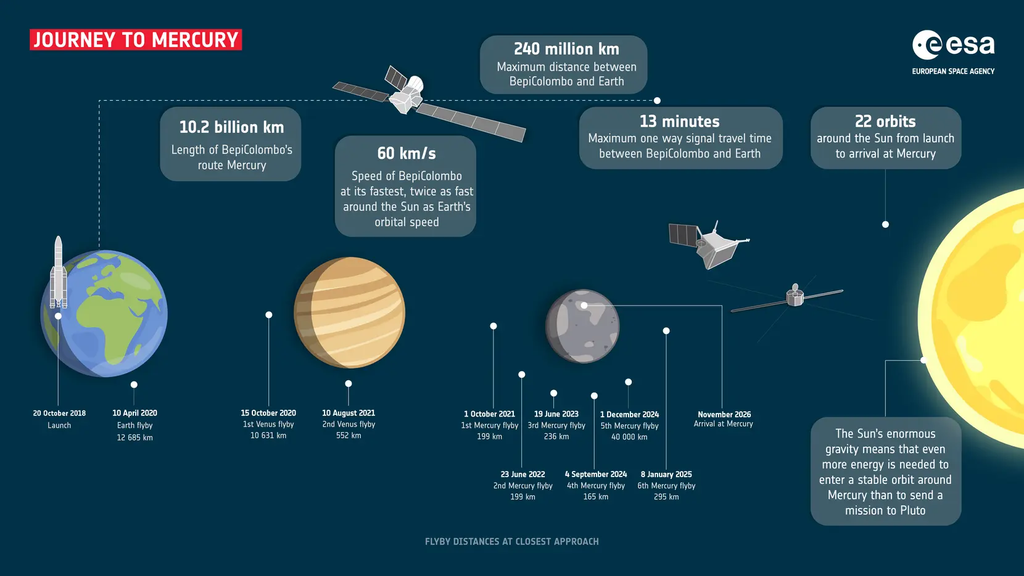
The joint European-Japanese BepiColombo mission entered orbit around Mercury on November 21, 2026, after an approximately eight-year journey. The mission is expected to provide new insights into Mercury’s internal structure, magnetic field, surface composition and polar water ice.

BepiColombo is only the third spacecraft mission to visit Mercury and the second to enter orbit around the planet.

UPSC Relevance: GS-3 Science and Technology: Space Technology

Prelims:  BepiColombo mission; Mercury 

BepiColombo: Mission Overview 

  • Agencies: Joint mission of the European Space Agency (ESA) and Japan Aerospace Exploration Agency (JAXA).
  • Launch: 2018, aboard an Ariane 5 rocket from Europe’s Spaceport in Kourou, French Guiana.
  • Named after: Italian mathematician and engineer Giuseppe (Bepi) Colombo, who made important contributions to the study of Mercury and planetary orbital mechanics.
  • Objective: To study Mercury’s origin, internal structure, geological evolution, magnetic field and interaction with the solar wind.

Twin-orbiter Architecture: 

BepiColombo is designed to deploy two specialised scientific orbiters around Mercury, making it the first mission to operate two spacecraft around the planet simultaneously.

1. Mercury Planetary Orbiter (MPO):

  • Developed by ESA.
  • Carries 11 scientific instruments.
  • Will investigate Mercury’s surface, internal structure, composition and geological history.

2. Mercury Magnetospheric Orbiter (MMO/MIO):

  • Developed by JAXA.
  • Designed to study Mercury’s magnetic field, magnetosphere, plasma environment and interaction with the solar wind.

Additional component: The Mercury Transfer Module (MTM), equipped with solar-electric propulsion, powered and propelled the spacecraft during most of its interplanetary journey. It separated from the spacecraft stack in September 2026.

image 42

Upcoming milestones:

  • December 2026: Separation of MPO and MIO.
  • March 2027: MPO expected to reach its final science orbit.
  • April 2027: Commencement of routine scientific operations.

Why is reaching Mercury so difficult?

Mercury is relatively close to Earth in terms of distance, but reaching and entering orbit around it is exceptionally challenging.

  • Strong gravitational pull of the Sun: A spacecraft travelling from Earth towards Mercury gains considerable orbital speed due to the Sun’s gravitational attraction. It must shed substantial velocity to be captured by Mercury’s relatively weak gravity. Thus, reaching Mercury requires complex orbital manoeuvres and significant braking rather than simply travelling towards the planet.
  • Extreme thermal environment: Mercury receives intense solar radiation because of its proximity to the Sun. Spacecraft systems must withstand extreme temperatures and radiation while maintaining the operating conditions required by sensitive scientific instruments.

The mission used solar-electric propulsion during its cruise phase. Solar panels generated electricity to power ion thrusters, which produced continuous, low-thrust propulsion over extended periods. This helped achieve the substantial velocity changes required for the journey.

BepiColombo used a technique called weak stability capture to enter Mercury’s orbit. It arrived at a relatively low speed, allowing Mercury’s gravity to capture it through a carefully designed orbital manoeuvre. It is the first mission to use this technique for insertion into orbit around a planet.

Major Scientific Objectives and Significance: 

  • Origin of Mercury’s magnetic field: Mercury is the only planet besides Earth among the inner planets with a global, internally generated magnetic field. Despite its small size, it possesses a disproportionately large iron-rich metallic core. The mission will investigate the origin, structure and dynamics of this magnetic field and its interaction with the solar wind.
  • Presence of water ice on a scorching planet: Despite being the closest planet to the Sun, Mercury has evidence of water ice in permanently shadowed polar craters. These regions remain extremely cold because sunlight never reaches them. BepiColombo will investigate the composition, distribution and origin of these polar deposits.
  • Mysterious surface features called ‘Hollows’: Hollows are shallow, irregular depressions found across Mercury’s surface. They were identified through observations by NASA’s MESSENGER spacecraft. BepiColombo will investigate their composition and formation mechanisms.
  • Understanding Mercury’s internal structure: Mercury has an unusually large metallic core relative to its size. Studying its interior structure will provide clues about planetary differentiation, formation and evolution.

Mercury: Important Facts 

  • Position: Closest planet to the Sun and the smallest planet in the Solar System.
  • Classification: Terrestrial (rocky) planet.
  • Diameter: Approximately 4,880 km.
  • Orbital period: Approximately 88 Earth days.
  • Rotation period: Approximately 59 Earth days.
  • Solar day: Approximately 176 Earth days.
  • Orbital eccentricity: Highest among the eight planets.
  • Atmosphere: Does not possess a substantial atmosphere; instead, it has an extremely thin exosphere.
  • Magnetic field: Has a global magnetic field, considerably weaker than Earth’s.
  • Temperature: Approximately 430°C during the day and -180°C at night.
  • Moons and rings: Neither natural satellites nor planetary rings.

Previous Missions to Mercury:

Only two spacecraft had visited Mercury before BepiColombo.

  • Mariner 10 (NASA, 1973): First spacecraft to visit Mercury. Captured close-up images of approximately 45% of the planet’s surface.
  • MESSENGER (NASA, 2004): First spacecraft to orbit Mercury (2011-2015). Mapped the planet’s surface and studied its composition, magnetic field and internal structure. Confirmed the presence of water ice in permanently shadowed polar regions.
  • BepiColombo (ESA-JAXA, 2018): Third spacecraft mission to visit Mercury. Second mission to orbit Mercury. First mission designed to operate two dedicated scientific orbiters around Mercury simultaneously.

Practice Prelims MCQ:

Q. With reference to Mercury and the BepiColombo mission, consider the following statements:

  1. Mercury is the only terrestrial planet other than Earth known to possess a global magnetic field.
  2. Mercury has a substantially thick atmosphere that moderates its extreme surface temperatures.
  3. BepiColombo is a joint mission of ESA and JAXA comprising two scientific orbiters.
  4. Mercury completes three rotations on its axis for every two revolutions around the Sun.

Which of the statements given above are correct?

(a) 1 and 2 only

(b) 1, 3 and 4 only

(c) 2, 3 and 4 only

(d) 1, 2, 3 and 4

Answer: (b)

CIE Manufacturing Incentives and Shared Testing Capacity

Open article →Download PDF

Why in News?

The Union Cabinet approved the CIE manufacturing scheme on November 25, 2026, combining incentives for additional eligible sales with support for a dedicated construction-equipment testing facility.

  • The Ministry of Heavy Industries will implement the scheme for eligible original equipment manufacturers and component producers.
  • Graded incentive rates range from 13% to 8% of incremental eligible sales over the incentive period.
  • The approved sequence provides two years for gestation, five years for incentive disbursement and a final settlement year.
  • A separate grant supports a dedicated CIE testing facility through viability gap funding.
  • Construction equipment connects industrial capability with the delivery of roads, ports, housing and underground infrastructure.
  • A domestic machine industry also needs component suppliers and testing capacity capable of supporting reliable performance.

UPSC Relevance

Prelims Relevance

  • CIE means construction and infrastructure equipment.
  • OEM means original equipment manufacturer.
  • Incremental sales measure eligible sales growth against the applicable baseline.
  • Viability gap funding helps finance a project whose public value exceeds its immediate commercial attractiveness.

Mains Relevance

GS Paper 3

  • Assess performance-linked industrial incentives and domestic manufacturing capability.
  • Explain how shared testing infrastructure can support suppliers and equipment quality.

Background and Context

Why Construction Equipment Needs an Industrial Ecosystem

Equipment manufacturing combines large machines with specialised components, engineering knowledge and dependable testing.

  • The approved scheme covers technologically advanced machinery, including tunnel-boring machines, hydraulic excavators, off-highway trucks and ship-to-shore cranes. Their applications connect factory capability with infrastructure construction and cargo movement.
  • An original equipment manufacturer integrates systems into a finished machine. Component manufacturers supply parts used within it. Supporting both groups can broaden domestic production beyond the final assembly operation alone.
  • A construction machine must perform under heavy loads and demanding operating conditions. Its commercial value depends on reliability, maintenance requirements and suitability for the task, alongside the price paid by its buyer.
  • Industrial capability develops through supplier relationships as well as factory investment. Equipment producers need dependable components, while component suppliers need customers whose orders justify investment in tooling, engineering and production capacity.
  • The policy objective is to improve supply-chain security and competitiveness. These outcomes depend on the quality and depth of domestic capability created during implementation, so approval alone cannot establish that import dependence has fallen.

How Incremental Sales Incentives Work

The manufacturing component links payments to additional eligible sales by approved applicants.

  • Incremental sales value refers to the eligible increase assessed against the applicable baseline. The detailed rules must define that baseline, eligible products and evidence required before an applicant can establish its claim.
  • The Cabinet release identifies approved applicants in the OEM and component categories. Administrative approval and eligible sales are distinct requirements within the proposed payment mechanism.
  • The gestation period gives manufacturers time to establish facilities before the incentive years. The final settlement year allows claims relating to the last eligible sales year to be processed after that year closes.
  • A sales-linked incentive rewards eligible commercial activity after production reaches customers. Its effectiveness depends on accurate sales records and verification of the products covered, alongside the manufacturing investment that precedes those sales.
  • Compare this with domestic-value procurement rules, which influence purchasing eligibility. CIE uses financial incentives; each instrument needs its own eligibility conditions and evidence of the industrial outcome it seeks.

Why a Dedicated Testing Facility Matters

Testing capacity addresses an industrial bottleneck that individual sales incentives may leave unresolved.

  • A dedicated testing facility can assess equipment performance using suitable infrastructure and procedures. For large or specialised machines, establishing such facilities requires substantial investment that individual producers may find difficult to justify.
  • The scheme provides a separate viability gap funding grant for the facility. This supports the economics of creating testing infrastructure, while the manufacturing incentive remains linked to incremental eligible equipment and component sales.
  • Shared access can help smaller producers demonstrate performance without each constructing a complete testing establishment. Access conditions, scheduling and technical credibility will determine how widely manufacturers benefit from the facility once it operates.
  • Testing produces evidence about performance under specified conditions. Any certification or regulatory acceptance depends on the applicable framework; the Cabinet announcement does not itself establish universal recognition of every future test result.
  • The implementation lesson also appears in manufacturing eligibility rules. Clear definitions and auditable claims connect policy intent with payments, while technical infrastructure addresses a different constraint on industrial capability.

Way Forward

Make Eligibility and Access Auditable

  • Publish clear baselines and eligible-product definitions so applicants can calculate claims consistently.
  • Verify incremental sales against reliable commercial records before disbursement.
  • Set transparent testing access and service standards that allow component firms and smaller manufacturers to use the facility.
  • Evaluate domestic capability and equipment performance alongside the amount of incentive disbursed.

Conclusion

  • The scheme combines sales incentives with an investment in testing infrastructure. Its industrial logic rests on improving both commercial production and the technical capacity required to demonstrate reliable equipment performance.
  • For a policy answer, connect eligibility, verification and facility access to the outcomes sought. Treat Cabinet approval as the start of implementation, with industrial gains requiring evidence from subsequent production and operation.

UPSC Practice Questions

Prelims MCQ 1

With reference to the approved CIE manufacturing scheme, consider the following statements:

  1. Its manufacturing incentive is linked to incremental eligible sales.
  2. Its testing-facility grant is a separate component.
  3. Every construction equipment manufacturer automatically receives an incentive.

How many of the above statements are correct?

(a) Only one (b) Only two (c) All three (d) None

Answer: (b) Only two

Explanation:

The scheme links manufacturing incentives to incremental eligible sales by approved applicants and separately supports a testing facility. Automatic payments to every manufacturer are not provided.

Prelims MCQ 2

Which constraint is most directly addressed by a dedicated construction-equipment testing facility?

(a) Absence of an income tax collection system (b) Limited access to specialised performance-testing infrastructure (c) Lack of consumer demand for all manufactured products (d) The need to fix a uniform retail price for machinery

Answer: (b) Limited access to specialised performance-testing infrastructure

Explanation:

Specialised facilities provide infrastructure for assessing equipment performance. Testing capacity complements the sales incentive provided to eligible manufacturers.

UPSC Mains Questions

  1. Explain how sales-linked incentives and shared testing infrastructure address different constraints in construction-equipment manufacturing.
  2. What safeguards should guide the implementation of performance-linked manufacturing incentives? Discuss with reference to the CIE scheme.

Source: PIB, Cabinet.

Frequently Asked Questions

What is the CIE manufacturing scheme?

It is an approved Ministry of Heavy Industries scheme supporting construction and infrastructure equipment production through incentives on incremental eligible sales and a separate grant for a dedicated testing facility.

Who can receive the sales-linked incentive?

Approved applicants in the eligible original equipment manufacturer and component manufacturer categories can qualify. Payments depend on incremental eligible sales and the conditions governing claims under the scheme.

Why does the scheme include a gestation period?

Manufacturing facilities require time to establish before generating eligible sales. The approved design places two gestation years before the five-year incentive period, followed by a final year for settlement.

Does Cabinet approval mean the testing facility is already operational?

The announcement approves support for establishing the facility. Its construction, operating arrangements and access conditions require implementation before manufacturers can use the resulting testing services.

Kamarajar Container Terminal and the DBFOT Model

Open article →Download PDF

Why in News?

The Cabinet Committee on Economic Affairs approved a second container terminal at Kamarajar Port on November 25, 2026, using the Design, Build, Finance, Operate and Transfer model.

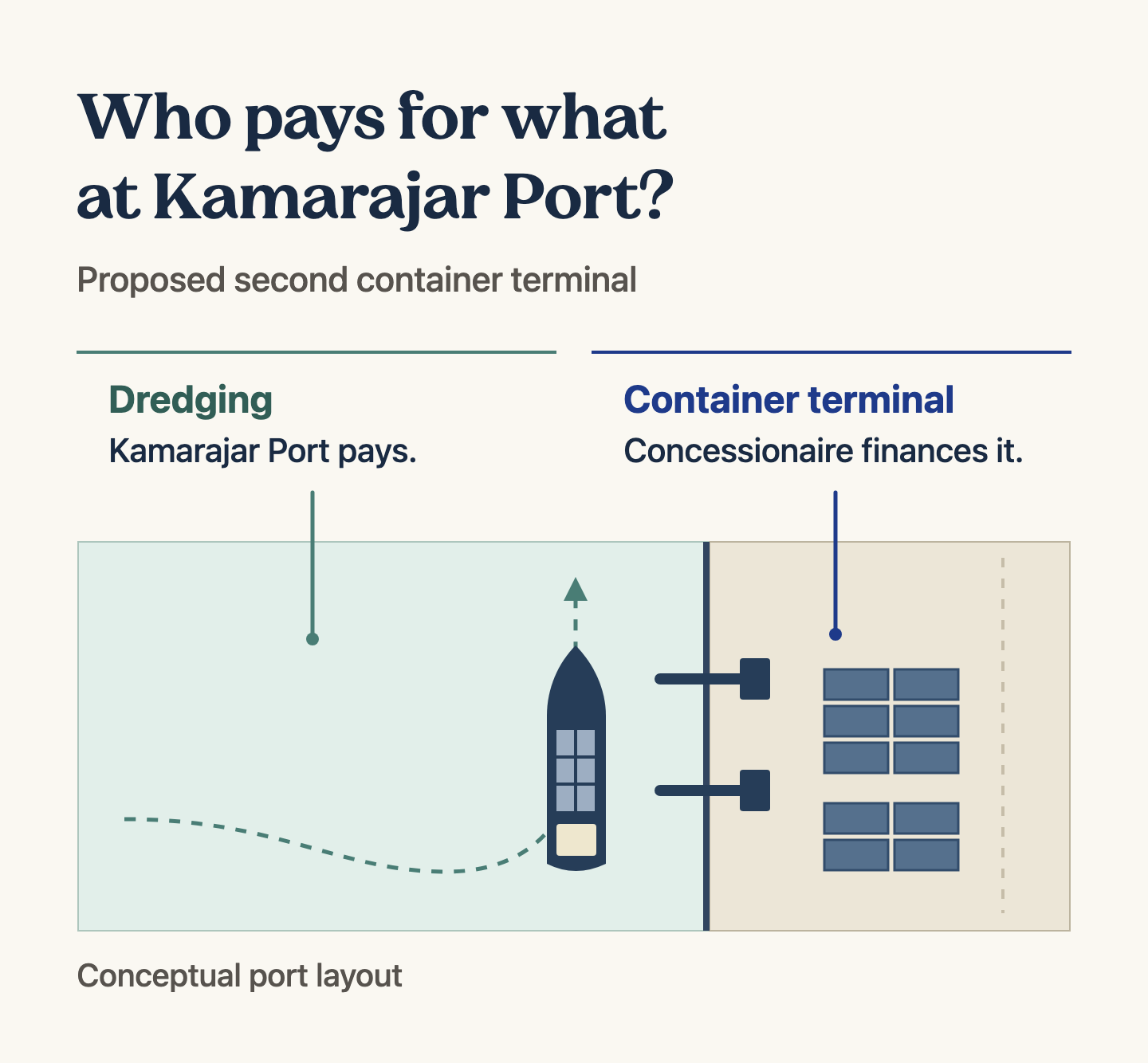
  • The selected concessionaire will arrange finance for the terminal and recover investment through user charges governed by the concession agreement and applicable tariff framework.
  • Kamarajar Port Limited will separately bear the proposed dredging expenditure. Terminal financing and navigation-related investment have different responsible entities within the approved project.
  • The approved 40-year concession includes construction. The announcement describes planned implementation through open global bidding, with environmental and other necessary clearances sought before the bid due date.
  • A port expansion links private investment with public infrastructure responsibilities. The financing structure determines who must deliver each part before vessels and cargo can use the facility.
  • The project serves the Chennai–Ennore industrial region and its wider hinterland. Its intended trade benefits depend on delivery, operating performance and access to shipping networks.

UPSC Relevance

Prelims Relevance

  • DBFOT expands to Design, Build, Finance, Operate and Transfer.
  • A concessionaire receives contractual rights and duties for a defined period.
  • Dredging removes material from underwater areas to support required navigable depths.
  • TEU is a standard unit for expressing container capacity.
  • Kamarajar Port is on the east coast of Tamil Nadu.

Mains Relevance

GS Paper 3

  • Evaluate risk allocation and public obligations in infrastructure partnerships.
  • Connect port capacity, hinterland access and shipping services with export competitiveness.

Background and Context

How the Terminal Concession Works

DBFOT combines delivery and operation within a time-bound contract, with investment recovered during the operating period.

  • The design and build stages require the concessionaire to translate the approved service requirements into a functioning terminal. Construction choices affect later maintenance, cargo handling and operating reliability.
  • Under the finance component, the selected concessionaire arranges the terminal investment. The funding obligation makes the expected flow of future operating receipts important to the commercial assessment of the project.
  • During operation, user charges provide the route for investment recovery described in the approval. Their application remains subject to the concession agreement and tariff framework, rather than an unrestricted pricing discretion.
  • The transfer element concerns the eventual handback under the concession arrangement. It makes the condition of the asset near the end of the contract relevant alongside initial completion and current throughput.
  • The proposed terminal is part of the wider maritime economy discussed in India’s shipbuilding plans. Terminal services connect vessels with cargo-handling facilities and the industrial hinterland.

Where Public and Private Responsibilities Meet

The approved arrangement assigns terminal investment to the concessionaire and separate dredging expenditure to Kamarajar Port Limited.

  • The Cabinet release identifies two financing responsibilities. The concessionaire funds the PPP terminal component, while KPL bears dredging expenditure recorded separately in the proposal.
  • Dredging and terminal works support connected functions. Ships need suitable navigable water as well as a usable berth and handling equipment, so completion of one component alone cannot establish readiness of the whole service.
  • The release states that the PPP component has no financial implication for the Union government. That statement must be read alongside KPL’s separately identified expenditure when assessing the public side of the project.
  • Environmental and other necessary clearances are to be obtained before the bid due date. This is an implementation requirement in the proposal, and the approval does not itself demonstrate that every clearance has been secured.
  • Coordination risk arises where separately delivered works must become usable together. The practical question is whether financing, construction and navigation requirements can be aligned through clear responsibilities and monitored milestones.
Port schematic. Kamarajar Port funds dredging on the water side. The concessionaire finances the container facilities on the quay side.
Conceptual port layout. Kamarajar Port Limited bears the separate dredging cost. The selected concessionaire finances the terminal under DBFOT.

Reading Project Benefits and Risks

The approval describes expected commercial and logistics benefits that still depend on bidding, construction and actual use.

  • The planned phased construction timetable runs from the award of concession. Readers should distinguish this contractual starting point from Cabinet approval when interpreting completion targets and the beginning of commercial operations.
  • Demand risk concerns whether actual cargo traffic supports the investment case. Forecast growth can inform planning, but changing trade patterns, competing gateways and shipping decisions affect the realised flow of containers.
  • The proposal expects larger mainline vessel calls to improve connectivity and reduce reliance on foreign transshipment hubs. These are intended outcomes whose achievement depends on shipping services using the completed facility.
  • For exporters, port performance interacts with freight and market-access support. Logistics competitiveness requires reliable movement across the chain, including the connection between factories, inland transport and the terminal.
  • The concession agreement is central to evaluating detailed obligations and remedies. The approval establishes the proposed model, while precise allocation of individual commercial risks requires reading the eventual contractual provisions.

Way Forward

Make Delivery Responsibilities Measurable

  • Publish clear milestones linking terminal construction, dredging and required approvals, with the responsible entity identified for each task.
  • Assess traffic assumptions and service needs before finalising the concession, including how changing shipping patterns could affect demand.
  • Track operating performance after commissioning through cargo handling, vessel access and service reliability, alongside compliance with contractual requirements.

Conclusion

  • The Kamarajar proposal illustrates how DBFOT can combine private terminal finance with continuing public infrastructure duties. Evaluating the partnership requires following both responsibilities through construction and operation.
  • For infrastructure answers, connect financing, service delivery and risk allocation. Cabinet approval establishes the project framework, while bidding, clearances, contractual terms and actual use determine its eventual results.

UPSC Practice Questions

Prelims MCQ 1

With reference to the approved second container terminal at Kamarajar Port, consider the following statements:

  1. The selected concessionaire is to arrange finance for the terminal component.
  2. Kamarajar Port Limited is to bear the separately identified dredging expenditure.
  3. Cabinet approval establishes that all necessary environmental clearances have already been obtained.

How many of the above statements are correct?

(a) Only one (b) Only two (c) All three (d) None

Answer: (b) Only two

Explanation:

The approval assigns terminal financing to the concessionaire and separate dredging expenditure to KPL. It provides for obtaining necessary clearances before the bid due date.

Prelims MCQ 2

In the DBFOT infrastructure model, the letter T refers to which of the following?

(a) Taxation (b) Transshipment (c) Transfer (d) Tendering

Answer: (c) Transfer

Explanation:

DBFOT means Design, Build, Finance, Operate and Transfer. Transfer concerns handback under the concession arrangement.

UPSC Mains Questions

  1. Explain how the Kamarajar terminal proposal illustrates the division of public and private responsibilities in infrastructure partnerships.
  2. Discuss why a port expansion requires coordination between financial arrangements, physical access and expected cargo demand.

Source: PIB, Cabinet Committee on Economic Affairs.

Frequently Asked Questions

What is DBFOT?

DBFOT means Design, Build, Finance, Operate and Transfer. A concessionaire undertakes the assigned project functions during a defined contract period, with eventual transfer governed by the concession arrangement.

Who will finance the new Kamarajar terminal?

The selected concessionaire is to arrange investment for the PPP terminal component and recover it through user charges under the agreement and applicable tariff framework. KPL separately bears dredging expenditure.

Has the second terminal begun operating?

The November 25 announcement approves a proposed project. Bidding, construction and other implementation steps remain relevant. The planned commercial timetable is measured from the award of concession.

Why is dredging relevant to terminal development?

Dredging supports the required navigable water depth. A usable terminal also needs suitable vessel access, so dredging and terminal delivery must be coordinated even where their financing responsibilities differ.

Pit Viper Antivenom and the Limits of Preclinical Evidence

Open article →Download PDF

Why in News?

On November 25, the Department of Science and Technology reported promising laboratory and preclinical results for a bivalent antivenom targeting two pit vipers found in Northeast India.

  • The IASST-led collaboration developed an equine antibody-fragment antivenom against Pope’s pit viper and the red-tailed bamboo pit viper, using venom samples originating in Meghalaya and Mizoram.
  • The bivalent candidate performed better than the Indian polyvalent comparator in the reported laboratory and preclinical investigations, including measures related to coagulation disturbances and tissue injury caused by these venoms.
  • The researchers explicitly require further clinical and regulatory testing before routine patient use. The announcement establishes a research advance while leaving human safety, effectiveness and approval to subsequent assessment.
  • The study appeared in the International Journal of Biological Macromolecules. Its central policy lesson concerns matching antivenom coverage to the medically important snakes and venom characteristics found in different regions.
  • Snakebite envenoming is a neglected tropical disease. Regional research gaps can leave affected communities without products whose effectiveness has been adequately established for local venoms.
  • A promising biological product needs both sound evidence and a workable delivery system. Laboratory progress alone cannot establish reliable access for rural health facilities.

UPSC Relevance

Prelims Relevance

  • Bivalent antivenom targets two specified venoms.
  • Passive immunity supplies prepared antibodies.
  • Venom variation affects product specificity.
  • Preclinical evidence precedes clinical assessment.
  • Snakebite envenoming is a neglected tropical disease.

Mains Relevance

GS Paper 3

  • Biotechnology adapted to regional disease burdens.
  • Research translation from laboratory findings to validated products.

GS Paper 2

  • Health equity and access to appropriate biological medicines.

Background and Context

Why Regional Venom Coverage Matters

An antivenom’s usefulness depends on the venoms it can neutralize.

  • India’s conventional Big Four coverage centres on the spectacled cobra, common krait, Russell’s viper and saw-scaled viper. Several medically important northeastern snakes fall outside this established manufacturing focus and require specific evidence.
  • The two target pit vipers belong to a different coverage problem. A product described as polyvalent can cover several venoms while still having limited effectiveness against species outside its demonstrated neutralization range.
  • WHO explains that venom composition varies across species and can vary within a species across geographical populations. This makes local evidence relevant when evaluating whether a product suits a region’s snakebite burden.
  • The DST announcement links the candidate to two specified pit vipers. Its findings cannot automatically be extended to every snake in Northeast India or every venom-related clinical effect.
  • Here, bivalent describes the two target venoms. The term alone does not establish wider coverage, superior safety or clinical effectiveness, all of which need their own evidence for the product being evaluated.

How Antivenom Supplies Passive Immunity

Prepared antibodies recognize venom components and can neutralize relevant toxins.

  • The candidate contains equine antibody fragments, identified in the release as F(ab)2. Equine indicates a horse-derived antibody source, while the fragment designation describes the antibody-based nature of the experimental product.
  • Antivenom provides passive immunity by supplying prepared antibodies. Its intended effect depends on those antibodies recognizing relevant venom components, so the match between the product and target venom is central to evaluation.
  • A vaccine stimulates the recipient’s own immune response. This distinction also helps interpret the H5N1 chicken-vaccine development, where pathogen targeting and immune response are assessed in a different preventive setting.
  • Antibody binding and useful protection are related but separate questions. Researchers must establish whether a candidate reduces relevant venom effects, rather than relying entirely on recognition of venom components in a laboratory assay.
  • The reported comparison found better protection against coagulation disruption and tissue injury under the study conditions. It supports further evaluation while leaving the extent of benefit in patients for clinical investigation.

What Preclinical Results Establish

Each stage of evaluation answers a different question about a candidate medicine.

  • Preclinical investigations examine a candidate before routine patient use. They provide evidence about biological activity and potential protection, but their controlled conditions cannot reproduce the full range of circumstances encountered in human care.
  • Clinical assessment must address human safety and effectiveness. The announcement does not report an approved patient-use programme, a completed clinical efficacy trial or routine availability of this particular antivenom candidate.
  • Regulatory assessment examines the evidence supporting a product’s proposed use. The separation between research findings and permission is also relevant to the proposed antimicrobial approval framework.
  • Regional effectiveness must be supported by appropriate evidence rather than inferred from a product name. The WHO discussion of venom diversity explains why geography matters when assessing antivenom suitability.
  • For health policy, translation includes reliable quality, suitable supply and trained services alongside product evidence. A candidate’s scientific promise and a health system’s ability to deliver dependable care require coordinated but distinct work.

Way Forward

Connect Evaluation With Regional Need

  • Support clinical and regulatory assessment with transparent reporting of the candidate’s benefits and limitations.
  • Use regional snakebite surveillance to guide research and future procurement priorities.
  • Strengthen quality assurance and supply planning alongside the development of locally relevant products.

Conclusion

  • The pit-viper candidate shows why venom specificity matters for regional health equity. Its reported preclinical performance provides a basis for further assessment, while routine use remains dependent on clinical and regulatory evidence.
  • For UPSC answers, connect local disease burdens with research priorities, product validation and access. Keep the finding’s stage explicit whenever discussing the public-health significance of a new biological candidate.

UPSC Practice Questions

Prelims MCQ 1

With reference to antivenoms, consider the following statements:

  1. They can supply prepared antibodies against venom components.
  2. Polyvalent antivenoms necessarily neutralize every medically important snake venom.
  3. Venom composition can vary geographically within a species.

How many of the above statements are correct?

(a) Only one (b) Only two (c) All three (d) None

Answer: (b) Only two

Explanation:

Statements 1 and 3 are correct. Polyvalent describes coverage of multiple venoms, with effectiveness dependent on demonstrated specificity.

Prelims MCQ 2

What is the strongest conclusion supported by the reported pit-viper antivenom announcement?

(a) It is approved for routine patient use. (b) It provides vaccination against all snakebites. (c) Preclinical promise warrants further clinical and regulatory assessment. (d) It replaces regional venom surveillance.

Answer: (c) Preclinical promise warrants further clinical and regulatory assessment.

Explanation:

The researchers explicitly identified further clinical and regulatory testing as necessary before routine use.

UPSC Mains Questions

  1. Explain how geographical variation in disease hazards can influence biotechnology research and public-health procurement.
  2. Discuss the challenges in translating promising preclinical findings into accessible and reliable health products.

Sources: PIB, Department of Science and Technology and World Health Organization.

Frequently Asked Questions

What does bivalent antivenom mean?

It refers to an antivenom designed against two target venoms. In this study, the targets were Pope’s pit viper and the red-tailed bamboo pit viper found in Northeast India.

Is this pit-viper antivenom approved for routine use?

The November 25 announcement reports laboratory and preclinical results. It states that additional clinical and regulatory testing is necessary before the candidate can be routinely used on patients.

How is antivenom different from a vaccine?

Antivenom supplies prepared antibodies, a form of passive immunity. A vaccine stimulates the recipient’s own immune response. Their intended uses and evaluation requirements need to be understood separately.

Why does antivenom need regional evidence?

Venom composition varies among species and can vary among populations of one species. Evidence from the relevant venoms helps establish whether a product can address a region’s snakebite burden.

Trusted Data Sharing and Statistical Confidentiality

Open article →Download PDF

Why in News?

MoSPI and the Data Security Council of India signed an MoU on November 25, 2026, to develop trusted data-sharing practices for the national statistical system.

  • The signed agreement covers protocols for sharing data within and across agencies while protecting privacy, preserving confidentiality and maintaining statistical quality.
  • The first planned output is a policy paper on trusted data flows and data management, drawing on international practices in data protection and cybersecurity.
  • The collaboration envisages research and pilot projects, with technical support for privacy-enhancing technologies and responsible artificial intelligence in statistical work.
  • Statistical agencies combine traditional and alternative data. Some records contain identifiers, making the conditions of access and use central to public trust.
  • The announcement sets a programme of cooperation. Its proposed protocols, technology support and pilots still require development and assessment.

UPSC Relevance

Prelims Relevance

  • MoSPI and the national statistical system
  • Data Security Council of India as an industry body
  • Statistical confidentiality and respondent trust
  • Privacy-enhancing technologies and controlled access
  • UN Fundamental Principles of Official Statistics

Mains Relevance

GS Paper 2

  • Institutional accountability in government data sharing
  • Balancing useful public information with respondent confidentiality

GS Paper 3

  • Responsible adoption of emerging technologies in official statistics

Background and Context

What the Agreement Establishes

The agreement creates a collaboration around data governance, with practical outputs to be developed through research and testing.

  • The Data Security Council of India, established by Nasscom, is a nonprofit industry body and think tank working on data protection and cybersecurity. Its role here is collaboration and technical support.
  • The MoSPI announcement places data quality alongside privacy and confidentiality. A sharing arrangement must preserve the usefulness of records while defining how agencies may handle them.
  • A policy paper can set out principles and proposed arrangements, while pilots can examine their practical application. Each output needs separate assessment before agencies extend it across routine statistical production.
  • The proposed partnerships include industry, academia and research institutions. Participation should be tied to defined statistical tasks, with responsibilities for access, processing and protection established before any project begins.
  • The announcement describes future technical support for privacy-enhancing technologies and responsible AI. It provides a basis for experimentation, while evidence from individual pilots must establish whether an approach works in practice.

Why Statistical Confidentiality Matters

Confidentiality protects respondents throughout the production of statistics and helps sustain their willingness to provide reliable information.

  • UN Principle 6 requires individual statistical data about people or businesses to remain confidential and serve statistical purposes. Protection applies to the records underlying published findings.
  • Respondent cooperation supports accurate and timely information. Confidence can weaken when households or enterprises fear that details supplied for statistical work will expose them or be used for unrelated decisions.
  • Published aggregates answer questions about groups, sectors or regions. Access to the underlying individual records calls for additional controls because detailed information may expose a person or business directly or indirectly.
  • Secure storage and managed access protect different stages of the process. Agencies also need to examine what their outputs reveal, since responsibility continues when findings or research results leave the production environment.
  • Useful official statistics depend on both protected inputs and credible methods. The discussion of monthly labour estimates illustrates the separate importance of explaining uncertainty when presenting statistical results.

Turning Cooperation Into Accountable Practice

A trusted arrangement needs clear purposes, responsible institutions and evidence that its safeguards work for the intended statistical task.

  • Before a pilot, agencies should define the statistical purpose and the records needed to meet it. This makes the case for access assessable and limits unnecessary circulation of detailed information.
  • Access responsibilities should identify who may work with records and under what conditions. Written arrangements help participating institutions understand their duties when a project crosses organisational boundaries.
  • Privacy-enhancing technologies require evaluation in their intended setting. The MoU promises support for their adoption, while a particular technique must be assessed for both information protection and statistical usefulness.
  • Responsible AI in a statistical workflow needs documented inputs, methods and review. The collaboration offers a route to examine these questions through research and pilots before wider adoption decisions.
  • The classification of services activity addresses how records are organised for measurement. Confidentiality arrangements address their handling and disclosure, giving administrators a separate set of responsibilities to document.

Way Forward

Make Each Pilot Assessable

  • Define the purpose and access conditions before a data-sharing pilot starts.
  • Evaluate statistical quality and confidentiality together when reviewing pilot results.
  • Publish a clear account of methods and institutional responsibilities while protecting confidential records.

Conclusion

  • Trusted data sharing depends on clear purposes, controlled handling and accountable institutions. The MoSPI–DSCI agreement offers a framework for developing these practices through policy work, research and pilots.
  • For governance answers, connect respondent trust with statistical quality. Assess implementation through evidence about access controls, output protection and the performance of the resulting statistics.

UPSC Practice Questions

Prelims MCQ 1

With reference to the MoSPI–DSCI agreement, consider the following statements:

  1. DSCI is an industry body and think tank established by Nasscom.
  2. The collaboration envisages a policy paper on trusted data flows.
  3. The agreement establishes that all proposed privacy technologies have already been deployed nationally.

How many of the above statements are correct?

(a) Only one (b) Only two (c) All three (d) None

Answer: (b) Only two

Explanation:

The first two statements follow the announcement. Technology support and pilots are prospective activities.

Prelims MCQ 2

Which approach best reflects statistical confidentiality?

(a) Publishing individual respondent records with every aggregate (b) Using survey records for any administrative purpose (c) Protecting individual records and controlling their statistical use (d) Treating cybersecurity as unnecessary for statistical agencies

Answer: (c) Protecting individual records and controlling their statistical use

Explanation:

Statistical confidentiality protects individual information and restricts its use to statistical purposes, with safeguards throughout production and dissemination.

UPSC Mains Questions

  1. Explain how statistical confidentiality supports the quality and legitimacy of official statistics.
  2. Discuss the institutional safeguards needed when government statistical agencies collaborate with external technical partners.

Sources: PIB, Ministry of Statistics and Programme Implementation and United Nations Statistics Division.

Frequently Asked Questions

What did MoSPI and DSCI agree to do?

They signed an MoU covering trusted data flows, a proposed policy paper, joint research, pilot projects and technical support for privacy-enhancing technologies and responsible AI in statistical work.

What is DSCI?

The Data Security Council of India is a nonprofit industry body and think tank established by Nasscom. It works on data protection and cybersecurity and is a technical partner in this collaboration.

What does statistical confidentiality protect?

It protects individual records about people and businesses, governs their statistical use and helps prevent identifiable information from being disclosed through statistical outputs or research access.

Have all the proposed technologies been deployed?

The announcement describes support for adoption, research and pilots. Each proposed technology or arrangement needs its own evaluation and implementation evidence before claims about wider deployment can be made.

Highway Opening and Incident Management Readiness

Open article →Download PDF

Why in News?

On November 25, NHAI issued guidelines requiring incident management services to be available before a National Highway stretch opens to traffic.

  • The required incident management services include ambulances, route patrol vehicles and tow-away cranes, bringing emergency assistance into the preparations for opening a highway.
  • On-location teams must connect with the 1033 National Highway Helpline and coordinate with local police, fire services and hospitals to support assistance during accidents, breakdowns and other emergencies.
  • The deployment arrangements distinguish operational stretches, highways entrusted to NHAI and highways tolled by NHAI that remain under another authority, making responsibility an essential part of readiness.
  • Infrastructure readiness includes the services required when ordinary travel is disrupted. This links road construction with the continuing duties of operators and emergency agencies.
  • Institutional coordination matters because toll collection, highway administration, vehicle deployment and hospital care can involve different organisations on the same stretch.

UPSC Relevance

Prelims Relevance

  • NHAI and the Ministry of Road Transport and Highways.
  • Incident management services on National Highways.
  • 1033 National Highway Helpline.
  • Entrustment of highways and responsibility for toll collection.

Mains Relevance

GS Paper 3

  • Infrastructure quality and road-user safety throughout the operating life of a highway.
  • Service readiness as a condition accompanying physical infrastructure delivery.

GS Paper 2

  • Coordination between national highway bodies, local emergency services and hospitals.

Background and Context

What Incident Management Provides

The guideline combines several services because different road incidents require different kinds of assistance.

  • An ambulance supports the medical response to an incident. Its availability must connect with local hospitals so that assistance on the road can lead to further care when required.
  • A route patrol vehicle provides an operational presence along the highway. Patrol arrangements connect the road authority with events occurring between fixed facilities such as toll plazas.
  • A tow-away crane serves vehicle recovery needs during breakdowns and accidents. Recovery capacity complements medical assistance by addressing vehicles that need removal from the affected road space.
  • The 1033 helpline connects with on-location teams under the announced arrangement. Police, fire services and hospitals remain part of the coordination required for an effective response to different incidents.
  • The official release makes availability before opening the central requirement. Assessing readiness requires attention to vehicles, responsible organisations and their working connections.

How Deployment Responsibility Differs

The authority collecting a toll and the authority responsible for a highway stretch can have different roles.

  • On operational stretches, ambulances are positioned at user fee plazas or other suitable locations. Accident data and the needs of the particular stretch guide their positioning.
  • For highways entrusted to NHAI, a centralised agency will deploy ambulances according to the delegated powers of NHAI field offices, linking procurement arrangements with local administrative authority.
  • On these entrusted stretches, patrol vehicles and tow-away cranes may be arranged through separate tenders or included within highway maintenance and strengthening works, allowing more than one contracting route.
  • Where NHAI collects tolls on a highway entrusted elsewhere, its centralised agency will deploy ambulances in coordination with the concerned Ministry regional office or NHIDCL, following the Ministry’s procedure.
  • On those NHAI-tolled stretches under another authority, the concerned authority arranges patrol vehicles and tow-away cranes. This allocation identifies who must provide each service instead of assuming one organisation handles everything.

How to Assess Readiness

The policy sets an administrative requirement whose practical results depend on deployment and coordination on each stretch.

  • Issuing guidelines establishes a requirement. Assessing implementation also needs evidence that the specified services are available on the stretch when traffic begins and remain available during operation.
  • Location choices should reflect accident data and local needs. The release allows suitable sites beyond toll plazas, making the characteristics of the stretch relevant to deployment decisions.
  • Coordination records can help operators examine whether the helpline and field teams reach the appropriate local agency. A shared process needs clearly assigned contacts and responsibilities.
  • Changes in toll-plaza design make service location a useful administrative question. The emergency arrangements must remain workable as highway operating layouts change.
  • Performance assessment needs actual service records. The announcement specifies neither a uniform response-time promise nor a universal spacing rule for vehicles, so either claim would require separate supporting evidence.

Way Forward

Verify Services Before Opening

  • Record the responsible agency for each service on every stretch and confirm the deployment arrangements before traffic begins.
  • Check communication links between the helpline, field teams and local emergency agencies, with current contact details available to all participants.
  • Use incident records to review vehicle positioning, gaps in availability and coordination problems during operation.

Conclusion

  • Highway readiness now includes the availability of incident management services before opening. The policy connects physical infrastructure with the organisations and vehicles needed when travel is disrupted.
  • Accountability follows responsibility. An exam answer should identify who deploys ambulances, who arranges patrols and towing, and how these services connect with local emergency agencies.

UPSC Practice Questions

Prelims MCQ 1

With reference to NHAI’s November 2026 incident management guidelines, consider the following statements:

  1. Incident management services include ambulances, route patrol vehicles and tow-away cranes.
  2. Services should be available before a highway stretch opens to traffic.
  3. Every ambulance must be stationed only at a toll plaza.

How many of the above statements are correct?

(a) Only one (b) Only two (c) All three (d) None

Answer: (b) Only two

Explanation:

The first two statements are correct. Operational stretches may have ambulances at user fee plazas or other suitable locations according to accident data and the stretch’s requirements.

Prelims MCQ 2

On a National Highway tolled by NHAI but entrusted to another authority, who arranges route patrol vehicles and tow-away cranes under the announced procedure?

(a) The concerned highway authority (b) The receiving hospital (c) The vehicle manufacturer (d) The individual toll user

Answer: (a) The concerned highway authority

Explanation:

The concerned authority arranges patrol vehicles and tow-away cranes. Ambulances are deployed through NHAI’s centralised agency in coordination with the concerned Ministry regional office or NHIDCL.

UPSC Mains Questions

  1. Explain how incident management readiness can improve the governance of National Highway projects.
  2. Discuss the coordination challenges created when toll collection and highway administration involve different authorities.

Source: PIB, Ministry of Road Transport and Highways.

Frequently Asked Questions

What are highway incident management services?

They include ambulances, route patrol vehicles and tow-away cranes. NHAI’s announced arrangement connects on-location teams with the 1033 helpline and local police, fire services and hospitals.

When must these services be available?

NHAI’s November 25 guidelines require incident management services before a National Highway stretch opens to traffic. Their deployment arrangements vary according to the administrative status of the stretch.

Must ambulances stay only at toll plazas?

On operational stretches, ambulances may be positioned at user fee plazas or other suitable locations. Accident data and the needs of the stretch guide that choice.

Does the announcement guarantee a response time?

The official release does not specify a uniform response-time guarantee. It describes required services, deployment arrangements and coordination, while actual performance needs evidence from implementation.

India–Singapore MRO Cooperation and Aircraft Maintenance Skills

Open article →Download PDF

Why in News?

On November 25, 2026, the Union Cabinet approved signing an India–Singapore MoU on skills and industry development in aviation maintenance, repair and overhaul.

  • The proposed MoU would support joint development of an industry-oriented Aircraft Maintenance Engineer curriculum.
  • Indian institutes would receive capacity-building support, while internships and exchanges would provide exposure to Singapore’s MRO industry.
  • Partnerships between industry stakeholders would support MRO facility development. The announcement reports Cabinet approval for signing; implementation outcomes remain prospective.
  • Aircraft maintenance capacity depends on trained personnel, facilities and reliable processes working together.
  • Bilateral skills cooperation can connect vocational education with the requirements of a specialised services industry.

UPSC Relevance

Prelims Relevance

  • MRO stands for maintenance, repair and overhaul.
  • AME stands for Aircraft Maintenance Engineer.
  • The framework concerns India and Singapore and the aviation maintenance sector.
  • Cabinet approval for signing is the procedural stage reported in this announcement.

Mains Relevance

GS Paper 2

  • Bilateral cooperation linking skills, institutions and industry.
  • Policy implementation through clearly defined institutional responsibilities.

GS Paper 3

  • Aviation infrastructure and domestic maintenance capability.
  • Employment and skill development in specialised services.

Background and Context

What Aviation MRO Covers

MRO supports the continued serviceability of aircraft and components throughout their operating lives.

  • Maintenance includes inspections and scheduled servicing intended to preserve serviceability. Repair addresses identified defects, while overhaul involves more extensive work on an aircraft or component according to applicable technical requirements.
  • The policy covers a broad maintenance ecosystem. The release names engines, landing gear, radomes, cockpit displays, seats and wings, illustrating why capacity must extend across several specialised types of work.
  • Aircraft availability depends partly on how efficiently maintenance can be completed. The ministry identifies higher costs and longer downtime associated with overseas servicing as reasons to develop domestic capability.
  • Technical skills have to match the equipment and work undertaken. Training institutions, maintenance facilities and employers must coordinate so that classroom preparation connects with the practical demands of aviation work.
  • The wider life-cycle capability issue also appears in equipment obsolescence management. Maintaining an asset over time requires continuing access to expertise, components and technical support.

How the Proposed Cooperation Builds Skills

The proposed framework connects curriculum design, institutional delivery, workplace exposure and industry participation.

  • Joint curriculum development would align AME training with industry requirements. The practical policy question is whether course content prepares students for the tasks and standards encountered in maintenance organisations.
  • Institute capacity building would support the delivery of that curriculum. Sharing expertise can help institutions improve teaching and training capabilities, although the announcement does not establish that these improvements have already occurred.
  • Internships and exchanges with Singapore MRO entities would give Indian students practical industry exposure. Their value depends on structured learning opportunities and supervision that connect workplace experience with the curriculum.
  • Industry partnerships would support the expansion of maintenance facilities. This connects the education component with potential demand for trained personnel and the physical capacity needed to undertake maintenance work.
  • The Civil Aviation Ministry release presents knowledge exchange as the organising mechanism. It combines institutional cooperation with opportunities for businesses to participate in building domestic capacity.

Reading the Approval and Its Limits

The announcement establishes the intended framework and its approval stage; delivery still requires subsequent action.

  • Approval to sign authorises a proposed agreement to proceed. It does not establish that the MoU has been signed, that exchanges have started or that new facilities have become operational.
  • Training cooperation and permission to certify maintenance are separate questions. The announcement provides no basis for claiming automatic licence recognition or unrestricted authority for graduates to approve aircraft for service.
  • Domestic capability must be assessed through the work facilities can perform reliably. Counts of agreements or training places alone cannot establish the depth of practical competence or the range of maintenance services available.
  • Implementation should track curriculum delivery and industry exposure alongside facility development. These measures would help establish whether cooperation is producing usable skills and maintenance capacity beyond the formal signing stage.
  • As with domestic-value requirements in procurement, capability claims need evidence matched to the policy instrument. Training arrangements should be assessed through their own delivery and competence outcomes.

Way Forward

Connect Training With Actual Maintenance Work

  • Define institutional responsibilities for curriculum development, faculty preparation and placement supervision once the cooperation framework proceeds.
  • Assess practical competence alongside course completion and document the industry tasks covered during internships.
  • Report implementation milestones separately for signing, training delivery and facility development so that progress remains traceable.

Conclusion

  • MRO development links education, industrial infrastructure and the continuing needs of aircraft fleets. The proposed India–Singapore framework addresses these connections through curriculum cooperation, institutional support and workplace exposure.
  • Implementation evidence will determine the framework’s value. UPSC answers should connect specialised skills with domestic service capacity while keeping approval, signing, training delivery and regulatory authorisation distinct.

UPSC Practice Questions

Prelims MCQ 1

With reference to the India–Singapore aviation MRO announcement of November 25, 2026, consider the following statements:

  1. The Cabinet approved signing a proposed MoU.
  2. The framework includes industry-oriented AME curriculum development.
  3. The announcement grants automatic mutual recognition of all maintenance licences.

How many of the above statements are correct?

(a) Only one (b) Only two (c) All three (d) None

Answer: (b) Only two

Explanation:

The first two statements are supported by the release. It announces no automatic mutual recognition of maintenance licences.

Prelims MCQ 2

Which activity best represents the proposed link between classroom training and industry practice?

(a) Replacing all technical assessment with attendance records (b) Giving students internships and exchanges with MRO entities (c) Treating Cabinet approval as completed practical training (d) Eliminating the need for maintenance facilities

Answer: (b) Giving students internships and exchanges with MRO entities

Explanation:

The proposed internships and exchanges provide practical industry exposure to complement institutional training.

UPSC Mains Questions

  1. Explain how bilateral skills cooperation can strengthen India’s aviation maintenance ecosystem.
  2. Discuss the implementation measures needed to turn an aviation training agreement into practical industrial capability.

Source: PIB, Ministry of Civil Aviation.

Frequently Asked Questions

What does MRO mean in aviation?

MRO means maintenance, repair and overhaul. It covers work needed to keep aircraft and components serviceable, address defects and undertake more extensive technical restoration where required.

What did the Cabinet approve?

The Cabinet approved signing a proposed India–Singapore MoU on skills and industry development in aviation MRO. The release identifies curriculum development, institute support, internships and industry partnerships as intended areas of cooperation.

Does the announcement confirm that the MoU has been signed?

The release reports approval for signing. It does not establish that signing or implementation has been completed. Training exchanges and facility development are presented as prospective outcomes.

Does the proposed MoU automatically recognise maintenance licences?

The announcement contains no automatic licence-recognition provision. Readers should keep cooperation on training and institutions separate from the regulatory permissions needed to certify maintenance or release aircraft for service.

Urea Investment Policy and Brownfield Project Risks

Open article →Download PDF

Why in News?

On November 25, the government announced approval of six brownfield urea projects under the National Investment Policy for Urea 2026.

  • The approved projects cover public, private and cooperative enterprises. Some replace ageing units, while others add capacity at operating complexes using infrastructure already present at those sites.
  • The framework specifies a 12% return-on-equity floor and a 16% ceiling. These are policy parameters for project viability whose practical application depends on the governing conditions.
  • A foreign-exchange mitigation mechanism normalises exchange rates and provides for conversion into rupees after four years at prevailing rates, according to the official announcement.
  • Urea supply security depends on reliable production, energy availability and delivery to agricultural markets. Approving new capacity begins a sequence of investment and construction decisions before additional fertiliser becomes available.
  • The policy connects industrial investment with agricultural input security. Its performance should be judged through completed plants, operating efficiency and dependable output, alongside the fiscal consequences of the support framework.

UPSC Relevance

Prelims Relevance

  • Brownfield investment develops or replaces facilities at an existing industrial site.
  • Return on equity relates earnings to the owners’ equity capital.
  • Installed capacity and actual annual output measure different things.
  • Urea supplies nitrogen for crop nutrition.
  • Exchange-rate risk can affect projects with foreign-currency exposure.

Mains Relevance

GS Paper 3

  • Industrial policy and agricultural input security.
  • Risk allocation, public support and efficiency in fertiliser manufacturing.

Background and Context

Why Existing Urea Sites Matter

Brownfield projects can use assets already available at a manufacturing site, while introducing new plant or replacing older equipment.

  • Urea is a nitrogen fertiliser commonly handled as small solid prills or granules. Investment in its production links the industrial supply chain with farmers’ access to a recurring agricultural input.
  • Existing land and utilities can reduce the work needed to establish a project. Transport connections, skilled workers and operating experience may also be available, helping project execution where the facilities remain suitable.
  • Replacement and expansion have different starting points. Replacing an inefficient unit renews existing production capability, while adding a unit can increase the capacity of an operating complex.
  • The announcement identifies ageing plants with higher energy consumption and process-safety concerns. Modernisation can address these constraints, provided the new equipment performs reliably and the transition is managed carefully.
  • The earlier investment policy also supported six units. Those completed additions form a separate cohort from the newly approved brownfield projects, even when an existing complex appears in both policy histories.

How the Policy Addresses Investment Risks

The framework combines a return band with a currency-risk provision to make long-lived industrial projects easier to finance.

  • Return on equity helps assess earnings relative to shareholder capital. A stated band gives investors a policy reference, while the rules for eligible costs and performance determine how that reference is applied.
  • The floor and ceiling operate together in the announced framework. Reading only the floor overlooks the upper limit and leaves out the conditions that govern support and the calculation of returns.
  • Foreign-currency exposure can arise when equipment or financial obligations are priced overseas. Exchange-rate changes can alter the rupee cost of meeting those obligations over a project’s development period.
  • The official release describes currency mitigation and later rupee conversion. It gives limited operational detail, so a project assessment still needs the applicable implementation rules and contractual terms.
  • Bankability also depends on execution, operating costs and dependable cash flows. The policy’s stated parameters alone cannot establish the return ultimately earned by every investor or remove every source of project risk.

From Approved Capacity to Reliable Supply

Manufacturing policy succeeds when new assets deliver usable output at a sustainable cost.

  • Approval establishes the policy decision. Financing, construction, commissioning and regular operation follow, so the announcement should be described as planned capacity development when discussing its near-term contribution to supply.
  • Installed capacity describes production capability under specified conditions. Actual output depends on utilisation, maintenance, energy supply and interruptions, which can make annual production differ from the plant’s rated capacity.
  • Energy efficiency matters because producing fertiliser consumes substantial energy. Replacing older equipment can improve resource use, but realised savings need operating evidence after the new plant starts production.
  • Potential import substitution depends on both domestic output and demand. Additional production can reduce exposure to imported urea, while changes in agricultural demand influence the remaining supply gap.
  • The phosphatic and potassic subsidy has a separate policy scope. Reading it alongside fertiliser subsidy pressures helps connect input availability with fiscal management.

Way Forward

Track Delivery and Operating Performance

  • Publish clear eligibility and calculation rules for the return band and currency provisions.
  • Report construction and commissioning milestones separately from approved capacity.
  • Assess energy use and realised output after commissioning, alongside public support and supply reliability.

Conclusion

  • The policy brings investment risk and agricultural supply security into the same decision. Brownfield advantages can support execution, while the quality of implementation determines the production that ultimately becomes available.
  • For a Mains answer, connect risk allocation with measurable delivery. Evaluate financing provisions alongside commissioning, energy efficiency, dependable supply and the fiscal implications of supporting domestic manufacturing.

UPSC Practice Questions

Prelims MCQ 1

With reference to the announced NIPU 2026 projects, consider the following statements:

  1. Brownfield projects can draw on existing site infrastructure.
  2. The announcement identifies a return-on-equity floor and ceiling.
  3. Approval confirms that all six projects have begun commercial production.

How many of the above statements are correct?

(a) Only one (b) Only two (c) All three (d) None

Answer: (b) Only two

Explanation:

Existing infrastructure and the return band are part of the announcement. Project approval does not establish commercial production.

Prelims MCQ 2

Which measure most directly indicates fertiliser actually produced during a year?

(a) Approved project cost (b) Installed capacity (c) Annual output (d) Shareholder equity

Answer: (c) Annual output

Explanation:

Annual output measures realised production. Installed capacity describes capability, while project cost and equity are financial measures.

UPSC Mains Questions

  1. Explain how brownfield investment can improve fertiliser supply security. What implementation risks require attention?
  2. Discuss the benefits and limits of using return bands and currency-risk provisions to encourage domestic manufacturing.

Source: PIB, Ministry of Chemicals and Fertilizers.

Frequently Asked Questions

What is a brownfield urea project?

It develops or replaces production facilities at an existing industrial site. Land, utilities, transport links and skilled workers may already be available, although their suitability still matters.

What return band was announced?

The announcement describes a return-on-equity floor of 12% and a ceiling of 16%. Application depends on the relevant policy conditions and implementation provisions.

Are the six new projects already producing urea?

The release announces approvals and planned development. Commercial production requires financing, construction, commissioning and operation, so approval alone cannot establish additional realised supply.

Why does the policy address exchange rates?

Foreign-currency exposure can change rupee project costs. The announced mechanism addresses this risk through exchange-rate normalisation and conversion into rupees after four years at prevailing rates.

Australia–Solomon Islands Treaty and Security Consultation

Open article →Download PDF

Why in News?

Australia and Solomon Islands signed a bilateral treaty in Canberra on November 25, connecting development cooperation, labour mobility and security consultation.

  • The joint statement identifies Australia as Solomon Islands’ chosen primary security partner while affirming the island country’s sovereignty and capacity to determine its security needs.
  • The leaders described prior consultation concerning critical infrastructure and security cooperation with countries outside the Pacific Islands Forum, adding a procedural element to their relationship.
  • The announcement also covers education, infrastructure and mobility. These commitments show how the partnership combines domestic development priorities with regional security considerations.
  • Small island states exercise agency through their choice of partnerships and the conditions attached to cooperation.
  • Infrastructure governance matters when civilian assets have security implications, making access, control and consultation relevant to foreign policy.

UPSC Relevance

Prelims Relevance

  • Solomon Islands and the southwestern Pacific.
  • Pacific Islands Forum and regional security cooperation.
  • Prior consultation as a diplomatic procedure.
  • Treaty signing and subsequent implementation requirements.

Mains Relevance

GS Paper 2

  • Small-state sovereignty and security partnerships.
  • Development assistance, labour mobility and strategic competition.
  • Civilian infrastructure and regional security governance.

Background and Context

What the Partnership Covers

The treaty connects security cooperation with practical priorities that affect communities, workers and public services.

  • The development component includes support for free education, local investment, roads and renewable energy. These areas give the partnership a domestic policy dimension beyond relations between security agencies.
  • The mobility component envisages wider opportunities through the Pacific Australia Labour Mobility scheme and improved visa arrangements. Implementation requires administrative decisions that translate the announced commitments into accessible opportunities.
  • The security component supports the development of the Royal Solomon Islands Police Force and border management. The joint statement places these activities within a wider relationship of cooperation between sovereign governments.
  • Solomon Islands identifies Australia as its primary security partner. The wording records a sovereign policy choice, while the statement also preserves Solomon Islands’ capacity to determine its own security needs and partnerships.
  • The partnership should be read through its specific commitments. As with bilateral defence cooperation, a broad label alone cannot establish what assistance, access or obligations have actually been agreed.

How Prior Consultation Works

Consultation creates an opportunity to discuss a proposed decision and its consequences before the decision is carried through.

  • At the joint press conference, Australia’s Prime Minister described commitments for prior consultation on critical infrastructure and Solomon Islands’ security cooperation with non-PIF members.
  • A consultation obligation calls for engagement between governments. The exact scope of any approval power, dispute procedure or enforcement mechanism must be established from the applicable treaty provisions.
  • The Pacific Islands Forum provides the regional frame. The joint statement presents Pacific security as a collective responsibility and says Solomon Islands will look to Forum members for future security cooperation needs.
  • The no-base commitment reflects Solomon Islands’ stated sovereign decision against foreign military or security bases. The statement also seeks to protect sensitive infrastructure from militarisation, interference and unauthorised access.
  • Critical infrastructure can support everyday services while raising questions about external access and control. The treaty’s consultation framework makes these questions part of ongoing bilateral dialogue rather than leaving them solely to commercial negotiations.

Signing and Implementation

The November announcement establishes the signing event, while subsequent legal and administrative steps require their own evidence.

  • Signature and entry into force are distinct treaty stages. A report that leaders signed an instrument cannot by itself establish that every obligation or promised programme has already become operational.
  • Solomon Islands’ Prime Minister told the press conference that domestic legislation would follow. This indicates further implementation work and requires care when describing the practical effect of the signing announcement.
  • The joint statement gives the agreed political direction. Claims about automatic troop deployment, exclusive control of infrastructure or cancellation of other agreements require specific legal evidence beyond this summary.
  • The earlier Qatar–Türkiye defence agreement illustrates why security commitments need individual reading. Consultation, capacity building and mutual defence describe different responsibilities whose wording determines their practical reach.
  • For India, the analytical relevance lies in how Pacific governments combine development needs with strategic autonomy. Assessment should account for their domestic priorities, regional institutions and capacity to negotiate partnership conditions.

Way Forward

Track Implementation Through Specific Commitments

  • Publish and explain the implementation sequence, including domestic procedures and administrative arrangements for the announced programmes.
  • Clarify consultation procedures so officials know which infrastructure and security proposals require engagement and how concerns will be considered.
  • Evaluate community outcomes in education, skills and mobility alongside the progress of security cooperation.

Conclusion

  • The treaty brings development and security into one bilateral framework. Its significance depends on the agreed procedures and the institutions that carry the commitments into practice.
  • For an exam answer, connect sovereignty, consultation and implementation. Separate the confirmed signing from later operational steps, and explain how Pacific governments shape cooperation around both national priorities and regional security.

UPSC Practice Questions

Prelims MCQ 1

With reference to the Australia–Solomon Islands Treaty signed in November 2026, consider the following statements:

  1. The joint statement identifies Australia as Solomon Islands’ chosen primary security partner.
  2. The joint statement supports the establishment of foreign military bases in Solomon Islands.
  3. The partnership includes development and mobility commitments.

How many of the above statements are correct?

(a) Only one (b) Only two (c) All three (d) None

Answer: (b) Only two

Explanation:

Statements 1 and 3 are correct. The joint statement reflects Solomon Islands’ decision that there will be no foreign military or security base.

Prelims MCQ 2

Which conclusion follows most directly from a requirement for prior consultation in a security partnership?

(a) Every proposed decision automatically requires foreign approval (b) Military assistance becomes automatic (c) The parties must engage before the specified decisions (d) All existing third-country agreements cease immediately

Answer: (c) The parties must engage before the specified decisions

Explanation:

Prior consultation establishes a procedural duty to engage. Approval powers, automatic assistance or termination of other agreements require separate legal provisions.

UPSC Mains Questions

  1. How can development cooperation and security consultation affect the strategic autonomy of small island states? Discuss with reference to the Australia–Solomon Islands Treaty.
  2. Explain why treaty signing, entry into force and implementation should be distinguished when analysing international security agreements.

Sources: Prime Minister of Australia, joint statement and Prime Minister of Australia, joint press conference.

Frequently Asked Questions

What happened on November 25, 2026?

Australia and Solomon Islands signed a treaty in Canberra covering development, mobility and security cooperation. The joint statement records the partnership’s direction and identifies Australia as Solomon Islands’ chosen primary security partner.

What does prior consultation cover?

The leaders’ press conference described prior consultation on critical infrastructure and Solomon Islands’ security cooperation with non-PIF members. The exact legal scope of particular obligations should be read from the treaty provisions.

Does the treaty permit foreign bases?

The joint statement reflects Solomon Islands’ sovereign decision that there will be no foreign military or security base. It also states that sensitive infrastructure should remain protected from militarisation, interference and unauthorised access.

Does signing mean all measures are operating?

Signing confirms the agreement between the leaders. Entry into force and programme implementation have separate requirements. The Solomon Islands Prime Minister indicated that domestic legislation would follow the signing.

Section 301 Determinations and Proposed Trade Action

Open article →Download PDF

Why in News?

On November 25, USTR issued Section 301 determinations covering India and other economies, while India disputed the excess-capacity premise and said it was examining the notice.

  • USTR determined that specified policies relating to structural excess capacity burden or restrict US commerce. This is the US agency’s finding under its domestic trade legislation.
  • For India, USTR proposed considering additional tariffs with product exceptions and adjustments linked to existing duties or a responsive trade agreement. The announcement opens a public process on those proposals.
  • India’s Commerce Department maintained that India has no structural excess capacity in any sector. Its response favoured addressing trade concerns within the ongoing bilateral trade agreement negotiations.
  • The comment deadline is January 5, 2027, and hearings are scheduled for January 25. These procedural dates matter when distinguishing an announced proposal from a measure implemented at the border.
  • Export planning depends on product coverage, duty interactions and commencement dates. A proposal can create uncertainty before the applicable customs treatment changes.
  • Industrial policy disputes connect domestic manufacturing support with market access, employment and international trade commitments.

UPSC Relevance

Prelims Relevance

  • Section 301 of the US Trade Act of 1974.
  • USTR as the agency conducting this investigation.
  • Determination, proposed action and public comments.
  • Structural excess capacity in manufacturing.
  • Bilateral trade negotiations and WTO dispute settlement.

Mains Relevance

GS Paper 2

  • Assess how unilateral trade instruments interact with negotiated trade relations.
  • Examine the role of evidence and consultation in managing bilateral disputes.

GS Paper 3

  • Discuss exposure of manufacturing exporters to changes in foreign market access.

Background and Context

How Section 301 Reaches a Proposed Response

The announcement follows an investigation and begins consultation on responsive action under US trade law.

  • Section 301 addresses foreign government practices considered unjustifiable, unreasonable or discriminatory when they burden or restrict US commerce. USTR can investigate such practices through the procedures provided in the Trade Act.
  • The current investigations began in March. USTR received public submissions and hearing testimony before making its determinations, linking its announced findings to an earlier examination of policies and their effects.
  • A determination states the agency’s conclusion on the investigated practices. The proposed response specifies measures under consideration, allowing interested parties to address their coverage, effects and possible alternatives before further action.
  • The announced public process includes written comments and requests to appear at hearings. Exporters and other affected participants must read the applicable economy-specific notice for the relevant requirements and deadlines.
  • Implementation requires attention to the final instrument, applicable products and effective date. An assessment of exposure should establish those details before calculating the duties payable on a particular shipment.

What the Excess-Capacity Dispute Concerns

The disagreement concerns the causes and trade effects of manufacturing expansion, with both governments stating different positions.

  • Structural excess capacity concerns production capability sustained beyond what demand and market conditions would otherwise support. Establishing it requires evidence about capacity, output, demand and the policies shaping producers’ decisions.
  • USTR’s India findings address manufacturing plans, labour protections, finance, market access barriers and exposure to non-market inputs. These are allegations and conclusions of the investigating US authority, which India disputes.
  • Capacity and output describe different things. Installed productive capability can exceed actual production, so a factory’s expansion alone cannot settle a claim about persistent excess production or its trade effects.
  • Trade effects can extend through supply chains and third-country markets. A sector assessment should connect the alleged policy to production decisions and competitive effects, rather than infer harm from export growth alone.
  • India’s official response places the dispute within bilateral negotiations. It records disagreement with the premise while keeping engagement on trade concerns open.

Reading the Legal and Commercial Stages

The issuing authority, procedural stage and product scope determine how an announcement should be interpreted.

  • The domestic legal finding comes from USTR under US legislation. A WTO dispute involves its own agreements, procedures and adjudicatory bodies, so each claim must be attributed to the institution making it.
  • Proposed tariff terms can include exceptions and adjustments for other duties. A headline rate alone cannot establish the combined burden on every product or substitute for the product annexes.
  • Negotiations may influence the eventual response where the proposal provides for an agreement. Their existence does not establish that a settlement has been reached or that its terms already apply.
  • Compare the separate work of scoping a trade agreement and responding to an adverse determination. Both require technical evidence, but their mandates and procedural stages differ.
  • Support for export barriers can improve firms’ capabilities. Managing a contested foreign measure also requires product-specific legal analysis, commercial planning and sustained engagement with the relevant trade authorities.

Way Forward

Build a Product-Specific Response

  • Government should submit sector evidence on production, demand and policy design through the relevant consultation and negotiating channels.
  • Exporters should track official notices, product exceptions and effective dates before revising shipment pricing or contractual assumptions.
  • Industry bodies should document likely costs and supply-chain effects so their submissions address the measures actually proposed.

Conclusion

  • Section 301 analysis requires a sequence of investigation, determination, proposed response and implementation. Each stage carries different implications for governments and firms assessing the announced policy.
  • India’s response combines rejection of the excess-capacity premise with continued bilateral engagement. A strong answer connects that position to evidence, procedural opportunities and the uncertainty facing affected exporters.

UPSC Practice Questions

Prelims MCQ 1

With reference to the November 25 Section 301 announcement, consider the following statements:

  1. USTR issued determinations under US domestic trade legislation.
  2. The announcement provided a public comment process for proposed responsive action.
  3. The determinations were rulings issued by a WTO dispute panel.

How many of the above statements are correct?

(a) Only one (b) Only two (c) All three (d) None

Answer: (b) Only two

Explanation:

The first two statements are correct. USTR acted under the US Trade Act and invited comments. The determination was issued by the US agency.

Prelims MCQ 2

Which information is most necessary to calculate the duties applicable to a shipment following a proposed trade measure?

(a) The headline description alone (b) The number of economies investigated (c) Final product coverage, applicable duty provisions and effective date (d) The exporter’s installed factory capacity alone

Answer: (c) Final product coverage, applicable duty provisions and effective date

Explanation:

The operative instrument and its product coverage, duty interactions and commencement determine the shipment’s treatment.

UPSC Mains Questions

  1. Explain how the stages of a Section 301 investigation shape the options available to affected exporting economies.
  2. Discuss how India can combine evidence-based responses and bilateral negotiations when facing contested foreign trade measures.

Sources: Office of the United States Trade Representative and PIB, Ministry of Commerce and Industry.

Frequently Asked Questions

What did USTR announce on November 25?

USTR made Section 301 determinations concerning manufacturing policies in several economies, including India, and proposed responsive trade action for public comment.

Did the announcement immediately impose the proposed India tariffs?

The release set out proposed action and a consultation process. Product coverage, applicable duty provisions and effective dates must be established from the final operative instruments.

How did India respond?

India said it was examining the notice, reiterated that it had no structural excess capacity in any sector and favoured addressing trade concerns through bilateral negotiations.

Is a Section 301 determination a WTO ruling?

The determination is issued by USTR under US domestic legislation. WTO dispute settlement follows its own treaty framework, procedures and institutional decisions.

Satellite Supply Chains and Space-Grade Qualification

Open article →Download PDF

Why in News?

The Hindu reported on November 25 that IN-SPACe’s newly released report identified import dependence and gaps in India’s satellite supply chains.

  • The IN-SPACe report maps satellite manufacturing capabilities and opportunities, including limitations in domestic production of space-grade microelectronics and advanced subsystems.
  • Its recommendations include commercial testing and qualification facilities, research in specialized components and partnerships with established manufacturers. These are proposed development priorities in the report.
  • The assessment covers systems, subsystems and components. Its illustrative supplier and product lists describe capabilities and opportunities without establishing each supplier’s market share.
  • Satellite assembly depends on components whose performance has been demonstrated for the intended mission.
  • Industrial capability includes design, repeatable production, testing and access to customers.

UPSC Relevance

Prelims Relevance

  • Satellite bus and payload
  • Assembly, integration and testing
  • Environmental qualification
  • IN-SPACe authorization
  • Electromagnetic compatibility

Mains Relevance

GS Paper 3

  • Domestic industrial capability and critical technology supply chains
  • Testing infrastructure and private participation in the space sector

Essay

  • Technological capability and international interdependence

Background and Context

How Components Become a Working Satellite

A satellite combines a platform that supports operations with equipment that performs the mission’s intended task.

  • The satellite bus supplies supporting functions such as power, structural support and thermal control. A payload performs the intended service, such as observing Earth or carrying communications, within the platform’s operating limits.
  • Integration joins subsystems into a functioning spacecraft. Mechanical fit, electrical connections and operating interfaces must work together, so successful assembly depends on understanding how one subsystem affects the others during operation.
  • The report identifies domestic strengths in structural assemblies and fabrication alongside gaps in advanced components. This explains how a country can assemble a satellite while continuing to source some important inputs from abroad.
  • A useful industrial assessment follows the value chain into its inputs. The distinction also appears in electronics materials and manufacturing equipment, although satellite parts carry mission-specific performance and reliability requirements.
  • Supplier substitution involves more than matching a component’s name. An alternative must satisfy the required interfaces and operating conditions, with evidence that it can perform its assigned role in the integrated system.

Why Testing Is Part of Manufacturing

Qualification provides evidence that a design can meet specified requirements under the conditions it is expected to encounter.

  • ISRO lists thermal-vacuum, vibration and acoustic testing among available satellite support facilities. These facilities allow engineers to examine hardware under different environmental conditions as part of a planned verification programme.
  • Electromagnetic compatibility concerns equipment working together without unacceptable interference. ISRO also lists facilities for this purpose, showing that testing addresses interactions between electrical systems as well as mechanical and thermal conditions.
  • A supplier needs repeatable production alongside design competence. Customers need confidence that later units meet agreed requirements, making documentation, process control and traceability relevant to commercial acceptance of a component or subsystem.
  • The report recommends commercially operated testing and qualification facilities. Shared specialist infrastructure can help firms obtain necessary evidence without each business building every testing capability internally, subject to suitable access and scheduling arrangements.
  • Test results apply to defined requirements and conditions. A passed test supports the relevant performance claim. Evaluating a different configuration or mission requires checking whether the available evidence covers its particular requirements.

Reading the Report’s Opportunities Carefully

A capability map helps identify industrial gaps, while investment and procurement decisions require evidence about individual products and suppliers.

  • The report’s illustrative export opportunities include platforms, structures, electronics and specialist services. An opportunity listing signals areas for assessment. Actual orders depend on demonstrated capability, qualification status, customer requirements and commercial terms.
  • Supplier counts cannot establish production shares or import dependence by value. Firms supply different products and volumes, so a market-share estimate needs a defined market, comparable values and an appropriate measurement period.
  • The Indian Space Policy assigns IN-SPACe a role in promotion and authorization. Its functions include frameworks for standards and access to public facilities, connecting industrial participation with regulatory oversight.
  • Authorization answers whether an entity may undertake covered activities. Product qualification examines performance against requirements. The earlier satellite network authorization discussion illustrates the regulatory side of this distinction.
  • The report’s recommendations describe possible capability development. Their appearance in an official assessment does not establish that a new subsidy, procurement commitment or testing facility has been approved or implemented.

Way Forward

Connect Capability Support With Evidence

  • Prioritize verified component gaps and assess supplier readiness against defined customer requirements.
  • Improve access to specialist testing with transparent schedules and documented procedures.
  • Track qualified products and repeat orders when evaluating industrial progress.

Conclusion

  • Satellite manufacturing capacity grows through reliable components, integration expertise and evidence from testing. These capabilities determine how effectively firms can participate in complex supply chains.
  • The report offers a basis for assessing industrial opportunities. Its proposals should be followed through to concrete decisions, delivery and customer acceptance.

UPSC Practice Questions

Prelims MCQ 1

With reference to satellite manufacturing, consider the following statements:

  1. Satellite integration requires compatibility between subsystems.
  2. A supplier directory alone establishes each firm’s market share.
  3. Qualification evaluates performance against specified requirements.

How many of the above statements are correct?

(a) Only one (b) Only two (c) All three (d) None

Answer: (b) Only two

Explanation:

Statements 1 and 3 are correct. Market shares require comparable output or value data and a defined market.

Prelims MCQ 2

Which measure most directly addresses access to specialist verification infrastructure for satellite component suppliers?

(a) Increasing the number of supplier names in a directory (b) Granting authorization without examining product requirements (c) Providing access to suitable testing and qualification facilities (d) Estimating market share from the number of registered firms

Answer: (c) Providing access to suitable testing and qualification facilities

Explanation:

Testing facilities help generate evidence about performance under defined conditions. Directories and registrations do not provide that evidence.

UPSC Mains Questions

  1. Explain how qualification and testing infrastructure influence private participation in satellite manufacturing.
  2. How should policymakers distinguish supplier mapping from evidence of domestic industrial capability?

Sources: IN-SPACe and The Hindu.

Frequently Asked Questions

What is a satellite bus?

A satellite bus is the supporting platform that provides functions such as power, structure and thermal control. The payload performs the intended service while operating within the platform’s design limits.

Why does qualification matter?

Qualification supplies evidence that a design meets specified requirements under defined conditions. It helps customers assess suitability for their applications, alongside production controls and other evidence needed for acceptance.

Do supplier counts measure market share?

Supplier counts identify listed participants. Market share requires a defined market and comparable production or value data. Firms may supply different products and quantities, so their numbers alone cannot determine shares.

Are the report’s proposals already implemented?

The report identifies gaps and recommends possible measures. Specific implementation must be established through subsequent decisions and evidence of delivery, such as operational facilities or approved programmes.