Opens in a new tab
Join Anantam IAS Channel on Telegram

Daily Digest · Sunday

14 June 2026 Current Affairs for UPSC

8 current affairs published on Sunday, 14 June 2026

14 June 2026 Current Affairs for UPSC — every Why-in-News article AnantamIAS published on Sunday, 14 June 2026, broken down with Why in News?, the exact GS paper it feeds, sub-topic mapping, MCQ-ready facts and a UPSC-style practice question. 8 articles in total, covering Polity, Economy, Environment, S&T, IR, Geography, History, Society and Internal Security — the same Why-in-News + GS-paper-mapping + practice-question format the Compass uses across every daily digest on the site.

Daily current affairs for UPSC is where new material enters your prep stream. Read this 14 June 2026 digest end-to-end in 25–35 minutes, attempt the practice question at the foot of each article (it's MCQ for some, 10/15-marker for others), then bookmark the entries that fall inside your active revision window. Everything stays cross-linked: tap any subject pill to jump to that subject's hub, or use the table of contents above to skip straight to a specific story.

Use this page three ways. Read sequentially for a one-sitting scan of everything that mattered on 14 June 2026. Download the 14 June 2026 PDF below for offline study or print revision. Or use the June 2026 Current Affairs compilation to see this day in the month's full context. For the previous day's reading, see 13 June 2026 Current Affairs; the next day's is 15 June 2026 Current Affairs.

Why we publish daily current affairs separately from the monthly compilation: daily is learning, monthly is revision. Use the daily page to add fresh material to your notes the day it breaks; come back to the June 2026 compilation 60 days before Prelims when the noise has settled and only the lasting takeaway is worth re-reading.

India’s Bullet-Train Tunnels: The Engineering Behind High-Speed Rail

Open article →Download PDF
image 55

Why in News?

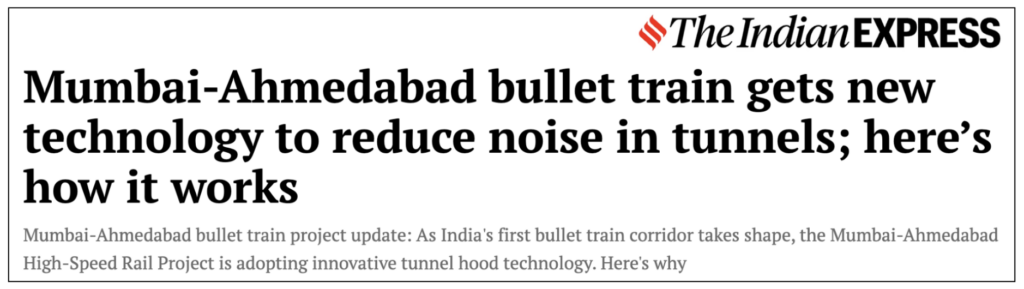
The Indian Express explained why the Mumbai-Ahmedabad High Speed Rail (MAHSR) corridor is fitting special tunnel hoods at its tunnel portals: at speeds near 320 km/h, a train piston-pushing air into a sealed tube generates a pressure shock that can burst out of the far end as a loud bang called the tunnel-boom.

The clarification matters because MAHSR is India’s first bullet-train project, built on Japanese Shinkansen technology with JICA financing, and includes the country’s first undersea rail tunnel near Mumbai – so the engineering choices being made now define how high-speed rail will be built across India’s railways.

  • Tunnel hoods: flared, vented hood structures bolted to tunnel mouths that let compressed air bleed out gradually, suppressing the micro-pressure wave (the sonic tunnel-boom) instead of releasing it as a single bang.
  • Why a boom forms: a train entering a tunnel at 320 km/h acts like a piston, compressing air ahead of it into a pressure pulse that travels down the bore and radiates as noise at the exit portal.
  • Project scale: The MAHSR corridor runs about 508 km with 12 stations, linking Mumbai (Maharashtra) and Ahmedabad (Gujarat) via Surat and Vadodara.
  • Undersea first: the alignment includes a roughly 21 km tunnel near Mumbai, of which about 7 km runs under the sea bed beneath Thane creek – India’s first undersea rail tunnel.
  • Implementing body: the National High Speed Rail Corporation Limited (NHSRCL), a special-purpose vehicle jointly owned by the Centre, Maharashtra and Gujarat, executes the corridor.
  • Speed design: trains are designed for operating speeds around 320 km/h and a design speed of about 350 km/h, far above conventional Indian railway speeds.

The development matters in the context of:

  • India-Japan cooperation: MAHSR is the flagship of bilateral infrastructure ties, using Shinkansen rolling stock and signalling with a long-tenor JICA soft loan.
  • Energy and emissions: high-speed electric rail offers a low-carbon alternative to short-haul flights and road travel on dense corridors.
  • Domestic capability: viaducts, tunnels and rolling-stock localisation under Make in India seed an Indian high-speed-rail engineering ecosystem.
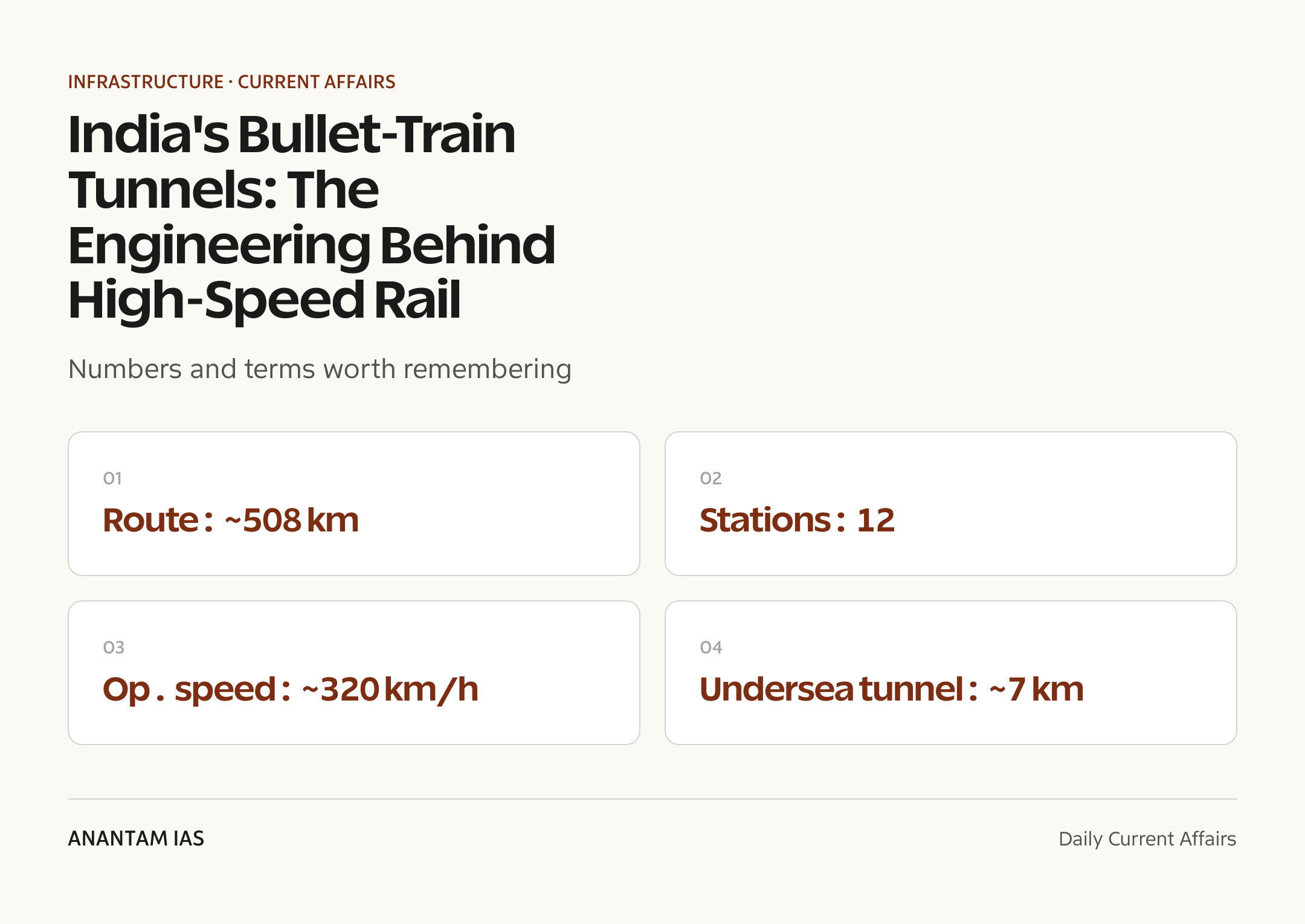
India's Bullet-Train Tunnels: The Engineering Behind High-Speed Rail — quick facts

UPSC Relevance

Prelims Relevance

  • Tunnel hood: a portal structure that suppresses the micro-pressure wave (tunnel-boom) by venting compressed air gradually.
  • Piston effect: the aerodynamic phenomenon by which a fast train pushes air through a tunnel like a piston.
  • MAHSR route: about 508 km, 12 stations, Mumbai to Ahmedabad via Surat and Vadodara.
  • Undersea tunnel: about 7 km of a 21 km tunnel runs under the sea near Mumbai – India’s first.
  • NHSRCL: the special-purpose vehicle implementing the project, jointly owned by the Union government and the two states.
  • Shinkansen: Japan’s high-speed rail system; E5 series trainsets are planned for India, with later E10 generation tech under discussion.
  • JICA: the Japan International Cooperation Agency, which funds the project through a concessional loan.
  • Operating speed: about 320 km/h, with a design speed near 350 km/h.
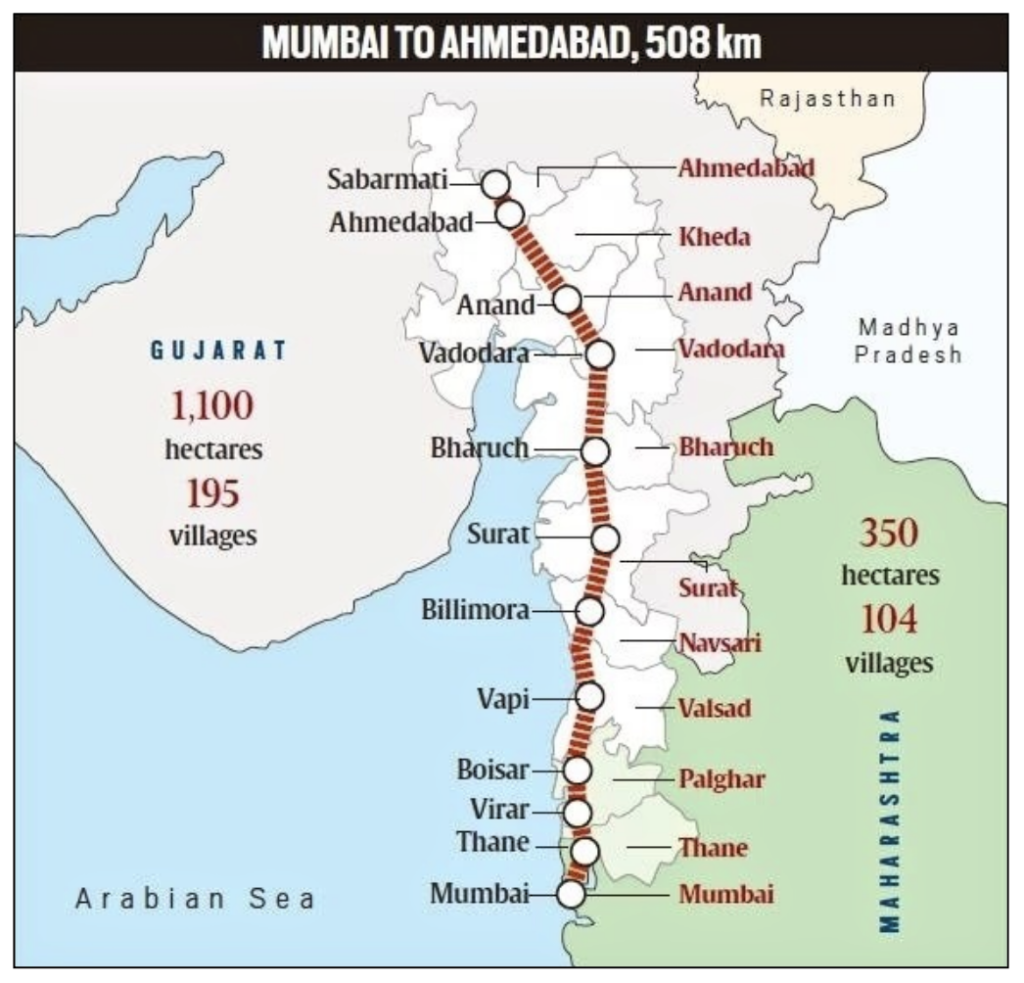
image 56

Mains Relevance

GS Paper 3

  • Infrastructure and growth: assess how high-speed rail reshapes intercity mobility, land use along corridors and regional economic geography.
  • Science and technology: explain the aerodynamics of tunnelling at high speed and the engineering of tunnel hoods, undersea boring and slab track.
  • Indigenisation: evaluate localisation of rolling stock, signalling and civil works under Make in India and the technology-transfer terms of foreign cooperation.
  • Project financing: discuss long-tenor concessional loans, cost-overrun risk and the fiscal trade-offs of capital-intensive megaprojects.

GS Paper 2

  • Bilateral cooperation: analyse India-Japan development partnership and the strategic logic of flagship connectivity projects.

Essay

  • Technology and nation-building: use the bullet-train corridor to argue how a single megaproject can transfer skills, set standards and seed an industry.
  • Speed versus sustainability: weigh the climate case for electric high-speed rail against the capital cost and land footprint of new corridors.

Background and Context

The tunnel-boom problem and how hoods fix it

The headline issue is aerodynamic: a very fast train turns a tunnel into a sealed air column that can fire a pressure pulse out the far end.

  • Piston effect: as a train enters at 320 km/h, it shoves the air ahead of it, forming a compression wave that races down the bore at the speed of sound.
  • Micro-pressure wave: when that wave reaches the exit portal it radiates outward as a sharp tunnel-boom – a sudden bang that can disturb residents and structures nearby.
  • Hood design: a tunnel hood is a perforated, gradually flared extension at the portal; vents let the compressed air escape progressively so the pressure rises slowly rather than all at once.
  • Net effect: spreading the pressure gradient over a longer length blunts the peak, cutting the boom’s intensity and the noise it throws into the surroundings.
  • Where it applies: hoods are added selectively at portals where speed, tunnel length and nearby habitation make the boom significant.
India's Bullet-Train Tunnels: The Engineering Behind High-Speed Rail — exam lens

The Mumbai-Ahmedabad corridor at a glance

MAHSR is the template project against which all later Indian high-speed corridors will be judged.

  • Route: about 508 km between Mumbai and Ahmedabad with 12 stations, passing Thane, Surat, Bharuch and Vadodara.
  • Speeds: operating speed around 320 km/h and design speed near 350 km/h, cutting travel time from hours to a couple of hours.
  • Alignment: largely elevated viaduct to limit land acquisition and avoid level crossings, with tunnel sections where terrain or the sea demand it.
  • Rolling stock: based on Japan’s Shinkansen E5 trainsets, with later E10-generation technology under discussion for future fleets.
  • Implementation: built by NHSRCL, a special-purpose vehicle jointly owned by the Union government, Maharashtra and Gujarat.

India’s first undersea rail tunnel

The Mumbai approach forced one of the project’s hardest engineering tasks – boring beneath the sea.

  • Length: a roughly 21 km tunnel near Mumbai, of which about 7 km runs under the seabed beneath Thane creek.
  • Method: large-diameter tunnel boring machines (TBMs) alongside the conventional New Austrian Tunnelling Method in rockier stretches.
  • Challenges: managing water ingress, ground settlement under dense urban areas, and ventilation and safety for a long single bore.
  • Significance: It is India’s first undersea rail tunnel, building domestic capability for future coastal and metro tunnelling, like the Kolkata underwater metro.
  • Aerodynamic link: long tunnels intensify the piston effect, which is exactly why portal hoods and cross-section design matter on this corridor.

Technology, financing and Make in India

The project is as much an economic and diplomatic instrument as an engineering one.

  • Shinkansen base: trains, signalling and operating practices draw on Japan’s high-speed system, prized for a decades-long record without a passenger fatality from derailment or collision.
  • JICA loan: the bulk of the cost is met by a long-tenor concessional loan from the Japan International Cooperation Agency, anchoring the project in the wider India-Japan partnership.
  • Localisation: civil works, viaduct segments, track and a growing share of components are made in India under Make in India, with technology transfer a stated goal.
  • Standards: the corridor sets Indian norms for slab track, ballastless permanent way, earthquake-detection systems and high-speed safety that future lines can reuse.
  • Skills: A new cadre of Indian engineers and technicians is being trained in high-speed civil, electrical and rolling-stock disciplines.

Why high-speed rail matters for India

Beyond the spectacle, the case rests on mobility, emissions and industrial spillovers.

  • Modal shift: on dense corridors, fast electric rail can absorb traffic that would otherwise go to short-haul flights or congested highways.
  • Low-carbon transport: electric high-speed rail is far less carbon-intensive per passenger-kilometre than air or road travel.
  • Economic corridors: stations can anchor real estate, logistics and services growth, knitting cities into a single labour market.
  • Industrial seeding: the engineering demands pull up domestic capability in tunnelling, precision civil works and rolling-stock manufacture.
  • Caveats: high capital cost, land acquisition friction and the need for high ridership to justify the investment temper the optimism.

Way Forward

Engineering and safety

  • Standardise tunnel-portal hood and cross-section design rules from MAHSR data so later corridors avoid retrofits.
  • Build domestic capacity in undersea and urban tunnelling, ventilation and high-speed track maintenance.
  • Institutionalise earthquake-detection, fire-safety and intrusion systems as mandatory high-speed-rail standards.

Localisation and ecosystem

  • Deepen technology transfer so Indian firms can design, not just assemble, future high-speed rolling stock and signalling.
  • Develop an indigenous supplier base for slab track, electrification and precision viaduct segments.
  • Create a permanent high-speed rail skilling pipeline through dedicated institutes and on-site training.

Financing and network planning

  • Sequence future corridors by projected ridership and economic density to protect viability.
  • Blend concessional foreign loans with domestic capital and value-capture from station-area development.
  • Integrate high-speed stations with metro, suburban rail and last-mile transit to maximise modal shift.

Conclusion

Small detail, big lesson: a tunnel hood is a modest structure, but it captures how high-speed rail forces India to solve problems – aerodynamics, undersea boring, precision civil works – it has never faced at this scale.

A template, not a one-off: the standards, skills and supplier base built on the Mumbai-Ahmedabad corridor will decide how fast and how cheaply India can roll out high-speed rail elsewhere.

Conditional payoff: the climate and mobility gains are real, but they depend on strong ridership, disciplined cost control and genuine technology transfer.

UPSC Practice Questions

Prelims MCQ 1

With reference to high-speed rail engineering, consider the following statements:

  1. A tunnel hood is fitted at a tunnel portal to suppress the micro-pressure wave generated by a fast-moving train.
  2. The tunnel-boom arises because a high-speed train compresses the air ahead of it like a piston.
  3. The Mumbai-Ahmedabad corridor includes India’s first undersea rail tunnel.

How many of the above statements are correct?

(a) Only one (b) Only two (c) All three (d) None

Answer: (c) All three

Explanation:

All three are correct. Tunnel hoods vent compressed air gradually to tame the micro-pressure wave; the boom is caused by the train’s piston effect on tunnel air; and the corridor’s roughly 21 km Mumbai tunnel includes about 7 km of undersea bore – India’s first.

Prelims MCQ 2

The Mumbai-Ahmedabad High Speed Rail project is being implemented with technical and financial cooperation primarily from which country?

(a) France (b) Germany (c) Japan (d) South Korea

Answer: (c) Japan

Explanation:

The corridor uses Japan’s Shinkansen technology and is financed largely by a concessional loan from the Japan International Cooperation Agency (JICA).

UPSC Mains Questions

  1. High-speed rail forces a country to master engineering problems it has never faced at scale. With reference to the Mumbai-Ahmedabad corridor, discuss the technological challenges – from tunnel aerodynamics to undersea boring – and their wider implications for Indian infrastructure.
  2. Evaluate high-speed rail as an instrument of low-carbon transport and industrial capability in India. What conditions must be met for such capital-intensive corridors to be economically and environmentally justified?
  3. Examine the role of foreign technology and concessional financing in India’s flagship infrastructure projects, using the bullet train corridor as a case study. How can such partnerships be structured to maximise genuine technology transfer?

Sources: National High Speed Rail Corporation Limited (NHSRCL) and The Indian Express (Explained, science and technology desk).

Frequently Asked Questions

What is a tunnel hood and why is it needed?

A tunnel hood is a flared, vented structure fitted at a tunnel mouth. When a bullet train enters a tunnel at high speed it compresses the air ahead of it, creating a pressure pulse that can burst out of the far portal as a loud bang called the tunnel-boom. The hood lets that compressed air escape gradually, smoothing the pressure rise and cutting the noise.

What causes the tunnel-boom?

It is caused by the piston effect. A train moving at about 320 km/h pushes the air in front of it down the sealed tunnel like a piston in a cylinder. This forms a compression wave that travels to the exit portal and radiates outward as a sharp micro-pressure wave, heard as a sudden boom.

How long is the Mumbai-Ahmedabad bullet-train route?

The corridor runs about 508 km between Mumbai and Ahmedabad with 12 stations, passing through Thane, Surat, Bharuch and Vadodara. Trains are designed to operate at around 320 km/h, sharply reducing travel time compared with conventional rail or road.

Does the project include an undersea tunnel?

Yes. The alignment near Mumbai includes a tunnel of about 21 km, of which roughly 7 km runs under the sea bed beneath Thane creek. It is India’s first undersea rail tunnel and is bored using tunnel boring machines and conventional tunnelling methods.

Which technology and funding does the project use?

The corridor is based on Japan’s Shinkansen high-speed rail technology, with E5-series trainsets planned and later-generation technology under discussion. Most of the cost is met by a long-tenor concessional loan from the Japan International Cooperation Agency, while civil works and components are increasingly made in India.

Why is high-speed rail important for India?

On dense intercity corridors it can shift travellers away from short-haul flights and congested highways, offering a low-carbon electric alternative. It also seeds domestic engineering capability in tunnelling, precision civil works and rolling-stock manufacture, and can anchor economic growth around stations – though high cost and the need for strong ridership remain real constraints.

Valuing a Homemaker’s Work: What the Supreme Court Said

Open article →Download PDF
image 57

Why in News?

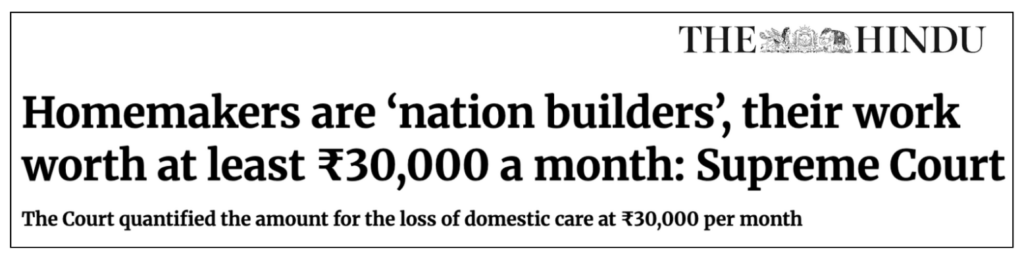
The Supreme Court of India has once more notionally quantified the economic value of a homemaker’s unpaid domestic labour while deciding a compensation claim under the Motor Vehicles Act, 1988.

The Court held that the work a non-earning spouse does at home carries real economic worth, comparable to that of a working spouse, and must be counted when fixing damages for the loss of a homemaker’s life.

The ruling, examined by The Hindu in its explainer on why the Court quantified the labour of homemakers, sits in a long line of judgments insisting that unpaid care work is not charity but a measurable economic contribution that the law and national accounts have long rendered invisible.

  • Decided in a motor-accident compensation appeal where the deceased was a homemaker with no salaried income.
  • The court rejected the idea that a homemaker’s notional income is negligible or zero.
  • Reaffirmed the reasoning of Kirti v. Oriental Insurance (2021), which directed tribunals to attribute a fair notional income to homemakers.
  • Linked the issue to constitutional values under Articles 14, 15 and 21 — equality, non-discrimination and dignity of life.
  • Flagged that the care economy remains outside the GDP production boundary and so is statistically erased.

The development matters in the context of:

  • Matters for crores of women whose full-time domestic and care work is unpaid and uncounted in national income.
  • Shapes how Motor Accident Claims Tribunals (MACTs) across India compute compensation, with direct money consequences for bereaved families.
  • Feeds the larger policy push to measure unpaid work through the Time Use Survey and to recognise the gendered division of labour.
Valuing a Homemaker's Work: What the Supreme Court Said — quick facts

UPSC Relevance

Prelims Relevance

  • Motor Vehicles Act, 1988 — basis for accident compensation and the ‘just compensation’ standard.
  • Kirti v. Oriental Insurance Co. (2021) — Supreme Court ruling on notional income of homemakers.
  • Notional income — imputed earnings assigned to a non-earning person for compensation.
  • GDP production boundary in the System of National Accounts — defines what counts as ‘economic’ output.
  • Time Use Survey (TUS) — conducted by the National Statistical Office (NSO), 2019 and 2024 rounds.
  • Constitutional articles invoked — Article 14 (equality), Article 15 (non-discrimination), Article 21 (life and dignity).
  • Unpaid care work and the ‘care economy’ as a development-economics concept.
  • Directive Principles — Article 39 on equal right to means of livelihood and equal pay.

Mains Relevance

GS Paper 1

  • Role of women and women’s organisations; the gendered division of unpaid domestic and care labour in Indian society.
  • Social empowerment and the recognition of women’s invisible work as a development issue.

GS Paper 2

  • Issues relating to the development and management of the social sector; mechanisms for the welfare and protection of vulnerable sections.
  • Role of the judiciary in advancing substantive equality and dignity through the interpretation of fundamental rights.

GS Paper 3

  • Measurement of unpaid work, the care economy, and its place in national income accounting and inclusive growth.

Essay

  • The invisible economy: what we do not count, we do not value.
  • Dignity of labour cannot stop at the household door.

Background and Context

What the Court actually held

The judgment treats a homemaker’s contribution as quantifiable economic value, not sentiment.

  • A homemaker’s services — cooking, cleaning, childcare, eldercare, household management — have a definite economic value that survives her death and must be compensated.
  • Where there is no proven income, tribunals must fix a fair notional income rather than treat it as nil.
  • The Court drew the analogy that replacing a homemaker’s labour in the market would cost a real wage, so its loss is a real financial loss to the family.
  • It rooted the reasoning in the ‘just compensation’ mandate of the Motor Vehicles Act, 1988 and in constitutional equality.

Key Legal Directives from the Judgment:

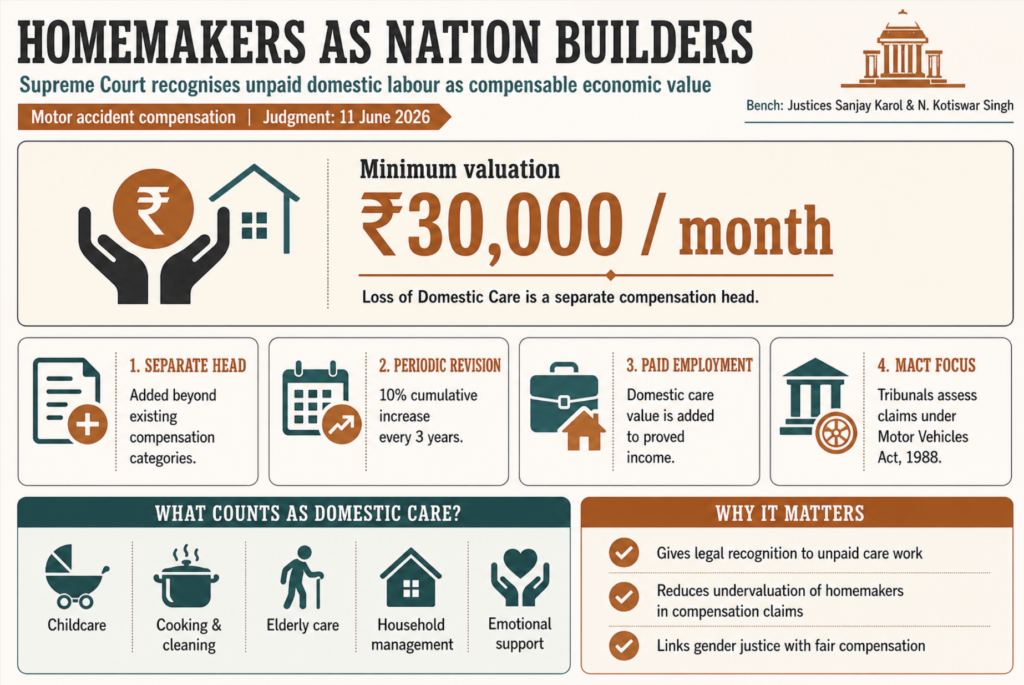
  • ₹30,000 Minimum Floor: Motor Accident Claims Tribunals must treat ₹30,000 per month as the baseline notional income for non-earning homemakers.
  • Inflation-Linked Revisions: The court directed that this baseline figure must automatically be revised upward by 10% cumulatively every three years.
  • Dual-Income Recognition: If a homemaker also holds a paid job, the ₹30,000 for “Loss of Domestic Care” will be paid in addition to her proven professional income.
  • Gender-Neutral Application: Though the case involved a deceased woman, the Court purposefully utilised the gender-neutral term “homemaker”, ensuring the precedent applies equally to male homemakers.
image 58
Valuing a Homemaker's Work: What the Supreme Court Said — exam lens

The Kirti line of cases

This ruling extends a settled judicial trend rather than breaking new ground.

  • Kirti v. Oriental Insurance (2021) held that assigning a low or zero income to homemakers is constitutionally suspect and socially regressive.
  • Earlier rulings, such as Arun Kumar Agrawal v. NIC (2010) and Lata Wadhwa v. State of Bihar (2001) had already pushed tribunals to value domestic work.
  • The courts have repeatedly criticised the practice of MACTs awarding token amounts for a homemaker’s death.
  • The consistent thread: unpaid domestic work is productive labour, and the law must price it fairly.

Why does housework sit outside GDP?

National accounts deliberately exclude most unpaid household production.

  • The System of National Accounts draws a production boundary that counts market output but excludes own-account domestic services like cooking and caregiving.
  • So a meal cooked at home adds nothing to GDP, while the same meal sold in a restaurant does — a statistical paradox feminist economists have long flagged.
  • The result is that the vast labour of mostly women is economically invisible in headline growth numbers, the core puzzle of the care economy.
  • Economists distinguish ‘productive’ from ‘reproductive’ labour, arguing that the latter sustains the entire workforce yet goes uncounted.

What does the data tell us?

India’s own surveys confirm a sharply gendered burden of unpaid work.

  • The Time Use Survey by the National Statistical Office shows women spending several hours a day on unpaid domestic and caregiving work, far more than men.
  • This unpaid burden depresses women’s participation in paid work — India’s female labour force participation rate has long been among the lowest of major economies.
  • International estimates have valued unpaid care work at a large share of global output, signalling its macroeconomic weight.
  • The gendered division of labour at home, not lack of ability, is a central reason women drop out of the formal workforce.

The constitutional anchor

The Court frames valuation as a question of equality and dignity, not just tort law.

  • Article 14 demands equal treatment — valuing a homemaker at zero treats her contribution as worthless (see the fundamental rights and articles).
  • Article 15 bars discrimination on grounds of sex, which a gender-blind devaluation of housework effectively perpetuates.
  • Article 21‘s guarantee of life with dignity extends to recognising the worth of a person’s life’s work.
  • The Directive Principles — Article 39 on equal pay and adequate livelihood — supply the moral backdrop for treating care work as labour.

Why is it contested?

Recognition is one thing; measurement and policy are harder.

  • Assigning a single notional income risks both undervaluing and over-standardising widely varying household work.
  • Some economists warn that monetising care work could distort the very relationships of love and obligation that sustain it.
  • There is no settled method to convert care work into wages — replacement-cost, opportunity-cost and market-substitute methods all give different figures.
  • Recognition in a courtroom does not automatically translate into social-security entitlements, pensions, or shared domestic responsibility at home.

Way Forward

Measure it

  • Institutionalise regular Time Use Surveys and publish a ‘satellite account’ that estimates the value of unpaid household work alongside GDP.
  • Use the data to inform welfare, pension and care-infrastructure policy.

Standardise compensation

  • Issue clear guidelines, so MACTs apply a consistent, dignified notional income for homemakers nationwide.
  • Train tribunal members and insurers to treat domestic work as a quantifiable loss.

Redistribute the burden

  • Expand public care infrastructure — creches, eldercare, affordable services — so unpaid work is lighter and shared.
  • Promote paternity leave and shared domestic responsibility to break the gendered division of labour.

Conclusion

By once again putting a number on a homemaker’s labour, the Supreme Court is doing more than fixing a compensation figure. It insists that work, which an entire economy depends on, cannot be priced at zero simply because no salary changes hands.

The harder task lies beyond the courtroom — counting unpaid care in national accounts, building care infrastructure, and sharing domestic work more equally. The judgment names the problem clearly; recognising its full economic weight is the unfinished agenda.

UPSC Practice Questions

Prelims MCQ 1

With reference to the valuation of a homemaker’s work in India, consider the following statements:

  1. The Supreme Court has held that a homemaker’s domestic labour has a quantifiable economic value for the purpose of compensation.
  2. Unpaid household services, such as cooking for one’s own family, are counted within the GDP production boundary.
  3. The Time Use Survey in India is conducted by the National Statistical Office.

How many of the above statements are correct?

(a) Only one (b) Only two (c) All three (d) None

Answer: (b) Only two

Explanation:

Statements 1 and 3 are correct. Statement 2 is wrong: own-account domestic services like home cooking lie OUTSIDE the GDP production boundary and are not counted in national income.

Prelims MCQ 2

Which of the following constitutional provisions is most directly invoked to argue that valuing a homemaker’s work at zero is impermissible?

(a) Article 14 (equality before law)

(b) Article 19 (freedom of speech and expression)

(c) Article 25 (freedom of religion)

(d) Article 32 (right to constitutional remedies)

Answer: (a) Article 14 (equality before law)

Explanation:

Courts root the recognition of unpaid domestic work in Articles 14, 15 and 21 — equality, non-discrimination on grounds of sex, and dignity of life. Article 14 is the most direct equality anchor.

UPSC Mains Questions

  1. Unpaid care work sustains the economy yet stays outside national income accounts. Critically examine why housework falls outside the GDP production boundary and what reforms could make this invisible labour visible. (250 words)
  2. The judiciary has repeatedly insisted on assigning economic value to a homemaker’s work. Discuss how this reflects the constitutional commitment to substantive equality and dignity, and the limits of judicial recognition in changing the gendered division of labour. (250 words)
  3. Examine the role of the care economy in India’s growth and women’s labour force participation. What policy measures can help recognise, reduce and redistribute unpaid care work? (150 words)

Sources: The Hindu and Supreme Court of India.

Frequently Asked Questions

Why did the Supreme Court value a homemaker’s work?

It was deciding a motor-accident compensation claim where the deceased was a homemaker with no salary. The Court held that domestic and care work has real economic value, so the family’s loss must be compensated using a fair notional income rather than treating that work as worth nothing.

What is notional income in this context?

Notional income is an imputed earning figure assigned to a person who has no proven salary, such as a homemaker or a non-earning spouse. Tribunals use it to calculate compensation under the Motor Vehicles Act, ensuring that the loss of unpaid domestic labour is given a realistic monetary value.

Why is housework not counted in GDP?

The System of National Accounts draws a production boundary that includes market output but excludes most unpaid services people produce for their own households, like cooking or childcare. So the same meal counts in GDP if sold in a restaurant but not if cooked at home, making unpaid domestic work statistically invisible.

What is the care economy?

The care economy covers all the paid and unpaid work of caring for people — children, the elderly, the sick — plus household maintenance. In India most of this is unpaid and done by women. It is essential to keeping the workforce healthy and productive, yet it is largely missing from headline economic measures.

What was the Kirti v. Oriental Insurance case?

In Kirti v. Oriental Insurance (2021) the Supreme Court ruled that assigning a low or zero income to homemakers in accident-compensation cases is unfair and discriminatory. It directed tribunals to recognise the economic worth of domestic work, and the current ruling continues this line of reasoning.

How does the Time Use Survey help?

The Time Use Survey, run by the National Statistical Office, records how people spend their day across paid and unpaid activities. Its data reveals how much more unpaid domestic and care work women do than men, providing the evidence base to measure the care economy and design fairer welfare and labour policies.

DRDO’s Ballistic Missile Defence Test: Building India’s Air-Defence Shield

Open article →Download PDF
image 59

Why in News?

The Defence Research and Development Organisation (DRDO) demonstrated a ballistic-missile-defence (BMD) interception capability— an indigenous interceptor engaging a simulated incoming missile in a controlled trial conducted from a launch complex off the eastern coast.

This is a home-grown interceptor, distinct from the imported S-400 Triumf and from offensive systems like the Agni family. BMD is about shooting down an enemy ballistic missile in flight, not launching one — a defensive, hit-to-kill capability that very few nations possess.

  • DRDO validated an interceptor missile against a target replicating an incoming ballistic-missile trajectory.
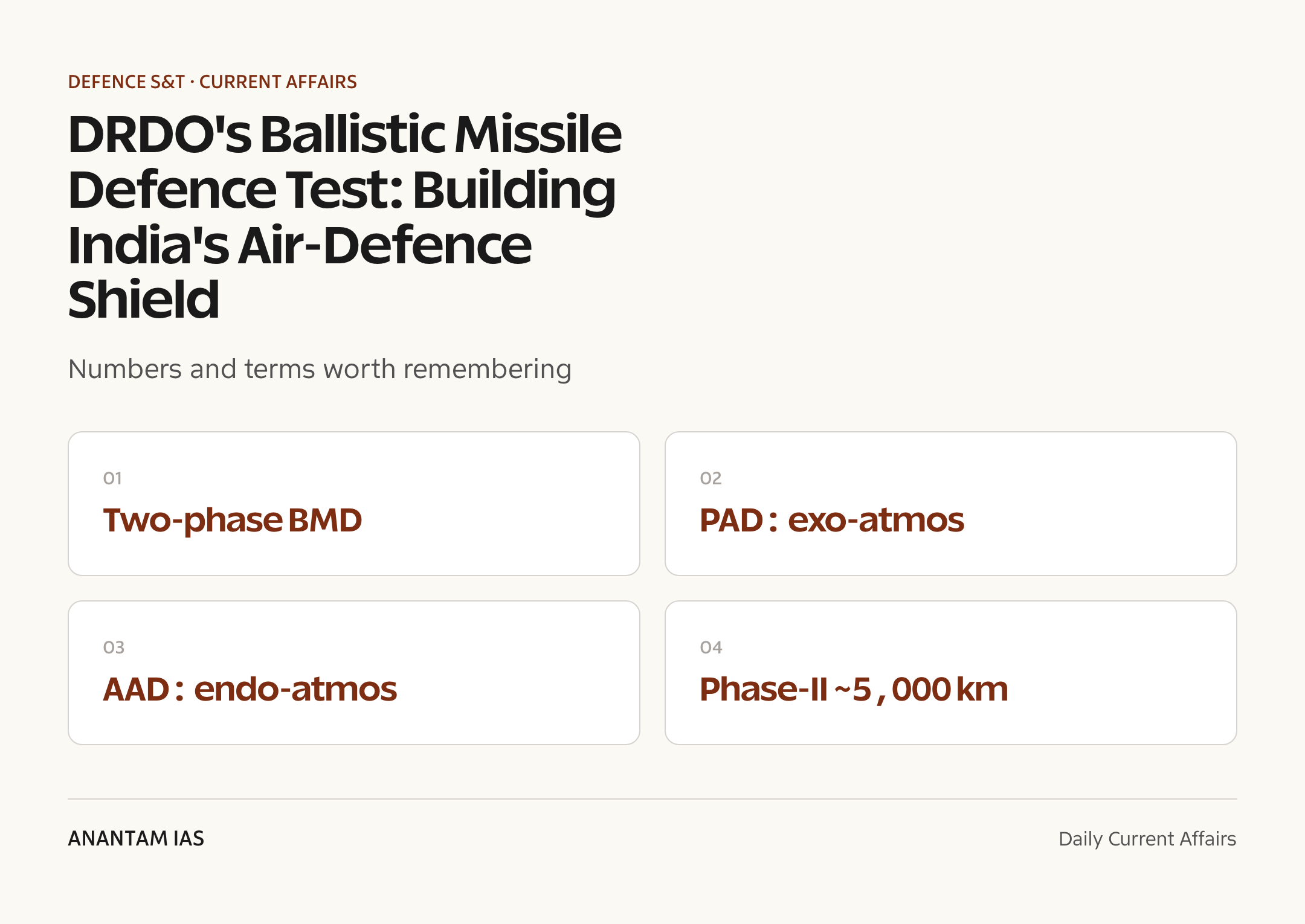
  • The test fits India’s two-phase BMD programme — Phase I (already proven against shorter-range threats) and the more capable Phase II (AD-1 / AD-2).
  • Phase-I pairs the Prithvi Air Defence (PAD) for high-altitude exo-atmospheric kills with the Advanced Air Defence (AAD) for lower endo-atmospheric intercepts.
  • Phase-II targets longer-range and Intermediate-Range Ballistic Missile (IRBM)-class threats out to roughly the 5,000 km band.
  • The capability feeds India’s emerging multi-tier shield concept under Mission Sudarshan Chakra, alongside the Army’s Akashteer air-defence control network.

The development matters in the context of:

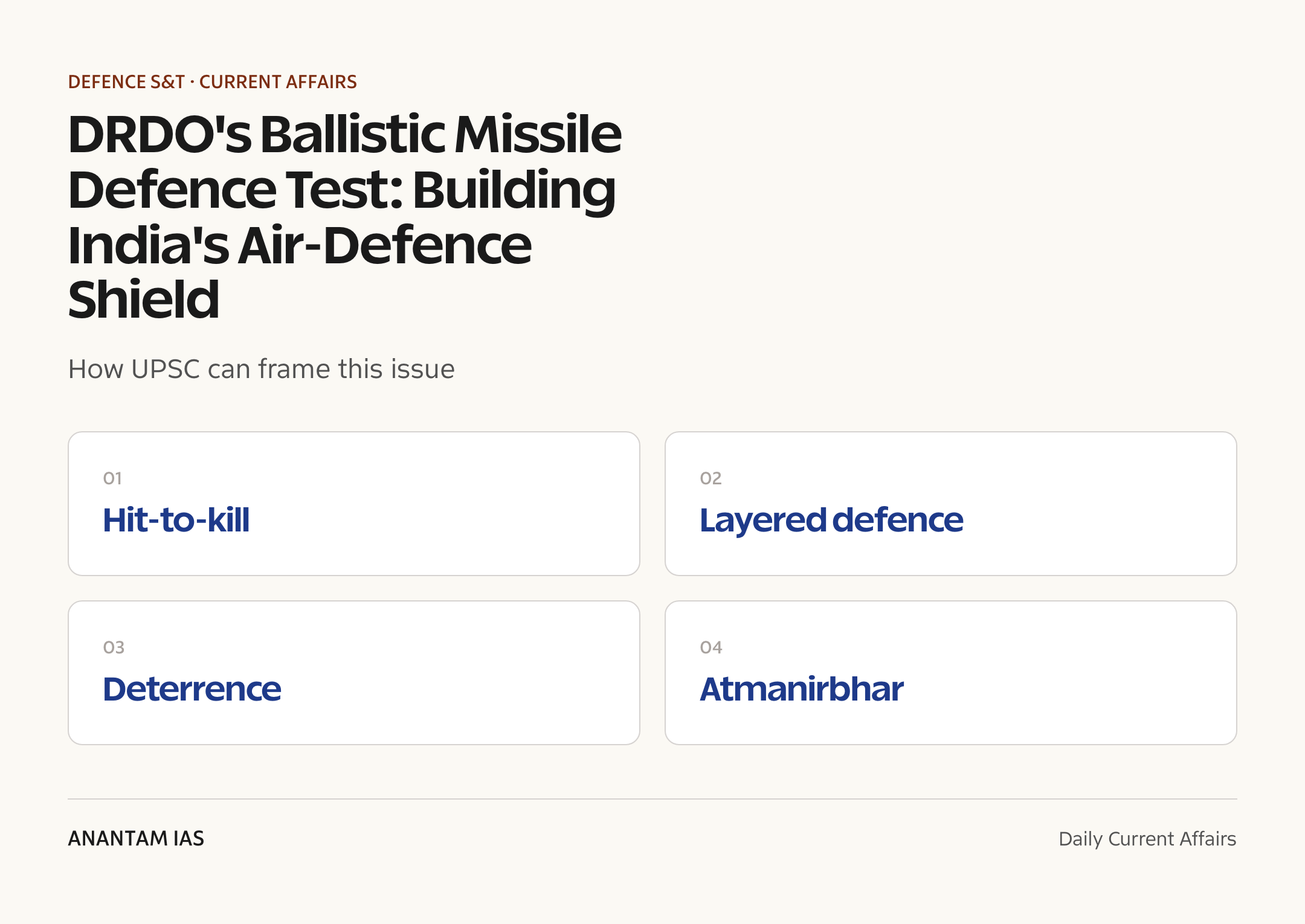
  • Matters because India faces ballistic-missile arsenals on two fronts, making credible missile defence central to strategic stability and deterrence.
  • Matters because BMD technology is tightly controlled by regimes like the Missile Technology Control Regime (MTCR), so indigenous mastery beats technology denial.
  • Matters because it pushes India toward self-reliance (Atmanirbharta) in the most demanding category of defence electronics and interception.
DRDO's Ballistic Missile Defence Test: Building India's Air-Defence Shield — quick facts

UPSC Relevance

Prelims Relevance

  • DRDO — R&D wing of the Ministry of Defence; BMD is a flagship programme.
  • Two-phase BMD: Phase I (PAD + AAD), Phase II (AD-1, AD-2).
  • PAD (Prithvi Air Defence) — exo-atmospheric interception (above ~50 km).
  • AAD (Advanced Air Defence) — endo-atmospheric interception (within the atmosphere).
  • Exo- vs endo-atmospheric: outside vs inside the atmosphere.
  • AD-1 / AD-2 — Phase-II interceptors for longer-range and IRBM-class threats.
  • Difference: Agni = offensive ballistic missile; BMD interceptor = defensive.
  • S-400 Triumf = imported Russian system; BMD = indigenous interception.
  • MTCR — export-control regime India joined in 2016.
  • Mission Sudarshan Chakra and Akashteer — integrated air-defence context.

Mains Relevance

GS Paper 3

  • Indigenous BMD as a marker of self-reliance in strategic technology and the role of DRDO.
  • Layered air defence: how interceptors, S-400, Akash and control networks fit a multi-tier shield.

GS Paper 2 / IR

  • Missile defence, deterrence and strategic stability in a two-front threat environment.
  • Technology-denial regimes (MTCR) versus indigenous mastery.

Essay

  • Self-reliance and security: can a nation buy deterrence, or must it build it?
  • Technology as the new currency of strategic autonomy.

Background and Context

What does ballistic missile defence actually do?

BMD is the art of hitting a bullet with a bullet — destroying an incoming warhead in flight.

  • A ballistic missile climbs on a rocket boost, coasts through space on a high arc, then falls on its target under gravity at hypersonic speed.
  • BMD intercepts it in one of three flight phases — boost, midcourse, or terminal — ideally before re-entry.
  • The interceptor uses radar tracking, a command-and-control chain and a fast kill vehicle to close the gap in seconds.
  • Most modern interceptions are hit-to-kill — destroying the target by direct collision rather than a blast — demanding extreme accuracy.
  • It is one of the hardest defence problems on earth: tiny reaction windows, decoys, and warheads arriving at several kilometres per second.
DRDO's Ballistic Missile Defence Test: Building India's Air-Defence Shield — exam lens

Exo- versus endo-atmospheric interception

The shield works in two layers — one above the atmosphere, one inside it.

  • Exo-atmospheric interception happens in space, typically above roughly 50 km, where there is no air drag.
  • Endo-atmospheric interception happens within the atmosphere, lower down, as the warhead re-enters — a last line of defence.
  • India’s PAD handles the high, exo-atmospheric kill; the AAD handles the lower, endo-atmospheric kill.
  • Two layers raise the kill probability — if the upper shot misses, the lower interceptor gets a second attempt.
  • This two-tier logic mirrors global systems and underpins the idea of a layered air defence.

India’s two-phase BMD programme

DRDO structured the programme in two phases of rising range and capability.

  • Phase-I targets shorter-range ballistic-missile threats and combines PAD (exo) with AAD (endo); both have been flight-proven over repeated trials.
  • Phase-II raises the bar to Intermediate-Range Ballistic Missile (IRBM)-class threats in roughly the 5,000 km band.
  • Phase-II rests on the AD-1 and AD-2 interceptors designed for both endo- and exo-atmospheric engagements.
  • The programme’s roots trace to lessons from the Integrated Guided Missile Development Programme (IGMDP) launched under A.P.J. Abdul Kalam.
  • Success here makes India one of a handful of states — alongside the United States, Russia and Israel — with a credible indigenous BMD.

Defence, not offence — and not imported

Three categories often get confused; the distinction is the whole point of this test.

  • The Agni and other offensive ballistic missiles are launched at an adversary — they are the threat BMD is built to stop.
  • The S-400 Triumf is a capable but imported Russian air-defence system covering aircraft, cruise missiles and some ballistic threats.
  • The DRDO interceptor is indigenous — designed, built and validated in India, reducing dependence and sanction risk.
  • Cruise missiles (like BrahMos) fly low and powered throughout; ballistic missiles arc through space — each needs a different defensive answer.
  • Indigenous BMD complements, rather than replaces, imported and point-defence systems in a layered grid.

Deterrence, technology denial and strategic stability

A working shield changes the strategic maths between rivals.

  • Credible missile defence strengthens deterrence by denial — an adversary cannot be sure its strike will land.
  • But it can also unsettle strategic stability: rivals may build more missiles or decoys to overwhelm the shield (the offence-defence spiral).
  • BMD electronics, seekers and propulsion fall under export curbs like the MTCR, so India had to develop them indigenously.
  • India is a member of the MTCR (since 2016), which also eases access to high-end dual-use technology.
  • Mastering BMD signals strategic autonomy and feeds India’s broader Atmanirbhar Bharat defence push.

How does it fit the wider air-defence shield?

BMD is one tier of an integrated, networked defence being assembled.

  • India’s layered air defence stacks long-range (S-400), medium-range (Akash, Barak-8) and BMD interceptors against different threats and altitudes.
  • The Army’s Akashteer automated control system fuses radar feeds to manage the airspace and direct the right weapon.
  • Mission Sudarshan Chakra envisions a national integrated air-defence shield knitting these elements together by the next decade.
  • Effective BMD also rests on the detection layer — long-range tracking radars and early-warning sensors feeding the kill chain.
  • The goal is a single, networked grid where sensors, command nodes and interceptors act as one system.

Way Forward

Mature and induct

  • Move Phase-II AD-1 / AD-2 from trials to series production and induction with repeatable, multi-target validation.
  • Build numbers and stockpile depth so the shield can absorb saturation and decoy attacks, not just single shots.

Integrate and network

  • Knit BMD into Akashteer and Mission Sudarshan Chakra so radars, command nodes and interceptors operate as one fused grid.
  • Strengthen the early-warning sensor chain — long-range radars and space-based detection — to widen the reaction window.

Sustain the ecosystem

  • Deepen private-industry and startup participation (via routes like iDEX) for seekers, propulsion and electronics.
  • Keep strategic-stability diplomacy alive so missile defence does not trigger a destabilising arms build-up.

Conclusion

An indigenous BMD interception is more than a successful trial — it is proof that India can build, not just buy, the hardest category of strategic defence. It moves the country into a small club of nations able to credibly attempt to stop an incoming ballistic missile.

The harder work lies ahead: turning a validated interceptor into a deployed, networked, multi-tier shield that holds up against decoys and salvos, while managing the deterrence dynamics a shield inevitably sets in motion.

UPSC Practice Questions

Prelims MCQ 1

With reference to India’s ballistic-missile-defence (BMD) programme, consider the following statements:

  1. Phase-I combines the Prithvi Air Defence (PAD) for exo-atmospheric interception with the Advanced Air Defence (AAD) for endo-atmospheric interception.
  2. Phase-II is designed to counter Intermediate-Range Ballistic Missile (IRBM)-class threats.
  3. The S-400 Triumf is the indigenous interceptor at the core of the BMD programme.

How many of the above statements are correct?

(a) Only one (b) Only two (c) All three (d) None

Answer: (b) Only two

Explanation:

Statements 1 and 2 are correct. Statement 3 is wrong — the S-400 Triumf is an imported Russian system, not the indigenous BMD interceptor; India’s BMD rests on PAD/AAD (Phase-I) and AD-1/AD-2 (Phase-II).

Prelims MCQ 2

Endo-atmospheric interception in a ballistic-missile-defence system refers to destroying the incoming missile:

(a) outside the earth’s atmosphere, in space (b) within the earth’s atmosphere, at lower altitude (c) during its powered boost phase only (d) before it is launched, on the ground

Answer: (b) within the earth’s atmosphere, at lower altitude

Explanation:

Endo-atmospheric interception occurs inside the atmosphere as the warhead re-enters; exo-atmospheric interception occurs above the atmosphere (roughly above 50 km). India’s AAD is the endo-atmospheric layer, PAD the exo-atmospheric one.

UPSC Mains Questions

  1. India’s ballistic-missile-defence programme reflects a shift from buying to building strategic capability. Examine the design of India’s two-phase BMD and the strategic significance of indigenous interception. (250 words)
  2. Discuss how a layered air-defence shield is constructed, and analyse the place of indigenous BMD interceptors within it alongside imported and point-defence systems. (150 words)
  3. Missile defence can strengthen deterrence yet unsettle strategic stability. Critically analyse this tension in the context of India’s security environment. (250 words)

Sources: Indian Express and DRDO, Ministry of Defence.

Frequently Asked Questions

What is ballistic missile defence (BMD)?

BMD is a defensive system that detects, tracks and destroys an incoming ballistic missile in flight before it reaches its target. It uses radars, a command-and-control chain and a fast interceptor that strikes the warhead — usually by direct collision (hit-to-kill). It is among the hardest problems in defence because warheads arrive at hypersonic speed within very short reaction windows.

How is India’s BMD different from the Agni missiles?

The Agni family are offensive ballistic missiles meant to be launched at an adversary. A BMD interceptor is the opposite — it is fired to shoot down an incoming enemy missile. One delivers a strike; the other defends against one. Both are DRDO products, but they sit on opposite sides of the offence-defence divide.

Is India’s BMD the same as the S-400?

No. The S-400 Triumf is an imported Russian air-defence system that India bought. The BMD interceptor is indigenous — designed and built in India by DRDO. They complement each other in a layered shield, but indigenous BMD reduces dependence on foreign suppliers and the risk of sanctions or supply disruption.

What is the difference between exo- and endo-atmospheric interception?

Exo-atmospheric interception happens above the atmosphere, in space (roughly above 50 km), where there is no air drag — India’s PAD handles this. Endo-atmospheric interception happens lower down, inside the atmosphere, as the warhead re-enters — India’s AAD handles this. Using both layers raises the chance of a successful kill.

What are Phase-I and Phase-II of the programme?

Phase-I targets shorter-range ballistic-missile threats and pairs the exo-atmospheric PAD with the endo-atmospheric AAD; both are flight-proven. Phase-II is more ambitious, designed to counter longer-range, IRBM-class threats in roughly the 5,000 km band, built around the AD-1 and AD-2 interceptors for both endo- and exo-atmospheric engagements.

Why does an indigenous BMD test matter for UPSC?

It links several syllabus threads — defence S&T, self-reliance (Atmanirbhar Bharat), layered air defence, deterrence and strategic stability, and technology-denial regimes like the MTCR. It also places India among the few nations with a credible indigenous capability to intercept ballistic missiles, a recurring theme in GS Paper 3 and security questions.

First NDA Women Cadets Commissioned: A Milestone for Women in Uniform

Open article →Download PDF

Why in News?

The Indian Express reported that the first batch of women cadets trained at the National Defence Academy (NDA), Khadakwasla, has been commissioned as officers. They are the maiden cohort to enter the tri-service academy through the regular cadet route rather than the short-service or specialist streams that women had used earlier.

Their commissioning closes a loop opened in August 2021, when the Supreme Court directed that women be allowed to sit the NDA entrance examination, ending a decades-old bar that had reserved the academy for male cadets.

  • The cohort cleared the UPSC-conducted NDA & NA examination, the SSB interview (see our NDA exam guide), and roughly three years of training at Khadakwasla before pre-commission training at the respective service academies.
  • Women were first admitted to the NDA in the 2022 (148th course) intake after the 2021 interim order; this batch reflects that pipeline maturing into commissioned officers.
  • Cadets are commissioned into the Army, Navy and Air Force, the same tri-service split the NDA has always fed.
  • The development builds on the Babita Puniya (2020) ruling on Permanent Commission for women in the Army.

The development matters in the context of:

  • Why this matters for gender integration: regular-cadet entry signals women are being inducted into the core officer pipeline, not a parallel track.
  • Why this matters for equality jurisprudence: the change flowed from constitutional litigation under the fundamental rights in Articles 14, 15 and 16, not from policy alone.
First NDA Women Cadets Commissioned: A Milestone for Women in Uniform — quick facts

UPSC Relevance

Prelims Relevance

  • National Defence Academy (NDA) — tri-service academy at Khadakwasla, Pune; feeds Army, Navy, Air Force.
  • The NDA & NA examination is conducted by the UPSC, twice a year.
  • Kush Kalra v. Union of India (2021) — Supreme Court interim order admitting women to the NDA exam.
  • Secretary, Ministry of Defence v. Babita Puniya (2020) — Permanent Commission for women Army officers.
  • Article 14 (equality before law), Article 15 (no discrimination on sex), Article 16 (equal opportunity in public employment).
  • Short Service Commission (SSC) vs Permanent Commission (PC) — tenure and pension distinction.
  • Indian Military Academy (IMA), Dehradun; OTA Chennai; Indian Naval Academy, Ezhimala; Air Force Academy, Dundigal — pre-commission training institutions.
  • Article 33 — Parliament may restrict fundamental rights of armed-forces members for discipline.

Mains Relevance

GS Paper 1

  • Role of women and women’s organisations; social barriers to women in non-traditional, hierarchical institutions.
  • Changing status of women in India and the symbolism of access to combat-arms careers.

GS Paper 2

  • Judicial review and the role of the Supreme Court in advancing substantive equality in state employment.
  • Government policies on gender inclusion in the armed forces and their implementation challenges.

Essay

  • If development is not engendered, it is endangered — equal access to institutions of the state.
  • Equality is not sameness: dismantling structural barriers versus formal non-discrimination.

Background and Context

The Supreme Court's 2021 NDA order

The opening of the academy was a court-driven reform, not an executive initiative.

  • In Kush Kalra v. Union of India (2021), the Supreme Court passed an interim order permitting eligible women to write the NDA entrance examination, calling the exclusion a matter of policy inertia rather than operational necessity.
  • The bench observed that the bar rested on a gender stereotype and was inconsistent with the constitutional guarantee of equal opportunity.
  • Following the order, the UPSC opened the exam to women from the November 2021 sitting, and the first women cadets joined the 148th course (2022).
  • The Centre later confirmed permanent induction of women through the NDA route rather than treating the order as a one-time concession.
First NDA Women Cadets Commissioned: A Milestone for Women in Uniform — exam lens

From Babita Puniya to permanent commission

The NDA verdict sits on a chain of rulings that progressively widened women’s service in the forces.

  • Secretary, Ministry of Defence v. Babita Puniya (2020) held that women SSC officers in the Army were entitled to Permanent Commission on par with men, rejecting arguments based on physiological limitations.
  • A companion judgment extended Permanent Commission to women officers in the Indian Navy.
  • The Court rejected blanket claims that troops would not accept women in command, terming such reasoning discriminatory.
  • These rulings reframed the debate from whether women can serve to how the institution must adapt its structures to include them.

How the officer pipeline now works

Entry routes for women officers have widened across both the cadet and direct-entry streams.

  • The NDA route is the youngest entry point, taking candidates straight after Class 12 for around three years of integrated training before service academies.
  • Women already entered as officers via OTA Chennai (Short Service Commission) and specialist branches such as medical, legal, education and engineering.
  • The 2024-2025 period saw women clear training and join arms previously closed to them, including Artillery and aviation streams.
  • The Agnipath scheme also opened recruitment of women in some non-officer roles such as the Agniveer (Naval) entry.

The combat-role debate

Access to the academy reopens the older question of women in front-line combat arms.

  • India inducts women across combat-support and combat-enabler roles, with phased entry into combat arms like Artillery still expanding.
  • Debate continues on infantry and armoured postings, where critics cite logistics, prisoner-of-war risk and unit cohesion, and supporters cite merit and equal opportunity.
  • The Indian Air Force has commissioned women fighter pilots since 2016, showing combat roles are not categorically barred.
  • The constitutional principle established is that exclusion must be justified by genuine operational need, not assumption.

Constitutional and equality dimension

The milestone is best read through the lens of substantive equality, not mere formal access.

  • Article 14 guarantees equality before the law; Article 15(1) bars discrimination on grounds of sex; Article 16 guarantees equal opportunity in public employment (read more on Articles 15 and 16).
  • Courts have moved from formal equality (same rules) toward substantive equality (removing structural barriers that disadvantage women).
  • Article 33 lets Parliament curtail some fundamental rights of forces personnel for discipline, but it does not authorise blanket gender exclusion from entry.
  • The reform aligns with India’s commitments under the Convention on the Elimination of All Forms of Discrimination Against Women (CEDAW).

Why it matters beyond the parade ground

The significance is symbolic, institutional and developmental at once.

  • It expands the aspirational horizon for young women and challenges occupational stereotypes early, at the school-leaving stage.
  • It pressures the forces to invest in infrastructure — accommodation, equipment fit and posting policies — designed for a mixed cadre.
  • It feeds the broader push for women’s leadership in hierarchical state institutions, complementing the wider agenda of women’s empowerment in India.
  • It demonstrates the judiciary’s role as a catalyst when policy lags behind constitutional values.

Way Forward

Build for a mixed cadre

  • Standardise gender-neutral infrastructure, equipment fit and accommodation across academies and field units.
  • Set transparent, role-based physical standards rather than across-the-board exclusions.

Widen the pipeline and track outcomes

  • Phase in remaining combat-arms openings with clear, reviewable criteria.
  • Publish data on intake, retention and command appointments so progress is measurable, not anecdotal.

Pair structural reform with cultural change inside units, so integration is owned by the institution and not seen as a court-imposed mandate.

Conclusion

The commissioning of the first NDA-trained women officers marks the point where a constitutional promise became an operational reality. What began as litigation under the equality guarantees has produced officers entering the core tri-service pipeline.

The harder work now is institutional: building units, postings and a service culture that treat a mixed officer corps as the norm. Done well, the milestone becomes a baseline rather than a headline.

UPSC Practice Questions

Prelims MCQ 1

With reference to the entry of women into the armed forces, consider the following statements:

  1. The National Defence Academy & Naval Academy Examination is conducted by the Union Public Service Commission.
  2. Women were permitted to write the NDA entrance examination following a Supreme Court order in 2021.
  3. The Babita Puniya case (2020) dealt with Permanent Commission for women officers in the Indian Army.

How many of the above statements are correct?

(a) Only one (b) Only two (c) All three (d) None

Answer: (c) All three

Explanation:

The UPSC conducts the NDA & NA exam. The 2021 Supreme Court order (Kush Kalra) opened the exam to women, and the 2020 Babita Puniya verdict addressed Permanent Commission for women Army officers. All three are correct.

Prelims MCQ 2

Which of the following constitutional provisions is most directly invoked against the gender-based exclusion of women from a public-employment entry examination?

(a) Article 19 — freedom of speech and expression (b) Article 16 — equality of opportunity in public employment (c) Article 21 — protection of life and personal liberty (d) Article 25 — freedom of conscience and religion

Answer: (b) Article 16 — equality of opportunity in public employment

Explanation:

Article 16 guarantees equal opportunity in matters of public employment and bars discrimination on grounds including sex, making it the most directly relevant provision, read with Articles 14 and 15.

UPSC Mains Questions

  1. The induction of women into the National Defence Academy has been described as a court-driven reform. Examine how the judiciary has advanced substantive equality for women in the armed forces, and discuss the institutional challenges that remain. (250 words)
  2. Access is not the same as integration. Critically analyse the social and structural barriers to women’s full participation in India’s armed forces, with reference to the combat-role debate. (250 words)
  3. Discuss the evolution of women’s service in the Indian armed forces from short-service entry to permanent commission and cadet-route induction, and assess its significance for gender equality. (150 words)

Sources: Indian Express and Supreme Court of India.

Frequently Asked Questions

What is the National Defence Academy?

The National Defence Academy (NDA) is India’s tri-service academy at Khadakwasla near Pune, where cadets for the Army, Navy and Air Force train together after Class 12. The roughly three-year course is followed by pre-commission training at the respective service academies before officers are commissioned.

When were women allowed to take the NDA exam?

Women became eligible to write the NDA entrance examination after an interim Supreme Court order in August 2021 in the Kush Kalra case. The UPSC opened the exam to women from the November 2021 sitting, and the first women cadets joined the academy in the 2022 intake.

What was the Babita Puniya case about?

Secretary, Ministry of Defence v. Babita Puniya (2020) was a Supreme Court verdict holding that women Short Service Commission officers in the Army were entitled to Permanent Commission on the same terms as men. The Court rejected arguments based on physiological limits and stereotypes about command.

Can women serve in combat roles in India?

Women already serve across many combat-support and enabler roles, and the Air Force has commissioned women fighter pilots since 2016. Entry into combat arms such as Artillery has been expanding, while postings in infantry and armoured corps remain part of an ongoing, phased debate.

Which constitutional articles support women’s entry into the forces?

The reform rests on Article 14 (equality before law), Article 15 (no discrimination on grounds of sex) and Article 16 (equal opportunity in public employment). Courts have used these to move from formal non-discrimination toward substantive equality that removes structural barriers.

Who conducts the NDA examination?

The Union Public Service Commission (UPSC) conducts the NDA & Naval Academy examination twice a year. Candidates who clear the written exam face the Services Selection Board (SSB) interview and a medical examination before selection for training at the academy.

Draft Broadcast Rules: Content, Security Clearance and Free Speech

Open article →Download PDF

Why in News?

The Ministry of Information and Broadcasting has floated draft rules for television and radio that, as reported by The Indian Express, would oblige broadcasters to carry “content of national importance”, seek security clearance for persons in key positions, and submit to tighter content oversight. The proposals sit within the broadcast-regulation architecture built on the Cable Television Networks (Regulation) Act, 1995 and the long-pending move toward a unified broadcasting law.

The top-line concern is constitutional: any state direction on what a broadcaster must air, and any vetting of who runs a channel, engages the right to free speech under Article 19(1)(a) and the closed list of Article 19(2) reasonable restrictions. Critics read the draft as a shift from self-regulation toward direct executive control over the airwaves.

  • Draft rules would mandate periodic telecast of content of national importance and public-service themes, echoing the old DD/All India Radio public-broadcasting obligation.
  • Security clearance would be required for individuals holding key managerial and editorial posts in broadcasting entities.
  • Content oversight is tightened through a layered grievance and compliance mechanism, with the Ministry retaining final powers.
  • The framework draws on the Cable Television Networks (Regulation) Act, 1995 and its Programme Code as the legal backbone.
  • It revives debate over the stalled Broadcasting Services (Regulation) Bill, twice circulated and then withdrawn after pushback.

The development matters in the context of:

  • Matters because it tests the line between legitimate regulation and unconstitutional prior restraint on speech.
  • Matters because the airwaves are public property held in trust by the State, per the Supreme Court’s 1995 cricket-telecast ruling.
  • Matters because vague phrases like “national importance” raise the chilling-effect and vagueness concerns flagged in Shreya Singhal.
Draft Broadcast Rules: Content, Security Clearance and Free Speech — quick facts

UPSC Relevance

Prelims Relevance

  • Article 19(1)(a) — freedom of speech and expression, includes the right to broadcast
  • Article 19(2) — eight grounds for reasonable restrictions (sovereignty, security, public order, decency, etc.)
  • Cable Television Networks (Regulation) Act, 1995 — Programme Code and Advertising Code
  • Prasar Bharati Act, 1990 — autonomy of Doordarshan and All India Radio
  • Secretary, Ministry of I&B vs Cricket Association of Bengal (1995) — airwaves are public property
  • Shreya Singhal vs Union of India (2015) — vagueness and chilling effect, Section 66A struck down
  • Broadcasting Services (Regulation) Bill — proposed unified law, not enacted
  • Self-regulation bodies — NBDSA, BCCC and the IT Rules 2021 three-tier model
  • TRAI — recommendatory role on broadcasting and carriage
  • Article 19(3) of ICCPR — international free-expression standard India is party to

Mains Relevance

GS Paper 2

  • Examine whether mandating ‘content of national importance’ on private broadcasters is a reasonable restriction under Article 19(2) or an impermissible prior restraint.
  • Discuss the trade-off between statutory content regulation and broadcaster autonomy in a democracy.

GS Paper 2

  • Evaluate the case for an independent broadcast regulator versus ministry-led control of the airwaves.

Essay

  • A free press is the oxygen of democracy; regulation must not become rationing.
  • Who guards the airwaves: the State, the market, or the citizen?

Background and Context

What the draft proposes

The rules bundle three distinct levers — mandated content, personnel vetting, and tighter oversight — into one framework.

  • Broadcasters would be required to telecast content of national importance and public-interest programming for a prescribed duration, mirroring the public-service mandate long carried by Doordarshan and All India Radio.
  • Persons appointed to key positions — senior management and editorial control — would need security clearance from the government before or during their tenure.
  • A layered content-oversight structure would route complaints through self-regulation and statutory tiers, with the Ministry of Information and Broadcasting retaining residual powers.
  • The draft leans on the Cable Television Networks (Regulation) Act, 1995, whose Programme Code already prohibits content offending good taste, decency, or public order.
  • The proposals are widely read as a step toward the unified broadcasting law the Ministry has tried to enact since 2023.
Draft Broadcast Rules: Content, Security Clearance and Free Speech — exam lens

The constitutional anchor: Article 19(1)(a) and 19(2)

Broadcasting is protected speech, so any state direction must clear the narrow gate of reasonable restrictions.

  • Article 19(1)(a) guarantees freedom of speech and expression, which the Supreme Court has held to include the right to receive and impart information through broadcast media — see our explainer on Article 19 and the freedoms it protects.
  • Restrictions are valid only if they fall within the eight enumerated grounds of Article 19(2) — sovereignty and integrity, security of the State, public order, decency or morality, contempt of court, defamation, incitement, and friendly relations with foreign states; these sit within the broader scheme of fundamental rights.
  • A restriction must also be reasonable and proportionate; a blanket duty to air state-defined content sits uneasily with this test.
  • Compelling a broadcaster to carry particular programming raises the question of compelled speech, the converse of the right to remain silent.
  • The vagueness of “national importance” invites the chilling-effect objection — speakers self-censor when the boundary is unclear.

How India regulates broadcasting today

The current regime is a patchwork of one old statute, a public-broadcaster law, and industry self-regulation.

  • The Cable Television Networks (Regulation) Act, 1995 is the principal statute, enforcing the Programme Code and Advertising Code on cable and satellite channels.
  • The Prasar Bharati Act, 1990 created an autonomous corporation to insulate Doordarshan and All India Radio from direct government control.
  • Private news television relies on self-regulation through bodies like the News Broadcasting and Digital Standards Authority (NBDSA) and the Broadcasting Content Complaints Council (BCCC) for general entertainment.
  • The IT Rules, 2021 introduced a three-tier grievance model for digital media, a template the broadcast draft partly echoes.
  • TRAI advises on carriage, tariff, and interconnection but has no content-regulation mandate.

Airwaves as public trust: the doctrinal foundation

The State’s regulatory claim rests on a landmark ruling that the spectrum belongs to the public.

  • In Secretary, Ministry of I&B vs Cricket Association of Bengal (1995), the Supreme Court held that airwaves are public property and must be used to serve the public good and plurality of views.
  • The judgment recognised the citizen’s right to diverse sources of information, justifying a fair allocation of spectrum but not state monopoly over content.
  • It is the doctrinal basis for an independent regulator to manage scarce spectrum, a recommendation never fully implemented.
  • The same ruling cautions against using the public-trust rationale to monopolise or homogenise broadcast speech.
  • Personnel vetting via security clearance revives memories of licensing-era gatekeeping that the Court warned against.

Free-speech jurisprudence and the vagueness problem

Courts have repeatedly struck down open-ended speech curbs for failing the clarity and proportionality tests.

  • In Shreya Singhal vs Union of India (2015), the Supreme Court struck down Section 66A of the IT Act as vague and overbroad, holding that imprecise speech offences chill protected expression.
  • The Court distinguished advocacy from incitement, narrowing the State’s power to penalise content that merely annoys or offends.
  • Open-ended terms like “content of national importance” risk the same fate absent precise, justiciable definition.
  • Earlier, Bennett Coleman vs Union of India (1973) rejected newsprint controls that indirectly throttled press freedom — a caution against indirect content steering.
  • International benchmarks under Article 19(3) of the ICCPR require restrictions to be provided by law, necessary, and proportionate.

Self-regulation versus statutory control: the core tension

The draft reopens a decade-long contest over who should police broadcast content.

  • Industry favours self-regulation, arguing that government content-vetting invites political misuse and undermines editorial independence.
  • The government argues statutory backing is needed because self-regulatory bodies lack enforcement teeth and consistency.
  • The withdrawn Broadcasting Services (Regulation) Bill drew criticism for sweeping definitions that could pull independent creators and OTT into a licensing net.
  • A security-clearance requirement for editorial leadership concentrates discretion in the executive, with limited appeal, straining the separation of powers between regulator and the regulated.
  • The unresolved question is whether India will create a genuinely independent regulator or keep oversight inside the Ministry.

Way Forward

Define terms with precision

  • Replace open phrases like “content of national importance” with a narrow, justiciable definition tethered to the Article 19(2) grounds.
  • Build in sunset and review clauses so any mandated-content duty is periodically tested against necessity and proportionality.

Insulate oversight from the executive

  • Create a statutory independent broadcast regulator at arm’s length from the Ministry, with a transparent appointments process.
  • Subject any security-clearance decision to recorded reasons, time limits, and a reasoned appeal mechanism.

Anchor the framework in wide pre-legislative consultation, codify procedural safeguards against arbitrary content directions, and preserve a robust layer of self-regulation so that statutory backing strengthens accountability without tipping into censorship.

Conclusion

The draft rules sharpen a familiar democratic dilemma: the State has a legitimate interest in fair, plural airwaves it holds in public trust, yet every direction on content and personnel presses against the citizen’s right to free speech. The constitutional test is not whether the State may regulate, but whether it does so with clarity, necessity, and proportionality.

If the final rules narrow vague mandates, route oversight through an independent regulator, and embed procedural safeguards, they can professionalise broadcast governance. If they instead vest open-ended discretion in the executive, they risk the chilling effect that Article 19(1)(a) and Shreya Singhal were meant to prevent.

UPSC Practice Questions

Prelims MCQ 1

With reference to the constitutional regulation of broadcasting in India, consider the following statements:

  1. The freedom of speech and expression under Article 19(1)(a) has been held to include the right to broadcast.
  2. Restrictions on broadcast speech can be imposed only on the grounds enumerated in Article 19(2).
  3. The Supreme Court has held that airwaves are private property of licensed broadcasters.

How many of the above statements are correct?

(a) Only one (b) Only two (c) All three (d) None

Answer: (b) Only two

Explanation:

Statements 1 and 2 are correct. Statement 3 is wrong: in the 1995 Cricket Association of Bengal case the Court held that airwaves are public property held in trust by the State, not private property of broadcasters.

Prelims MCQ 2

Which one of the following statutes provides the principal legal framework, including a Programme Code, for cable and satellite television content in India?

(a) The Prasar Bharati Act, 1990 (b) The Cable Television Networks (Regulation) Act, 1995 (c) The Press and Registration of Books Act, 1867 (d) The Information Technology Act, 2000

Answer: (b) The Cable Television Networks (Regulation) Act, 1995

Explanation:

The Cable Television Networks (Regulation) Act, 1995 and its Programme Code and Advertising Code form the principal statutory basis for regulating cable and satellite television content; the Prasar Bharati Act governs the public broadcaster.

UPSC Mains Questions

  1. The draft broadcast rules would mandate ‘content of national importance’ and security clearance for key broadcaster posts. Examine these proposals against Article 19(1)(a) and the reasonable-restriction test of Article 19(2). (250 words)
  2. “The airwaves are public property, but the State is not the public.” Critically analyse the case for an independent broadcast regulator over ministry-led content control in India. (250 words)
  3. Discuss how the principle laid down in Shreya Singhal vs Union of India (2015) bears on the vagueness of phrases like ‘content of national importance’ in media regulation. (150 words)

Sources: Ministry of Information and Broadcasting and The Indian Express.

Frequently Asked Questions

What do the draft broadcast rules propose?

As reported by The Indian Express, the I&B Ministry’s draft rules would require television and radio broadcasters to carry content of national importance, obtain security clearance for people in key managerial and editorial roles, and submit to a tighter content-oversight system. They build on the Cable Television Networks Act, 1995 and revive the push toward a unified broadcasting law that the Ministry has tried to enact since 2023.

How do they affect free speech?

Broadcasting is protected speech under Article 19(1)(a). Directing what a channel must air or vetting who runs it engages this right, so any curb must fit the eight grounds in Article 19(2) and be reasonable and proportionate. Critics argue vague mandates like ‘national importance’ risk a chilling effect, pushing broadcasters to self-censor rather than risk losing clearance or compliance.

Why are airwaves called public property?

In Secretary, Ministry of I&B vs Cricket Association of Bengal (1995), the Supreme Court held that airwaves or spectrum are public property held in trust by the State and must serve the public good and a plurality of views. This justifies fair regulation of scarce spectrum but, the Court warned, not state monopoly or homogenisation of broadcast content.

What is the current broadcast regulation regime?

It is a patchwork. The Cable Television Networks (Regulation) Act, 1995 enforces the Programme and Advertising Codes; the Prasar Bharati Act, 1990 governs the public broadcaster; and private channels rely largely on self-regulation through bodies such as the NBDSA and BCCC. TRAI advises on carriage and tariff but has no content-regulation mandate.

How is Shreya Singhal relevant here?

In Shreya Singhal vs Union of India (2015), the Supreme Court struck down Section 66A of the IT Act for being vague and overbroad, holding that imprecise speech offences chill protected expression. The same reasoning warns that open-ended terms like ‘content of national importance’ may be unconstitutional unless given a precise, justiciable definition tied to Article 19(2).

Is self-regulation or statutory control better?

It is contested. Industry favours self-regulation to protect editorial independence from political misuse, while the government argues self-regulatory bodies lack enforcement teeth. Most reform proposals seek a middle path: an independent statutory regulator at arm’s length from the Ministry, with precise definitions and a reasoned appeal mechanism, so accountability is strengthened without tipping into censorship.

Assam Restricts Aadhaar for Adults: Citizenship, NRC and Immigration

Open article →Download PDF

Why in News?

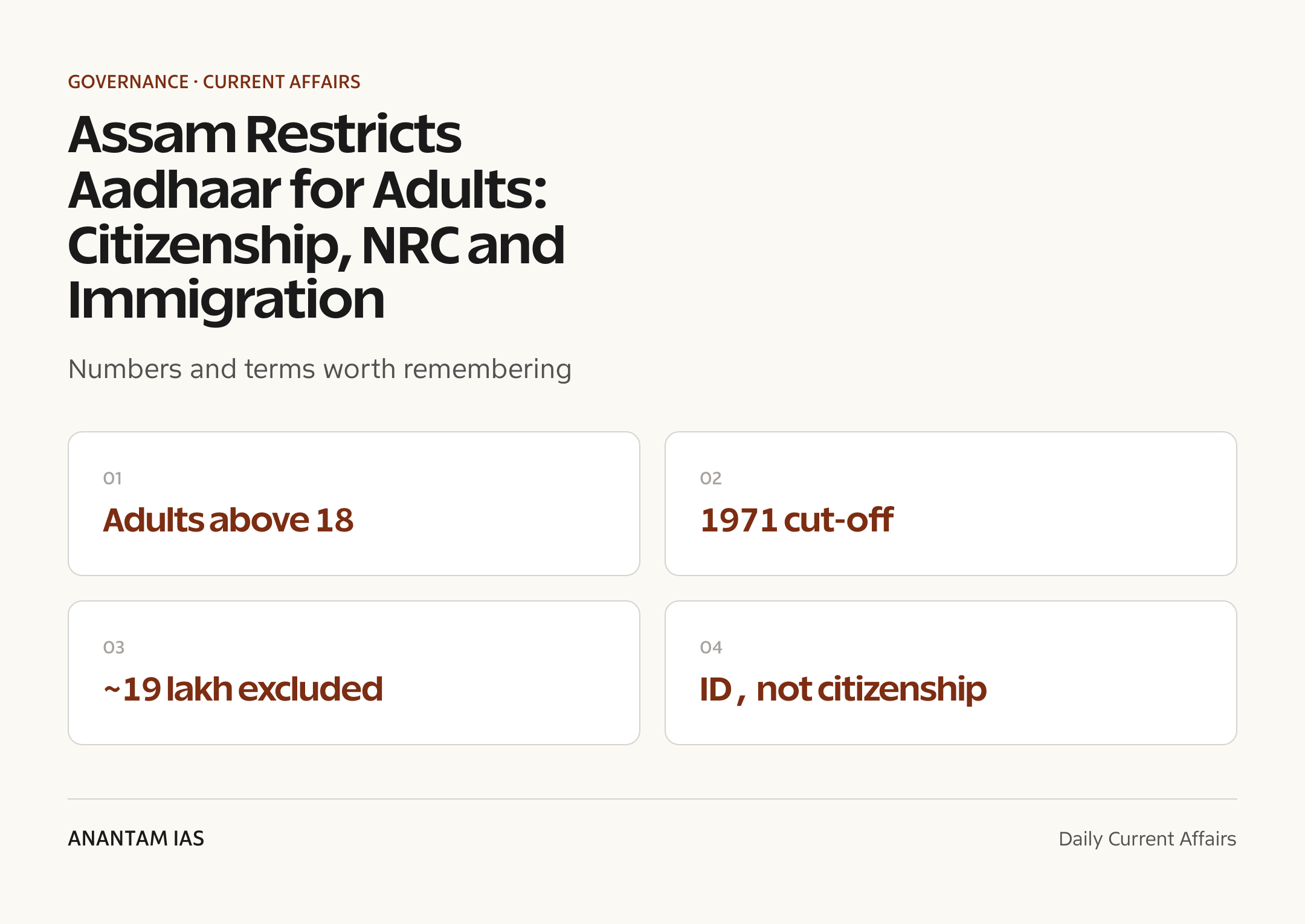
The Assam Cabinet, on 13 June 2026, decided that fresh Aadhaar enrolment for residents above 18 years will face extra scrutiny and be screened against the state’s National Register of Citizens (NRC) data, a move the government framed as a tool to curb illegal immigration, as reported by the Indian Express.

The order does not make Aadhaar a citizenship document; it adds a verification layer at the enrolment stage, so adults whose details do not match NRC records may have new Aadhaar requests held for additional checks rather than issued routinely.

  • Decision applies to fresh Aadhaar requests by adults above 18, not to existing Aadhaar holders.
  • New applications to be cross-checked against NRC application data before generation is approved.
  • Stated aim is to plug routes by which illegal immigrants allegedly obtain identity documents.
  • Aadhaar remains, in law, proof of identity and residence, never proof of citizenship.

The development matters in the context of:

  • Matters because identity documents like Aadhaar can become de-facto proof in welfare and service access, even though they confer no nationality.
  • Sits at the intersection of centre-state roles: Aadhaar is a Union (UIDAI) subject, while citizenship determination and border management have strong Union mandates too.
  • Raises the recurring tension between security screening and the risk of exclusion errors for genuine residents.
Assam Restricts Aadhaar for Adults: Citizenship, NRC and Immigration — quick facts

UPSC Relevance

Prelims Relevance

  • Aadhaar (Targeted Delivery of Financial and Other Subsidies, Benefits and Services) Act, 2016 — Aadhaar is identity proof, not citizenship.
  • UIDAI is a statutory authority under the Aadhaar Act, 2016, under the Ministry of Electronics and IT.
  • National Register of Citizens (NRC) for Assam updated under the Citizenship Act, 1955 read with Citizenship (Registration of Citizens) Rules, 2003.
  • Assam Accord, 1985 set 24 March 1971 (midnight) as the cut-off for detecting and deporting illegal migrants.
  • Section 6A of the Citizenship Act gives special citizenship provisions for Assam; upheld by the Supreme Court (4:1) in 2024.
  • Article 5–11 of the Constitution deal with citizenship; Parliament legislates citizenship under the Union List.
  • Foreigners Act, 1946 and Foreigners Tribunals govern detection and adjudication of foreigners in Assam.
  • Aadhaar is voluntary for residence-based identity but mandatory for many DBT subsidies under Section 7 of the Act.
  • K.S. Puttaswamy (2017) recognised privacy as a fundamental right under Article 21, shaping Aadhaar’s limits.

Mains Relevance

GS Paper 2

  • Governance challenge of using identity infrastructure to address an immigration and citizenship problem it was never designed to solve.
  • Centre-state coordination: a state-level screening layer over a Union-run identity programme (UIDAI).

GS Paper 2

  • Rights vs. security: balancing exclusion-error risk against the state’s interest in curbing illegal immigration.

GS Paper 3

  • Internal security and border management dimension of identity-document misuse in border states.

Essay

  • Identity, belonging and the state: who counts as a citizen and who decides.
  • Technology of governance — when an ID system becomes a gatekeeper it was not meant to be.

Background and Context

What Aadhaar Is — and Is Not

The starting point is a legal distinction the headline tends to blur.

  • Aadhaar is a 12-digit unique identity number issued by UIDAI under the Aadhaar Act, 2016.
  • It certifies identity and residence in India, established through demographic and biometric data.
  • Section 9 of the Act is explicit: Aadhaar is not proof of citizenship or domicile.
  • Eligibility is based on residence (182+ days in the year preceding application), not nationality — which is why a screening overlay is legally delicate.
  • Linking Aadhaar issuance to NRC status grafts a citizenship test onto a residence-based ID.
Assam Restricts Aadhaar for Adults: Citizenship, NRC and Immigration — exam lens

Assam's NRC and the 1971 Cut-off

Assam is the one state with a state-specific citizenship register, rooted in its migration history.

  • The NRC lists Indian citizens in Assam; its 2019 final draft excluded about 19 lakh applicants.
  • Inclusion turned on proving presence (self or ancestor) in India before the 24 March 1971 cut-off from the Assam Accord, 1985.
  • Those excluded can contest before Foreigners Tribunals, with appeals to higher courts.
  • The register has faced criticism for exclusion errors affecting genuine citizens, including women and the poor without documentary trails.
  • Tying Aadhaar to NRC data imports those same data-quality and fairness concerns into the ID pipeline.

The Constitutional and Statutory Frame

Citizenship is a Union subject governed by a layered legal architecture.

  • Articles 5–11 set out citizenship in India at commencement and empower Parliament to regulate it.
  • The Citizenship Act, 1955 governs acquisition and termination; the NRC rests on it.
  • Section 6A, inserted after the Assam Accord, creates the special 1971-based regime for Assam.
  • In 2024, a Constitution Bench upheld Section 6A by 4:1, affirming the Accord’s constitutional validity (see the CAA 2019 and Section 6A verdict).
  • The Foreigners Act, 1946 places the burden of proving citizenship on the person alleged to be a foreigner.

Why a State Acts on a Union ID

The move surfaces a federal fault line over who controls identity gatekeeping.

  • UIDAI and the Aadhaar Act are Union instruments; enrolment is delivered through registrars, often state agencies.
  • Assam has historically run Aadhaar enrolment with extra caution, pending NRC finalisation.
  • A state-imposed scrutiny layer raises questions of uniformity across India for a national ID.
  • It also tests the limits of executive (Cabinet) action versus what needs statutory or central sanction.
  • Border management and immigration policy carry a strong Union mandate, complicating a purely state-led approach.

The Exclusion-Error Risk

Any screening layer carries a false-positive cost borne by real residents.

  • Genuine residents whose names or spellings differ from NRC records may be wrongly held up.
  • Aadhaar is a gateway to rations, pensions, bank accounts and DBT — delay can mean denial of entitlements.
  • Marginalised groups — the poor, women, the displaced — are likeliest to lack clean documentary trails.
  • The Puttaswamy (2017) right to privacy framework cautions against function creep in identity systems.
  • An ID block that effectively penalises before adjudication risks treating residents as foreigners by default.

Way Forward

Keep the legal lines clean

  • Reaffirm publicly that Aadhaar screening does not, and cannot, determine citizenship.
  • Anchor any added scrutiny in clear, reviewable rules rather than discretionary holds.

Build a fair safeguard layer

  • Provide a fast, low-friction grievance and appeal route for residents wrongly flagged.
  • Pre-fill and reconcile NRC data to cut spelling and matching errors before it gates IDs.

Settle the federal question

  • Coordinate with UIDAI and the Centre so a national ID is not applied unevenly across states.
  • Address illegal immigration through the proper channels — Foreigners Tribunals, border management — not ID denial.

Conclusion

Assam’s decision restates an old anxiety in a new form: a border state trying to keep identity documents from becoming a backdoor to belonging. The legal core, though, is unchanged — Aadhaar proves who you are and where you live, not whether you are a citizen.

The test of the policy will be precision. If NRC-linked scrutiny catches only genuine misuse without stranding real residents from their entitlements, it strengthens governance. If exclusion errors multiply, it risks punishing citizens for a problem that belongs to immigration enforcement, not to the ID counter.

UPSC Practice Questions

Prelims MCQ 1

With reference to Aadhaar in India, consider the following statements:

  1. Aadhaar is statutorily recognised as proof of Indian citizenship.
  2. The Unique Identification Authority of India (UIDAI) is established under the Aadhaar Act, 2016.
  3. Eligibility for Aadhaar is based on residence in India, not on nationality.

How many of the above statements are correct?

(a) Only one (b) Only two (c) All three (d) None

Answer: (b) Only two

Explanation:

Statements 2 and 3 are correct. UIDAI is a statutory body under the Aadhaar Act, 2016, and eligibility rests on residence (182+ days), not nationality. Statement 1 is wrong — Aadhaar is proof of identity and residence, never of citizenship.

Prelims MCQ 2

The cut-off date for detection of illegal migrants under the Assam Accord, 1985 (reflected in Section 6A of the Citizenship Act) is:

(a) 26 January 1950 (b) 19 July 1948 (c) 24 March 1971 (d) 1 January 1966

Answer: (c) 24 March 1971

Explanation:

The Assam Accord set midnight of 24 March 1971 as the cut-off; entrants after this date are to be detected and deported. The Supreme Court upheld Section 6A, which embeds this date, by 4:1 in 2024.

UPSC Mains Questions

  1. Aadhaar was designed as proof of identity and residence, yet states increasingly treat it as a gatekeeper for citizenship-linked concerns. Examine the governance and federal challenges this creates, using Assam’s recent decision as a reference.
  2. “Screening identity-document issuance against citizenship registers risks converting administrative errors into denial of rights.” Critically analyse this statement in the context of the NRC and Aadhaar in Assam.
  3. Discuss the constitutional and statutory framework governing citizenship determination in Assam, and assess whether linking Aadhaar enrolment to NRC data is an appropriate tool to curb illegal immigration.

Sources: Indian Express and UIDAI.

Frequently Asked Questions

Does the new Assam rule make Aadhaar proof of citizenship?

No. Even after the new scrutiny, Aadhaar remains proof of identity and residence only. Section 9 of the Aadhaar Act, 2016 is explicit that Aadhaar is not proof of citizenship or domicile. The Assam decision adds a verification step at enrolment; it does not change what an Aadhaar number legally certifies.

Who is affected by the Assam Cabinet decision?

The decision targets fresh Aadhaar enrolment by residents above 18 years of age. Existing Aadhaar holders are not affected. New adult applications will be cross-checked against the state’s NRC data before generation is approved, so genuine residents with matching records should still be enrolled.

What is the National Register of Citizens (NRC) in Assam?

The NRC is a register of Indian citizens specific to Assam, maintained under the Citizenship Act, 1955 and the 2003 Rules. Inclusion requires proving presence in India before the 24 March 1971 cut-off from the Assam Accord. Its 2019 final draft excluded about 19 lakh applicants, who can contest before Foreigners Tribunals.

Why is Aadhaar based on residence rather than citizenship?

Aadhaar was built to deliver subsidies, benefits and services to all residents, regardless of nationality. The Aadhaar Act, 2016 keys eligibility to residence — typically 182 days or more in the preceding year — so it can reach the people who actually live in and use Indian public services.

What is the main risk of linking Aadhaar to NRC checks?

The chief risk is exclusion error. Residents whose names or spellings differ from NRC records may be wrongly delayed, and because Aadhaar gates rations, pensions and bank accounts, a delay can effectively deny entitlements. Marginalised groups without clean documentary trails are the most exposed.

Did the Supreme Court rule on Assam’s citizenship cut-off?

Yes. In 2024 a Constitution Bench upheld Section 6A of the Citizenship Act by a 4:1 majority. Section 6A embeds the Assam Accord’s 24 March 1971 cut-off and the special citizenship regime for Assam, affirming the constitutional validity of the Accord’s framework.

India and Turkey: Repairing a Strained Relationship

Open article →Download PDF

Why in News?

An Indian Express Explained feature reports that India and Turkey are quietly working to bring a badly strained relationship back from the brink, after a sharp downturn driven by Ankara’s open backing of Pakistan during the recent India-Pakistan military tensions and its repeated remarks on Jammu and Kashmir.

The recalibration is being pursued cautiously through trade channels and working-level diplomacy, signalling that both capitals see value in containing the damage even as the underlying strategic divergence on Kashmir and the Turkey-Pakistan axis persists.

  • Ties hit a low after Turkey publicly sided with Pakistan in the latest India-Pakistan confrontation.
  • Turkish-origin armed drones, including the Bayraktar TB2, have featured in Pakistan’s arsenal, deepening Indian unease.
  • President Recep Tayyip Erdogan has repeatedly raised Kashmir in UN General Assembly speeches and at the OIC.
  • India responded with calibrated pushback, including travel-advisory caution, scrutiny of Turkish firms, and deeper outreach to Greece, Cyprus and Armenia.
  • Both sides retain sizeable bilateral trade and people-to-people links, giving each an incentive to stabilise relations.

The development matters in the context of:

  • Tests India’s doctrine of strategic autonomy and issue-based partnerships in a multipolar West Asia.
  • Shows how a third country’s stance on Kashmir directly shapes the texture of a bilateral relationship.
  • Illustrates the use of counterbalancing partnerships (Greece, Cyprus, Armenia) as a diplomatic tool.
India and Turkey: Repairing a Strained Relationship — quick facts

UPSC Relevance

Prelims Relevance

  • Turkey is a member of NATO but not of the EU; it straddles Europe and Asia across the Bosphorus and Dardanelles straits.
  • The Organisation of Islamic Cooperation (OIC) is the forum where Turkey has often amplified the Kashmir issue.
  • Bayraktar TB2 is a Turkish-made armed unmanned combat aerial vehicle (UCAV) produced by Baykar.
  • Cyprus is divided; the internationally recognised Republic of Cyprus is an EU member, while northern Cyprus is recognised only by Turkey.
  • Armenia has tense ties with Turkey and Azerbaijan; India has stepped up defence exports to Armenia.
  • Greece and Turkey have long-running disputes in the Aegean Sea and Eastern Mediterranean.
  • India and Turkey established diplomatic relations in 1948.
  • The Bosphorus and Dardanelles straits, controlled by Turkey, are governed by the Montreux Convention.

Mains Relevance

GS Paper 2

  • Assess how a third state’s position on Jammu and Kashmir shapes India’s bilateral diplomacy.
  • Evaluate India’s strategy of building counterbalancing partnerships (Greece, Cyprus, Armenia) against the Turkey-Pakistan axis.

GS Paper 2

  • Discuss the relevance of India’s strategic autonomy in managing relations with a NATO member like Turkey.

Essay

  • Diplomacy is the art of restraint: managing rivalry without rupture.
  • In a multipolar world, no friendship is permanent and no estrangement is final.

Background and Context

The roots of the strain

The downturn is structural, not episodic, anchored in Turkey’s strategic alignment with Pakistan.

  • Turkey-Pakistan axis: deepening defence, diplomatic and ideological ties have made Ankara one of Islamabad’s most vocal backers.
  • Kashmir at the UN and OIC: President Erdogan has repeatedly internationalised Kashmir, which India treats as an internal matter and a red line.
  • Defence supplies: Turkish drones, including the Bayraktar TB2, and other systems have reached Pakistan, hardening Indian threat perceptions.
  • Turkey’s bid for leadership of the Muslim world has positioned it against India’s interests on contested issues.
  • Ankara’s ambition to be a pan-Islamic voice often clashes with the position of the Gulf states, with whom India enjoys warm ties, complicating Turkey’s appeal in West Asia.
  • The relationship lacks the institutional ballast, such as a strong defence or strategic dialogue, that anchors India’s ties with many other powers.
India and Turkey: Repairing a Strained Relationship — exam lens

How relations cooled after the latest tensions

Ankara’s stance during the recent India-Pakistan crisis pushed an already-cool relationship to a near-rupture.

  • Public Turkish support for Pakistan during the confrontation triggered sharp Indian displeasure.
  • Indian scrutiny fell on Turkish companies operating in sensitive sectors, including ground-handling at airports.
  • Calls within India to limit tourism and trade with Turkey gained traction in public discourse.
  • New Delhi signalled that strategic trust would have to be rebuilt before normal business resumed.

India's counterbalancing playbook

India has answered Turkey’s tilt by cultivating Turkey’s own regional rivals.

  • Greece: upgraded political and defence engagement, with the Eastern Mediterranean as a shared strategic theatre.
  • Cyprus: closer ties with the EU-member Republic of Cyprus, where Turkey backs the unrecognised north.
  • Armenia: growing Indian defence exports to Yerevan, which faces pressure from the Turkey-Azerbaijan partnership.
  • This issue-based hedging is a textbook application of strategic autonomy rather than bloc alignment.

Why both sides still want to talk

Beneath the friction lies a durable web of economic and connectivity interests.

  • Bilateral trade spans engineering goods, chemicals, textiles, machinery and minerals, giving exporters on both sides a stake in stability.
  • Turkey sits astride key trade and energy corridors linking Asia, Europe and West Asia.
  • Indian firms and tourists, and Turkish construction and contracting interests, create people-to-people ballast.
  • Diaspora, education and cultural links add a softer layer that survives political chill.
  • Turkey is a major destination for Indian travellers, and any boycott hurts Turkish tourism revenues, giving Ankara a commercial reason to avoid open hostility.
  • Both economies trade across multilateral platforms such as the G20, where Turkey and India have at times found common ground on development financing.

Where Turkey fits in India's West Asia balancing

India’s Turkey policy is one piece of a wider Mediterranean and Gulf calculus.

  • India simultaneously deepens ties with the Gulf monarchies, Israel, Egypt and Iran, refusing to be boxed into any camp.
  • Connectivity initiatives such as the India-Middle East-Europe Economic Corridor (IMEC) reshape the regional map without depending on Turkey.
  • Turkey’s NATO membership and friction with the West give India room to engage Ankara on its own terms.
  • The guiding principle is multi-alignment: many partners, no permanent adversaries.

Risks and limits of the thaw

Repair is real but fragile, and the structural divergence has not disappeared.

  • Any fresh Turkish remark on Kashmir at the UN or OIC could reverse gains overnight.
  • Continued arms flows to Pakistan would keep the security file unresolved.
  • Domestic sentiment in India remains wary, constraining how far normalisation can go.
  • The thaw is likely to stay transactional and trade-led rather than a strategic embrace.

Way Forward

Compartmentalise the relationship

  • Insulate trade and people-to-people ties from the political dispute over Kashmir.
  • Build working-level diplomatic channels that can absorb periodic friction.

Keep counterbalances in reserve

  • Sustain partnerships with Greece, Cyprus and Armenia as durable leverage, not one-off signalling.
  • Use these ties to raise the cost to Ankara of any anti-India posture.

Pursue quiet, issue-based engagement while holding firm on Kashmir as a non-negotiable, letting economic interdependence do the slow work of normalisation.

Conclusion

The India-Turkey reset is a study in pragmatic statecraft: neither capital pretends the strategic divergence has vanished, yet both recognise that an open rupture serves no one. Trade, connectivity and diaspora links give the relationship a floor beneath the political ceiling set by Kashmir and the Turkey-Pakistan axis.

For India, the episode reaffirms the logic of strategic autonomy and multi-alignment: engage where interests converge, counterbalance where they clash, and never mortgage core positions for short-term warmth. The repair will likely stay measured and reversible, a managed rivalry rather than a friendship.

UPSC Practice Questions

Prelims MCQ 1

With reference to Turkey and its regional relationships, consider the following statements:

  1. Turkey is a member of the North Atlantic Treaty Organisation (NATO).
  2. The Bayraktar TB2 is a Turkish-manufactured armed unmanned aerial vehicle.
  3. Turkey is a full member of the European Union.

How many of the above statements are correct?

(a) Only one (b) Only two (c) All three (d) None

Answer: (b) Only two

Explanation:

Turkey is a NATO member and makes the Bayraktar TB2 UCAV (statements 1 and 2 correct). Turkey is an EU candidate but not a full member, so statement 3 is wrong.

Prelims MCQ 2

India has stepped up defence and diplomatic engagement with which of the following as a counterbalance to the Turkey-Pakistan axis?

(a) Greece, Cyprus and Armenia (b) Azerbaijan and Pakistan (c) Saudi Arabia and Qatar only (d) Russia and Belarus

Answer: (a) Greece, Cyprus and Armenia

Explanation:

India has deepened ties with Greece, Cyprus and Armenia, all of which have their own tensions with Turkey or the Turkey-Azerbaijan partnership, as a calibrated counterbalance.

UPSC Mains Questions

  1. India’s relationship with Turkey illustrates how a third state’s position on Jammu and Kashmir can shape a bilateral equation. Discuss, with reference to India’s use of counterbalancing partnerships. (250 words)
  2. Examine how the doctrine of strategic autonomy guides India’s engagement with a NATO member like Turkey amid the Turkey-Pakistan axis. (250 words)
  3. Assess the role of trade and connectivity in stabilising politically strained bilateral relationships, using India-Turkey ties as a case study. (150 words)

Sources: The Indian Express (Explained) and Ministry of External Affairs.

Frequently Asked Questions

Why are India-Turkey relations strained?

Relations soured chiefly because Turkey openly backed Pakistan during recent India-Pakistan tensions and because President Erdogan repeatedly raised Jammu and Kashmir at the UN and the OIC, which India treats as an internal matter. Turkish-origin drones reaching Pakistan deepened the strategic distrust between the two capitals.

What is the Turkey-Pakistan axis?

It refers to the deepening defence, diplomatic and ideological partnership between Ankara and Islamabad. Turkey has become one of Pakistan’s most vocal international backers, supplying military hardware such as drones and supporting Pakistan’s positions on Kashmir at multilateral forums, which directly cuts against Indian interests.

How is India counterbalancing Turkey?

India has cultivated Turkey’s regional rivals: Greece and Cyprus in the Eastern Mediterranean, and Armenia, which faces pressure from the Turkey-Azerbaijan partnership. Deeper defence exports and political engagement with these states raise the diplomatic cost to Ankara of any anti-India posture, applying issue-based strategic autonomy.

What is the Bayraktar TB2?

The Bayraktar TB2 is a Turkish-made armed unmanned combat aerial vehicle produced by Baykar. Its presence in Pakistan’s arsenal, alongside other Turkish systems, has heightened Indian threat perceptions and become a concrete irritant in the security dimension of India-Turkey relations.

Why are the two countries still talking?

Despite the friction, India and Turkey retain sizeable bilateral trade in engineering goods, chemicals, textiles and machinery, plus connectivity, diaspora and people-to-people links. These interests give both sides an incentive to contain the damage and pursue a cautious, trade-led normalisation rather than a full rupture.

How does this relate to strategic autonomy?

India engages Turkey where economic interests converge while counterbalancing where they clash, and holds firm on Kashmir. Refusing to align with any single bloc and keeping many partners across West Asia reflects multi-alignment and strategic autonomy, the guiding principles of India’s foreign policy.

IIT-Madras’s 3D Brainstem Atlas: Mapping the Brain’s Control Centre

Open article →Download PDF

Why in News?

Researchers at the Sudha Gopalakrishnan Brain Centre at the Indian Institute of Technology Madras (IIT-Madras) have released a high-resolution 3D digital atlas of the human brainstem, the small but vital region that links the brain to the spinal cord and controls automatic life-sustaining functions.

Reported by The Hindu in June 2026, the atlas maps the brainstem’s nuclei (clusters of nerve-cell bodies) and tracts (nerve-fibre highways) at near cellular resolution, giving neuroscientists, neurosurgeons and clinicians an open reference for studying disease and planning treatment.

  • Built by the Sudha Gopalakrishnan Brain Centre, IIT-Madras’s dedicated whole-brain mapping facility.
  • Resolves individual nuclei and fibre tracts of the brainstem in three dimensions, far finer than a standard MRI scan.
  • Positioned as a freely usable scientific reference for neurosurgery, neurology and brain-disorder research.
  • Adds to India’s growing capacity in indigenous high-resolution brain mapping and digital neuroscience.

The development matters in the context of:

  • The brainstem governs breathing, heart rate and consciousness, so even tiny structures matter clinically.
  • Surgery near the brainstem is high-risk; a precise atlas can guide safer navigation.
  • Open digital brain atlases are now core infrastructure for global neuroscience, much like genome databases are for biology.
IIT-Madras's 3D Brainstem Atlas: Mapping the Brain's Control Centre — quick facts

UPSC Relevance

Prelims Relevance

  • Brainstem = midbrain + pons + medulla oblongata; connects cerebrum and cerebellum to the spinal cord.
  • Medulla oblongata controls breathing, heart rate and blood pressure (the ‘vital centre’).
  • Pons relays signals between the cerebrum and cerebellum and aids breathing rhythm.
  • Midbrain handles reflexes for vision, hearing and motor control.
  • Nuclei are clusters of neuron cell bodies; tracts are bundles of nerve fibres (axons).
  • Most of the 12 pairs of cranial nerves emerge from the brainstem.
  • The Sudha Gopalakrishnan Brain Centre is housed at IIT-Madras.
  • A brain atlas is a 3D reference map of brain structures used across research and clinical care.

Mains Relevance

GS Paper 3

  • Indigenous high-end research and self-reliance in science and technology: India building world-class brain-mapping capacity.
  • Applications of biotechnology and digital tools in medicine and healthcare; the science-to-clinic pipeline.

GS Paper 2

  • Strengthening public healthcare and neurology capacity through better diagnostic and surgical tools.

Essay

  • Science as a public good: open knowledge infrastructure and the democratisation of research.
  • Mapping the unknown — from the genome to the brain, the quest to understand ourselves.

Background and Context

What the brainstem is and why it matters

The brainstem is small but indispensable, running the body’s automatic systems.

  • It has three parts: the midbrain, the pons and the medulla oblongata, stacked between the brain and the spinal cord.
  • The medulla houses centres for breathing, heart rate and blood pressure — damage here is life-threatening.
  • It is a crossing point for nerve tracts carrying signals up to the brain and down to the body.
  • Most cranial nerves, which control the face, eyes, hearing and swallowing, arise here.
  • It also regulates sleep, alertness and consciousness through the reticular formation.
IIT-Madras's 3D Brainstem Atlas: Mapping the Brain's Control Centre — exam lens

What IIT-Madras actually built

The new resource is a digital, three-dimensional map at far finer detail than routine imaging.

  • A 3D digital atlas reconstructing the brainstem’s internal architecture in space.
  • It resolves individual nuclei and fibre tracts at close to cellular resolution.
  • Such detail typically comes from thin physical sectioning and high-power microscopy, then digital stitching — not from a living-patient MRI.
  • The output is a navigable reference that scientists worldwide can study and overlay on their own data.
  • It builds on the centre’s broader effort to map the whole human brain at high resolution.

The Sudha Gopalakrishnan Brain Centre

IIT-Madras runs a dedicated facility built specifically for whole-brain mapping.

  • The Sudha Gopalakrishnan Brain Centre focuses on high-throughput, high-resolution digital reconstruction of human brain tissue.
  • It develops imaging pipelines that turn physical brain sections into searchable 3D digital models.
  • It is an example of an indigenous, India-led platform in a field long dominated by a few foreign laboratories.
  • Work like this strengthens India’s footprint in global neuroscience and data-driven biology.

Why a brain atlas is useful

Detailed maps turn the brain into shared, reusable scientific infrastructure.

  • Neurosurgery: a precise map helps surgeons plan routes around fragile structures, lowering risk.
  • Disease research: comparing healthy and diseased brains can reveal where disorders begin.
  • Education: students and clinicians get an interactive reference instead of flat textbook diagrams.
  • Standardisation: a common atlas lets labs around the world compare results in the same coordinate space.
  • It complements brain-imaging methods such as MRI and fMRI, and frontier neurotech like the brain-computer interface, by adding microscopic structural detail.

Links to AI and the wider brain-mapping push

High-resolution brain data sits at the intersection of biology and computing.

  • Reconstructing a brain at cellular scale generates huge datasets that need artificial intelligence and machine learning to align, label and analyse, echoing India’s wider push for indigenous AI under efforts like sovereign AI and BharatGen.
  • Detailed wiring maps can also inform brain-inspired computing such as neuromorphic computing, which models chips on the structure of neurons.
  • Globally, large efforts such as the Human Connectome Project have shown the value of open brain-mapping data.
  • Indian efforts add to this commons while building domestic expertise in imaging, computing and clinical translation.

What to be careful about

A reference atlas is a powerful tool, not an instant cure, and a few caveats apply.

  • An atlas from donated tissue is a detailed reference; it does not by itself diagnose or treat a living patient.
  • Translating such maps into routine clinical practice takes validation, training and regulatory steps.
  • Sustained funding, tissue donation and skilled staff are needed to keep mapping the rest of the brain.
  • Open, well-documented data and ethics in handling human brain tissue remain essential.

Way Forward

From reference to clinic

  • Validate the atlas against clinical cases so it can guide neurosurgical planning.
  • Integrate it with hospital imaging so surgeons can overlay it on a patient’s scans.

Scale and openness

  • Extend high-resolution mapping to the whole brain, not just the brainstem.
  • Keep the data open and interoperable so Indian and global labs can build on it.

Sustain investment in imaging hardware, AI pipelines and trained neuroscientists, and encourage brain-tissue donation through clear, ethical frameworks so India can keep building world-class brain-mapping infrastructure.

Conclusion

The brainstem runs the body’s most basic life-support systems, yet its small, densely packed structures have been hard to study in fine detail. A 3D atlas that resolves its nuclei and tracts turns this region into a shared, navigable reference for surgeons and scientists alike.

By building this map at home, IIT-Madras’s Sudha Gopalakrishnan Brain Centre shows India can lead in frontier neuroscience. The next test is turning open scientific maps into safer surgery, sharper diagnoses and stronger homegrown research capacity.

UPSC Practice Questions

Prelims MCQ 1

With reference to the human brainstem, consider the following statements:

  1. It is composed of the midbrain, the pons and the medulla oblongata.
  2. The medulla oblongata contains centres that control breathing and heart rate.
  3. It connects the cerebrum and cerebellum to the spinal cord.

How many of the above statements are correct?

(a) Only one (b) Only two (c) All three (d) None

Answer: (c) All three

Explanation:

The brainstem comprises the midbrain, pons and medulla. The medulla holds the vital centres for breathing, heart rate and blood pressure, and the brainstem links the cerebrum and cerebellum to the spinal cord. All three statements are correct.

Prelims MCQ 2

The high-resolution 3D atlas of the human brainstem reported in 2026 was released by which institution?

(a) The Sudha Gopalakrishnan Brain Centre at IIT-Madras (b) The National Institute of Mental Health and Neurosciences (c) The Indian Institute of Science, Bengaluru (d) The All India Institute of Medical Sciences, New Delhi

Answer: (a) The Sudha Gopalakrishnan Brain Centre at IIT-Madras

Explanation:

The atlas was produced by the Sudha Gopalakrishnan Brain Centre, the whole-brain mapping facility at IIT-Madras, as reported in June 2026.

UPSC Mains Questions

  1. High-resolution brain atlases are emerging as critical scientific infrastructure. Discuss how indigenous brain-mapping efforts can strengthen India’s capacity in neuroscience, medicine and digital research. (250 words)
  2. Examine the role of advanced imaging and artificial intelligence in modern brain research, and the challenges in translating such basic science into clinical benefit in India. (150 words)

Sources: The Hindu and Sudha Gopalakrishnan Brain Centre, IIT-Madras.

Frequently Asked Questions

What is the brainstem?

The brainstem is the lower part of the brain that connects the cerebrum and cerebellum to the spinal cord. It has three sections — the midbrain, pons and medulla oblongata — and controls automatic functions such as breathing, heart rate, blood pressure, swallowing and alertness, making it essential for survival.

What did IIT-Madras release?

Researchers at IIT-Madras’s Sudha Gopalakrishnan Brain Centre released a high-resolution 3D digital atlas of the human brainstem. It maps the region’s nuclei and nerve-fibre tracts in three dimensions at close to cellular resolution, giving scientists, neurosurgeons and clinicians a detailed open reference for research and treatment.

Why is a brain atlas important?

A brain atlas is a standard 3D map of brain structures. It helps neurosurgeons plan safer operations, lets researchers compare healthy and diseased brains in the same coordinate space, supports teaching, and gives laboratories worldwide a common reference, much like a genome database does for biology.

How is this different from an MRI scan?

An MRI scans a living patient but cannot show individual cell clusters. This atlas, built from detailed sectioning and microscopy of donated tissue, resolves nuclei and tracts at far finer, near-cellular detail. The two are complementary: MRI for patients, the atlas as a high-resolution reference.

What is the Sudha Gopalakrishnan Brain Centre?

It is a dedicated brain-mapping facility at IIT-Madras that reconstructs human brain tissue into high-resolution 3D digital models. It is an example of indigenous Indian capacity in neuroscience, developing imaging and computing pipelines to map the brain in fine detail.

How does artificial intelligence relate to this?

Mapping a brain at cellular scale produces enormous datasets that need artificial intelligence and machine learning to align, label and interpret. Detailed wiring maps can also inform brain-inspired computing, linking neuroscience with advances in AI and data science.