Why in News?
The Hindu reported that the Department of Space issued a memorandum on July 14, 2026 after receiving multiple requests for resignation and voluntary retirement from scientific and technical personnel working on important ISRO programmes.
The reported instruction asks ISRO centre directors and unit heads not to process such requests as a routine matter when the employee is associated with Gaganyaan or another important mission. Each covered request is to be referred to the Department of Space for a final decision; the report doesn’t establish a blanket prohibition on every employee leaving.
- The memorandum reportedly covers Group A scientific and technical personnel connected with prestigious or nationally important missions and projects.
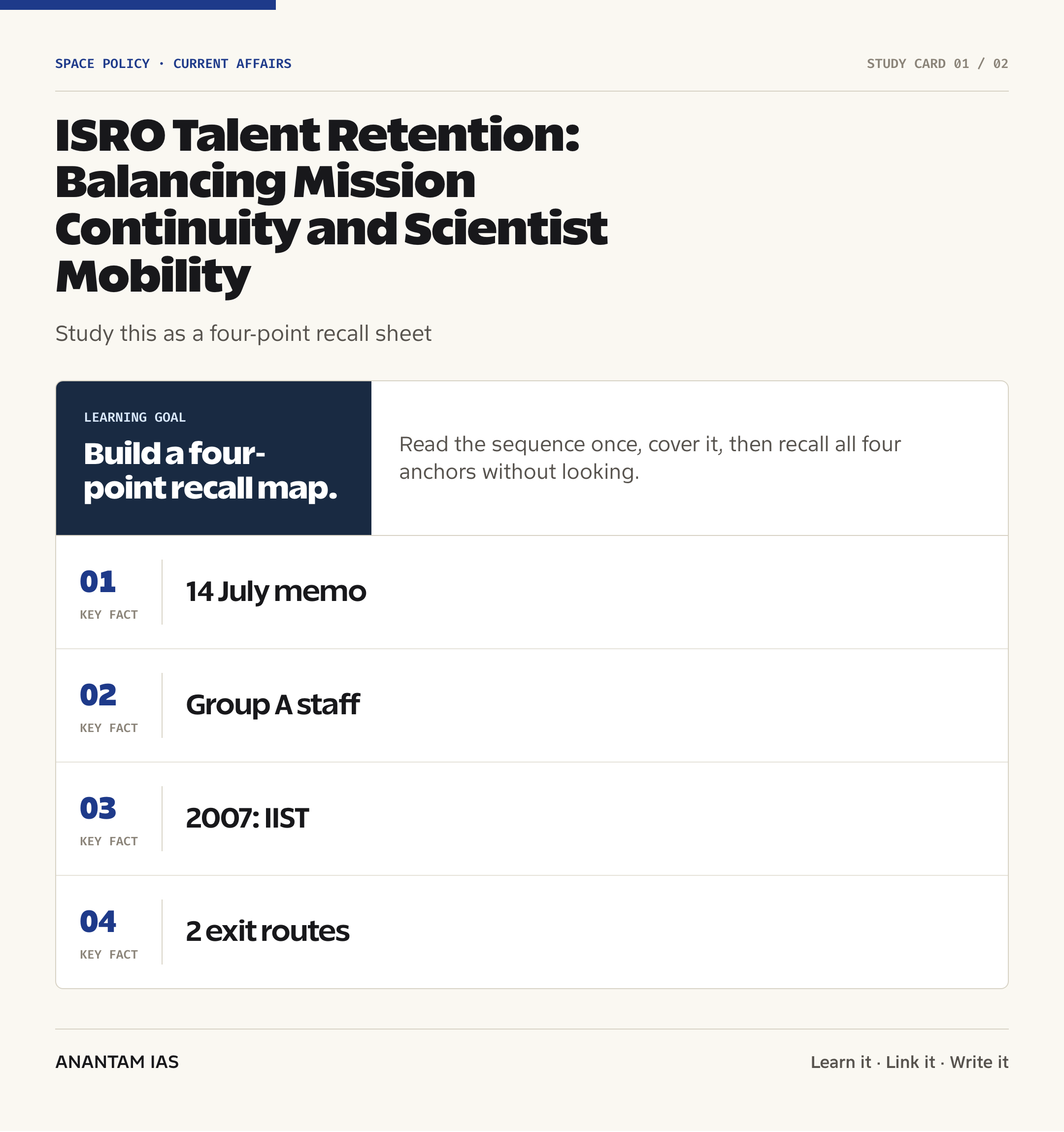
- The Hindu reported departures of around 100 scientists in recent months from strategically important centres; this figure should be read as a news report, not as a publicly released official personnel statement.
- The immediate administrative concern is project continuity: highly specialised roles can’t always be replaced quickly without losing design knowledge, test experience and mission-specific judgement.
- The news revives an earlier episode from the early 1990s, when the information-technology boom drew engineers away while ISRO was expanding the PSLV, GSLV and satellite programmes.
- The policy question is wider than resignation procedure: a strategic institution needs a credible system for retention, succession planning and knowledge transfer without turning mission commitment into indefinite immobility.
The development matters in the context of:
- This matters in the context of human spaceflight safety, where system engineering, certification records and tacit knowledge must remain traceable across long testing cycles.
- It also matters in the context of the Indian Space Policy 2023, which expands private participation while keeping ISRO focused on advanced research, mission development and capacity building.
- The case offers a governance test: how should the state reconcile national-interest projects with transparent procedure, employee dignity and sustainable public-sector careers?
UPSC Relevance
Prelims Relevance
- Department of Space administers the Indian space programme and is responsible for personnel under its control.
- Space Commission lays down policies for the Department of Space; the department is under the charge of the Prime Minister.
- ISRO is the principal research and development organisation under the Department of Space.
- Gaganyaan aims to demonstrate India’s indigenous human-spaceflight capability to low Earth orbit.
- Human Space Flight Centre leads and coordinates Gaganyaan activities across ISRO centres, laboratories, academia and industry.
- PSLV recorded its first successful flight in October 1994 and became ISRO’s workhorse launch vehicle.
- GSLV is designed to place communication satellites in geosynchronous transfer orbit; its first developmental flight was in April 2001.
- IIST was established at Thiruvananthapuram in 2007 to provide education and research aligned with the Indian space programme’s manpower needs.
- Indian Space Policy 2023 assigns ISRO a stronger focus on research, innovation and development of new space technologies and applications.
Mains Relevance
GS Paper 3
- Strategic technologies depend on mission teams, tacit knowledge and systems integration, not only on physical infrastructure or budget allocation.
- Gaganyaan shows why continuity, reliability, certification and human safety require long institutional memory.
- Space-sector reform creates both innovation opportunities and a more competitive labour market for scarce aerospace, avionics, propulsion and software skills.
GS Paper 2
- The memorandum raises questions of administrative discretion, reasoned decision-making and proportionality in public employment.
- A sustainable response needs workforce planning, fair career progression and grievance redress, not exit restrictions alone.
- Institutional accountability requires publication of anonymised workforce trends without exposing security-sensitive mission details.
Essay
- Institutions retain talent through purpose and trust, while coercion can protect continuity only for a limited period.
- Strategic autonomy rests as much on people and knowledge as on machines, budgets and infrastructure.
Background and Context
What the July memorandum changes
The reported intervention adds a higher level of scrutiny to selected exit requests rather than proving that all ISRO resignations have been stopped.
- According to The Hindu, the memorandum concerns a spate of requests from Group A scientific and technical personnel, including people associated with Gaganyaan and other important missions.
- Centre directors and unit heads have reportedly been told not to accept covered resignation or voluntary-retirement requests as a matter of routine.
- Such requests must instead be referred to the Department of Space, which means the decision moves from routine unit-level disposal to central review.
- The available report doesn’t provide a public list of covered posts, a fixed holding period or a new salary package. Those details must not be inferred from the memorandum.
Why mission-critical expertise is hard to replace
Space missions combine codified engineering records with tacit knowledge built through repeated design reviews, failures, simulations and tests.
- Tacit knowledge includes practical judgement that isn’t fully captured in manuals: why a design margin was chosen, how an anomaly was diagnosed and which interfaces are most failure-sensitive.
- An unexpected departure can create a single-point human dependency when only one or two people understand a critical subsystem or its test history.
- Replacement recruitment doesn’t immediately restore capacity because a new engineer needs security clearance, mission context, laboratory access and supervised experience.
- The risk is sharper in human spaceflight. ISRO’s official Gaganyaan programme page identifies reliability, human safety, life-support systems, human factors, crew training and certification as core areas coordinated by the Human Space Flight Centre.
- Talent continuity is also a reader-friendly entry point to the broader Gaganyaan mission, where safety depends on institutions preserving evidence across every test and design change.
The 1990s precedent
The current concern resembles an earlier competition for engineers, but the surrounding space economy is now more complex.
- The Hindu reported that the information-technology boom and private campus recruitment drew engineers away from ISRO in the early 1990s.
- A former ISRO personnel-policy official recalled that government recruitment could take eight to nine months because vacancies had to be publicly advertised and candidates given equal opportunity; private firms could recruit much faster on campuses.
- The institutional response included more centralised recruitment. The long-term capacity response also included specialised education: ISRO’s official page says IIST was established in Thiruvananthapuram in 2007 to meet the space programme’s need for high-quality education and trained manpower.
- The lesson isn’t that the two episodes are identical. The 1990s competitor was chiefly the broad IT sector; today’s ecosystem includes private space companies, global aerospace employers and deep-tech start-ups seeking directly transferable skills.
Space reform changes the labour market
India’s private-space reforms expand national capability, but they also increase competition for a limited pool of specialised workers.
- The Indian Space Policy 2023 allows non-governmental entities to undertake end-to-end space activities subject to authorisation and regulation.
- The policy expects ISRO to concentrate on research, innovation, advanced technology and newer applications, while operational and commercial roles are shared with other public and private actors.
- Students can revise this changing architecture through the published note on Indian Space Policy 2023, including the roles of ISRO, IN-SPACe, NSIL and non-governmental entities.
- Mobility from ISRO to industry can spread expertise across the national ecosystem. But unmanaged exits may weaken the public institution that trains talent and carries the highest-risk, longest-horizon work.
- A complete policy must address knowledge circulation, conflicts of interest, confidentiality and cooling-off requirements where justified, while avoiding a general assumption that every move to industry is disloyal.
- The state should measure both attrition and return flows across the space ecosystem.
Governance and ethical questions
Mission continuity is a legitimate public objective, but the method used to secure it shapes morale, fairness and institutional trust.
- A decision on an exit request should follow clear criteria: mission criticality, availability of a trained successor, completion of notice obligations and the time needed for a safe handover.
- Open-ended delay can produce presenteeism, where a person remains on the payroll but disengages from the institution; this doesn’t create dependable mission capacity.
- Natural justice supports notice of reasons, an opportunity to make representations and a time-bound decision by the competent authority, especially when discretion affects a career choice.
- Public disclosure should remain aggregated. Publishing individual names, sensitive unit shortages or subsystem vulnerabilities could create privacy and national-security risks.
- The strongest ethical standard is reciprocity: if the institution asks for extraordinary continuity during a critical phase, it should provide recognition, support, workload safeguards and a credible exit timeline.
What durable talent policy looks like
Retention improves when workforce design removes avoidable reasons to leave and makes knowledge resilient to individual movement.
- Workforce analytics should identify high-risk skills, retirement clusters, vacancy duration, training lead time and mission phases with thin staffing.
- Every critical subsystem needs a named successor, deputy or shadow team; no strategic programme should depend on a single person’s memory.
- Knowledge management should capture design rationale, anomaly reports, configuration changes, test evidence and lessons learned in searchable, access-controlled repositories.
- Career pathways should reward both technical depth and programme leadership, so specialists don’t need to leave engineering for administration to gain status.
- Structured secondments among ISRO, academia and approved industry partners can create mobility without permanent capability loss, subject to security and conflict-of-interest safeguards.
- The public system should shorten recruitment without sacrificing equality by using predictable calendars, talent pools, campus outreach and faster verification.
- Students can connect the personnel question to the wider catalogue of ISRO missions: a larger and more technically diverse mission portfolio needs a matching workforce pipeline.
Way Forward
Use time-bound mission retention
- Define critical roles and mission phases through written, reviewable criteria instead of applying a vague restriction across an entire centre.
- When an exit must be deferred, specify a maximum transition window, record reasons and provide an appeal or review route.
- Use negotiated handovers, completion bonuses or short mission extensions where appropriate; don’t treat administrative refusal as the only retention tool.
Build redundancy before a crisis
- Require two-person depth for critical subsystems and conduct periodic succession-readiness reviews.
- Pair senior specialists with deputies, rotate staff through test and integration roles, and make documentation quality part of performance evaluation.
- Track attrition by skill and mission stage while protecting personal data and security-sensitive information.
Make public research careers competitive
- Improve technical career progression, research autonomy, recognition and continuing education, not only compensation.
- Use IIST, universities and apprenticeships to deepen the pipeline in avionics, propulsion, human factors, systems engineering and mission software.
- Create transparent routes for secondment, re-entry and collaboration so movement can strengthen India’s space ecosystem rather than permanently sever institutional ties.
Conclusion
ISRO’s retention challenge isn’t a choice between mission success and employee freedom. It is a test of whether a strategic public institution can plan its workforce well enough to protect both.
The July memorandum may provide an immediate review gate for sensitive departures, but the durable answer lies in succession, documentation, fair careers and time-bound decisions. India’s expanding space programme needs people who stay because the institution is worth building, alongside systems robust enough to survive when individuals move on.
UPSC Practice Questions
Prelims MCQ 1
With reference to India’s space administration, consider the following statements:
- The Department of Space is responsible for the administration of India’s space programme.
- The Space Commission lays down policies implemented by the Department of Space.
- IN-SPACe is the principal research and development organisation under the Department of Space.
How many of the above statements are correct?
(a) Only one (b) Only two (c) All three (d) None
Answer: (b) Only two
Explanation:
Statements 1 and 2 are correct. The Department of Space administers the programme and executes policies laid down by the Space Commission. Statement 3 is incorrect: ISRO is the principal R&D organisation; IN-SPACe promotes, authorises and supervises non-governmental space activities.
Prelims MCQ 2
Which one of the following best describes the primary objective of the Gaganyaan programme?
(a) Establishing a permanent lunar settlement (b) Demonstrating indigenous human-spaceflight capability to low Earth orbit (c) Replacing all communication satellites with a single constellation (d) Creating a regulator for private launch companies
Answer: (b) Demonstrating indigenous human-spaceflight capability to low Earth orbit
Explanation:
ISRO defines Gaganyaan as a programme to demonstrate indigenous human-spaceflight capability to low Earth orbit and to build a foundation for sustained Indian human-space exploration.
UPSC Mains Questions
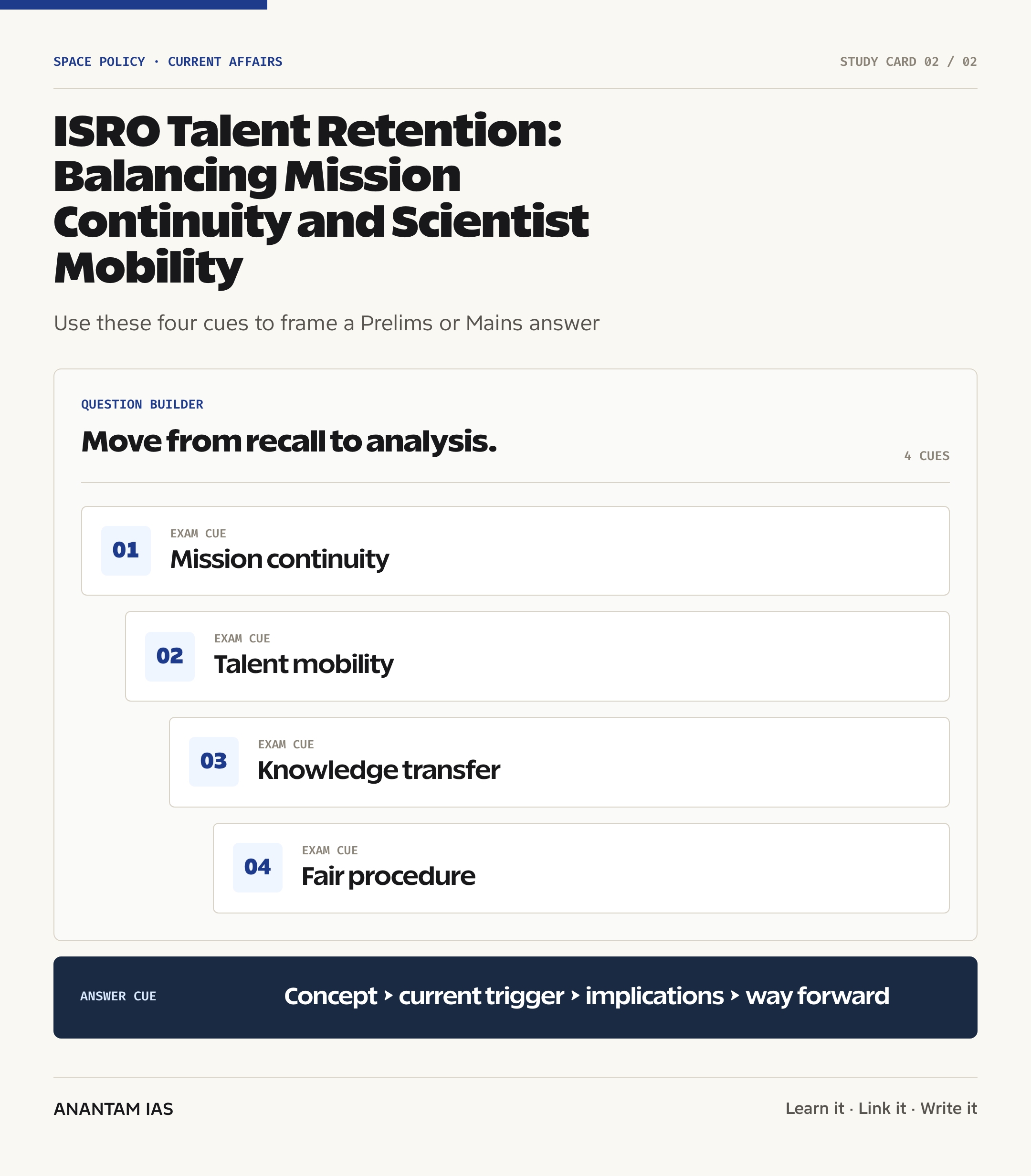
- Mission-critical scientific institutions depend on tacit knowledge and team continuity, yet public employment must remain fair and humane. Examine the administrative and ethical issues raised by restricting the exit of specialised personnel, and suggest a proportionate framework for India’s strategic research organisations.
- India’s space-sector reforms have expanded private participation and competition for skilled workers. Discuss how ISRO can protect advanced research and human-spaceflight capability through workforce planning, succession, knowledge management and structured mobility without weakening the wider national innovation ecosystem.
Sources: Department of Space and ISRO and The Hindu.
Frequently Asked Questions
What did the July 14 ISRO memorandum do?
As reported by The Hindu, it asked centre directors and unit heads not to treat resignation or voluntary-retirement requests from covered Group A scientific and technical personnel as routine. Requests involving Gaganyaan and other important missions are to be referred to the Department of Space for a final decision.
Does the memorandum ban every ISRO resignation?
The available report doesn’t support that conclusion. It describes central review of selected requests connected with important missions, not a published blanket ban on all employees. The memorandum’s full criteria, timelines and case-by-case decisions haven’t been publicly detailed in the cited official material.
Why are Gaganyaan skills considered mission-critical?
Gaganyaan combines human-rated launch systems, crew escape, life support, human factors, training, recovery and certification. These functions involve long test histories and strict safety evidence. Losing specialised staff without a trained successor can disrupt interfaces, reviews and the traceability needed for safe human spaceflight.
How is the present episode similar to the 1990s?
The Hindu reports that ISRO also faced exits during the early-1990s IT boom, when private campus hiring moved faster than government recruitment. The comparison is useful because both periods combine rapid programme expansion with competition for engineers, though today’s private space and deep-tech ecosystem is more directly connected to ISRO skills.
What is the role of IIST in talent development?
The Indian Institute of Space Science and Technology was established in Thiruvananthapuram in 2007 as an autonomous body under the Department of Space. Its teaching and research in space science and technology help build a specialised talent pipeline aligned with the needs of India’s space programme.
What is a better long-term retention strategy?
A durable strategy combines career progression, research autonomy, workload support and recognition with succession planning and strong documentation. Time-bound handovers, deputy roles, secondments and re-entry pathways can protect mission continuity while respecting mobility. Exit scrutiny should be narrow, reasoned and reviewable, not a substitute for workforce reform.