Why in News?
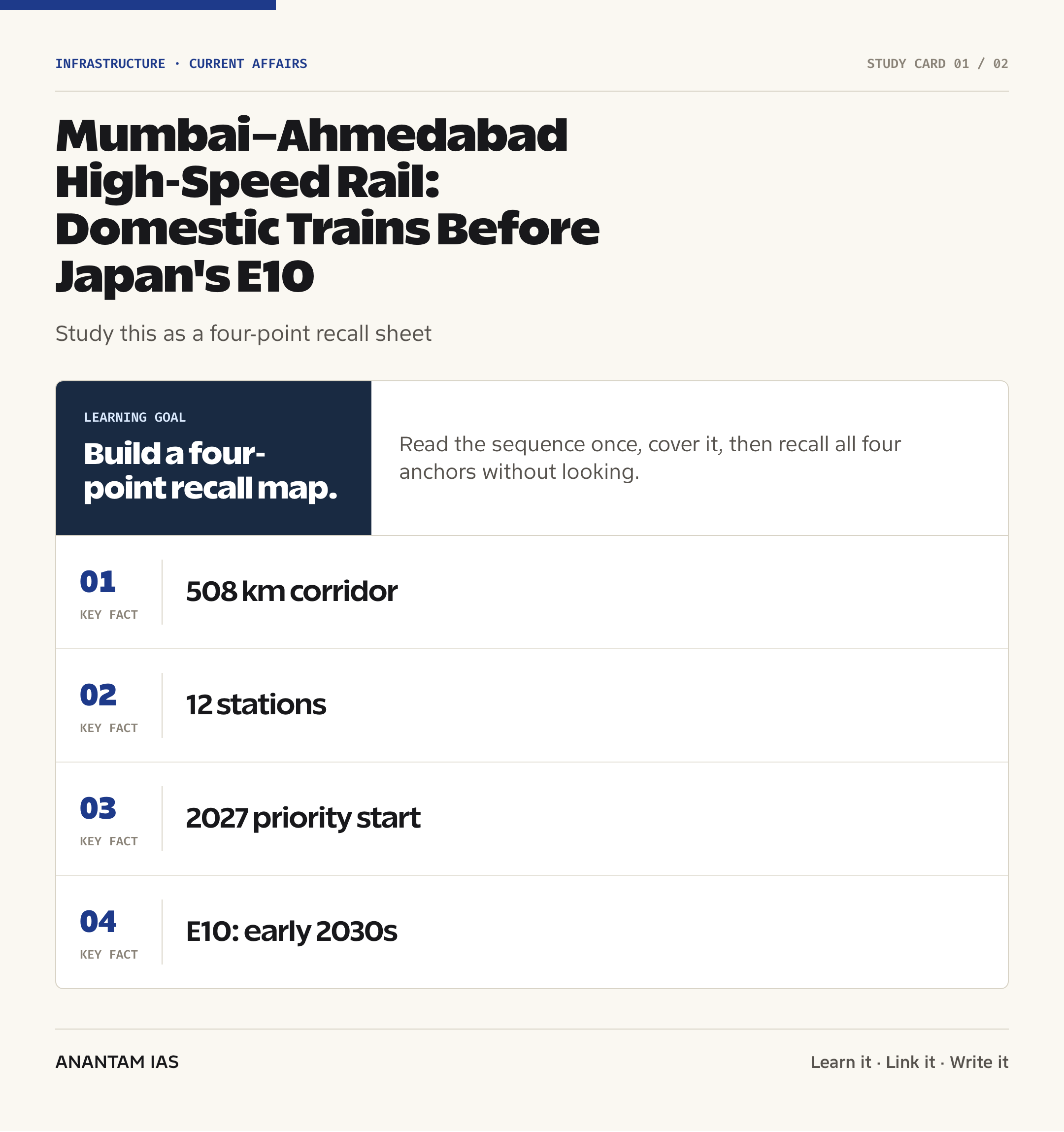
The Ministries of External Affairs and Railways clarified on 17 July 2026 that operations on a priority section of the Mumbai–Ahmedabad High-Speed Rail corridor are planned to begin with an Indian high-speed train, while Japan’s next-generation E10 Shinkansen is expected only in the early 2030s.
The clarification, reported by The Hindu and The Indian Express, answered claims that India–Japan cooperation had stalled. The durable issue isn’t a replacement of Japanese technology by Indian technology; it is a phased rolling-stock and systems strategy within a bilateral infrastructure project.
- Near-term sequence: India is developing a domestic high-speed trainset through Integral Coach Factory and BEML for initial service on a priority section.
- Later sequence: The bilateral commitment is to introduce the still-developing E10 Shinkansen in the early 2030s, not necessarily in calendar year 2030.
- Priority opening: A current PIB factsheet expects the first high-speed service in August 2027 on the Surat–Vapi section; this isn’t a full-corridor completion date.
- System question: Signalling, train control and rolling stock must be certified as one safety system, so sequencing can’t be reduced to the nationality of the train.
- Bilateral continuity: The July 2026 India–Japan summit acknowledged both India’s 2027 priority-section target and the goal of introducing the E10.
The development matters in the context of:
- Technology transfer: The project combines Japanese high-speed-rail practices with domestic construction, manufacturing, training and systems capability.
- Project governance: Phased commissioning can produce learning earlier, but only if every interim configuration meets independent safety and interoperability requirements.
- Industrial policy: Domestic trainset development creates tooling, testing and supplier capacity that may support India’s proposed future high-speed corridors.
- Strategic partnership: MAHSR is a flagship of the India–Japan Special Strategic and Global Partnership, linking finance, engineering and long-term industrial cooperation.
UPSC Relevance
Prelims Relevance
- MAHSR stands for the Mumbai–Ahmedabad High-Speed Rail corridor, India’s first dedicated high-speed rail corridor.
- The implementing company is the National High Speed Rail Corporation Limited, incorporated in 2016.
- The approximately 508 km corridor crosses Maharashtra, Gujarat and the Union Territory of Dadra and Nagar Haveli.
- The corridor has 12 planned stations, from Mumbai BKC to Sabarmati.
- The official corridor specification gives a 350 kmph design speed and a 320 kmph operating speed for the mature system.
- The J-slab ballastless track is based on Japanese Shinkansen track technology.
- ICF, in collaboration with BEML, is developing indigenous high-speed trainsets described by PIB as 280 kmph trainsets.
- The E10 is Japan’s next-generation Shinkansen series and remains under development.
- The 2025 India–Japan joint statement placed E10 introduction in the early 2030s and referred to the Japanese signalling system.
- High-speed rail uses dedicated infrastructure, advanced rolling stock, continuous train control and stringent system-level safety assurance.
Mains Relevance
GS Paper 3
- Infrastructure: Benefits and risks of phased commissioning in a capital-intensive, safety-critical transport corridor.
- Industrial capability: Localisation of rolling stock, slab track, construction equipment, testing facilities and maintenance skills.
- Technology governance: Interoperability among trainsets, signalling, electrification, track and operating procedures.
- Regional development: Station-area planning, multimodal integration and productivity gains along an economic corridor.
GS Paper 2
- International relations: Infrastructure finance and technology cooperation as pillars of the India–Japan partnership.
- Institutional coordination: Managing standards, procurement and public communication across two governments and multiple implementing agencies.
- Strategic trust: Separating political controversy from agreed summit outcomes and verifiable project milestones.
Essay
- Self-reliance works best as capability building, not technological isolation.
- Infrastructure partnerships endure when finance, standards, skills and accountability move together.
Background and Context
What the New Sequencing Actually Means
The domestic trainset and the E10 belong to different stages of the same corridor plan, so they shouldn’t be treated as identical or mutually exclusive choices.
- Stage one: India plans to use an indigenously developed trainset when a priority section is ready for service.
- Stage two: Japan is expected to supply the E10 after that train family is developed and the corridor is prepared for its introduction.
- Timing discipline: The official bilateral phrase is early 2030s; converting it into a guaranteed 2030 delivery date would overstate the commitment.
- Scope discipline: A 2027 start on a priority section doesn’t mean the entire Mumbai–Ahmedabad corridor will be commercially open that year.
- Not a simple substitution: Rolling stock, signalling, train control, track, power, depots and operating rules have to function as an integrated safety system.
- Policy reading: The sequence tries to balance early operations, domestic capability and continued access to advanced Japanese technology.
The Corridor at a Glance
MAHSR is a dedicated standard-gauge passenger corridor built for speeds and safety requirements far beyond conventional Indian Railways operations.
- Alignment: The corridor runs for about 508 km through Maharashtra, Dadra and Nagar Haveli, and Gujarat.
- Stations: Its 12 planned stops are Mumbai, Thane, Virar, Boisar, Vapi, Bilimora, Surat, Bharuch, Vadodara, Anand, Ahmedabad and Sabarmati.
- Performance: NHSRCL specifies a mature-system operating speed of 320 kmph and limited-stop travel of about two hours.
- Structures: Most of the route is elevated, while the Maharashtra section includes a long tunnel with an undersea portion beneath Thane Creek.
- Track: The project introduces J-slab ballastless track, which fixes rails to concrete slabs instead of conventional ballast.
- Planning connection: Read the corridor alongside India’s broader infrastructure constraints and investment pipeline.
Domestic Trainset: Capability, Not Yet a Finished Service
Building a trainset is only one milestone; safe commercial service needs design validation, dynamic trials, certification and operating readiness.
- Industrial actors: ICF awarded BEML the work to design, manufacture and commission two eight-car high-speed trainsets.
- Official description: PIB calls these indigenous 280 kmph high-speed trainsets, while BEML’s technical material distinguishes test speed from commercial operating speed.
- Exam caution: A test or design speed isn’t automatically the speed at which passengers will initially travel.
- Testing chain: Braking distance, ride dynamics, wheel–rail interaction, electromagnetic compatibility and emergency procedures need verification.
- Production ecosystem: The programme creates specialised tooling, jigs, test facilities, suppliers and skilled teams for future trainsets.
- Operational learning: Initial service can build experience in dispatch, maintenance, passenger handling and incident response before later rolling stock arrives.
E10 and the India–Japan Technology Compact
The E10 is part of a wider bilateral package that includes finance, engineering, safety culture, inspection systems and human-resource development.
- Summit mandate: The 2025 joint statement recorded Japan’s offer to introduce the E10 in the early 2030s.
- Development status: Japan’s Ministry of Foreign Affairs describes the E10 as still under development, which explains why it can’t anchor the first operational stage.
- Inspection support: The same bilateral framework referred to a General Inspection Train and one E5 set for inspection, testing and preparatory work.
- Human capital: Japanese methods are being transmitted through training of Indian engineers, technicians, operators and maintenance personnel.
- Finance: Japan’s concessional official-development assistance lowers financing pressure while binding the project to agreed procurement and technical frameworks.
- Strategic meaning: The corridor shows how a bilateral partnership can move from buying a finished asset toward co-developing domestic capabilities.
Why Signalling and Interoperability Matter
High-speed signalling is a continuous safety architecture, not a roadside signal upgraded for faster trains.
- Cab signalling: At high speed, drivers need movement authority and speed information inside the cab because trackside signals may be unreadable in time.
- Automatic protection: The system must enforce speed limits and braking curves if human action is late or unsafe.
- Interoperability: Train-borne equipment must communicate reliably with trackside equipment, control centres and radio networks.
- Interface risk: A train proven on one signalling architecture can’t be assumed safe on another without engineering integration and certification.
- Migration planning: If the domestic trainset and E10 use different onboard configurations, the infrastructure and operating rules need an explicit transition path.
- Governance test: Procurement speed should never weaken independent safety assurance, transparent interface management or incident accountability.
Economic and Regional Significance
The strongest case for high-speed rail rests on network effects and regional productivity, not speed as a spectacle.
- Time geography: Faster reliable travel can bring major business centres within a practical same-day travel market.
- Intermediate cities: Vapi, Surat, Bharuch, Vadodara and Anand can gain access to larger labour, services and investment networks.
- Station-area development: Dense mixed-use planning and public-transport interchange are needed to turn a station into an economic node.
- Modal integration: Last-mile metro, bus and conventional-rail links determine whether door-to-door time savings reach ordinary passengers.
- Industrial spillovers: Demand for steel, electrical systems, precision components and civil engineering can deepen local supply chains.
- Evidence need: Appraisal should track ridership, affordability, land-value change, emissions and regional distribution, themes also central to transport-economics research.
Risks and Public-Policy Questions
A phased launch reduces waiting time but can add interface, cost and accountability risks if the transition is poorly governed.
- Schedule risk: Civil works, stations, power, signalling, depots, rolling stock and certification must converge on the same usable section.
- Configuration risk: An interim system can become costly if later E10 introduction requires extensive retrofitting.
- Safety risk: Political deadlines may pressure testing, making regulator independence and public disclosure of readiness criteria essential.
- Financial risk: Delays and scope changes can raise lifetime costs even when headline loan terms are concessional.
- Equity risk: High fares or weak feeder links can limit benefits to a narrow passenger segment.
- Communication risk: Governments should distinguish target dates, expected dates and certified readiness so public debate isn’t built on false precision.
Way Forward
Publish a Phased Commissioning Baseline
- Define each stage: State the section, trainset, signalling configuration, trial window and safety approvals required before passenger service.
- Separate milestones: Report civil completion, trial readiness and commercial opening as different events.
- Use evidence: Publish periodic progress against interfaces, not only kilometres of viaduct or piers.
Protect System-Level Safety
- Independent assurance: Subject rolling stock, signalling and operating rules to third-party review and statutory certification.
- Transition case: Prepare and disclose a safety case for moving from domestic trainsets to the E10 configuration.
- Emergency readiness: Test evacuation, tunnel response, power failure, degraded-mode operations and multi-agency command.
Turn Localisation into Learning
- Supplier development: Use quality audits and long-term orders to deepen precision manufacturing instead of chasing a headline local-content ratio.
- Skills: Build permanent training, simulation, maintenance and research capacity around NHSRCL, ICF, BEML and technical institutes.
- Open standards: Document interfaces carefully so future corridors can reuse verified designs without creating vendor lock-in.
Maximise Public Value
- Integrate stations: Coordinate metro, bus, conventional rail, walking and land use before operations begin.
- Track outcomes: Measure door-to-door time, ridership, affordability, safety, emissions and regional investment.
- Maintain bilateral trust: Resolve technical disputes through formal India–Japan mechanisms and communicate agreed facts jointly.
Conclusion
The July clarification doesn’t mark a retreat from the India–Japan high-speed-rail partnership. It describes a sequence: use a domestic trainset for an earlier priority-section launch, then introduce the E10 when the Japanese train and corridor systems are ready.
For UPSC answers, the real issue is the governance of technological transition. India gains only if early commissioning, localisation, interoperability and safety certification reinforce one another while public timelines remain precise about what is opening and when.
UPSC Practice Questions
Prelims MCQ 1
With reference to the Mumbai–Ahmedabad High-Speed Rail corridor, consider the following statements:
- It passes through Maharashtra, Gujarat and the Union Territory of Dadra and Nagar Haveli.
- It has 12 planned stations between Mumbai and Sabarmati.
- The entire corridor is officially scheduled to begin commercial operations in August 2027.
How many of the above statements are correct?
(a) Only one (b) Only two (c) All three (d) None
Answer: (b) Only two
Explanation:
Statements 1 and 2 are correct. The August 2027 expectation concerns the first priority section, identified by PIB as Surat–Vapi, not guaranteed commercial opening of the entire 508 km corridor.
Prelims MCQ 2
Which statement best describes the current rolling-stock sequence for MAHSR?
(a) The E10 is already operating on the completed corridor (b) India has cancelled Japanese technology and converted MAHSR to conventional rail (c) A domestic trainset is planned for initial operations before the later introduction of Japan’s E10 (d) The domestic trainset and E10 are the same train under different names
Answer: (c) A domestic trainset is planned for initial operations before the later introduction of Japan's E10
Explanation:
The domestic ICF–BEML trainset is intended for the initial priority-section sequence. The E10 is a separate next-generation Japanese Shinkansen train under development and planned for the early 2030s.
UPSC Mains Questions
- The Mumbai–Ahmedabad High-Speed Rail project is as much a technology-governance challenge as a transport-infrastructure project. Examine how phased commissioning, domestic manufacturing, interoperability and independent safety assurance should be balanced.
- Infrastructure cooperation has become a durable pillar of the India–Japan Special Strategic and Global Partnership. Discuss with reference to financing, technology transfer, human-resource development and the evolving rolling-stock plan for MAHSR.
Sources: PIB Research and Ministry of Railways and Prime Minister's Office, Government of India.
Frequently Asked Questions
What is the MAHSR corridor?
The Mumbai–Ahmedabad High-Speed Rail corridor is India’s first dedicated high-speed passenger railway. It runs for about 508 km through Maharashtra, Dadra and Nagar Haveli, and Gujarat, with 12 planned stations between Mumbai BKC and Sabarmati. NHSRCL is the implementing company.
Will Indian trains operate before the E10?
Yes. The July 2026 clarification says both sides agreed to begin operations on a priority section with an Indian high-speed trainset because the E10 is still under development. This is a phased rolling-stock plan, not proof that Japan has left the project.
When will the E10 reach India?
The official India–Japan joint statement uses the phrase early 2030s for E10 introduction. It doesn’t guarantee a calendar-year 2030 delivery. The train is still under development, and deployment also depends on corridor systems, testing, signalling integration and certification.
Will the full corridor open in 2027?
No official source cited here promises full-corridor commercial opening in 2027. PIB expects the first high-speed service in August 2027 on the Surat–Vapi priority section. Other sections have separate civil, systems, tunnel, station and certification dependencies.
Why is signalling central to this issue?
At high speed, signalling continuously controls movement authority, speed and braking. Train-borne and trackside equipment must work together reliably. Any domestic trainset, inspection train or later E10 needs system-level integration, trials and independent safety certification before passenger operations.
How does MAHSR support Make in India?
The project builds domestic capability in trainsets, slab track, precision components, construction methods, testing facilities, maintenance and workforce training. The stronger objective is reusable engineering capacity for future corridors, while retaining access to Japanese safety practices and advanced Shinkansen technology.