Opens in a new tab
Join Anantam IAS Channel on Telegram

Daily Digest · Saturday

11 July 2026 Current Affairs for UPSC

10 current affairs published on Saturday, 11 July 2026

11 July 2026 Current Affairs for UPSC — every Why-in-News article AnantamIAS published on Saturday, 11 July 2026, broken down with Why in News?, the exact GS paper it feeds, sub-topic mapping, MCQ-ready facts and a UPSC-style practice question. 10 articles in total, covering Polity, Economy, Environment, S&T, IR, Geography, History, Society and Internal Security — the same Why-in-News + GS-paper-mapping + practice-question format the Compass uses across every daily digest on the site.

Daily current affairs for UPSC is where new material enters your prep stream. Read this 11 July 2026 digest end-to-end in 25–35 minutes, attempt the practice question at the foot of each article (it's MCQ for some, 10/15-marker for others), then bookmark the entries that fall inside your active revision window. Everything stays cross-linked: tap any subject pill to jump to that subject's hub, or use the table of contents above to skip straight to a specific story.

Use this page three ways. Read sequentially for a one-sitting scan of everything that mattered on 11 July 2026. Download the 11 July 2026 PDF below for offline study or print revision. Or use the July 2026 Current Affairs compilation to see this day in the month's full context. For the previous day's reading, see 10 July 2026 Current Affairs; the next day's is 12 July 2026 Current Affairs.

Why we publish daily current affairs separately from the monthly compilation: daily is learning, monthly is revision. Use the daily page to add fresh material to your notes the day it breaks; come back to the July 2026 compilation 60 days before Prelims when the noise has settled and only the lasting takeaway is worth re-reading.

SHANTI Act 2025: NITI Aayog consultation kicks off implementation

Open article →Download PDF

Why in News?

PIB confirmed that NITI Aayog convened the first Stakeholder Consultation on Implementation of the SHANTI Act 2025 on 10 July 2026 at the Dr. Ambedkar International Centre, New Delhi. The meeting brought government, regulators, research institutions and industry to one table to shape the operational framework of the law that has replaced the Atomic Energy Act, 1962 and the Civil Liability for Nuclear Damage (CLND) Act, 2010.

The consultation, chaired by Prof. Abhay Karandikar (Member, NITI Aayog), marks the shift of India’s biggest nuclear-sector reform from statute to rollout — the draft rules, the nuclear FDI policy, insurance arrangements and capacity-building plans are all now under active design.

  • The consultation was held on 10 July 2026 at Samrasta Auditorium, Dr. Ambedkar International Centre, New Delhi; PIB released the summary on 11 July 2026.
  • Participants included the Secretary, Ministry of Power (Pankaj Agrawal), the Chairperson of the Central Electricity Authority, the CMD of NTPC Ltd, and senior officials of the Department of Atomic Energy (DAE) and the Atomic Energy Regulatory Board (AERB).
  • Discussions ran on three pillars: Legislative & Regulatory Framework; Finance, Insurance & Public Perception; and Manufacturing, Operations & Capacity Building.
  • The opening technical segment presented the statutory compliance mechanisms under the Act and how foreign capital can be attracted while safeguarding domestic interests.
  • The SHANTI Act was passed by the Lok Sabha on 17 December 2025 and the Rajya Sabha on 18 December 2025, per PRS Legislative Research.

The development matters in the context of:

  • This is the operational follow-through on India’s 100 GW nuclear capacity by 2047 goal under the Nuclear Energy Mission announced in Budget 2025-26 — a roughly twelve-fold jump from today’s installed base of about 8.2 GW.
  • The presence of the Ministry of Power, CEA and NTPC signals that nuclear power is being mainstreamed into general electricity planning, not treated as a sealed DAE enclave.
  • How the rules, FDI policy and insurance pools are drafted will decide whether private and foreign capital actually flows — the statute alone only opens the door.
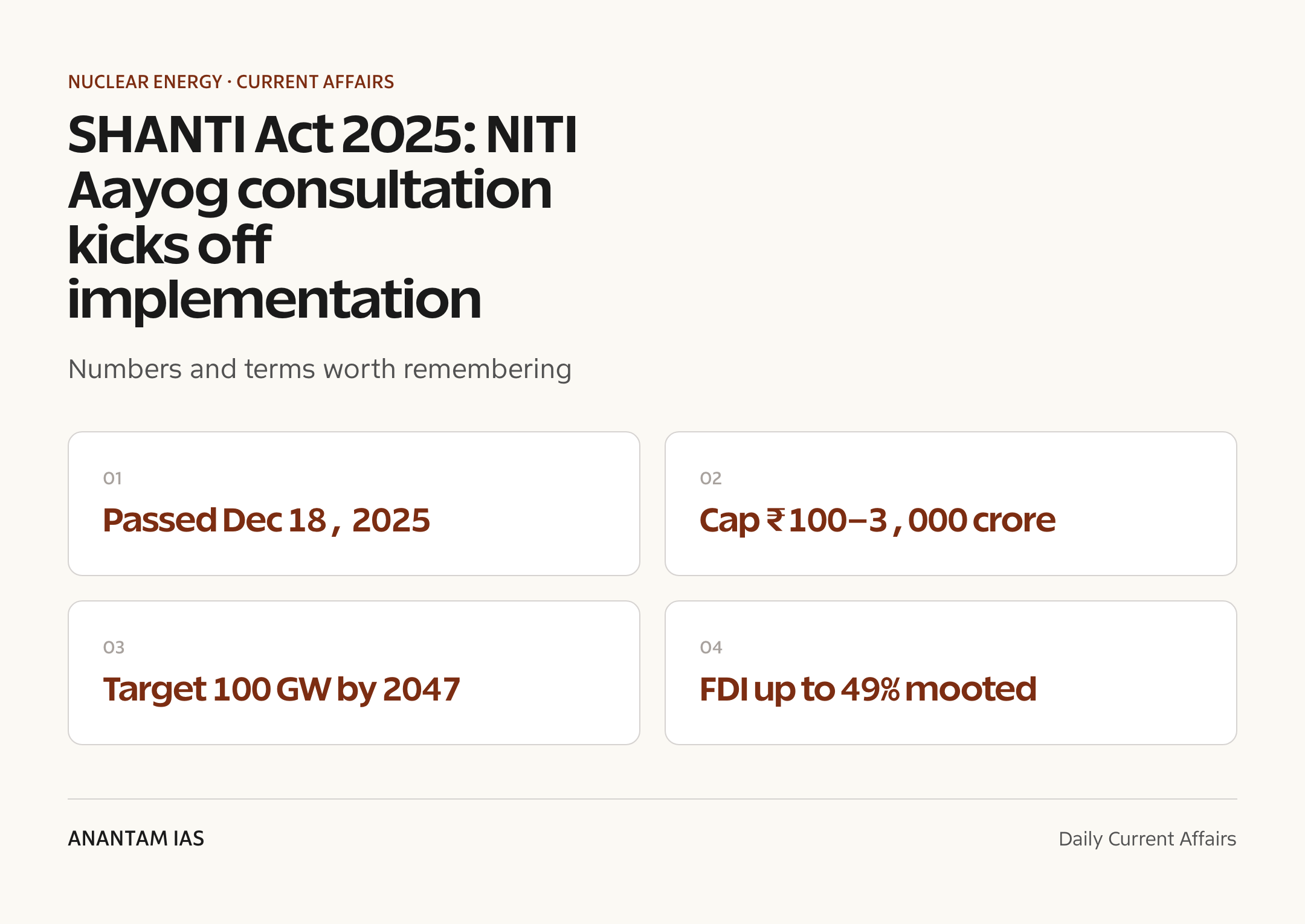
SHANTI Act 2025: NITI Aayog consultation kicks off implementation — quick facts

UPSC Relevance

Prelims Relevance

  • SHANTI = Sustainable Harnessing and Advancement of Nuclear Energy for Transforming India Act, 2025.
  • Repeals and replaces TWO laws: the Atomic Energy Act, 1962 and the CLND Act, 2010.
  • Passed: Lok Sabha 17 Dec 2025, Rajya Sabha 18 Dec 2025; introduced 15 Dec 2025 (Ministry of Science and Technology and Earth Sciences, per PRS).
  • Licences can now go to Indian private companies and JVs — but NOT to companies incorporated outside India.
  • Operator liability becomes a tiered structure: ₹100 crore to ₹3,000 crore by power capacity (the 2010 Act had a flat ₹1,500 crore cap for reactors of 10 MW thermal and above).
  • The Act removes the operator’s right of recourse against suppliers for defective equipment — the clause that had frozen foreign vendor interest since 2010.
  • AERB gets statutory status: chairperson + 1 whole-time member + up to 7 part-time members, chosen via a search-cum-selection committee.
  • New appellate body: Atomic Energy Redressal Advisory Council, chaired by the Chairperson of the Atomic Energy Commission; further appeals lie before the Appellate Tribunal for Electricity (APTEL).
  • Consultation convener: NITI Aayog; chaired by Prof. Abhay Karandikar; venue: Dr. Ambedkar International Centre, New Delhi.

Mains Relevance

GS Paper 3

  • Energy security and the clean-energy transition: nuclear as firm, low-carbon baseload for the net-zero by 2070 pathway and the 100 GW-by-2047 target.
  • Mobilising private investment in strategic infrastructure: licensing design, graded liability, insurance pools and FDI sequencing as instruments of calibrated liberalisation.
  • Science-technology ecosystem: Small Modular Reactors (SMRs), domestic manufacturing, supply-chain resilience and skilled-workforce pipelines discussed at the consultation.

GS Paper 2

  • Statutory regulators and governance: converting AERB from an executive body under the DAE into a statutory regulator — independence, appointments and accountability design.
  • Policy implementation architecture: NITI Aayog’s convening role in translating a statute into rules, regulations and institutional capacity.

Essay

  • Atoms for prosperity: can state monopolies reform themselves without surrendering safety?
  • Energy transitions are institutional transitions first and technological transitions second.

Background and Context

What the SHANTI Act 2025 is

One statute now governs both nuclear development and nuclear liability in India.

  • The Sustainable Harnessing and Advancement of Nuclear Energy for Transforming India (SHANTI) Act, 2025 replaces the Atomic Energy Act, 1962 (development and control of atomic energy) and the CLND Act, 2010 (liability and compensation after a nuclear incident).
  • Parliament cleared it in the 2025 Winter Session — Lok Sabha on 17 December 2025, Rajya Sabha on 18 December 2025 — ending a 63-year government monopoly over nuclear power.
  • The reform rests on the Nuclear Energy Mission (Budget 2025-26), which set the 100 GW by 2047 capacity goal and committed ₹20,000 crore for Small Modular Reactor R&D, with at least five indigenously designed SMRs targeted by 2033.
  • For the full statutory design, see our explainer on the SHANTI Act 2025 and the primer on nuclear energy in India.
SHANTI Act 2025: NITI Aayog consultation kicks off implementation — exam lens

Ending the monopoly: who can hold a licence now

The licensing chapter is where the 1962 architecture changes most.

  • Under the 1962 Act, licences for atomic-mineral mining and for producing, using or trading nuclear substances could go only to central government entities or government companies — in practice, NPCIL ran the power plants.
  • The SHANTI Act lets the Centre license any Indian company, joint ventures between government entities and private firms, and any other person it expressly permits — for building, owning or operating a nuclear plant or reactor, and for fabrication, transport, trade or storage of nuclear fuel.
  • Companies incorporated outside India remain barred from holding a licence — foreign participation is routed through equity in Indian entities instead.
  • Every activity involving radiation exposure additionally needs a safety authorisation from the AERB, keeping a single safety gate across public and private operators.

Liability rework: graded caps and the supplier clause

The Act keeps the no-fault principle but redraws the numbers that scared investors away.

  • The no-fault operator liability of the 2010 Act survives: the operator compensates victims regardless of negligence, backed by mandatory insurance, with the Centre bearing liability beyond the cap.
  • The flat cap of ₹1,500 crore (for reactors of 10 MW thermal and above) gives way to a tiered structure of ₹100 crore to ₹3,000 crore linked to power capacity — smaller caps for SMRs, larger for big plants.
  • The operator’s right of recourse against suppliers for defective equipment — Section 17(b) of the CLND Act, the clause blamed for stalling deals with foreign vendors after 2010 — is removed; recourse now survives only via contract or intentional acts.
  • Territorial coverage widens: compensation can extend to nuclear damage in a foreign state’s territory caused by an incident in India, subject to conditions.
  • The caps are already contested — a plea before the Supreme Court has argued the limits are too low for a Fukushima-scale disaster; see our note on the SC challenge to SHANTI liability caps.

A statutory AERB and a new appeals ladder

Regulatory independence moves from promise to statute — with caveats.

  • The Act gives the Atomic Energy Regulatory Board statutory recognition; since 1983 it had existed only by executive order under the Department of Atomic Energy — the very entity it regulated, a conflict flagged by the CAG in 2012.
  • Composition: a chairperson, one whole-time member and up to seven part-time members, appointed by the Centre on the recommendation of a search-cum-selection committee constituted by the Atomic Energy Commission; terms run three years, extendable by three.
  • A new Atomic Energy Redressal Advisory Council — chaired by the Chairperson of the Atomic Energy Commission, with the Directors of BARC, AERB and CEA — hears appeals against orders of the Centre or the AERB.
  • Appeals against the Council go to the Appellate Tribunal for Electricity (APTEL), stitching nuclear regulation into the wider electricity-law appellate system.
  • Critics note the selection loop still runs through the Atomic Energy Commission, so full arm’s-length independence of the regulator remains a design question for the rules.

What the NITI Aayog consultation actually covered

PIB’s release organises the rollout agenda into three pillars.

  • Legislative & Regulatory Framework — the Act’s draft rules and regulations and the related FDI policy provisions; the opening segment mapped statutory compliance mechanisms and how to attract foreign capital while safeguarding domestic interests.
  • Finance, Insurance & Public Perception — financial and risk-mitigation frameworks, insurance arrangements for long-term projects, and strategies to build public awareness and community trust around nuclear plants.
  • Manufacturing, Operations & Capacity Building — domestic manufacturing depth, operational readiness, supply-chain resilience and dedicated skilling programmes for the nuclear workforce.
  • Attendance told its own story: the Ministry of Power, Central Electricity Authority and NTPC sat alongside DAE and AERB — nuclear power is being planned as part of the general grid, and NTPC is positioning as a major nuclear operator.
  • Stakeholder inputs from all three pillars will feed into the Act’s implementation framework, PIB said.

The FDI question: policy, not yet statute

The Act opens the sector to Indian private players; foreign money needs a separate policy change.

  • India’s extant FDI policy prohibits FDI in atomic energy; the SHANTI Act itself does not amend that — it only makes foreign minority equity legally workable by allowing licensed Indian companies.
  • Press reports around the Cabinet clearance said the government intends to allow up to 49% FDI in nuclear power; Business Standard reported in April 2026 that the Atomic Energy Commission has cleared the draft FDI policy and sent it for inter-ministerial consultation.
  • The PIB release confirms FDI policy provisions were a live agenda item at the consultation — the caps, entry routes and security screening are being settled now.
  • Global vendors (from the US, France, Russia and South Korea) had long cited the supplier-liability clause and the licensing bar as deal-breakers; the new framework removes both, contingent on credible rules.

Way Forward

Notify credible rules fast

  • Publish the draft rules and AERB regulations for public comment with clear timelines — licensing criteria, safety codes and decommissioning norms decide investor confidence more than the statute does.
  • Finalise the nuclear FDI policy with unambiguous caps, entry routes and national-security screening so foreign partners can price risk.

Build the financial plumbing

  • Deepen the India Nuclear Insurance Pool and design long-tenor insurance products matched to 60-year plant lives.
  • Clarify tariff treatment and offtake for private nuclear power through the CEA-CERC framework so projects are bankable.

Protect regulatory independence and public trust

  • Operationalise the statutory AERB with independent funding, transparent appointments and published safety reviews.
  • Institutionalise community engagement around plant sites — the consultation’s public-perception pillar acknowledges that social licence, not technology, is often the binding constraint.

Conclusion

The SHANTI Act 2025 rewired the legal foundations of India’s nuclear sector in a single stroke — one statute in place of two, private operators in place of a state monopoly, graded liability in place of a flat cap, and a statutory regulator in place of an executive one. But statutes don’t build reactors; rules, money and trust do.

That’s why the NITI Aayog consultation matters. The draft rules, the FDI policy, insurance pools and skilling pipelines discussed on 10 July 2026 are the machinery that will decide whether the 100 GW-by-2047 ambition becomes bankable projects or stays a slogan. For aspirants, this is a living case study in how a landmark law travels from Parliament to the ground.

UPSC Practice Questions

Prelims MCQ 1

With reference to the SHANTI Act, 2025, consider the following statements:

  1. It replaces both the Atomic Energy Act, 1962 and the Civil Liability for Nuclear Damage Act, 2010.
  2. It permits companies incorporated outside India to obtain a licence to operate nuclear power plants in India.
  3. It gives statutory recognition to the Atomic Energy Regulatory Board (AERB).

How many of the above statements are correct?

(a) Only one (b) Only two (c) All three (d) None

Answer: (b) Only two

Explanation:

Statements 1 and 3 are correct. Statement 2 is wrong — the Act extends licensing to Indian private companies and JVs but expressly excludes companies incorporated outside India; foreign participation can come only as equity in Indian entities under a separate FDI policy.

Prelims MCQ 2

Under the SHANTI Act, 2025, appeals against the decisions of the Atomic Energy Redressal Advisory Council lie before which body?

(a) The Supreme Court of India directly (b) The National Green Tribunal (c) The Appellate Tribunal for Electricity (d) The Atomic Energy Commission

Answer: (c) The Appellate Tribunal for Electricity

Explanation:

The Council — chaired by the Chairperson of the Atomic Energy Commission — hears appeals against orders of the Centre or the AERB; further appeals go to the Appellate Tribunal for Electricity (APTEL), linking nuclear regulation to the electricity-law appellate chain.

UPSC Mains Questions

  1. The SHANTI Act, 2025 replaces state monopoly with calibrated liberalisation in India’s nuclear sector. Examine how its licensing, graded-liability and regulatory provisions attempt to balance private investment with nuclear safety and security. (250 words)
  2. Statutory independence of the regulator is a precondition for opening a high-risk sector to private capital. Discuss with reference to the Atomic Energy Regulatory Board under the SHANTI Act, 2025. (250 words)
  3. India’s target of 100 GW nuclear capacity by 2047 is as much an institutional challenge as a technological one. In the light of the ongoing implementation of the SHANTI Act, 2025, discuss the financing, insurance and skilling gaps that must be closed. (250 words)

Sources: PIB, NITI Aayog and PRS Legislative Research.

Frequently Asked Questions

What is the SHANTI Act 2025?

The Sustainable Harnessing and Advancement of Nuclear Energy for Transforming India Act, 2025 is India’s new umbrella nuclear law. Passed in December 2025, it replaces the Atomic Energy Act, 1962 and the CLND Act, 2010, opens nuclear power to Indian private companies, restructures liability and makes the AERB a statutory regulator.

Why was NITI Aayog’s consultation in news?

On 10 July 2026, NITI Aayog convened the first stakeholder consultation on implementing the SHANTI Act at the Dr. Ambedkar International Centre, New Delhi. Chaired by Prof. Abhay Karandikar, it discussed the draft rules, nuclear FDI policy, insurance arrangements, public perception and manufacturing capacity — the operational framework of the Act.

Can private companies now run nuclear plants in India?

Yes, in law. The Act lets the Centre license Indian private companies and joint ventures to build, own and operate nuclear plants and handle nuclear fuel — ending the government-only regime of the 1962 Act. Companies incorporated outside India are excluded, and every operator still needs AERB safety authorisation.

How does the Act change nuclear liability?

It keeps the operator’s no-fault liability but replaces the flat ₹1,500 crore cap with a tiered structure of ₹100 crore to ₹3,000 crore based on plant capacity. It also removes the operator’s right of recourse against suppliers for defective equipment — the CLND Act clause that had deterred foreign vendors since 2010.

Is 49% FDI in nuclear energy already allowed?

Not yet. The extant FDI policy still prohibits FDI in atomic energy. Press reports say the government intends to permit up to 49% foreign investment, and the Atomic Energy Commission has cleared a draft FDI policy now in inter-ministerial consultation. The PIB release confirms FDI provisions were discussed at the consultation.

What changes for the AERB under the Act?

The AERB, created by executive order in 1983 under the DAE, becomes a statutory body with a chairperson, one whole-time member and up to seven part-time members chosen through a search-cum-selection committee. A new Redressal Advisory Council hears appeals, with further appeals lying before the Appellate Tribunal for Electricity.
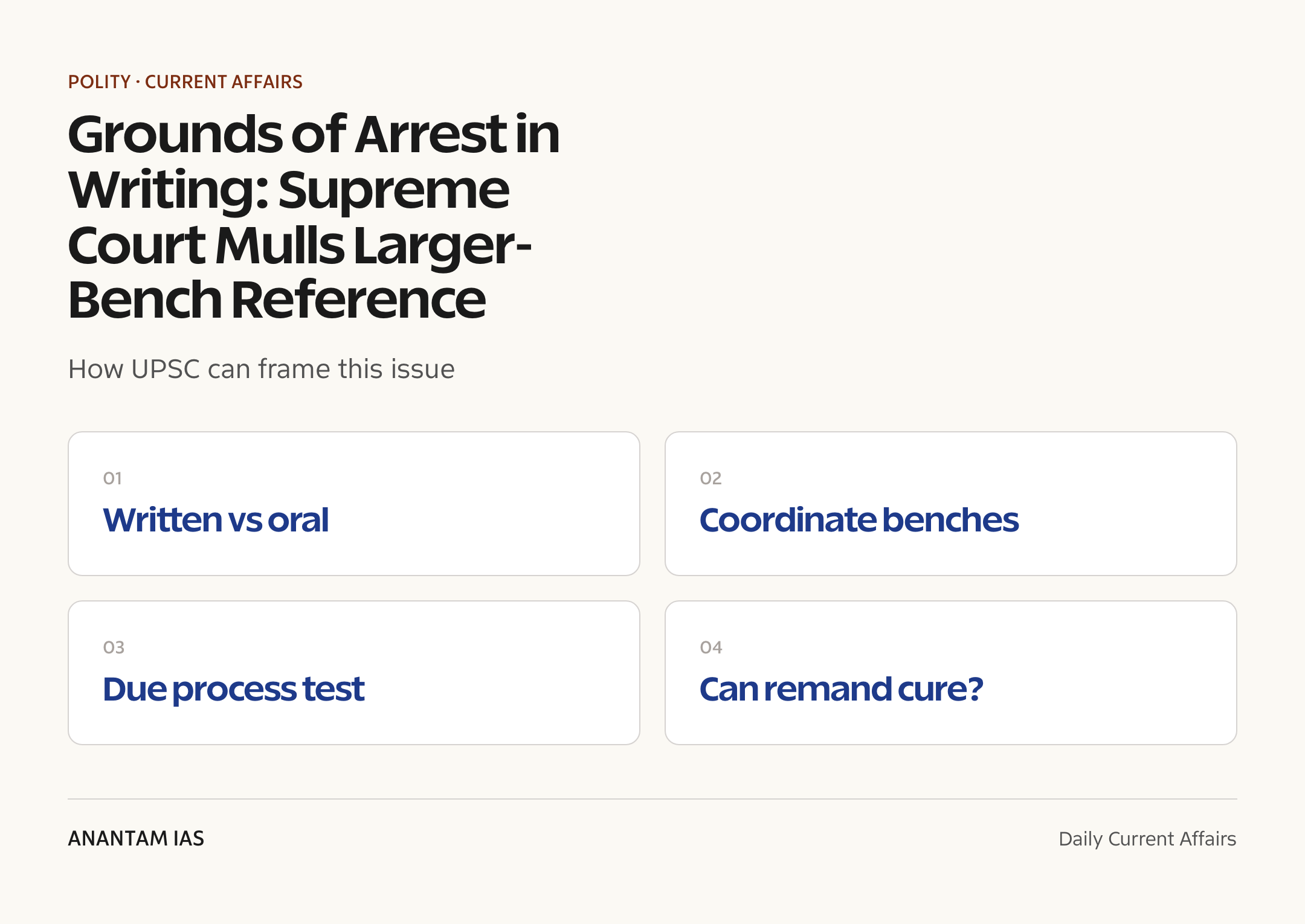
Grounds of Arrest in Writing: Supreme Court Mulls Larger-Bench Reference

Open article →Download PDF

Why in News?

On 9 July 2026, a partial working days bench of the Supreme Court — Justice Manoj Misra and Justice Shree Chandrashekhar — indicated it may refer to a larger bench the question of whether grounds of arrest must mandatorily be supplied in writing to an accused at the time of arrest. LiveLaw reported that the bench flagged conflicting judgments of coordinate benches on the issue.

The question arose in the State of Meghalaya’s challenge to the bail granted to Sonam Raghuvanshi, the prime accused in the murder of her husband Raja Raghuvanshi during their honeymoon in Meghalaya in May 2025. The Meghalaya High Court had granted bail because her arrest memo cited a non-existent penal provision. The Supreme Court did not stay the bail, sought the arrest documents, and listed the matter for 14 July 2026.

  • The bench of Justice Manoj Misra and Justice Shree Chandrashekhar signalled a possible larger-bench reference on whether written grounds of arrest are a constitutional mandate in every case.
  • Trigger: Sonam Raghuvanshi’s arrest memo cited Section 403(1) — a provision that doesn’t exist — instead of Section 103(1) of the Bharatiya Nyaya Sanhita (murder).
  • The Meghalaya High Court held the repeated reference to a non-existent provision showed non-application of mind and vitiated the arrest.
  • Justice Misra cited Pankaj Bansal (written grounds under PMLA) and a later NDPS bail order applying Mihir Shah (written grounds under all statutes) to illustrate the divergence.
  • No stay was granted, so the bail continues; the state must produce the arrest memo before the next hearing on 14 July 2026.

The development matters in the context of:

  • The case sits at the intersection of Article 22(1) due-process guarantees and practical police work — one authoritative rule on the form of communicating grounds will govern every arrest in India.
  • Conflicting coordinate-bench rulings mean identical procedural lapses can produce opposite bail outcomes in different states.
  • With the BNSS, 2023 now governing arrests, the answer decides how Section 47 BNSS is operationalised — orally, in writing, or in writing within a fixed timeline.
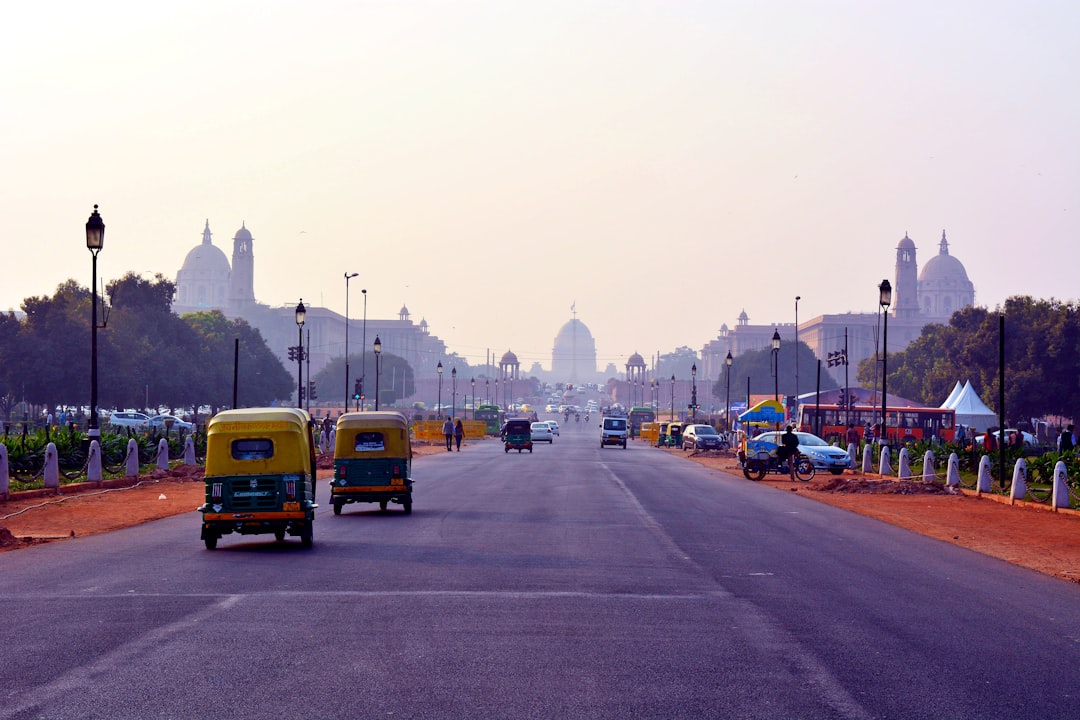
The Supreme Court of India building in New Delhi
The Supreme Court of India, which may refer the written-grounds-of-arrest question to a larger bench. Photo: Laurentiu Morariu (Unsplash)
Grounds of Arrest in Writing: Supreme Court Mulls Larger-Bench Reference — quick facts

UPSC Relevance

Prelims Relevance

  • Article 22(1): an arrested person must be informed, as soon as may be, of the grounds of arrest, and cannot be denied a legal practitioner of choice.
  • Article 22(2): production before the nearest magistrate within 24 hours of arrest (excluding journey time).
  • Section 47, BNSS 2023 (successor to Section 50 CrPC): the officer arresting without warrant must communicate full particulars of the offence or grounds of arrest, and inform a person arrested for a bailable offence of the right to bail.
  • Pankaj Bansal v Union of India (2023): the ED must furnish written grounds under Section 19 PMLA “as a matter of course and without exception”.
  • Prabir Purkayastha (2024): extended the written-grounds rule to UAPA; distinguished “grounds of arrest” (personal to the accused) from “reasons of arrest” (general).
  • Vihaan Kumar v State of Haryana (2025): Article 22(1) applies to ordinary penal law; non-communication vitiates the arrest and later remand or chargesheet cannot cure it.
  • Mihir Rajesh Shah v State of Maharashtra (Nov 2025): written grounds, in a language the arrestee understands, mandatory for all offences under all statutes; if impractical at arrest, within a reasonable time and at least two hours before remand production.
  • A coordinate bench cannot overrule an equal-strength bench; conflicts go to a larger bench (Central Board of Dawoodi Bohra Community, 2005).
  • D.K. Basu v State of West Bengal (1997): binding arrest-and-detention guidelines, including a witnessed, signed arrest memo.

Mains Relevance

GS Paper 2

  • Article 22 as a due-process safeguard: how judicial interpretation has converted a bare right to be “informed” into an enforceable written-communication mandate.
  • Conflicting coordinate-bench rulings and the larger-bench reference mechanism as an instrument of judicial certainty and discipline.
  • Criminal-justice reform under the BNSS, 2023: whether statutory codification of a written-grounds rule is preferable to case-by-case judicial evolution.
  • Police accountability and procedural rigour: the cost of a defective arrest memo — from vitiated arrests to bail in heinous-offence cases.

GS Paper 4

  • Rule of law vs outcome anxiety: should a typographical error free a murder accused — the ethics of procedural fidelity in state action.

Essay

  • Liberty lives in procedure: due process as the true measure of a constitutional democracy.
  • When courts disagree with themselves: judicial consistency as a public good.

Background and Context

Article 22: The Right to Know Why You Are Arrested

The constitutional text guarantees communication of arrest grounds but is silent on the form, and that silence is the root of the present conflict.

  • Article 22(1) mandates informing the arrestee “as soon as may be” of the grounds of arrest and access to a lawyer of choice; Article 22(2) adds the 24-hour magistrate-production rule.
  • For preventive detention, Article 22(5) requires communication of grounds; Harikisan v State of Maharashtra (1962) held those grounds must be in writing, in a language the detenu understands.
  • Joginder Kumar (1994) held the power to arrest is not itself the justification to arrest; D.K. Basu (1997) operationalised safeguards via the arrest memo, witness attestation and intimation to relatives.
  • Communication of grounds is functional — it lets the arrestee challenge custody, seek bail and brief counsel — so courts treat defective communication as a constitutional breach, not a technicality.
Grounds of Arrest in Writing: Supreme Court Mulls Larger-Bench Reference — exam lens

The Statutory Frame: Section 47 of the BNSS

Parliament restated the safeguard in the new criminal procedure code, again without prescribing the mode of communication.

  • Section 47, BNSS 2023 — successor to Section 50 CrPC — obliges the arresting officer to communicate forthwith full particulars of the offence or other grounds for the arrest.
  • It also requires informing a person arrested for a bailable offence of the right to be released on bail.
  • Section 48 BNSS mandates informing a nominated friend or relative of the arrest and place of custody — the D.K. Basu safeguard in statutory form.
  • Neither Article 22(1) nor Section 47 uses the word “writing” — the written-grounds requirement is a product of judicial interpretation, which is exactly what the benches now read differently.

The Precedent Ladder: Pankaj Bansal to Prabir Purkayastha

The written-grounds doctrine began in special-statute cases where arrest powers are exceptionally wide.

  • Pankaj Bansal v Union of India (October 2023): the ED must furnish grounds of arrest in writing under Section 19 PMLA “as a matter of course and without exception”.
  • Prabir Purkayastha (May 2024) — the NewsClick founder’s case — extended the rule to the UAPA, invalidating the arrest and remand for non-supply of written grounds.
  • It drew the key distinction between generic “reasons of arrest” and specific “grounds of arrest” personal to the accused.
  • Both rulings anchored the requirement in Article 22(1) itself, not the special statutes — opening the door to every arrest.

Vihaan Kumar and Mihir Shah: Expansion, Then Divergence

Two 2025 rulings pushed the doctrine into ordinary criminal law but left the form of communication in dispute.

  • Vihaan Kumar v State of Haryana (February 2025): Article 22(1) applies fully to ordinary penal law; an arrest without meaningful communication of grounds is illegal, and remand or a chargesheet cannot cure it. The Court treated effective communication as the mandate, with writing the desirable mode.
  • Mihir Rajesh Shah v State of Maharashtra (6 November 2025) — from the Mumbai BMW hit-and-run case — went further: a bench headed by Chief Justice B.R. Gavai held grounds must be given in writing, in a language the arrestee understands, for all offences under all statutes.
  • Mihir Shah’s narrow exception: where written grounds at arrest are impractical, they must follow within a reasonable time and no later than two hours before remand production; commentators note the ruling operates prospectively.
  • LiveLaw reported Justice Misra also cited a later NDPS bail order (the Dr Rajinder Rajan matter) applying Mihir Shah — showing how quickly the rule now decides custody outcomes.
  • The live conflict: is the mandate effective communication (writing merely advisable, per Vihaan Kumar) or written supply in every case (per Mihir Shah)?

The Meghalaya Case: A Typo That Won Bail

The reference is being considered in an appeal where a clerical slip in the arrest memo proved decisive.

  • Indore businessman Raja Raghuvanshi was murdered in May 2025 while honeymooning in Meghalaya; the prosecution alleges his wife Sonam Raghuvanshi conspired with her lover and hired assailants.
  • The Meghalaya High Court granted her bail because the arrest memo repeatedly cited Section 403(1) — non-existent — instead of Section 103(1) BNS (murder), holding this vitiated the arrest.
  • On 9 July the Supreme Court asked whether a mere typographical error can invalidate an arrest and yield bail in a murder case, while confronting the wider written-grounds conflict.
  • It declined to stay the bail, sought the arrest documents, and fixed 14 July 2026 for further hearing — when a formal reference may crystallise.

Why a Larger Bench, and What Rides on It

Judicial discipline requires that conflicting rulings of equal-strength benches be settled by a bigger bench, and the stakes here are systemic.

  • A bench cannot overrule a coordinate bench of equal strength; per Dawoodi Bohra (2005) the remedy is a larger-bench reference, and Article 145(3) requires five judges for substantial constitutional questions.
  • An authoritative ruling binds every police station: it decides whether a defective or missing written memo automatically vitiates arrest, or whether courts weigh the substance of communication case by case.
  • A rigid writing rule demands standard arrest-memo formats, translation capacity and time-stamped records; for liberty, it turns Article 22(1) into a verifiable paper trail.
  • The outcome will shape bail jurisprudence — procedural default is now among the most successful bail grounds. See the explainers on mandatory disclosure of arrest grounds and procedure established by law vs due process.

Way Forward

Settle the Law Authoritatively

  • An early larger-bench decision should state one clear rule — form, timeline, language and the consequence of breach — so police, magistrates and High Courts stop applying divergent standards.
  • It should also distinguish curable clerical errors (a wrong section number) from total non-communication, so substance, not typography, decides liberty.

Codify and Operationalise

  • Parliament could amend Section 47 BNSS to expressly prescribe written grounds, a model bilingual arrest-memo format and a service timeline.
  • States should issue SOPs, train station-house officers, and adopt digital time-stamped arrest memos through platforms like ICJS.
  • Magistrates at first production should routinely verify written grounds — catching defects within 24 hours instead of years later at the bail stage.

Conclusion

The question before the Supreme Court looks procedural but is really about how much paperwork the Constitution demands before the state takes away liberty. From Pankaj Bansal to Mihir Shah, the Court has steadily thickened the Article 22(1) safeguard — without speaking in one voice on whether writing is the mandate or just best practice.

The Meghalaya appeal forces that reckoning through an uncomfortable fact pattern: a murder accused on bail because of a typo. However the larger bench answers, its decision will write the operating manual for every arrest under the BNSS — and the everyday meaning of due process in India.

UPSC Practice Questions

Prelims MCQ 1

With reference to the communication of grounds of arrest in India, consider the following statements:

  1. Article 22(1) of the Constitution requires that an arrested person be informed of the grounds of arrest as soon as may be.
  2. In Pankaj Bansal v Union of India (2023), the Supreme Court held that the Enforcement Directorate must furnish grounds of arrest in writing under the PMLA.
  3. The Supreme Court has held that the safeguards of Article 22(1) do not apply to arrests made under ordinary penal law.

How many of the above statements are correct?

(a) Only one (b) Only two (c) All three (d) None

Answer: (b) Only two

Explanation:

Statements 1 and 2 are correct. Statement 3 is wrong — in Vihaan Kumar v State of Haryana (2025), the Supreme Court held Article 22(1) applies fully to arrests under ordinary penal law, and non-communication of grounds vitiates the arrest.

Prelims MCQ 2

Section 47 of the Bharatiya Nagarik Suraksha Sanhita (BNSS), 2023 corresponds to which provision of the repealed Code of Criminal Procedure, 1973?

(a) Section 41 CrPC (when police may arrest without warrant) (b) Section 50 CrPC (person arrested to be informed of grounds of arrest and right to bail) (c) Section 57 CrPC (person arrested not to be detained more than 24 hours) (d) Section 167 CrPC (procedure when investigation cannot be completed in 24 hours)

Answer: (b) Section 50 CrPC (person arrested to be informed of grounds of arrest and right to bail)

Explanation:

Section 47 BNSS carries forward Section 50 CrPC: the officer arresting without warrant must communicate full particulars of the offence or grounds of arrest, and inform a person arrested for a bailable offence of the right to bail.

UPSC Mains Questions

  1. Conflicting Supreme Court rulings on whether grounds of arrest must be furnished in writing have created uncertainty in criminal procedure. Examine the constitutional basis of this right under Article 22(1) and the case for an authoritative larger-bench settlement. (250 words)
  2. Procedural lapses at the stage of arrest increasingly determine bail outcomes in India. Discuss how the Supreme Court’s due-process jurisprudence, from D.K. Basu to Mihir Shah, balances individual liberty with the needs of effective criminal investigation. (250 words)

Sources: LiveLaw and Business Standard.

Frequently Asked Questions

What did the Supreme Court say on 9 July 2026?

A bench of Justices Manoj Misra and Shree Chandrashekhar said Supreme Court judgments conflict on whether grounds of arrest must be supplied in writing, and indicated it may refer the question to a larger bench. It sought the arrest documents in the Sonam Raghuvanshi bail matter and listed it for 14 July 2026.

What does Article 22(1) guarantee an arrested person?

Article 22(1) guarantees that no arrested person shall be detained without being informed, as soon as may be, of the grounds of arrest, and that they cannot be denied the right to consult and be defended by a legal practitioner of their choice. Article 22(2) adds production before a magistrate within 24 hours.

What is Section 47 of the BNSS?

Section 47 of the Bharatiya Nagarik Suraksha Sanhita, 2023 — the successor to Section 50 CrPC — requires a police officer arresting without warrant to immediately communicate full particulars of the offence or other grounds of arrest, and to inform a person arrested for a bailable offence of the right to be released on bail.

Which judgments require written grounds of arrest?

Pankaj Bansal (2023) mandated written grounds for PMLA arrests, Prabir Purkayastha (2024) extended this to UAPA, and Mihir Rajesh Shah (November 2025) made written grounds, in a language the arrestee understands, mandatory for all offences under all statutes, with a narrow two-hours-before-remand exception.

Why was Sonam Raghuvanshi granted bail?

The Meghalaya High Court granted bail because her arrest memo repeatedly cited Section 403(1), a non-existent provision, instead of Section 103(1) of the Bharatiya Nyaya Sanhita, which punishes murder. It held this showed non-application of mind and vitiated the arrest. The State of Meghalaya has appealed to the Supreme Court.

Why refer the issue to a larger bench?

Benches of equal strength have taken conflicting views, and one coordinate bench cannot overrule another. Judicial discipline, affirmed in the Dawoodi Bohra case (2005), requires such conflicts to be resolved by a larger bench, whose ruling will bind all courts and police forces across India.

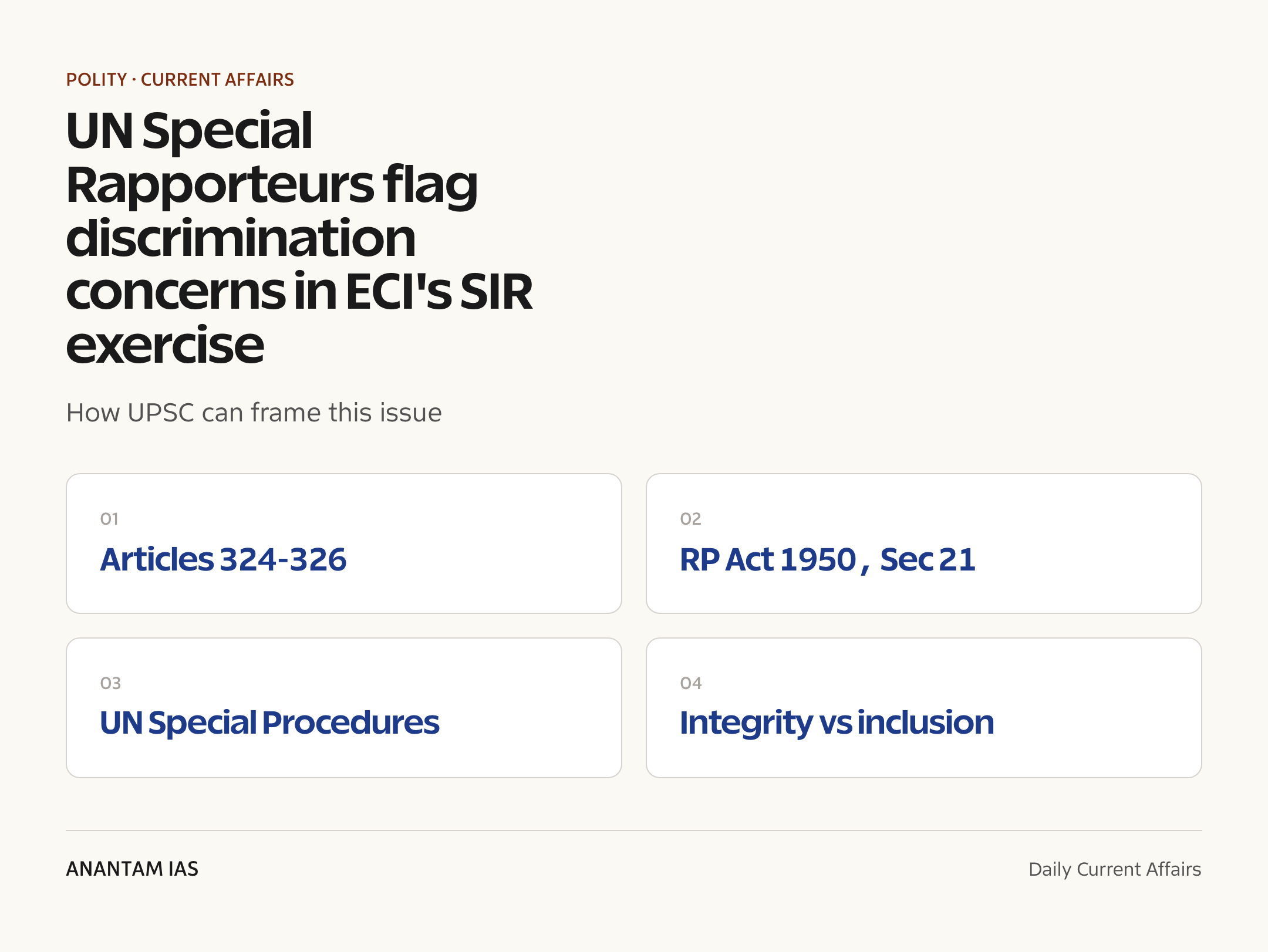
UN Special Rapporteurs flag discrimination concerns in ECI’s SIR exercise

Open article →Download PDF

Why in News?

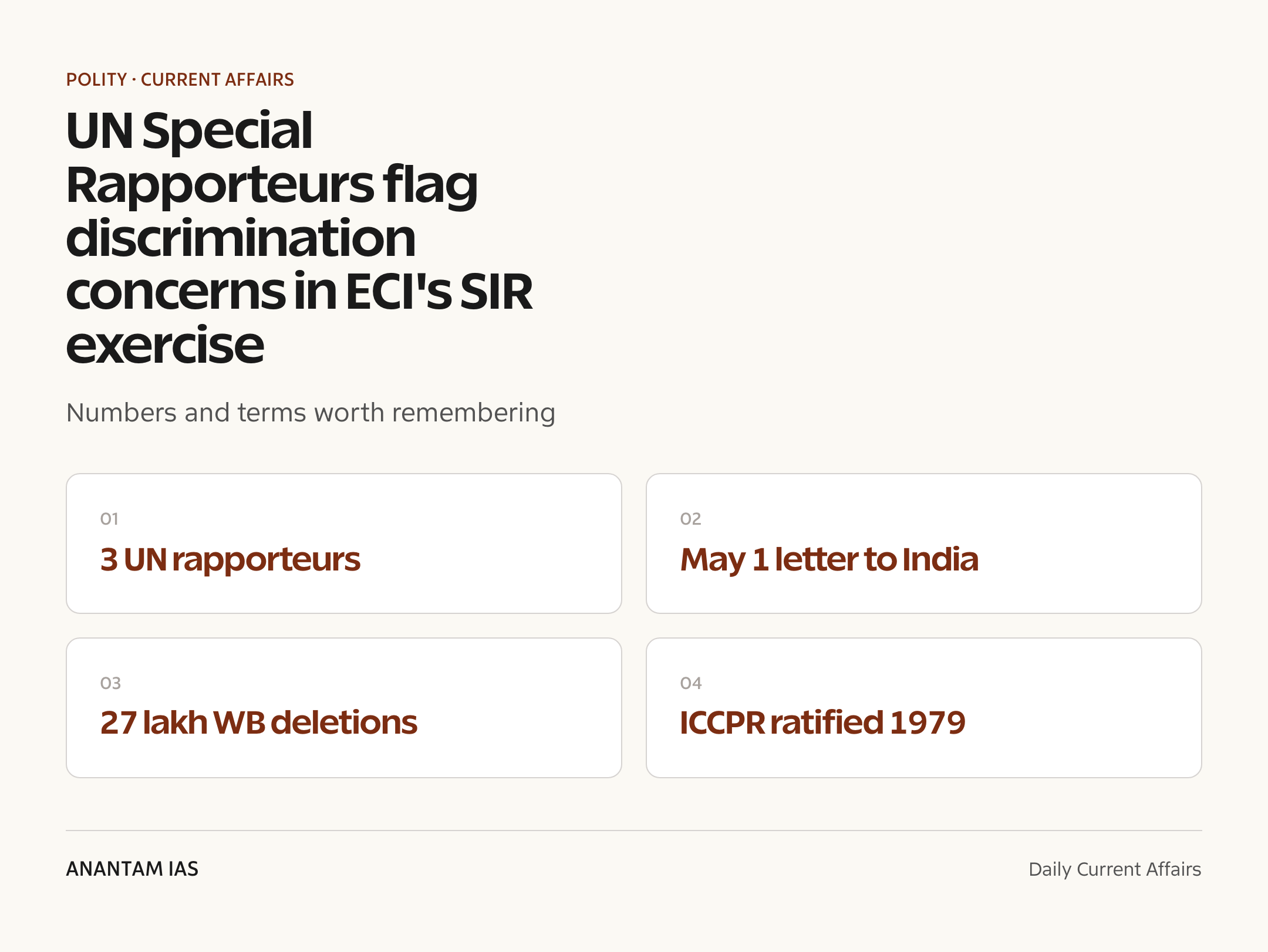
Three United Nations Special Rapporteurs have written to the Government of India expressing concern over alleged discrimination against minorities during the Election Commission of India’s (ECI) Special Intensive Revision (SIR) of electoral rolls, particularly in West Bengal. The Indian Express reported that the letter, dated May 1, 2026, was made public after the customary 60-day confidentiality window that UN Special Procedures observe.

The mandate holders sought the government’s comments on allegations that Bengali and Muslim electors were disproportionately affected by roll deletions, and asked what steps were taken to ensure eligible voters were not prevented from voting in the 2026 Assembly elections. The rapporteurs stated they “do not wish to prejudge the accuracy of these allegations”; emails to the Ministry of External Affairs and the ECI seeking a response went unanswered at the time of the report.

  • The letter was signed by three mandate holders: Nicolas Levrat (Special Rapporteur on minority issues), Irene Khan (freedom of opinion and expression) and Nazila Ghanea (freedom of religion or belief).
  • It followed complaints submitted to the Office of the UN High Commissioner for Human Rights (OHCHR) by the Independent Panel for Monitoring Indian Elections, a group of academics, in August 2025 and April 2026.
  • The letter cites the reported removal of millions of voters’ names from rolls and alleges that minor spelling inconsistencies in documents were used as grounds for deletion.
  • In West Bengal, about 27 lakh electors were deleted from the rolls after a series of steps the ECI took on Supreme Court orders, and they could not vote in the April 2026 Assembly polls while their appeals remained pending before tribunals.
  • The rapporteurs flagged an alleged AI-driven system used to flag “irregularities” in voter data, raising questions of transparency, error and bias.
  • They wrote that certain statements by senior government functionaries around the SIR could amount to incitement to discrimination within the meaning of the International Covenant on Civil and Political Rights (ICCPR), which India ratified in 1979.

The development matters in the context of:

  • The communication tests how India engages the UN human-rights machinery on a matter it treats as a sovereign electoral process run by an independent constitutional body.
  • It revives the classic GS2 tension between electoral-roll purity (no ineligible names) and universal adult franchise under Article 326 (no eligible voter left out).
  • Special Procedures communications are non-binding — their weight is reputational and normative, which is why the government’s choice of response matters.
  • The episode adds an international dimension to a debate the Supreme Court is already supervising domestically through SIR-related litigation.
UN Special Rapporteurs flag discrimination concerns in ECI's SIR exercise — quick facts

UPSC Relevance

Prelims Relevance

  • Special Rapporteurs are independent experts appointed by the UN Human Rights Council under its Special Procedures system; they serve in a personal capacity and are not UN staff.
  • Special Procedures mandate holders send communications (allegation letters and urgent appeals) to states; these are confidential for 60 days before publication, and state replies are voluntary.
  • Article 324 vests superintendence, direction and control of elections in the ECI; Article 325 bars exclusion from electoral rolls on grounds of religion, race, caste or sex; Article 326 guarantees adult suffrage.
  • Electoral rolls are prepared and revised under the Representation of the People Act, 1950 and the Registration of Electors Rules, 1960; Section 21 of the 1950 Act empowers special revision of rolls.
  • The ICCPR — ratified by India in 1979 — protects the right to vote (Article 25) and non-discrimination (Article 26).
  • The OHCHR, headquartered in Geneva, provides secretariat support to the Special Procedures system.
  • The SIR began in Bihar in June 2025 and was extended to 10 states and 3 Union Territories, including West Bengal, from October 2025.
  • The three signatory mandates: minority issues, freedom of opinion and expression, and freedom of religion or belief.

Mains Relevance

GS Paper 2

  • ECI’s constitutional mandate under Articles 324–326 versus due-process concerns in mass roll revision — institutional safeguards for the right to vote.
  • India’s engagement with UN human-rights mechanisms: sovereignty-based responses versus constructive engagement with Special Procedures.
  • The balance between electoral integrity (removing ineligible entries) and inclusion (protecting eligible electors from wrongful deletion).
  • Role of judicial oversight — the Supreme Court’s supervision of the SIR — as the domestic accountability channel.

GS Paper 1

  • Communal and linguistic fault lines in citizenship-adjacent administrative exercises — society-level effects of documentation-heavy verification.

Essay

  • The health of a democracy is measured at the margins of its voter list.
  • Sovereignty and scrutiny: how mature democracies should respond to international human-rights questions.

Background and Context

What the Special Intensive Revision is

The SIR is the ECI’s most sweeping electoral-roll clean-up in decades, grounded in its statutory revision powers.

  • A Special Intensive Revision is an intensive re-verification of the electoral roll — house-to-house enumeration and document checks — carried out under Section 21 of the Representation of the People Act, 1950, which lets the ECI direct a special revision of rolls for any constituency.
  • The ECI’s stated objective is a roll free of dead, duplicate, shifted and ineligible entries, so that only citizens eligible under Article 326 remain enrolled. Read the fuller explainer on the Special Intensive Revision (SIR).
  • The exercise began in Bihar in June 2025, ahead of that state’s Assembly election, and was extended from October 2025 to 10 states and 3 UTs, including West Bengal.
  • Deleted electors have remedies: claims and objections before the Electoral Registration Officer, and appeals under the 1950 Act — in West Bengal, appeals of deleted electors were pending before tribunals when the April 2026 polls were held.
  • The Indian Express reported that in West Bengal, steps taken by the ECI on Supreme Court orders resulted in about 27 lakh deletions, and those electors could not vote in the April 2026 Assembly election.
UN Special Rapporteurs flag discrimination concerns in ECI's SIR exercise — exam lens

Who the Special Rapporteurs are

Special Rapporteurs sit within the UN Human Rights Council’s Special Procedures — the largest body of independent human-rights experts in the UN system.

  • Special Procedures mandate holders are appointed by the UN Human Rights Council (which India has been elected to several times); they are independent experts who serve in a personal, unpaid capacity and do not speak for the UN as a whole.
  • Mandates are either thematic (minority issues, freedom of religion, expression, and others) or country-specific; the OHCHR in Geneva provides secretariat support. See the primer on the United Nations system.
  • Their main tool is the communication — a letter to a government seeking clarification on alleged violations. By practice it stays confidential for 60 days, then is published in the Special Procedures communications database whether or not the state replies.
  • Communications are not judicial findings: the May 1 letter itself records that the experts “do not wish to prejudge the accuracy of these allegations.”
  • The signatories were Nicolas Levrat (minority issues), Irene Khan (freedom of opinion and expression) and Nazila Ghanea (freedom of religion or belief).

What the letter alleges

The communication consolidates complaints about deletions, documentation, technology and rhetoric — while asking, not asserting.

  • It flags the reported removal of millions of names, potentially affecting Muslims and persons of Bengali descent who, the letter says, risk wrongful exclusion because of their “historical and continuing treatment as foreigners and illegal immigrants,” notably in West Bengal.
  • It alleges that minor spelling inconsistencies in documents — common across India for administrative reasons — were used as a pretext to delete names, and that people excluded in the second phase had furnished valid identification.
  • On Bihar, it records alarm over potential large-scale disenfranchisement and denationalisation, and questions an alleged AI-driven system that flagged “irregularities” in voter data — raising transparency, error and bias concerns.
  • It cites public statements by senior functionaries — including framing deletions as targeting “illegal Bangladeshi immigrants” and the formula “Detect, Delete and Deport” — which, the experts wrote, could amount to incitement to discrimination under the ICCPR.
  • The experts also referenced a 2018 communication in which earlier rapporteurs had raised concerns over the National Register of Citizens (NRC) exercise.

The ECI's mandate and stated position

The Commission has consistently defended the SIR as a lawful, court-supervised clean-up that protects the integrity of the franchise.

  • The ECI is a constitutional body under Article 324; the preparation of accurate rolls is central to its mandate, and Article 325 itself prohibits excluding anyone from a roll on grounds of religion, race, caste or sex. Background: Election Commission of India.
  • The Commission has publicly maintained that the SIR targets ineligible entries — the dead, duplicates, permanently shifted electors and non-citizens — since only Indian citizens can be electors under Article 326 and the RP Act, 1950.
  • The process design includes enumeration forms, published draft rolls, a claims-and-objections window, speaking orders by Electoral Registration Officers and statutory appeals — safeguards the ECI cites against the charge of arbitrary deletion.
  • Key parts of the exercise have proceeded under the Supreme Court’s directions and continuing scrutiny — the Court, not an external body, is the operative check on the SIR’s legality.
  • Neither the ECI nor the MEA had responded to the newspaper’s queries on the UN letter at the time of the report; the government’s formal reply, if any, would go through diplomatic channels in Geneva.

India and UN human-rights machinery

India engages the UN system selectively — cooperative in periodic reviews, resistant to what it sees as intrusion into sovereign processes.

  • India participates in the Human Rights Council’s Universal Periodic Review (UPR) and responds to many Special Procedures communications, but has long held that elections are a sovereign, constitutionally regulated domain.
  • Special Procedures communications create no legal obligation; their force is normative and reputational — non-response is itself recorded in the public database and can be cited in later reviews.
  • India ratified the ICCPR in 1979: Article 25 protects the right to vote without unreasonable restrictions, Article 26 guarantees equality before the law, and Article 20(2) requires states to prohibit advocacy of hatred that incites discrimination.
  • India has not accepted the ICCPR’s individual-complaints mechanism (First Optional Protocol), so international scrutiny works through reports, reviews and communications rather than adjudication.
  • Domestically, the National Human Rights Commission and constitutional courts are the designated channels for rights grievances — see the note on the NHRC.

The integrity-versus-inclusion debate

The SIR controversy is at bottom a design question: how to purge ineligible names without shedding eligible ones.

  • A padded roll invites impersonation and duplicate voting; an over-pruned roll produces wrongful disenfranchisement — both corrode electoral legitimacy, just from opposite ends.
  • Documentation-heavy verification bears hardest on migrants, the poor and linguistic minorities, whose papers are most likely to carry the spelling variations and gaps the letter describes.
  • The burden-of-proof question — whether the state must justify a deletion or the elector must prove eligibility — has been the central legal fault line in SIR litigation.
  • Technology-assisted flagging speeds up screening but imports risks of opaque criteria and unexamined error; the UN letter’s AI concern mirrors domestic demands for explainable deletion lists.
  • The deeper design principles are examined in Electoral Roll Integrity Cannot Become Voter Friction.

Way Forward

Transparent process data

  • Publish constituency-wise deletion data with reasons, and machine-readable draft rolls, so claims of disproportionate impact can be tested against evidence rather than argued in the abstract.
  • Disclose the criteria and audit results of any algorithmic flagging used in roll verification; a human ERO order should record independent application of mind for every deletion.

Strengthen remedies before polls

  • Fast-track appellate tribunals so that no elector with a pending appeal faces an election day without a decision; provisional inclusion pending appeal is one option debated in litigation.
  • Standardise a tolerant document-matching protocol — treating minor spelling variations as verification triggers, not deletion grounds.

Calibrated international engagement

  • A reasoned, factual reply to the communication — documenting the SIR’s statutory basis, safeguards and judicial supervision — serves India better than silence, since the letter and any response both become part of the public UN record.
  • Political messaging around roll revision should stay within the register of law and procedure; rhetoric that conflates citizens with foreigners hands external critics their strongest exhibit.

Conclusion

The May 1 communication doesn’t adjudicate anything — Special Rapporteurs ask questions; they don’t issue verdicts. But it internationalises a question the Supreme Court is already wrestling with at home: whether the Special Intensive Revision can deliver a clean roll without shaving off genuine electors at the margins, where the poorest and least-documented voters live.

For the exam, the episode is a two-in-one: a Polity case study on the ECI’s Article 324 mandate, roll-revision law and due process, and an IR case study on how India engages UN Special Procedures. The durable takeaway is institutional — electoral integrity and universal franchise are not rival goals but joint tests that any revision exercise must pass together.

UPSC Practice Questions

Prelims MCQ 1

With reference to the UN Special Procedures system, consider the following statements:

  1. Special Rapporteurs are appointed by the UN Human Rights Council and serve in an independent, personal capacity.
  2. Communications sent by Special Rapporteurs to governments are legally binding on the state concerned.
  3. By practice, such communications remain confidential for a period before being made public.

How many of the above statements are correct?

(a) Only one (b) Only two (c) All three (d) None

Answer: (b) Only two

Explanation:

Statements 1 and 3 are correct — mandate holders are independent experts appointed by the Human Rights Council, and their letters stay confidential for 60 days before publication. Statement 2 is wrong: communications seek a state’s response and carry normative weight only; they create no binding legal obligation.

Prelims MCQ 2

Which one of the following constitutional provisions prohibits a person from being excluded from an electoral roll on grounds only of religion, race, caste or sex?

(a) Article 324 (b) Article 325 (c) Article 326 (d) Article 329

Answer: (b) Article 325

Explanation:

Article 325 mandates one general electoral roll for every constituency and bars ineligibility on grounds only of religion, race, caste or sex. Article 324 vests superintendence of elections in the ECI, Article 326 provides adult suffrage, and Article 329 bars judicial interference in electoral matters except through election petitions.

UPSC Mains Questions

  1. The Special Intensive Revision of electoral rolls illustrates the tension between electoral-roll integrity and universal adult franchise. Examine this tension with reference to the constitutional and statutory framework governing electoral rolls in India, and suggest safeguards against wrongful deletion. (250 words)
  2. Communications from UN Special Procedures mandate holders are non-binding, yet they matter. Discuss how India should engage with UN human-rights machinery when questions are raised about sovereign domestic processes such as elections. (250 words)

Source: The Indian Express.

Frequently Asked Questions

What did the UN Special Rapporteurs’ letter say?

Three UN experts wrote to India on May 1, 2026, seeking its response to allegations that Bengali and Muslim electors were disproportionately deleted during the ECI’s Special Intensive Revision of electoral rolls, particularly in West Bengal. They asked what steps ensured eligible voters could vote in the 2026 Assembly polls, while clarifying they were not prejudging the allegations.

Who are UN Special Rapporteurs?

They are independent human-rights experts appointed by the UN Human Rights Council under its Special Procedures system. They serve in a personal, unpaid capacity, hold thematic or country-specific mandates, and send communications to governments seeking clarification on alleged violations. Their letters are confidential for 60 days, then published.

Is the UN communication binding on India?

No. Special Procedures communications create no legal obligation — states may reply or not. Their force is normative and reputational: the letter, and any government response, enter a public UN database and can be cited in later reviews like the Universal Periodic Review.

What is the Special Intensive Revision (SIR)?

It is an intensive re-verification of electoral rolls under Section 21 of the Representation of the People Act, 1950, involving enumeration and document checks. The ECI began it in Bihar in June 2025 and extended it to 10 states and 3 UTs, including West Bengal, from October 2025, to remove dead, duplicate, shifted and ineligible entries.

Which constitutional articles govern electoral rolls?

Article 324 vests superintendence, direction and control of elections in the Election Commission. Article 325 bars exclusion from the roll on grounds only of religion, race, caste or sex. Article 326 guarantees elections on the basis of universal adult suffrage for citizens aged 18 and above.

What is the ICCPR and India’s status under it?

The International Covenant on Civil and Political Rights is a core UN human-rights treaty India ratified in 1979. Article 25 protects the right to vote, Article 26 guarantees equality, and Article 20(2) requires prohibiting advocacy of hatred that incites discrimination. India has not accepted its individual-complaints protocol.

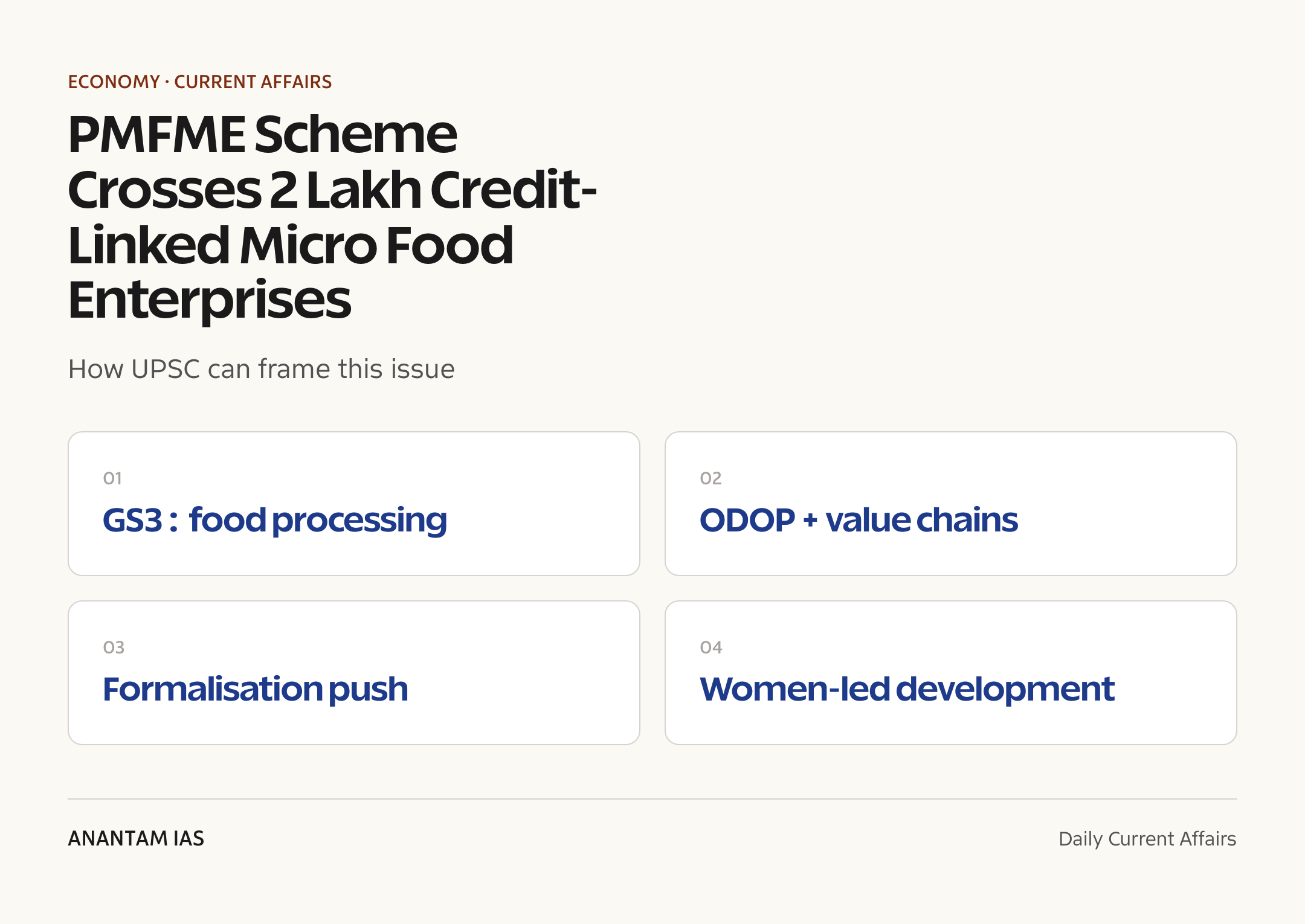
PMFME Scheme Crosses 2 Lakh Credit-Linked Micro Food Enterprises

Open article →Download PDF

Why in News?

The Union Minister for Food Processing Industries, Chirag Paswan, presided over a special event in New Delhi on 11 July 2026 to mark a landmark under the Pradhan Mantri Formalisation of Micro Food Processing Enterprises (PMFME) Scheme — loan sanctions to more than two lakh micro food processing enterprises. PIB confirmed the milestone in a release from the Ministry of Food Processing Industries (MoFPI).

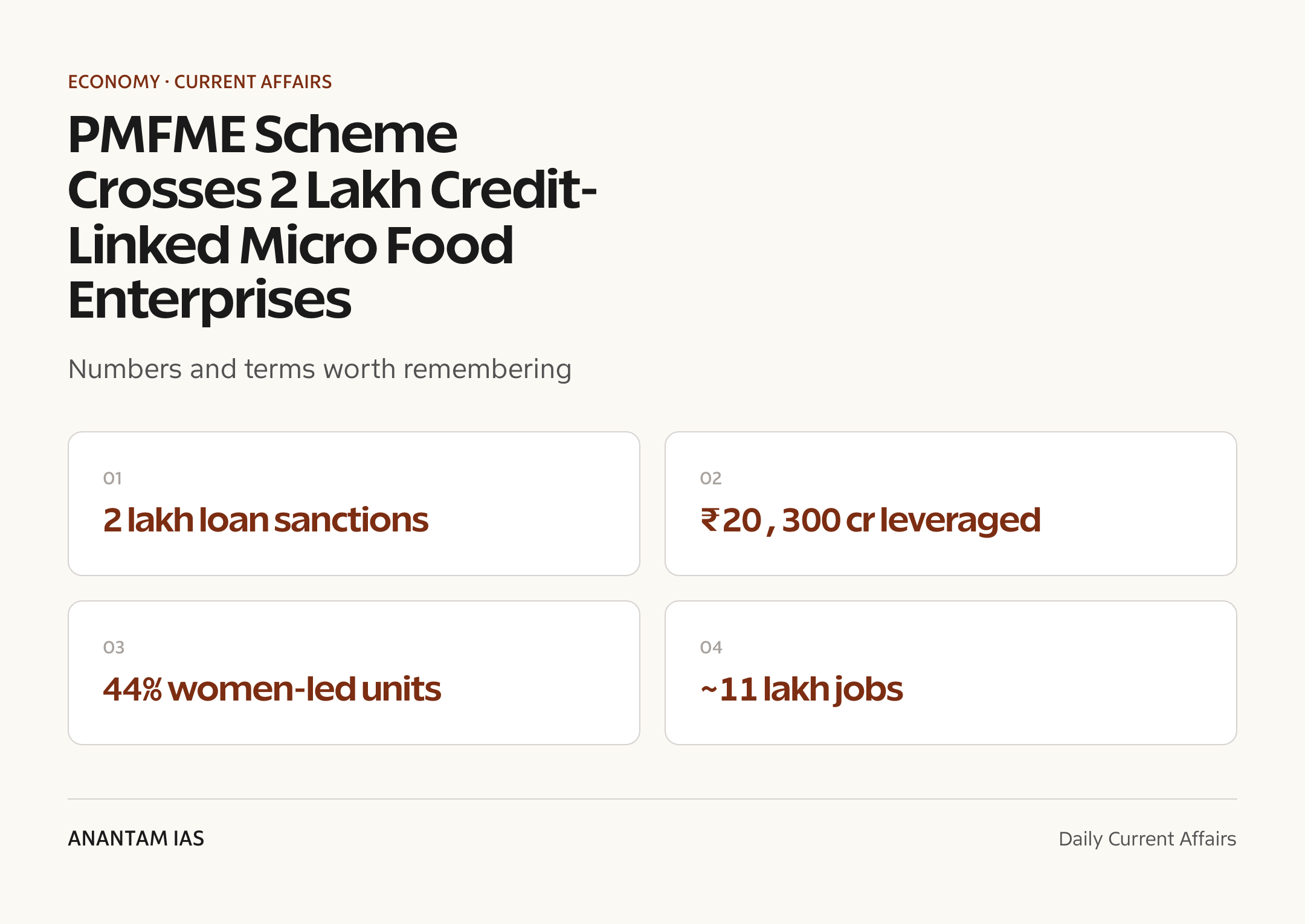
In crossing 2 lakh loan sanctions, the scheme has leveraged project investments of over Rs 20,300 crore. Nearly 90% of beneficiaries are first-generation entrepreneurs and 44% are women, and the scheme has generated close to 11 lakh direct and indirect jobs — making this the strongest formalisation story yet in India’s micro food processing sector.

  • Over 2 lakh credit-linked micro food processing enterprises sanctioned loans — the scheme’s original target of assisting 2 lakh units now reached.
  • Project investments of over Rs 20,300 crore leveraged through credit-linked support.
  • Nearly 90% first-generation entrepreneurs; 44% women beneficiaries.
  • Over 75,000 enterprises entered the formal economy through Udyam Aadhaar, Udyam Assist, FSSAI and GST registrations.
  • Close to 11 lakh direct and indirect employment opportunities generated.
  • The 2-lakhth beneficiary, Inderjeet Singh from Ranchi, Jharkhand, was felicitated at the event; leading states include Bihar, Maharashtra, Uttar Pradesh, Tamil Nadu and Madhya Pradesh.

The development matters in the context of:

  • The milestone matters because India’s micro food processing sector is overwhelmingly informal — the NSSO 73rd Round estimated about 25 lakh unregistered food processing enterprises, roughly two-thirds of them rural and mostly family-run.
  • PMFME is the government’s flagship instrument to pull these units into the formal net — combining credit, subsidy, training, branding and market linkage in one package, so the 2-lakh mark is a direct measure of formalisation progress.
  • With 44% women beneficiaries and seed capital routed through Self-Help Groups, the scheme doubles as a case study for women-led development — a recurring Mains and Essay theme.
PMFME Scheme Crosses 2 Lakh Credit-Linked Micro Food Enterprises — quick facts

UPSC Relevance

Prelims Relevance

  • PMFME Scheme — launched 29 June 2020 under the Aatmanirbhar Bharat Abhiyan; implemented by the Ministry of Food Processing Industries.
  • It is a Centrally Sponsored Scheme with an outlay of Rs 10,000 crore, originally for 2020-21 to 2024-25 and extended to 2025-26.
  • Funding pattern: 60:40 Centre:State; 90:10 for North-Eastern and Himalayan states; 100% Centre for UTs without legislature.
  • Core benefit: credit-linked capital subsidy at 35% of eligible project cost, capped at Rs 10 lakh per unit.
  • Seed capital of Rs 40,000 per SHG member engaged in food processing, for working capital and small tools.
  • One District One Product (ODOP) approach — district-specific product focus; scheme supports 40 common brands covering nearly 200 products (makhana, millets, spices, GI-tagged products).
  • 80 Common Incubation Centres approved across 27 States/UTs; 32 commissioned so far.
  • Seed capital has reached over 4.18 lakh SHG members; more than 1.76 lakh beneficiaries trained, 77% of them women.
  • District Resource Persons (DRPs) — the scheme’s grassroots handholding cadre for applications, DPRs and registrations.

Mains Relevance

GS Paper 3

  • Food processing as the bridge between agriculture and industry — how PMFME-style micro-enterprise support reduces post-harvest losses, adds value locally and raises farm incomes.
  • Formalisation of the informal economy — evaluate credit-linked subsidy plus Udyam/FSSAI/GST registration as a formalisation pathway against demonetisation-era compliance-led approaches.
  • MSME credit gap — what the 2 lakh sanctions (of ~25 lakh informal units) say about last-mile credit delivery, bank risk appetite and the role of handholding cadres like DRPs.
  • ODOP and cluster development — district-level product specialisation, common branding and shared infrastructure as answers to the scale problem of micro units.

GS Paper 2

  • Cooperative federalism in scheme delivery — Centrally Sponsored Scheme design, state nodal agencies and the wide inter-state variation in performance (Bihar, Maharashtra, UP leading).
  • Women’s empowerment through SHGs — seed capital via SRLM-linked Self-Help Groups as a governance model for reaching women entrepreneurs.

Essay

  • Formalisation is not paperwork but empowerment — the informal worker’s route to credit, markets and dignity.
  • Women-led development as the engine of Viksit Bharat: from beneficiaries to builders.
  • Small enterprises, big transformation — why India’s growth story must be written in its districts.

Background and Context

What is the PMFME Scheme?

PMFME is the Centre’s first scheme aimed squarely at the smallest, mostly unregistered food processing units.

  • Launched on 29 June 2020 by the Ministry of Food Processing Industries as part of the Aatmanirbhar Bharat Abhiyan package.
  • A Centrally Sponsored Scheme with a total outlay of Rs 10,000 crore, originally over 2020-21 to 2024-25 and extended to 2025-26.
  • Cost-sharing: 60:40 between Centre and states, 90:10 for North-Eastern and Himalayan states, 60:40 with UTs having legislatures, and 100% central funding for other UTs.
  • Its stated target was to assist 2 lakh micro food processing units with credit-linked subsidy — the target the 11 July milestone formally crosses.
  • The design rests on the Aatmanirbhar Bharat logic: build local enterprise capacity rather than substitute it.
PMFME Scheme Crosses 2 Lakh Credit-Linked Micro Food Enterprises — exam lens

What Beneficiaries Actually Get

The scheme bundles subsidy, seed money, shared infrastructure and marketing support into one pipeline.

  • Credit-linked capital subsidy of 35% of the eligible project cost, with a ceiling of Rs 10 lakh per unit, for individual micro enterprises upgrading or setting up.
  • Seed capital of Rs 40,000 per SHG member engaged in food processing — for working capital and small tools, routed through State Rural Livelihood Missions.
  • Groups — FPOs, SHGs and producer cooperatives — get 35% credit-linked grant support for capital investment and common infrastructure along the value chain.
  • Support for branding and marketing (up to 50% grant) when groups build common brands and packaging.
  • Capacity building: training through state-level technical institutions, plus District Resource Persons (DRPs) who handhold applicants through DPRs, bank loans and FSSAI/Udyam registrations.
  • Full component details are on the ministry’s scheme portal, pmfme.mofpi.gov.in.

One District One Product: The Organising Idea

PMFME channels support through a district-level product focus instead of scattering money thinly.

  • Under ODOP, each district identifies a signature food product — based on raw material availability and existing clusters — and scheme infrastructure converges around it.
  • PIB highlighted support for 40 common brands covering nearly 200 products, building local value chains around makhana, millets, spices and GI-tagged products.
  • ODOP lets micro units share what they can’t individually afford — common processing facilities, incubation centres, branding and quality certification.
  • The approach links naturally to Farmer Producer Organisations, which aggregate the same district-level produce on the supply side.

The Milestone in Numbers

The 11 July data set is exam-ready — every figure below is from the ministry’s release.

  • Over 2 lakh micro food processing enterprises sanctioned credit-linked loans.
  • Project investments of over Rs 20,300 crore leveraged.
  • Nearly 90% of beneficiaries are first-generation entrepreneurs; 44% are women.
  • Nearly 11 lakh direct and indirect employment opportunities generated.
  • Over 75,000 enterprises formalised through Udyam Aadhaar, Udyam Assist, FSSAI and GST registrations.
  • Seed capital support to more than 4.18 lakh SHG members; over 1.76 lakh beneficiaries trained, 77% women.
  • 80 Common Incubation Centres approved across 27 States/UTs; 32 commissioned.
  • Best-performing states named by the minister: Bihar, Maharashtra, Uttar Pradesh, Tamil Nadu, Madhya Pradesh.

Why Formalisation of Micro Food Processing Matters

The sector PMFME targets is huge, employment-rich and almost entirely off the books.

  • The NSSO 73rd Round estimated about 25 lakh unregistered food processing enterprises — roughly two-thirds in rural areas and around 80% family-based.
  • Informality locks these units out of institutional credit, forces reliance on moneylenders, and keeps them below FSSAI hygiene and packaging standards — capping both safety and market reach.
  • Registration under Udyam, FSSAI and GST unlocks priority-sector bank lending, government procurement, e-commerce onboarding and formal supply contracts.
  • Formalisation here has an outsized welfare payoff because micro food processing absorbs women, rural workers and first-generation entrepreneurs — exactly the groups formal MSME credit historically missed, as covered in our note on the MSME sector in India.
  • The SHG seed-capital route builds on the DAY-NRLM architecture — the same federated women’s collectives profiled in our NRLM SHG guide.

The Bigger Food Processing Picture

PMFME sits at the micro end of a larger policy stack for the sector.

  • Food processing is the classic agriculture-industry bridge: it cuts post-harvest losses, stabilises farm-gate prices and creates non-farm rural jobs.
  • The macro instruments — PM Kisan SAMPADA Yojana (infrastructure: mega food parks, cold chains) and the PLI Scheme for Food Processing (large players, global brands) — address scale; PMFME addresses the base of the pyramid.
  • Together they map the full value chain: farm aggregation (FPOs) → micro processing (PMFME) → infrastructure (SAMPADA) → export-scale manufacturing (PLI).
  • Sector fundamentals, data and challenges are in our full note on the food processing sector in India.

Way Forward

Deepen Credit and Close the Coverage Gap

  • Two lakh sanctioned units against ~25 lakh informal enterprises means coverage is still under a tenth — the next phase needs simpler documentation, faster bank turnaround and wider DRP presence in low-performing states.
  • Nudge banks with better credit-guarantee layering so first-generation borrowers without collateral histories aren’t screened out.

Convert Formalisation into Market Access

  • Commission the remaining Common Incubation Centres quickly and tie ODOP brands to e-commerce, ONDC and public procurement so registration translates into revenue.
  • Use the new nationwide multimedia awareness campaign announced at the event to push FSSAI compliance and quality certification, not just enrolment.

A durable exit path matters as the scheme window closes: states should institutionalise the DRP cadre and incubation network within their own industries or rural livelihoods departments, so handholding doesn’t end with the scheme’s outlay.

Conclusion

Crossing 2 lakh credit-linked enterprises is more than a scheme statistic — it’s evidence that India’s smallest food businesses respond quickly when credit, subsidy and handholding arrive as one package. The profile of the beneficiaries — 90% first-generation, 44% women — shows the gains are going to entrants, not incumbents.

The unfinished agenda is scale and sustainability: most of the ~25 lakh informal units remain outside the net, and the incubation-and-branding infrastructure is only partly built. For UPSC, PMFME is now the standard illustration for formalisation, women-led development and the agriculture-industry linkage — with a fresh, citable data set attached.

UPSC Practice Questions

Prelims MCQ 1

With reference to the Pradhan Mantri Formalisation of Micro Food Processing Enterprises (PMFME) Scheme, consider the following statements:

  1. It is a Centrally Sponsored Scheme implemented by the Ministry of Food Processing Industries.
  2. It provides a credit-linked capital subsidy of 35% of the eligible project cost, subject to a maximum of Rs 10 lakh per unit.
  3. Seed capital under the scheme is provided only to Farmer Producer Organisations.

How many of the above statements are correct?

(a) Only one (b) Only two (c) All three (d) None

Answer: (b) Only two

Explanation:

Statements 1 and 2 are correct: PMFME is a Centrally Sponsored Scheme of MoFPI (launched June 2020, Rs 10,000 crore outlay) with a 35% credit-linked subsidy capped at Rs 10 lakh. Statement 3 is wrong — seed capital of Rs 40,000 per member goes to Self-Help Group members engaged in food processing, not to FPOs.

Prelims MCQ 2

The ‘One District One Product (ODOP)’ approach, under which districts build value chains around products such as makhana, millets and GI-tagged foods, is a design feature of which scheme?

(a) PM Kisan SAMPADA Yojana (b) PM Formalisation of Micro Food Processing Enterprises (PMFME) Scheme (c) PLI Scheme for Food Processing Industry (d) Mission for Integrated Development of Horticulture

Answer: (b) PM Formalisation of Micro Food Processing Enterprises (PMFME) Scheme

Explanation:

ODOP is the organising framework of PMFME: each district identifies a signature food product and the scheme’s infrastructure, branding and incubation support converge on it. PMFME currently supports 40 common brands covering nearly 200 products.

UPSC Mains Questions

  1. The PMFME Scheme’s crossing of two lakh credit-linked enterprises shows that formalisation of micro enterprises works best as a bundled offer of credit, subsidy and handholding rather than a compliance mandate. Critically examine with reference to India’s micro food processing sector.
  2. Food processing is the most direct bridge between India’s farms and its factories. Discuss how the One District One Product approach under PMFME strengthens this bridge, and identify the constraints that still limit micro food enterprises from scaling up.
  3. Nearly 44% of PMFME beneficiaries are women and seed capital flows through Self-Help Groups. Evaluate the SHG route as an instrument for women-led enterprise development in India.

Source: PIB, Ministry of Food Processing Industries.

Frequently Asked Questions

What is the PMFME Scheme?

The Pradhan Mantri Formalisation of Micro Food Processing Enterprises Scheme, launched on 29 June 2020 under Aatmanirbhar Bharat, is a Centrally Sponsored Scheme of the Ministry of Food Processing Industries. With a Rs 10,000 crore outlay, it gives micro food processing units credit-linked subsidy, training, branding support and help with formal registration.

What milestone did PMFME cross in July 2026?

On 11 July 2026, the ministry celebrated loan sanctions crossing two lakh micro food processing enterprises — the scheme’s original target. The credit-linked support has leveraged over Rs 20,300 crore in project investment and generated close to 11 lakh direct and indirect jobs across the country.

How much subsidy does PMFME give?

Individual micro enterprises get a credit-linked capital subsidy of 35% of the eligible project cost, capped at Rs 10 lakh per unit. Self-Help Group members engaged in food processing get seed capital of Rs 40,000 each, while FPOs, SHGs and cooperatives get 35% grant support for common infrastructure.

What is the One District One Product approach?

Under ODOP, every district identifies one signature food product — based on local raw materials and existing clusters — and PMFME’s infrastructure, incubation, branding and marketing support converge around it. The scheme currently backs 40 common brands covering nearly 200 products, including makhana, millets, spices and GI-tagged foods.

Why is formalisation of food processing units important?

The NSSO 73rd Round counted about 25 lakh unregistered food processing enterprises, mostly rural and family-run. Informality cuts them off from bank credit, FSSAI certification and organised markets. Registration under Udyam, FSSAI and GST unlocks institutional loans, e-commerce access, government procurement and safer, better-priced products.

Which states lead in PMFME implementation?

At the July 2026 milestone event, the Union Minister named Bihar, Maharashtra, Uttar Pradesh, Tamil Nadu and Madhya Pradesh as the leading states. The two-lakhth beneficiary, Inderjeet Singh of Ranchi, Jharkhand, was felicitated and handed his sanction letter at the New Delhi event.

China’s new ethnic unity law: what it means for Tibet and Xinjiang

Open article →Download PDF

Why in News?

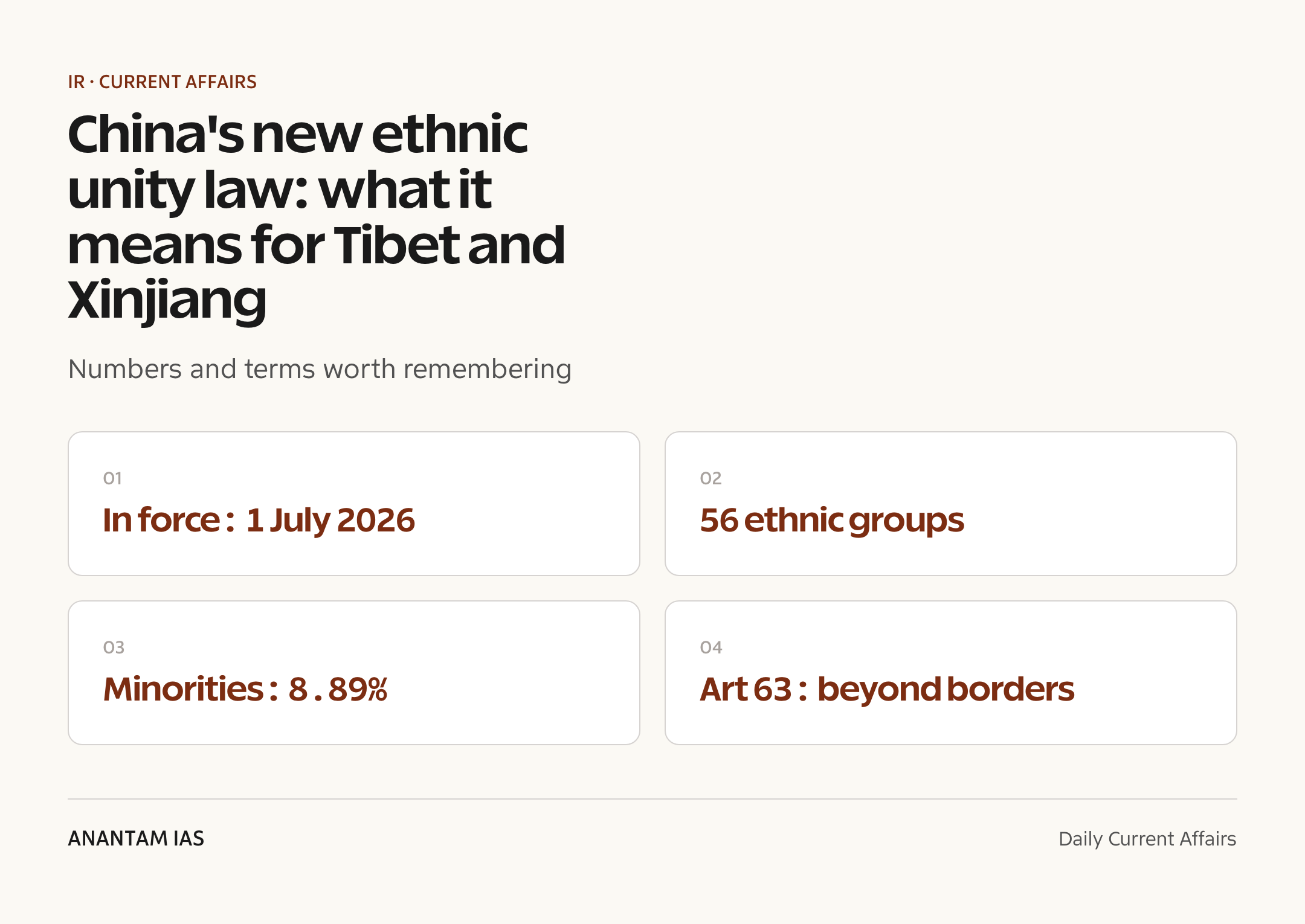
China’s Law on Promoting Ethnic Unity and Progress came into effect on 1 July 2026. The Hindu reported that the law — passed by the National People’s Congress (NPC) on 12 March 2026 — aims to build a “shared” national identity by strengthening the “community of the Chinese nation“, giving legal backing to Mandarin promotion, ideological education and the ‘Sinicisation‘ of religion.

The UN Human Rights Office (OHCHR) warned the law could threaten minority freedoms and lead to forced assimilation — a concern that lands hardest on China’s roughly 7 million Tibetans and 11 million Uyghurs, and feeds directly into the looming Dalai Lama succession question that touches India.

  • The bill was introduced by the NPC’s Ethnic Affairs Committee in September 2025, signed on 12 March 2026 and enforced from 1 July 2026 — China’s first nationwide law of its kind on ethnic policy.
  • China officially recognises 56 ethnic groups; the majority Han are over 90% of the population, while the 2020 census put ethnic minorities at 125 million-plus, or 8.89% of the total.
  • Article 15 mandates Mandarin teaching for all children from before kindergarten through the end of compulsory schooling.
  • Article 46 directs religious organisations, schools and places of worship to promote the Sinicisation of religion — aligning religious practice with state law and ideology.
  • Article 63 extends liability to organisations and individuals outside China who “undermine national unity” — critics call this a licence for transnational repression.

The development matters in the context of:

  • The law codifies a decade-long shift from ethnic autonomy to assimilation that began with the 2014 Central Ethnic Work Conference under Xi Jinping.
  • For India, the law sharpens three live files: the Dalai Lama succession, the ~1-lakh-strong Tibetan exile community hosted in India, and the fragile post-2024 normalisation of India-China relations.
  • It sits in tension with China’s own Constitution and its Law on Regional Ethnic Autonomy, which promise minorities language rights and limited self-rule.
The Potala Palace in Lhasa, Tibet, historic seat of the Dalai Lamas
The Potala Palace in Lhasa — historic seat of the Dalai Lamas and the symbolic heart of Tibetan Buddhism. Photo: Lhasa Government, CC BY-SA 4.0 (Wikimedia Commons)
China's new ethnic unity law: what it means for Tibet and Xinjiang — quick facts

UPSC Relevance

Prelims Relevance

  • Law on Promoting Ethnic Unity and Progress — passed by China’s NPC on 12 March 2026; in force from 1 July 2026.
  • China recognises 56 ethnic groups; Han Chinese are over 90% of the population; minorities were 8.89% (125 million+) in the 2020 census.
  • Sinicisation of religion — the policy of aligning all religious practice in China with Chinese laws, socialist values and party ideology.
  • 2014 Central Ethnic Work Conference — the policy turning point where Xi Jinping pushed “forging the sense of community of the Chinese nation”.
  • Article 63 of the law has extraterritorial reach — foreign entities can be held liable for “undermining national unity”.
  • Gaden Phodrang Trust (Dharamshala, 2011) — the body the 14th Dalai Lama says has sole authority to identify his reincarnation.
  • Golden Urn — the 1793 Qing-era lot-drawing ritual Beijing insists must decide the next Dalai Lama, with central government approval.
  • Xinjiang (2015) and Inner Mongolia (2021) had enacted local “ethnic unity” regulations before the national law.
  • OHCHR — the UN Human Rights Office, which flagged the law’s forced-assimilation risk.

Mains Relevance

GS Paper 2

  • India-China relations: how China’s internal ethnic consolidation in Tibet feeds into the border question, Tawang and the Dalai Lama succession.
  • Policies of other states affecting India’s interests and the Indian diaspora/refugee-hosting role — the Tibetan exile community in India.
  • Human rights and international institutions: OHCHR scrutiny vs state sovereignty; the limits of UN human-rights machinery against P-5 members.

GS Paper 1

  • Salient features of world societies: assimilationist vs multicultural models of managing ethnic diversity — China’s unitary model vs India’s constitutional pluralism.

Essay

  • Unity imposed is uniformity: can a nation be built by erasing its diversity?
  • India’s ‘unity in diversity’ vs the assimilationist nation-state — two Asian answers to the same question.

Background and Context

From the 2014 conference to a nationwide law

The law is the legal capstone of a decade-long turn in Chinese ethnic policy under Xi Jinping.

  • The 2014 Central Ethnic Work Conference marked the shift: from accommodating ethnic difference to “forging the sense of community of the Chinese nation” (zhonghua minzu gongtongti yishi).
  • Provinces moved first — Xinjiang (2015) and Inner Mongolia (2021) enacted local “ethnic unity and progress” regulations; the new law scales that template nationwide.
  • The bill was introduced by the NPC’s Ethnic Affairs Committee on 8 September 2025, signed on 12 March 2026, and came into force on 1 July 2026.
  • Article 1 states its purpose: promote national unity, strengthen the sense of community of the Chinese nation, and advance the “great rejuvenation of the Chinese nation“.
  • NPC delegate Lou Qinjian, introducing the proposal, said it is designed to foster “a stronger sense of community among all ethnic groups”.
China's new ethnic unity law: what it means for Tibet and Xinjiang — exam lens

What the law actually mandates

Three provisions carry most of the weight — language, religion, and an arm that reaches beyond China’s borders.

  • Article 15 (language): Mandarin must be taught to all children from before kindergarten through compulsory education and high school; the “national common language” is the basic language of teaching and official work, taking precedence over minority languages.
  • Article 46 (religion): religious organisations, schools and places of worship must promote the Sinicisation of religion and strengthen shared Chinese national identity — folding monasteries and mosques into state ideology.
  • Article 63 (extraterritorial): any organisation or individual outside China that “undermines national unity” or “creates national division” can be held legally responsible — read by critics as targeting exile groups, including the Tibetan administration in India.
  • The law bans acts that “undermine ethnic unity” — terms rights groups call broad and undefined, usable against peaceful expression, activism or cultural practice.

How it rewrites China's older autonomy promise

The new framework sits uneasily on top of China’s own constitutional commitments to minorities.

  • China’s Constitution says every ethnicity has “the right to use and develop their own language” and “the right to self-rule”.
  • The Law on Regional Ethnic Autonomy (1984) promises limited autonomy — including flexible measures for minority regions to run their economies.
  • Five autonomous regions (Tibet, Xinjiang, Inner Mongolia, Ningxia, Guangxi) were built on that accommodation model, loosely inspired by Soviet nationality policy.
  • The unity law inverts the hierarchy: national identity above ethnic identity — autonomy provisions survive on paper but are subordinated to “forging one community”.
  • Critics see it as the final step of a policy called “second-generation ethnic policy” in Chinese academic debate — replacing group-differentiated rights with a single state-defined identity.

Tibet and the Dalai Lama succession

The law lands just as the succession of the 14th Dalai Lama becomes the central India-China flashpoint on Tibet.

  • On 2 July 2025, days before his 90th birthday, the 14th Dalai Lama affirmed the institution will continue and that his Gaden Phodrang Trust (Dharamshala, set up 2011) has sole authority to identify the reincarnation.
  • Beijing countered that the next Dalai Lama must be chosen by the Golden Urn lot-drawing ritual — a 1793 Qing-dynasty practice — and approved by the central government.
  • The unity law’s Sinicisation-of-religion mandate (Article 46) gives Beijing a fresh statutory hook to control Tibetan Buddhist institutions, monasteries and the reincarnation system.
  • Precedent: in 1995 China detained the boy the Dalai Lama recognised as the 11th Panchen Lama and installed its own candidate — a dry run for a contested Dalai Lama succession.
  • Article 63’s extraterritorial clause could be aimed at the Central Tibetan Administration and exile bodies operating from Indian soil, since the Tibetan plateau remains the strategic heart of the dispute.
  • Mandarin-first schooling threatens the Tibetan language: rights groups have long flagged boarding-school education separating Tibetan children from their linguistic and cultural roots.

Xinjiang and the Uyghurs

For Xinjiang, the law nationalises an approach already tested on the region’s Muslim minorities.

  • Xinjiang is home to around 11 million Uyghurs, a Turkic Muslim minority; the region enacted its local ethnic-unity regulation back in 2015.
  • Rights groups have documented arbitrary mass detention, surveillance and curbs on religious and cultural practice in Xinjiang — allegations Beijing denies.
  • The law legalises the toolkit: Mandarin-medium schooling, mosque oversight, and ideological education now carry national statutory backing instead of regional regulation.
  • Amnesty International’s Sarah Brooks said the law “does the opposite” of protecting minorities — it pushes Uyghurs, Tibetans and Mongolians toward “a single, state-defined national identity dominated by Han Chinese culture“, where “unity” means alignment with the Communist Party.

Why India should watch closely

A law about China’s interior is still strategic news for New Delhi on at least four counts.

  • Succession stakes: India hosts the Dalai Lama and the Gaden Phodrang Trust; a Beijing-installed rival Dalai Lama would force New Delhi into a choice it has so far avoided — India officially takes no position on matters of faith, even as ministers attended the 90th-birthday celebrations.
  • Exile community: India shelters the largest Tibetan exile population and the Central Tibetan Administration in Dharamshala; Article 63’s extraterritorial claim implicitly targets activity on Indian soil.
  • Border linkage: Beijing frames Arunachal Pradesh (which it calls “Zangnan”) through the Tibet lens — tighter control over Tibet historically precedes harder positions on the LAC and Tawang.
  • Ties under repair: the post-2024 thaw — patrolling disengagement, resumed Kailash Mansarovar Yatra and direct flights — remains hostage to flashpoints like succession; the law adds one more.
  • Normative contrast: India’s constitutional model protects minority language and culture (Articles 29-30); China’s law is a live case study in the opposite, assimilationist model — useful for GS and essay answers.

The global pushback

Criticism has come from the UN system, governments and rights groups — Beijing calls it “spreading falsehoods”.

  • The UN OHCHR expressed concern the law threatens minority freedoms and could lead to forced assimilation.
  • Former UN special rapporteurs, several governments and scholars have criticised the law’s vague prohibitions and its reach into classrooms, worship and homes.
  • Rights groups warn the undefined offences — “undermining unity”, “creating division” — chill peaceful expression and cultural practice.
  • Beijing rejects the criticism, accusing detractors of spreading falsehoods, and presents the law as a guarantee of equality and shared prosperity among all 56 groups.

Way Forward

For India's policy

  • Keep the Dalai Lama succession firmly framed as a religious matter decided by established Tibetan Buddhist convention — consistent, low-temperature messaging that neither provokes nor concedes.
  • Quietly strengthen the institutional footing of the Tibetan exile community — education, documentation, cultural preservation — without making it a bilateral irritant.
  • Insulate the border normalisation track: keep LAC de-escalation, trade and pilgrimage channels compartmentalised from the succession dispute.
  • Invest in Buddhist-circuit diplomacy (Nalanda, Bodh Gaya, the International Buddhist Confederation) — India’s soft-power counter in the contest over Buddhism’s centre of gravity.

For the international system

  • Sustained OHCHR and treaty-body scrutiny of implementation — especially boarding schools, language rights and religious controls in Tibet and Xinjiang.
  • Democracies need a common line on transnational repression under Article 63-type provisions, protecting diaspora communities within their jurisdictions.

Conclusion

The Law on Promoting Ethnic Unity and Progress converts a decade of assimilationist practice into binding national law. Its real work is definitional: it makes one state-defined Chinese identity the legal norm, and difference — linguistic, religious, cultural — a compliance problem.

For India, the law is not an internal Chinese matter alone. It hard-codes Beijing’s claim over the Dalai Lama’s reincarnation, reaches extraterritorially toward exile institutions on Indian soil, and tightens the Tibet lens through which China views the border. New Delhi’s task is steadiness: protect the sanctity of the succession process, keep ties functional, and let India’s own pluralist model stand as the counter-argument.

UPSC Practice Questions

Prelims MCQ 1

With reference to China’s Law on Promoting Ethnic Unity and Progress (2026), consider the following statements:

  1. The law came into force on 1 July 2026 after being passed by China’s National People’s Congress.
  2. It mandates Mandarin-medium teaching for children from before kindergarten through compulsory education.
  3. The law applies only within the territory of the People’s Republic of China.

How many of the above statements are correct?

(a) Only one (b) Only two (c) All three (d) None

Answer: (b) Only two

Explanation:

Statements 1 and 2 are correct — the NPC passed the law on 12 March 2026 and it took effect on 1 July 2026, with Article 15 mandating Mandarin from pre-kindergarten. Statement 3 is wrong: Article 63 has extraterritorial reach, holding organisations and individuals outside China liable for acts that “undermine national unity”.

Prelims MCQ 2

The ‘Golden Urn’ method, recently in news in the context of the Dalai Lama’s succession, is associated with which of the following?

(a) A Ming-dynasty tribute ritual for recognising Tibetan monasteries (b) A Qing-era lot-drawing ritual that Beijing insists must select senior reincarnate lamas (c) A Tibetan exile convention adopted at Dharamshala in 2011 (d) A UNESCO-listed intangible heritage practice of Inner Mongolia

Answer: (b) A Qing-era lot-drawing ritual that Beijing insists must select senior reincarnate lamas

Explanation:

The Golden Urn dates to 1793 under the Qing dynasty. China maintains that reincarnations of major figures like the Dalai Lama and Panchen Lama must be identified by drawing lots from the urn and approved by the central government — a claim the 14th Dalai Lama rejects, vesting sole authority in his Gaden Phodrang Trust.

UPSC Mains Questions

  1. China’s new ethnic unity law marks the legal culmination of its shift from ethnic autonomy to assimilation. Examine the implications of this shift for the Tibetan question and for India-China relations. (250 words)
  2. “The succession of the 14th Dalai Lama is as much a geopolitical question as a religious one.” Discuss India’s stakes and the policy options available to New Delhi. (250 words)
  3. Compare the assimilationist model of managing ethnic diversity with India’s constitutional model of pluralism. What lessons does the contrast hold for multi-ethnic states? (150 words)

Source: The Hindu (Explained).

Frequently Asked Questions

What is China’s new ethnic unity law?

The Law on Promoting Ethnic Unity and Progress, in force from 1 July 2026, is China’s first nationwide statute on ethnic policy. It aims to forge a single “community of the Chinese nation”, giving legal backing to Mandarin-first schooling, ideological education and the Sinicisation of religion across all 56 recognised ethnic groups.

What does ‘Sinicisation of religion’ mean?

It is China’s policy of aligning every religious practice — Tibetan Buddhism, Islam, Christianity and others — with Chinese laws, socialist values and Communist Party ideology. Article 46 of the new law makes religious bodies, schools and places of worship legally responsible for promoting this alignment.

Why is Article 63 of the law controversial?

Article 63 extends liability beyond China’s borders: any foreign organisation or individual who “undermines national unity” or “creates national division” can be held legally responsible. Critics call this a legal basis for transnational repression aimed at exile groups, including Tibetan institutions based in India.

How does the law affect the Dalai Lama’s succession?

The 14th Dalai Lama says only his Gaden Phodrang Trust in Dharamshala can identify his reincarnation. Beijing insists on the Qing-era Golden Urn ritual plus government approval. The new law’s religious-control provisions strengthen China’s statutory claim over Tibetan Buddhist institutions, setting up a likely contest of rival successors.

Why does this law matter for India?

India hosts the Dalai Lama, the Gaden Phodrang Trust and the largest Tibetan exile community. The law’s extraterritorial clause implicitly reaches Indian soil, the succession dispute could strain the post-2024 thaw in ties, and China views the Arunachal border through the Tibet lens.

Who has criticised the law, and what is China’s response?

The UN Human Rights Office (OHCHR), Amnesty International, former UN special rapporteurs and several governments have warned it enables forced assimilation of Uyghurs, Tibetans and Mongolians. Beijing rejects the criticism as “spreading falsehoods” and presents the law as promoting equality and unity.

Tribal land disputes in Jharkhand: why CNT-SPT safeguards keep failing

Open article →Download PDF

Why in News?

The Indian Express Explained has published a walk-through of Jharkhand’s tribal land-protection regime, timed to the anniversary of the Santhal Hul of 1855 — the revolt in the Damin-i-Koh region of present-day eastern Jharkhand that erupted over 170 years ago against British officials, zamindars and moneylenders. That uprising produced one of India’s earliest protective tenancy laws for Adivasi land.

The top-line finding is sobering: despite three stacked layers of protection — the Chotanagpur Tenancy (CNT) Act, 1908, the Santhal Parganas Tenancy (SPT) Act and the PESA Act, 1996 operating under the Fifth Schedule — one of India’s most mineral-rich states keeps losing adivasi land to mining overrides, land banks, fraudulent transfers and weak restoration machinery.

  • The Santhal Hul (revolution) of 1855, which some accounts date to the first week of July, led the British to enact the SPT Act of 1876 to check land alienation and exploitative moneylending; it was consolidated after Independence as the Santhal Parganas Tenancy (Supplementary Provisions) Act, 1949.
  • The CNT Act, 1908 was itself the outcome of Birsa Munda’s Ulgulan (1899-1900) — both of Jharkhand’s core land laws were won through tribal revolt.
  • A 1996 amendment to Section 49 of the CNT Act expanded permissible land transfers from religious, educational and charitable purposes to industrial and mining purposes, subject to the Deputy Commissioner’s sanction.
  • Researchers quoted by the Indian Express say central laws such as the MMDR Act, 1957 and the Coal Bearing Areas (Acquisition and Development) Act, 1957 routinely override tribal tenancy laws in the name of ‘public interest’.
  • During a 2016 aerial survey for mineral exploration, tribal common lands used for grazing, threshing and festivals were marked as wasteland and diverted to land banks and compensatory afforestation.
  • Section 71A of the CNT Act mandates restoration of illegally transferred tribal land, but enforcement is sporadic; mafia-backed transfers are disguised as dan patra (gift deeds) or badlanama (exchange deeds).

The development matters in the context of:

  • Jharkhand sits at the heart of India’s tribal-land question: Scheduled Tribes make up about 26.2% of its population (Census 2011), and the state’s coal, iron ore and bauxite belts overlap almost exactly with its Fifth Schedule areas.
  • The episode is a live case study of the classic UPSC tension between development and displacement — how resource extraction, afforestation targets and industrial land pooling collide with constitutional guarantees of tribal self-governance.
  • It also revives the relevance of the Samatha judgment (1997), in which the Supreme Court voided mining leases of government land in Scheduled Areas to non-tribals.
Portrait of Birsa Munda, the tribal leader whose Ulgulan movement led to the Chotanagpur Tenancy Act, 1908
Birsa Munda, whose Ulgulan (1899-1900) forced the enactment of the Chotanagpur Tenancy Act, 1908. Photo: Unknown photographer, Public domain (Wikimedia Commons)
Tribal land disputes in Jharkhand: why CNT-SPT safeguards keep failing — quick facts

UPSC Relevance

Prelims Relevance

  • Santhal Hul, 1855 — Santal revolt in the Damin-i-Koh region led by Sido and Kanhu Murmu against the British, zamindars and moneylenders; precursor of the SPT Act.
  • SPT Act — enacted 1876, consolidated as the Santhal Parganas Tenancy (Supplementary Provisions) Act, 1949; prohibits transfer of Adivasi land (urban or rural) to non-Adivasis; land passes only by inheritance under the Act.
  • SPT Act covers the six Santal Pargana districts: Dumka, Deoghar, Godda, Pakur, Sahibganj and Jamtara.
  • CNT Act, 1908 — followed Birsa Munda’s Ulgulan; allows Adivasi-to-Adivasi transfers within the same police station and Dalit transfers within the same district, with the District Collector’s approval.
  • CNT Act applies to the North Chotanagpur, South Chotanagpur and Palamau divisions — districts such as Ranchi, Hazaribagh, Palamu, Khunti and Gumla.
  • PESA Act, 1996 — extends Part IX of the Constitution (Panchayats) to Fifth Schedule areas; recognises Gram Sabha control over natural resources; notified in 10 states, including Jharkhand.
  • Fifth Schedule (Article 244(1)) — Scheduled Areas and Scheduled Tribes in states other than Assam, Meghalaya, Tripura and Mizoram; Governor’s report and Tribes Advisory Council.
  • Samatha v State of Andhra Pradesh (1997) — SC held leases of government land in Scheduled Areas to non-tribals void; mining only via the state mineral corporation or tribal cooperatives.
  • Section 71A, CNT Act — power to restore illegally transferred tribal land; Section 49 — transfers for industrial/mining purposes after the 1996 amendment.
  • Land bank — a government pool of land parcels held for future allotment; in Jharkhand it has absorbed tribal commons recorded as ‘wasteland’.

Mains Relevance

GS Paper 1

  • Tribal uprisings (Santhal Hul, Ulgulan) as the origin of protective land legislation — resistance shaping colonial policy.
  • Land alienation as a driver of tribal marginalisation, cultural erosion and distress migration in central India.

GS Paper 2

  • Fifth Schedule, PESA and Gram Sabha consent — the gap between constitutional design and administrative practice.
  • Mechanisms for the protection of vulnerable sections: why restoration provisions like Section 71A fail without enforcement capacity.
  • Centre-state and law-vs-law conflicts: central mining statutes overriding state tenancy protections.

GS Paper 3

  • Mineral-led growth vs inclusive development: land banks, compensatory afforestation and the displacement-employment mismatch.

Essay

  • Development that displaces is not development — the ethics of extraction in tribal India.
  • Laws are only as strong as the administration that enforces them.

Background and Context

From Hul to statute: how revolt wrote the SPT Act

Jharkhand’s oldest land protections were conceded by the colonial state only after armed tribal resistance.

  • In the Hul of 1855, Santals in the lush Damin-i-Koh region rose against economic and social oppression by the British, upper castes, zamindars and moneylenders.
  • An enduring outcome was the SPT Act of 1876, designed to protect Adivasi communities from land alienation and exploitative moneylending; after Independence it was consolidated as the Santhal Parganas Tenancy (Supplementary Provisions) Act, 1949.
  • The law prohibits the transfer of Adivasi land — urban or rural — to non-Adivasis; land can only be inherited as per the Act, preserving the Santals’ right to self-govern their land.
  • It covers the six present-day Santal Pargana districts: Dumka, Deoghar, Godda, Pakur, Sahibganj and Jamtara.
  • The Santhal tribe remains India’s largest Adivasi community — background on the community and the 1855 rebellion is at Santhal Tribe: culture and the 1855 rebellion.
Tribal land disputes in Jharkhand: why CNT-SPT safeguards keep failing — exam lens

The CNT Act, 1908: Birsa Munda's legislative legacy

The second pillar of Jharkhand’s land regime also traces to an uprising — the Ulgulan.

  • The Chotanagpur Tenancy Act, 1908 was enacted by the British as a direct result of the Birsa Munda movement of 1899 (the Ulgulan, or ‘Great Tumult’).
  • It permits land transfers within the same caste and specified geographical limits, with the District Collector’s approval — Adivasis may transfer to Adivasis of the same police station, Dalits to Dalits of the same district.
  • The Act restricts the sale of both Adivasi and Dalit land, and applies to the North Chotanagpur, South Chotanagpur and Palamau divisions, covering districts such as Ranchi, Hazaribagh, Palamu, Khunti and Gumla.
  • Section 71A gives authorities the power to restore illegally transferred tribal land — on paper, a self-correcting mechanism.
  • A profile of the leader whose movement forced the law is at Birsa Munda: Ulgulan and legacy.

The constitutional layer: Fifth Schedule and PESA

Above the tenancy Acts sits a constitutional architecture meant to guarantee tribal self-rule.

  • The Fifth Schedule, under Article 244(1), governs Scheduled Areas and Scheduled Tribes in most mainland states, with the Governor empowered to modify laws and a Tribes Advisory Council to advise — details at Scheduled Areas under the Fifth Schedule.
  • The PESA Act, 1996 extends Part IX of the Constitution (Panchayats) to Scheduled Areas, mandating self-governance through Gram Sabhas and recognising community rights over natural resources — see PESA Act 1996 explained.
  • PESA has been notified in ten states: Andhra Pradesh, Chhattisgarh, Gujarat, Himachal Pradesh, Jharkhand, Madhya Pradesh, Maharashtra, Odisha, Rajasthan and Telangana.
  • In Samatha v State of Andhra Pradesh (1997), the Supreme Court held that leasing even government land in a Scheduled Area to non-tribals for mining is void; mining there may proceed only through the state mineral development corporation or tribal cooperatives.

Leak one: mining laws that trump tenancy laws

The first and largest loophole is structural — central extraction statutes sit above state protections.

  • Researchers told the Indian Express that central laws like the Mines and Minerals (Development and Regulation) Act, 1957 and the Coal Bearing Areas (Acquisition and Development) Act, 1957 often override tribal laws in the name of public interest.
  • The Judicial Academy Jharkhand’s Handbook on Land Laws records that Section 49 of the CNT Act originally allowed transfers only for religious, educational and charitable activities; a 1996 amendment widened it to industrial and mining purposes with the Deputy Commissioner’s sanction.
  • Mining leases are issued under overlapping mining, environmental, forest and land-acquisition laws, creating running conflicts with PESA and the Fifth Schedule over which law prevails; state authorities frequently prioritise industrial policy over local self-governance.
  • PESA is also gamed at the ground level: it applies to minor minerals (sand, clay, gravel), and companies sometimes obtain minor-mineral permissions while actually extracting major minerals, a Ranchi-based lawyer told the paper.

Leak two: land banks, 'wastelands' and afforestation

The second leak converts tribal commons into state inventory through classification.

  • Land banking — the state acquiring land to redistribute or allocate later — often sweeps in parcels of tribal land.
  • Tribal villages hold common lands not actively farmed but used for cattle grazing, threshing, crop storage, community gatherings and festivals; during the 2016 aerial survey for mineral exploration, many such commons were recorded as wasteland.
  • These ‘wastelands’ were then used for compensatory afforestation — itself criticised for planting non-native species that fail to replicate traditional forests.
  • After plantation, land is often transferred to the Forest Department, extinguishing the community’s traditional access to forest land and produce — a pattern that sits uneasily with the Forest Rights Act, 2006.

Leak three: fraud deeds and a restoration clause that sleeps

Even where the law is clear, transfers slip through disguised paperwork and thin enforcement.

  • Section 71A of the CNT Act mandates restoration of illegally transferred tribal land, but enforcement is sporadic.
  • Research on Jharkhand’s land transactions (Niranjan Baghwar, ‘Land, Law and Power’) finds mafia-backed transfers disguised as dan patra (gift deeds) or badlanama (exchange deeds), bypassing scrutiny through procedural loopholes.
  • The human cost compounds the legal one: as Ranchi-based researcher Akriti Lakra put it, communities aren’t against development, but displaced Adivasis end up in low-paying, low-skilled jobs with little presence in decision-making — losing land without gaining economic security.

Why Jharkhand is the crucible

Geography and geology make the state the sharpest test of India’s tribal-land promise.

  • Jharkhand is among India’s most mineral-rich states — coal, iron ore, bauxite and mica — and its richest seams lie under Fifth Schedule land.
  • Scheduled Tribes form roughly 26.2% of the state’s population (Census 2011), among the highest shares in mainland India.
  • Every instrument in the protective stack — CNT, SPT, PESA, the Fifth Schedule, Samatha — is tested here first and hardest, which is why Jharkhand’s failures are national lessons.

Way Forward

Close the statutory gaps

  • Harmonise central mining statutes with PESA and state tenancy laws so that Gram Sabha consent isn’t nullified by ‘public interest’ acquisition; the Samatha principle should guide leasing in all Fifth Schedule states.
  • Review the 1996 amendment to Section 49 of the CNT Act and tighten the industrial/mining transfer route with time-bound, reasoned, appealable sanads.
  • Audit land banks in Scheduled Areas and de-notify tribal commons wrongly classified as wasteland, restoring recorded community uses.

Make restoration real

  • Convert Section 71A into a functioning remedy: special restoration benches, digitised record-of-rights, and proactive scrutiny of gift and exchange deeds involving tribal land.
  • Strengthen Gram Sabha capacity — legal aid, survey access and mandatory prior consultation records — so consent is informed, not performed.
  • Tie mining approvals to verifiable local employment and benefit-sharing, addressing the displacement-without-development grievance directly.

Conclusion

Jharkhand’s land laws are monuments to resistance — the SPT Act to the Hul of 1855, the CNT Act to Birsa Munda’s Ulgulan. But a protection regime that can be amended toward mining, out-classified by wasteland surveys and out-papered by fake gift deeds protects less than it promises.

The lesson for administrators and aspirants alike is the same: tribal land security fails not for want of law but for want of enforcement, harmonisation and good faith. Until restoration works as reliably as acquisition does, the disputes will outlive every statute written to end them.

UPSC Practice Questions

Prelims MCQ 1

With reference to tribal land laws in Jharkhand, consider the following statements:

  1. The Chotanagpur Tenancy Act, 1908 was enacted in the aftermath of Birsa Munda’s Ulgulan.
  2. The Santhal Parganas Tenancy Act permits the transfer of Adivasi land to non-Adivasis with the Deputy Commissioner’s approval.
  3. The PESA Act, 1996 extends Part IX of the Constitution to Scheduled Areas and has been notified in ten states.

How many of the above statements are correct?

(a) Only one (b) Only two (c) All three (d) None

Answer: (b) Only two

Explanation:

Statements 1 and 3 are correct. The SPT Act prohibits the transfer of Adivasi land (urban or rural) to non-Adivasis altogether — such land passes only by inheritance under the Act — so statement 2 is wrong.

Prelims MCQ 2

In Samatha v State of Andhra Pradesh (1997), the Supreme Court held that:

(a) The PESA Act applies to Sixth Schedule areas as well (b) Leases of government land in Scheduled Areas to non-tribals for mining are void (c) Gram Sabha consent is not required for minor mineral extraction (d) Fifth Schedule protection lapses once land is classified as wasteland

Answer: (b) Leases of government land in Scheduled Areas to non-tribals for mining are void

Explanation:

Samatha (1997) voided mining leases of land — including government land — in Scheduled Areas granted to non-tribals, holding that mining there may proceed only through the state mineral development corporation or cooperatives of tribal people.

UPSC Mains Questions

  1. Jharkhand’s protective tenancy laws were born out of tribal revolts, yet adivasi land alienation continues. Identify the legal and administrative loopholes in the CNT-SPT framework and suggest measures to make land restoration effective. (250 words)
  2. The PESA Act, 1996 promised self-governance in Scheduled Areas, but its spirit is routinely defeated by mining policy, land banks and compensatory afforestation. Critically examine with reference to Jharkhand. (250 words)

Sources: Indian Express Explained and India Code, Santhal Parganas Tenancy (Supplementary Provisions) Act 1949.

Frequently Asked Questions

What is the Santhal Hul of 1855?

The Hul (revolution) was the Santal uprising of 1855 in the Damin-i-Koh region of present-day eastern Jharkhand, directed against oppression by the British, upper castes, zamindars and moneylenders. It forced the colonial state to enact the SPT Act of 1876 protecting Adivasi land from alienation and exploitative moneylending.

What does the SPT Act prohibit?

The Santhal Parganas Tenancy Act prohibits the transfer of Adivasi land, urban or rural, to non-Adivasis; the land can only be inherited as provided in the Act. It covers six Santal Pargana districts — Dumka, Deoghar, Godda, Pakur, Sahibganj and Jamtara — and was consolidated post-Independence by the 1949 Supplementary Provisions Act.

How is the CNT Act, 1908 different?

The Chotanagpur Tenancy Act, enacted after Birsa Munda’s Ulgulan, restricts sale of Adivasi and Dalit land but allows limited transfers — Adivasi to Adivasi within the same police station, Dalit to Dalit within the same district — with the District Collector’s approval. It applies to the North and South Chotanagpur and Palamau divisions.

What is Section 71A of the CNT Act?

Section 71A mandates the restoration of tribal land that has been illegally transferred. In practice enforcement is sporadic: fraudulent transfers are disguised as gift deeds (dan patra) or exchange deeds (badlanama), and restoration proceedings are slow, so alienated land is rarely returned to Adivasi owners.

Why does PESA fail to stop land alienation?

Central mining and land-acquisition laws often override PESA in the name of public interest, and overlapping mining, forest and environmental clearances blur which law prevails. Companies also exploit the minor-minerals window — taking permissions for sand or gravel while extracting major minerals — and states prioritise industrial policy over Gram Sabha consent.

What did the Samatha judgment decide?

In Samatha v State of Andhra Pradesh (1997), the Supreme Court held that leasing land in a Scheduled Area — even government land — to non-tribals for mining is void. Mining in such areas may be carried out only by the state mineral development corporation or cooperatives of tribal people, reinforcing Fifth Schedule protections.

AI to assist, not decide: CJI Surya Kant on technology in courts

Open article →Download PDF

Why in News?

On 11 July 2026, Chief Justice of India Surya Kant drew a bright constitutional line on technology in justice delivery: Artificial Intelligence should be used only for procedural convenience, never for actual judging. Speaking at a summit organised by the Indian Institute of Arbitration and Mediation in New Delhi, he said the role of AI is that of an assistant, not a judge — The Hindu reported his remarks the same evening.

The CJI’s formulation was precise: AI may triage a dispute, organise evidence, or draft a first translation, but the moment it begins to weigh one party’s equities against another’s, “it has stopped assisting and started deciding” — and no algorithm has earned the authority to do that. The caution lands weeks after the Supreme Court found a tribunal had relied on AI-hallucinated precedents to decide a real case.

  • The address was delivered on 11 July 2026 at a summit of the Indian Institute of Arbitration and Mediation (IIAM), with digital dispute resolution as the theme.
  • The CJI said the real question isn’t whether India should embrace AI tools — that’s already under way — but whether we build legislative clarity and human oversight so these platforms widen access to justice rather than narrow it.
  • He flagged the equity concern directly: safeguards must protect exactly the people least equipped to question an algorithm’s output.
  • Earlier in July 2026, a Bench headed by Justice P.S. Narasimha set aside a tribunal ruling built on AI-hallucinated verdicts and declared zero tolerance for blind reliance on machine intelligence.
  • Supreme Court judges including Justices B.V. Nagarathna and Dipankar Datta have reported encountering fabricated citations in petitions — including a fictitious case titled ‘Mercy versus Mankind’.
  • Current Supreme Court AI deployments — legal research, case summarisation, translation of judgments into regional languages — remain “deliberately assistive rather than adjudicatory”, the CJI underscored.

The development matters in the context of:

  • The speech supplies the judiciary’s own doctrinal answer to a question India’s AI governance debate keeps circling: which functions of the state can be delegated to algorithms, and which cannot.
  • It converts scattered judicial anxiety about AI hallucinations into a positive design principle — assistive automation with a human adjudicator always in the loop.
  • For aspirants, it’s a ready quote-bank: the assist-vs-decide test works in answers on judicial reforms, due process, ethics of emerging technology, and regulation of AI.
AI to assist, not decide: CJI Surya Kant on technology in courts — quick facts

UPSC Relevance

Prelims Relevance

  • CJI Surya Kant — remarks on AI at the Indian Institute of Arbitration and Mediation summit, 11 July 2026: AI to assist, not decide equities.
  • SUVAS (Supreme Court Vidhik Anuvaad Software) — AI-assisted neural machine translation tool launched on Constitution Day, 26 November 2019, to translate Supreme Court judgments into Indian languages.
  • SUPACE (Supreme Court Portal for Assistance in Court’s Efficiency) — AI research-assistant portal launched in April 2021; processes case files and helps judges with research, but takes no part in decision-making.
  • eCourts Project Phase III (2023–2027) — Cabinet-approved outlay of about ₹7,210 crore; includes a component (~₹53.57 crore) for AI and blockchain integration in courts.
  • AI hallucination — a generative-AI system confidently producing false output, such as citations to non-existent case law.
  • July 2026 Supreme Court ruling (Bench of Justice P.S. Narasimha) — set aside a tribunal verdict resting on hallucinated precedents; likened fake precedents to the release of methyl isocyanate in the province of law; directed the Bar Council of India to frame guidelines on AI-generated legal material.
  • Digital dispute resolution / ODR — online dispute resolution platforms for negotiation, mediation and arbitration; NITI Aayog has backed ODR for small-value disputes.
  • Articles 14 and 21 — equality before law and fair procedure; the constitutional basis for keeping adjudication reasoned, human and answerable.

Mains Relevance

GS Paper 2

  • Judiciary and reforms: how assistive AI (translation, transcription, case management, triage) can attack the pendency backlog without touching the adjudicatory core.
  • Access to justice: the CJI’s warning that poorly designed platforms hurt litigants least equipped to question an algorithm — a due-process and digital-divide argument in one line.
  • Separation of functions within adjudication: why weighing equities is a non-delegable judicial function tied to reasoned decisions, natural justice and appealability.

GS Paper 3

  • AI governance by domain: courts join finance and defence in defining sector-specific guardrails — compare the UK FCA’s review of AI risk in financial services and the debate on AI reshaping warfare.
  • Trust and safety in generative AI: hallucination as a systemic risk when institutions consume AI output without verification.
  • The case for legislative clarity: India has no statute governing AI use in adjudication; courts are filling the gap with rulings and administrative circulars.

GS Paper 4

  • Accountability and moral responsibility: a judge can be reasoned with, recused, and held to account — an algorithm cannot; the ethics of delegating discretion to opaque systems.

Essay

  • Technology is a good servant but a bad master — the courtroom as the test case.
  • Justice must not only be done, it must be seen to be done: can an algorithm ever satisfy that maxim?
  • Automation of process versus automation of judgment — where should a constitutional democracy draw the line?

Background and Context

The line the CJI drew: assist, never adjudicate

Chief Justice Surya Kant offered a functional test for AI in courts, not a blanket verdict for or against technology.

  • Permissible zone: AI may triage disputes, organise evidence, transcribe proceedings, summarise case files and produce first-draft translations — all procedural convenience.
  • Prohibited zone: the moment a system begins to weigh one party’s equities against another’s, it “has stopped assisting and started deciding” — and no algorithm has “earned the ability or authority to do that quietly”.
  • On whether digital dispute resolution and AI enhance or disrupt access to justice, his honest answer was: they’ll do both, “depending on how deliberately we design their use”.
  • The embracing exercise “is already under way and cannot sensibly be resisted” — so the operative agenda is legislative clarity plus human oversight, not prohibition.
  • He framed the equity stake sharply: design must protect the people least equipped to question an algorithm’s output — the poor litigant, not the resourced law firm.
AI to assist, not decide: CJI Surya Kant on technology in courts — exam lens

What triggered the caution: the hallucination crisis

The CJI’s remarks follow a run of incidents where fabricated AI output entered real judicial proceedings.

  • In early July 2026, a Supreme Court Bench headed by Justice P.S. Narasimha found that a tribunal had relied on AI-hallucinated verdicts — citations to judgments that never existed — to decide a live insolvency-linked matter, and set the ruling aside.
  • The Court declared zero tolerance for citing or relying on fake precedents, for the Bar and the Bench alike, warning that such sloppiness “would spell catastrophe” for the judicial process.
  • The Bench’s metaphor was deliberately chilling: fake precedents are like methyl isocyanate released into the province of law — invisible, insidious, catastrophic by the time anyone notices.
  • It directed the Bar Council of India to set up a committee to frame guidelines on AI-generated legal material and recommend disciplinary measures for advocates who file fabricated citations.
  • Judges including Justices B.V. Nagarathna and Dipankar Datta have flagged fake case law in petitions from the open court — one filing cited a fictitious case titled ‘Mercy versus Mankind’.
  • The pattern mirrors global experience: courts in the US, UK and Canada have sanctioned lawyers for filing briefs with hallucinated citations since 2023.

India's judicial AI stack: what already exists

The Supreme Court’s current deployments follow exactly the assistive template the CJI described.

  • SUVAS (Supreme Court Vidhik Anuvaad Software), launched on Constitution Day, 26 November 2019, is a neural machine-translation system trained on judicial text; it has translated tens of thousands of judgments into Indian languages, widening access for non-English-speaking litigants.
  • SUPACE (Supreme Court Portal for Assistance in Court’s Efficiency), launched in April 2021, reads case files and assists judges with research and fact-extraction — its design brief explicitly excludes decision-making.
  • eCourts Phase III (2023–2027), approved with an outlay of about ₹7,210 crore, funds digital case records, e-filing, virtual hearings and courtroom infrastructure, with a dedicated slice (~₹53.57 crore) for AI and blockchain pilots in High Courts.
  • AI-enabled live transcription of Constitution Bench hearings began in 2023, creating searchable records of oral arguments.
  • In 2025, the Kerala High Court issued one of the first policies on AI use by the district judiciary — barring AI tools from being used to draft findings or orders while permitting administrative assistance.
  • The CJI’s summary of the status quo: these interventions remain “deliberately assistive rather than adjudicatory” — the design choice, not an accident.

Why adjudication must stay human: the constitutional logic

The assist-vs-decide line isn’t technophobia; it flows from what a judicial decision is under the Constitution.

  • Article 14 demands non-arbitrariness: a decision must rest on reasons that can be examined, and an opaque model’s output can’t be interrogated the way a judgment can.
  • Article 21 guarantees a fair, just and reasonable procedure — which presupposes a hearing before a human mind capable of being persuaded (audi alteram partem).
  • Judicial accountability runs through reasoned orders, appeals and review; an algorithm’s weights can’t be cross-examined, recused for bias, or impeached.
  • Weighing equities involves discretion — mercy, proportionality, context — which training data can imitate but not own; responsibility for the outcome must sit with an identifiable judge.
  • Algorithmic bias is a live risk: models trained on past outcomes can encode historic prejudice against marginalised litigants while wearing the costume of neutrality.
  • Foreign experiments reinforce the caution — the US COMPAS recidivism-scoring controversy showed risk-assessment tools reproducing racial disparities in bail and sentencing.

The wider AI-governance moment

The judiciary is the latest Indian institution to write sector-specific rules of the road for AI, ahead of any general statute.

  • India still has no dedicated AI law; governance runs through sectoral advisories, MeitY guidance and the IndiaAI Mission’s safe-and-trusted-AI pillar.
  • The CJI’s call for legislative clarity effectively invites Parliament to define permissible judicial uses of AI, verification duties and liability for synthetic output.
  • Regulators abroad are converging on the same human-oversight template — the UK’s Financial Conduct Authority is reviewing AI risk in financial services, and militaries are debating meaningful human control over autonomous systems.
  • Digital dispute resolution (ODR) raises the same design question at scale: platforms resolving lakhs of small-value disputes must keep a human appeal route, or the algorithm quietly becomes the judge of first and last resort.
  • The exam-ready synthesis: India’s emerging position is human-in-the-loop by design — automation of process, never automation of judgment.

Way Forward

Legislate the boundary

  • Codify the assist-vs-decide line in statute or court-made rules: enumerate permissible AI uses (translation, transcription, triage, research) and prohibit adjudicatory delegation.
  • Mandate disclosure when AI tools contribute to any filing or order, so parties and appellate courts can test the output.

Build verification into practice

  • Fast-track the Bar Council of India guidelines the Supreme Court directed — a citation-verification duty for advocates, with graded discipline for filing hallucinated material.
  • Deploy citation-checking tools in registries so fake precedents are caught at filing, not after judgment.

Design for the weakest litigant

  • Audit judicial AI tools for bias and accuracy in Indian languages before scale-up; publish error rates.
  • Pair ODR expansion with legal-aid navigators and a guaranteed human appeal, so digital-first never means algorithm-only for those least able to contest it.
  • Invest eCourts Phase III funds in judicial training on AI capabilities and failure modes, from taluka courts up.

Conclusion

CJI Surya Kant’s speech is best read as a design document, not a lament. It accepts that AI in courts is irreversible, welcomes it for the drudgery — translation, transcription, triage — and fences off the one function that defines a court: weighing one person’s equities against another’s before the law.

The July 2026 hallucination ruling shows what happens when that fence fails quietly. The task now is institutional: a legislated boundary, a verification culture at the Bar, and tools audited for the litigant least able to question them. Done that way, the same technology that threatened the judicial process can become its most effective clerk.

UPSC Practice Questions

Prelims MCQ 1

With reference to the use of Artificial Intelligence in the Indian judiciary, consider the following statements:

  1. SUVAS is an AI-assisted software developed to translate Supreme Court judgments into Indian languages.
  2. SUPACE is an AI portal empowered to pronounce final verdicts in pending Supreme Court cases.
  3. Phase III of the eCourts Project (2023–2027) was approved with a financial outlay of over ₹7,000 crore.

How many of the above statements are correct?

(a) Only one (b) Only two (c) All three (d) None

Answer: (b) Only two

Explanation:

Statements 1 and 3 are correct: SUVAS (launched 2019) translates judgments into Indian languages, and eCourts Phase III carries an outlay of about ₹7,210 crore. Statement 2 is wrong — SUPACE only assists judges with research and case-file processing; it plays no role in decision-making.

Prelims MCQ 2

According to Chief Justice of India Surya Kant’s July 2026 remarks, which one of the following best describes the permissible role of Artificial Intelligence in courts?

(a) AI may decide small-value disputes to reduce pendency, subject to appeal before a judge (b) AI may perform assistive tasks such as triaging disputes, organising evidence and drafting translations, but must not weigh the equities between parties (c) AI must be excluded from all judicial work until Parliament enacts a comprehensive AI law (d) AI may draft final judgments provided a judge signs them

Answer: (b) AI may perform assistive tasks such as triaging disputes, organising evidence and drafting translations, but must not weigh the equities between parties

Explanation:

The CJI’s test is functional: procedural assistance (triage, evidence organisation, translation) is welcome, but the moment AI weighs one party’s equities against another’s it “has stopped assisting and started deciding”. He didn’t call for exclusion pending legislation — he said the embrace is already under way and needs legislative clarity plus human oversight.

UPSC Mains Questions

  1. “AI may triage a dispute, organise evidence, or draft a first translation — but it must not weigh one party’s equities against another’s.” In the light of this observation, examine the opportunities and constitutional limits of Artificial Intelligence in India’s justice delivery system. (250 words)
  2. AI-hallucinated precedents have been called the “methyl isocyanate” of the legal process. Discuss the risks generative AI poses to judicial integrity in India and suggest institutional safeguards for the Bench and the Bar. (250 words)
  3. Digital dispute resolution can both widen and narrow access to justice. Critically analyse this claim with reference to online dispute resolution platforms and litigants least equipped to question an algorithm’s output. (150 words)

Source: The Hindu.

Frequently Asked Questions

What did CJI Surya Kant say about AI in courts?

Speaking at an Indian Institute of Arbitration and Mediation summit on 11 July 2026, the CJI said AI should serve only procedural convenience — triaging disputes, organising evidence, drafting translations. The moment it weighs one party’s equities against another’s, it stops assisting and starts deciding, which no algorithm has the authority to do.

What prompted the CJI’s warning?

Weeks earlier, a Supreme Court Bench headed by Justice P.S. Narasimha found a tribunal had decided a real case on AI-hallucinated precedents — citations to judgments that never existed. The Court set the ruling aside, declared zero tolerance for fake precedents, and asked the Bar Council of India to frame guidelines.

What is an AI hallucination in the legal context?

It’s when a generative-AI tool confidently invents false output — most dangerously, citations to non-existent case law. Indian judges have reported fabricated precedents in petitions, including a fictitious case titled ‘Mercy versus Mankind’. Filing such material can amount to professional misconduct for an advocate.

What AI tools does the Supreme Court already use?

SUVAS (launched 2019) translates judgments into Indian languages using neural machine translation; SUPACE (2021) helps judges with research and case-file processing; live AI transcription covers Constitution Bench hearings. All are deliberately assistive — none takes part in deciding cases.

What is eCourts Phase III?

It’s the 2023–2027 phase of the judiciary’s digitisation mission, approved with an outlay of about ₹7,210 crore. It funds e-filing, digital case records, virtual hearings and courtroom infrastructure, and earmarks roughly ₹53.57 crore for AI and blockchain pilots in High Courts.

Why can’t AI decide cases if it reduces pendency?

Adjudication under Articles 14 and 21 requires reasoned, contestable decisions by an accountable human mind. An algorithm’s reasoning can’t be cross-examined, recused for bias, or held responsible; models trained on past data can also encode historic prejudice. Speed gains can’t substitute for due process.

Pillale Sampada: Andhra Pradesh turns pro-natalist on World Population Day

Open article →Download PDF

Why in News?

Andhra Pradesh Chief Minister N. Chandrababu Naidu launched the Pillale Sampada scheme at a World Population Day (July 11) programme in Vijayawada, The Hindu reported. The scheme offers direct financial assistance to families for the birth of a third and fourth child — making Andhra Pradesh one of the first major Indian states to formally incentivise larger families.

The Chief Minister framed the shift bluntly: “population preservation, not population control” is the need of the hour, as the Total Fertility Rate (TFR) declines steadily across the world and, sharply, across South India. For a state that once pioneered the two-child norm for local-body candidates, this is a complete policy reversal.

  • ₹30,000 will be paid for the birth of a third child and ₹40,000 for a fourth child under Pillale Sampada.
  • The stated goal is demographic stability — a healthy working-age population to sustain economic growth, industry and welfare spending.
  • Naidu noted that populations are declining in about 40 countries, and a similar trend is visible in South India: falling enrolment in Anganwadi centres and schools alongside a rapidly rising elderly population.
  • He recalled that the rule disqualifying people with more than two children from contesting local-body elections has already been revoked in view of changed circumstances.
  • Andhra Pradesh ranks seventh in geographical area but has comparatively low population density, the CM said, arguing the state’s TFR should rise.

The development matters in the context of:

  • This matters because India’s population policy conversation is inverting: after decades of family planning aimed at limiting births, a large state is now paying families to have more children.
  • It crystallises the North–South demographic divergence ahead of the post-2026 delimitation exercise, where states that controlled fertility early fear losing parliamentary weight.
  • It puts India inside a global debate — from South Korea to Hungary — on whether cash incentives can actually reverse fertility decline.
Pillale Sampada: Andhra Pradesh turns pro-natalist on World Population Day — quick facts

UPSC Relevance

Prelims Relevance

  • Pillale Sampada — Andhra Pradesh scheme (launched July 11, 2026): ₹30,000 for a third child, ₹40,000 for a fourth; objective: demographic stability.
  • Total Fertility Rate (TFR) — average number of children a woman would bear in her lifetime at current age-specific fertility rates.
  • Replacement-level fertility — TFR of about 2.1, at which a population exactly replaces itself across generations.
  • NFHS-5 (2019–21) — India’s TFR at 2.0, below replacement; Andhra Pradesh at 1.7; Kerala and Tamil Nadu 1.8; Karnataka 1.7.
  • World Population Day — observed on July 11, instituted by the UN in 1989 after global population crossed five billion.
  • Two-child norm — Andhra Pradesh introduced it for local-body candidates in 1994; repealed via the AP Panchayat Raj (Amendment) Act, 2024 and parallel municipal-law amendments.
  • 84th Constitutional Amendment, 2001 — froze the state-wise allocation of Lok Sabha seats on the 1971 Census until the first census after 2026.
  • India Ageing Report 2023 (UNFPA) — the 60+ population share is projected to double from about 10.5% (2022) to 20.8% by 2050.

Mains Relevance

GS Paper 1

  • Population and associated issues: the demographic transition in South India, below-replacement fertility, and the shift from population control to population preservation.
  • Regional demographic divergence — young North vs ageing South — and its social consequences (care economy, migration, shrinking school cohorts).

GS Paper 2

  • Government policies and interventions: design and likely efficacy of pro-natalist cash transfers; the 2024 repeal of the two-child norm for local-body polls.
  • Federal dimensions — post-2026 delimitation and Finance Commission devolution as reasons low-fertility states fear being penalised for demographic success.

GS Paper 3

  • Economy: shrinking working-age share, the closing demographic dividend window in southern states, and fiscal pressure from ageing.

Essay

  • Demography is destiny: how falling fertility is rewriting the politics and economics of nations.
  • From ‘Hum Do Hamare Do’ to baby bonuses: the arc of India’s population policy.
  • A country ages before it grows rich: the middle-income demographic trap.

Background and Context

What Pillale Sampada offers

The scheme is a direct cash incentive for higher-order births, announced with an explicit demographic-stability objective.

  • Financial assistance of ₹30,000 for the birth of a third child and ₹40,000 for the birth of a fourth child.
  • The name roughly translates from Telugu as “children are wealth” — signalling the state now treats births as an asset, not a burden.
  • Launched at a state-organised World Population Day event in Vijayawada on July 11, 2026 — a deliberate irony, since the day was created to draw attention to over-population.
  • Naidu paired the scheme with softer levers: women’s empowerment and entrepreneurship, the message that raising children is not the sole responsibility of women, and a push to reduce caesarean deliveries to protect maternal health.
  • The rationale: a healthy working-age population underpins economic development, industrial growth, welfare programmes and future productivity.
Pillale Sampada: Andhra Pradesh turns pro-natalist on World Population Day — exam lens

From two-child norm to baby bonus: a full reversal

Andhra Pradesh has travelled the entire arc of Indian population policy in one generation.

  • In 1994, undivided AP barred anyone with more than two children from contesting elections to gram panchayats, mandal and zilla parishads — among the country’s strictest population-control rules.
  • In November 2024, the state assembly passed the AP Panchayat Raj (Amendment) Act and municipal-law amendments scrapping that disqualification, with Naidu arguing family planning had “outlived its purpose”.
  • Naidu has since floated the opposite idea — that having more children could one day be encouraged, even for public life — and Tamil Nadu CM M.K. Stalin has made similar (half-joking) appeals to young couples.
  • Pillale Sampada converts that rhetoric into a funded scheme, joining smaller precedents such as Sikkim’s incentives for indigenous families and allowances announced in Mizoram.
  • The reversal echoes national policy direction too: the National Population Policy, 2000 aimed at replacement-level TFR, a goal India achieved around 2020 — earlier than many projections.

The fertility data behind the panic

Every southern state is now well below replacement-level fertility, and has been for two decades.

  • Replacement level is a TFR of about 2.1 children per woman — the rate at which each generation exactly replaces itself.
  • Per NFHS-5 (2019–21), India’s TFR is 2.0; Andhra Pradesh stands at 1.7, Karnataka 1.7, Kerala 1.8, Tamil Nadu 1.8 and Telangana about 1.8. Sample Registration System estimates place AP lower still, around 1.5.
  • The South got here early: Kerala reached replacement fertility in 1988 and Tamil Nadu in 1993; AP crossed it in the early 2000s.
  • Only a few large states — Bihar, Uttar Pradesh and Jharkhand — still record TFRs above 2.1, which is what creates the North–South demographic divergence.
  • AP’s TFR has collapsed from about 3.7 in 1992–93 (NFHS-1 era) to 1.7 or below now — one of the fastest fertility transitions among big Indian states.
  • Once fertility falls this low, population momentum fades and the age pyramid inverts: fewer school entrants and Anganwadi children today, more dependent elderly tomorrow.

Delimitation and fiscal federalism: the political economy

Southern anxiety isn’t only economic — representation and revenue shares are on the line.

  • The 42nd Amendment (1976) froze the state-wise allocation of Lok Sabha seats on the 1971 Census; the 84th Amendment (2001) extended that freeze until the first census taken after 2026.
  • When the freeze lifts, a population-based delimitation could shift parliamentary weight toward high-fertility northern states — southern states fear being punished for controlling population successfully.
  • Fiscal stakes run parallel: the 15th Finance Commission used 2011 Census population (15% weight) in its devolution formula, softened by a 12.5% demographic-performance weight that rewards low-fertility states — but the southern states argue the protection is partial.
  • Naidu’s demographic-stability push is best read against this backdrop: population size increasingly determines seats, funds and bargaining power in the federal system.
  • Track the broader debate in our monthly current-affairs digests, where delimitation and Finance Commission issues recur.

Ageing before affluence: the workforce problem

Low fertility today is tomorrow’s dependency crisis — and the South is a decade ahead of the national curve.

  • The India Ageing Report 2023 (UNFPA–IIPS) projects the 60+ share of India’s population to roughly double from 10.5% in 2022 to 20.8% by 2050; southern states will age fastest.
  • Naidu flagged the ground-level symptoms: declining enrolment in Anganwadi centres and schools even as the elderly population rises rapidly.
  • A shrinking working-age base threatens the state’s pitch for industrial investment, strains pension and health spending, and deepens dependence on in-migration from northern states.
  • The classic risk is the “grow old before growing rich” trap: developed East Asian economies hit low fertility at high incomes; Indian states are hitting it at middle incomes.
  • The demographic dividend — a bulge of workers relative to dependents — is a one-time window; for South India it’s already closing, while it stays open longer in the Hindi belt.

Do baby bonuses work? The global record

International experience suggests cash incentives rarely lift fertility durably — which is the core criticism of Pillale Sampada.

  • South Korea has spent enormous sums on birth incentives since 2006, yet its TFR fell to around 0.7 — the world’s lowest; Japan and Singapore show similarly weak responses to baby bonuses.
  • Hungary’s generous loans and tax breaks for mothers produced only a modest, plateauing rise — and at a very high fiscal cost per additional birth.
  • Fertility decisions hinge on structural factors — cost of housing and education, women’s career penalties, childcare availability — that one-time transfers of ₹30,000–40,000 barely touch.
  • Critics also warn of design risks: incentives skewed to higher-order births can conflict with maternal-health goals, and poorly targeted transfers may reward births that would have happened anyway.
  • Demographers argue the smarter response to ageing is raising female labour-force participation, healthy-ageing policy, skilling, and managed internal migration — not chasing a higher TFR alone.

Way Forward

Support families, not just births

  • Pair cash grants with creches, childcare leave, flexible work and affordable schooling so the real costs of raising children fall — the levers that actually move fertility intentions.
  • Protect maternal health: ensure incentives for third and fourth births never override safe-birth spacing, anaemia control and the state’s own push to cut caesarean rates.

Plan for ageing regardless

  • Fertility responds slowly at best, so AP must simultaneously build elder-care infrastructure, pension sustainability and healthy-ageing programmes in line with the India Ageing Report’s warnings.
  • Raise effective workforce size now — higher female labour-force participation, later retirement options and skilling can offset a smaller youth cohort faster than new births can.

Settle the federal question

  • The post-2026 delimitation and future Finance Commission formulas need an explicit political settlement that doesn’t penalise states for demographic success — otherwise every low-TFR state has an incentive to game population numbers.

Conclusion

Pillale Sampada is a milestone less for its modest purse than for its symbolism: the state that once disqualified parents of three from panchayat polls now pays for the third child. India’s population debate has formally entered its second act — managing scarcity of the young, not excess of the many.

For aspirants, the scheme sits at the junction of GS1 population dynamics and GS2 governance and federalism. The durable takeaways are the numbers and the structure: TFR 1.7 against replacement 2.1, the 84th Amendment’s 2026 delimitation trigger, and the global evidence that demography yields to childcare economics far more readily than to cash.

UPSC Practice Questions

Prelims MCQ 1

With reference to the Pillale Sampada scheme and Andhra Pradesh’s population policy, consider the following statements:

  1. The scheme provides ₹30,000 for the birth of a third child and ₹40,000 for the birth of a fourth child.
  2. Andhra Pradesh has repealed the rule disqualifying persons with more than two children from contesting local-body elections.
  3. As per NFHS-5, Andhra Pradesh’s Total Fertility Rate is above the replacement level of 2.1.

How many of the above statements are correct?

(a) Only one (b) Only two (c) All three (d) None

Answer: (b) Only two

Explanation:

Statements 1 and 2 are correct: Pillale Sampada (launched July 11, 2026) pays ₹30,000 and ₹40,000 for third and fourth births, and the 1994 two-child norm for local-body candidates was repealed in 2024. Statement 3 is wrong — AP’s NFHS-5 TFR is 1.7, well below the 2.1 replacement level.

Prelims MCQ 2

The 84th Constitutional Amendment Act, 2001 is often cited in debates on South India’s demographic concerns because it:

(a) Introduced a two-child norm for members of Parliament (b) Froze the state-wise allocation of Lok Sabha seats on the 1971 Census until the first census after 2026 (c) Made population stabilisation a Directive Principle of State Policy (d) Transferred family planning from the State List to the Concurrent List

Answer: (b) Froze the state-wise allocation of Lok Sabha seats on the 1971 Census until the first census after 2026

Explanation:

The 42nd Amendment (1976) first froze seat allocation on the 1971 Census; the 84th Amendment (2001) extended this freeze until the first census taken after 2026. Low-fertility southern states fear a population-based delimitation after the freeze lifts would reduce their relative parliamentary strength.

UPSC Mains Questions

  1. Andhra Pradesh’s Pillale Sampada scheme marks a shift from population control to ‘population preservation’. Examine the demographic and federal factors driving pro-natalist policies in southern states, and critically evaluate whether cash incentives can reverse below-replacement fertility. (250 words)
  2. “India’s southern states risk growing old before they grow rich.” Discuss the economic and social implications of the closing demographic-dividend window in South India, and suggest policy measures beyond birth incentives to manage rapid population ageing. (250 words)

Source: The Hindu.

Frequently Asked Questions

What is the Pillale Sampada scheme?

Pillale Sampada is an Andhra Pradesh government scheme launched by CM N. Chandrababu Naidu on World Population Day (July 11, 2026) in Vijayawada. It gives ₹30,000 for the birth of a third child and ₹40,000 for a fourth child, aiming at demographic stability as fertility falls below replacement level.

Why is Andhra Pradesh encouraging more births?

AP’s Total Fertility Rate is about 1.7 (NFHS-5), well below the 2.1 replacement level. The state fears a shrinking working-age population, rapidly rising elderly numbers, falling school and Anganwadi enrolment, and loss of parliamentary seats and fiscal share after the post-2026 delimitation.

What is replacement-level fertility?

Replacement-level fertility is a Total Fertility Rate of roughly 2.1 children per woman — the rate at which a generation exactly replaces itself, allowing for some childhood mortality. Below this level, a population eventually starts shrinking once the momentum of its young age structure is exhausted.

Did AP earlier have a two-child rule?

Yes. From 1994, undivided Andhra Pradesh disqualified anyone with more than two children from contesting local-body elections. The rule was repealed in 2024 through the AP Panchayat Raj (Amendment) Act and municipal-law amendments, with the government arguing family planning had achieved its purpose.

Why does delimitation worry southern states?

The 84th Amendment froze the allocation of Lok Sabha seats on the 1971 Census until the first census after 2026. When seats are redrawn by current population, high-fertility northern states could gain representation while southern states, which controlled fertility early, could lose relative weight.

Do cash incentives for births actually work?

Global evidence is discouraging. South Korea, Japan, Singapore and Hungary have spent heavily on baby bonuses with little durable rise in fertility. Births respond more to structural supports — affordable childcare, housing, education and women’s career security — than to one-time cash transfers.

PM SVANidhi Street Food Hubs: first batch of towns approved

Open article →Download PDF

Why in News?

On 11 July 2026, PIB confirmed that the Ministry of Housing and Urban Affairs (MoHUA) has approved the first batch of Street Food Hubs under the PM SVANidhi initiative — a new infrastructure layer that will build up to 50 organised, hygienic street-food vending hubs in towns and cities across India.

The announcement came via Union Minister of State Dr Jitendra Singh, who disclosed that Lakhanpur in Kathua district (Jammu & Kashmir) figures among the first approved towns. The bigger story for aspirants is the scheme design: each hub gets ₹4 crore in central assistance, and the programme converges vendor micro-credit with tourism and food-safety infrastructure.

  • MoHUA plans up to 50 Street Food Hubs nationwide under PM SVANidhi; the first batch of towns has now been approved.
  • Each approved project receives ₹4 crore in financial assistance, released in three instalments — 30%, 50% and 20% (the last after completion).
  • Cities that have notified their Street Vending Plan get an additional incentive of ₹25 lakh.
  • The ministry received 126 proposals from 32 States and UTs, covering 106 Urban Local Bodies and seven Census Towns.
  • The initiative follows a Whole-of-Government approach — MoHUA converges with the Ministry of Tourism and FSSAI.
  • First-batch example: Lakhanpur (J&K) — two clusters over 1,754.25 sq m at the gateway to Jammu & Kashmir, promoting Dogra cuisine on the Amarnath and Vaishno Devi pilgrim routes.

The development matters in the context of:

  • PM SVANidhi began in 2020 as a pure micro-credit scheme for street vendors; the Street Food Hubs add a brick-and-mortar infrastructure layer on top of credit and welfare linkage.
  • The hubs tie urban livelihoods to tourism — selection favours towns with heritage value, distinctive cuisine and convergence with Swadesh Darshan and PRASHAD.
  • This deepens the mainstreaming of street vendors that the Street Vendors Act, 2014 began — from legal protection, to credit, to dedicated public infrastructure.
An Indian street food vendor preparing food at a busy market stall
Street Food Hubs under PM SVANidhi aim to give vendors organised, hygienic spaces. Photo: Brijender Dua (Unsplash)
PM SVANidhi Street Food Hubs: first batch of towns approved — quick facts

UPSC Relevance

Prelims Relevance

  • PM SVANidhi (PM Street Vendor’s AtmaNirbhar Nidhi) — launched 1 June 2020 by MoHUA as a special micro-credit facility for street vendors hit by the COVID-19 lockdown.
  • Street Food Hubs — up to 50 hubs under PM SVANidhi; ₹4 crore per project in 30-50-20 instalments; ₹25 lakh incentive for cities with a notified Street Vending Plan.
  • Selection preference — towns with high tourism potential, heritage significance, distinctive food traditions, and convergence with Swadesh Darshan, PRASHAD, UNESCO World Heritage Sites and UNESCO Creative Cities.
  • Convergence partners — MoHUA + Ministry of Tourism + FSSAI (Whole-of-Government approach); technical support via Centres of Excellence for Urban Planning and AMRUT-funded Centres of Planning.
  • Revamped PM SVANidhi (Cabinet, 2025) — loan tranches raised to ₹15,000 / ₹25,000 / ₹50,000; UPI-linked RuPay credit card with a ₹30,000 limit; lending extended to 31 March 2030.
  • Revamped outlay — ₹7,332 crore, targeting 1.15 crore vendors including about 50 lakh new beneficiaries.
  • SVANidhi se Samriddhi — socio-economic profiling of vendor families to link them with central welfare schemes (insurance, pension, food security).
  • Street Vendors (Protection of Livelihood and Regulation of Street Vending) Act, 2014 — Town Vending Committees, vending certificates, protection from eviction; the legal backbone of vendor policy.
  • PM SVANidhi is a Central Sector Scheme — fully funded by the Centre; SIDBI is the implementation partner for the credit component.
  • Demand-side incentives — 7% interest subsidy on timely repayment plus cashback on digital transactions.

Mains Relevance

GS Paper 2

  • Government interventions for vulnerable sections: PM SVANidhi’s evolution from emergency credit (2020) to welfare convergence (SVANidhi se Samriddhi) to physical infrastructure (Street Food Hubs) as a template for scheme layering.
  • Implementation of the Street Vendors Act, 2014: how central incentives (the ₹25 lakh bonus for a notified Street Vending Plan) nudge states and ULBs to complete statutory duties.
  • Cooperative and competitive federalism: 126 proposals from 32 States/UTs — challenge-mode selection of ULB projects under a central scheme.

GS Paper 3

  • Inclusive growth and informal-sector formalisation: digital-transaction trails under PM SVANidhi as a pathway to credit history for the unbanked urban poor.
  • Tourism economy linkage: food streets as local economic multipliers — the Lakhanpur model of converting a transit point into a culinary destination.

GS Paper 1

  • Urbanisation and its problems: organised vending zones as a response to congestion, hygiene and contested street space in Indian cities.

Essay

  • The street as an economic space: dignity of labour in India’s informal economy.
  • From survival to enterprise — how micro-credit and infrastructure can transform urban poverty.
  • Food as heritage: culinary traditions in nation-building and tourism.

Background and Context

PM SVANidhi: the parent scheme

The Street Food Hubs sit on top of a micro-credit scheme born during the pandemic.

  • PM Street Vendor’s AtmaNirbhar Nidhi (PM SVANidhi) was launched on 1 June 2020 by the Ministry of Housing and Urban Affairs to help street vendors restart livelihoods disrupted by the COVID-19 lockdown.
  • It is a Central Sector Scheme (100% centrally funded) offering collateral-free working-capital loans in rising tranches, with SIDBI as the implementation partner.
  • Original loan ladder: ₹10,000 (first tranche) → ₹20,000 (second) → ₹50,000 (third), each unlocked by timely repayment of the previous loan.
  • Incentives ride on behaviour: a 7% interest subsidy for timely repayment and cashback on digital transactions, nudging vendors into formal finance.
  • The companion component SVANidhi se Samriddhi profiles vendor households and links them to central welfare schemes — insurance, pension and food-security cover.
PM SVANidhi Street Food Hubs: first batch of towns approved — exam lens

The 2025 revamp: bigger loans, longer runway

The Union Cabinet restructured PM SVANidhi in 2025, as announced in the Union Budget 2025-26.

  • Loan limits were raised to ₹15,000 / ₹25,000 / ₹50,000 across the three tranches.
  • A UPI-linked RuPay credit card with a ₹30,000 limit was introduced for vendors who repay their second loan — instant micro-credit without fresh paperwork.
  • The lending window was extended to 31 March 2030, with a total outlay of ₹7,332 crore targeting 1.15 crore vendors, including roughly 50 lakh new beneficiaries.
  • The revamp added capacity building — training vendors in digital literacy, food hygiene and packaging — signalling the shift from credit alone to enterprise development.
  • The Street Food Hubs announced now are the infrastructure arm of this revamped design: credit, skills and now physical vending space.

Street Food Hubs: design and funding

PIB confirmed the funding architecture of the new hubs in its 11 July 2026 release.

  • MoHUA will establish up to 50 Street Food Hubs across the country — organised, hygienic, ‘world-class’ vending spaces showcasing regional cuisine.
  • Central assistance of ₹4 crore per project, released in three instalments: 30% first, 50% second, and 20% after completion — a completion-linked payment design.
  • Cities that have notified their Street Vending Plan under the 2014 Act receive an extra ₹25 lakh — a direct fiscal nudge for statutory compliance.
  • Technical handholding comes from the Centres of Excellence for Urban Planning and AMRUT-funded Centres of Planning, helping states and ULBs prepare bankable projects.
  • Response was strong: 126 proposals from 32 States and UTs, covering 106 Urban Local Bodies and 7 Census Towns — more than double the 50 slots available.

Selection criteria: tourism and heritage convergence

The hubs are deliberately placed where food, culture and visitor flows intersect.

  • Preference goes to towns with high tourism potential, cultural and heritage significance, and distinctive local food traditions.
  • Convergence is built in with Swadesh Darshan and PRASHAD (Ministry of Tourism schemes), plus UNESCO World Heritage Sites and UNESCO Creative Cities (India’s gastronomy entries include Hyderabad).
  • FSSAI joins as the food-safety partner — echoing its existing ‘Eat Right Street Food Hub’ certification push for clean street-food clusters.
  • The first-batch example of Lakhanpur (Kathua, J&K) shows the logic: two clusters over 1,754.25 sq m at the Pathankot gateway to J&K, on routes to Shri Mata Vaishno Devi and the Amarnath Yatra, promoting Dogra cuisine.
  • The stated aim is to convert transit points and tourist towns into culinary destinations — livelihoods and tourism reinforcing each other.

The legal backbone: Street Vendors Act, 2014

Every layer of vendor policy rests on the 2014 statute.

  • The Street Vendors (Protection of Livelihood and Regulation of Street Vending) Act, 2014 recognises vending as a legitimate livelihood and shields vendors from arbitrary eviction.
  • It mandates Town Vending Committees (TVCs) — with at least 40% vendor representation — to conduct surveys, issue vending certificates and demarcate vending zones.
  • States/ULBs must prepare a Street Vending Plan; patchy compliance has been the Act’s weakest link, which is exactly what the ₹25 lakh incentive targets.
  • The Act followed the National Policy on Urban Street Vendors (2009) and Supreme Court rulings recognising vending under Article 19(1)(g) — the right to practise any profession or trade.
  • Street Food Hubs operationalise the Act’s promise: designated, serviced vending space rather than contested pavements.

Significance and concerns

The scheme layering is promising, but exam answers need the critique too.

  • Significance: hubs give vendors fixed, hygienic infrastructure — water, waste disposal, seating — raising both earnings and consumer trust.
  • They formalise without displacing: vendors stay in their trade while gaining tenure security and visibility, unlike relocation-based ‘beautification’ drives.
  • Concerns: 50 hubs is a pilot-scale footprint against an estimated 50-60 lakh street vendors nationwide; selection may favour showcase tourist towns over ordinary market towns.
  • Allotment risk — who gets a stall inside a hub? Without transparent TVC-led selection, incumbent vendors could be edged out by better-connected entrants.
  • Maintenance and user charges — ULBs with weak finances may struggle to run the hubs after the 20% completion instalment; recurring costs are the classic failure point of urban asset schemes.

Way Forward

Anchor allotment in the 2014 Act

  • Route stall allotment through Town Vending Committees with published criteria, prioritising surveyed vendors holding vending certificates.
  • Tie the hub’s operation plan to the city’s notified Street Vending Plan so infrastructure and legal entitlements move together.

Plan for the recurring costs

  • Build O&M models upfront — modest vendor user fees, ULB budget lines, or CSR partnerships — so hubs don’t decay after commissioning.
  • Use FSSAI’s Eat Right certification and periodic hygiene audits to keep quality (and footfall) from sliding.

Scale beyond the showcase 50

  • Treat the first 50 as demonstrations; publish outcome data (vendor incomes, footfall, credit uptake) and let states replicate with their own or 15th Finance Commission urban grants.
  • Link hub vendors to the revamped scheme’s UPI-linked credit card and capacity-building so infrastructure translates into enterprise growth.

Conclusion

The first batch of Street Food Hubs marks PM SVANidhi’s third act: a scheme that began as emergency pandemic credit, grew a welfare-linkage arm in SVANidhi se Samriddhi, and now builds physical market infrastructure for the vendors it banked. For GS2 answers — and for revision alongside our daily current affairs notes — this is a clean example of scheme layering: credit, welfare convergence and infrastructure stacked on one beneficiary base.

The test is execution. Fifty hubs are a pilot against India’s tens of lakhs of vendors, and their fate rests on the unglamorous machinery of the Street Vendors Act, 2014 — Town Vending Committees, vending plans and ULB finances. If that machinery works, the hubs become a replicable model of dignified urban livelihoods tied to India’s food heritage; if not, they join the long list of well-built, poorly-run urban assets.

UPSC Practice Questions

Prelims MCQ 1

With reference to the Street Food Hubs initiative under PM SVANidhi, consider the following statements:

  1. The Ministry of Housing and Urban Affairs proposes to establish up to 50 Street Food Hubs across the country.
  2. Each approved project receives central financial assistance of ₹4 crore, released in three instalments.
  3. Cities that have notified their Street Vending Plan receive an additional incentive of ₹25 lakh.

How many of the above statements are correct?

(a) Only one (b) Only two (c) All three (d) None

Answer: (c) All three

Explanation:

All three are correct per the PIB release: up to 50 hubs under MoHUA, ₹4 crore each in 30%-50%-20% instalments, and a ₹25 lakh incentive for cities with a notified Street Vending Plan under the Street Vendors Act, 2014.

Prelims MCQ 2

Under the revamped PM SVANidhi scheme approved by the Union Cabinet in 2025, what is the credit limit of the UPI-linked credit card offered to eligible street vendors?

(a) ₹10,000 (b) ₹20,000 (c) ₹30,000 (d) ₹50,000

Answer: (c) ₹30,000

Explanation:

The 2025 revamp introduced a UPI-linked RuPay credit card with a ₹30,000 limit for vendors who repay their second loan, alongside enhanced loan tranches of ₹15,000/₹25,000/₹50,000 and an extension of lending to 31 March 2030.

UPSC Mains Questions

  1. PM SVANidhi has evolved from an emergency micro-credit facility into a layered programme covering credit, welfare convergence and now physical infrastructure. Examine how such ‘scheme layering’ improves outcomes for street vendors, and identify the implementation risks it carries. (250 words)
  2. The Street Vendors Act, 2014 remains weakly implemented a decade after enactment. Discuss how centrally sponsored incentives such as those under the PM SVANidhi Street Food Hubs initiative can nudge states and urban local bodies toward statutory compliance. (250 words)
  3. Linking informal-sector livelihoods to tourism infrastructure can create local economic multipliers. Critically evaluate this approach with reference to the Street Food Hubs initiative under PM SVANidhi. (150 words)

Sources: PIB, Ministry of Science & Technology / Ministry of Housing and Urban Affairs and PM India (Cabinet approval of revamped PM SVANidhi).

Frequently Asked Questions

What is the Street Food Hubs initiative?

It is a new component under PM SVANidhi through which the Ministry of Housing and Urban Affairs will build up to 50 organised, hygienic street-food vending hubs in towns with tourism and heritage value. Each project gets ₹4 crore in central assistance, with the Ministry of Tourism and FSSAI as convergence partners.

How is each Street Food Hub funded?

Every approved project receives ₹4 crore from the Centre, released in three instalments of 30%, 50% and 20% — the final tranche only after completion. Cities that have notified their Street Vending Plan under the 2014 Act earn an additional ₹25 lakh incentive.

What is PM SVANidhi?

PM Street Vendor’s AtmaNirbhar Nidhi, launched on 1 June 2020 by MoHUA, gives street vendors collateral-free working-capital loans in rising tranches, a 7% interest subsidy for timely repayment, and cashback on digital transactions. It began as COVID-19 relief and is now a full livelihood programme.

What changed in the 2025 revamp of PM SVANidhi?

The Cabinet raised loan tranches to ₹15,000, ₹25,000 and ₹50,000, added a UPI-linked RuPay credit card with a ₹30,000 limit, extended lending to 31 March 2030, and provided a ₹7,332 crore outlay targeting 1.15 crore vendors, including about 50 lakh new beneficiaries.

How were the first hub towns selected?

MoHUA received 126 proposals from 32 States and UTs covering 106 urban local bodies. Preference went to towns with high tourism potential, heritage significance, distinctive cuisine, and convergence with Swadesh Darshan, PRASHAD, UNESCO World Heritage Sites and UNESCO Creative Cities.

Why does the Street Vendors Act, 2014 matter here?

The Act is the legal backbone of vendor policy — it mandates Town Vending Committees, vending certificates and city Street Vending Plans. The hubs reward compliance directly: only cities with a notified Street Vending Plan receive the ₹25 lakh bonus, nudging ULBs to complete their statutory duties.

TET verdict: teachers’ bodies to file curative petition in Supreme Court

Open article →Download PDF

Why in News?

The Hindu reported that the All India Primary Teachers’ Federation (AIPTF) and its Andhra Pradesh affiliate, the Andhra Pradesh Primary Teachers’ Association (APPTA), have decided to file a curative petition in the Supreme Court seeking exemption for in-service teachers from the Teacher Eligibility Test (TET). The decision was taken unanimously at an emergency virtual meeting of the federation’s national executive committee.

The move follows the Court’s 29 May 2026 order dismissing a batch of over 65 review petitions against its 1 September 2025 judgment in Anjuman Ishaat-e-Taleem Trust v. State of Maharashtra, which made qualifying the TET mandatory even for teachers already in service. A curative petition is the last judicial remedy available once review fails — making this a live case study of the Rupa Ashok Hurra doctrine.

  • The Anjuman Ishaat-e-Taleem Trust judgment (1 September 2025, bench of Justices Dipankar Datta and Manmohan) held TET a minimum qualification under Section 23 of the RTE Act, binding on in-service teachers too.
  • On 29 May 2026, the same bench dismissed 65+ review petitions filed by States, teachers’ bodies and individual teachers, but used Article 142 to extend the compliance deadline to 31 August 2028 — with no further extension.
  • AIPTF has asked its counsel to file the curative petition at the earliest; the federation says it was the first organisation to file a review petition in the case.
  • In parallel, the federation is pursuing a political route: it has met Union Education Minister Dharmendra Pradhan three times seeking a parliamentary resolution granting TET exemption to in-service teachers, and plans to lobby MPs in the coming session.
  • The teachers’ bodies have clubbed the TET demand with a second long-running one — restoration of the Old Pension Scheme (OPS) — and are running district-level protests across States.

The development matters in the context of:

  • Curative petitions succeed extremely rarely — the remedy exists to correct a gross miscarriage of justice, not to re-argue a case. The episode lets aspirants revise the full ladder: judgment → Article 137 review → curative.
  • The dispute sits at the junction of two constitutional claims: children’s right to quality education under Article 21A and the livelihood security of nearly a generation of pre-RTE teachers.
  • It also tests institutional boundaries — teachers are simultaneously asking the judiciary (curative), the executive (ministerial assurances) and the legislature (parliamentary resolution) to undo the same ruling.
TET verdict: teachers' bodies to file curative petition in Supreme Court — quick facts

UPSC Relevance

Prelims Relevance

  • Curative petition — evolved by a 5-judge Constitution Bench in Rupa Ashok Hurra v. Ashok Hurra (2002); not mentioned in the Constitution; heard after dismissal of a review petition.
  • Grounds for curative relief are narrow: violation of natural justice (affected party not heard) or bias/undisclosed conflict of interest of a judge — not mere disagreement with the verdict.
  • A curative petition must be certified by a senior advocate and is circulated to the three senior-most judges plus the judges who delivered the original judgment (if available); it is ordinarily decided in chambers, without oral hearing.
  • Article 137 — power of the Supreme Court to review its own judgments; review petitions must normally be filed within 30 days.
  • Article 142 — power to do ‘complete justice’; used in this case to extend the TET compliance deadline to 31 August 2028.
  • Section 23, RTE Act 2009 — minimum qualifications for teachers are laid down by the academic authority, the NCTE; the TET was introduced by NCTE’s 2010 notification.
  • TET structure — CTET is conducted by CBSE for central-government schools; States conduct their own TETs; since 2021 the TET qualifying certificate has lifetime validity.
  • Judgment rule of thumb: pre-RTE teachers with more than 5 years of service left must clear TET to continue; those with less than 5 years left may serve till superannuation but need TET for promotion.

Mains Relevance

GS Paper 2

  • Judiciary: the curative petition as a self-created check on judicial error — balancing finality of judgments against the duty to prevent miscarriage of justice.
  • Judicial review vs legislative response: can Parliament ‘exempt’ in-service teachers by resolution when the Court has read TET into the RTE Act itself?
  • Education governance: enforcing teacher-quality norms (NCTE qualifications, TET) against ground realities of a large pre-RTE workforce.
  • Use of Article 142 to craft calibrated, transition-friendly relief while upholding a statutory standard.

GS Paper 4

  • Ethical dilemma: the child-centric reading of the RTE Act (‘service of teachers cannot come at the cost of the educational future of children’) versus fairness to teachers recruited under old rules.

Essay

  • Finality of judgments vs the possibility of judicial error — how much correction is too much?
  • Quality of the teacher is the ceiling on the quality of education.

Background and Context

The 2025 judgment that started it

The trigger is the Supreme Court’s ruling in Anjuman Ishaat-e-Taleem Trust v. State of Maharashtra (1 September 2025).

  • A bench of Justices Dipankar Datta and Manmohan held that the TET is a minimum qualification under Section 23 of the Right of Children to Free and Compulsory Education Act, 2009.
  • Passing the TET is mandatory not only for fresh appointment but also for promotion in schools covered by the RTE Act.
  • Crucially, the Court extended the requirement to in-service teachers appointed before the RTE Act came into force — the point the associations are contesting.
  • Calibrated transition under Article 142: teachers with less than 5 years to superannuation may continue without TET (but cannot be promoted); those with more than 5 years left must qualify within two years or face compulsory retirement with terminal benefits.
  • The bench also flagged the separate question of whether RTE norms bind minority institutions (the Pramati exemption) for consideration by a larger bench.
TET verdict: teachers' bodies to file curative petition in Supreme Court — exam lens

Review dismissed, deadline extended

The review route has already been exhausted — which is what makes a curative petition the only judicial option left.

  • On 29 May 2026, the Supreme Court dismissed more than 65 review petitions filed by State governments, teachers’ federations and individual teachers.
  • The Court refused to touch the core holding, observing that the RTE Act is a child-centric legislation and that teachers’ service interests cannot override children’s educational future.
  • Using Article 142, it extended the deadline for acquiring the TET qualification from 31 August 2027 to 31 August 2028, stating no further extension would be granted.
  • AIPTF says it was the first organisation to seek review; with that door shut, its national executive has now authorised a curative petition.

What is a curative petition?

The curative petition is a judge-made remedy of last resort, created in Rupa Ashok Hurra v. Ashok Hurra (2002).

  • A 5-judge Constitution Bench held that even after a review is dismissed, the Supreme Court may reconsider its judgment to prevent abuse of its process and cure a gross miscarriage of justice.
  • The remedy is not mentioned in the Constitution; the Court sourced it from its inherent powers, and it is now regulated by the Supreme Court Rules, 2013.
  • Admissible grounds are deliberately narrow: (a) breach of principles of natural justice — an affected person was not heard; or (b) a judge failed to disclose facts raising an apprehension of bias.
  • Safeguards against misuse: certification by a senior advocate, circulation to the three senior-most judges and the judges who passed the verdict, decision normally in chambers, and exemplary costs if the petition is found meritless.
  • Success is rare — notable instances include Navneet Kaur (2014), where a death sentence was commuted, and the DMRC–DAMEPL curative (2024), where the Court set aside its own order upholding an arbitral award.

Review vs curative — the ladder of remedies

Aspirants should be able to separate the two post-judgment remedies cleanly.

  • Review (Article 137): a constitutional power; filed normally within 30 days; grounds include error apparent on the face of the record or discovery of new evidence; usually decided by circulation by the same bench. Read the anantamias notes on the Supreme Court’s jurisdiction for the fuller picture.
  • Curative: a judge-made remedy available only after review fails; grounds restricted to natural-justice violation or judge bias; needs senior-advocate certification; no fixed limitation period, but must be filed within a reasonable time.
  • Both remedies qualify the doctrine of finality: Article 141 makes SC law binding on all courts, yet the Court accepts that certainty ‘cannot be at the price of injustice’.
  • Article 142 often works alongside these remedies to mould relief — as with the TET deadline extension. See the explainer on Article 142 and complete justice.

TET and the RTE teacher-quality framework

The underlying statute is the RTE Act, 2009, which operationalises Article 21A.

  • Section 23(1): a person must possess minimum qualifications laid down by an academic authority authorised by the Central government — that authority is the National Council for Teacher Education (NCTE).
  • NCTE’s August 2010 notification made passing the TET an essential qualification for teachers of Classes I–VIII.
  • The CTET (Central TET) is conducted by CBSE; States run their own TETs (APTET, UPTET and others); the qualifying mark is 60%, and since 2021 the certificate carries lifetime validity.
  • The policy logic: TET screens for subject and pedagogic competence, reinforcing the RTE promise of quality, not just access. The RTE Act and Article 21A notes cover the statute’s design.
  • NEP 2020 pushes the same direction — TET strengthening, extension across school stages, and merit-based teacher recruitment. See the NEP 2020 explainer.

The teachers' side and the political track

Alongside the curative petition, the federations are working every non-judicial lever available.

  • AIPTF has met Union Education Minister Dharmendra Pradhan on three occasions, seeking a parliamentary resolution granting TET exemption to in-service teachers; the Minister assured the delegation the matter would be raised with the Home Minister and the Prime Minister.
  • The federation plans to meet MPs during the upcoming Parliament session to press two demands: TET exemption and restoration of the Old Pension Scheme.
  • AIPTF affiliates are running district-level protests across States; the national executive resolved to continue the agitation until OPS is restored.
  • The teachers’ core argument: they were recruited under the rules of their time, many have decades of classroom experience, and a fresh eligibility screen so late in their careers threatens livelihood security.

Significance and concerns

The case is a compact lesson in how far post-verdict remedies can stretch.

  • For the curative to be even entertained, petitioners must show a Hurra ground — a natural-justice or bias defect — not merely that the judgment is harsh; most curative petitions fail at this threshold.
  • A legislative override raises its own questions: a resolution has no statutory force, and an amendment diluting Section 23 could face scrutiny against Article 21A‘s quality mandate.
  • Implementation is the real challenge for States: lakhs of pre-RTE teachers must be helped to clear TET by 31 August 2028 — needing preparation support, exam scheduling and contingency staffing.
  • The episode illustrates a recurring governance pattern: courts setting hard standards under rights-based statutes, and the political system absorbing the transition costs.

Way Forward

For governments and NCTE

  • Run state-funded TET preparation programmes — bridge courses, model papers and exam-fee support — targeted at in-service teachers, with multiple TET sittings before the 2028 deadline.
  • Plan contingency recruitment so schools in remote areas are not left teacher-less if some incumbents cannot qualify.
  • NCTE can review TET design — testing classroom pedagogy and experience-linked competencies rather than rote recall — without diluting the standard.

For the judicial process

  • Any curative petition should be argued strictly on Hurra grounds; using it as a second review invites summary dismissal with costs.
  • Clear, early communication of the Court’s timelines to school managements and teachers will reduce panic-driven litigation.

Conclusion

The AIPTF-APPTA decision moves the TET dispute to the very last rung of India’s judicial ladder. A curative petition is not a third bite at the cherry — after Rupa Ashok Hurra (2002), it succeeds only where a judgment was produced by a process that failed the basics of natural justice. On the merits, the Court has twice said the same thing: the RTE Act is child-centric, and teacher quality is non-negotiable.

For aspirants, the takeaway is structural. One news item packages the review–curative distinction, Articles 137 and 142, Section 23 of the RTE Act, NCTE’s role, and a live federalism-and-governance problem of transitioning a legacy workforce to a new standard. Whatever the curative bench decides, the 31 August 2028 deadline is now the operative fact for every pre-RTE teacher in the country.

UPSC Practice Questions

Prelims MCQ 1

With reference to the curative petition in the Supreme Court of India, consider the following statements:

  1. The remedy of a curative petition was evolved by the Supreme Court in Rupa Ashok Hurra v. Ashok Hurra (2002) and is not expressly mentioned in the Constitution.
  2. A curative petition can be filed only after a review petition against the judgment has been dismissed.
  3. A curative petition must be certified by the Attorney-General of India before it is circulated to the judges.

How many of the above statements are correct?

(a) Only one (b) Only two (c) All three (d) None

Answer: (b) Only two

Explanation:

Statements 1 and 2 are correct: the curative petition is a judge-made remedy from Rupa Ashok Hurra (2002), available only after review fails. Statement 3 is wrong — certification is by a senior advocate, not the Attorney-General; the petition is then circulated to the three senior-most judges and the judges who delivered the verdict.

Prelims MCQ 2

The Supreme Court’s 2025 ruling in Anjuman Ishaat-e-Taleem Trust v. State of Maharashtra, recently in news, relates to which one of the following?

(a) Regularisation of contractual teachers in minority institutions (b) Mandatory Teacher Eligibility Test (TET) qualification for in-service teachers under the RTE Act (c) Reservation in teacher recruitment for economically weaker sections (d) Validity of the no-detention policy under the RTE Act

Answer: (b) Mandatory Teacher Eligibility Test (TET) qualification for in-service teachers under the RTE Act

Explanation:

The judgment held TET to be a minimum qualification under Section 23 of the RTE Act, mandatory for appointment, promotion and — with calibrated timelines — for teachers already in service. Review petitions were dismissed in May 2026, with the compliance deadline extended to 31 August 2028 under Article 142.

UPSC Mains Questions

  1. The curative petition reconciles the finality of judgments with the Supreme Court’s duty to prevent miscarriage of justice. Explain the origin, grounds and procedure of the curative jurisdiction, and assess whether its narrow design serves this balance. (250 words)
  2. The Supreme Court’s mandatory-TET ruling pits children’s right to quality education against the livelihood claims of pre-RTE teachers. Examine the governance challenges in implementing the ruling and suggest measures to manage the transition. (250 words)
  3. “A judge-made remedy correcting judge-made error is both a strength and a paradox of the Indian judiciary.” Discuss with reference to review and curative jurisdictions of the Supreme Court. (150 words)

Source: The Hindu.

Frequently Asked Questions

What is a curative petition?

A curative petition is the last judicial remedy in the Supreme Court, created in Rupa Ashok Hurra v. Ashok Hurra (2002). It’s heard after a review petition is dismissed, on narrow grounds — violation of natural justice or bias of a judge — and needs certification by a senior advocate.

Why are teachers’ bodies filing a curative petition now?

The Supreme Court’s September 2025 Anjuman Ishaat-e-Taleem Trust judgment made TET mandatory for in-service teachers, and in May 2026 the Court dismissed over 65 review petitions against it. With review exhausted, AIPTF and APPTA have authorised a curative petition seeking exemption for serving teachers.

What did the Supreme Court’s TET judgment hold?

It held TET is a minimum qualification under Section 23 of the RTE Act, 2009 — required for appointment, promotion, and continuation in service. Pre-RTE teachers with over five years of service left must clear TET; those with less may serve till retirement but can’t be promoted without it.

What is the current TET compliance deadline?

While dismissing the review petitions on 29 May 2026, the Supreme Court used Article 142 to extend the deadline for in-service teachers to qualify TET from 31 August 2027 to 31 August 2028, and made clear that no further extension will be granted.

How is a curative petition different from a review petition?

A review under Article 137 challenges a judgment for error apparent on record, normally within 30 days. A curative comes only after review fails, on stricter grounds — natural-justice violation or judge bias — and is usually decided in chambers by the senior-most judges along with the original bench.

Who conducts the Teacher Eligibility Test?

The Central TET (CTET) is conducted by CBSE for central-government schools, while States conduct their own TETs. The test flows from NCTE’s 2010 notification under Section 23 of the RTE Act, and since 2021 the qualifying certificate has lifetime validity.