The Delhi EV policy 2026 is doing something unusual in Indian clean mobility. It’s deliberately stepping back from blanket purchase subsidies and moving toward a market-driven model that uses infrastructure, mandates, and behavioral nudges as its primary tools. After roughly five years of generous incentives that pushed Delhi to one of the highest EV penetration rates in India, the city government has decided that the next phase of the transition needs different instruments.
The shift matters. Most state EV policies in India still lean heavily on direct subsidies, whether through registration fee waivers, road tax exemptions, or per-vehicle cash transfers. That approach worked when EVs were expensive and unfamiliar. It runs into trouble at scale. Fiscal cost balloons. Beneficiaries skew toward middle-income buyers who would have bought EVs anyway. Subsidies become politically difficult to wind down. Delhi’s new framing tries to sidestep these problems by treating EV adoption as an ecosystem-design challenge rather than a price-discounting one.
This piece walks through what the new policy actually contains, why the shift makes economic sense, what risks it carries, and how it fits into the broader Indian clean-mobility transition.
Quick Facts at a Glance
- Policy name: Delhi Electric Vehicle Policy 2026 (market-driven phase)
- Predecessor: Delhi EV Policy 2020, extended in 2024
- Issuing body: Government of NCT of Delhi, Transport Department
- Core shift: From purchase subsidies to charging infrastructure, mandates, and low-emission zones
- Target EV share: Significant share of new vehicle registrations to be EVs by end of policy term
- Charging coverage: Network expansion across municipal wards with focus on residential clusters and high-traffic corridors
- Fleet rules: Commercial fleet electrification timelines for ride-hail, last-mile delivery, and government vehicles
- Air-quality linkage: Designed to integrate with PM2.5 reduction targets under the National Clean Air Programme
What Just Happened
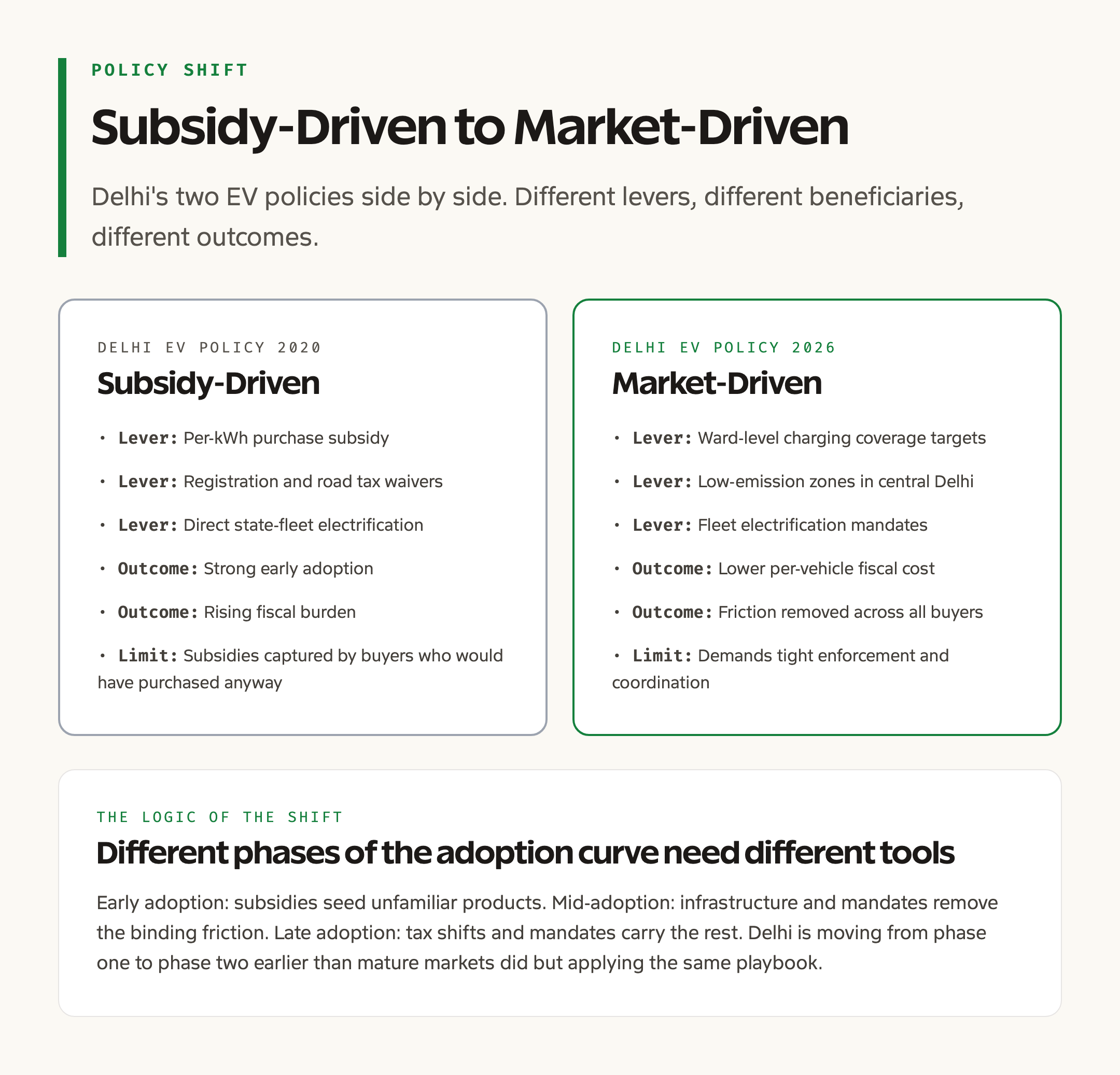
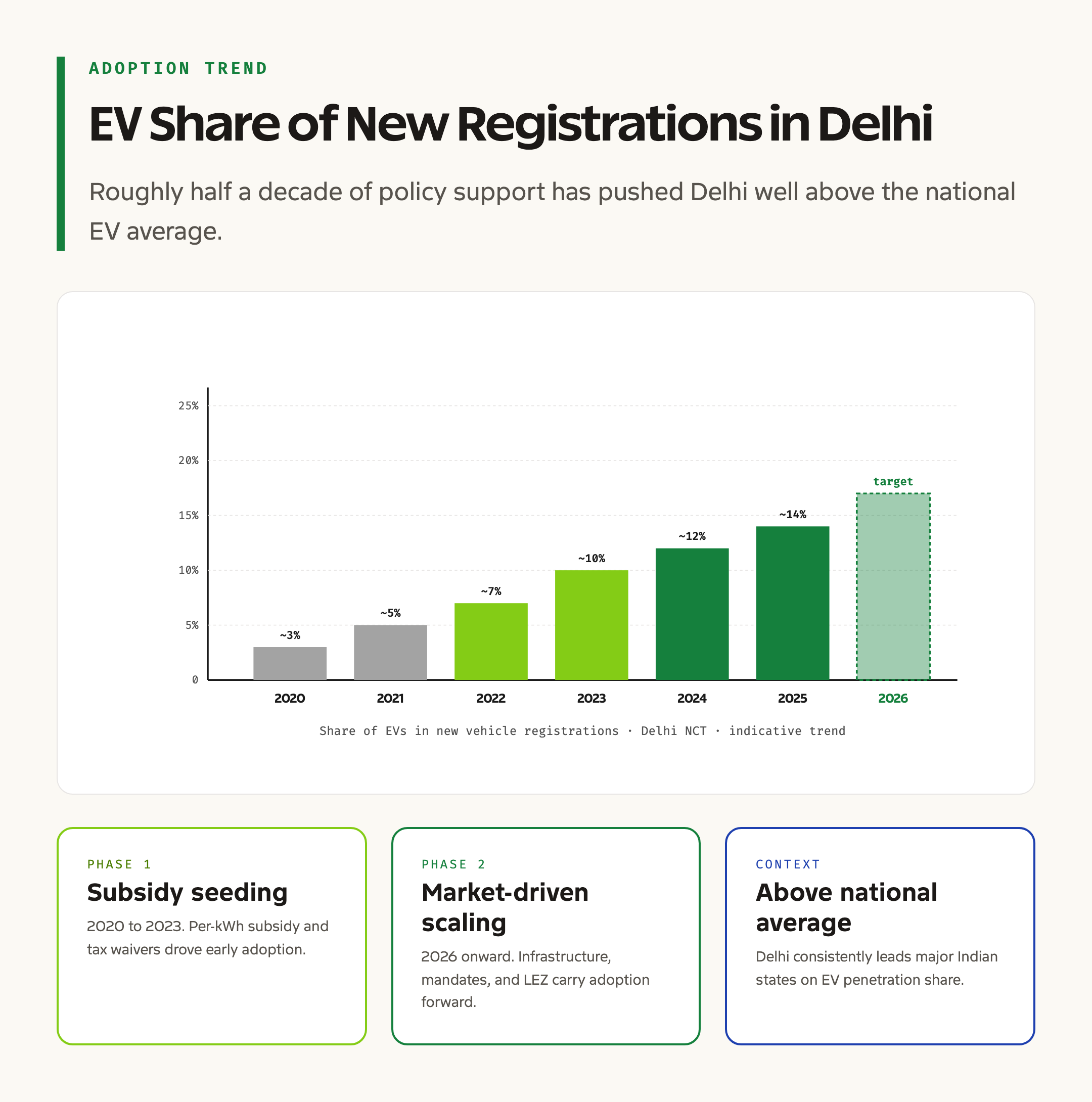
The Delhi government released the new EV policy framework in early May 2026, ending months of consultation with industry, civil society, and central agencies. The headline change is the explicit move away from blanket purchase subsidies. The previous policy paid up to a fixed amount per kilowatt-hour of battery capacity for two-wheelers and three-wheelers and offered waivers on registration and road tax. The new framework retains some tax-side benefits for select categories but redirects fiscal space toward infrastructure and demand-side measures.
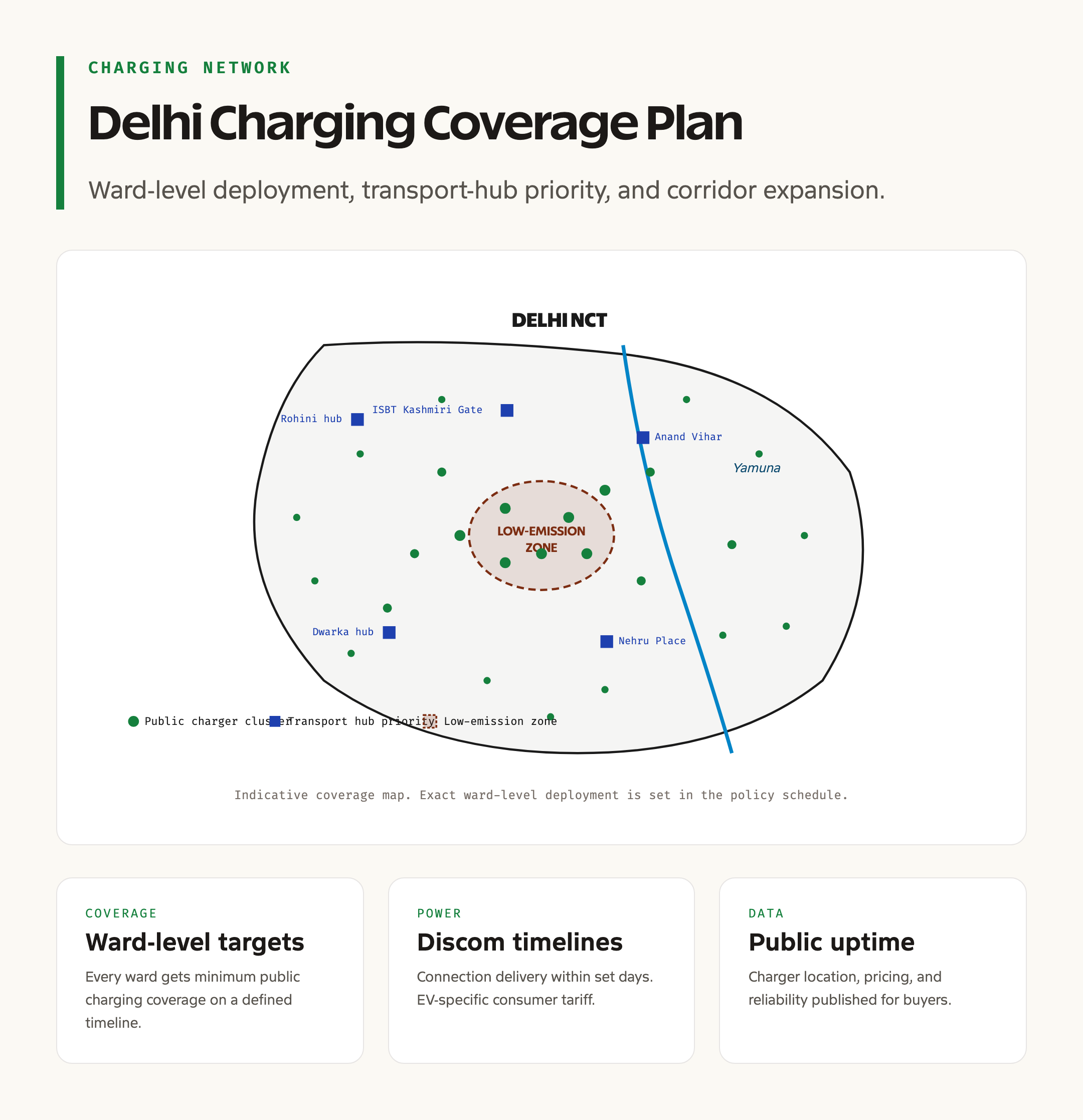
The policy also introduces or expands four other instruments. Low-emission zones in specified areas of central and old Delhi, where access by older internal-combustion vehicles is restricted. Mandatory electrification timelines for commercial fleets, including ride-hail aggregators and last-mile e-commerce delivery. Public charging coverage targets across municipal wards, with land-allocation rules to make installation faster. Awareness and transparency tools, including standardised on-road TCO calculators that show buyers the lifetime cost difference between EV and ICE options.
The signal beyond Delhi is significant. As the city with India’s most aggressive EV adoption rate, Delhi’s policy choices have historically been watched by other state transport departments. A move toward market-driven design here will influence Maharashtra, Karnataka, Tamil Nadu, and other states currently revising their own EV frameworks.
Background and Historical Context
India’s EV journey at the state level took off after the 2019 FAME-II launch under the central government, which provided per-vehicle subsidies for two-wheelers, three-wheelers, four-wheelers, and buses. State EV policies layered on top of FAME-II. Delhi’s 2020 policy was among the most generous and the most administratively efficient. The state delivered subsidies through a transparent online portal, exempted EVs from registration fees and road tax, and required state-owned vehicles to electrify on a defined timeline.
The results were visible. By 2024, Delhi’s share of EVs in new vehicle registrations crossed double digits, well above the national average. Electric two-wheelers became common in urban deliveries. Electric three-wheelers replaced a growing fraction of the city’s diesel auto fleet. The Delhi Transport Corporation built one of India’s largest e-bus fleets.
By 2025, the policy success had created its own problems. Subsidy claims piled up, fiscal pressure grew, and a substantial share of subsidies were going to buyers who would have purchased EVs at modestly higher prices anyway. Meanwhile, charging infrastructure had not scaled as fast as vehicle adoption. Drivers complained about charger availability, range anxiety, and inconsistent operator quality. The next phase needed a different design.
Internationally, similar transitions have played out. Norway, Europe’s EV leader, gradually rolled back purchase incentives once EV market share crossed 50 percent of new sales. China shifted from direct subsidies to dual-credit mandates on automakers. The United States moved from federal tax credits to manufacturing-linked incentives under the Inflation Reduction Act. Delhi’s new model fits this pattern of post-subsidy maturation, though at a much lower absolute adoption level.
Key Features of the Delhi EV Policy 2026
The policy is built on six pillars, each addressing a specific gap in the previous regime.
Charging infrastructure expansion: The policy sets ward-level targets for public charging coverage. Standardised land-allocation rules cut approval time for setting up chargers on public land. Discoms are required to provide power connections within defined timelines, and tariff structures favour EV-specific consumer categories.
Low-emission zones: Defined areas of central Delhi, including portions of the Walled City and select market clusters, become restricted-access zones for older internal-combustion vehicles. Compliance is monitored through camera-based number-plate recognition.
Fleet electrification mandates: Ride-hailing aggregators must transition specified percentages of their on-road fleet to electric by defined years. Last-mile delivery vehicles, including those operated by e-commerce platforms, face similar timelines. Government and state-owned enterprise vehicles continue on an accelerated electrification path.
Selective fiscal support: Purchase subsidies for most categories are phased down or removed. Select categories with weaker commercial viability, including heavy commercial vehicles and specific use-cases like school buses, retain support. Road tax and registration fee waivers continue for now.
Buyer transparency tools: The transport department maintains standardised TCO calculators that let buyers compare lifetime cost of EV and ICE options for their use profile. Charger location, pricing, and uptime data are published.
Battery and end-of-life policy: Battery swapping standards, second-life battery use cases, and recycling guidelines are integrated into the framework. This addresses a gap that the 2020 policy did not adequately cover.
Why the Delhi EV Policy 2026 Matters
The Delhi EV policy 2026 is significant for three reasons that extend beyond the city limits. First, it tests whether Indian states can sustain EV momentum without continually escalating fiscal commitments. India’s medium-term clean-mobility goal involves moving millions of vehicles to electric propulsion. That scale isn’t affordable purely on subsidy, and the world’s evidence shows mature markets eventually shift to mandates and infrastructure. Delhi is the first major Indian state to formally test that transition.
Second, the policy responds to a known weakness in Indian urban air-quality interventions. Delhi’s PM2.5 and PM10 burdens come from many sources, including biomass burning, construction dust, and industrial emissions, but vehicular emissions are a major contributor. Even with cleaner BS-VI ICE vehicles, the air-quality math doesn’t close unless the vehicle stock shifts more decisively toward electric. The link between EV penetration and air quality is exactly the linkage that the Air Prevention and Control of Pollution Act 1981 and its modern implementation tools rely on.
Third, the policy has implications for India’s energy transition more broadly. EVs are only as clean as the electricity that charges them. As Delhi’s EV stock grows, demand for clean charging grows. That demand reinforces grid-level renewable energy expansion and creates space for time-of-day tariffs, vehicle-to-grid pilots, and battery storage business cases. The Delhi policy explicitly encourages green charging through tariff differentials.
Detailed Analysis
The deeper logic of the market-driven shift is that subsidies and infrastructure work differently across the adoption curve. In the early phase, when products are expensive, buyers unfamiliar, and ecosystems thin, direct subsidies are necessary to seed adoption. As products approach price parity or fall below ICE lifetime costs, the binding constraint shifts. It becomes infrastructure access, range confidence, and use-case fit. Subsidies in this later phase are economically inefficient because they pay buyers who would have purchased anyway. Infrastructure investment, by contrast, removes friction across all potential buyers and operators.
Delhi appears to be at or near this transition zone for several categories. Electric two-wheelers and three-wheelers have largely reached TCO competitiveness on a per-kilometer basis in urban delivery and ride-hail use. Four-wheelers are closer to parity in fleet applications than in private ownership. Heavy commercial vehicles remain the laggard. The new policy reflects this differentiation by maintaining selective support for categories that are still pre-tipping-point.
The mandate approach has its own logic. Fleet operators react predictably to clear timelines. If a ride-hail aggregator knows it must reach a defined EV share by a specific year, it plans procurement, charging deployment, and driver onboarding around that timeline. The cost of the transition gets absorbed into the operator’s commercial decisions, including pricing, partnership deals with OEMs, and battery swapping arrangements, rather than being externalised onto the state exchequer.
The risks of the market-driven approach are real. Mandates without enabling infrastructure produce compliance failure and litigation. Low-emission zones without adequate public transport push lower-income commuters out of central areas. Phased subsidy withdrawal at the wrong moment can stall adoption just as it reaches mass-market sensitivity. The Delhi framework attempts to address these by sequencing infrastructure first, mandates second, and subsidy phase-out third, but the execution discipline required is high.
Comparative Perspective
| State / Region | Policy Approach | Key Instruments | Notable Outcome |
|---|---|---|---|
| Delhi 2020 | Subsidy-heavy | Per-kWh subsidy, tax waivers, e-bus fleet | High adoption, fiscal pressure |
| Delhi 2026 | Market-driven | Charging targets, LEZ, fleet mandates | Under implementation |
| Maharashtra | Subsidy plus fleet | Two-wheeler subsidy, fleet rules | Moderate adoption |
| Tamil Nadu | Manufacturing focus | OEM incentives, charging support | Strong supply-side growth |
| Norway | Post-subsidy phase | Mandates, tax shifts, charging | EV share above 80 percent of new sales |
| China | Dual-credit mandate | OEM credit system, infrastructure | Largest EV market globally |
The Norway and China models are far more mature, but the Delhi shift broadly follows the same maturation logic. The risk for India is the gap between current adoption levels and the levels at which post-subsidy approaches stabilised in mature markets. Delhi is making this shift earlier in its curve than Norway did.
Challenges and Concerns
Three challenges shape the policy’s near-term outlook.
Charging deployment pace: Delhi’s previous targets for public charging coverage were partially met. The new policy raises the bar significantly. Whether discoms, the transport department, and private CPOs can collectively scale fast enough to support the projected EV stock growth is the most important operational question.
Low-equity risks of LEZ: Low-emission zones can disproportionately affect lower-income commuters, small commercial operators, and informal sector workers who rely on older two-wheelers and auto-rickshaws. The policy includes exemption windows and phased rollouts, but execution discipline will determine whether equity concerns are managed.
Coordination with central policy: FAME-II is being phased into a successor scheme at the central level. State-level mandates only work if they sit consistently within national frameworks for vehicle standards, battery certification, and charger interoperability. Coordination gaps would create regulatory uncertainty.
There’s also a broader question about the air-quality payoff. Vehicular emissions are one driver of Delhi air pollution. Without parallel action on construction dust, industrial emissions, and crop-residue burning, EV gains alone won’t deliver the air-quality outcomes the policy implicitly promises. This is the same multi-source challenge that India’s air pollution control framework confronts at a national scale.
Prelims Pointers
- The Delhi EV Policy 2026 shifts focus from purchase subsidies to charging infrastructure, low-emission zones, and fleet mandates
- FAME-II is the central government scheme that initially anchored EV adoption in India
- Low-emission zones restrict access by older internal-combustion vehicles in specified urban areas
- The Delhi Transport Corporation operates one of India’s largest electric bus fleets
- TCO refers to total cost of ownership, capturing purchase, fuel, maintenance, and resale value across vehicle life
- The National Clean Air Programme sets PM2.5 and PM10 reduction targets for non-attainment cities
- Norway’s EV transition relies primarily on tax differentials and infrastructure rather than direct subsidies
- Dual-credit mandates require automakers to produce a defined share of zero-emission vehicles
Mains-Style Questions
- GS-III (Environment and Economy): Examine the rationale for India’s transition from subsidy-driven to market-driven electric vehicle policy with reference to the Delhi EV Policy 2026. (250 words)
- GS-III (Infrastructure): Discuss the role of charging infrastructure, fleet mandates, and low-emission zones in scaling electric mobility in Indian cities. (250 words)
- GS-III (Environment): Critically analyse the relationship between electric vehicle adoption and urban air quality outcomes. (150 words)
- GS-II (Governance): Coordination between central and state EV policies is essential for a coherent national transition. Examine. (150 words)
Way Forward
The Delhi EV Policy 2026 will succeed or fail on three execution variables. The first is the pace and reliability of public charging deployment. Without dense, reliable, and reasonably priced charging, all the mandate language in the policy will create friction without producing outcomes.
The second is the credibility of mandate enforcement. Fleet electrification timelines work when operators believe deadlines will hold. Delhi’s transport department will need monitoring tools, penalty mechanisms, and exemption procedures that are transparent and consistent.
The third is the equity envelope around low-emission zones. Compensation, exemptions, and transition support for vulnerable commuters must be designed in from the start rather than retrofitted in response to complaints. The international experience shows that LEZ programmes that ignore equity early face political backlash that erodes the policy.
Beyond Delhi, the policy’s broader contribution is to test whether mid-cycle Indian EV markets can sustain momentum without escalating fiscal commitments. If the model works, it offers a template for state EV policies entering their second decade. If it stalls, it will inform what additional levers other states need before they make a similar shift.
Frequently Asked Questions
What is the Delhi EV Policy 2026?
The Delhi EV Policy 2026 is the next-phase electric vehicle framework issued by the Government of NCT of Delhi in early May 2026. It shifts the policy approach from direct purchase subsidies toward charging infrastructure expansion, low-emission zones, and fleet electrification mandates.
Why is Delhi moving away from EV subsidies?
Delhi’s previous policy delivered high adoption but at growing fiscal cost. A meaningful share of subsidies were going to buyers who would have purchased EVs anyway. Meanwhile, charging infrastructure and use-case ecosystems had not scaled as fast as vehicle adoption. The new policy redirects fiscal space toward removing friction across all potential buyers rather than discounting purchases for individual ones.
What are low-emission zones in the new policy?
Low-emission zones are defined areas of central Delhi, including parts of the Walled City and select market clusters, where access by older internal-combustion vehicles is restricted. Compliance is monitored through camera-based number-plate recognition. The aim is to reduce localized air pollution and accelerate stock turnover toward cleaner vehicles.
Which commercial fleets must electrify under the policy?
Ride-hailing aggregators, last-mile e-commerce delivery operators, and government and state-owned enterprise fleets face defined electrification timelines. Specific share targets apply by year. Exemptions and phased rollouts manage operational realities for affected operators.
How does the policy address charging infrastructure?
The policy sets ward-level coverage targets for public charging, standardises land-allocation rules to speed installation, requires discoms to deliver power connections within set timelines, and offers tariff structures that favour EV-specific consumer categories. Charger uptime and pricing data are published transparently.
Will EV buyers in Delhi still get any incentives?
Road tax and registration fee waivers continue for now. Selective purchase subsidies remain for categories with weaker commercial viability, including heavy commercial vehicles and specific use-cases like school buses. Blanket per-vehicle subsidies for two-wheelers, three-wheelers, and four-wheelers are being phased down or removed.
How does the Delhi policy compare with other Indian states?
Most other state EV policies remain subsidy-heavy. Maharashtra and Karnataka offer per-vehicle support. Tamil Nadu emphasises manufacturing-side incentives. Delhi is the first major Indian state to deliberately shift the policy mix toward mandates and infrastructure, putting it closer in design philosophy to the Norway and China models, though at much lower adoption levels.
Will this policy actually improve Delhi air quality?
Vehicular emissions are a major contributor to Delhi’s PM2.5 and PM10 burden, so accelerated EV adoption will help. The air-quality math doesn’t close on EVs alone, however. Parallel action on construction dust, industrial emissions, and seasonal crop-residue burning is required to deliver meaningful improvement in ambient air quality across the National Capital Region.