Opens in a new tab
Join Anantam IAS Channel on Telegram

Daily Digest · Monday

6 July 2026 Current Affairs for UPSC

15 current affairs published on Monday, 6 July 2026

6 July 2026 Current Affairs for UPSC — every Why-in-News article AnantamIAS published on Monday, 6 July 2026, broken down with Why in News?, the exact GS paper it feeds, sub-topic mapping, MCQ-ready facts and a UPSC-style practice question. 15 articles in total, covering Polity, Economy, Environment, S&T, IR, Geography, History, Society and Internal Security — the same Why-in-News + GS-paper-mapping + practice-question format the Compass uses across every daily digest on the site.

Daily current affairs for UPSC is where new material enters your prep stream. Read this 6 July 2026 digest end-to-end in 25–35 minutes, attempt the practice question at the foot of each article (it's MCQ for some, 10/15-marker for others), then bookmark the entries that fall inside your active revision window. Everything stays cross-linked: tap any subject pill to jump to that subject's hub, or use the table of contents above to skip straight to a specific story.

Use this page three ways. Read sequentially for a one-sitting scan of everything that mattered on 6 July 2026. Download the 6 July 2026 PDF below for offline study or print revision. Or use the July 2026 Current Affairs compilation to see this day in the month's full context. For the previous day's reading, see 5 July 2026 Current Affairs; the next day's is 7 July 2026 Current Affairs.

Why we publish daily current affairs separately from the monthly compilation: daily is learning, monthly is revision. Use the daily page to add fresh material to your notes the day it breaks; come back to the July 2026 compilation 60 days before Prelims when the noise has settled and only the lasting takeaway is worth re-reading.

PM’s Three-Nation Visit: Indonesia, Australia, New Zealand and the Act East Policy

Open article →Download PDF

Why in News?

The Prime Minister began a three-nation visit to Indonesia, Australia and New Zealand from 6-11 July 2026. PIB released his departure statement, which frames the tour as a single strategic arc — from the Eastern Indian Ocean (Indonesia) through the Southern Indian Ocean (Australia) to the South Pacific (New Zealand).

The PM said the visit will strengthen India’s Act East Policy, the MAHASAGAR Vision and the country’s outlook towards a free and open Indo-Pacific. The Hindu reported that this is his first bilateral visit to Indonesia since ties were elevated to a Comprehensive Strategic Partnership (CSP) in 2018.

  • Indonesia leg (6-8 July): at the invitation of President Prabowo Subianto; first bilateral PM visit after the 2018 CSP elevation, and a return call after Prabowo was Republic Day 2025 chief guest.
  • The PM will visit the Prambanan Temple complex at Yogyakarta with President Prabowo — a 9th-century Hindu temple ensemble that showcases civilisational links.
  • Australia leg (Melbourne): talks with PM Anthony Albanese on defence and security, trade and investment, education and mobility, plus emerging and critical technologies and sports science.
  • New Zealand leg (Auckland): talks with PM Christopher Luxon, building on Luxon’s March 2025 India visit and the newly signed India-New Zealand Free Trade Agreement.
  • Diaspora outreach is a common thread — the PM will address Indian communities in all three countries.

The development matters in the context of:

  • The tour is a live case study of how Act East has widened from an ASEAN-centred economic outreach into a full Indo-Pacific strategy spanning Southeast Asia and Oceania.
  • It stitches together three different instruments of foreign policy — CSP-level summitry (Indonesia, Australia), trade agreements (ECTA, India-NZ FTA) and diaspora diplomacy.
  • The explicit reference to MAHASAGAR signals that India’s maritime doctrine, first articulated as SAGAR in 2015, now anchors even bilateral visits.
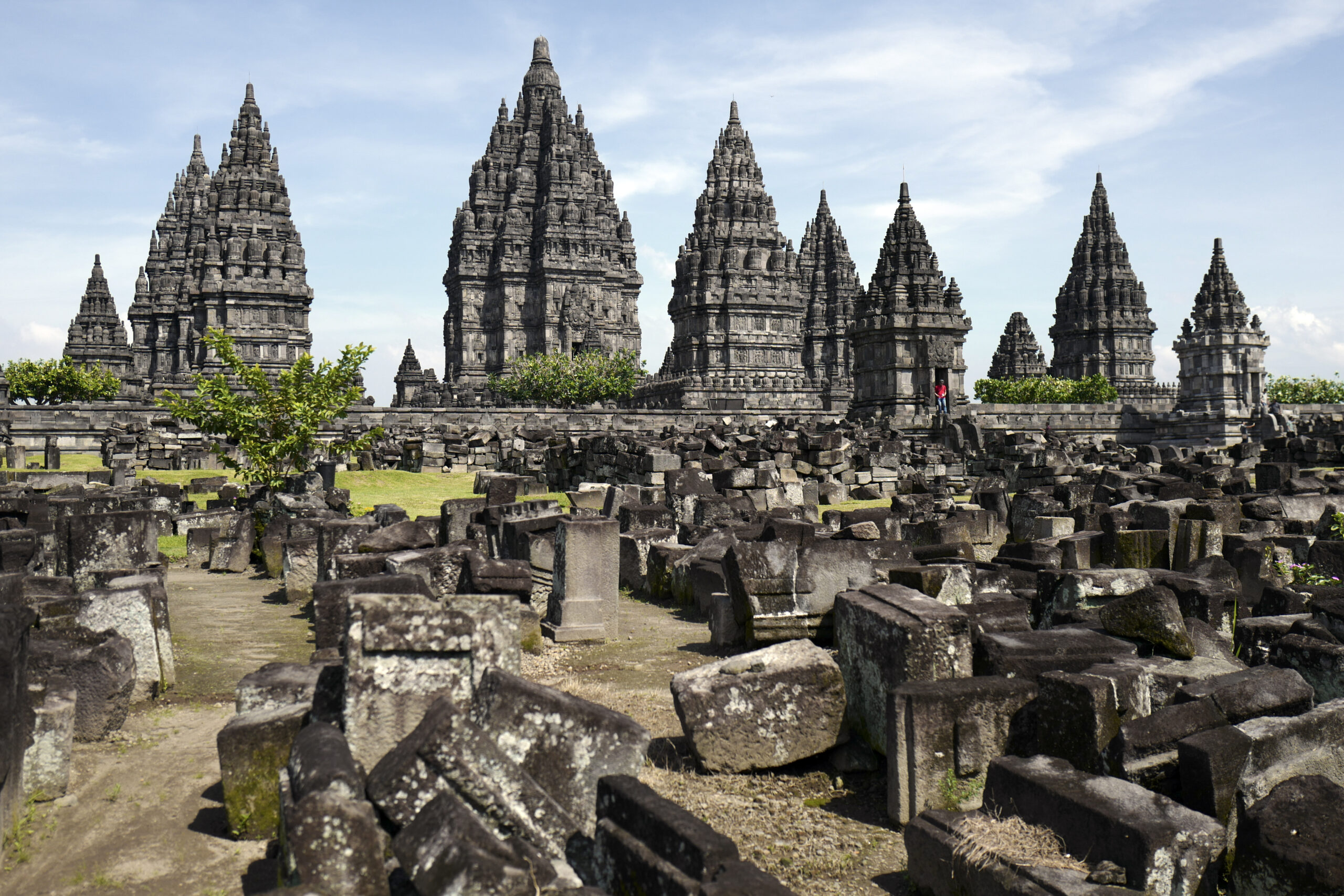
The spires of the Prambanan Hindu temple complex near Yogyakarta, Indonesia
Prambanan, the 9th-century Hindu temple complex at Yogyakarta that the PM will visit with President Prabowo Subianto Photo: Christopher Michel, CC BY-SA 4.0 (Wikimedia Commons)
PM's Three-Nation Visit: Indonesia, Australia, New Zealand and the Act East Policy — quick facts

UPSC Relevance

Prelims Relevance

  • Act East Policy — announced in November 2014 at the 12th India-ASEAN Summit in Nay Pyi Taw, Myanmar; upgrade of the 1992 Look East Policy.
  • The 4 Cs of Act East: Culture, Commerce, Connectivity, Capacity building.
  • MAHASAGAR — Mutual and Holistic Advancement for Security and Growth Across Regions; unveiled during the PM’s Mauritius visit in March 2025 as the evolution of SAGAR (2015).
  • India-Indonesia Comprehensive Strategic Partnership — elevated in 2018; President Prabowo Subianto was chief guest at Republic Day 2025.
  • Prambanan — 9th-century Hindu temple complex near Yogyakarta, Indonesia; a UNESCO World Heritage Site dedicated to the Trimurti.
  • India-Australia CSP dates from the June 2020 virtual summit; the ECTA trade pact entered into force in December 2022.
  • Quad members: India, USA, Japan, Australia — New Zealand is NOT a member.
  • India-New Zealand FTA — negotiations launched during PM Luxon’s March 2025 visit; the agreement has since been signed, per the PIB statement.
  • Indo-Pacific Oceans Initiative (IPOI) — proposed by India at the East Asia Summit, Bangkok, 2019.

Mains Relevance

GS Paper 2

  • Evolution of the Act East Policy from Look East: drivers, instruments and outcomes across ASEAN and Oceania.
  • India-Indonesia ties as the fulcrum of maritime-neighbour diplomacy — CSP, defence cooperation and ASEAN centrality.
  • Trade-led statecraft: how ECTA and the India-NZ FTA convert strategic convergence into economic interdependence.
  • Diaspora diplomacy as a pillar of bilateral partnerships in Australia and New Zealand.

GS Paper 3

  • Maritime security in the Indo-Pacific: SAGAR to MAHASAGAR, sea-lane security and the Andaman Sea neighbourhood.
  • Critical minerals and emerging technologies cooperation with Australia as a supply-chain resilience play.

Essay

  • Geography is destiny: India’s two-ocean future and the Indo-Pacific century.
  • Soft power and civilisational connect as instruments of foreign policy — from Prambanan to the diaspora.
  • Trade agreements as the new alliances: economics at the heart of 21st-century strategy.

Background and Context

From Look East to Act East: the policy arc

The visit sits squarely within a three-decade evolution of India’s eastern engagement.

  • The Look East Policy (1992), launched under PM P. V. Narasimha Rao after the balance-of-payments crisis, sought economic integration with the fast-growing economies of Southeast Asia.
  • It was upgraded to the Act East Policy in November 2014 at the 12th India-ASEAN Summit in Nay Pyi Taw, Myanmar — shifting from passive economic engagement to proactive strategic, security and connectivity partnerships.
  • Act East rests on the 4 Cs — Culture, Commerce, Connectivity, Capacity building — and now extends beyond ASEAN to Japan, South Korea, Australia, New Zealand and the Pacific Island states.
  • This tour operationalises that wider canvas: Indonesia anchors the ASEAN pillar, while Australia and New Zealand represent the Oceania extension of Act East.
  • The PM’s own framing — Indonesia in the Eastern Indian Ocean, Australia in the Southern Indian Ocean, then New Zealand — presents the three legs as one continuous maritime geography, not three separate bilaterals.
PM's Three-Nation Visit: Indonesia, Australia, New Zealand and the Act East Policy — exam lens

India-Indonesia: the first leg (6-8 July)

Jakarta is the strategic heart of the tour — a giant maritime neighbour and ASEAN’s largest economy.

  • India and Indonesia elevated ties to a Comprehensive Strategic Partnership during the PM’s first visit in 2018; PIB confirmed this is his first bilateral visit since that elevation.
  • The visit reciprocates President Prabowo Subianto’s state visit as chief guest at Republic Day, 26 January 2025 — a slot India reserves for its closest partners.
  • The two countries are close maritime neighbours: India’s Andaman and Nicobar Islands lie near Indonesia’s Aceh province across the Andaman Sea, making Jakarta central to India’s sea-lane security.
  • Defence ties include coordinated naval patrols (IND-INDO CORPAT) and the bilateral naval exercise Samudra Shakti.
  • Indonesia is the world’s largest archipelagic state and its largest Muslim-majority nation — yet the shared Ramayana-Mahabharata heritage gives the relationship a rare civilisational depth.
  • The joint visit to the Prambanan Temple complex at Yogyakarta — a 9th-century Hindu temple ensemble and UNESCO World Heritage Site — is deliberate cultural signalling of that shared inheritance.

India-Australia: the Melbourne leg

The Australia stop consolidates one of India’s fastest-deepening strategic partnerships.

  • India and Australia elevated ties to a Comprehensive Strategic Partnership at the June 2020 virtual summit; both are Quad members alongside the USA and Japan.
  • The Economic Cooperation and Trade Agreement (ECTA) entered into force in December 2022 — India’s first trade pact with a developed economy in over a decade — and talks continue on a fuller CECA.
  • Per the departure statement, the agenda spans defence and security, trade and investments, education and mobility, and people-to-people ties.
  • New frontiers flagged by the PM: emerging and critical technologies and sports and sports science — the latter notable ahead of Brisbane 2032 and India’s own Olympic ambitions.
  • Australia is a key partner for critical minerals (lithium, cobalt, rare earths) that feed India’s clean-energy and semiconductor plans.
  • The Indian diaspora in Australia, which the PM called an important pillar of the partnership, is among the country’s fastest-growing migrant communities.

India-New Zealand: the Auckland leg and the FTA

The final stop converts a long-quiet relationship into a trade-first partnership.

  • The visit builds on PM Christopher Luxon’s visit to India in March 2025, when the two sides launched free trade negotiations after a decade-long freeze.
  • PIB confirmed the two countries have now signed a Free Trade Agreement — the anchor of the Auckland conversations on economic, trade and commercial engagement.
  • For New Zealand, India offers market diversification away from over-dependence on China; for India, the FTA extends its Oceania footprint beyond Australia.
  • The Indian community in New Zealand has, in the PM’s words, contributed significantly to bilateral ties; he will address a large diaspora gathering in Auckland.
  • Both countries share stakes in a rules-based South Pacific, where infrastructure and aid competition among major powers has intensified.

SAGAR to MAHASAGAR: the doctrinal frame

The visit’s vocabulary matters as much as its itinerary.

  • SAGAR (Security and Growth for All in the Region), announced in Mauritius in 2015, was India’s first named maritime doctrine for the Indian Ocean.
  • It was upgraded to MAHASAGAR — Mutual and Holistic Advancement for Security and Growth Across Regions — during the PM’s Mauritius visit in March 2025, widening the canvas from the Indian Ocean region to the broader Indo-Pacific and the Global South.
  • The Hindu noted the PM’s statement explicitly tied this tour to MAHASAGAR and to a free, open and inclusive Indo-Pacific — language that signals convergence with partners wary of coercion in the region.
  • Complementary frameworks: the Indo-Pacific Oceans Initiative (IPOI, 2019), the Quad, and India’s ASEAN-centrality posture all plug into the same architecture.
  • Taken together, the doctrine stack shows India positioning itself as a net security provider and development partner, not merely a balancer.

Significance and the harder questions

The tour advances real interests, but examiners reward candidates who also see the friction points.

  • Strategic: three democracies on one arc deepen India’s options in a contested Indo-Pacific without formal alliance commitments.
  • Economic: ECTA and the India-NZ FTA give Act East a trade backbone that the older Look East era lacked; Indonesia remains India’s largest ASEAN trading partner.
  • Challenges: India stayed out of RCEP (2019), so bilateral FTAs must do the heavy lifting of regional economic integration.
  • Defence and connectivity promises with Indonesia (including port and patrol cooperation near the Malacca Strait approaches) have historically moved slower than announced.
  • Balancing deep economic ties with China — the top trading partner of Indonesia, Australia and New Zealand alike — limits how far each partner will go on security alignment.
  • Diaspora diplomacy cuts both ways: it builds constituencies for India, but visa, mobility and community-safety issues need steady consular follow-through.

Way Forward

Institutionalise the gains

  • Convert summit momentum into scheduled mechanisms — annual leader-level meetings, 2+2 style dialogues and delivery-bound joint working groups with Indonesia.
  • Fast-track utilisation of the India-NZ FTA and push the India-Australia CECA to completion so tariff gains reach exporters quickly.

Build the maritime spine

  • Deepen maritime domain awareness sharing, coordinated patrols and humanitarian-assistance capacity across the Andaman Sea and South Pacific under MAHASAGAR.
  • Pair security cooperation with visible development delivery — connectivity, digital public infrastructure and capacity building — to keep ASEAN centrality credible.

Sustained diaspora engagement — mobility partnerships, mutual recognition of qualifications and student pathways — can quietly compound every other pillar of these three relationships.

Conclusion

The three-nation tour is Act East in motion: one journey linking a civilisational partner in ASEAN, a Quad ally in the Southern Indian Ocean and a new FTA partner in the South Pacific. The PIB statement’s closing line — that the visit strengthens the Act East Policy, MAHASAGAR and a free and open Indo-Pacific — is effectively a one-sentence summary of India’s eastern strategy.

For the exam, treat this visit as a peg to revise the whole framework: Look East to Act East, SAGAR to MAHASAGAR, CSP diplomacy, and the growing role of trade agreements and the diaspora in India’s external engagement. The durable syllabus behind the headline is what UPSC will test.

UPSC Practice Questions

Prelims MCQ 1

With reference to India’s recent three-nation visit and its eastern-engagement frameworks, consider the following statements:

  1. The Act East Policy was announced in 2014 as an upgrade of the earlier Look East Policy.
  2. India and Indonesia elevated their relationship to a Comprehensive Strategic Partnership in 2018.
  3. Both Australia and New Zealand are members of the Quad grouping.

How many of the above statements are correct?

(a) Only one (b) Only two (c) All three (d) None

Answer: (b) Only two

Explanation:

Statements 1 and 2 are correct — Act East was announced at the 12th India-ASEAN Summit (Nay Pyi Taw, 2014), and India-Indonesia ties became a CSP during the PM’s 2018 visit. Statement 3 is wrong: the Quad comprises India, the USA, Japan and Australia; New Zealand is not a member.

Prelims MCQ 2

The ‘MAHASAGAR’ vision, often mentioned alongside India’s Indo-Pacific outreach, is best described as:

(a) A deep-ocean mineral exploration mission of the Ministry of Earth Sciences (b) India’s vision of Mutual and Holistic Advancement for Security and Growth Across Regions, evolving from the earlier SAGAR doctrine (c) A coastal shipping and inland waterways integration scheme (d) A multilateral naval exercise hosted by India with ASEAN navies

Answer: (b) India's vision of Mutual and Holistic Advancement for Security and Growth Across Regions, evolving from the earlier SAGAR doctrine

Explanation:

MAHASAGAR, unveiled during the PM’s March 2025 Mauritius visit, upgrades the 2015 SAGAR (Security and Growth for All in the Region) doctrine to a wider Indo-Pacific and Global South canvas.

UPSC Mains Questions

  1. The Act East Policy has evolved from an economic outreach to ASEAN into a comprehensive Indo-Pacific strategy. Discuss this evolution in the light of India’s recent engagements with Indonesia, Australia and New Zealand.
  2. Trade agreements are emerging as the backbone of India’s strategic partnerships in the Indo-Pacific. Examine with reference to the India-Australia ECTA and the India-New Zealand Free Trade Agreement.
  3. India-Indonesia relations illustrate how civilisational ties, maritime geography and strategic convergence can reinforce one another. Analyse in the context of the Comprehensive Strategic Partnership.

Sources: PIB, Prime Minister's Office and The Hindu.

Frequently Asked Questions

What is the PM’s three-nation visit about?

The Prime Minister is visiting Indonesia, Australia and New Zealand from 6 to 11 July 2026. PIB says the tour will deepen bilateral ties with each country and strengthen India’s Act East Policy, the MAHASAGAR Vision and its outlook towards a free and open Indo-Pacific.

Why is the Indonesia leg significant?

It is the PM’s first bilateral visit to Indonesia since ties were elevated to a Comprehensive Strategic Partnership in 2018, and it reciprocates President Prabowo Subianto’s visit as Republic Day 2025 chief guest. A joint visit to the Prambanan Hindu temple complex highlights civilisational links.

What is the Act East Policy?

Announced in November 2014 at the India-ASEAN Summit in Myanmar, Act East upgraded the 1992 Look East Policy. It pursues culture, commerce, connectivity and capacity building with Southeast Asia and the wider Indo-Pacific, including Australia, New Zealand and the Pacific Islands.

What is the MAHASAGAR Vision?

MAHASAGAR — Mutual and Holistic Advancement for Security and Growth Across Regions — was unveiled in Mauritius in March 2025. It expands the 2015 SAGAR doctrine from the Indian Ocean region to the broader Indo-Pacific and the Global South, combining security cooperation with development partnership.

What is the India-New Zealand FTA context?

Free trade negotiations were launched during PM Christopher Luxon’s March 2025 visit to India, and the agreement has since been signed. The Auckland leg focuses on expanding economic, trade and commercial engagement on the back of this new FTA.

How do Quad and ECTA fit into this visit?

Australia is India’s Quad partner and CSP ally; the ECTA trade pact, in force since December 2022, anchors economic ties. The Melbourne talks cover defence, trade, education, mobility, emerging and critical technologies, and sports science.
Pahalgam Terror Attack: NIA chargesheet names LeT founder Hafiz Saeed

Open article →Download PDF

Why in News?

The National Investigation Agency (NIA) on July 6, 2026 filed a supplementary chargesheet before the NIA Special Court, Jammu, naming Hafiz Saeed — founder and chief of the Pakistan-based Lashkar-e-Taiba (LeT) and its proxy The Resistance Front (TRF) — as an accused in the Pahalgam terror attack of April 22, 2025, in which 26 civilians were killed. The Hindu reported that Saeed has been charged both in his personal capacity and as head of the two proscribed outfits.

The chargesheet invokes the Bharatiya Nyaya Sanhita (BNS), 2023 and the Unlawful Activities (Prevention) Act, 1967, including penal provisions for waging war against India and hatching a conspiracy from across the border. LeT and TRF have also been charged as legal entities for planning, facilitating and executing the attack — formally documenting the Pakistan-based conspiracy in a court of law.

  • Filed on July 6, 2026 as a supplementary chargesheet, in continuation of the original 1,597-page chargesheet of December 15, 2025.
  • Saeed charged in his personal capacity and as founder-chief of the proscribed LeT and its active proxy TRF.
  • Provisions invoked: BNS 2023, UAPA 1967, plus sections for waging war against India and cross-border criminal conspiracy.
  • LeT and TRF charged as legal entities — for their role in planning, facilitating and executing the attack.
  • The NIA says the evidence comes from scientific investigation and on-ground examination; the probe into the full Pakistan-backed conspiracy continues.
  • The original chargesheet had named Pakistani handler Sajid Jatt, three terrorists killed in Operation Mahadev (July 2025), and two arrested local logistics providers.

The development matters in the context of:

  • This is India’s formal legal attribution of the Pahalgam attack to Pakistan-based leadership — evidence that supports India’s diplomatic case on cross-border terrorism at forums like the UN and FATF.
  • It tests the machinery India built after 26/11: the NIA Act, 2008, the UAPA designation regime, and the 2019 amendments that let the NIA probe offences plotted outside India.
  • Charging organisations as legal entities alongside individuals reflects a strategy of targeting the terror ecosystem — leadership, proxies, financiers and local facilitators together.
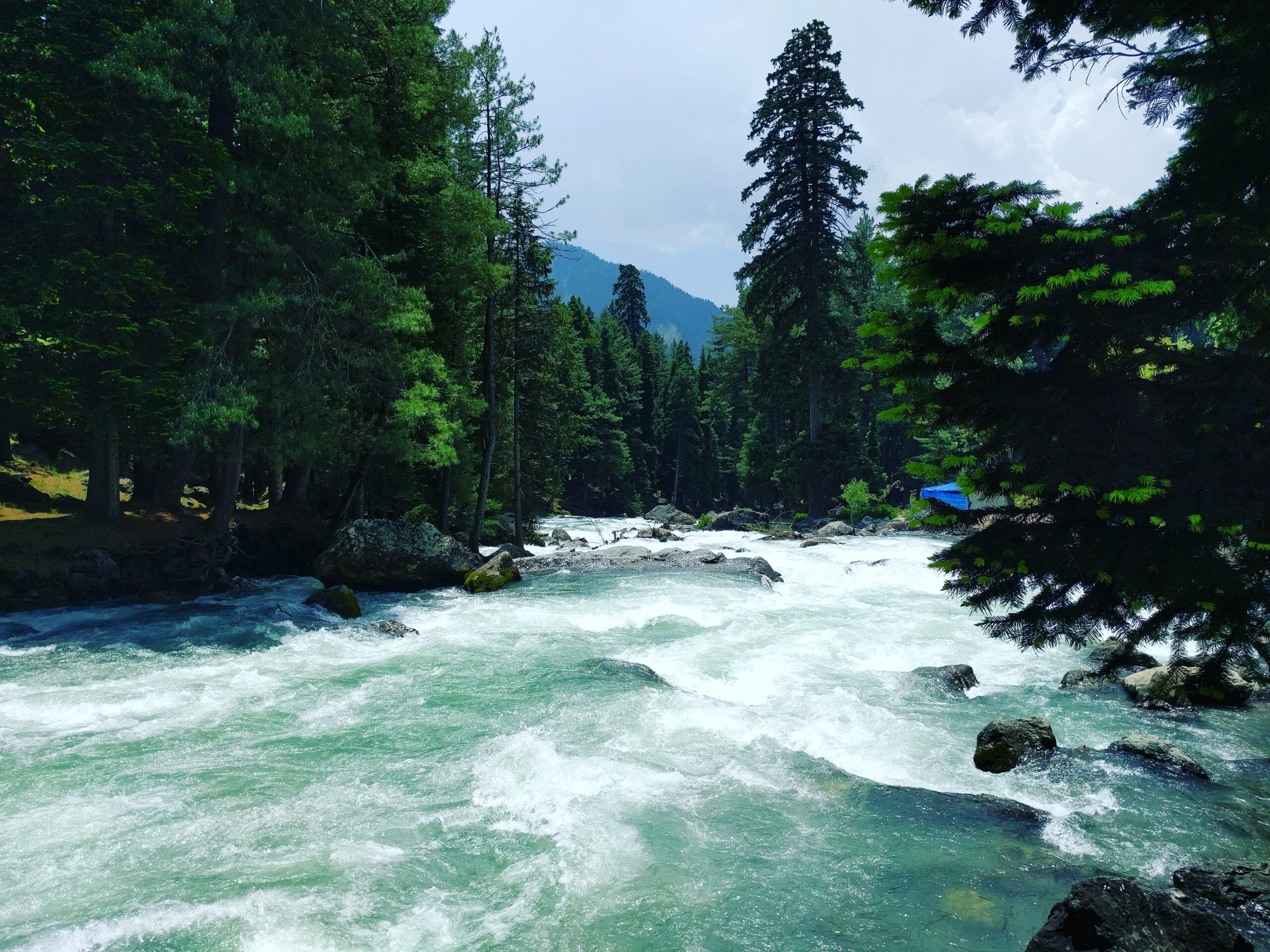
View of Pahalgam town and the Lidder valley in Anantnag district, Jammu and Kashmir
Pahalgam in Anantnag district, J&K — site of the April 2025 terror attack now chargesheeted by the NIA. Photo: Wikimedia Commons, CC0 (Wikimedia Commons)
Pahalgam Terror Attack: NIA chargesheet names LeT founder Hafiz Saeed — quick facts

UPSC Relevance

Prelims Relevance

  • NIA — statutory body under the NIA Act, 2008 (set up after the 26/11 Mumbai attacks); investigates scheduled offences without state consent; works under the Ministry of Home Affairs.
  • NIA (Amendment) Act, 2019 — extended jurisdiction to offences committed outside India affecting Indian citizens or interests; added cyber-terrorism, human trafficking and Explosive Substances Act offences to the schedule; enabled designation of Special Courts.
  • UAPA, 1967 — India’s principal anti-terror law; the 2019 amendment (Section 35) allows the Centre to designate individuals as terrorists; Hafiz Saeed was among the first four so designated in 2019.
  • Hafiz Saeed — founder of LeT; listed by the UNSC 1267 Sanctions Committee in December 2008 after the Mumbai attacks; carries a US $10 million Rewards for Justice bounty.
  • The Resistance Front (TRF) — LeT proxy that emerged in 2019; banned by MHA under UAPA in January 2023; designated a Foreign Terrorist Organisation by the United States in July 2025.
  • BNS, 2023 — replaced the IPC; retains the offence of waging war against the Government of India (Section 147) and adds a dedicated terrorist act provision (Section 113).
  • Pahalgam attack — April 22, 2025, near Pahalgam in Anantnag district, J&K; 26 civilians (25 tourists, one local) killed in targeted shootings.
  • Operation Sindoor — India’s May 2025 precision strikes on terror infrastructure in Pakistan and PoK in response to Pahalgam; Operation Mahadev (July 2025) eliminated three attackers in J&K.

Mains Relevance

GS Paper 3

  • Cross-border terrorism and state-sponsored proxies: how the LeT–TRF layering is designed to evade attribution and FATF scrutiny, and how investigation pierces it.
  • Role and evolution of the NIA as a federal counter-terror agency — powers, 2019 expansion, extraterritorial investigation and conviction record.
  • Linkages between external state actors and internal security: local overground workers providing logistics to foreign attackers.

GS Paper 2

  • India’s legal-diplomatic response to terrorism: UNSC 1267 listings, FATF processes, extradition limits with Pakistan and the value of court-tested evidence.
  • Efficacy of international designation regimes when the host state shields designated terrorists — the Hafiz Saeed precedent since 2008.

Essay

  • Justice across borders: can law reach where armies cannot?
  • Terrorism is waged by networks; states must respond with institutions.

Background and Context

The Pahalgam attack and the case so far

The chargesheet caps a 14-month investigation that moved from a local FIR to a documented cross-border conspiracy.

  • On April 22, 2025, terrorists killed 26 civilians — 25 tourists and one local — in targeted, religion-based shootings near Pahalgam, a tourist town in Anantnag district of Jammu & Kashmir.
  • An FIR was first registered at the Pahalgam police station; after initial investigation by J&K Police, the Union Home Ministry transferred the case to the NIA.
  • The original 1,597-page chargesheet (December 15, 2025) named Pakistani handler Sajid Jatt, the three attackers killed by security forces in Operation Mahadev (July 2025), and two arrested civilians who allegedly provided logistics.
  • The July 6, 2026 supplementary chargesheet moves up the chain of command to Hafiz Saeed himself, and indicts LeT and TRF as organisations.
  • The NIA says its evidence rests on scientific investigation — forensics, digital trails and on-ground examination — and that the probe into the complete conspiracy continues.
Pahalgam Terror Attack: NIA chargesheet names LeT founder Hafiz Saeed — exam lens

Hafiz Saeed, LeT and the TRF proxy model

The accused is not a foot soldier but the head of a UN-designated terror network operating from Pakistani soil.

  • Hafiz Saeed founded Lashkar-e-Taiba, the group behind the 2008 Mumbai attacks (166 killed); the UNSC 1267 Committee listed him as a global terrorist in December 2008.
  • The US placed a $10 million Rewards for Justice bounty on him; India designated him an individual terrorist under the amended UAPA in 2019.
  • Despite convictions in terror-financing cases in Pakistan, he has never been prosecuted there for attacks on India — the core of India’s charge of state complicity.
  • The Resistance Front surfaced in 2019 as an LeT front with a secular-sounding name — a deliberate rebranding to project terrorism in J&K as indigenous and to dodge FATF terror-financing scrutiny of Pakistan.
  • India banned TRF under UAPA in January 2023; the US State Department designated it a Foreign Terrorist Organisation in July 2025, expressly linking it to the Pahalgam attack.
  • TRF initially claimed the Pahalgam attack and later retracted — the chargesheet now fixes responsibility on the LeT–TRF continuum as one legal enterprise.

The legal arsenal: BNS, UAPA and waging war

The charges knit together India’s new criminal code and its special anti-terror statute.

  • The Bharatiya Nyaya Sanhita, 2023 (which replaced the IPC) retains waging war against the Government of India (Section 147) — one of the gravest offences, punishable with death or life imprisonment — and adds a dedicated terrorist act offence (Section 113).
  • The UAPA, 1967 supplies the terrorism-specific framework: terrorist acts, conspiracy, membership of and support to a banned organisation (LeT and TRF are both proscribed in the First Schedule).
  • The UAPA (Amendment) Act, 2019 lets the Centre designate individuals (Section 35, Fourth Schedule) as terrorists — earlier only organisations could be banned, so leaders escaped by floating new fronts.
  • Charging LeT and TRF as legal entities means the organisations themselves face prosecution for planning, facilitating and executing the attack — attacking the institution, not just its members.
  • Invoking criminal conspiracy from across the border anchors the extraterritorial dimension: the plot was hatched in Pakistan, executed in India.

NIA: mandate, powers and the 2019 expansion

The case showcases the federal counter-terror architecture India built after 26/11.

  • The NIA Act, 2008 created India’s first truly federal investigation agency; it can take up scheduled offences (terrorism, bomb blasts, hijacking, terror financing) anywhere in India without state consent.
  • The NIA (Amendment) Act, 2019 gave it extraterritorial jurisdiction — offences committed outside India against Indian citizens or Indian interests — the legal basis for investigating a conspiracy hatched in Pakistan.
  • The 2019 amendment also widened the schedule (cyber-terrorism, human trafficking, Explosive Substances Act) and allowed Centre and states to designate Sessions Courts as NIA Special Courts for speedy trial — the Jammu court hearing this case is one such court.
  • Cases reach the NIA by MHA transfer, as happened here after the initial J&K Police probe.
  • The agency maintains one of the highest conviction rates among Indian investigative agencies in terror cases, built on chargesheets designed to survive judicial scrutiny. Details of the agency’s mandate are on the official NIA portal (nia.gov.in).

Why chargesheet an accused who may never stand trial

Saeed remains in Pakistan, so the chargesheet’s value is strategic as much as judicial.

  • India and Pakistan have no extradition treaty, and Islamabad has consistently refused to hand over Saeed — as it did after the 26/11 case.
  • A court-filed chargesheet converts intelligence into admissible, documented evidence — the strongest currency in diplomacy at the UNSC, FATF and bilateral forums.
  • It enables downstream legal tools: proclaimed offender proceedings, Interpol notices, property attachment under UAPA, and pressure on states that host or fund the network.
  • It also builds the record of Pakistan’s state sponsorship — relevant if FATF re-examines Pakistan’s commitments on terror financing.
  • The precedent: the 26/11 chargesheets underpinned a decade of sanctions, listings and Pakistan’s 2018–2022 stint on the FATF grey list.

The wider post-Pahalgam response

The legal track ran parallel to military and diplomatic instruments through 2025-26.

  • Operation Sindoor (May 2025): precision strikes on terror infrastructure in Pakistan and Pakistan-occupied Kashmir — India’s declared doctrine of treating terror attacks as acts of war.
  • Diplomatic measures after the attack included placing the Indus Waters Treaty in abeyance, closing the Attari integrated check post and downgrading diplomatic missions.
  • Operation Mahadev (July 2025) neutralised the three attackers inside J&K, closing the tactical loop while the NIA pursued the command chain.
  • The combined effect is a template: kinetic response + legal attribution + diplomatic isolation, each reinforcing the other.
  • For the running record of such developments, see the daily digests at anantamias.com/current-affairs.

Way Forward

Sustain the legal-diplomatic offensive

  • Pursue proclaimed offender status, Interpol notices and UAPA property attachment against Saeed and the charged entities; keep the evidence dossier before the UNSC 1267 Committee and FATF.
  • Push for TRF’s listing in the UNSC sanctions framework, using the US FTO designation and the chargesheet as supporting material.

Harden the internal grid

  • Deepen intelligence coverage of overground workers and logistics networks that enabled foreign attackers to operate in the Valley.
  • Institutionalise tourist-area security protocols in J&K — the attack targeted the tourism economy as much as lives.

Build prosecution capacity

  • Fast-track the trial in the NIA Special Court with protected witnesses and forensic continuity, so the verdict carries international weight.
  • Invest in digital forensics and cross-border evidence-sharing arrangements (MLATs) that modern conspiracies demand.

Conclusion

The supplementary chargesheet does what military strikes cannot: it places Hafiz Saeed, LeT and TRF inside a documented, court-tested chain of responsibility for Pahalgam. Even if the trial proceeds without the principal accused, the record it creates is a durable instrument of state policy.

For UPSC, the case is a live illustration of how the post-26/11 architecture — the NIA Act, the amended UAPA, the new BNS — is deployed against externally sponsored terrorism, and why legal attribution, diplomatic pressure and kinetic response now operate as one integrated doctrine.

UPSC Practice Questions

Prelims MCQ 1

With reference to the National Investigation Agency (NIA), consider the following statements:

  1. The NIA was established by an Act of Parliament in the aftermath of the 2008 Mumbai terror attacks.
  2. The NIA (Amendment) Act, 2019 empowered the agency to investigate scheduled offences committed outside India affecting Indian citizens or interests.
  3. The NIA can investigate a scheduled offence in a state only with the prior consent of that state government.

How many of the above statements are correct?

(a) Only one (b) Only two (c) All three (d) None

Answer: (b) Only two

Explanation:

Statements 1 and 2 are correct — the NIA Act, 2008 followed 26/11, and the 2019 amendment added extraterritorial jurisdiction. Statement 3 is wrong: for scheduled offences the NIA needs no state consent; that is what makes it a federal agency.

Prelims MCQ 2

The Unlawful Activities (Prevention) Amendment Act, 2019 is significant primarily because it:

(a) created the National Investigation Agency (b) allowed the Central Government to designate individuals, and not just organisations, as terrorists (c) abolished the requirement of sanction for prosecution under the Act (d) transferred all terror trials to military courts

Answer: (b) allowed the Central Government to designate individuals, and not just organisations, as terrorists

Explanation:

The 2019 amendment inserted individual designation under Section 35 (Fourth Schedule). Hafiz Saeed, Masood Azhar, Zaki-ur-Rehman Lakhvi and Dawood Ibrahim were the first individuals so designated.

UPSC Mains Questions

  1. The chargesheeting of a Pakistan-based terrorist leader who may never face trial in India is still a meaningful instrument of state policy. Discuss with reference to the Pahalgam terror attack investigation and India’s legal-diplomatic options against cross-border terrorism.
  2. Proxy organisations like The Resistance Front are designed to blur attribution of state-sponsored terrorism. Examine how India’s legal framework — the UAPA, the BNS and the NIA Act — has evolved to counter this proxy model, and suggest further reforms.
  3. “India’s response to Pahalgam combined kinetic, diplomatic and legal instruments.” Evaluate the strengths and limits of this integrated approach to externally sponsored terrorism.

Sources: The Hindu and Indian Express.

Frequently Asked Questions

What has the NIA chargesheet on Pahalgam said?

The supplementary chargesheet, filed on July 6, 2026 before the NIA Special Court in Jammu, names LeT founder Hafiz Saeed as an accused in the April 2025 Pahalgam attack, both personally and as chief of LeT and its proxy TRF, and charges both outfits as legal entities.

Under which laws has Hafiz Saeed been charged?

He is charged under the Bharatiya Nyaya Sanhita, 2023 and the Unlawful Activities (Prevention) Act, 1967. The NIA has also invoked provisions for waging war against India and for hatching a criminal conspiracy from across the border in Pakistan.

What happened in the Pahalgam terror attack?

On April 22, 2025, terrorists carried out targeted shootings of civilians near Pahalgam in Anantnag district of Jammu & Kashmir, killing 26 people — 25 tourists and one local resident. The NIA describes it as an attack planned and directed by Pakistan-based LeT and TRF.

What is The Resistance Front (TRF)?

TRF is a proxy of Lashkar-e-Taiba that emerged in 2019 with a non-religious name to make terrorism in Kashmir look indigenous and evade FATF scrutiny. India banned it under UAPA in January 2023, and the US designated it a Foreign Terrorist Organisation in July 2025.

Can Hafiz Saeed actually be tried in India?

Only if he is brought to India, which is unlikely since Pakistan shields him and no extradition treaty exists. But the chargesheet still enables proclaimed-offender proceedings, Interpol notices, property attachment, and gives India court-grade evidence for diplomacy at the UNSC and FATF.

Why could the NIA probe a conspiracy hatched in Pakistan?

The NIA (Amendment) Act, 2019 gave the agency extraterritorial jurisdiction — it can investigate scheduled offences committed outside India that affect Indian citizens or India’s interests. The Pahalgam conspiracy, plotted across the border but executed in J&K, falls squarely within this mandate.

Agnipath Scheme Review: Armed Forces Seek Larger Retention of Agniveers

Open article →Download PDF

Why in News?

The Indian Express reported on July 6, 2026 that the Armed Forces are seeking a larger share of Agniveers to be retained as regular soldiers after their four-year tenure, well beyond the 25 per cent cap approved under the Agnipath scheme.

The timing is significant: the first batches of Agniveers, who began training in early 2023, complete their four-year tenure later in 2026. The retention question — how many stay, how many exit — moves from policy design to lived reality this year, making it the first big course-correction signal on Agnipath since its 2022 launch.

  • The Navy is likely to seek retention of around 75 per cent of its Agniveer sailors; the Army and the IAF may seek an increase to around 50 per cent — against the currently approved 25 per cent for each service.
  • Under existing policy, all Agniveers are first released at the end of four years; up to 25 per cent of those who volunteer are then re-enrolled as regular soldiers on merit.
  • The demand will be discussed between the three services and the Department of Military Affairs (DMA); an earlier proposal for higher retention was returned by the DMA for re-evaluation.
  • The push draws on lessons from Operation Sindoor: experienced troops reacted faster and more effectively in operational situations, and new platforms procured since then need longer specialised training.
  • Around 70,000 Agniveers were under training in the Army alone in the last training year; about 90,000 vacancies are likely in the next, as the Army works to close a shortfall of roughly 1.8 lakh troops.

The development matters in the context of:

  • This is the first structural stress-test of India’s biggest military manpower reform since Independence — the answer will shape recruitment, training economics and force structure for decades.
  • The retention debate sits at the intersection of three GS3 themes: a youthful force profile, the ballooning defence pension bill the scheme was designed to contain, and combat effectiveness in an era of high-technology warfare.
  • It also has a governance and youth-employment dimension: the 75 per cent who exit each cycle enter the civilian job market with four years of service and a Seva Nidhi corpus, testing the promised resettlement architecture.
Agnipath Scheme Review: Armed Forces Seek Larger Retention of Agniveers — quick facts

UPSC Relevance

Prelims Relevance

  • Agnipath scheme — announced June 14, 2022 by the Ministry of Defence; recruits soldiers, sailors and airmen (below officer rank) called Agniveers for a 4-year tenure.
  • Entry age band 17.5–21 years (relaxed one-time to 23 for the first cycle); recruitment through all three services with common terms of service.
  • Retention rule: up to 25 per cent of each batch re-enrolled as regular cadre on merit and organisational need, after first being released; regular soldiers then serve a further 15 years.
  • Seva Nidhi package: about ₹11.71 lakh tax-exempt at exit, built from 30 per cent of monthly emoluments matched by an equal government contribution.
  • Exiting Agniveers get no pension or gratuity but carry a non-contributory ₹48 lakh life-insurance cover during service.
  • Post-exit reservations: 10 per cent of vacancies in CAPFs and Assam Rifles (MHA), plus quotas in the Indian Coast Guard, defence civilian posts and defence PSUs, with age relaxations.
  • Department of Military Affairs (DMA) — created in 2019 under the Ministry of Defence, headed by the Chief of Defence Staff; the nodal department for the retention decision.
  • Bhairav battalions — the Army’s newly raised agile light units, which may induct a higher share of retained (more experienced) Agniveers than regular infantry battalions.
  • Operation Sindoor (May 2025) — India’s tri-service response to the Pahalgam terror attack; its operational lessons are driving the retention demand.
  • First Agniveer batches complete their tenure in late 2026 — the scheme’s first full exit-retention cycle.

Mains Relevance

GS Paper 3

  • Defence reforms and force modernisation: evaluating Agnipath as a manpower reform — the trade-off between a youthful profile, fiscal savings on pensions, and the operational need for experienced, technology-trained soldiers.
  • Security implications of the 25 per cent retention cap: unit cohesion, regimental ethos, specialised trades (Navy sailors, technical airmen) and lessons from Operation Sindoor.
  • Defence economics: the pension burden (over ₹1.4 lakh crore a year) versus the hidden costs of high turnover — repeated recruitment, training and exit management.

GS Paper 2

  • Governance and policy design: Agnipath as a case study in policy iteration — piloting, feedback from field commanders, and mid-course correction through institutional channels like the DMA.
  • Government schemes for skilling and resettlement of exiting Agniveers — credibility of the CAPF reservation and lateral-absorption promises.

Essay

  • Reform is a process, not an event — institutional learning in Indian governance.
  • Youth, employment and the state: when public recruitment doubles as social policy.
  • Technology changes war; but wars are still won by trained humans.

Background and Context

Agnipath in Brief: The Design Being Tested

Announced on June 14, 2022, Agnipath replaced the legacy long-service recruitment model for personnel below officer rank with a short-tenure, tour-of-duty format. Read the full scheme explainer in our Agnipath scheme guide.

  • All recruits — Agniveers — join for exactly four years, including about six months of training, across the Army, Navy and Air Force.
  • At the end of tenure, the entire batch is released; up to 25 per cent who volunteer are re-enrolled as regular soldiers on merit, serving a further 15 years with pension benefits.
  • The exiting 75 per cent receive the Seva Nidhi corpus of about ₹11.71 lakh (tax-free), a skill certificate, and reservation windows in CAPFs, the Coast Guard and defence PSUs — but no pension or gratuity.
  • The scheme’s twin declared aims: a younger force (average age projected to fall from around 32 towards 26 over time) and containment of the defence pension bill, which exceeds ₹1.4 lakh crore a year.
  • Monthly pay rises from about ₹30,000 in year one to about ₹40,000 in year four; allowances such as leave are at par with regular soldiers, and MoUs with banks have been signed for Agniveer-specific financial schemes.
Agnipath Scheme Review: Armed Forces Seek Larger Retention of Agniveers — exam lens

What the Services Are Now Asking For

The Indian Express reported that all three services want the retention ceiling raised well above the approved 25 per cent — each to a different level.

  • The Navy is likely to seek retention of around 75 per cent of its Agniveer sailors — the highest demand, reflecting the long training cycles for technical naval trades.
  • The Army and the IAF may each seek an increase to around 50 per cent, double the current cap.
  • The services and the Department of Military Affairs are expected to discuss feasible options; a similar proposal sent earlier was returned for re-evaluation, so approval is not a given.
  • The Indian Express sent formal queries to the three services on July 1; none had responded, and the forces have so far publicly maintained that the retention figure remains 25 per cent.
  • Former Army chief General Upendra Dwivedi has called Agnipath an evolutionary process — any tweak, he said, will rest on time, experience, operational feedback and institutional assessment, since the first full cycle is not yet complete.

Why the Retention Pressure Is Building

Three converging pressures — operational experience, new technology, and manpower arithmetic — are driving the demand.

  • Operation Sindoor lessons: Agniveers performed well, but troops with multiple field tenures and exercises reacted faster and more effectively in operational situations — experience proved a force multiplier.
  • Post-Sindoor procurement of new platforms and weapon systems demands longer specialised training; releasing a soldier just as he becomes proficient wastes the training investment, especially for Navy sailors and technical airmen.
  • Manpower arithmetic: with a fixed number of retirements every year, retaining only 25 per cent risks a manpower shortfall in the immediate future — the Army is already about 1.8 lakh troops short of sanctioned strength.
  • Longer initial tenures also build camaraderie — soldiers who endure hard postings together develop the cohesion that regiments have historically relied on.
  • The counter-consideration: higher retention dilutes the scheme’s core promise of a younger age profile and revives the pension liability the reform was built to control.

The Workaround: Differential Retention Within the 25 Per Cent

Even if the overall cap stays, the services have a fallback — distribute experience unevenly across units.

  • Certain specialised units could induct a higher proportion of retained (experienced) Agniveers, while other units absorb more soldiers still serving their four-year tenure — keeping the aggregate at 25 per cent.
  • The Army’s newly raised Bhairav battalions — light, agile strike units — could carry a larger share of retained soldiers than regular infantry battalions.
  • This mirrors a wider trend in force design: matching experience density to mission criticality rather than spreading it thin, a theme that also runs through the theaterisation debate.
  • The approach buys time for a fuller review after the first exit cycle generates real data on attrition, performance and resettlement.

The Recruitment Pipeline: Numbers That Matter

Training under Agnipath is running at full scale even as the retention debate plays out.

  • Around 70,000 Agniveers were undergoing training in the Army alone in the last training year, across all regimental centres.
  • About 90,000 vacancies are likely to be released in the next training year as the Army progressively raises intake.
  • The Army plans to close its shortfall of roughly 1.8 lakh troops by stepping up Agniveer recruitment over the next two years.
  • The first batches — recruited after the 2022 launch, in training from early 2023 — complete their tenure in late 2026, triggering the scheme’s first release-and-retention cycle.

The Institutional Route: Where the Decision Sits

The retention call is not the services’ alone — it runs through the post-2019 higher defence management architecture.

  • The Department of Military Affairs, created in 2019 and headed by the Chief of Defence Staff, is the nodal department for service matters like retention percentages; our CDS explainer maps this architecture.
  • Any change to the 25 per cent cap would need government approval, since it alters the scheme’s fiscal maths — more retained soldiers means more 15-year regulars earning pensions, the liability discussed in our pension debate explainer.
  • In October 2025, when reports suggested Army Commanders would discuss retention at their conference, the Army clarified the item was not on the official agenda — a sign of how carefully the issue is being handled.
  • The government has consistently framed Agnipath as open to refinement based on feedback, so a calibrated revision (rather than a rollback) is the likeliest path.

Way Forward

Evidence-Based Retention Review

  • Let the first full exit cycle in late 2026 generate hard data — performance of retained versus fresh Agniveers, attrition, resettlement outcomes — before fixing new percentages.
  • Consider service-specific caps instead of a uniform 25 per cent: the Navy’s technical trades and the infantry’s manpower needs are structurally different problems.

Protect the Training Investment

  • Map retention to skill criticality: retain a higher share in trades with long proficiency curves (naval systems, air defence, signals) and use differential unit-level induction, as planned for the Bhairav battalions.
  • Extend specialised training windows on newly procured platforms so tenure length matches the technology absorption cycle.

Strengthen the Exit Pipeline

  • Make the 10 per cent CAPF reservation and defence-PSU absorption visibly deliver for the first exiting batch — the scheme’s social legitimacy depends on what happens to the 75 per cent who leave.
  • Publish transparent data on Agniveer re-employment outcomes, and deepen bank, state-government and industry partnerships for lateral entry.

Conclusion

The services’ push to retain 50–75 per cent of Agniveers is the strongest institutional signal yet that the Agnipath scheme‘s original 25 per cent cap sits uneasily with operational reality. Experience, Operation Sindoor showed, is not a luxury — it is combat power.

But the cap was never arbitrary: it is what makes the scheme’s fiscal and demographic promise work. Raising it re-imports the pension liability and ages the force. The likely landing zone is a calibrated middle path — higher, service-differentiated retention with experience concentrated in specialised units.

For aspirants, the takeaway is the process as much as the numbers: a major reform being tested against evidence, contested within institutions like the DMA, and refined rather than abandoned. That is how policy matures.

UPSC Practice Questions

Prelims MCQ 1

With reference to the Agnipath scheme, consider the following statements:

  1. Under the scheme, up to 25 per cent of Agniveers in each batch can be enrolled as regular soldiers after their four-year tenure.
  2. Agniveers who exit after four years are entitled to a pension but not gratuity.
  3. The Department of Military Affairs, headed by the Chief of Defence Staff, deals with service matters such as Agniveer retention.

How many of the above statements are correct?

(a) Only one (b) Only two (c) All three (d) None

Answer: (b) Only two

Explanation:

Statements 1 and 3 are correct. Statement 2 is wrong — exiting Agniveers get the tax-free Seva Nidhi package (about ₹11.71 lakh), not a pension or gratuity.

Prelims MCQ 2

The ‘Bhairav battalions’, recently seen in the news in the context of Agniveer retention, are:

(a) Counter-insurgency units of the Assam Rifles deployed in the Northeast (b) Newly raised agile light units of the Indian Army that may induct a higher share of retained Agniveers (c) Marine commando units of the Indian Navy trained for amphibious operations (d) Rapid-action battalions of the CRPF earmarked for Left-Wing Extremism areas

Answer: (b) Newly raised agile light units of the Indian Army that may induct a higher share of retained Agniveers

Explanation:

Bhairav battalions are the Army’s newly raised light, agile units. Reports indicate they may carry a larger proportion of retained (experienced) Agniveers than regular infantry battalions, even if the overall 25 per cent retention cap stays.

UPSC Mains Questions

  1. The Agnipath scheme was designed to make the armed forces younger and fiscally sustainable, yet the services now seek retention of 50–75 per cent of Agniveers. Examine the tension between a youthful force profile and the operational need for experienced manpower. (250 words)
  2. Discuss how lessons from recent military operations and the induction of new technology platforms are reshaping India’s military manpower policy. What should a calibrated revision of the Agnipath scheme look like? (250 words)
  3. Major reforms succeed when institutions learn and iterate. Using the Agnipath scheme’s evolution since 2022, evaluate the role of feedback mechanisms — field commanders, the Department of Military Affairs and public scrutiny — in refining defence policy. (150 words)

Sources: Indian Express and Indian Express Explained.

Frequently Asked Questions

What retention increase are the armed forces seeking?

The Navy is likely to seek retention of around 75 per cent of its Agniveers, while the Army and IAF may seek about 50 per cent, according to the Indian Express. The currently approved cap is 25 per cent for each of the three services.

What happens to Agniveers after four years?

All Agniveers are first released at the end of their tenure. Up to 25 per cent who volunteer are re-enrolled as regular soldiers on merit. The rest exit with the tax-free Seva Nidhi package of about ₹11.71 lakh, a skill certificate, and reservation windows in CAPFs, the Coast Guard and defence PSUs.

Why do the services want higher retention?

Operational lessons from Operation Sindoor showed experienced troops react faster and more effectively; new platforms procured since then need longer specialised training; and with fixed annual retirements, retaining only 25 per cent risks a manpower shortfall — the Army is already about 1.8 lakh troops short.

When does the first Agniveer batch complete its tenure?

The initial batches of Agniveers began training in early 2023 and complete their four-year tenure later in 2026. This makes 2026 the scheme’s first full release-and-retention cycle, which is why the retention question has become urgent now.

Who decides whether the retention cap changes?

The Department of Military Affairs (DMA) under the Ministry of Defence, headed by the Chief of Defence Staff, is the nodal department. The services’ demand will be discussed with the DMA; an earlier proposal for higher retention was returned for re-evaluation.

Can experience be increased without raising the 25 per cent cap?

Yes. Specialised units — such as the Army’s newly raised Bhairav battalions — could induct a higher proportion of retained, experienced Agniveers, while other units take more soldiers still in their four-year tenure, keeping the overall retention at 25 per cent.

Sahkar Se Samriddhi: Five years of the Ministry of Cooperation

Open article →Download PDF

Why in News?

The Ministry of Cooperation celebrated its 5th Foundation Day on July 6, 2026, at Bharat Mandapam, New Delhi. PIB released a backgrounder, ‘Sahkar Se Samriddhi: Five Years of Strengthening India’s Cooperative Movement’, taking stock of reforms since the ministry was carved out as a standalone ministry on July 6, 2021.

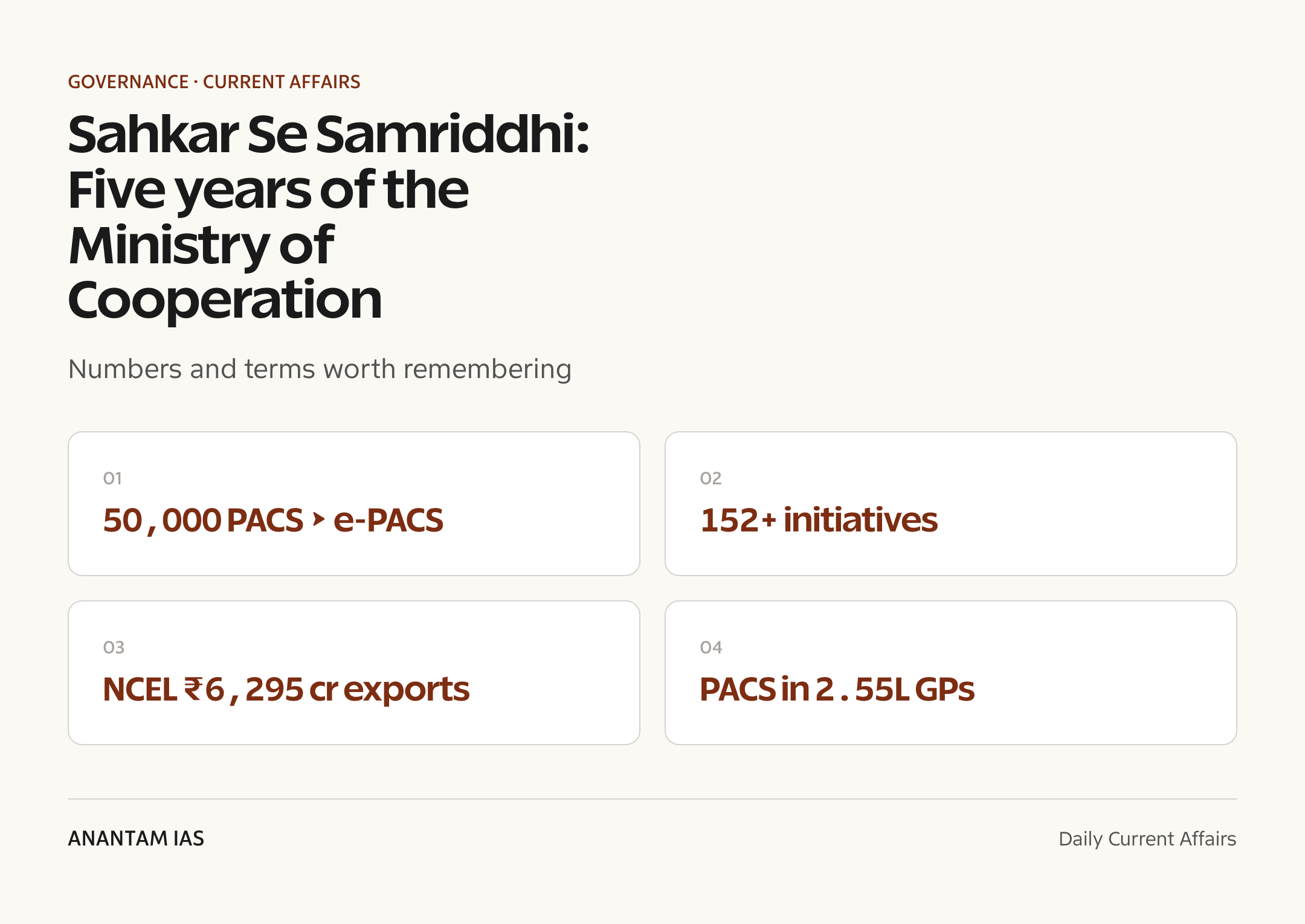
The headline announcement: 50,000 Primary Agricultural Credit Societies (PACS) have been transformed into digital e-PACS, foundation stones were laid for 47 cooperative grain-storage godowns, a Milk Supply Review Dashboard was launched for the National Dairy Development Board, and NUCFDC unveiled Sahakar CBS and Sahakar Sahyogi for urban cooperative banks.

  • 50,000 PACS converted into e-PACS — the flagship milestone of the day, part of the drive to computerise 63,000 PACS by March 31, 2027.
  • Foundation stones laid for 47 grain-storage godowns under the world’s largest decentralised grain-storage plan run through cooperatives.
  • A Milk Supply Review Dashboard Portal launched for the National Dairy Development Board (NDDB) to track milk procurement and distribution.
  • Sahakar CBS — a centralised Core Banking Solution for Urban Cooperative Banks — and Sahakar Sahyogi, a conversational AI platform for customer services, unveiled by NUCFDC.
  • PIB confirmed that over 152 major initiatives have been launched since the ministry’s creation in 2021.

The development matters in the context of:

  • The ministry embodies the ‘Sahkar se Samriddhi’ (prosperity through cooperation) vision — turning cooperatives from narrow credit societies into multi-service engines of the rural economy.
  • India runs one of the largest cooperative ecosystems in the world, spanning credit, dairy, fisheries, housing, sugar and marketing — so institutional reform here touches crores of members directly.
  • The five-year report card is a ready-made case study for Mains answers on cooperative federalism, rural credit and inclusive growth.
Sahkar Se Samriddhi: Five years of the Ministry of Cooperation — quick facts

UPSC Relevance

Prelims Relevance

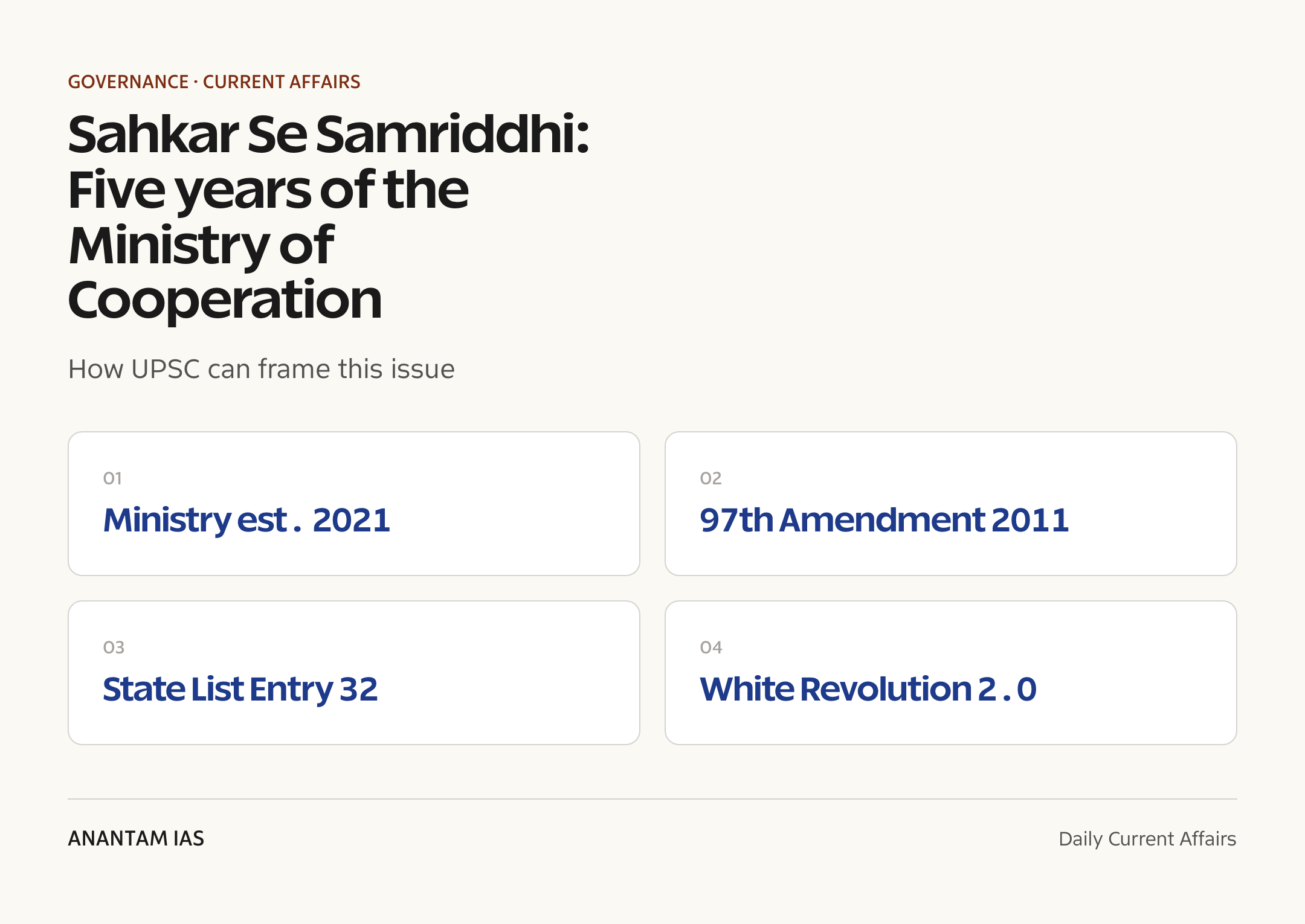
  • Ministry of Cooperation — created on July 6, 2021 by carving the cooperation portfolio out of the Ministry of Agriculture and Farmers Welfare.
  • PACS — Primary Agricultural Credit Societies, the base tier of the short-term cooperative credit structure; model bye-laws now let them run 25+ business activities in 32 states/UTs.
  • e-PACS — PACS running on a common ERP software available in 14 languages; 50,000 transformed so far, target 63,000 by March 2027.
  • NUCFDC — National Urban Cooperative Finance and Development Corporation, the umbrella body for urban cooperative banks; launched Sahakar CBS and Sahakar Sahyogi.
  • Three new national multi-state cooperatives: NCEL (exports), NCOL (organics), BBSSL (seeds, brand ‘Bharat Beej’).
  • Tribhuvan Sahkari University — India’s first national cooperative university.
  • White Revolution 2.0 — targets a 50% rise in milk procurement by 2028-29, with a focus on women-led dairy cooperatives.
  • Constitutional anchors: 97th Constitutional Amendment Act, 2011 — Article 19(1)(c) (right to form cooperatives), Article 43B (DPSP), Part IXB; ‘Cooperative societies’ is Entry 32, State List.
  • NCDC — National Cooperative Development Corporation; sanctioned ₹1.55 lakh crore and disbursed ₹1.27 lakh crore in FY 2025-26.
  • Bharat Taxi — India’s first cooperative-based mobility platform, run by Sahakar Taxi Cooperative Limited.

Mains Relevance

GS Paper 2

  • Governance reform: a dedicated ministry as an instrument of institutional focus — what changed after cooperation moved out of the Agriculture Ministry.
  • Cooperative federalism: cooperation is a State subject (Entry 32, State List); the Centre steers reform through model bye-laws, funding and multi-state legislation rather than direct control.
  • Service delivery through PACS — Common Service Centres, Jan Aushadhi Kendras and PM Kisan Samriddhi Kendras as last-mile governance platforms.

GS Paper 3

  • Rural credit architecture: digitised PACS, NABARD linkages and the health of the short-term cooperative credit structure.
  • Agri-infrastructure: the decentralised grain-storage plan through cooperatives as a fix for post-harvest losses.
  • Inclusive growth: cooperatives, FPOs and White Revolution 2.0 as instruments for doubling farm-gate value realisation.

Essay

  • Collective ownership as a third path between state and market — the cooperative model in India’s growth story.
  • Technology as the great leveller: what digitising a village credit society says about inclusive digital public infrastructure.

Background and Context

The Ministry of Cooperation: why a separate ministry

The ministry was created to give the cooperative sector a dedicated administrative, legal and policy framework of its own.

  • Established on July 6, 2021, by carving the cooperation portfolio out of the Ministry of Agriculture and Farmers Welfare, with the motto ‘Sahkar se Samriddhi’.
  • Its mandate: streamline processes for ease of doing business for cooperatives, deepen cooperatives as true people-based movements, and develop multi-state cooperative societies (MSCS).
  • PIB counts 152+ major initiatives in five years — from model bye-laws and PACS computerisation to three new national-level cooperative bodies and a cooperative university.
  • The constitutional frame: the 97th Amendment (2011) made forming cooperatives a fundamental right under Article 19(1)(c) and added Article 43B (DPSP) and Part IXB; the Supreme Court in Union of India v. Rajendra N. Shah (2021) confined Part IXB to multi-state cooperatives, since ‘cooperative societies’ sits in Entry 32 of the State List.
  • The Multi-State Co-operative Societies (Amendment) Act, 2023 tightened governance, elections and audit norms for MSCS.
Sahkar Se Samriddhi: Five years of the Ministry of Cooperation — exam lens

PACS 2.0: from credit windows to rural growth centres

PACS — the village-level base of the cooperative credit pyramid — are being re-engineered into multi-service hubs.

  • Model bye-laws adopted in 32 states/UTs now allow PACS to take up 25+ business activities — retail, storage, healthcare, fuel and digital services — beyond lending.
  • 54,117 PACS function as Common Service Centres (CSCs), delivering e-governance services in villages.
  • 39,177 PACS operate as PM Kisan Samriddhi Kendras; 4,248 PACS are approved as Jan Aushadhi Kendras (843 ready to function).
  • 394 PACS have applied for retail fuel outlets, with 3 already commissioned.
  • Coverage push: 37,454 new multipurpose PACS, dairy and fisheries societies registered; PACS now present in over 2.55 lakh Gram Panchayats, dairy cooperatives in 87,159 and fisheries cooperatives in 29,964 panchayats.

Digitising the base tier: the e-PACS project

Computerisation is the backbone reform — a common ERP that plugs every PACS into the NABARD-linked credit system.

  • Financial outlay raised to ₹2,925.39 crore (2025) from the initial ₹2,516 crore approved in 2022; the target is 63,000 PACS by March 31, 2027.
  • 79,630 PACS sanctioned for computerisation; 63,428 already run the common ERP software, available in 14 languages.
  • Hardware delivered to over 65,000 PACS; online audits completed in more than 42,700 PACS — a direct transparency gain.
  • The 50,000 e-PACS milestone announced on Foundation Day marks the visible face of this transformation: standardised accounting, real-time monitoring and faster credit delivery.

Storage, dairy and urban cooperative banking

Three sectoral pushes anchor the second phase of reforms — grain storage, White Revolution 2.0 and urban cooperative banks.

  • The world’s largest decentralised grain-storage plan is being executed through PACS: godowns completed in 145 PACS with over 68,702 MT capacity, and foundation stones for 47 more godowns laid on Foundation Day — cutting post-harvest losses and letting farmers time the market.
  • White Revolution 2.0 targets a 50% increase in milk procurement by 2028-29; 25,282 dairy cooperative societies registered so far, with an explicit focus on women-led dairy cooperatives. The new NDDB Milk Supply Review Dashboard gives real-time visibility into procurement and distribution.
  • For urban cooperative banks, NUCFDC launched Sahakar CBS — a shared, centralised Core Banking Solution — and Sahakar Sahyogi, a conversational AI-powered platform for customer service and banking operations, addressing the technology gap that has long weakened this segment.

New national institutions and export muscle

Three multi-state cooperative societies created in 2023 give the sector national-scale aggregation for the first time.

  • National Cooperative Exports Limited (NCEL) — umbrella exporter for cooperative produce; recorded 15.4 LMT of exports worth ₹6,295 crore to 38 countries as of June 2026.
  • National Cooperative Organics Limited (NCOL) — aggregates, certifies and markets organic produce; 14,286 member cooperatives.
  • Bharatiya Beej Sahakari Samiti Limited (BBSSL) — produces and distributes quality seeds under the ‘Bharat Beej’ brand; 38,665 member cooperatives.
  • Tribhuvan Sahkari University — India’s first cooperative university — anchors education, research and skilling, alongside training by the National Council for Cooperative Training (NCCT) and NABARD.
  • Bharat Taxi, run by Sahakar Taxi Cooperative Limited, extends the model to urban mobility — a driver-owned alternative to aggregator platforms.

Finance and tax: easing the money side

Financing and tax parity reforms have improved cooperative liquidity and competitiveness against companies.

  • NCDC sanctioned ₹1.55 lakh crore and disbursed ₹1.27 lakh crore in FY 2025-26 — the sector’s principal development financier.
  • ₹2,320 crore disbursed to FPOs and Cluster-Based Business Organisations under the 10,000 FPOs scheme (as of May 2026); 1,863 FPOs formed in the cooperative sector, 1,117 of them through PACS, plus 1,070 fisheries FPOs supported with ₹98 crore.
  • Tax relief: surcharge cut from 12% to 7% for cooperatives earning ₹1–10 crore; MAT reduced from 18.5% to 15%, matching companies.
  • The TDS-free cash withdrawal limit raised from ₹1 crore to ₹3 crore, with higher cash transaction limits for PACS and primary cooperative agriculture and rural development banks.

Way Forward

Deepen, don't just digitise

  • Move from hardware roll-out to usage quality — regular online audits, credit-history building for members, and interoperability of PACS ERP with banks and government platforms.
  • Extend viable PACS coverage to the remaining uncovered Gram Panchayats, prioritising the Northeast and hill states where cooperative density is thin.

Governance and federal trust

  • Professionalise boards and audits so cooperatives shed the legacy of political capture and dormancy; the model bye-laws work only if states enforce them.
  • Since cooperation is a State subject, sustained Centre-state coordination — not central direction — must drive the next phase; states need capacity support to match the reform pace.
  • Ensure new national bodies like NCEL and NCOL pass gains back to member societies transparently, so aggregation doesn’t become a new layer of middlemen.

Conclusion

Five years in, the Ministry of Cooperation has converted a neglected sector into a visible reform theatre: a digitised PACS base, national aggregators for exports, organics and seeds, a cooperative university, and a decentralised storage network. The 50,000 e-PACS milestone shows the plumbing is being rebuilt, not just repainted.

The test now shifts from creation to performance — whether member incomes rise, urban cooperative banks stabilise on shared technology, and states co-own the reform. If they do, ‘Sahkar se Samriddhi’ becomes more than a motto; it becomes India’s third engine of growth beside the state and the market.

UPSC Practice Questions

Prelims MCQ 1

With reference to India’s cooperative sector, consider the following statements:

  1. The Ministry of Cooperation was created in 2021 by carving the cooperation portfolio out of the Ministry of Agriculture and Farmers Welfare.
  2. Sahakar CBS is a centralised core banking solution developed for Regional Rural Banks.
  3. Tribhuvan Sahkari University is India’s first cooperative university.

How many of the above statements are correct?

(a) Only one (b) Only two (c) All three (d) None

Answer: (b) Only two

Explanation:

Statements 1 and 3 are correct. Sahakar CBS, launched by NUCFDC, is a centralised Core Banking Solution for Urban Cooperative Banks, not Regional Rural Banks — statement 2 is wrong.

Prelims MCQ 2

The brand ‘Bharat Beej’, in the news recently, is associated with which of the following organisations?

(a) National Cooperative Exports Limited (NCEL) (b) National Cooperative Organics Limited (NCOL) (c) Bharatiya Beej Sahakari Samiti Limited (BBSSL) (d) National Dairy Development Board (NDDB)

Answer: (c) Bharatiya Beej Sahakari Samiti Limited (BBSSL)

Explanation:

BBSSL, one of three national multi-state cooperatives set up in 2023, produces and distributes quality seeds under the ‘Bharat Beej’ brand through the cooperative network; it had 38,665 member cooperatives as of June 2026.

UPSC Mains Questions

  1. The creation of the Ministry of Cooperation marked a shift from treating cooperatives as credit channels to treating them as engines of rural enterprise. Examine this shift with reference to the PACS reforms undertaken since 2021.
  2. Cooperation is a State subject, yet the most consequential cooperative reforms of the last five years have come from the Union government. Discuss the tools the Centre has used and the federal tensions this model must manage.
  3. Digitisation of Primary Agricultural Credit Societies can transform rural credit delivery, but technology alone cannot fix governance deficits in cooperatives. Critically analyse.

Source: PIB, Ministry of Cooperation.

Frequently Asked Questions

What is Sahkar Se Samriddhi?

‘Sahkar se Samriddhi’ — prosperity through cooperation — is the guiding vision of the Ministry of Cooperation, created on July 6, 2021. It aims to strengthen cooperatives as people-owned institutions, streamline their regulation, and expand them into new sectors like exports, organics, seeds and urban mobility.

What are e-PACS?

e-PACS are Primary Agricultural Credit Societies running on a common ERP software, available in 14 languages, that standardises accounting, enables online audits and links them to the cooperative credit system. By the ministry’s 5th Foundation Day in July 2026, 50,000 PACS had been transformed into e-PACS, against a target of 63,000 by March 2027.

What are Sahakar CBS and Sahakar Sahyogi?

Both were launched by NUCFDC, the umbrella body for urban cooperative banks. Sahakar CBS is a centralised Core Banking Solution that lets urban cooperative banks share modern banking technology, while Sahakar Sahyogi is a conversational AI-powered platform for customer services and banking operations.

Which new national cooperative bodies were set up?

Three multi-state cooperatives were created: National Cooperative Exports Limited (NCEL) for exports (₹6,295 crore to 38 countries by June 2026), National Cooperative Organics Limited (NCOL) for organic produce, and Bharatiya Beej Sahakari Samiti Limited (BBSSL) for quality seeds under the ‘Bharat Beej’ brand.

Is cooperation a Union or State subject?

Cooperative societies fall under Entry 32 of the State List, so states legislate for ordinary cooperatives. The Union governs multi-state cooperative societies. The 97th Constitutional Amendment (2011) added Part IXB, which the Supreme Court in 2021 confined to multi-state cooperatives only.

What is White Revolution 2.0?

White Revolution 2.0 is the cooperative dairy strategy targeting a 50% increase in milk procurement by 2028-29. It emphasises registering new dairy cooperative societies — 25,282 so far — expanding coverage to uncovered villages, and promoting women-led dairy cooperatives.

Energy Statistics Reform: MoSPI Releases Expert Committee Report

Open article →Download PDF

Why in News?

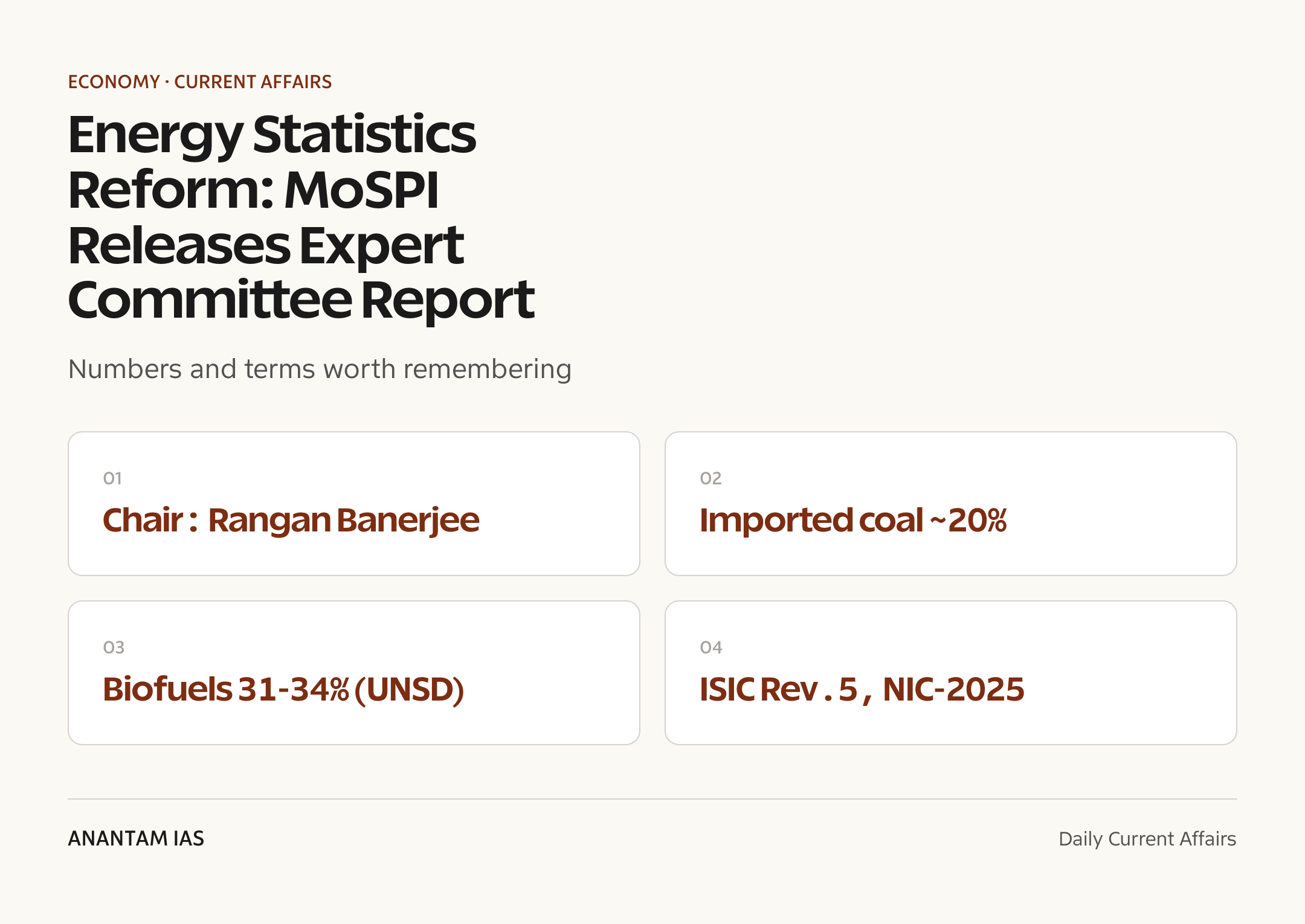
The Ministry of Statistics and Programme Implementation (MoSPI) released the report of the Expert Committee on Energy Statistics on 6 July 2026, PIB confirmed. The committee, chaired by Dr. Rangan Banerjee, Director of IIT Delhi, reviewed India’s entire energy-statistics database and the annual Energy Statistics India publication.

The report recommends aligning India’s energy data with international classification standards, adopting uniform conversion factors across energy ministries, and building new methodologies for the biggest measurement gaps — biofuels, captive power, and electricity consumed by electric vehicles (EVs).

  • The committee was constituted by MoSPI under Dr. Rangan Banerjee (Director, IIT Delhi), with members from line energy ministries and research bodies such as TERI and the Alliance for an Energy Efficient Economy (AEEE).
  • It recommends tabulation aligned with ISIC Rev. 5, NIC-2025 and the Standard International Energy Product Classification (SIEC).
  • A new methodology covers sectoral end-use of imported coal — about 20% of India’s total coal consumption — using the Annual Survey of Industries (ASI) database.
  • The UN Statistics Division (UNSD) currently estimates India’s biofuel use on its own, at roughly 31–34% of total annual energy consumption; the committee proposes India’s own methodology to bring biofuels into the national energy balance.
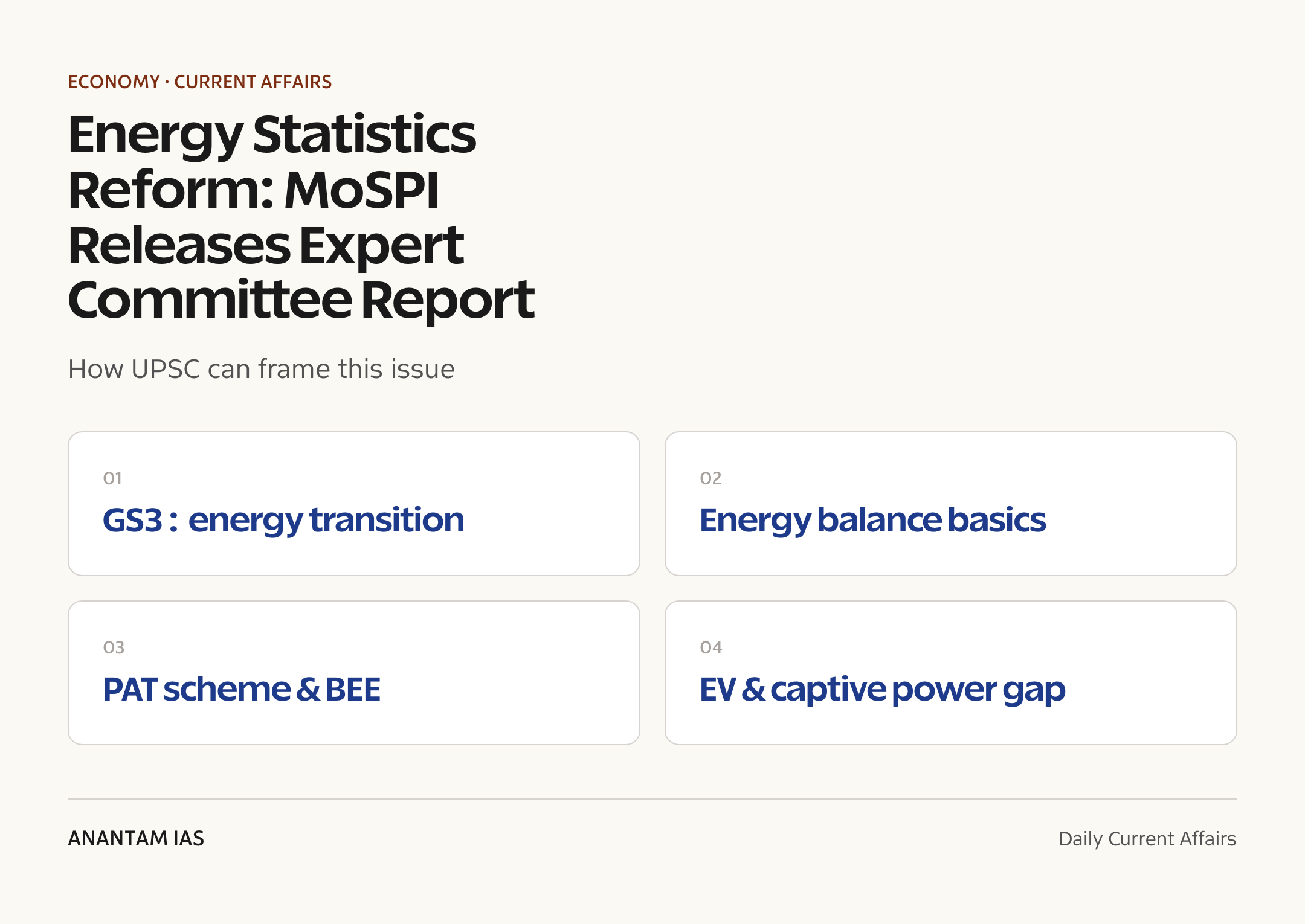
  • The Bureau of Energy Efficiency (BEE) is asked to build a comprehensive database under the Perform, Achieve and Trade (PAT) scheme.
  • Initial frameworks are proposed for measuring captive/off-grid electricity and EV electricity consumption — two of the largest unmeasured segments of India’s energy demand.

The development matters in the context of:

  • Reliable energy accounts are the statistical backbone of India’s energy transition: you can’t track progress towards Net Zero by 2070 or the 500 GW non-fossil capacity goal with inconsistent data.
  • India’s energy data is produced by multiple ministries — coal, petroleum, power, renewables — each with its own definitions and conversion factors, so a harmonised framework directly improves evidence-based policymaking.
  • When national data is missing, international bodies like the UNSD and IEA fill gaps with their own estimates — meaning India’s official energy picture is partly written outside India.
Energy Statistics Reform: MoSPI Releases Expert Committee Report — quick facts

UPSC Relevance

Prelims Relevance

  • Expert Committee on Energy Statistics — constituted by MoSPI, chaired by Dr. Rangan Banerjee, Director, IIT Delhi; report released July 2026.
  • Energy Statistics India — MoSPI’s annual publication presenting the national flow-of-energy, energy balance tables and sustainable-energy indicators.
  • SIEC — Standard International Energy Product Classification; ISIC Rev. 5 and NIC-2025 — industrial classifications recommended for energy-data tabulation.
  • Energy balance — an accounting framework showing energy supply, transformation and final consumption in a common unit for one reference year.
  • Imported coal is about 20% of India’s total coal consumption; its end-use split is to be refined using the ASI database.
  • UNSD World Energy Balances estimates India’s biofuel share at about 31–34% of total annual energy consumption, based on its own estimation.
  • PAT (Perform, Achieve and Trade) — market-based energy-efficiency trading mechanism run by BEE under the National Mission for Enhanced Energy Efficiency.
  • Captive power — electricity generated by an industry primarily for its own use, largely outside grid-level metering statistics.

Mains Relevance

GS Paper 3

  • Statistical infrastructure as public infrastructure: how harmonised energy accounts underpin energy-transition planning, Net Zero tracking and climate finance credibility.
  • Data gaps in biofuels, captive power and EV charging distort estimates of energy demand, emissions intensity and efficiency gains — with direct consequences for policy design.
  • Institutional coordination problem: multiple line ministries producing inconsistent energy data, and MoSPI’s role as the harmonising statistical agency.

GS Paper 2

  • Expert committees as instruments of governance reform — composition, consultative process and the challenge of getting line ministries to implement cross-cutting recommendations.
  • India’s obligations to international statistical systems (UNSD, IEA reporting) and the sovereignty question when foreign bodies estimate national data.

Essay

  • What gets measured gets managed — statistics as the quiet infrastructure of the green transition.
  • India’s climate ambition is only as credible as India’s data.

Background and Context

India's energy statistics ecosystem — and why it's fragmented

India’s energy numbers are stitched together from many producers, each measuring differently.

  • MoSPI compiles the annual Energy Statistics India publication — national flow-of-energy tables, graphs and sustainable-energy indicators aligned to international guidelines (see mospi.gov.in).
  • But the primary data comes from line ministries — Coal, Petroleum and Natural Gas, Power, New and Renewable Energy — plus bodies like the Central Electricity Authority (CEA) and BEE.
  • Each source historically used its own definitions, classifications and conversion factors, producing inconsistencies when the numbers are combined into one national energy balance.
  • The committee’s core diagnosis: India needs one harmonised framework meeting International Standards on Energy Statistics, not several parallel ministry databases.
Energy Statistics Reform: MoSPI Releases Expert Committee Report — exam lens

The committee: mandate and composition

MoSPI set up the panel to audit the whole system, not just one publication.

  • Chaired by Dr. Rangan Banerjee, Director, IIT Delhi — an energy-systems academic rather than a ministry insider.
  • Members included senior representatives of line energy ministries and domain experts from TERI (The Energy and Resources Institute) and AEEE.
  • Mandate: review the Energy Statistics India publication and the full energy-statistics database — coverage, definitions, classification systems, data sources and estimation methodologies.
  • The panel held several rounds of technical consultations with ministries, agencies and subject experts before finalising recommendations, PIB noted.

Recommendation 1: speak the world's statistical language

The first fix is classification — putting Indian energy data into internationally comparable boxes.

  • Adopt tabulation categories aligned with ISIC Rev. 5 (the UN’s international industrial classification), NIC-2025 (its Indian counterpart) and SIEC (the standard classification of energy products).
  • All line energy ministries should use uniform conversion factors — the multipliers that turn tonnes of coal or litres of fuel into common energy units — so inter-ministerial data stops disagreeing.
  • Alignment matters because global datasets (UNSD, IEA energy balances) can only ingest Indian data cleanly if the categories match international norms.
  • This mirrors the wider statistical-reform push under which India updated its industrial classification to NIC-2025.

Recommendation 2: fix the coal and electricity blind spots

Two big consumption puzzles get an ASI-based solution.

  • Imported coal — around 20% of total coal consumption — and domestic coal sold via auction are currently lumped under a ‘miscellaneous’ category, hiding who actually burns it.
  • The committee’s methodology mines the Annual Survey of Industries (ASI) database, which captures industry-wise coal consumption, to build a sectoral end-use split.
  • The same ASI-based approach is recommended for industry-wise end-use consumption of electricity.
  • BEE should develop and maintain a comprehensive database under the PAT scheme — turning an efficiency-trading programme into a rich source of industrial energy data (beeindia.gov.in).

Recommendation 3: bring biofuels into India's own energy balance

India’s biggest energy-data gap is the fuel much of rural India actually uses.

  • There’s no consolidated national data on biofuel consumption — firewood, crop residue, dung cake and modern biofuels used by households and small industry.
  • In the absence of Indian data, the UN Statistical Division (UNSD) plugs its own estimate into the World Energy Balances: roughly 31–34% of India’s total annual energy consumption.
  • That means a third of India’s official energy picture rests on a foreign statistical guess — a striking sovereignty-of-data problem.
  • The committee recommends a comprehensive Indian methodology to incorporate the biofuel component into the national energy balance table.

Recommendation 4: measure the new economy — captive power and EVs

The energy transition is creating consumption that today’s statistics simply don’t see.

  • Captive and off-grid electricity — industrial plants generating for their own use, rooftop and off-grid solar — largely escapes grid-based metering statistics.
  • EV electricity consumption is invisible in current accounts: charging shows up as ordinary household or commercial demand, so the transport sector’s shift from petroleum to electricity can’t be tracked.
  • The committee proposes an initial methodological framework for both, explicitly flagged as needing refinement by users and researchers before full incorporation into the energy-balance database.
  • As EV adoption accelerates under schemes like PM E-DRIVE, this gap grows every year it stays unfixed.

Why harmonised energy data matters for Net Zero

Energy statistics are the measurement layer beneath every climate commitment India has made.

  • India’s Net Zero by 2070 pledge and its 2030 targets — including 500 GW of non-fossil capacity — need credible baselines and trend data to be monitored honestly.
  • Emissions inventories reported under the UNFCCC are built on energy-consumption data; bad energy statistics flow straight into bad carbon accounting.
  • Investors and multilateral lenders price climate finance partly on data credibility — internationally comparable statistics lower the cost of scepticism.
  • MoSPI stressed that implementation will need sustained inter-ministerial coordination — the same coordination failure the fragmented data reflects.

Way Forward

Institutionalise the harmonisation

  • Notify uniform conversion factors and the SIEC/NIC-2025 tabulation standard across all line energy ministries with clear timelines, rather than leaving adoption voluntary.
  • Create a standing inter-ministerial energy-statistics mechanism under MoSPI to own the energy balance and arbitrate definitional disputes.

Close the measurement gaps

  • Pilot the biofuel consumption methodology with household-survey instruments so the UNSD estimate can be replaced by measured Indian data.
  • Mandate anonymised data-sharing from DISCOMs, charging-point operators and captive generators so EV and off-grid electricity can be separated from general demand.
  • Fast-track the BEE-PAT database so industrial efficiency data feeds directly into national energy accounts.

Alongside these, MoSPI should publish the refined methodologies openly and invite academic scrutiny — the committee itself frames the captive-power and EV frameworks as first drafts that researchers must stress-test.

Conclusion

The Rangan Banerjee committee’s report is unglamorous but foundational. India’s energy transition is being steered with a dashboard that can’t see biofuels, misclassifies a fifth of its coal, and can’t tell an EV charging from a geyser running. Fixing the statistics fixes the steering.

For aspirants, the exam thread is clear: this links statistical reform (MoSPI, NIC-2025, international standards) with energy security and climate policy (energy balance, PAT, Net Zero). Track its implementation alongside your monthly current affairs revision — committee reports like this often surface in Prelims two cycles later.

UPSC Practice Questions

Prelims MCQ 1

With reference to the Expert Committee on Energy Statistics, which released its report in July 2026, consider the following statements:

  1. The committee was constituted by the Ministry of Power and chaired by the Chairperson of the Central Electricity Authority.
  2. It recommended aligning India’s energy statistics with international classifications such as ISIC Rev. 5 and the Standard International Energy Product Classification (SIEC).
  3. Imported coal accounts for about one-fifth of India’s total coal consumption.

How many of the above statements are correct?

(a) Only one (b) Only two (c) All three (d) None

Answer: (b) Only two

Explanation:

Statement 1 is incorrect — the committee was constituted by MoSPI and chaired by Dr. Rangan Banerjee, Director, IIT Delhi. Statements 2 and 3 are correct: it recommended ISIC Rev. 5/NIC-2025/SIEC alignment, and imported coal is about 20% of India’s total coal consumption.

Prelims MCQ 2

The Perform, Achieve and Trade (PAT) scheme, recently in news in the context of energy-statistics reform, is implemented by which body?

(a) Central Electricity Regulatory Commission (CERC) (b) Bureau of Energy Efficiency (BEE) (c) Central Electricity Authority (CEA) (d) NITI Aayog

Answer: (b) Bureau of Energy Efficiency (BEE)

Explanation:

PAT is a market-based energy-efficiency mechanism for energy-intensive industries run by the Bureau of Energy Efficiency. The Expert Committee on Energy Statistics recommended that BEE build a comprehensive database under PAT to strengthen industrial energy data.

UPSC Mains Questions

  1. Robust energy statistics are a prerequisite for a credible energy transition. In the light of the Expert Committee on Energy Statistics (2026), examine the major data gaps in India’s energy accounts and their policy consequences. (250 words)
  2. Statistical fragmentation across ministries is a governance problem, not merely a technical one. Discuss with reference to India’s energy-statistics system and suggest institutional mechanisms for harmonisation. (250 words)

Source: PIB, Ministry of Statistics & Programme Implementation.

Frequently Asked Questions

What is the Expert Committee on Energy Statistics?

It’s a committee constituted by the Ministry of Statistics and Programme Implementation (MoSPI) and chaired by Dr. Rangan Banerjee, Director of IIT Delhi. It reviewed India’s energy-statistics database and the annual Energy Statistics India publication, and its report was released on 6 July 2026.

What are the committee’s key recommendations?

Adopt international classifications (ISIC Rev. 5, NIC-2025, SIEC), use uniform conversion factors across energy ministries, refine coal and electricity end-use data using the ASI database, build a BEE database under the PAT scheme, and create methodologies for biofuels, captive power and EV electricity consumption.

Why are biofuels a major data gap for India?

India has no consolidated national data on biofuel consumption, so the UN Statistical Division estimates it independently — at roughly 31–34% of India’s total annual energy consumption. The committee wants an Indian methodology so the national energy balance rests on measured domestic data.

What is an energy balance?

An energy balance is an accounting framework that presents a country’s energy supply, transformation and final consumption in a common energy unit for a reference year. It shows how energy flows from production and imports through conversion (like power plants) to end users.

Why is EV electricity consumption hard to measure?

EV charging is billed as ordinary household or commercial electricity, so it can’t be separated from general demand in current statistics. Without that split, India can’t accurately track the transport sector’s shift from petroleum to electricity or plan grid capacity for it.

How does this reform connect to Net Zero?

India’s Net Zero 2070 pledge and 2030 targets need credible baselines. Emissions inventories are built on energy-consumption data, so harmonised, internationally comparable energy statistics directly improve carbon accounting, transition monitoring and the credibility India presents to climate-finance providers.

Media as ‘Public Function’: Delhi HC ruling on press freedom and privacy

Open article →Download PDF

Why in News?

A two-judge bench of the Delhi High Court ruled on July 1 that private media houses perform a public function and can face a writ petition in a High Court for violating an individual’s right to privacy. The Indian Express reported that the bench of Justice C Hari Shankar and Justice O P Shukla upheld a single-judge order of 2013 directing TV Today Network to pay Rs 5 lakh as compensation for a broadcast that could identify a minor victim of sexual assault.

The judgment extends the horizontal application of fundamental rights — enforcing them against private actors, not just the State — to the press. It builds on the Supreme Court’s Kaushal Kishor (2023) Constitution Bench ruling and directly reframes how Article 19(1)(a) press freedom is balanced against Article 21 privacy.

  • The dispute dates to August 2005: news channel Aaj Tak broadcast a segment on a child sexual-assault complaint despite the mother’s explicit refusal to interact with the crew.
  • The broadcast disclosed the accused father’s name and official designation, the colony’s address board, visuals of the house and the mother’s voice — enough to identify the minor victim.
  • The mother moved a writ petition under Article 226 against the private channel; the core legal question was whether such a petition is even maintainable against a non-State broadcaster.
  • The court held the media’s role in disseminating news and shaping public opinion is so central to society that it is a public function, carrying an inherent public duty not to injure the public’s rights.
  • On this reasoning the court applied the right to privacy horizontally, held the consent-less broadcast an illegal intrusion, and sustained monetary compensation in a writ court.

The development matters in the context of:

  • Fundamental rights have traditionally operated vertically — a citizen versus the State. This ruling is among the first to operationalise Kaushal Kishor specifically against the media, a classic non-State actor.
  • It opens a faster constitutional-court route for privacy claims that earlier went through slow civil suits for defamation or tort — a structural shift in media litigation.
  • It sharpens a live GS2 tension: an unfettered press is a check on the State, yet the same press can injure the dignity and privacy of private individuals, especially vulnerable victims.
Delhi High Court building, where the division bench delivered the media public-function ruling
The Delhi High Court held that private media houses perform a public function amenable to writ jurisdiction. Photo: Brijender Dua (Unsplash)
Media as 'Public Function': Delhi HC ruling on press freedom and privacy — quick facts

UPSC Relevance

Prelims Relevance

  • Article 226: High Courts issue writs for enforcement of fundamental rights AND ‘for any other purpose’ — against the State and against authorities or persons discharging public duties; wider than the Supreme Court’s Article 32.
  • Article 19(1)(a): freedom of speech and expression; freedom of the press is implied within it (Romesh Thappar, 1950), subject to Article 19(2) reasonable restrictions.
  • Right to privacy: declared a fundamental right intrinsic to Article 21 by a unanimous nine-judge bench in Justice K S Puttaswamy v Union of India (2017).
  • Kaushal Kishor v State of UP (2023): a five-judge Constitution Bench held that rights under Articles 19 and 21 are enforceable even against persons other than the State.
  • Textually horizontal rights: Article 15(2) (access to shops, public places), Article 17 (untouchability), Articles 23–24 (exploitation) bind private actors by design.
  • Section 23, POCSO Act 2012: bars media from disclosing a child victim’s identity; Section 72, Bharatiya Nyaya Sanhita (earlier IPC 228A) criminalises disclosing identities of victims of sexual offences.
  • Nipun Saxena v Union of India (2018): Supreme Court guidelines protecting the identity of victims of sexual offences, including in media reporting.
  • Media self-regulation bodies: Press Council of India (print, statutory), NBDSA (TV news, self-regulatory), Programme Code under the Cable Television Networks (Regulation) Act, 1995.

Mains Relevance

GS Paper 2

  • Horizontal versus vertical application of fundamental rights — how Kaushal Kishor and this ruling redraw the citizen–private actor rights map.
  • Balancing press freedom (Article 19(1)(a)) with the right to privacy and dignity (Article 21) of private individuals and victims.
  • Scope of writ jurisdiction under Article 226 — the ‘public function/public duty’ test for non-State bodies.
  • Judicial remedies versus media self-regulation: adequacy of PCI, NBDSA and the Programme Code.

GS Paper 4

  • Media ethics: consent, victim identity, and the public-interest test in journalism — TRP-driven reporting versus the duty of care to vulnerable persons.

Essay

  • Freedom of the press is not an end in itself but a means to responsible public discourse.
  • Rights that check the State must not become weapons against the citizen — the ethics of power without accountability.

Background and Context

The case: from a 2005 broadcast to writ compensation

A two-decade-old privacy injury has produced a precedent-setting constitutional remedy.

  • In August 2005, a woman filed a police complaint accusing her husband of sexually assaulting their minor daughter; a TV crew from Aaj Tak visited despite her explicit refusal to interact.
  • The channel aired identifying details — the father’s name and designation, the colony address board, house visuals and the mother’s voice — effectively exposing the child victim’s identity.
  • The mother filed a writ petition before the Delhi High Court; in 2013 a single judge directed TV Today Network to pay Rs 5 lakh in compensation.
  • On July 1, the division bench of Justice C Hari Shankar and Justice O P Shukla upheld that order, authoring detailed principles on the media’s constitutional accountability.
  • The maintainability question was decisive: can a writ — a public-law remedy — run against a purely private broadcaster at all?
Media as 'Public Function': Delhi HC ruling on press freedom and privacy — exam lens

Article 226 and the 'public function' test

The judgment turns on the breadth of High Court writ jurisdiction, which has always been wider than Article 32.

  • Article 226 empowers High Courts to issue writs for enforcing fundamental rights and ‘for any other purpose’ — to the State AND to any person or authority performing a public duty.
  • In Andi Mukta Sadguru (1989), the Supreme Court held that mandamus can issue to a private body if it discharges a public duty; the form of the entity matters less than the function.
  • In Zee Telefilms v Union of India (2005), the BCCI was held not to be ‘State’ under Article 12, yet its public functions remained amenable to Article 226 review.
  • The Delhi HC reasoned it would be ‘unrealistic’ to hold that the media performs no public function: news dissemination and shaping public opinion are central to a democratic society.
  • That public function, the court held, carries an inherent public duty to ensure the rights of the public are not ‘prejudiced or injured’ by how the function is performed.

Vertical vs horizontal application of fundamental rights

The ruling sits in a longer doctrinal shift from rights-against-the-State to rights-against-power.

  • Classically, fundamental rights apply vertically: the citizen invokes them against the State as defined in Article 12.
  • Some rights are textually horizontal: Article 15(2), Article 17 (abolition of untouchability) and Articles 23–24 (prohibition of exploitation) bind private persons directly.
  • In Kaushal Kishor v State of UP (January 2023), a five-judge Constitution Bench held that rights under Articles 19 and 21 can be enforced even against non-State actors.
  • Kaushal Kishor arose from a minister’s speech; the Delhi HC has now carried its logic into a new field — the privately owned press — and paired it with the writ route.
  • Senior Advocate Madhavi Goradia Divan told The Indian Express the legal groundwork existed, but this is the first time the principles are ‘actively put together’ in the context of the media.

Privacy, press freedom and victim-identity law

The clash here is between two constitutional values the Supreme Court has repeatedly ranked contextually, not absolutely.

  • Puttaswamy (2017): a unanimous nine-judge bench held privacy is a fundamental right intrinsic to Article 21 — covering informational privacy, dignity and decisional autonomy.
  • Freedom of the press flows from Article 19(1)(a) (Romesh Thappar, 1950; Bennett Coleman, 1973) and can be restricted only on Article 19(2) grounds, which include decency and defamation.
  • For child victims the statute is categorical: Section 23 of the POCSO Act, 2012 bars any report that discloses a child’s identity, and Section 72 BNS (earlier IPC 228A) criminalises naming victims of sexual offences.
  • In Nipun Saxena (2018) the Supreme Court issued detailed directions shielding victim identity even in indirect forms — addresses, family details, photographs.
  • The Delhi HC’s strict insistence on consent was anchored in these heightened protections for a minor sexual-assault victim, not in a general licence to censor reporting.

Why experts are worried: the chilling-effect argument

The concern is not this case’s outcome but what the maintainability doctrine could enable.

  • Law professor Shameek Sen (WBNUJS) called the ruling a ‘logical corollary’ of Kaushal Kishor but warned against equating the media with the State: the press is designed to keep the State in check.
  • He argued journalistic wrongs belong in private law — defamation suits and tort claims — and that writ jurisdiction ‘constitutionalises’ what should be a civil dispute.
  • Kaushik Moitra (Bharucha & Partners) warned that declaring all press activity a public function ‘hands future litigants an easier maintainability argument’, inviting more privacy-linked writs, pre-publication writs, and defamation claims repackaged as privacy claims.
  • The feared result is a chilling effect: docile, defensive journalism and over-cautious editorial gatekeeping under the shadow of constitutional litigation.
  • Divan noted the shift to writ courts is partly a symptom of civil-justice delay: damages after a full civil trial can take years, making the faster writ route attractive to genuine victims too.

What remains protected: the public-interest filter

Experts converge on one safeguard — context and public interest will decide future cases.

  • Genuine investigative journalism on matters of public concern remains protected: a public figure who abuses office cannot, in Divan’s words, hide behind privacy and call ill-gotten gains ‘private wealth’.
  • Courts are expected to apply a strict public-interest analysis so privacy does not become ‘a tool for prior restraint‘ against adverse reporting.
  • The ruling’s own facts — a non-consenting family, a minor victim, zero public interest in identification — mark the outer boundary of legitimate reporting, not its core.
  • Existing accountability layers stay relevant: Press Council of India censure for print, NBDSA orders for TV news, and the Programme Code under the Cable TV Networks Act, 1995.

Way Forward

Doctrinal clarity from the Supreme Court

  • An authoritative ruling should define WHEN media activity is a public function — distinguishing news gathering in public interest from commercial or sensational broadcasting.
  • Courts should codify a public-interest and proportionality test for privacy writs against the press, with strong presumptions against pre-publication restraint.
  • Maintainability screens can filter SLAPP-style petitions by powerful litigants seeking to suppress critical coverage.

Fix the remedies ecosystem

  • Speed up civil defamation and tort adjudication — dedicated benches and timelines — so constitutional courts stop being the default forum for private-law injuries.
  • Strengthen statutory self-regulation: give NBDSA-type bodies enforceable compensation powers and make newsroom consent-and-victim-identity protocols auditable.
  • Newsrooms should institutionalise POCSO/Nipun Saxena compliance — blur-and-anonymise defaults, consent logs, and pre-broadcast legal review for victim-related stories.

Conclusion

The Delhi High Court’s ruling is best read as a rights-protective response to an egregious fact pattern: a channel identifying a minor sexual-assault victim against her family’s explicit refusal. By routing the remedy through Article 226 and the public function doctrine, the court gave a genuine victim a faster, constitutional remedy that the civil system could not deliver in time.

But doctrine outlives its facts. If every newsroom decision is potentially a ‘public function’ reviewable in writ jurisdiction, the same tool can be turned against the press by those it investigates. The task ahead — for the Supreme Court and for High Courts applying this precedent — is to keep the public-interest filter strict, so that privacy protects the vulnerable without becoming an instrument of prior restraint on free speech.

UPSC Practice Questions

Prelims MCQ 1

With reference to the application of fundamental rights in India, consider the following statements:

  1. Fundamental rights are traditionally enforced vertically, i.e., by citizens against the State as defined in Article 12.
  2. In Kaushal Kishor v State of UP (2023), the Supreme Court held that rights under Articles 19 and 21 can be enforced even against persons other than the State.
  3. A writ under Article 226 can be issued only against the State and its instrumentalities.

How many of the above statements are correct?

(a) Only one (b) Only two (c) All three (d) None

Answer: (b) Only two

Explanation:

Statements 1 and 2 are correct. Statement 3 is wrong: Article 226 is wider — High Courts can issue writs to ‘any person or authority’ performing a public duty, and for ‘any other purpose’ beyond fundamental rights (Andi Mukta Sadguru, 1989).

Prelims MCQ 2

The right to privacy was declared a fundamental right intrinsic to Article 21 of the Constitution in which of the following cases?

(a) Kaushal Kishor v State of Uttar Pradesh (2023) (b) Justice K S Puttaswamy v Union of India (2017) (c) Maneka Gandhi v Union of India (1978) (d) Nipun Saxena v Union of India (2018)

Answer: (b) Justice K S Puttaswamy v Union of India (2017)

Explanation:

A unanimous nine-judge Constitution Bench in Puttaswamy (2017) held privacy is a fundamental right under Article 21. Kaushal Kishor (2023) dealt with horizontal application of Articles 19 and 21; Nipun Saxena (2018) laid down victim-identity protection guidelines.

UPSC Mains Questions

  1. The Delhi High Court has held that private media houses perform a ‘public function’ and are amenable to writ jurisdiction for privacy violations. Examine the implications of this ruling for the balance between press freedom under Article 19(1)(a) and the right to privacy under Article 21.
  2. The horizontal application of fundamental rights extends constitutional protection against private power, but risks chilling the very freedoms it draws upon. Discuss with reference to the Kaushal Kishor judgment and recent judicial trends concerning the media.
  3. Media self-regulation in India has failed to protect the privacy and dignity of victims of crime, forcing constitutional courts to step in. Critically evaluate, suggesting reforms to the media-accountability ecosystem.

Sources: Indian Express Explained and Delhi High Court.

Frequently Asked Questions

What did the Delhi High Court rule about the media?

A division bench held on July 1 that private media houses perform a public function and can face writ petitions under Article 226 for violating the right to privacy. It upheld Rs 5 lakh compensation against TV Today Network for a 2005 broadcast identifying a minor sexual-assault victim.

What is horizontal application of fundamental rights?

It means enforcing fundamental rights against private (non-State) actors, not just the government. The Supreme Court’s five-judge bench in Kaushal Kishor (2023) held that rights under Articles 19 and 21 are enforceable against persons other than the State.

Why is Article 226 wider than Article 32?

Article 32 lets the Supreme Court enforce only fundamental rights. Article 226 lets High Courts issue writs both for fundamental rights and ‘for any other purpose’, and against any person or authority performing a public duty — not just the State.

Which laws protect the identity of sexual-offence victims?

Section 23 of the POCSO Act, 2012 bars media disclosure of a child victim’s identity; Section 72 of the Bharatiya Nyaya Sanhita (earlier IPC 228A) criminalises naming victims of sexual offences; Nipun Saxena (2018) added Supreme Court guidelines covering indirect identification.

Why do critics fear a chilling effect from this ruling?

Because calling all press activity a public function makes writ petitions against newsrooms easier to file. Politicians and corporations could repackage defamation grievances as privacy claims, seek pre-publication orders, and push journalists toward defensive, over-cautious reporting.

Does the ruling end investigative journalism into public figures?

No. Experts note courts will apply a public-interest test: a public figure misusing office cannot hide behind privacy to block scrutiny. The ruling’s strict consent standard was rooted in protecting a minor victim, where no public interest justified identification.

Natural Gas Curbs Lifted: What freer allocation means for India’s energy market

Open article →Download PDF

Why in News?

On 4 July 2026, the Union government lifted the emergency curbs it had imposed on the supply of natural gas in March 2026 during the West Asia crisis. The Hindu reported that the Ministry of Petroleum and Natural Gas issued a notification amending the Natural Gas (Supply Regulation) Order, 2026, omitting the provisions that had forced all domestically produced natural gas and imported Liquefied Natural Gas (LNG) to be sold strictly as per a government priority list.

The ministry cited the ceasefire and negotiations in West Asia and the resumption of sea traffic through the Strait of Hormuz as the reasons for restoring normal supplies to fertiliser plants, refineries, city gas distributors and industrial users.

  • The curbs dated to the US–Israel war on Iran: LNG shipments through the Strait of Hormuz were disrupted, and supplies from Qatar — India’s main long-term LNG supplier — dwindled to a trickle after its gas fields were attacked.
  • Under the March priority sequence announced in Parliament by Petroleum Minister Hardeep Singh Puri: domestic piped gas (PNG) to homes and CNG for vehicles got 100% supply, industrial consumers up to 80% of their six-month average, and fertiliser plants up to 70%.
  • This is the second easing step: on 25 June 2026 the government had already restored industrial and commercial LPG supplies to pre-crisis levels by removing all sectoral restrictions on non-domestic packed LPG.
  • The rollback chiefly benefits fertiliser plants, refineries, city gas distribution (CGD) entities and gas-intensive industries such as the Morbi ceramic cluster in Gujarat.
  • During the crisis India replaced lost Qatari cargoes with LNG from the US (26%), Oman (24%), Nigeria (22%) and Angola (16%), according to a Businessline report cited by The Hindu.

The development matters in the context of:

  • India imports about half of its natural gas and around 60% of its LPG — any Hormuz disruption directly hits fertiliser output, cooking gas and city transport fuel.
  • The episode is a live case study for the gas-based economy goal: raising natural gas from about 6.3% of the energy mix to 15% by 2030, a target the government has reiterated through PIB.
  • It also tests the normal peacetime allocation architecture — APM gas, priority to CNG/domestic PNG, and market pricing — that the emergency order had temporarily overridden.
A liquefied natural gas carrier ship with spherical storage tanks at sea
LNG carriers move super-cooled methane from exporters like Qatar and the US to Indian regasification terminals. Photo: Pline, CC BY-SA 3.0 (Wikimedia Commons)
Natural Gas Curbs Lifted: What freer allocation means for India's energy market — quick facts

UPSC Relevance

Prelims Relevance

  • Natural Gas (Supply Regulation) Order, 2026 — emergency supply-prioritisation order of March 2026; operative provisions omitted by notification in July 2026.
  • LNG is mostly methane cooled to about −160°C into liquid form, shipped in cryogenic tankers and re-gasified in vaporisers at port terminals.
  • LPG is a mix of propane and butane stored as liquid under pressure; India imports about 60% of its LPG.
  • Sectoral gas use (ICRA estimates): fertilisers just under 30%, city gas distribution 21%, power plants 13%.
  • Urea (about 46% nitrogen) is made by converting natural gas (methane) into ammonia, then combining it with carbon dioxide — the reason fertiliser plants dominate LNG demand.
  • Strait of Hormuz — chokepoint between the Persian Gulf and Gulf of Oman; the transit route for Qatari LNG to India.
  • Gas-based economy target: 15% share of natural gas in the primary energy mix by 2030, from about 6.3% now.
  • APM (Administered Price Mechanism) gas — domestically produced gas from legacy ONGC/OIL fields, priced since April 2023 at 10% of the Indian crude basket price with a floor and ceiling, on the Kirit Parikh Committee’s recommendation.
  • PNGRB (Petroleum and Natural Gas Regulatory Board, 2006) regulates downstream gas; the Indian Gas Exchange (IGX), launched 2020, is India’s gas trading platform.
  • India’s crude import basket has widened from 27 to 41 countries, and LNG import terminal capacity has roughly doubled over a decade.

Mains Relevance

GS Paper 3

  • Energy security as economic security: how import dependence (about 50% for gas, 60% for LPG, nearly 88% for crude) transmits geopolitical shocks into fertiliser, transport and industrial costs.
  • Emergency allocation vs market allocation: when should the state override price signals with priority lists, and what are the costs of prolonged rationing for industry?
  • Progress and hurdles of the gas-based economy: CGD expansion, national gas grid, LNG terminals, pricing reform (Kirit Parikh formula) against the 15%-by-2030 target.
  • Vulnerability of the fertiliser–food security chain to imported LNG, and de-risking options (nano urea, ammonia imports, renewables-based green ammonia).

GS Paper 2

  • West Asia instability and Indian interests: the Strait of Hormuz chokepoint, diaspora, and energy diplomacy with Qatar, the US, Oman and African suppliers.
  • Institutional response to crises: use of statutory supply-regulation orders, parliamentary accountability, and the calibrated exit from emergency controls.

Essay

  • Energy is the new currency of geopolitics: resilience is built in decades, tested in days.
  • Markets allocate efficiently; states allocate in emergencies — the art lies in knowing when to switch.

Background and Context

What the curbs were: the March 2026 priority order

The emergency regime replaced normal contracts with a state-drawn queue for every molecule of gas.

  • In March 2026, as the West Asia crisis peaked, the government invoked emergency powers through the Natural Gas (Supply Regulation) Order, 2026, requiring all domestic gas and imported LNG to be sold according to a government priority list.
  • Minister Hardeep Singh Puri told Parliament on 12 March the sequence: households (domestic PNG) and CNG for vehicles — 100% supply, no cuts; industrial and manufacturing consumers — up to 80% of their previous six-month average; fertiliser plants — up to 70%, protecting the agricultural input chain ahead of the sowing season.
  • Refineries and petrochemical units absorbed a managed reduction, with the freed gas redirected to higher-priority sectors.
  • The design logic: shield household cooking, urban transport and food security first, and let sectors with fuel-switching options carry the burden.
Natural Gas Curbs Lifted: What freer allocation means for India's energy market — exam lens

Why they were imposed: Hormuz, Qatar and the supply shock

One chokepoint closure rearranged India’s entire gas import map.

  • The US–Israel war on Iran halted commercial shipping through the Strait of Hormuz, the exit route for Persian Gulf LNG; India’s dominant supplier Qatar saw its gas fields attacked, and its long-term cargoes to India dried up.
  • India imports about half of its LNG; with Qatar cut off, the supply mix flipped to the US (26%), Oman (24%), Nigeria (22%) and Angola (16%).
  • LPG was hit in parallel — India imports around 60% of it, mostly from the Gulf — forcing emergency procurement from the US Gulf coast.
  • The pre-built buffers mattered: a crude basket widened from 27 to 41 countries, doubled import terminals, and pipelines and reserves created over a decade kept supplies moving, a point Mr Puri underlined in a recent blog post.
  • For the geography of this chokepoint, see the explainer on Strait of Hormuz geopolitics.

Know the fuels: LNG vs LPG, and who consumes India's gas

The two look-alike acronyms behave very differently in trade and use.

  • LNG is natural gas — mostly methane — cooled to about −160°C so it can travel in specialised cryogenic tankers; it is re-gasified in vaporisers (heat exchangers) at port terminals and piped onward.
  • LPG is propane plus butane, stored as liquid under modest pressure — the familiar cooking cylinder fuel.
  • Sectoral shares of gas use (ICRA’s Prashant Vasisht, quoted by The Hindu): fertilisers just under 30%, city gas distribution 21%, power 13%.
  • The fertiliser sector has accounted for almost all of India’s LNG demand growth since FY2016, per the Institute for Energy Economics and Financial Analysis (IEEFA).
  • Urea, with about 46% nitrogen, is produced by converting methane into ammonia and combining it with carbon dioxide — an energy-intensive route that makes LNG a core input for food security. Alternatives like nano urea and nano DAP aim to cut this bulk-urea dependence.
  • The ceramic cluster at Morbi, Gujarat, showed the industrial stakes: reports indicated about 600 factories and 4 lakh workers were hit by the wartime shortage of propane and natural gas.

How gas is normally allocated and priced

The emergency order sat on top of an allocation-and-pricing architecture that now resumes full effect.

  • APM gas — output from legacy fields of ONGC and Oil India — is allocated with first priority to CNG (transport) and domestic PNG segments of city gas distribution.
  • On the Kirit Parikh Committee’s recommendation, APM gas has been priced since April 2023 at 10% of the Indian crude basket price, within a floor-and-ceiling band, replacing the old formula linked to foreign gas hubs.
  • Gas from difficult fields (deepwater, high-pressure high-temperature) earns a higher ceiling price to incentivise domestic exploration.
  • The Petroleum and Natural Gas Regulatory Board (PNGRB) regulates pipelines, CGD authorisation rounds and access; the Indian Gas Exchange (IGX) provides market-based spot and forward trading.
  • Lifting the supply order restores contract-based and market-based allocation — buyers and sellers, not a ministry priority list, again decide who gets gas beyond the protected CGD segments.

The gas-based economy push: the 15% target

The crisis interrupted, but did not change, India’s structural bet on gas as a transition fuel.

  • The government targets raising natural gas from about 6.3% of the primary energy mix to 15% by 2030 (PIB).
  • Instruments: expanding the National Gas Grid to roughly 33,500 km, successive CGD bidding rounds covering most districts, and new LNG import terminals.
  • CGD entities authorised up to the 11A round are committed to about 12.33 crore PNG connections and 17,700 CNG stations by 2030.
  • Gas is pitched as the bridge fuel — halving CO2 versus coal in power and displacing dirtier industrial fuels — while renewables and storage scale up.
  • The Hormuz episode exposes the target’s soft underbelly: a 15% gas share built on imported LNG imports geopolitical risk along with the molecules — the systems-over-austerity argument made in this site’s essay on energy security.

What the lifting means now

Restored flows change costs, output and price signals across four sectors at once.

  • Fertilisers: plants move back from 70% rationing to full feedstock, stabilising urea output and easing the subsidy arithmetic before the kharif peak.
  • City gas: CGD entities regain assured volumes for expansion, supporting CNG and PNG growth beyond the protected core.
  • Industry: Morbi-type gas-intensive clusters (ceramics, glass, steel re-rolling) get predictable supply at market terms instead of quota allocations.
  • Refineries and petrochemicals: the managed reduction ends, normalising product output.
  • The larger signal: emergency economic controls were time-bound and reversible — imposed with a stated priority logic, reported to Parliament, and withdrawn once the trigger (Hormuz closure) passed.

Way Forward

Build resilience before the next chokepoint crisis

  • Create strategic gas storage — depleted fields, salt caverns and expanded LNG tankage — mirroring the crude oil strategic reserves.
  • Deepen supplier diversification with term contracts beyond Qatar (US, Oman, African producers) and destination-flexible clauses.
  • Accelerate domestic exploration under HELP/OALP and difficult-field pricing incentives to lift the domestic share of consumption.
  • De-risk fertilisers via green ammonia, nano-fertilisers and efficiency in urea use, so food security is less hostage to shipping lanes.
  • Complete the National Gas Grid and CGD build-out so restored supply reaches consumers, and let IGX-based market pricing deepen now that controls are gone.

Conclusion

The lifting of the gas curbs closes a four-month experiment in wartime energy rationing. The priority architecture — households and transport first, fertilisers protected, industry curtailed — worked as designed, and the decade-long investment in diversified suppliers, doubled terminals and pipelines gave the government room to manage the shock without blackouts or a cooking-gas crisis.

But the episode is a warning wrapped in a success story. A country that imports half its gas and 60% of its LPG cannot treat the Strait of Hormuz as a given. If natural gas is to reach 15% of the energy mix by 2030, storage, domestic production and supplier diversity must grow as fast as demand — or the next emergency order will be back sooner than expected.

UPSC Practice Questions

Prelims MCQ 1

With reference to the natural gas supply curbs lifted by the Government of India in July 2026, consider the following statements:

  1. The curbs had been imposed through the Natural Gas (Supply Regulation) Order, 2026 during the West Asia crisis.
  2. Under the emergency priority sequence, fertiliser plants received 100% of their supplies while household piped gas faced cuts.
  3. The government cited the resumption of sea traffic through the Strait of Hormuz while withdrawing the curbs.

How many of the above statements are correct?

(a) Only one (b) Only two (c) All three (d) None

Answer: (b) Only two

Explanation:

Statements 1 and 3 are correct. Statement 2 inverts the priority: domestic PNG to homes and CNG for vehicles got 100% supply with no cuts, while fertiliser plants received up to 70% of their previous six-month average.

Prelims MCQ 2

Which one of the following correctly distinguishes Liquefied Natural Gas (LNG) from Liquefied Petroleum Gas (LPG)?

(a) LNG is mainly propane and butane, while LPG is mainly methane (b) LNG is mainly methane cooled to about −160°C, while LPG is propane and butane stored as liquid under pressure (c) Both are mainly methane, but LPG is transported only by pipeline (d) LNG is used only for cooking, while LPG is used only in power plants

Answer: (b) LNG is mainly methane cooled to about −160°C, while LPG is propane and butane stored as liquid under pressure

Explanation:

LNG is natural gas (mostly methane) liquefied at cryogenic temperature (about −160°C) for shipping and re-gasified at port terminals. LPG is a propane-butane mix liquefiable under modest pressure, used chiefly as cylinder cooking gas; India imports around 60% of its LPG.

UPSC Mains Questions

  1. India’s emergency natural gas allocation during the 2026 West Asia crisis prioritised households and fertilisers over industry. Examine the rationale of such administrative allocation, its economic costs, and the conditions under which a return to market-based allocation is justified.
  2. “A gas-based economy built on imported LNG imports geopolitical risk along with the fuel.” In the light of the Strait of Hormuz disruption, critically evaluate India’s 15%-by-2030 natural gas target and suggest measures to strengthen gas security.
  3. Energy resilience is created in peacetime, not during a crisis. Discuss with reference to India’s diversification of crude and LNG sources, import infrastructure, and strategic reserves.

Sources: Ministry of Petroleum and Natural Gas and The Hindu Explained.

Frequently Asked Questions

Why were the natural gas curbs imposed?

The March 2026 West Asia crisis shut sea traffic through the Strait of Hormuz and crippled LNG supplies from Qatar, India’s main supplier. The government invoked the Natural Gas (Supply Regulation) Order, 2026 to ration available gas by priority — households and CNG first, then industry and fertilisers.

What changed on 4 July 2026?

The Petroleum Ministry amended the Natural Gas (Supply Regulation) Order, 2026 and omitted the priority-list provisions. Domestic gas and imported LNG can again be sold on normal contractual and market terms, citing the ceasefire and the reopening of the Strait of Hormuz.

Who benefits from the lifting of curbs?

Fertiliser plants (which use just under 30% of India’s gas), refineries and petrochemical units, city gas distributors supplying CNG and PNG, and gas-intensive industries such as the Morbi ceramic cluster in Gujarat, where about 600 factories were hit during the shortage.

Why do fertiliser plants need so much LNG?

Urea, the most common nitrogen fertiliser with about 46% nitrogen, is made by converting methane into ammonia and combining it with carbon dioxide. The process is energy-intensive, and IEEFA notes the fertiliser sector drove almost all of India’s LNG demand growth since FY2016.

What is the gas-based economy target?

The government aims to raise natural gas from about 6.3% of India’s primary energy mix to 15% by 2030, through the National Gas Grid, city gas distribution rounds, and new LNG terminals. Heavy import dependence remains the target’s biggest vulnerability.

How did India replace Qatari LNG during the crisis?

With Qatar’s cargoes disrupted, India sourced LNG mainly from the US (26%), Oman (24%), Nigeria (22%) and Angola (16%), and bought LPG from the US Gulf coast. A crude basket widened to 41 countries and doubled import terminals helped absorb the shock.

AI in Warfare: How autonomous systems are reshaping conflict and India’s response

Open article →Download PDF

Why in News?

Writing in The Indian Express, a retired Lieutenant General who commanded the Army Training Command (ARTRAC) has argued that the trinity of artificial intelligence (AI), military autonomy and algorithmic warfare is redefining warfighting and deterrence — and that India’s strategic-military establishment faces a ‘Manhattan Project’ moment: the deployment of military software at unprecedented speed and scale.

The piece draws on the Russia-Ukraine war, where AI-enabled data fusion and cheap drones have compressed the time from detection to strike into minutes, and prescribes a sovereign roadmap for India — from a Delta-style battlefield data platform to a five-million-drone inventory by 2028.

  • Ukraine’s AI-enabled data analytics platform Delta fuses inputs from radar imagery to social media into one stream and plugs into drone fleets to form a digital ‘kill web’ that compresses detection-to-neutralisation to a couple of minutes.
  • A roughly 35-km corridor along the Russia-Ukraine frontier is nicknamed the ‘death zone’ — artillery is outranged, tanks can’t move, and infantry spotted by surveillance drones is neutralised by FPV (first-person view) drones within minutes.
  • Ukraine is buying eight million drones this year — more units than the artillery shells it fired last year — giving commanders options from close air support (~25 km) to strategic strikes (~2,500 km).
  • The article notes combat-theatre software innovation cycles of three weeks against hardware cycles of three months, and the rise of autonomous platforms such as the YFQ-44A Fury AI-powered fighter developed by the US defence-tech startup Anduril.
  • Key prescriptions for India: a sovereign Delta-like platform, drone-swarm coordination software, 5 million drones by 2028, counter-drone ‘kill webs’ on the LoC and LAC, and at least 40% of the ~₹2 lakh crore modernisation budget for technological solutions from 2027.

The development matters in the context of:

  • For India this is not academic: Operation Sindoor (May 2025) saw large-scale drone and loitering-munition exchanges with Pakistan, with the indigenous Akashteer automated air-defence control system credited for intercepts — a live preview of algorithmic warfare on India’s borders.
  • India faces a two-front challenge: attaining ‘combat overmatch’ against Pakistan and ‘asymmetric deterrence’ against a China whose digital-military innovation is accelerating.
  • Military AI sits at the heart of a favourite GS3 mains theme — indigenisation of defence technology, emerging tech and internal security — and links to the global debate on lethal autonomous weapon systems (LAWS).
AI in Warfare: How autonomous systems are reshaping conflict and India's response — quick facts

UPSC Relevance

Prelims Relevance

  • Delta — Ukraine’s AI-enabled battlefield data-fusion and situational-awareness platform; feeds a drone-based ‘kill web’.
  • Kill web vs kill chain — a kill chain is a linear sensor-to-shooter sequence; a kill web is a resilient, many-to-many network of sensors, deciders and shooters.
  • FPV drones — cheap first-person-view attack drones; with loitering munitions, the signature weapons of the Russia-Ukraine war.
  • Defence AI Council (DAIC) — apex body created in 2019, chaired by the Raksha Mantri; gives strategic direction for AI adoption in defence.
  • Defence AI Project Agency (DAIPA) — execution arm under the chairmanship of Secretary (Defence Production); both bodies flow from the 2018 N. Chandrasekaran task force on strategic implementation of AI for national security.
  • iDEX (Innovations for Defence Excellence) — MoD’s startup-innovation platform; its ADITI sub-scheme (₹750 crore, 2023-24 to 2025-26) funds deep-tech projects — AI, autonomous weapons, quantum — with grants up to ₹25 crore.
  • Akashteer — indigenous automated air-defence control-and-reporting system that anchored India’s counter-drone grid during Operation Sindoor.
  • CCW GGE on LAWS — the Group of Governmental Experts on lethal autonomous weapon systems under the UN Convention on Certain Conventional Weapons; India chaired its first session in 2017-18.
  • Collaborative Combat Aircraft (CCA) — AI-piloted ‘loyal wingman’ drones (e.g., Anduril’s YFQ-44A Fury) designed to fly alongside crewed fighters.
  • Offensive ISR — using dense low-Earth-orbit (LEO) satellite constellations to move from passive surveillance to targeting-grade intelligence.

Mains Relevance

GS Paper 3

  • Effect of AI, autonomy and drones on the character of war; lessons from Russia-Ukraine and Operation Sindoor for Indian force design.
  • Indigenisation of defence technology: DAIC-DAIPA architecture, iDEX-ADITI, DRDO AI groups, and the shift from platform-centric to software-centric procurement.
  • Internal and border security: counter-drone grids on the LoC/LAC, directed-energy weapons, and protecting critical infrastructure from cheap aerial threats.

GS Paper 2

  • Global governance of lethal autonomous weapons — the CCW GGE process, ‘meaningful human control’, and India’s balancing position.
  • Institutional reform: converting the Ministry of Defence from a ‘platform and weapons factory’ into a software enterprise; civil-military-startup interface.

Essay

  • Algorithms at war: when code, not courage, decides the battlefield.
  • Technology changes the character of war, never its nature — examine in the age of AI.
  • National security in the 21st century is built in laboratories, not just on borders.

Background and Context

The new trinity: AI, autonomy and algorithmic warfare

Three overlapping technologies are compressing the decision cycle of combat from hours to minutes.

  • Artificial intelligence ingests and fuses battlefield data — radar, satellite imagery, intercepts, even social media — far faster than human staff officers can.
  • Military autonomy lets platforms act with little or no human piloting: drones that navigate jammed airspace, naval vessels captained by software, and AI wingmen flying beside crewed jets.
  • Algorithmic warfare is the connective tissue — software that matches sensors to shooters automatically, generating targeting solutions at machine speed.
  • The result is the ‘kill web’: instead of a linear kill chain, any sensor can cue any shooter through a resilient network, shrinking detection-to-strike timelines to minutes.
  • The Indian Express piece calls drones the greatest techno-military revolution since gunpowder and nuclear weapons — and warns that lethality will rise exponentially over the next few years.
AI in Warfare: How autonomous systems are reshaping conflict and India's response — exam lens

Lessons from the Russia-Ukraine war

Ukraine has become the live laboratory of algorithmic warfare, and its lessons travel directly to India’s borders.

  • Ukraine’s Delta platform fuses multi-source data into one intelligent stream and plugs into a versatile drone inventory, compressing engagement times to a couple of minutes.
  • In the ~35-km ‘death zone’ along the front, artillery has been pushed back and outranged, tanks don’t move, and infantry is spotted by surveillance drones and destroyed by FPV drones.
  • Unmanned platforms now perform tasks once done by humans — acquiring targets, resupplying ammunition and rations, and even evacuating casualties.
  • Scale matters: Ukraine’s purchase of eight million drones in a single year signals that attritable, cheap systems — not exquisite platforms — dominate this style of war.
  • Innovation tempo is the real weapon: new combat software ships every three weeks; new hardware every three months. Armies that iterate faster win.
  • India saw a compressed version of this during Operation Sindoor, when waves of drones and loitering munitions were met by the Akashteer-anchored counter-UAS grid — proof that drone-on-drone warfare has already arrived in South Asia. (See our explainer on drone swarms and counter-drone technology.)

India's military AI architecture so far

India built its defence-AI institutions early; the gap is between architecture on paper and capability at scale.

  • The 2018 task force on AI for national security, chaired by N. Chandrasekaran (Chairman, Tata Sons), set the blueprint; it reported to the Department of Defence Production in June 2018.
  • On its recommendation, the Defence AI Council (DAIC) — chaired by the Raksha Mantri, with the three service chiefs, Defence Secretary and the National Cyber Security Coordinator — was created in 2019 for strategic direction.
  • The Defence AI Project Agency (DAIPA), under Secretary (Defence Production), executes AI projects; PIB has confirmed budgetary support of about ₹100 crore per year to DAIPA, with each service earmarking a similar amount for AI applications.
  • All DRDO system laboratories run AI technology groups, and roughly 70 defence-specific AI projects have been identified across defence PSUs under AI roadmaps.
  • iDEX channels startups into defence innovation; its ADITI sub-scheme (₹750 crore outlay) funds ~30 deep-tech strategic technologies — AI, autonomous weapons, quantum, satcom — with grants up to ₹25 crore per project. (Background: iDEX explained.)
  • iDEX-ADITI challenges already target this battlespace directly — a loitering aerial interceptor swarm to counter drone swarms, and an expendable active-decoy swarm with electronic-warfare payloads for the IAF.

The global race: startups, autonomy and China

The centre of gravity of defence innovation is shifting from legacy primes to agile software-first startups — and China is sprinting.

  • Anduril’s YFQ-44A Fury, an AI-powered autonomous fighter developed under the US Collaborative Combat Aircraft effort, signals that future airpower will be human-machine teaming, not solo pilots.
  • The business model is migrating from traditional defence primes to defence-tech startups that ship software like consumer companies do.
  • Chinese digital innovation is turbo-charging the competition: the piece cites DeepSeek-style AI models and Huawei’s push towards 1.4-nanometre transistor density by 2031 to challenge Nvidia’s Blackwell-class chips.
  • Autonomy is spreading across domains — uncrewed surface and underwater vessels, robotic ground logistics, and dense LEO satellite constellations that shift ISR from persistent watching to offensive targeting.
  • For a fuller map of this landscape, see our note on new and emerging defence technologies.

Lethal autonomous weapons: the law and ethics debate

As machines edge towards kill decisions, international law is scrambling to keep ‘meaningful human control’ in the loop.

  • Lethal autonomous weapon systems (LAWS) can select and engage targets without further human intervention once activated — the heart of the global regulatory debate.
  • Discussions run through the Group of Governmental Experts (GGE) under the UN Convention on Certain Conventional Weapons (CCW) at Geneva, meeting since 2017; India chaired the first GGE session.
  • Core concerns: accountability gaps when an algorithm errs, compliance with international humanitarian law (distinction, proportionality), and the risk of lowering the threshold of war.
  • States are split — many push for a binding ban or regulation of LAWS, while major military powers prefer non-binding principles; the UN General Assembly has begun adopting resolutions urging urgent action.
  • India’s position balances both worlds: it supports human accountability over weapons while resisting premature bans that could freeze technological asymmetries against it.

Why India finds this hard: the structural gaps

The obstacle is less money than metabolism — procurement, data and culture move slower than the three-week software cycle.

  • The Ministry of Defence has historically been a platform-and-weapons buyer; algorithmic warfare demands it behave like a software enterprise with continuous updates, not decadal acquisitions.
  • Military data remains locked in service-wise silos; a Delta-style fusion platform needs shared data standards, secure cloud infrastructure and jointness across the three services.
  • Import dependence in high-end chips, sensors and flight controllers exposes drone supply chains to disruption; scale manufacturing of five million drones needs a deep domestic component base.
  • Talent competition is brutal: AI engineers command private-sector salaries the services can’t match, so models of lateral entry and startup partnership become essential.
  • Testing, certification and rules of engagement for autonomous systems barely exist — doctrine has to catch up with the code.

Way Forward

Build the sovereign software stack

  • Urgently develop an indigenous Delta-style data-analytics platform that fuses radar, satellite, electronic and open-source feeds into a single operational picture.
  • Create software that autonomously coordinates drone swarms, identifies objects of interest, distinguishes birds and civilian aircraft from combat platforms, and cues shooters.

Scale the drone and counter-drone ecosystem

  • Build a diverse drone inventory with a target of five million drones by 2028, prioritising cheap, attritable systems over exquisite platforms.
  • Field layered counter-drone systems — including laser and high-power microwave weapons — with dedicated drone-hunting teams to create AI-enabled kill webs along the LoC and LAC.
  • Crowd low-Earth orbit with Indian satellites to move from persistent surveillance to offensive ISR.

Reform money and institutions

  • The article urges that at least 40% of the ~₹2 lakh crore modernisation budget from 2027 flow to technological solutions rather than legacy platforms.
  • Deepen the DAIC-DAIPA-iDEX pipeline: faster contracts, milestone funding, and assured procurement so startups survive the ‘valley of death’.
  • Push jointness and theaterisation so data, drones and decisions flow across services — algorithmic warfare punishes silos hardest.

Conclusion

The Russia-Ukraine war has settled one argument: wars are now won by whoever senses, decides and strikes faster, and that speed comes from software. The ‘Manhattan Project’ framing is apt — the change is not one more weapon but a new grammar of war built on AI, autonomy and algorithms.

India has the institutional skeleton — DAIC, DAIPA, iDEX-ADITI, DRDO’s AI groups — and a live demonstration from Operation Sindoor of what drone-age conflict looks like. What it needs now is metabolism: budgets that favour code over chrome, procurement that moves at startup speed, and doctrine that keeps a human accountable even as machines take over the loop.

Done right, this transition expands India’s options in crisis and buys ‘combat overmatch’ on one front and ‘asymmetric deterrence’ on the other. Done slowly, it cedes the death zone’s lessons to adversaries who are already studying them.

UPSC Practice Questions

Prelims MCQ 1

With reference to India’s institutional architecture for artificial intelligence in defence, consider the following statements:

  1. The Defence AI Council (DAIC) is chaired by the Union Defence Minister.
  2. The Defence AI Project Agency (DAIPA) functions under the chairmanship of the Vice-Chairman of NITI Aayog.
  3. ADITI is a sub-scheme of iDEX meant to fund deep-tech critical and strategic defence technologies.

How many of the above statements are correct?

(a) Only one (b) Only two (c) All three (d) None

Answer: (b) Only two

Explanation:

Statements 1 and 3 are correct. The DAIC, created in 2019 on the recommendation of the 2018 N. Chandrasekaran task force, is chaired by the Raksha Mantri, and ADITI (₹750 crore) is iDEX’s deep-tech sub-scheme. Statement 2 is wrong — DAIPA works under the chairmanship of Secretary (Defence Production), not NITI Aayog.

Prelims MCQ 2

The ‘Delta’ platform, recently seen in news in the context of modern warfare, is best described as:

(a) India’s automated air-defence control and reporting system (b) Ukraine’s AI-enabled data-fusion and situational-awareness platform that links sensors to drone strikes (c) A NATO framework for collective cyber defence (d) A Chinese low-Earth-orbit military satellite constellation

Answer: (b) Ukraine's AI-enabled data-fusion and situational-awareness platform that links sensors to drone strikes

Explanation:

Delta fuses inputs from radar imagery to social media into one intelligent stream and plugs into Ukraine’s drone inventory, forming a digital ‘kill web’ that compresses detection-to-neutralisation to minutes. India’s automated air-defence system is Akashteer.

UPSC Mains Questions

  1. “The trinity of artificial intelligence, autonomy and algorithmic warfare is changing the character of war.” Examine this statement in the light of the Russia-Ukraine conflict, and evaluate the adequacy of India’s institutional response. (250 words)
  2. Cheap attritable drones and AI-driven ‘kill webs’ have shifted military advantage from platforms to software. Discuss the implications for India’s defence modernisation priorities and border security along the LoC and LAC. (250 words)
  3. Autonomous weapons promise military efficiency but strain international humanitarian law. Critically examine the global debate on lethal autonomous weapon systems and India’s position in it. (150 words)

Sources: The Indian Express (Explained) and PIB, Ministry of Defence.

Frequently Asked Questions

What is algorithmic warfare?

Algorithmic warfare uses software to fuse battlefield data, match sensors to shooters and generate targeting decisions at machine speed. Combined with AI analytics and autonomous platforms like drones, it compresses the time from detecting a target to striking it into minutes, as seen in the Russia-Ukraine war.

What is Ukraine’s Delta platform?

Delta is Ukraine’s AI-enabled data-analytics platform. It fuses inputs ranging from radar imagery to social media into one intelligent stream and connects to a versatile drone inventory, creating a digital ‘kill web’ that shrinks detection-to-neutralisation timelines to a couple of minutes.

What are DAIC and DAIPA?

The Defence AI Council (DAIC), chaired by the Defence Minister, gives strategic direction for AI adoption in Indian defence. The Defence AI Project Agency (DAIPA), under Secretary (Defence Production), executes AI projects. Both were created in 2019 on the recommendation of the 2018 N. Chandrasekaran task force.

What is the ADITI scheme?

ADITI (Acing Development of Innovative Technologies with iDEX) is a ₹750 crore iDEX sub-scheme running 2023-24 to 2025-26. It funds about 30 deep-tech critical and strategic technologies — AI, autonomous weapons, quantum, satellite communication — with grants of up to ₹25 crore per project to startups and MSMEs.

What are lethal autonomous weapon systems (LAWS)?

LAWS are weapons that can select and engage targets without further human intervention once activated. Their regulation is debated in the Group of Governmental Experts under the UN Convention on Certain Conventional Weapons, where questions of accountability and ‘meaningful human control’ dominate.

What does the article recommend for India?

Key prescriptions: build a sovereign Delta-style data platform, develop drone-swarm coordination software, create a five-million-drone inventory by 2028, deploy laser and microwave counter-drone kill webs along the LoC and LAC, expand LEO satellites for offensive ISR, and spend at least 40% of the modernisation budget on technology.

Ethanol Blending Debate: E20 rollout, mileage worries and the road to E25

Open article →Download PDF

Why in News?

The Indian Express has published a detailed explainer on why mileage-conscious motorists are resisting the ethanol mandate, months after India completed its transition to E20 petrol — 80% petrol blended with 20% ethanol — in 2025, a full five years ahead of the original 2030 target. E20 is now the standard petrol sold nationwide, with no unblended alternative.

The debate has sharpened because the government is preparing the next leg: a move toward E25, and the launch of E85 fuel (85% ethanol) for flex-fuel vehicles by Petroleum Minister Hardeep Singh Puri on 5 June 2026. Motorists complain of lower fuel economy and possible engine damage, while industry voices such as Toyota Kirloskar’s Vikram Gulati call ethanol the fastest and cheapest way to decarbonise road mobility.

  • India achieved 20% ethanol blending in 2025 — the average blend doubled from 10% to 20% in about three years, a shift originally planned over eight years.
  • The Indian Express reported that motorists with E10-era vehicles face a real drop in fuel economy, harder cold starts and worries over corrosion, with no cheaper blended-fuel option at the pump.
  • E85 fuel for flex-fuel vehicles was launched on 5 June 2026 and is expected to be priced about ₹20 per litre below E20 petrol to begin with.
  • Toyota Kirloskar’s Vikram Gulati told The Indian Express the E10-to-E20 shift caused negligible material impact and a fuel-efficiency loss of around 3–5%, but said E25 needs fresh testing on both new and older vehicles.
  • Carmakers say the E25 transition will demand engine recalibration, fuel-system durability work, corrosion-resistance checks and fresh homologation — certification of vehicles for safety and emissions compliance.
  • PIB data show ethanol blending by public-sector oil companies substituted about 245 lakh tonnes of crude between 2014-15 and July 2025, saving over ₹1.36 lakh crore in foreign exchange.

The development matters in the context of:

  • The row sits at the junction of three GS3 themes: energy security, farm incomes (sugarcane and maize offtake) and decarbonisation of road transport.
  • It’s also a consumer-policy question for GS2: the costs of the fuel transition — lower mileage, possible engine wear, costlier vehicles — fall on the motorist, who gets no fuel choice and no price discount at the pump.
  • Brazil’s five-decade ethanol experience, built on flex-fuel vehicles and mandated price differentials, is the template India is urged to study before pushing beyond E20.
Fuel nozzle at a petrol pump dispensing blended petrol into a car
E20 — 80% petrol and 20% ethanol — is now the standard petrol sold at pumps across India. Photo: Saad Ahmad (Unsplash)
Ethanol Blending Debate: E20 rollout, mileage worries and the road to E25 — quick facts

UPSC Relevance

Prelims Relevance

  • Ethanol Blended Petrol (EBP) Programme — launched in 2003; blending was just 1.53% in 2013-14, reached 10% (E10) in June 2022, and 20% (E20) in 2025.
  • National Policy on Biofuels, 2018 — amended in 2022 to advance the E20 target from 2030 to Ethanol Supply Year (ESY) 2025-26; the ESY runs November to October.
  • Eligible feedstocks include sugarcane juice, B-heavy and C-heavy molasses, maize, damaged and surplus food grains, rotten potatoes and agricultural residues (for 2G ethanol).
  • E20 = 80% petrol + 20% ethanol; E85 = 85% ethanol, usable only in flex-fuel vehicles (FFVs) designed for variable blends.
  • Ethanol is C2H5OH, a two-carbon alcohol, against petrol’s C8–C12 hydrocarbons; it has a high octane number of about 108 RON but a lower calorific value — roughly a third less energy per litre.
  • Ethanol is hygroscopic — it attracts and holds water — driving corrosion worries in fuel systems not designed for high blends.
  • ARAI (Automotive Research Association of India, Pune) tested 8 metals, 6 elastomers and 4 plastics with E20 and found the corrosion impact on metals insignificant.
  • The first National Policy on Biofuels (2009) set an indicative 20% target by 2017; a 2009-10 study by Indian Oil, ARAI and SIAM cleared E10 as feasible.
  • GST on ethanol supplied for the EBP programme was cut from 18% to 5%.
  • Brazilian pumps offer a choice between blended petrol (27–35% ethanol) and E100 hydrous ethanol, with legally mandated price discounts for higher blends.

Mains Relevance

GS Paper 3

  • Energy security and import substitution: ethanol as a domestic fuel that trims the crude bill and hedges against West Asia supply shocks.
  • Agriculture linkage: assured ethanol offtake supports sugarcane and maize farmers, but raises food-vs-fuel, water-use and cropping-pattern concerns.
  • Decarbonisation pathways: comparing ethanol, EVs, hybrids, CNG, compressed biogas and hydrogen as complementary — not competing — routes to net zero by 2070.
  • Infrastructure and technology: flex-fuel vehicles, engine recalibration, homologation and the industrial ecosystem needed for blends beyond E20.

GS Paper 2

  • Governance and consumer interest: designing fuel transitions so that costs (mileage loss, engine risk) aren’t silently shifted onto citizens without choice or compensation.
  • Evidence-based policymaking: the role of ARAI-type testing, transparent data and public communication in countering misinformation while retaining trust.

Essay

  • Energy transitions succeed when the citizen, not just the state, sees value in them.
  • Annadata to Urjadata: can the Indian farmer fuel the Indian economy?

Background and Context

The EBP journey: from 1.53% to E20, five years early

India’s Ethanol Blended Petrol programme moved from token blending to a nationwide E20 standard in barely a decade.

  • The EBP Programme began in 2003, but blending languished at 1.53% as late as 2013-14 because of feedstock and pricing bottlenecks.
  • The National Policy on Biofuels, 2018 set an E20 target for 2030; its 2022 amendment advanced this to ESY 2025-26 and widened the feedstock basket.
  • E10 was achieved in June 2022, months ahead of schedule; blending rose to 12.06% in ESY 2022-23, 14.60% in ESY 2023-24 and touched 20% in 2025 — five years early.
  • The blend share thereby doubled in about three years, a compression the Indian Express notes was originally meant to play out over eight — leaving owners of older, E10-certified vehicles little time to adjust.
  • Enablers: a GST cut to 5%, interest-subvention schemes for distilleries, differential pricing for B-heavy molasses and grain ethanol, and permission to use maize and damaged food grains.
  • An earlier note on the programme’s farm linkage is on our site: Ethanol — Annadata se Urjadata.
Ethanol Blending Debate: E20 rollout, mileage worries and the road to E25 — exam lens

Why the government is betting on ethanol

The official case rests on import savings, farm incomes and carbon cuts.

  • PIB data show blending substituted about 245 lakh tonnes of crude between 2014-15 and July 2025, saving upwards of ₹1.36 lakh crore in foreign exchange — significant for a country importing over 85% of its crude.
  • Ethanol procurement has channelled roughly ₹1.18 lakh crore to farmers, creating an assured market for sugarcane and grain.
  • Ethanol burns with less CO2 than the petrol it replaces, supporting India’s net zero by 2070 pledge and its NDCs under the UNFCCC — background: UNFCCC explained.
  • Toyota’s Vikram Gulati calls ethanol “the fastest as well as cheapest way to decarbonise road mobility” — it needs no new charging or hydrogen infrastructure and rides on the existing fuel-retail network.
  • There’s a political economy too: the Indian Express notes the sugarcane lobby in Maharashtra and Uttar Pradesh, sitting on distilling overcapacity, is pushing for blends beyond E20, while West Asia tensions and firm crude prices strengthen the import-substitution case.

The chemistry: why E20 dents mileage

Ethanol’s molecular profile explains both its promise and the motorist’s complaint.

  • Ethanol (C2H5OH) is a short, two-carbon molecule against petrol’s C8–C12 chains, so each molecule burnt releases less CO2 — the core climate case.
  • Its octane number of about 108 RON gives a cleaner, knock-free burn; turbocharged and high-compression engines worldwide use ethanol blends for anti-knock performance and the cooling effect of its high latent heat of vaporisation.
  • But ethanol’s calorific value is lower — roughly a third less energy per litre than petrol — so a tank of high-blend fuel simply carries fewer kilometres.
  • For vehicles calibrated for E10 or pure petrol, the penalty is real: Gulati puts the E10-to-E20 loss at around 3–5%; older-vehicle owners report more, and the drop worsens non-linearly as blends rise.
  • Ethanol is hygroscopic — it draws in water — raising corrosion concerns for rubber parts, fuel pumps, valves and piston heads in engines not built for it; its higher burn temperature also makes winter cold-starts harder.
  • Engines designed for high blends can claw the loss back: carmakers told The Indian Express that ethanol’s high octane lets them build higher-compression engines — but that fleet is still in the future.

What the studies actually found

Official testing says the E20 scare is overblown; the mileage hit, though, is conceded.

  • The ARAI materials study immersed 8 metals, 6 elastomers and 4 plastics used in fuel systems in E20, against an E10 baseline: corrosion impact on metals was insignificant, though some elastomers showed greater change in tensile strength and volume.
  • The government maintains viral clips alleging engine damage rely on unverified claims and click-bait framing; manufacturers on record report no major E20 issues, though privately they flag risks for older cars and two-wheelers at higher blends.
  • A senior auto-industry expert told The Indian Express there are no conclusive long-term studies on blended fuel’s impact on non-compliant vehicles — engine life, rubber parts, valves and piston heads remain open questions.
  • Two-wheelers are the soft underbelly: older bikes often lack the high-grade aluminium or steel engine castings that tolerate aggressive blends, and India is overwhelmingly a two-wheeler market.

The road to E25 and E85: who pays for the transition?

The next jump is where automakers, and consumers, get nervous.

  • Moving to E25 requires fresh engineering and validation — engine calibration, fuel-system durability, corrosion resistance, material compatibility — capped by homologation, the official certification of vehicles for safety, emissions and road-worthiness on the new fuel.
  • Every vehicle now on sale was certified on E20; re-certification for E25 means cost increases that will likely pass to buyers, on top of the mileage penalty owners already absorb.
  • Vehicle makers privately warn the E20-to-E25 impact could exceed the E10-to-E20 experience, especially for older engines and two-wheelers; Gulati says E25 “requires adequate testing” on new and old vehicles alike.
  • E85, launched in June 2026, is meant only for flex-fuel vehicles (FFVs); it’s expected to start about ₹20 per litre cheaper than E20, but with a fuel-efficiency loss above 25%, it pays only when the discount is steep — in Brazil the switch works when E85 is at least 30% cheaper.
  • Unlike Brazil, Indian motorists get no choice of blends and no mandated discount for a lower-energy fuel — the Indian Express calls this a cost “forced down the throat” of the motorist.
  • Government sources counter that the move beyond E20 is not being rushed, with time promised for automakers and oil companies to prepare.

The Brazil template: what a mature ethanol market looks like

Brazil shows that consumer economics, not mandates alone, mainstream high blends.

  • Brazil’s ethanol push began in the 1970s in response to the oil shocks; five decades on, nearly every pump offers blended petrol (27–35% ethanol) alongside E100 hydrous ethanol.
  • The breakthrough was the flex-fuel vehicle: once customers could fill whichever fuel was cheaper that day, adoption soared — by the late 1980s, nine in ten new Brazilian cars could run on ethanol alone.
  • Brazilian law mandates a pricing discount for higher blends; E100 often retails 25–35% below blended petrol, making the mileage trade-off visibly worthwhile.
  • Gulati’s lesson for India: make FFV technology customer-friendly and affordable, and let policy create economic value at purchase and at the pump — scale will then cut flex-fuel engine costs.
  • India’s contrast is stark: one fuel, one price, no discount — consumer buy-in is assumed, not earned.

Criticisms beyond the fuel pump

The programme’s costs aren’t only mechanical; they run through water, grain and land.

  • Food vs fuel: diverting sugarcane juice, molasses, maize and surplus grains to distilleries links fuel policy to the food economy; ethanol demand for maize has tightened domestic grain supplies and pushed up imports.
  • Water stress: sugarcane, the dominant feedstock, is among India’s thirstiest crops, concentrated in water-scarce Maharashtra and Uttar Pradesh — an ecological cost the blending arithmetic ignores.
  • Equity: the fuel-efficiency loss is a regressive, invisible tax — heaviest on owners of older two-wheelers and small cars, the most price-sensitive motorists.
  • Technology-neutrality: Gulati frames the transition as “EVs and hybrids” plus flex fuels, CNG, biogas and hydrogen together; see our explainers on electric vehicles in India and the National Green Hydrogen Mission.
  • Hybrids’ claim: certified data cited by Toyota show hybrids deliver 40–50% better fuel efficiency and run nearly 60% of city time in EV mode on a 1–2 kWh battery — industry wants policy support for them too.

Way Forward

Give the consumer a choice and a price signal

  • Offer at least two blend options at major pumps, Brazil-style, with a mandated price differential that compensates for ethanol’s lower energy content.
  • Publish transparent, vehicle-category-wise mileage-impact data so buyers can make informed decisions rather than rely on viral videos.

Test first, then transition

  • Complete E25 validation on both new and legacy fleets — material compatibility, durability, emissions — before any rollout, as was done for E20, and publish the findings.
  • Sequence homologation timelines with automakers so certification costs don’t cascade abruptly into vehicle prices.

Fix the feedstock mix

  • Shift incentives from water-hungry sugarcane toward maize, damaged grains and 2G ethanol from crop residues, easing food-vs-fuel and water-stress pressures.
  • Accelerate flex-fuel vehicle manufacturing at scale with fiscal support so the fleet, not just the fuel, becomes blend-agnostic.

Conclusion

India’s E20 milestone is a genuine energy-security achievement: a domestically produced fuel now displaces a fifth of the petrol pool, saving foreign exchange and paying farmers. Getting there five years early showed administrative muscle.

But the E10-to-E20 compression also revealed the programme’s blind spot — the consumer. Mileage losses, engine anxieties and the absence of choice or discount at the pump have turned a decarbonisation success into a trust problem.

The road to E25 and E85 will be smoother if India borrows Brazil’s real lesson: mandates create supply, but only visible consumer value — flexible vehicles, fuel choice and honest pricing — creates demand.

UPSC Practice Questions

Prelims MCQ 1

With reference to India’s Ethanol Blended Petrol (EBP) Programme, consider the following statements:

  1. India achieved 20% ethanol blending in petrol about five years ahead of the original 2030 target.
  2. The 2022 amendment to the National Policy on Biofuels, 2018 advanced the E20 target to Ethanol Supply Year 2025-26.
  3. Ethanol has a lower octane number than petrol, which is why it reduces vehicle mileage.

How many of the above statements are correct?

(a) Only one (b) Only two (c) All three (d) None

Answer: (b) Only two

Explanation:

Statements 1 and 2 are correct: E20 was reached in 2025 against the original 2030 target, advanced to ESY 2025-26 by the 2022 amendment. Statement 3 is wrong — ethanol has a HIGHER octane number (~108 RON) than petrol; mileage falls because of ethanol’s LOWER calorific value.

Prelims MCQ 2

Which one of the following best explains why E20 petrol gives lower mileage in vehicles designed for E10 or unblended petrol?

(a) Ethanol increases the sulphur content of the fuel blend (b) Ethanol has a lower calorific value, so each litre of blend carries less energy (c) Ethanol lowers the octane rating, causing engine knocking (d) Ethanol increases the density of petrol, choking fuel injectors

Answer: (b) Ethanol has a lower calorific value, so each litre of blend carries less energy

Explanation:

Ethanol contains roughly a third less energy per litre than petrol. Blending it reduces the energy content of every litre of fuel, cutting kilometres per litre in engines not recalibrated for the blend. Its octane number is actually higher than petrol’s.

UPSC Mains Questions

  1. India achieved its E20 ethanol blending target five years ahead of schedule, yet consumer resistance to the programme is rising. Examine the reasons for this paradox and suggest how the transition to higher blends can be made consumer-centric. (250 words)
  2. Ethanol blending serves energy security, farm incomes and decarbonisation, but raises food-versus-fuel and water-stress concerns. Critically evaluate the sustainability of India’s biofuel strategy in light of the National Policy on Biofuels, 2018. (250 words)
  3. “Mandates create supply; consumer value creates demand.” Discuss with reference to Brazil’s flex-fuel experience and its lessons for India’s push beyond E20. (150 words)

Sources: PIB, Ministry of Petroleum and Natural Gas and Indian Express Explained.

Frequently Asked Questions

What is E20 petrol?

E20 is petrol blended with 20% ethanol and 80% petrol. It became the standard petrol variant sold across India in 2025, when the country achieved its 20% blending target five years ahead of the original 2030 deadline under the amended National Policy on Biofuels.

Why does E20 reduce vehicle mileage?

Ethanol has a lower calorific value — roughly a third less energy per litre than petrol. So every litre of E20 carries less energy, cutting fuel economy. Toyota estimates the E10-to-E20 efficiency loss at around 3–5% for compliant vehicles; older vehicles may lose more.

Does E20 damage car engines?

An ARAI study found E20’s corrosion impact on fuel-system metals insignificant, with only some elastomers showing property changes. Manufacturers report no major issues on record, but ethanol’s water-attracting nature keeps concerns alive for older cars and two-wheelers, especially at blends beyond E20.

What are flex-fuel vehicles (FFVs)?

FFVs have engines and fuel systems designed to run on widely varying ethanol-petrol blends, from regular petrol up to E85 or even E100. Brazil mainstreamed them from the 2000s, letting drivers pick whichever fuel is cheaper at the pump on a given day.

What is the food-versus-fuel debate?

Ethanol in India comes mainly from sugarcane juice, molasses, maize and surplus grains. Diverting these to fuel links energy policy to food supply — tightening grain markets, raising maize imports and encouraging water-hungry sugarcane in stressed regions like Maharashtra.

What comes after E20 in India?

The government plans a gradual move toward E25 blending after testing and consultations, and launched E85 fuel for flex-fuel vehicles in June 2026. E25 will need fresh engine calibration, durability validation and homologation of vehicles for the new fuel.

BRICS Women’s Working Group: Kochi meeting under India’s 2026 Chairship

Open article →Download PDF

Why in News?

India commenced the BRICS Women’s Working Group (WWG) meeting in Kochi, Kerala on 6 July 2026, under its BRICS Chairship 2026. PIB confirmed that senior officials from all BRICS member countries are attending the two-day meeting to deliberate on women’s empowerment and women-led development.

The Women Track under India’s Chairship is organised around four priority areas — governance and leadership, financial and digital inclusion, entrepreneurship and skill development, and women’s role in climate action, food security and nutrition. The Working Group meeting feeds directly into the BRICS Women’s Ministerial Meeting, also in Kochi, on 8–9 July 2026.

  • Two-day Working Group meeting in Kochi on 6–7 July 2026; senior government officials from all BRICS members participating.
  • Shri Anil Malik, Secretary, Ministry of Women and Child Development, opened the meeting, noting that the four priorities have guided the Women Track for several months of preparatory consultations.
  • Held under India’s Chairship theme — “Building for Resilience, Innovation, Cooperation and Sustainability” — whose initials deliberately spell BRICS.
  • The WWG prepares consensus outcomes for the Ministerial Meeting on 8–9 July; news agency IANS reported that a Digital Repository of Best Practices and BRICS Women’s Capacity Building Guidelines are among the outcome documents under discussion.
  • India convened a third preparatory (virtual) meeting of the Women Track on 30 June 2026 before the in-person Kochi round.

The development matters in the context of:

  • This is India’s first full run of the BRICS Women Track as Chair since the grouping expanded to eleven members — a test of whether India can convert its G20 women-led development template into a BRICS-wide agenda.
  • Gender tracks are how plurilateral groupings institutionalise soft-policy cooperation: they produce repositories, guidelines and ministerial declarations rather than treaties, but they set normative benchmarks members cite domestically.
  • For GS2, the meeting connects two syllabus threads at once — groupings and agreements involving India (IR) and mechanisms for the vulnerable sections (Social Justice).
Waterfront view of Kochi, Kerala, host city of the BRICS Women's Working Group meeting 2026
Kochi, Kerala — venue of the BRICS Women's Working Group and Ministerial meetings under India's Chairship 2026. Photo: Fsquares (The Ibrahims), CC BY-SA 4.0 (Wikimedia Commons)
BRICS Women's Working Group: Kochi meeting under India's 2026 Chairship — quick facts

UPSC Relevance

Prelims Relevance

  • BRICS Women’s Working Group (WWG) — official-level body of the BRICS Women Track; 2026 meeting in Kochi, Kerala, 6–7 July, followed by the Ministerial on 8–9 July.
  • India’s BRICS Chairship 2026 — assumed on 1 January 2026; theme: “Building for Resilience, Innovation, Cooperation and Sustainability”; the 18th BRICS Summit is to be hosted in New Delhi.
  • Four Women Track priorities — (1) women’s governance and leadership; (2) financial and digital inclusion; (3) entrepreneurship and skill development; (4) climate action, food security and nutrition.
  • BRICS membership (2026) — eleven: Brazil, Russia, India, China, South Africa, Egypt, Ethiopia, Iran, UAE, Saudi Arabia, Indonesia — roughly 49.5% of world population and about 40% of global GDP (PPP).
  • Expansion timeline — BRIC founded 2006 (first summit Yekaterinburg, 2009); South Africa joined 2010; Egypt, Ethiopia, Iran and UAE from 1 January 2024; Indonesia became a full member in 2025.
  • New Development Bank (NDB) — set up by the 2014 Fortaleza Summit, headquartered in Shanghai; the Contingent Reserve Arrangement (CRA) is the grouping’s USD 100 billion liquidity backstop.
  • Women-led development — paradigm mainstreamed by India’s G20 Presidency 2023 (New Delhi Leaders’ Declaration), which also created a dedicated G20 Working Group on the Empowerment of Women.
  • Nodal ministry — the Women Track under India’s Chairship is steered by the Ministry of Women and Child Development.

Mains Relevance

GS Paper 2

  • IR: BRICS as an instrument of India’s multi-alignment — how a Chairship lets India set agendas (Women Track priorities, summit theme) in a grouping it neither dominates nor wants dominated by China.
  • Social Justice: plurilateral gender mechanisms (G20 EmPower, BRICS Women Track, W20) as external accountability devices that reinforce domestic commitments on women’s empowerment.
  • Governance: the shift from welfare (‘development of women’) to agency (‘women-led development’) as a design principle for schemes — from beneficiaries to entrepreneurs, lenders and leaders.

GS Paper 1

  • Indian society: women’s organisations, low female labour-force participation and the care burden as the structural constraints any ‘women-led development’ agenda must answer.
  • Use Kochi 2026 as a current example when discussing empowerment vs representation debates in society questions.

Essay

  • “When women lead, development follows” — women-led development as India’s normative export from G20 to BRICS.
  • Multipolarity with a human face: can plurilateral groupings deliver social outcomes, not just geopolitics?

Background and Context

BRICS: from four-letter acronym to eleven-member grouping

The grouping India chairs in 2026 is much larger — and harder to steer — than the one it co-founded.

  • BRIC began as a foreign-ministers’ dialogue in 2006; the first summit was held at Yekaterinburg in 2009, and South Africa’s entry in 2010 completed the original BRICS.
  • From 1 January 2024 the grouping admitted Egypt, Ethiopia, Iran and the UAE; Indonesia joined as a full member in 2025, taking membership to eleven (with Saudi Arabia also counted among members on the official BRICS India 2026 portal).
  • The expanded BRICS accounts for roughly 49.5% of the world’s population and about 40% of global GDP — heft that makes even its soft-policy tracks, like the Women Track, globally consequential.
  • Institutionally, BRICS runs on consensus, a rotating chair, and delivery arms such as the New Development Bank (Fortaleza, 2014; HQ Shanghai) and the Contingent Reserve Arrangement. Our notes on the BRICS Kazan Summit 2024 cover the expansion mechanics in detail.
  • Sectoral ‘tracks’ — energy, health, science, women — are where BRICS does continuous work between summits, through working groups of officials that prepare ministerial meetings.
BRICS Women's Working Group: Kochi meeting under India's 2026 Chairship — exam lens

India's BRICS Chairship 2026

India took over the rotating chair on 1 January 2026 with a theme engineered to spell the grouping’s own name.

  • Theme: “Building for Resilience, Innovation, Cooperation and Sustainability” — a backronym of BRICS, reflecting what PIB calls a people-centric, humanity-first approach first articulated by the Prime Minister at the 2025 Rio de Janeiro Summit.
  • The Chairship year runs through dozens of working-group and ministerial meetings across Indian cities and culminates in the 18th BRICS Summit in New Delhi later in 2026.
  • A Chairship is agenda-setting power: the chair decides which tracks get priority, drafts outcome documents, and frames the summit declaration — the same lever India used during its G20 Presidency 2023.
  • For India, the Women Track is a deliberate showcase: it projects Global South leadership on a theme where India claims recent domestic credentials — from the Nari Shakti Vandan Adhiniyam to women-centred DBT and SHG architecture.
  • Kochi’s selection also continues India’s G20-era practice of taking multilateral meetings beyond Delhi to showcase states — here, Kerala’s social-development record.

The Women Track: four priority areas

PIB confirmed that four priorities have guided the Women Track through months of preparatory consultations.

  • 1. Governance and leadership: building a more resilient BRICS through women’s participation in public decision-making — legislatures, local government, public administration and corporate boards.
  • 2. Financial and digital inclusion: treating bank access, credit and digital public infrastructure as catalysts — the JAM-trinity logic (Jan Dhan, Aadhaar, mobile) India routinely presents as a replicable model.
  • 3. Entrepreneurship and skill development: moving women from wage-taking to enterprise ownership, through credit guarantees, market linkages and skilling.
  • 4. Climate action, food security and nutrition: recognising women as first responders to climate stress and the pivotal actors in household nutrition and smallholder farming.
  • The Working Group is negotiating outcome documents — IANS reported a Digital Repository of Best Practices and BRICS Women’s Capacity Building Guidelines — for adoption at the Ministerial Meeting on 8–9 July.
  • Secretary Anil Malik framed the spirit of the meeting in one line: “While geography kept us physically apart, our shared commitment to advancing women’s empowerment has kept us closely connected.”

From G20 to BRICS: the women-led development continuity

Kochi 2026 is best read as the second act of a normative project India began at the G20.

  • India’s G20 Presidency 2023 shifted the vocabulary from ‘development of women’ to ‘women-led development’ — women as drivers, not beneficiaries — and wrote it into the New Delhi Leaders’ Declaration.
  • That presidency also created a new G20 Working Group on the Empowerment of Women, institutionalising the gender agenda beyond a single host year; our G20 explainer tracks this arc.
  • Carrying the same framework into BRICS gives India cross-forum consistency: the identical four-pillar logic (leadership, inclusion, enterprise, climate-nutrition) now runs through both groupings it recently chaired.
  • It also serves a strategic purpose — women-led development is a non-contentious, unifying agenda in a BRICS whose members disagree on much else, letting the chair bank early consensus before harder files (payments, expansion, West Asia).
  • For the exam, this continuity is the analytical core: norm entrepreneurship — India exporting a domestically-branded development paradigm through successive chairships.

Where India stands: the gender scoreboard

India’s credibility as convenor rests on a domestic record that is improving but uneven.

  • Female labour-force participation (usual status, 15+) rose to about 41.7% in PLFS 2023–24, up sharply from 23.3% in 2017–18 — though much of the rise is rural and self-employment-led.
  • The WEF Global Gender Gap Report 2025 ranked India 131st of 148 countries — strong on political-empowerment history, weak on economic participation and health.
  • Financial inclusion is the strongest suit: Jan Dhan accounts are majority women-held, and DAY-NRLM‘s self-help-group network (with the Lakhpati Didi push) is the world’s largest women’s collective platform.
  • The 106th Constitutional Amendment (2023) reserves one-third of seats in the Lok Sabha and state assemblies for women, though its operation awaits the delimitation exercise.
  • Instruments like gender budgeting, Beti Bachao Beti Padhao, and the NITI Aayog Women Entrepreneurship Platform supply the ‘best practices’ India will place in the proposed BRICS repository.

Significance and the gaps

A working-group meeting will not transform gender outcomes by itself — its value and limits both need stating.

  • Significance: BRICS-wide guidelines and a best-practices repository create peer-learning channels among countries that together hold nearly half of the world’s women.
  • Significance: hosting the track lets India shape definitions — whose ‘best practice’ counts — and quietly benchmarks members against SDG 5 (gender equality).
  • Gap: BRICS outcomes are non-binding; without financing lines (an NDB gender window, for instance) the track risks producing documents, not outcomes.
  • Gap: member diversity cuts both ways — legal regimes on women’s rights vary drastically across the eleven members, capping how specific any consensus text can be.
  • Gap: India’s own unfinished business — low urban FLFPR, unpaid care burden, under-representation in legislatures pending delimitation — will be cited back at it; a chair is judged by its home record.

Way Forward

Institutionalise the track

  • Anchor the Women Track in a standing BRICS mechanism with an annual reporting cycle, so the Kochi outcomes survive rotation of the chair.
  • Link the proposed repository and capacity-building guidelines to measurable indicators (FLFPR, account ownership, women-led MSME credit) rather than narrative reporting.
  • Explore a New Development Bank gender-lending window so the track acquires a financing arm, mirroring how G20 commitments ride on multilateral banks.

Convert consensus into domestic delivery

  • Use BRICS peer exchange to fix India’s weakest indicator — urban female workforce participation — through care-infrastructure investment (creches, elder care) and safe mobility.
  • Fast-track operational steps for the 106th Amendment so India’s leadership pillar rests on realised, not promised, representation.
  • Scale digital-inclusion exports responsibly: pair DPI evangelism with data-protection and digital-literacy safeguards for first-generation women users.

Conclusion

The Kochi meeting is a small event with a large frame around it. As BRICS Chair, India is testing whether the women-led development paradigm it branded at the G20 can travel into a bigger, more heterogeneous grouping — and whether soft-policy tracks can give an expanded BRICS a cooperative core its geopolitics often lacks.

For aspirants, the takeaways are concrete: the four priority areas, the Chairship theme, the Kochi dates, and the analytical thread from the New Delhi G20 Declaration to the BRICS Women Track. The 8–9 July Ministerial Meeting and its outcome documents are the follow-up to watch.

UPSC Practice Questions

Prelims MCQ 1

With reference to the BRICS Women’s Working Group meeting of July 2026, consider the following statements:

  1. The meeting was held in Kochi under India’s BRICS Chairship 2026.
  2. The theme of India’s BRICS Chairship is “Building for Resilience, Innovation, Cooperation and Sustainability”.
  3. BRICS currently comprises nine member countries.

How many of the above statements are correct?

(a) Only one (b) Only two (c) All three (d) None

Answer: (b) Only two

Explanation:

Statements 1 and 2 are correct: the Working Group met in Kochi on 6–7 July 2026 under India’s Chairship, whose theme is a backronym of BRICS. Statement 3 is wrong — after the 2024 expansion and Indonesia’s 2025 entry, BRICS has eleven members, not nine.

Prelims MCQ 2

Which of the following is NOT one of the four priority areas of the Women Track under India’s BRICS Chairship 2026?

(a) Women’s governance and leadership (b) Financial and digital inclusion (c) Women’s entrepreneurship and skill development (d) Women’s participation in UN peacekeeping operations

Answer: (d) Women's participation in UN peacekeeping operations

Explanation:

The four priorities are governance and leadership; financial and digital inclusion; entrepreneurship and skill development; and women’s role in climate action, food security and nutrition. Peacekeeping is not among them.

UPSC Mains Questions

  1. India has carried the ‘women-led development’ agenda from its G20 Presidency into its BRICS Chairship 2026. Examine how plurilateral groupings can advance gender-equality outcomes, and the limits of such non-binding mechanisms. (250 words)
  2. “A country’s credibility as a norm entrepreneur abroad depends on its delivery record at home.” Discuss with reference to India’s leadership of the BRICS Women Track and its domestic indicators on women’s economic participation. (250 words)

Sources: PIB, Ministry of Women and Child Development and BRICS India 2026 official portal.

Frequently Asked Questions

What is the BRICS Women’s Working Group?

It’s the official-level body of the BRICS Women Track, where senior officials from all member countries negotiate cooperation on women’s empowerment. Its July 2026 meeting in Kochi, under India’s Chairship, prepares consensus outcomes for the BRICS Women’s Ministerial Meeting held immediately after, on 8–9 July.

What are the four priority areas of India’s BRICS Women Track?

Women’s governance and leadership; financial and digital inclusion; women’s entrepreneurship and skill development; and women’s role in climate action, food security and nutrition. PIB confirmed these four have guided the track through preparatory consultations since India assumed the chair.

What is the theme of India’s BRICS Chairship 2026?

“Building for Resilience, Innovation, Cooperation and Sustainability” — its initials deliberately spell BRICS. India assumed the rotating chair on 1 January 2026 and will host the 18th BRICS Summit in New Delhi later in the year.

How many members does BRICS have now?

Eleven. The original five (Brazil, Russia, India, China, South Africa) were joined by Egypt, Ethiopia, Iran and the UAE from January 2024, Indonesia in 2025, with Saudi Arabia also listed among members — together nearly half the world’s population.

What is women-led development?

A paradigm that treats women as drivers of growth — entrepreneurs, leaders and decision-makers — rather than passive beneficiaries of welfare. India mainstreamed the phrase through its G20 Presidency 2023 and the New Delhi Leaders’ Declaration, and has now made it the spine of the BRICS Women Track.

Why is this topic important for UPSC?

It sits at the junction of GS2 International Relations (BRICS mechanisms, India’s chairship diplomacy) and GS2 Social Justice/GS1 Society (women’s empowerment). The four priority areas, Kochi dates, chairship theme and G20-to-BRICS continuity are all directly testable.

Ayushman Bharat Digital Mission: 93 crore ABHA accounts and India’s digital health backbone

Open article →Download PDF

Why in News?

PIB released a backgrounder on the Ayushman Bharat Digital Mission (ABDM), describing it as one of the world’s largest digital health ecosystems. Over 104 crore health records now stand linked to more than 93 crore ABHA accounts, connecting patients, hospitals, doctors and insurers on a single interoperable network.

The backgrounder also details the revamped Aarogya Setu 2.0 app launched on June 29, 2026, the Scan and Share OPD service that cut hospital waiting times from about an hour to 2–5 minutes, and the National Health Claims Exchange (NHCX) for paperless insurance claims.

  • Over 104 crore health records linked to 93 crore-plus ABHA accounts; the 100-crore-records / 90-crore-ABHA milestone was crossed in May 2026.
  • Aarogya Setu 2.0 relaunched on June 29, 2026 by Union Health Minister J.P. Nadda as a citizen-facing gateway and Personal Health Record app under ABDM.
  • Over 23.21 crore ABHA-linked tokens issued through the Scan and Share service (as on June 18, 2026); an IIHMR study found OPD waiting time fell from about one hour to 2–5 minutes.
  • The Digital Health Incentive Scheme has paid hospitals over ₹107 crore, digital solution companies over ₹26 crore, and diagnostics/labs/pharmacies ₹2.95 crore for digitising records.
  • eSushrut@Clinic, a plug-and-play hospital management system by C-DAC for small clinics, has onboarded over 2,200 facilities since its June launch.

The development matters in the context of:

  • ABDM is the health layer of India’s digital public infrastructure (DPI) story — the same design logic as Aadhaar for identity and UPI for payments, now applied to health records and services.
  • The mission is central to the National Health Policy 2017 goal of Universal Health Coverage: portable records, verified providers and faster claims lower both the cost and friction of care.
  • Anonymised, consent-based health data at this scale can power disease surveillance, better public-health planning and India’s emerging AI-in-health ecosystem.
Ayushman Bharat Digital Mission: 93 crore ABHA accounts and India's digital health backbone — quick facts

UPSC Relevance

Prelims Relevance

  • ABDM — launched 27 September 2021; implemented by the National Health Authority (NHA) under the Ministry of Health and Family Welfare; nationwide rollout followed a pilot in six Union Territories.
  • ABHA (Ayushman Bharat Health Account) — a 14-digit unique health identifier that links a person’s health records across hospitals, labs, insurers and national health programmes, with consent.
  • Healthcare Professionals Registry (HPR) — national registry of verified doctors and practitioners, including AYUSH professionals.
  • Health Facility Registry (HFR) — single national repository of public and private hospitals, clinics, labs and pharmacies.
  • Unified Health Interface (UHI) — an open network for health services, often called ‘UPI for healthcare‘; its common gateway is operated by the NHA.
  • NHCX (National Health Claims Exchange) — a digital highway for exchanging insurance-claims information among payers, providers, beneficiaries and regulators.
  • Scan and Share — QR-code OPD registration service launched in 2022; over 23.21 crore ABHA-linked tokens issued.
  • Aarogya Setu 2.0 — the former COVID-19 contact-tracing app relaunched on June 29, 2026 as ABDM’s unified citizen gateway and Personal Health Record.
  • Record-sharing under ABDM needs the patient’s revocable, time-bound consent — a federated, consent-first architecture, not a central health database.
  • Policy lineage: National Health Policy 2017 → National Digital Health Blueprint 2019 → National Digital Health Mission pilot (2020) → ABDM (2021).

Mains Relevance

GS Paper 2

  • Digital public infrastructure as a governance instrument: how ABDM’s ABHA–HPR–HFR–UHI stack replicates the Aadhaar–UPI playbook in the health sector.
  • ABDM and Universal Health Coverage: portability of records, verified providers and faster NHCX claims as tools to cut out-of-pocket friction.
  • E-governance design lessons: consent-based federated architecture, incentive schemes for private-sector adoption, and measurable service-delivery gains (2–5 minute OPD registration).
  • Gaps to argue: digital divide, data-privacy safeguards in the absence of sector-specific health-data law, and uneven private-sector participation.

GS Paper 3

  • Anonymised health data as a resource for AI-driven diagnostics, disease surveillance and health-tech innovation.
  • Cybersecurity of health records: protecting a 104-crore-record ecosystem against breaches, and the interplay with the Digital Personal Data Protection Act, 2023.

Essay

  • Technology as the great equaliser in public service delivery — from UPI to ABHA.
  • Health for all in a digital republic: can code substitute for clinics?

Background and Context

What ABDM is and where it came from

ABDM is India’s attempt to give healthcare the same digital backbone that Aadhaar gave identity and UPI gave payments.

  • The Ayushman Bharat Digital Mission was launched nationwide on 27 September 2021, after a pilot as the National Digital Health Mission in six Union Territories from August 2020.
  • It’s implemented by the National Health Authority (NHA) — the same body that runs the AB-PMJAY insurance scheme — under the Ministry of Health and Family Welfare.
  • The policy lineage runs from the National Health Policy 2017 (integrating health and IT) through the National Digital Health Blueprint 2019, which designed the building blocks ABDM now operates.
  • The architecture is federated and consent-first: records stay with hospitals and labs, and can be accessed only through the patient’s revocable, time-bound consent — there’s no single central health database.
  • PIB describes the outcome as one of the world’s largest digital health ecosystems: 104 crore-plus health records linked to 93 crore-plus ABHA accounts. For the full scheme explainer, see our note on the Ayushman Bharat Digital Mission.
Ayushman Bharat Digital Mission: 93 crore ABHA accounts and India's digital health backbone — exam lens

The building blocks: ABHA, HPR, HFR, UHI

Four registries and rails make up the core stack — each is independently testable in Prelims.

  • ABHA number: a 14-digit unique health identifier, Aadhaar-like in design, that links all of a person’s records across hospitals, labs, insurers and national health programmes — shared only with consent.
  • Healthcare Professionals Registry (HPR): a national, verified registry of healthcare professionals — from allopathic doctors to AYUSH practitioners — digitally connected to the ecosystem.
  • Health Facility Registry (HFR): one national list of health facilities — hospitals, clinics, labs, pharmacies — public and private; enrolled facilities become discoverable on the ABHA app.
  • Unified Health Interface (UHI): an open network — ‘UPI for healthcare‘ — that lets a patient on any UHI-enabled app discover, book and consult any verified provider, whatever app the provider uses.
  • UHI requests route through a common gateway run by the NHA, which authenticates patients via ABHA and verifies providers through the HPR and HFR; its design principles include interoperability and fair discoverability for providers of any size.
  • Together these form health-sector digital public infrastructure — open, interoperable rails on which public and private apps can build.

Aarogya Setu 2.0: from contact tracing to health gateway

The pandemic-era app has been rebuilt as ABDM’s citizen-facing front door.

  • Aarogya Setu 2.0 was launched on June 29, 2026 by Health Minister J.P. Nadda, transforming the COVID-19 contact-tracing app into a unified gateway and Personal Health Record (PHR) under ABDM.
  • Core services: ABHA creation, health-record management, and Scan & Register for instant digital OPD registration.
  • Smart Reports use Optical Character Recognition (OCR) to read and digitise uploaded medical documents.
  • Users can view their AB-PMJAY wallet and private insurance details through NHCX, and check real-time blood-unit availability via e-RaktKosh.
  • The app adds AI-driven health insights (biomarker and wellness trends from linked records), teleconsultation and in-person booking through UHI, plus wearable-device syncing for steps, heart rate and glucose.

Measured gains: Scan and Share, DHIS, eSushrut@Clinic

PIB’s backgrounder leans on hard service-delivery numbers rather than promises.

  • Scan and Share (launched 2022): patients scan a QR code at a facility to get a digital queue token, with demographic details pulled securely from their ABHA.
  • A study by the Indian Institute of Health Management Research (IIHMR) found the service cut OPD waiting times from roughly one hour to 2–5 minutes; over 23.21 crore ABHA-linked tokens have been issued (as on June 18, 2026).
  • The Digital Health Incentive Scheme (DHIS) pays facilities and software firms for creating interoperable digital records: hospitals have received over ₹107 crore, digital solution companies over ₹26 crore, and diagnostics/labs/pharmacies ₹2.95 crore.
  • eSushrut@Clinic, launched in June 2026, is a plug-and-play Hospital Management Information System built by C-DAC for small clinics; over 2,200 facilities have been onboarded, with access gated through HPR/HFR verification.
  • The National Health Claims Exchange (NHCX) acts as a digital highway for claims data among insurers, hospitals, beneficiaries and regulators — speeding approvals, cutting discharge delays and letting patients track every claim in one place.

Why it matters: DPI and Universal Health Coverage

ABDM is the connective tissue between India’s insurance push and its service-delivery goals.

  • India’s stated destination is Universal Health Coverage — quality care for all without financial hardship; a digital backbone makes that goal administratively feasible in a country of 140-crore people.
  • Portability is the quiet revolution: a migrant worker’s records travel with their ABHA, accessible at any ABDM-enabled facility in the country.
  • Consent-based access to full patient histories reduces duplicate diagnostics and improves clinical decisions — direct savings in out-of-pocket expenditure.
  • Anonymised, aggregated data can drive disease surveillance, smarter public-health planning and India’s AI ecosystem in diagnostics and healthcare management.
  • For insurers, structured NHCX data enables faster claim decisions and new products — relevant as health-insurance penetration widens under AB-PMJAY and private cover.

Concerns and criticisms to balance the answer

A Mains answer needs the friction points, not just the milestone numbers.

  • Digital divide: smartphone-first services risk excluding the elderly, rural poor and low-literacy users unless assisted-access models (CSCs, ASHA workers) keep pace.
  • Privacy and data protection: health data is the most sensitive personal data; India relies on the general Digital Personal Data Protection Act, 2023 rather than a dedicated health-data law, and consent quality at the point of care remains a live concern.
  • Cybersecurity: a 104-crore-record ecosystem is a high-value target; breach-response capacity across thousands of small facilities is untested.
  • Adoption asymmetry: many ABHA accounts exist because they were generated during vaccination and public-programme drives; active, repeated use by patients and full private-hospital participation are the harder metrics.
  • Federal dimension: health is a State subject — sustained success needs states to integrate their own HMIS systems and programmes with ABDM rails.

Way Forward

Deepen adoption, not just registration

  • Shift KPIs from ABHA counts to active usage — records fetched per patient visit, repeat Scan and Share use, and NHCX claim volumes.
  • Expand assisted digital access through ASHAs, ANMs and Common Service Centres so the digital divide doesn’t become a care divide.
  • Scale eSushrut@Clinic and DHIS incentives to bring small private clinics — where most Indians first seek care — onto the network.

Harden trust and governance

  • Operationalise the DPDP Act, 2023 for health with sector-specific consent standards, audits and breach-notification drills.
  • Publish transparent data-governance norms for anonymised-data use in research and AI, with independent oversight.
  • Co-opt states through flexible integration support, since public health delivery ultimately runs through state systems.

Conclusion

With 104 crore health records linked to 93 crore ABHA accounts, ABDM has crossed the scale threshold where digital public infrastructure starts changing everyday experience — a queue token in minutes, records that follow the patient, claims that settle faster.

The next phase is less about numbers and more about trust: privacy safeguards, cybersecurity, and pulling small clinics and states fully onto the network. If that holds, ABDM becomes the administrative backbone on which Universal Health Coverage can actually be delivered.

UPSC Practice Questions

Prelims MCQ 1

With reference to the Ayushman Bharat Digital Mission (ABDM), consider the following statements:

  1. It was launched in 2021 and is implemented by the National Health Authority.
  2. The ABHA number is a 14-digit unique health identifier that links a person’s health records across facilities.
  3. Under ABDM, a health facility can access a patient’s past health records without the patient’s consent.

How many of the above statements are correct?

(a) Only one (b) Only two (c) All three (d) None

Answer: (b) Only two

Explanation:

Statements 1 and 2 are correct — ABDM was launched on 27 September 2021 and is implemented by the NHA; ABHA is a 14-digit identifier. Statement 3 is wrong: records can be exchanged only with the patient’s revocable, time-bound consent.

Prelims MCQ 2

The ‘Unified Health Interface (UHI)’, sometimes described as ‘UPI for healthcare’, refers to:

(a) A digital exchange for processing health-insurance claims between insurers and hospitals (b) An open network that lets a patient on any enabled app discover, book and consult any verified healthcare provider (c) A national registry of verified doctors and AYUSH practitioners (d) A revamped contact-tracing application for pandemic surveillance

Answer: (b) An open network that lets a patient on any enabled app discover, book and consult any verified healthcare provider

Explanation:

UHI is ABDM’s open, interoperable service network with a common NHA-run gateway. Option (a) describes the NHCX, (c) the Healthcare Professionals Registry, and (d) the original Aarogya Setu.

UPSC Mains Questions

  1. “The Ayushman Bharat Digital Mission extends India’s digital public infrastructure playbook from payments to health.” Examine the mission’s architecture and its potential to advance Universal Health Coverage, highlighting the risks that a records-first approach must address. (250 words)
  2. Digital health platforms can reduce the cost and friction of healthcare delivery, but only if trust keeps pace with technology. Discuss with reference to consent, data protection and the digital divide in the context of ABDM. (250 words)

Source: PIB, Ministry of Health and Family Welfare.

Frequently Asked Questions

What is the Ayushman Bharat Digital Mission?

ABDM is India’s national digital health ecosystem, launched on 27 September 2021 and implemented by the National Health Authority. It creates interoperable rails — ABHA IDs, professional and facility registries, and the Unified Health Interface — so patients, hospitals, doctors and insurers can exchange health records with consent on one network.

What is an ABHA number?

ABHA (Ayushman Bharat Health Account) is a 14-digit unique health identifier, similar in design to Aadhaar. It links a person’s health records across hospitals, labs, insurers and national health programmes, and lets them share those records digitally through revocable, time-bound consent. Over 93 crore ABHA accounts have been created.

How many health records are linked under ABDM?

As per the PIB backgrounder of July 2026, more than 104 crore health records are linked to over 93 crore ABHA accounts. The milestone of 100 crore records linked to 90 crore-plus accounts was crossed in May 2026, making ABDM one of the world’s largest digital health ecosystems.

What is Aarogya Setu 2.0?

Aarogya Setu 2.0, launched on June 29, 2026, is the COVID-era contact-tracing app rebuilt as ABDM’s citizen gateway and Personal Health Record. It offers ABHA creation, OCR-based smart reports, insurance visibility via NHCX, blood availability through e-RaktKosh, UHI-based appointment booking and wearable-device syncing.

What is the Scan and Share service?

Scan and Share, launched in 2022, lets patients scan a QR code at a hospital to generate a digital OPD token using their ABHA details. An IIHMR study found it cut waiting times from about one hour to 2–5 minutes; over 23.21 crore tokens have been issued nationwide.

What is the National Health Claims Exchange?

NHCX is a digital highway for exchanging health-insurance claims information among insurers, hospitals, beneficiaries and regulators. It speeds up claim decisions, reduces discharge delays and administrative costs, and lets patients track benefits, entitlements and every claim on a single platform — useful for chronic, non-communicable disease treatment.

Punjab Urea Diversion: How subsidised fertiliser leaks from farms to factories

Open article →Download PDF

Why in News?

The Punjab government has acted against seven officials of Markfed and Milkfed — the state’s marketing and milk producers’ cooperatives — and police have registered multiple FIRs over the alleged diversion of subsidised agricultural urea for industrial use. The Indian Express reported that investigators believe neem-coated farm urea was pulled out of the fertiliser supply chain, repackaged, and passed off as technical-grade urea for factories and cattle-feed plants.

The case matters well beyond Punjab. It challenges the assumption that 100% neem coating, digital tracking and point-of-sale authentication have closed the diversion route, and it spotlights the design of one of the world’s largest fertiliser subsidy programmes — worth about ₹1.71 lakh crore in 2026-27.

  • Seven officials of Markfed and Milkfed chargesheeted; FIRs name cooperative officers and private suppliers.
  • Laboratory tests reportedly found material labelled technical-grade urea was actually subsidised agricultural-grade urea.
  • Diverted fertiliser is suspected to have reached cattle-feed plants and other non-agricultural users.
  • Farm urea sells at roughly ₹5.92 per kg; Punjab investigators cite an industrial market price of about ₹61 per kg — a ten-fold gap.
  • A 2022 crackdown by the Centre had estimated 10–12 lakh tonnes of urea diverted annually, a leakage of about ₹6,000 crore a year.

The development matters in the context of:

  • The case involves cooperative institutions embedded in Punjab’s farm economy, not just private traders — a governance failure inside the delivery system itself.
  • It tests the durable GS3 theme of subsidy design: when the same molecule is priced at ₹6 for one buyer and ₹61 for another, enforcement alone struggles to hold the line.
  • Similar diversion cases have surfaced across several states despite mandatory neem coating and repeated enforcement drives by the Centre.
A farmer broadcasting urea fertiliser by hand in a green crop field
Subsidised urea is meant only for farms — its diversion to industry drains the fertiliser subsidy. Photo: Alandmanson, CC BY-SA 4.0 (Wikimedia Commons)
Punjab Urea Diversion: How subsidised fertiliser leaks from farms to factories — quick facts

UPSC Relevance

Prelims Relevance

  • Urea MRP is statutorily fixed (₹242 per 45-kg bag, excluding taxes and neem-coating charges); farmers effectively pay about ₹266.50 per bag.
  • Urea is outside the Nutrient Based Subsidy (NBS) scheme; NBS (2010) covers only P&K fertilisers.
  • 100% neem coating of all subsidised urea, domestic and imported, is mandatory since May 2015 (New Urea Policy 2015).
  • Neem coating slows nitrification, raising nitrogen-use efficiency, and makes urea unfit for direct industrial use.
  • DBT in fertilisers (pan-India from March 2018) pays subsidy to companies only after actual retail sale through PoS devices with buyer authentication — it is not a cash transfer to farmers.
  • Fertilisers are regulated under the Fertiliser (Control) Order, 1985, issued under the Essential Commodities Act, 1955.
  • India consumes roughly 35–38 million tonnes of urea a year; legitimate industrial demand is only about 15–16 lakh tonnes.
  • One Nation One Fertiliser (PMBJP, October 2022) mandates the single ‘Bharat’ brand on all subsidised fertiliser bags.
  • Markfed and Milkfed are Punjab’s apex marketing and dairy cooperatives.
  • Agricultural urea moves in marked yellow bags; technical-grade urea is sold in plain white bags at market price.

Mains Relevance

GS Paper 3

  • Fertiliser subsidy design and leakages: price-gap arbitrage as the root cause of diversion.
  • Limits of technological fixes — neem coating, PoS-based DBT, QR tracking — without structural pricing reform.
  • Fiscal cost: subsidy leakage versus targeted support to farmers; implications for public expenditure quality.
  • Impact on legitimate industry — unfair competition, informal supply chains and tax evasion.

GS Paper 2

  • Governance and accountability in cooperative institutions (Markfed, Milkfed) delivering public schemes.
  • Centre-state enforcement coordination under the Essential Commodities Act and Fertiliser (Control) Order.

Essay

  • Good economics of a subsidy can be undone by bad price design — the gap between intent and incentive.
  • Technology can raise the cost of corruption but cannot substitute for institutional integrity.

Background and Context

Two ureas, one molecule

Agricultural and industrial urea are chemically the same compound sold under two different regulatory and price regimes.

  • Agricultural urea is a nitrogen fertiliser — heavily subsidised, mandatorily neem-coated, and regulated under the Fertiliser (Control) Order, 1985.
  • Technical-grade urea feeds industry: resins, plywood adhesives, melamine, textiles, dyes, moulding compounds and some cattle-feed formulations. It carries no subsidy and sells at market price.
  • Packaging is the visible marker: farm urea comes in yellow bags with mandatory fertiliser markings and a neem-coating declaration; technical-grade urea ships in plain white bags with industrial specifications.
  • Punjab investigators treated this bag-swap — subsidised yellow-bag material re-emerging as white-bag ‘technical’ urea — as key evidence of diversion.
Punjab Urea Diversion: How subsidised fertiliser leaks from farms to factories — exam lens

The arbitrage that drives diversion

The subsidy creates a ten-fold price gap between the farm gate and the factory gate, and that gap finances the entire illegal chain.

  • A 45-kg bag of farm urea costs the farmer about ₹266.50 — roughly ₹5.92 per kg — because the Union government bears most of the production cost.
  • Technical-grade urea sells for about ₹55–65 per kg (₹2,700–3,000 a bag); Punjab investigators cite around ₹61 per kg.
  • Even after paying for transport, repackaging and de-coating (removing neem oil), diverted subsidised urea stays far cheaper than legally procured industrial urea.
  • India uses roughly 35–38 million tonnes of urea a year, almost all for agriculture; industrial demand is only 15–16 lakh tonnes — so even a small percentage diverted means a large subsidy loss.
  • The gap sustains a parallel economy of middlemen who profit simply by moving bags from the farm distribution chain into industrial channels.

How India subsidises urea

Urea is the most tightly price-controlled fertiliser in India, and that control is precisely what makes it the most diverted.

  • Urea’s MRP is statutorily fixed — ₹242 per 45-kg bag excluding taxes and neem-coating charges — while the government reimburses producers the difference between cost and price.
  • Urea sits outside the Nutrient Based Subsidy (NBS) regime introduced in 2010 for phosphatic and potassic fertilisers, whose retail prices are decontrolled.
  • The Budget 2026-27 provides about ₹1.71 lakh crore for fertiliser subsidy — nearly ₹1.17 lakh crore for urea alone and about ₹54,000 crore under NBS.
  • Because the subsidy is paid on the bag, not the beneficiary, anyone who controls the bag captures the subsidy — the structural flaw at the heart of diversion.
  • Cheap urea also skews the NPK nutrient balance in Indian soils, since decontrolled P&K fertilisers cost far more per bag than urea.

Safeguards built so far — and their limits

The Centre has layered technological and administrative checks over a decade, yet the Punjab case shows determined networks can still route around them.

  • 100% neem coating became mandatory for all subsidised urea from May 2015 under the New Urea Policy — to slow nitrification, raise nitrogen-use efficiency, and make urea unfit for industrial processes.
  • DBT in fertilisers rolled out nationally in March 2018: subsidy is released to companies only after actual sale to the buyer through PoS devices at over 2.6 lakh retail points, with Aadhaar-based authentication.
  • After the 2022 estimates of 10–12 lakh tonnes diverted annually (about ₹6,000 crore of leakage), the Department of Fertilisers created dedicated Flying Squads to inspect warehouses, transport, retail outlets and industrial units.
  • Those inspections found illegal stockpiles, repackaging operations and farm urea moving into plywood, resin, textile and cattle-feed units.
  • One Nation One Fertiliser (October 2022) standardised all subsidised bags under the ‘Bharat’ brand, making stray subsidised bags easier to spot outside the farm chain.
  • The Punjab investigation indicates diversion networks now de-coat or mislabel the product — technology raised the cost of diversion but the arbitrage still pays for it.

What makes the Punjab case different

Earlier crackdowns mostly caught private traders; this case implicates the cooperative delivery system itself.

  • Markfed (marketing) and Milkfed (dairy) are apex state cooperatives that farmers deal with routinely — their alleged involvement is a breach of institutional trust, not just a market crime.
  • Officials were chargesheeted and FIRs registered against cooperative officers along with private suppliers after laboratory testing exposed the mislabelling.
  • The suspected destination — cattle-feed plants — sits inside the agricultural economy, showing how blurred the farm-industry boundary can be.
  • For a wider view of how India is trying to professionalise its cooperatives, see the National Cooperative Policy 2025.

Who loses when urea leaks

Diversion is not a victimless arbitrage; it taxes farmers, honest industry, the exchequer and the environment at once.

  • Farmers: delayed supplies in sowing windows, local shortages, black marketing, and forced purchases at inflated prices — disruptions that alter planting decisions and hit crop productivity.
  • Legitimate industry: firms importing or buying technical-grade urea legally face unfair competition from rivals running on subsidised inputs, distorting prices and encouraging tax evasion.
  • Taxpayers: every diverted bag is public money that never reached its intended beneficiary — the subsidy becomes an industrial input discount.
  • Environment: replacing leaked farm urea can force extra fertiliser production and imports, adding energy and emissions costs.
  • Alternatives that shrink the physical bag itself — such as nano urea and nano DAP — are partly pitched as diversion-proof delivery.

Way Forward

Shrink the arbitrage, not just police it

  • Move towards direct benefit transfer to farmers — subsidy per landholding or per-farmer cap with market-priced bags — so the bag itself stops carrying the subsidy.
  • Rationalise urea pricing gradually and bring it closer to the NBS framework to reduce the nutrient-price distortion and the ₹6-versus-₹61 gap.
  • Cap the number of subsidised bags per buyer per season using the existing PoS purchase history.

Harden the supply chain

  • End-to-end track-and-trace — QR-coded bags reconciled from plant to retail sale — with automatic flags for bulk or repeat purchases.
  • Regular lab audits of ‘technical-grade’ urea stocks in plywood, resin, textile and cattle-feed units to detect de-coated farm urea.
  • Sustained Flying Squad inspections with stringent action under the Essential Commodities Act and the Fertiliser (Control) Order, plus accountability audits of cooperative institutions handling fertiliser.

Structural demand-side measures help too: balanced fertilisation guided by Soil Health Cards, promotion of nano and slow-release formulations, and assured legal supply channels of technical-grade urea for industry so legitimate users are never pushed towards the grey market.

Conclusion

The Punjab case is a reminder that subsidy leakage is an economics problem before it is a policing problem. Neem coating, DBT at the point of sale and branded bags have made diversion harder, but a ten-fold price gap keeps it profitable enough to corrupt even cooperative institutions meant to serve farmers.

Protecting a ₹1.71 lakh crore subsidy programme needs both arms working: relentless enforcement in the short run, and a redesign that attaches the subsidy to the farmer rather than the bag in the long run. Until the arbitrage shrinks, every safeguard will remain a speed-bump, not a wall.

UPSC Practice Questions

Prelims MCQ 1

With reference to urea in India, consider the following statements:

  1. Since 2015, the production and distribution of 100% neem-coated urea is mandatory for all subsidised urea, domestic and imported.
  2. Urea is covered under the Nutrient Based Subsidy (NBS) scheme, and its maximum retail price is market-determined.
  3. Neem coating slows the nitrification of urea in the soil and improves nitrogen-use efficiency.

How many of the above statements are correct?

(a) Only one (b) Only two (c) All three (d) None

Answer: (b) Only two

Explanation:

Statements 1 and 3 are correct: 100% neem coating is mandatory since May 2015, and the coating slows nitrification, improving nitrogen-use efficiency. Statement 2 is wrong — urea is outside NBS (which covers P&K fertilisers) and its MRP is statutorily fixed by the government.

Prelims MCQ 2

Which of the following best explains why subsidised agricultural urea gets illegally diverted to industrial use in India?

(a) Industrial units are legally barred from importing technical-grade urea (b) The wide gap between the subsidised farm-gate price and the market price of technical-grade urea creates a large arbitrage profit (c) Neem-coated urea is of higher chemical purity than technical-grade urea (d) Agricultural urea and industrial urea are different chemical compounds

Answer: (b) The wide gap between the subsidised farm-gate price and the market price of technical-grade urea creates a large arbitrage profit

Explanation:

Both grades contain the same compound. Farm urea costs about ₹5.92 per kg to farmers while technical-grade urea sells at roughly ₹55–65 per kg; even after de-coating and repackaging costs, diversion stays profitable. Industry can legally buy technical-grade urea — the price gap, not scarcity of legal supply, drives diversion.

UPSC Mains Questions

  1. India’s urea subsidy prices the same molecule at about ₹6 per kg for farmers and ₹61 per kg for industry. Examine how this price design incentivises diversion of subsidised fertiliser, and suggest reforms that attach the subsidy to the farmer rather than the product.
  2. Technological safeguards such as neem coating, point-of-sale DBT and standardised bags have made fertiliser diversion harder but not unviable. Critically evaluate the limits of technology-led enforcement in plugging subsidy leakages, with reference to the recent Punjab urea diversion case.

Sources: The Indian Express (Explained) and PIB, Department of Fertilisers (Neem Coated Urea explainer).

Frequently Asked Questions

What is the Punjab urea diversion case?

Punjab chargesheeted seven officials of its cooperatives Markfed and Milkfed and registered FIRs after lab tests showed subsidised neem-coated agricultural urea was repackaged and sold as technical-grade urea for industrial and cattle-feed use, siphoning the Centre’s fertiliser subsidy.

How is agricultural urea different from technical-grade urea?

Chemically both are the same compound. Agricultural urea is subsidised, mandatorily neem-coated, sold in marked yellow bags and regulated under the Fertiliser (Control) Order. Technical-grade urea is unsubsidised, sold in plain white bags at market price for industries like resins, plywood and melamine.

Why is subsidised urea diverted to industry?

Price arbitrage. Farmers buy urea at about ₹5.92 per kg while industrial technical-grade urea costs ₹55–65 per kg. Even after transport, de-coating and repackaging expenses, diverted subsidised urea remains far cheaper, so middlemen earn large margins moving it to factories.

What is neem-coated urea and why was it mandated?

Urea sprayed with neem oil. Mandatory at 100% since May 2015, the coating slows nitrification so crops absorb nitrogen longer, raising nitrogen-use efficiency by an estimated 10–20%, and it makes urea unfit for direct industrial use, deterring diversion.

How does DBT work in fertilisers?

Under the fertiliser DBT system, running nationwide since March 2018, the subsidy goes to fertiliser companies only after actual retail sale to buyers through PoS devices with Aadhaar-based authentication. Farmers still pay the low fixed price; it is not a cash transfer to their accounts.

How big is India’s fertiliser subsidy leakage?

During the 2022 crackdown, government estimates put diversion at 10–12 lakh tonnes of subsidised urea a year — roughly ₹6,000 crore of annual leakage from a fertiliser subsidy budgeted at about ₹1.71 lakh crore for 2026-27, of which urea alone takes nearly ₹1.17 lakh crore.

Indiahandmade Platform: Taking India’s handloom and handicraft heritage online

Open article →Download PDF

Why in News?

The Press Information Bureau released a backgrounder on Indiahandmade, the dedicated digital marketplace of the Ministry of Textiles that sells India’s handloom and handicraft products directly to buyers. Developed by the Digital India Corporation, the platform was launched in 2023 as a zero-commission alternative to private e-commerce for craft sellers.

The backgrounder places hard numbers behind the platform: India has an estimated 64.66 lakh handloom and handicraft artisans, and women account for 71 per cent of handloom weavers and 64 per cent of all artisans as of August 2025. The government plans to onboard 60 lakh-plus artisans onto the marketplace.

  • PIB confirmed the platform is developed by Digital India Corporation and run under the Ministry of Textiles; it went live in 2023.
  • India has an estimated 64.66 lakh handloom and handicraft artisans; women form 71% of handloom weavers and 64% of total artisans (August 2025).
  • The marketplace charges zero commission from sellers and offers buyers free shipping, purchase protection and secure payments.
  • Sellers without GST registration can join using an Enrolment ID, with sales restricted to their own state — a deliberate door for first-time digital sellers.
  • The platform gives shelf space to GI-tagged crafts (Aipan art, Pashmina shawls, Dokra décor) and ODOP products (Banarasi silk, Chanderi, Tangail sarees, terracotta).
  • The stated goal is to onboard 60 lakh+ artisans, in line with the Atmanirbhar Bharat vision.

The development matters in the context of:

  • The platform sits at the junction of two UPSC themes: cultural preservation (GS1 art and culture, GI-protected crafts) and inclusive livelihoods (GS3 economy, informal sector, women’s work).
  • It’s a live case study of the Digital India logic — using public digital infrastructure to remove intermediaries in markets where private platforms charge sellers heavily.
  • With 71% of handloom weavers being women, the platform doubles as a women’s economic-empowerment intervention in largely rural households.
A weaver working on a traditional handloom with colourful yarn
A handloom weaver at work — women make up 71 per cent of India's handloom weaving workforce. Photo: P.K.Niyogi, Public domain (Wikimedia Commons)
Indiahandmade Platform: Taking India's handloom and handicraft heritage online — quick facts

UPSC Relevance

Prelims Relevance

  • Indiahandmade — zero-commission e-commerce marketplace for handloom and handicraft products; launched 2023.
  • Developed by Digital India Corporation; administered under the Ministry of Textiles.
  • 64.66 lakh estimated handloom and handicraft artisans; women = 71% of handloom weavers, 64% of total artisans (Aug 2025).
  • Fourth All India Handloom Census (2019-20): 35.22 lakh handloom workers, about 72% women, 88.7% of weaver households rural.
  • GI tags flow from the Geographical Indications of Goods (Registration and Protection) Act, 1999; registry at Chennai.
  • ODOP (One District One Product) — identifies one signature product per district to drive balanced regional growth.
  • Non-GST sellers can register with an Enrolment ID but may sell only within their own state.
  • National Handloom Day — 7 August, commemorating the launch of the Swadeshi Movement (1905).
  • GI crafts on the platform: Aipan art (Uttarakhand), Pashmina shawls, Dokra décor, Mundu products.
  • ODOP items featured: Banarasi silk, Tangail sarees, Ikat, Tussar silk, Chanderi silk, terracotta.

Mains Relevance

GS Paper 3

  • Inclusive growth through digital public platforms: how zero-commission state marketplaces alter the economics of artisan livelihoods versus commission-charging private e-commerce.
  • Formalising the informal: the Enrolment ID route as a low-friction bridge for non-GST micro-sellers into digital commerce.
  • Market access as a supplement to subsidy-led craft policy — comparing Indiahandmade with ONDC and PM Vishwakarma’s credit-and-toolkit approach.

GS Paper 1

  • Safeguarding intangible craft heritage — how market visibility for GI-tagged and ODOP products sustains regional craft identities.
  • Women’s work in the handloom economy: 71% of weavers are women — implications for rural social structure and household incomes.

GS Paper 2

  • Governance design: a ministry-run marketplace as e-governance for livelihoods — strengths, accountability and the risk of the State competing with private platforms.

Essay

  • Tradition and technology need not be adversaries — India’s looms on the internet.
  • Digital public infrastructure as the new welfare state: from subsidies to market access.
  • The hand that weaves also votes, earns and codes: women at the centre of India’s craft economy.

Background and Context

What exactly is Indiahandmade?

Indiahandmade is a government-run e-commerce marketplace built exclusively for handloom and handicraft sellers.

  • It was launched in 2023 and developed by the Digital India Corporation, with the Ministry of Textiles as the administrative anchor.
  • The design intent is disintermediation: weavers and artisans list products and sell directly to buyers, cutting out the trader-middleman chain that historically captured most of the margin.
  • Unlike private marketplaces, it charges zero commission and no portal fees from sellers — the full sale price flows to the artisan.
  • Buyers get free shipping, purchase protection, secure payments and buyer support, addressing the trust deficit that keeps shoppers away from unknown craft sellers.
  • The catalogue spans apparel, home décor, furnishings, paintings, furniture, religious items, stationery, musical instruments, jewellery, bags and footwear.
  • PIB confirmed the platform aims to eventually onboard 60 lakh+ artisans — effectively the bulk of India’s craft workforce.
Indiahandmade Platform: Taking India's handloom and handicraft heritage online — exam lens

The workforce behind the platform

The numbers explain why a dedicated marketplace matters — this is one of India’s largest employment clusters outside agriculture.

  • India has an estimated 64.66 lakh handloom and handicraft artisans, per the PIB backgrounder.
  • Women account for 71 per cent of handloom weavers and 64 per cent of total artisans as of August 2025 — making craft policy de facto women’s-livelihood policy.
  • The Fourth All India Handloom Census (2019-20) counted 35.22 lakh handloom workers — 26.74 lakh weavers and 8.49 lakh allied workers — across 31.45 lakh households.
  • About 88.7 per cent of weaver households in that census were rural, which is why market access, not just skill, is the binding constraint.
  • Craft earnings are typically low and seasonal; the census flagged widespread part-time work and dependence on master weavers and traders for market linkage.
  • Handloom is also India’s proud low-carbon textile sector — largely hand-operated, low-energy and dispersed, giving it a sustainability story that machine-made textiles can’t match.

GI tags and ODOP: the heritage layer

The platform gives dedicated shelf space to two categories that link products to place — GI-tagged and ODOP crafts.

  • A Geographical Indication (GI) ties a product to a specific region, quality and reputation under the GI Act, 1999 — the community, not an individual, holds the right. Read the full primer on Geographical Indications and the GI Act.
  • GI-tagged crafts featured on Indiahandmade include Aipan art (Kumaon, Uttarakhand), pure Pashmina shawls, Dokra metal-craft décor and Mundu products.
  • One District One Product (ODOP) identifies and promotes one signature product from each district to spread growth beyond metros; the platform features Tangail sarees, Banarasi silk, Ikat, Tussar silk sarees, Chanderi silk and terracotta under this banner.
  • The commercial logic: a GI or ODOP label converts anonymous handicraft into a branded regional product, letting artisans charge for provenance rather than compete on price alone.
  • For a state-wise list of protected products, see the GI Tags of India compilation.

The policy ecosystem it plugs into

Indiahandmade is one node in a wider stack of craft and digital-economy interventions.

  • The Digital India programme (2015) supplies the underlying philosophy — public digital infrastructure that brings excluded groups into the formal economy; background at Digital India Programme.
  • PM Vishwakarma (2023) covers 18 traditional trades with recognition, collateral-free credit and toolkit support — Indiahandmade supplies the missing market-access leg; details at PM Vishwakarma.
  • The National Handloom Development Programme (NHDP) and the Raw Material Supply Scheme handle input-side support — yarn, design, infrastructure — for weavers.
  • ONDC attacks the same disintermediation problem economy-wide through an open network rather than a single portal; compare the two models at ONDC explained.
  • National Handloom Day (7 August) — instituted in 2015 to mark the 1905 Swadeshi Movement — anchors the sector’s cultural-nationalist framing.

Why the zero-commission design matters

The platform’s economics are its real innovation — each design choice removes a specific barrier that kept artisans offline.

  • Private marketplaces typically charge sellers commissions plus fees; for low-margin handmade goods this can wipe out the artisan’s profit. Zero commission changes the unit economics.
  • The Enrolment ID route lets sellers without GST registration join and sell within their own state — an on-ramp for micro-sellers the formal GST net hasn’t reached.
  • Guided onboarding supports individual artisans, weavers and producer organisations, so cooperatives and self-help groups can sell collectively.
  • PIB’s showcased sellers illustrate the range: Dastkar Craft channels the skill of over 500 artisans into cane and bamboo products, while Villages Craft sells handloom cotton towels and gamchas.
  • Direct selling also generates data on demand — which crafts sell, where, at what price — that can inform design and raw-material interventions upstream.

The gaps a portal cannot close alone

A fair reading also needs the limits — a marketplace solves discovery, not everything.

  • Digital divide: many weaver households lack smartphones, digital literacy or cataloguing skills; onboarding 60 lakh artisans is a far bigger task than building a website.
  • Logistics from craft clusters: pickup, packaging and returns from remote rural locations remain costly even when shipping is free for the buyer.
  • The intra-state cap on non-GST sellers protects compliance but shrinks the very market access the platform promises to its smallest sellers.
  • Handloom competes with cheaper powerloom imitations; an online shelf doesn’t by itself solve authentication, though GI labelling helps.
  • Discovery is a chicken-and-egg problem: a government portal must still win buyer traffic against entrenched private platforms with large marketing budgets.

Way Forward

Deepen the seller side

  • Pair onboarding with digital-literacy camps in weaver clusters, using Common Service Centres and producer organisations as aggregators.
  • Build cluster-level photography, cataloguing and packaging hubs so a weaver’s product page matches private-platform quality.
  • Converge with PM Vishwakarma and NHDP so credit, toolkits and market access reach the same artisan as one package.

Grow the demand side

  • Push GI-led storytelling — provenance, maker profiles, craft history — as the differentiator no mass-produced competitor can copy.
  • List the catalogue on ONDC so Indiahandmade inventory surfaces across buyer apps instead of depending on one portal’s traffic.
  • Use government and institutional procurement of handloom gifting to guarantee a demand floor while retail traffic builds.

Conclusion

Indiahandmade is best read as the market-access leg of India’s craft policy: where earlier schemes subsidised inputs, this one restructures the point of sale in the artisan’s favour. Zero commission, direct buyer contact and an Enrolment ID on-ramp are all answers to specific, well-documented failures of the traditional trader chain.

The hard part is scale. Between roughly 64.66 lakh artisans and the target of onboarding 60 lakh of them lies the digital divide, rural logistics and the battle for buyer attention. Whether a state-run marketplace can win that battle — or whether its future is as a trusted supply node on ONDC — is the question worth watching.

For the exam, hold on to the architecture: Ministry of Textiles plus Digital India Corporation, zero commission, GI and ODOP shelves, women at 71 per cent of the weaving workforce, and the census numbers underneath.

UPSC Practice Questions

Prelims MCQ 1

With reference to the Indiahandmade platform, consider the following statements:

  1. It has been developed by the Digital India Corporation and functions under the Ministry of Textiles.
  2. It charges zero commission from artisans and weavers selling on the platform.
  3. Sellers without GST registration are not permitted to sell on the platform.

How many of the above statements are correct?

(a) Only one (b) Only two (c) All three (d) None

Answer: (b) Only two

Explanation:

Statements 1 and 2 are correct: the platform is developed by Digital India Corporation under the Ministry of Textiles and is a zero-commission marketplace. Statement 3 is wrong — sellers without GST registration can register using an Enrolment ID, though they may sell only within their own state.

Prelims MCQ 2

Which one of the following pairs of a craft featured on the Indiahandmade platform and its associated region is correctly matched?

(a) Aipan art — Uttarakhand (b) Dokra metal craft — Kerala (c) Chanderi silk — Gujarat (d) Tangail saree — Rajasthan

Answer: (a) Aipan art — Uttarakhand

Explanation:

Aipan is a GI-tagged ritual folk art of the Kumaon region of Uttarakhand. Dokra metal craft belongs to the tribal belts of West Bengal, Chhattisgarh and Odisha; Chanderi silk is from Madhya Pradesh; and the Tangail saree tradition in India is associated with West Bengal.

UPSC Mains Questions

  1. Government e-marketplaces like Indiahandmade attempt to solve market failures that subsidy-based craft schemes could not. Examine this proposition with reference to the handloom and handicraft sector, and suggest how such platforms can complement schemes like PM Vishwakarma. (250 words)
  2. Women constitute over 70 per cent of India’s handloom weavers, yet remain among its lowest-paid workers. Discuss how digital market access, GI protection and producer organisations can together improve their incomes and agency. (250 words)
  3. Cultural heritage survives only when it pays its practitioners. In the light of the ODOP initiative and GI-tagged crafts, discuss the role of market-linked instruments in preserving India’s craft traditions. (150 words)

Source: PIB Backgrounder, Ministry of Textiles.

Frequently Asked Questions

What is the Indiahandmade platform?

Indiahandmade is a government e-commerce marketplace launched in 2023 for handloom and handicraft products. Developed by Digital India Corporation under the Ministry of Textiles, it connects weavers and artisans directly with buyers, charges sellers zero commission, and showcases GI-tagged and ODOP crafts alongside everyday handmade goods.

Which ministry runs Indiahandmade?

The Ministry of Textiles administers the platform, while the Digital India Corporation built and maintains it. This pairing combines the Textiles Ministry’s artisan networks and schemes with MeitY-ecosystem digital infrastructure, reflecting the Digital India approach of using public technology platforms for livelihood delivery.

How many artisans does the platform serve?

India has an estimated 64.66 lakh handloom and handicraft artisans, and the government plans to onboard over 60 lakh of them. Women dominate the workforce, forming 71 per cent of handloom weavers and 64 per cent of all artisans as of August 2025.

Can artisans without GST registration sell on it?

Yes. Sellers without GST registration can join using an Enrolment ID, but they are permitted to sell only within their own state. This keeps the platform accessible to micro-sellers and first-time digital entrepreneurs while staying within GST compliance rules.

What GI and ODOP products does it feature?

GI-tagged crafts include Aipan art from Uttarakhand, pure Pashmina shawls, Dokra metal décor and Mundu products. Under ODOP, the platform features Tangail sarees, Banarasi silk, Ikat, Tussar silk sarees, Chanderi silk and terracotta — each linked to a specific district or region.

Why does zero commission matter for artisans?

Private marketplaces charge commissions and fees that can erase the thin margins on handmade goods. With zero commission and no portal fees, the full sale price reaches the artisan, making direct online selling viable for low-volume craft sellers who previously depended on trader intermediaries.

Hidden Black Holes: IIA-backed radio study finds faint black hole activity in nearby galaxies

Open article →Download PDF

Why in News?

PIB confirmed on 6 July 2026 that an international team of astronomers — including Dr Aru Beri of the Indian Institute of Astrophysics (IIA), an autonomous institution under the Department of Science and Technology (DST) — has detected a hidden population of weakly active black holes in the local Universe using high-resolution radio observations.

The team used the e-MERLIN radio array in the United Kingdom to observe 280 nearby galaxies drawn from the Palomar sample, and found compact radio emission from the centres of nearly one-quarter of them — the signature of supermassive black holes that are quietly feeding at very low rates.

  • The survey probed galaxy centres on parsec scales (1 parsec ≈ 3.26 light years), fine enough to separate a faint black-hole signal from surrounding starlight and gas.
  • Most detected sources are extremely compact; a smaller fraction shows jet-like radio structures extending over several parsecs.
  • Radio results were cross-checked with X-ray data from NASA’s Chandra X-ray Observatory to rule out star formation, supernova remnants, and X-ray binaries as the source of the emission.
  • PIB describes it as one of the first statistically complete high-resolution radio surveys able to isolate faint black hole activity in nearby galaxies.
  • The study, led by D. R. A. Williams-Baldwin, was published in the Monthly Notices of the Royal Astronomical Society (MNRAS).

The development matters in the context of:

  • The finding suggests that faint, low-level accretion — not spectacular quasar-like feeding — may be the dominant mode of black hole growth in the present-day Universe.
  • It showcases Indian participation in frontline international astronomy, an area UPSC repeatedly tests through questions on black holes, gravitational waves, and space observatories.
  • It lands in the same season as reports, carried by The Hindu, of the ESA Euclid telescope finding the oldest quasars yet — the loud, bright opposite of these quiet local black holes.
The large white dish of the Lovell radio telescope at Jodrell Bank Observatory against the sky
The Lovell Telescope at Jodrell Bank, the hub of the seven-dish e-MERLIN array used in the survey Photo: Mike Peel; Jodrell Bank Centre for Astrophysics, University of Manchester, CC BY-SA 4.0 (Wikimedia Commons)
Hidden Black Holes: IIA-backed radio study finds faint black hole activity in nearby galaxies — quick facts

UPSC Relevance

Prelims Relevance

  • e-MERLIN — an array of 7 radio telescopes spread across the UK, working together as a single interferometer; its hub is the Jodrell Bank Observatory.
  • Radio interferometry — combining signals from widely separated antennas to mimic the resolving power of one giant dish.
  • Supermassive black hole (SMBH) — a black hole of millions to billions of solar masses; nearly every large galaxy hosts one at its centre (the Milky Way’s is Sagittarius A*).
  • Accretion — matter spiralling onto a black hole through a hot accretion disc; the process that makes black holes detectable.
  • Active Galactic Nucleus (AGN) — a galaxy centre that shines brightly because its black hole is accreting; quasars are the most luminous AGN.
  • Indian Institute of Astrophysics (IIA), Bengaluru — autonomous institute under DST; operates the Kodaikanal Solar Observatory, Vainu Bappu Observatory (Kavalur) and the Indian Astronomical Observatory at Hanle, Ladakh.
  • Chandra X-ray Observatory — NASA’s flagship X-ray space telescope, used here to confirm the black-hole origin of the radio emission.
  • Palomar sample — a well-studied catalogue of bright nearby galaxies from which the 280 survey targets were selected.
  • Parsec — astronomical distance unit equal to about 3.26 light years.

Mains Relevance

GS Paper 3

  • Achievements of Indians in science and technology: IIA’s role in an international radio survey published in MNRAS.
  • Big-science instrumentation: how interferometric arrays (e-MERLIN, GMRT, the Square Kilometre Array) push observational limits and where India fits in.
  • Basic research pays off indirectly — radio astronomy has historically seeded technologies in imaging, signal processing, and communications.

GS Paper 2

  • International scientific collaboration as soft power: Indian researchers embedded in UK-led facilities, and India’s membership of the Square Kilometre Array Observatory (SKAO).

Essay

  • The invisible shapes the visible: what quiet black holes teach us about slow, unseen forces of change.
  • Basic science as a long-term national investment — from telescopes to technology.

Background and Context

What the Study Actually Found

The survey turned high-resolution radio eyes on ordinary neighbourhood galaxies and found many of their central black holes quietly switched on.

  • Astronomers observed 280 nearby galaxies selected from the Palomar sample using the e-MERLIN array, imaging their central regions on parsec scales.
  • Compact radio emission was detected from the centres of nearly one-quarter of the galaxies — evidence of weakly accreting supermassive black holes that conventional surveys usually miss.
  • Most detections are point-like and extremely compact; a smaller fraction shows parsec-scale jets — narrow beams of plasma launched from near the black hole.
  • Earlier surveys either lacked the sensitivity and angular resolution to separate weak nuclear emission from surrounding stellar activity, or relied on smaller, potentially biased samples.
  • Complementary Chandra X-ray data confirmed the emission is powered by accreting black holes rather than by star formation, supernova remnants, or X-ray binary systems.
Hidden Black Holes: IIA-backed radio study finds faint black hole activity in nearby galaxies — exam lens

Black Holes and Accretion: The Concepts UPSC Tests

A black hole itself emits no light — everything we detect comes from matter falling towards it.

  • A black hole is a region where gravity is so strong that nothing, not even light, escapes past its event horizon.
  • They come in classes: stellar-mass black holes (formed when massive stars collapse) and supermassive black holes of millions to billions of solar masses at galaxy centres; our galaxy hosts Sagittarius A*, about 4 million solar masses.
  • Infalling gas forms a hot, spinning accretion disc; friction heats it until it glows across radio, optical, and X-ray bands — this is how an invisible object becomes observable.
  • When accretion is vigorous, the galaxy centre becomes an Active Galactic Nucleus (AGN); the most luminous AGN are quasars, outshining a trillion suns.
  • The black holes in this study sit at the other extreme — weak accretors, sipping rather than gorging, and so faint that only parsec-scale radio imaging can pick them out.
  • For the full concept map — event horizon, singularity, Chandrasekhar limit, Hawking radiation — see our explainer on black holes and related concepts and the life cycle of a star.

e-MERLIN and the Power of Radio Interferometry

The instrument matters as much as the result — this survey was possible only because of how radio telescopes can be networked.

  • e-MERLIN links 7 radio telescopes spread across the United Kingdom, anchored at the Jodrell Bank Observatory, into a single virtual instrument.
  • The technique, interferometry, combines signals from separated dishes so the array resolves detail as if it were one telescope hundreds of kilometres wide.
  • That is what enables parsec-scale imaging — sharp enough to isolate the tiny radio core of a galaxy from the star-forming regions around it.
  • Radio waves also pass through the gas and dust that hide galaxy centres from optical telescopes, making radio the natural hunting band for buried black holes.
  • India runs its own world-class facility on the same principle — the Giant Metrewave Radio Telescope (GMRT) near Pune, operated by NCRA-TIFR — and has joined the Square Kilometre Array Observatory (SKAO), the next-generation global radio telescope.

IIA and India's Astronomy Footprint

The Indian connection here is institutional, and it is worth knowing the institution.

  • The Indian Institute of Astrophysics (IIA), Bengaluru, is an autonomous research institute under the Department of Science and Technology; Dr Aru Beri of IIA is part of the survey team.
  • IIA traces its lineage to the Madras Observatory (1786) and today runs the Kodaikanal Solar Observatory, the Vainu Bappu Observatory at Kavalur, and the Indian Astronomical Observatory at Hanle, Ladakh — one of the world’s highest optical telescope sites.
  • IIA built the Visible Emission Line Coronagraph (VELC), the primary payload on ISRO’s Aditya-L1 solar mission.
  • Indian space astronomy assets include AstroSat (multi-wavelength observatory) and XPoSat (X-ray polarimetry, useful for black hole and neutron star studies).
  • This study is a template for how Indian researchers plug into international facilities — a theme that recurs from LIGO-India to SKAO. Broader context sits in our space technology explainer.

Why Faint Black Holes Matter for Galaxy Evolution

Quiet does not mean unimportant — low-level black hole activity may quietly steer how galaxies evolve.

  • Even weakly accreting black holes inject energy into their host galaxies through jets and outflows — a process astronomers call AGN feedback.
  • This feedback can heat or expel gas, throttling star formation rates and shaping the long-term evolution of the galaxy.
  • PIB notes the results suggest faint, low-level activity may be the dominant mode of black hole growth in the present-day Universe — most local black holes grow by trickle, not by feast.
  • A statistically complete census matters because it tells us how common such activity is in ordinary galaxies, not just in the rare, bright ones that dominate older catalogues.
  • The result reframes the local Universe: galaxy centres that looked dormant are, in large numbers, gently active.

The Other Extreme: Euclid's Ancient Quasars

The same week’s science news offers a striking contrast from the early Universe.

  • The Hindu reported that ESA’s Euclid space telescope discovered 31 quasars, including the two oldest yet — shining when the Universe was roughly 670 million years old, about 5% of its current age of 13.8 billion years.
  • Those quasars date to the epoch of reionisation, when the first stars and galaxies ended the cosmic dark ages.
  • They deepen a standing puzzle: black holes of billions of solar masses already existed in the Universe’s infancy, and astronomers can’t yet explain how they grew so fast.
  • Read together, the two studies bracket the black hole story — furious growth in the young Universe, and slow, faint feeding in the mature one.
  • The James Webb Space Telescope has also observed the new quasars, with data analysis under way.

Way Forward

Deepening India's Radio Astronomy Play

  • Convert SKAO membership into leadership niches — signal processing, data pipelines, and receiver technology — where Indian institutions already have GMRT-honed strengths.
  • Expand fellowships and joint-PhD channels so more Indian scientists embed in surveys on facilities like e-MERLIN, Chandra, and Euclid.
  • Keep investing in home instruments — the uGMRT upgrade path, Hanle’s dark-sky reserve, and follow-on X-ray missions after XPoSat — so collaboration flows both ways.

For aspirants, the durable takeaway is conceptual: master the physics vocabulary — accretion, AGN, jets, interferometry — and the Indian institutional map (IIA, NCRA-TIFR, ISRO’s observatory missions). Prelims questions on black holes recur, and this study supplies fresh, concrete pegs for both papers.

Conclusion

The e-MERLIN survey of 280 Palomar galaxies converts a long-held belief — that nearly every galaxy hides a central black hole — into measured statistics: about a quarter of ordinary nearby galaxies show detectable, weakly accreting supermassive black holes. The local Universe is not asleep; it is murmuring.

For India, the study is a quiet credential. An IIA scientist on a statistically complete international radio census, published in MNRAS, reflects the growing reach of Indian astrophysics from Kodaikanal to SKAO.

For the exam, the peg is double-edged: a Prelims-friendly bundle of facts (e-MERLIN, Chandra, parsec, one-in-four) and a Mains-friendly argument about basic research, international collaboration, and the payoff of patient, precise instruments.

UPSC Practice Questions

Prelims MCQ 1

With reference to the recent high-resolution radio survey of nearby galaxies that found widespread faint black hole activity, consider the following statements:

  1. The survey used the e-MERLIN facility, an array of radio telescopes located in the United Kingdom.
  2. Compact radio emission from weakly accreting supermassive black holes was detected in nearly one-quarter of the roughly 280 galaxies surveyed.
  3. The radio findings were confirmed using X-ray data from the European Space Agency’s XMM-Newton observatory.

How many of the above statements are correct?

(a) Only one (b) Only two (c) All three (d) None

Answer: (b) Only two

Explanation:

Statements 1 and 2 are correct: e-MERLIN links 7 radio telescopes across the UK, and the survey of 280 Palomar-sample galaxies detected compact radio emission in nearly a quarter of them. Statement 3 is wrong — the confirming X-ray data came from NASA’s Chandra X-ray Observatory, not XMM-Newton.

Prelims MCQ 2

In astrophysics, the term ‘accretion disc’ is best described as:

(a) The spherical shell of dark matter surrounding a galaxy (b) A rotating disc of hot gas and matter spiralling into a compact object such as a black hole, emitting radiation as it falls (c) The boundary around a black hole beyond which light cannot escape (d) A ring of asteroids and icy debris left over from planet formation

Answer: (b) A rotating disc of hot gas and matter spiralling into a compact object such as a black hole, emitting radiation as it falls

Explanation:

Infalling matter forms a spinning disc around the black hole; friction heats it until it radiates across the spectrum. Option (c) describes the event horizon, and (d) describes a debris disc — different concepts.

UPSC Mains Questions

  1. Nearly every large galaxy is believed to host a supermassive black hole, yet most remain undetected. Explain how radio interferometry helps uncover such faint objects, and discuss the significance of Indian participation in international astronomy collaborations. (250 words)
  2. Basic research in astronomy delivers no immediate product, yet nations keep funding telescopes and space observatories. Critically examine the scientific, technological, and strategic returns of India’s investments in facilities such as GMRT, AstroSat, Aditya-L1, and SKAO membership. (250 words)

Sources: PIB, Ministry of Science & Technology and The Hindu.

Frequently Asked Questions

What did the new black hole study find?

Using the e-MERLIN radio array, astronomers surveyed 280 nearby galaxies from the Palomar sample and detected compact radio emission from nearly one-quarter of them — the signature of weakly accreting supermassive black holes that ordinary surveys miss. The study was published in the Monthly Notices of the Royal Astronomical Society.

What is India’s connection to the study?

Dr Aru Beri of the Indian Institute of Astrophysics (IIA), Bengaluru — an autonomous institution under the Department of Science and Technology — was part of the international team, as PIB highlighted. It reflects Indian researchers’ growing role in frontline global astronomy collaborations.

What is e-MERLIN?

e-MERLIN is an array of seven radio telescopes spread across the United Kingdom, anchored at Jodrell Bank Observatory. Working as an interferometer, the linked dishes act like one giant telescope, achieving the parsec-scale resolution needed to isolate faint radio emission from galaxy centres.

Why are these black holes called ‘weakly accreting’?

They are pulling in matter at very low rates. Instead of blazing like quasars, they emit only a faint, compact radio glow. The study suggests this slow, low-level feeding may be the dominant way black holes grow in today’s Universe.

How was star formation ruled out as the source?

The team combined the radio maps with X-ray observations from NASA’s Chandra X-ray Observatory. The joint data confirmed the central emission comes from accreting supermassive black holes, not from star formation, supernova remnants, or X-ray binary systems in the host galaxies.

Why do faint black holes matter for galaxies?

Even weak black hole activity launches jets and outflows that inject energy into the host galaxy — a process called AGN feedback. This can heat or expel gas, regulate star formation, and shape how galaxies evolve over billions of years.

Syama Prasad Mookerjee: 125th birth anniversary of the Jana Sangh founder

Open article →Download PDF

Why in News?

On 6 July 2026, India commemorated the 125th birth anniversary of Dr Syama Prasad Mookerjee (born 6 July 1901, Calcutta) — educationist, parliamentarian, the first Union Minister for Industry and Supply, and founder of the Bharatiya Jana Sangh.

PIB confirmed that the Prime Minister penned an op-ed on Mookerjee’s life and legacy, while Vice President C. P. Radhakrishnan paid floral tributes at Uprashtrapati Bhawan. Both described the 2019 abrogation of Articles 370 and 35A as a tribute to his lifelong campaign for the full integration of Jammu & Kashmir.

  • The Prime Minister’s op-ed highlighted Mookerjee’s roles as educationist, Vice-Chancellor, Minister and political leader, and his push for national unity.
  • Vice President C. P. Radhakrishnan called him “a distinguished educationist, visionary statesman and nation-builder” and said his sacrifice for unity “will never go unheeded”.
  • The commemorations recalled that Mookerjee made the supreme sacrifice in Jammu & Kashmir — he died in detention in Srinagar on 23 June 1953 while agitating for the state’s full integration.
  • Both offices framed the removal of Article 370 and Article 35A in 2019 as the fulfilment of his “one Constitution for one country” ideal.

The development matters in the context of:

  • Mookerjee is a personalities-in-news staple: UPSC regularly tests founders of political-ideological movements, members of the first Cabinet, and figures linked to national integration.
  • His career connects three syllabus threads — modern Indian history (Bengal politics, Partition), post-independence consolidation (first Cabinet, J&K), and polity (Article 370 and its 2019 abrogation).
Portrait of Dr Syama Prasad Mookerjee
Dr Syama Prasad Mookerjee (1901–1953), founder of the Bharatiya Jana Sangh and independent India's first Minister for Industry and Supply. Photo: NFAI Digital Archives, CC BY-SA 2.5 (Wikimedia Commons)
Syama Prasad Mookerjee: 125th birth anniversary of the Jana Sangh founder — quick facts

UPSC Relevance

Prelims Relevance

  • Born 6 July 1901 in Calcutta; son of Sir Ashutosh Mookerjee, the celebrated judge and Vice-Chancellor of Calcutta University.
  • Became the youngest Vice-Chancellor of Calcutta University in 1934, at age 33 (served till 1938).
  • Served as Finance Minister of Bengal (1941–42) in A. K. Fazlul Huq’s Progressive Coalition ministry; later led the Akhil Bharatiya Hindu Mahasabha as its president.
  • Member of the Constituent Assembly and independent India’s first Minister for Industry and Supply in the Nehru Cabinet.
  • The Industrial Policy Resolution, 1948 — India’s first industrial policy, adopting the mixed-economy model — came during his tenure.
  • Resigned from the Cabinet in April 1950 in protest against the Nehru–Liaquat Pact (Delhi Pact) on minority protection.
  • Founded the Bharatiya Jana Sangh on 21 October 1951 in Delhi and became its first president; the party won 3 Lok Sabha seats in the 1952 elections.
  • Gave the slogan “Ek desh mein do Vidhan, do Pradhan aur do Nishan nahi chalenge” against J&K’s separate constitution, premier and flag.
  • Entered J&K without the then-mandatory permit; arrested on 11 May 1953; died in detention in Srinagar on 23 June 1953. The permit system was scrapped soon after.
  • Legacy markers: Kolkata Port renamed Syama Prasad Mookerjee Port (2020); Shyama Prasad Mukherji Rurban Mission (2016).

Mains Relevance

GS Paper 1

  • Personalities of the freedom struggle and post-independence consolidation — Mookerjee’s role in Bengal politics, the 1947 partition of Bengal, and the integration of J&K.
  • The evolution of political ideologies in modern India — from the Hindu Mahasabha to the Bharatiya Jana Sangh as an alternative to Congress dominance.

GS Paper 2

  • Article 370 and asymmetric federalism — the historical roots of the debate that culminated in the 2019 abrogation and the Supreme Court’s 2023 verdict upholding it.
  • The first Cabinet as an experiment in consensus government — non-Congress ministers like Mookerjee and B. R. Ambedkar, and the norms of dissent and resignation.

Essay

  • National unity and integrity as the first test of statecraft — “one Constitution, one flag” as an integrative ideal.
  • Dissent within democratic institutions: when resignation becomes a form of principled politics.

Background and Context

Early Life and the Education Years

Mookerjee’s first career was academic, and it made him a national figure before politics did.

  • Born on 6 July 1901 in Calcutta to Sir Ashutosh Mookerjee — the “Tiger of Bengal”, a Calcutta High Court judge and long-serving Vice-Chancellor of Calcutta University.
  • Studied at Presidency College, Calcutta; enrolled as an advocate at the Calcutta High Court in 1924 and was called to the Bar from Lincoln’s Inn, England, in 1927.
  • Appointed Vice-Chancellor of Calcutta University in 1934 at age 33 — the youngest in the university’s history — and served till 1938.
  • As VC he promoted Bengali as a medium of instruction, examination reform and vernacular scholarship; Rabindranath Tagore delivered the university’s convocation address in Bengali during his tenure — a first.
  • He remained a lifelong champion of indigenous education, an angle examiners pair with the National Education Movement of the freedom struggle era.
Syama Prasad Mookerjee: 125th birth anniversary of the Jana Sangh founder — exam lens

Bengal Politics: Legislature, Ministry and the Mahasabha

Between 1929 and 1947 Mookerjee moved from Congress-backed legislator to Bengal’s Finance Minister to a leading Hindu Mahasabha voice.

  • Entered the Bengal Legislative Council in 1929 from the Calcutta University constituency as a Congress-backed candidate; resigned when Congress boycotted the legislature, and returned as an independent.
  • Joined A. K. Fazlul Huq’s Progressive Coalition ministry as Finance Minister of Bengal (1941–42), and resigned within a year, protesting the colonial government’s repression and interference.
  • Rose in the Akhil Bharatiya Hindu Mahasabha under V. D. Savarkar’s presidency and later served as the organisation’s president.
  • Organised extensive relief work during the Bengal famine of 1943, one of the deadliest famines of colonial India.
  • In 1947 he argued for the partition of Bengal so that a Hindu-majority West Bengal would remain with India — a decisive intervention in the province’s fate, read alongside the 1905 partition of Bengal for contrast.

In the First Cabinet: Industry and Supply

Nehru inducted Mookerjee into free India’s first Cabinet as a non-Congress minister — part of the early consensus model of governance.

  • Served as a member of the Constituent Assembly that drafted the Constitution (see how representative the Assembly was).
  • As the first Minister for Industry and Supply, he presided over the Industrial Policy Resolution of 1948 — the founding document of India’s mixed economy, reserving core sectors for the State while retaining private enterprise.
  • Flagship public-sector projects took shape in his tenure, including the Chittaranjan Locomotive Works, the Sindri fertiliser factory and the expansion of Hindustan Aircraft Factory (Bengaluru).
  • He resigned on principle in April 1950, rejecting the Nehru–Liaquat Pact, which relied on Pakistan’s assurances to protect minorities in East Bengal after large-scale communal violence and migration.
  • The resignation is a classic study in Cabinet dissent: a minister leaving office over policy disagreement rather than office-holding.

Founding the Bharatiya Jana Sangh

Out of the Cabinet, Mookerjee built a new opposition party that would become the ideological ancestor of today’s ruling party.

  • After consultations with M. S. Golwalkar of the RSS, he founded the Bharatiya Jana Sangh (BJS) on 21 October 1951 in Delhi and became its first president.
  • The party stood for national unity, a single citizenship-and-Constitution framework, and swadeshi economics; a young Deendayal Upadhyaya was among its earliest organisers.
  • In the first general elections (1951–52) the BJS won 3 Lok Sabha seats; Mookerjee himself won from Calcutta South-East.
  • Inside Parliament he stitched together the National Democratic Party, a small opposition bloc, and earned a reputation as one of the sharpest critics of the treasury benches.
  • The BJS merged into the Janata Party in 1977; its successors regrouped as the Bharatiya Janata Party in 1980 — the lineage examiners expect you to know.

Kashmir, Article 370 and the Final Agitation

Mookerjee’s last campaign targeted J&K’s special arrangements — a separate constitution, a separate flag and a ‘Prime Minister’ — under Article 370.

  • Article 370 gave Jammu & Kashmir a special status: its own constituent assembly, flag and a head of government styled Prime Minister (Wazir-e-Azam); entry into the state needed a permit.
  • Mookerjee backed the Praja Parishad movement in Jammu, led by Prem Nath Dogra, which demanded the state’s full merger with India.
  • His slogan — “Ek desh mein do Vidhan, do Pradhan aur do Nishan nahi chalenge” (one country cannot have two constitutions, two premiers and two flags) — became the campaign’s rallying cry.
  • On 11 May 1953 he crossed into J&K at Lakhanpur without a permit, courting arrest; he was detained in Srinagar.
  • He died in custody on 23 June 1953; the demand for an independent inquiry into his death was never conceded. The permit system was abolished soon after, and the offices of Sadar-i-Riyasat and Prime Minister of J&K were replaced by Governor and Chief Minister in 1965.
  • PIB noted that both the Prime Minister and the Vice President now present the 2019 abrogation of Articles 370 and 35A — upheld by the Supreme Court in 2023 — as the completion of his unfinished agenda.

Legacy and Memorialisation

The commemorations sit within a wider official effort to memorialise Mookerjee’s contributions.

  • Kolkata Port Trust was renamed Syama Prasad Mookerjee Port in 2020 — one of India’s 12 major ports.
  • The Shyama Prasad Mukherji Rurban Mission (SPMRM), 2016 develops rural clusters with urban amenities — a frequently tested scheme name.
  • Institutions from research foundations to Delhi’s civic infrastructure carry his name; his birth anniversary is observed with official tributes across ministries.
  • For revision, place him in your modern history personalities chart alongside first-Cabinet colleagues like B. R. Ambedkar and Sardar Patel.

Way Forward

How to Study a Personality in News

  • Build a five-row snapshot: birth/death dates, offices held, organisations founded, signature policy or slogan, and legacy schemes named after the person.
  • Link the personality to durable syllabus anchors — here, Article 370, the Industrial Policy Resolution 1948, the Nehru–Liaquat Pact and post-independence political consolidation.
  • Track official commemoration language (PIB op-eds, tributes): it signals the angles — national integration, education, institution-building — that surface in both Prelims statements and Mains value-addition.

For Mains, use Mookerjee sparingly and precisely: as an example of principled Cabinet dissent (GS2), of the integration debate over J&K (GS1/GS2), and of early public-sector institution-building (GS3 economic history). One accurate line beats a paragraph of rhetoric.

Conclusion

Syama Prasad Mookerjee packed several public lives into 51 years — the youngest Vice-Chancellor of Calcutta University, Bengal’s Finance Minister, a Constituent Assembly member, free India’s first Industry and Supply Minister, and the founder of the Bharatiya Jana Sangh.

His 125th jayanti matters for the exam because his biography is a map of early-republic fault lines: minority protection after Partition, the design of industrial policy, and the constitutional status of Jammu & Kashmir. The official framing of the 2019 Article 370 abrogation as his tribute makes the history-polity connection unusually current.

UPSC Practice Questions

Prelims MCQ 1

With reference to Dr Syama Prasad Mookerjee, consider the following statements:

  1. He was the youngest Vice-Chancellor of Calcutta University.
  2. He resigned from the Union Cabinet in protest against the Nehru–Liaquat Pact of 1950.
  3. He founded the Akhil Bharatiya Hindu Mahasabha.

How many of the above statements are correct?

(a) Only one (b) Only two (c) All three (d) None

Answer: (b) Only two

Explanation:

Statements 1 and 2 are correct — he became Calcutta University’s youngest VC in 1934 at 33, and quit Nehru’s Cabinet in April 1950 over the Delhi (Nehru–Liaquat) Pact. Statement 3 is wrong: the Hindu Mahasabha predates him (founded 1915); Mookerjee later served as its president, not founder.

Prelims MCQ 2

The slogan “Ek desh mein do Vidhan, do Pradhan aur do Nishan nahi chalenge” was raised against which of the following arrangements?

(a) The princely states retaining separate armies after accession (b) Jammu & Kashmir’s separate constitution, flag and head of government under Article 370 (c) The continuation of separate electorates after independence (d) The division of India and Pakistan into two dominions

Answer: (b) Jammu & Kashmir's separate constitution, flag and head of government under Article 370

Explanation:

Syama Prasad Mookerjee coined the slogan against J&K’s special arrangements — its own constitution (Vidhan), a ‘Prime Minister’ (Pradhan) and a separate flag (Nishan) — during the Praja Parishad agitation of 1952–53.

UPSC Mains Questions

  1. Syama Prasad Mookerjee’s public life spanned education, industry and the politics of national integration. Examine his contribution to institution-building in the first decade of the Indian republic. (250 words)
  2. The first Union Cabinet accommodated ministers from outside the Congress, yet several of them resigned over policy differences. Discuss what these resignations reveal about consensus and dissent in early Indian democracy. (250 words)

Sources: PIB, Prime Minister's Office and PIB, Vice President's Secretariat.

Frequently Asked Questions

Who was Syama Prasad Mookerjee?

An educationist and political leader (1901–1953): the youngest Vice-Chancellor of Calcutta University, Bengal’s Finance Minister, a Constituent Assembly member, independent India’s first Minister for Industry and Supply, and founder of the Bharatiya Jana Sangh in 1951.

Why is 6 July 2026 significant for him?

It marks his 125th birth anniversary. The Prime Minister published an op-ed on his legacy and Vice President C. P. Radhakrishnan paid floral tributes, with PIB releases framing the 2019 Article 370 abrogation as a tribute to his ideals.

Why did Mookerjee resign from Nehru’s Cabinet?

He resigned in April 1950 in protest against the Nehru–Liaquat Pact, which depended on Pakistan’s assurances to protect minorities in East Bengal. He believed the pact offered no credible safeguard after the communal violence and refugee influx of 1950.

What was the Bharatiya Jana Sangh?

A political party Mookerjee founded on 21 October 1951 in Delhi after consulting RSS chief M. S. Golwalkar. It championed national unity and one Constitution for all of India, won 3 Lok Sabha seats in 1952, and is the ideological forerunner of the BJP.

How did Mookerjee die?

He entered Jammu & Kashmir without the then-required permit on 11 May 1953 to protest the state’s special status, was arrested, and died in detention in Srinagar on 23 June 1953. No independent inquiry into his death was held.

What is his connection to Article 370?

He led the national campaign against J&K’s separate constitution, flag and premier under Article 370, coining the slogan ‘Ek desh mein do Vidhan, do Pradhan aur do Nishan nahi chalenge’. The 2019 abrogation is officially presented as the completion of that campaign.