Why in News?
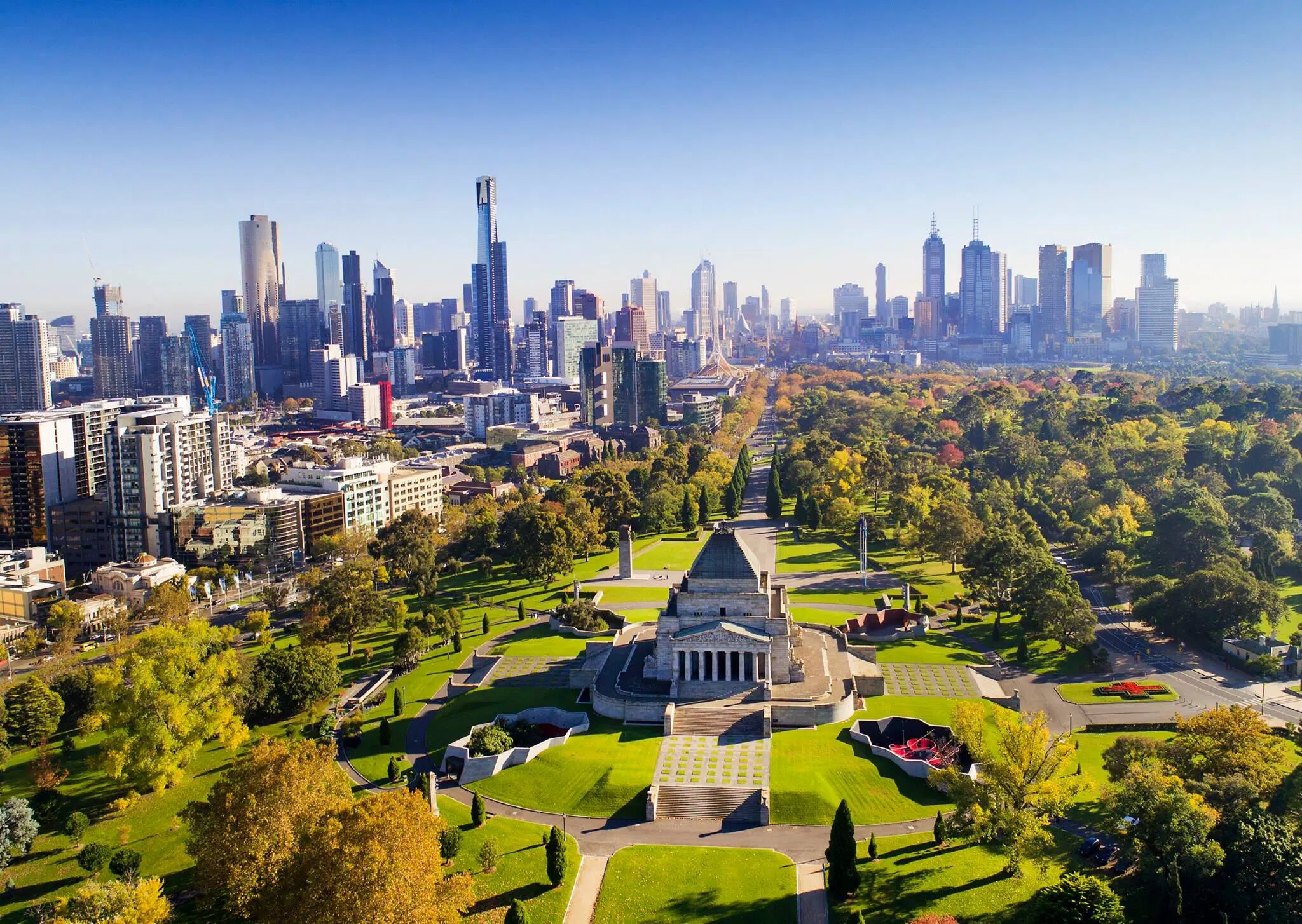
Prime Minister Narendra Modi and Australian Prime Minister Anthony Albanese co-chaired the 3rd India-Australia Annual Summit in Melbourne on 9 July 2026, the centrepiece of the Prime Minister’s 8–10 July visit to Australia — the final leg of a three-nation tour across the Indo-Pacific.
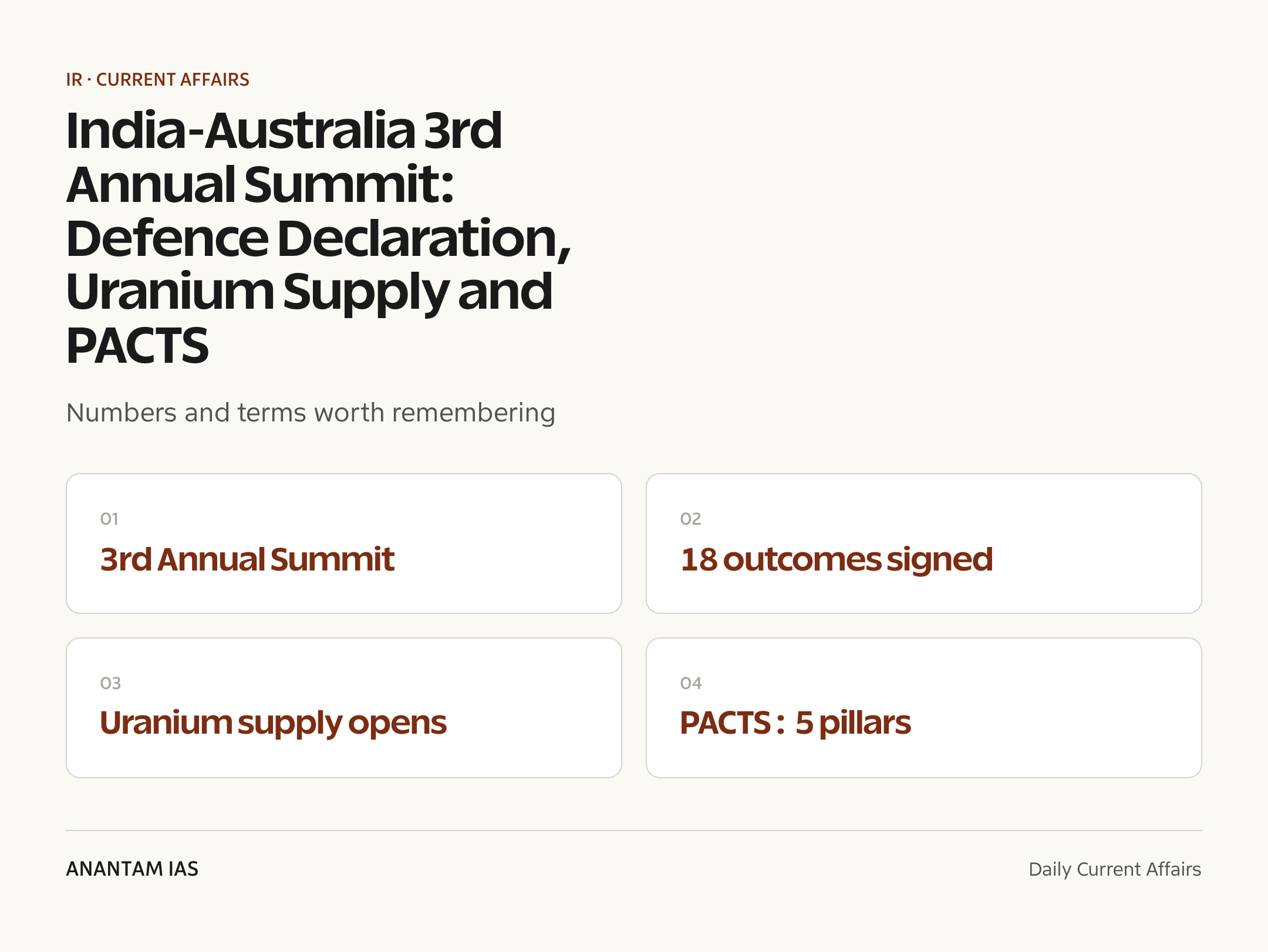
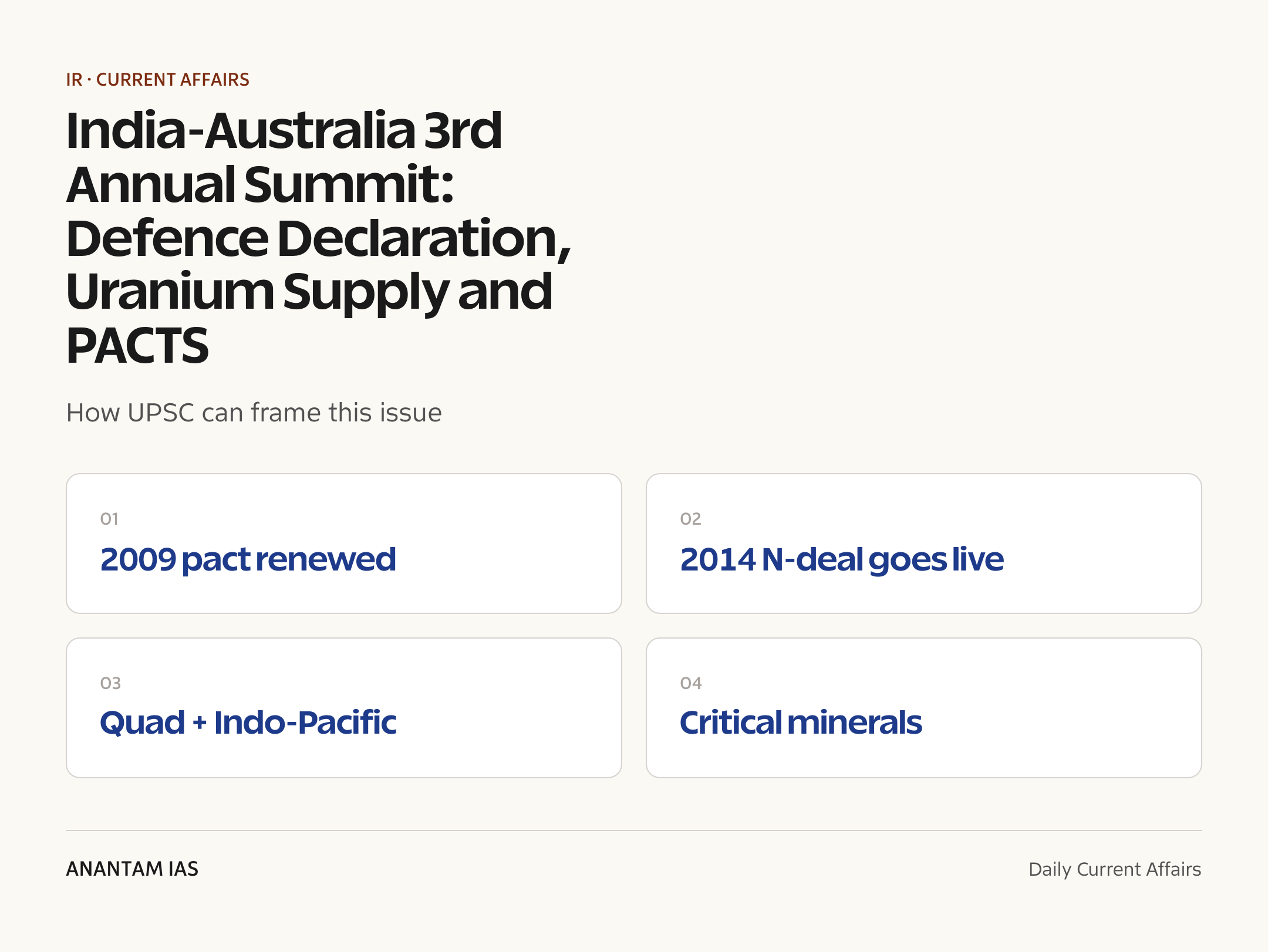
PIB released a list of 18 outcomes, led by a new Joint Declaration on Defence and Security Cooperation (JDDSC), the finalisation of the Administrative Arrangement that operationalises the 2014 Civil Nuclear Agreement and enables uranium supply to India, and a five-pillar Partnership for Cyber, Critical Technologies and Supply Chains (PACTS).
- The JDDSC renews the 2009 Joint Declaration on Security Cooperation — covering interoperability of forces, maritime domain, defence industrial collaboration, cyber security, counter-terrorism and HADR.
- A Maritime Security Collaboration Roadmap (MSCR) was adopted to deepen information sharing, capability development and operational coordination across the Indian Ocean and wider Indo-Pacific.
- The Administrative Arrangement finalised at the summit operationalises the India-Australia Civil Nuclear Agreement (2014), opening the door to Australian uranium supply for Indian reactors.
- PACTS succeeds and replaces the 2020 Framework Arrangement on Cyber and Cyber Enabled Critical Technology Cooperation, with five pillars from supply chains to defence research.
- An MoU links the Indian Coast Guard (ICG) with Australia’s Maritime Border Command (MBC) for maritime law enforcement and domain awareness.
- Cultural diplomacy delivered too: Australia is repatriating 3 Indian antiquities — a granite Nandi, a bronze Bhadrakali trident and a basalt six-headed Skanda, all from Tamil Nadu.
The development matters in the context of:
- The package lands amid geostrategic uncertainty in the Indo-Pacific: The Hindu reported that both leaders called for disputes to be resolved peacefully, without force or coercion, and in line with UNCLOS 1982.
- It converts the Comprehensive Strategic Partnership (2020) from dialogue into instruments — a defence declaration, a nuclear supply channel, a tech-and-supply-chain architecture and institution-to-institution MoUs.
- For India, Australia is now a supplier of strategic inputs — uranium, critical minerals, LNG — as much as a security partner in the Quad.
UPSC Relevance
Prelims Relevance
- 3rd India-Australia Annual Summit — Melbourne, 9 July 2026; co-chaired by PM Modi and PM Anthony Albanese; 18 listed outcomes.
- JDDSC — Joint Declaration on Defence and Security Cooperation; renews the 2009 Joint Declaration on Security Cooperation.
- MSCR — Maritime Security Collaboration Roadmap: information sharing, capability development, operational coordination.
- Civil Nuclear Agreement 2014 — now operationalised via a finalised Administrative Arrangement; enables uranium supply from Australia to India.
- PACTS — Australia-India Partnership on Cyber, Critical Technologies and Supply Chains; replaces the 2020 Framework Arrangement; five pillars; chaired by Australia’s Deputy Secretary (International and Security Group) and India’s Deputy NSA.
- ACITI — Australia-Canada-India Technology and Innovation Partnership (trilateral) — distinct from the bilateral PACTS.
- ICG–MBC MoU — Indian Coast Guard and Australia’s Maritime Border Command: maritime law enforcement, domain awareness, border protection.
- TKDL — CSIR gives IP Australia access to the Traditional Knowledge Digital Library.
- Campuses: Flinders University — Bengaluru (LoI); Victoria University — Gurugram (Letter of Approval).
- Rooftop Solar Training Academy — Pandit Deendayal Energy University, Gandhinagar; to train 2,000 women and youth; supports PM Surya Ghar.
Mains Relevance
GS Paper 2
- Bilateral agreements involving India: how the summit converts the Comprehensive Strategic Partnership into binding instruments (JDDSC, PACTS, nuclear Administrative Arrangement).
- India and its neighbourhood-plus: Australia as a pillar of India’s Indo-Pacific strategy and the Quad; balancing strategic autonomy with alignment.
- Effect of policies of developed countries on India’s interests: Australia’s uranium export policy and university campuses in India under NEP 2020 internationalisation.
GS Paper 3
- Security: maritime domain awareness, coast guard cooperation and defence industrial supply chains as internal-external security interface.
- Technology and economy: critical minerals, semiconductors, undersea cables and cyber resilience under PACTS; energy security and civil nuclear fuel supply.
Essay
- Middle powers together can shape order: India-Australia as an axis of stability in a contested Indo-Pacific.
- From buyers and sellers to co-creators — technology partnerships as the new currency of diplomacy.
Background and Context
The summit at a glance
The Melbourne meeting was the third edition of the annual leaders’ summit that anchors the India-Australia Comprehensive Strategic Partnership.
- India and Australia upgraded ties to a Comprehensive Strategic Partnership (CSP) at the June 2020 virtual summit; annual leaders’ summits now institutionalise it.
- PM Modi visited Australia from 8 to 10 July 2026; the summit was held in Melbourne, with a business round-table and a CEO Forum alongside.
- The joint statement flagged complementarities between Make in India and Australia’s Future Made in Australia agenda across manufacturing, technology and investment.
- The Hindu reported that PM Modi invited Australian businesses to invest in India and pressed for early conclusion of the Comprehensive Economic Cooperation Agreement (CECA) — the full FTA meant to build on the ECTA, in force since December 2022.
- PIB listed 18 outcomes spanning defence, nuclear energy, cyber and critical technologies, skills, education, science and culture.
The defence declaration and maritime roadmap
The JDDSC is the summit’s strategic core — a generational refresh of the 2009 security declaration.
- The Joint Declaration on Defence and Security Cooperation renews the 2009 Joint Declaration on Security Cooperation and names interoperability, capacity building, the maritime domain, defence industry, cyber, counter-terrorism and HADR as pillars.
- The Hindu reported the declaration commits both sides to regular consultations on Indo-Pacific developments, more complex military exercises, faster interoperability and information sharing, and expanded aircraft deployments from each other’s territories.
- It deepens personnel exchanges — education, training, liaison appointments — and even explores cooperation in recruiting skilled personnel for each other’s defence workforces; Australia has invited an Indian military instructor to its Defence College for 2028-29.
- The Maritime Security Collaboration Roadmap operationalises coordination across the Indian Ocean; a separate MoU ties the Indian Coast Guard to Australia’s Maritime Border Command for law enforcement and domain awareness.
- These sit atop an existing lattice: the 2+2 Ministerial Dialogue, the Mutual Logistics Support Arrangement (2020), Australia’s return to Exercise Malabar, and bilateral drills like AUSINDEX and AUSTRAHIND.
- Both sides committed to a unified approach through UNCLOS, ASEAN-led architecture, the Pacific Islands Forum (PIF) and IORA — the regional institutions India also works through in the Quad.
Uranium: the 2014 nuclear deal finally goes live
The quietest line in the outcomes list may be the most consequential for India’s energy security.
- PIB confirmed the finalisation of the Administrative Arrangement of the India-Australia Civil Nuclear Agreement, signed in 2014 — the step that operationalises the pact and enables supply of uranium from Australia to India.
- Australia holds among the world’s largest known uranium resources, and India’s expanding reactor fleet needs assured fuel; a stable supplier reduces dependence on a narrow set of sources.
- The deal is diplomatically notable because India is not a signatory to the NPT; Australia reversed its long-standing policy against uranium sales to non-NPT states for India, building on India’s 2008 NSG waiver and its separation of civil and military facilities (for the regimes involved, see multilateral export control regimes).
- Imported uranium supplements limited domestic mining centred on Jaduguda and Tummalapalle (covered in uranium mining in India) and supports safeguarded reactors under IAEA oversight.
- A companion India-Australia Joint Statement on Energy Security reaffirms both countries’ commitment to stable energy flows amid geopolitical tensions — Australia is already a major supplier of coal and LNG to India.
PACTS decoded: five pillars, one architecture
PACTS upgrades a cyber-era arrangement into a full technology-and-supply-chain compact.
- The Australia-India Partnership on Cyber, Critical Technologies and Supply Chains (PACTS) succeeds and replaces the 2020 Framework Arrangement on Cyber and Cyber Enabled Critical Technology Cooperation.
- Pillar 1 — Supply chain resilience: trusted vendor frameworks, secure undersea cables (via the Quad Partnership for Cable Connectivity and Resilience), semiconductor supply chain research, and critical minerals through coordinated investment and recycling.
- Pillar 2 — Critical technology: joint work on AI standards, space, telecommunications, biotechnology and advanced materials, with consensus-driven international benchmarks grounded in democratic values.
- Pillar 3 — Cybersecurity: countering cybercrime, cooperation in UN cyber processes, joint workshops, and a new cyber tech skill incubator hub.
- Pillar 4 — Digital resilience: scaling India’s Digital Public Infrastructure (DPI) principles and affordable DPI solutions across the Indo-Pacific — health, education, connectivity, social protection.
- Pillar 5 — Defence research: institutional links between Australia’s Defence Science and Technology Group and India’s DRDO, plus start-up ecosystem ties and maritime surveillance technology.
- Governance: chaired by Australia’s Deputy Secretary (International and Security Group, PM&C) and India’s Deputy National Security Adviser, with an annual Senior Officials Meeting; pillar leads include the NSCS, MEA’s Cyber Diplomacy and Oceania divisions, and the Ministry of Defence.
- A separate MoU advances the trilateral Australia-Canada-India Technology and Innovation (ACITI) Partnership — do not confuse the two in Prelims.
Education, skills and culture: the people layer
Beyond hard security, the summit thickened the human and institutional bridge between the two countries.
- Flinders University received a Letter of Intent for a campus in Bengaluru, and Victoria University a Letter of Approval for a campus in Gurugram — foreign campuses that align with NEP 2020’s internationalisation push.
- An NCVET–ASQA Letter of Intent links India’s vocational-training regulator with the Australian Skills Quality Authority for quality assurance and aligned occupational standards.
- An MSDE–TAFE Western Australia MoU sets up a Centre of Excellence in Mining Equipment, Technology and Services (METS) at NSTI Bhubaneswar — skills for the critical-minerals economy.
- The Rooftop Solar Training Academy at Pandit Deendayal Energy University, Gandhinagar, was operationalised to train 2,000 women and youth as solar technicians, feeding the PM Surya Ghar rooftop-solar push.
- Australia is repatriating three Indian antiquities — an 11th–12th century granite Nandi, an 11th century bronze trident with Bhadrakali, and a 12th century basalt six-headed Skanda (Karttikeya) — all from Tamil Nadu.
- Science MoUs round it out: GeoScience Australia–GSI on mineral exploration, CSIR–University of Melbourne on drug-target research, CSIR-IP Australia access to the TKDL, and an SRFTI–Griffith Film School partnership.
Why the relationship is compounding
Structural forces — geography, economics and China’s rise — keep pushing New Delhi and Canberra together.
- Both are Quad members and maritime democracies straddling the Indian Ocean; both worry about coercion, grey-zone activity and threats to undersea cable infrastructure.
- Australia supplies what India’s growth needs — critical minerals (lithium, cobalt, rare earths), uranium, coal, LNG and education — while India offers scale, talent and a manufacturing alternative for supply-chain diversification.
- The ECTA (2022) lifted bilateral trade momentum, and a concluded CECA would widen coverage to services, investment and digital trade.
- A diaspora of nearly a million Indian-origin Australians gives the relationship domestic ballast in both polities.
- The 2009 declaration took 17 years to be renewed; the density of the 2026 package signals that defence, technology and energy are now moving on the same track, not separate ones.
Way Forward
Deliver the instruments
- Convert the JDDSC into visible outputs — a regular exercise calendar, reciprocal aircraft deployments and time-bound interoperability milestones.
- Begin actual uranium shipments under the Administrative Arrangement with transparent safeguards reporting, so the 2014 agreement stops being symbolic.
Institutionalise PACTS
- Hold the first Senior Officials Meeting early, publish pillar-wise project lists, and fund the cyber skill incubator and semiconductor research links so PACTS avoids the fate of dormant frameworks.
- Use the DPI pillar to co-deliver digital public goods in third countries of the Indo-Pacific — a partnership visible beyond the bilateral.
Close the economic loop
- Conclude CECA to match the strategic layer with a full economic one, and fast-track critical-minerals investment vehicles so Indian firms secure offtake, not just MoUs.
Conclusion
The Melbourne summit is the moment the India-Australia relationship moved from declarations of intent to a working architecture: a renewed defence compact, an operational nuclear fuel channel, and a five-pillar technology partnership with named chairs and annual review.
For UPSC, the package is a compact case study in how India builds issue-based coalitions in the Indo-Pacific — combining hard security (JDDSC, MSCR), strategic inputs (uranium, critical minerals) and normative agendas (DPI, AI standards) with one partner.
The test now is execution. Frameworks like the 2020 cyber arrangement lapsed into routine before PACTS replaced them; the 2014 nuclear deal waited over a decade for its administrative plumbing. Delivery, not signing ceremonies, will decide whether 2026 is remembered as the inflection point.
UPSC Practice Questions
Prelims MCQ 1
With reference to the outcomes of the 3rd India-Australia Annual Summit (2026), consider the following statements:
- The Joint Declaration on Defence and Security Cooperation renews the India-Australia Joint Declaration on Security Cooperation of 2009.
- The Administrative Arrangement finalised at the summit operationalises the India-Australia Civil Nuclear Agreement of 2014, enabling uranium supply to India.
- PACTS is a trilateral partnership among India, Australia and Canada.
How many of the above statements are correct?
(a) Only one (b) Only two (c) All three (d) None
Answer: (b) Only two
Explanation:
Statements 1 and 2 are correct per the PIB list of outcomes. Statement 3 is wrong: PACTS is a bilateral India-Australia partnership on cyber, critical technologies and supply chains that replaces the 2020 Framework Arrangement; the trilateral with Canada is the separate ACITI Partnership.
Prelims MCQ 2
The ‘Maritime Security Collaboration Roadmap’, recently in news, is an arrangement between India and which country?
(a) Indonesia (b) France (c) Australia (d) Japan
Answer: (c) Australia
Explanation:
The Maritime Security Collaboration Roadmap was adopted at the 3rd India-Australia Annual Summit in Melbourne (July 2026) to deepen information sharing, capability development and operational coordination across the Indian Ocean and the wider Indo-Pacific.
UPSC Mains Questions
- The 3rd India-Australia Annual Summit converted a decade of declarations into operational instruments. Examine how the new defence declaration, the operationalised civil nuclear agreement and PACTS together reshape India’s Indo-Pacific strategy.
- Critical minerals, uranium and undersea cables are the new currencies of strategic partnership. Discuss with reference to India-Australia relations, highlighting the opportunities and the implementation risks.
Sources: PIB, Prime Minister's Office and The Hindu.
Frequently Asked Questions
What was decided at the India-Australia summit 2026?
The 3rd Annual Summit in Melbourne (9 July 2026) produced 18 outcomes: a new Joint Declaration on Defence and Security Cooperation, a Maritime Security Collaboration Roadmap, operationalisation of the 2014 Civil Nuclear Agreement enabling uranium supply, the PACTS technology partnership, a Coast Guard MoU, education campuses and the return of three Tamil Nadu antiquities.
What is the JDDSC?
The Joint Declaration on Defence and Security Cooperation renews the 2009 India-Australia security declaration. It commits both countries to more complex military exercises, deeper interoperability and information sharing, expanded aircraft deployments from each other’s territories, defence industrial collaboration, counter-terrorism and humanitarian assistance cooperation.
What is PACTS between India and Australia?
PACTS — the Australia-India Partnership on Cyber, Critical Technologies and Supply Chains — replaces the 2020 cyber framework. It has five pillars: supply chain resilience, critical technology, cybersecurity, digital resilience, and defence research. It is chaired by India’s Deputy NSA and a senior Australian official, with annual reviews.
Why is the uranium deal significant?
The Administrative Arrangement finalised at the summit operationalises the 2014 Civil Nuclear Agreement, enabling Australian uranium supply to India. Australia holds some of the world’s largest uranium resources, and supply to non-NPT India — built on the 2008 NSG waiver and IAEA safeguards — diversifies fuel for India’s expanding reactor fleet.
Which Australian universities are opening campuses in India?
At the summit, Flinders University received a Letter of Intent for a campus in Bengaluru, and Victoria University a Letter of Approval for a campus in Gurugram. These add to the internationalisation of higher education that the National Education Policy 2020 encourages.
Which artefacts is Australia returning to India?
Australia is repatriating three antiquities, all from Tamil Nadu: an 11th–12th century granite sculpture of Nandi, an 11th century bronze trident with Bhadrakali, and a 12th century basalt image of the six-headed Skanda (Karttikeya).