Opens in a new tab
Join Anantam IAS Channel on Telegram

Daily Digest · Wednesday

22 April 2026 Current Affairs for UPSC

20 current affairs published on Wednesday, 22 April 2026

22 April 2026 Current Affairs for UPSC — every Why-in-News article AnantamIAS published on Wednesday, 22 April 2026, broken down with Why in News?, the exact GS paper it feeds, sub-topic mapping, MCQ-ready facts and a UPSC-style practice question. 20 articles in total, covering Polity, Economy, Environment, S&T, IR, Geography, History, Society and Internal Security — the same Why-in-News + GS-paper-mapping + practice-question format the Compass uses across every daily digest on the site.

Daily current affairs for UPSC is where new material enters your prep stream. Read this 22 April 2026 digest end-to-end in 25–35 minutes, attempt the practice question at the foot of each article (it's MCQ for some, 10/15-marker for others), then bookmark the entries that fall inside your active revision window. Everything stays cross-linked: tap any subject pill to jump to that subject's hub, or use the table of contents above to skip straight to a specific story.

Use this page three ways. Read sequentially for a one-sitting scan of everything that mattered on 22 April 2026. Download the 22 April 2026 PDF below for offline study or print revision. Or use the April 2026 Current Affairs compilation to see this day in the month's full context. For the previous day's reading, see 21 April 2026 Current Affairs; the next day's is 23 April 2026 Current Affairs.

Why we publish daily current affairs separately from the monthly compilation: daily is learning, monthly is revision. Use the daily page to add fresh material to your notes the day it breaks; come back to the April 2026 compilation 60 days before Prelims when the noise has settled and only the lasting takeaway is worth re-reading.

Draft IT (Second Amendment) Rules 2026: MeitY Expands Oversight to Users

Open article →Download PDF

Why in News?

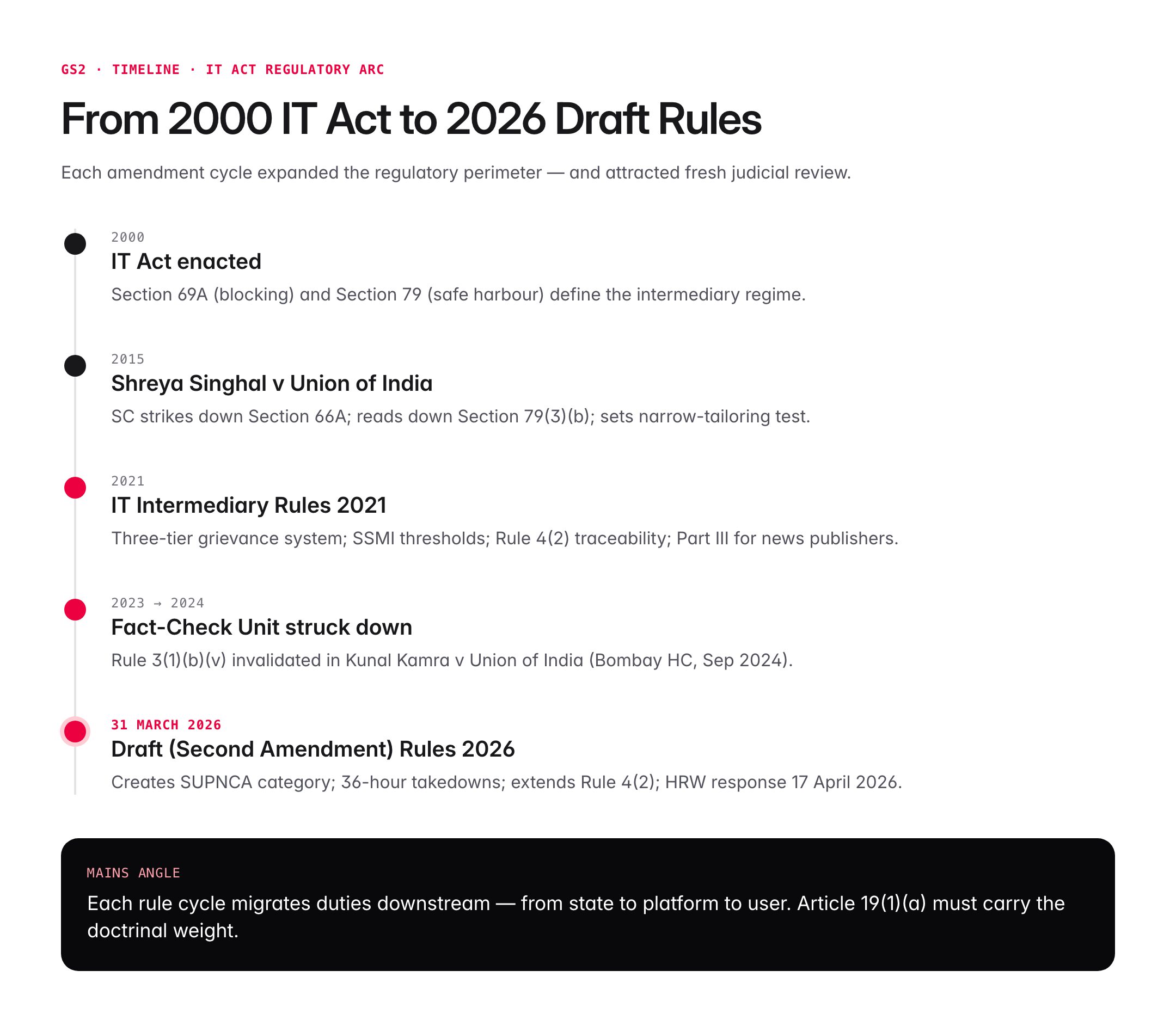
On 31 March 2026, the Ministry of Electronics and Information Technology (MeitY) published the Draft Information Technology (Intermediary Guidelines and Digital Media Ethics Code) Second Amendment Rules, 2026 for public consultation. The draft, released under Sections 69A, 79 and 87 of the Information Technology Act, 2000, marks the third substantive amendment cycle since the parent 2021 Rules were notified.

Unlike earlier iterations that addressed intermediaries (social media platforms) and digital news publishers, the 2026 draft expands compliance obligations to a new category: individual users who post “news and current affairs” content at scale. A user who posts such content beyond prescribed thresholds would be treated akin to a publisher, requiring grievance officer contact details, code-of-ethics adherence and takedown responsiveness within fixed timelines.

On 17 April 2026, Human Rights Watch (HRW) issued a public response urging MeitY to withdraw the draft, arguing that it “collapses the safe-harbour architecture and imports direct obligations onto ordinary speakers.” The Internet Freedom Foundation (IFF) and the Electronic Frontier Foundation (EFF) filed detailed consultation comments flagging Article 19(1)(a) and Article 14 infirmities.

UPSC Relevance at a Glance

DimensionDetail
GS PaperGS2 — Polity, Governance, Fundamental Rights
PrelimsIT Act 2000 Sections 69A/79/87; IT Rules 2021; Shreya Singhal case; Bombay HC ruling on Fact-Check Unit
MainsSafe-harbour doctrine; Article 19(1)(a) limits; chilling effect; delegated legislation tests
Syllabus TagsDigital Rights, Executive Rule-Making, Judicial Review, Media Regulation
Draft IT (Second Amendment) Rules 2026: MeitY Expands Oversight to Users

Background and Context

India’s internet speech architecture rests on two pillars of the IT Act, 2000. Section 79 grants intermediaries conditional immunity (“safe harbour”) for third-party content, provided they exercise due diligence and act on actual knowledge or a court/government order. Section 69A allows the Union government to block information online on defined grounds drawn narrowly from Article 19(2) of the Constitution.

The first rules under Section 79, notified in 2011, were challenged and judicially narrowed in Shreya Singhal v Union of India (2015). The Supreme Court struck down Section 66A for vagueness, read down Section 79(3)(b) so intermediaries need act only on court/government orders, and reaffirmed that restrictions on speech must be “narrowly tailored” to Article 19(2) grounds.

The IT Rules 2021 replaced the 2011 framework. They introduced a three-tier grievance mechanism, required Significant Social Media Intermediaries (SSMIs) with over 50 lakh users to appoint a Chief Compliance Officer, Nodal Contact Person and Resident Grievance Officer, and mandated traceability of the “first originator” for messaging platforms under Rule 4(2). Part III of the 2021 Rules, notably, extended oversight to digital news publishers and OTT platforms under the Ministry of Information and Broadcasting (MIB), a move the Bombay and Madras High Courts partially stayed.

The 2023 amendment inserted Rule 3(1)(b)(v) creating a government-notified Fact-Check Unit (FCU) to flag “fake, false or misleading” information about central government business. In Kunal Kamra v Union of India (2024), the Bombay High Court struck this down as violating Articles 14, 19(1)(a) and 19(1)(g), holding that truth cannot be adjudicated by an executive body that is also an interested party.

The 2026 draft is the first to pierce the user-intermediary distinction that has defined Indian internet law for 25 years. For related governance context, see form-6-controversy-electoral-rolls-allegations-2026 and a-social-media-ban-will-not-save-our-children.

Key Features and Provisions

User-as-Publisher Classification

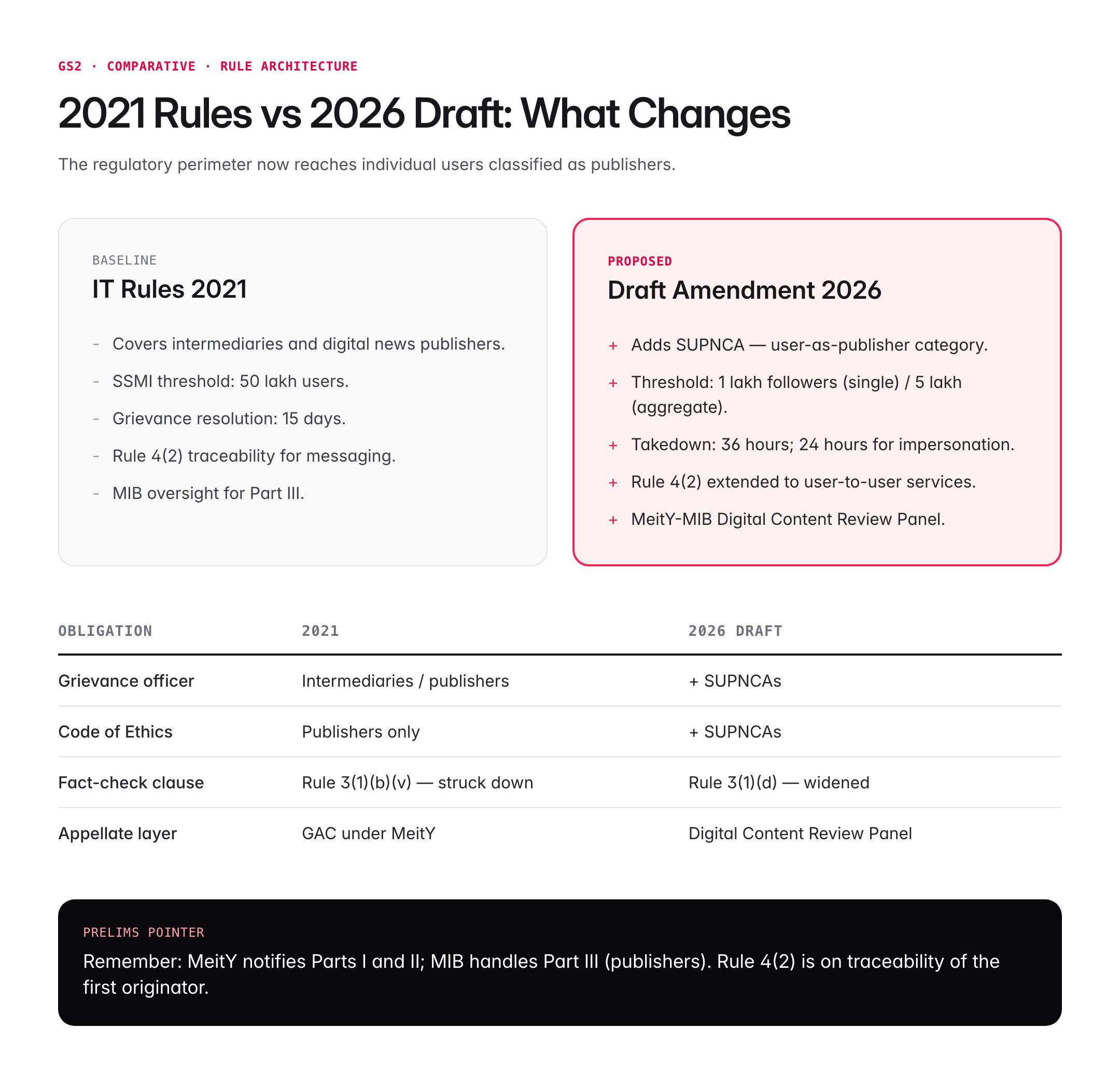
The draft introduces “Significant User-Publishers of News and Current Affairs” (SUPNCA), a new category covering individual accounts that post current-affairs content to audiences crossing a notified threshold (proposed: 1 lakh followers on a single platform or aggregate of 5 lakh across platforms). A SUPNCA must:

  • Publish contact details of a grievance officer resident in India.
  • Adhere to the Code of Ethics in Appendix to Part III of the 2021 Rules (earlier limited to digital news publishers).
  • Take down content within 36 hours of a legitimate complaint; within 24 hours for content deemed to impersonate or depict private parts.
  • Furnish self-declaration of compliance annually to MeitY.

Expanded Takedown Grounds

Rule 3(1)(d) is proposed to be amended to include content that “presents demonstrably false claims on matters of public record” and content that “undermines public confidence in election processes.” Neither phrase is defined in the draft.

Role of MIB

Part III jurisdiction continues to rest with the Ministry of Information and Broadcasting, but the 2026 draft creates an inter-ministerial Digital Content Review Panel combining MeitY and MIB officials to adjudicate user-publisher disputes.

Traceability and Encryption

Rule 4(2) on traceability is retained and extended to “significant user-to-user information services,” a phrase broad enough to cover federated and end-to-end encrypted platforms. WhatsApp’s pending challenge before the Delhi High Court (WhatsApp LLC v Union of India, 2021) remains undecided.

Grievance Timelines

CategoryAcknowledgeResolve
Intermediary complaint (existing)24 hours15 days
SUPNCA complaint (proposed)24 hours36 hours for takedown
Impersonation/non-consensual imageryImmediate24 hours

Penalties

Non-compliance triggers loss of safe harbour under Section 79 for intermediaries and, for SUPNCAs, prosecution under Section 45 of the IT Act (residual penalty of up to Rs 25,000) plus deactivation requests to the host platform.

Significance

  • Addresses platform-era harms: Coordinated inauthentic behaviour, deepfake-driven defamation, and synthetic election content have scaled faster than the 2021 framework anticipated. The draft attempts to plug gaps identified by the Parliamentary Standing Committee on Communications and IT in its 2024 report.
  • Harmonises publisher obligations: Treating high-reach individual accounts like publishers recognises that influence, not institutional form, drives public-opinion impact.
  • Strengthens victim remedies: Faster takedown windows for impersonation and non-consensual intimate imagery respond to civil-society demands documented by the National Commission for Women and the Cyber Crime Coordination Centre (I4C) under MHA.
  • Provides regulatory certainty: A single notified threshold replaces ad hoc executive orders under Section 69A.
  • Signals Indian digital sovereignty: Aligns with the Digital India Act (Draft, 2025) trajectory of domestic-first platform governance, comparable to EU’s Digital Services Act (DSA).
  • Institutionalises grievance flow: The Digital Content Review Panel offers an appellate layer short of judicial review.
Draft IT (Second Amendment) Rules 2026: MeitY Expands Oversight to Users

Concerns, Criticisms and Challenges

The draft has attracted pointed constitutional critique. HRW (17 April 2026) argued the SUPNCA category lacks an “intelligible differentia” and tests the equality guarantee under Article 14, because follower counts are platform-generated metrics unrelated to editorial responsibility. IFF submitted that the phrase “demonstrably false claims on matters of public record” is unconstitutionally vague, violating the void-for-vagueness doctrine the Supreme Court applied in Shreya Singhal.

The Editors Guild of India flagged a chilling effect: journalists with large personal followings would face overlapping obligations under the Press Council Act, the Cable Networks Act and now the IT Rules. The 36-hour takedown window, EFF noted, incentivises over-removal because the cost of refusal (prosecution, deplatforming) is asymmetric.

The Fact-Check Unit precedent looms large. In Kunal Kamra, the Bombay High Court held that executive determination of “truth” is inherently suspect when the executive is a party of interest. Rule 3(1)(d)’s new proviso mirrors the FCU’s logical structure. Senior counsel Sajan Poovayya has argued the clause would be struck down on identical reasoning.

Encryption concerns persist. The extension of Rule 4(2) to “significant user-to-user information services” effectively criminalises end-to-end encryption designs. The Karnataka High Court, in X Corp v Union of India (2025), expressed doubts about the constitutionality of the parallel Section 69A “Sahyog Portal” framework.

Federalism worries also surface. Content takedown is increasingly invoked by state police under Section 91 CrPC / 94 BNSS. Absence of a state consultation mechanism in the Draft Rules weakens cooperative federalism principles articulated in the S.R. Bommai (1994) line of cases.

Comparative and Historical Perspective

FrameworkYearPrimary TargetSafe Harbour TreatmentKey Weakness
IT Rules 20112011IntermediariesBroad immunityRead down in Shreya Singhal
IT Rules 20212021Intermediaries + PublishersConditional on due diligenceParts partially stayed
2023 Amendment2023Fact-Check Unit—Struck down (Bombay HC)
2026 Draft2026Intermediaries + Publishers + SUPNCAsConditional + user-level dutiesArticle 14, 19(1)(a) challenges expected
EU DSA2022Very Large Online PlatformsRisk-based, no user dutiesResource-intensive audits
US Section 2301996Interactive computer servicesStrong statutory immunityLimited takedown incentive

Historically, Indian courts have insisted that speech restrictions pass the proportionality test articulated in K.S. Puttaswamy (2017) and Anuradha Bhasin v Union of India (2020). The 2026 draft, by creating an open-ended user obligation, pushes against that doctrinal line.

Way Forward

  • MeitY and MIB should jointly publish a gazetted impact assessment defining SUPNCA with quantitative thresholds and sunset review.
  • Parliament should consider placing user-publisher obligations in primary legislation (pending Digital India Act) rather than subordinate rules, addressing delegated-legislation concerns raised in In re Delhi Laws Act (1951).
  • Law Commission of India could examine harmonisation with Bharatiya Nyaya Sanhita 2023 provisions on misinformation.
  • Supreme Court e-Committee should operationalise a fast-track judicial review channel for takedown orders, moving beyond the current Article 226 route.
  • Data Protection Board of India under the DPDP Act 2023 should coordinate with MeitY to avoid overlapping grievance regimes.
  • MEA and DPIIT should engage bilateral partners (UK, EU, Singapore) to avoid extra-territorial compliance conflicts.
  • Civil society engagement must move beyond 30-day consultation windows; a standing multi-stakeholder advisory on internet rulemaking, modelled on TRAI’s open-house discussions, would improve legitimacy.

Conclusion

The Draft IT (Second Amendment) Rules 2026 mark a doctrinal shift: for the first time, Indian subordinate legislation treats high-reach individual users as publishers. The policy instinct is defensible, given platform-era harms that the 2021 architecture did not foresee. But the constitutional scaffolding is thin. Vague takedown grounds, compressed timelines, and user-level duties risk replicating the very features the Supreme Court struck down in Shreya Singhal and the Bombay High Court reversed in Kunal Kamra.

A durable solution requires primary legislation, clearer definitions tied to Article 19(2) categories, independent appellate review, and respect for end-to-end encryption as a privacy-enabling technology under K.S. Puttaswamy. The executive’s task is not to abandon online regulation, but to design it inside the constitutional envelope. The consultation window closing in May 2026 is the moment to get it right.

Prelims Pointers

  • Section 69A of the IT Act 2000 allows blocking for sovereignty, security, public order and related grounds.
  • Section 79 grants conditional safe harbour to intermediaries.
  • IT Rules 2021 were notified on 25 February 2021.
  • Shreya Singhal v Union of India was decided on 24 March 2015.
  • The 2023 Fact-Check Unit was struck down in Kunal Kamra v Union of India (Bombay HC, September 2024).
  • Rule 4(2) of the 2021 Rules mandates traceability of the first originator.
  • MeitY is the nodal ministry for Parts I and II of the Rules; MIB handles Part III.
  • The Draft Rules 2026 were released on 31 March 2026.
  • HRW issued its response on 17 April 2026.
  • Significant Social Media Intermediary threshold is 50 lakh registered users.
  • The Digital Content Review Panel proposed in the 2026 draft is an inter-ministerial body.
  • The parallel EU instrument is the Digital Services Act (DSA).

Mains Practice Question

“The Draft IT (Second Amendment) Rules 2026 test the constitutional boundary between regulating online harms and preserving Article 19(1)(a).” Critically examine. (15 marks, 250 words)

  • Explain the key shift: intermediary-centric to user-centric obligations; SUPNCA category; 36-hour takedowns.
  • Apply Shreya Singhal and Kunal Kamra tests; discuss proportionality under Puttaswamy; highlight vagueness in “demonstrably false” clause.
  • Suggest remedies: statutory basis, independent appellate review, encryption safeguards, multi-stakeholder consultation.

Frequently Asked Questions

What are the Draft IT (Second Amendment) Rules 2026?

Issued by MeitY on 31 March 2026 under the IT Act 2000, the draft amends the 2021 Intermediary Rules by creating a new category called Significant User-Publishers of News and Current Affairs (SUPNCA), extending compliance duties previously limited to platforms and digital news publishers to individual users above a follower threshold.

Why is the draft in news in April 2026?

Human Rights Watch issued a public critique on 17 April 2026 urging withdrawal, arguing that the draft collapses India’s safe-harbour architecture. Internet Freedom Foundation and Electronic Frontier Foundation filed consultation submissions flagging Article 19(1)(a), Article 14 vagueness and chilling-effect concerns.

How does the draft affect UPSC Prelims and Mains preparation?

For Prelims, candidates must note Sections 69A/79 of the IT Act, Rule 4(2) traceability, the Shreya Singhal (2015) ruling, and the Bombay HC’s 2024 Kunal Kamra judgment on the Fact-Check Unit. For Mains GS2, the topic aligns with executive rule-making, fundamental rights, and digital governance debates.

What is the SUPNCA category and its threshold?

Significant User-Publishers of News and Current Affairs covers individual accounts crossing 1 lakh followers on a single platform or 5 lakh aggregate across platforms, who post news and current-affairs content. They must appoint a grievance officer, follow the Code of Ethics and respond to takedown complaints within 36 hours.

How does the 2026 draft differ from the 2021 Rules?

The 2021 Rules targeted intermediaries and digital news publishers. The 2026 draft retains those duties and adds user-level obligations, creates a Digital Content Review Panel combining MeitY and MIB, expands Rule 3(1)(d) to cover ‘demonstrably false’ claims, and extends Rule 4(2) traceability to ‘significant user-to-user information services’.

Why do critics cite the Shreya Singhal judgment?

In Shreya Singhal v Union of India (2015), the Supreme Court struck down Section 66A for vagueness and read down Section 79(3)(b). Critics argue the 2026 draft’s phrase ‘demonstrably false claims on matters of public record’ is similarly vague, fails the proportionality test from K.S. Puttaswamy, and would chill protected speech.

What happened to the 2023 Fact-Check Unit?

The 2023 amendment created a government Fact-Check Unit to flag ‘fake’ content about central government business. The Bombay High Court, in Kunal Kamra v Union of India (September 2024), struck it down for violating Articles 14, 19(1)(a) and 19(1)(g), holding that the executive cannot adjudicate truth while being an interested party.

What is the way forward?

Experts recommend moving user-publisher obligations into primary legislation via the pending Digital India Act, tying takedown grounds to Article 19(2) categories, preserving end-to-end encryption, creating an independent appellate tribunal, and institutionalising multi-stakeholder consultations beyond the 30-day comment window closing in May 2026.
BioE3 Policy and National Biofoundry Network 2026: India’s $1 Trillion Bioeconomy Blueprint

Open article →Download PDF

Why in News?

On 2 April 2026, Union Minister of State for Science and Technology Dr Jitendra Singh told the Rajya Sabha that India has operationalised six biofoundries and 21 bio-enabler facilities under the National Biofoundry Network, marking the first measurable milestone of the BioE3 Policy approved by the Union Cabinet on 24 August 2024.

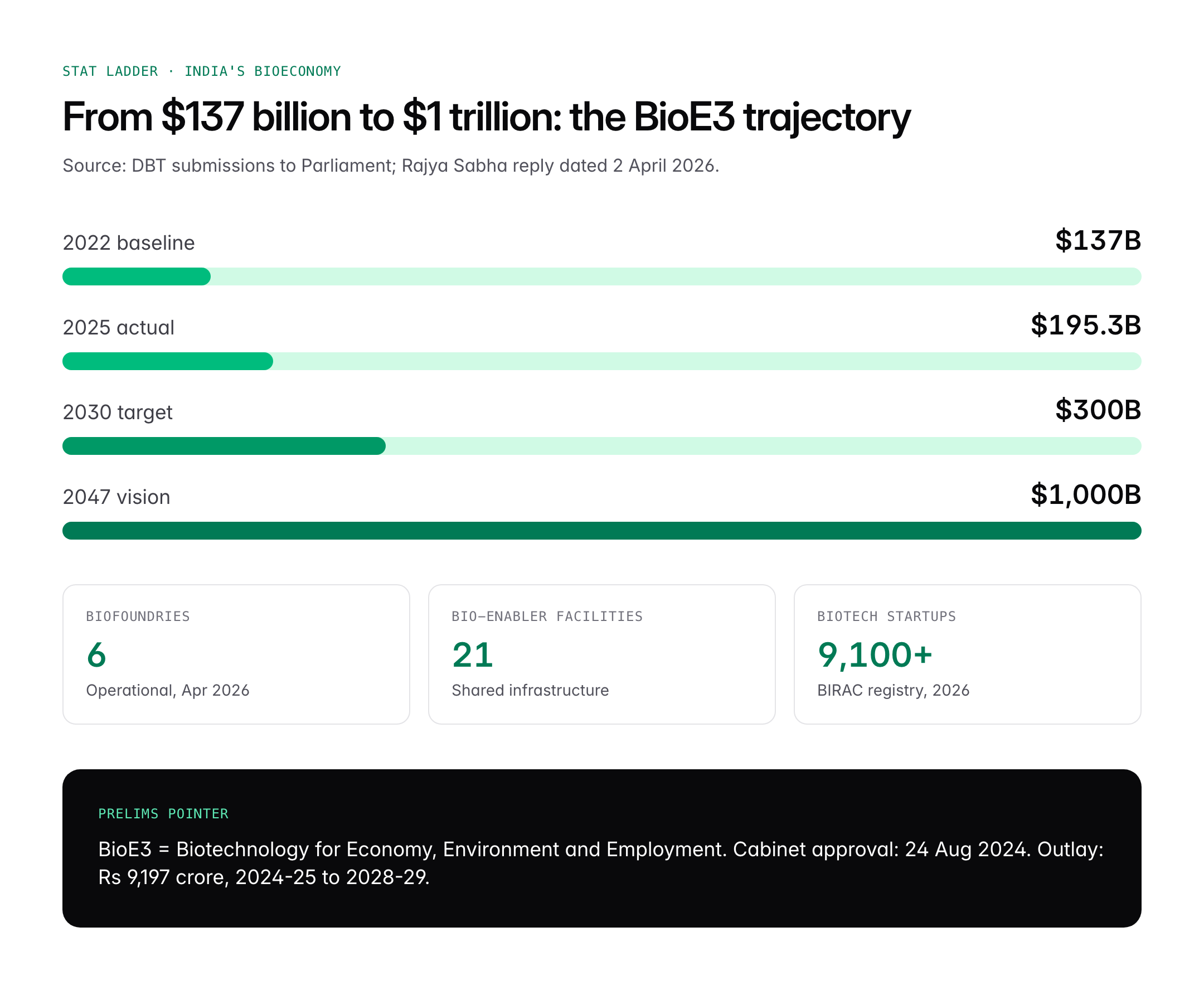
In the same reply, the Department of Biotechnology (DBT) placed India’s bioeconomy at $195.3 billion in 2025, up from $137 billion in 2022, and reiterated the staged target of $300 billion by 2030 and $1 trillion by 2047. India’s position in the global bioeconomy index has moved from 14th in 2022 to 12th in 2026.

The statement frames the biofoundry rollout as the operational arm of BioE3, which is short for Biotechnology for Economy, Environment and Employment. It is the clearest signal yet that DBT is pivoting from a grants-heavy research ministry to an industrial policy actor.

UPSC Relevance at a Glance

DimensionCoverage
GS PaperGS3 – Science and Technology, Economy, Environment
PrelimsBioE3 Policy, biofoundry, BIRAC, synthetic biology, GEAC, iGEM
MainsIndustrial biotech, bioeconomy, employment, biosafety regulation
Syllabus TagsAwareness in biotech, IPR, indigenisation of technology
BioE3 Policy and National Biofoundry Network 2026: India's $1 Trillion Bioeconomy Blueprint

Background and Context

India’s biotechnology industry grew on the back of generics, vaccines and agricultural biotech. The first National Biotechnology Development Strategy (2007) and its 2015-20 successor focused on capacity building, human resource and vaccine manufacturing. The DBT was set up in 1986 and the Biotechnology Industry Research Assistance Council (BIRAC) was carved out in 2012 as a public sector enterprise for startup financing.

By 2022, India had over 6,000 biotech startups and a bioeconomy valued at $137 billion, roughly 4.25 percent of GDP. The pandemic demonstrated both the strength of India’s vaccine manufacturing ecosystem and its weakness in upstream synthetic biology, enzymes, specialty chemicals and precision fermentation. Countries like the United States (with its 2022 Executive Order on Biomanufacturing), the United Kingdom (Engineering Biology programme) and China (14th Five Year Plan bioeconomy chapter) began treating engineering biology as strategic infrastructure.

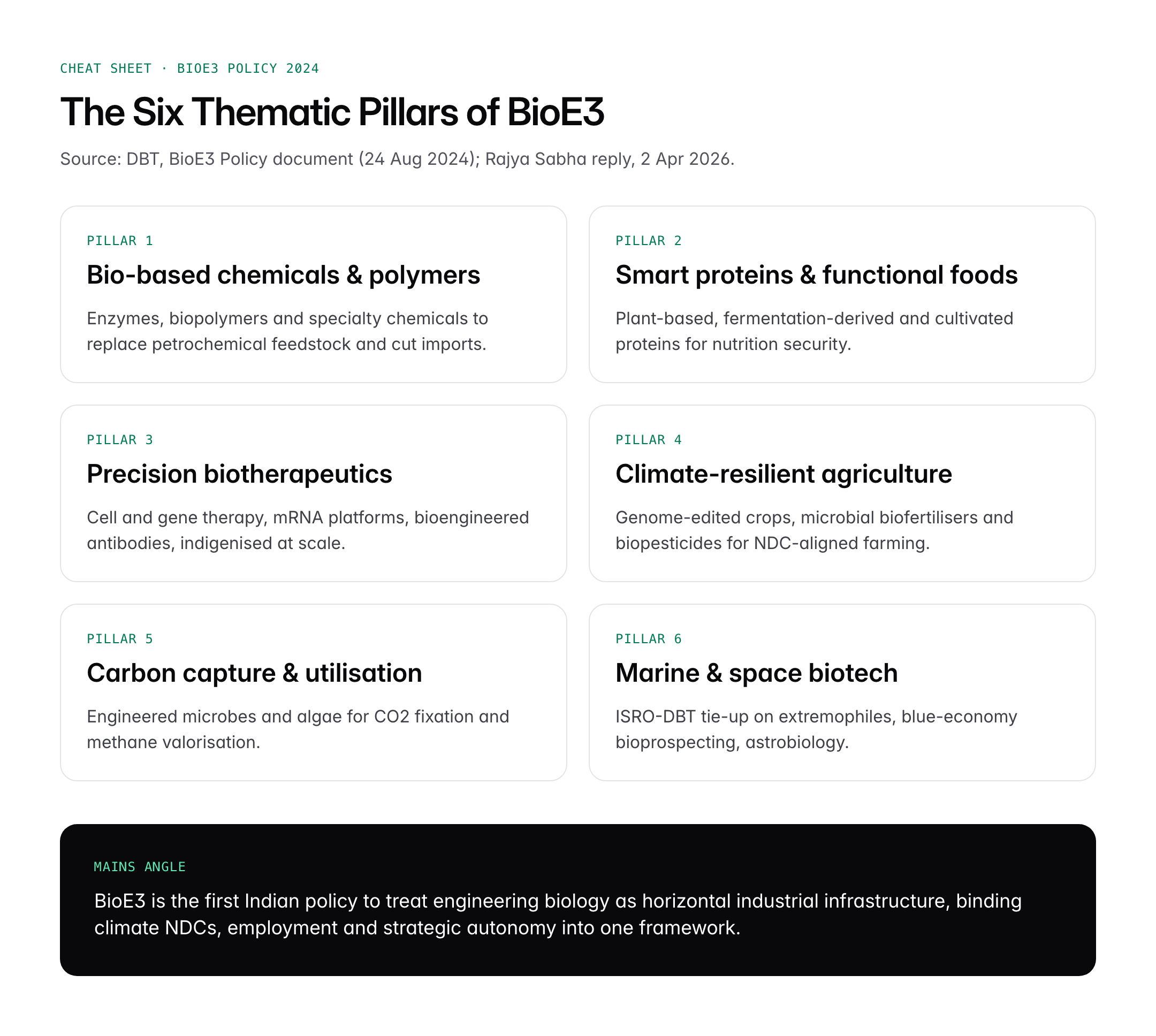
The BioE3 Policy, approved on 24 August 2024, is India’s response. It reframes biotechnology not merely as a health sciences discipline but as a horizontal enabler for the economy, the environment and employment. The policy identifies six thematic sectors: high-value bio-based chemicals, enzymes and biopolymers; smart proteins and functional foods; precision biotherapeutics; climate-resilient agriculture; carbon capture and utilisation; and marine and space biotechnology.

The National Biofoundry Network is the industrial spine that follows the policy. A biofoundry is an automated facility that combines design-build-test-learn cycles for engineered biology: DNA synthesis, robotic liquid handling, high-throughput screening, omics analysis and bioprocess scale-up, which compresses research-to-product cycles from years to months. Six biofoundries and 21 bio-enabler facilities were confirmed operational by the 2 April 2026 Rajya Sabha reply.

This policy also situates India within commitments such as the Convention on Biological Diversity, the Cartagena Protocol on Biosafety and the One Health framework, giving BioE3 a regulatory as well as an economic dimension.

Key Features and Provisions

BioE3 is structured as a mission-mode, inter-ministerial policy anchored in DBT and implemented through BIRAC, CSIR laboratories and academic partners.

Six thematic pillars

  • High-value bio-based chemicals, enzymes and biopolymers to replace petrochemical derivatives, with a target of import substitution in specialty chemicals.
  • Smart proteins and functional foods, covering plant-based, fermentation-derived and cultivated proteins.
  • Precision biotherapeutics, including cell and gene therapies, mRNA platforms and bioengineered antibodies.
  • Climate-resilient agriculture, spanning genome-edited crops, microbial biofertilisers and biopesticides.
  • Carbon capture and utilisation, using engineered microbes and algae for CO2 fixation and methane valorisation.
  • Marine and space biotechnology, with ISRO-DBT collaboration on extremophile research and blue economy bioprospecting.

National Biofoundry Network

  • Six operational biofoundries hosted across CSIR-IGIB Delhi, CSIR-IICT Hyderabad, IIT Madras, IIT Bombay, NCBS Bengaluru and IISc Bengaluru, as confirmed by DBT submissions.
  • 21 bio-enabler facilities for DNA synthesis, fermentation scale-up, strain engineering and analytics, providing shared infrastructure to startups at concessional rates.
  • Each biofoundry integrates AI-driven design tools, robotic automation and standard biological parts libraries aligned with global registries.
  • Open-access user time is reserved for startups registered on the BIRAC startup registry, with over 9,100 biotech startups in 2026, up from about 1,000 in 2016.

Financial architecture

  • Initial outlay is Rs 9,197 crore under a central sector scheme window from 2024-25 to 2028-29.
  • A Bio-Enabler Hub Fund co-invests with state governments and industry.
  • Bio-AI fellowships and Biomanufacturing Hubs add a talent layer.

Regulatory and ethics stack

  • The Genetic Engineering Appraisal Committee (GEAC) continues to approve genetically modified organism releases under the Environment Protection Act 1986.
  • A new BioE3 Regulatory Consultative Group will harmonise synthetic biology oversight across DBT, MoEFCC and ICMR.
  • Ethics guidance from the Indian Council of Medical Research applies to human-subject and gene-editing research.

Significance

  • The bioeconomy expanded from $137 billion in 2022 to $195.3 billion in 2025, with DBT projecting $300 billion by 2030. At 5.2 percent of GDP in 2025, biotechnology has become macroeconomically material, not a niche research sector.
  • India’s rise to 12th in the 2026 global bioeconomy index, from 14th in 2022, reflects improved patent filings, startup density and manufacturing exports, and reduces strategic dependence on imported enzymes and reagents.
  • The policy explicitly targets green jobs, with DBT estimating 35 lakh direct and indirect jobs by 2030, addressing a persistent gap in high-skill employment for STEM graduates.
  • Biofoundries lower the capital threshold for synthetic biology startups, which typically need Rs 40-80 crore for a wet lab. Shared infrastructure reduces this burden substantially and deepens the startup pipeline.
  • The carbon capture and marine pillars align with India’s Nationally Determined Contributions under the Paris Agreement and its commitments at CBD COP15, linking climate policy with industrial policy.
  • The National Biofoundry Network gives India sovereign capability in engineered biology, relevant for biosecurity and pandemic preparedness after the COVID-19 experience.
BioE3 Policy and National Biofoundry Network 2026: India's $1 Trillion Bioeconomy Blueprint

Concerns, Criticisms and Challenges

BioE3 has been received positively by industry, but several concerns have been flagged by researchers and civil society.

  • Biosafety governance lag. India’s biosafety rules 1989 and the Environment Protection Act 1986 were written for classical recombinant DNA work. Synthetic biology, gene drives and self-propagating organisms stress the existing GEAC process. A draft Biological Research Authority Bill has been pending since 2013.
  • Public trust deficit on GM. The Supreme Court’s 2024 Bt brinjal moratorium extension and the GM mustard litigation show that public and judicial confidence in biotech releases remains fragile. Farmer groups have questioned whether biofoundries will push patented seeds and microbial consortia.
  • IPR and access. A 2026 Centre for Science and Environment note warned that without compulsory licensing clauses, BioE3 outputs could be captured by large multinationals, replicating the patent-heavy pattern of precision therapeutics in the United States.
  • Skill pipeline. India produces 25 lakh STEM graduates a year, but only around 20,000 are trained in bioinformatics, protein engineering or bioprocess design. Without a focused Bio-AI cadre, biofoundries risk under-utilisation.
  • Ethics and dual use. Gene synthesis capability poses biosecurity risk. There is no statutory equivalent of the US Federal Select Agent Programme. DBT’s guidelines remain advisory.
  • Regional concentration. All six initial biofoundries are in metro clusters. Northeast India, despite its biodiversity, has none, raising federal and equity concerns.
  • Data governance. Biological data sharing across the Network is governed by the Biological Diversity Act 2002, amended in 2023, but implementation rules for digital sequence information remain draft.

Comparative and Historical Perspective

India is a late mover in engineering biology, but the gap is closing.

CountryAnchor policyBioeconomy size 2025Biofoundries
United States2022 Executive Order on Biomanufacturing, NSCEB report 2024$1.1 trillion15+ (incl. Ginkgo Bioworks, DOE AgileBioFoundry)
China14th Five Year Plan Bioeconomy 2022-25$800 billion est.20+ state-linked facilities
United KingdomEngineering Biology vision 2023, Rs equivalent of Pound 2 billion$240 billion5 (incl. Earlham, London, Edinburgh)
European UnionBioeconomy Strategy 2018, updated 2022$2.4 trillion aggregateGlobal Biofoundry Alliance nodes
IndiaBioE3 Policy 2024$195.3 billion6, with 21 bio-enabler facilities

India’s per capita bioeconomy remains under $140, compared with over $3,300 in the US, indicating the headroom as well as the execution task.

Way Forward

  • DBT and MoEFCC should fast-track a unified Synthetic Biology Regulation, covering gene drives, digital sequence information and dual-use research of concern.
  • BIRAC should ring-fence at least 25 percent of biofoundry user time for women-led and northeast-based startups, to counter metro concentration.
  • ICMR and DBT should co-issue binding ethics guidelines on heritable gene editing, aligned with the 2023 WHO framework.
  • Ministry of Education and AICTE should expand Bio-AI and bioprocess engineering seats by at least 10,000 per year for five years.
  • MEA and DBT should sign biofoundry access agreements with the Global Biofoundry Alliance and Quad biotech partners for reagent and standard parts exchange.
  • NITI Aayog should build a public biofoundry dashboard with quarterly output, patents, jobs and revenue metrics, to bring accountability to the Rs 9,197 crore outlay.
  • SEBI and DPIIT should notify a biotech-specific startup recognition category to enable patient capital and deep-tech listings, following the 2025 DPIIT DeepTech Startup Policy.

Conclusion

BioE3 is among the most ambitious industrial policies of the decade because it treats biology as a platform technology, not a sector. The National Biofoundry Network gives the policy operational credibility by compressing research-to-product cycles, and the 2026 data point of $195.3 billion and rank 12 shows early traction.

The execution risk, however, is regulatory and social, not scientific. If India cannot upgrade its biosafety statute, close the ethics and IPR gaps and distribute infrastructure beyond metros, the $1 trillion bioeconomy target for 2047 will remain an aspiration. A biotechnology policy of this scale is ultimately a test of institutional capacity as much as of laboratory capacity. For further context, see Rashtriya Vigyan Puraskar, India Successfully Demonstrates 1000 km Quantum Communication Network and the debate on Transforming India’s Nuclear Energy Landscape.

Prelims Pointers

  • BioE3 Policy was approved by the Union Cabinet on 24 August 2024.
  • BioE3 expands to Biotechnology for Economy, Environment and Employment.
  • Implementing agencies are DBT and BIRAC.
  • Six thematic sectors: bio-based chemicals, smart proteins, precision therapeutics, climate-resilient agriculture, carbon capture, marine and space biotech.
  • Six biofoundries and 21 bio-enabler facilities were operational by April 2026.
  • India’s bioeconomy stood at $195.3 billion in 2025, a 5.2 percent share of GDP.
  • Target: $300 billion by 2030 and $1 trillion by 2047.
  • India ranks 12th globally in 2026, up from 14th in 2022.
  • Over 9,100 biotech startups are registered with BIRAC in 2026.
  • GEAC under MoEFCC regulates genetically modified organism releases.
  • iGEM is the International Genetically Engineered Machine competition for synthetic biology teams.
  • Initial BioE3 outlay is Rs 9,197 crore for 2024-25 to 2028-29.

Mains Practice Question

Q. Critically examine how the BioE3 Policy and the National Biofoundry Network can help India achieve a $1 trillion bioeconomy by 2047, and identify the governance reforms required to manage biosafety, ethics and equity. (15 marks, 250 words)

  • Outline BioE3’s scope – six thematic pillars, biofoundry infrastructure, Rs 9,197 crore outlay, $195.3 billion baseline in 2025.
  • Link policy to employment, climate NDCs and strategic autonomy in engineered biology, drawing on 2026 data and global comparators.
  • Identify governance gaps – biosafety statute, IPR and access, ethics of heritable editing, regional equity – and propose a reform package across DBT, MoEFCC, ICMR and NITI Aayog.

Frequently Asked Questions

What is the BioE3 Policy?

BioE3 stands for Biotechnology for Economy, Environment and Employment. Approved by the Union Cabinet on 24 August 2024 and implemented by the Department of Biotechnology and BIRAC, it is India’s first industrial policy for engineering biology. It targets six sectors including bio-based chemicals, smart proteins, precision therapeutics, climate-resilient agriculture, carbon capture and marine and space biotechnology.

Why is the BioE3 Policy in news in April 2026?

On 2 April 2026, Union Minister Dr Jitendra Singh told the Rajya Sabha that six biofoundries and 21 bio-enabler facilities under the National Biofoundry Network are now operational. He placed India’s bioeconomy at $195.3 billion in 2025 and reiterated the $300 billion by 2030 and $1 trillion by 2047 targets. India has risen to 12th in the 2026 global bioeconomy index.

What is a biofoundry?

A biofoundry is an automated laboratory that combines DNA synthesis, robotic liquid handling, high-throughput screening, omics and bioprocess scale-up into a design-build-test-learn cycle. It compresses research-to-product timelines in synthetic biology from years to months and lowers the capital barrier for biotech startups by offering shared access to expensive infrastructure.

How many biofoundries are operational in India in 2026?

As of April 2026, six biofoundries and 21 bio-enabler facilities are operational under the National Biofoundry Network. The biofoundries are hosted at CSIR-IGIB Delhi, CSIR-IICT Hyderabad, IIT Madras, IIT Bombay, NCBS Bengaluru and IISc Bengaluru, with shared access for BIRAC-registered startups.

What is the size of India’s bioeconomy?

India’s bioeconomy reached $195.3 billion in 2025, up from $137 billion in 2022, according to DBT data cited by the Minister in April 2026. This is roughly 5.2 percent of GDP. The official trajectory is $300 billion by 2030 and $1 trillion by 2047. India now ranks 12th globally, up from 14th in 2022.

How does BioE3 address biosafety and ethics concerns?

BioE3 continues to use GEAC under the Environment Protection Act 1986 for GMO approvals and proposes a BioE3 Regulatory Consultative Group across DBT, MoEFCC and ICMR. Critics argue that the 1989 biosafety rules are outdated for synthetic biology and gene drives, and that a statutory Biological Research Authority, pending since 2013, should be enacted.

How does this affect UPSC Prelims and Mains?

For Prelims, memorise the 2024 approval date, the six thematic pillars, the DBT and BIRAC anchor roles, the 2026 rank of 12, and the $1 trillion 2047 target. For Mains GS3, BioE3 is a ready case study for science and technology policy, employment generation, industrial policy and climate linked innovation, with a built-in biosafety and ethics critique.

How does India compare with global bioeconomy leaders?

The United States leads with a $1.1 trillion bioeconomy and 15 plus biofoundries, followed by China at about $800 billion. The European Union aggregates to $2.4 trillion. India at $195.3 billion is the fastest growing major bioeconomy but lags in per capita terms at under $140, against over $3,300 in the US, indicating both the headroom and the execution task.

DRDO DURGA-II: India’s 100 kW Laser Weapon Enters Navy Trials

Open article →Download PDF

Why in News?

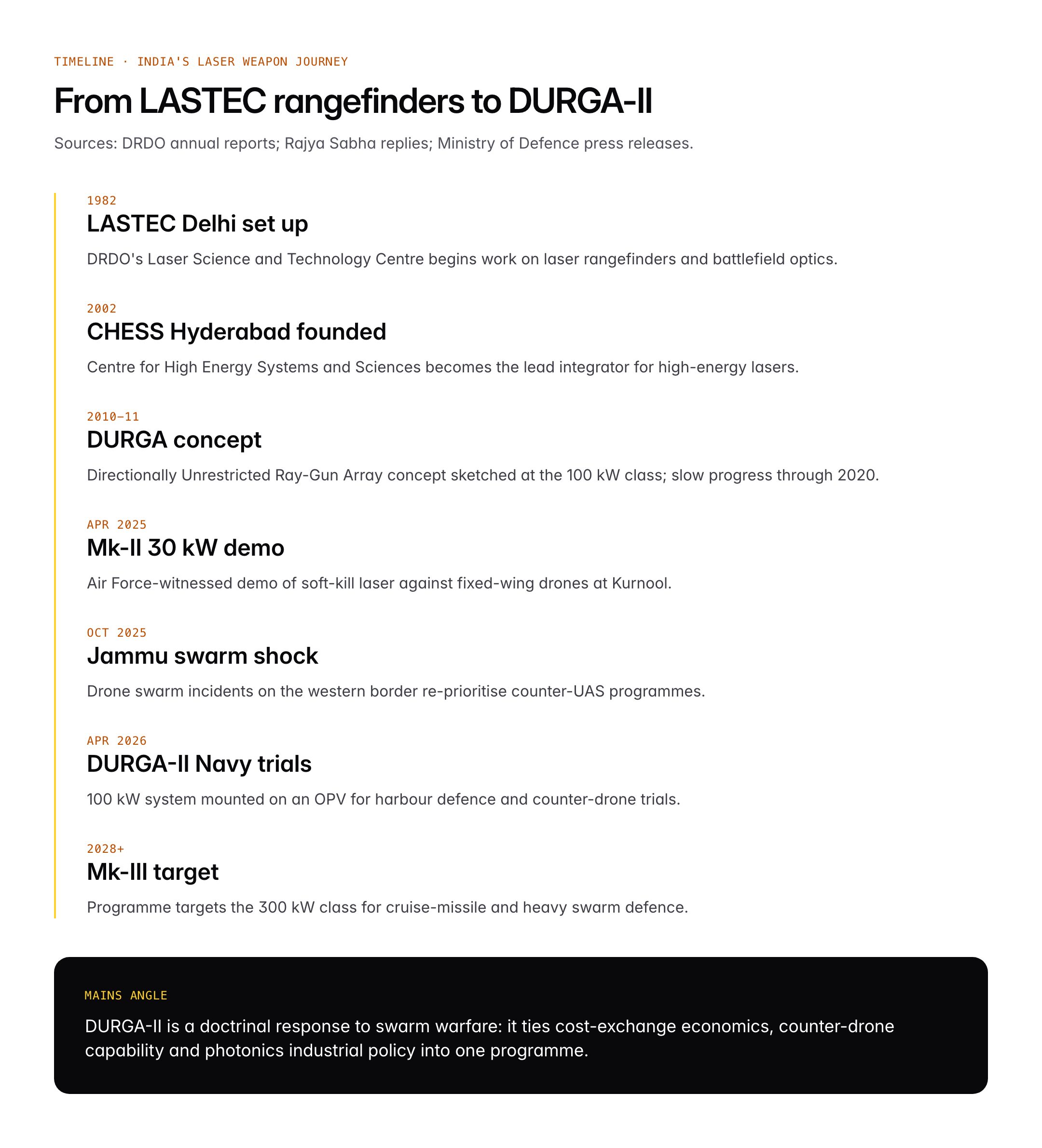
In April 2026, the Defence Research and Development Organisation (DRDO) confirmed that its DURGA-II directed-energy weapon, rated at the 100 kW class, has entered Indian Navy trials. The system is being mounted on an Offshore Patrol Vessel for harbour-defence and anti-drone evaluation off the Visakhapatnam coast.

The announcement follows DRDO’s earlier public demonstration of the 30 kW Mk-II laser dazzler-and-soft-kill system in April 2025 at the Kurnool test range, conducted before the Indian Air Force. The Mk-II could blind sensors and disable fixed-wing drones at short ranges. DURGA-II moves India from soft-kill to kinetic-kill capability against fast-moving aerial threats.

Momentum has come from two operational shocks. The Russia-Ukraine war, now into its fifth year, has normalised swarm-drone warfare at the tactical edge. And the October 2025 Jammu and Punjab swarm attacks, in which dozens of low-cost drones tested Indian air defence along the western border, exposed the cost-exchange problem of using expensive missile interceptors against cheap unmanned aerial systems.

UPSC Relevance at a Glance

DimensionCoverage
GS PaperGS3 – Defence Technology, Internal Security, Science and Technology
PrelimsDURGA-II, CHESS, LASTEC, DRDO, directed-energy weapons, HELWS, Iron Beam
MainsCounter-drone doctrine, indigenisation, cost-exchange, strategic deterrence
Syllabus TagsIndigenous technology, security challenges, border management
DRDO DURGA-II: India's 100 kW Laser Weapon Enters Navy Trials

Background and Context

Directed-energy weapons (DEWs) use concentrated electromagnetic energy, typically lasers or high-power microwaves, to damage or destroy targets. DEW research in India began in the early 1980s at the Laser Science and Technology Centre (LASTEC), Delhi, a DRDO lab originally focused on ballistic laser rangefinders. In 2002, DRDO set up the Centre for High Energy Systems and Sciences (CHESS) in Hyderabad as the lead integrator for high-energy laser platforms.

The first conceptual designs of DURGA (Directionally Unrestricted Ray-Gun Array) were floated around 2010-11. These envisaged a naval-mounted laser at the 100 kW class, but progress stalled for a decade because of the twin bottlenecks of high-power fibre lasers and beam-director optics.

Three exogenous shocks reopened the programme. First, the cost-exchange crisis in Ukraine, where a Rs 15-25 lakh surface-to-air missile was being used to intercept Rs 1-2 lakh drones. Second, the debut of operational DEWs abroad: the United States deployed HELWS on Stryker vehicles and a 50 kW laser on USS Preble; Israel advanced the Iron Beam for mortar and rocket defence in the 2024-25 window; and China openly displayed the Silent Hunter truck-mounted laser for export. Third, the 2025 border drone incidents inside India.

DRDO compressed its roadmap. The 30 kW Mk-II was demonstrated in April 2025. DURGA-II, in the 100 kW class, was bench-tested through 2025 and rolled into Navy trials in April 2026. A Mk-III programme at the 300 kW class is in concept phase, aimed at countering cruise missiles and heavier swarms by the end of the decade.

Key Features of DURGA-II

Architecture and engineering

  • Hybrid laser core: DURGA-II combines a fibre laser array with a solid-state laser stage, which gives it modular scalability, better beam quality and a more compact footprint than chemical lasers.
  • Power and thermal budget: The system is rated at the 100 kW class output, drawn from an onboard power pack with about 1 MW of thermal management for cooling the laser head and electronics.
  • Beam director: A stabilised gimbal with adaptive optics compensates for atmospheric turbulence and platform motion. Tracking is cued by radar and electro-optical sensors.
  • Engagement envelope: Estimated effective range of about 5 km against small unmanned aerial systems, mortars, and unguided rockets. Engagement time per target is in single-digit seconds.
  • Platform: Initial trials on an Indian Navy Offshore Patrol Vessel. Army and Air Force variants are planned on truck and shelter platforms.

Kill chain and doctrine

  • Dazzle mode: Low-power sensor denial, inherited from Mk-II.
  • Soft-kill mode: Disable optical and electronic payloads.
  • Hard-kill mode: Structural damage to airframe or warhead, enabled by the 100 kW class output.

Institutional anchor

  • CHESS Hyderabad leads integration; LASTEC Delhi supplies the beam source; private industry partners include Tata Advanced Systems, L&T and Paras Defence for optics and power electronics.
  • The Integrated Defence Staff coordinates doctrine and tri-service trials.

Cost-exchange logic

DRDO’s internal estimate puts the cost per engagement at Rs 5-10 lakh, compared with Rs 15-25 lakh for a surface-to-air missile interceptor. For drones priced at Rs 1-5 lakh, this reverses the cost-exchange ratio that currently favours the attacker.

Significance

  • Strategic deterrence against low-cost drone swarms, anti-ship missiles in terminal phase and loitering munitions, a capability the Indian armed forces lacked until now.
  • Reduces the cost-exchange penalty. Every successful laser engagement saves up to 20x the per-shot cost of a conventional interceptor.
  • Places India in a small DEW club with the United States, Israel, China, Russia and the United Kingdom, raising its profile in defence technology diplomacy and potential exports under the Rs 50,000 crore defence export target.
  • Validates the indigenisation push under Atmanirbhar Bharat Defence, with over 70 percent domestic content across the beam source, power pack and optics.
  • Creates a platform for civil-military spinoffs in industrial laser cutting, additive manufacturing and atmospheric sensing.
  • Answers the October 2025 swarm attack lesson directly, giving border and high-value asset defenders a scalable counter-swarm tool.
DRDO DURGA-II: India's 100 kW Laser Weapon Enters Navy Trials

Concerns, Criticisms and Challenges

The DURGA-II programme is promising but not problem-free.

  • Atmospheric limitation. Laser beams attenuate in rain, fog and dust. Effective range drops sharply in humid coastal conditions, the very environment the Navy trial is evaluating. Desert and high-altitude performance is yet to be published.
  • Power and cooling. Sustaining the 100 kW beam for sequential engagements requires large power packs and thermal stores. Integration on smaller Army vehicles remains an open engineering challenge.
  • Line-of-sight constraint. DEWs cannot engage targets beyond the horizon or behind terrain, unlike surface-to-air missiles with datalink guidance.
  • Export controls. Key photonics components are covered by the Wassenaar Arrangement dual-use list; while India is a member since 2017, certain pump diodes and high-damage-threshold coatings still require import.
  • Doctrine and escalation. A blinding-capable laser raises obligations under the 1995 UN Protocol on Blinding Laser Weapons, which India ratified. Rules of engagement will have to separate soft-kill from hard-kill modes clearly.
  • Counter-DEW measures. Adversaries are already experimenting with ablative coatings, retro-reflective countermeasures and hardened sensors. The advantage window may be shorter than optimism suggests.
  • Budgetary scale. Moving from Mk-II to a 300 kW Mk-III will require sustained R&D funding, which competes with recurring modernisation outlays under the Defence Services Estimates.

Comparative and Historical Perspective

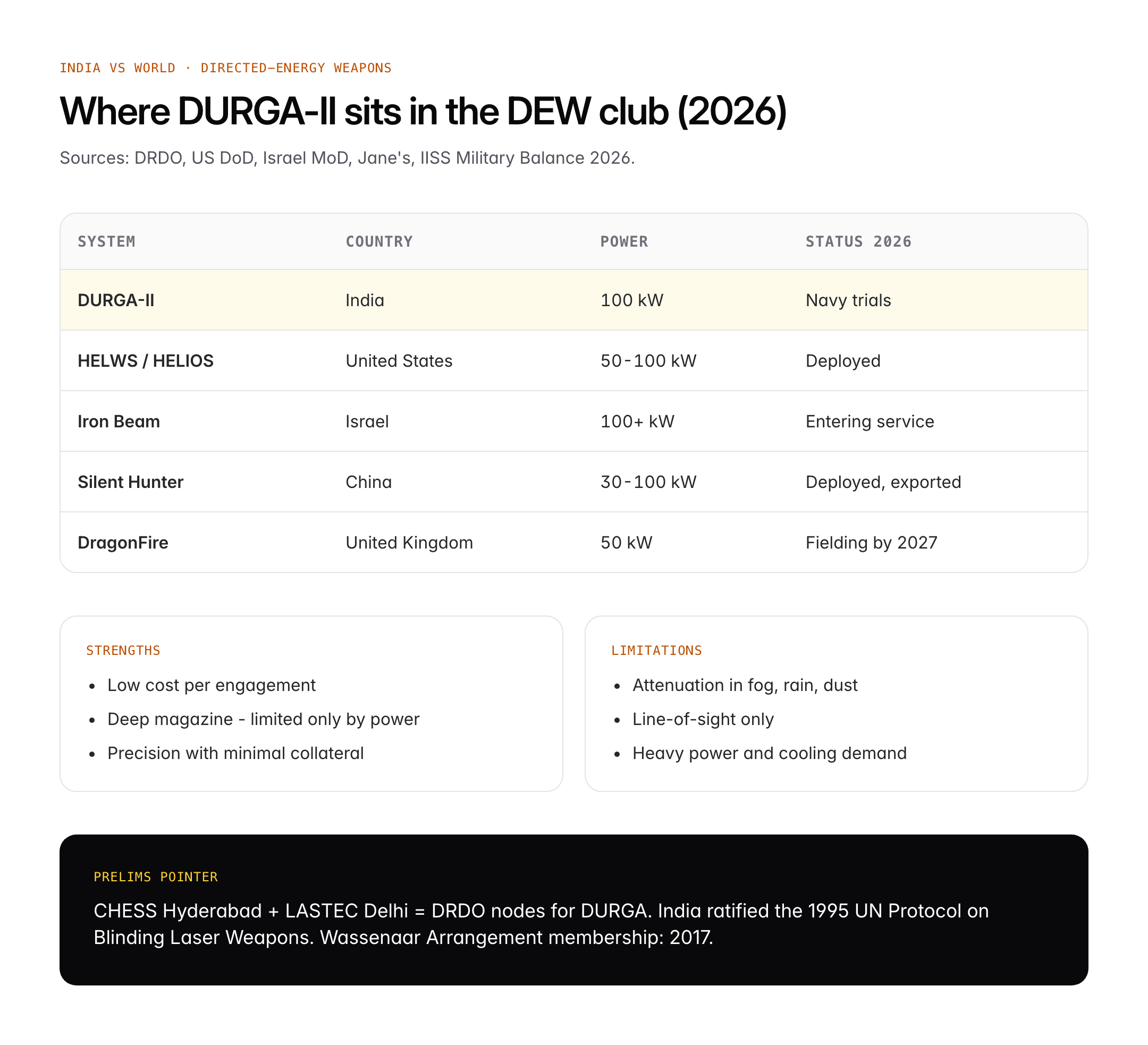
SystemCountryPower classPlatformStatus 2026
DURGA-IIIndia100 kWOPV, Army vehicles (planned)Navy trials, Apr 2026
HELWS / DE M-SHORADUnited States50-100 kWStryker, navalDeployed
Iron BeamIsrael100+ kWFixed siteEntering service, 2025-26
Silent HunterChina30-100 kWTruckDeployed, exported
Peresvet / ZadiraRussiaClassifiedFixed / mobileLimited operational
DragonFireUnited Kingdom50 kW classRN shipsFielding by 2027

India’s 2026 entry brings it within a decade-adjusted parity with the US 2014 LaWS demonstration at 30 kW, and 2021-22 Navy HELIOS at 60 kW. The Mk-III 300 kW target closes this gap meaningfully.

Way Forward

  • DRDO and the Integrated Defence Staff should finalise joint counter-drone doctrine that blends DURGA-II with point-defence guns and electronic warfare, not as a standalone system.
  • MoD Department of Defence Production should accelerate private-sector orders for beam directors and power electronics to crowd-in investment, following the iDEX – ADITI framework.
  • Ministry of External Affairs should proactively engage CCW Protocol IV and export-control forums to shape DEW norms, not lag them.
  • Ministry of Defence should fast-track an Integrated Air and Missile Defence Command so that DEWs, missiles and electronic warfare report to a single command chain.
  • DST-DRDO-IISc should fund a photonics mission to domesticate pump diodes, fibre laser combiners and high-damage optical coatings.
  • Indian Navy, Army and Air Force should conduct a tri-service integration exercise in 2027 to validate DURGA-II against swarm targets in coastal, desert and mountain conditions.
  • NITI Aayog and DPIIT should ensure dual-use spinoffs in industrial lasers reach MSMEs, following the ISRO-style technology transfer playbook.

Conclusion

DURGA-II is not merely a prestige weapon. It is a doctrinal response to a world where the cheapest attacker has the advantage. By demonstrating a 100 kW laser on an operational Navy platform in April 2026, India has bought itself a counter-swarm capability that matches the operational lessons of Ukraine and Jammu 2025.

The programme is still short of the 300 kW threshold that makes DEWs a true cruise-missile and fast-jet defence, and the atmospheric, doctrinal and industrial challenges are real. Yet the direction is correct. If India can pair DURGA-II with coherent tri-service doctrine, export-control diplomacy and a deep photonics supply chain, it will be among the first middle powers to normalise directed-energy weapons in day-to-day force structure. See related coverage on Agni-P Missile, Apache Helicopter and Nuclear Weapon Technologies.

Prelims Pointers

  • DURGA-II expands to Directionally Unrestricted Ray-Gun Array, Phase II.
  • Rated at 100 kW class, up from Mk-II 30 kW demonstrated April 2025.
  • Developed by CHESS Hyderabad and LASTEC Delhi under DRDO.
  • Hybrid architecture: fibre laser plus solid-state stage.
  • Estimated engagement range about 5 km.
  • Mk-III target 300 kW class for cruise missile and heavy swarm defence.
  • Cost per engagement Rs 5-10 lakh versus Rs 15-25 lakh per missile interceptor.
  • India ratified the 1995 UN Protocol on Blinding Laser Weapons.
  • Foreign comparators: US HELWS, Israel Iron Beam, China Silent Hunter, UK DragonFire.
  • First platform for trials: Indian Navy Offshore Patrol Vessel.
  • India joined the Wassenaar Arrangement in 2017.
  • IDS, the Integrated Defence Staff, coordinates tri-service DEW doctrine.

Mains Practice Question

Q. Directed-energy weapons are reshaping the economics of air defence. Critically examine the strategic and doctrinal implications of DRDO’s DURGA-II programme for India’s counter-drone capability. (15 marks, 250 words)

  • Describe DURGA-II specifications, CHESS-LASTEC lineage, Navy trial context and the Mk-II to Mk-III roadmap.
  • Analyse its implications for cost-exchange, strategic deterrence and counter-swarm operations after Ukraine and the October 2025 Jammu incidents.
  • Identify atmospheric, industrial, export-control and doctrinal limits, and outline a tri-service integration plan.

Frequently Asked Questions

What is DURGA-II?

DURGA-II stands for Directionally Unrestricted Ray-Gun Array, Phase II. It is a 100 kW class directed-energy laser weapon developed by DRDO through CHESS Hyderabad and LASTEC Delhi. The system uses a hybrid fibre plus solid-state laser architecture and is designed to destroy small drones, mortars and rockets at ranges of about five kilometres.

Why is DURGA-II in news in April 2026?

In April 2026, DRDO confirmed that DURGA-II has entered Indian Navy trials aboard an Offshore Patrol Vessel off the Visakhapatnam coast. This marks India’s jump from the 30 kW Mk-II dazzler demonstrated in April 2025 to a 100 kW kinetic-kill laser, placing India in the same directed-energy weapons club as the United States, Israel and China.

How is DURGA-II different from the Mk-II laser shown in 2025?

The 30 kW Mk-II was a soft-kill system. It could blind sensors and disable small drones at short range but could not structurally damage a fast-moving target. DURGA-II at 100 kW offers kinetic-kill capability, structurally destroying airframes, optics and warheads, and can be mounted on naval and mobile platforms.

What is the cost-exchange advantage of directed-energy weapons?

DRDO estimates DURGA-II’s cost per engagement at Rs 5-10 lakh of electricity and consumables, against Rs 15-25 lakh per surface-to-air missile interceptor. When the target drone itself costs Rs 1-5 lakh, lasers reverse the attacker’s cost advantage that swarm tactics exploit, as seen in Ukraine and the October 2025 Jammu incidents.

Which agencies developed DURGA-II?

The Centre for High Energy Systems and Sciences (CHESS) in Hyderabad led integration, with the beam source supplied by the Laser Science and Technology Centre (LASTEC) in Delhi. Both are DRDO laboratories. Private sector partners include Tata Advanced Systems, L&T and Paras Defence for optics, power electronics and structural elements.

What are the limitations of laser weapons like DURGA-II?

Laser beams attenuate sharply in fog, rain and dust, reducing effective range. Sustained fire demands heavy power and thermal management. The system is line-of-sight only and cannot engage beyond the horizon. Dual-use photonics components face export-control restrictions under the Wassenaar Arrangement, and counter-DEW measures like ablative coatings are already in development.

How does this affect UPSC Prelims and Mains?

For Prelims, remember DURGA-II full form, 100 kW rating, CHESS and LASTEC, Navy trial in April 2026, and foreign equivalents like HELWS and Iron Beam. For Mains GS3, DURGA-II supports answers on indigenous defence technology, counter-drone doctrine, cost-exchange economics, border management and India’s place in the global directed-energy weapons club.

How does India compare with the global DEW club?

The US deploys HELWS at 50-100 kW on land and naval platforms, Israel is fielding Iron Beam at 100 kW plus, China exports the Silent Hunter, and the UK is fielding DragonFire by 2027. India at 100 kW in 2026 closes the parity gap. DRDO’s Mk-III roadmap at 300 kW plus aims to bring cruise-missile class defence within reach by the late 2020s.

Patna Bird Sanctuary & Chhari-Dhand: India’s 97th and 98th Ramsar Sites (2026)

Open article →Download PDF

Why in News?

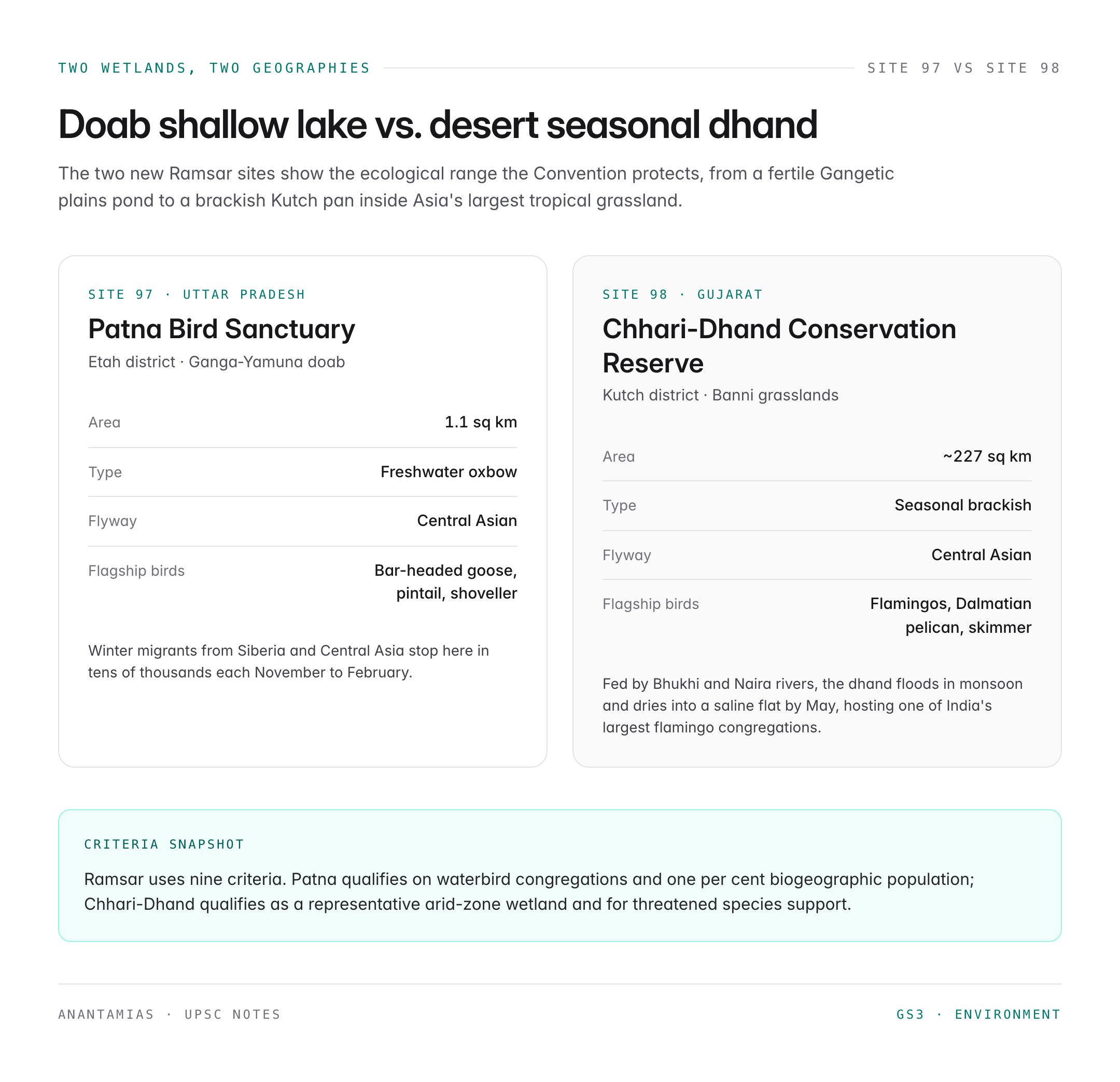
In early 2026, the Ministry of Environment, Forest and Climate Change (MoEFCC) announced the addition of two new wetlands to India’s Ramsar list, taking the national tally to 98. The designations came in the run-up to World Wetlands Day on 2 February and were formally notified by the Ramsar Secretariat based in Gland, Switzerland.

The two freshly added sites are the Patna Bird Sanctuary in the Etah district of Uttar Pradesh and the Chhari-Dhand Conservation Reserve in Kutch, Gujarat. With this addition, India now hosts the largest network of Wetlands of International Importance in Asia, surpassing China’s count and underlining the country’s diplomatic and ecological footprint under the Ramsar Convention framework.

The timing is significant. The Central government has been scaling up wetland action through the Amrit Dharohar initiative, the National Plan for Conservation of Aquatic Ecosystems (NPCA), and state-level wetland authorities mandated under the Wetlands (Conservation and Management) Rules, 2017. The two new sites also reinforce India’s position at the upcoming Conference of Contracting Parties of the Ramsar Convention and dovetail with disclosures in the country’s seventh biodiversity report to the CBD.

UPSC Relevance at a Glance

DimensionRelevance
GS PaperGS3 — Environment and Biodiversity
PrelimsRamsar Convention, Montreux Record, Central Asian Flyway, Bonn Convention, Amrit Dharohar, Wetlands Rules 2017, Banni grasslands
MainsWetland governance, transboundary bird conservation, federal wetland management, climate and ecosystem services
Syllabus TagsConservation, Environmental Pollution and Degradation, Environmental Impact Assessment, International Treaties
Patna Bird Sanctuary & Chhari-Dhand: India's 97th and 98th Ramsar Sites (2026)

Background and Context

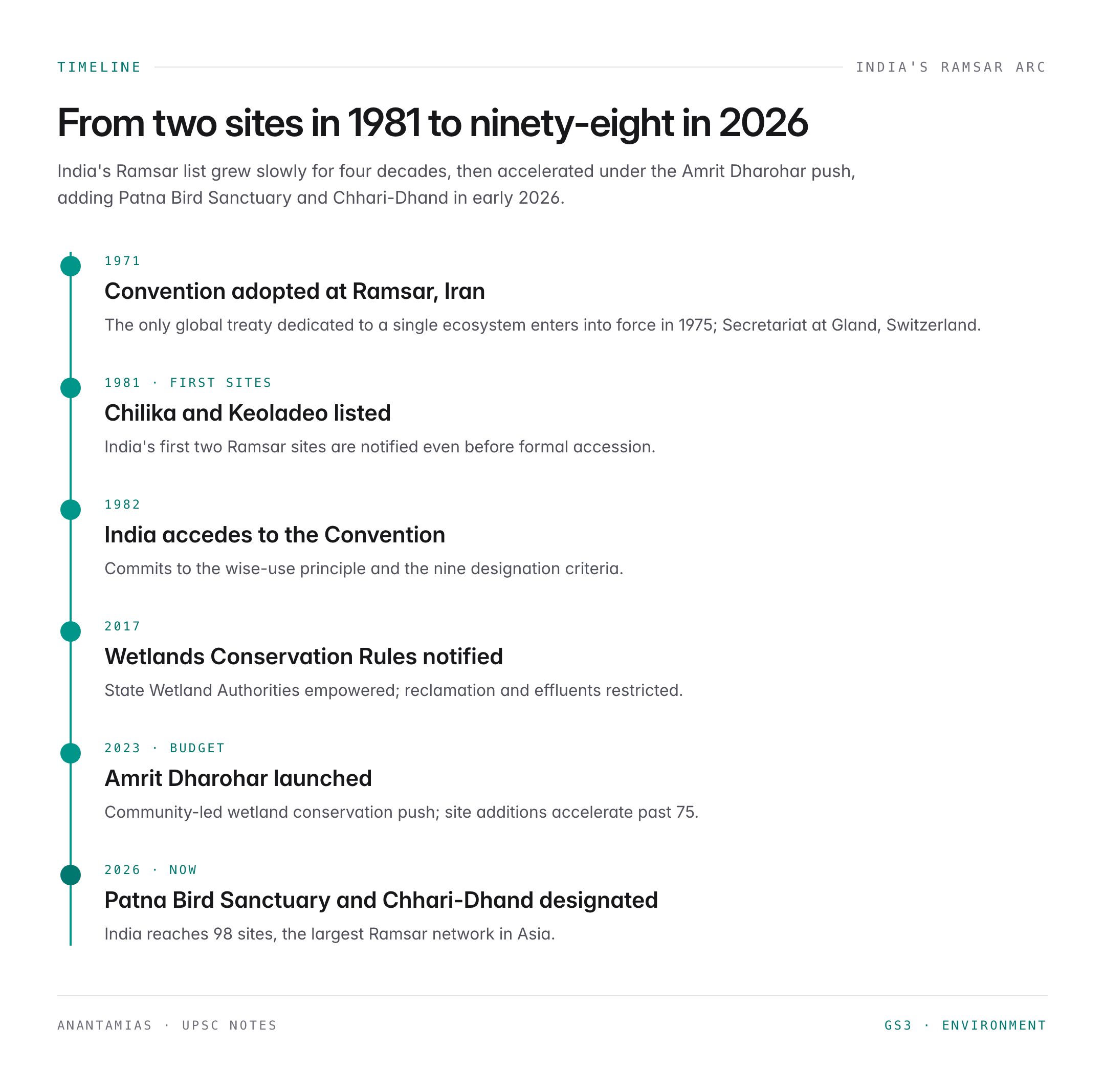
The Ramsar Convention on Wetlands of International Importance especially as Waterfowl Habitat was adopted on 2 February 1971 in the Iranian city of Ramsar on the Caspian coast. It remains the only global treaty focused on a single ecosystem type, and its Secretariat is co-hosted by the International Union for Conservation of Nature in Gland, Switzerland. The Convention entered into force in 1975.

India acceded to the Convention in 1982, becoming one of the earlier contracting parties in South Asia. The first two Indian sites, both designated in 1981, were Chilika Lake in Odisha and the Keoladeo National Park (Bharatpur) in Rajasthan. Over the next four decades the list grew slowly, but the pace accelerated sharply from 2022 onward under the Amrit Dharohar push, crossing 75 sites in the Azadi Ka Amrit Mahotsav year and now reaching 98.

The Convention rests on three pillars: designation of Ramsar sites, commitment to the wise-use principle (sustainable use that maintains ecological character), and international cooperation on shared wetlands and migratory waterbird flyways. Sites that have suffered or are likely to suffer a change in ecological character are placed on the Montreux Record, a watch-list mechanism. Keoladeo and Loktak remain on this list, and managing their removal is a continuing policy challenge.

Wetland governance within India is anchored by the Wetlands (Conservation and Management) Rules, 2017, which empower State Wetland Authorities, mandate integrated management plans, and regulate activities such as reclamation, solid waste dumping, and industrial effluent discharge. Complementary vehicles include the NPCA, the Amrit Dharohar scheme launched in the 2023-24 Budget, and state-specific ecosystem payments. Unlike biosphere reserves, which rely on UNESCO’s Man and the Biosphere programme, Ramsar sites are legally anchored in an intergovernmental treaty with binding reporting obligations.

Key Features

Patna Bird Sanctuary, Uttar Pradesh

Patna Bird Sanctuary, often called Patna Pakshi Vihar to distinguish it from the Bihar capital, lies in the Etah district of western Uttar Pradesh, roughly 210 km from Delhi. At around 1.1 sq km, it is among the smallest wetlands in India’s Ramsar list but one of the richest in bird density.

  • Location and origin: A shallow natural depression on the Ganga-Yamuna doab, fed seasonally by monsoon run-off and a subsurface connection with the Kali Nadi.
  • Flyway importance: The sanctuary sits squarely on the Central Asian Flyway (CAF), one of nine global migratory bird flyways, stretching from the Arctic to the Indian Ocean through roughly 30 countries.
  • Key avifauna: Bar-headed goose (Anser indicus), northern pintail, northern shoveller, common teal, ruddy shelduck, cotton pygmy goose, spot-billed duck and sarus crane.
  • Protection status: Notified as a sanctuary under the Wild Life (Protection) Act, 1972, with the UP Forest Department as the lead management authority.

Chhari-Dhand Conservation Reserve, Gujarat

Chhari-Dhand is a seasonal desert wetland inside the Banni grasslands ecosystem of the Kutch district. Chhari means salt-affected in Kutchi and dhand means a shallow wetland, together describing a mosaic of brackish pools that form during the monsoon.

  • Hydrology: Fed by rivers such as the Bhukhi, Naira and Mathal, plus run-off from the Kala Dungar hills, the wetland dries out in summer into a saline flat.
  • Ecological value: Supports one of India’s largest congregations of greater and lesser flamingos, along with cranes, raptors such as the Eurasian marsh harrier, Dalmatian pelicans and Indian skimmers.
  • Landscape matrix: Embedded within the Banni grasslands, Asia’s largest tropical grassland, and adjacent to the Kutch Biosphere Reserve and the Lala-Parjan bustard sanctuary.
  • Community link: The pastoral Maldhari community depends on Banni for livestock grazing, making Chhari-Dhand a test case for integrating conservation with pastoral livelihoods.

Criteria Used for Designation

Ramsar uses nine scientific criteria, grouped into two sets. Group A (Criterion 1) covers representative, rare or unique wetland types. Group B (Criteria 2 to 9) covers sites of international importance for conserving biological diversity, including threatened species, waterbird congregations of at least 20,000 individuals, or sites holding one per cent of a biogeographic population.

Patna Bird Sanctuary qualifies under criteria focused on waterbird assemblages, while Chhari-Dhand meets criteria relating to representative wetland types in a biogeographic region, threatened species support, and large bird congregations.

Significance

  • Diplomatic leadership: With 98 sites India now operates the largest Ramsar network in Asia, strengthening its voice at the Convention’s Conference of the Parties and in parallel IUCN fora such as the IUCN World Congress.
  • Flyway conservation: Both sites anchor India’s commitments under the Central Asian Flyway Action Plan, a non-binding instrument under the Bonn Convention on Migratory Species, to which India is a signatory.
  • Ecosystem services: Wetlands act as carbon sinks, buffer floods and droughts, recharge groundwater and sustain fisheries. The Economics of Ecosystems and Biodiversity exercises value these services in the trillions globally.
  • Climate resilience: Seasonal wetlands like Chhari-Dhand become critical drought refuges in arid Kutch, while Patna supports winter migrants fleeing frozen Central Asian breeding grounds.
  • Community economies: Ramsar status unlocks eco-tourism, research grants and convergence funding across ministries, benefitting Maldhari pastoralists in Banni and farming communities around Etah.
  • Legal shield: Designation strengthens the obligation of state governments to notify integrated management plans and restricts incompatible activities under the 2017 Rules.
Patna Bird Sanctuary & Chhari-Dhand: India's 97th and 98th Ramsar Sites (2026)

Concerns and Challenges

Ramsar status is a label, not an automatic safeguard. India’s record on the ground is uneven. Keoladeo National Park and Loktak Lake remain on the Montreux Record because of shrinking water inflows, invasive species and hydrological interference. Several sites lack up-to-date integrated management plans, a violation of both the 2017 Rules and the Convention’s wise-use obligation.

The Patna Bird Sanctuary faces encroachment from expanding agriculture, eutrophication from fertiliser run-off in the sugarcane and wheat belt of Etah, and pesticide residues that bioaccumulate in piscivorous birds. Its small size, barely a square kilometre, makes buffer-zone management vital but also politically difficult where cultivation abuts the boundary.

Chhari-Dhand sits in a stressed landscape. The spread of the invasive mesquite Prosopis juliflora, locally called gando baval, has converted large tracts of Banni into thorn forest, altering grazing patterns and hydrology. Proposed renewable energy corridors, including solar and wind projects in Kutch, risk fragmenting the flyway. Saline ingress, reduced monsoon dependability and upstream water diversions further threaten the dhand’s seasonal flooding regime.

A structural gap is governance. State Wetland Authorities often lack dedicated budgets, ecologists and enforcement capacity. Citizen-science monitoring is patchy. There is no single national wetland inventory that matches Survey of India mapping with ground-truthed ecological data, limiting adaptive management.

Finally, climate change is a slow-motion threat. Shifting monsoon onset, extreme rainfall events and rising temperatures are reshaping both sites. The Central Asian Flyway itself may reorganise, potentially bypassing smaller stopovers if cues change. The World Heritage Outlook 4 report flags similar concerns for natural sites globally.

Comparative / Historical Perspective

India’s Ramsar journey reflects a shift from token designations to a pan-Indian, state-negotiated network. Tamil Nadu now leads with 18 sites, reflecting a focused state-level push through its Wetlands Mission. Uttar Pradesh follows closely, with the addition of Patna Bird Sanctuary taking its count higher. Gujarat strengthens its coastal-arid wetland portfolio with Chhari-Dhand.

Parameter1981 (First Sites)2022 (75 Sites milestone)2026 (98 Sites)
Total sites27598
Leading stateRajasthan, OdishaTamil NaduTamil Nadu (18)
Flagship additionChilika, KeoladeoPallikaranai, KhijadiyaPatna BS, Chhari-Dhand
Policy frameWildlife Protection Act, 1972Wetlands Rules, 2017 + Amrit DharoharNPCA 2.0, state wetland missions
Global rankMid-tierAmong top 10Largest network in Asia

Globally, the United Kingdom has the most Ramsar sites, followed by Mexico and Bolivia. India’s progression mirrors a broader Asian trend where China, South Korea and Japan are also rapidly adding sites, but India’s 2026 tally now leads the continent.

Way Forward

  • Integrated management plans with teeth: MoEFCC and State Wetland Authorities should publish time-bound, budgeted plans for every Ramsar site, with independent ecological audits every three years.
  • Flyway-level action: The Wildlife Institute of India and Bombay Natural History Society should operationalise the Central Asian Flyway National Action Plan through satellite-tagging, eBird-linked citizen science and transboundary coordination.
  • Banni landscape approach: Gujarat Forest Department, in partnership with Sahjeevan and Maldhari community institutions, should combine Chhari-Dhand management with Prosopis removal and pastoral livelihood schemes under MGNREGS.
  • Sensitive siting of renewables: The Ministry of New and Renewable Energy must align solar and wind corridor planning in Kutch with the CAF migration map and Great Indian Bustard recovery.
  • Fertiliser and pesticide controls: The Ministry of Agriculture and Farmers Welfare and state agriculture departments should roll out buffer-zone natural-farming clusters around Patna Bird Sanctuary under Paramparagat Krishi Vikas Yojana.
  • Remove Montreux blots: Targeted action to restore Keoladeo inflows from the Panchana dam and address Loktak’s Ithai Barrage regulation is needed to exit the Montreux Record.
  • Wetland finance: RBI, SEBI and MoEFCC can together frame green-bond and biodiversity-credit instruments to channel private capital into wetland restoration under the Amrit Dharohar umbrella.

Conclusion

The addition of Patna Bird Sanctuary and Chhari-Dhand to the Ramsar list marks a quiet but consequential milestone in India’s conservation story. A small doab wetland in Uttar Pradesh and a brackish desert pan in Kutch now stand on the same global pedestal as Chilika and Keoladeo. The message is that wetlands come in many forms and each is worth saving.

For the UPSC aspirant, the event is a prompt to think beyond labels. India’s challenge is not to keep adding sites but to make each one function as a living, self-regulating ecosystem that supports biodiversity, livelihoods and climate resilience. The arithmetic of 98 is impressive. The test now is ecological character, community stewardship and the humility to learn from the two sites still on the Montreux Record.

Prelims Pointers

  1. The Ramsar Convention was adopted in 1971 in Ramsar, Iran, and came into force in 1975.
  2. India ratified the Convention in 1982. Chilika and Keoladeo were the first Indian Ramsar sites, designated in 1981.
  3. Wetlands of International Importance are designated against nine scientific criteria.
  4. The Montreux Record lists sites with adverse changes in ecological character. Keoladeo and Loktak remain on it from India.
  5. Patna Bird Sanctuary is in the Etah district of Uttar Pradesh, on the Central Asian Flyway.
  6. Chhari-Dhand Conservation Reserve lies in the Banni grasslands of Kutch, Gujarat.
  7. The Central Asian Flyway is one of nine global flyways and operates under the Bonn Convention on Migratory Species.
  8. Tamil Nadu has the largest number of Ramsar sites in India at 18.
  9. The Wetlands (Conservation and Management) Rules, 2017 govern Indian wetlands and empower State Wetland Authorities.
  10. Amrit Dharohar was announced in the 2023-24 Union Budget for community-led wetland conservation.
  11. Banni is Asia’s largest tropical grassland and faces invasion from Prosopis juliflora.
  12. With 98 Ramsar sites, India has the largest such network in Asia.

Mains Practice Question

Q. Mere designation of wetlands as Ramsar sites has not translated into ecological security on the ground in India. Examine with reference to recent additions and suggest a way forward. (15 marks, 250 words)

  • Structure: introduce the Ramsar framework and India’s 98-site network, referencing Patna Bird Sanctuary and Chhari-Dhand.
  • Argue the implementation gap using Montreux Record sites, Wetlands Rules 2017 enforcement weaknesses, and landscape pressures such as Prosopis, agriculture run-off and renewable corridors.
  • Conclude with reforms: integrated management plans, Central Asian Flyway action, community-led conservation, green finance, and removal from the Montreux Record as a measurable goal.

Frequently Asked Questions

What is the Ramsar Convention and when did India join it?

The Ramsar Convention is a 1971 international treaty adopted in Ramsar, Iran for the conservation and wise use of wetlands. It entered into force in 1975. India acceded to it in 1982, and its first two designated sites were Chilika Lake in Odisha and Keoladeo National Park in Rajasthan, both listed in 1981.

Why are Patna Bird Sanctuary and Chhari-Dhand in the news in 2026?

In early 2026 the Ministry of Environment, Forest and Climate Change notified Patna Bird Sanctuary in Etah, Uttar Pradesh, and Chhari-Dhand Conservation Reserve in Kutch, Gujarat as India’s 97th and 98th Ramsar sites. The designations, made around World Wetlands Day, gave India the largest Ramsar network in Asia.

Where is Patna Bird Sanctuary located and what birds does it host?

Patna Bird Sanctuary, also called Patna Pakshi Vihar, is a small shallow wetland in the Etah district of Uttar Pradesh on the Central Asian Flyway. It hosts bar-headed geese, northern pintails, northern shovellers, common teals, ruddy shelducks, spot-billed ducks and sarus cranes, especially during the winter migration season.

What makes Chhari-Dhand ecologically unique?

Chhari-Dhand is a seasonal desert wetland inside the Banni grasslands of Kutch, Gujarat. Fed by rivers such as the Bhukhi and Naira, it floods in the monsoon into brackish pools that attract flamingos, Dalmatian pelicans, Indian skimmers and raptors, then dries to a saline flat in summer, demonstrating an arid-land wetland cycle.

What is the Central Asian Flyway?

The Central Asian Flyway is one of nine global migratory bird flyways. It spans about 30 countries from Arctic Russia and Siberia to the Indian Ocean, passing through India. It is coordinated through a non-binding action plan under the Bonn Convention on Migratory Species, which India has signed.

What is the Montreux Record and which Indian sites are on it?

The Montreux Record is a list maintained under the Ramsar Convention of wetlands that have suffered or are likely to suffer adverse changes in ecological character. From India, Keoladeo National Park in Rajasthan and Loktak Lake in Manipur remain on this list due to altered hydrology, invasive species and water regulation concerns.

How does the 2017 Wetlands Rules framework work in India?

The Wetlands (Conservation and Management) Rules, 2017 are issued under the Environment (Protection) Act, 1986. They set up State Wetland Authorities, require integrated management plans, prohibit reclamation, solid waste dumping and untreated effluent discharge, and define a regulated zone around notified wetlands to secure ecological character.

How does this topic help in UPSC preparation?

The topic covers Prelims facts on Ramsar, Montreux, flyways, CMS and Wetlands Rules, while supporting Mains GS3 answers on conservation, climate resilience and federal environmental governance. It also links to Amrit Dharohar, NPCA and community-led conservation, enabling cross-cutting answers that blend ecology, policy and diplomacy.

Cyrtodactylus jayadityai: New Bent-Toed Gecko Discovered in Assam (2026)

Open article →Download PDF

Why in News?

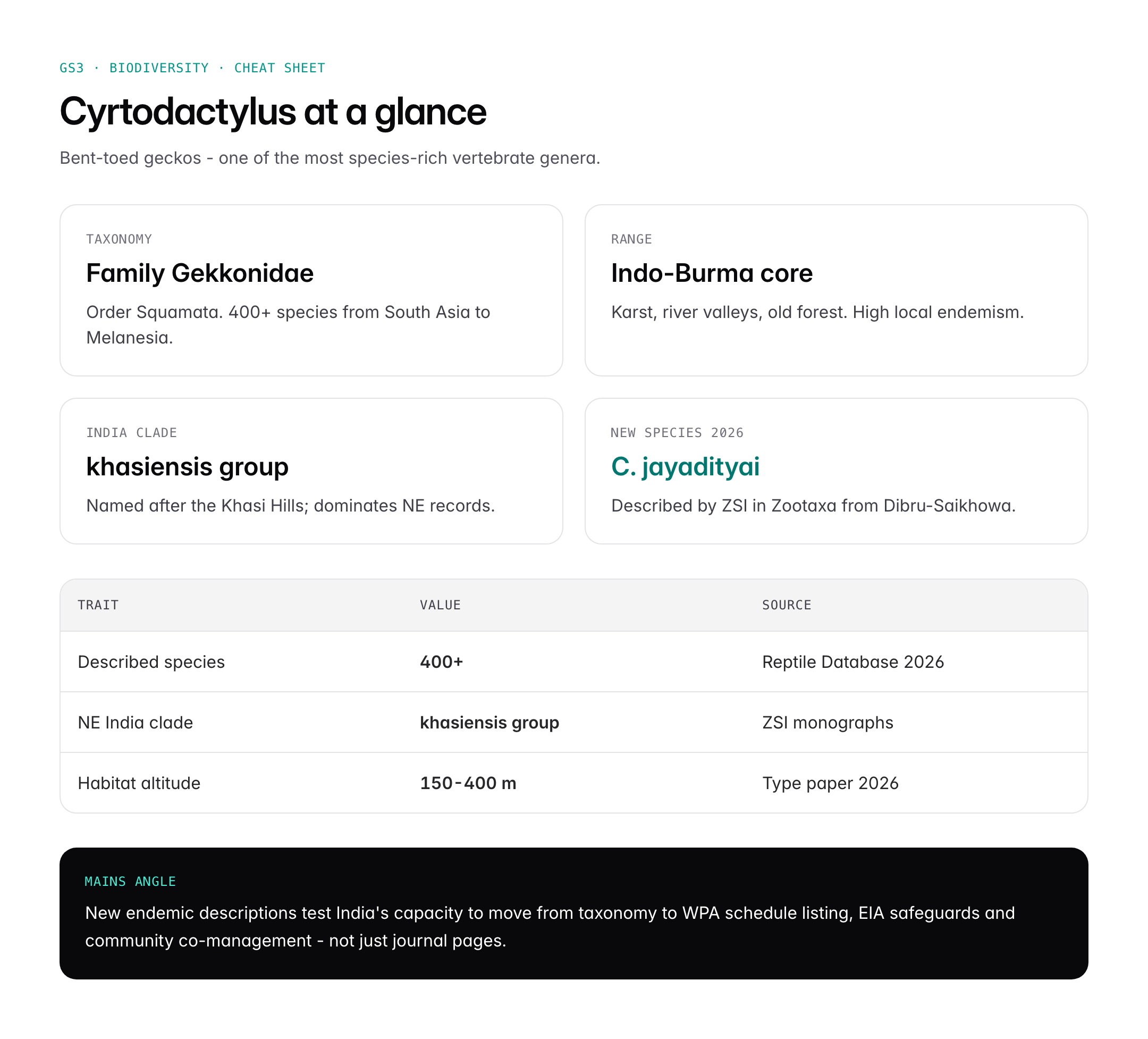
In April 2026, scientists of the Zoological Survey of India (ZSI) formally described a new bent-toed gecko, Cyrtodactylus jayadityai, in the peer-reviewed journal Zootaxa. The species was collected from moist evergreen patches adjoining the Dibru-Saikhowa landscape in upper Assam and has been named in honour of a senior Indian herpetologist for his contributions to reptile taxonomy.

The paper adds yet another lineage to the already swollen Cyrtodactylus khasiensis species group and reinforces that Northeast India continues to be one of the least-catalogued yet most biodiverse regions in the tropical world. ZSI noted that the holotype and paratypes have been deposited in its National Zoological Collections in Kolkata.

The discovery lands at a moment when India is stress-testing its Seventh National Report to the Convention on Biological Diversity (CBD) and updating the National Biodiversity Strategy and Action Plan (NBSAP) 2024 with fresh baselines for endemic fauna.

UPSC Relevance at a Glance

DimensionRelevance
GS PaperGS3 – Environment, Biodiversity, Conservation
PrelimsCyrtodactylus genus; Indo-Burma hotspot; ZSI; Dibru-Saikhowa; IUCN Red List; CITES; WPA 1972
MainsSpecies discovery and conservation planning in Northeast India; EIA and biodiversity hotspots
Syllabus TagsBiodiversity, Ecosystems, Environmental impact assessment

Related reading on anantamias.com: /current-affairs/india-submits-7th-biodiversity-report-but-will-it-meet-its-2030-targets/, /current-affairs/iucn-world-congress/, /current-affairs/biosphere-reserves/.

Cyrtodactylus jayadityai: New Bent-Toed Gecko Discovered in Assam (2026)

Background and Context

Cyrtodactylus, the bent-toed or bow-fingered geckos, is a radiation of nocturnal lizards distributed from South Asia through Southeast Asia to Melanesia. With over 400 accepted species as of 2026 (Uetz, Reptile Database), it is frequently listed among the most speciose vertebrate genera on earth, rivalled chiefly by Old World rodents and some cichlid fish lineages.

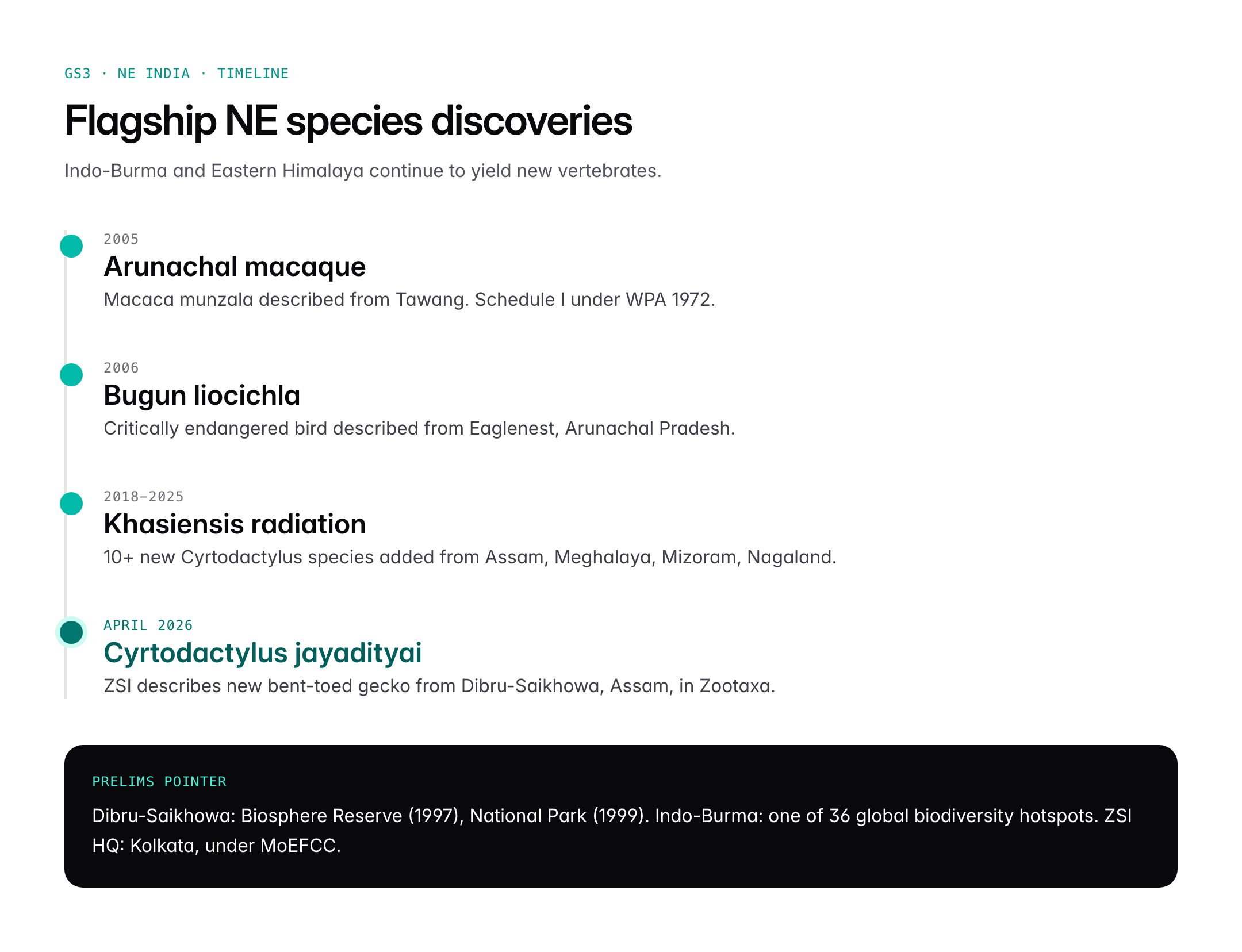
The group’s explosive diversification is linked to karst topography, river valley isolation and old forest cover – exactly the conditions that characterise the Indo-Burma Biodiversity Hotspot. Conservation International recognises Indo-Burma as one of 36 global hotspots, straddling Northeast India, Bangladesh, Myanmar, southern China and mainland Southeast Asia. The hotspot has already lost more than 95% of its original primary vegetation, making every undescribed taxon ecologically significant.

Within India, the khasiensis species group – named after the Khasi Hills of Meghalaya – is the dominant Cyrtodactylus clade. Between 2018 and 2026 alone, ZSI and academic partners have added more than a dozen species to this group from Assam, Meghalaya, Mizoram, Nagaland and Arunachal Pradesh. The addition of C. jayadityai continues that trajectory.

Dibru-Saikhowa, a floodplain mosaic of grasslands, semi-evergreen forest and wetlands between the Brahmaputra and Lohit rivers, was declared a Biosphere Reserve in 1997 and a National Park in 1999. It hosts feral horses, Gangetic dolphins, and a reptile assemblage that taxonomists have only begun to systematically survey.

Key terms readers should fix in memory: type locality (the place where the holotype was collected), holotype (the single specimen on which the species description rests), sympatric (species coexisting in the same area) and cryptic species (morphologically similar but genetically distinct lineages).

Key Findings

Diagnostic characters

  • Cyrtodactylus jayadityai is a medium-sized gecko with a snout-vent length of roughly 80-95 mm.
  • Diagnosed by a combination of tubercle rows, precloacal pore arrangement and a dorsal colour pattern of dark saddles bordered by pale bands.
  • Differs from its closest congeners by a unique count of ventral scales and an unbroken nuchal loop on the neck.
  • Molecular evidence from the ND2 mitochondrial marker supports its placement as a distinct lineage within the khasiensis group.

Ecology and habitat

  • Collected at night from moss-covered boulders and tree trunks at altitudes between 150 and 400 m.
  • Sympatric with at least two other Cyrtodactylus species, suggesting niche partitioning across microhabitats.
  • The type locality sits within a mosaic of community forest and reserve forest, outside the core Dibru-Saikhowa National Park.

Naming and authorship

  • The specific epithet jayadityai honours a veteran Indian herpetologist for his decades of work on South Asian reptiles.
  • Authors include ZSI scientists from the North Eastern Regional Centre (Shillong) and the Herpetology Division (Kolkata).
  • Publication in Zootaxa, a leading taxonomic journal, followed ICZN registration of the name.

Conservation status

  • Not yet assessed by IUCN; authors recommend a preliminary Data Deficient tag pending range surveys.
  • Likely to qualify for Schedule II of the Wildlife (Protection) Act, 1972 through a future MoEFCC notification, bringing it under legal protection.
  • Not listed on any CITES appendix at present.

Why the find matters scientifically

  • Confirms that the khasiensis radiation extends to the Brahmaputra floodplain edges, not just the Meghalaya-Mizoram ranges.
  • Strengthens the case for revisiting protected area boundaries that still use 1990s-era species lists.
  • Provides a fresh calibration point for divergence-time estimates within Cyrtodactylus.

Significance

  • Strategic value for biodiversity diplomacy: Fresh endemic descriptions feed directly into India’s reporting under CBD’s Kunming-Montreal Global Biodiversity Framework (KM-GBF), including Target 3 (30 by 30) on area-based conservation.
  • Policy leverage for Northeast conservation: The Ministry of Environment, Forest and Climate Change (MoEFCC) can use the discovery to justify continued funding of the NE-specific schemes under the Integrated Development of Wildlife Habitats (IDWH).
  • Capacity signal: ZSI has described over 400 new taxa in the past five years (ZSI Annual Report 2024-25), reinforcing India’s standing as a tropical taxonomy powerhouse.
  • EIA recalibration: Environmental Impact Assessment notifications for hydro and linear projects in upper Assam will now need to factor in a newly recognised endemic.
  • Education and outreach: Names honouring Indian scientists counter the historical dominance of colonial-era binomials in Indian natural history.
  • Ecotourism spillover: Dibru-Saikhowa already draws birders; new reptile records can seed a herpetology-focused eco-tourism circuit with revenue for local communities.
Cyrtodactylus jayadityai: New Bent-Toed Gecko Discovered in Assam (2026)

Concerns, Criticisms and Challenges

The discovery also exposes familiar tensions. First, taxonomic inflation – the splitting of populations into multiple species on thin morphological grounds – is an active debate within herpetology. Critics argue that without deeper genomic sampling, some “new” Cyrtodactylus lineages may collapse back into existing species, complicating Red List assessments.

Second, protection lags description. Schedule amendments under the Wildlife (Protection) Act, 1972 require a formal MoEFCC notification, and in practice newly described reptiles often wait years before being listed. During that interval, pet-trade poaching – documented for other Cyrtodactylus species by TRAFFIC – can threaten tiny populations.

Third, the type locality is outside the national park core. Community forests in Assam are governed by a patchwork of traditional rules, the Assam Forest Regulation, 1891, and village authorities. Absent clear co-management agreements with forest-dependent communities, conservation obligations may collide with customary rights.

Fourth, climate vulnerability is high. Bent-toed geckos are thermally sensitive; modelling by Wildlife Institute of India (WII) scientists suggests Cyrtodactylus ranges in the Eastern Himalaya may contract by 20-35% by 2070 under RCP 4.5. A species known only from one locality is one extreme weather event away from functional extinction.

Finally, there is the persistent under-funding of taxonomy. India trains very few professional herpetologists each year, and ZSI field stations have reported vacancies upwards of 30% in 2024 (Standing Committee on Science & Technology report). Without a cadre, even well-documented species fall out of surveillance.

Comparative Perspective

DimensionCyrtodactylus jayadityai (2026)Earlier NE Discoveries
SiteDibru-Saikhowa, AssamBugun liocichla (2006, Eaglenest, Arunachal); Arunachal macaque (2005)
Host agencyZSI + NE Regional CentreBNHS, Nature Conservation Foundation, university teams
Legal protectionPending WPA schedule listingBugun liocichla on Schedule I; Arunachal macaque on Schedule I
HotspotIndo-BurmaEastern Himalaya + Indo-Burma
Threat profileHabitat fragmentation, pet tradeShifting cultivation, infrastructure, hunting

Globally, Southeast Asian bent-toed gecko descriptions – from Vietnam’s karst and Myanmar’s Chin Hills – have averaged 15-25 new species a year since 2015 (Zootaxa bibliometrics). India’s relative count remains modest, underscoring room for scaled-up effort.

Way Forward

  • MoEFCC should fast-track Schedule listing under WPA 1972 for newly described endemic reptiles via an annual omnibus notification.
  • ZSI and WII must jointly initiate a Northeast Herpetofauna Baseline Mission using standardised transect protocols and eDNA sampling.
  • State Forest Departments of Assam, Meghalaya and Arunachal Pradesh should integrate herpetological data layers into working plans and zonal management plans.
  • National Biodiversity Authority (NBA) should update Access and Benefit Sharing (ABS) guidelines to ensure local communities are compensated when species are named from community forests.
  • Ministry of Tribal Affairs must align Community Forest Resource (CFR) rights under the Forest Rights Act, 2006 with species-level conservation micro-plans.
  • University Grants Commission (UGC) should seed at least ten additional herpetology PhD slots annually at NE universities.
  • EIA 2006 notification should be amended to require a minimum reptile-amphibian survey window of one full monsoon cycle for projects in hotspots.

Conclusion

The description of Cyrtodactylus jayadityai is a small taxonomic event with a large policy shadow. It reminds the state that India’s biodiversity accounts remain provisional, especially in a Northeast that is simultaneously a global hotspot and an infrastructure frontier.

For the UPSC aspirant, the lesson is twofold. Species discovery is not a trivia event – it is a measurable indicator of scientific capacity, legal readiness and federal cooperation. Converting such findings into durable protection requires the slower work of notifications, community agreements and trained personnel, and that work is ultimately what distinguishes a biodiversity-rich country from a biodiversity-secure one.

Prelims Pointers

  • Cyrtodactylus is among the most speciose vertebrate genera, with 400+ described species.
  • C. jayadityai belongs to the khasiensis species group.
  • Type locality is in the Dibru-Saikhowa landscape in upper Assam.
  • Described by ZSI in Zootaxa, April 2026.
  • Dibru-Saikhowa is both a Biosphere Reserve (1997) and a National Park (1999).
  • Indo-Burma is one of 36 global biodiversity hotspots recognised by Conservation International.
  • ZSI is headquartered in Kolkata, under MoEFCC.
  • Wildlife Protection Act 1972 has six Schedules (post-2022 amendment: four schedules).
  • CITES has three appendices: I, II, III.
  • KM-GBF Target 3 is the 30 by 30 target.
  • National Biodiversity Authority is the apex body under the Biological Diversity Act, 2002.
  • EIA Notification 2006 governs project clearances in India.

Mains Practice Question

Q. “Every new species description in a biodiversity hotspot is also a test of state capacity.” In light of recent herpetological discoveries from Northeast India, examine the institutional architecture that converts taxonomic findings into durable conservation outcomes. (15 marks, 250 words)

Answer map:

  • Taxonomy as capacity: role of ZSI, WII, universities; publication pipeline; funding gaps.
  • Legal architecture: WPA schedules, CITES, EIA 2006, Biological Diversity Act 2002.
  • Federal-community interface: CFR rights under FRA 2006, state forest departments, ABS rules; way forward.

Frequently Asked Questions

What is Cyrtodactylus jayadityai?

Cyrtodactylus jayadityai is a new bent-toed gecko species described in April 2026 by Zoological Survey of India scientists in the journal Zootaxa. It was collected from the Dibru-Saikhowa landscape in upper Assam and belongs to the Cyrtodactylus khasiensis species group, which dominates Northeast India’s bent-toed gecko fauna.

Why is Cyrtodactylus jayadityai in news?

The species was formally described in April 2026, adding to the growing list of reptile endemics from the Indo-Burma Biodiversity Hotspot. It reinforces Northeast India’s status as a herpetological frontier and feeds into India’s ongoing updates to the National Biodiversity Strategy and Action Plan and the 7th National Report to the CBD.

Where is the Dibru-Saikhowa landscape?

Dibru-Saikhowa is a floodplain mosaic in upper Assam, lying between the Brahmaputra and Lohit rivers. It was declared a Biosphere Reserve in 1997 and a National Park in 1999. It hosts feral horses, Gangetic dolphins, and a rich but under-surveyed reptile and amphibian assemblage.

What is the Cyrtodactylus genus?

Cyrtodactylus, or bent-toed geckos, is a nocturnal lizard genus with over 400 species, distributed from South Asia to Melanesia. It is one of the most species-rich vertebrate genera globally. Its diversification is linked to karst topography, river valley isolation and old forest cover, conditions typical of Indo-Burma.

What is the Indo-Burma Biodiversity Hotspot?

Indo-Burma is one of 36 global biodiversity hotspots recognised by Conservation International. It spans Northeast India, Bangladesh, Myanmar, southern China and mainland Southeast Asia. Over 95% of its primary vegetation has been lost, making every endemic species description ecologically significant for conservation planning.

Which legal frameworks apply to new Indian reptile species?

Protection for new reptile species flows from the Wildlife (Protection) Act, 1972, through MoEFCC schedule notifications. The Biological Diversity Act, 2002 and its access and benefit sharing rules cover research use. CITES governs international trade, while the EIA Notification 2006 shapes project-level safeguards.

How does this affect UPSC Prelims and Mains?

For Prelims, note the species name, Zootaxa, ZSI, Dibru-Saikhowa, and the khasiensis group. For Mains, the story illustrates GS3 themes on biodiversity hotspots, EIA safeguards, and state capacity in taxonomy. It pairs well with questions on KM-GBF Target 3 and on Northeast-specific conservation.

What are the main conservation concerns for the new species?

The gecko is known from a single locality, making it vulnerable to habitat fragmentation, climate shifts and pet-trade poaching. Schedule listing under WPA 1972 takes time, the type locality sits outside the national park core, and trained herpetologists are scarce. Community co-management and faster legal listing are key.

Chambal Flow Collapse Forces Ganges River Dolphins Downstream: WII Study 2026

Open article →Download PDF

Why in News?

The Wildlife Institute of India (WII), Dehradun, on 18 April 2026 released a technical study titled “Hydrological Stress on Platanista gangetica in the Lower Chambal Basin”. The report concludes that a sustained collapse of environmental flows between the Kota Barrage and the Chambal’s confluence with the Yamuna has pushed the Gangetic river dolphin, India’s National Aquatic Animal, out of several stretches it occupied as recently as 2022.

WII surveyors recorded a 41 per cent fall in sightings inside the National Chambal Sanctuary between 2022 and 2026, with near-complete absence of dolphins between Pali and Rameshwaram ghats during lean months. The animals have shifted downstream into the Yamuna-Chambal confluence and into the middle Ganga, where they face heavier pollution and vessel traffic.

The findings have landed at a politically awkward moment. The Union government is finalising the second phase of Project Dolphin (2020), the National Mission for Clean Ganga (NMCG) is reviewing its aquatic species action plan, and the Central Water Commission (CWC) is revising the environmental flow formula for peninsular rivers. A tributary that was supposed to be the species’ safest refuge is, by WII’s own measurement, becoming hydrologically unliveable.

UPSC Relevance at a Glance

AxisMapping
GS PaperGS3 — Environment, Biodiversity, Conservation
PrelimsPlatanista gangetica, National Chambal Sanctuary, Kota Barrage, Project Dolphin, Schedule I WPA 1972, Vikramshila Dolphin Sanctuary, NMCG
MainsRiver ecology and cumulative impact of dams; environmental flows as a governance problem; species-specific conservation vs catchment-level management
Syllabus TagsEnvironment, Biodiversity, Wildlife Conservation, Water Resources
Chambal Flow Collapse Forces Ganges River Dolphins Downstream: WII Study 2026

Background and Context

The Gangetic river dolphin (Platanista gangetica gangetica) is one of only four obligate freshwater dolphin species in the world. It is effectively blind, with a degenerate eye that lacks a lens, and navigates and hunts entirely through echolocation. It lives exclusively in the Ganga, Brahmaputra, Meghna and Karnaphuli-Sangu river systems, and within these, in deep pools and confluences where water depth stays above one and a half to two metres even in the lean season.

The species carries unusually heavy protective layering. It was declared India’s National Aquatic Animal in 2009, is listed in Schedule I of the Wild Life (Protection) Act, 1972, is classified Endangered by the IUCN, and sits in Appendix I of CITES. The Vikramshila Gangetic Dolphin Sanctuary in Bhagalpur, Bihar, notified in 1991, was the first protected area designated for it. The date 5 January is observed as Gangetic Dolphin Day, marking the 2009 national-animal declaration. In 2020 the Union government launched Project Dolphin, modelled loosely on Project Tiger, to create a coordinated conservation architecture across the Ganga basin.

The first formal all-India Gangetic dolphin census, coordinated by WII and the NMCG, reported roughly 6,327 individuals in 2024. That headline figure masked a sharp geographic skew. The main Ganga channel, the Brahmaputra, and a handful of tributaries carried almost the entire population, with the Chambal standing out as the only major tributary where dolphins still lived in near-reference-condition water.

The Chambal itself has been a conservation success story precisely because its middle reach was never dammed to the extent of other rivers. The National Chambal Sanctuary, a tri-state protected area spanning Madhya Pradesh, Rajasthan and Uttar Pradesh, was notified in 1979 primarily for the critically endangered gharial but incidentally sheltered gangetic dolphins, smooth-coated otters and seven species of freshwater turtles. It is the upstream dams on the Chambal, not inside the sanctuary itself, that have now altered this picture.

Key Findings of the WII Study

Flow data from the Kota Barrage cascade

The Chambal below Kota is regulated by a four-dam cascade. Gandhi Sagar (Madhya Pradesh, commissioned 1960) and Rana Pratap Sagar (Rajasthan, 1970) store water for hydropower and irrigation. Jawahar Sagar (1972) functions as a pickup dam. Kota Barrage, the lowest structure, diverts water into the Chambal Right Main Canal and the Chambal Left Main Canal for command-area irrigation in the Kota, Baran and Bundi districts.

WII’s hydrology annex reports that mean lean-season discharge immediately downstream of Kota Barrage fell from 71 cumecs in the 1990s to 19 cumecs in 2024-25. For roughly 90 days between late February and early May, releases have been so low that several pool-and-riffle stretches between Kota and Dholpur now become disconnected, a condition freshwater ecologists call “hydrological fragmentation”.

Dolphin response signal

  • Sighting rate: dropped from 0.84 dolphins per linear km in 2022 to 0.49 per km in 2026 inside the sanctuary.
  • Range contraction: the upper Chambal stretch between Palighat and Rameshwaram, once a stable year-round habitat, recorded zero confirmed sightings across three survey seasons.
  • Downstream crowding: densities at the Chambal-Yamuna confluence near Pachnada rose sharply, suggesting displacement rather than population collapse.
  • Calf ratios: the share of juveniles in sightings fell from 17 per cent to 9 per cent, a classic indicator of reproductive stress.
  • Acoustic environment: passive acoustic monitoring picked up a rise in background noise from pump-sets and sand-mining craft, shrinking the effective echolocation range that a blind species depends on.

Ecological mechanism

The study identifies three linked pressures. First, loss of deep pools: when lean-season flow drops, depth falls below the 1.5 metre threshold the species needs, and dolphins abandon the reach. Second, thermal stress: shallower, slower water warms faster, lowers dissolved oxygen and depresses fish prey. Third, prey collapse: catla, rohu and mahseer populations track flow volumes, and WII’s fish surveys found a 30 per cent decline in biomass in stretches where flow had dropped below 25 cumecs.

Governance finding

WII is explicit that the Kota cascade operates on a 1970s-era water accounting framework that does not carry a binding environmental-flow component. The CWC’s 2018 e-flow notification for the Ganga main stem has no equivalent for the Chambal. Releases are driven by the Rajasthan-Madhya Pradesh inter-state allocation and by canal demand, not by ecological thresholds.

Significance

  • Stress-test for Project Dolphin: the Chambal was the reference site against which other stretches were being benchmarked. Its deterioration forces the mission to shift from species protection to catchment-level flow management.
  • Link between river governance and biodiversity: the study turns what was treated as an irrigation and power management question into a wildlife question under the WPA, widening the universe of institutional actors.
  • Data baseline: the first dolphin census of 2024 at 6,327 individuals provided a number; WII’s 2026 study provides a process, showing where and why that number can fall.
  • Convention commitments: India’s Appendix I CITES listing and its 2024-commenced work under the Convention on Migratory Species for freshwater cetaceans are both strengthened by evidence-based tributary-level action.
  • Federal signalling: because Gandhi Sagar, Rana Pratap Sagar and Kota Barrage sit in three different states, the finding sharpens the case for the River Basin Organisation model that the Draft River Basin Management Bill has proposed.
  • Climate adaptation framing: lean-season flow reliability is itself a climate adaptation metric, linking dolphin survival to monsoon variability and to reservoir operation rules.
Chambal Flow Collapse Forces Ganges River Dolphins Downstream: WII Study 2026

Concerns and Challenges

The first concern is attribution. Rajasthan and Madhya Pradesh irrigation departments have publicly questioned whether flow reduction alone explains the dolphin decline, pointing to sand mining, motorised boats and local fishing gear as parallel drivers. WII concedes that these stressors matter but points out that they have been stable or declining since the sanctuary’s 2020 enforcement upgrade, while dolphin numbers fell sharply in the same window.

A second concern is the absence of a legally enforceable e-flow regime for peninsular rivers. Even if the Ministry of Jal Shakti accepts WII’s flow prescription, there is no statutory route to compel the Kota Barrage operators to release it except by renegotiating the inter-state water sharing arrangement.

Third, Project Dolphin has been operating without a dedicated finance line. Unlike Project Tiger, which receives a protected budget head under the Centrally Sponsored Scheme for Integrated Development of Wildlife Habitats, Project Dolphin is funded through NMCG allocations that compete with sewage treatment and ghat development. Capacity to act at the sub-basin level is thin.

Fourth, there is a data gap on cumulative impact. India has no publicly available cumulative environmental impact assessment for the Chambal cascade, and the Supreme Court’s 2014 direction on such assessments for Uttarakhand’s hydropower projects has not been generalised.

Finally, the species itself is biologically cornered. With an effectively blind animal that depends on acoustic mapping, even modest increases in vessel noise or turbulence around engineered reaches produce disproportionate behavioural costs. That sets a ceiling on how much navigation, tourism and transport intensification these rivers can carry.

Comparative / Historical Perspective

The Chambal situation parallels two earlier freshwater cetacean crises internationally and one domestically. The Yangtze baiji (Lipotes vexillifer), declared functionally extinct in 2007, collapsed under a combination of Three Gorges-era flow alteration, shipping noise and incidental bycatch. The Indus river dolphin (Platanista gangetica minor) survived a comparable cascade of barrages by being concentrated into a single sanctuary reach between the Guddu and Sukkur barrages, with Pakistan’s WWF-assisted rescue protocol moving animals out of irrigation canals each monsoon. Domestically, the Ghaghra and Gandak have already seen similar range contractions in the past decade, but without the monitoring density WII has deployed on the Chambal.

River / SpeciesCore PressureProtection ToolOutcome
Yangtze, China — BaijiCascade dams, shipping, bycatchReserves on paper onlyFunctionally extinct, 2007
Indus, Pakistan — Platanista minorBarrage fragmentationSanctuary + canal rescueRecovering, ~2,000 animals
Chambal, India — Platanista gangeticaE-flow collapse below KotaSchedule I, NCS 1979Range contraction, WII 2026
Ganga main stem, IndiaPollution, dredgingNMCG + Project DolphinStable core population

The lesson across these cases is consistent. Species-focused sanctuaries matter, but they fail when the hydrological envelope of the river is set outside the conservation framework.

Way Forward

  • CWC should notify a statutory environmental-flow schedule for the Chambal below Kota, using the Building Block Methodology rather than the 20 per cent-of-mean-monthly-flow thumb rule, and link it to reservoir operation rules for Gandhi Sagar and Rana Pratap Sagar.
  • Ministry of Jal Shakti and NMCG should fold tributary e-flows into the second phase of Project Dolphin, with tripartite monitoring by Madhya Pradesh, Rajasthan and Uttar Pradesh forest departments.
  • MoEFCC should commission a cumulative environmental impact assessment for the Chambal cascade, drawing on the 2014 Supreme Court direction on Uttarakhand hydropower as precedent.
  • Rajasthan Irrigation Department should review the Chambal Right and Left Main Canal diversion schedule, moving canal-filling windows out of the dolphin breeding lean season.
  • WII and NMCG should scale acoustic monitoring to all dolphin-bearing rivers and publish real-time noise and flow dashboards, following the model of the Ganga Water Quality Monitoring System.
  • NITI Aayog should treat river-health indicators as a state-performance metric in the Composite Water Management Index, giving downstream ecological outcomes political weight.
  • Parliament should revive consideration of the draft River Basin Management framework so that tri-state rivers like the Chambal have a single accountable basin authority.

Conclusion

The WII study is not really a dolphin story. It is a governance story about how India allocates water between irrigation, power, drinking supply and living rivers, and what happens when the living river is residual. The Gangetic dolphin, being blind, charismatic and slow-breeding, simply makes that trade-off visible in a way sewage and sand mining do not.

For UPSC purposes, the case illustrates the gap between species-level protection tools such as Schedule I listing and sanctuary notification, and landscape-level drivers such as dam operation rules and inter-state allocations. Closing that gap is the actual work of environmental governance in 2026. A National Aquatic Animal whose last tributary refuge is drying up seasonally is an uncomfortable prompt, and one the next phase of Project Dolphin will have to answer with hydrology rather than publicity.

Prelims Pointers

  • Platanista gangetica gangetica is one of four obligate freshwater dolphin species worldwide.
  • The species is effectively blind and navigates by echolocation.
  • Declared India’s National Aquatic Animal in 2009.
  • Listed in Schedule I of the Wild Life (Protection) Act, 1972, and Appendix I of CITES.
  • IUCN Red List status: Endangered.
  • 5 January is observed as Gangetic Dolphin Day.
  • Project Dolphin launched in 2020 under the Ministry of Jal Shakti, implemented through NMCG.
  • Vikramshila Gangetic Dolphin Sanctuary, Bihar, was notified in 1991 — the first for the species.
  • First all-India dolphin census (2024) estimated about 6,327 individuals.
  • National Chambal Sanctuary, notified in 1979, is a tri-state protected area across MP, Rajasthan and UP.
  • The Chambal cascade comprises Gandhi Sagar, Rana Pratap Sagar, Jawahar Sagar and Kota Barrage.
  • CWC is the statutory body tasked with environmental-flow assessment; its e-flow notification currently covers only the Ganga main stem.

Mains Practice Question

Q. “Species-specific legal protection cannot substitute for catchment-level hydrological management.” Critically examine this statement with reference to the Gangetic river dolphin and the 2026 Wildlife Institute of India study on the Chambal. (15 marks, 250 words)

  • Set up the tension: Schedule I WPA protection and the National Chambal Sanctuary gave the Gangetic dolphin strong species-level protection, yet WII 2026 records a 41 per cent fall in sightings driven by flow collapse below Kota Barrage.
  • Argue the case: reservoir operation rules, canal diversion schedules and the absence of a statutory e-flow regime for the Chambal sit outside the wildlife-protection framework, so species law cannot reach the actual driver of decline.
  • Close with the reform agenda: binding CWC e-flow schedules, a cumulative environmental impact assessment for the Chambal cascade, Project Dolphin’s second phase with a dedicated finance line, and a river-basin authority for tri-state rivers.

Frequently Asked Questions

What is the Gangetic river dolphin and why does it matter?

Platanista gangetica gangetica is an obligate freshwater dolphin found in the Ganga, Brahmaputra and Meghna systems. It is effectively blind and hunts by echolocation. India declared it the National Aquatic Animal in 2009, and it is listed in Schedule I of the Wild Life (Protection) Act, 1972 and Appendix I of CITES. IUCN lists it Endangered.

Why is the Chambal flow collapse in the news in April 2026?

The Wildlife Institute of India released a study on 18 April 2026 showing that mean lean-season discharge below Kota Barrage has fallen from 71 cumecs in the 1990s to 19 cumecs in 2024-25. Dolphin sightings inside the National Chambal Sanctuary fell 41 per cent between 2022 and 2026, with the population shifting downstream to the Yamuna confluence.

Which dams and barrages regulate the Chambal?

The Chambal below Kota is regulated by a four-structure cascade. Gandhi Sagar in Madhya Pradesh commissioned in 1960, Rana Pratap Sagar in Rajasthan in 1970, Jawahar Sagar in 1972, and Kota Barrage which diverts water into the Chambal Right and Left Main Canals for irrigation in Kota, Baran and Bundi districts.

What is Project Dolphin?

Project Dolphin was launched by the Union government in 2020, modelled loosely on Project Tiger, to coordinate Gangetic and Indus dolphin conservation across the Ganga basin. It is implemented through the National Mission for Clean Ganga under the Ministry of Jal Shakti. The first all-India dolphin census in 2024 estimated about 6,327 individuals.

What is an environmental flow and who sets it in India?

Environmental flow is the quantity, timing and quality of water required to sustain freshwater ecosystems. The Central Water Commission is the statutory body for e-flow assessment. A binding e-flow notification currently exists only for the Ganga main stem. Peninsular rivers such as the Chambal have no statutory e-flow regime, which is the governance gap WII flags.

Why is the Gangetic dolphin called blind?

The species has a degenerate eye that lacks a proper lens and does not form images. It navigates, hunts and communicates entirely through echolocation, emitting ultrasonic clicks and interpreting the echoes. This makes it unusually vulnerable to underwater noise from pump-sets, sand-mining craft and motorised boats, which shrink its effective acoustic range.

How does this topic help UPSC preparation?

It sits at the Prelims-Mains interface. Prelims factual hooks include Schedule I status, Project Dolphin 2020, Vikramshila Sanctuary 1991, National Chambal Sanctuary 1979, and the 2024 census figure. Mains use includes GS3 environment, biodiversity and water resources, especially the argument that species law cannot substitute for catchment-level hydrological governance.

What is the Vikramshila Dolphin Sanctuary?

Vikramshila Gangetic Dolphin Sanctuary is a 50 km stretch of the Ganga in Bhagalpur district, Bihar, notified in 1991 as India’s first protected area dedicated specifically to the Gangetic river dolphin. It remains a core conservation site and is a key reference population for the 2024 all-India census coordinated by the Wildlife Institute of India and NMCG.

Invasive Species in India: AAD 2026 Flags Lantana, Prosopis as Biggest Threats

Open article →Download PDF

Why in News?

At the Annual Conference on Applied Biodiversity for Development (AAD 2026) held in April 2026, ecologist Jagdish Krishnaswamy of the Indian Institute for Human Settlements and the Ashoka Trust for Research in Ecology and the Environment delivered a keynote that framed invasive alien species (IAS) as the single most underestimated driver of biodiversity loss inside Indian forests, grasslands and wetlands. Down To Earth magazine carried a detailed report on the keynote, placing the Indian crisis in conversation with the 2023 assessment of the Intergovernmental Science-Policy Platform on Biodiversity and Ecosystem Services.

The conference singled out two woody invaders for urgent attention. Lantana camara, a neotropical shrub introduced as an ornamental in the colonial period, now occupies measurable portions of roughly 40 per cent of India’s tiger reserves. Prosopis juliflora, a fast-growing thorny tree from Central and South America, is steadily converting the Banni grasslands of Kachchh, once among Asia’s largest tropical grasslands, into a closed thorn scrubland.

The timing matters for policy. India’s updated National Biodiversity Strategy and Action Plan, notified in 2024, for the first time lists invasive alien species as a standalone strategic target. That alignment with Target 6 of the Kunming-Montreal Global Biodiversity Framework has moved IAS from a footnote in forest working plans to a mainstream concern for climate adaptation, livelihood security and public health.

UPSC Relevance at a Glance

AxisRelevance
GS PaperGS3 Environment and Biodiversity
PrelimsIPBES 2023 IAS Assessment, Kunming-Montreal GBF Target 6, Lantana camara, Prosopis juliflora, Biological Diversity Act 2002, 2023 amendment, GEAC, Wildlife Protection Act 1972
MainsBiodiversity conservation, ecosystem services, agrarian distress, wetland ecology, federalism in forest governance
Syllabus TagsConservation, Environmental Pollution and Degradation, Disaster Management (ecological), Science and Technology
Invasive Species in India: AAD 2026 Flags Lantana, Prosopis as Biggest Threats

Background and Context

An invasive alien species is a non-native organism whose introduction and spread threaten biological diversity, ecosystem services or human wellbeing. Not every exotic species qualifies. Rice, wheat and mango are all exotic in origin yet benign. The IAS label is reserved for species that establish self-sustaining populations in the wild and then spread aggressively, crowding out native flora and fauna.

The scale of the Indian problem has historically been undercounted. Botanical Survey of India inventories and the 2023 IPBES IAS Assessment jointly suggest over 2,000 invasive plant taxa have been documented in the country, with hundreds categorised as high-impact. Roughly 66 per cent of India’s natural systems, ranging from the Shola grasslands of the Western Ghats to the Thar fringes and the Sundarban mudflats, have been mapped as vulnerable to one or more invasions.

The history is instructive. Lantana camara arrived in the National Botanic Garden, Calcutta, in 1807 as an ornamental hedge plant. Prosopis juliflora was planted across arid Rajasthan and Gujarat from the 1930s onwards as a drought-hardy fuelwood and soil-binder, with sustained state backing until the 1970s. Parthenium hysterophorus, the notorious Congress grass, piggybacked on US wheat imports in the 1950s under the PL-480 programme. Water hyacinth, originally a Brazilian ornamental, now chokes lakes from Dal in Kashmir to Vembanad in Kerala.

The 2023 IPBES assessment placed IAS among the five leading direct drivers of global biodiversity loss, alongside land-use change, direct exploitation, climate change and pollution. For India, the ranking is particularly sharp inside protected areas where, unlike land-use change, the IAS threat is not blocked by a legal boundary.

Key Features of the AAD 2026 Keynote and the IAS Framework

Lantana camara: the tiger reserve invader

Krishnaswamy’s keynote drew on long-term vegetation plots in Bandipur, BRT Hills and Mudumalai to describe how lantana has reshaped forest understory across the Deccan. Where canopy gaps open, it germinates within days, reaches two metres within a growing season, and forms thickets that are allelopathic, suppressing native grass and sapling regeneration. Fire, once a friendly disturbance in Indian dry forests, now acts as a lantana amplifier because the shrub resprouts faster than native saplings. Estimates presented at the conference suggest lantana infestation in parts of 40 per cent of India’s 58 tiger reserves, with the heaviest load in the Western Ghats, central Indian highlands and the Terai.

Prosopis juliflora and the Banni transition

The second headline species was Prosopis juliflora, locally called gando bawal in Gujarat and seemai karuvelam in Tamil Nadu. In the Banni grasslands of Kachchh, successive state plantations since the 1960s have seeded a runaway invasion. Satellite time-series shared at AAD 2026 show thorn scrub cover rising from under 5 per cent in the early 1980s to over 50 per cent in recent mapping, with pastoralist Maldhari livelihoods squeezed as fodder grasses retreat. Similar dynamics are unfolding in the Chambal ravines and the Point Calimere region.

Invasive fauna and aquatic systems

The conference also profiled invasive animals. The African catfish (Clarias gariepinus), banned from aquaculture but widely smuggled, now dominates stretches of the Ganga and Yamuna. Nile tilapia has displaced native carps in peninsular reservoirs. The red-eared slider, an aquarium turtle, has been reported breeding in Yamuna wetlands near Delhi. The suckermouth armoured catfish clogs Kolkata’s East Calcutta Wetlands. The apple snail (Pomacea) has emerged since 2021 as a paddy pest in Kerala’s Kuttanad and parts of Karnataka, damaging young seedlings and shifting pest management budgets.

Legal and institutional architecture

The Biological Diversity Act, 2002, amended in 2023, authorises the National Biodiversity Authority to regulate access to biological resources but treats IAS management largely through the rule-making power of the Centre. The Wildlife Protection Act, 1972 allows control operations inside protected areas with Chief Wildlife Warden approval. The Plant Quarantine Order, 2003 governs border interception. The Genetic Engineering Appraisal Committee (GEAC), under the Ministry of Environment, Forest and Climate Change, clears any proposal to use genetically modified biocontrol agents, which keeps a tight regulatory leash on novel control options.

India’s target alignment

Target 6 of the Kunming-Montreal Global Biodiversity Framework, adopted under the Convention on Biological Diversity in December 2022, commits signatories to cut the rate of introduction of priority invasive species by at least 50 per cent by 2030, eradicate or control them on priority sites, and minimise their impact on native species. India’s 2024 NBSAP operationalises this through a dedicated target, linking it to the 7th national biodiversity report submitted to the CBD Secretariat.

Significance

  • IAS management is now central to biodiversity policy, not peripheral. The 2024 NBSAP shift moves funding lines from a diffuse forestry head into a targeted strategic pillar, which is the precondition for measurable action.
  • Lantana and Prosopis directly affect tiger prey densities, ungulate movement corridors and fire regimes, so the IAS agenda plugs into the conservation logic behind Project Tiger and biosphere reserves.
  • The pastoralist economy of the Banni and the Thar, and the paddy economy of Kuttanad, show that IAS is a livelihood issue. Invasion reduces fodder, groundwater and farm incomes, pushing adaptation costs onto the rural poor.
  • Aligning NBSAP with GBF Target 6 gives India a diplomatic platform at the CBD Conferences of the Parties, useful when negotiating on biodiversity finance and on Digital Sequence Information benefits.
  • Early detection and rapid response models, if institutionalised, can avert the eradication-cost escalations that Australia faced with cane toads and South Africa with Prosopis.
  • IAS data and mapping create downstream value in climate adaptation planning, since invasions often peak where rainfall regimes are shifting and where fire seasons are lengthening.
Invasive Species in India: AAD 2026 Flags Lantana, Prosopis as Biggest Threats

Concerns and Challenges

The Indian IAS response faces structural gaps. First, there is no single law dedicated to invasive species, and no statutory national list of priority IAS with binding management obligations. The closest instrument, the Plant Quarantine Order, 2003, works at ports and airports but has little grip on species already established inland. Second, control operations are fragmented across forest departments, agriculture departments, inland fisheries, irrigation departments and municipal bodies, with no shared budget line.

Third, biological control has a mixed record. Zygogramma bicolorata, a Mexican beetle, has reduced Parthenium in some pockets, yet the earlier mongoose-release experiment in the Caribbean is a standing warning against naïve introductions. The GEAC route for GM biocontrol is slow and politically charged. Fourth, manual removal of lantana costs between twenty thousand and one lakh rupees per hectare depending on terrain, and regrowth within three to five years is common if root systems are not extracted. Employment guarantee convergence remains patchy.

Fifth, there is a data problem. The Botanical Survey of India, Zoological Survey of India, ICAR institutes and state forest departments each maintain overlapping lists. A unified national IAS database, promised under the NBSAP, is still in pilot stage. Without it, Target 6 reporting to the CBD depends on ad-hoc pulls from literature. Sixth, climate change is widening the fundamental niche of several invaders, including water hyacinth at higher elevations and Prosopis deeper into the Deccan, which means today’s modest problem can become tomorrow’s eradication target.

Comparative / Historical Perspective

Australia and South Africa offer instructive benchmarks. Australia’s Biosecurity Act, 2015, is a unified federal statute covering pre-border, border and post-border IAS management with mandatory emergency response protocols. South Africa’s National Environmental Management: Biodiversity Act, 2004, read with the Alien and Invasive Species Regulations, 2014, created a national IAS list, permit system and Working for Water programme that combines control with rural employment. India has neither of these instruments.

JurisdictionLead lawNational IAS listDedicated programme
IndiaBD Act 2002 plus PQ Order 2003Proposed under NBSAP 2024None unified; MGNREGA convergence in pockets
AustraliaBiosecurity Act 2015Yes, statutoryNational Biosecurity Committee
South AfricaNEMBA 2004 and AIS Regs 2014Yes, statutory, four categoriesWorking for Water

Historically, India has been a reluctant regulator of IAS because the same species have delivered short-term ecological services, Prosopis for fuelwood and Lantana for fencing, for example. The 2020s mark a pivot, where the ecological and livelihood costs have crossed the benefit line and where international obligations add a ratchet.

Way Forward

  • The Ministry of Environment, Forest and Climate Change should notify a statutory list of priority IAS with management categories modelled on the South African template, under rules framed through the Biological Diversity Act as amended in 2023.
  • The Botanical Survey of India and Zoological Survey of India should co-host a unified national IAS database with annual updates, integrated with state biodiversity boards and the India Biodiversity Portal.
  • The Ministry of Rural Development should issue a formal circular allowing convergence of MGNREGA labour budgets with lantana and Prosopis removal in forest fringes, on the Working for Water model.
  • The Ministry of Agriculture and Farmers Welfare should strengthen Plant Quarantine Order enforcement at seaports and land customs, with digital interception records, and include e-commerce imports in its scope.
  • The ICAR National Bureau of Agricultural Insect Resources should be made the nodal agency for risk-assessed biological control, with a published pipeline and transparent GEAC interface.
  • State forest departments should build early detection and rapid response cells at the division level, with satellite and citizen-science inputs, so that new invasions are caught at under ten hectares rather than ten thousand.
  • MoEFCC and NITI Aayog should cost the lantana-Prosopis management gap and include it in Finance Commission recommendations for ecological fiscal transfers.

Conclusion

The AAD 2026 keynote has pushed a long-standing research concern into mainstream policy space. India now has the diagnostic consensus, the international framework and the domestic strategic target to treat invasive alien species as a first-order conservation challenge. What it lacks is the statutory spine, the unified list, the shared database and the sustained field budget to act at the scale the problem demands.

Getting this right is not only a biodiversity question. It shapes tiger reserve management, pastoralist livelihoods in the Banni, paddy productivity in Kuttanad, wetland health around Delhi and carbon stocks in dry forests. If the next five years match the ambition of Target 6 with the execution of a Working for Water-style programme, India can credibly claim progress at the 2030 stocktake under the Kunming-Montreal Global Biodiversity Framework.

Prelims Pointers

  • An invasive alien species is a non-native organism whose spread threatens native biodiversity or ecosystem services.
  • IPBES released its first dedicated Assessment Report on Invasive Alien Species and their Control in 2023.
  • IPBES places IAS among the five leading direct drivers of global biodiversity loss.
  • Target 6 of the Kunming-Montreal GBF seeks a 50 per cent cut in introduction rates of priority IAS by 2030.
  • India’s updated NBSAP, 2024, lists IAS as a standalone strategic target for the first time.
  • Lantana camara is native to tropical America and was introduced in Calcutta in 1807 as an ornamental.
  • Prosopis juliflora is native to Mexico, Central and South America, planted in India from the 1930s.
  • Parthenium hysterophorus entered India with PL-480 wheat imports in the 1950s.
  • The African catfish Clarias gariepinus is banned from Indian aquaculture but is widespread in rivers.
  • The Biological Diversity Act, 2002, was amended in 2023 to ease research access and tighten penalties.
  • The Genetic Engineering Appraisal Committee clears GM biocontrol proposals under MoEFCC.
  • Around two-thirds of India’s natural systems are mapped as vulnerable to IAS.

Mains Practice Question

Question (15 marks, 250 words): Invasive alien species have emerged as a first-order driver of biodiversity loss in India. Examine the ecological and socio-economic impact of species such as Lantana camara and Prosopis juliflora, and suggest a policy architecture that aligns with Target 6 of the Kunming-Montreal Global Biodiversity Framework.

Answer skeleton:

  • Frame IAS as one of five IPBES drivers, cite 2,000 plus invasive plants in India, link to NBSAP 2024 and Target 6.
  • Map ecological impact, lantana in tiger reserves, Prosopis in Banni, and socio-economic impact on Maldhari pastoralists, Kuttanad paddy farmers and forest-fringe communities.
  • Recommend a statutory national IAS list, MGNREGA convergence on Working for Water lines, unified BSI-ZSI database, risk-assessed biocontrol via NBAIR, and Finance Commission ecological transfers.

Frequently Asked Questions

What is an invasive alien species?

An invasive alien species is a non-native plant, animal or microorganism whose introduction and spread cause measurable harm to native biodiversity, ecosystem services or human wellbeing. Not all exotic species qualify; only those that establish self-sustaining wild populations and displace native flora or fauna, such as Lantana camara and Prosopis juliflora in India.

Why are invasive species in India in the news in 2026?

The Annual Conference on Applied Biodiversity for Development 2026 featured a keynote by ecologist Jagdish Krishnaswamy of IIHS and ATREE flagging Lantana camara and Prosopis juliflora as India’s most damaging invasive plants. Down To Earth covered the address. It coincides with India’s 2024 NBSAP, which for the first time treats invasive alien species as a standalone strategic target.

How does this topic help UPSC aspirants?

The issue sits squarely in GS3 Environment, linking biodiversity conservation, ecology, climate adaptation and federal governance. It yields factual pointers for Prelims, an analytical Mains answer frame around IPBES 2023, Kunming-Montreal GBF Target 6 and the Biological Diversity Act 2023 amendment, and case studies for essays on sustainable development, pastoralist livelihoods and science policy.

Which invasive species are most damaging in India?

Lantana camara now infests parts of roughly 40 per cent of India’s tiger reserves. Prosopis juliflora has converted much of the Banni grasslands in Kachchh into thorn scrub. Parthenium hysterophorus and water hyacinth are widespread. Invasive fauna include African catfish, Nile tilapia, red-eared slider, suckermouth catfish and the apple snail in Kerala paddy fields.

What is Target 6 of the Kunming-Montreal Global Biodiversity Framework?

Target 6 commits parties to the Convention on Biological Diversity to reduce the introduction and establishment rate of priority invasive alien species by at least 50 per cent by 2030, to eradicate or control them on priority sites such as islands, and to minimise the impact of IAS on biodiversity and ecosystem services.

What does the IPBES 2023 assessment say about invasive species?

The 2023 IPBES Assessment Report on Invasive Alien Species and their Control identifies IAS as one of the five leading direct drivers of global biodiversity loss, alongside land-use change, direct exploitation, climate change and pollution. It estimates global annual costs above 400 billion US dollars and documents growing invasion pressure in tropical regions including India.

What Indian laws regulate invasive species?

The Biological Diversity Act, 2002, amended in 2023, provides the umbrella framework. The Wildlife Protection Act, 1972, covers control inside protected areas. The Plant Quarantine Order, 2003, regulates border interception. The Genetic Engineering Appraisal Committee under MoEFCC clears any genetically modified biocontrol agents. No dedicated national invasive species law yet exists.

What should India do next on invasive species?

Priorities include notifying a statutory national list of priority IAS, creating a unified BSI-ZSI database, allowing MGNREGA convergence for lantana and Prosopis removal on the South African Working for Water model, strengthening plant quarantine at ports, and empowering ICAR-NBAIR to drive risk-assessed biological control with clearer GEAC timelines for GM biocontrol proposals.

State of India’s Environment 2026: Seven of Nine Planetary Boundaries Breached

Open article →Download PDF

Why in News?

The Centre for Science and Environment (CSE) and its fortnightly magazine Down To Earth released the annual State of India’s Environment 2026 report in April 2026. The headline finding is that seven of the nine planetary boundaries defined by the Stockholm Resilience Centre have now been crossed, with ocean acidification added to the list of breached thresholds in the 2026 update.

The report stitches together India-specific data on air quality, groundwater, land-use change, biodiversity loss, chemical pollution and greenhouse gas emissions, and compares the 2026 picture with the State of Environment 2024-25 volume. It argues that the global diagnosis is no longer an abstract Earth-system warning but a practical input for domestic policies on clean air, water security and Panchamrit climate targets announced at COP26 in Glasgow.

For the UPSC aspirant, the report revives the Rockström framework of 2009, tracks how the 2023 Richardson et al. update in Science Advances raised the count of breached boundaries to six, and situates India’s Lifestyle for Environment (LiFE) Mission and National Adaptation Plan within a planet under stress.

UPSC Relevance at a Glance

FieldMapping
GS PaperGS3 — Environment, Conservation, Pollution, Climate Change
PrelimsPlanetary boundaries, Rockström 2009, Richardson 2023, CSE, DTE, IPCC AR6, Panchamrit, LiFE, CGWA
MainsEarth-system science for policy; India’s air and water stress; Panchamrit progress; reconciling growth with planetary limits
Syllabus TagsEnvironment, Biodiversity, Pollution, Climate Change, Sustainable Development
State of India's Environment 2026: Seven of Nine Planetary Boundaries Breached

Background and Context

The planetary boundaries framework was first proposed in 2009 by Johan Rockström and colleagues in Nature and Ecology and Society. It identified nine Earth-system processes that together regulate the stability of the Holocene-like conditions in which human civilisation evolved. The original paper placed three boundaries in the breached zone: climate change, biosphere integrity and the nitrogen cycle.

A 2015 update by Will Steffen and co-authors refined the metrics, split biosphere integrity into genetic and functional diversity, and introduced the novel entities boundary to capture synthetic chemicals and plastics. The 2023 reassessment led by Katherine Richardson quantified all nine for the first time and concluded that six boundaries were outside the safe operating space: climate change, biosphere integrity (both components), land-system change, freshwater change, biogeochemical flows (nitrogen and phosphorus) and novel entities.

Domestically, the Ministry of Environment, Forest and Climate Change has tracked environmental health through the State of Environment Report, the India State of Forest Report and the India State of Air publications. The CSE’s parallel State of India’s Environment volume, first published in the 1980s by Anil Agarwal, has become a widely cited civil-society tracker. India has also made five international commitments at COP26, branded as Panchamrit, covering 500 GW non-fossil capacity, 50 percent renewable electricity, one billion tonnes cumulative emission reduction, 45 percent emissions intensity cut by 2030 and net zero by 2070.

The 2026 report argues that these national commitments must now be read against a biosphere where the ocean acidification boundary, rooted in the aragonite saturation of surface waters, has also slipped into the unsafe zone.

Key Findings

The nine boundaries, after 2026

The framework tracks nine control variables. The 2026 edition maps them as follows.

BoundaryIndicator200920232026
Climate changeCO2 ppm, radiative forcingBreachedBreachedBreached
Biosphere integrity (genetic)Extinction rateBreachedBreachedBreached
Biosphere integrity (functional)BIINot definedBreachedBreached
Land-system changeForest coverWithinBreachedBreached
Freshwater changeBlue and green waterWithinBreachedBreached
Biogeochemical flows (N, P)Reactive flowsBreachedBreachedBreached
Ocean acidificationAragonite saturationWithinWithinBreached
Atmospheric aerosol loadingAODWithinWithinWithin (India regional breach)
Stratospheric ozoneO3 columnWithinWithinWithin
Novel entitiesSynthetic chemicals, plasticsNot definedBreachedBreached

Only stratospheric ozone and the global aerosol mean remain clearly within the safe space, the latter masking sharp regional exceedances over the Indo-Gangetic Plain.

India-specific signals

Air quality. The report reiterates that Indian cities continue to breach the World Health Organization’s 2021 PM 2.5 guideline of 5 micrograms per cubic metre annual average by a factor of six to twenty. The National Clean Air Programme target of a 40 percent reduction over 2017 levels by 2026 has been met in a minority of non-attainment cities.

Water. The Central Ground Water Authority classification, updated in the 2024 assessment, flags that roughly 14 percent of assessment units are over-exploited. Punjab, Haryana, Rajasthan and parts of western Uttar Pradesh remain structural hotspots, aligning India with the freshwater-change boundary breach.

Land and forests. The India State of Forest Report 2023 showed a marginal increase in total forest and tree cover, but CSE’s analysis flags loss of very dense forest in the Northeast and encroachment pressure in central India, consistent with the land-system change boundary.

Biodiversity. The report draws on IUCN assessments and the National Biodiversity Action Plan to argue that the Biosphere Integrity Index for India sits below the safe threshold, driven by habitat fragmentation and invasive species.

GHG trajectory. India’s emissions intensity of GDP has fallen by more than 33 percent from 2005 levels, meeting the pre-2030 milestone ahead of schedule, while absolute emissions continue to rise with growth.

Ocean acidification added

The 2026 report highlights new measurements of aragonite saturation in the Indian Ocean showing a sustained decline through the 2020s, which, combined with the global mean, pushes the ocean acidification variable into the unsafe zone. This matters for Indian fisheries and coral systems in the Lakshadweep and Andaman seas.

Significance

  • It moves the planetary boundaries concept from a research frame to an operational one by linking each boundary to Indian indicators and schemes.
  • It strengthens the case for the LiFE Mission launched at COP26 in Glasgow and formally adopted by the Union Cabinet, as it quantifies how consumption patterns press on multiple boundaries simultaneously.
  • It offers a framework to read IPCC AR6 findings through an Indian lens, particularly the Working Group II chapter on Asia and the Synthesis Report of 2023.
  • It provides a measurable baseline to judge Panchamrit delivery and the updated Nationally Determined Contribution submitted to the UNFCCC.
  • It widens the policy conversation from carbon alone to nitrogen, phosphorus, freshwater and novel entities such as microplastics and PFAS compounds.
  • It equips sub-national actors, including State Action Plans on Climate Change and city Clean Air Action Plans, with a comparable yardstick.
State of India's Environment 2026: Seven of Nine Planetary Boundaries Breached

Concerns and Challenges

The report is not without pushback. Several Earth-system scientists argue that converting a global safe operating space into national dashboards risks double counting, since boundaries interact and national shares are contested. The nitrogen boundary is a familiar example. India’s per-hectare fertiliser use exceeds global safe levels in irrigated belts, yet per-capita consumption remains below that of several OECD economies, raising a fairness question already flagged in the Common But Differentiated Responsibilities principle of the UNFCCC.

Data gaps pose a second problem. The novel entities boundary depends on inventories of synthetic chemicals and plastic flows that India is only beginning to build through the Extended Producer Responsibility framework under the Plastic Waste Management Rules 2016, as amended in 2022 and 2024. Without granular monitoring, the assessment remains qualitative.

A third concern is the risk of a counsel of despair. If seven boundaries are already breached, policy can slip into fatalism or, worse, into a narrative that justifies slowing the energy transition because the damage is done. The report pushes back by using the language of return to the safe space, emphasising that boundary transgression is not a cliff but a rising probability of abrupt change.

Finally, questions of equity remain central. India houses about 18 percent of humanity on about 2.4 percent of the land and contributes around 7 percent of current annual CO2 emissions and under 4 percent of cumulative emissions since 1850. Mapping national responsibility for global boundaries must grapple with this historical asymmetry.

Comparative / Historical Perspective

YearMilestoneBreached boundaries
2009Rockström et al., Nature3: climate, biosphere integrity, nitrogen
2015Steffen et al., Science4: adds land-system change
2023Richardson et al., Science Advances6: adds freshwater, novel entities, biosphere functional
2026CSE State of India’s Environment7: adds ocean acidification

The progression tells a familiar story. Each iteration has added variables or reclassified existing ones as the science has sharpened, and each has tightened the window for course correction. The Indian trajectory maps onto this arc, with the National Action Plan on Climate Change of 2008, the Swachh Bharat Mission of 2014, the National Clean Air Programme of 2019 and the LiFE Mission of 2022 acting as policy responses to successive boundary concerns.

Way Forward

  • The Ministry of Environment, Forest and Climate Change should publish an annual Planetary Boundaries and India dashboard, integrating CPCB, CGWA and Forest Survey of India data.
  • The Ministry of Agriculture and Farmers Welfare, working with the Indian Council of Agricultural Research, should accelerate the shift to balanced fertilisation under the PM PRANAM scheme to address the nitrogen and phosphorus flows boundary.
  • The Central Ground Water Authority should move from notifying critical blocks to enforcing demand-side pricing reforms in over-exploited units, aligned with the Atal Bhujal Yojana.
  • The Ministry of Earth Sciences should expand aragonite saturation and chlorophyll monitoring in the Bay of Bengal and Arabian Sea to feed into the ocean acidification tracker.
  • The Ministry of Chemicals and Fertilizers and the Central Pollution Control Board should build a novel entities inventory covering PFAS, pharmaceuticals and microplastics under the Chemicals Management Rules framework.
  • The Ministry of Power and the Ministry of New and Renewable Energy should hold the Panchamrit line on 500 GW non-fossil capacity while hardening the grid through storage and transmission reform.
  • NITI Aayog and the Finance Commission should price ecosystem services into devolution formulae, building on the forest-cover weight introduced by the Fifteenth Finance Commission.

Conclusion

The State of India’s Environment 2026 report delivers a blunt message. The Earth system has moved further out of its Holocene safe space, and ocean acidification has joined the list of breached boundaries. For India, the utility of the framework lies in its capacity to connect what feel like separate problems, Delhi’s winter smog, Punjab’s falling water table, the Nilgiris’ thinning biodiversity and the warming Bay of Bengal, into a single diagnosis of planetary pressure.

The policy task is to translate this diagnosis into schemes that already exist, from the National Clean Air Programme to the Atal Bhujal Yojana to the LiFE Mission, and to build the data infrastructure that lets India hold itself and others accountable. A civilisation that has crossed seven of nine boundaries cannot afford another decade of incremental action.

Prelims Pointers

  • The planetary boundaries framework was proposed by Johan Rockström and colleagues in 2009.
  • The 2015 update was led by Will Steffen and published in Science.
  • The 2023 update led by Katherine Richardson identified six breached boundaries.
  • The nine boundaries are climate change, biosphere integrity, land-system change, freshwater change, biogeochemical flows, ocean acidification, atmospheric aerosol loading, stratospheric ozone and novel entities.
  • Biosphere integrity is split into genetic diversity and functional diversity.
  • The novel entities boundary covers synthetic chemicals, plastics and engineered materials.
  • The CSE was founded by Anil Agarwal and publishes Down To Earth.
  • Panchamrit was announced by Prime Minister at COP26 Glasgow in 2021.
  • The LiFE Mission was launched in 2022.
  • The WHO 2021 PM 2.5 annual guideline is 5 micrograms per cubic metre.
  • The Central Ground Water Authority classifies blocks as safe, semi-critical, critical and over-exploited.
  • IPCC AR6 Synthesis Report was released in 2023.

Mains Practice Question

Question, 15 marks. The planetary boundaries framework has evolved from three breached thresholds in 2009 to seven in the 2026 assessment. Examine its usefulness in designing India’s environmental policy, with reference to air, water and biodiversity indicators.

Answer skeleton:

  • Introduce the framework, trace the 2009 to 2026 arc, and name the seven breached boundaries, highlighting ocean acidification as the 2026 addition.
  • Map each boundary to an Indian indicator and scheme, for example PM 2.5 and NCAP for aerosols, CGWA for freshwater, BII for biodiversity, Panchamrit for climate.
  • Conclude with a balanced view on limits of the framework, equity concerns, and the integration agenda for a national planetary boundaries dashboard.

Frequently Asked Questions

What is the planetary boundaries framework?

It is an Earth-system science framework first proposed by Johan Rockstrom and colleagues in 2009 that identifies nine biophysical processes regulating the stability of the planet. Each boundary has a control variable and a safe threshold, and crossing it raises the risk of abrupt, non-linear change in the Earth system.

Why is the State of India’s Environment 2026 report in news?

The Centre for Science and Environment and Down To Earth released the April 2026 edition. Its headline finding is that seven of the nine planetary boundaries are now breached, with ocean acidification added for the first time, and it maps India-specific air, water, land and biodiversity signals against these boundaries.

Which seven boundaries are breached in 2026?

Climate change, biosphere integrity covering genetic and functional diversity, land-system change, freshwater change, biogeochemical flows of nitrogen and phosphorus, novel entities, and now ocean acidification. Stratospheric ozone and atmospheric aerosol loading remain within the global safe space, although India shows strong regional aerosol breach.

How does the 2023 Richardson update differ from the 2009 Rockstrom paper?

The 2009 paper flagged three breached boundaries: climate change, biosphere integrity and the nitrogen cycle. The 2023 Richardson et al update in Science Advances quantified all nine for the first time, split biosphere integrity into genetic and functional diversity and pushed the count of breached boundaries to six.

What is Panchamrit and how is it linked to this report?

Panchamrit is the five-fold climate commitment India announced at COP26 Glasgow in 2021, covering 500 GW non-fossil capacity, 50 percent renewable electricity, a billion tonne cumulative emission cut, 45 percent emissions intensity reduction by 2030 and net zero by 2070. The report uses Panchamrit as the benchmark for India’s contribution to the climate boundary.

What does the report say about India’s air and water stress?

It notes that most Indian cities breach the WHO PM 2.5 guideline of 5 micrograms per cubic metre by a wide margin and that the Central Ground Water Authority classifies around one in seven assessment units as over-exploited, with Punjab, Haryana and Rajasthan as structural hotspots for the freshwater boundary.

What is the LiFE Mission?

Lifestyle for Environment is a mission launched by India in 2022 and formally adopted by the Union Cabinet to nudge individual and community behaviour toward sustainable consumption. The 2026 report treats it as a demand-side complement to the supply-side Panchamrit targets and to the National Action Plan on Climate Change.

How does this help UPSC preparation?

The topic cuts across GS3 Environment, Conservation, Pollution and Climate Change, and feeds prelims with names, years and numbers such as Rockstrom 2009, Richardson 2023, Panchamrit, NCAP and the nine boundaries. It also anchors a strong mains answer that links global Earth-system science to Indian schemes and data.

Supreme Court Notice on Extending Article 21A Right to Education to 3-6 Year Olds

Open article →Download PDF

Why in News?

In April 2026, a Supreme Court bench led by Chief Justice Surya Kant issued notice on a public interest litigation that asks the Union government to extend the fundamental right to education under Article 21A of the Constitution to children in the 3 to 6 years age group. At present, the right covers only children aged 6 to 14, the bracket carved out by the 86th Constitutional Amendment Act, 2002 and operationalised through the Right of Children to Free and Compulsory Education Act, 2009.

The petitioner argued that early childhood care and education, now recognised globally as the single most consequential stage of human capital formation, cannot continue to sit outside the fundamental rights architecture when the National Education Policy 2020 itself treats the 3 to 8 years span as the foundational stage of schooling. The bench asked the Ministry of Education, the Ministry of Women and Child Development and the National Commission for Protection of Child Rights to file their responses within eight weeks.

The case has re-opened a long-pending constitutional and policy question, because the reach of Article 21A has remained frozen for more than two decades while the education system around it has been restructured by NEP 2020, the National Curriculum Framework for Foundational Stage 2022, and the integration of Anganwadis with pre-primary schooling under Mission POSHAN 2.0.

UPSC Relevance at a Glance

DimensionDetails
GS PaperGS2 — Polity and Governance
PrelimsArticle 21A, 86th CAA 2002, RTE Act 2009, Article 45 DPSP, NEP 2020, NCFFS 2022, Anganwadi-Balvatika, POSHAN 2.0, NIPUN Bharat
MainsFundamental rights and DPSPs, education as a right, centre-state roles in schooling, ECCE, judicial review of social rights
Syllabus TagsIndian Constitution, Fundamental Rights, Welfare Schemes, Issues relating to Development of Social Sector, Education
Supreme Court Notice on Extending Article 21A Right to Education to 3-6 Year Olds

Background and Context

The Indian Constitution originally placed education entirely in the Directive Principles. The pre-2002 Article 45 directed the State to provide free and compulsory education for all children until they completed the age of fourteen years. It was aspirational, non-justiciable and fiscally soft.

Two Supreme Court judgments changed this trajectory. In Mohini Jain v. State of Karnataka (1992) the Court read a right to education into the right to life under Article 21, though framed widely. A year later, J.P. Unnikrishnan v. State of Andhra Pradesh (1993) refined this holding and tethered the right to Article 21 read with Articles 41 and 45, limiting it to children up to fourteen years. These decisions made it politically unsustainable to keep education outside the enforceable portion of the Constitution.

The 86th Constitutional Amendment Act, 2002 therefore inserted Article 21A, which reads that the State shall provide free and compulsory education to all children of the age of six to fourteen years in such manner as the State may, by law, determine. The same amendment recast Article 45, which now directs the State to provide early childhood care and education for all children until they complete the age of six years, and added a parental duty under Article 51A(k). Parliament operationalised Article 21A through the Right of Children to Free and Compulsory Education Act, 2009, which came into force on 1 April 2010.

Two structural gaps were baked into this settlement. The 3 to 6 years bracket, covering pre-primary, was left in the Directive Principles. And the 14 to 18 years bracket, covering secondary education, was left outside the fundamental right altogether. Flagship schemes have tried to paper over these gaps. Sarva Shiksha Abhiyan expanded elementary enrolment, Samagra Shiksha 2.0 integrated pre-school, elementary and secondary funding, and on the pre-school side the Integrated Child Development Services network of roughly 43 lakh Anganwadis reaches close to 8 crore beneficiaries. None of these schemes however carry the enforceable bite of a fundamental right.

Key Features of the PIL and the Policy Landscape

What the PIL seeks

The petition makes three linked prayers. First, a declaration that the phrase six to fourteen years in Article 21A be read down or read up to include children from three years onward, on the reasoning that the constitutional object of universal foundational education cannot be met if pre-primary is excluded. Second, a direction to amend the RTE Act, 2009 so that its neighbourhood school guarantee, free entitlement and teacher-pupil norms extend to Anganwadi-Balvatika pre-school sections. Third, a time-bound roadmap from the Union to converge ICDS pre-school with NEP 2020’s foundational stage.

The NEP 2020 foundational stage

NEP 2020 restructured school education into a 5+3+3+4 design. The first five years form the foundational stage and cover children from age three to eight. This cuts across the pre-school years of ICDS and the first two years of elementary school, making the ICDS-RTE boundary administratively awkward. The National Curriculum Framework for the Foundational Stage (NCFFS) 2022 then translated this design into a curriculum for play-based, activity-based learning across this unbroken five-year span.

Anganwadi-Balvatika integration under POSHAN 2.0

Mission POSHAN 2.0, launched in 2021, merged the erstwhile ICDS, POSHAN Abhiyaan and Scheme for Adolescent Girls. It has pushed for upgrading a subset of Anganwadis into Saksham Anganwadis with smart infrastructure, and for attaching Balvatika pre-school sections to primary schools. The architecture now looks like a shared 3 to 6 pre-school space supervised jointly by the Ministry of Women and Child Development and the Ministry of Education, with no single statutory guarantee of quality, attendance or teacher norms.

The learning crisis backdrop

ASER 2023 found that over 25 per cent of children in the 14 to 18 age group could not fluently read a Class 2 level text. The National Achievement Survey 2021 showed steep learning losses across Classes 3, 5, 8 and 10. The World Bank’s learning poverty metric, the share of 10 year olds unable to read a simple text, stood at over 50 per cent for India in post-pandemic assessments. NIPUN Bharat (2021) set a target of universal foundational literacy and numeracy by 2026-27, but the PIL argues that the target is impossible to meet when the first three years of the foundational stage have no enforceable right.

Who delivers pre-school today

ProviderMinistryChildren covered
Anganwadi Centres (ICDS)MoWCD3-6 years pre-school component, nutrition
Balvatika in government schoolsMoEAges 5-6, pre-Class 1
Private pre-schools and play groupsUnregulatedUrban, fee-paying
NGO-run ECCE centresState-alignedOften first-generation learners

Significance

  • Constitutional completion of Article 21A. Extension would close the gap between the 86th Amendment’s text and NEP 2020’s design, and would give the foundational stage a justiciable floor rather than a policy ceiling.
  • Equity dividend. Children from Scheduled Caste, Scheduled Tribe, minority and migrant households depend overwhelmingly on Anganwadis for pre-school. A right-based guarantee would reduce the first-contact learning gap that shapes lifetime outcomes.
  • Convergence lever. A constitutional guarantee would force the Ministry of Women and Child Development and the Ministry of Education to reconcile their standards for teachers, infrastructure, curriculum and assessment, a reform that administrative memoranda have failed to deliver.
  • Alignment with SDG 4.2. The Sustainable Development Goal target 4.2 calls for universal access to quality early childhood development, care and pre-primary education by 2030. Article 21A extension makes India’s reporting on SDG 4.2 domestically enforceable rather than aspirational.
  • Learning outcomes. Evidence from longitudinal studies shows that each additional year of quality pre-school increases learning outcomes at Class 5 by a measurable margin. NIPUN Bharat’s 2026-27 targets cannot be met without universalising quality pre-school.
  • Judicial continuity. The PIL continues the trajectory of Mohini Jain and Unnikrishnan, applying a purposive reading of Article 21 that tracks contemporary understanding of child development.
Supreme Court Notice on Extending Article 21A Right to Education to 3-6 Year Olds

Concerns and Challenges

The most immediate objection is textual. Article 21A uses precise age language, six to fourteen years, and reading it to begin at three requires either a constitutional amendment or a very wide interpretive move. Critics argue that courts should not judicially re-write a provision whose drafting history shows Parliament deliberately chose to keep the 3 to 6 years band in Directive Principles under the revised Article 45. A judicial extension could also be politically brittle, since ICDS is a state-run programme in many states with varying fiscal capacity.

The second concern is fiscal. Extending the RTE Act to 3 to 6 years means universalising teacher-pupil ratios of 30:1 at the pre-primary level, upgrading infrastructure at 43 lakh Anganwadis, retraining Anganwadi workers into qualified pre-school educators, and absorbing the cost of neighbourhood school obligations. Rough estimates by policy think tanks place the recurring incremental cost at well over one per cent of GDP.

The third concern is institutional turf. Anganwadi workers are classified as honorary workers, not teachers, under the MoWCD framework. Reclassifying them as pre-primary teachers would collide with the National Council for Teacher Education’s qualification rules, and trigger litigation on service conditions, pay parity and pensionable status. States that have already moved pre-school into primary schools, such as Himachal Pradesh and Kerala, would be less affected than states where the Anganwadi model dominates.

The fourth concern is quality. An enforceable right without quality standards can produce box-ticking. The 25 per cent no-detention clause of the RTE Act was seen, rightly or wrongly, as having weakened accountability. Extending the same regime down to three years without a separate ECCE quality framework could entrench the learning crisis rather than resolve it.

Comparative and Historical Perspective

India’s exclusion of pre-primary from its education right is unusual among comparable economies. Most middle-income and OECD countries either include the last one to two pre-primary years in the compulsory schooling law or run a distinct universal ECCE entitlement.

CountryCompulsory school agePre-primary status
India6-14 (Art 21A)Directive principle only
United Kingdom5-16Free early education from age 3
France3-16Compulsory pre-primary from 2019
Brazil4-17Pre-primary compulsory from age 4
South Africa7-15Reception year (Grade R) universal
China6-15Three-year pre-school campaign

Within India, the historical trajectory has moved one step at a time. The Kothari Commission (1964-66) recommended ECCE as part of the school system. The National Policy on Education 1986 committed to a child-centred ECCE programme. The Justice J.S. Verma Committee on Teacher Education (2012) flagged the absence of qualified pre-primary teachers. NEP 2020 is the first policy to give ECCE a structural slot. The Article 21A extension PIL is the logical next move in this arc.

Way Forward

  • Amend Article 21A by constitutional amendment to read three to fourteen years, rather than attempting a contested judicial re-reading. This keeps Parliament at the centre of a major fiscal commitment.
  • Ministry of Education to publish a single Foundational Stage Operational Framework binding on both MoE-run Balvatikas and MoWCD-run Anganwadi pre-school sections, aligned with NCFFS 2022.
  • Ministry of Women and Child Development to reclassify a tiered cadre of Anganwadi workers into a pre-primary educator stream, with NCTE-aligned qualifications, phased over five years.
  • NITI Aayog to cost the transition and recommend a Finance Commission grant window dedicated to pre-primary universalisation, earmarked under Samagra Shiksha 2.0.
  • NCPCR to be designated the grievance redressal body for pre-primary entitlements, mirroring its current RTE role.
  • States to notify neighbourhood pre-school norms under their RTE rules, with a five-year glide path and annual social audits.
  • MoE and MoWCD to jointly run an annual Foundational Stage Quality Index, disaggregated by district, gender, Scheduled Caste, Scheduled Tribe and minority status, and published alongside ASER and NAS.

Conclusion

The Article 21A extension question is not a narrow litigation about ages. It is a test of whether India’s rights architecture can keep pace with its policy architecture. NEP 2020, NCFFS 2022 and POSHAN 2.0 already treat the 3 to 6 years band as integral to schooling. Article 21A still does not. Bridging that gap is the unfinished business of the 86th Amendment.

For the examination aspirant, the case is a clean illustration of how fundamental rights, directive principles and statutes interact, and how judicial review, constitutional amendment and administrative convergence each do different work. Whether the Supreme Court reads up Article 21A, nudges Parliament, or simply flags the policy gap, the outcome will shape the foundational years of an entire cohort of Indian children.

Prelims Pointers

  • Article 21A inserted by the 86th Constitutional Amendment Act, 2002.
  • Article 21A currently guarantees free and compulsory education to children aged 6 to 14.
  • Article 45 after 2002 directs the State to provide early childhood care and education for children below 6 years.
  • Article 51A(k) makes it a fundamental duty of parents to provide educational opportunities to children between 6 and 14.
  • RTE Act, 2009 came into force on 1 April 2010.
  • Mohini Jain v. Karnataka (1992) first read right to education into Article 21.
  • J.P. Unnikrishnan v. AP (1993) limited the right to children up to 14 years.
  • NEP 2020 introduced the 5+3+3+4 structure with a 5-year Foundational Stage covering ages 3 to 8.
  • NCFFS 2022 is the National Curriculum Framework for the Foundational Stage.
  • Mission POSHAN 2.0 launched in 2021 integrates ICDS, POSHAN Abhiyaan and Scheme for Adolescent Girls.
  • Approximately 43 lakh Anganwadis reach around 8 crore beneficiaries.
  • NIPUN Bharat (2021) targets universal foundational literacy and numeracy by 2026-27.
  • SDG 4.2 covers universal quality early childhood development and pre-primary education.

Mains Practice Question

Q. The current reach of Article 21A of the Constitution does not match the structure of the Foundational Stage under NEP 2020. In light of the recent Supreme Court notice on extending the right to education to children aged 3 to 6 years, examine the constitutional, fiscal and institutional implications of such an extension. (15 marks, 250 words)

Answer skeleton:

  • Map the constitutional setting: 86th CAA 2002 text, Article 45 DPSP, Unnikrishnan lineage, and the 3-to-6 gap that sits outside Article 21A while NEP 2020 and NCFFS 2022 treat it as foundational.
  • Evaluate the implications: fiscal load of universalising pre-primary, institutional turf between MoE and MoWCD, Anganwadi worker reclassification, NCTE qualification issues, and quality risk of extending RTE without a separate ECCE standard.
  • Conclude with a balanced way forward: prefer a constitutional amendment over judicial re-reading, converge Balvatika and Anganwadi pre-school under a single operational framework, assign NCPCR grievance redressal, and cost the transition through a Finance Commission grant tied to Samagra Shiksha 2.0.

Frequently Asked Questions

What is Article 21A of the Indian Constitution?

Article 21A is a fundamental right inserted by the 86th Constitutional Amendment Act, 2002. It directs the State to provide free and compulsory education to all children aged six to fourteen years in such manner as the State may, by law, determine. Parliament operationalised it through the Right of Children to Free and Compulsory Education Act, 2009, which came into force on 1 April 2010.

Why is Article 21A in news in 2026?

In April 2026, a Supreme Court bench led by Chief Justice Surya Kant issued notice on a PIL seeking to extend the right to education under Article 21A to children in the three to six years age group. The petition argues that NEP 2020 treats ages three to eight as the foundational stage, yet this band sits outside the fundamental right, and seeks a constitutional or statutory bridge.

Which Supreme Court judgments shaped the right to education?

Mohini Jain v. State of Karnataka (1992) first read the right to education into Article 21. J.P. Unnikrishnan v. State of Andhra Pradesh (1993) refined this, tethering the right to Articles 21, 41 and 45 and capping it at fourteen years. These rulings created the political momentum for the 86th Constitutional Amendment Act, 2002, which inserted Article 21A as a standalone fundamental right.

What does NEP 2020 say about early childhood education?

NEP 2020 restructured school education into a 5+3+3+4 design. The first five years form the Foundational Stage and cover children aged three to eight, cutting across pre-school and the first two years of primary school. The National Curriculum Framework for the Foundational Stage 2022 translated this into a play-based, activity-based curriculum delivered jointly through Anganwadis and Balvatikas.

How do Anganwadis fit into pre-primary education?

About 43 lakh Anganwadi Centres under Mission POSHAN 2.0 reach close to 8 crore beneficiaries and run the pre-school component for ages three to six, alongside nutrition services. These are supervised by the Ministry of Women and Child Development. Balvatika sections in government schools, run by the Ministry of Education, cover ages five to six. The two systems operate in parallel without a common statutory floor.

What are the main concerns about extending Article 21A to 3-6 years?

Key concerns include textual limits of the provision, which speaks of ages six to fourteen, significant fiscal costs of universalising teacher-pupil ratios and infrastructure across 43 lakh Anganwadis, institutional turf between the Ministry of Education and the Ministry of Women and Child Development, reclassification of Anganwadi workers as teachers, and the risk of extending the RTE framework without a distinct ECCE quality standard.

How does India compare internationally on pre-primary rights?

Most comparable economies include pre-primary within compulsory schooling or run a universal ECCE entitlement. France made schooling compulsory from age three in 2019, Brazil from age four, the United Kingdom offers free early education from age three, and South Africa universalised its Grade R reception year. India is an outlier in keeping the 3 to 6 years band in the Directive Principles rather than within Article 21A.

How does this topic help UPSC preparation?

The case cleanly illustrates the interaction of fundamental rights, Directive Principles, constitutional amendments and statutes, which is central to GS2. It links Article 21A, Article 45, the 86th CAA, RTE Act 2009, NEP 2020, NCFFS 2022, Mission POSHAN 2.0, NIPUN Bharat and SDG 4.2 into a single chain, offering high-yield material for both Prelims factual questions and a Mains analytical answer on education as a right.

Cooperative Societies & ‘State’ Under Article 12: Supreme Court’s April 2026 Ruling

Open article →Download PDF

Why in News?

In April 2026, a five-judge Constitution Bench of the Supreme Court delivered a long-awaited verdict on whether cooperative societies registered under state Cooperative Societies Acts can be treated as “State” within the meaning of Article 12 of the Constitution. The question determines whether aggrieved members, employees and third parties can invoke writ jurisdiction under Article 32 or Article 226, or must instead approach civil courts and the registrar of cooperative societies for redress.

The ruling refines two foundational precedents. It reads down the sweeping six-factor test laid out in Ajay Hasia v Khalid Mujib Sehravardi (1981) and aligns it with the narrower “cumulative functional test” in Pradeep Kumar Biswas v Indian Institute of Chemical Biology (2002). The Bench also situates its answer against the backdrop of Union of India v Rajendra N Shah (2021), which struck down the cooperative provisions of the 97th Constitutional Amendment Act 2011 to the extent they intruded upon the state list.

For a sector that now spans over 8.5 lakh registered societies, two flagship multi-state cooperatives (IFFCO, KRIBHCO), India’s largest dairy federation (Amul/GCMMF) and a new Union Ministry of Cooperation headed since 2021 by Amit Shah, the verdict has immediate consequences for governance, accountability and the path of litigation.

UPSC Relevance at a Glance

DimensionDetails
GS PaperGS2 — Polity, Constitution, Judiciary
PrelimsArticle 12, Part IXB, 97th CAA, Art 32 vs Art 226, Ministry of Cooperation, IFFCO/KRIBHCO/Amul
MainsMeaning of “State” and “other authorities”; writ jurisdiction; cooperative federalism
Syllabus TagsFundamental Rights, Judicial Review, Federalism, Constitutional Amendments
Key CasesRajasthan SEB v Mohan Lal (1967); Ajay Hasia (1981); Pradeep Biswas (2002); Zee Telefilms (2005); Rajendra N Shah (2021)
Cooperative Societies & 'State' Under Article 12: Supreme Court's April 2026 Ruling

Background and Context

Article 12 defines “the State” as the Government and Parliament of India, the Government and Legislature of each State, all local authorities, and “other authorities” within the territory of India or under the control of the Government of India. The phrase “other authorities” has generated one of the richest veins of constitutional interpretation in Indian jurisprudence, because only entities that qualify as “State” can be directly sued for violations of fundamental rights through writs.

Early readings were narrow. In Rajasthan State Electricity Board v Mohan Lal (1967), the Court held that statutory bodies performing public functions qualified. Sukhdev Singh v Bhagatram (1975) extended the net to LIC, ONGC and IFC on the logic of deep governmental control. The high-water mark came in Ajay Hasia (1981), where Justice P N Bhagwati articulated a six-factor test: entire share capital held by government; financial assistance so substantial as to meet almost all expenditure; monopoly status conferred or protected by the State; deep and pervasive control; functions of public importance closely related to governmental functions; and the body being a transferred government department.

Two decades later, a seven-judge Bench in Pradeep Kumar Biswas (2002) moved away from a mechanical checklist. It held that the Ajay Hasia factors were illustrative and that the real question was whether, cumulatively, a body was financially, functionally and administratively dominated by, or under the control of, the government — and whether that control was “particular” to the body, not general regulation applicable to all. Zee Telefilms v Union of India (2005) further clarified that BCCI, though performing public functions, was not “State” because it lacked deep state control.

Cooperative societies sit awkwardly in this architecture. They are voluntary, member-owned bodies registered under state Acts, but they are simultaneously regulated, part-financed and sometimes operationally directed by governments. The 97th Constitutional Amendment Act 2011 inserted Part IXB (Articles 243-ZH to 243-ZT) to give cooperatives a constitutional floor, and Article 19(1)(c) was amended to include the right to form cooperative societies. In Rajendra N Shah (2021), a 2:1 majority struck down Part IXB insofar as it applied to cooperatives not falling within the Union’s legislative competence, preserving it only for multi-state cooperatives. The April 2026 judgment now completes the map by answering who these entities are answerable to under Part III.

Key Features of the 2026 Judgment

1. The Restated Test

The Bench holds that the question “is a cooperative society State under Article 12” cannot be answered by form or by a single factor. The controlling test is the Pradeep Biswas cumulative functional test, read in light of Ajay Hasia’s illustrative indicators. A society is “State” only where three elements converge:

  • Financial dominance — substantial or near-total state funding that is not merely subsidy or statutory support available to all societies.
  • Functional essentiality — the society discharges a function that is public in nature and integral to governmental obligations (distribution of essential commodities, credit to farmers, public housing, public health).
  • Particularised administrative control — directions, supersession powers, appointment of directors or nominees, and audit powers that go beyond the regulatory scheme of the Cooperative Societies Act itself.

2. Regulation Alone Is Not Control

The Court draws a sharp line. Provisions of a Cooperative Societies Act empowering the Registrar to inspect accounts, supersede boards in case of default, or call for returns are regulatory and general. They apply to every society and do not make each one an instrumentality of the State. This is consistent with Zee Telefilms and with Federal Bank v Sagar Thomas (2003), which held private banks were not “State” despite RBI regulation.

3. The Multi-State Cooperative Carve-Out

Societies incorporated under the Multi-State Cooperative Societies Act 2002 — IFFCO, KRIBHCO, the National Cooperative Development Corporation, national federations — receive closer scrutiny. Where the Union holds equity, nominates a majority of directors or uses the society as a channel for a public distribution or procurement function, the society will be treated as “State” for those functions.

4. Amenability to Article 226

Even where a society is not “State” under Article 12, it may still be amenable to writ jurisdiction under Article 226 if it discharges a public duty or a function of public importance. Article 226, the Bench reiterates, is wider than Article 32 and reaches “any person or authority.” This preserves member remedies against arbitrariness without expanding the Article 12 definition indiscriminately.

5. Employee and Member Disputes

Pure service disputes between a cooperative and its employees, and pure member disputes over share allotment, dividends or expulsion, remain outside writ jurisdiction unless a statutory duty is in issue. The appropriate forum continues to be the Cooperative Tribunal, the Registrar, or a civil suit.

Significance

  • Doctrinal clarity. The ruling ends nearly two decades of inconsistent High Court outcomes, where some benches applied Ajay Hasia mechanically and others followed Pradeep Biswas. A single, cumulative test is now binding.
  • Federalism-sensitive. By refusing to treat every state-registered society as “State,” the Court respects the cooperative sector’s autonomy and the state legislature’s primary competence over List II Entry 32.
  • Protection of fundamental rights preserved. Article 226 remains available wherever a cooperative performs a public function, so citizens are not left without a constitutional remedy.
  • Litigation discipline. Thousands of writ petitions filed by members, employees and borrowers of cooperative banks and credit societies will now be screened against a clearer threshold, reducing docket pressure on High Courts.
  • Accountability of flagship cooperatives. IFFCO, KRIBHCO and bodies acting as procurement or distribution arms of government become more directly answerable under Part III for the specific public functions they perform.
  • Signal to the Ministry of Cooperation. The 2021-created Ministry, which has driven initiatives such as the model bye-laws, computerisation of PACS and the “Sahakar se Samriddhi” programme, now operates against a clearer constitutional boundary.
Cooperative Societies & 'State' Under Article 12: Supreme Court's April 2026 Ruling

Concerns and Challenges

Several legitimate concerns flow from the ruling.

First, the cumulative test is inherently fact-intensive. Whether a society’s state funding is “substantial” or its control “particularised” will turn on the record in each case, creating scope for divergent High Court findings until appellate jurisprudence catches up. This reproduces, in a softer form, the uncertainty the Court sought to remove.

Second, the Article 226 safety valve is real but uneven. Not every citizen can litigate a writ of mandamus to compel a cooperative to perform a public duty; legal aid in rural cooperative disputes is thin, and tribunal remedies are slow. For members of primary agricultural credit societies and urban cooperative banks, delay in statutory forums has historically translated into loss.

Third, the ruling coexists with the partial invalidation of Part IXB in Rajendra N Shah. State-level cooperative societies no longer enjoy a uniform constitutional floor on matters such as board tenure, number of directors or reservation for women and SC/ST members, except where state legislatures choose to legislate equivalently. The absence of a constitutional minimum weakens internal democracy in many states.

Fourth, the line between regulation and control is thin in sectors like cooperative banking, where the RBI and the Registrar exercise overlapping powers under the Banking Regulation (Amendment) Act 2020. Classification of urban cooperative banks may generate fresh rounds of litigation.

Finally, critics argue the ruling privileges institutional form over substantive power. A society performing an essential public function with modest state equity may still influence livelihoods of millions — think of dairy federations or state-level marketing cooperatives — yet escape Article 12. The minority view in earlier cases, that public function alone should suffice, has been decisively rejected.

Comparative / Historical Perspective

The Indian trajectory tracks a broader global debate on whether private-law entities performing public functions should be bound by constitutional rights.

JurisdictionDoctrineApplication to Cooperatives
India (post-2026)Cumulative financial, functional, administrative controlOnly society-by-society; Art 226 available for public functions
United StatesState action doctrine; “symbiotic relationship” and “public function” tests (Marsh, Jackson)Rarely extended to cooperatives
South AfricaSection 8(2) of the 1996 Constitution applies rights to private bodies to the extent appropriateDirect horizontal effect possible
United Kingdom“Public authority” under s.6 Human Rights Act 1998; hybrid body test (YL v Birmingham)Functional test, case-by-case
European UnionFoster v British Gas test — emanation of the StateClose parallel to Ajay Hasia

Historically, the Indian shift from Mohan Lal (1967) to Ajay Hasia (1981) mirrored the expansion of the welfare state. The shift from Ajay Hasia to Pradeep Biswas (2002) and Zee Telefilms (2005) coincided with liberalisation and the rise of private actors in regulated sectors. The 2026 ruling reflects a third phase, where cooperative institutions are once again policy instruments — particularly in agriculture, credit and food processing — but courts resist treating them as government by another name.

Way Forward

  • The Ministry of Cooperation should publish a framework distinguishing regulatory powers from operational control, so societies, members and courts apply consistent markers of “particularised” control.
  • Parliament should consider a fresh constitutional amendment to restore a minimum democratic floor for state cooperatives (tenure, reservations, independent elections) in the wake of Rajendra N Shah, using the consultation mechanism under Article 252.
  • The Supreme Court’s e-Courts mission should issue a standard pro forma for Article 226 petitions against cooperatives, distinguishing public function claims from private disputes.
  • State Registrars of Cooperative Societies should be empowered as quasi-judicial authorities with fixed timelines under each state Act, reducing the pressure on writ courts.
  • The RBI and the National Bank for Agriculture and Rural Development (NABARD) should issue a joint circular on grievance redress in urban and rural cooperative banks that reflects the 2026 boundary, ensuring depositors retain effective remedies.
  • The Law Commission of India may examine whether a statutory ombudsman for the cooperative sector, on the lines of the banking ombudsman, would address the Article 226 access gap.
  • Legal services authorities should notify panels dedicated to cooperative disputes, especially for small borrowers and women members.

Conclusion

The April 2026 judgment settles a long-running question without collapsing the delicate balance between fundamental rights and institutional autonomy. It keeps Article 12 tethered to the idea of government by substance, not form, while preserving the reach of Article 226 wherever a cooperative performs a public function. In doing so, it treats cooperatives as a distinctive species of organisation — voluntary in origin, democratic in design, and occasionally instrumental in public delivery — rather than forcing them into a binary of State or non-State.

For the UPSC aspirant, the verdict is a case study in how constitutional doctrine evolves through small, careful refinements rather than wholesale replacement. It invites engagement with the textual, structural and functional approaches to Article 12, and rewards the ability to connect the dots between the 97th Amendment, Rajendra N Shah, the cooperative banking reforms of 2020, and the cumulative test of Pradeep Biswas. It is a reminder that the definition of the State in India is not a closed list but a living inquiry into who wields public power.

Prelims Pointers

  • Article 12 defines “State” to include Government, Parliament, State Governments, State Legislatures, local and other authorities.
  • Six-factor Ajay Hasia test laid down in 1981 by Justice P N Bhagwati.
  • Pradeep Kumar Biswas (2002), a seven-judge Bench, adopted the cumulative functional control test.
  • Zee Telefilms v Union of India (2005) held BCCI is not “State” under Article 12.
  • 97th Constitutional Amendment Act 2011 inserted Part IXB (Articles 243-ZH to 243-ZT) and amended Article 19(1)(c).
  • Union of India v Rajendra N Shah (2021) struck down Part IXB for non-multi-state cooperatives.
  • Multi-State Cooperative Societies Act 2002 governs societies operating in more than one state.
  • Ministry of Cooperation was created in July 2021; Union Minister is Amit Shah.
  • IFFCO is the largest fertiliser cooperative; KRIBHCO specialises in urea; Amul is a brand of the Gujarat Cooperative Milk Marketing Federation.
  • Article 32 is available only against the “State”; Article 226 is wider and reaches any person or authority.
  • Banking Regulation (Amendment) Act 2020 brought urban and multi-state cooperative banks under RBI supervision.
  • NABARD is the apex body for rural credit and supervises State Cooperative Banks and District Central Cooperative Banks.

Mains Practice Question

Q. “The expression ‘other authorities’ in Article 12 is not a fixed catalogue but a functional inquiry into the distribution of public power.” In light of the Supreme Court’s 2026 ruling on cooperative societies, critically examine the evolution of this expression. (15 marks, 250 words)

Answer skeleton:

  • Trace the jurisprudence: Mohan Lal (1967) → Ajay Hasia (1981) → Pradeep Biswas (2002) → Zee Telefilms (2005) → 2026 cooperative societies ruling; show the shift from formal to cumulative functional tests.
  • Apply to cooperatives: explain how financial dominance, functional essentiality and particularised control now operate together; contrast multi-state cooperatives with state-registered societies; locate the role of Article 226 as a residual safeguard.
  • Evaluate: balance between federalism (List II Entry 32, Rajendra N Shah) and fundamental rights protection; note concerns around fact-intensive litigation and the democratic deficit after Part IXB was partly struck down; suggest a role for Parliament, the Ministry of Cooperation and the Law Commission.

Related reads: Right to Information to Right to Deny Information, Secularism, A Modest Plea for Constitutional Morality, HC Justice Verma Resigns: Judicial Accountability Gap, SC Status After Religious Conversion, Right to Safe Roads Under Article 21.

Frequently Asked Questions

What is Article 12 of the Indian Constitution?

Article 12 defines ‘the State’ for the purpose of Part III (Fundamental Rights). It includes the Government and Parliament of India, the Government and Legislature of each State, all local authorities, and ‘other authorities’ within the territory of India or under the control of the Government of India. Only ‘State’ bodies can be directly challenged for violating fundamental rights through Article 32.

Why is the cooperative societies ruling in the news?

In April 2026 a five-judge Constitution Bench of the Supreme Court clarified when cooperative societies registered under state or central Acts qualify as ‘State’ under Article 12. The ruling refines the Ajay Hasia (1981) and Pradeep Kumar Biswas (2002) tests and decides whether members and employees can approach writ courts directly.

What was the Ajay Hasia test?

Ajay Hasia v Khalid Mujib (1981) laid down six indicators to decide if a body is ‘State’: full government share capital, deep financial assistance, state-conferred monopoly, deep and pervasive control, public importance of functions, and whether the body was a transferred government department. The 2026 ruling treats these as illustrative, not mandatory.

How is Pradeep Kumar Biswas different?

Pradeep Kumar Biswas v IICB (2002), a seven-judge Bench, replaced the mechanical Ajay Hasia checklist with a cumulative functional control test. A body is ‘State’ only if it is financially, functionally and administratively dominated by or under the particularised control of the government. The 2026 Bench has made this the controlling test.

Does the ruling apply to IFFCO, KRIBHCO and Amul?

Flagship multi-state cooperatives such as IFFCO and KRIBHCO may be treated as ‘State’ for the specific public functions they perform, especially where the Union holds equity or nominates directors. Amul (GCMMF) is a state-registered federation and will generally fall outside Article 12, though Article 226 remains available if it discharges a public duty.

What is Part IXB of the Constitution?

Part IXB, inserted by the 97th Constitutional Amendment Act 2011, contains Articles 243-ZH to 243-ZT dealing with the incorporation, governance and audit of cooperative societies. In Union of India v Rajendra N Shah (2021) the Supreme Court struck it down for non-multi-state cooperatives, holding that it trespassed on state legislative competence under List II Entry 32.

What is the difference between Article 32 and Article 226?

Article 32 allows a citizen to approach the Supreme Court directly for enforcement of fundamental rights, but only against the ‘State’ as defined in Article 12. Article 226 empowers High Courts to issue writs against any person or authority for enforcement of fundamental rights or for any other purpose, making it wider than Article 32.

How does this topic help UPSC aspirants?

The ruling is a high-yield GS2 topic touching fundamental rights, judicial review, federalism and constitutional amendments. Prelims can ask about Article 12, Part IXB, the 97th Amendment and landmark cases. Mains answers can trace the doctrinal evolution from Mohan Lal to the 2026 judgment and link it with cooperative federalism and the Ministry of Cooperation.

India-South Korea Summit 2026: Maritime, Semiconductors & Climate Cooperation

Open article →Download PDF

Why in News?

Republic of Korea (ROK) Prime Minister Lee Jae-myung undertook a two-day state visit to India on 20-21 April 2026, anchoring the India-South Korea Summit 2026. It was the first ROK prime ministerial visit since the administration of President Lee Jae-myung took office in Seoul, and the first high-level bilateral exchange of the year for New Delhi that involved a full ministerial delegation across commerce, industry, science and defence.

The visit produced a Joint Statement that formally elevates the bilateral relationship, upgraded to a Special Strategic Partnership in 2015, into a more implementation-oriented compact. Core announcements covered shipbuilding, semiconductor supply chains, electric-vehicle (EV) battery manufacturing, defence co-development, a new climate pillar, and a review of the India-Korea Comprehensive Economic Partnership Agreement (CEPA) in force since 2010.

Symbolically, the delegation travelled from New Delhi to the Lothal National Maritime Heritage Complex (NMHC) in Gujarat, signalling that the maritime-industrial dimension, from ancient Harappan port-trade to modern shipyards, is now the organising frame of the partnership.

UPSC Relevance at a Glance

DimensionDetails
GS PaperGS2 – International Relations; GS3 – Defence, Economy, Science & Technology
PrelimsSpecial Strategic Partnership (2015); CEPA (2010); IPEF; Lothal NMHC; K9 Vajra; T-50 Golden Eagle; Samsung Noida fab
MainsAct East policy; Indo-Pacific cooperation; semiconductor sovereignty; defence indigenisation; climate diplomacy
Syllabus TagsBilateral Relations; Regional Groupings; Critical Technologies; Maritime Security
India-South Korea Summit 2026: Maritime, Semiconductors & Climate Cooperation

Background and Context

India-ROK ties rest on a long historical substratum. Korean Buddhist chronicles record the legend of Princess Suriratna (Heo Hwang-ok) of Ayodhya marrying King Kim Suro of the Gaya kingdom in 48 CE, a memory that both governments invoke as the oldest people-to-people link. In the modern era, Rabindranath Tagore’s 1929 poem addressing Korea as the “Lamp of the East” remains a cultural touchstone, regularly cited in joint statements.

Diplomatic relations were established in 1973. Economic convergence accelerated after India’s 1991 reforms, and ROK firms such as Hyundai, LG, Samsung and POSCO became anchor investors. The two countries signed the Comprehensive Economic Partnership Agreement (CEPA) in August 2009, which entered into force on 1 January 2010, making it one of India’s earliest trade deals with a major economy.

The relationship was upgraded to a Strategic Partnership in 2010 and to a Special Strategic Partnership during Prime Minister Narendra Modi’s visit to Seoul in May 2015. Under India’s Act East Policy, Seoul became a pillar of the extended eastern neighbourhood along with Japan, ASEAN and Australia. Subsequent summits in 2018 (Modi-Moon Jae-in) and engagements at G20, East Asia Summit and Indo-Pacific Economic Framework (IPEF) deepened convergence on connectivity, supply chains and democratic governance.

Geopolitics has since hardened. The consolidation of a Pyongyang-Beijing-Moscow axis, intensifying semiconductor competition, fragile sea lanes in the Indian Ocean and the South China Sea, and the United States tariff cycle since 2025 have pushed Seoul and New Delhi toward an “implementation decade”. For the ROK, India is the largest reliable democratic market with manufacturing scale; for India, the ROK is a source of capital, precision manufacturing know-how and defence technology unencumbered by sanctions exposure. The 2026 summit must be read against this dual compulsion.

Key Features of the 2026 Summit Outcomes

Maritime and Shipbuilding Pillar

The flagship announcement is a shipbuilding Memorandum of Understanding (MoU) between Mazagon Dock Shipbuilders Limited (MDL) and Hyundai Heavy Industries (HHI), covering commercial vessel co-production, design transfer for LNG carriers and very large crude carriers, and feasibility studies for two mega-shipyards on India’s east and west coasts. A second maritime working group was constituted between India’s Ministry of Ports, Shipping and Waterways and Korea’s Ministry of Oceans and Fisheries to synchronise port-led industrialisation with the Maritime India Vision 2030 and Amrit Kaal Vision 2047. The choice of Lothal NMHC as the visit venue was deliberate: it frames shipbuilding as civilisational continuity, not a new industry.

Semiconductors and Critical Technologies

A Semiconductor Cooperation Framework links the India Semiconductor Mission (ISM) with Korea’s K-Chips Act ecosystem. The existing Samsung display and mobile-component fab at Noida is being expanded, and a new memory-packaging line is under study in Gujarat’s Dholera node. Cooperation extends to materials, photoresists, rare-earth refining, EV battery gigafactory collaboration involving LG Energy Solution and SK On, and hydrogen fuel-cell research.

Defence Technology and Co-Development

The K9 Vajra-T 155mm self-propelled howitzer, co-produced by Hanwha Aerospace and L&T, remains the showcase of defence industrial cooperation. The summit launched talks on a next-generation K9 successor (longer barrel, autoloader), accelerated evaluation of the T-50 Golden Eagle (FA-50) trainer/light combat aircraft for the Indian Air Force, and a joint working group on minesweepers and submarine batteries.

Climate and Clean Energy Pillar

For the first time, the Joint Statement carries a distinct Climate Pillar, covering green hydrogen standards, offshore wind, small modular reactors (SMR), and joint bids under the Green Credit Programme. This mirrors templates India is building with other partners on clean energy.

Trade and CEPA Review

Bilateral trade stood at roughly USD 24 billion in 2025, with a persistent deficit favouring Korea. The two sides committed to a USD 50 billion target by 2030 and a time-bound review of CEPA to correct asymmetries in tariff lines for marine products, textiles, processed food and auto components.

Significance

  • Strategic autonomy through diversification: Deepening ties with a middle-power democracy reduces India’s exposure to any single supply chain, particularly in semiconductors, batteries and precision machinery.
  • Indo-Pacific balancing: A stronger Delhi-Seoul axis complements the Quad without formal alignment, and offers Seoul a southern anchor amid the Pyongyang-Beijing-Moscow compression.
  • Manufacturing depth: Korean participation upgrades the quality ceiling of Make in India in shipbuilding, chips and EV batteries, which require tacit engineering knowledge that only long operational partnerships transmit.
  • Defence indigenisation: Co-development models such as K9 Vajra have proven that ROK firms transfer technology at levels European and American suppliers rarely match, making them structurally important for the Atmanirbhar Bharat defence roadmap.
  • Maritime economy: Shipbuilding cooperation positions India to recapture global market share that fell below one percent, with the east-coast and west-coast mega-yards potentially anchoring an export-oriented cluster.
  • Climate credibility: A dedicated climate pillar with a large OECD economy strengthens India’s case at UNFCCC, G20 and IPEF forums that developing economies can lead, not merely receive, clean technology partnerships.
India-South Korea Summit 2026: Maritime, Semiconductors & Climate Cooperation

Concerns and Challenges

The CEPA’s performance is the first pressure point. Since 2010, bilateral trade has grown but the structural deficit has widened because Korea’s export basket (auto parts, electronics, steel, petrochemicals) moves up the tariff ladder faster than India’s export basket (marine, textiles, commodities). Indian exporters argue Seoul offered deeper concessions to the EU and ASEAN, creating a disadvantage. A review is overdue but politically sensitive in Seoul where domestic agriculture and marine lobbies resist reciprocal opening.

Second, Korean FDI, though in the top fifteen sources, remains below potential. Investors cite land acquisition friction, tax predictability and contract-enforcement timelines. POSCO’s withdrawal from the Odisha steel project in 2017 still informs Korean board-room risk models.

Third, defence co-production raises indigenisation depth questions. The K9 Vajra example shows that local value addition can exceed fifty percent only after the second production run; rushed timelines risk creating assembly-only capacity.

Fourth, the semiconductor collaboration faces a talent bottleneck. The ROK’s chip ecosystem demands thousands of process engineers, and India’s present pipeline from IIT and IISc cannot scale without ROK-funded training missions at Indian universities, which are yet to be institutionalised.

Fifth, the Korean political cycle is short and contested. Any downturn in Seoul’s domestic politics, or a sharp turn on North Korea policy, can slow implementation. The summit’s delivery mechanisms, working groups with annual reporting, were designed against this risk but remain untested.

Finally, balancing the United States under renewed tariff pressure, China’s market gravity, and Russian energy exposure requires diplomatic dexterity both capitals share but neither has fully mastered.

Comparative and Historical Perspective

PartnershipYear EstablishedCurrent TierTrade (approx, 2025)Flagship Project
India-Japan2000Special Strategic & GlobalUSD 22 bnMumbai-Ahmedabad HSR
India-South Korea1973Special StrategicUSD 24 bnK9 Vajra, Samsung Noida
India-Australia2020Comprehensive StrategicUSD 26 bnECTA, critical minerals
India-ASEAN1992 dialogueComprehensive StrategicUSD 125 bnAITIGA review

Historically, the India-ROK arc has been slower but steadier than the India-Japan track. Japan offered concessional finance and flagship infrastructure; Korea offered private-sector manufacturing density. The 2026 summit aims to combine the best of both templates: government-backed strategic projects (shipyards, chip nodes, climate pillar) matched with commercial-scale private investment. The Lothal symbolism explicitly reaches further back than either post-war partnership, placing the relationship in a civilisational maritime lineage.

Way Forward

  • The Ministry of External Affairs and Korea’s Ministry of Foreign Affairs should publish a public CEPA-review roadmap within ninety days, with tariff-line level transparency for domestic industry.
  • The Department for Promotion of Industry and Internal Trade (DPIIT) should establish a dedicated Korea-desk with single-window clearance for projects above USD 100 million, mirroring the Japan-Plus template.
  • The Ministry of Defence through the Defence Acquisition Council should formalise a K9 successor and T-50 evaluation timeline with explicit indigenisation depth targets of sixty percent within five years.
  • The Ministry of Electronics and Information Technology (MeitY) and ISM should co-fund a ROK-India Semiconductor Talent Bridge, sponsoring a thousand Indian engineers annually at Korean fabs and universities.
  • The Ministry of Ports, Shipping and Waterways should notify a Shipbuilding Financial Assistance Policy 2.0, with ROK-participation clauses for east-coast and west-coast mega-yards.
  • The Ministry of New and Renewable Energy and Korea’s Ministry of Trade, Industry and Energy should operationalise the climate pillar through a joint green-hydrogen certification standard, feeding into India-UK and India-EU parallel tracks.
  • NITI Aayog and the Korea Development Institute should co-publish an annual Strategic Partnership Review Report, ensuring political transitions in either capital do not reset the agenda.

Conclusion

The India-South Korea Summit 2026 is less about new headlines and more about moving a mature partnership from declaratory to operational. Shipbuilding, semiconductors, batteries, defence and climate are the five pillars on which the Special Strategic Partnership, conceived in 2015, must finally deliver at scale. The Lothal choice reminds both sides that maritime and industrial destiny for India has always involved partners from the Korean peninsula.

For the UPSC aspirant, the summit is a compact case study in modern middle-power diplomacy: how two democracies, hemmed in by great-power rivalry, use trade reviews, co-development projects and cultural symbolism to manufacture strategic space. Reproducing this logic across Act East partners is the broader test of India’s foreign policy imagination in the Amrit Kaal decade.

Prelims Pointers

  • India-ROK diplomatic relations established in 1973.
  • CEPA signed August 2009; in force 1 January 2010.
  • Relationship upgraded to Special Strategic Partnership in May 2015 (Modi-Park Geun-hye).
  • ROK PM Lee Jae-myung visited India on 20-21 April 2026.
  • Bilateral trade approximately USD 24 billion in 2025; target USD 50 billion by 2030.
  • Lothal National Maritime Heritage Complex is in Gujarat; Lothal is a Harappan dockyard site.
  • K9 Vajra-T is a 155mm/52-calibre self-propelled howitzer co-produced by Hanwha Aerospace and L&T.
  • T-50 Golden Eagle is a supersonic trainer/light combat aircraft by Korea Aerospace Industries.
  • Samsung’s largest mobile factory globally is located at Noida, Uttar Pradesh.
  • Princess Suriratna (Heo Hwang-ok) legend links Ayodhya with Korea’s Gaya kingdom (48 CE).
  • Rabindranath Tagore called Korea the “Lamp of the East” in 1929.
  • ROK is part of the Indo-Pacific Economic Framework (IPEF) along with India.

Mains Practice Question

Q. The India-South Korea Special Strategic Partnership must now move from summitry to delivery. Examine the key pillars of the 2026 bilateral framework and suggest measures to convert intent into outcomes. (15 marks, 250 words)

  • Introduce the Special Strategic Partnership (2015) and the 2026 summit’s anchor projects at Lothal.
  • Evaluate the five pillars: maritime/shipbuilding, semiconductors, EV batteries, defence co-development, climate; highlight CEPA review.
  • Suggest delivery mechanisms: Korea-Plus desk at DPIIT, semiconductor talent bridge, indigenisation-depth targets, joint climate standards, annual partnership review report.

Internal Links

Frequently Asked Questions

What is the India-South Korea Special Strategic Partnership?

It is the highest tier of bilateral engagement between India and the Republic of Korea, established during Prime Minister Narendra Modi’s May 2015 visit to Seoul. It upgraded the 2010 Strategic Partnership and covers political, economic, defence, science, maritime and people-to-people tracks, with regular summit-level reviews and joint working groups.

Why is the India-South Korea Summit 2026 in the news?

Republic of Korea Prime Minister Lee Jae-myung made a state visit to India on 20-21 April 2026, culminating at the Lothal National Maritime Heritage Complex in Gujarat. The summit produced MoUs on shipbuilding, semiconductors, EV batteries and defence co-development, launched a climate pillar and committed to a time-bound review of the India-Korea CEPA.

What is CEPA between India and South Korea?

The Comprehensive Economic Partnership Agreement was signed in August 2009 and came into force on 1 January 2010. It liberalises trade in goods, services, investment and intellectual property. Bilateral trade has grown but an asymmetric deficit has prompted Indian exporters to demand a review, which the 2026 summit formally initiated.

How does the K9 Vajra reflect India-Korea defence ties?

The K9 Vajra-T is a 155mm/52-calibre self-propelled howitzer co-produced in India by Larsen & Toubro under licence from Korea’s Hanwha Aerospace. It is the flagship example of Korean technology transfer enabling Atmanirbhar Bharat in artillery, and the 2026 summit opened talks on a next-generation successor and further co-development.

What role does Lothal play in the 2026 summit symbolism?

Lothal in Gujarat hosted one of the world’s earliest known dockyards during the Harappan civilisation, and now houses the National Maritime Heritage Complex. By taking the Korean delegation to Lothal, India framed the shipbuilding and maritime pillar as a civilisational continuity, linking ancient port-trade heritage with modern mega-shipyard ambitions.

How does the summit fit into India’s Act East Policy?

The Republic of Korea is a cornerstone of Act East beyond ASEAN, along with Japan and Australia. The 2026 summit reinforces Act East by converting declaratory partnership into operational projects in shipbuilding, chips and climate, and by complementing India’s Indo-Pacific posture without formal military alignment.

What are the main challenges in the India-Korea economic relationship?

The CEPA has delivered an expanding but structurally lopsided trade deficit. Korean FDI remains below potential due to land, tax and contract-enforcement concerns; POSCO’s 2017 Odisha withdrawal still shapes risk perception. Defence and semiconductor cooperation face indigenisation-depth and talent-pipeline bottlenecks that require institutional responses.

How does the India-South Korea Summit 2026 help UPSC preparation?

It is a high-yield GS2 case study combining bilateral relations, Indo-Pacific strategy, Act East policy, CEPA mechanics and defence indigenisation. Prelims facts include CEPA dates, the 2015 upgrade, K9 Vajra, Samsung Noida, Lothal NMHC and the Tagore and Suriratna linkages, making it useful for factual MCQs and analytical Mains answers.

RBI April 2026 MPC: Repo Held at 5.25% Amid West Asia Oil Shock

Open article →Download PDF

Why in News?

On 10 April 2026, the Reserve Bank of India’s Monetary Policy Committee (MPC) concluded its first bi-monthly review of FY27 by holding the policy repo rate at 5.25 per cent. Governor Sanjay Malhotra announced that all six members voted to retain the neutral stance first adopted in October 2024, signalling a calibrated pause after the 25 basis point cut delivered in December 2025.

The decision was taken against a sharp external backdrop. Escalating tensions around the Strait of Hormuz, triggered by the latest round of West Asia hostilities, had pushed Brent crude past 95 dollars a barrel in the week before the meeting. Despite this imported inflation risk, the MPC retained its CPI forecast close to the midpoint of the tolerance band and nudged its growth projection higher.

The review matters because it reveals how the RBI is navigating a textbook supply shock while protecting a disinflation record that took three years to build. The repo pause, the neutral stance, and the unchanged liquidity tools together outline India’s policy choreography when domestic conditions are comfortable but the external environment is not.

UPSC Relevance at a Glance

DimensionDetail
GS PaperGS3 — Indian Economy, Monetary Policy, Inflation
PrelimsMPC composition, MPFA 2015, RBI Act Section 45ZA, LAF corridor, SDF, MSF, CRR, flexible inflation targeting
MainsMonetary transmission, crude-CAD linkage, stance vs rate distinction, rupee defence, policy trade-offs
Syllabus TagsIndian Economy, External Sector, Banking Regulation, Energy Security
RBI April 2026 MPC: Repo Held at 5.25% Amid West Asia Oil Shock

Background and Context

India’s monetary policy architecture was fundamentally restructured in 2015-16. The Monetary Policy Framework Agreement (MPFA) signed between the Government of India and the RBI in February 2015 formally adopted a flexible inflation targeting (FIT) regime. This was given statutory backing through the amended Reserve Bank of India Act, 1934. Section 45ZA of the Act empowers the central government, in consultation with the RBI, to set the inflation target once every five years.

The current target, notified for 2021-2026 and extended into the new five-year cycle, is headline Consumer Price Index (CPI) inflation of 4 per cent with a tolerance band of plus or minus 2 percentage points. A failure to keep CPI within 2-6 per cent for three consecutive quarters triggers a statutory report from the RBI to Parliament explaining the miss and proposing remedial action.

Policy decisions are taken by the Monetary Policy Committee, a six-member statutory body constituted under Section 45ZB. It has three RBI members, the Governor who chairs it, a Deputy Governor in charge of monetary policy, and one officer nominated by the central board, and three external members appointed by the central government for a non-renewable four-year term. Decisions are taken by majority vote; the Governor holds a casting vote in the event of a tie.

The operating framework rests on the Liquidity Adjustment Facility (LAF) corridor. The repo rate is the policy rate at which banks borrow overnight from the RBI against government securities. The Standing Deposit Facility (SDF), introduced in April 2022, forms the floor of the corridor and absorbs surplus liquidity without collateral. The Marginal Standing Facility (MSF) is the ceiling, 25 basis points above the repo rate, allowing banks to draw emergency liquidity against statutory liquidity ratio (SLR) securities. A symmetric corridor of plus or minus 25 basis points around the repo has been the norm since April 2022.

Between May 2022 and February 2023, the MPC raised the repo by 250 basis points to 6.50 per cent to break a post-pandemic inflation surge. A first cut of 25 basis points in February 2025 began the easing cycle, followed by further cuts that brought the repo down to 5.50 per cent, and a 25 basis point reduction in December 2025 took it to 5.25 per cent. The April 2026 review was therefore the first pause of the current cycle.

Key Features of the April 2026 Review

Rate Action and Stance

The MPC voted six to zero to hold the repo rate at 5.25 per cent. The SDF stayed at 5.00 per cent and the MSF at 5.50 per cent, preserving the symmetric 25 basis point corridor. The Bank Rate was aligned with the MSF. The cash reserve ratio (CRR) was left untouched at 4 per cent of net demand and time liabilities, and the SLR was unchanged at 18 per cent.

The stance remained neutral, language that permits the committee to move in either direction depending on incoming data. Governor Malhotra underlined that a neutral stance is not a tightening bias in disguise; it is an acknowledgement that the policy rate is close to what the committee considers the effective real rate consistent with the 4 per cent CPI objective.

Growth and Inflation Projections

The RBI revised its real GDP growth projection for FY27 to 6.9 per cent, up 10 basis points from the February print, with quarterly trajectory of 7.1, 7.0, 6.8 and 6.7 per cent. The upward revision reflected stronger rural demand, a robust services PMI, and a favourable base effect in the first half.

Headline CPI inflation for FY27 is projected at 4.6 per cent, with Q1 at 4.8, Q2 at 4.7, Q3 at 4.5 and Q4 at 4.4 per cent. The committee assumed a normal southwest monsoon, a fiscal pass-through of recent excise cuts on transport fuels, and an average Brent price of 88 dollars a barrel for the full year. The Governor flagged that every 10 dollar sustained rise in Brent beyond the baseline would add roughly 30 basis points to headline CPI through direct fuel and indirect transport, freight and core goods channels.

External Environment and Rupee Defence

The West Asia flare-up around the Strait of Hormuz, through which nearly a fifth of global oil trade passes, has been the dominant external story. India sources close to 40 per cent of its crude imports through the strait. The Governor confirmed that the RBI had intervened in both spot and forward segments to smooth rupee volatility, without defending any particular level.

Forex reserves stood at around 700 billion dollars, comfortably over 11 months of import cover. The Governor argued that reserves adequacy, combined with a current account deficit projected at 1.4 per cent of GDP, gave India a shock-absorbing buffer that was absent during the 2013 taper tantrum.

Transmission and Liquidity

The Governor noted that the 125 basis points of cumulative easing since February 2025 had transmitted fully to the weighted average lending rate on fresh rupee loans, with a pass-through of about 90 basis points to the outstanding book. Loans linked to the external benchmark lending rate (EBLR) adjusted almost immediately, while marginal cost of funds based lending rate (MCLR) loans moved with a lag of one to two quarters. System liquidity had shifted to a durable surplus of around 1.8 lakh crore rupees, and the RBI would continue to use variable rate repo and reverse repo auctions as the primary tools of fine-tuning.

Significance

  • The pause signals that India’s disinflation is durable enough to withstand a classic supply shock without a premature move either way, preserving MPC credibility at a delicate juncture.
  • A neutral stance keeps option value open; if the Hormuz premium on oil proves sticky, the committee can pivot without a fresh stance change that would disturb bond markets.
  • The unchanged CRR and the durable liquidity surplus indicate that the RBI is willing to separate price policy from quantity policy, allowing banks to lend while the policy rate holds the inflation line.
  • Full EBLR transmission and improved MCLR pass-through validate the reforms begun with the October 2019 external benchmark directive, which forced banks off opaque internal benchmarks.
  • A 6.9 per cent growth projection, among the highest in the G20, reinforces India’s macro narrative at a time when global financial conditions have tightened on the back of oil and a firmer dollar.
  • Robust forex reserves and a moderate current account deficit allow the central bank to calibrate rupee smoothing without depleting buffers, a clear contrast with past crude-driven episodes in 2011-13 and 2018.
RBI April 2026 MPC: Repo Held at 5.25% Amid West Asia Oil Shock

Concerns and Challenges

The Hormuz risk is not fully priced in. If tensions escalate to actual disruption rather than the current sentiment premium, Brent could touch 110-120 dollars, and India’s CPI could breach 5.5 per cent by late FY27, testing the upper bound of the tolerance band and the MPC’s neutral posture.

Food inflation remains the volatile swing factor. Vegetable price spikes have repeatedly pushed headline above core in recent cycles, and the RBI’s ability to look through transient supply-side shocks is tested each time. A deficient monsoon or unseasonal rainfall could quickly nullify the favourable assumption built into the projections.

The transmission story, while improved, is uneven across borrower categories. Deposit rates have lagged, squeezing bank margins and creating political pressure on savers, particularly senior citizens who rely on term deposit income. The shift to floating-rate retail loans has also amplified household sensitivity to any future tightening.

There is an intellectual debate about the real neutral rate. Some committee members and external economists argue that India’s neutral real rate has risen with the growth acceleration and that holding rates at 5.25 per cent with projected CPI at 4.6 per cent delivers only 65 basis points of real accommodation, which is too tight for a 7 per cent growth economy. Others counter that the neutral rate must be calibrated to medium-term inflation expectations, not realised inflation.

Global spillovers remain the deeper constraint. The US Federal Reserve’s pause and the narrower interest differential have reduced the room for unilateral Indian easing without triggering rupee pressure. Coordinating domestic objectives with external stability is the structural tension the MPC will keep navigating.

Comparative / Historical Perspective

Two earlier crude-driven episodes offer useful reference points. In 2011-12, an oil spike to 120 dollars under an opaque multiple-indicator regime led to a disorderly rate cycle and double-digit CPI. In 2018, Brent touched 86 dollars and the RBI hiked by 50 basis points under a fledgling FIT framework; the rupee still fell to 74 per dollar. The April 2026 posture is materially different because of the institutional buffers now in place.

EpisodeTriggerRBI ResponseCPI PeakINR Pressure
2011-12Brent > 120, fiscal slippageRate hikes, disorderly liquidity10.9%Rupee to 57
2018Brent > 86, EM selloff50 bps hikes, FX intervention5.1%Rupee to 74
2022War shock, 8.0% CPI250 bps hike over 10 months7.8%Rupee to 83
April 2026Hormuz tension, Brent 95Hold, neutral stance4.6% projOrderly, managed

The shift from reactive hikes to a confident hold reflects the maturing of the FIT regime, deeper reserves, and a more credible MPC communication framework.

Way Forward

  • The Ministry of Finance should use the fiscal space opened by strong tax buoyancy to cushion any sustained Brent overshoot through calibrated excise adjustments on petrol and diesel, limiting second-round effects on core CPI.
  • The RBI should publish a technical note on its estimate of the neutral real rate to anchor market expectations and reduce speculation about implicit policy biases.
  • The Department of Economic Affairs and the RBI should accelerate the operationalisation of rupee settlement arrangements for West Asian crude, reducing dollar demand in the trade channel during periods of geopolitical stress.
  • The Department of Food and Public Distribution, in coordination with the Ministry of Agriculture, should strengthen buffer management for tomato, onion and pulses to reduce the high-frequency food inflation volatility that repeatedly distorts headline CPI.
  • The Indian Banks Association and scheduled commercial banks should accelerate deposit-rate rationalisation to preserve savings incentives and widen the pool of small deposits that remain sticky across rate cycles.
  • The Petroleum Ministry should expand the Strategic Petroleum Reserve from the current 5.3 million tonnes at Visakhapatnam, Mangalore and Padur to the sanctioned Phase II volumes at Chandikhol and Padur, delivering at least 22 days of national import cover by 2028.
  • SEBI and the RBI should jointly deepen the corporate bond market so that monetary transmission is not routed exclusively through bank balance sheets, distributing interest rate risk more efficiently.

Conclusion

The April 2026 review is a compact case study in how a mature inflation-targeting regime should respond to an imported supply shock. By holding the repo at 5.25 per cent, retaining a neutral stance, and keeping the LAF corridor and CRR unchanged, the MPC has chosen credibility over cleverness. It has allowed the disinflation dividend of the last three years to do the work of reassuring markets, while preserving the optionality to move in either direction as the Hormuz risk resolves.

For the UPSC aspirant, the decision maps neatly onto the core GS3 syllabus themes of monetary policy, inflation management, external sector resilience and energy security. It also offers a template for essay and ethics-of-governance questions on institutional credibility, rule-based policy, and the value of well-designed statutory frameworks such as the MPFA and Section 45ZA of the RBI Act.

Prelims Pointers

  • The repo rate was held at 5.25 per cent in the April 2026 MPC; the stance is neutral.
  • The SDF is 5.00 per cent and the MSF is 5.50 per cent, maintaining a symmetric 25 bps LAF corridor.
  • CRR is 4.0 per cent and SLR is 18.0 per cent of net demand and time liabilities.
  • The FIT target is 4 per cent CPI with a 2-6 per cent tolerance band, under the MPFA 2015.
  • Section 45ZA of the RBI Act 1934 empowers the central government, in consultation with RBI, to set the target.
  • Section 45ZB constitutes the MPC — six members, three from RBI and three external.
  • The Governor has a casting vote; external members serve a four-year non-renewable term.
  • SDF was introduced in April 2022 and replaced the fixed-rate reverse repo as the floor of the corridor.
  • India’s forex reserves are around 700 billion dollars, covering more than 11 months of imports.
  • FY27 real GDP growth projection is 6.9 per cent; CPI projection is 4.6 per cent.
  • Brent crude breached 95 dollars a barrel on Hormuz tensions; every 10 dollar sustained rise adds roughly 30 bps to CPI.
  • External Benchmark Lending Rate (EBLR) transmission is near full; MCLR transmission works with a lag.

Mains Practice Question

Q. The Reserve Bank of India’s decision to hold the repo rate while retaining a neutral stance, amid an oil shock, illustrates the maturity of India’s flexible inflation targeting framework. Critically examine. (15 marks, 250 words)

  • Outline the FIT framework, MPFA 2015, Section 45ZA, MPC composition and LAF corridor; situate the April 2026 pause within the 2022-26 rate cycle.
  • Argue the case for maturity, credible disinflation, reserves buffer, smooth transmission, neutral stance optionality, contrast with 2011-12 and 2018 episodes.
  • Qualify with limitations, Hormuz tail risk, food volatility, neutral real rate debate, deposit side stress, and global spillovers, and conclude with the institutional design lesson.

Frequently Asked Questions

What is the RBI repo rate after the April 2026 MPC?

The Monetary Policy Committee held the repo rate unchanged at 5.25 per cent in its 10 April 2026 meeting. The Standing Deposit Facility stayed at 5.00 per cent and the Marginal Standing Facility at 5.50 per cent, preserving a symmetric 25 basis point corridor. All six members voted to retain the neutral stance.

Why is the April 2026 RBI monetary policy in news?

The MPC held rates amid a West Asia oil shock, with Brent crude past 95 dollars a barrel on Strait of Hormuz tensions. Governor Sanjay Malhotra announced a pause after the December 2025 cut, revised FY27 GDP up to 6.9 per cent and projected CPI at 4.6 per cent, making this a high-profile test of flexible inflation targeting.

How does this help UPSC preparation?

The review is directly relevant to GS3 on monetary policy, inflation, external sector and energy security. It offers a compact case study linking the MPFA 2015, Section 45ZA of the RBI Act 1934, the MPC’s composition, LAF corridor tools and rupee defence. Prelims can ask factual details; Mains can test policy trade-offs and institutional credibility.

What is the flexible inflation targeting framework?

Flexible inflation targeting is India’s statutory monetary policy regime established by the 2015 Monetary Policy Framework Agreement and Section 45ZA of the amended RBI Act 1934. It sets a headline CPI target of 4 per cent with a 2 to 6 per cent tolerance band. Breaching the band for three consecutive quarters triggers an explanatory RBI report to Parliament.

What is the composition of the Monetary Policy Committee?

The MPC has six members under Section 45ZB of the RBI Act. Three are from the RBI, the Governor as chair, a Deputy Governor in charge of monetary policy and one officer nominated by the central board. Three external members are appointed by the central government for non-renewable four-year terms. Decisions are by majority with the Governor holding a casting vote.

How does a West Asia oil shock affect the Indian economy?

Higher Brent prices widen the current account deficit, pressure the rupee, raise fuel and transport CPI and can seep into core inflation through freight. Every 10 dollar sustained rise adds roughly 30 basis points to India’s headline CPI. India imports nearly 40 per cent of its crude through the Strait of Hormuz, making Hormuz tensions a direct macro risk.

What are SDF, MSF and CRR in monetary policy?

The Standing Deposit Facility is an uncollateralised overnight deposit window for banks at 25 basis points below the repo, forming the corridor floor since April 2022. The Marginal Standing Facility is an overnight window at 25 basis points above the repo, forming the ceiling. The Cash Reserve Ratio is the share of net demand and time liabilities banks must hold as reserves with the RBI, currently 4 per cent.

What is monetary transmission and why does it matter?

Monetary transmission is the process by which changes in the policy repo rate pass through to deposit rates, lending rates such as MCLR and EBLR, bond yields and eventually output and inflation. It matters because policy loosening or tightening only works if banks and markets respond. The RBI reports near-full transmission to EBLR-linked loans and improving MCLR pass-through in the current cycle.

PM Viksit Bharat Rozgar Yojana (ELIS): India’s Employment-Linked Incentive Scheme

Open article →Download PDF

Why in News?

In April 2026, the Ministry of Labour and Employment (MoLE), in consultation with the Employees’ Provident Fund Organisation (EPFO), notified the operational guidelines of the Prime Minister Viksit Bharat Rozgar Yojana, popularly styled the Employment-Linked Incentive Scheme (ELIS). The scheme was first announced in the Union Budget 2025-26 as the government’s flagship instrument to boost formal hiring, deepen social security coverage and arrest the jobless-growth critique that has dogged the post-pandemic recovery.

The newly notified rules lay down eligibility thresholds, disbursement timelines through the EPFO architecture, and employer verification protocols. With a total outlay of Rs 1.07 lakh crore over two financial years and a stated target of 4.1 crore additional jobs, ELIS is being presented as the labour-market counterpart to the Production Linked Incentive (PLI) scheme that transformed manufacturing investment after 2020.

For UPSC aspirants, the scheme sits at the intersection of multiple debates: jobless growth, informality of India’s workforce, the slow operationalisation of the four Labour Codes, and the policy pivot from skilling to direct wage subsidy. It is also the first major test of whether India can convert cyclical formalisation gains into structural ones.

UPSC Relevance at a Glance

DimensionMapping
GS PaperGS3 — Indian Economy, Employment, Inclusive Growth
PrelimsELIS outlay, EPFO wage ceiling, PLFS vs CMIE, Labour Codes count
MainsEmployment generation, formalisation, fiscal efficacy of wage subsidies
Syllabus TagsHuman Resources, Mobilisation of Resources, Growth and Development
Essay AngleJobless growth, demographic dividend, welfare state design
PM Viksit Bharat Rozgar Yojana (ELIS): India's Employment-Linked Incentive Scheme

Background and Context

India’s employment puzzle has always been statistical and structural in equal measure. The Periodic Labour Force Survey (PLFS) from the National Statistical Office records an unemployment rate of around 3.2 per cent in 2024-25, while private tracker CMIE reports figures closer to 7-8 per cent for comparable months. The gap is not noise. It reflects definitional choices around who counts as employed, how unpaid family labour is treated, and whether discouraged workers are included in the labour force.

Beneath both numbers sits a deeper reality. Roughly 90 per cent of India’s 56-crore workforce is informal, lacking written contracts, social security or predictable wages. The organised sector, proxied by EPFO subscribers, covers barely 7.5 crore active members. Formalisation has climbed since the pandemic, but much of the gain is attributed to statutory enforcement rather than genuine job creation.

The policy backdrop is equally layered. The earlier Aatmanirbhar Bharat Rozgar Yojana (ABRY), operational from October 2020 to March 2022, subsidised both employee and employer EPFO contributions for new hires earning up to Rs 15,000 a month. ABRY added about 60 lakh formal jobs on paper but suffered from low employer uptake, leakage and tepid post-scheme retention. Separately, the Pradhan Mantri Rojgar Protsahan Yojana (PMRPY) of 2016 reimbursed employer EPS contributions for new hires.

Supply-side interventions also proliferated. The Pradhan Mantri Kaushal Vikas Yojana (PMKVY), SANKALP, STRIVE, Deen Dayal Upadhyaya Grameen Kaushalya Yojana (DDU-GKY) and the apprenticeship-linked NAPS collectively trained over 2.5 crore youth. Yet placement rates hovered around 20-25 per cent, and wage outcomes rarely crossed Rs 12,000 per month. The diagnosis was simple: skilling without demand-side absorption is a sunk cost. ELIS is the government’s attempt to fix that missing demand.

Key Features

ELIS is a three-scheme architecture delivered entirely through the EPFO’s Universal Account Number (UAN) pipeline, making the scheme portable, auditable and Aadhaar-seeded by design.

Scheme A — First-Job Wage Support

The flagship component targets first-time formal entrants to the EPFO. An eligible employee, defined as someone registering their first UAN on or after 1 August 2025 and earning up to Rs 1 lakh per month, receives a one-time wage support equivalent to one month of EPF wages, capped at Rs 15,000. The payment is disbursed in two tranches. The first tranche arrives after six months of continuous EPFO contribution. The second follows completion of twelve months, contingent on attending a short financial literacy module delivered through the EPFO’s digital portal.

A portion of the second tranche is mandatorily parked in a savings instrument for a fixed lock-in, echoing the behavioural design nudges of Jan Dhan-Aadhaar-Mobile (JAM). The scheme targets around 1.92 crore first-time workers over two years.

Scheme B — Manufacturing Emphasis

Scheme B layers an additional incentive for first-time employees hired in the manufacturing sector. Both the employee and the employer receive a substantial EPFO-routed incentive during the first four years of employment, calibrated on a sliding scale tied to EPF wages. The objective is unambiguous: shift the compositional balance of job creation toward manufacturing, whose share in total employment has stagnated at around 11-12 per cent for a decade. This aligns with the broader Make in India 2.0 and PLI ambition of raising manufacturing to 25 per cent of GDP.

Scheme C — Employer Incentive for Additional Hiring

The employer-facing leg is structurally closest to ABRY but more generous. Any employer registered under EPFO and hiring additional employees beyond a baseline reference workforce receives Rs 3,000 per month per additional employee for two years. For manufacturing employers, the benefit extends to the third and fourth years as well. The wage ceiling for the additional employee is Rs 1 lakh per month. The baseline threshold is calculated from the employer’s average EPFO headcount in the previous financial year, preventing churning and window-dressing.

Implementation and Governance

ParameterSpecification
Total OutlayRs 1.07 lakh crore
DurationFY 2025-26 to FY 2026-27 (two years)
Target Beneficiaries4.1 crore jobs; 1.92 crore first-time workers
Wage CeilingRs 1 lakh per month
Administering AgencyMinistry of Labour and Employment + EPFO
Delivery RailUAN, Aadhaar-seeded EPFO account, DBT
VerificationEmployer EPFO ECR filings, biometric auth

Payments are Direct Benefit Transfer (DBT) based, with anti-fraud triangulation against the e-Shram unorganised workers database and Income Tax TDS records.

Significance

  • Demand-side pivot. ELIS breaks with two decades of supply-heavy skilling orthodoxy. By paying the employer and the worker at the point of hiring, it attacks the absorption gap directly rather than assuming it will clear itself.
  • Formalisation push. Every ELIS beneficiary is by construction an EPFO member, which means access to provident fund, pension under EPS-95, and the Employees’ Deposit Linked Insurance (EDLI) scheme. This is a structural upgrade for workers who otherwise would have remained on the informal fringe.
  • Manufacturing tilt. The extra four-year envelope for manufacturing hires complements PLI’s capital-side incentives. Together they create a coherent industrial policy stack where PLI rewards output and ELIS rewards payroll.
  • Fiscal design. At Rs 1.07 lakh crore spread over two years, the outlay is roughly 0.15 per cent of GDP per year. If the 4.1 crore jobs target is even half-met, the cost per formal job created would fall below Rs 55,000, cheaper than MGNRGA-equivalent person-days and with multi-year social security spillovers.
  • Behavioural architecture. The lock-in on part of the second tranche, the financial literacy requirement, and the two-tranche disbursement structure all incorporate lessons from behavioural economics. They hedge against consumption leakage and promote savings habit formation.
  • Data infrastructure. ELIS forces tighter reconciliation between EPFO, e-Shram, PAN and Aadhaar. The data substrate it leaves behind will outlast the scheme itself.
PM Viksit Bharat Rozgar Yojana (ELIS): India's Employment-Linked Incentive Scheme

Concerns and Challenges

The most serious concern is deadweight loss. If employers were going to hire anyway, paying them Rs 3,000 per month per additional employee simply transfers public money to private balance sheets without generating net new employment. International evidence on wage-subsidy schemes, including OECD evaluations of similar ELIS-type instruments in Europe and Latin America, finds deadweight ranging from 40 to 70 per cent. The Indian scheme’s baseline-comparison design reduces but does not eliminate this risk.

A second concern is displacement and substitution. Employers may retrench workers earning above the Rs 1 lakh ceiling or outside the baseline window to replace them with subsidised first-time hires. The two-year incentive window for Scheme C creates a cliff at month 25 that could trigger mass attrition.

Targeting and exclusion form the third worry. First-time EPFO entrants skew urban, male, and educated. Rural women, gig workers registered on e-Shram, and platform economy participants fall outside the scheme’s perimeter. Unless ELIS is complemented with a parallel track for informal workers, it could widen intra-labour inequality.

Administrative capacity is a further bottleneck. EPFO still struggles with claim turnaround times, KYC reconciliation and grievance redress. Layering a complex two-tranche, multi-scheme disbursal on top of existing workloads without proportional expansion of compliance capacity invites implementation failure.

Finally, ELIS operates in a policy vacuum on the four Labour Codes — Code on Wages 2019, Industrial Relations Code 2020, Occupational Safety, Health and Working Conditions Code 2020, and the Social Security Code 2020. Parliament has passed all four, but most states have not notified the rules. Without Code implementation, the definitional scaffolding of “employee”, “wages” and “establishment” that ELIS assumes remains legally unsettled.

Comparative / Historical Perspective

Wage-subsidy and employment-linked incentive schemes have a mixed global record. Germany’s Kurzarbeit short-time work model famously saved jobs in 2008-09 and 2020. South Korea’s Youth Employment Incentive paid employers KRW 9 lakh per year per young hire. Brazil’s Bolsa Empregador supplemented payroll during COVID. The OECD’s 2023 review of employment-linked incentive schemes concludes that such instruments work best when (a) tightly targeted, (b) time-bound, and (c) embedded in broader active labour market policies.

India’s ELIS can be read against its own domestic predecessors and international peers.

SchemePeriodTargetInstrumentOutcome
PMRPY (India)2016-2019Employers hiring new EPFO membersEmployer EPS subsidy~1.2 crore beneficiaries; low retention
ABRY (India)2020-2022Pandemic-hit formal hiringDual EPFO subsidy~60 lakh jobs; uneven uptake
Kurzarbeit (Germany)2008-Job retention in shocksShort-time wage supportHighly effective; countercyclical
Youth Employment Incentive (Korea)2018-2022Youth first-job hiringAnnual employer grant30-40% deadweight observed
ELIS (India)2025-2027Formalisation + manufacturingDual-sided EPFO incentiveTo be evaluated

The ELIS design borrows ABRY’s EPFO delivery rail but layers manufacturing preference and a behavioural savings nudge that neither predecessor contained.

Way Forward

  • Tighten baselines. MoLE and EPFO should publish quarterly employer-level baseline data to allow third-party verification of “additionality” claims.
  • Integrate e-Shram. The Ministry of Labour should build a bridge pathway for unorganised workers registered on e-Shram to transition into EPFO-covered roles under ELIS Scheme A.
  • Notify the Labour Codes. The Centre, in concert with states, must expedite notification of the four Labour Codes so that ELIS’s statutory scaffolding is clear.
  • Independent evaluation. NITI Aayog, in partnership with the Development Monitoring and Evaluation Office (DMEO), should commission a randomised evaluation at the 12-month mark.
  • Gender and rural tilt. The scheme should consider a topped-up component for female first-time hires and for hiring in Aspirational Districts, analogous to the differential incentives in PMAY-G.
  • Convergence with PMKVY 4.0. MSDE should align ELIS with Pradhan Mantri Kaushal Vikas Yojana 4.0 so that subsidised first-job hires are drawn from skilled pipelines, improving employer match quality.
  • Sunset clause and taper. The scheme must have a pre-announced taper so that employer expectations are anchored and no fiscal cliff forms at the end of FY 2026-27.

Conclusion

PM Viksit Bharat Rozgar Yojana is the most ambitious attempt by the Indian state in two decades to use the fiscal lever to directly change the composition of hiring. Its architecture reflects hard-learned lessons from PMRPY and ABRY, its delivery rides on the maturing EPFO-UAN-Aadhaar stack, and its manufacturing bias sits coherently alongside the PLI regime. Whether it succeeds will depend less on the size of the outlay and more on how cleanly the baseline rules are enforced and how rigorously the post-scheme retention is monitored.

For a country adding nearly a crore youth to the labour force every year, and still carrying a 90 per cent informal workforce, ELIS is necessary but not sufficient. It must be read alongside the four Labour Codes, PMKVY, DDU-GKY and the gig worker social security framework under the Social Security Code. India’s demographic dividend has an expiry date. ELIS is one instrument on the table; the question is whether the state will build the complementary scaffolding fast enough for the instrument to bite.

Prelims Pointers

  • ELIS announced in Union Budget 2025-26; operational rules notified April 2026 by MoLE.
  • Total outlay: Rs 1.07 lakh crore over two years (FY 2025-26 and FY 2026-27).
  • Target: 4.1 crore additional jobs; 1.92 crore first-time formal workers.
  • Income ceiling for beneficiary: Rs 1 lakh per month EPF wages.
  • Scheme A one-time wage support capped at Rs 15,000, disbursed in two tranches.
  • Scheme C employer incentive: Rs 3,000 per month per additional employee for two years; four years for manufacturing.
  • Delivery rail: Universal Account Number (UAN) under EPFO, Aadhaar-seeded, DBT-based.
  • Predecessor schemes: PMRPY (2016-2019), ABRY (2020-2022).
  • India’s informal workforce share: around 90 per cent of 56-crore workforce.
  • EPFO active members: approximately 7.5 crore.
  • Four Labour Codes: Wages 2019, Industrial Relations 2020, OSH 2020, Social Security 2020.
  • PLFS is released by NSO, MoSPI; CMIE is a private think-tank.

Mains Practice Question

Q. “The Prime Minister Viksit Bharat Rozgar Yojana attempts to fix India’s jobless-growth problem by targeting demand rather than supply.” Critically examine the design of ELIS and its likely impact on formalisation of India’s labour force. (15 marks, 250 words)

Answer skeleton:

  • Frame the jobless-growth and formalisation problem, citing PLFS-CMIE gap and 90 per cent informality; introduce ELIS as a demand-side pivot from skilling-era supply policies.
  • Examine Schemes A, B and C; highlight EPFO delivery, manufacturing tilt, and behavioural design; contrast with PMRPY and ABRY and OECD evidence on deadweight loss.
  • Conclude with structural conditions for success: Labour Codes notification, e-Shram integration, gender targeting, independent evaluation, and convergence with PMKVY and PLI.

Frequently Asked Questions

What is the PM Viksit Bharat Rozgar Yojana (ELIS)?

PM Viksit Bharat Rozgar Yojana is India’s Employment-Linked Incentive Scheme, announced in Union Budget 2025-26 and operationalised in April 2026. It offers up to Rs 15,000 first-month wage support to first-time EPFO members and Rs 3,000 per month employer incentives for additional hires, with a total outlay of Rs 1.07 lakh crore to create 4.1 crore jobs in two years.

Why is the ELIS scheme in news in April 2026?

The Ministry of Labour and Employment along with EPFO notified the detailed operational rules of ELIS in April 2026, activating its three-scheme architecture. The notification clarified eligibility thresholds, two-tranche disbursement timelines and employer verification protocols, paving the way for actual claim processing through the Universal Account Number pipeline.

How do Scheme A, B and C of ELIS differ?

Scheme A offers one-time wage support up to Rs 15,000 to first-time EPFO members in two tranches. Scheme B adds extra incentives for manufacturing sector first-time hires across four years. Scheme C gives employers Rs 3,000 per month per additional employee beyond a baseline workforce for two years, extended to four for manufacturing.

Who is eligible under ELIS?

Employees earning up to Rs 1 lakh per month EPF wages and registering their first Universal Account Number on or after 1 August 2025 are eligible for Scheme A. Employers registered under EPFO hiring workers above a computed baseline headcount qualify for Scheme C. Manufacturing sector employers and workers unlock additional years of incentives under Scheme B.

How does ELIS differ from ABRY and PMRPY?

PMRPY reimbursed only employer EPS contributions for new hires. ABRY during the pandemic subsidised both employee and employer EPFO contributions for 24 months. ELIS goes further by paying direct wage support to first-time workers, adding a dedicated manufacturing leg, introducing behavioural savings lock-ins, and extending employer incentives up to four years for manufacturing.

What are the main criticisms of ELIS?

Critics cite deadweight loss since employers may have hired anyway, displacement of existing workers above the Rs 1 lakh ceiling, and exclusion of rural women, gig workers and e-Shram registrants. EPFO’s administrative capacity is stretched, and the unresolved status of the four Labour Codes creates legal ambiguity around definitions of employee and wages.

How does ELIS help UPSC preparation?

ELIS sits at the crossroads of GS3 Economy, Employment and Inclusive Growth topics. It offers concrete data points for Prelims, a policy-evaluation angle for Mains, and an essay-worthy frame of jobless growth and demographic dividend. Aspirants can link it with PLI, Labour Codes, PLFS-CMIE debates and formalisation, giving a high-leverage single story for multiple answer structures.

Why is formalisation of the Indian labour force important?

Around 90 per cent of India’s 56-crore workforce is informal, lacking contracts, provident fund, pension or insurance. Formalisation through EPFO membership under ELIS delivers statutory social security via EPS-95 and EDLI, strengthens the tax base, improves data visibility for policy, and lifts worker bargaining power, making growth more inclusive and shock-resilient.

Indus Waters Treaty: Neutral Expert Award 2026 and Pakistan’s Legal Response

Open article →Download PDF

Why in News?

In April 2026, Neutral Expert Michel Lino, the international engineer appointed under the Indus Waters Treaty (IWT) by the World Bank, issued his long-awaited final award on the seven technical design questions referred to him concerning the Kishenganga Hydro-Electric Project on the Jhelum and the Ratle Hydro-Electric Project on the Chenab. The award is widely read as vindicating India’s interpretation that design features such as low-level outlets, freeboard, pondage and intake elevation are matters for expert determination rather than treaty renegotiation, and that the Neutral Expert retains exclusive competence over these technical differences.

The award lands in an unusually charged political setting. Since India’s post-Pahalgam notice of 24 April 2025 placing the treaty “in abeyance” after the terror attack in Kashmir, the Permanent Indus Commission has not met, data-sharing has been suspended and Islamabad has repeatedly approached international fora alleging treaty violations. India’s January 2023 and September 2024 notices to Pakistan under Article XII(3) of the IWT, demanding formal renegotiation in light of changed circumstances, form the larger backdrop.

For UPSC aspirants, the 2026 award is a textbook case of how a nearly 66-year-old water-sharing compact, signed in Karachi on 19 September 1960 by Prime Minister Jawaharlal Nehru and President Ayub Khan with the World Bank as witness, is being renegotiated in practice through parallel legal tracks, domestic posture and geopolitical signalling.

UPSC Relevance at a Glance

DimensionDetails
GS PaperGS2 International Relations, GS1 Geography (River Systems), GS3 Environment
PrelimsIWT Articles, Annexures D and E, Kishenganga and Ratle projects, Permanent Indus Commission, Court of Arbitration, VCLT 1969
MainsIndia-Pakistan relations, treaty renegotiation, transboundary river governance, climate change and water security
Syllabus TagsBilateral treaties, agreements affecting India’s interests, international institutions
Indus Waters Treaty: Neutral Expert Award 2026 and Pakistan's Legal Response

Background and Context

The Indus Waters Treaty is one of the most durable water-sharing arrangements in the world. Negotiated over nine years under the auspices of the International Bank for Reconstruction and Development (IBRD, now World Bank) and championed by its president Eugene Black, it divided the six rivers of the Indus basin into two baskets. The three eastern rivers, Ravi, Beas and Sutlej, were allocated in full to India with a transition period for Pakistan. The three western rivers, Indus, Jhelum and Chenab, were allocated to Pakistan, with India permitted limited, strictly regulated non-consumptive uses including domestic use, navigation, agriculture up to specified acreages, and run-of-the-river hydroelectric generation subject to detailed design criteria in Annexure D.

The treaty established the Permanent Indus Commission with a Commissioner from each country tasked with exchanging flow data, inspecting projects and resolving routine questions. When a question cannot be settled at the Commission level, the treaty provides a three-step ladder under Article IX: questions are first discussed at the Commission, then elevated to differences referred to a Neutral Expert for technical determinations, and finally escalated to a Court of Arbitration for legal interpretation issues.

Disputes have punctuated the treaty’s life. The Baglihar award of 2007, authored by Neutral Expert Raymond Lafitte, established that modern dam engineering practices could not be frozen at 1960 technology and largely upheld India’s design. The Kishenganga partial award of 2013 by a Court of Arbitration permitted India’s inter-tributary diversion while mandating a minimum environmental flow of 9 cumecs downstream. Since 2016 Pakistan has pressed for a Court of Arbitration on Kishenganga and Ratle while India has insisted on a Neutral Expert, triggering the World Bank’s controversial decision in 2022 to allow both tracks to proceed in parallel, a step Delhi has consistently refused to recognise.

India’s January 2023 notice, reinforced in September 2024, invoked Article XII(3) to demand modification of the treaty citing fundamentally changed circumstances including demographic shifts, irrigation needs, climate variability and the weaponisation of the dispute resolution architecture. The 2025 abeyance moved this from legal demand to political fact.

Key Features of the 2026 Award

Seven Technical Questions

The Neutral Expert was asked to determine seven specific engineering questions, including whether the design of the Kishenganga and Ratle projects is consistent with the criteria in Annexure D, Paragraph 8 of the treaty. These covered freeboard height above normal operating level, the size and elevation of low-level outlets used for sediment flushing, pondage volumes required for daily peaking power, intake elevation for power generation, and spillway gate configurations.

The Competence Question

A threshold question decided earlier, in the Neutral Expert’s competence award of January 2025, held that the issues fell squarely within his mandate under Annexure F of the treaty, rejecting Pakistan’s argument that they were legal questions requiring a Court of Arbitration. The 2026 final award operationalises this by issuing technical determinations that largely align with modern international best practice for run-of-the-river plants in seismically active Himalayan terrain.

Design Findings

On Kishenganga, the expert accepted that the project’s intake and pondage design are consistent with Annexure D requirements, subject to operational conditions on drawdown flushing. On Ratle, the 850 MW project on the Chenab, the award affirmed India’s freeboard and low-level outlet configuration, noting that sediment management in the high-silt Chenab cannot be achieved with the gated spillway heights Pakistan had proposed.

The Abeyance Question

The award explicitly records, in a procedural note, that the Neutral Expert’s mandate is defined by the treaty and is not legally extinguished by a unilateral notice of abeyance. This is jurisprudentially significant: it reflects the principle that dispute settlement clauses survive broader disputes about treaty status, a principle drawn by analogy from Article 60 of the Vienna Convention on the Law of Treaties (VCLT) 1969 on material breach.

Parallel PCA Proceedings

The Permanent Court of Arbitration at The Hague, seised by Pakistan, issued its own supplemental award in 2025 asserting competence. India does not participate in these proceedings and does not recognise their outcomes. The 2026 Neutral Expert award deepens the legal divergence between the two tracks.

Significance

  • The award reinforces India’s position that technical design questions belong to the Neutral Expert track, consolidating a line of reasoning that runs from Baglihar 2007 to Kishenganga 2013 to the 2025 competence ruling.
  • It creates operational certainty for the Ratle (850 MW) and Kishenganga (330 MW) projects, unlocking downstream economic and energy benefits for Jammu and Kashmir while respecting Annexure D obligations.
  • It provides India diplomatic cover to pursue Article XII(3) renegotiation from a position of legal strength, since the substantive design questions have been resolved on the merits.
  • The award illustrates the durability of multilateral institutions under stress, as the World Bank’s fiduciary role as treaty signatory and appointing authority held even through the 2025 abeyance period.
  • For basin states globally, the award signals that modern engineering standards, climate adaptation and sediment management can be reconciled with older water treaties without wholesale renegotiation.
  • It strengthens India’s bargaining hand on any future modification dialogue, as Pakistan’s argument that Indian projects violate the treaty has been weakened on the technical merits.
Indus Waters Treaty: Neutral Expert Award 2026 and Pakistan's Legal Response

Concerns and Challenges

The award does not resolve the underlying political rupture. With the treaty in abeyance and the Permanent Indus Commission not meeting, day-to-day treaty operations, including flood forecasting data, project notifications under Article VII, and tour inspections, remain suspended. The cost of this suspension is borne disproportionately by downstream communities on both sides of the line of control who depend on flow predictability.

The parallel proceedings problem is unresolved. The Court of Arbitration at The Hague continues to claim jurisdiction over the same questions, and any future award from that bench that conflicts with the Neutral Expert’s determination will generate a direct clash of international legal instruments. The World Bank’s 2022 decision to allow both tracks in parallel remains institutionally unsustainable.

Pakistan’s agricultural economy, with over 80 percent of its irrigation drawn from the western rivers of the Indus system and the Indus Basin Irrigation System feeding 90 percent of its food production, means that any operational disruption translates rapidly into food security and political pressure. Islamabad has signalled that continued abeyance will be treated as an act of war, raising escalation risks.

Climate change complicates every parameter. Himalayan glacial retreat, shifting monsoon patterns and rising variability in Jhelum and Chenab flows mean that design criteria negotiated in 1960 and dispute mechanisms tested in 2007 and 2013 must now accommodate hydrological realities that the treaty drafters did not anticipate. The 2026 award nods to this reality but cannot substitute for renegotiation.

Comparative and Historical Perspective

The IWT is often compared with other transboundary water regimes. The contrast with the Nile Basin, where the 1959 Egypt-Sudan agreement is contested by upstream Ethiopia over the Grand Ethiopian Renaissance Dam, shows how upstream-downstream asymmetry plays out without a binding multilateral framework. The Mekong River Commission, established in 1995 among Cambodia, Laos, Thailand and Vietnam, offers a softer cooperative model without China’s participation. The Helsinki Rules 1966 and the Berlin Rules 2004 of the International Law Association represent the doctrinal evolution from equitable utilisation toward ecosystem-based management.

Treaty or FrameworkYearPartiesDispute MechanismStatus 2026
Indus Waters Treaty1960India, Pakistan, World Bank witnessCommission to Neutral Expert to CoAIn abeyance
Ganges Waters Treaty1996India, BangladeshJoint CommitteeUp for renewal 2026
Mekong Agreement1995Four lower ripariansMRC consensusOperating, China absent
Helsinki Rules1966Soft law (ILA)NoneSuperseded in part
Berlin Rules2004Soft law (ILA)NoneReference framework

Way Forward

  • The Ministry of External Affairs and Ministry of Jal Shakti should use the 2026 award as a platform to re-engage on Article XII(3) renegotiation covering climate, sediment, environmental flows and modernised dispute clauses.
  • The Permanent Indus Commission should be revived in a limited technical mode for humanitarian flood data exchange, isolating it from the wider political abeyance.
  • The Central Water Commission should complete detailed project reports for all permissible storages on the western rivers to fully utilise India’s 3.6 million acre-feet storage entitlement under Annexure E.
  • The World Bank, as fiduciary, should be pressed to resolve the parallel proceedings anomaly and reaffirm the single-track Neutral Expert mechanism.
  • NITI Aayog and the Ministry of Power should fast-track Kishenganga and Ratle commissioning with transparent monitoring of minimum environmental flows at 9 cumecs.
  • The Ministry of Environment, Forest and Climate Change should align treaty modernisation with national climate adaptation plans for the Jhelum and Chenab basins.
  • The Law Ministry should publish a white paper articulating India’s VCLT-based position on fundamental change of circumstances under Article 62 to build domestic and international legal consensus.

Conclusion

The 2026 Neutral Expert award is not a final settlement of the Indus dispute but a reaffirmation of one of its enduring principles: that technical questions of dam design belong to engineers applying treaty criteria, not to political forums invoking grievance. By vindicating India’s interpretation on Kishenganga and Ratle, the award sharpens the asymmetry between the legal and political tracks and gives India a stronger position to pursue the larger renegotiation it has sought since 2023.

For aspirants, the takeaway is that treaties are living instruments. The IWT has survived three wars and countless crises because its design separates technical operation from political conflict. Whether the post-Pahalgam abeyance ends in a modernised treaty or a permanent rupture will depend less on the legal merits of any single award and more on whether both capitals can recover the minimum political trust required to let water flow on its own schedule.

Prelims Pointers

  • IWT signed on 19 September 1960 at Karachi by Jawaharlal Nehru and Ayub Khan, with World Bank as a witness party.
  • Eastern rivers: Ravi, Beas, Sutlej allocated to India.
  • Western rivers: Indus, Jhelum, Chenab allocated to Pakistan with limited Indian non-consumptive use.
  • The Permanent Indus Commission comprises one Commissioner from each country.
  • Dispute resolution ladder: Commission, then Neutral Expert, then Court of Arbitration.
  • Annexure D governs run-of-the-river plants; Annexure E governs storage; Annexure F governs Neutral Expert procedure.
  • Baglihar award 2007 was authored by Raymond Lafitte of Switzerland.
  • Kishenganga partial award 2013 required India to release 9 cumecs as minimum environmental flow.
  • Neutral Expert Michel Lino was appointed in October 2022.
  • India issued Article XII(3) notices in January 2023 and September 2024.
  • Treaty placed in abeyance in April 2025 after Pahalgam attack.
  • VCLT 1969 Article 60 deals with material breach; Article 62 covers fundamental change of circumstances.

Mains Practice Question

Q. The 2026 Neutral Expert award on Kishenganga and Ratle reaffirms the technical architecture of the Indus Waters Treaty even as the political framework stands suspended. Critically examine India’s options for modernising the treaty under Article XII(3) in light of climate change and bilateral trust deficit. (15 marks, 250 words)

  • Explain the structure of IWT dispute resolution and the specific findings of the 2026 award.
  • Analyse the drivers of India’s 2023 and 2024 notices and the 2025 abeyance decision.
  • Suggest a calibrated path combining legal continuity, climate adaptation and political re-engagement.

Frequently Asked Questions

What is the Indus Waters Treaty?

The Indus Waters Treaty is a 1960 water-sharing agreement between India and Pakistan, brokered by the World Bank and signed in Karachi by Jawaharlal Nehru and Ayub Khan. It allocates the three eastern rivers Ravi, Beas and Sutlej to India and the three western rivers Indus, Jhelum and Chenab to Pakistan, while permitting India limited non-consumptive use on the western rivers.

Why is the Indus Waters Treaty in news in April 2026?

Neutral Expert Michel Lino issued his final award in April 2026 on seven technical design questions concerning the Kishenganga and Ratle hydroelectric projects. The award largely upheld India’s interpretation of Annexure D design criteria, even as the treaty itself remains in abeyance following India’s April 2025 notice after the Pahalgam terror attack.

How does this help UPSC preparation?

The topic bridges GS2 International Relations, GS1 Geography and GS3 Environment. It offers concrete material on bilateral treaties, dispute resolution mechanisms, the Vienna Convention on the Law of Treaties, river systems of the Indus basin and climate change impacts on transboundary water governance, all frequently tested in Prelims and Mains..

What is the dispute resolution mechanism under the treaty?

Article IX of the treaty sets a three-step ladder. Questions are first examined by the Permanent Indus Commission. Unresolved differences on technical matters are referred to a Neutral Expert appointed by the World Bank. Legal interpretation issues escalate to a Court of Arbitration. The 2026 award emerged from the Neutral Expert track.

What did India’s Article XII(3) notices of 2023 and 2024 demand?

India’s notices of January 2023 and September 2024 invoked Article XII(3) to demand formal modification of the treaty. They cited fundamentally changed circumstances including demographic pressure, irrigation needs, climate variability and the misuse of dispute mechanisms, seeking bilateral renegotiation rather than unilateral abrogation.

What role does the World Bank play in the treaty?

The World Bank is a signatory in a fiduciary capacity. It brokered the original negotiation, holds the Indus Basin Development Fund, appoints the Neutral Expert when parties disagree and facilitates the Court of Arbitration. Its 2022 decision to allow parallel Neutral Expert and Court of Arbitration tracks remains contested by India.

How does the Kishenganga 2013 award differ from the 2026 award?

The 2013 Court of Arbitration partial award dealt with the legality of inter-tributary diversion, permitting it while imposing a 9 cumecs minimum environmental flow. The 2026 Neutral Expert award, by contrast, resolves technical design questions such as low-level outlets, freeboard and pondage under Annexure D, not legal interpretation issues.

Why is Pakistan especially concerned about western river flows?

Pakistan’s agriculture draws more than 80 percent of its irrigation from the western rivers, with the Indus Basin Irrigation System supporting roughly 90 percent of national food production. Any reduction or uncertainty in flows from the Jhelum, Chenab or Indus translates quickly into food security, livelihood and political pressures inside Pakistan.

Bangladesh FM’s First Delhi Visit Under BNP Government (April 2026)

Open article →Download PDF

Why in News?

On 7 April 2026, the Foreign Minister of Bangladesh landed in Delhi for the first high-level political visit from Dhaka since the August 2024 ouster of Sheikh Hasina and the subsequent formation of a Bangladesh Nationalist Party (BNP)-led government. The visit, announced after weeks of back-channel diplomacy, was framed by both sides as a “reset” meeting aimed at stabilising a relationship that had frayed across water, border, trade, and minority-rights issues.

The agenda was unusually dense. Teesta water sharing, killings along the 4,096-kilometre border, the continued presence of 1.2 million Rohingya refugees in Cox’s Bazar, transit rights through Tripura, the fate of the Bangladesh-China Mongla port MoU signed in 2025, the security of the Siliguri Corridor or Chicken’s Neck, and the treatment of Hindu minorities in Bangladesh all sat on the table at South Block.

For Indian policymakers, the visit was the first real chance to read the BNP’s foreign-policy instincts in government after a decade and a half in opposition. For Dhaka, it was an opportunity to signal that a change of regime does not automatically mean a shift to Beijing or Islamabad, even as structural dependencies on India remain.

UPSC Relevance at a Glance

DimensionDetails
GS PaperGS2 (International Relations)
PrelimsGanges Water Treaty 1996, Land Boundary Agreement 2015, 100th Constitutional Amendment, Maitri Setu, BBIN, BIMSTEC, Siliguri Corridor, Cox’s Bazar, CHT
MainsIndia-Bangladesh relations under a post-Hasina government; water, border and minority issues; connectivity architecture in the eastern neighbourhood
Syllabus TagsIndia and Neighbourhood, Bilateral Groupings, Regional Connectivity
Bangladesh FM's First Delhi Visit Under BNP Government (April 2026)

Background and Context

India and Bangladesh share the longest land boundary India has with any country at 4,096 kilometres, running across West Bengal, Assam, Meghalaya, Tripura, and Mizoram. That border is also the spine of a relationship that swings between intimacy and irritation. Under the Awami League government of Sheikh Hasina, which ran Bangladesh from 2009 to August 2024, bilateral ties touched a historic peak. The Land Boundary Agreement of 2015, ratified through the 100th Constitutional Amendment, settled adversely held enclaves. Power trade, rail revival, inland-waterways protocols, credit lines worth over eight billion dollars, and intelligence cooperation on insurgent groups in the Northeast anchored the partnership.

That scaffolding cracked in August 2024 when a student-led movement against job-quota decisions toppled the Hasina government. An interim administration under Muhammad Yunus stabilised the transition, and the elections that followed brought the BNP back to power after seventeen years. Between the ouster and the new government’s inauguration, the relationship absorbed multiple shocks: attacks on Hindu minority homes and temples, prickly statements from Dhaka on water and border, visa suspensions, and a perceptible tilt in rhetoric toward China.

By the time the BNP-led foreign minister landed in Delhi in April 2026, the baseline was difficult. The Ganges Water Treaty of 1996, which governs sharing at Farakka, is scheduled to expire in 2026 and must be renegotiated. The Teesta framework, negotiated in 2011, has been stalled for more than a decade because of objections from West Bengal. Border killings, consistently flagged by Bangladeshi media and human-rights bodies, continue to shadow every round of Director General-level talks between the Border Security Force and Border Guard Bangladesh. The India must reboot neighbourhood policy trade is the key debate within Indian strategic circles directly framed the visit.

Key Features

Agenda at South Block

The Foreign Minister’s meetings in Delhi covered seven clusters of issues. Each was rooted in a legacy file and each has implications for domestic politics in both capitals.

  • Teesta water sharing: Bangladesh pressed for a time-bound commitment on the draft 2011 interim agreement that would share dry-season flows on the Teesta in an equitable ratio. India restated that the Centre cannot sign without concurrence from West Bengal, which has opposed the arrangement citing reduced upstream flows.
  • Ganges Water Treaty 1996 renewal: The thirty-year treaty, which guarantees Bangladesh a minimum share of Ganga waters at Farakka during the lean season, expires in 2026. Both sides agreed to open a joint technical committee to draft a successor instrument.
  • BSF border killings: Dhaka raised deaths along the fence and reiterated its long-standing demand for a zero-casualty policy. India pointed to the coordinated border management plan and ongoing operational-level exchanges between the Border Security Force and Border Guard Bangladesh.
  • Rohingya repatriation: With 1.2 million Rohingya still in Cox’s Bazar camps, Bangladesh sought India’s support at the United Nations and with ASEAN to push Myanmar’s junta toward a credible repatriation plan.
  • Transit and BBIN: India pushed for operationalisation of the Bangladesh Bhutan India Nepal (BBIN) Motor Vehicles Agreement and for faster transit through Tripura, including via the Maitri Setu bridge over the Feni River to Chittagong port.
  • Hindu minorities and Chittagong Hill Tracts (CHT): India flagged the security of Hindu, Buddhist and indigenous minorities, noting the decline of the Hindu share of Bangladesh’s population from around 8 per cent in earlier census cycles to roughly 7.5 per cent.
  • Strategic anxieties: India raised the 2025 Bangladesh-China memorandum on Mongla port development, the Siliguri Corridor or Chicken’s Neck security, and the broader Bay of Bengal maritime architecture.

Instruments already on the ground

The 2015 Land Boundary Agreement, implemented through the 100th Amendment, remains the most important legal settlement of the border. Maitri Setu, inaugurated in 2021, connects Sabroom in Tripura with Ramgarh in Bangladesh and reduces the distance from the Northeast to Chittagong port to around 80 kilometres. BBIN and BIMSTEC provide the sub-regional and regional architecture, though the former remains blocked by Bhutan’s non-ratification.

New irritants

The Bangladesh-China Mongla port MoU of 2025, which allows Chinese firms to upgrade terminal infrastructure near the Bay of Bengal, was read in Delhi as a strategic signal. Cumulative Indian foreign direct investment in Bangladesh stands at roughly three billion dollars, and New Delhi wants assurances that future port, power and telecom contracts will not exclude Indian bidders.

Significance

  • The visit restores a working channel between the two foreign offices after a nearly eighteen-month freeze, allowing technical groups on water, border, trade and connectivity to resume calendared meetings.
  • It signals that the BNP government, despite historical scepticism of India, is willing to treat New Delhi as a first-order partner rather than default to Beijing for balance.
  • A credible successor to the Ganges Water Treaty 1996 is now possible within the calendar year, protecting dry-season flows at Farakka and reducing a long-standing source of domestic anger in Bangladesh.
  • Operationalising BBIN transit, Maitri Setu throughput, and the eastern inland waterways network would pay directly into the Northeast’s logistics costs and reduce dependence on the Siliguri Corridor. The parallel Brahmaputra inland waterways push in Dibrugarh agenda fits this frame.
  • The visit creates political cover for Dhaka to manage Chinese port advances transparently, rather than as faits accomplis, and gives India a structured way to raise Bay of Bengal concerns at the Raisina Dialogue 2026 and at G20 platforms.
  • It stabilises expectations on minority rights, with both sides committing to a regular consular review covering Hindu, Buddhist and indigenous communities.
Bangladesh FM's First Delhi Visit Under BNP Government (April 2026)

Concerns and Challenges

Domestic politics in Bangladesh will constrain any grand bargain. The BNP’s base is sceptical of what it views as concessions to India on transit, water, and border management during the Hasina years. The interim period produced a durable narrative of India having been partisan in Bangladeshi politics, and the new government cannot afford to appear soft in its first year.

West Bengal remains the binding constraint on Teesta. Any federal push from New Delhi on water sharing without the state’s concurrence risks both constitutional friction and an electoral backlash. The Ganges Water Treaty renegotiation is technically more tractable because Bihar and West Bengal are less directly involved than on Teesta, but a 2026 expiry window leaves thin margins.

Border killings are a recurring scar. Despite the 2011 protocol on non-lethal force, deaths continue. Any fresh incident during the negotiation window can collapse the fragile goodwill the visit generated.

The Mongla MoU and growing Chinese footprint in Bangladesh’s defence procurement, including submarines and patrol vessels, raise long-run concerns about Bay of Bengal access and Chicken’s Neck vulnerability. Indian planners worry that a hostile administration in Dhaka, even if not the current BNP government, could complicate Northeast connectivity overnight.

Rohingya repatriation remains hostage to Myanmar’s junta. Neither India nor Bangladesh can move the needle in Naypyidaw without ASEAN and China, which limits what the bilateral can deliver.

Finally, the decline of the Hindu share of Bangladesh’s population, reported drops in temple attendance, and periodic communal incidents have become a persistent irritant in Indian domestic politics. The foreign ministry can manage episodes, but structural demographic change requires patient, long-term engagement.

Comparative / Historical Perspective

India-Bangladesh ties have moved through three broad cycles since 1971. The liberation-war consensus under Sheikh Mujibur Rahman built a rare moment of strategic trust. The years between 1975 and 2008 saw oscillation, with the BNP governments typically cooler toward Delhi and the Awami League warmer. The 2009 to 2024 Hasina era produced the densest cooperation agenda in South Asia. The post-2024 phase is testing whether institutional architecture can survive a political rupture.

PhaseDhaka GovernmentDefining FeatureIndia’s Posture
1971-1975Awami League (Mujib)Liberation solidarity, Ganges waters dispute beginsSecurity guarantor, treaty-based engagement
1975-2008Mixed (military, BNP, AL)Insurgent sanctuary concerns, trade deficit, migrationCautious, issue-by-issue
2009-2024Awami League (Hasina)LBA 2015, connectivity, power trade, counter-terrorStrategic partner
2024 onwardBNP (post-Yunus interim)Reset under stress, China factor, minority anxietiesGuarded re-engagement

Way Forward

  • The Ministry of External Affairs and Ministry of Jal Shakti should front-load negotiations on the Ganges Water Treaty 1996 successor, aiming for initialling before the lean-season cycle of 2026-27.
  • The Ministry of Home Affairs, through the Border Security Force, should adopt a time-bound zero-casualty target with published monthly data, mirroring the transparency already extended on drug seizures and cattle movement.
  • The Ministry of External Affairs should quietly lead a Teesta-plus package with West Bengal that trades a phased water-sharing arrangement for irrigation modernisation grants and flood-management cooperation on shared tributaries.
  • The Ministry of Road Transport and Highways, along with the Ministry of Ports, Shipping and Waterways, should pilot a BBIN-minus-Bhutan trilateral transit protocol and scale throughput via Maitri Setu and Chittagong port.
  • The Ministry of Commerce and Industry, supported by the Export-Import Bank of India, should re-open stalled lines of credit with clearer disbursement timelines and a grievance cell for Bangladeshi importers.
  • The Ministry of External Affairs and the National Human Rights Commission should formalise a consular review mechanism for minorities, modelled on the India-Sri Lanka fishermen working group.
  • NITI Aayog and the Development Monitoring and Evaluation Office should anchor a public audit of project delivery under Indian lines of credit, building confidence against the narrative that Indian projects are slow.

Conclusion

The April 2026 visit does not heal the relationship. It re-opens a room. The substantive questions on water, border, minorities, transit, and Bay of Bengal security will be negotiated across multiple cycles, often under domestic pressures in both countries. What the visit achieves is the replacement of rhetoric with a calendar: joint committees, technical groups, and ministerial reviews that make predictable, documented progress possible.

For UPSC preparation, the visit is a compact case study of how India’s neighbourhood policy manages political transitions in partner states. It shows why structural instruments such as the Land Boundary Agreement and institutional frameworks such as BBIN and BIMSTEC matter more than any single government. It also shows why water, border management, and minority rights will remain the three durable tests of India-Bangladesh ties, regardless of who governs in Dhaka.

Prelims Pointers

  • India-Bangladesh land border length: 4,096 km, India’s longest with any country.
  • Indian states sharing the Bangladesh border: West Bengal, Assam, Meghalaya, Tripura, Mizoram.
  • Ganges Water Treaty signed in December 1996, valid for 30 years, expires in 2026.
  • Land Boundary Agreement 1974 ratified through the 100th Constitutional Amendment in 2015.
  • Maitri Setu links Sabroom (Tripura) to Ramgarh (Bangladesh) across the Feni river.
  • BBIN Motor Vehicles Agreement signed in 2015; pending Bhutan’s ratification.
  • BIMSTEC headquarters is in Dhaka; the grouping has seven members around the Bay of Bengal.
  • Cox’s Bazar hosts approximately 1.2 million Rohingya refugees from Myanmar.
  • Chittagong Hill Tracts (CHT) accord signed in 1997 between Bangladesh and PCJSS.
  • Hindu share of Bangladesh’s population recorded at around 8 per cent and more recently around 7.5 per cent in successive census reports.
  • Mongla is Bangladesh’s second-largest seaport, on the Pasur river, with a Chinese upgrade MoU signed in 2025.
  • Cumulative Indian FDI in Bangladesh stands at approximately 3 billion dollars.

Mains Practice Question

Q. The first visit by Bangladesh’s Foreign Minister to New Delhi under the BNP government marks a reset rather than a reconciliation. Discuss the key issues on the bilateral agenda and suggest a way forward that balances strategic autonomy with neighbourhood stability. (15 marks, 250 words)

  • Outline the post-August 2024 disruption and the significance of the April 2026 visit; map the seven agenda clusters from water to Bay of Bengal.
  • Analyse constraints: federalism on Teesta, border killings, Mongla MoU, Rohingya, minorities; connect to Chicken’s Neck and Northeast connectivity.
  • Conclude with a calibrated roadmap: Ganges treaty renewal, BBIN-minus-Bhutan transit, transparent project delivery, minorities review, consistent with India’s Neighbourhood First policy.

Frequently Asked Questions

What is the significance of Bangladesh Foreign Minister’s Delhi visit in April 2026?

The visit on 7 April 2026 was the first high-level political engagement from Dhaka since Sheikh Hasina’s ouster in August 2024 and the installation of a BNP-led government. It re-opened formal channels on water, border, connectivity, and minority issues after nearly eighteen months of strained relations and marked a deliberate reset in India-Bangladesh ties.

Why is the Bangladesh FM’s Delhi visit in news?

It is the first visit under the BNP government that replaced the Awami League, carries the weight of renegotiating the Ganges Water Treaty 1996 before its 2026 expiry, addresses BSF border killings, Rohingya, Hindu minority rights, Teesta sharing, and responds to the 2025 Bangladesh-China Mongla port MoU that raised strategic concerns in New Delhi.

How does this visit help UPSC aspirants?

It is a ready case study for GS2 on India and its neighbourhood, combining water diplomacy, border management, minority protection, sub-regional connectivity through BBIN and BIMSTEC, and strategic competition with China. Aspirants can use it for mains questions on Neighbourhood First, federalism in foreign policy, and Bay of Bengal security.

What is the Ganges Water Treaty 1996 and why does it matter now?

Signed in December 1996 between India and Bangladesh, the treaty shares Ganga waters at Farakka during the lean season from January to May for thirty years. It expires in 2026, making renewal a central agenda item. A successor instrument will shape dry-season flows, agriculture, and salinity in Bangladesh’s south-west.

How long is the India-Bangladesh border and which Indian states share it?

The border is 4,096 kilometres long, India’s longest land boundary with any neighbour. It runs through West Bengal, Assam, Meghalaya, Tripura, and Mizoram. Border management is handled by the Border Security Force on the Indian side and the Border Guard Bangladesh on the other, with regular DG-level talks.

What is the Land Boundary Agreement and the 100th Amendment?

The Land Boundary Agreement was originally signed in 1974 and finally implemented in 2015 through the 100th Constitutional Amendment. It exchanged 111 Indian enclaves in Bangladesh and 51 Bangladeshi enclaves in India, settling adversely held territories and giving residents the right to choose citizenship.

Why is the Chicken’s Neck or Siliguri Corridor important in India-Bangladesh ties?

The Siliguri Corridor is a narrow strip in north Bengal roughly 20 to 22 kilometres wide that connects mainland India to the Northeast. Its vulnerability makes any hostile alignment in Bangladesh a direct security concern for India, which is why Indian planners track Dhaka’s defence and port deals with China closely.

What is the Bangladesh-China Mongla port MoU of 2025?

In 2025 Bangladesh signed a memorandum with Chinese firms to upgrade terminal infrastructure at Mongla, the country’s second-largest seaport on the Pasur river near the Bay of Bengal. The MoU raised concerns in New Delhi about Chinese presence close to the Indian maritime zone and the future competitiveness of Indian infrastructure bids.

Nipah Virus Outbreak in West Bengal 2026: India’s First Cluster Outside Kerala

Open article →Download PDF

Why in News?

Between January and April 2026, West Bengal confirmed India’s first geographically distinct cluster of Nipah virus infections outside Kerala since the disease was first recognised in Siliguri and Nadia districts in 2001 and 2007. The index case, a 34-year-old date palm sap collector from Nadia, was confirmed positive at the ICMR-NIV Pune reference laboratory on 28 January 2026, with subsequent confirmations at the AIIMS Kalyani Viral Research and Diagnostic Laboratory (VRDL).

The World Health Organization issued a Disease Outbreak News notification on 30 January 2026, recording nine laboratory-confirmed cases and four deaths across Nadia, Murshidabad and North 24 Parganas districts. The Indian Council of Medical Research, in coordination with the Union Ministry of Health and Family Welfare, activated the National One Health Mission response protocol and, for the first time in India, deployed the indigenously validated monoclonal antibody candidate MABSYN under a compassionate use authorisation.

The cluster has ended the assumption, held since the Kozhikode outbreak of 2018, that Nipah in India is a Kerala-specific problem tied to Western Ghats Pteropus roosts. It has also exposed surveillance gaps in eastern India’s date palm sap supply chain, a transmission route documented in Bangladesh since 2001 but largely under-monitored on the Indian side of the border.

UPSC Relevance at a Glance

DimensionRelevance
GS PaperGS3 primary (Science and Technology, Health, Disaster Management); GS2 secondary (Governance, Health Policy, One Health)
PrelimsNipah virus, Henipavirus genus, Pteropus medius, BSL-4 labs, ICMR-NIV Pune, NIHSAD Bhopal, One Health Mission, MABSYN, Disease Outbreak News (WHO)
MainsZoonotic spillover risk; surveillance architecture; biosafety infrastructure; vaccine R&D gaps; centre-state coordination in outbreak response
Syllabus TagsIssues relating to development and management of Health; Awareness in the fields of Biotechnology; Disaster and disaster management
Nipah Virus Outbreak in West Bengal 2026: India's First Cluster Outside Kerala

Background and Context

Nipah virus is a Biosafety Level 4 (BSL-4) pathogen first isolated in 1999 during an outbreak in pig farmers in Kampung Sungai Nipah, Malaysia. It belongs to the genus Henipavirus within the family Paramyxoviridae, which also includes Hendra virus and the more recently described Langya henipavirus. Its natural reservoir is the fruit bat of the genus Pteropus, commonly known as flying foxes.

Two distinct lineages circulate: NiV-M (Malaysia strain), which caused the 1998 to 1999 epizootic in pigs and a bat to pig to human cycle with a case fatality around 40 percent, and NiV-B (Bangladesh strain), which has driven near-annual outbreaks in Bangladesh since 2001 through the consumption of raw date palm sap contaminated by bat saliva or urine. NiV-B shows higher case fatality, frequently cited in the 70 to 85 percent range, and notable human-to-human transmission in healthcare and household clusters.

India’s recognised outbreaks prior to 2026 were confined to two states. Siliguri in 2001 recorded 66 cases and 45 deaths, with Nadia following in 2007. Kerala then became the recurring epicentre, with outbreaks in Kozhikode in 2018 (23 cases, 21 deaths), Ernakulam in 2019 (one case, contained), Kozhikode again in 2021, Kozhikode in 2023, and a further cluster in Malappuram and Kozhikode in 2024. Kerala’s experience built a template of rapid contact tracing, mobile BSL-3 units, and fever surveillance that the Union government has sought to replicate nationally through the National One Health Mission announced in 2023.

The West Bengal cluster breaks that geographical pattern. It also reopens questions about the density of Pteropus medius populations in the Gangetic plain, the regulatory vacuum around raw date palm sap (khejur rosh) in winter months, and the readiness of tier-2 district hospitals to manage a pathogen that remains without any approved vaccine and without a licensed therapeutic.

Key Features of the Outbreak and Response

The epidemiological profile

The index case worked as a seasonal shiuli, tapping date palms and selling raw sap in morning village markets across Nadia. He developed fever, encephalitis and respiratory distress between 18 and 22 January 2026, was referred from a block hospital to AIIMS Kalyani, and died on 25 January. Throat swabs and cerebrospinal fluid sent to NIV Pune returned positive on RT-PCR and confirmed by whole genome sequencing as the NiV-B lineage, closely related to strains circulating in Faridpur and Rajshahi divisions of Bangladesh.

Of the nine confirmed cases, five were household or close caregiver contacts, two were fellow sap collectors, and two were hospital-acquired infections in nursing staff who attended the index patient before isolation protocols were activated. Case fatality in the cluster so far is 44 percent, closer to the Malaysia strain than to typical NiV-B figures, a deviation attributed provisionally to earlier diagnosis and supportive intensive care.

The ICMR MABSYN deployment

MABSYN is a humanised monoclonal antibody targeting the G glycoprotein of Nipah virus, developed in collaboration between ICMR, the Translational Health Science and Technology Institute Faridabad, and Bharat Biotech. It was granted a restricted emergency use authorisation under the New Drugs and Clinical Trials Rules 2019 for compassionate deployment in confirmed cases and high-risk contacts. Seven of the nine confirmed cases received MABSYN; five survived.

This is India’s first human deployment of a Nipah-specific biologic. Globally, the only comparable product is m102.4, a monoclonal antibody developed at the Uniformed Services University and tested in limited compassionate use in Australia and the United States.

Surveillance and containment

The Union Ministry of Health and Family Welfare dispatched a central team under the Integrated Disease Surveillance Programme. The National Centre for Disease Control established mobile BSL-3 testing at Kalyani. The Department of Animal Husbandry and Dairying, through the ICAR-National Institute of High Security Animal Diseases (NIHSAD Bhopal), began Pteropus serosurveys in twelve districts. The state government banned the sale of raw date palm sap in affected districts until 31 March 2026 and mandated protective sap collection using bamboo skirts around trees, a technique piloted in Bangladesh.

Laboratory and biosafety architecture

India has one operational BSL-4 laboratory, the Maximum Containment Laboratory at NIV Pune, supported by BSL-3 facilities at NIHSAD Bhopal, AIIMS Delhi, and a network of VRDLs. The West Bengal outbreak has accelerated Union Cabinet in-principle clearance for a second BSL-4 facility at the proposed National Institute of One Health in Nagpur.

Significance

  • Breaks the Kerala-centric narrative. The cluster demonstrates that any state with Pteropus medius roosts and raw date palm sap consumption carries endemic risk, shifting surveillance priorities to Bengal, Assam, Bihar and Odisha.
  • First Indian deployment of a domestically validated Nipah monoclonal antibody marks a leap in sovereign biomanufacturing capacity for BSL-4 pathogens, reducing dependence on US and Australian supply chains for m102.4.
  • Validates the One Health Mission as more than a framework on paper. Coordinated action across the Ministry of Health, the Ministry of Fisheries Animal Husbandry and Dairying, and the Ministry of Environment Forest and Climate Change was evident within 72 hours of confirmation.
  • Reinforces the value of the VRDL network established under the Department of Health Research, which brought AIIMS Kalyani’s diagnostic turnaround from seven days to under 18 hours.
  • Strengthens the case for a second BSL-4 facility and expanded Pteropus ecology research, long recommended by the ICMR Vision 2030 document and the Principal Scientific Adviser’s Pandemic Preparedness Roadmap.
  • Provides a real-world stress test of India’s International Health Regulations (2005) reporting obligations, with the WHO DON issued within 48 hours of laboratory confirmation.
Nipah Virus Outbreak in West Bengal 2026: India's First Cluster Outside Kerala

Concerns and Challenges

The outbreak exposes several structural fragilities. Surveillance for zoonotic spillover outside Kerala has been thin. The Integrated Disease Surveillance Programme’s syndromic surveillance typically flags encephalitis clusters only after multiple admissions, creating a lag of seven to ten days during which human-to-human transmission can occur. The two nosocomial infections at AIIMS Kalyani point to gaps in respiratory isolation infrastructure at tertiary public hospitals outside metros.

There is no approved vaccine for Nipah anywhere in the world. Candidates in the pipeline include the Oxford ChAdOx1 NipahB platform in Phase 1 trials supported by the Coalition for Epidemic Preparedness Innovations, and a Public Health Vaccine LLC attenuated vesicular stomatitis virus vector candidate. India has no indigenous vaccine candidate in clinical trials, a gap that the Department of Biotechnology’s Mission COVID Suraksha did not extend to henipaviruses.

Treatment options remain limited. Ribavirin showed a modest mortality benefit in the Malaysian outbreak but has not been confirmed in controlled trials. Remdesivir, used compassionately in the 2018 Kozhikode outbreak, has shown activity in non-human primate models but lacks randomised data. MABSYN itself has been deployed on a single-arm compassionate basis without a controlled trial, which limits the evidentiary weight of the West Bengal survival data.

Socio-economic factors complicate containment. Date palm sap is embedded in Bengal’s winter food culture, supports seasonal livelihoods for thousands of sap collectors, and is sold largely through informal channels that resist regulatory notifications. A blanket ban displaces livelihoods without offering compensation, while half-measures fail epidemiologically. The federal structure adds friction. Animal husbandry is a state subject, public health is primarily a state subject, and wildlife is concurrent, creating overlapping jurisdictions that slowed the Pteropus serosurvey by several weeks.

Comparative and Historical Perspective

OutbreakYearLocationStrainCasesDeathsKey Lesson
Malaysia1998-99Kampung Sungai NipahNiV-M265105Bat-pig-human cycle; culling response
Siliguri2001West BengalNiV-B6645Nosocomial amplification
Bangladesh2001-presentAnnualNiV-B300+200+Date palm sap route
Kozhikode2018KeralaNiV-B2321Rapid contact tracing template
West Bengal2026Nadia, MurshidabadNiV-B9+4+MABSYN deployment; One Health activation

The comparison underscores a consistent pattern. NiV-B outbreaks in South Asia track raw date palm sap consumption and produce case fatality between 40 and 85 percent. What the 2026 cluster changes is the therapeutic landscape, not the epidemiology. For the first time, an Indian outbreak response has an indigenous biologic in the toolkit, shifting the country closer to self-reliance in pandemic countermeasures envisaged in the Atmanirbhar Bharat Abhiyan and the Biotechnology for Economy, Environment and Employment (BioE3) Policy.

Way Forward

  • Expand Pteropus ecology mapping nationally under the Wildlife Institute of India in coordination with NIHSAD Bhopal, with continuous serosurveillance in roosts near human settlements across eastern and northeastern India.
  • Operationalise the proposed BSL-4 facility at the National Institute of One Health Nagpur and strengthen the Viral Research and Diagnostic Laboratory network to achieve district-level turnaround under 24 hours.
  • Fund indigenous Nipah vaccine development through the Department of Biotechnology and the Biotechnology Industry Research Assistance Council, with public-private partnerships modelled on the Covaxin pathway.
  • Institutionalise sap collection safety standards through the Food Safety and Standards Authority of India and the Ministry of Agriculture’s Krishi Vigyan Kendras, including subsidised bamboo skirt kits for registered sap collectors.
  • Strengthen Integrated Disease Surveillance Programme event-based surveillance with AI-assisted syndromic pattern detection at the block level, piloted by the National Centre for Disease Control.
  • Operationalise the One Health Data Platform mandated by the National One Health Mission, linking human, animal and wildlife disease databases across the Ministry of Health, the Ministry of Fisheries Animal Husbandry and Dairying, and the Ministry of Environment.
  • Embed pandemic preparedness in the Finance Commission’s health grants to states, with dedicated capex for respiratory isolation wards in every district hospital by 2030.

Conclusion

The West Bengal Nipah cluster of 2026 is neither a black swan nor a surprise. It is the predictable consequence of an ecology that India shares with Bangladesh, a livelihood economy that India has not regulated, and a surveillance architecture that India has only recently begun to consolidate under the One Health umbrella. The response, faster than Siliguri 2001 and more therapeutically equipped than Kozhikode 2018, shows that institutional learning has taken hold across the Union health ministry, ICMR and the state government.

The larger test is sustained. A single indigenous monoclonal antibody does not compensate for the absence of a vaccine, and a 72-hour activation does not substitute for year-round surveillance. For India to translate this episode into durable pandemic preparedness, the response must move from outbreak reaction to ecological stewardship, from compassionate use to controlled trials, and from Kerala’s playbook to a pan-Indian standard. The stakes are measured not in the 44 percent case fatality of this cluster but in the next zoonotic spillover, which may not offer the luxury of a familiar virus.

Prelims Pointers

  • Nipah virus belongs to the genus Henipavirus, family Paramyxoviridae.
  • Natural reservoir is the fruit bat genus Pteropus, with Pteropus medius being the principal Indian species.
  • Two lineages circulate: NiV-M (Malaysia) and NiV-B (Bangladesh); NiV-B drives South Asian outbreaks.
  • Case fatality ranges from 40 percent (NiV-M) to 75 percent or higher (NiV-B).
  • First human outbreak was in Kampung Sungai Nipah, Malaysia, in 1998-99.
  • India’s first recognised outbreak was Siliguri 2001; Kerala outbreaks occurred in 2018, 2019, 2021, 2023 and 2024.
  • Nipah is a Biosafety Level 4 pathogen; India’s sole operational BSL-4 facility is at the Maximum Containment Laboratory, ICMR-NIV Pune.
  • ICAR-NIHSAD Bhopal handles animal BSL-4 and BSL-3 work.
  • MABSYN is India’s indigenous monoclonal antibody against the Nipah virus G glycoprotein.
  • No approved vaccine exists globally; leading candidate is Oxford ChAdOx1 NipahB under CEPI.
  • Date palm sap (khejur rosh) is the dominant transmission route in Bangladesh and eastern India.
  • The National One Health Mission was announced in 2023; Nagpur is the proposed site for the National Institute of One Health.

Mains Practice Question

Q. The 2026 Nipah virus cluster in West Bengal demonstrates that India’s zoonotic disease preparedness cannot rest on a single-state template. Critically examine the institutional, therapeutic and surveillance dimensions of India’s response and suggest a One Health roadmap. (15 marks, 250 words)

Answer skeleton:

  • Map the institutional response: ICMR-NIV Pune confirmation, AIIMS Kalyani VRDL, central team deployment under IDSP, MABSYN compassionate use, and NIHSAD Pteropus surveys; evaluate centre-state coordination gaps and the jurisdictional overlap between health, animal husbandry and wildlife.
  • Assess therapeutic and biosafety capacity: lone BSL-4 at NIV Pune, absence of approved Nipah vaccine, limited randomised data on ribavirin and remdesivir, and the strategic significance of the first indigenous monoclonal antibody deployment.
  • Recommend a One Health roadmap: second BSL-4 at Nagpur, nationwide Pteropus mapping, sap collection safety standards via FSSAI and KVKs, indigenous vaccine pipeline through DBT-BIRAC, IDSP AI-assisted surveillance, and Finance Commission health grants for district-level isolation infrastructure.

Frequently Asked Questions

What is Nipah virus and why is it classified BSL-4?

Nipah virus is a zoonotic henipavirus in the family Paramyxoviridae, first identified in Malaysia in 1998. Fruit bats of the genus Pteropus are its natural reservoir. It is classified as a Biosafety Level 4 pathogen because it has high case fatality between 40 and 75 percent, can transmit between humans, and has no approved vaccine or licensed therapeutic.

Why is the 2026 West Bengal Nipah outbreak in the news?

West Bengal confirmed a nine-case cluster in Nadia, Murshidabad and North 24 Parganas districts between January and April 2026. The WHO issued a Disease Outbreak News notification on 30 January 2026. It is India’s first significant Nipah cluster outside Kerala since Siliguri 2001 and Nadia 2007, and the first deployment of India’s indigenous monoclonal antibody MABSYN.
What is the difference between NiV-B and NiV-M strains?

NiV-M, the Malaysia strain, caused the original 1998-99 pig farmer outbreak with case fatality around 40 percent through a bat-pig-human cycle. NiV-B, the Bangladesh strain, drives near-annual outbreaks in Bangladesh and India with case fatality between 70 and 85 percent, spreads chiefly through raw date palm sap contaminated by bat saliva or urine, and shows stronger human-to-human transmission.

What is MABSYN and how is it different from existing therapies?

MABSYN is India’s first indigenous humanised monoclonal antibody targeting the Nipah virus G glycoprotein, developed through ICMR, THSTI Faridabad and Bharat Biotech. It was deployed under compassionate use in the 2026 West Bengal cluster. Unlike remdesivir and ribavirin, which have limited randomised evidence, MABSYN is a targeted biologic comparable to the US-Australian antibody m102.4.

How does date palm sap transmit Nipah virus?

Fruit bats of the species Pteropus medius lick or urinate into earthen pots collecting raw date palm sap during winter months in eastern India and Bangladesh. Humans who drink the unboiled sap within a few hours of collection ingest viable virus. This route has driven most NiV-B outbreaks in Bangladesh since 2001 and now in West Bengal’s 2026 cluster.

What is the One Health Mission and how did it respond?

The National One Health Mission, launched in 2023, coordinates surveillance across the Ministry of Health, the Ministry of Fisheries Animal Husbandry and Dairying, and the Ministry of Environment. In the West Bengal cluster, it activated joint action within 72 hours, dispatched IDSP teams, mobilised NIHSAD Bhopal for Pteropus serosurveys, and coordinated sap collection restrictions with state authorities.

Why does India have only one BSL-4 laboratory?

BSL-4 facilities require sealed containment, hazmat suits, dedicated air handling and specialised waste management, making them expensive to build and operate. India’s sole BSL-4 is the Maximum Containment Laboratory at ICMR-NIV Pune, supported by BSL-3 sites at NIHSAD Bhopal and AIIMS Delhi. A second BSL-4 at the proposed National Institute of One Health in Nagpur has received in-principle Cabinet clearance.

How does the Nipah outbreak help in UPSC preparation?

The topic integrates GS3 Science and Technology with GS2 Governance and Health. It offers factual depth for Prelims on henipaviruses, Pteropus, BSL levels and ICMR architecture, while providing Mains material on zoonotic surveillance, One Health, pandemic preparedness, centre-state coordination, and indigenous vaccine and biologics development under BioE3 policy and Atmanirbhar Bharat.

Axiom-4 Mission Results: India’s 7 Space-Biology Experiments Deliver Breakthrough Data

Open article →Download PDF

Why in News?

In the first week of April 2026, the Indian Space Research Organisation (ISRO) and the Department of Biotechnology (DBT), speaking jointly at the Human Space Flight Centre (HSFC) in Bengaluru, released the consolidated scientific results of the seven Indian experiments flown on the Axiom-4 (Ax-4) private astronaut mission to the International Space Station in mid-2025. The mission, which carried Group Captain Shubhanshu Shukla as pilot, was India’s first human spaceflight to low-Earth orbit since Rakesh Sharma’s Soyuz flight in 1984, a gap of 41 years.

The released dataset spans sprouting behaviour of moong and methi, survival and gene expression of tardigrades, human skeletal-muscle myogenesis under microgravity, cyanobacterial growth, microalgal photosynthesis, crop seed germination, and cognitive-ergonomic testing of the Voyager Tablet Displays. Preliminary findings confirm that several Indian crop varieties sprout faster in microgravity, that tardigrades not only survive but reproduce viable offspring, and that specific cyanobacterial strains can serve as closed-loop oxygen and nutrient systems for long-duration missions.

For UPSC, the mission is the clearest policy signal yet that India’s human space programme has moved from capability demonstration to science return. The data directly feeds the Gaganyaan Human Space Mission (HSM) timeline and the Bharatiya Antariksh Station (BAS), targeted for 2035.

UPSC Relevance at a Glance

DimensionLinkage
GS PaperGS3 Science and Technology; peripheral GS2 (international cooperation)
PrelimsAx-4 crew, Expedition number, Crew Dragon, Falcon 9, HSFC Bengaluru, ICGEB, Space Policy 2023, BAS timeline
MainsIndigenous human spaceflight capacity, public-private space cooperation, space biology as a strategic science, INSPACe reforms
Syllabus TagsSpace Technology, Biotechnology, Indigenisation of Technology, Achievements of Indians in Science and Technology
Axiom-4 Mission Results: India's 7 Space-Biology Experiments Deliver Breakthrough Data

Background and Context

Axiom-4 is the fourth private astronaut mission organised by Axiom Space of Houston in partnership with the National Aeronautics and Space Administration (NASA) and SpaceX. The mission lifted off in mid-2025 on a Falcon 9 rocket carrying a Crew Dragon capsule, docked with the International Space Station as part of an ISS Expedition, and stayed in orbit for roughly two weeks before splashdown off the California coast. Commander Peggy Whitson of Axiom led the four-member crew, which included pilot Shubhanshu Shukla of the Indian Air Force and mission specialists from Poland and Hungary.

India’s participation was negotiated under a government-to-government framework between ISRO and NASA first announced during the June 2023 state visit, and was operationalised through a commercial seat contract with Axiom Space reportedly worth around Rs 550 crore. Group Captain Prasanth Balakrishnan Nair served as backup astronaut. Both officers had already been designated Gaganyaan astronaut-designates in February 2024 and underwent additional training at Johnson Space Center and SpaceX facilities.

The science payload was curated by a joint ISRO-DBT committee and drew on proposals from the International Centre for Genetic Engineering and Biotechnology (ICGEB) New Delhi, the Council of Scientific and Industrial Research (CSIR) laboratories, the National Centre for Biological Sciences (NCBS) Bengaluru, and multiple Indian Institutes of Technology. This multi-institution architecture is itself a departure from earlier mission designs, where payload ownership was concentrated in a single ISRO centre.

The mission sits within the wider policy scaffolding of the Indian Space Policy 2023, which opened upstream and downstream activities to non-government entities, and the subsequent foreign direct investment liberalisation of 2024, which permits up to 100 per cent FDI in satellite components manufacturing.

Key Findings from the Seven Experiments

Sprouting of Moong and Methi

The sprout experiment, designed by researchers at ICGEB and the National Institute of Plant Genome Research, tracked germination kinetics of green gram (moong) and fenugreek (methi) inside sealed pouches. Preliminary analysis shows that moong seeds germinated about 18 per cent faster under microgravity than ground controls, though root architecture was more random and less gravitropic. Methi sprouts showed higher concentrations of certain secondary metabolites, a finding with implications for astronaut nutrition on long missions.

Tardigrade Survival and Reproduction

An Indian strain of tardigrades, the so-called “water bears”, was exposed to microgravity in a custom-built habitat. Beyond confirming survival, the experiment returned viable offspring laid in orbit, along with transcriptomic data showing upregulated DNA-repair pathways and heat-shock protein expression. The results extend earlier European Space Agency tardigrade findings and position India as a serious contributor to astrobiology research.

Human Skeletal-Muscle Myogenesis

A myogenesis payload, developed with NCBS and IIT Madras, cultured human muscle precursor cells in a miniaturised bioreactor. Microgravity accelerated certain fusion events but suppressed mature contractile protein expression, confirming that microgravity-induced sarcopenia begins at the molecular level within days, not weeks. The data feeds countermeasure design for Gaganyaan crew training.

Cyanobacteria and Microalgae

Two parallel experiments studied Synechococcus cyanobacteria and an Indian freshwater microalga (Chlorella variabilis) as candidates for closed-loop life-support. Both organisms maintained photosynthetic activity and showed tolerance to the ISS radiation environment, making them credible building blocks for a future Indian bioregenerative life-support system.

Seed Germination Panel

A six-crop seed germination panel (rice, wheat, tomato, brinjal, chickpea, spinach) produced germination rates within five per cent of ground controls for most species, but significantly poorer performance for tomato. This indicates that crop selection for orbital greenhouses must be species-specific rather than generic.

Voyager Tablet Displays

The non-biology experiment, a human-factors study on Voyager Displays tablets, measured astronaut cognitive load while operating Indian-designed touch interfaces in microgravity. The dataset is being used by HAL and ISRO to refine the Gaganyaan cockpit human-machine interface.

Significance

  • Closes a 41-year gap: India returned a citizen to orbit for the first time since Rakesh Sharma in 1984, reopening the human spaceflight learning curve at a moment of strategic necessity rather than symbolic politics.
  • Validates the Gaganyaan HSM pathway: Flight-qualified an Indian pilot on foreign hardware before committing indigenous systems to crewed flight, reducing integration risk for the LVM3-HLVM and Orbital Module.
  • Seeds the BAS 2035 roadmap: Life-support biology, crop germination, and countermeasure data directly feed subsystem design for the Bharatiya Antariksh Station planned by 2035.
  • Demonstrates a public-private science model: A private commercial mission delivered sovereign science, with ISRO as customer rather than operator, setting precedent for the Indian Space Policy 2023.
  • Expands the scientific constituency: By routing payloads through ICGEB, CSIR, NCBS, and IITs, the mission broadened ownership of space science beyond traditional ISRO centres.
  • Positions India in astrobiology: Tardigrade, cyanobacteria, and microalgae datasets establish Indian presence in frontier space biology, a field previously dominated by NASA, ESA, and JAXA.
Axiom-4 Mission Results: India's 7 Space-Biology Experiments Deliver Breakthrough Data

Concerns and Challenges

The mission was expensive in relative terms. The reported cost of roughly Rs 550 crore, primarily for a single commercial seat and associated payload integration, drew criticism that the same outlay could have funded three or four indigenous uncrewed life-science missions. Supporters counter that orbital flight-hours for an Indian astronaut cannot be substituted by uncrewed proxies, but the opportunity-cost question will recur as Gaganyaan budgets scale.

Data sovereignty is the second concern. Raw telemetry and biological samples transited through Axiom, SpaceX, and NASA systems before reaching Bengaluru. While ISRO has confirmed that primary datasets are held at HSFC, certain metadata streams remain on US-operated servers. As space biology becomes dual-use (with medical, agricultural, and biodefence implications) this opaque data geography may complicate future missions.

Third, the payload selection process itself was criticised by some Indian academic groups as opaque. The joint ISRO-DBT committee did not issue a public call for proposals; instead, payload slots were allocated through institutional nomination. For BAS and follow-on missions, a transparent peer-reviewed payload call, similar to NASA’s ROSES solicitations, would widen participation.

Finally, there is a capacity question. HSFC Bengaluru, set up in 2019, is still a young centre, and the ground-segment analysis of seven simultaneous experiments stretched its life-sciences bench. India lacks a dedicated space-biology laboratory with BSL-2 plus microgravity-analogue rigs at the scale of NASA’s Ames Research Center. Without such infrastructure, the return on each future mission will be bottlenecked by analysis capacity rather than flight hardware.

Comparative and Historical Perspective

MissionYearIndian AstronautVehicle / StationDurationIndian Experiments
Soyuz T-11 (Intercosmos)1984Rakesh SharmaSoyuz / Salyut-77 days, 21 hours4 (yoga, biomedical, remote sensing, photography)
STS-107 Columbia (tragic)2003Kalpana Chawla (US citizen)Space Shuttle Columbia16 daysNone Indian-funded
Axiom-42025Shubhanshu ShuklaFalcon 9 / Crew Dragon / ISSapprox. 14 days7 (sprouts, tardigrades, myogenesis, cyanobacteria, microalgae, seeds, HMI)
Gaganyaan HSM (planned)2027Indian crew of 2-3LVM3-HLVM / Gaganyaanapprox. 3 daysIndigenous life-support demonstration
Bharatiya Antariksh Station2035Rotating Indian crewsBAS (indigenous)ContinuousFull laboratory suite

Rakesh Sharma’s 1984 flight produced the memorable “Saare Jahan Se Achchha” moment but limited original science because the Salyut-7 payload was Soviet-defined. Axiom-4, by contrast, flew a payload manifest designed, built, and analysed by Indian institutions, even though the launch vehicle and station were foreign.

Way Forward

  • Issue a transparent BAS payload call by end of 2026, jointly signed by ISRO, DBT, and the Department of Science and Technology, modelled on international peer-reviewed solicitations.
  • Establish a National Space Biology Laboratory under DBT with microgravity-analogue clinostats and radiation exposure rigs, to absorb and extend flight data.
  • Mandate data-sovereignty clauses in all future commercial astronaut contracts negotiated by the Indian National Space Promotion and Authorisation Centre (IN-SPACe).
  • Publish an open dataset release policy for Ax-4 primary data after a 12-month embargo, aligned with the FAIR data principles, to seed the Indian space-biology research community.
  • Use Ax-4 insights to finalise Gaganyaan countermeasures: DRDO’s Institute of Aerospace Medicine and the Indian Council of Medical Research should co-lead countermeasure protocols for sarcopenia and radiation.
  • Include space biology in the National Research Foundation priority list, creating a funding channel independent of ISRO’s operational budget.
  • Negotiate an Ax-6 or successor seat conditioned on an indigenous payload share of at least 50 per cent by mass, to sustain the learning curve until Gaganyaan flies.

Conclusion

Axiom-4 is not just a symbolic return of an Indian to low-Earth orbit. It is a working demonstration that India can design, qualify, fly, recover, and analyse a credible space-biology manifest on a commercial private mission, at a cadence far shorter than what a fully indigenous campaign would permit. The April 2026 release of the seven experimental datasets converts a twelve-day orbital stay into a multi-year research programme that will feed Gaganyaan countermeasures, BAS subsystem design, and frontier astrobiology scholarship.

The policy challenge now is institutional. To convert the Axiom-4 data return into durable scientific capacity, India needs a funded, peer-reviewed, open-data space-biology ecosystem anchored outside ISRO’s operational cycle. If that ecosystem is built, the 2025 mission will be remembered as the hinge point at which Indian human spaceflight moved from episodic demonstration to continuous science.

Prelims Pointers

  • Axiom-4 (Ax-4) was the fourth private astronaut mission organised by Axiom Space, launched mid-2025.
  • Group Captain Shubhanshu Shukla of the Indian Air Force served as pilot; Group Captain Prasanth Balakrishnan Nair was backup.
  • The mission launched on a SpaceX Falcon 9 rocket carrying a Crew Dragon capsule.
  • Commander of Ax-4 was Peggy Whitson, Axiom’s Director of Human Spaceflight.
  • Shubhanshu Shukla is India’s first astronaut to reach the International Space Station and first Indian in orbit since Rakesh Sharma (1984).
  • The mission carried seven Indian experiments: moong and methi sprouts, tardigrades, human myogenesis, cyanobacteria, microalgae, six-crop seed germination, and Voyager Tablet Displays human-factors study.
  • Nodal Indian agencies: Indian Space Research Organisation (ISRO) and Department of Biotechnology (DBT).
  • Human Space Flight Centre (HSFC), Bengaluru, established in 2019, coordinates Gaganyaan and Indian astronaut training.
  • Participating research institutions included ICGEB New Delhi, CSIR laboratories, NCBS Bengaluru, and multiple IITs.
  • Reported Indian expenditure on the mission seat and payloads: approximately Rs 550 crore.
  • Policy frame: Indian Space Policy 2023 and 100 per cent FDI in satellite components (2024 reform).
  • Downstream missions: Gaganyaan HSM (targeted 2027) and Bharatiya Antariksh Station (BAS, targeted 2035).

Mains Practice Question

Q. “Axiom-4 demonstrates that India’s human spaceflight programme has matured from capability demonstration to science return.” Critically examine the scientific and policy significance of the seven Indian experiments flown on Ax-4 for the Gaganyaan and Bharatiya Antariksh Station roadmap. (15 marks, 250 words)

Answer skeleton:

  • Frame Ax-4 as a bridge mission: commercial seat, Indian-designed payload, 41-year gap since Rakesh Sharma; list the seven experiments and their subsystem linkages to Gaganyaan (myogenesis, HMI) and BAS (cyanobacteria, seeds).
  • Evaluate gains: broadened scientific constituency beyond ISRO, validated life-support biology, reduced integration risk for indigenous crewed flight; contrast with 1984 Soyuz-T11 where payload was Soviet-defined.
  • Offer balanced critique: Rs 550 crore cost question, data-sovereignty gaps, opaque payload selection, limited ground-segment capacity; recommend an open peer-reviewed BAS payload call and a National Space Biology Laboratory under DBT.

Frequently Asked Questions

What is the Axiom-4 mission?

Axiom-4 (Ax-4) was the fourth private astronaut mission organised by Axiom Space, NASA, and SpaceX. It launched in mid-2025 on a Falcon 9 rocket with a Crew Dragon capsule and docked with the International Space Station for about two weeks. The four-member crew was led by Commander Peggy Whitson, with India’s Group Captain Shubhanshu Shukla as pilot.

Why is Axiom-4 in news in April 2026?

ISRO and the Department of Biotechnology jointly released the consolidated results of the seven Indian space-biology experiments flown on Ax-4. Findings include faster moong germination in microgravity, viable tardigrade reproduction in orbit, molecular evidence of microgravity sarcopenia, and photosynthetically active cyanobacteria and microalgae for closed-loop life-support.

Who was India’s pilot on Ax-4 and why is he significant?

Group Captain Shubhanshu Shukla, an Indian Air Force test pilot and Gaganyaan astronaut-designate, flew as Ax-4 pilot. He became India’s first astronaut at the International Space Station and the first Indian in orbit since Rakesh Sharma’s 1984 Soyuz-T11 flight, a 41-year gap. His backup was Group Captain Prasanth Balakrishnan Nair.

What were the seven Indian experiments flown on Axiom-4?

The manifest covered moong and methi sprout germination, tardigrade survival and reproduction, human skeletal-muscle myogenesis, cyanobacterial growth, microalgal photosynthesis, a six-crop seed germination panel (rice, wheat, tomato, brinjal, chickpea, spinach), and a human-factors study of Voyager Tablet Displays designed for Gaganyaan cockpit interfaces.

How does Axiom-4 help India’s Gaganyaan and BAS missions?

Ax-4 flight-qualified an Indian pilot on foreign hardware before Gaganyaan commits indigenous crewed systems, reducing integration risk. Myogenesis data guide Gaganyaan countermeasures against muscle loss. Cyanobacteria, microalgae, and seed-germination findings feed subsystem design for the Bharatiya Antariksh Station planned by 2035.

Which Indian institutions participated in the Ax-4 science programme?

Apart from ISRO’s Human Space Flight Centre in Bengaluru and DBT, payloads drew on the International Centre for Genetic Engineering and Biotechnology (ICGEB), Council of Scientific and Industrial Research (CSIR) laboratories, National Centre for Biological Sciences (NCBS) Bengaluru, and multiple Indian Institutes of Technology, broadening space-science ownership.

What did the Axiom-4 mission cost India?

The commercial seat contract and associated payload integration are reported at around Rs 550 crore. Supporters argue an orbital flight-hour for an Indian astronaut cannot be substituted by uncrewed proxies; critics note the same budget could have funded multiple indigenous life-science missions. The opportunity-cost debate will shape future seat purchases.

How does this topic help UPSC preparation?

Axiom-4 offers a high-yield case study bridging GS3 Science and Technology (space, biotechnology, indigenisation) and GS2 international cooperation. Candidates can cite crew details, experiment names, Indian Space Policy 2023, HSFC Bengaluru, ICGEB, Gaganyaan, and BAS 2035 in Mains answers on human spaceflight, space biology, and public-private partnerships.

Supreme Court: Vulgar Language Alone Not Obscenity Under BNS §294 (2026 Ruling)

Open article →Download PDF

Why in News?

In April 2026, the Supreme Court of India delivered its first substantive interpretation of Section 294 of the Bharatiya Nyaya Sanhita, 2023 (BNS), the provision that punishes obscene acts, songs and utterances in public places. A two-judge bench quashed an FIR registered against the appellant for using allegedly vulgar words at a public gathering, holding that coarse, crude or distasteful language does not automatically amount to obscenity within the meaning of the statute.

The Court reaffirmed the “contemporary community standards” test laid down in Aveek Sarkar v State of West Bengal (2014) and categorically distanced itself from the Victorian-era Hicklin test borrowed in Ranjit D. Udeshi v State of Maharashtra (1965). The ruling is the first major appellate pronouncement on obscenity after the BNS, Bharatiya Nagarik Suraksha Sanhita (BNSS) and Bharatiya Sakshya Adhiniyam (BSA) came into force on 1 July 2024, replacing the IPC, CrPC and Evidence Act respectively.

Beyond the immediate facts, the judgment sets the interpretive tone for how police, magistrates and lower courts should read the BNS speech offences. With political speech, stand-up comedy, rap music, web series and influencer content routinely attracting §294 complaints, the decision carries implications for Article 19(1)(a) jurisprudence, platform regulation and the quality of the criminal process in India.

UPSC Relevance at a Glance

DimensionDetail
GS PaperGS2 (Polity, Laws, Fundamental Rights)
PrelimsBNS 2023, IPC repeal, Article 19(1)(a) and 19(2), Aveek Sarkar case, Hicklin test, IT Rules 2021
MainsFree speech vs reasonable restrictions; criminal law reform; judicial tests for obscenity; platform regulation
Syllabus TagsFundamental Rights; Structure and functioning of the judiciary; Government policies; Criminal law reform
Supreme Court: Vulgar Language Alone Not Obscenity Under BNS §294 (2026 Ruling)

Background and Context

Obscenity law in India began as a colonial import. The IPC of 1860 criminalised obscene acts under Section 294 and sale of obscene material under Section 292. In Ranjit D. Udeshi v State of Maharashtra (1965), a five-judge Constitution Bench upheld the conviction of a bookseller for selling Lady Chatterley’s Lover and adopted the English Hicklin test from Regina v Hicklin (1868). The Hicklin standard asked whether matter was liable to “deprave and corrupt those whose minds are open to such immoral influences” — a deliberately protective and paternalistic yardstick anchored in Victorian morality.

The test sat uneasily with Article 19(1)(a). Over the following decades, the Court narrowed its reach. In Samaresh Bose v Amal Mitra (1986), the Bench distinguished between vulgarity and obscenity, observing that a vulgar passage may cause disgust but does not necessarily arouse sexual thoughts. In Bobby Art International v Om Pal Singh Hoon (1996), the Court cleared the film Bandit Queen, holding that the scenes had to be judged in the context of the message.

The decisive shift came in Aveek Sarkar v State of West Bengal (2014), where the Court expressly rejected Hicklin and endorsed the contemporary community standards test. The obscenity of a work, it held, must be assessed from the perspective of an average person applying contemporary community standards, with reference to the theme, context and purpose of the material as a whole, not isolated passages.

Parallel developments added layers. Section 67 and 67A of the Information Technology Act, 2000 criminalise publication of obscene and sexually explicit material in electronic form. The Cinematograph Act, 1952 governs film certification through the CBFC. The IT (Intermediary Guidelines and Digital Media Ethics Code) Rules, 2021 created a three-tier grievance framework for OTT platforms and a Code of Ethics for online curated content. The BNS 2023 retains §294 with minor modifications, preserving the pre-existing jurisprudence.

Key Features of the Judgment

Factual Matrix

The appellant, a public speaker, was booked under §294 BNS after using words some audience members found coarse. The High Court declined to quash the FIR. The Supreme Court, exercising Article 136 jurisdiction, heard the appeal and set aside the prosecution.

Statutory Text Interpreted

BNS §294 retains the substance of IPC §294, punishing any person who, to the annoyance of others, does any obscene act in a public place or sings, recites or utters any obscene song, ballad or words in or near a public place. The offence carries imprisonment up to three months, a fine up to one thousand rupees, or both, and is cognizable, bailable and non-compoundable. The essential ingredients the Court emphasised:

  • The act or utterance must be obscene, not merely vulgar
  • It must occur in or near a public place
  • It must cause annoyance to others — a factual determination, not a presumption

The Court’s Reasoning

  • Vulgarity is not obscenity. The Bench held that the threshold for §294 is higher than crude or distasteful expression. Relying on Samaresh Bose, it observed that disgust is not the same as depravity.
  • Community standards, not Hicklin. The Court reaffirmed Aveek Sarkar and expressly stated that the Hicklin test, by isolating passages and measuring them against the most susceptible reader, is inconsistent with Article 19(1)(a).
  • Context and audience matter. The utterance must be assessed in context — the nature of the gathering, the theme of the speech, the reasonable expectations of the audience and the purpose of the communication.
  • Chilling effect. Registering FIRs for coarse speech, the Bench warned, risks a disproportionate chilling effect on political discourse, satire and artistic expression.
  • Magistrate’s gatekeeping duty. Courts taking cognizance under §223 BNSS must apply mind to whether the allegation, taken at face value, discloses obscenity and annoyance, not merely offence to taste.

Guiding Principles Distilled

  1. The average reasonable person is the yardstick, not the most sensitive member of the audience
  2. The material must be judged as a whole, not by isolated phrases
  3. Artistic, political or educational purpose is a relevant mitigating context
  4. Annoyance must be established as a fact, not assumed from the language used
  5. The constitutional presumption favours speech; restrictions under Article 19(2) must be narrowly construed

Significance

  • Clarifies post-BNS jurisprudence. The judgment is the first authoritative reading of §294 BNS and signals that the pre-existing obscenity doctrine carries over with its free-speech protections intact.
  • Narrows police discretion. By requiring real annoyance and genuine obscenity, the Court raises the bar for registration of FIRs and restrains the frequent misuse of §294 against comedians, rappers, politicians and social media users.
  • Aligns with Article 19(1)(a). The ruling embeds the Aveek Sarkar test more firmly in constitutional practice, treating freedom of expression as the default and restrictions as the exception.
  • Protects creative expression. Stand-up comedy, satire, protest poetry and political rhetoric — forms that often push against the boundaries of taste — gain a stronger shield against criminalisation.
  • Guides lower courts and magistrates. The insistence on application of judicial mind at the cognizance stage should reduce the “process as punishment” phenomenon where defendants suffer years of trial before acquittal.
  • Signals continuity with comparative jurisprudence. The reasoning echoes the US Miller v California (1973) three-prong test and the European Court of Human Rights’ contextual approach to Article 10 ECHR restrictions.
Supreme Court: Vulgar Language Alone Not Obscenity Under BNS §294 (2026 Ruling)

Concerns and Challenges

The ruling resolves doctrine but not practice. Several frictions remain.

Enforcement culture has not caught up with Aveek Sarkar. Police stations routinely register §294 FIRs on bare allegations, and the bailable nature of the offence does not prevent harassment through investigation, travel, legal costs and reputational damage. The Supreme Court’s guidance has limited purchase unless internalised in police manuals, prosecutor training and magistrate sensitisation.

The “community standards” test is itself contested. Community standards in a plural society are not uniform. What passes as acceptable at a late-night comedy club may scandalise a neighbourhood audience. Courts will continue to face the challenge of defining the reference community — geographic, demographic, or notional.

Digital speech raises fresh questions. §294 applies to public places and physical utterance, but parallel prosecutions under §67 and §67A of the IT Act cover the same conduct online with far harsher penalties — up to five and seven years respectively for first and repeat offences. The contemporary community standards test has not been uniformly applied in the digital sphere, and platforms often over-remove content to avoid safe harbour disputes.

Women’s rights groups raise a distinct concern. Lewd public catcalling and sexualised harassment are often charged under §294 alongside §354 (now §74–75 BNS). A high threshold for obscenity may, in practice, weaken prosecutions against street harassment unless pleadings specifically invoke the annoyance-plus-targeting element.

Finally, political pressures can distort enforcement. In politically charged cases, §294 is used as a speech-suppression tool. The Court’s chilling-effect warning is welcome but will be tested only case by case.

Comparative and Historical Perspective

India’s obscenity doctrine has tracked global shifts away from Victorian standards toward contextual, purpose-aware tests. The journey from Hicklin (1868) to Miller (1973) to Aveek Sarkar (2014) marks a common-law convergence on free-speech-protective frameworks.

Jurisdiction / CaseTestCore Standard
UK — Regina v Hicklin (1868)Hicklin testTendency to deprave and corrupt susceptible readers
India — Ranjit Udeshi (1965)Hicklin adoptedIsolated passages, vulnerable reader
US — Miller v California (1973)Miller three-prongPrurient interest + patent offensiveness + lack of serious value, judged by community standards
India — Aveek Sarkar (2014)Contemporary community standardsAverage person, work as a whole, contemporary standards
India — §294 BNS Ruling (2026)Aveek Sarkar reaffirmedVulgarity not obscenity; context, purpose, audience determinative

Historically, the Perumal Murugan episode (Madras High Court, 2016) and the sustained harassment of writers such as Taslima Nasreen illustrate how even the broader Aveek Sarkar framework can be circumvented by private pressure and administrative silence. The 2026 judgment is a doctrinal reinforcement but the battleground has moved to police practice, platform moderation and state capacity.

Way Forward

  • Ministry of Home Affairs should circulate an advisory to all state police headquarters translating the judgment into registration-of-FIR protocols for §294 BNS, with an obligation to record why the threshold is met.
  • Bureau of Police Research and Development (BPR&D) should revise police training modules to embed the Aveek Sarkar–2026 ruling framework, with case studies on political speech, comedy and protest.
  • National Judicial Academy and State Judicial Academies should design magistrate refresher courses on cognizance under §223 BNSS for speech offences, emphasising the gatekeeping duty.
  • Parliament should consider a statutory amendment clarifying that “annoyance” in §294 requires a complaint by a directly affected person, not a third-party offence at hearsay.
  • Law Commission of India should examine harmonising §294 BNS, §67/§67A IT Act and the IT Rules 2021 Code of Ethics, recommending graded penalties and clearer definitions for digital obscenity.
  • Ministry of Information and Broadcasting should align the OTT grievance framework with the community standards test, avoiding prior restraint on creative content.
  • Civil society and bar associations should invest in legal aid clinics for defendants facing §294 prosecutions, and build a public repository of §294 FIRs to surface patterns of misuse.

Conclusion

The 2026 ruling is a small judgment with a long shadow. By reaffirming Aveek Sarkar under the new BNS, the Supreme Court has ensured that the shift from IPC to BNS is not a silent doctrinal rollback on free speech. The ruling keeps India’s obscenity law tethered to contemporary community standards, contextual reading and constitutional values rather than to the sensibilities of a nineteenth-century English judge.

For UPSC aspirants, the decision is a clean case study in how Article 19(1)(a) is operationalised through ordinary criminal statutes, how judicial tests evolve across common-law jurisdictions, and how criminal law reform is as much about enforcement culture as about the statute book. The true measure of the ruling will be whether a police officer in a district headquarters thinks twice before registering an FIR the next time someone gives a fiery public speech.

Prelims Pointers

  • BNS, BNSS and BSA came into force on 1 July 2024, replacing IPC 1860, CrPC 1973 and Indian Evidence Act 1872.
  • BNS §294 punishes obscene acts, songs, ballads and words in or near a public place with up to three months imprisonment, fine up to ₹1000, or both.
  • Ranjit D. Udeshi v State of Maharashtra (1965) adopted the Hicklin test from Regina v Hicklin (1868).
  • Aveek Sarkar v State of West Bengal (2014) replaced Hicklin with the contemporary community standards test.
  • Miller v California (1973) is the leading US obscenity test, applying a three-prong standard.
  • Article 19(1)(a) guarantees freedom of speech and expression; Article 19(2) permits reasonable restrictions including on grounds of public order, decency and morality.
  • §67 and §67A of the IT Act 2000 criminalise obscene and sexually explicit material in electronic form, with penalties up to five and seven years respectively.
  • Cinematograph Act 1952 establishes the Central Board of Film Certification (CBFC).
  • IT Rules 2021, Part III, lay down a Code of Ethics for OTT platforms and a three-tier grievance redressal mechanism.
  • Samaresh Bose v Amal Mitra (1986) distinguished vulgarity from obscenity.
  • Bobby Art International (1996) upheld certification of Bandit Queen, emphasising context and purpose.
  • §223 BNSS corresponds to the cognizance-taking provision of the former CrPC §190.

Mains Practice Question

Q. “Vulgarity is not obscenity.” In light of the Supreme Court’s recent ruling on Section 294 of the Bharatiya Nyaya Sanhita, 2023, critically examine the evolution of the judicial test for obscenity in India and its implications for freedom of expression under Article 19(1)(a). (15 marks, 250 words)

Answer skeleton:

  • Trace the doctrinal arc from Hicklin (1868) through Ranjit Udeshi (1965), Samaresh Bose (1986), Bobby Art (1996) to Aveek Sarkar (2014) and the 2026 BNS §294 ruling; highlight the shift from susceptible-reader to average-person and from isolated-passages to work-as-a-whole.
  • Analyse the constitutional significance: alignment with Article 19(1)(a), narrow construction of Article 19(2) grounds (decency and morality), chilling-effect doctrine, and the gatekeeping role of magistrates under §223 BNSS.
  • Flag the enforcement gap, digital spillover under §67/§67A IT Act, tension with women’s rights dimensions, and the way forward through police training, statutory clarification and harmonisation of obscenity provisions across BNS, IT Act and IT Rules 2021.

—

Related reading on anantamias.com:

Frequently Asked Questions

What is Section 294 of the Bharatiya Nyaya Sanhita, 2023?

BNS §294 punishes any person who performs an obscene act in a public place or sings, recites or utters any obscene song, ballad or words in or near a public place to the annoyance of others. The offence is cognizable, bailable, and non-compoundable, with punishment up to three months imprisonment, a fine up to one thousand rupees, or both. It replaces the identical IPC §294.

Why is the 2026 Supreme Court ruling on BNS §294 in the news?

In April 2026 the Supreme Court delivered its first major interpretation of §294 under the new BNS regime. The Court quashed an FIR and held that vulgar language alone does not amount to obscenity. It reaffirmed the contemporary community standards test from Aveek Sarkar (2014) and distanced itself from the Victorian-era Hicklin test adopted in Ranjit Udeshi (1965).

What is the difference between the Hicklin test and the contemporary community standards test?

The Hicklin test, from Regina v Hicklin (1868), judged obscenity by whether isolated passages could deprave the most susceptible reader. The contemporary community standards test, endorsed in Aveek Sarkar (2014), evaluates the work as a whole from the perspective of an average reasonable person applying current social standards, considering theme, context and purpose.

How does the judgment affect freedom of expression under Article 19(1)(a)?

The ruling narrows the scope of §294 prosecutions and raises the threshold for FIRs based on coarse speech. By warning against the chilling effect on political, satirical and artistic expression, it strengthens Article 19(1)(a) and ensures that Article 19(2) restrictions on decency and morality are read narrowly, preserving space for uncomfortable but constitutionally protected speech.

Does the ruling cover online or digital obscenity?

Directly, no. §294 BNS applies to obscene acts and utterances in or near public places. Digital obscenity is governed primarily by Sections 67 and 67A of the IT Act 2000 and the IT Rules 2021 Code of Ethics for OTT platforms. However, the community standards reasoning influences how courts interpret those provisions too.

What is the Miller test and how does it compare with India’s approach?

The Miller test, from Miller v California (1973), is the US standard for obscenity. It asks whether the work appeals to prurient interest by contemporary community standards, depicts sexual conduct in a patently offensive way, and lacks serious literary, artistic, political or scientific value. India’s Aveek Sarkar test is conceptually similar but places greater weight on context and purpose.

Why is the BNS 2023 significant in this context?

The BNS came into force on 1 July 2024 replacing the IPC of 1860 along with the BNSS and BSA replacing the CrPC and Evidence Act. Although §294 is retained with minor modifications, this judgment is the first authoritative Supreme Court reading under the new code, setting the interpretive baseline for lower courts, police and prosecutors.

How does this topic help UPSC aspirants?

The case links Fundamental Rights (Article 19), criminal law reform (BNS), judicial review, and comparative jurisprudence (Miller test) — a GS2 staple. It offers examples for Mains essays on free speech, ethics of public discourse, and law-enforcement reform, plus Prelims facts on BNS dates, landmark cases and constitutional provisions.

How altered Mosquitoes could reshape Malaria Control?

Open article →Download PDF

Why in News?

New research has confirmed that genetically modified mosquitoes can suppress malaria parasites from real-world infections. This implies that advanced mosquito genetic engineering can be carried out in malaria-endemic regions for malaria control. 

UPSC Relevance: GS-3 Science and Technology: Biology and Biotechnology

Prelims: Malaria; Gene Drive Technology in Malaria Elimination; CRISPR-Cas9 
Mains: Gene Drive Technology: Applications & Concerns 

Key facts about Malaria: 

  • Malaria is a neglected tropical disease, i.e, mainly prevalent among impoverished communities in tropical areas.
  • The life-threatening disease is caused by Plasmodium parasites and is transmitted to people by bites of infected female Anopheles mosquitoes.
  • Transmission: Through blood transfusion, organ transplant, shared use of needles or syringes contaminated with blood. The malaria parasite is found in red blood cells (RBCs) of an infected person.
  • Vaccine: RTS,S/ AS01 (brand name Mosquirix) and R21/Matrix M.
  • According to the WHO World Malaria Report 2023, there were approximately 249 million malaria cases and over 6 lakh deaths globally in 2022. 

Despite decades of conventional interventions (insecticides, bed nets, and antimalarial drugs), eradication remains elusive, largely due to vector resistance and parasite adaptation. 

In this context, Gene Drive Technology has emerged as a potentially transformative tool in Malaria Elimination. It offers the prospect of genetically modifying or suppressing mosquito populations at the ecological level. 

What is Gene Drive Technology?

  • In standard inheritance, an organism normally has a 50% chance of passing a specific gene to its offspring. Gene drive alters this rule.
  • Gene drive is a genetic engineering technique. It is used to alter the law of inheritance to pass on a particular genetic trait from one generation to the next generation, faster than the normal  50/50 inheritance rate. 

How does Gene Drive Technology work?

  • Gene drives use CRISPR-Cas9 (a molecular scissors tool) to cut the corresponding gene on the chromosome inherited from the other parent.
  • The cell’s own repair machinery copies the modified sequence into that gap (through a process called homology-directed repair).
  • This conversion typically occurs in the germline (the cells that produce sperm or eggs). This ensures that the drive allele is now present in both chromosomes — and thus passed to nearly 100% of offspring.
image 65

Targeting Malaria: Application of Gene Drive Technology: 

  • Target Gene: Scientists have targeted a highly conserved gene called doublesex (Agdsx) in Anopheles gambiae mosquitoes.
  • Sex-Specific Impact: Disruption of this gene blocks female development but does not affect males. Females with two copies of the modified gene (homozygous) develop an “intersex” phenotype.
  • Resulting Traits: These intersex females are sterile; they have male-like mouthparts (making them unable to bite) and do not have functioning ovaries (making them unable to lay eggs).

The mosquito population typically crashed completely by the 8th to 12th generation, as no more fertile females remained to produce offspring.

Types of Gene Drives for Malaria: 

Researchers are developing two main types of mosquito gene drives.

  • Population suppression: These drives disrupt the genes essential for female mosquitoes to develop or become fertile. As the drive spreads, more females become sterile, causing mosquito populations to shrink or collapse.
  • Population modification (also called replacement): Here, mosquitoes remain alive but carry genes that prevent the malaria parasites from developing inside their bodies. This strategy thus reduces the mosquitoes’ ability to transmit malaria, without eliminating the species. 

Key research focuses on Anopheles gambiae (primary malaria vector in Africa) and Anopheles stephensi (urban malaria vector in South Asia, including India).

Why is Gene Drive relevant for India?

India accounts for approximately 2% of global malaria cases. India has made significant strides under the National Vector Borne Disease Control Programme (NVBDCP) and the National Framework for Malaria Elimination (NFME) 2016-2030, which targets malaria-free status by 2030.

  • Anopheles stephensi invasion: This urban malaria vector, traditionally limited to South Asia, has spread to African cities, making it a global threat. India hosts the native range and must lead research on it.
  • Drug and insecticide resistance: Resistance to chloroquine and pyrethroids is documented in Indian states like Odisha, Jharkhand, and Chhattisgarh.
  • Tribal and forested belt: Conventional vector control is difficult in high-burden, hard-to-reach tribal areas of central and northeastern India.
  • Climate change: Expanding vector habitats into newer geographies (Himalayan foothills, urban areas) demand next-generation tools.

Advantages of Gene Drive Technology: 

  • Self-propagating: Once released, it spreads without continuous human intervention — unlike insecticide spraying.
  • Species-specific: Designed to target specific mosquito species, minimising off-target ecological impacts.
  • Cost-effective at scale: One-time release could have generational effects, unlike recurring pesticide campaigns.
  • Resistance-breaking: Targets essential genes that mosquitoes cannot easily mutate away from.
  • Complements existing tools: Works alongside bed nets, vaccines (e.g., RTS,S/ AS01 – Mosquirix), and antimalarials.

Concerns and Challenges:

Scientific Challenges:

  • Off-target effects: CRISPR may cause unintended gene edits in non-target species through horizontal gene transfer.
  • Ecological unpredictability: Eliminating a mosquito species could disrupt food webs — birds, bats, and aquatic larvae consumers, etc.

Ethical Concerns: 

  • Irreversibility: Once released into the wild, population suppression drives may be impossible to reverse.
  • Consent of local communities: Indigenous and rural communities affected by the change deserve free, prior, and informed consent (FPIC).
  • Cross-border spillover: Mosquitoes do not respect national boundaries — a release in one country could affect another.
  • “Playing God” debate: Deliberate extinction of a species raises deep bioethical questions.

Regulatory Gaps:

  • No global governance framework: Neither the Convention on Biological Diversity (CBD) nor the Cartagena Protocol on Biosafety provides specific guidance on gene drives.
  • India’s regulatory vacuum: India’s current Environment Protection Act, 1986, and Rules for the Manufacture, Use, Import, Export and Storage of Hazardous Microorganisms (1989) do not explicitly cover gene drives.
  • Dual-use concerns: Gene drive technology could theoretically be weaponised (bioweapon risk).

Way Forward:

  • Develop a national regulatory framework: India must establish clear biosafety norms for gene drive research, ideally under a dedicated biotechnology governance authority or an expanded GEAC (Genetic Engineering Appraisal Committee) mandate.
  • Invest in indigenous R&D: ICMR, DBT, and academic institutions should build capacity in CRISPR-based vector biology, particularly for Anopheles stephensi.
  • Community engagement: Any field trial must be preceded by robust community consent mechanisms and transparent risk communication, especially in tribal regions.
  • International collaboration: India should engage with the WHO VCAG, Target Malaria, and Global Health Security Agenda (GHSA) for knowledge-sharing and co-governance.
  • Biodiversity safeguards: Ecological impact assessments must precede any release, in consonance with India’s obligations under the Biological Diversity Act, 2002.
  • Parallel investment in conventional tools: Gene drives are a long-term tool; India must simultaneously strengthen ASHA networks, surveillance systems, and the malaria vaccine rollout.

As India strives toward its 2030 malaria elimination goal, gene drives could be a powerful arrow in the quiver, but only if wielded with scientific rigour and ethical responsibility.

UPSC PYQ 2023

Q. ‘Wolbachia method’ is sometimes talked about with reference to which one of the following?

(a) Controlling the viral diseases spread by mosquitoes

(b) Converting crop residues into packing material

(c) Producing biodegradable plastics

(d) Producing biochar from thermo-chemical conversion of biomass

Answer: (a)

Foundational Literacy and Numeracy Crisis: Missing Urgency around Learning

Open article →Download PDF

Why in News?

India continues to face a deep learning crisis, as evidenced by the Annual Status of Education Reports (ASER). Barring marginal improvements in recent years, the persistent failure to ensure Foundational Literacy and Numeracy (FLN) has failed to generate urgency at the policy implementation and grassroots levels. 

UPSC Relevance: GS-2 Social Justice: Education, Human Resources.

Mains: Foundational Literacy and Numeracy: Associated challenges 

What is Foundational Literacy and Numeracy?

  • FLN refers to the ability of children to read and understand a basic text and perform simple mathematical calculations, typically by the end of grade 3. 
  • Components of FLN:
    • Literacy: Decoding, reading fluency, reading comprehension, and writing basic text.
    • Numeracy: Identifying numbers, basic arithmetic operations (addition, subtraction, etc.), measurement, and shape recognition.
  • Significance: FLN acts as the foundational “building block” for all future learning.
  • National Education Policy (2020) has identified FLN as an “urgent and necessary prerequisite” for all future education.
  • NIPUN Bharat mission (National Initiative for Proficiency in Reading with Understanding and Numeracy) was launched (2021) to ensure this goal is achieved by 2026-27.
Findings of ASER 2024: Recent ASER findings underline the severity of the crisis:

• 50% of Class 5 students are not able to read Class 2 text, whether they study in a government school or a private school.
• Only around 30% of Class 5 students can solve basic division problems. 
• A large proportion of Grade 3 students lack basic reading fluency. 

This clearly indicates that schooling is not translating into learning, especially in the foundational years. As a result, children often start formal schooling without the skills they need.

Challenges in achieving Foundational Literacy and Numeracy:

1. Lack of systemic Urgency & Accountability: 

  • Invisible Learning Deficit: Unlike infrastructure gaps such as the absence of classrooms, toilets, or teachers, learning deficits are intangible and not immediately visible to parents, administrators, or policymakers.
  • Input-Outcome Mismatch: India’s education governance has traditionally measured success through enrollment rates, attendance, mid-day meal distribution, and infrastructure compliance, rather than learning outcomes. 
  • Weak Monitoring: Block and Cluster Resource Centres (BRC/CRC) function as administrative intermediaries, not pedagogic support hubs. Data collected rarely feed back into classroom planning; assessments are used for reporting rather than diagnosis. There are no direct consequences for persistent learning deficits at the school level.
  • Socio-Economic Normalisation: Parents from disadvantaged backgrounds often lack awareness of grade-level learning benchmarks, have limited capacity to monitor progress, and may prioritise certification over actual competency. This reduces community pressure on schools to improve.

2. Grade Promotion Culture & RTE Misapplication: 

  • No-Detention Policy (Section 16, RTE 2009): Automatic promotion ensured that children moved to higher grades regardless of mastery of FLN. This allowed learning deficits to compound.
  • Amendment but Weak Enforcement: Although the RTE Amendment (2019) allowed states to hold back students in Grades 5 and 8 after assessments, enforcement has been uneven.
  • Cumulative Learning Deficit: Children in higher grades carry unresolved foundational gaps, making it progressively harder for teachers to address them. By Grade 5 or 6, the deficit becomes too large to bridge within regular instruction time.

3. Inadequate Early Childhood Care & Education (ECCE): 

Over 85% of cumulative brain development occurs before age 6, the period before formal schooling. Failure at this stage creates a deficit that is difficult to reverse.

  • Coverage Gap: Quality ECCE is not universally accessible, especially for children from marginalised sections. 
  • Undertrained Anganwadi Workers (AWW): Only 9% of pre-primary schools have a dedicated ECCE teacher. AWWs are expected to perform the roles of educator, health worker, and social service provider simultaneously. As a result, AWWs spend an average of only 38 minutes per day on preschool instruction against the scheduled 2 hours.
  • Resource Asymmetry: The government spends only ₹1,263 per child annually on Early Childhood Education, compared with ₹37,000 per student on school education.

4. Teacher Shortages & Capacity Gaps: 

  • Single-Teacher Schools: As per UDISE+ 2023-24, India has 1,10,971 single-teacher schools (7.54% of all schools), where one teacher is responsible for all subjects and all grades simultaneously. Nearly 40 lakh students study in these schools.
  • High Absenteeism: Teacher absenteeism (particularly in rural and tribal areas) remains a persistent structural problem. Some studies estimate 25% absence rates on any given day.
  • Inadequate FLN Pedagogy Training: Most in-service training programmes are generic and top-down. 

5. Language Barrier & Pedagogical Mismatch: 

  • Language Barrier: In many states, children whose mother tongue is a regional dialect or tribal language are taught in the state’s official language, or in English. This creates cognitive overload and poor FLN outcomes.
  • Tribal and Migrant Children: Tribal children, and children of seasonal migrant workers who move between linguistic zones, face compounded disadvantage: linguistic discontinuity, school switching, and catch-up gaps that compound FLN deficits.

6. Nutritional Deficiencies among Children: 

  • As per GHI 2024, India has the highest child-wasting rate (18.7%) of all the countries, with a child stunting rate of 35.5%, reflecting chronic undernutrition. Malnutrition adversely affects children’s cognitive development, attention span and memory. 

7. Inadequate Infrastructure & Digital Divide: 

Physical and digital infrastructure deficits continue to undermine the learning environment in thousands of schools across India.

  • Persistent Infrastructure Gaps: Despite RTE 2009 mandating basic infrastructure (separate toilets, safe drinking water, classrooms, playgrounds), UDISE+ 2023-24 shows that deficits persist, particularly in government schools across aspirational districts and tribal regions.
  • Digital Divide: While computer availability has risen to 57.2% and internet connectivity to 53.9% in schools (UDISE+ 2023-24), over 40% of schools (disproportionately in rural and hilly areas) remain without these facilities.

India spends only 2.7% of its GDP on education, against the 6% recommended by the Kothari Commission (1968) and reaffirmed by NEP 2020.

Way Forward:

  • Systematic remedial education: Targeted catch-up programs for children above Grade 3 who missed FLN milestones.
  • Mother-tongue-based multilingual education: Begin instruction in the home language to improve comprehension and reduce language barriers.
  • Strengthen Early Childhood Care and Education (ECCE): Universal, quality preschool education under trained Anganwadi workers to ensure school-readiness.
  • Structured Pedagogy: Adopt the research-backed Teaching at the Right Level (TaRL) approach, pioneered by Pratham.
  • Classroom-level formative assessment: Routine, low-stakes assessment tools for teachers to track progress daily.
  • FLN-specific teacher training: Dedicated, subject-focused professional development, not generic training.
  • Revise accountability frameworks: Link teacher performance assessment to FLN outcomes at the school level.
  • Community mobilisation: Involve parents and local bodies (Gram Panchayats) in monitoring learning outcomes.
  • Establish a National Assessment Centre with real-time, disaggregated learning data to enable rapid policy response.
  • Strengthen block and cluster resource centres (BRCs/CRCs) as pedagogic support hubs, not just administrative units.

India’s FLN crisis is not a crisis of policy design — NEP 2020, NIPUN Bharat, and SAMAGRA SHIKSHA exist. It is a crisis of implementation, accountability, and the invisible nature of learning deficits.

UPSC PYQ 2022:

Q. The Right of Children to Free and Compulsory Education Act, 2009, remains inadequate in promoting incentive-based system for children’s education without generating awareness about the importance of schooling. Analyse.