Yearly Digest
UPSC · Civil Services Examination
Current Affairs · 2026
Current affairs curated and edited by Anantam IAS faculty — pulled from The Hindu, PIB, IDSA, Foreign Affairs and the ministries. Read, annotate, revise.
Old Rajinder Nagar · Delhi 110005 · anantamias.com
SOAR AI Readiness: Skilling India for the Age of Artificial Intelligence
President Droupadi Murmu launched SOAR, SkillTheNation’s AI Readiness challenge, on 1 January 2026. The initiative seeks to take artificial-intelligence literacy beyond elite institutions and into urban, semi-urban and rural learning ecosystems.
For UPSC, SOAR is not only a technology update. It is a governance question about how India can prepare workers, students and public institutions for an economy where AI changes jobs, productivity, education and state capacity.
This article uses SOAR to examine India’s AI-skilling agenda, its link with Skill India and the risks of treating AI literacy as a certificate exercise rather than a capability project.
Quick Facts
- SOAR stands for SkillTheNation’s AI Readiness challenge.
- It was launched by the President of India on 1 January 2026.
- The program is linked to AI literacy and skilling for diverse learner groups.
- It fits into the wider Skill India and IndiaAI policy ecosystem.
- The theme is relevant for GS-II governance and GS-III science and technology.
- The official source is the PIB release dated 1 January 2026.
- Official source: PIB, Ministry of Skill Development and Entrepreneurship.
What Just Happened
The President launched SOAR as a nationwide AI-readiness initiative. The public message was simple: AI should not remain confined to a small technical elite.
The timing matters because AI tools are entering classrooms, offices, service delivery systems, farms, factories and small enterprises. Workers now need not only coding skills but also judgement, data literacy and responsible-use habits.
For aspirants, the event is a hook to revise AI governance, employment transitions, digital divide, skilling institutions and the role of the state in preparing citizens for technological change.
Background and Historical Context
India’s skilling architecture includes Skill India Mission, NSDC, sector skill councils, PMKVY, ITIs, apprenticeships and state skill missions. The AI era puts pressure on this system because job tasks can change faster than training curricula.
IndiaAI Mission, Digital India and the National Education Policy have already pushed digital capability into policy language. SOAR adds an awareness and readiness layer to that framework.
The core challenge is not whether India can create AI users. It is whether India can create AI-capable citizens who can use tools safely, productively and ethically.
Key Features of AI Skilling
The core policy architecture can be read through these features.
- AI literacy: the focus is on broad familiarity with AI concepts, tools and risks.
- Skilling link: the initiative sits inside India’s larger skill-development ecosystem.
- Inclusion goal: rural and semi-urban learners are part of the policy imagination.
- Workforce relevance: AI-readiness is connected to employability and productivity.
- Governance relevance: state institutions also need AI capacity for service delivery.
- Ethics layer: bias, privacy, misinformation and accountability cannot be ignored.
Why It Matters
This is a high-yield UPSC topic because it joins current news with durable syllabus themes.
- It connects a January 2026 event with durable UPSC syllabus themes.
- It gives usable facts for Prelims and analytical hooks for Mains.
- It helps students move from news recall to policy reasoning.
- It can be linked with static concepts in polity, economy, governance, science, environment or society.
Detailed Analysis: AI Skilling Lens
AI skilling must avoid the certificate trap. A short course can introduce AI vocabulary, but real capability needs problem-solving, domain knowledge and repeated practice.
The digital divide is now an AI divide. Learners without devices, bandwidth, English fluency or mentor access will fall behind unless public systems deliberately include them.
Responsible use is part of skilling. Students must learn what AI cannot do, how hallucinations happen, why data privacy matters and when human judgement is non-negotiable.
Comparative Perspective
A comparison helps prevent the answer from becoming a one-dimensional news summary.
- FutureSkills Prime: focused on emerging technology skills for industry and learners.
- PMKVY: broad vocational skilling with placement and certification goals.
- IndiaAI Mission: compute, data, innovation and ecosystem building.
- SOAR: an AI-readiness and awareness layer that can feed the larger ecosystem.
Challenges
The policy or institutional promise runs into recurring constraints.
- AI courses can become superficial if assessment rewards recall instead of capability.
- Teachers and trainers themselves need AI-readiness.
- Rural and low-income learners need access to devices, connectivity and mentoring.
- Indian-language AI material must improve rapidly.
- Skilling policy must track employment outcomes, not only enrollment.
Prelims Pointers
- AI literacy means basic understanding of AI tools, uses, limits and risks.
- Skill India Mission is India’s broad skilling policy umbrella.
- NSDC supports skill-development initiatives and sectoral skilling ecosystems.
- IndiaAI Mission focuses on AI compute, datasets, innovation and application development.
- AI governance includes ethics, privacy, bias, accountability and safety.
- Digital divide can become an AI-readiness divide.
Mains Questions
- AI-readiness is now a governance challenge, not only a technology challenge. Discuss. (GS Paper III, 250 words)
- How can India ensure that AI skilling does not widen the digital divide? (GS Paper II, 150 words)
- Evaluate the role of public skilling institutions in preparing workers for AI-led labour-market change. (GS Paper III, 250 words)
- AI literacy must include ethics and limitations, not only tool usage. Analyse. (GS Paper IV/III, 250 words)
Way Forward
SOAR should be linked with schools, colleges, ITIs, self-help groups and district skill centres rather than being run only as an online challenge.
India needs Indian-language AI learning material, teacher training, public datasets for practice and outcome tracking.
The stronger UPSC answer is balanced: AI skilling is essential, but without inclusion, ethics and employment pathways it can become another certificate layer.
The examiner is unlikely to reward a bare fact dump here. The better answer connects the January 2026 event to institutional design, implementation capacity and India’s long-term development priorities.
Frequently Asked Questions
What is SOAR?
SOAR is SkillTheNation’s AI Readiness challenge launched on 1 January 2026 to promote AI literacy and readiness.
Why is SOAR important for UPSC?
It links AI with governance, skilling, employment, digital divide and responsible technology use.
Which GS paper is most relevant?
GS-III science and technology is central, with GS-II governance links.
What is the biggest risk?
The biggest risk is superficial certification without real AI capability or ethical understanding.
How is it linked to Skill India?
It extends the skilling agenda into AI literacy and workforce readiness.
What should students remember?
AI readiness needs access, training, ethics, domain knowledge and employment pathways.
Source: https://anantamias.com/current-affairs/soar-ai-readiness-skilling-2026/
Integrated e-Bill System for Fertilizer Subsidy: Digital Governance in Agriculture
The government launched an integrated e-Bill system for fertilizer subsidy claims on 1 January 2026. The system is designed to digitise the claim-processing chain for a subsidy bill that is central to India’s farm economy.
For UPSC, the issue is much larger than an IT portal. Fertilizer subsidy reform sits at the intersection of food security, fiscal pressure, soil health, WTO rules, DBT architecture and Centre-state delivery capacity.
This article explains the e-Bill system as an example of digital public finance management and as a possible stepping stone toward deeper fertilizer-subsidy reform.
Quick Facts
- The e-Bill system was launched by the Department of Fertilizers.
- It digitises fertilizer subsidy claim submission, processing and monitoring.
- India’s fertilizer subsidy is among the largest recurring revenue expenditures in agriculture.
- Urea remains under price control, while P and K fertilizers operate through nutrient-based subsidy.
- The topic connects to DBT, fiscal deficit, soil health and agricultural productivity.
- Official source: PIB release dated 1 January 2026.
- Official source: PIB, Ministry of Chemicals and Fertilizers.
What Just Happened
The Department of Fertilizers introduced an integrated electronic billing system to process subsidy claims more digitally and transparently.
The stated purpose is to reduce paperwork, improve claim tracking and create a more accountable workflow between companies and the government.
The reform is incremental, but important. In a subsidy-heavy sector, better claim data can improve audits, reduce delays and create the foundation for future targeting.
Background and Historical Context
Fertilizer subsidy has historically kept farm input prices low, especially for urea. This has supported food security but also created fiscal strain and nutrient imbalance.
The government introduced nutrient-based subsidy for phosphatic and potassic fertilizers, but urea remains politically sensitive and highly subsidised.
DBT in fertilizers currently works through point-of-sale authentication at retailers, with subsidy paid to companies after sales. The e-Bill system addresses the back-end claim layer.
Key Features of Fertilizer Subsidy
The core policy architecture can be read through these features.
- Digital claim flow: companies submit and track subsidy claims electronically.
- Transparency: the system can reduce opaque paperwork and processing delays.
- Audit trail: digital records improve accountability in subsidy payments.
- Fiscal monitoring: real-time data can help the government forecast subsidy outgo.
- DBT linkage: it complements point-of-sale based fertilizer DBT.
- Reform base: better data can support future nutrient and beneficiary targeting.
Why It Matters
This is a high-yield UPSC topic because it joins current news with durable syllabus themes.
- It connects a January 2026 event with durable UPSC syllabus themes.
- It gives usable facts for Prelims and analytical hooks for Mains.
- It helps students move from news recall to policy reasoning.
- It can be linked with static concepts in polity, economy, governance, science, environment or society.
Detailed Analysis: Fertilizer Subsidy Lens
The portal improves administration, not subsidy design by itself. It can make claims faster and cleaner, but it does not solve overuse of urea or fiscal pressure automatically.
Data quality is the hidden reform. Once sales, claims, inventory and geography are digitised, the state can identify anomalies and policy distortions better.
Farmer-facing reform remains politically hard. Moving subsidy directly to farmers or rationalising urea prices requires trust, land-record quality and protection for smallholders.
Comparative Perspective
A comparison helps prevent the answer from becoming a one-dimensional news summary.
- Food subsidy: uses procurement, storage and PDS architecture.
- LPG DBT: transfers subsidy more directly to consumers.
- Fertilizer DBT: still pays companies after authenticated retail sales.
- e-Bill: strengthens the back-end claim-management layer.
Challenges
The policy or institutional promise runs into recurring constraints.
- Urea overuse continues to distort the N:P:K ratio.
- Subsidy bills rise when global fertilizer and gas prices rise.
- Small farmers fear price shocks from subsidy rationalisation.
- Retail-level data can be weak if authentication or connectivity fails.
- Digital systems need strong audit and cybersecurity safeguards.
Prelims Pointers
- Urea is controlled under the New Urea Policy framework.
- Nutrient Based Subsidy applies to phosphatic and potassic fertilizers.
- Fertilizer DBT pays subsidy to companies after authenticated retail sale.
- Soil Health Card scheme promotes balanced nutrient use.
- Excess nitrogen use can harm soil and water systems.
- Public financial management reforms often begin with digitised claims and audit trails.
Mains Questions
- Digital systems can improve subsidy administration, but not necessarily subsidy design. Discuss with reference to fertilizer subsidy. (GS Paper III, 250 words)
- Why has urea reform remained politically difficult in India? (GS Paper III, 150 words)
- Examine the role of data and audit trails in improving public expenditure quality. (GS Paper II, 250 words)
- Fertilizer subsidy reform must balance food security, fiscal prudence and soil health. Analyse. (GS Paper III, 250 words)
Way Forward
The e-Bill system should be integrated with retailer sales, inventory, soil-health and land-record data while protecting farmers from abrupt price shocks.
India needs gradual nutrient-balanced reform: promote nano fertilizers where evidence supports them, improve soil testing, rationalise urea use and protect small farmers.
The exam-ready point is that digitisation is necessary but not sufficient. It improves visibility, while political economy decides the reform.
The examiner is unlikely to reward a bare fact dump here. The better answer connects the January 2026 event to institutional design, implementation capacity and India’s long-term development priorities.
Frequently Asked Questions
What is the integrated e-Bill system?
It is a digital platform for processing fertilizer subsidy claims electronically.
Why is fertilizer subsidy important?
It lowers input costs for farmers but creates fiscal pressure and can encourage nutrient imbalance.
Does e-Bill mean subsidy is paid directly to farmers?
No. It mainly improves the back-end claim process. Fertilizer DBT still pays subsidy to companies after authenticated sales.
Which fertilizers are covered by NBS?
Nutrient Based Subsidy mainly applies to phosphatic and potassic fertilizers.
Why is urea reform difficult?
Urea is politically sensitive because it is widely used and price increases can hit small farmers.
What is the UPSC angle?
Digital governance, subsidy reform, agriculture, fiscal policy and soil health.
Source: https://anantamias.com/current-affairs/integrated-ebill-fertilizer-subsidy-system/
Land Stack Portal and Revenue Glossary: Digital Land Governance Explained
The launch of Land Stack and a Glossary of Revenue Terms in January 2026 placed land-record modernisation back in the news. The initiative aims to standardise land-governance vocabulary and improve access to digital land information.
For UPSC, land records are not a dry administrative topic. They shape credit access, property disputes, urbanisation, welfare targeting, women’s property rights, infrastructure acquisition and rural economic security.
This article explains Land Stack as a digital-governance issue and links it with DILRMP, ULPIN, SVAMITVA and the unfinished agenda of land reform.
Quick Facts
- Land Stack was launched with a Glossary of Revenue Terms.
- The initiative is linked to the Department of Land Resources.
- It supports standardisation in a field where state-level terminology varies widely.
- It connects with DILRMP, ULPIN, cadastral maps and land-record digitisation.
- Land is a State List subject, which makes harmonisation a federal challenge.
- Official source: PIB Press Note dated 2 January 2026.
- Official source: PIB, Ministry of Rural Development.
What Just Happened
The government launched Land Stack and the Glossary of Revenue Terms to improve standardisation and accessibility in land governance.
The move responds to a long-standing problem: land records in India are fragmented across departments, languages, formats, maps and legal histories.
For aspirants, the topic is a strong example of how Digital India reforms are limited by federalism, legacy records and local administrative capacity.
Background and Historical Context
India’s land-record system has colonial roots. Records of rights, cadastral maps, mutation registers and registration databases often evolved separately.
The Digital India Land Records Modernization Programme seeks to digitise records, maps, registration and mutation processes. ULPIN aims to create a unique land parcel identifier.
SVAMITVA uses drone mapping to provide property cards in rural inhabited areas. Together, these programs try to convert land from a disputed social asset into a clearer economic asset.
Key Features of Land Governance
The core policy architecture can be read through these features.
- Terminology standardisation: a common glossary can reduce confusion across states and departments.
- Digital access: Land Stack can improve discoverability of land-governance resources.
- Federal coordination: states remain central because land administration is state-led.
- ULPIN link: unique parcel identification can improve transactions and service delivery.
- Dispute reduction: better records can lower litigation and fraud.
- Credit link: clear titles can improve mortgage and institutional credit access.
Why It Matters
This is a high-yield UPSC topic because it joins current news with durable syllabus themes.
- It connects a January 2026 event with durable UPSC syllabus themes.
- It gives usable facts for Prelims and analytical hooks for Mains.
- It helps students move from news recall to policy reasoning.
- It can be linked with static concepts in polity, economy, governance, science, environment or society.
Detailed Analysis: Land Governance Lens
Land is data plus law plus local power. Digitising a wrong record can make injustice more efficient. Verification and grievance redress are as important as portals.
Standardisation is a quiet reform. A glossary may look small, but inconsistent terminology often blocks interoperability across states and departments.
Gender and tenancy cannot be ignored. Digital records can improve women’s property claims only if inheritance, mutation and social barriers are addressed.
Comparative Perspective
A comparison helps prevent the answer from becoming a one-dimensional news summary.
- DILRMP: digitises and modernises land records and registration systems.
- SVAMITVA: maps rural inhabited property and issues property cards.
- ULPIN: creates a unique land parcel identifier.
- Land Stack: works as a knowledge and interoperability layer for land governance.
Challenges
The policy or institutional promise runs into recurring constraints.
- Legacy records may be inaccurate or contested.
- Mutation delays can make records outdated.
- Land is a state subject, so implementation varies widely.
- Digital exclusion can hurt vulnerable landholders.
- Clear records do not automatically solve tenancy and women’s ownership gaps.
Prelims Pointers
- Land is largely a State List subject.
- DILRMP stands for Digital India Land Records Modernization Programme.
- ULPIN means Unique Land Parcel Identification Number.
- SVAMITVA uses drone surveying for rural property cards.
- Records of Rights are important land-record documents.
- Cadastral maps show land parcel boundaries.
Mains Questions
- Land-record digitisation can reduce disputes only when legal verification and grievance redress accompany technology. Discuss. (GS Paper II, 250 words)
- Explain the significance of ULPIN and SVAMITVA in rural economic development. (GS Paper III, 150 words)
- Why is land governance a federal challenge in India? (GS Paper II, 250 words)
- Digital land records can improve credit access but may also reproduce old exclusions. Analyse. (GS Paper III, 250 words)
Way Forward
Land Stack should be linked with state-level record correction drives, legal-aid support, gender-sensitive mutation processes and public grievance systems.
Interoperability must not be confused with centralisation. States need flexibility, but core definitions, parcel IDs and metadata standards should converge.
A strong UPSC answer should mention that technology clarifies records; it does not by itself settle ownership justice.
The examiner is unlikely to reward a bare fact dump here. The better answer connects the January 2026 event to institutional design, implementation capacity and India’s long-term development priorities.
Frequently Asked Questions
What is Land Stack?
It is a digital land-governance initiative linked to better access, standardisation and interoperability of land-record information.
What is ULPIN?
ULPIN is a Unique Land Parcel Identification Number for land parcels.
Why is land governance difficult in India?
Records are fragmented, land is state-administered, ownership is often contested and local power relations matter.
What is DILRMP?
It is the Digital India Land Records Modernization Programme.
How does SVAMITVA relate to land records?
It uses drone mapping to provide property cards in rural inhabited areas.
What is the UPSC relevance?
Federalism, e-governance, land reforms, rural credit, property rights and dispute reduction.
Source: https://anantamias.com/current-affairs/land-stack-portal-revenue-glossary-2026/
Electronics Components Manufacturing Scheme (ECMS): Deepening India’s Electronics Value Chain
Why in News?
The Union Cabinet has approved the Electronics Components Manufacturing Scheme (ECMS), a dedicated incentive programme run by the Ministry of Electronics and Information Technology (MeitY) to grow domestic manufacture of the electronic components that sit beneath finished devices.
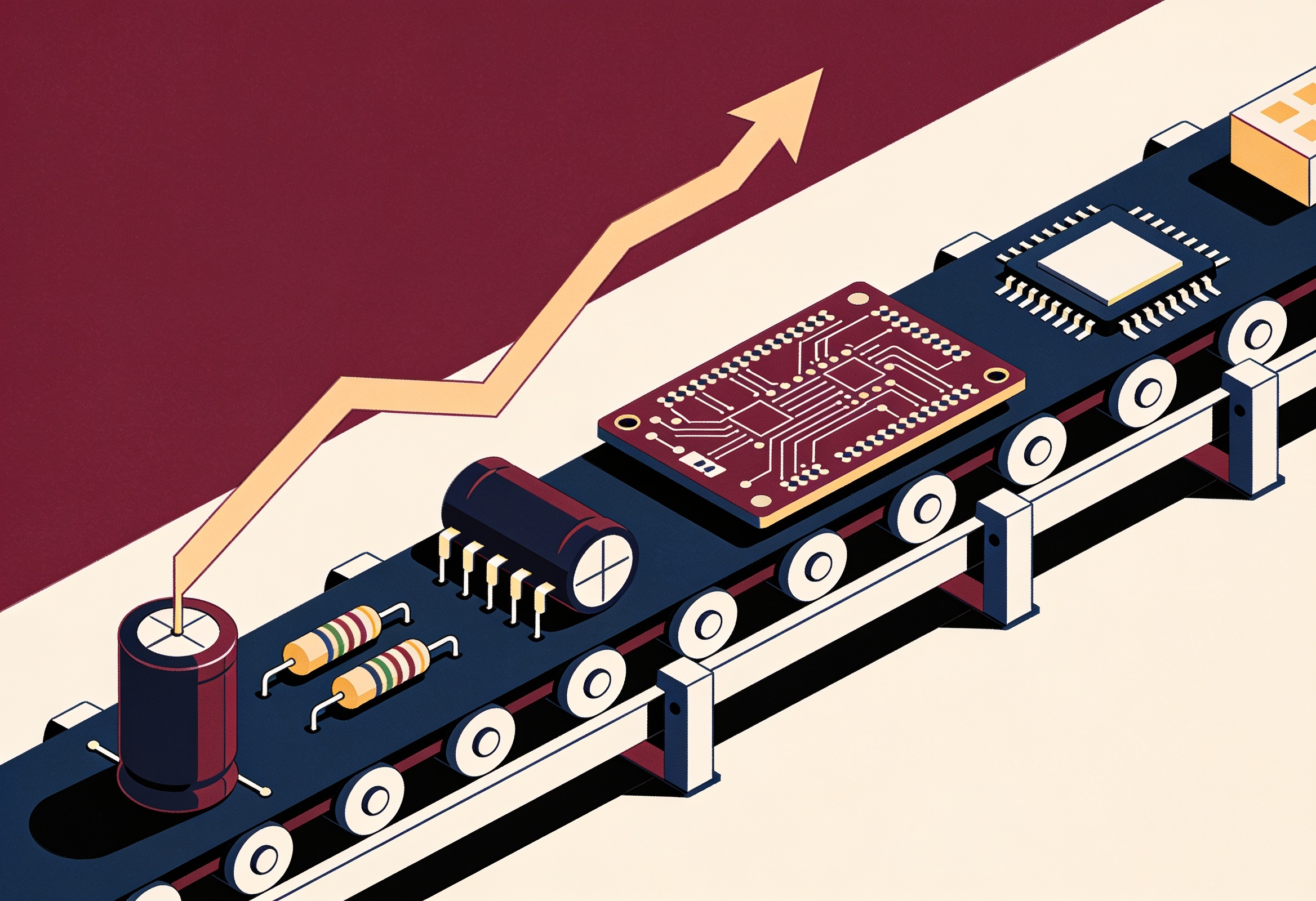
The scheme targets the long-missing components layer of India’s electronics chain — passive parts, printed circuit boards and sub-assemblies — that are still imported in bulk, mostly from China, even as final-device assembly has scaled under the Production Linked Incentive (PLI) route.
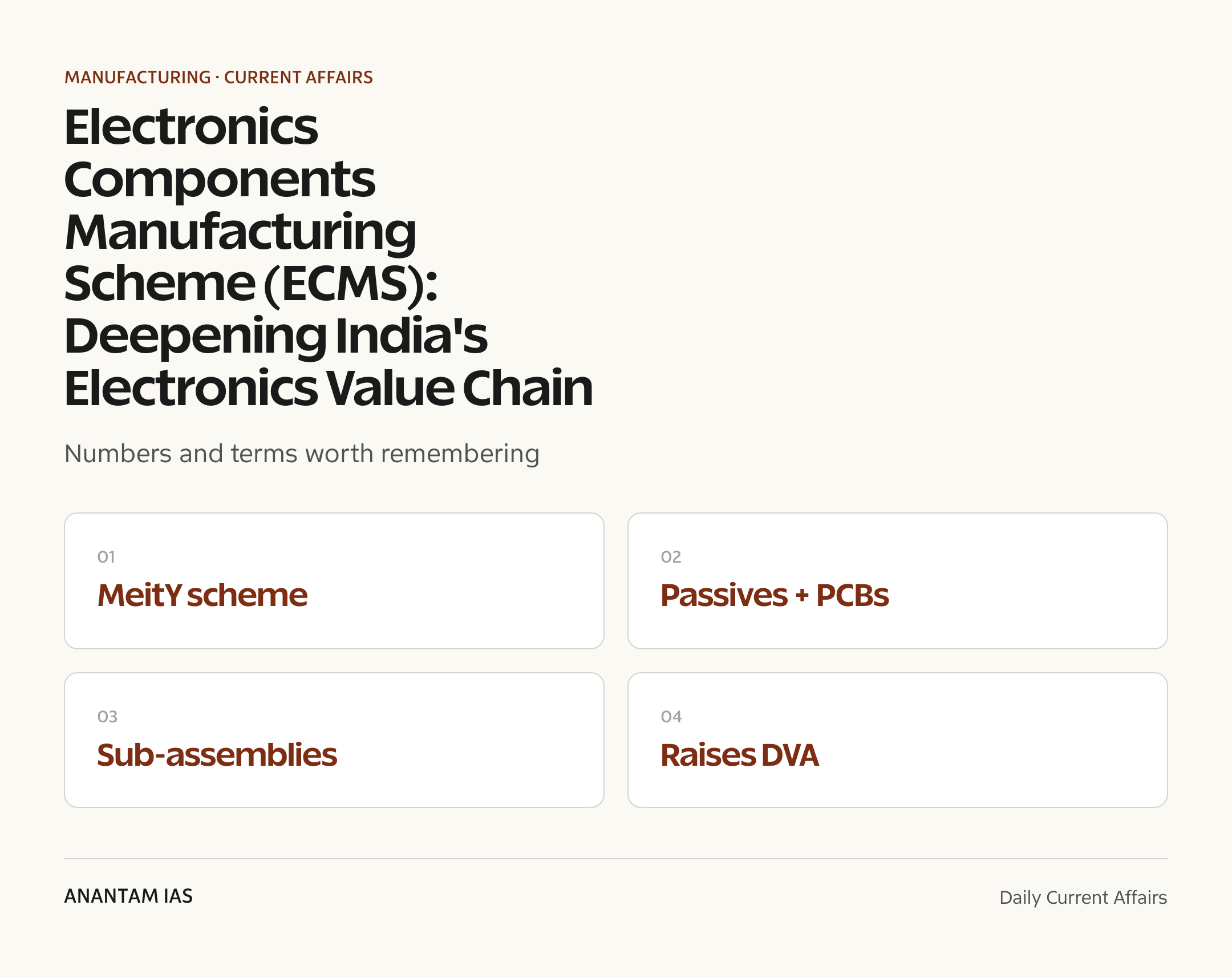
- Covers passive components (resistors, capacitors, inductors), printed circuit boards (PCBs), camera modules, and display and other sub-assemblies.
- Designed to lift Domestic Value Addition (DVA) in electronics, where India’s value capture stayed low despite record assembly output.
- Blends turnover-linked and capital-expenditure-linked incentives so both high-volume passives and capital-heavy sub-assemblies qualify.
- Sits alongside the India Semiconductor Mission (ISM) and the Design Linked Incentive (DLI) scheme, completing the device-to-chip ladder.
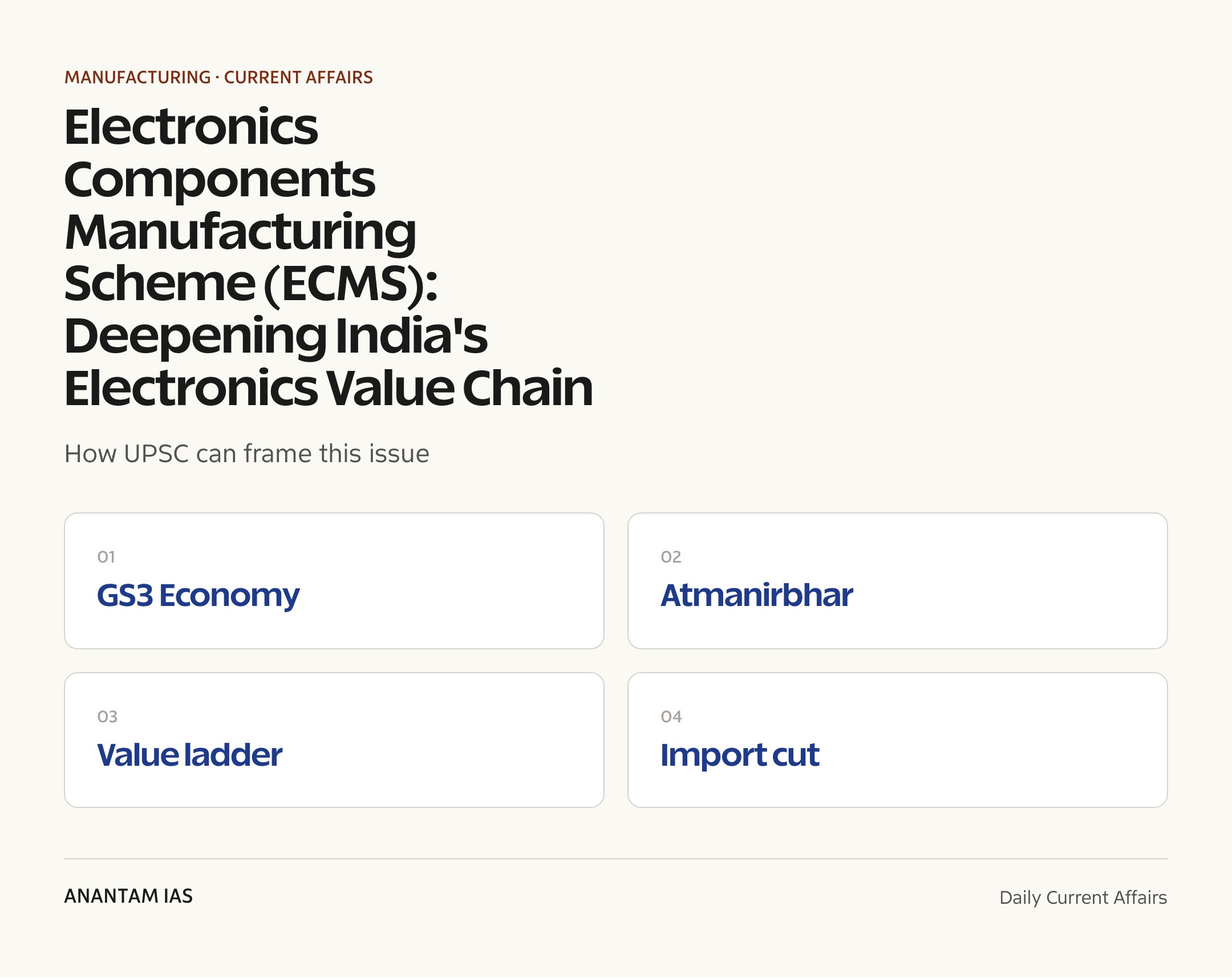
- Anchored in the Atmanirbhar Bharat goal of cutting strategic import dependence in a sector flagged for supply-chain risk.
The development matters in the context of:
- India became a large mobile-phone assembler under PLI, but most value stayed offshore because components were imported.
- A components base is a precondition for genuine supply-chain resilience and for moving up the electronics value ladder.
UPSC Relevance
Prelims Relevance
- ECMS — administered by MeitY, not by the Ministry of Commerce or Heavy Industries
- Difference between active and passive components (passives: resistors, capacitors, inductors)
- PCB = printed circuit board; the substrate that interconnects components
- Domestic Value Addition (DVA) as the metric for value capture
- India Semiconductor Mission (ISM) targets fabs/ATMP; DLI targets chip design
- PLI rewards incremental sales/turnover; ECMS adds a capex-linked track
- Sub-assemblies covered: camera modules, display modules
- Atmanirbhar Bharat framing of import-substitution in electronics
Mains Relevance
GS Paper 3
- Why deepening the components layer matters more than headline assembly output for value capture and jobs.
- Electronics as a strategic sector — import dependence on a single source country and supply-chain resilience.
- How ECMS, PLI, ISM and DLI fit together as a layered industrial-policy stack.
GS Paper 2
- Design choices in incentive schemes — turnover-linked versus capex-linked support and their trade-offs.
Essay
- Self-reliance and the limits of assembly-led growth in a globalised value chain.
- Can industrial policy build durable capability, or only subsidised output?
Background and Context
What ECMS covers
The scheme is built around the parts that finished electronics are assembled from, not the finished devices themselves.
- Passive components — resistors, capacitors and inductors — high-volume, low-unit-value parts India imports in vast quantities.
- Printed circuit boards (PCBs) — the boards on which components are mounted and interconnected; bare-board and multilayer types.
- Sub-assemblies and modules — camera modules, display modules and similar partly-built units that feed final assembly.
- Selected bare components and supporting materials needed to localise the upstream chain.
- The aim is a deeper components ecosystem beneath the assembly lines that Make in India and PLI already built.
Why the components layer was the gap
India’s electronics story so far has been one of assembly volume without matching value capture.
- Under PLI for Large-Scale Electronics, mobile-phone assembly and exports rose sharply.
- But Domestic Value Addition stayed modest because components were shipped in and merely fitted together here.
- Most passives, PCBs and modules came from China and a few East Asian hubs, concentrating supply-chain risk.
- Without a components base, the higher-margin, higher-skill rungs of the value ladder stayed offshore.
- ECMS goes straight at this missing middle so more of each device’s worth is created in India.
How the incentives are structured
The scheme mixes two incentive logics so that very different kinds of component makers can both qualify.
- A turnover-linked track suits high-volume passives where margins are thin and scale is everything.
- A capital-expenditure-linked track suits capital-heavy sub-assemblies and PCB lines where upfront investment is the barrier.
- Hybrid support recognises that one flat formula cannot fit both ends of the components spectrum.
- Eligibility ties to committed investment, output and employment, keeping the payout outcome-linked.
- MeitY runs the scheme, continuing its lead role across India’s electronics policy stack.
Where ECMS sits in the policy stack
ECMS is the components rung in a deliberately layered set of electronics schemes.
- PLI — rewards finished-device assembly and incremental sales.
- ECMS — the new layer for passive components, PCBs and sub-assemblies beneath that.
- India Semiconductor Mission (ISM) — supports fabrication and assembly-test-mark-pack (ATMP/OSAT) units.
- Design Linked Incentive (DLI) — backs domestic chip design and IP.
- Together they trace the chain from chip design to fabrication to components to final assembly.
Strategic and economic stakes
Components are a question of resilience and capability, not just of import bills.
- A domestic components base reduces exposure to a single supplier country during shocks or curbs.
- It deepens technology absorption and creates higher-skill manufacturing jobs than bare assembly.
- It improves the trade math by cutting the import content of every device exported.
- It supports the broader Atmanirbhar Bharat aim of strategic autonomy in critical sectors.
- It is a precondition for credibly entering global electronics supply chains as a maker, not just an assembler.
Risks and the critique
Component depth is hard to engineer with subsidies alone, and earlier schemes carry cautionary lessons.
- Passive-component making is a scale-and-margin game where incumbents enjoy decades of cost advantage.
- Incentives can buy output without building durable capability if technology and design stay imported.
- Disbursement and verification delays dogged some earlier PLI rounds; design clarity matters.
- Genuine value addition must be measured carefully so re-labelling does not pass as localisation.
- Sustained gains need skilling, logistics, power reliability and stable input duties, not subsidy alone.
Way Forward
Make value addition the real test
- Tie incentives to verified Domestic Value Addition, not just turnover, so localisation is genuine.
- Track component-level import substitution rather than headline device output.
Build the enabling base
- Pair ECMS with skilling, testing labs and stable input-duty structures.
- Strengthen logistics and power reliability so component lines stay cost-competitive.
Anchor to global chains
- Court anchor investors and technology partners so domestic firms climb the value ladder.
- Sequence ECMS with ISM and DLI so design, chips and components reinforce one another.
Conclusion
ECMS is an attempt to fix the structural weakness that assembly-led growth exposed — India built the factories but imported the parts, so the value walked away. By targeting passive components, PCBs and sub-assemblies, the scheme goes after the rung that actually decides how much of an electronic device is made in India.
The test will be capability, not output. If incentives translate into real Domestic Value Addition, a skilled workforce and durable supply-chain resilience, ECMS can move India from assembler to maker. If they only subsidise re-labelled imports, the import bill will simply shift one layer up the chain.
UPSC Practice Questions
Prelims MCQ 1
With reference to the Electronics Components Manufacturing Scheme (ECMS), consider the following statements:
- It is administered by the Ministry of Electronics and Information Technology.
- It supports manufacture of passive components, printed circuit boards and sub-assemblies.
- It funds the setting up of semiconductor fabrication plants.
How many of the above statements are correct?
(a) Only one (b) Only two (c) All three (d) None
Answer: (b) Only two
Explanation:
Statements 1 and 2 are correct — ECMS is a MeitY scheme for the components layer. Statement 3 is wrong: fabrication plants fall under the India Semiconductor Mission (ISM), not ECMS.
Prelims MCQ 2
Which one of the following is a passive electronic component?
(a) Transistor (b) Capacitor (c) Integrated circuit (d) Microprocessor
Answer: (b) Capacitor
Explanation:
A capacitor is a passive component (it stores or filters energy without amplification). Transistors, ICs and microprocessors are active devices.
UPSC Mains Questions
- India scaled electronics assembly but captured little value. Examine how the Electronics Components Manufacturing Scheme (ECMS) seeks to correct this, and discuss the conditions needed for it to raise domestic value addition.
- Discuss how ECMS, the PLI scheme, the India Semiconductor Mission and the Design Linked Incentive together form a layered industrial-policy stack for electronics. What are the risks of incentive-led capability building?
- Self-reliance in strategic sectors needs depth, not just volume. Critically analyse this statement with reference to India’s electronics component manufacturing ecosystem.
Sources: PIB, Ministry of Electronics and Information Technology and Press Information Bureau.
Frequently Asked Questions
What is the Electronics Components Manufacturing Scheme?
ECMS is a Cabinet-approved incentive scheme run by MeitY to grow domestic manufacture of electronic components — passive parts like resistors and capacitors, printed circuit boards, camera and display modules and other sub-assemblies. It targets the components layer that sits beneath finished-device assembly, aiming to cut import dependence and raise the value made in India.
How is ECMS different from the PLI scheme?
PLI for electronics mainly rewards finished-device assembly and incremental sales, such as mobile phones. ECMS targets the layer below that — the components and sub-assemblies those devices are built from. The two are complementary: PLI built the assembly base, while ECMS tries to localise the parts that assembly still imports.
Why does India need a domestic components base?
Despite record assembly output, most components were imported, mainly from China, so domestic value addition stayed low and supply-chain risk stayed high. A components base captures more value at home, creates higher-skill jobs, improves the trade balance and reduces exposure to a single supplier country during shocks or curbs.
How does ECMS relate to the India Semiconductor Mission?
They cover different rungs of the same chain. ISM supports semiconductor fabrication and assembly-test units, and the Design Linked Incentive backs chip design, while ECMS handles passive components, PCBs and sub-assemblies. Together with PLI they form a layered stack from chip design through fabrication and components to final assembly.
What kinds of incentives does ECMS offer?
The scheme blends a turnover-linked track, suited to high-volume passive components with thin margins, and a capital-expenditure-linked track, suited to capital-heavy sub-assemblies and PCB lines. This hybrid design lets very different kinds of component makers qualify, with payouts tied to committed investment, output and employment.
What are the main risks for ECMS?
Passive-component making is a scale-and-margin game dominated by long-established global players, so incentives may buy output without building durable capability if technology stays imported. Disbursement delays seen in earlier schemes, weak value-addition checks, and gaps in skilling, logistics and power reliability could blunt the scheme’s impact.
Source: https://anantamias.com/current-affairs/electronics-components-manufacturing-scheme-ecms-2026/
ASUSE: What the Survey of Unincorporated Enterprises Tells Us About the Informal Economy
Why in News?
The Ministry of Statistics and Programme Implementation (MoSPI), through the National Statistics Office (NSO), runs the Annual Survey of Unincorporated Sector Enterprises (ASUSE) to measure India’s vast non-agricultural informal economy. As the survey moves to an annual cycle, its findings have become a recurring fixture in debates over jobs, productivity and the true size of the unorganised sector.
ASUSE counts the country’s small, owner-run units — roadside workshops, tailors, kirana shops, household manufacturers — and reports their number, employment, Gross Value Added (GVA) and increasingly their use of the internet and formal registration. It is the primary input MoSPI uses to estimate output for the unorganised segment in national accounts.
- ASUSE succeeds the older NSS unincorporated-enterprise surveys (the 73rd round of 2015-16 was the last in the earlier series).
- It covers non-agricultural establishments across manufacturing, trade and other services that are not registered as companies.
- Estimates feed directly into GDP/GVA figures for the unorganised sector compiled by the NSO.
- Recent rounds added indicators on internet use and maintenance of accounts, tracking digital adoption and formalisation.
The development matters in the context of:
- Why it matters for jobs: the informal sector employs the overwhelming majority of India’s non-farm workforce, so its health is a proxy for livelihood security.
- Why it matters for data: without reliable enterprise surveys, GDP estimates for the unorganised economy rest on weak benchmarks.
- Why it matters for policy: schemes like Udyam registration and e-Shram are judged by how far the informal sector is formalising.

UPSC Relevance
Prelims Relevance
- ASUSE — Annual Survey of Unincorporated Sector Enterprises; conducting body NSO under MoSPI.
- Predecessor: NSS surveys of unincorporated non-agricultural enterprises (last full round 73rd, 2015-16).
- Coverage: non-agricultural manufacturing, trade, other services; excludes companies and agriculture.
- Key concept: Gross Value Added (GVA) = output minus intermediate consumption.
- Unincorporated vs incorporated: unincorporated units are proprietorships/partnerships, not registered as companies under the Companies Act.
- Formalisation tools: Udyam Registration (MSMEs) and e-Shram (unorganised workers’ database).
- MoSPI also conducts the Periodic Labour Force Survey (PLFS) and Annual Survey of Industries (ASI) — distinguish the three.
- OAE vs establishment: an Own-Account Enterprise (OAE) runs without any hired worker; an establishment hires at least one.
Mains Relevance
GS Paper 3
- Significance of robust enterprise surveys for credible national income estimation and the unorganised sector.
- Informal sector’s role in employment, productivity gaps, and the challenge of formalisation.
GS Paper 2
- Strengthening India’s official statistical system and the governance of data quality.
Essay
- The unseen economy: counting the work that holds India together.
- Data is the new oil only if we choose to measure honestly.
Background and Context
What ASUSE actually measures
ASUSE is a sample survey of unincorporated non-agricultural enterprises, designed to capture the economic activity that company registers and factory rolls miss.
- Universe: proprietary and partnership units in manufacturing, trade and other services that are not incorporated as companies or cooperatives.
- Variables captured: number of enterprises, employment, fixed assets, GVA, value of output and operating expenses.
- Distinguishes Own-Account Enterprises (OAEs) — run by household labour alone — from establishments that employ at least one hired worker.
- Newer rounds record internet use, computer use and whether the unit maintains accounts — signals of digitisation and formal practice.
- Excluded: agriculture, and any unit registered under the Factories Act or as a company (those are picked up by the Annual Survey of Industries).
From NSS rounds to an annual survey
ASUSE is the successor to a long line of National Sample Survey (NSS) enterprise surveys, but with a crucial upgrade — frequency.
- Earlier, unincorporated enterprises were surveyed only periodically; the 73rd NSS round (2015-16) was the last in that older series.
- ASUSE shifts measurement to an annual cycle, narrowing the gap between successive benchmarks.
- Annual data lets the NSO update GDP estimates for the unorganised sector with fresher inputs rather than projecting from a dated base year.
- It complements the annual Periodic Labour Force Survey (PLFS), giving both an enterprise-side and a household-side view of informal work.
Why it feeds GDP and national accounts
The informal sector is statistically hard to see, so ASUSE acts as the empirical anchor for estimating its contribution to the economy.
- National income for the unorganised segment is largely estimated, not directly recorded — ASUSE supplies the per-worker GVA benchmarks used in that estimation.
- These benchmarks are combined with workforce numbers to scale up sector output in the national accounts.
- A stale benchmark risks mis-stating the size of the informal economy and, with it, headline GDP.
- So ASUSE matters far beyond the units it surveys — it shapes how the whole unorganised economy is valued.
What the data reveals about the informal economy
Read together, ASUSE indicators sketch a sector that is huge in headcount but thin in productivity.
- A very large share of non-farm units are tiny Own-Account Enterprises with no hired worker — survival livelihoods rather than growing firms.
- Average GVA per worker in the informal sector trails the formal sector sharply, exposing a deep productivity gap.
- Rising internet and account-keeping adoption hints at gradual formalisation, but from a low base.
- Sectoral mix is dominated by trade and services, with manufacturing units smaller and more vulnerable to shocks.
Formalisation: Udyam, e-Shram and the bridge to data
Policy increasingly tries to pull informal units into formal registers, and ASUSE is one way to check whether that bridge is being crossed.
- Udyam Registration brings MSMEs onto a formal portal, unlocking credit, schemes and procurement preferences.
- e-Shram builds a national database of unorganised workers to deliver social security and benefits.
- ASUSE’s questions on registration and account-keeping help gauge whether such drives are widening formal coverage on the ground.
- Formalisation is not automatic: many units stay informal to avoid compliance cost, so survey evidence keeps the policy debate honest.
Where ASUSE sits in MoSPI's statistical system
ASUSE is one pillar of a broader official statistics architecture, and confusing it with its siblings is a common exam trap.
- ASUSE — unincorporated, non-agricultural enterprises (the informal/unorganised side).
- Annual Survey of Industries (ASI) — registered factories under the Factories Act (the organised manufacturing side).
- Periodic Labour Force Survey (PLFS) — household-based employment and unemployment data.
- All three are run by the National Statistics Office (NSO) within MoSPI, the apex body for India’s official statistics.
Way Forward
Tighten the statistical backbone
- Sustain the annual frequency so GDP benchmarks stay current rather than drifting on old base years.
- Improve the sampling frame by linking it to live registers like Udyam and GST data to reduce coverage gaps.
Use the data to lift productivity
- Target credit, skilling and digital tools at the low-GVA Own-Account Enterprises that ASUSE flags.
- Treat formalisation as a means to better terms — credit, markets, social security — not as an end in itself.
Pair ASUSE with PLFS and administrative data so that enterprise-side and worker-side evidence are read together, giving policymakers a single, coherent picture of the informal economy rather than fragments.
Conclusion
ASUSE is unglamorous but foundational. By systematically counting the workshops, shops and home-based units that make up the bulk of India’s non-farm economy, it turns an otherwise invisible sector into measurable evidence — and that evidence flows straight into the nation’s GDP estimates.
For UPSC, the survey is best understood as the meeting point of three durable themes: the informal economy, the integrity of India’s statistical system, and the long project of formalisation. Get those linkages right, and ASUSE stops being a name to memorise and becomes a lens on how India sees its own economy.
UPSC Practice Questions
Prelims MCQ 1
With reference to the Annual Survey of Unincorporated Sector Enterprises (ASUSE), consider the following statements:
- It is conducted by the National Statistics Office under MoSPI.
- It covers registered factories operating under the Factories Act.
- It excludes agricultural enterprises from its coverage.
How many of the above statements are correct?
(a) Only one (b) Only two (c) All three (d) None
Answer: (b) Only two
Explanation:
ASUSE is conducted by the NSO under MoSPI (1 correct) and excludes agriculture (3 correct). It covers unincorporated non-agricultural units, NOT registered factories — those fall under the Annual Survey of Industries (2 wrong).
Prelims MCQ 2
Which of the following is correctly matched with the population it primarily surveys?
(a) ASI — household employment and unemployment (b) PLFS — registered factories under the Factories Act (c) ASUSE — unincorporated non-agricultural enterprises (d) ASUSE — incorporated companies under the Companies Act
Answer: (c) ASUSE — unincorporated non-agricultural enterprises
Explanation:
ASUSE surveys unincorporated non-agricultural enterprises. ASI covers registered factories, PLFS measures household employment, and incorporated companies are outside ASUSE’s scope.
UPSC Mains Questions
- Reliable measurement of the informal sector is essential for credible national income estimation. In this light, examine the significance of the Annual Survey of Unincorporated Sector Enterprises (ASUSE) for India’s statistical system. (250 words)
- The informal economy employs the bulk of India’s non-farm workforce yet contributes far less per worker than the formal sector. Discuss the productivity challenge this poses and suggest measures to address it. (250 words)
- Formalisation of enterprises is often presented as a policy goal in itself. Critically evaluate this view with reference to instruments such as Udyam registration and e-Shram. (150 words)
Sources: MoSPI, National Statistics Office and PIB, Ministry of Statistics and Programme Implementation.
Frequently Asked Questions
What is ASUSE?
ASUSE is the Annual Survey of Unincorporated Sector Enterprises, conducted by the National Statistics Office under MoSPI. It measures India’s non-agricultural informal enterprises — their number, employment, Gross Value Added, assets and increasingly their internet use and registration status — to map the unorganised economy.
Who conducts ASUSE?
It is conducted by the National Statistics Office (NSO), which functions under the Ministry of Statistics and Programme Implementation (MoSPI). MoSPI is the apex body for India’s official statistics, and the NSO also runs surveys such as the Periodic Labour Force Survey and the Annual Survey of Industries.
How is ASUSE different from the Annual Survey of Industries?
ASUSE covers unincorporated, non-agricultural units that are not registered as companies or factories — the informal sector. The Annual Survey of Industries (ASI) covers registered factories operating under the Factories Act, which form the organised manufacturing side. The two surveys deliberately measure different universes.
Why does ASUSE matter for GDP?
Output of the unorganised sector is largely estimated rather than directly recorded. ASUSE supplies per-worker Gross Value Added benchmarks that the NSO combines with workforce numbers to scale up the sector’s contribution in the national accounts. A stale benchmark can distort the estimated size of the informal economy and headline GDP.
What did ASUSE replace?
ASUSE succeeds the older National Sample Survey rounds on unincorporated non-agricultural enterprises, the last full round of which was the 73rd round in 2015-16. The key change is frequency: ASUSE measures the sector annually, keeping national-accounts benchmarks fresher than the earlier periodic approach.
How does ASUSE connect to formalisation?
ASUSE records whether units maintain accounts, use the internet and are registered. Read alongside drives like Udyam registration for MSMEs and the e-Shram database for unorganised workers, these indicators help gauge whether the informal sector is gradually entering formal registers and practices.
Source: https://anantamias.com/current-affairs/asuse-unincorporated-sector-survey-2026/
Design Linked Incentive Scheme: India’s Semiconductor Design Push
A January 2026 PIB backgrounder put the Design Linked Incentive scheme back in focus as part of India’s semiconductor strategy. The DLI scheme supports chip design, intellectual property and domestic fabless semiconductor companies.
For UPSC, this topic matters because semiconductors are now industrial policy, national security, trade policy and science policy at the same time. India cannot build a credible electronics ecosystem by focusing only on assembly.
This article explains why chip design is strategically different from chip fabrication and how DLI fits into India’s semiconductor mission.
Quick Facts
- DLI stands for Design Linked Incentive.
- It supports semiconductor design, IP cores and fabless chip companies.
- The scheme is part of the India Semiconductor Mission ecosystem.
- Semiconductor design is less capital-intensive than fabrication but deeply talent-intensive.
- Chips are critical for telecom, defence, AI, automobiles, electronics and energy systems.
- Official source: PIB January 2026 backgrounder on DLI.
- Official source: PIB backgrounder.
What Just Happened
The January 2026 official backgrounder highlighted the DLI scheme as a pillar of India’s semiconductor policy.
The update is important because India’s semiconductor conversation often focuses on fabs. Design capability is equally strategic because it captures intellectual property and high-value engineering.
For aspirants, DLI is a way to connect PLI-style industrial policy with technological sovereignty and global supply-chain resilience.
Background and Historical Context
The global semiconductor industry is organised across design, electronic design automation, fabrication, packaging, testing and end-use manufacturing. No country dominates every layer equally.
India has strong chip-design talent through global capability centres and engineering services, but domestic ownership of product IP has been weaker.
The India Semiconductor Mission seeks to build a more complete ecosystem through incentives for fabs, display manufacturing, compound semiconductors, design and talent.
Key Features of Semiconductor Policy
The core policy architecture can be read through these features.
- Fabless focus: DLI supports companies that design chips but outsource fabrication.
- IP creation: the goal is Indian-owned design intellectual property.
- Financial support: incentives reduce early-stage design and prototype costs.
- Talent leverage: India can use its engineering workforce before full fab depth emerges.
- Strategic sectors: telecom, defence, automotive and AI need trusted chips.
- Ecosystem link: design must connect with packaging, testing, fabs and end customers.
Why It Matters
This is a high-yield UPSC topic because it joins current news with durable syllabus themes.
- It connects a January 2026 event with durable UPSC syllabus themes.
- It gives usable facts for Prelims and analytical hooks for Mains.
- It helps students move from news recall to policy reasoning.
- It can be linked with static concepts in polity, economy, governance, science, environment or society.
Detailed Analysis: Semiconductor Policy Lens
Design is where value and control begin. A country that only assembles electronics depends on others for architecture, security and margins.
Fabs are capital-heavy; design is talent-heavy. India can move faster in design if it supports startups, EDA access, prototyping and market linkages.
The missing bridge is commercial demand. DLI-backed designs must find buyers in telecom, defence, automotive and public procurement ecosystems.
Comparative Perspective
A comparison helps prevent the answer from becoming a one-dimensional news summary.
- Taiwan: fabrication strength through foundries such as TSMC.
- United States: strong in design, EDA tools and advanced chips.
- China: heavy state support across the chip stack despite export controls.
- India: stronger in design talent than fabrication depth, making DLI strategically important.
Challenges
The policy or institutional promise runs into recurring constraints.
- EDA tools and advanced IP blocks are expensive and often foreign-controlled.
- Startups face long product cycles and uncertain buyers.
- Fabrication access for prototypes can be costly.
- Design talent must be retained in domestic product companies.
- Security-sensitive sectors require trusted supply chains and testing standards.
Prelims Pointers
- Fabless companies design chips but do not own fabrication plants.
- EDA means Electronic Design Automation.
- India Semiconductor Mission supports semiconductor and display ecosystem development.
- Semiconductors are essential for electronics, defence, telecom, AI and vehicles.
- Chip fabrication plants are capital-intensive and water/power intensive.
- Design IP can create high-value domestic capability.
Mains Questions
- Why is semiconductor design strategically important for India even before large-scale fabrication matures? (GS Paper III, 250 words)
- Compare design-linked incentives with production-linked incentives in technology sectors. (GS Paper III, 150 words)
- Semiconductor self-reliance requires ecosystem depth, not only fabs. Discuss. (GS Paper III, 250 words)
- How can public procurement support domestic semiconductor design? (GS Paper III, 150 words)
Way Forward
India should support design startups with EDA access, prototyping grants, trusted foundry partnerships and anchor demand from defence, telecom and public digital infrastructure.
DLI must be judged by Indian-owned IP, chips reaching production and startups surviving beyond prototype stage.
For UPSC, remember the layered answer: design, fabrication, packaging, testing, talent and demand all matter.
The examiner is unlikely to reward a bare fact dump here. The better answer connects the January 2026 event to institutional design, implementation capacity and India’s long-term development priorities.
Frequently Asked Questions
What is the DLI scheme?
It is the Design Linked Incentive scheme that supports semiconductor design and domestic chip IP creation.
What is a fabless chip company?
It designs chips but outsources fabrication to a foundry.
Why does chip design matter?
Design captures high-value intellectual property and strategic control over chip architecture.
Is DLI the same as PLI?
No. DLI targets design capability, while PLI usually rewards production output.
Which mission is linked to DLI?
India Semiconductor Mission.
What is the main challenge?
Moving from supported designs to commercial products with buyers and secure supply chains.
Source: https://anantamias.com/current-affairs/semiconductor-design-linked-incentive-2026/
Namami Gange Smart STP Dashboard: River Cleaning Meets Data Governance
The National Mission for Clean Ganga reviewed smart STP monitoring, digital dashboards and effluent-surveillance tools in January 2026. The update pointed to a shift from building sewage infrastructure to monitoring whether it actually performs.
For UPSC, this is the exact distinction that matters. River cleaning fails when projects are counted as assets but pollution load is not continuously tracked, enforced and corrected.
This article uses the smart STP dashboard update to explain Namami Gange, sewage treatment, river pollution governance and the implementation gap in environmental policy.
Quick Facts
- The update came through the 17th Empowered Task Force review under Namami Gange.
- Smart STP monitoring and digital dashboards were highlighted.
- STP stands for Sewage Treatment Plant.
- NMCG is the National Mission for Clean Ganga.
- River pollution is driven by sewage, industrial effluents, solid waste and ecological-flow stress.
- Official source: PIB Jal Shakti release dated 5 January 2026.
- Official source: PIB, Ministry of Jal Shakti.
What Just Happened
The National Mission for Clean Ganga reviewed digital monitoring systems for sewage treatment plants and river-cleaning progress.
The policy direction is important because India has often built treatment capacity without ensuring utilisation, power supply, maintenance and compliance.
For aspirants, this is a practical case where environmental governance depends on data, local bodies, contracts and enforcement rather than only central funding.
Background and Historical Context
Namami Gange was launched as an integrated mission to reduce pollution, conserve biodiversity and improve riverfront and public participation components in the Ganga basin.
Earlier river-cleaning efforts struggled because sewage generation outpaced treatment capacity and local urban bodies lacked funds and technical capacity.
Hybrid annuity models, one-city-one-operator contracts and real-time monitoring are attempts to improve long-term operation and maintenance.
Key Features of River Governance
The core policy architecture can be read through these features.
- Smart monitoring: dashboards track STP performance and effluent quality.
- Accountability: real-time data can expose non-performing treatment plants.
- Urban link: municipal sewage remains the biggest pollution source.
- Basin approach: Ganga governance must cover tributaries and urban clusters.
- Institutional coordination: NMCG, states, ULBs and regulators all matter.
- Outcome focus: river health depends on treated discharge, not sanctioned capacity.
Why It Matters
This is a high-yield UPSC topic because it joins current news with durable syllabus themes.
- It connects a January 2026 event with durable UPSC syllabus themes.
- It gives usable facts for Prelims and analytical hooks for Mains.
- It helps students move from news recall to policy reasoning.
- It can be linked with static concepts in polity, economy, governance, science, environment or society.
Detailed Analysis: River Governance Lens
The dashboard is only as good as the sensor and the response. Data must trigger enforcement, maintenance and financing decisions.
STPs fail because O&M fails. Many plants underperform due to power costs, weak sewer connections, poor maintenance and lack of skilled staff.
River cleaning is urban governance. Unless cities manage sewage and solid waste, river missions will remain downstream clean-up efforts.
Comparative Perspective
A comparison helps prevent the answer from becoming a one-dimensional news summary.
- Ganga Action Plan: early focus on infrastructure but weak implementation.
- Namami Gange: integrated mission with stronger central financing and monitoring.
- Hybrid annuity model: links payment to long-term plant operation.
- Smart dashboards: add performance visibility to the mission.
Challenges
The policy or institutional promise runs into recurring constraints.
- Sewer networks often do not connect all households to STPs.
- Small towns lack technical and financial capacity.
- Industrial effluent enforcement can be uneven.
- River ecology also needs environmental flows, not only pollution control.
- Data manipulation or sensor failure can weaken real-time systems.
Prelims Pointers
- NMCG implements Namami Gange.
- STP stands for Sewage Treatment Plant.
- CPCB and State Pollution Control Boards regulate pollution standards.
- Biochemical Oxygen Demand is a common water-quality indicator.
- Environmental flow refers to water needed to sustain river ecosystems.
- Hybrid annuity model combines construction and long-term operation payments.
Mains Questions
- River cleaning in India is as much an urban-governance challenge as an environmental challenge. Discuss. (GS Paper III, 250 words)
- How can real-time monitoring improve pollution-control outcomes? (GS Paper III, 150 words)
- Evaluate Namami Gange’s shift from infrastructure creation to performance monitoring. (GS Paper III, 250 words)
- Why do sewage-treatment plants underperform in Indian cities? Suggest reforms. (GS Paper II/III, 250 words)
Way Forward
Smart dashboards should be backed by public data disclosure, independent audits and penalty-linked O&M contracts.
Urban local bodies need predictable funds and technical capacity to run sewage systems after construction.
The exam answer should avoid a simplistic claim that STP capacity equals river cleanliness. Utilisation and compliance are the real test.
The examiner is unlikely to reward a bare fact dump here. The better answer connects the January 2026 event to institutional design, implementation capacity and India’s long-term development priorities.
Frequently Asked Questions
What is an STP?
A Sewage Treatment Plant treats wastewater before discharge into rivers or other water bodies.
What is NMCG?
The National Mission for Clean Ganga is the implementation agency for Namami Gange.
Why are dashboards useful?
They can track plant performance, effluent quality and gaps in near real time.
What is the main pollution source in rivers?
Untreated municipal sewage is one of the biggest sources.
What is BOD?
Biochemical Oxygen Demand is a measure of organic pollution in water.
What is the UPSC angle?
Environment, urban governance, data systems, federal coordination and implementation capacity.
Source: https://anantamias.com/current-affairs/namami-gange-smart-stp-dashboard-2026/
Payments Regulatory Board: Reshaping Oversight of India’s Digital Payments
Why in News?
The Reserve Bank of India (RBI) notified the constitution of the Payments Regulatory Board (PRB), a new statutory body that replaces the older Board for Regulation and Supervision of Payment and Settlement Systems (BPSS) as the apex authority for regulating and supervising payment systems in India.
The PRB takes over the powers exercised under the Payment and Settlement Systems Act, 2007, and will set policy for systems such as UPI, cards, prepaid instruments, and large-value settlement rails like RTGS and NEFT.
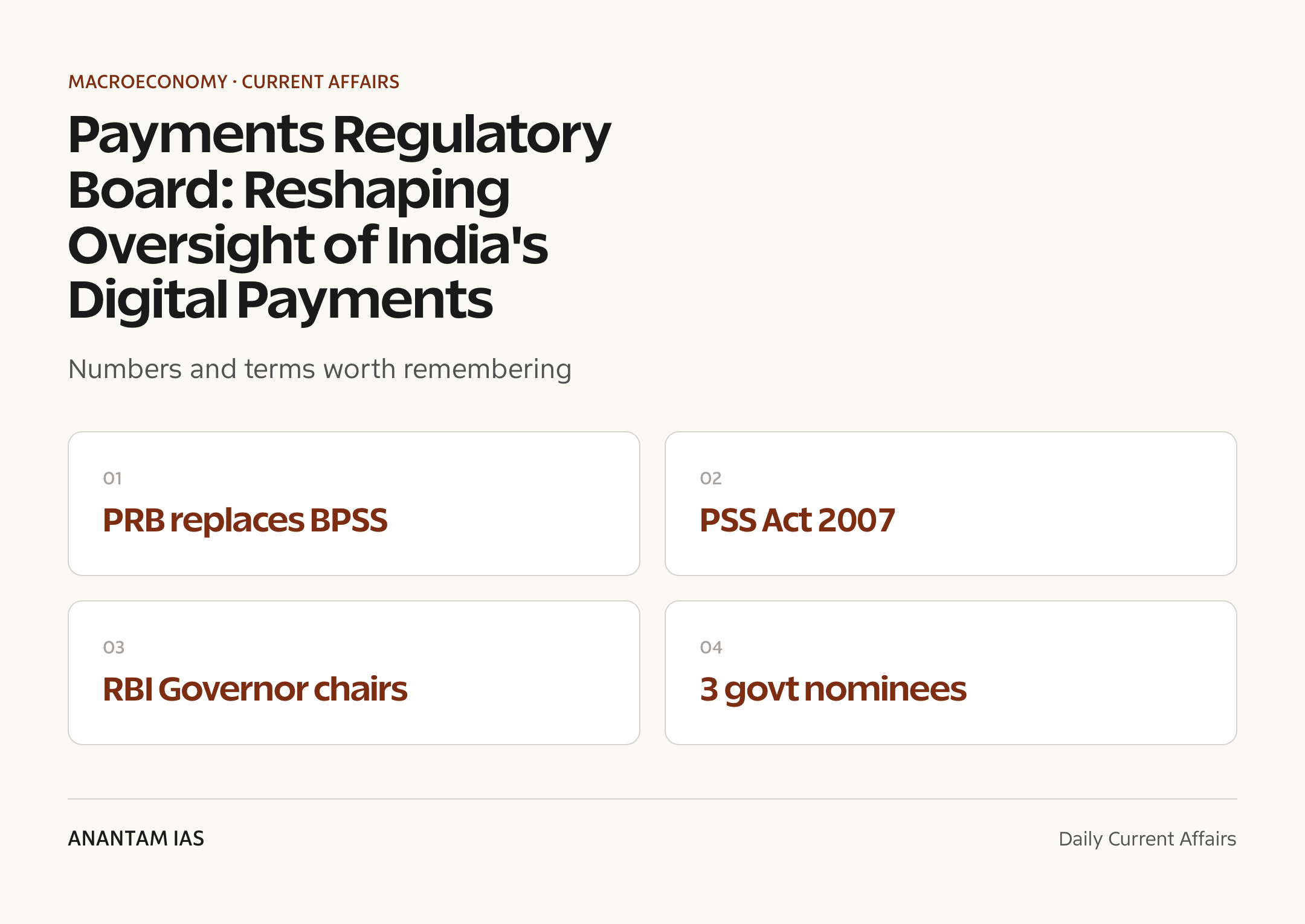
- The PRB is chaired by the RBI Governor, with the Deputy Governor in charge of payments as the vice-chair.
- Its membership includes three nominees of the Central Government, alongside RBI members and experts.
- It supersedes the BPSS, which was a sub-committee of the RBI’s Central Board with no government nominees.
- The board’s mandate covers authorisation, oversight and standard-setting for all payment and settlement systems.
The development matters in the context of:
- Sets up a recurring tension between regulatory independence and government representation in financial-sector bodies.
- Comes as India’s UPI volumes cross record monthly transactions, making payments oversight systemically important.
- Reflects a broader shift in how the Finance Ministry and the RBI share institutional authority over the digital-payments stack.

UPSC Relevance
Prelims Relevance
- Payment and Settlement Systems Act, 2007 — the parent statute for payments regulation in India.
- Payments Regulatory Board (PRB) — replaces the BPSS; chaired by the RBI Governor.
- Board for Regulation and Supervision of Payment and Settlement Systems (BPSS) — the earlier RBI sub-committee.
- Reserve Bank of India as the designated authority for payment systems under the Act.
- National Payments Corporation of India (NPCI) — operates UPI, RuPay, IMPS and NACH.
- Unified Payments Interface (UPI), RTGS, NEFT and Prepaid Payment Instruments (PPIs) as regulated payment systems.
- Composition: RBI Governor, Deputy Governor, RBI nominees and three Central Government nominees.
- Distinction between a statutory regulator and an internal RBI committee.
Mains Relevance
GS Paper 3
- Role of the RBI in regulating India’s payment and settlement systems and the implications of the PRB for financial stability.
- How the digital-payments ecosystem (UPI, cards, PPIs) shapes financial inclusion and the formalisation of the economy.
GS Paper 2
- Debates on regulatory autonomy versus government representation in independent financial-sector bodies.
Essay
- Independence of regulators in a developmental state — balancing accountability with autonomy.
- Technology and trust — governing India’s digital public infrastructure.
Background and Context
Why payments needed a dedicated regulator
Payment systems sit at the core of financial stability, and India built a statutory base for their oversight nearly two decades ago.
- The Payment and Settlement Systems Act, 2007 designated the RBI as the authority to regulate and supervise payment systems and to authorise their operation.
- Under the Act, the RBI set up the BPSS in 2005 as a sub-committee of its Central Board to discharge these powers.
- A ‘payment system’ under the Act covers any system enabling payment between a payer and a beneficiary — cards, UPI, money transfers, clearing and settlement.
- As volumes scaled, the case grew for a more formal, statutorily defined board rather than an internal committee.
From BPSS to the Payments Regulatory Board
The PRB is a statutory upgrade of the body that previously governed payments inside the RBI.
- The BPSS had only RBI members and reported within the central bank’s governance structure.
- The PRB is constituted as the apex decision-making body for payments policy, replacing the BPSS entirely.
- Chair: the RBI Governor; vice-chair: the Deputy Governor overseeing the payments portfolio.
- Members: RBI officials and experts plus three nominees of the Central Government, a structural change from the BPSS.
What the PRB regulates
The board’s remit spans the full payments stack, from retail rails to systemically important settlement systems.
- UPI — the interoperable real-time retail rail operated by NPCI, now India’s dominant payment mode.
- Card networks and Prepaid Payment Instruments (PPIs) such as wallets.
- Large-value and bulk systems: RTGS (real-time gross settlement) and NEFT.
- Standard-setting, authorisation of operators, and oversight of risk, security and interoperability.
The autonomy-versus-representation debate
The inclusion of government nominees has reopened a long-running question about how independent India’s financial regulators should be.
- Supporters of regulatory autonomy argue payments policy benefits from insulation from short-term political and fiscal pressures.
- The presence of government nominees on the board is read by critics as a dilution of the RBI’s operational independence.
- Earlier drafts proposing an independent payments regulator separate from the RBI were debated and then dropped in favour of an RBI-anchored board.
- The episode echoes wider questions about independent regulatory bodies, where central banks usually retain primacy over payment-system oversight.
Why the stakes are high now
Payments are no longer a back-office function; they are critical digital public infrastructure.
- UPI processes billions of transactions a month, making any oversight gap a systemic concern.
- Outages, fraud and data-security incidents in payment rails carry economy-wide spillovers.
- A clear regulatory anchor matters for cross-border payment linkages and for fintech innovation.
- Strong oversight underpins public trust in cashless transactions and continued financial inclusion.
Way Forward
Safeguard regulatory independence
- Codify clear decision rules so the RBI retains primacy over technical and prudential payments matters.
- Keep the role of government nominees advisory on policy direction rather than operational supervision.
Strengthen oversight capacity
- Invest in monitoring of fraud, outages and cyber-risk across UPI, cards and PPIs.
- Ensure transparent, consultative standard-setting with operators such as NPCI and banks.
Build accountability by publishing the board’s decisions and review processes, so that autonomy is paired with transparency rather than opacity.
Conclusion
The Payments Regulatory Board formalises and elevates the governance of a payments system that now touches almost every Indian transaction. By replacing the BPSS with a statutory board, it signals that digital payments are systemically important and deserve a dedicated apex authority.
The unresolved question is institutional design. Keeping the RBI at the centre while admitting government nominees will test whether India can combine democratic accountability with the regulatory independence that financial stability requires.
UPSC Practice Questions
Prelims MCQ 1
With reference to the Payments Regulatory Board (PRB), consider the following statements:
- It is constituted under the Payment and Settlement Systems Act, 2007.
- It replaces the Board for Regulation and Supervision of Payment and Settlement Systems (BPSS).
- It is chaired by the Union Finance Minister.
How many of the above statements are correct?
(a) Only one (b) Only two (c) All three (d) None
Answer: (b) Only two
Explanation:
Statements 1 and 2 are correct: the PRB derives from the Payment and Settlement Systems Act, 2007, and replaces the BPSS. Statement 3 is wrong — the PRB is chaired by the RBI Governor, not the Finance Minister.
Prelims MCQ 2
Which of the following payment systems falls within the regulatory remit of the RBI’s payments board?
(a) Unified Payments Interface (UPI) only (b) RTGS and NEFT only (c) Prepaid Payment Instruments (PPIs) only (d) UPI, cards, PPIs and RTGS/NEFT
Answer: (d) UPI, cards, PPIs and RTGS/NEFT
Explanation:
The board’s mandate spans the full payments stack — UPI, card networks, prepaid instruments and large-value settlement systems such as RTGS and NEFT.
UPSC Mains Questions
- The Payments Regulatory Board replaces the BPSS as the apex authority for India’s payment systems. Examine its significance for financial stability and the digital-payments ecosystem. (250 words)
- Government representation on financial-sector boards is often defended as democratic accountability and criticised as a threat to regulatory autonomy. Critically discuss with reference to the Payments Regulatory Board. (250 words)
- India’s digital public infrastructure, led by UPI, has transformed payments. Discuss the regulatory challenges this scale creates and how a dedicated payments board can address them. (150 words)
Sources: Reserve Bank of India and The Hindu.
Frequently Asked Questions
What is the Payments Regulatory Board?
The Payments Regulatory Board (PRB) is a statutory body constituted by the Reserve Bank of India to regulate and supervise payment and settlement systems in India. It replaces the older Board for Regulation and Supervision of Payment and Settlement Systems (BPSS) and sets policy for systems such as UPI, cards and prepaid instruments.
Which body did the PRB replace?
The PRB replaces the Board for Regulation and Supervision of Payment and Settlement Systems (BPSS), which was a sub-committee of the RBI’s Central Board. Unlike the BPSS, the PRB is constituted as a formal statutory board and includes Central Government nominees alongside RBI members.
Under which law is the PRB constituted?
The PRB exercises powers under the Payment and Settlement Systems Act, 2007. This Act designates the Reserve Bank of India as the authority to regulate, supervise and authorise payment systems operating in the country, providing the statutory basis for the board’s functions.
Who chairs the Payments Regulatory Board?
The Payments Regulatory Board is chaired by the RBI Governor, with the Deputy Governor in charge of payments acting as vice-chair. Its membership combines RBI officials and experts with three nominees of the Central Government, which is the change driving the autonomy debate.
Why is the PRB linked to a debate on RBI autonomy?
The inclusion of Central Government nominees on the board has revived concerns about regulatory independence. Critics argue it could dilute the RBI’s operational autonomy over payments, while supporters frame it as democratic accountability over a systemically important public infrastructure.
What payment systems does the PRB oversee?
The board oversees the full payments stack, including the Unified Payments Interface (UPI), card networks, Prepaid Payment Instruments such as wallets, and large-value settlement systems like RTGS and NEFT. Its work covers authorisation, standard-setting, security and risk oversight.
Source: https://anantamias.com/current-affairs/payments-regulatory-board-prb-2026/
Somnath Temple at a Millennium: Iconoclasm, Reconstruction and National Memory
Why in News?
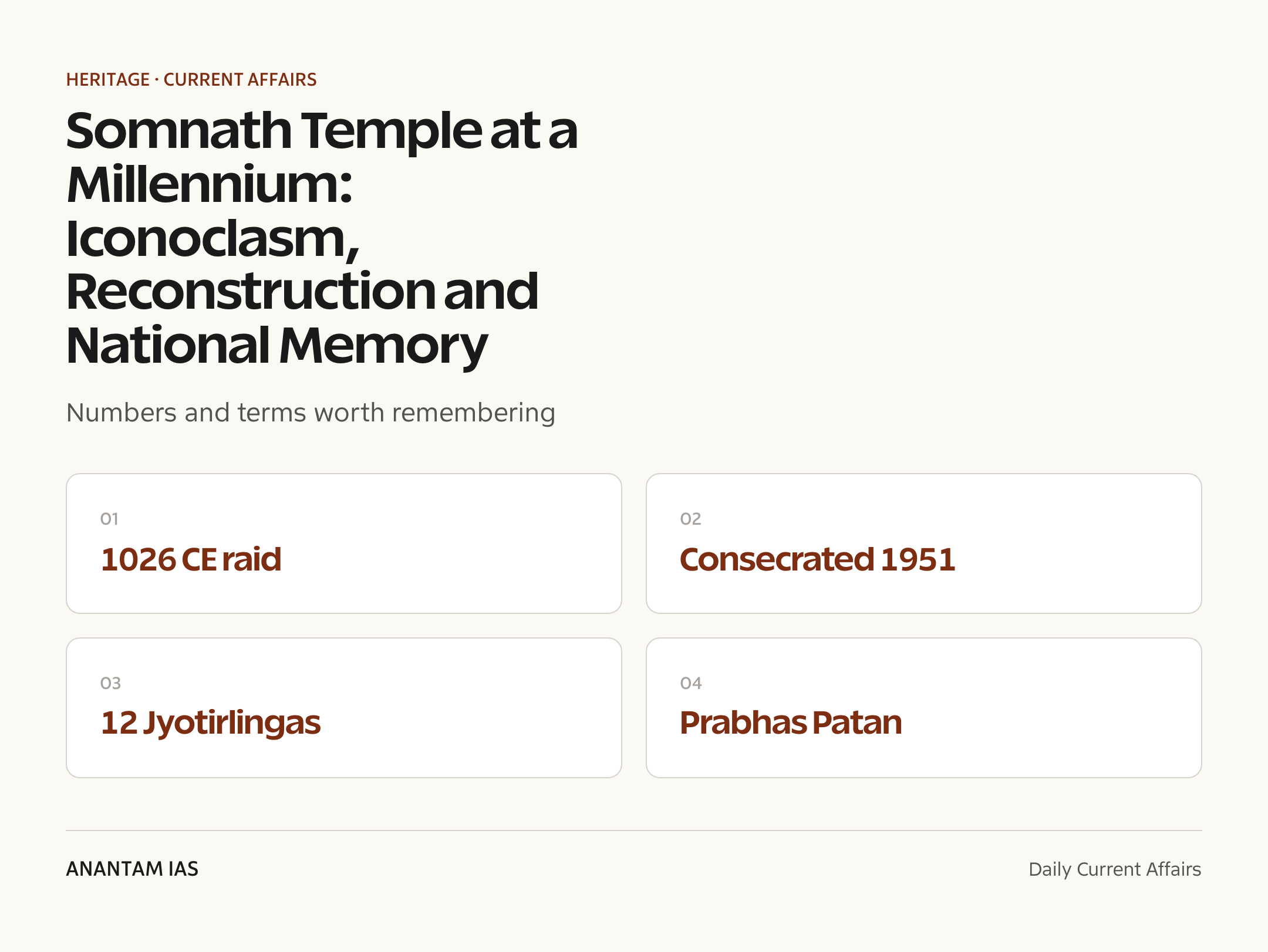
The year 2026 marks roughly a thousand years since the raid on the Somnath temple at Prabhas Patan, on the Saurashtra coast of Gujarat, by Mahmud of Ghazni in 1026 CE — an event that turned a regional shrine into a recurring symbol in debates over iconoclasm, cultural memory and restoration.
The anniversary has revived attention on Somnath’s long destruction-and-reconstruction cycle and on its post-Independence rebuilding, which was driven by Sardar Vallabhbhai Patel and K.M. Munshi and consecrated in 1951.
- Somnath is counted among the twelve Jyotirlinga shrines of Shiva, the holiest class of Shaivite sites in India.
- The temple stands on the coast at Prabhas Patan near Veraval, in Gir Somnath district of Gujarat.
- Mahmud of Ghazni’s raid of 1026 CE is the most cited of several attacks the shrine endured between the 11th and 18th centuries.
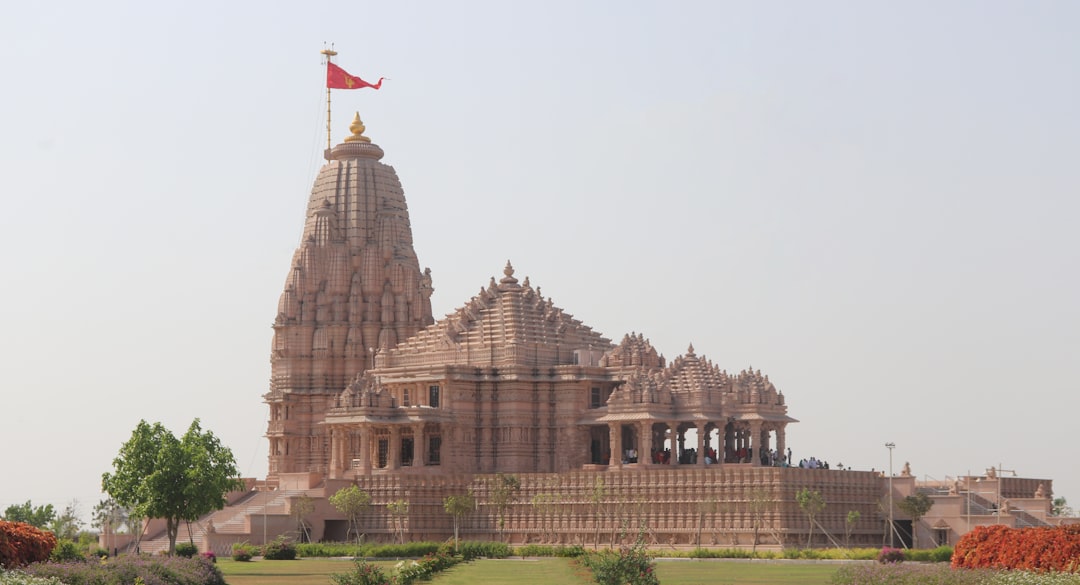
- The present structure, in the Maru-Gurjara (Solanki) style, was completed and consecrated on 11 May 1951 by President Rajendra Prasad.
- The rebuilding was steered by the Somnath Trust, set up at the initiative of Sardar Patel after Independence.
The development matters in the context of:
- Somnath sits at the intersection of three durable syllabus themes — temple architecture styles, medieval iconoclasm, and the politics of heritage restoration.
- Its history is a case study in how a single monument is read very differently across communities and centuries, making it a recurring essay and interview theme.
UPSC Relevance
Prelims Relevance
- Jyotirlinga — twelve shrines of Shiva; Somnath traditionally listed first
- Maru-Gurjara (Solanki / Chaulukya) temple architecture — features and other examples
- Nagara style of temple architecture and its sub-schools
- Mahmud of Ghazni — raids on India, c. 1000–1027 CE
- Prabhas Patan / Veraval / Gir Somnath — location on the Saurashtra coast
- Sardar Vallabhbhai Patel and K.M. Munshi — role in reconstruction
- Rajendra Prasad — consecrated the rebuilt temple in 1951
- Chaulukya / Solanki dynasty of Gujarat and its temple-building
Mains Relevance
GS Paper 1
- Salient features of Indian temple architecture, with the Maru-Gurjara style as an illustration.
- Medieval iconoclasm and the historiography around the destruction of temples — how historians read the Somnath raids.
GS Paper 1
- Cultural heritage as a tool of nation-building after Independence, with Somnath’s reconstruction as a case study.
Essay
- Monuments as memory: how a nation chooses to remember loss and renewal.
- Heritage, identity and the uses of the past in a plural society.
Background and Context
Where Somnath stands and what it is
Somnath is a coastal Shaivite shrine whose sanctity and seaward position together shaped its history.
- It lies at Prabhas Patan, near the port of Veraval, in Gir Somnath district on the southern coast of the Saurashtra peninsula.
- It is venerated as the first of the twelve Jyotirlinga — shrines where Shiva is worshipped as a self-manifest pillar of light.
- Pilgrimage traditions and a coastal trade economy made it wealthy, which in turn made it a target during the medieval period.
- Its name links it to Prabhasa, a tirtha mentioned in early texts as the place associated with the moon-god Soma.
Chaulukya temple-building and the Maru-Gurjara style
The architectural lineage Somnath belongs to is the western-Indian Maru-Gurjara school perfected under the Solankis.
- The Chaulukya (Solanki) rulers of Gujarat patronised a distinctive idiom now called Maru-Gurjara, a regional form of the broader Nagara tradition.
- Its signatures are a soaring curvilinear shikhara, intricately carved exterior walls, ornate ceilings, and pillared halls (mandapas) richly decorated with sculpture.
- Sister monuments of the style include the Sun Temple at Modhera, the Rani ki Vav stepwell at Patan, and many Jain temples of Dilwara.
- The rebuilt 1951 Somnath was designed in this Maru-Gurjara idiom by the architect Prabhashankar Sompura, drawing on traditional temple-craft (the Sompura guild).
The destruction-and-reconstruction cycle
Somnath’s defining historical feature is that it was repeatedly damaged and repeatedly rebuilt over centuries.
- Tradition holds that successive temples occupied the site; the structure standing in the early 11th century was raided by Mahmud of Ghazni in 1026 CE.
- It was rebuilt and again attacked across the medieval period, with further damage attributed to forces under Alauddin Khalji‘s general and, later, under Aurangzeb.
- Each rebuilding drew on local patronage — rulers, merchants and devotees — a tradition of temple-renewal echoed centuries later by figures such as Ahilyabai Holkar.
- By the colonial era the medieval temple lay largely in ruin, setting the stage for a planned 20th-century reconstruction.
Reading the iconoclasm debate
How historians interpret the 1026 raid is itself a major historiographical theme.
- Older accounts treated the raid mainly as religious zeal aimed at idol-breaking, an image amplified in later Persian and colonial retellings.
- Scholars such as Romila Thapar have argued the event was layered — driven substantially by plunder of temple wealth — and that its symbolism was magnified much later, including in 19th-century British debates over the so-called gates of Somnath.
- The point for answers is to distinguish the historical event from its later mythologisation, and to weigh economic, political and religious motives together.
- It is a textbook example of how the past is reinterpreted to serve later political needs — a recurring essay theme on memory and identity.
Post-Independence rebuilding and heritage politics
The 1951 reconstruction made Somnath a case study in cultural restoration as nation-building.
- Sardar Vallabhbhai Patel championed rebuilding the temple soon after the integration of Junagadh into India in 1947–48.
- K.M. Munshi, then a Union minister and a writer-historian, drove the project and the Somnath Trust that funded it from public donations rather than the state exchequer.
- President Rajendra Prasad performed the consecration on 11 May 1951, framing it as a revival of cultural confidence.
- The episode also opened a lasting debate on the relationship between a secular state and the restoration of religious heritage, a tension still discussed in GS Paper 1 and Paper 2 contexts.
Conservation and the site today
Beyond the working temple, the surrounding Prabhas Patan zone is an archaeological and pilgrimage landscape.
- The Archaeological Survey of India protects monuments and remains in the Prabhas Patan area, distinct from the living temple managed by the Trust.
- The site combines an active place of worship with layered remains of earlier structures, raising standard conservation questions about restoration versus authenticity.
- Somnath features in heritage-tourism circuits alongside other Saurashtra sites, linking pilgrimage with regional development.
- It remains a reference point in discussions of how India presents contested heritage to domestic and international visitors.
Way Forward
Distinguish history from memory
- Teach and present Somnath with the documented record alongside its later symbolism, so that the monument informs rather than inflames.
- Use the site to explain how historians weigh plunder, politics and faith as overlapping motives.
Conserve with rigour
- Sustain ASI-led scientific conservation of the Prabhas Patan remains while respecting the living temple’s role.
- Document the Maru-Gurjara craft traditions and the Sompura guild knowledge that made the 1951 rebuild possible.
Frame heritage restoration as inclusive nation-building — celebrating cultural revival while keeping the state even-handed across communities, and integrating pilgrimage with sustainable coastal tourism.
Conclusion
A thousand years after 1026, Somnath is less a single event than a long argument about loss, renewal and how a society chooses to remember. Its stones carry the Maru-Gurjara craft of the Solankis, the scars of medieval raids, and the optimism of a republic that rebuilt it in 1951.
For the UPSC aspirant the value lies in the durable threads behind the anniversary — temple architecture, the Jyotirlinga tradition, the historiography of iconoclasm, and heritage as a project of identity — each of which outlasts any single news cycle.
UPSC Practice Questions
Prelims MCQ 1
With reference to the Somnath temple, consider the following statements:
- It is traditionally counted among the twelve Jyotirlinga shrines of Shiva.
- It is located on the Saurashtra coast of Gujarat near Veraval.
- Its present structure was built in the Dravidian style of temple architecture.
How many of the above statements are correct?
(a) Only one (b) Only two (c) All three (d) None
Answer: (b) Only two
Explanation:
Statements 1 and 2 are correct — Somnath is a Jyotirlinga on the Saurashtra coast near Veraval. Statement 3 is wrong: the temple is in the Maru-Gurjara (Solanki) idiom, a regional form of the Nagara style, not Dravidian.
Prelims MCQ 2
The reconstruction of the Somnath temple that was consecrated in 1951 is most closely associated with which of the following figures?
(a) Jawaharlal Nehru and Maulana Azad (b) Sardar Vallabhbhai Patel and K.M. Munshi (c) B.R. Ambedkar and Rajagopalachari (d) Syama Prasad Mookerjee and G.B. Pant
Answer: (b) Sardar Vallabhbhai Patel and K.M. Munshi
Explanation:
Patel initiated the rebuilding after Junagadh’s integration; K.M. Munshi drove the project through the Somnath Trust. President Rajendra Prasad performed the 1951 consecration.
UPSC Mains Questions
- The Somnath temple has been described as a monument of repeated destruction and renewal. Examine how its architecture and history illustrate the salient features of western-Indian temple-building and the wider Nagara tradition.
- Historians distinguish the medieval raids on Somnath from their later mythologisation. Critically discuss how interpretations of iconoclasm have been shaped by colonial and post-colonial concerns.
- Evaluate the reconstruction of the Somnath temple in 1951 as an exercise in cultural heritage and nation-building, and the questions it raised about the secular state’s relationship with religious restoration.
Sources: Archaeological Survey of India, Ministry of Culture and The Hindu.
Frequently Asked Questions
Why is Somnath in the news in 2026?
The year marks roughly a thousand years since Mahmud of Ghazni’s raid on the Somnath temple in 1026 CE. The anniversary has revived interest in the shrine’s long cycle of destruction and rebuilding, its Maru-Gurjara architecture, and its reconstruction after Independence in 1951.
Where is the Somnath temple located?
It stands at Prabhas Patan, near the port town of Veraval, in Gir Somnath district on the southern coast of the Saurashtra peninsula in Gujarat. Its coastal position and pilgrimage wealth shaped much of its history.
What architectural style is the Somnath temple built in?
The present temple, completed in 1951, follows the Maru-Gurjara or Solanki idiom, a regional form of the Nagara tradition. It features a tall curvilinear shikhara, richly carved walls and pillared mandapas, designed by the temple architect Prabhashankar Sompura.
What is a Jyotirlinga and where does Somnath fit?
A Jyotirlinga is one of twelve especially sacred shrines where Shiva is worshipped as a self-manifest pillar of light. Somnath is traditionally listed first among the twelve, which is why it ranks among the holiest Shaivite sites in India.
Who rebuilt the Somnath temple after Independence?
Sardar Vallabhbhai Patel championed the reconstruction after Junagadh’s integration, and K.M. Munshi steered the project through the Somnath Trust, funded by public donations. President Rajendra Prasad performed the consecration on 11 May 1951.
Why do historians debate the 1026 raid?
Older accounts framed it mainly as religious idol-breaking, while later scholars such as Romila Thapar stressed plunder of temple wealth and showed how the event’s symbolism was magnified much later, including in 19th-century British debates. The debate is a model of distinguishing history from memory.
Source: https://anantamias.com/current-affairs/somnath-temple-millennium-2026/
Bio-Bitumen from Farm Residue: Clean Green Highways and Stubble Management
India’s January 2026 bio-bitumen update connected two stubborn policy problems: road-building dependence on petroleum bitumen and the annual burning of crop residue. CSIR labs demonstrated bio-bitumen from rice straw through pyrolysis and showed its use in road construction trials.
For UPSC, this is a compact GS-III topic because it brings together science and technology, infrastructure, circular economy, pollution control, farmer income and import dependence. It is exactly the kind of applied innovation that can appear in both Prelims and Mains.
This article explains bio-bitumen as a policy instrument, not a laboratory curiosity, and maps how it can support cleaner roads and better residue management.
Quick Facts
- CSIR-CRRI and CSIR-IIP are central institutions in the bio-bitumen demonstration.
- Rice straw can be converted into bio-oil through pyrolysis and processed into bio-bitumen.
- Bio-bitumen can partially replace petroleum bitumen in road construction.
- A demonstration road stretch was reported on NH-40 in Telangana.
- India imports a large share of petroleum bitumen, creating an import-substitution opportunity.
- Crop-residue burning is a major air-pollution source in northern India.
- Official source: PIB, Ministry of Science and Technology.
What Just Happened
The official update highlighted India’s progress in producing bio-bitumen from agricultural residue and using it in road trials. The technology uses rice straw, a residue often burnt in fields, as a feedstock for a useful infrastructure material.
The policy significance is that a waste stream becomes a road-construction input. If scaled, the same farm residue that worsens winter air pollution could earn value in a supply chain linked to highways.
The topic also aligns with the Clean Green Highways idea: reduce fossil dependence in road materials, lower waste burning and improve the life-cycle profile of infrastructure.
Background and Historical Context
Bitumen is a petroleum-derived binder used in asphalt roads. India consumes large volumes of it for national highways, state highways and urban roads. Import dependence exposes the sector to crude-price volatility.
Rice straw burning is driven by tight sowing windows, low residue value, labour shortage and mechanised harvesting. Farmers often burn residue because removing it costs money and delays the next crop.
Bio-bitumen attempts to change the economics. If residue becomes a purchased input, farmers have a reason to collect and sell it. But that requires aggregation, transport, processing plants and assured demand from road agencies.
Key Features of Bio-Bitumen Technology
The core policy architecture can be read through these features.
- Feedstock: rice straw and other biomass residues can be used.
- Process: pyrolysis converts biomass into bio-oil, which can be upgraded for bitumen blending.
- Use case: partial replacement of petroleum bitumen in asphalt roads.
- Institutional role: CSIR laboratories provide research, testing and standards support.
- Environmental link: the technology can reduce open burning if procurement works.
- Infrastructure link: highways can create steady demand for the material.
Why It Matters
This is a high-yield UPSC topic because it joins current news with durable syllabus themes.
- It connects air-pollution control with farmer incentives, not only enforcement.
- It gives GS-III content on circular economy, clean technology and infrastructure.
- It shows import substitution without crude industrial protectionism.
- It helps candidates write integrated answers on stubble burning beyond bans and fines.
Detailed Analysis: Environment Lens
The technology solves only half the problem. Producing bio-bitumen is important, but the policy challenge is feedstock logistics. Rice straw is bulky, seasonal and scattered across millions of farms.
Demand assurance is essential. Road agencies must create clear procurement standards and blending norms. Without predictable demand, farmers and processors will not invest in collection chains.
It is better as a portfolio tool. Bio-bitumen will not eliminate stubble burning alone. It should sit alongside in-situ residue management, biomass power, compressed biogas, pellets and soil-health practices.
Comparative Perspective
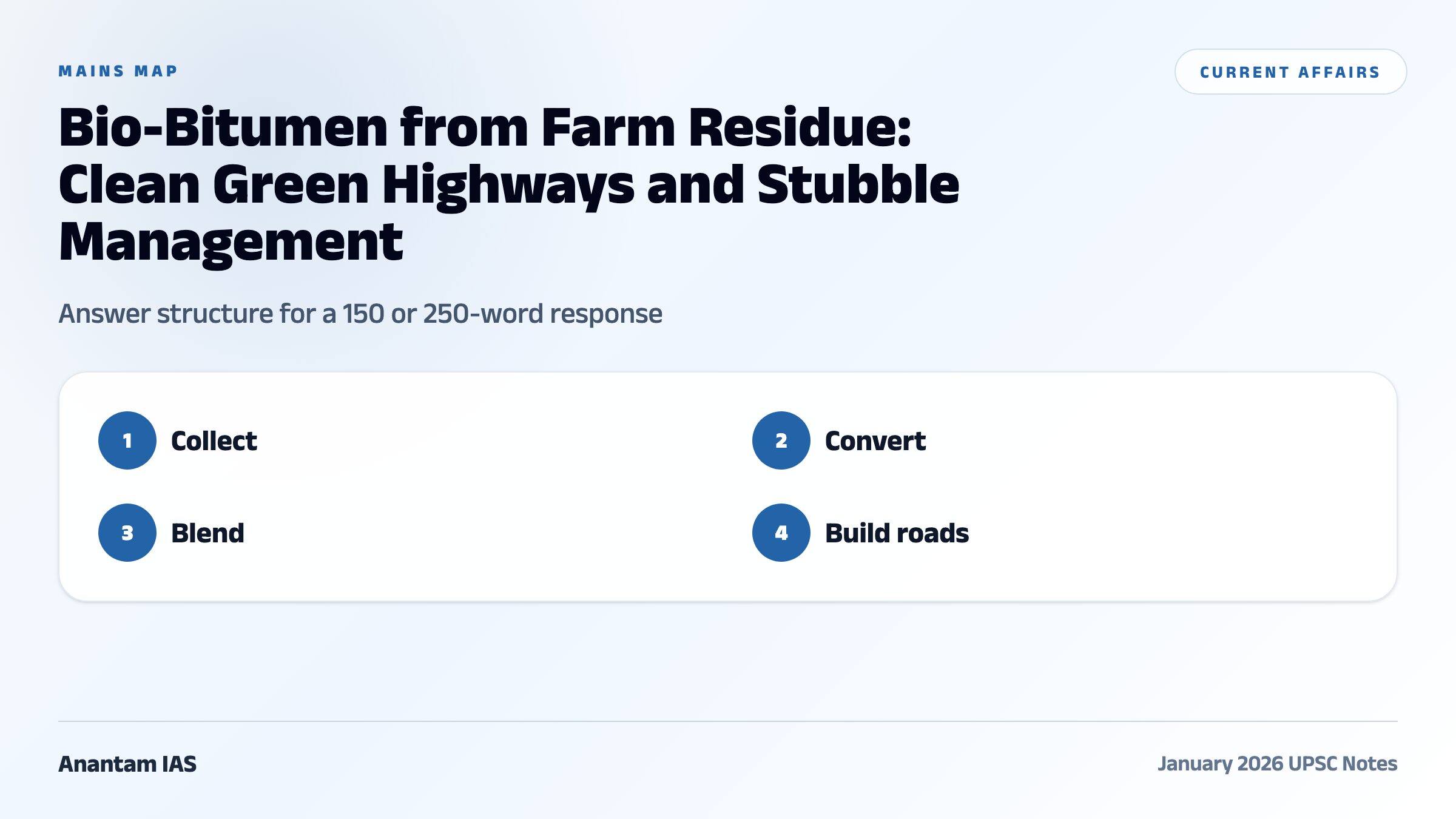
A comparison helps prevent the answer from becoming a one-dimensional news summary.
- In-situ residue management: machines like Happy Seeder retain residue in fields but require farmer adoption.
- Compressed biogas: converts residue into fuel but depends on plant economics and gas offtake.
- Bio-bitumen: links residue to road construction and import substitution.
- Ex-situ biomass power: uses residue for energy but faces collection and tariff challenges.
Challenges
The policy or institutional promise runs into recurring constraints.
- Residue aggregation is expensive because rice straw is bulky.
- Quality standards must prove road durability across climate zones.
- Farmers need timely payments and local collection points.
- Processing plants must be located close enough to feedstock sources.
- Public procurement rules must allow innovative materials without compromising road safety.
Prelims Pointers
- Bitumen is a petroleum-derived binder used in road construction.
- Pyrolysis is thermal decomposition in limited or no oxygen.
- CSIR-CRRI works on roads and transport infrastructure research.
- CSIR-IIP works on petroleum and energy research.
- Crop-residue burning contributes to particulate pollution.
- Circular economy aims to convert waste streams into useful inputs.
Mains Questions
- Bio-bitumen can turn stubble from an air-pollution liability into an infrastructure input. Discuss the opportunities and constraints. (GS Paper III, 250 words)
- Why have enforcement-heavy approaches failed to solve crop-residue burning? Suggest incentive-based alternatives. (GS Paper III, 250 words)
- Evaluate the role of public procurement in scaling clean technologies. (GS Paper III, 150 words)
- Circular economy solutions require ecosystem design, not only innovation. Analyse with reference to bio-bitumen. (GS Paper III, 250 words)
Way Forward
India should begin with regional procurement corridors in high-residue districts, linking farmer-producer organisations, biomass aggregators, CSIR-tested processors and highway contractors.
Standards must be strict. A green road material that fails early will lose credibility quickly. Field performance across heat, rain and heavy traffic should guide blending limits.
Bio-bitumen is a promising bridge between clean technology and farmer income, but its success will be decided by logistics and procurement, not the press release.
The examiner is unlikely to reward a bare fact dump here. The better answer connects the January 2026 event to institutional design, implementation capacity and India’s long-term development priorities.
Frequently Asked Questions
What is bio-bitumen?
Bio-bitumen is a bitumen-like road binder produced partly from biomass such as rice straw, usually through thermochemical processing.
Why is bio-bitumen important for India?
It can reduce petroleum-bitumen dependence and create value for crop residue that is otherwise often burnt.
Which institutions are involved?
CSIR-CRRI and CSIR-IIP are key institutions mentioned in the official bio-bitumen update.
Can bio-bitumen end stubble burning?
No. It can help if scaled well, but it must be combined with other residue-management options.
What is pyrolysis?
Pyrolysis is heating biomass in limited or no oxygen to produce bio-oil, char and gases.
What is the main bottleneck?
The hard part is collecting, transporting and processing bulky residue at a cost that works for farmers and road agencies.
Source: https://anantamias.com/current-affairs/bio-bitumen-farm-residue-india-2026/
Rajasthan AI Impact Conference 2026: State-Level AI Governance and Skilling
Rajasthan hosted a Regional AI Impact Conference in January 2026 with a strong focus on skilling, youth participation and public-sector AI use. The event showed that AI policy is moving from national strategy documents into state-level implementation.
For UPSC, the state angle is important. AI governance will not be solved only in Delhi. Schools, police departments, health systems, agriculture extension, local language services and state data systems will decide how citizens actually experience AI.
This article uses the Rajasthan AI Impact Conference to explain state-level AI governance, skilling, public-service delivery and the federal dimension of India’s AI strategy.
Quick Facts
- The conference was held in Rajasthan in January 2026.
- It was linked to the IndiaAI and AI-for-impact policy ecosystem.
- Youth skilling and public-sector applications were central themes.
- States can apply AI in health, education, agriculture, policing, tourism and grievance redress.
- AI policy has federal implications because many service-delivery sectors are state-led.
- Official source: PIB MeitY release dated 7 January 2026.
- Official source: PIB, Ministry of Electronics and IT.
What Just Happened
The conference brought AI policy discussions to a state platform with emphasis on skilling and impact-oriented use cases.
The event reflects a broader policy shift: AI is no longer only about startups and models. It is about public administration, local capacity and citizen services.
For aspirants, this is a useful example when writing about cooperative federalism in technology governance.
Background and Historical Context
India’s AI policy ecosystem includes IndiaAI Mission, digital public infrastructure, sectoral datasets, skilling programs and state innovation missions.
States control or heavily influence health, police, schools, agriculture extension and local administration. These are precisely the areas where AI applications can affect citizens.
The risk is uneven adoption. A few states may build strong AI capacity while others remain dependent on vendors and poorly governed pilots.
Key Features of AI Governance
The core policy architecture can be read through these features.
- State platform: AI discussion moved into a regional implementation context.
- Skilling: youth capability was positioned as a central requirement.
- Public services: AI can support education, health, agriculture and grievance systems.
- Federalism: states must adapt national AI frameworks to local realities.
- Ethics: fairness, privacy and accountability are public-sector requirements.
- Capacity building: officials need procurement and data-governance literacy.
Why It Matters
This is a high-yield UPSC topic because it joins current news with durable syllabus themes.
- It connects a January 2026 event with durable UPSC syllabus themes.
- It gives usable facts for Prelims and analytical hooks for Mains.
- It helps students move from news recall to policy reasoning.
- It can be linked with static concepts in polity, economy, governance, science, environment or society.
Detailed Analysis: AI Governance Lens
AI impact depends on administrative capacity. A good model deployed in a weak department can still fail.
States need procurement discipline. AI tools bought without audit, explainability and grievance mechanisms can create opaque governance.
Local-language AI is a governance multiplier. It can expand access to information and services if privacy and accuracy are protected.
Comparative Perspective
A comparison helps prevent the answer from becoming a one-dimensional news summary.
- National AI missions: set compute, dataset and innovation priorities.
- State AI missions: translate AI into sector-specific delivery.
- Private AI tools: move fast but need regulation in public use.
- Public DPI: can provide trusted rails for AI-enabled services.
Challenges
The policy or institutional promise runs into recurring constraints.
- State data quality is uneven.
- Public procurement may not understand AI risks.
- Bias can harm welfare targeting or policing decisions.
- Officials and teachers need training.
- Citizens need grievance mechanisms when AI-assisted decisions go wrong.
Prelims Pointers
- AI governance includes privacy, fairness, transparency, accountability and safety.
- Many AI use cases in India depend on state subjects such as health, agriculture and police.
- IndiaAI Mission is a national AI ecosystem initiative.
- Digital public infrastructure can support AI applications through trusted data and identity layers.
- Algorithmic bias means systematic unfairness in model outputs.
- Explainability is important in high-stakes public decisions.
Mains Questions
- Why is state capacity central to responsible AI deployment in India? (GS Paper II/III, 250 words)
- Discuss the federal dimension of AI governance in India. (GS Paper II, 150 words)
- AI in public services can improve efficiency but also deepen exclusion. Analyse. (GS Paper III, 250 words)
- What safeguards should guide state governments when procuring AI systems? (GS Paper II, 250 words)
Way Forward
States should create AI procurement checklists, data-governance standards, model audits and citizen grievance channels before large-scale deployment.
AI skilling must include officials, teachers, local bodies and civil society, not just engineering students.
The balanced exam view is that AI can improve governance only when institutions remain accountable for decisions.
The examiner is unlikely to reward a bare fact dump here. The better answer connects the January 2026 event to institutional design, implementation capacity and India’s long-term development priorities.
Frequently Asked Questions
Why is a state AI conference important?
Because many AI use cases are implemented by state departments in education, health, agriculture and policing.
What is AI governance?
It is the framework for safe, fair, accountable and rights-respecting use of AI.
How does AI link to federalism?
States control many service-delivery sectors where AI will be deployed.
What is the main risk?
Opaque AI systems can produce biased or unchallengeable decisions.
Which GS papers are relevant?
GS-II governance and GS-III science and technology.
What should students remember?
AI policy requires both technology and administrative capacity.
Source: https://anantamias.com/current-affairs/rajasthan-ai-impact-conference-2026/
NATGRID and the Architecture of Surveillance: Security vs Privacy
Why in News?
The operationalisation of NATGRID (the National Intelligence Grid) is back in focus as a unified intelligence-sharing backbone that connects sensitive citizen databases for India’s security and intelligence agencies. Conceived in the aftermath of the 26/11 Mumbai attacks (2008), it is meant to give authorised users near-real-time, searchable access to scattered government data for counter-terror investigations.
Its roll-out has revived a sharp constitutional debate: the platform sits inside a country that still lacks a dedicated surveillance law, even after the Supreme Court recognised privacy as a fundamental right in Justice K.S. Puttaswamy (2017) and Parliament passed the Digital Personal Data Protection (DPDP) Act, 2023.
- NATGRID integrates roughly 21 databases spanning banking, telecom, immigration, travel, tax and other records.
- It was sanctioned in 2009-10 as a direct institutional response to intelligence failures around 26/11.
- It functions as a secure search-and-retrieval layer, not a new database — it queries existing data held by other agencies.
- Access is meant to be restricted to designated central security and intelligence agencies, not open-ended.
- The debate it triggers turns on the proportionality test laid down in Puttaswamy and the absence of standalone surveillance legislation.
The development matters in the context of:
- Matters because India’s counter-terror response depends on fusing data that today sits in silos across ministries and agencies.
- Matters because surveillance powers are still exercised under colonial-era and pre-internet statutes rather than a modern, rights-aware framework.
- Matters because the DPDP Act, 2023 grants the State broad exemptions, leaving the citizen-versus-state balance largely to executive discretion.

UPSC Relevance
Prelims Relevance
- NATGRID — National Intelligence Grid, under the Ministry of Home Affairs (MHA)
- Origin: institutional response to the 26/11 Mumbai attacks (2008)
- Links approximately 21 sensitive databases (banking, telecom, immigration, travel, tax)
- Justice K.S. Puttaswamy v. Union of India (2017) — right to privacy under Article 21
- The proportionality doctrine: legitimate aim, suitable means, necessity, balancing
- Digital Personal Data Protection (DPDP) Act, 2023 and State exemptions
- Interception powers: Section 5(2), Indian Telegraph Act, 1885 and Section 69, IT Act, 2000
- Related bodies: NIA, Intelligence Bureau (IB), R&AW, NCTC (proposed)
- CMS (Centralised Monitoring System) and NETRA — distinct surveillance projects
Mains Relevance
GS Paper 3
- Linkages between development and the spread of extremism; the role of an integrated intelligence grid in India’s internal-security architecture.
- Challenges to internal security through communication networks; the role of media and social networking sites; basics of cyber security and data protection.
GS Paper 2
- Government policies and interventions; the need for a dedicated surveillance/data-protection law and parliamentary oversight of intelligence agencies.
- Fundamental rights — the right to privacy as a facet of Article 21 and reasonable restrictions in the interest of security.
Essay
- Liberty and security are not opposites but conditions for each other.
- A surveillance State protects no one if it answers to no one.
Background and Context
What NATGRID is — and what it is not
NATGRID is a secure intelligence-sharing platform, not a fresh data-collection machine.
- It is a federated search-and-retrieval system that lets authorised agencies query data already held by other departments.
- It connects around 21 source databases — including banking, telecom, immigration, railway and air travel, and income-tax records.
- It does not create a new central pool of citizen data; it acts as a fast indexing-and-access layer over distributed silos.
- Access is designed to be limited to designated central security and intelligence agencies for counter-terror and security work.
- The goal is speed: turning days of inter-agency paperwork into a single authenticated query.
Why it was conceived — the 26/11 lesson
The grid is a structural fix for the intelligence fragmentation exposed by the 2008 attacks.
- The 26/11 Mumbai attacks revealed that critical leads lay scattered across agencies that did not share data in time.
- NATGRID was sanctioned in 2009-10 under the Ministry of Home Affairs to break those silos.
- It sits alongside other post-26/11 reforms within India’s internal security framework — the National Investigation Agency (NIA), coastal-security upgrades, and the proposed NCTC.
- The animating idea is intelligence fusion — connecting dots across financial, travel and communication footprints before an attack.
- Several states and agencies initially resisted, citing turf and the risk of a single point of data failure.
The constitutional anchor — Puttaswamy and proportionality
Any large-scale surveillance system must clear the bar the Supreme Court set in 2017.
- In Justice K.S. Puttaswamy v. Union of India (2017), a nine-judge bench held that the right to privacy is a fundamental right under Article 21.
- The court laid down a proportionality test: a legitimate State aim, a rational nexus, necessity (least-restrictive means), and a fair balance with rights.
- Surveillance must also satisfy legality — it needs the backing of a clear, publicly known law, not just executive instruction.
- The verdict implies that bulk or open-ended data access without safeguards is constitutionally suspect.
- Courts have since stressed procedural safeguards, independent review, and data-minimisation as conditions for lawful interception.
The legal vacuum — no dedicated surveillance law
India authorises interception under old statutes never written for an integrated data grid.
- Telephone interception rests on Section 5(2) of the Indian Telegraph Act, 1885 and its rules.
- Digital interception and monitoring rest on Section 69 of the Information Technology Act, 2000.
- Neither statute contemplates a federated grid linking financial, travel and communication records at scale.
- There is no standalone law that defines who may be surveilled, on what threshold, with what judicial or parliamentary oversight.
- Critics argue this leaves NATGRID-type access governed largely by executive discretion and internal guidelines.
DPDP Act 2023 — protection with broad State exemptions
The data-protection law tightens private-sector rules but carves out wide space for the State.
- The Digital Personal Data Protection (DPDP) Act, 2023 is India’s first horizontal data-protection statute.
- It allows the Central Government to exempt notified agencies from the Act’s obligations on grounds such as sovereignty, integrity and security of the State.
- These exemptions can switch off consent, purpose-limitation and data-minimisation duties for security agencies.
- The Act does not create an independent surveillance oversight body or judicial warrant requirement.
- So the citizen-versus-State balance is shaped less by hard statutory limits and more by how exemptions are written and used.
Security gains versus privacy risks
The grid promises faster counter-terror action but concentrates power over sensitive data.
- Security upside: rapid intelligence fusion, quicker tracing of suspects, fewer fatal delays in fast-moving plots.
- Privacy risk: profiling and function creep, where a counter-terror tool drifts into routine monitoring.
- Governance risk: weak audit trails and the absence of independent review invite misuse or chilling effects on dissent.
- Security risk: a high-value, integrated access layer is itself an attractive target for breaches and insider threats.
- Trust risk: opacity around who queries what, and when, erodes public confidence in the State’s restraint.
Way Forward
Enact a dedicated surveillance law
- Replace the patchwork of 1885 and 2000 statutes with a modern, rights-aware surveillance framework.
- Codify clear thresholds, time limits, and a least-restrictive-means requirement consistent with Puttaswamy.
Build independent oversight
- Introduce judicial or quasi-judicial authorisation for access to sensitive linked data.
- Create a standing parliamentary intelligence-oversight committee, as in many democracies.
Engineer privacy into the system
- Apply data-minimisation, purpose-limitation and tamper-proof audit logs by design.
- Mandate periodic independent security and privacy audits, with summary findings placed before Parliament.
Conclusion
NATGRID answers a real and proven need: the 26/11 failure to connect intelligence in time cost lives, and a federated grid can close that gap. The question is not whether the State should fuse intelligence, but on what terms — and who watches the watchers.
The Puttaswamy framework and the DPDP Act, 2023 give India the constitutional vocabulary; what is missing is a dedicated surveillance law, independent oversight, and privacy-by-design. Get those right, and security and liberty reinforce rather than cancel each other.
UPSC Practice Questions
Prelims MCQ 1
With reference to NATGRID (National Intelligence Grid), consider the following statements:
- It was conceived as an institutional response in the aftermath of the 26/11 Mumbai attacks.
- It functions primarily as a single new central database that collects citizen information directly from the public.
- It is meant to link multiple existing government databases such as banking, telecom and immigration records.
How many of the above statements are correct?
(a) Only one (b) Only two (c) All three (d) None
Answer: (b) Only two
Explanation:
Statements 1 and 3 are correct. Statement 2 is wrong — NATGRID is a secure search-and-retrieval layer over existing databases, not a fresh central data-collection pool.
Prelims MCQ 2
The proportionality test for restricting the right to privacy was authoritatively laid down by the Supreme Court in which case?
(a) Maneka Gandhi v. Union of India (1978) (b) Kesavananda Bharati v. State of Kerala (1973) (c) Justice K.S. Puttaswamy v. Union of India (2017) (d) Shreya Singhal v. Union of India (2015)
Answer: (c) Justice K.S. Puttaswamy v. Union of India (2017)
Explanation:
The nine-judge bench in Puttaswamy (2017) held privacy to be a fundamental right under Article 21 and set out the proportionality test for State restrictions.
UPSC Mains Questions
- NATGRID was conceived to fuse intelligence after 26/11, yet India still lacks a dedicated surveillance law. Examine the constitutional and governance challenges of operating such an intelligence grid in light of the Puttaswamy judgment. (250 words)
- “Security and privacy are not rival claims but interdependent goods.” Critically analyse this statement with reference to India’s surveillance architecture and the Digital Personal Data Protection Act, 2023. (250 words)
- Discuss the case for independent oversight of intelligence agencies in India. What institutional safeguards would make data-integration systems like NATGRID compatible with fundamental rights? (150 words)
Sources: Ministry of Home Affairs, Government of India and Press Information Bureau.
Frequently Asked Questions
What is NATGRID in simple terms?
NATGRID, the National Intelligence Grid, is a secure platform under the Ministry of Home Affairs that lets authorised security and intelligence agencies quickly search data already held across various government departments. It links roughly 21 databases, such as banking, telecom and travel records, to support counter-terror investigations rather than creating a brand-new central database of its own.
Why was NATGRID created?
It was conceived after the 26/11 Mumbai attacks of 2008, which exposed how critical intelligence leads were scattered across agencies that did not share information in time. Sanctioned around 2009-10, NATGRID was designed to break these data silos and enable faster intelligence fusion, so that financial, travel and communication footprints could be connected before, not after, an attack.
Which databases does NATGRID link?
It connects approximately 21 sensitive source databases. These include banking and financial records, telecom data, immigration and visa records, railway and air-travel bookings, and income-tax information, among others. NATGRID does not own this data; it queries the systems that already hold it, acting as a fast, authenticated access-and-indexing layer for designated central agencies.
How does the right to privacy affect NATGRID?
In Justice K.S. Puttaswamy v. Union of India (2017), the Supreme Court held that privacy is a fundamental right under Article 21. Any surveillance or data-integration system must then pass a proportionality test — pursuing a legitimate aim, using the least-restrictive means, and balancing security against individual rights — and rest on a clear, publicly known law.
Does the DPDP Act 2023 cover surveillance by the State?
The Digital Personal Data Protection Act, 2023 governs how personal data is handled, but it allows the Central Government to exempt notified agencies on grounds like the security of the State. These exemptions can switch off consent and data-minimisation duties for security agencies, and the Act does not create an independent surveillance oversight body or a warrant requirement.
Why do critics worry about surveillance in India?
Critics point out that India authorises interception under old laws — Section 5(2) of the Indian Telegraph Act, 1885 and Section 69 of the IT Act, 2000 — that were never written for an integrated data grid. With no dedicated surveillance law and limited independent oversight, they fear function creep, profiling, and a chilling effect on free expression and dissent.
Source: https://anantamias.com/current-affairs/natgrid-surveillance-architecture-2026/
The Doomsday Glacier: Why Thwaites Matters for Global Sea Levels
Why in News?
Thwaites Glacier in West Antarctica — popularly called the Doomsday Glacier — remains the most closely watched ice mass on Earth, with researchers warning that its grounding line is retreating faster than models predicted as warm ocean water melts it from below.
Roughly the size of Florida (about 192,000 sq km), Thwaites alone holds enough ice to lift global mean sea level by around 65 cm, and its loss could unpin the wider West Antarctic Ice Sheet (WAIS), with far larger long-term consequences for coastal nations including India.
- Nickname: dubbed the Doomsday Glacier for its outsized, potentially abrupt impact on global sea level.
- Scale: roughly Florida-sized (~192,000 sq km), one of the widest glaciers on the planet.
- Direct contribution: full collapse could raise global sea level by about 65 cm.
- Tipping risk: acts as a cork holding back the West Antarctic Ice Sheet, which stores enough ice for several metres of rise.
- Mechanism: warm Circumpolar Deep Water is melting the glacier at its grounding line, accelerating retreat.
- India link: rising seas threaten low-lying coasts, deltas and island groups, sharpening the case for polar research from stations Maitri and Bharati.
The development matters in the context of:
- Cryosphere stress: Antarctica and Greenland are now the dominant drivers of accelerating sea-level rise, overtaking thermal expansion.
- Marine ice-sheet instability: glaciers grounded below sea level on inward-sloping beds, like Thwaites, can retreat in a self-sustaining feedback once destabilised.
- IPCC framing: the IPCC flags polar ice loss as a low-probability, high-impact tail risk that could push sea levels beyond central projections.
- Coastal India: Mumbai, Kolkata, Chennai, the Sundarbans and Lakshadweep are highly exposed to even decimetre-scale sea-level change.

UPSC Relevance
Prelims Relevance
- Thwaites Glacier location — West Antarctica, draining into the Amundsen Sea embayment.
- Meaning of an ice shelf versus a grounding line versus sea ice.
- West Antarctic Ice Sheet (WAIS) as a marine-based ice sheet grounded below sea level.
- Circumpolar Deep Water (CDW) — a relatively warm, salty water mass circling Antarctica.
- Concept of thermohaline circulation and the role of polar waters in it.
- Components of the cryosphere: glaciers, ice sheets, ice shelves, sea ice, permafrost.
- India’s Antarctic research stations — Maitri, Bharati (and historic Dakshin Gangotri).
- Nodal Indian body for polar science — NCPOR, under the Ministry of Earth Sciences.
- The IPCC as the UN body assessing climate science and sea-level projections.
- Difference between thermal expansion and land-ice melt contributions to sea-level rise.
Mains Relevance
GS Paper 1 (Geography)
- Explain how grounding-line retreat and warm ocean intrusion destabilise marine-based ice sheets, and why this matters for global geomorphology.
- Discuss the cryosphere’s role in regulating sea level and ocean circulation, using Thwaites as a case study.
GS Paper 3 (Environment)
- Assess the implications of polar ice-sheet instability for India’s coastal vulnerability and disaster preparedness.
- Evaluate the significance of international and Indian polar research in monitoring climate tipping points.
Essay
- Use Thwaites as a vivid anchor in essays on climate tipping points, intergenerational equity and the limits of prediction.
- Relevant to essays on the commons, planetary boundaries and the ethics of acting under deep uncertainty.
Background and Context
Where Thwaites sits and why it is called the Doomsday Glacier
A vast, fast-flowing outlet glacier with disproportionate leverage over global sea level.
- Setting: lies in West Antarctica, draining into the Amundsen Sea.
- Size: about Florida-sized (~192,000 sq km) and exceptionally wide at its ocean front.
- Nickname: called the Doomsday Glacier because its collapse could trigger large, hard-to-reverse sea-level rise.
- Cork effect: it buttresses neighbouring ice; losing Thwaites could unplug a much larger reservoir of inland ice.
Cryosphere basics: ice shelves, grounding lines and sea ice
Getting the vocabulary right is half the battle in answering questions on polar ice.
- Cryosphere: the frozen parts of the Earth system — glaciers, ice sheets, ice shelves, sea ice and permafrost.
- Ice shelf: the floating extension of a glacier or ice sheet over the ocean; it already displaces water, so its melt adds little directly to sea level.
- Grounding line: the boundary where the ice lifts off the bedrock and begins to float; its inland retreat signals real ice loss.
- Sea ice: frozen seawater that forms and melts seasonally — distinct from land-based glacial ice.
How warm water is undermining the glacier
The threat to Thwaites comes mainly from the ocean below, not the air above.
- Circumpolar Deep Water: relatively warm, salty water is being drawn beneath the floating ice, melting it from underneath.
- Grounding-line retreat: as the line shifts inland over a downward-sloping bed, thicker ice meets the ocean and melts faster — a self-reinforcing loop.
- Marine ice-sheet instability: glaciers grounded below sea level on reverse-sloping beds can retreat in a runaway fashion once tipped.
- Thinning shelf: weakening of the floating ice shelf reduces the back-pressure that slows the glacier’s flow to the sea.
Sea-level rise and the link to thermohaline circulation
Polar ice does not only raise seas; it also helps power the global ocean conveyor.
- Direct rise: a full Thwaites collapse adds roughly 65 cm to global mean sea level; destabilising the wider WAIS could add several metres over centuries.
- Two drivers: sea-level rise comes from thermal expansion of warming water plus land-ice melt from glaciers and ice sheets.
- Thermohaline circulation: cold, dense polar water sinks and drives the deep-ocean conveyor belt; large freshwater pulses from melting ice can disrupt it.
- IPCC view: the IPCC treats rapid polar ice loss as a high-impact risk that could push rise above central projections.
India's stake and its polar research footprint
A glacier on the far side of the planet has direct consequences for Indian coasts.
- Exposed coasts: Mumbai, Kolkata, Chennai, the Sundarbans delta and Lakshadweep are highly vulnerable to even small rises.
- India in Antarctica: research is run from the stations Maitri and Bharati, coordinated by NCPOR under the Ministry of Earth Sciences.
- Monitoring: Indian glaciology and ocean science feed into global assessments of ice loss and sea-level projections.
- Adaptation: coastal zone management, mangrove protection and disaster preparedness become central planning priorities.
Why prediction is hard and the stakes of uncertainty
The honest answer is that scientists cannot yet date the collapse precisely.
- Deep uncertainty: the timing of any rapid collapse spans decades to centuries, but the direction of travel is clear.
- Inaccessibility: the glacier’s remote, harsh setting makes direct measurement difficult and costly.
- Irreversibility: once marine ice-sheet instability is triggered, retreat may continue even if warming stabilises.
- Precaution: high-impact tail risks justify aggressive emission cuts and serious investment in polar observation.
Way Forward
Strengthen polar observation
- Sustained monitoring: expand under-ice ocean sensors, satellite altimetry and grounding-line surveys to narrow timing estimates.
- Indian capacity: deepen NCPOR-led glaciology and Southern Ocean research from Maitri and Bharati.
Cut emissions and plan for the long tail
- Mitigation: rapid decarbonisation remains the only lever that meaningfully lowers worst-case sea-level outcomes.
- Scenario planning: incorporate high-end ice-loss scenarios into long-term coastal and infrastructure decisions.
Build coastal resilience in India
- Coastal management: enforce coastal regulation zones, protect mangroves and restore natural buffers.
- Preparedness: map flood-exposed assets and embed sea-level rise into city master plans and disaster frameworks.
Conclusion
The leverage point: Thwaites earns its grim nickname because a single, remote glacier can swing global sea level by tens of centimetres and unlock far more by destabilising the West Antarctic Ice Sheet.
The mechanism is clear: warm Circumpolar Deep Water eroding the grounding line is a textbook case of how the ocean, not just the air, drives modern ice loss.
The Indian lesson: a frozen continent’s fate is tied to the safety of Indian deltas and cities, which is exactly why polar research and decisive climate action are national, not distant, concerns.
UPSC Practice Questions
Prelims MCQ 1
With reference to Thwaites Glacier, consider the following statements:
- It is located in West Antarctica and drains into the Amundsen Sea.
- Its destabilisation is driven mainly by warm Circumpolar Deep Water melting it at the grounding line.
- It is roughly the size of the state of Florida.
How many of the above statements are correct?
(a) Only one (b) Only two (c) All three (d) None
Answer: (c) All three
Explanation:
Thwaites lies in West Antarctica draining into the Amundsen Sea, is roughly Florida-sized, and is being undermined by warm Circumpolar Deep Water at its retreating grounding line. All three statements are correct.
Prelims MCQ 2
Which one of the following best explains why melting of a floating ice shelf adds little directly to global sea level?
(a) Ice shelves are made of frozen seawater, which is denser than ice (b) The floating ice already displaces ocean water before it melts (c) Ice shelves are located above the grounding line on bedrock (d) Meltwater from ice shelves evaporates before reaching the ocean
Answer: (b) The floating ice already displaces ocean water before it melts
Explanation:
A floating ice shelf already displaces its own weight of water (Archimedes’ principle), so its melt adds little directly. Loss of land-based grounded ice, and the loss of buttressing that speeds up glaciers, is what raises sea level.
UPSC Mains Questions
- Explain the mechanism of marine ice-sheet instability with reference to Thwaites Glacier. Why is the retreat of the grounding line considered a more reliable indicator of ice loss than the melting of floating ice shelves?
- Polar ice-sheet instability is a low-probability, high-impact climate risk. Discuss its implications for India’s coastal regions and the role of Indian polar research in addressing this challenge.
- Distinguish between thermal expansion and land-ice melt as drivers of sea-level rise. How might large freshwater inputs from Antarctic melting affect global thermohaline circulation?
Sources: National Centre for Polar and Ocean Research (NCPOR), Ministry of Earth Sciences and Intergovernmental Panel on Climate Change (IPCC).
Frequently Asked Questions
Why is Thwaites called the Doomsday Glacier?
Because its collapse could raise global sea level by around 65 cm on its own and, by unplugging the wider West Antarctic Ice Sheet, eventually contribute several metres more. A single glacier with that much leverage over the world’s coastlines earns the dramatic nickname.
Where is Thwaites Glacier located?
It lies in West Antarctica, draining into the Amundsen Sea. Roughly the size of Florida (about 192,000 sq km), it is one of the widest glaciers on Earth and a key part of the marine-based West Antarctic Ice Sheet.
What is making the glacier retreat?
Mainly the ocean, not the air. Relatively warm, salty Circumpolar Deep Water is drawn beneath the floating ice and melts it from below. As the grounding line retreats inland over a downward-sloping bed, melting accelerates in a self-reinforcing loop.
What is the difference between an ice shelf and a grounding line?
An ice shelf is the floating extension of a glacier over the sea; because it already displaces water, its melt adds little directly to sea level. The grounding line is where ice lifts off bedrock and starts to float — its inland retreat marks genuine loss of land-based ice.
How does Thwaites threaten coastal India?
Sea-level rise from Antarctic ice loss endangers low-lying Indian coasts and deltas — Mumbai, Kolkata, Chennai, the Sundarbans and Lakshadweep. Even decimetre-scale rise worsens flooding, erosion and saltwater intrusion, making coastal management and disaster preparedness urgent.
What is India’s role in polar research?
India runs Antarctic science from its stations Maitri and Bharati, coordinated by the NCPOR under the Ministry of Earth Sciences. This work on glaciers and the Southern Ocean feeds into global assessments of ice loss and sea-level rise.
Source: https://anantamias.com/current-affairs/thwaites-doomsday-glacier-2026/
PARAM Rudra at IIT Bombay: National Supercomputing Mission and Indigenous HPC
IIT Bombay inaugurated a 3 PetaFLOPS PARAM Rudra high-performance computing facility in January 2026. The system is built on indigenous Rudra servers and belongs to the wider National Supercomputing Mission ecosystem.
For UPSC, this is a clean example of why compute capacity is now strategic infrastructure. Supercomputers are not only for physics departments. They support climate models, drug discovery, materials research, AI, defence simulations, weather forecasting and industrial design.
This article explains PARAM Rudra as a current-affairs issue, but the deeper static anchor is India’s attempt to build sovereign compute capacity under the National Supercomputing Mission.
Quick Facts
- PARAM Rudra at IIT Bombay has 3 PetaFLOPS peak computing capacity.
- It uses indigenous Rudra servers developed through India’s high-performance computing ecosystem.
- The facility includes a Data Center Level Cooling system.
- More than 200 faculty members and 1,200 students are expected to use the facility.
- The National Supercomputing Mission has deployed dozens of systems with combined capacity above 44 PetaFLOPS.
- Key institutions include C-DAC, IISc, MeitY and the Department of Science and Technology.
- Official source: PIB, Ministry of Science and Technology.
What Just Happened
IIT Bombay inaugurated its PARAM Rudra supercomputing facility, adding a high-capacity compute node for academic and applied research. The system expands India’s supercomputing grid and demonstrates progress in indigenous server design.
The facility matters because compute demand is rising across disciplines. Modern science increasingly depends on simulations and data-intensive analysis. A university without serious compute infrastructure is constrained in climate, materials, health, AI and engineering research.
The inauguration also sharpened the policy message behind NSM: India must reduce dependence on imported high-end compute stacks while still integrating with global research networks.
Background and Historical Context
India’s supercomputing journey is often traced to the PARAM series developed by C-DAC after technology-denial pressures in the late 1980s. That experience shaped a long-running belief that high-performance computing is a sovereignty issue.
The National Supercomputing Mission was launched to build a national network of supercomputers across academic and research institutions. It aims to move India from merely buying machines to building hardware, software, cooling, interconnect and application capacity.
The current era adds a new layer: AI. High-performance computing and AI computing are not identical, but both depend on advanced chips, energy-efficient data centres, software stacks and skilled talent.
Key Features of PARAM Rudra and NSM
The core policy architecture can be read through these features.
- Indigenous design: Rudra servers show movement toward domestic hardware capability.
- PetaFLOPS capacity: the system can perform quadrillions of floating-point operations per second.
- Research access: faculty and students can use compute for advanced simulations and data-heavy work.
- Cooling architecture: data-centre-level cooling is essential because HPC systems consume significant energy.
- Institutional network: NSM links premier institutions instead of concentrating compute in one location.
- Application focus: weather, climate, genomics, materials, aerospace and AI benefit directly.
Why It Matters
This is a high-yield UPSC topic because it joins current news with durable syllabus themes.
- It gives GS-III material on science policy, indigenisation and digital infrastructure.
- It connects to AI, climate modelling, health research and defence technology.
- It shows how technology denial can push domestic capability building.
- It gives Essay material on technological sovereignty.
Detailed Analysis: Science and Tech Lens
Compute is the new laboratory. Many discoveries now begin with simulation before they move to physical testing. If Indian researchers lack compute access, their research frontier narrows.
Indigenisation is about the stack, not just the machine. Servers matter, but so do processors, accelerators, networking, cooling, operating systems, compilers and application software.
Access governance will decide impact. A supercomputer delivers public value only when researchers can use it efficiently, queue times are fair and technical support is strong.
Comparative Perspective
A comparison helps prevent the answer from becoming a one-dimensional news summary.
- United States: leads in exascale systems and AI accelerators, supported by national labs and private firms.
- China: has built large supercomputing capacity as part of strategic technology competition.
- European Union: EuroHPC coordinates cross-border supercomputing infrastructure.
- India: NSM seeks a distributed, institution-linked model with rising domestic capability.
Challenges
The policy or institutional promise runs into recurring constraints.
- High-end chips and accelerators remain import-dependent.
- Power and cooling costs can limit expansion.
- Software optimisation skills are scarce.
- Research groups need training to use HPC efficiently.
- AI compute demand may outpace traditional HPC planning.
Prelims Pointers
- FLOPS means floating-point operations per second.
- PetaFLOPS refers to 10^15 floating-point operations per second.
- C-DAC developed India’s PARAM line of supercomputers.
- NSM is implemented by MeitY and DST through C-DAC and IISc.
- Supercomputers support weather, climate, materials, genomics, AI and defence simulations.
- Cooling and energy efficiency are central to HPC infrastructure.
Mains Questions
- High-performance computing has become strategic infrastructure. Discuss in the context of India’s National Supercomputing Mission. (GS Paper III, 250 words)
- What does technological sovereignty mean in the age of AI and supercomputing? (GS Paper III, 150 words)
- Evaluate the role of public research institutions in building India’s advanced computing capacity. (GS Paper III, 250 words)
- Indigenisation in computing requires an ecosystem, not only machines. Analyse. (GS Paper III, 250 words)
Way Forward
India should pair supercomputer deployment with training programs for researchers, not only hardware procurement.
The next frontier is ecosystem depth: domestic accelerators, system software, secure supply chains, cooling innovation and open access to compute for problem-solving in public sectors.
PARAM Rudra is a strong signal, but the exam answer should be balanced: India is building capacity, yet advanced chips, energy efficiency and software talent remain the difficult pieces.
The examiner is unlikely to reward a bare fact dump here. The better answer connects the January 2026 event to institutional design, implementation capacity and India’s long-term development priorities.
Frequently Asked Questions
What is PARAM Rudra?
PARAM Rudra is an indigenous high-performance computing system developed within India’s supercomputing ecosystem. IIT Bombay inaugurated a 3 PetaFLOPS facility in January 2026.
What is the National Supercomputing Mission?
NSM is India’s mission to deploy supercomputers across institutions and develop domestic capability in high-performance computing.
What does PetaFLOPS mean?
It refers to one quadrillion floating-point operations per second.
Why is supercomputing important for UPSC?
It links science policy with AI, climate models, weather forecasting, drug discovery, materials, defence and technological sovereignty.
Which institutions implement NSM?
MeitY and DST implement NSM through institutions such as C-DAC and IISc.
What is the main limitation for India?
Advanced chip dependence, power cost, cooling, software talent and scale are the main constraints.
Source: https://anantamias.com/current-affairs/param-rudra-supercomputer-iit-bombay-2026/
Samagra Shiksha 3.0: School Education Reform and Foundational Learning
Samagra Shiksha 3.0 came into the January 2026 current-affairs cycle as the government highlighted the next phase of India’s integrated school-education program. The scheme remains central to the implementation of NEP 2020 at school level.
For UPSC, Samagra Shiksha is a high-yield welfare-governance topic because it combines funding, learning outcomes, teacher capacity, inclusion, digital learning and federal delivery.
This article explains Samagra Shiksha 3.0 as a policy instrument for school reform rather than as a scheme-name to memorise.
Quick Facts
- Samagra Shiksha integrates school education from pre-school to Class XII.
- It supports implementation of NEP 2020 priorities.
- Core themes include access, equity, quality, teacher training and learning outcomes.
- Foundational literacy and numeracy remain central through NIPUN Bharat links.
- School education is a concurrent governance space with strong state implementation.
- Official source: PIB Ministry of Education release dated 9 January 2026.
- Official source: PIB, Ministry of Education.
What Just Happened
The Ministry of Education highlighted Samagra Shiksha 3.0 as a renewed school-education reform platform.
The update matters because school policy is moving from enrolment alone toward learning, inclusion, digital access, teacher capacity and holistic development.
For aspirants, this is useful for GS-II answers on education, human capital and the implementation challenges of centrally sponsored schemes.
Background and Historical Context
Samagra Shiksha was launched by subsuming Sarva Shiksha Abhiyan, Rashtriya Madhyamik Shiksha Abhiyan and teacher-education components into one integrated framework.
NEP 2020 emphasises foundational literacy and numeracy, early childhood care, flexible curriculum, mother-tongue education, teacher development and assessment reform.
India has achieved high enrolment in many areas, but learning outcomes, dropout transitions, digital divide and teacher quality remain major concerns.
Key Features of Education Policy
The core policy architecture can be read through these features.
- Integrated coverage: pre-school to Class XII under one program architecture.
- Learning focus: foundational literacy and numeracy receive priority.
- Inclusion: girls, CWSN, disadvantaged groups and remote areas need targeted support.
- Teacher development: training and professional support are crucial.
- Digital layer: technology can support learning but cannot replace teachers.
- Federal funding: Centre and states share responsibilities and implementation.
Why It Matters
This is a high-yield UPSC topic because it joins current news with durable syllabus themes.
- It connects a January 2026 event with durable UPSC syllabus themes.
- It gives usable facts for Prelims and analytical hooks for Mains.
- It helps students move from news recall to policy reasoning.
- It can be linked with static concepts in polity, economy, governance, science, environment or society.
Detailed Analysis: Education Policy Lens
The shift from schooling to learning is the real reform. Enrolment is necessary, but UPSC answers should focus on whether children can read, count, reason and stay in school.
Teachers are the policy hinge. Infrastructure and digital content cannot compensate for unsupported teachers in overcrowded classrooms.
Equity must be measured inside classrooms. Girls, tribal children, disabled students and first-generation learners may be enrolled yet still excluded from real learning.
Comparative Perspective
A comparison helps prevent the answer from becoming a one-dimensional news summary.
- SSA: focused on universal elementary education.
- RMSA: targeted secondary education expansion.
- Samagra Shiksha: integrates school education stages and quality goals.
- NEP 2020: provides the broader reform philosophy.
Challenges
The policy or institutional promise runs into recurring constraints.
- Learning outcomes remain uneven across states.
- Teacher vacancies and multi-grade teaching affect quality.
- Digital learning can widen inequality if device access is unequal.
- CWSN inclusion requires trained teachers and assistive infrastructure.
- Funding delays and state capacity can weaken implementation.
Prelims Pointers
- Samagra Shiksha subsumed SSA, RMSA and teacher education components.
- NIPUN Bharat focuses on foundational literacy and numeracy.
- School education is influenced by both Union and state governments.
- NEP 2020 emphasises 5+3+3+4 curricular structure.
- UDISE+ is a key school education data system.
- CWSN means Children With Special Needs.
Mains Questions
- India’s school challenge has shifted from enrolment to learning outcomes. Discuss with reference to Samagra Shiksha. (GS Paper II, 250 words)
- Why is teacher capacity central to school education reform? (GS Paper II, 150 words)
- Evaluate the role of centrally sponsored schemes in improving school education in a federal system. (GS Paper II, 250 words)
- Digital learning can support but not substitute classroom reform. Analyse. (GS Paper II, 250 words)
Way Forward
Samagra Shiksha 3.0 should prioritise foundational learning, teacher mentoring, school complexes, inclusive infrastructure and regular learning assessments.
States need flexibility, but national dashboards should track learning, retention and inclusion, not only expenditure.
A strong answer should treat education as human-capital policy and social-justice policy at the same time.
The examiner is unlikely to reward a bare fact dump here. The better answer connects the January 2026 event to institutional design, implementation capacity and India’s long-term development priorities.
Frequently Asked Questions
What is Samagra Shiksha?
It is India’s integrated school-education scheme covering pre-school to Class XII.
Which earlier schemes were subsumed?
Sarva Shiksha Abhiyan, Rashtriya Madhyamik Shiksha Abhiyan and teacher education components.
What is NIPUN Bharat?
It is a mission for foundational literacy and numeracy.
Why is Samagra Shiksha important for UPSC?
It links education, welfare delivery, federalism, human capital and social justice.
What is the main challenge?
Improving learning outcomes and inclusion, not merely enrolment.
How does NEP 2020 connect?
Samagra Shiksha supports implementation of many school-level NEP priorities.
Source: https://anantamias.com/current-affairs/samagra-shiksha-3-0-2026/
Digitalising India’s Dairy Sector: Data, Traceability and Farmer Incomes
Why in News?
India’s dairy economy is being rewired around digital public infrastructure. The Department of Animal Husbandry and Dairying (DAHD) and the National Dairy Development Board (NDDB) are scaling animal tagging, a unique-ID livestock database and electronic milk-procurement systems to raise productivity, build disease traceability and protect farmer incomes.
India remains the world’s largest milk producer, accounting for roughly 24% of global milk output, with the sector anchored in millions of small and marginal households organised through dairy cooperatives such as Amul and the wider NDDB network.
- Pashu Aadhaar: Each bovine receives a 12-digit unique identification number linked to a polyurethane ear tag for nationwide tracking.
- INAPH database: The Information Network for Animal Productivity and Health records breeding, nutrition and health data animal-by-animal.
- NDLM: The National Digital Livestock Mission aims to build a unified data architecture for the livestock and dairy sector.
- Largest producer: India produces about 24% of global milk, the single biggest national share.
- e-markets: Electronic milk-collection units and automated fat/SNF testing speed up transparent, real-time payments to farmers.
The development matters in the context of:
- Smallholder base: Dairying is mostly a side-occupation for small, marginal and landless households, making it a key rural livelihood and income smoother.
- Cooperative spine: The Anand pattern of cooperatives links village societies to district unions and state federations, cutting out middlemen.
- Productivity gap: Indian milk yield per animal is below the global average, so breeding and feeding data are central to closing the gap.
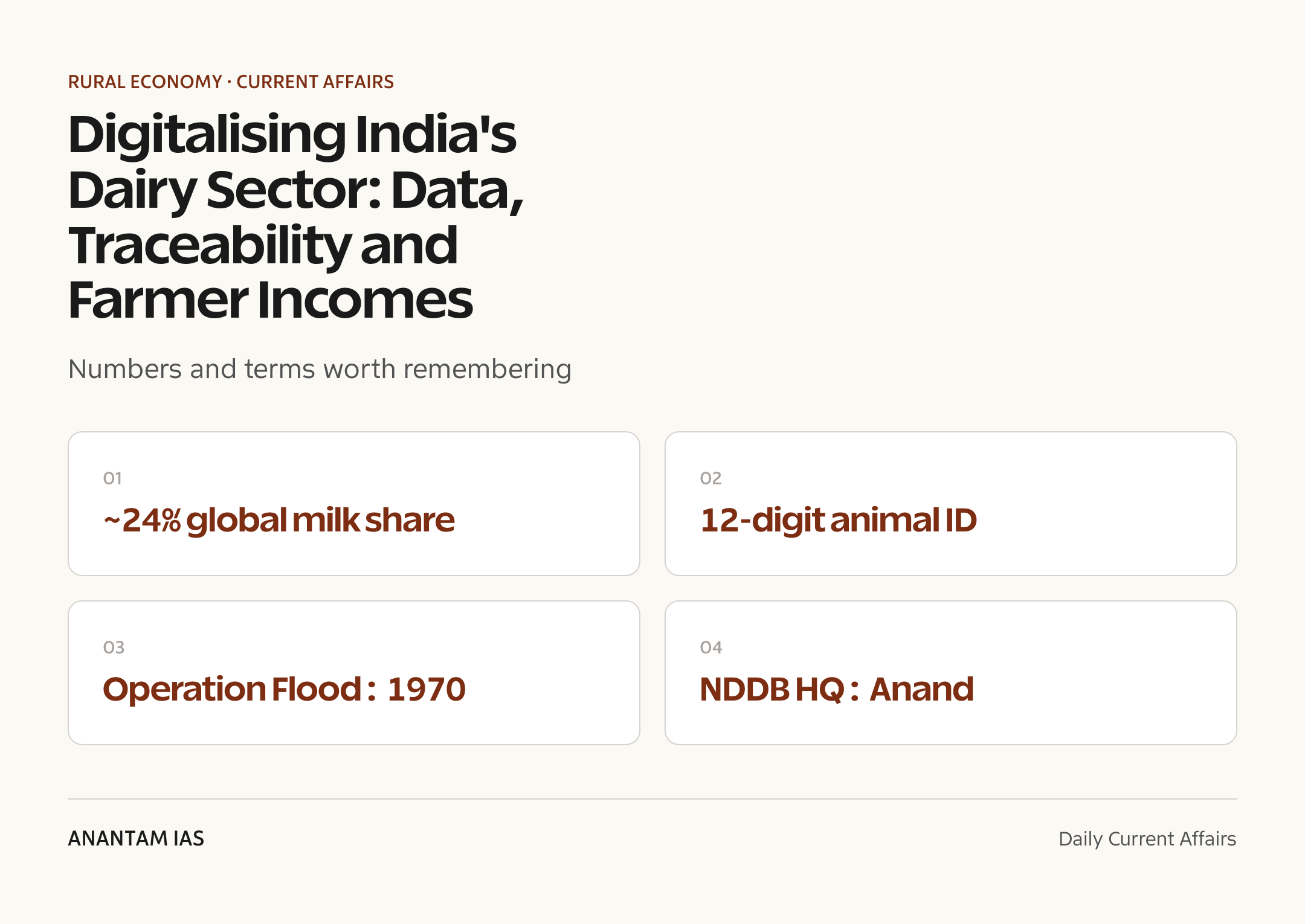
UPSC Relevance
Prelims Relevance
- Operation Flood and the White Revolution — Verghese Kurien and the Anand pattern of dairy cooperatives.
- National Dairy Development Board (NDDB) — statutory body under an Act of Parliament (1987), headquartered at Anand, Gujarat.
- Rashtriya Gokul Mission — conservation and development of indigenous bovine breeds.
- INAPH — Information Network for Animal Productivity and Health, maintained for breeding and health records.
- National Digital Livestock Mission (NDLM) and the unique animal-ID tagging (Pashu Aadhaar) system.
- National Programme for Dairy Development (NPDD) — strengthens milk procurement, processing and chilling infrastructure.
- Department of Animal Husbandry and Dairying (DAHD) sits under the Ministry of Fisheries, Animal Husbandry and Dairying.
- India’s share in global milk production (about 24%) and its status as the largest producer.
Mains Relevance
GS Paper 3
- Examine how digital public infrastructure in animal husbandry can raise productivity and farmer incomes.
- Assess the role of dairy cooperatives in inclusive rural growth and the post-harvest value chain.
- Discuss disease traceability and food safety as economic and public-health priorities for the dairy sector.
GS Paper 2
- Evaluate the design and delivery of livestock-sector government schemes and the data-privacy questions a national animal database raises.
Essay
- Use as evidence in essays on technology and rural transformation, the digital economy, or doubling farmer incomes.
- Relevant to themes on cooperatives, self-reliance and inclusive growth in the agrarian economy.
Background and Context
From Operation Flood to a digital dairy
The sector’s foundations sit in the cooperative White Revolution.
- Operation Flood: Launched in 1970 under Verghese Kurien and the NDDB, the White Revolution made India self-sufficient in milk through the Anand pattern of cooperatives.
- White Revolution: It linked village producers directly to urban demand and turned dairying into a mass rural livelihood.
- Today’s shift: The next phase layers data and digital tools onto this cooperative base to lift yield and transparency.
- Why it matters: With millions of smallholders, marginal gains in productivity and payment efficiency scale into large income effects.
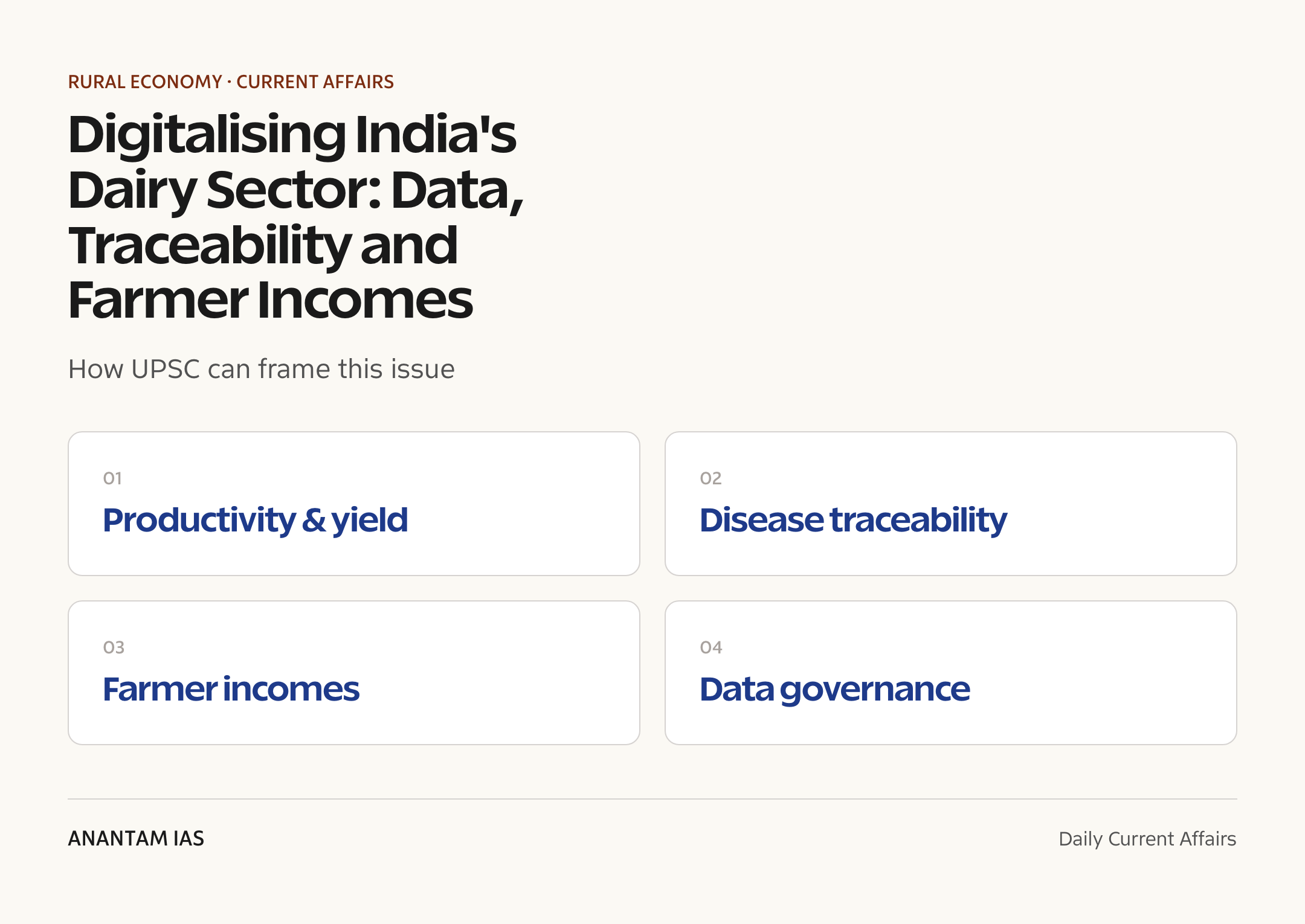
Animal tagging and the unique-ID database
A national livestock database underpins every other intervention.
- Pashu Aadhaar: A 12-digit unique ID on a tamper-evident ear tag identifies each animal across its lifetime.
- INAPH: The Information Network for Animal Productivity and Health stores breeding, artificial-insemination, nutrition and vaccination records per animal.
- Use cases: Tagging enables targeted breeding advice, ration balancing and disease surveillance at the individual-animal level.
- Market trust: Verified identity supports insurance claims, credit, and authentic provenance for buyers.
Schemes driving the digital push
Several government programmes converge on data and infrastructure, building on India’s broader digital public infrastructure.
- National Digital Livestock Mission: Builds a unified data architecture linking animals, owners, traders and services.
- Rashtriya Gokul Mission: Conserves and develops indigenous breeds and improves bovine productivity through scientific breeding.
- National Programme for Dairy Development: Strengthens milk procurement, testing, chilling and processing capacity.
- DAHD oversight: The Department coordinates these under the Ministry of Fisheries, Animal Husbandry and Dairying.
Traceability and food safety
Digital records turn the milk chain into a traceable, auditable system.
- Disease control: Animal-level data speeds outbreak detection and vaccination drives for foot-and-mouth and brucellosis.
- Quality testing: Automated fat and SNF (solids-not-fat) analysers at collection points price milk objectively.
- Provenance: End-to-end traceability supports export standards and consumer confidence in safety.
- Adulteration check: Digital logging of volumes and tests reduces leakage and tampering in procurement.
Farmer incomes and inclusion
The income case rests on faster, fairer and data-led payments across the wider animal husbandry and dairy sector.
- Real-time payment: Electronic milk-collection units transfer dues quickly, often to bank accounts, improving cash flow.
- Higher yield: Breeding and feeding advice from INAPH data can raise per-animal milk output over time.
- Women’s role: Women dominate dairy labour, so transparent income flows strengthen household and gender outcomes.
- Risk cover: Verified identity links animals to livestock insurance and institutional credit.
Challenges and limits
Scaling a national data system faces real friction.
- Connectivity: Patchy rural internet and electricity can stall data uploads and device uptime.
- Data governance: A large database raises questions on privacy, consent and who controls farmer and animal data.
- Tag durability: Ear-tag retention, re-tagging and clean data entry remain field-level hurdles.
- Fragmentation: Many small herds and informal sales outside cooperatives stay hard to digitise.
Way Forward
Strengthen data infrastructure
- Interoperability: Make the livestock database talk to credit, insurance and extension platforms through open standards.
- Offline-first tools: Design field apps that work with poor connectivity and sync later.
Protect farmers and animals
- Data safeguards: Clear consent, security and ownership rules for animal and household records.
- Capacity building: Train cooperative staff and farmers to use devices and read advisories.
Close the productivity gap: Tie breeding data to ration-balancing and fodder programmes so digital records translate into measurable yield gains.
Deepen the cooperative model: Extend e-payment and testing to weaker unions so transparency benefits reach the smallest producers.
Conclusion
Core idea: Digital public infrastructure can convert India’s scale in milk into better breeding, cleaner traceability and faster farmer payments.
The balance: Gains depend on field-level connectivity, data safeguards and reaching the smallest, often informal producers.
Bottom line: Building on the cooperative White Revolution, a well-governed digital layer can raise rural incomes while strengthening food safety.
UPSC Practice Questions
Prelims MCQ 1
With reference to digital initiatives in India’s livestock and dairy sector, consider the following statements:
- INAPH records animal-level breeding, nutrition and health data.
- The National Dairy Development Board is headquartered at Anand, Gujarat.
- Rashtriya Gokul Mission focuses on the conservation and development of indigenous bovine breeds.
How many of the above statements are correct?
(a) Only one (b) Only two (c) All three (d) None
Answer: (c) All three
Explanation:
INAPH maintains per-animal records; NDDB is based at Anand, Gujarat; and the Rashtriya Gokul Mission targets indigenous breed conservation and development. All three statements are correct.
Prelims MCQ 2
India’s approximate share in global milk production is closest to:
(a) 8% (b) 15% (c) 24% (d) 40%
Answer: (c) 24%
Explanation:
India is the world’s largest milk producer, accounting for roughly 24% of global milk output.
UPSC Mains Questions
- Digital public infrastructure is reshaping India’s dairy economy. Examine how animal tagging, a national livestock database and electronic procurement can raise productivity, traceability and farmer incomes, and identify the main implementation challenges.
- The White Revolution made India the world’s largest milk producer through cooperatives. Discuss how a digital layer can build on this cooperative model to deliver inclusive rural growth.
- A national animal-identification database promises better disease control and credit access but raises data-governance concerns. Evaluate the trade-offs and suggest a balanced policy approach.
Sources: Department of Animal Husbandry and Dairying, Ministry of Fisheries, Animal Husbandry and Dairying and National Dairy Development Board (NDDB).
Frequently Asked Questions
Why is India’s dairy sector in the news?
Government agencies are scaling digital tools across the dairy economy — animal tagging, a national livestock database and electronic milk procurement. The aim is to improve breeding, build disease traceability and ensure faster, fairer payments to the millions of small farmers who anchor India’s milk output.
What is Pashu Aadhaar?
Pashu Aadhaar is a unique 12-digit identification number assigned to individual cattle and buffaloes, linked to a tamper-evident ear tag. It lets authorities track an animal’s breeding, health and vaccination history over its lifetime and connects the animal to schemes, insurance and credit.
What is INAPH?
INAPH stands for the Information Network for Animal Productivity and Health. It is a database that records animal-level data on breeding, artificial insemination, nutrition and health, helping deliver targeted advice that can raise per-animal milk yield and improve disease surveillance.
How does digitalisation help dairy farmers’ incomes?
Electronic collection units with automated fat and SNF testing price milk objectively and transfer payments quickly, often straight to bank accounts. Data-driven breeding and feeding advice can lift yields, while verified animal identity unlocks livestock insurance and institutional credit.
What is the link to Operation Flood?
Operation Flood, launched in 1970 under Verghese Kurien and the NDDB, created the cooperative White Revolution that made India self-sufficient in milk. Today’s digital push builds on that same cooperative base, layering data and technology onto the Anand pattern of dairy societies.
What are the main challenges in digitalising dairying?
Key hurdles include patchy rural internet and power, ear-tag durability and accurate data entry, and the difficulty of reaching small, informal herds outside cooperatives. A large animal-and-owner database also raises questions of data privacy, consent and ownership that need clear safeguards.
Source: https://anantamias.com/current-affairs/digitalising-india-dairy-sector-2026/
The Kashmir Markhor: Conserving a Himalayan Flagship Species
Why in News?
Conservation attention has returned to the Kashmir markhor (Capra falconeri), the world’s largest wild goat, whose Indian range has narrowed to a handful of small, fragmented populations across the western Himalaya of Jammu and Kashmir.
Surveys and protected-area reporting place the surviving Indian markhor in pockets such as Kazinag, Hirpora, Shopian and Boniyar, making it a textbook case of a flagship species clinging on at the edge of its global range.
- The markhor is listed as Near Threatened on the IUCN Red List, an improvement from its earlier Endangered status driven largely by recovery in Pakistan.
- India’s markhor is the Pir Panjal markhor (the western, flare-horned form), found only in Jammu and Kashmir and numbering only a few hundred animals.
- Key Indian sites include Kazinag National Park, the Hirpora Wildlife Sanctuary and the Boniyar–Shopian belt along the Pir Panjal.
- Principal threats are habitat loss, grazing competition from domestic livestock, and poaching for meat and the distinctive spiral horns.
- The species is the national animal of Pakistan, where community-run trophy-hunting conservancies have helped numbers rebound — a model debated for its lessons and limits.
The development matters in the context of:
- The markhor matters as an indicator species: a healthy markhor herd signals an intact, well-protected Himalayan slope ecosystem.
- Its decline mirrors the wider stress on Himalayan biodiversity from livestock pressure, fragmentation and weak landscape-level protection.


UPSC Relevance
Prelims Relevance
- Capra falconeri — the markhor, the world’s largest wild goat; not a deer or an antelope
- Indian range is restricted to Jammu and Kashmir (Pir Panjal and Kazinag belts)
- IUCN Red List status — Near Threatened (down-listed from Endangered)
- National animal of Pakistan; flare-horned and straight-horned forms exist
- Kazinag National Park and Hirpora Wildlife Sanctuary as key Indian markhor habitats
- Difference between a flagship, indicator, keystone and umbrella species
- Protected under the Wild Life (Protection) Act, 1972 in India
- Shares Himalayan habitat with the snow leopard, its principal natural predator
- Listed on CITES Appendix I, restricting international trade
Mains Relevance
GS Paper 3
- Conserving a flagship Himalayan species through protected areas, the Wild Life (Protection) Act and community reserves.
- Human-wildlife conflict and grazing competition as drivers of mountain biodiversity loss.
- Lessons and limits of incentive-based, community-led conservation models drawn from across the border.
GS Paper 2
- Transboundary conservation cooperation for a species split across the India-Pakistan frontier.
Essay
- Can a single charismatic species rescue an entire landscape — the promise and limits of flagship conservation?
Background and Context
What the markhor is
The markhor is a large, spiral-horned wild goat adapted to steep, rugged Himalayan and Central Asian terrain.
- Capra falconeri is the world’s largest wild goat, with males far heavier than females and bearing dramatic corkscrew horns.
- Its global range arcs across the mountains of Pakistan, Afghanistan, Tajikistan, Uzbekistan and the western Himalaya of India.
- Several geographic forms exist — broadly the flare-horned (western) and straight-horned (southern) types.
- India’s animals belong to the Pir Panjal markhor, the flare-horned form at the easternmost edge of the species’ range.
- It grazes and browses on steep grassy and rocky slopes, descending to lower elevations in harsh winter.

Where it survives in India
India holds only a small, fragmented sliver of the global markhor population, confined to Jammu and Kashmir.
- Kazinag National Park, in the lower Jhelum valley, is a core Indian markhor stronghold.
- Hirpora Wildlife Sanctuary along the Pir Panjal protects another key population and a historic migration corridor.
- Animals also persist around Shopian, Boniyar and other pockets of the Pir Panjal range.
- Indian numbers run only to a few hundred, scattered across these isolated patches with limited connectivity.
- Small, broken-up populations are vulnerable to inbreeding, local extinction and chance events.
Why it is threatened
The markhor’s Indian decline is driven by pressure on its mountain habitat rather than any single cause.
- Habitat loss and fragmentation from settlement, infrastructure and degradation of slope pastures.
- Grazing competition with domestic sheep and goats that crowd the same forage and carry disease.
- Poaching for meat and for the prized spiral horns sold as trophies.
- Disturbance along migration routes that severs seasonal movement between summer and winter ranges.
- Disease transmission and predation pressure that small, isolated herds absorb poorly.
Conservation status and legal protection
The markhor sits within an interlocking set of global and Indian protection frameworks.
- IUCN Red List — currently Near Threatened, down-listed from Endangered after recovery elsewhere in its range.
- Listed on CITES Appendix I, banning commercial international trade in the species.
- Protected in India under the Wild Life (Protection) Act, 1972, with its habitats notified as protected areas.
- Conservation rests on the protected-area network plus community reserves that bring local people into stewardship.
- Recovery in Pakistan, where the markhor is the national animal, shows incentive-linked protection can reverse declines.
Flagship and indicator value
The markhor’s worth to conservation goes well beyond its own population numbers.
- As a flagship species, its charisma draws funding, attention and protected-area status that benefit the whole slope ecosystem.
- As an indicator species, a thriving markhor herd signals intact grazing land, low disturbance and a functioning food web.
- It is prey for the snow leopard, so markhor health underpins the survival of a still-rarer Himalayan predator.
- Protecting markhor habitat also shelters co-occurring species across the Himalaya biodiversity hotspot.
- Its plight is a barometer of how well India manages human-wildlife conflict in shared mountain landscapes.
The community-conservation debate
The most-cited markhor success story comes with both a clear model and pointed criticisms.
- Across the border, community conservancies let villages earn from tightly regulated, very limited trophy hunting of old males.
- Channelling that revenue to local communities turned residents into custodians and curbed unregulated poaching.
- Numbers rebounded enough to justify the IUCN down-listing — a headline win for incentive-based conservation.
- Critics question the ethics of hunting for conservation and warn of elite capture of permit revenue.
- India’s path leans instead on the protected-area network, the Wild Life (Protection) Act and non-consumptive community engagement.
Way Forward
Secure and connect the habitat
- Strengthen Kazinag, Hirpora and surrounding reserves and restore corridors so fragmented herds can mix.
- Regulate livestock grazing on key markhor slopes to ease forage and disease pressure.
Build local stewardship
- Develop community reserves and benefit-sharing that give residents a direct stake in markhor survival.
- Curb poaching through patrolling, intelligence and alternative livelihoods rather than enforcement alone.
Monitor and cooperate
- Run regular population surveys and genetic monitoring to track small, isolated herds.
- Explore transboundary cooperation for a species whose range straddles a contested frontier.
Conclusion
The markhor’s Indian story is a reminder that a species can be globally recovering yet locally precarious. The Near Threatened down-listing rides largely on gains across the border, while India’s Pir Panjal animals remain a few hundred individuals scattered across shrinking, disconnected patches of the western Himalaya.
Saving them means protecting habitat, easing grazing competition and stopping poaching — and treating the markhor as a flagship whose fate is tied to the whole mountain ecosystem. Whether through the protected-area network, community reserves or careful borrowing of incentive-based models, the test is the same: keep the slope intact, and the markhor stays.
UPSC Practice Questions
Prelims MCQ 1
With reference to the markhor (Capra falconeri), consider the following statements:
- It is the world’s largest wild goat.
- In India its range is restricted to Jammu and Kashmir.
- It is currently classified as Critically Endangered on the IUCN Red List.
How many of the above statements are correct?
(a) Only one (b) Only two (c) All three (d) None
Answer: (b) Only two
Explanation:
Statements 1 and 2 are correct — the markhor is the largest wild goat and its Indian range is confined to Jammu and Kashmir. Statement 3 is wrong: it is listed as Near Threatened, not Critically Endangered.
Prelims MCQ 2
The markhor is the national animal of which one of the following countries?
(a) Afghanistan (b) Nepal (c) Pakistan (d) Tajikistan
Answer: (c) Pakistan
Explanation:
The markhor is the national animal of Pakistan, where community-run conservancies are credited with helping the species recover.
UPSC Mains Questions
- The markhor is often described as a flagship species of the western Himalaya. Explain what flagship and indicator species mean, and discuss why conserving the markhor matters for the wider Himalayan ecosystem.
- Examine the main threats to the markhor in India and assess how the protected-area network, the Wild Life (Protection) Act, 1972 and community reserves can together secure its small, fragmented populations.
- Incentive-based, community-led conservation has been credited with reviving the markhor across its range. Critically analyse the promise and the limits of such models for Indian wildlife conservation.
Sources: IUCN Red List, Wildlife Institute of India and Jammu & Kashmir Department of Wildlife Protection.
Frequently Asked Questions
What is the markhor?
The markhor (Capra falconeri) is the world’s largest species of wild goat, instantly recognisable by the long, spiralling corkscrew horns of the males. It lives on steep, rugged slopes across the mountains of Pakistan, Afghanistan, Central Asia and the western Himalaya of India, where it grazes and browses on grassy and rocky terrain.
Where is the markhor found in India?
India’s markhor survives only in Jammu and Kashmir, in small, fragmented populations along the Pir Panjal range. Key sites include Kazinag National Park, the Hirpora Wildlife Sanctuary, and pockets around Boniyar and Shopian. The total Indian population runs to only a few hundred animals scattered across these isolated patches.
What is the markhor’s conservation status?
The markhor is listed as Near Threatened on the IUCN Red List, having been down-listed from Endangered after recovery in parts of its range, mainly Pakistan. It is also on CITES Appendix I, which bans commercial international trade, and is protected in India under the Wild Life (Protection) Act, 1972.
Why is the markhor threatened in India?
The main threats are habitat loss and fragmentation, grazing competition with domestic sheep and goats that crowd its forage and spread disease, and poaching for meat and its prized horns. Small, disconnected herds are also vulnerable to inbreeding, disease and chance events that can wipe out a local population.
Which country has the markhor as its national animal?
Pakistan has the markhor as its national animal. There, village-run community conservancies have used tightly regulated, very limited trophy hunting of old males to fund conservation and curb poaching, a model often credited with helping markhor numbers recover, though it remains ethically debated.
Why is the markhor called a flagship species?
As a charismatic, recognisable animal, the markhor attracts attention, funding and protected-area status that benefit its entire mountain habitat. It is also an indicator species — a healthy markhor herd signals an intact slope ecosystem — and it is prey for the snow leopard, so protecting it helps safeguard wider Himalayan biodiversity.
Source: https://anantamias.com/current-affairs/kashmir-markhor-conservation-2026/
India’s First Deep-Tech Startup Push: Funding the Hard-Technology Frontier
Why in News?
India’s deep-tech ecosystem is in focus as the National Deep Tech Startup Policy (NDTSP) framework — first proposed by a working group under the office of the Principal Scientific Adviser — moves toward implementation, and Tamil Nadu in January 2026 unveiled a state-first dedicated deep-tech startup policy.
The push targets startups built on hard science and engineering — artificial intelligence, quantum, biotech, space, semiconductors and advanced materials — that need long gestation periods, deep intellectual property (IP) and patient capital the regular venture market rarely supplies.
- Deep-tech ventures commercialise frontier research and engineering, with R&D-heavy products, long timelines and defensible patents, unlike consumer-app or services startups.
- The NDTSP framework proposes patient capital, shared R&D infrastructure, IP facilitation and stronger academia-industry linkages.
- Tamil Nadu’s January 2026 policy is the first state-level deep-tech blueprint, with sector funds, lab access and incubation support.
- It complements Startup India (2016) and the Anusandhan National Research Foundation (ANRF), the new apex body for funding research.
- Anchored in the goal of technology sovereignty — owning, not just importing, critical frontier technologies.
The development matters in the context of:
- India’s gross expenditure on R&D is low at about 0.65% of GDP, well below peers like China, South Korea and the US.
- Most Indian startup capital chases quick-return consumer and fintech models, leaving a funding gap for slow, capital-intensive deep tech.

UPSC Relevance
Prelims Relevance
- NDTSP originated from a working group under the Principal Scientific Adviser, not the RBI or NITI Aayog
- Deep-tech domains: AI, quantum, biotech, space, semiconductors, advanced materials, robotics
- ANRF created by the Anusandhan National Research Foundation Act, 2023; subsumed the erstwhile SERB
- Startup India launched 2016; DPIIT recognises eligible startups
- India’s R&D spend is roughly 0.65% of GDP (GERD); private-sector share is comparatively low
- Patient capital — long-horizon funding that tolerates delayed returns
- India AI Mission, National Quantum Mission and India Semiconductor Mission as enabling sectoral programmes
- Tamil Nadu’s 2026 deep-tech policy is the first sub-national dedicated framework
Mains Relevance
GS Paper 3
- Why deep tech needs a distinct policy from a generic startup push — long gestation, IP intensity and patient-capital gap.
- How NDTSP, ANRF, Startup India and sectoral missions fit together to build an innovation ecosystem.
- R&D financing in India — the structural reasons GERD stays near 0.65% of GDP and how to lift private-sector spend.
GS Paper 2
- Cooperative federalism in innovation policy — the role of state-led blueprints like Tamil Nadu’s deep-tech policy.
Essay
- Technology sovereignty and the cost of importing the future.
- Can patient capital be engineered, or must it be cultivated?
Background and Context
What deep tech means
Deep tech is defined by what it is built on, not by the app it ships.
- Ventures that commercialise frontier science and engineering rather than business-model innovation.
- Core domains span artificial intelligence, quantum technologies, biotech, space, semiconductors, advanced materials and robotics.
- Marked by long gestation from lab to market, high upfront R&D cost and heavy reliance on patents and proprietary IP.
- Products solve fundamental technical problems, so the moat is the technology itself, not just scale or marketing.
- This profile makes deep tech high-risk for ordinary venture capital, which prefers faster, lighter returns.
Why a dedicated policy was needed
India’s broader startup boom did not naturally fund the hard-technology frontier.
- Startup India (2016) seeded a large startup base, but capital concentrated in consumer, e-commerce and fintech ventures.
- Deep-tech founders face a funding gap — no revenue for years while the science matures, which deters short-horizon investors.
- They also lack affordable access to expensive R&D infrastructure such as fabrication labs, testing rigs and compute.
- Weak academia-industry translation leaves much publicly funded research stranded in journals rather than products.
- A generic startup framework cannot fix these structural gaps, so a deep-tech-specific policy was proposed.
What the NDTSP framework proposes
The National Deep Tech Startup Policy is built around the bottlenecks unique to frontier ventures.
- A patient-capital pool — long-horizon, risk-tolerant funding through dedicated funds and fund-of-funds support.
- Shared R&D infrastructure — open access to national labs, testing facilities and prototyping centres so founders skip heavy capex.
- IP facilitation — faster, cheaper patent filing and support so startups can protect and license their inventions.
- Stronger academia-industry linkages and technology-transfer offices to move research from campus to company.
- Sectoral focus areas, skilling support and a single-window approach to align the many existing schemes.
Where it sits in the ecosystem
NDTSP is an integrating layer over a set of existing programmes and bodies.
- Startup India and DPIIT — the recognition, tax and ease-of-doing-business base for all startups.
- Anusandhan National Research Foundation (ANRF) — the apex research-funding body created in 2023, which subsumed the Science and Engineering Research Board (SERB).
- Sectoral missions — the India AI Mission, the National Quantum Mission and the India Semiconductor Mission supply demand and capability in specific frontiers.
- Atal Innovation Mission incubators and academic tech-transfer cells feed the early-stage pipeline.
- NDTSP tries to stitch these into one innovation ecosystem rather than scattered, overlapping schemes.
The Tamil Nadu first-mover
A state has moved ahead of the national rollout with its own deep-tech blueprint.
- Tamil Nadu in January 2026 unveiled the first state-level deep-tech startup policy.
- It proposes dedicated sector funds and co-investment to crowd in private patient capital.
- It offers access to state and academic laboratories, prototyping facilities and incubation space.
- It leverages the state’s strong manufacturing and engineering-talent base to anchor hardware deep tech.
- It is a test of cooperative federalism — states tailoring innovation policy to local strengths ahead of a national template.
The R&D-financing backdrop
Deep-tech ambition runs into India’s long-standing under-investment in research.
- India’s gross expenditure on R&D (GERD) is about 0.65% of GDP, far below China, South Korea, Israel and the US.
- The private sector contributes a smaller share of R&D in India than in those economies, where firms drive most spending.
- Public funding has historically dominated, channelled through agencies the ANRF now seeks to coordinate and scale.
- Patient capital and shared infrastructure are partly an attempt to de-risk private R&D so corporates and funds invest more.
- Without lifting overall R&D intensity, even a strong policy may struggle to sustain a deep-tech pipeline.
Significance and the critique
The stakes are strategic, but design and execution risks are real.
- Deep tech underpins technology sovereignty — owning critical capabilities in AI, chips and quantum rather than importing them.
- Domestic frontier ventures create high-skill jobs and reduce dependence on foreign IP and hardware.
- But patient capital is hard to mandate; if funds chase faster exits, public money may end up carrying most of the risk.
- Shared infrastructure and IP support can stall on bureaucratic access rules and slow patent processing.
- Success needs sustained funding, real academia-industry translation and a rise in overall R&D intensity, not a one-time scheme.
Way Forward
Engineer genuine patient capital
- Use blended finance and fund-of-funds support to crowd in private long-horizon money, not just public grants.
- Tie incentives to deep-tech outcomes — patents, prototypes and revenue from frontier products.
Open the R&D base
- Make access to national labs, fabs and compute simple, time-bound and affordable for startups.
- Fund and staff technology-transfer offices so campus research reaches companies.
Lift R&D intensity
- Push GERD decisively above the long-stuck 0.65% of GDP, with stronger private-sector spend.
- Sequence NDTSP with ANRF and the sectoral missions so funding, research and demand reinforce one another.
Conclusion
India’s deep-tech turn recognises a hard truth — the startup boom that produced unicorns rarely funded the slow, IP-heavy science that decides technology sovereignty. The NDTSP framework and Tamil Nadu’s state-first policy go after the specific bottlenecks of frontier ventures: patient capital, shared R&D infrastructure, IP support and academia-industry translation.
The test will be whether the country can engineer genuine long-horizon capital and lift its R&D intensity above the long-stuck 0.65% of GDP. If it can, deep tech can move India from a buyer of frontier technology to a builder of it. If patient capital stays scarce and labs stay closed, the policy risks remaining ambition without a pipeline.
UPSC Practice Questions
Prelims MCQ 1
With reference to deep-tech startups and India’s innovation ecosystem, consider the following statements:
- Deep-tech ventures are typically characterised by long gestation periods and heavy intellectual-property intensity.
- The Anusandhan National Research Foundation (ANRF) was set up to coordinate and fund research and subsumed the Science and Engineering Research Board.
- The National Deep Tech Startup Policy is administered by the Reserve Bank of India.
How many of the above statements are correct?
(a) Only one (b) Only two (c) All three (d) None
Answer: (b) Only two
Explanation:
Statements 1 and 2 are correct. Statement 3 is wrong — the deep-tech policy framework emerged from a working group under the Principal Scientific Adviser and the startup-policy apparatus (DPIIT/Startup India), not the RBI.
Prelims MCQ 2
Which one of the following is NOT typically classified as a deep-tech domain?
(a) Quantum computing (b) Advanced materials (c) Food-delivery aggregation (d) Semiconductors
Answer: (c) Food-delivery aggregation
Explanation:
Food-delivery aggregation is a consumer business-model innovation, not deep tech. Quantum computing, advanced materials and semiconductors are frontier hard-technology domains built on deep science and engineering.
UPSC Mains Questions
- India’s startup boom produced scale but little frontier science. Examine why deep-tech ventures need a policy distinct from a generic startup push, and discuss how the National Deep Tech Startup Policy seeks to address their specific bottlenecks.
- Discuss how the National Deep Tech Startup Policy, the Anusandhan National Research Foundation and India’s sectoral technology missions can together build an innovation ecosystem. What role can state-led blueprints play in this effort?
- Technology sovereignty requires building, not buying, critical capabilities. Critically analyse this statement with reference to India’s low R&D intensity and its deep-tech financing challenge.
Sources: Department for Promotion of Industry and Internal Trade (DPIIT) and Press Information Bureau.
Frequently Asked Questions
What is a deep-tech startup?
A deep-tech startup commercialises frontier science and engineering rather than a new business model. Its products are built on hard technologies such as artificial intelligence, quantum, biotech, space, semiconductors or advanced materials. These ventures are defined by long gestation periods, high upfront R&D cost and heavy reliance on patents and proprietary intellectual property, which makes them harder to fund than consumer or services startups.
What is the National Deep Tech Startup Policy?
The National Deep Tech Startup Policy (NDTSP) is a framework, first proposed by a working group under the office of the Principal Scientific Adviser, to support hard-technology ventures. It focuses on the bottlenecks unique to deep tech — patient long-horizon capital, shared R&D infrastructure, faster intellectual-property facilitation and stronger academia-industry linkages — and seeks to align the many existing startup and research schemes into one ecosystem.
How is deep tech different from a normal startup?
A normal startup usually innovates on the business model — how a service is delivered or priced — and can reach the market quickly. Deep tech innovates on the underlying science and engineering, so its products take years to mature, demand expensive R&D infrastructure and depend on defensible patents. This profile creates a funding gap because ordinary venture capital prefers faster, lighter returns.
What is patient capital and why does deep tech need it?
Patient capital is long-horizon, risk-tolerant funding that accepts delayed returns while a technology matures. Deep-tech ventures may earn no revenue for years as the science is proven and prototypes are built. Without patient capital they cannot survive that gap, so the deep-tech policy push tries to engineer such funding through dedicated funds, fund-of-funds support and blended finance that crowds in private money.
How does the deep-tech push relate to ANRF and Startup India?
Startup India and DPIIT provide the recognition, tax and ease-of-business base for all startups. The Anusandhan National Research Foundation, created in 2023, is the apex body for funding and coordinating research and subsumed the earlier Science and Engineering Research Board. The deep-tech policy tries to integrate these with sectoral missions in AI, quantum and semiconductors so funding, research and demand reinforce one another.
Why is India’s R&D spending considered low?
India’s gross expenditure on research and development is about 0.65% of GDP, far below peers such as China, South Korea, Israel and the United States. A large share is public, with the private sector contributing less than in those economies, where firms drive most spending. This low R&D intensity is a core reason deep-tech ventures struggle for funding and why patient capital and shared infrastructure are seen as ways to de-risk private investment.
Source: https://anantamias.com/current-affairs/national-deep-tech-startup-policy-2026/
India-Fiji Agriculture Cooperation: Deepening Ties in the Pacific
Why in News?
India and Fiji agreed to extend their existing agriculture-cooperation Memorandum of Understanding (MoU) for a further five years, renewing a partnership built around capacity building, crop diversification and farm mechanisation.
The renewal sits within the Forum for India-Pacific Islands Cooperation (FIPIC) and India’s wider Act East and Indo-Pacific outreach, where Pacific microstates and a large Indo-Fijian diaspora anchor a steadily warming relationship.
- The two countries renewed an agriculture MoU for five years, covering capacity building, crop diversification and mechanisation.
- Cooperation flows through the FIPIC platform that India launched in 2014 to engage 14 Pacific Island states collectively.
- Fiji is the most populous Pacific Island nation and home to a sizeable Indo-Fijian community descended from indentured labour, giving the tie deep diaspora roots.
- The partnership advances India’s development-partnership model — sharing low-cost, replicable agri-technology rather than extractive financing.
- It signals solidarity with the Global South and Small Island Developing States (SIDS) facing food-security and climate stress.
The development matters in the context of:
- Pacific Island states are courted by major powers, so India’s capacity-first approach is a quiet contrast to debt-heavy alternatives.
- Agriculture is central to Fiji’s economy and food security, making the MoU a high-impact, low-cost lever of influence.
UPSC Relevance
Prelims Relevance
- FIPIC — Forum for India-Pacific Islands Cooperation, launched in 2014 at Suva, Fiji; covers 14 Pacific Island countries
- Fiji — Melanesian archipelago in the South Pacific; capital Suva; largest islands Viti Levu and Vanua Levu
- The Indo-Fijian community traces to indentured labour (‘Girmitiyas’) brought under British rule from 1879
- Act East Policy extends India’s eastern engagement to the Pacific, not just ASEAN
- Indo-Pacific — India’s strategic theatre stretching from the African coast to the western Pacific
- Small Island Developing States (SIDS) — a UN-recognised grouping vulnerable to climate change and external shocks
- MoUs are non-binding instruments of intent, distinct from binding treaties
- Fiji hosts the Pacific Islands Forum (PIF) secretariat at Suva
Mains Relevance
GS Paper 2
- India’s bilateral and regional engagement with Pacific Island states through FIPIC, and its place in Act East and Indo-Pacific strategy.
- Development partnership and capacity building as instruments of Indian soft power and South-South cooperation.
- The role of the diaspora — here the Indo-Fijian community — in shaping bilateral relations.
GS Paper 3
- Agricultural diplomacy — sharing crop diversification, mechanisation and capacity building with food-stressed island economies.
Essay
- Small states, large stakes — the geopolitics of the Pacific.
- Diplomacy as solidarity — India and the Global South.
Background and Context
Fiji and the Pacific Island states
Fiji is the hub of a region of small, scattered, climate-vulnerable island economies.
- Fiji is a Melanesian archipelago in the South Pacific, with capital Suva and main islands Viti Levu and Vanua Levu.
- It is the most populous and connected of the Pacific Island states and hosts the Pacific Islands Forum secretariat.
- These states are classed as Small Island Developing States (SIDS) — tiny landmasses, narrow economies and acute exposure to sea-level rise and cyclones.
- Agriculture, fisheries and tourism dominate their economies, so farm productivity is central to both incomes and food security.
- Their dispersed geography and small markets make low-cost, replicable technology far more useful than capital-heavy projects.
The Indo-Fijian diaspora link
A shared history of migration gives the relationship unusual human depth.
- Indo-Fijians descend from indentured labourers (‘Girmitiyas’) brought from India under British rule from 1879 to work sugarcane plantations.
- They form a large share of Fiji’s population and have shaped its economy, politics and culture.
- This diaspora creates enduring linguistic, cultural and family ties that outlast any single government.
- Sugarcane — the crop the Girmitiyas were brought to cultivate — remains symbolically and economically central to Fiji.
- Diaspora goodwill gives India a reservoir of soft power that purely transactional partners cannot match.
FIPIC and the regional architecture
India engages the Pacific collectively, not just bilaterally, through a dedicated forum.
- The Forum for India-Pacific Islands Cooperation (FIPIC) was launched in 2014 at Suva during Prime Minister Modi’s visit.
- It brings together India and 14 Pacific Island countries for cooperation on development, climate, health and capacity building.
- FIPIC summits have pledged support in renewable energy, telemedicine, disaster resilience and small-grant community projects.
- It complements India’s Act East Policy, which extends engagement beyond ASEAN to the far Pacific.
- The forum lets India offer a collective partnership that respects the autonomy of very small states.
What the agriculture MoU covers
The renewed MoU targets the practical bottlenecks of island farming.
- Capacity building — training Fijian officials and farmers, scholarships and knowledge exchange in agricultural science.
- Crop diversification — moving beyond a narrow sugarcane base toward varied, resilient and nutrition-rich crops.
- Farm mechanisation — affordable, scale-appropriate machinery and tools suited to small island holdings.
- Sharing India’s experience in research, seeds, soil management and post-harvest handling adapted to local conditions.
- A five-year renewal gives the cooperation continuity and a planning horizon for joint projects.
India's development-partnership model
The MoU exemplifies how India distinguishes its outreach from that of larger powers.
- India frames its engagement as partnership, not aid — demand-driven, capacity-first and respectful of sovereignty.
- It favours low-cost, replicable technology and human-resource development over large debt-financed infrastructure.
- This is the logic of South-South cooperation — one developing country sharing solutions it has road-tested at home.
- It contrasts implicitly with debt-heavy external financing that can strain small economies.
- Agriculture, health and digital tools are India’s signature offerings because they are cheap to scale and visibly useful.
Why the Pacific matters strategically
Tiny states sit on a contested maritime map, raising the stakes of even modest cooperation.
- The Pacific is part of India’s Indo-Pacific theatre, where freedom of navigation and a rules-based order are core interests.
- Major powers are competing for influence among Pacific microstates, each of which carries an equal UN vote.
- Goodwill built through agriculture and disaster relief translates into diplomatic support in multilateral forums.
- Climate-vulnerable island states are natural partners in India’s climate diplomacy and Global-South coalition-building.
- Reliable, non-coercive cooperation positions India as a trusted partner of choice in a crowded field.
Significance and the critique
The MoU is high-symbolism and low-cost, but its real test is delivery.
- It deepens a tie rooted in diaspora, history and shared developing-country experience.
- It strengthens India’s standing in the Pacific at modest financial outlay relative to rival offers.
- But an MoU is non-binding — outcomes depend on funding, follow-through and on-the-ground execution.
- Sustained impact needs project monitoring, not one-off training, so gains are not lost between renewals.
- India’s distance and limited resources mean it must pick focused, high-impact sectors like agriculture rather than spread thin.
Way Forward
Turn intent into delivery
- Move from the MoU to time-bound, monitored projects with clear targets in diversification and mechanisation.
- Build local institutions and trainers so capacity outlasts each five-year cycle.
Leverage diaspora and climate links
- Channel Indo-Fijian goodwill into people-to-people, educational and agri-business ties.
- Pair agriculture with climate-resilience support, the priority shared by all Pacific island states.
Scale through FIPIC
- Use the Act East and FIPIC platforms to replicate the Fiji template across other Pacific partners.
- Coordinate agriculture with health, renewable energy and disaster-relief offers for a fuller partnership.
Conclusion
The five-year renewal of the India-Fiji agriculture MoU is modest in money but meaningful in intent. It deepens a relationship anchored in a shared history of indentured migration, a large Indo-Fijian diaspora and India’s preference for capacity-building partnership over debt-financed aid. Within FIPIC and the wider Act East and Indo-Pacific framework, agriculture is a low-cost, high-trust lever in a region courted by far larger powers.
The decisive question is delivery. An MoU signals goodwill; monitored projects, lasting local institutions and climate-linked follow-through turn that goodwill into resilient food systems and durable diplomatic capital. If India can convert intent into outcomes here, the Fiji partnership becomes a template for its solidarity with the Global South and the small island states of the Pacific.
UPSC Practice Questions
Prelims MCQ 1
With reference to the Forum for India-Pacific Islands Cooperation (FIPIC) and India-Fiji relations, consider the following statements:
- FIPIC was launched in 2014 and brings together India and a group of Pacific Island countries.
- Fiji hosts a large Indo-Fijian community descended from indentured labourers brought during the colonial period.
- Fiji is located in the Atlantic Ocean off the western coast of Africa.
How many of the above statements are correct?
(a) Only one (b) Only two (c) All three (d) None
Answer: (b) Only two
Explanation:
Statements 1 and 2 are correct. Statement 3 is wrong — Fiji is a Melanesian archipelago in the South Pacific Ocean, not the Atlantic. FIPIC was launched at Suva, Fiji, in 2014, and the Indo-Fijian community traces to indentured ‘Girmitiya’ labour from 1879.
Prelims MCQ 2
India’s approach to the Pacific Island states, exemplified by the agriculture MoU with Fiji, is best described as:
(a) Large debt-financed infrastructure lending (b) Capacity building and development partnership (c) Military basing and security guarantees (d) Tariff-free market integration
Answer: (b) Capacity building and development partnership
Explanation:
India frames its Pacific engagement as demand-driven development partnership — capacity building, crop diversification, mechanisation and low-cost replicable technology — rather than debt-heavy financing, basing or trade integration.
UPSC Mains Questions
- The renewal of the India-Fiji agriculture MoU reflects India’s distinctive model of engagement in the Pacific. Discuss how capacity building and development partnership serve as instruments of Indian soft power and South-South cooperation.
- Examine the place of the Pacific Island states in India’s Act East Policy and Indo-Pacific strategy. How does the Forum for India-Pacific Islands Cooperation (FIPIC) advance India’s regional objectives?
- Diaspora ties shape foreign policy. With reference to the Indo-Fijian community, analyse how historical migration and people-to-people links influence the India-Fiji relationship.
Sources: Ministry of External Affairs, Government of India and Press Information Bureau.
Frequently Asked Questions
What is the India-Fiji agriculture MoU?
It is a Memorandum of Understanding between India and Fiji for cooperation in agriculture, focused on capacity building, crop diversification and farm mechanisation. In January 2026 the two countries agreed to extend this existing MoU for a further five years. The arrangement lets India share low-cost, replicable agricultural technology and training suited to Fiji’s small-island farming, deepening a partnership built on development cooperation rather than aid.
What is FIPIC?
FIPIC is the Forum for India-Pacific Islands Cooperation, launched in 2014 at Suva, Fiji, during Prime Minister Modi’s visit. It brings together India and 14 Pacific Island countries for collective cooperation on development, climate resilience, health, renewable energy and capacity building. FIPIC is the main platform through which India engages the Pacific region as a whole, complementing bilateral ties like the one with Fiji and supporting India’s Act East Policy.
Why is the Indo-Fijian community important to this relationship?
The Indo-Fijian community descends from indentured labourers, known as Girmitiyas, brought from India to Fiji under British rule from 1879 to work on sugarcane plantations. They form a large share of Fiji’s population and have shaped its economy and culture. This shared history creates deep linguistic, cultural and family ties that give India enduring soft power and a human anchor for the bilateral relationship.
How does India’s Pacific approach differ from that of larger powers?
India frames its engagement as partnership rather than aid — demand-driven, capacity-first and respectful of each state’s sovereignty. It favours low-cost, replicable technology and human-resource development in fields like agriculture, health and digital tools over large debt-financed infrastructure. This South-South cooperation model contrasts with debt-heavy external financing that can strain the small economies of the Pacific island states.
Where is Fiji and why does it matter strategically?
Fiji is a Melanesian archipelago in the South Pacific Ocean, with capital Suva and main islands Viti Levu and Vanua Levu. It is the most populous and connected Pacific Island state and hosts the Pacific Islands Forum secretariat. The Pacific lies within India’s Indo-Pacific theatre, where freedom of navigation and a rules-based order matter, and each island state carries an equal UN vote, raising the stakes of even modest cooperation.
Is an MoU legally binding?
No. A Memorandum of Understanding is a non-binding instrument that records a shared intent to cooperate, unlike a treaty, which creates binding legal obligations. Its value lies in signalling commitment and framing joint work. That is why the renewal’s real test is delivery — monitored projects, lasting local institutions and follow-through that turn the stated intent into actual gains in Fiji’s agriculture.
Source: https://anantamias.com/current-affairs/india-fiji-agriculture-cooperation-2026/
PSLV-C62/EOS-N1 Mission Anomaly: Lessons for India’s Commercial Space Program
ISRO’s PSLV-C62/EOS-N1 mission in January 2026 became important for an uncomfortable reason: the mission encountered an anomaly at the end of the PS3 phase. The official mission page noted that detailed analysis had been initiated.
For UPSC, a space anomaly is often more useful than a routine success. It allows candidates to discuss reliability, transparency, commercial launch credibility, failure analysis, institutional learning and the maturing of India’s private and public space ecosystem.
This article treats PSLV-C62 not as a failure headline, but as an exam-worthy window into India’s launch-vehicle architecture and space-sector governance.
Quick Facts
- PSLV-C62 was planned as the 64th mission of the Polar Satellite Launch Vehicle.
- It used the PSLV-DL configuration with two strap-on boosters.
- The primary payload was EOS-N1, along with 15 co-passenger satellites.
- It was described as the ninth dedicated commercial mission facilitated by NSIL.
- The mission also carried a KID demonstration payload.
- The official page reported an anomaly at the end of the PS3 phase and noted that analysis had begun.
- Official source: ISRO mission page.
What Just Happened
The PSLV-C62 mission attempted to launch EOS-N1 and co-passenger satellites in January 2026. ISRO later reported that an anomaly occurred at the end of the third stage, triggering a detailed technical review.
The immediate news value lies in the mission outcome. The deeper policy value lies in the credibility of failure reporting. A mature space agency does not hide anomalies. It investigates, fixes and returns with a more reliable launch system.
The mission also matters because it was linked to commercial launch services through NSIL. Commercial customers do not expect perfection, but they do expect transparency, predictable timelines and credible failure analysis.
Background and Historical Context
PSLV is India’s workhorse launch vehicle. It has launched Indian remote-sensing satellites, lunar and Mars mission payloads and many international satellites. Its reputation rests on reliability across decades.
The space-sector reforms of 2020 created a larger role for NSIL, IN-SPACe and private firms. ISRO is expected to focus more on advanced missions and technology while commercial and private actors take on routine services over time.
Mission anomalies are common in global space programs. What matters is whether the institutional response improves design, testing, quality assurance and launch-readiness protocols.
Key Features of PSLV-C62/EOS-N1
The core policy architecture can be read through these features.
- Launch vehicle: PSLV, India’s proven four-stage launch system.
- Configuration: PSLV-DL uses two strap-on boosters.
- Primary payload: EOS-N1, an Earth observation satellite.
- Commercial angle: the mission was facilitated through NSIL as a dedicated commercial launch.
- Co-passengers: 15 additional satellites were listed.
- Anomaly point: ISRO reported the issue at the end of PS3, the third stage.
Why It Matters
This is a high-yield UPSC topic because it joins current news with durable syllabus themes.
- It gives GS-III material on space technology, commercialisation and institutional learning.
- It helps aspirants distinguish launch vehicles, stages, payloads and governance institutions.
- It shows why reliability is central to the economics of commercial launch markets.
- It gives Essay material on failure, transparency and scientific temper.
Detailed Analysis: Space Lens
Reliability is a national asset. PSLV’s reputation took decades to build. A single anomaly does not erase that record, but it does demand a transparent technical review.
Commercialisation raises the stakes. When private and foreign customers are involved, launch risk becomes a market issue. Insurance, contracts, timelines and customer confidence all depend on credible post-flight analysis.
Failure data is valuable. A space program that learns from anomalies improves more than one that treats every mission as a publicity event. This is the scientific-temper angle UPSC can test.
Comparative Perspective
A comparison helps prevent the answer from becoming a one-dimensional news summary.
- NASA: major failures such as Challenger and Columbia led to institutional reforms and safety reviews.
- SpaceX: rapid testing and visible failures are part of an iterative engineering model.
- ESA: Ariane launch issues have affected European commercial-launch timelines.
- ISRO: historically combines conservative engineering with gradual capability expansion.
Challenges
The policy or institutional promise runs into recurring constraints.
- Failure analysis must be technically deep and publicly credible without compromising sensitive details.
- Commercial customers need predictable corrective timelines.
- Private-sector participation requires clear liability, insurance and quality-control frameworks.
- India must maintain PSLV reliability while developing newer vehicles and private launch capacity.
- Public communication should avoid both hype and silence.
Prelims Pointers
- PSLV has four stages using alternating solid and liquid propulsion.
- PSLV-DL refers to a configuration with two strap-on boosters.
- NSIL is NewSpace India Limited, a commercial arm under the Department of Space.
- IN-SPACe authorises and promotes private participation in the space sector.
- Earth observation satellites support mapping, agriculture, disaster management and security applications.
- A launch anomaly is not the same as a complete vehicle design failure.
Mains Questions
- Space mission anomalies can strengthen institutional credibility when handled transparently. Discuss with reference to India’s space sector. (GS Paper III, 250 words)
- Examine the role of NSIL and IN-SPACe in India’s space-sector reforms. (GS Paper III, 150 words)
- Reliability is the core currency of the commercial launch market. Analyse in the Indian context. (GS Paper III, 250 words)
- How should India balance public-sector space expertise with private participation? (GS Paper III, 250 words)
Way Forward
ISRO should complete and communicate the technical review in a way that preserves mission confidence while respecting engineering confidentiality.
Commercial launch governance needs clear contracts, insurance rules and customer communication protocols for anomalies.
The larger reform lesson is simple: India should not fear visible failure in space. It should fear unexamined failure.
The examiner is unlikely to reward a bare fact dump here. The better answer connects the January 2026 event to institutional design, implementation capacity and India’s long-term development priorities.
Frequently Asked Questions
What was PSLV-C62?
It was a January 2026 PSLV mission carrying EOS-N1 and co-passenger satellites, with a commercial-launch angle through NSIL.
What happened to PSLV-C62?
ISRO’s mission page reported an anomaly at the end of the PS3 phase and said detailed analysis had been initiated.
What is PSLV-DL?
It is a PSLV configuration with two strap-on boosters.
Why is this important for UPSC?
It connects space technology with commercialisation, institutional transparency, public-sector reform and scientific temper.
What is NSIL?
NewSpace India Limited is the commercial arm under the Department of Space.
Does one anomaly mean PSLV is unreliable?
No. PSLV has a long record of reliability. A single anomaly matters because the response can improve future reliability.
Source: https://anantamias.com/current-affairs/pslv-c62-eos-n1-mission-anomaly-2026/
Viksit Bharat Young Leaders Dialogue 2026: Youth Participation and Governance
Viksit Bharat Young Leaders Dialogue 2026 concluded around National Youth Day with the government highlighting large-scale participation, youth ideas and thematic tracks linked to India’s 2047 development vision.
For UPSC, the event should not be treated as a slogan. It is useful because it raises a real governance question: how can a young country convert demographic weight into civic capability, innovation, accountability and public problem-solving?
This article reads the Dialogue as a case study in youth participation, democratic consultation and the institutional challenge of turning ideas into policy feedback.
Quick Facts
- The event was linked to National Youth Day, observed on 12 January, Swami Vivekananda’s birth anniversary.
- The 2026 Dialogue used the Viksit Bharat 2047 frame.
- Government releases highlighted mass youth participation before the final dialogue.
- The platform included thematic tracks, presentations and interactions with national leadership.
- Youth policy connects to education, skills, entrepreneurship, civic service and health.
- The topic is relevant for GS-II governance and social justice.
- Official source: PIB, Ministry of Youth Affairs and Sports.
What Just Happened
The government conducted the Viksit Bharat Young Leaders Dialogue 2026 as a youth-engagement platform around National Youth Day. Participants were invited to present ideas connected to India’s long-term development goals.
The event fits into a broader trend of consultative governance: competitions, innovation challenges, youth parliaments, hackathons and digital idea platforms. The promise is participation. The risk is tokenism if feedback does not move into policy.
For aspirants, the issue is a bridge between demographic dividend and governance capacity. India does not gain from youth numbers automatically. It gains when young people are educated, skilled, healthy, employable and civically engaged.
Background and Historical Context
National Youth Day commemorates Swami Vivekananda, whose ideas on service, strength and character have long been used in youth mobilisation. In contemporary policy, youth development is tied to skills, entrepreneurship, sports, health and national service.
India’s demographic dividend is time-bound. The working-age share of the population is high, but employability, female labour-force participation, mental health, regional inequality and digital access determine whether the dividend becomes growth or frustration.
The Viksit Bharat 2047 frame attempts to turn the centenary of independence into a planning and mobilisation horizon. Youth engagement is one part of that narrative.
Key Features of the Dialogue Model
The core policy architecture can be read through these features.
- Mass participation: the process sought ideas from a large youth base before selecting final participants.
- Thematic tracks: young participants worked on development themes rather than generic speeches.
- Leadership interaction: the event connected youth delegates with national leadership.
- Viksit Bharat frame: ideas were tied to the 2047 development horizon.
- Civic learning: the model introduces participants to problem framing and public communication.
- Policy challenge: the real test is whether ideas are evaluated and followed up.
Why It Matters
This is a high-yield UPSC topic because it joins current news with durable syllabus themes.
- It gives GS-II content on participatory governance and citizen engagement.
- It links with GS-I and GS-II themes on youth, society, education and social capital.
- It provides Essay material on demographic dividend and nation-building.
- It helps candidates distinguish symbolic participation from institutionalised consultation.
Detailed Analysis: Governance Lens
Participation is not the same as policy influence. A dialogue becomes governance only when ideas are filtered, documented, assigned to institutions and tracked.
Youth policy must be intersectional. Urban graduates, rural women, apprentices, sportspersons, tribal youth and gig workers face different constraints. One national platform cannot substitute for targeted policy.
The demographic dividend is a governance project. Education, health, skilling, local-government participation and employment markets must work together. Youth inspiration alone is not enough.
Comparative Perspective
A comparison helps prevent the answer from becoming a one-dimensional news summary.
- Youth Parliament: builds deliberation and constitutional awareness.
- Hackathons: generate technical solutions but may not address institutional adoption.
- National service models: build civic capacity through sustained field engagement.
- VBYLD: focuses on idea generation and leadership interaction around a long-term development vision.
Challenges
The policy or institutional promise runs into recurring constraints.
- Consultations can become event-driven without implementation tracking.
- Participation may be skewed toward English-speaking, urban or already-networked youth.
- Digital platforms can exclude young people with weaker internet access.
- Youth ideas need mentoring and policy translation before adoption.
- Employment outcomes remain the central test of youth policy.
Prelims Pointers
- National Youth Day is observed on 12 January.
- It marks Swami Vivekananda’s birth anniversary.
- Viksit Bharat 2047 refers to India’s centenary development vision.
- Youth Affairs and Sports is the nodal ministry for many youth programs.
- Demographic dividend depends on working-age population, health, education and employment.
- Citizen participation can occur through consultations, parliaments, digital platforms and local institutions.
Mains Questions
- Youth participation in governance must move from symbolic consultation to institutional feedback. Discuss. (GS Paper II, 250 words)
- What conditions are necessary for India to convert its demographic dividend into development capability? (GS Paper I, 250 words)
- Evaluate the role of civic education and youth platforms in strengthening democracy. (GS Paper II, 150 words)
- Viksit Bharat 2047 requires young citizens as problem-solvers, not only beneficiaries. Analyse. (GS Paper II, 250 words)
Way Forward
The Dialogue should publish theme-wise idea summaries, route workable proposals to ministries and create a public tracking mechanism. That would turn participation into accountability.
Future editions should deliberately include rural, tribal, women, disabled and non-English-speaking youth through offline routes, universities, ITIs, panchayats and civil-society networks.
Aspirants should use the topic to write balanced answers: youth mobilisation is useful, but jobs, skills, health and institutional follow-up decide whether it becomes governance.
The examiner is unlikely to reward a bare fact dump here. The better answer connects the January 2026 event to institutional design, implementation capacity and India’s long-term development priorities.
Frequently Asked Questions
What is Viksit Bharat Young Leaders Dialogue?
It is a youth-engagement platform linked to India’s Viksit Bharat 2047 vision, where young participants present ideas on national development themes.
When is National Youth Day observed?
National Youth Day is observed on 12 January, the birth anniversary of Swami Vivekananda.
Why is this topic important for UPSC?
It connects participatory governance with demographic dividend, youth policy, skills, civic education and employment.
What is Viksit Bharat 2047?
It is the official development vision for India at 100 years of independence.
What is the main limitation of youth dialogues?
They risk becoming symbolic unless ideas are documented, evaluated, assigned and tracked.
Which GS paper is most relevant?
GS-II governance is the main paper, with links to GS-I society and Essay.
Source: https://anantamias.com/current-affairs/viksit-bharat-young-leaders-dialogue-2026/
Jharkhand PESA Rules 2026: Tribal Self-Governance After 25 Years
On 2 January 2026, Jharkhand’s Panchayati Raj department issued a notification that the state’s tribal heartland had waited a quarter of a century to read. With it, Jharkhand finally framed the rules to operate the Panchayats (Extension to Scheduled Areas) Act — PESA, the 1996 law that lets the village assembly, not the district office, govern tribal India. The cabinet had cleared the draft on 23 December 2025, and the notification a few days later switched the law on across 16,022 villages and 2,074 panchayats in the state’s Fifth Schedule areas. After almost 30 years on the central statute book and 25 years after Jharkhand itself was carved out in 2000, the Gram Sabha — the assembly of every adult voter in a village — was at last named the supreme authority over its own land, water and forest.
And that is why this is more than a piece of state-level paperwork. PESA is the boldest experiment in self-rule India has tried below the level of an elected council, built on a simple, radical idea: that in tribal areas the smallest unit of democracy should be the strongest. For a state where roughly a quarter of the population is tribal and where the fight over land, mines and forests is the fight over everything, putting that idea into working rules is a genuine turning point. It also sits at the centre of UPSC’s GS2 syllabus on devolution, the Fifth Schedule and the empowerment of vulnerable sections — and it rewards an aspirant who can explain not just what PESA says, but why it took Jharkhand so long to say it.
Why It’s in the News
Jharkhand notified its PESA Rules on 2 January 2026, becoming one of the last major Fifth Schedule states to operationalise a law Parliament passed back in 1996. The Fifth Schedule is the part of the Constitution that sets up a special administrative regime for “Scheduled Areas” — tribal-majority tracts where ordinary laws can be modified to protect Adivasi land and custom. PESA extends Panchayati Raj to exactly these areas, but with tribal-friendly twists. A central Act, though, only sets the frame. The actual powers come alive only when a state writes its own rules to put flesh on the bones — who calls the Gram Sabha, how it votes, what happens when it says no to a mine. For 25 years Jharkhand had the Act but not the rules, so the Gram Sabha’s grand powers stayed mostly on paper.
The notification ends that limbo. The rules apply fully in 13 of Jharkhand’s districts — Ranchi, Khunti, Lohardaga, Gumla, Simdega, Latehar, East Singhbhum, West Singhbhum, Seraikela-Kharswan, Dumka, Jamtara, Sahibganj and Pakur — and partly in three more, Palamu, Godda and Garhwa. The trigger was a mix of pressure and politics. The Jharkhand High Court had been hearing petitions pushing the state to frame the rules, tribal organisations had agitated for years, and a state government elected on a promise of tribal rights finally moved. But the moment it landed, it also drew fire. Within days, a delegation from the Customary Tribal Coordination Committee met the Governor to object that the rules dilute the Act — that they blur PESA into Jharkhand’s ordinary 2001 Panchayati Raj law and weaken the protection of customary governance. So the news is twofold: a long-delayed empowerment, and an immediate argument over whether it goes far enough.
What PESA Is, the Fifth Schedule, and Why the Delay Ran So Long
To see why this matters, go back to the design. When Parliament passed the 73rd Constitutional Amendment in 1992, it created a uniform three-tier Panchayati Raj across the country — elected village, block and district councils everywhere. But the amendment deliberately left out the Fifth Schedule areas. Tribal society governs itself through its own customs, its own village councils and headmen, and Parliament worried that a one-size-fits-all panchayat would simply flatten those institutions. So Part IX, the panchayat chapter of the Constitution, was switched off for Scheduled Areas until a separate law could extend it on tribal terms.
That separate law was PESA, the Panchayats (Extension to Scheduled Areas) Act, enacted on 24 December 1996. Its blueprint came from the Bhuria Committee of 1994-95, chaired by the tribal leader Dilip Singh Bhuria, which argued that in tribal areas the Gram Sabha — not the bureaucracy, not even the elected panchayat — should be the real seat of power over natural resources and development. PESA wrote that conviction into law. It made the Gram Sabha “competent to safeguard and preserve” the traditions, customs and community resources of the people, and it handed the assembly a list of powers no Gram Sabha in the rest of India enjoys. Crucially, PESA covers ten states with Fifth Schedule areas, and it required each of those states to amend its own Panchayat law and frame rules in line with the central Act. Most dragged their feet. Himachal Pradesh, Rajasthan and Andhra Pradesh notified their rules in 2011, Maharashtra in 2014, Telangana in 2016, Gujarat in 2017, and Madhya Pradesh and Chhattisgarh as late as 2022. Odisha still hasn’t finalised its rules, and Jharkhand only got there in 2026.
Why did Jharkhand of all states — born in 2000 expressly as a tribal homeland — take the longest? Part of it is the awkward truth that PESA cuts against the grain of how states like to run. A Gram Sabha with a veto over a mine or a land transfer is a Gram Sabha that can say no to revenue, to industry, to the line departments that prize control. Land, forests, mining and excise are exactly the sectors where state power and PESA collide, so successive governments found it easier to leave the rules unwritten than to surrender that grip. Add political churn, administrative inertia and genuine confusion over how to fit PESA’s customary Gram Sabha into Jharkhand’s regular 2001 panchayat structure, and the delay compounds. It took sustained High Court pressure and tribal mobilisation to force the issue — which is itself a lesson about how decentralisation in India often advances only when courts and communities push together.
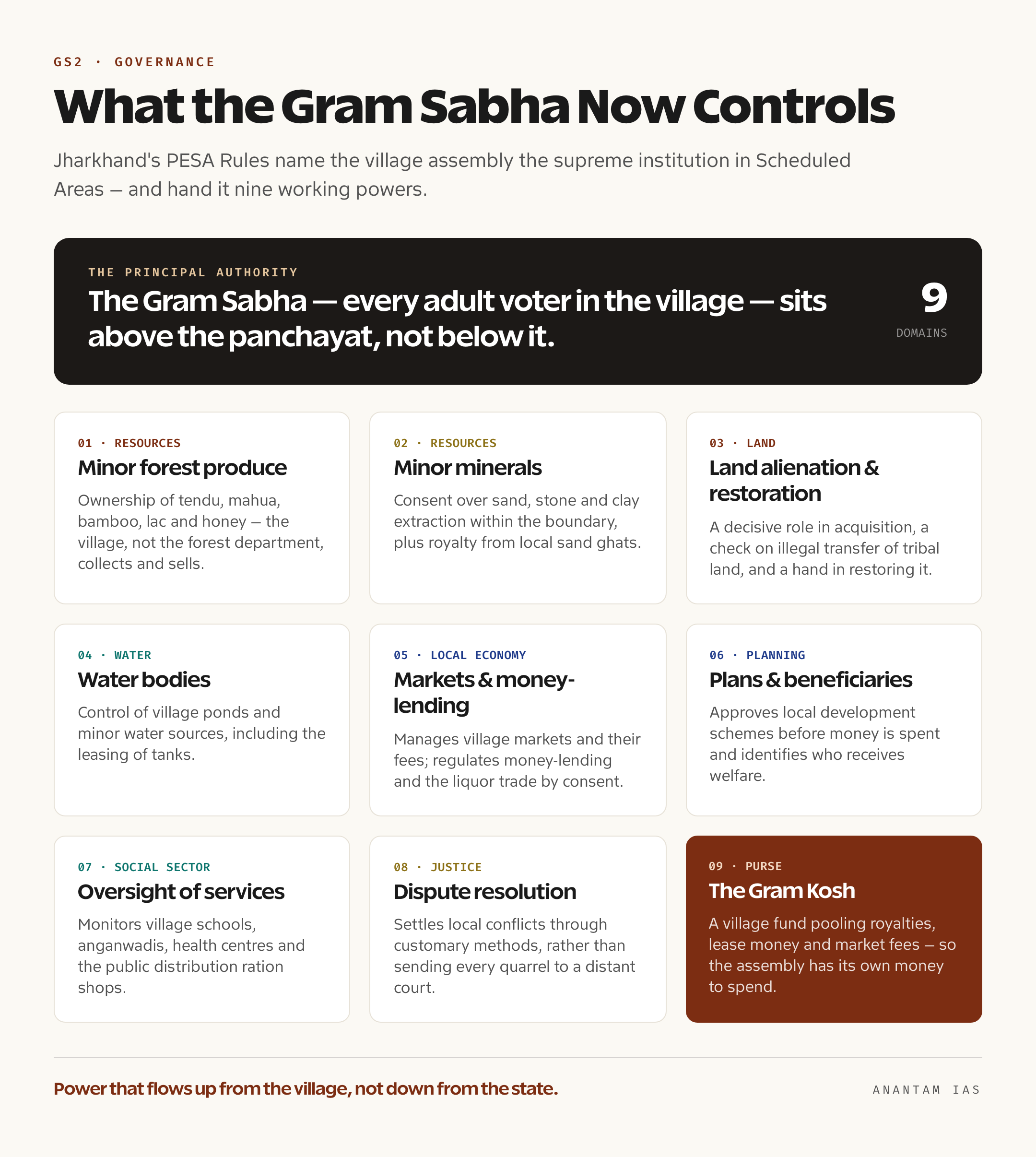

The Powers Jharkhand’s Rules Devolve to the Gram Sabha
So what can a Jharkhand Gram Sabha now actually do? The rules name it the strongest and supreme institution in the Scheduled Areas, and they translate PESA’s broad mandate into concrete, examinable powers. Start with natural resources, because that’s where the stakes are highest. The Gram Sabha gets ownership and control over minor forest produce — the tendu leaves, mahua flowers, bamboo, lac, honey and wild fruit that tribal households gather and sell, which PESA explicitly vests in the village rather than the forest department. It gets a say over minor minerals — sand, stone, ordinary clay and the like — including the power to monitor and consent to mining and quarrying within its boundary, and to take royalty and fees from sand ghats and the local extraction it allows.
Then comes the heart of the matter for Adivasi India: land. The rules give the Gram Sabha a decisive role in land acquisition, requiring its involvement before tribal land is taken for any project, and a role in preventing land alienation — the illegal transfer of tribal land to non-tribals — and in restoring land that has been wrongly taken. They hand it control over village water bodies and minor water sources, including the leasing of ponds. And they devolve a cluster of everyday governance powers that decide how a village actually lives. The Gram Sabha now manages village markets and collects their fees. It regulates money-lending to Scheduled Tribes, the historic trap that has stripped Adivasis of land for generations. It controls the local liquor trade — no manufacture, storage or sale without the assembly’s consent, a recognition that excise has long preyed on tribal areas.
Beyond resources, the rules wire the Gram Sabha into the machinery of the state. It approves local plans and development schemes before money is spent, and it identifies the beneficiaries of poverty-reduction and welfare programmes — turning the assembly from a petitioner into a planner. It oversees the social sector running in the village: the power to monitor schools, anganwadis (the rural child-care and nutrition centres), health sub-centres and the ration shops of the public distribution system. It is empowered in dispute resolution, settling local conflicts through customary methods rather than sending every quarrel to a distant court. And to give all this teeth, each Gram Sabha can build a Gram Kosh — a village fund pooling royalties, lease money, market fees and other local income, so the assembly has its own purse to spend. Take those together — minor minerals, minor forest produce, land alienation and restoration, water bodies, village markets, money-lending, local plans and beneficiary lists, social-sector oversight and dispute resolution — and you have a Gram Sabha that, on paper at least, governs almost everything that touches a tribal villager’s daily life.
What Operationalising PESA Means for Tribal Self-Rule
Step back and the significance is constitutional, not just administrative. PESA is the only place in Indian law where the Gram Sabha is not a junior body under an elected panchayat but the principal authority above it. Everywhere else in India, real power flows downward from the state through elected councils. In Scheduled Areas under PESA, it is supposed to flow upward from the village assembly. That inversion is the whole point — it tries to make decentralisation genuine, pushing decisions to the people who live with their consequences. By framing its rules, Jharkhand has at last given that principle an operating manual within its borders, and it brings the state into line with the spirit of the Fifth Schedule, which exists precisely to let tribal areas be governed differently.
The deeper purpose is protective. For tribal communities, land and forest are not assets to be traded but the basis of identity, livelihood and culture, and the long history of Adivasi dispossession is a history of that base being eroded — by moneylenders, by acquisition, by quiet alienation. A Gram Sabha with real authority over land restoration, minor forest produce and consent for projects is a shield against that erosion, and a way to keep the fruits of local resources in local hands through the Gram Kosh. It also revives institutions of self-governance that predate the Indian state itself, giving legal weight to customary decision-making rather than overriding it.
And the timing carries its own message. Jharkhand acting in 2026, however late, adds momentum to a wider push for tribal rights and reads alongside the Forest Rights Act of 2006, which gives communities title to the forests they have long used, as part of a slow constitutional project to make Adivasi self-rule real rather than rhetorical. When it works, PESA can do what few laws manage — turn a marginalised community from the object of governance into its author. For a state that defines itself by its tribal identity, finally switching the law on is a statement about what kind of democracy Jharkhand wants to be.
Gaps, Challenges and the Way Forward
But a notification is not a transformation, and the criticism that greeted these rules is worth taking seriously. The sharpest objection from tribal groups is that Jharkhand has diluted PESA by folding it into the state’s ordinary Panchayati Raj Act of 2001, instead of treating PESA as the special, stand-alone law it is meant to be. Activists argue that key safeguards have been weakened — that the protection of customary law, religious practice and cultural identity, which PESA insists on, has been thinned, and that on land restoration the rules stop short of the full authority PESA envisages. When the body that recognises a Gram Sabha is a district official rather than the community itself, critics say, you have reintroduced the very bureaucratic control PESA was written to remove. That is the difference between empowering an assembly and merely permitting one.
The bigger, structural problem is one PESA has faced everywhere it operates. The law sits inside a thicket of older laws — on land, forests, mining, excise and revenue — that often contradict it, and line departments routinely treat the Gram Sabha’s consent as a box to tick rather than a decision to respect. A village can say no to a mine and still find the clearance granted, because a sectoral law lets the department proceed. There is also the consent-versus-consultation gap: where PESA demands the Gram Sabha’s agreement, officials too often settle for a token meeting. And unlike the Sixth Schedule areas of the Northeast, which have their own autonomous district councils, Fifth Schedule Gram Sabhas lack a higher tier of self-government to back them up, which can leave them strong on paper and weak in practice.
So the way forward is less about new laws than about honouring this one. The state needs to harmonise its land, mining and excise rules with PESA so the Gram Sabha’s word is not quietly overruled, treat consent as real consent, and invest in the unglamorous work of capacity-building — training Gram Sabha members, funding the Gram Kosh, and protecting assemblies from capture by local elites, contractors and political muscle. Genuine recognition of customary institutions, not their absorption into the standard panchayat, would answer the central complaint. And the test, ultimately, is on the ground: whether a village in Khunti or Simdega can actually stop an illegal transfer, collect its mahua royalty and plan its own school. If it can, Jharkhand’s 2026 rules will be remembered as the year self-rule arrived. If it can’t, they will be another well-drafted law waiting, like the Act itself, for someone to mean it.
For Your Mains Answer
This is a core topic for GS Paper 2, which covers devolution of powers, local self-government, the Panchayati Raj system, statutory and constitutional provisions for vulnerable sections, and the working of mechanisms for protecting the rights of the Scheduled Tribes. It links the 73rd Amendment, the Fifth Schedule and PESA into one chain, and it offers a sharp, current case study — Jharkhand’s January 2026 rules — for any question on decentralisation, tribal rights or the gap between legislation and implementation. It also feeds GS1 on the issues of the Scheduled Tribes and Essay themes of inclusion and grassroots democracy.
How to Build the Answer
Move in a clear chain: the 73rd Amendment (1992) brought Panchayati Raj but left out Scheduled Areas → PESA (1996), built on the Bhuria Committee, extended it on tribal terms and made the Gram Sabha supreme → states had to frame rules, and most delayed → Jharkhand finally notified its rules on 2 January 2026, 25 years after statehood → list the powers devolved (minor forest produce, minor minerals, land restoration, water, markets, money-lending, plans, beneficiaries, social-sector oversight, dispute resolution) → assess the significance and the gaps → close with the way forward. That arc — context, law, delay, powers, significance, critique, fix — fits almost any PESA or tribal-governance question.
Common Mistakes to Avoid
Don’t confuse PESA with the Forest Rights Act of 2006 — PESA is about self-governance and the Gram Sabha’s powers, the FRA about individual and community forest title; mention both, but keep them distinct. Don’t say PESA created Panchayati Raj; the 73rd Amendment did that, and PESA extended it to Scheduled Areas. Don’t forget that PESA needs state rules to work — the whole Jharkhand story is about the rules, not the Act. And don’t present the notification as an unqualified success; the marks come from noting the dilution debate and the consent-versus-consultation problem.
A Compact Answer Spine
73rd Amendment (1992) excludes Fifth Schedule areas → PESA Act (24 Dec 1996), from the Bhuria Committee, extends Part IX to Scheduled Areas with the Gram Sabha as supreme → covers 10 Fifth Schedule states → Jharkhand notifies rules 2 Jan 2026, 25 years late, across 16,022 villages and 2,074 panchayats in 13+3 districts → powers: minor forest produce, minor minerals, land alienation/restoration, water bodies, markets, money-lending, local plans, beneficiaries, social-sector oversight, dispute resolution, Gram Kosh → significance: makes the Gram Sabha principal authority, shields tribal land → gaps: dilution into 2001 panchayat law, sectoral-law conflicts, consent treated as formality → way forward: harmonise laws, real consent, capacity-building.
Diagram or Flowchart Idea
Draw a simple downward funnel: Constitution (Fifth Schedule, Art. 244) → PESA 1996 → State Rules (Jharkhand 2026) → Gram Sabha, with the Gram Sabha box ringed by its powers (land, minor forest produce, minor minerals, water, markets, money-lending, schemes, disputes). A parallel timeline strip — 1992 → 1996 → 2000 → 2026 — drives home the delay at a glance.
A Balanced-Conclusion Line
A line that lands the marks: “Jharkhand’s PESA Rules of 2026 are a belated but real step toward making the Gram Sabha the author of its own development — yet their promise will be measured not by the notification, but by whether a tribal village can finally say no and be heard.”
How to Use Data Without Cramming
You need only a handful of anchors: PESA enacted 24 December 1996; rules notified 2 January 2026; 25 years after Jharkhand’s formation in 2000; 16,022 villages and 2,074 panchayats; full coverage in 13 districts. Drop those into the right sentences and attribute them plainly — “as the state’s January 2026 notification showed” — rather than scattering figures loose.
FAQ
What are the Jharkhand PESA Rules 2026? They are the operating rules that Jharkhand notified on 2 January 2026 to implement the central Panchayats (Extension to Scheduled Areas) Act, 1996 — PESA — in the state’s Fifth Schedule tribal areas. The cabinet cleared them on 23 December 2025. The rules apply across 16,022 villages and 2,074 panchayats, fully in 13 districts and partly in three more, and they name the Gram Sabha, the assembly of all adult voters in a village, the supreme authority over local land, water, forest and governance.
What is the PESA Act and when was it passed? PESA, the Panchayats (Extension to Scheduled Areas) Act, was enacted on 24 December 1996. After the 73rd Constitutional Amendment of 1992 brought Panchayati Raj to the rest of India but left out the Fifth Schedule areas, PESA extended that system to those tribal tracts on special terms — making the Gram Sabha, rather than the bureaucracy, the principal authority over natural resources and development, in line with the Bhuria Committee’s recommendations.
What powers does the Gram Sabha get under PESA? A Gram Sabha in a PESA area controls minor forest produce (tendu, mahua, bamboo and the like), has a say over minor minerals and mining within its boundary, plays a decisive role in land acquisition and the prevention of land alienation and its restoration, manages village water bodies and markets, regulates money-lending and the liquor trade, approves local plans and identifies scheme beneficiaries, oversees village schools, anganwadis, health centres and ration shops, and resolves local disputes by custom. In Jharkhand it can also build a Gram Kosh, a village fund of local royalties and fees.
Why did Jharkhand take 25 years to frame the PESA Rules? Because PESA gives the Gram Sabha powers — a veto over mines, over land transfers, over local revenue — that successive governments and line departments were reluctant to surrender, since land, mining and excise are exactly where state power and PESA collide. Political churn, administrative inertia and confusion over fitting PESA into the state’s 2001 panchayat law added to the delay. Sustained Jharkhand High Court pressure and tribal mobilisation finally forced the notification in January 2026.
Practice Questions
Prelims MCQs
- With reference to the PESA Act, consider the following:
(a) it was enacted in 1996
(b) it extends Part IX of the Constitution to Fifth Schedule areas
(c) it makes the Gram Sabha the principal authority over local resources
(d) all of the above
Answer: (d) PESA, enacted on 24 December 1996, extends the Panchayati Raj provisions of Part IX to Scheduled Areas and makes the Gram Sabha the supreme local authority. - The 73rd Constitutional Amendment of 1992 did which of the following with respect to the Fifth Schedule areas?
(a) automatically applied Panchayati Raj to them
(b) excluded them, leaving extension to a separate law
(c) abolished the Fifth Schedule
(d) created autonomous district councils for them
Answer: (b) The amendment excluded Scheduled Areas, and PESA (1996) later extended Panchayati Raj to them on tribal-friendly terms. - Which committee’s recommendations formed the basis of the PESA Act?
(a) the Balwant Rai Mehta Committee
(b) the Ashok Mehta Committee
(c) the Bhuria Committee
(d) the Sarkaria Commission
Answer: (c) The Bhuria Committee of 1994-95, chaired by Dilip Singh Bhuria, recommended that the Gram Sabha control natural resources in tribal areas, shaping PESA. - Under PESA, the Gram Sabha is empowered with which of the following?
(a) ownership of minor forest produce
(b) prevention of land alienation and its restoration
(c) a role in approving local plans and identifying beneficiaries
(d) all of the above
Answer: (d) PESA vests the Gram Sabha with minor forest produce, land-alienation safeguards, planning approval, beneficiary identification and more. - The Fifth Schedule of the Constitution is associated with which Article?
(a) Article 244(1)
(b) Article 370
(c) Article 280
(d) Article 356
Answer: (a) The Fifth Schedule is provided for under Article 244(1) and deals with the administration of Scheduled Areas and Scheduled Tribes outside the Sixth Schedule states.
Mains Practice Questions
- The PESA Act, 1996 makes the Gram Sabha the principal authority in Scheduled Areas, yet its promise has remained largely unrealised. Examine the powers it devolves and the reasons for its weak implementation. (15 marks, 250 words)
- “A notification is not a transformation.” In light of Jharkhand’s framing of its PESA Rules after 25 years, critically analyse the gap between legislating tribal self-governance and delivering it. (15 marks, 250 words)
- Trace the constitutional journey from the 73rd Amendment to PESA and discuss why a separate law was needed for Panchayati Raj in the Fifth Schedule areas. (10 marks, 150 words)
- Discuss how conflicts between PESA and sectoral laws on land, forests, mining and excise dilute the authority of the Gram Sabha, and suggest measures to harmonise them. (15 marks, 250 words)
- PESA and the Forest Rights Act, 2006 are often described as twin pillars of tribal empowerment. Compare their objectives and assess their combined significance for tribal self-rule in India. (15 marks, 250 words)
Source: https://anantamias.com/current-affairs/jharkhand-pesa-rules-2026/
India-Germany Joint Statement 2026: Defence, Semiconductors and Green Hydrogen
Germany’s Chancellor Friedrich Merz visited India in January 2026, and the joint statement that followed was unusually dense. Defence industrial cooperation, semiconductors, critical minerals, telecom, green hydrogen, green ammonia, bioeconomy and skilled migration all appeared in one diplomatic package.
For UPSC, this is not a routine bilateral visit. It shows how India is building partnerships with middle powers and major industrial economies at a time when supply chains, climate technology and defence manufacturing are becoming strategic rather than purely commercial questions.
This article decodes the India-Germany 2026 outcomes through a GS-II international relations lens and a GS-III technology-security lens.
Quick Facts
- The visit marked the 25th anniversary of the India-Germany Strategic Partnership and 75 years of diplomatic relations.
- A 23-member German CEO delegation accompanied the Chancellor.
- The joint statement listed 19 formal agreements and eight major announcements.
- Priority areas included defence, semiconductors, critical minerals, telecom, quantum, AI, green hydrogen and green ammonia.
- Germany announced visa-free transit facility for Indian nationals.
- Germany’s Global Shield against Climate Risks was linked with climate-resilience cooperation.
- Official source: PIB joint statement.
What Just Happened
The two sides adopted a wide-ranging joint statement after Chancellor Merz’s India visit. The outcomes covered security, industrial cooperation, climate action, migration, education, innovation and Indo-Pacific coordination.
The important shift is from values-only diplomacy to production-linked diplomacy. Defence platforms, semiconductor supply chains, critical minerals, AI and green hydrogen are now treated as strategic infrastructure.
India and Germany also used the visit to signal a shared interest in a rules-based Indo-Pacific, secure sea lanes and resilient technology supply chains. That gives the relationship relevance beyond trade.
Background and Historical Context
India and Germany established diplomatic relations in 1951. The Strategic Partnership was launched in 2000, and the Inter-Governmental Consultations mechanism later gave the relationship a Cabinet-level review format.
Germany is Europe’s largest economy and a major manufacturing, technology and climate-finance actor. India is a large market, a skilled-labour source, an Indo-Pacific power and a diversification option for European companies.
The relationship has often underperformed its potential because German industry moved slowly in India, and India did not always align regulatory systems with European manufacturing expectations. Supply-chain stress after COVID-19 and geopolitical uncertainty have changed the incentive structure.
Key Features of the 2026 Joint Statement
The core policy architecture can be read through these features.
- Defence industry: cooperation moved toward co-development, co-production and technology partnerships.
- Semiconductors: the statement placed chip design, manufacturing ecosystems and talent cooperation in the bilateral frame.
- Critical minerals: both sides linked green transition with secure mineral supply chains.
- Green hydrogen: hydrogen and green ammonia were treated as trade, climate and industrial-policy priorities.
- Mobility: skilled migration and visa facilitation supported labour-market complementarity.
- Indo-Pacific: maritime security and rules-based order appeared as strategic anchors.
Why It Matters
This is a high-yield UPSC topic because it joins current news with durable syllabus themes.
- It gives GS-II content on India’s relations with Europe beyond the India-EU framework.
- It connects IR with GS-III themes: semiconductors, defence manufacturing, energy transition and supply-chain security.
- It shows how diplomacy now includes CEOs, technology standards, migration and climate finance.
- It provides Essay material on a multipolar world and strategic autonomy.
Detailed Analysis: International Relations Lens
The relationship is moving from market access to strategic production. Germany wants supply-chain diversification. India wants technology, investment and manufacturing depth. The overlap is real, but it needs execution.
Green hydrogen is the bridge sector. Germany will need imported green molecules. India wants to become a low-cost producer. If standards, finance and offtake contracts align, this can become one of the most concrete India-Germany partnerships.
Defence cooperation remains promising but difficult. Germany has advanced platforms and engineering capacity, while India seeks indigenisation. Export controls, cost, intellectual property and long procurement cycles will test the ambition.
Comparative Perspective
A comparison helps prevent the answer from becoming a one-dimensional news summary.
- India-France: defence and space cooperation are deeper and more operationally mature.
- India-Germany: manufacturing, green technology, skills and industrial supply chains are the stronger pillars.
- India-UK: services, education, finance and diaspora dominate the relationship.
- India-EU: the wider framework covers trade, standards and climate, but Germany remains the industrial heavyweight inside Europe.
Challenges
The policy or institutional promise runs into recurring constraints.
- German companies often find India’s regulatory and compliance environment difficult.
- India needs deeper supplier ecosystems before it can absorb high-end manufacturing at scale.
- Technology transfer in defence and semiconductors will remain sensitive.
- Green hydrogen trade requires common standards, certification and long-term offtake certainty.
- Europe’s internal politics can slow external industrial and trade decisions.
Prelims Pointers
- India-Germany Strategic Partnership began in 2000.
- Inter-Governmental Consultations are a high-level bilateral review mechanism.
- Green hydrogen is produced using renewable electricity through electrolysis.
- Critical minerals are essential for batteries, clean energy, electronics and defence systems.
- Semiconductors are central to electronics, AI, defence, automobiles and telecom.
- Germany is a member of the G7, EU and NATO.
Mains Questions
- India-Germany relations are shifting from trade diplomacy to technology and supply-chain diplomacy. Discuss. (GS Paper II, 250 words)
- How can green hydrogen become a strategic pillar of India-Europe relations? (GS Paper III, 150 words)
- Evaluate the role of middle powers and industrial democracies in India’s strategic autonomy. (GS Paper II, 250 words)
- What constraints limit defence industrial cooperation between India and Germany? Suggest reforms. (GS Paper III, 250 words)
Way Forward
India should convert the joint statement into sector-specific roadmaps: one for defence platforms, one for green hydrogen offtake, one for semiconductor talent and one for critical minerals.
Regulatory predictability will matter more than diplomatic warmth. German firms will invest at scale only if land, taxation, customs, standards and dispute-resolution systems are dependable.
The best India-Germany partnership will not be measured by communiques. It will be measured by factories, research labs, skilling pipelines, co-developed technologies and clean-energy contracts.
The examiner is unlikely to reward a bare fact dump here. The better answer connects the January 2026 event to institutional design, implementation capacity and India’s long-term development priorities.
Frequently Asked Questions
Why was the 2026 India-Germany visit important?
It marked key anniversaries in the relationship and produced outcomes across defence, semiconductors, critical minerals, green hydrogen, AI, migration and the Indo-Pacific.
What is the India-Germany Strategic Partnership?
It is the bilateral framework launched in 2000 to deepen cooperation across political, economic, technological and security domains.
Why does Germany matter to India?
Germany is Europe’s largest economy, a manufacturing powerhouse and a major source of technology, skills cooperation and climate finance.
Why does India matter to Germany?
India offers market scale, skilled talent, Indo-Pacific relevance and supply-chain diversification opportunities.
What are the UPSC themes here?
GS-II international relations, GS-III technology, defence manufacturing, green hydrogen, critical minerals and supply-chain security.
What is the main challenge?
Implementation. The relationship has strong intent, but regulatory friction, technology transfer limits and slow procurement can weaken outcomes.
Source: https://anantamias.com/current-affairs/india-germany-joint-statement-2026/
Ganga Innovation Meet 2026: Technology, Biodiversity and River Rejuvenation
Ganga Innovation Meet 2026 brought together technology, research and river-rejuvenation ideas under the Namami Gange umbrella. The event signalled that river governance is increasingly looking to sensors, biodiversity science, citizen participation and applied innovation.
For UPSC, this topic helps students move beyond a static Namami Gange note. It asks what kind of innovation actually matters for a living river system.
This article explains the innovation agenda in river governance and connects it with biodiversity, pollution control and institutional coordination.
Quick Facts
- Ganga Innovation Meet was organised in January 2026.
- It was linked to Namami Gange and NMCG’s river-rejuvenation agenda.
- Themes included technology, biodiversity, pollution monitoring and stakeholder participation.
- River governance requires basin-level thinking, not city-wise projects alone.
- The topic is relevant for GS-III environment and science and technology.
- Official source: PIB Jal Shakti release dated 13 January 2026.
- Official source: PIB, Ministry of Jal Shakti.
What Just Happened
The Meet created a platform for innovation in river rejuvenation, including technological and ecological approaches.
The policy signal was that river cleaning cannot remain a civil-engineering exercise. It needs data, ecological restoration and community engagement.
For aspirants, the event is useful for writing answers on how environmental governance can use technology without losing sight of ecology.
Background and Historical Context
Ganga rejuvenation efforts have evolved from project-based sewage treatment to a broader basin approach involving pollution control, biodiversity, wetlands, afforestation and public participation.
NMCG has increasingly used research institutions, data systems and stakeholder platforms to strengthen implementation.
Innovation in river governance can include real-time water-quality monitoring, low-cost sensors, bio-remediation, biodiversity mapping and riverfront behaviour change.
Key Features of River Innovation
The core policy architecture can be read through these features.
- Technology focus: digital and scientific tools can improve monitoring.
- Biodiversity link: river health includes species, habitats and ecological flows.
- Stakeholder platform: innovators, researchers and administrators can interact.
- Basin thinking: tributaries and catchments must be part of solutions.
- Citizen role: behavioural change and local monitoring can support formal systems.
- Implementation test: pilots must move into procurement and field use.
Why It Matters
This is a high-yield UPSC topic because it joins current news with durable syllabus themes.
- It connects a January 2026 event with durable UPSC syllabus themes.
- It gives usable facts for Prelims and analytical hooks for Mains.
- It helps students move from news recall to policy reasoning.
- It can be linked with static concepts in polity, economy, governance, science, environment or society.
Detailed Analysis: River Innovation Lens
Innovation cannot be gadget-driven. A sensor is useful only when institutions respond to the data.
Ecological restoration is different from beautification. A clean-looking riverfront is not the same as a healthy river.
Public participation matters because rivers are social spaces. Ritual use, waste disposal, tourism and urban growth all shape river outcomes.
Comparative Perspective
A comparison helps prevent the answer from becoming a one-dimensional news summary.
- STP dashboards: track sewage-treatment performance.
- Biodiversity programs: focus on species and habitats.
- Wetland restoration: improves natural filtration and flood buffering.
- Innovation meets: create a bridge between ideas and mission implementation.
Challenges
The policy or institutional promise runs into recurring constraints.
- Pilot projects often fail to scale.
- Ecological indicators are harder to communicate than infrastructure milestones.
- Cities may lack capacity to adopt new tools.
- Data from sensors needs validation and maintenance.
- River rejuvenation requires coordination across multiple states.
Prelims Pointers
- NMCG is linked to Namami Gange implementation.
- BOD, dissolved oxygen and faecal coliform are important water-quality indicators.
- Environmental flows sustain river ecosystems.
- Wetlands can support natural water purification.
- Ganga river dolphin is an important indicator species.
- River basins cross administrative boundaries.
Mains Questions
- River rejuvenation requires ecological restoration, not only pollution-control infrastructure. Discuss. (GS Paper III, 250 words)
- How can technology improve river governance without becoming a substitute for enforcement? (GS Paper III, 150 words)
- Explain the importance of basin-level planning in river conservation. (GS Paper III, 250 words)
- Citizen participation is critical to environmental governance. Analyse with reference to river rejuvenation. (GS Paper III, 250 words)
Way Forward
Innovation platforms should connect pilots with procurement pathways, city-level capacity and public data disclosure.
River-health dashboards should include ecological indicators, not only sewage-infrastructure milestones.
For UPSC, frame Ganga Innovation Meet as a shift from project execution to adaptive river governance.
The examiner is unlikely to reward a bare fact dump here. The better answer connects the January 2026 event to institutional design, implementation capacity and India’s long-term development priorities.
Frequently Asked Questions
What is Ganga Innovation Meet?
It is a platform focused on innovative approaches for Ganga river rejuvenation.
How is it linked to Namami Gange?
It supports the mission’s broader goals of pollution control, biodiversity and river restoration.
Why is technology important?
It can improve monitoring, data quality and targeted action.
What is ecological flow?
It is the water flow needed to sustain river ecosystems.
Why is this UPSC-relevant?
It combines environment, science, governance and federal coordination.
What is the main caution?
Innovation must scale into accountable implementation, not remain a conference theme.
Source: https://anantamias.com/current-affairs/ganga-innovation-meet-2026/
Pariksha Pe Charcha 2026: Exam Stress, Student Wellbeing and Public Communication
Pariksha Pe Charcha 2026 crossed a record registration figure in January, keeping exam stress, student wellbeing and parent-teacher communication in the public-policy conversation.
For UPSC, the topic is useful because it connects education policy with mental health, adolescent wellbeing, competitive pressure and the state’s use of public communication to shape social behaviour.
This article reads Pariksha Pe Charcha as a governance communication tool and asks what deeper reforms are needed to reduce exam stress.
Quick Facts
- Pariksha Pe Charcha is an annual interaction around exams, stress and student motivation.
- The 2026 edition saw very large registrations through official platforms.
- The event is linked to students, teachers and parents.
- The broader theme is exam stress and student wellbeing.
- It connects with NEP 2020’s emphasis on holistic education.
- Official source: PIB Ministry of Education release dated 13 January 2026.
- Official source: PIB, Ministry of Education.
What Just Happened
The Ministry of Education announced strong registration numbers for Pariksha Pe Charcha 2026.
The event seeks to normalise conversations around exam anxiety, preparation, motivation and parental pressure.
For aspirants, the news hook is a chance to discuss mental health in education without reducing it to motivational messaging.
Background and Historical Context
India’s education system has long been exam-heavy. Board exams, entrance tests and coaching ecosystems create pressure that affects students and families.
NEP 2020 calls for more holistic, flexible and competency-based education. Assessment reform is central to that vision.
Student wellbeing is now part of education governance because stress, dropout, self-harm and learning anxiety affect human capital.
Key Features of Student Wellbeing
The core policy architecture can be read through these features.
- Public communication: the platform creates national conversation around exam stress.
- Stakeholder inclusion: students, teachers and parents participate.
- Behavioural signal: it tries to reduce fear and stigma around exams.
- NEP link: holistic education and assessment reform provide the policy background.
- Mental-health angle: stress management needs institutional support.
- Limitation: communication cannot replace counselling and assessment reform.
Why It Matters
This is a high-yield UPSC topic because it joins current news with durable syllabus themes.
- It connects a January 2026 event with durable UPSC syllabus themes.
- It gives usable facts for Prelims and analytical hooks for Mains.
- It helps students move from news recall to policy reasoning.
- It can be linked with static concepts in polity, economy, governance, science, environment or society.
Detailed Analysis: Student Wellbeing Lens
Motivation is useful, but structural pressure remains. Students still face high-stakes exams, coaching inequality and narrow definitions of success.
Parents are part of the policy ecosystem. Exam stress is shaped at home as much as in school.
Schools need counselling capacity. Public messaging should be backed by counsellors, teacher training and referral systems.
Comparative Perspective
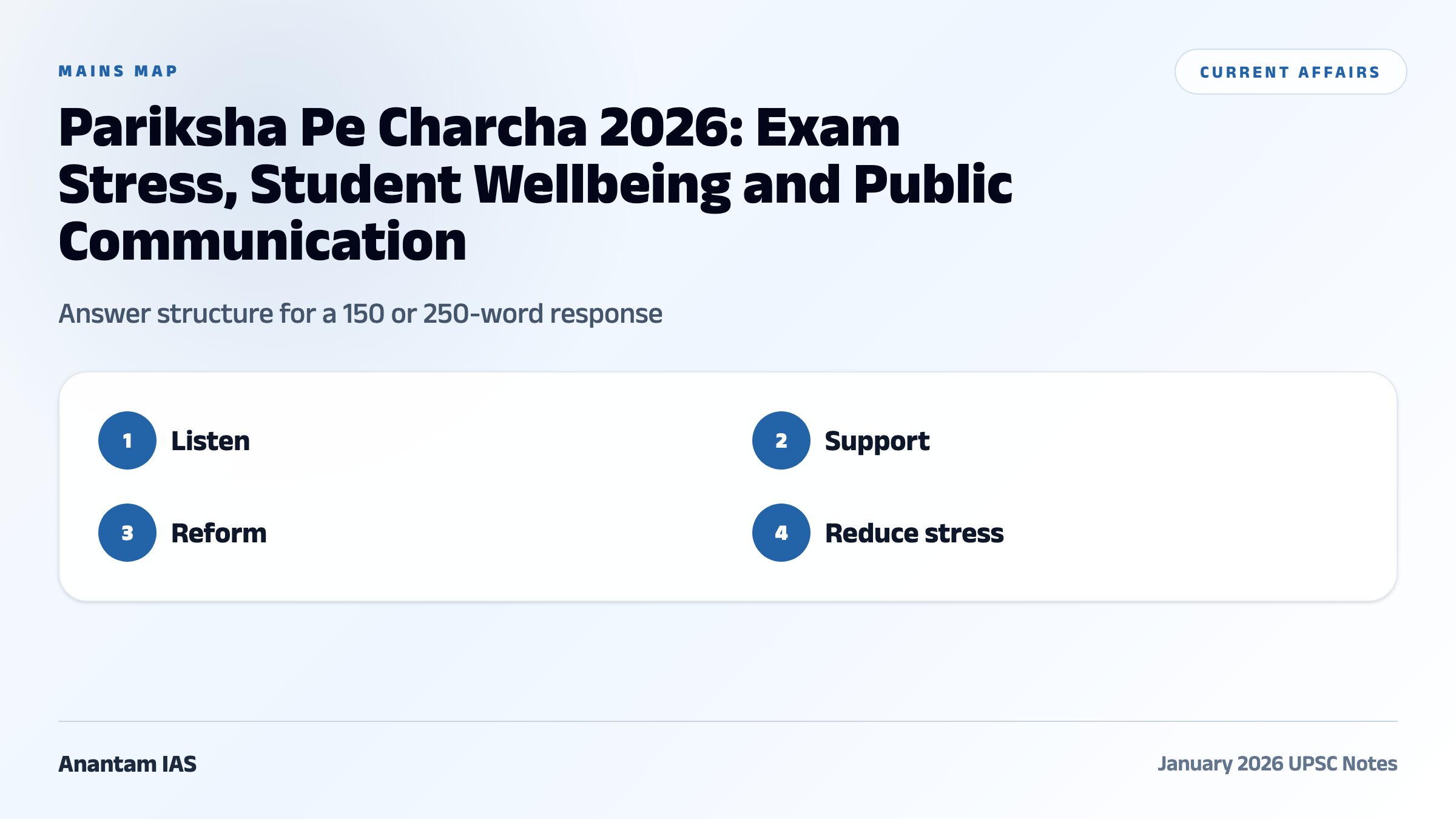
A comparison helps prevent the answer from becoming a one-dimensional news summary.
- Exam reform: changes assessment design and stakes.
- Counselling: provides direct mental-health support.
- Public campaigns: shift social norms and awareness.
- Pariksha Pe Charcha: works mainly as public communication and motivation.
Challenges
The policy or institutional promise runs into recurring constraints.
- One annual event cannot substitute for school-level counselling.
- Competitive exams continue to create high-stakes pressure.
- Rural and government schools need stronger wellbeing infrastructure.
- Parents and coaching centres may reinforce unhealthy pressure.
- Mental-health stigma prevents students from seeking help.
Prelims Pointers
- Pariksha Pe Charcha is linked to exam stress and student interaction.
- NEP 2020 emphasises holistic development and assessment reform.
- Adolescent mental health is a public-health and education concern.
- School counsellors and teacher training are important wellbeing measures.
- Competency-based assessment tests understanding rather than rote recall.
- Public communication can be a governance tool.
Mains Questions
- Student wellbeing must be treated as a core education-policy concern. Discuss. (GS Paper II, 250 words)
- Public communication can reduce stigma but cannot replace institutional reform. Analyse with reference to exam stress. (GS Paper II, 150 words)
- How can assessment reform reduce pressure in India’s school system? (GS Paper II, 250 words)
- Examine the role of parents and teachers in addressing adolescent mental health. (GS Paper II, 250 words)
Way Forward
Pariksha Pe Charcha should be backed by school counsellors, teacher mental-health training, helplines, peer-support systems and assessment reform.
Student wellbeing indicators should be tracked along with enrolment and learning outcomes.
In UPSC answers, use the event as a hook but move quickly to structural reforms.
The examiner is unlikely to reward a bare fact dump here. The better answer connects the January 2026 event to institutional design, implementation capacity and India’s long-term development priorities.
Frequently Asked Questions
What is Pariksha Pe Charcha?
It is an annual interaction focused on exams, stress, motivation and student wellbeing.
Why is it relevant for UPSC?
It links education policy with mental health, assessment reform and public communication.
Is it a scheme?
It is more of a public interaction and communication platform than a conventional welfare scheme.
What is the main limitation?
It cannot replace counselling, assessment reform and school-level wellbeing systems.
How does NEP 2020 connect?
NEP emphasises holistic education, flexibility and assessment reform.
Which GS paper is relevant?
GS-II social sector and governance.
Source: https://anantamias.com/current-affairs/pariksha-pe-charcha-2026-registrations/
Shaksgam Valley: The Geography and Strategic Stakes of the Trans-Karakoram Tract
Why in News?
The Shaksgam Valley — the high, glaciated Trans-Karakoram Tract wedged between Pakistan-occupied Kashmir and China’s Xinjiang — is back in strategic focus after fresh reports of Chinese road and construction activity in and around the area, close to the Siachen sector.
India holds that the roughly 5,180 sq km tract is its own sovereign territory, illegally handed over by Pakistan to China under the 1963 Sino-Pakistan boundary agreement, since it lies within the erstwhile princely state of Jammu and Kashmir that acceded to India in 1947.
- What it is: the Shaksgam Valley or Trans-Karakoram Tract, a high-altitude expanse north of the Karakoram watershed.
- Area: about 5,180 sq km of largely uninhabited glaciers, ridges and the Shaksgam (Shimshal) river basin.
- The cession: Pakistan transferred administration of the tract to China under the 1963 Sino-Pakistan boundary agreement.
- India’s stand: New Delhi treats the agreement as illegal and void, since Pakistan had no sovereign title to cede Indian territory.
- Strategic proximity: it abuts the Siachen Glacier, the Karakoram Pass and the contested Aksai Chin theatre to the east.
- Latest trigger: open-source imagery has flagged Chinese infrastructure and access roads creeping into the tract, raising fresh concern in India.
The development matters in the context of:
- Three-way frontier: the tract sits where Indian-claimed territory, Pakistani control and Chinese administration converge in the western Himalaya.
- PoK linkage: it adjoins Gilgit-Baltistan, the area of Pakistan-occupied Kashmir through which the China-Pakistan Economic Corridor also runs.
- Siachen overhang: any Chinese consolidation near the tract increases pressure on India’s positions on the Saltoro Ridge and Siachen.
- Cartographic stakes: India’s official maps continue to show the tract as part of the Union Territory of Ladakh, not as Chinese territory.

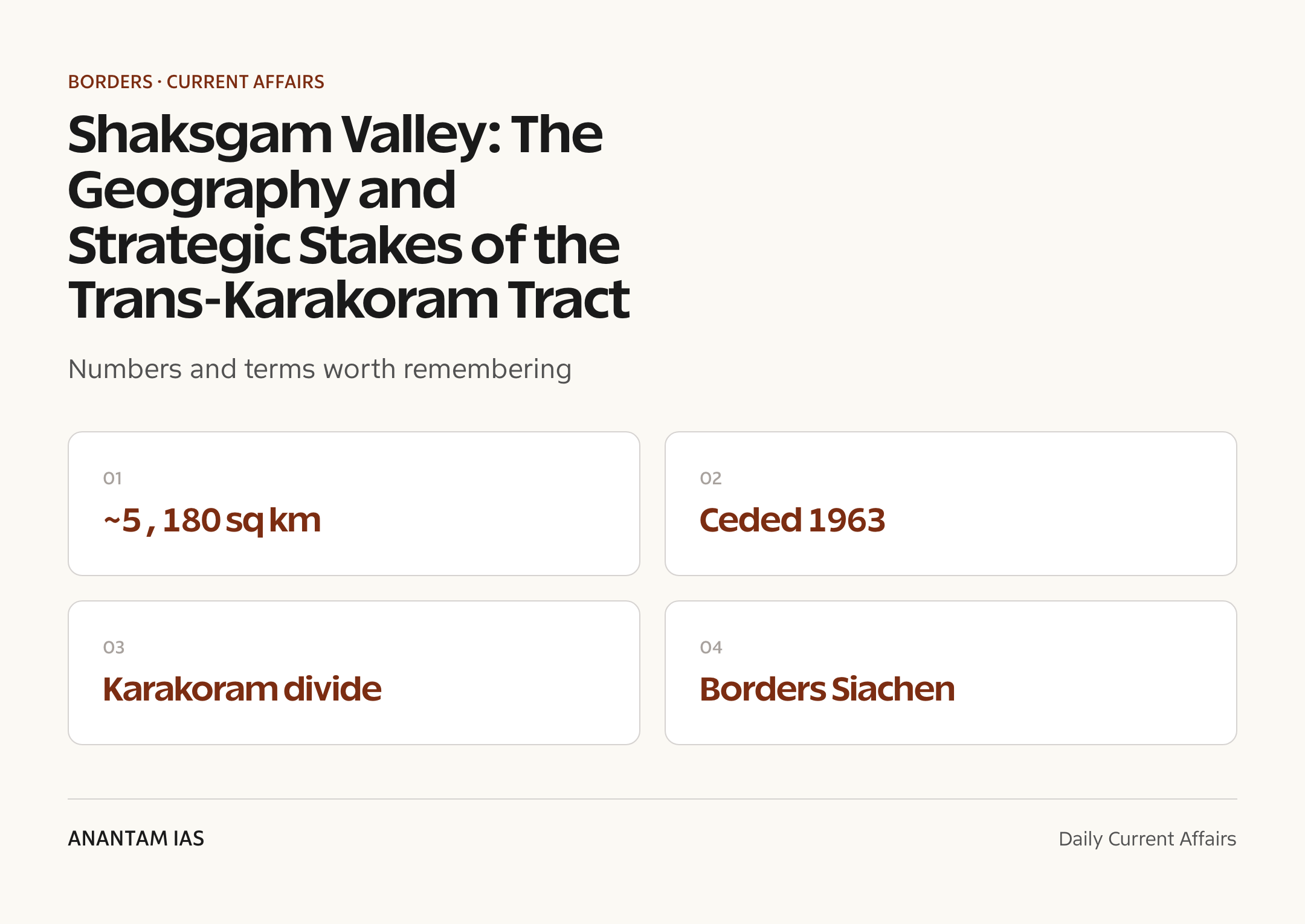
UPSC Relevance
Prelims Relevance
- Shaksgam Valley location — north of the Karakoram main divide, between PoK / Gilgit-Baltistan and Xinjiang.
- Trans-Karakoram Tract as the formal name; area roughly 5,180 sq km.
- The 1963 Sino-Pakistan boundary agreement and the territory it transferred to China.
- Distinction between the Karakoram and the Himalaya as separate mountain systems.
- The Karakoram Pass — historic trade route linking Ladakh with Central Asia (Yarkand).
- Siachen Glacier and the Saltoro Ridge in relation to the tract.
- Aksai Chin — the China-administered plateau India claims, lying east of the tract.
- Difference between the Line of Control (LoC), the Line of Actual Control (LAC) and an international boundary.
- Gilgit-Baltistan as part of Pakistan-occupied Kashmir; the Instrument of Accession, 1947.
- The K2 massif and major glaciers (Siachen, Baltoro) of the Karakoram zone.
Mains Relevance
GS Paper 1 (Geography)
- Describe the physiography of the Trans-Karakoram region — relief, glaciation and drainage — and explain why such terrain shapes strategic behaviour.
- Locate the Shaksgam Valley with respect to the Karakoram divide, the Siachen sector and the Karakoram Pass, and bring out its watershed significance.
GS Paper 2 (International Relations)
- Examine India’s legal position that the 1963 Sino-Pakistan boundary agreement is void, and its implications for the India-Pakistan-China boundary tangle.
- Assess how Chinese activity in PoK and the Trans-Karakoram Tract intersects with the China-Pakistan strategic partnership and India’s security.
Essay
- Use the tract as a concrete anchor in essays on contested borders, sovereignty and the geography of power.
- Relevant to essays on how physical terrain conditions the strategic choices of states.
Background and Context
Where the Shaksgam Valley sits
A high, glaciated bowl on the far side of the Karakoram watershed, far from any settled population.
- Setting: the valley lies north of the main Karakoram divide, draining toward the Shaksgam (Shimshal) river that flows into the Yarkand system in Xinjiang.
- Extent: the Trans-Karakoram Tract covers roughly 5,180 sq km of ridges, snowfields and glaciers, almost entirely uninhabited.
- Neighbours: it adjoins Gilgit-Baltistan (in PoK) to the west and China’s Xinjiang to the north and east.
- Mountain context: the Karakoram range here is distinct from the Himalaya proper, hosting some of the world’s highest peaks and longest mid-latitude glaciers.
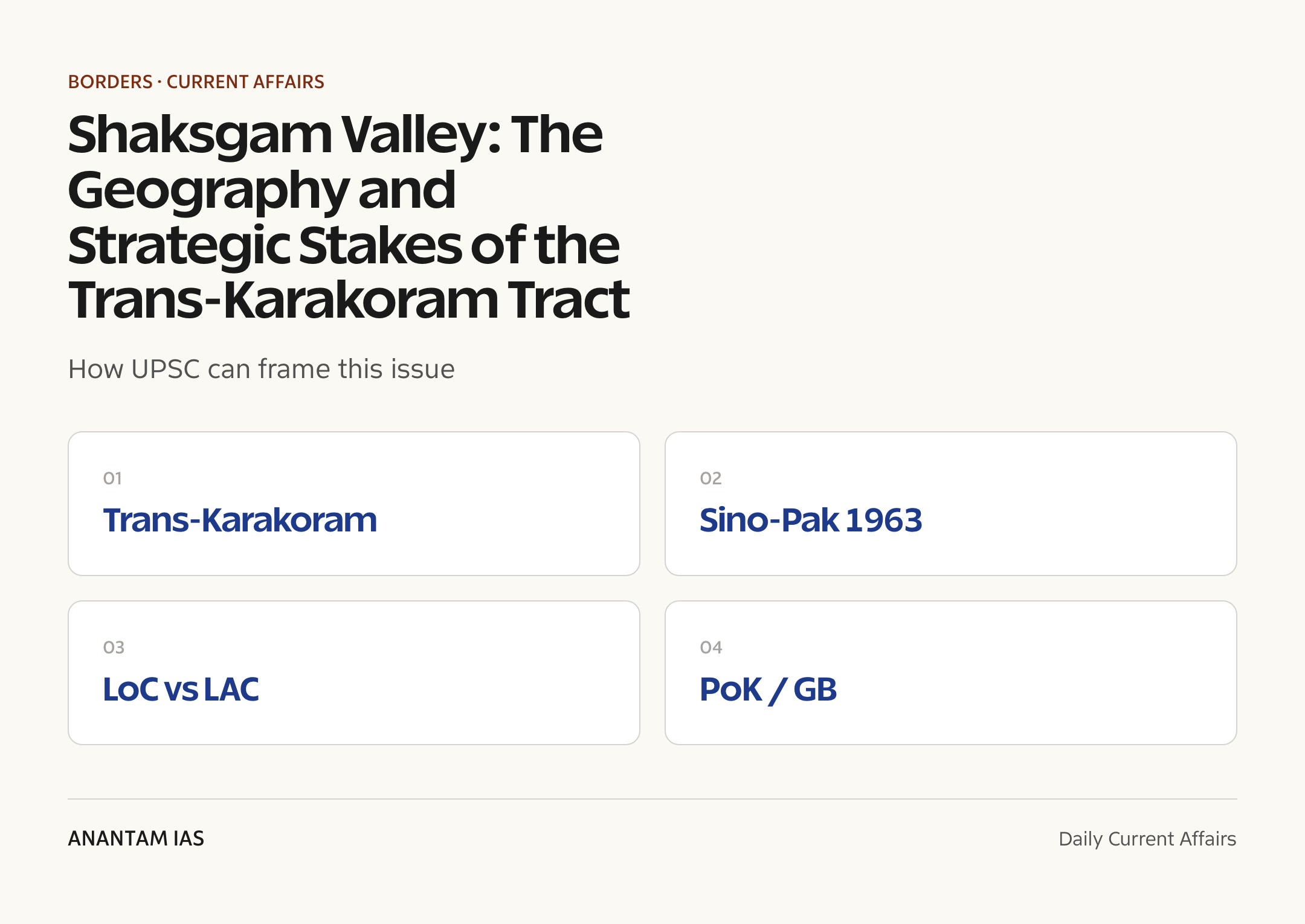
The 1963 cession and how it happened
The tract changed hands not by conquest but by an agreement India never recognised.
- The deal: under the 1963 Sino-Pakistan boundary agreement, Pakistan transferred administration of the Shaksgam tract to China.
- Provisional clause: the text itself called the settlement provisional, to be renegotiated once the Kashmir dispute was resolved between India and Pakistan.
- Why India objects: New Delhi holds that Pakistan, as an illegal occupier of part of Jammu and Kashmir, had no sovereign title to cede the area.
- Outcome: China gained a contiguous high-altitude frontier with PoK, tightening the China-Pakistan strategic embrace along India’s north-western flank.
Why the legal status matters
The dispute turns on the chain of title that runs back to 1947.
- Accession, 1947: the princely state of Jammu and Kashmir acceded to India through the Instrument of Accession, bringing its entire territory — including Gilgit-Baltistan and the Shaksgam area — under Indian claim.
- Indian position: the whole of the erstwhile state, including Pakistan-occupied Kashmir, is integral to India, so the 1963 transfer is void.
- Parliamentary resolution: India’s Parliament has resolved that PoK and areas ceded to China remain Indian territory awaiting recovery.
- Cartography: official Indian maps continue to depict the tract within the Union Territory of Ladakh.
The strategic neighbourhood: Siachen, Karakoram Pass, Aksai Chin
The tract is hemmed in by some of the most militarised and contested geography on Earth.
- Siachen: the tract lies just north of the Siachen Glacier and the Saltoro Ridge, where Indian and Pakistani troops face off at extreme altitude.
- Karakoram Pass: a historic gateway between Ladakh and Central Asia (Yarkand), it is one of the great high mountain passes of the region.
- Aksai Chin: to the east lies the China-administered plateau India claims, scene of the 1962 conflict and a continuing flashpoint.
- Convergence: control of the tract gives China interior lines linking Xinjiang, Aksai Chin and PoK, with the China-Pakistan Economic Corridor running nearby.
LoC versus LAC versus international boundary
The terminology is exam-critical and explains why the tract is so legally tangled.
- Line of Control (LoC): the military ceasefire line between India and Pakistan in Jammu and Kashmir, formalised after the 1972 Simla Agreement; it is not an international border.
- Line of Actual Control (LAC): the notional line separating Indian-controlled areas from Chinese-controlled areas, including near Aksai Chin; it is undemarcated and disputed.
- International boundary: a settled, mutually recognised border — which neither the India-Pakistan nor the India-China alignment fully is in this sector.
- Shaksgam’s status: India claims it; China administers it; Pakistan handed it over — so it sits at the intersection of all three categories.
What renewed Chinese activity signals
Construction in remote terrain is rarely just about logistics; it changes facts on the ground.
- Roads and access: reported road-building and infrastructure in and around the tract improve Chinese reach toward the Siachen-Karakoram zone.
- Dual-use risk: high-altitude roads, tracks and camps in such terrain typically carry dual civilian-military value.
- Pressure on Siachen: better Chinese mobility north of Siachen can stretch India’s already demanding logistics on the Saltoro Ridge.
- India’s response: New Delhi has repeatedly protested Chinese activity in PoK and the tract as a violation of its sovereignty and territorial integrity.
Way Forward
Hold the legal and diplomatic line
- Consistent protest: keep formally objecting to any third-party activity in PoK and the Trans-Karakoram Tract as illegal occupation of Indian territory.
- Cartographic clarity: continue depicting the tract within Ladakh on official maps and in international forums.
Strengthen situational awareness
- Surveillance: sustain satellite and aerial monitoring of construction near Siachen, the Karakoram Pass and the tract.
- Logistics: deepen all-weather connectivity and high-altitude readiness on the Indian side of the Saltoro-Siachen sector.
Manage the China-Pakistan axis
- Diplomacy: factor the tract into the wider India-China boundary dialogue and India’s engagement on border management.
- Coalition: highlight the legal infirmity of activity in disputed PoK in relevant bilateral and multilateral conversations.
Conclusion
A small tract, an outsized stake: the Shaksgam Valley is empty of people but full of strategic meaning, sitting where Indian claims, Pakistani control and Chinese administration meet in the high Karakoram.
The legal thread is unbroken: India’s case rests on the 1947 accession of Jammu and Kashmir, which makes the 1963 Sino-Pakistan agreement a transfer of territory Pakistan never lawfully held.
Geography is destiny here: with Siachen, the Karakoram Pass and Aksai Chin all in the neighbourhood, every road built in this terrain reshapes the strategic map of India’s northern frontier.
UPSC Practice Questions
Prelims MCQ 1
With reference to the Shaksgam Valley (Trans-Karakoram Tract), consider the following statements:
- It lies north of the main Karakoram watershed, adjoining Gilgit-Baltistan and Xinjiang.
- It was transferred by Pakistan to China under the 1963 Sino-Pakistan boundary agreement.
- India regards the 1963 transfer as legal and final.
How many of the above statements are correct?
(a) Only one (b) Only two (c) All three (d) None
Answer: (b) Only two
Explanation:
Statements 1 and 2 are correct: the tract lies north of the Karakoram divide and was ceded by Pakistan to China in 1963. Statement 3 is wrong — India treats the transfer as illegal and void, since Pakistan had no sovereign title to the area.
Prelims MCQ 2
Which one of the following correctly distinguishes the Line of Control (LoC) from the Line of Actual Control (LAC)?
(a) The LoC separates India and China, while the LAC separates India and Pakistan (b) The LoC is the India-Pakistan ceasefire line in J&K, while the LAC is the disputed India-China separation line (c) Both are fully demarcated international boundaries recognised by all parties (d) The LoC lies in Aksai Chin, while the LAC lies along the Karakoram Pass
Answer: (b) The LoC is the India-Pakistan ceasefire line in J&K, while the LAC is the disputed India-China separation line
Explanation:
The LoC is the India-Pakistan military ceasefire line in Jammu and Kashmir, formalised after the 1972 Simla Agreement. The LAC is the undemarcated, disputed line separating Indian and Chinese controlled areas, including near Aksai Chin. Neither is a settled international boundary.
UPSC Mains Questions
- Locate the Shaksgam Valley with respect to the Karakoram watershed, the Siachen sector and Aksai Chin, and explain why its physiography makes it strategically significant despite being largely uninhabited.
- India regards the 1963 Sino-Pakistan boundary agreement as illegal and void. Examine the legal basis of this position and its implications for the India-Pakistan-China boundary disputes.
- Distinguish between the Line of Control, the Line of Actual Control and an international boundary. How does the status of the Trans-Karakoram Tract illustrate the difficulty of border settlement in this region?
Sources: Ministry of External Affairs, Government of India and Survey of India, Department of Science and Technology.
Frequently Asked Questions
What is the Shaksgam Valley?
The Shaksgam Valley, or Trans-Karakoram Tract, is a high, glaciated expanse of about 5,180 sq km lying north of the main Karakoram divide, between Pakistan-occupied Gilgit-Baltistan and China’s Xinjiang. It is largely uninhabited terrain of ridges, snowfields and the Shaksgam river basin.
How did China come to control it?
Pakistan transferred administration of the tract to China under the 1963 Sino-Pakistan boundary agreement. The agreement itself described the arrangement as provisional, to be revisited once the Kashmir dispute was settled — but China has administered the area ever since.
Why does India call the cession illegal?
Because the tract lies in the erstwhile princely state of Jammu and Kashmir, which acceded to India in 1947. India holds that Pakistan, as an illegal occupier, had no sovereign title to cede the area, so the 1963 transfer is void and the tract remains Indian territory.
How is the valley linked to Siachen?
The tract sits just north of the Siachen Glacier and the Saltoro Ridge, where Indian and Pakistani forces are deployed at extreme altitude. Chinese roads and infrastructure near the tract can improve access toward this sector and add pressure on India’s high-altitude positions.
What is the difference between Shaksgam and Aksai Chin?
Both are areas India claims but does not control. Aksai Chin is a plateau east of the tract, administered by China and central to the 1962 conflict. The Shaksgam Valley lies to its west and was handed to China by Pakistan in 1963, rather than seized directly.
Why is the valley back in the news?
Open-source satellite imagery has flagged renewed Chinese road-building and construction in and around the tract, close to the Siachen-Karakoram zone. India has protested such activity in Pakistan-occupied Kashmir and the tract as a violation of its sovereignty and territorial integrity.
Source: https://anantamias.com/current-affairs/shaksgam-valley-strategic-geography-2026/
Jharkhand’s Megaliths: Astronomy, Memory and Tribal Heritage in Stone
Why in News?
Renewed scholarly and conservation attention has gathered around the megalithic standing stones of Jharkhand — notably Punkri Burwadih near Hazaribagh and the Pancha Pandav site — where rows of upright menhirs appear deliberately aligned to mark the equinox sunrise, suggesting a prehistoric form of archaeoastronomy practised by early tribal communities.
These sites matter because they fuse three durable syllabus threads in one landscape: India’s megalithic culture of the Iron Age and proto-history, the science of archaeoastronomy, and the living memorial traditions of Adivasi communities who still raise commemorative stones.
- At Punkri Burwadih, near Hazaribagh, a cluster of tall standing stones is reported to frame the rising Sun on the equinoxes (around 21 March and 23 September), when day and night are roughly equal.
- Such alignments imply that the builders observed and tracked the Sun’s annual movement — an early astronomical calendar etched into the landscape.
- Megaliths across the region also served as burial and memorial markers, raised over or beside the dead, linking the living to ancestors.
- Researchers associated with local heritage groups in the Hazaribagh belt have documented these alignments, while the Archaeological Survey of India studies and protects megalithic remains nationally.
- Living menhir-raising customs survive among tribal groups in Jharkhand and the North-East, making these not merely dead ruins but part of a continuing cultural practice.
The development matters in the context of:
- The sites sit at the meeting point of prehistoric archaeology, the history of science and astronomy in India, and tribal cultural heritage — a combination that turns up across GS Paper 1 themes.
- They challenge the idea that systematic sky-watching in India began only with classical texts, pushing the story back to non-literate, proto-historic communities.


UPSC Relevance
Prelims Relevance
- Megalith — a monument built of large stones; types include menhir, dolmen, cist, cairn, stone circle
- Menhir — a single tall upright standing stone; dolmen — a chamber of upright slabs with a capstone
- Cairn circle and stone alignment — clustered burial/commemorative forms
- Archaeoastronomy — the study of how past peoples observed and used the sky
- Equinox — around 21 March and 23 September, when day and night are nearly equal
- Iron Age / proto-history — the broad period of much South Indian and central-Indian megalith building
- Punkri Burwadih and Hazaribagh — Jharkhand megalith locations
- Archaeological Survey of India (ASI) — under the Ministry of Culture; protects monuments and remains
Mains Relevance
GS Paper 1
- Salient aspects of India’s megalithic culture and what burials and standing stones reveal about proto-historic society.
- Evidence for early astronomical knowledge in non-literate communities and what archaeoastronomy adds to the history of Indian science.
GS Paper 1
- Tribal (Adivasi) cultural heritage as a living tradition, and the conservation challenges of protecting open-air prehistoric sites.
Essay
- What the stones remember: heritage, ancestry and the long memory of the land.
- Science before writing — how early societies read the sky.
Background and Context
What a megalith is and the main types
Megalith simply means a monument made of large stones, and India has a rich vocabulary of forms.
- A menhir is a single tall upright stone, planted vertically in the ground — the form most visible at the Jharkhand sites.
- A dolmen is a chamber made of upright slabs roofed by a flat capstone; a cist is a stone-lined box-grave, often below ground.
- A cairn is a mound of stones, frequently ringed by a cairn circle or stone circle; an alignment is a deliberate row or pattern of stones.
- Most Indian megaliths are linked to burial and commemoration of the dead, though some are pure memorials with no body beneath them.
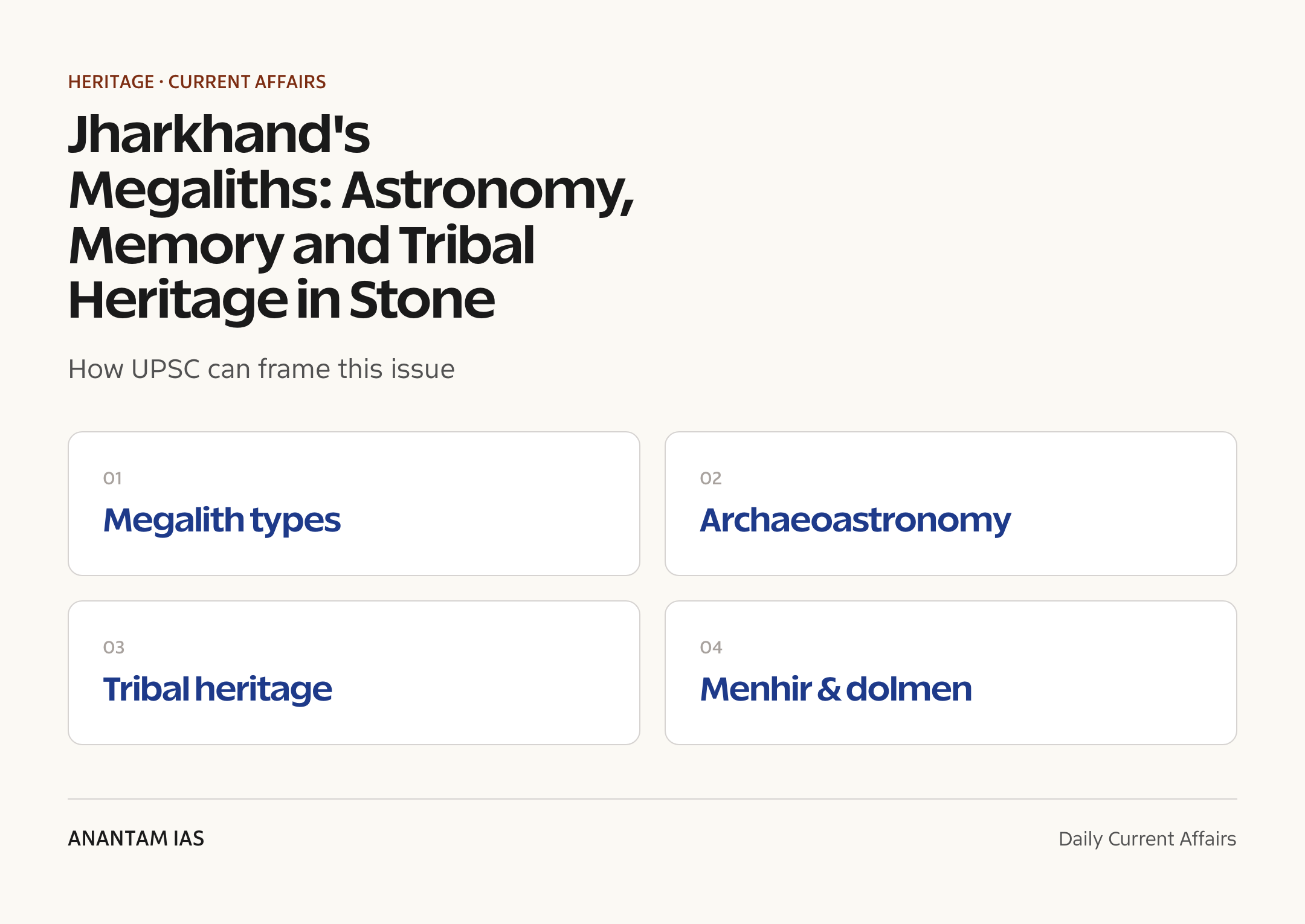
When and where India's megaliths belong
Megalith-building in India spans late prehistory into the early historic era, with strong concentrations in the peninsula and pockets across the centre and east.
- Much megalithic activity falls in the Iron Age and proto-history, broadly the first millennium BCE, though dates vary widely by region.
- The classic megalith zone is peninsular and South India — sites such as Brahmagiri in Karnataka and clusters across the Deccan.
- Eastern and central India, including the Chota Nagpur plateau of Jharkhand, has its own megalithic landscapes tied to tribal communities.
- Because many sites are open-air and undated by inscriptions, dating leans on associated pottery, iron tools and radiocarbon evidence rather than written records.
Punkri Burwadih and the equinox alignment
The standout feature of the Hazaribagh megaliths is that some stones appear placed to track the Sun.
- At Punkri Burwadih, a notch or gap between standing stones is reported to frame the rising Sun on the equinoxes, when it rises due east.
- Marking the equinox lets a community fix two stable points in the year — useful for an agricultural and ritual calendar.
- The Pancha Pandav standing stones, locally tied to Mahabharata legend, belong to the same menhir tradition of the Hazaribagh belt.
- Such solar alignments are read as evidence of deliberate sky-observation, not chance — a recurring theme wherever standing stones cluster, from Carnac to the Deccan.
Archaeoastronomy — reading the sky in stone
Archaeoastronomy is the discipline that asks how past peoples watched and used the heavens, and the Jharkhand stones are a textbook Indian case.
- Archaeoastronomy studies orientations of monuments toward the Sun, Moon and stars at significant moments such as solstices and equinoxes.
- Sunrise and sunset alignments are the most testable, because the Sun’s rising point shifts predictably along the horizon through the year.
- Evidence here suggests proto-historic communities had practical astronomical knowledge long before classical Sanskrit astronomy was written down.
- It reframes the history of Indian science to include non-literate, community-built observatories alongside later texts and instruments.
Megaliths as memory and ancestor-worship
Beyond astronomy, these stones are first of all about the dead and about remembering them.
- Standing stones often mark a grave or honour an ancestor, anchoring lineage and land to a visible monument.
- The act of raising a heavy stone is a collective social event, signalling status, kinship and continuity for the community.
- This memorial logic connects megaliths to wider ancestor-veneration still central to many Adivasi belief systems.
- It is comparable in spirit to the commemorative and funerary practices visible in other early Indian cultures studied through archaeological findings.
A living tradition — Jharkhand and the North-East
Unlike most prehistoric monuments, menhir-raising in India is not wholly extinct.
- Several tribal communities in Jharkhand and the North-East still erect memorial stones for the dead, keeping the practice alive.
- Among groups such as the Khasi of Meghalaya, megalithic monoliths are raised within living memory, blurring the line between archaeology and ethnography.
- These customs sit alongside the region’s wider tribal art and ritual culture, including Jharkhand’s Sohrai painting.
- The continuity makes the stones a bridge between a prehistoric past and present-day Adivasi identity, not a closed chapter.
Conservation, study and the threats
Open-air megalithic sites are fragile and easily lost, which makes documentation urgent.
- The Archaeological Survey of India, under the Ministry of Culture, studies and protects megalithic remains, but many minor sites lie outside formal protection.
- Threats include quarrying, mining, encroachment and farming, especially across the mineral-rich Chota Nagpur belt.
- Standing stones can be displaced or removed, destroying the precise alignments that carry their astronomical meaning.
- Careful surveying, community involvement and tying sites to heritage tourism are the practical levers for keeping them intact.
Way Forward
Document before it is lost
- Survey and map Jharkhand’s standing stones with precise orientations, so alignments are recorded even if a site is later disturbed.
- Use modern dating and archaeoastronomical survey to test which alignments are intentional rather than coincidental.
Protect with the community
- Bring minor open-air megaliths under stronger ASI or state protection, and shield clusters from quarrying and encroachment.
- Involve local Adivasi communities, for whom the stones remain meaningful, as custodians rather than bystanders.
Position the megalith landscapes within heritage-tourism and education circuits — pairing the stones with regional tribal art and history so that conservation funds the community and the science of archaeoastronomy reaches a wider public.
Conclusion
Jharkhand’s standing stones do three things at once — they bury and remember the dead, they track the Sun across the year, and they carry a tribal tradition still practised today. Read together, Punkri Burwadih and its kin push India’s story of sky-watching back into proto-history and root it in the lives of Adivasi communities.
For the UPSC aspirant the durable takeaways outlast any single discovery — the vocabulary of megalithic culture, the method of archaeoastronomy, and the idea that heritage can be both ancient and living. The stones are a reminder that science, memory and identity were once raised in the same monument.
UPSC Practice Questions
Prelims MCQ 1
With reference to megalithic monuments in India, consider the following statements:
- A menhir is a single tall upright standing stone.
- Megaliths in India are associated only with the medieval period.
- Some megalithic standing stones are oriented to mark the equinox sunrise.
How many of the above statements are correct?
(a) Only one (b) Only two (c) All three (d) None
Answer: (b) Only two
Explanation:
Statements 1 and 3 are correct — a menhir is a single upright stone, and sites such as Punkri Burwadih show equinox-sunrise alignment. Statement 2 is wrong: Indian megaliths belong chiefly to the Iron Age and proto-history, not the medieval period.
Prelims MCQ 2
Archaeoastronomy is best described as the study of which of the following?
(a) The chemical dating of ancient pottery and metals (b) How past peoples observed and used the Sun, Moon and stars (c) The classification of fossils in sedimentary rock layers (d) The decipherment of ancient scripts and inscriptions
Answer: (b) How past peoples observed and used the Sun, Moon and stars
Explanation:
Archaeoastronomy examines how earlier societies tracked celestial bodies — for example, aligning standing stones to the equinox or solstice sunrise. Dating of materials, palaeontology and epigraphy are separate fields.
UPSC Mains Questions
- India’s megalithic monuments are usually read as burials, but sites such as those in Jharkhand suggest more. Examine what standing-stone alignments reveal about astronomical knowledge in proto-historic communities.
- Distinguish the main types of Indian megaliths and discuss why open-air prehistoric sites pose distinctive conservation challenges, with reference to the Chota Nagpur region.
- Megalith-raising survives as a living tradition among some tribal communities. Discuss how this continuity reshapes the way we study Adivasi cultural heritage and the history of Indian science.
Sources: Archaeological Survey of India, Ministry of Culture and The Hindu.
Frequently Asked Questions
What are the Jharkhand megaliths?
They are prehistoric monuments built of large stones in Jharkhand, especially tall upright menhirs at sites like Punkri Burwadih near Hazaribagh and the Pancha Pandav stones. They served as burial and memorial markers, and some appear deliberately aligned to track the Sun across the year.
Why are the Punkri Burwadih stones special?
At Punkri Burwadih a gap between standing stones is reported to frame the rising Sun on the equinoxes, around 21 March and 23 September. This suggests the builders observed the Sun’s annual movement, making the site an early example of archaeoastronomy in India.
What is the difference between a menhir and a dolmen?
A menhir is a single tall stone set upright in the ground, like the standing stones in Jharkhand. A dolmen is a chamber made of upright slabs roofed by a flat capstone, usually linked to burial. Both are types of megalith, meaning a monument of large stones.
What is archaeoastronomy?
Archaeoastronomy studies how past peoples observed and used the sky. It looks at how monuments are oriented toward the Sun, Moon or stars at key moments such as equinoxes and solstices. The Jharkhand equinox alignments are a classic Indian case of this approach.
Are megaliths still being built in India?
Yes, in places. Several tribal communities in Jharkhand and the North-East, such as the Khasi of Meghalaya, still raise memorial standing stones for the dead. This makes megalith-building a living tradition rather than a purely prehistoric one.
Who protects megalithic sites in India?
The Archaeological Survey of India, under the Ministry of Culture, studies and protects megalithic remains, with state archaeology departments also involved. Many minor open-air sites lie outside formal protection and face threats from quarrying, mining and encroachment.
Source: https://anantamias.com/current-affairs/jharkhand-megaliths-archaeoastronomy-2026/
78th Army Day 2026 in Jaipur: Theatre Commands, Modernisation and Civil-Military Memory
India observed the 78th Army Day in Jaipur on 15 January 2026. Holding the event outside Delhi continued the recent practice of taking major military commemorations to different regions.
For UPSC, Army Day is a useful hook to revise civil-military memory, military modernisation, jointness, theatre commands, border security and India’s evolving defence posture.
This article explains the 2026 Army Day event through a GS-III security lens rather than as a ceremonial fact.
Quick Facts
- Army Day is observed on 15 January every year.
- The 2026 event marked the 78th Army Day.
- The main event was held in Jaipur, Rajasthan.
- Army Day commemorates Field Marshal K. M. Cariappa taking over as Commander-in-Chief in 1949.
- The day is linked to military honour, remembrance and operational readiness.
- Official source: PIB Ministry of Defence release dated 15 January 2026.
- Official source: PIB, Ministry of Defence.
What Just Happened
The Indian Army marked Army Day 2026 with ceremonial and public events in Jaipur.
The location is significant because it decentralises national military commemoration and improves public connection with the armed forces outside the capital.
For aspirants, the event should be used to revise modernisation challenges, jointness and the changing nature of warfare.
Background and Historical Context
Army Day marks the Indianisation of command after independence, when K. M. Cariappa became Commander-in-Chief of the Indian Army on 15 January 1949.
The Army’s role has expanded from conventional defence to counter-insurgency, disaster relief, border management, UN peacekeeping and technology-driven warfare.
Current defence debates include theatre commands, Atmanirbhar Bharat in defence, drones, cyber, space, logistics and manpower reforms.
Key Features of Defence
The core policy architecture can be read through these features.
- Commemoration: honours the Army’s service and sacrifice.
- Decentralised venue: Jaipur brings the event closer to citizens outside Delhi.
- Modernisation signal: platforms, drills and messages highlight capability upgrades.
- Jointness debate: Army reform is linked to integrated theatre commands.
- Public outreach: military ceremonies build civil-military familiarity.
- Security context: borders, technology and hybrid warfare shape the agenda.
Why It Matters
This is a high-yield UPSC topic because it joins current news with durable syllabus themes.
- It connects a January 2026 event with durable UPSC syllabus themes.
- It gives usable facts for Prelims and analytical hooks for Mains.
- It helps students move from news recall to policy reasoning.
- It can be linked with static concepts in polity, economy, governance, science, environment or society.
Detailed Analysis: Defence Lens
Army Day is public memory plus policy signal. The parade honours history, but the speeches and displays communicate readiness and reform priorities.
Jointness is the big structural reform. Future conflict will require land, air, maritime, cyber and space coordination rather than service-wise silos.
Technology is changing infantry-heavy assumptions. Drones, precision fires, sensors and electronic warfare now affect battlefield survivability and logistics.
Comparative Perspective
A comparison helps prevent the answer from becoming a one-dimensional news summary.
- Army Day: commemorates Indian Army leadership and service.
- Navy Day: linked to Operation Trident and maritime power.
- Air Force Day: celebrates air power and IAF capability.
- Republic Day parade: presents combined national military and cultural symbolism.
Challenges
The policy or institutional promise runs into recurring constraints.
- Theatre-command reform requires inter-service consensus.
- Defence indigenisation must balance speed, quality and technology absorption.
- Two-front security concerns require logistics resilience.
- Drones and electronic warfare demand rapid adaptation.
- Manpower reforms must preserve morale and operational effectiveness.
Prelims Pointers
- Army Day is observed on 15 January.
- K. M. Cariappa became Commander-in-Chief of the Indian Army on 15 January 1949.
- Field Marshal is a five-star honorary rank in India.
- Theatre commands aim to integrate service capabilities under operational commands.
- CDS stands for Chief of Defence Staff.
- UN peacekeeping is an important Indian Army contribution.
Mains Questions
- Army Day is both a commemoration and a policy signal. Discuss in the context of India’s military modernisation. (GS Paper III, 250 words)
- Why is jointness central to India’s defence reform agenda? (GS Paper III, 150 words)
- Examine how technology is changing land warfare. (GS Paper III, 250 words)
- Civil-military public outreach strengthens national security culture. Analyse. (GS Paper III, 150 words)
Way Forward
India should accelerate joint planning, logistics integration, drone defence, battlefield communications and defence-industrial depth.
Commemorative events should also educate citizens about military history, constitutional control of armed forces and veterans’ welfare.
For UPSC, connect Army Day with reform. That is where the marks are.
The examiner is unlikely to reward a bare fact dump here. The better answer connects the January 2026 event to institutional design, implementation capacity and India’s long-term development priorities.
Frequently Asked Questions
When is Army Day observed?
Army Day is observed on 15 January every year.
Why is 15 January important?
K. M. Cariappa took over as Commander-in-Chief of the Indian Army on 15 January 1949.
Where was Army Day 2026 held?
The main event was held in Jaipur.
Why is Army Day relevant for UPSC?
It links defence history with modernisation, jointness and security policy.
What are theatre commands?
They are integrated operational commands designed to improve joint military planning and execution.
What should students focus on?
Modernisation, jointness, indigenisation, border security and civil-military memory.
Source: https://anantamias.com/current-affairs/army-day-2026-jaipur/
Niryat Protsahan and Postal Exports: MSME Export Support Explained
January 2026 produced a cluster of export-support measures aimed squarely at small businesses. The most visible was the Department of Posts decision to cut tariffs for overseas document and merchandise shipments from Foreign Post Offices, framed around MSMEs, artisans, start-ups, women entrepreneurs and small exporters.
The larger story is not cheaper parcels. It is India’s attempt to make exporting less intimidating for firms that do not have dedicated compliance teams, shipping agents or foreign-market networks. For UPSC, this is a practical case study in trade facilitation, MSME productivity and inclusive growth.
This article places the postal export move inside the wider Niryat Protsahan and Export Promotion Mission ecosystem and explains why the smallest exporter now matters to India’s trade strategy.
Quick Facts
- Reduced postal tariffs took effect from 15 January 2026 across Foreign Post Offices.
- More than 1,000 Dak Niryat Kendras support postal export documentation and dispatch.
- The Commerce Ministry’s export-support proposals included interest subvention, credit guarantees and trade-promotion support.
- Niryat Protsahan for MSMEs was framed to cover a wide share of tariff lines and labour-intensive export sectors.
- The Export Promotion Mission has a six-year official outlay of Rs 25,060 crore for 2025-26 to 2030-31.
- Priority beneficiaries include MSMEs, first-time exporters, artisans, ODOP producers and women-led businesses.
- Official sources: PIB, Ministry of Communications and PIB, Ministry of Commerce and Industry.
What Just Happened
The Department of Posts announced reduced tariffs for overseas documents and merchandise from Foreign Post Offices, effective 15 January 2026. The government positioned the move as an export-enablement measure for small sellers who use the postal network instead of private logistics channels.
This followed wider export-support discussions around Niryat Protsahan and the Export Promotion Mission. Together, the measures point to a policy shift from large-exporter support toward a more distributed export base.
For India, the timing is important. Global trade is entering a more protectionist phase. A country that wants to expand exports cannot rely only on large manufacturing champions. It also needs thousands of small firms to sell textiles, handicrafts, processed foods, engineering goods, toys, gems, wellness products and digital services abroad.
Background and Historical Context
MSMEs contribute significantly to India’s manufacturing, employment and exports, but small firms face high entry barriers in global markets. Logistics cost, documentation, quality certification, payment risk and lack of market intelligence often matter more than tariff rates.
The postal export route tries to solve a specific problem: small consignments. An artisan in Bhadohi or a small seller in Jaipur may not ship container loads. They may send low-volume, high-variety parcels. A dense post-office network can serve that exporter better than a metro-centric logistics model.
India’s trade policy has increasingly moved from only negotiating market access to improving domestic export readiness. RoDTEP, Districts as Export Hubs, ODOP, PM Gati Shakti and digital customs are part of the same shift.
Key Features of the Export-Support Push
The core policy architecture can be read through these features.
- Postal tariff reduction: lower international postal charges reduce the fixed cost of small exports.
- Dak Niryat Kendras: post offices help exporters with documentation and booking.
- Credit support: proposals around interest subvention and credit guarantees aim to ease working-capital stress.
- Trade promotion: market access, branding and buyer discovery are treated as public-support functions.
- MSME focus: the architecture targets first-time and small exporters rather than only established export houses.
- District linkage: ODOP and Districts as Export Hubs can feed small consignments into postal export channels.
Why It Matters
This is a high-yield UPSC topic because it joins current news with durable syllabus themes.
- It gives GS-III material on export promotion, MSMEs, logistics and inclusive growth.
- It links trade policy with financial inclusion and last-mile infrastructure.
- It provides a practical example of how administrative cost reduction can affect competitiveness.
- It helps explain why employment-intensive exports matter for India’s growth model.
Detailed Analysis: Trade Policy Lens
India’s export problem is not only global demand. Small firms often lose before they reach the market because compliance, shipping and payment risks are too high. Postal exports lower one piece of that entry cost.
Credit and logistics must move together. Cheaper shipping does little if the exporter cannot finance inventory, obtain certification or absorb delayed payment. That is why Niryat Protsahan-style credit support matters.
The model is also a federal story. District export plans, local product mapping and state export-promotion agencies will determine whether national schemes become real business opportunities.
Comparative Perspective
A comparison helps prevent the answer from becoming a one-dimensional news summary.
- China: export dominance was built on scale, logistics corridors, supplier networks and state-backed industrial ecosystems.
- Vietnam: targeted manufacturing integration into global value chains raised export intensity quickly.
- India: the small-exporter route can complement large-scale manufacturing by turning craft, food and niche manufacturing clusters into export-ready ecosystems.
- European Union: small businesses often benefit from structured trade-information portals and credit insurance support.
Challenges
The policy or institutional promise runs into recurring constraints.
- MSMEs still face quality-certification and packaging gaps.
- Payment default and currency risk can hurt first-time exporters.
- Awareness of Dak Niryat Kendras remains uneven outside export-active districts.
- Logistics improvement must extend beyond booking to tracking, returns and customs coordination.
- Export incentives must comply with WTO disciplines and avoid becoming distortionary subsidies.
Prelims Pointers
- MSME stands for Micro, Small and Medium Enterprises.
- ODOP means One District One Product.
- Dak Niryat Kendras support small exporters through the postal network.
- RoDTEP is Remission of Duties and Taxes on Exported Products.
- Export credit, logistics and market access are different policy instruments.
- Foreign Post Offices handle international postal articles.
Mains Questions
- MSME export promotion requires trade facilitation as much as financial incentives. Discuss with reference to postal exports. (GS Paper III, 250 words)
- How can Districts as Export Hubs and ODOP improve India’s export diversification? (GS Paper III, 150 words)
- Evaluate the role of logistics cost in determining India’s manufacturing competitiveness. (GS Paper III, 250 words)
- Can small exporters help India create employment-intensive growth? Analyse the constraints and reforms needed. (GS Paper III, 250 words)
Way Forward
Postal export support should be paired with district-level handholding: packaging, GST export refund support, customs basics, e-commerce onboarding and buyer discovery.
Credit guarantee and interest support must be simple enough for a first-time exporter to use without a consultant. Otherwise the benefit will remain concentrated among better-organised firms.
India should measure this policy by active exporters created, repeat shipments, export survival rates and job creation in clusters, not only by total export value.
The examiner is unlikely to reward a bare fact dump here. The better answer connects the January 2026 event to institutional design, implementation capacity and India’s long-term development priorities.
Frequently Asked Questions
What changed in January 2026 for postal exports?
The Department of Posts reduced tariffs for overseas document and merchandise shipments from Foreign Post Offices, effective 15 January 2026.
What are Dak Niryat Kendras?
They are postal export facilitation points that help small exporters book international consignments and handle basic documentation.
Why are MSME exports important for UPSC?
They connect trade policy with employment, regional development, logistics, credit access and inclusive growth.
What is Niryat Protsahan?
It refers to export-promotion support aimed at improving competitiveness, especially for smaller exporters and labour-intensive sectors.
What is the Export Promotion Mission?
It is a multi-year government mission with official funding support for export credit, market access and trade-promotion measures.
What is the main risk in export incentives?
Poorly designed incentives can become complex, poorly targeted or inconsistent with WTO rules. The better approach is to lower structural costs.
Source: https://anantamias.com/current-affairs/niryat-protsahan-msme-export-support-2026/
India’s Minerals Diplomacy: Securing Critical Minerals for the Energy Transition
Why in News?
India has stepped up its minerals diplomacy — using overseas asset deals, the National Critical Mineral Mission (NCMM) and supply-chain partnerships to lock in the lithium, cobalt, nickel and rare earths its clean-energy build-out depends on. The push is led by the Ministry of Mines, the state vehicle KABIL and the Geological Survey of India (GSI).
The strategy responds to a single hard fact: a handful of countries hold the ore and China dominates the processing and refining of these minerals, giving it choke-point power over the inputs for electric vehicles (EVs), batteries, wind turbines and solar gear that India must import or build domestically.
- KABIL (Khanij Bidesh India Ltd) — a joint venture of NALCO, HCL and MECL — pursues overseas mineral assets, including a lithium-exploration deal in Argentina’s Catamarca province.
- The National Critical Mineral Mission (NCMM) covers the full chain — exploration, mining, processing, recycling and overseas acquisition.
- The MMDR Act amendments empower the Centre to auction blocks of critical and strategic minerals directly and freed several from the atomic-minerals list.
- India is a member of the US-led Minerals Security Partnership (MSP) and has supply pacts with resource-rich states such as Australia.
- GSI exploration flagged a large inferred lithium resource in Reasi, Jammu and Kashmir, the first sizeable domestic find.
The development matters in the context of:
- Critical minerals are the new strategic commodities — like oil in the 20th century — and access decides who can build the clean-energy economy.
- India’s net-zero by 2070 and EV ambitions are unworkable without secure, diversified mineral supply chains.
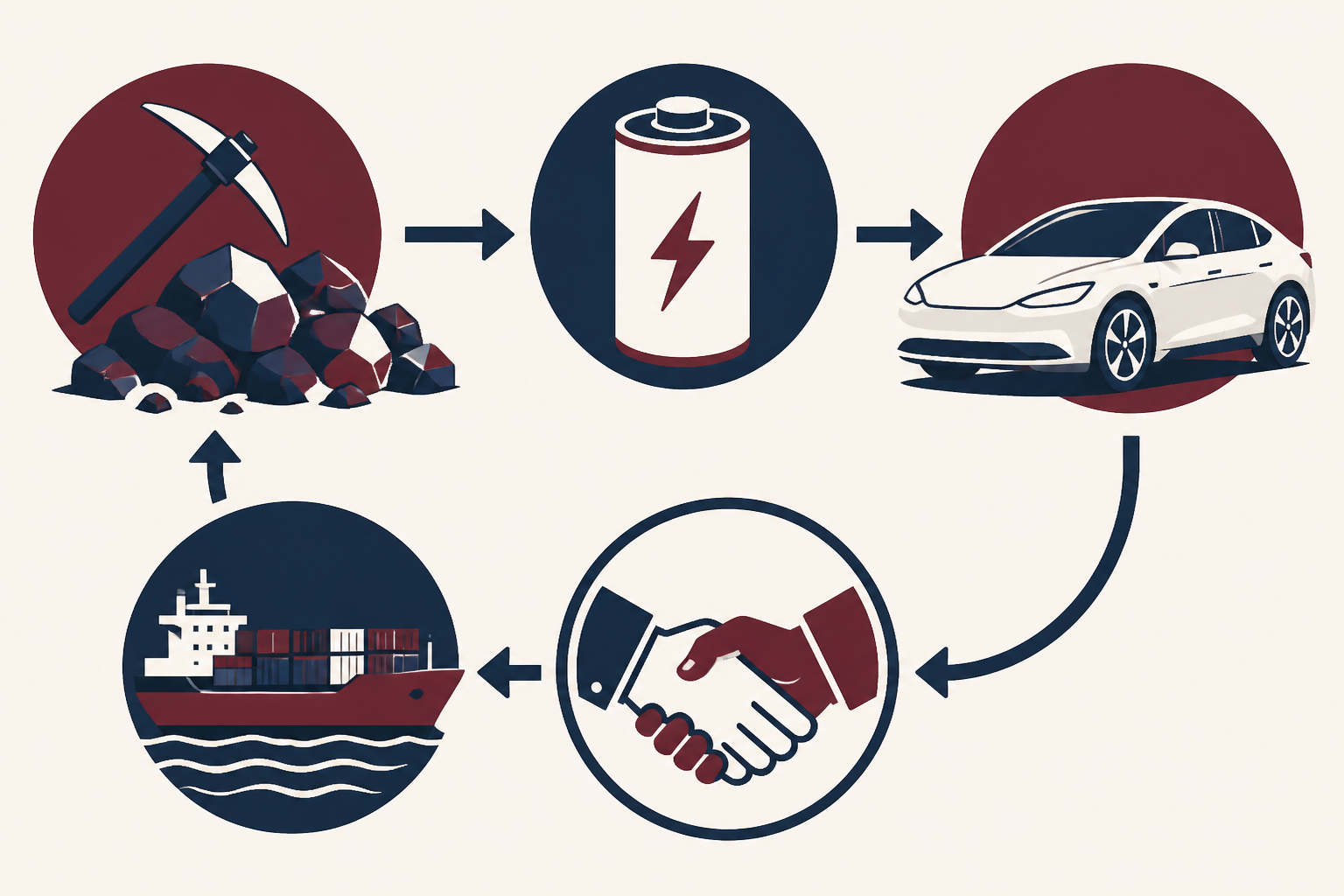
UPSC Relevance
Prelims Relevance
- KABIL — a three-PSU joint venture (NALCO, HCL, MECL) for overseas critical-mineral assets
- National Critical Mineral Mission (NCMM) — covers exploration to recycling, including overseas acquisition
- MMDR Act (Mines and Minerals Development and Regulation) — basis for auctioning critical-mineral blocks
- List of critical minerals notified by the Ministry of Mines (lithium, cobalt, nickel, rare earths, graphite and more)
- Geological Survey of India (GSI) — the chief exploration agency; flagged the Reasi (J&K) lithium resource
- Minerals Security Partnership (MSP) — a US-led plurilateral grouping for resilient mineral supply chains
- Rare earth elements are not geologically rare; the bottleneck is mining and especially refining
- Difference between a mineral reserve and an inferred resource
Mains Relevance
GS Paper 3
- Critical-mineral security as the backbone of the energy transition, EV manufacturing and battery supply chains.
- How NCMM, KABIL and MMDR auctions fit together as a resource-security policy stack.
- Why downstream processing and recycling, not just mining, decide India’s leverage.
GS Paper 2
- Minerals diplomacy and strategic autonomy — diversifying away from over-dependence on a single supplier country.
- Plurilateral groupings like the Minerals Security Partnership and bilateral resource pacts as instruments of foreign policy.
Essay
- Resource security in an age of energy transition — who controls the minerals controls the future.
- Strategic autonomy means diversification, not isolation.
Background and Context
Why these minerals are 'critical'
A mineral is critical when an economy depends on it and its supply is concentrated, exposed to disruption or hard to substitute.
- Lithium, cobalt, nickel and graphite are the core inputs for lithium-ion batteries that power EVs and grid storage.
- Rare earth elements (REEs) — such as neodymium and dysprosium — make the permanent magnets in EV motors and wind turbines.
- Criticality combines high economic importance with high supply risk, not geological scarcity.
- The Ministry of Mines has notified a list of critical minerals to guide policy, exploration and incentives.
- Demand is set to surge with the global shift to clean energy, electrified transport and digital hardware.
The China choke-point
The supply risk that frames the whole strategy is the concentration of refining in one country.
- China controls the dominant share of global rare-earth refining and a large share of battery-mineral processing.
- Mining is spread across countries, but midstream refining is heavily concentrated, creating a single point of leverage.
- Export controls or curbs on rare earths and processing technology can disrupt downstream manufacturing worldwide.
- For India, this turns a commercial issue into one of strategic autonomy and supply-chain security.
- Reducing this dependence requires both alternative sources of ore and India’s own processing capacity.
KABIL and overseas acquisition
The outward arm of the strategy is a dedicated state vehicle that hunts for assets abroad.
- KABIL (Khanij Bidesh India Ltd) is a joint venture of NALCO, HCL and MECL set up to acquire and develop overseas mineral assets.
- Its flagship effort is a lithium-exploration agreement in Catamarca, Argentina, part of South America’s ‘lithium triangle’.
- The aim is long-term offtake and equity stakes in lithium, cobalt and other battery minerals, not one-off purchases.
- It mirrors the model India uses for overseas oil and gas assets, adapted to the minerals age.
- Diversifying sources — Argentina, Australia, Africa — cuts exposure to any single supplier.
The domestic policy stack — NCMM and MMDR
At home the strategy rests on a new mission and amended mining law.
- The National Critical Mineral Mission (NCMM) spans the full value chain — exploration, mining, beneficiation, processing, recycling and overseas acquisition.
- MMDR Act amendments let the Centre auction blocks of critical and strategic minerals and removed several from the restrictive atomic-minerals list, opening them to private players.
- Exploration by the Geological Survey of India (GSI) flagged a large inferred lithium resource at Reasi, Jammu and Kashmir.
- Incentives target recycling and urban mining of e-waste to recover battery metals.
- The package complements EV manufacturing and battery cell production incentives downstream.
Partnerships and minerals diplomacy
Because India lacks large reserves of most battery minerals, diplomacy does much of the heavy lifting.
- India joined the US-led Minerals Security Partnership (MSP), a plurilateral push for resilient, diversified supply chains.
- It signed a critical-minerals investment partnership with Australia, a major lithium and rare-earth producer.
- Engagement extends to resource-rich states in Africa and Latin America for offtake and joint ventures.
- These ties knit resource security into foreign policy and the broader logic of geoeconomic statecraft.
- The goal is a friend-shored network that lowers dependence on any one source country.
Stakes, gaps and the critique
Securing ore abroad is only half the battle; the harder gap is downstream and at home.
- India’s biggest weakness is the missing midstream — refining and processing capacity, not just mines.
- Overseas deals take years to convert into delivered metal, and equity stakes carry geopolitical and price risk.
- Domestic mining of critical minerals raises environmental and tribal-land concerns that need careful clearance.
- Recycling remains nascent, though it could become a major secondary source as the first EV fleets retire.
- Without parallel investment in skills, technology and processing, India risks repeating the assembly-not-value trap seen in electronics.
Way Forward
Build the missing midstream
- Invest in domestic refining and processing so secured ore translates into usable battery-grade metal.
- Incentivise recycling and urban mining to create a circular secondary supply of battery metals.
Diversify and deepen partnerships
- Convert KABIL exploration into long-term offtake and equity across Argentina, Australia and Africa.
- Use the Minerals Security Partnership and bilateral pacts to friend-shore supply away from a single source.
Get the domestic enabling base right
- Run transparent MMDR auctions with environmental and community safeguards built in.
- Pair the NCMM with skilling, technology transfer and stable demand from EV and battery makers.
Conclusion
Critical minerals are doing to the 21st century what oil did to the 20th — turning a question of geology into one of geopolitics. India’s response weaves overseas acquisition through KABIL, a full-chain National Critical Mineral Mission, amended mining law and a web of partnerships into a single resource-security strategy.
The real test is leverage, not access. Securing ore abroad matters little if the refining, recycling and processing stay offshore. If India builds the missing midstream while diversifying its sources, minerals diplomacy can underwrite both the energy transition and genuine strategic autonomy; if it does not, it will simply trade one import dependence for another.
UPSC Practice Questions
Prelims MCQ 1
With reference to India’s critical-minerals strategy, consider the following statements:
- KABIL is a joint venture of NALCO, Hindustan Copper and Mineral Exploration Corporation set up to acquire overseas mineral assets.
- The National Critical Mineral Mission covers exploration, processing, recycling and overseas acquisition.
- Rare earth elements are classed as critical mainly because they are among the rarest elements in the Earth’s crust.
How many of the above statements are correct?
(a) Only one (b) Only two (c) All three (d) None
Answer: (b) Only two
Explanation:
Statements 1 and 2 are correct. Statement 3 is wrong: rare earths are reasonably abundant in the crust — they are critical because mining and especially refining are concentrated and difficult, not because the elements are scarce.
Prelims MCQ 2
Which one of the following best explains why China is described as a choke-point in global critical-mineral supply chains?
(a) It holds nearly all of the world’s lithium reserves (b) It dominates the refining and processing of these minerals (c) It is the only country mining cobalt (d) It controls all global rare-earth ore deposits
Answer: (b) It dominates the refining and processing of these minerals
Explanation:
Ore mining is spread across many countries, but China’s dominance lies in the midstream — refining and processing rare earths and battery minerals — which gives it leverage over downstream manufacturing.
UPSC Mains Questions
- Critical minerals are to the energy transition what oil was to the industrial age. Examine India’s strategy to secure lithium, cobalt, nickel and rare earths, and discuss why downstream processing matters as much as access to ore.
- Evaluate the role of minerals diplomacy in India’s pursuit of strategic autonomy. How do instruments like KABIL, the Minerals Security Partnership and bilateral resource pacts reduce supply-chain dependence on a single country?
- Discuss how the National Critical Mineral Mission and the amended MMDR Act seek to build a domestic critical-mineral ecosystem. What environmental and institutional challenges must be addressed?
Sources: PIB, Ministry of Mines and Press Information Bureau.
Frequently Asked Questions
What are critical minerals?
Critical minerals are those an economy depends on but whose supply is risky — concentrated in a few countries, exposed to disruption or hard to substitute. For India they include lithium, cobalt, nickel, graphite and rare earths, which are essential for batteries, electric vehicles, wind turbines and solar equipment. The label reflects economic importance and supply risk, not geological scarcity.
What is KABIL and what does it do?
KABIL (Khanij Bidesh India Ltd) is a state joint venture of NALCO, Hindustan Copper and Mineral Exploration Corporation, created to acquire and develop critical-mineral assets abroad. Its flagship effort is a lithium-exploration agreement in Catamarca, Argentina. KABIL aims to secure long-term supply and equity stakes in battery minerals, mirroring how India pursues overseas oil and gas assets.
Why does China dominate critical-mineral supply chains?
Mining of these minerals is spread across many countries, but China dominates the midstream — the refining and processing of rare earths and battery metals. This concentration gives it choke-point leverage: export curbs or technology restrictions can disrupt manufacturing worldwide. Reducing this dependence is the central aim of India’s minerals diplomacy and domestic processing push.
What is the National Critical Mineral Mission?
The National Critical Mineral Mission (NCMM) is India’s full-value-chain strategy for critical minerals, covering exploration, mining, beneficiation, processing, recycling and overseas acquisition. It works alongside amended MMDR Act provisions that let the Centre auction critical-mineral blocks. The mission aims to secure supply for the energy transition while building domestic capability rather than relying only on imports.
Has India found its own lithium?
Exploration by the Geological Survey of India flagged a large inferred lithium resource at Reasi in Jammu and Kashmir — the first sizeable domestic find. However, an inferred resource is an early estimate, not a proven reserve; extraction faces technical, environmental and processing challenges. Domestic finds reduce import dependence over time but do not replace overseas sourcing in the near term.
How does minerals diplomacy support strategic autonomy?
Because India lacks large reserves of most battery minerals, it diversifies sources through diplomacy — joining the US-led Minerals Security Partnership, signing a critical-minerals pact with Australia and engaging Africa and Latin America. Spreading supply across friendly partners lowers dependence on any single country, turning resource security into an instrument of strategic autonomy and foreign policy.
Source: https://anantamias.com/current-affairs/india-critical-minerals-diplomacy-2026/
Dugongs in Indian Waters: Saving the Sea Cow and Its Seagrass Home
Why in News?
Conservation focus has returned to the dugong (Dugong dugon), India’s only surviving herbivorous marine mammal, after the country anchored its protection around the first dedicated Dugong Conservation Reserve notified in Palk Bay, off the coast of Tamil Nadu.
The gentle, slow-moving ‘sea cow’ now survives in only three Indian pockets — the Gulf of Mannar, the Gulf of Kutch and the waters of the Andaman and Nicobar Islands — making it a textbook case of a flagship marine species clinging to fragmented seagrass meadows.
- India notified its first Dugong Conservation Reserve in Palk Bay, Tamil Nadu, covering roughly 448 sq km of dugong and seagrass habitat.
- The dugong is listed as Vulnerable on the IUCN Red List and is protected under Schedule I of the Wild Life (Protection) Act, 1972.
- India’s dugong population is estimated at only around 200-250 animals, concentrated in the Gulf of Mannar and Palk Bay.
- Principal threats are seagrass-meadow loss, accidental gillnet bycatch, and boat and vessel strikes in shallow coastal waters.
- The species is listed on Appendix I of both CITES and the Convention on Migratory Species (CMS), and India is a signatory to the CMS Dugong Memorandum of Understanding.
The development matters in the context of:
- The dugong is an indicator species: a healthy dugong herd signals intact, productive seagrass meadows and clean coastal waters.
- Its decline mirrors the wider stress on India’s coastal blue-carbon ecosystems from fishing pressure, pollution and habitat fragmentation.


UPSC Relevance
Prelims Relevance
- Dugong dugon — the only living member of family Dugongidae; India’s sole herbivorous marine mammal
- Indian range is restricted to the Gulf of Mannar, Gulf of Kutch and Andaman and Nicobar Islands
- IUCN Red List status — Vulnerable; listed on CITES Appendix I and CMS Appendix I
- Protected under Schedule I of the Wild Life (Protection) Act, 1972
- India notified its first Dugong Conservation Reserve in Palk Bay, Tamil Nadu
- Belongs to order Sirenia; its closest relatives are the manatees
- Feeds almost exclusively on seagrass, a flowering marine plant (not seaweed/algae)
- Difference between a conservation reserve, a national park, a wildlife sanctuary and a community reserve
- Seagrass meadows as blue-carbon sinks alongside mangroves and salt marshes
Mains Relevance
GS Paper 3
- Conserving a flagship marine mammal through conservation reserves, the Wild Life (Protection) Act and seagrass-habitat protection.
- Fisheries bycatch and habitat degradation as drivers of coastal marine biodiversity loss.
- Seagrass meadows as blue-carbon ecosystems and their role in climate mitigation and coastal resilience.
GS Paper 2
- International conservation cooperation through the CMS Dugong MoU and CITES for a migratory marine species.
Essay
- Can a single charismatic species protect an entire ecosystem — the promise and limits of flagship marine conservation?
Background and Context
What the dugong is
The dugong is a large, slow-moving marine mammal that grazes seagrass like a cow grazes pasture.
- Dugong dugon is the only living species in the family Dugongidae and India’s sole herbivorous marine mammal.
- It belongs to the order Sirenia — the ‘sea cows’ — sharing ancestry with the manatees of the Atlantic.
- Adults grow to about three metres and live wholly in shallow, warm coastal waters, never venturing onto land.
- It feeds almost exclusively on seagrass, a flowering marine plant, uprooting whole shoots and leaving distinctive feeding trails.
- Slow to breed — females calve only once every few years — so populations recover very slowly from any loss.
Where it survives in India
India holds a small, fragmented share of the global dugong population across just three coastal regions.
- The Gulf of Mannar and adjoining Palk Bay off Tamil Nadu form the country’s most important dugong stronghold.
- The Gulf of Kutch in Gujarat holds a small, isolated western population in its seagrass shallows.
- Scattered animals persist in the lagoons and reefs of the Andaman and Nicobar Islands.
- Total Indian numbers are estimated at only around 200-250 dugongs, well below historic levels.
- These small, disconnected groups are highly vulnerable to local extinction from chance events and habitat loss.
Why it is threatened
The dugong’s Indian decline is driven by pressure on its seagrass habitat and on the animals themselves.
- Seagrass-meadow loss from siltation, coastal pollution, dredging and trawling that scours the seabed.
- Accidental gillnet bycatch, where dugongs drown after becoming entangled in fishing nets.
- Boat and vessel strikes in busy, shallow coastal channels the slow-moving animals cannot escape.
- Historic hunting for meat, oil and ivory-like tusks that drove early population crashes.
- Climate stress and warming that degrades the very seagrass the dugong depends on for food.
Conservation status and legal protection
The dugong sits within an interlocking set of national and international protection frameworks.
- IUCN Red List — classified as Vulnerable across its global range.
- Protected in India under Schedule I of the Wild Life (Protection) Act, 1972, the highest level of legal protection.
- Listed on CITES Appendix I and CMS Appendix I, restricting trade and committing range states to protect it.
- India is a signatory to the CMS Dugong MoU, a non-binding pact coordinating dugong and seagrass conservation across the Indo-Pacific.
- The Wildlife Institute of India runs a dedicated dugong-recovery programme tracking the animals and their seagrass habitat.
The Palk Bay Dugong Conservation Reserve
India’s first dedicated dugong reserve marks a shift toward protecting the species through its habitat.
- Tamil Nadu notified India’s first Dugong Conservation Reserve in Palk Bay, covering about 448 sq km.
- A conservation reserve is a category under the Wild Life (Protection) Act for protecting habitat that links or buffers existing protected areas, often with community involvement.
- The reserve targets the seagrass meadows that anchor the dugong, not just the animal alone.
- It complements the older Gulf of Mannar Marine National Park and Biosphere Reserve next door.
- Crucially, it aims to balance protection with the livelihoods of coastal fishing communities who share the waters.
Flagship value and seagrass blue carbon
The dugong’s worth to conservation goes well beyond its own numbers, anchoring an entire coastal system.
- As a flagship species, the dugong’s appeal draws funding, attention and reserve status that benefit the whole seagrass ecosystem.
- As an indicator species, a thriving dugong herd signals healthy, productive seagrass and clean coastal water.
- Seagrass meadows are powerful blue-carbon sinks, storing carbon in seabed sediments alongside mangroves and salt marshes.
- Those meadows are nurseries for fish, stabilise the seabed and shield coasts — so protecting dugongs underpins coastal livelihoods and resilience.
- The dugong’s fate is a barometer of how well India manages its marine biodiversity and coastal blue-carbon wealth.
Way Forward
Protect and restore the seagrass
- Map and restore degraded seagrass meadows in the Gulf of Mannar, Palk Bay and Gulf of Kutch.
- Regulate trawling, dredging and pollution that smother and uproot seagrass beds.
Cut direct mortality
- Curb gillnet bycatch through gear modification, seasonal no-fishing zones and trained release protocols.
- Enforce boat speed limits and channel rules in shallow dugong waters to prevent vessel strikes.
Engage communities and cooperate
- Build fisher-community stewardship and alternative livelihoods around the Palk Bay reserve.
- Strengthen regional cooperation under the CMS Dugong MoU for this migratory Indo-Pacific species.
Conclusion
The dugong’s Indian story is a reminder that a marine mammal can be globally Vulnerable yet locally on the brink. With only around 200-250 animals left in three shrinking pockets, the species depends entirely on the health of the seagrass meadows it grazes — and on whether India can curb bycatch, vessel strikes and habitat loss in time.
India’s first Dugong Conservation Reserve in Palk Bay signals the right instinct: protect the habitat, not just the animal. Treating the dugong as a flagship for coastal blue-carbon ecosystems means safeguarding seagrass that also stores carbon, nurses fisheries and shields the coast. Keep the meadows intact, and the sea cow stays.
UPSC Practice Questions
Prelims MCQ 1
With reference to the dugong (Dugong dugon), consider the following statements:
- It is India’s only herbivorous marine mammal.
- In India it is found only in the Gulf of Mannar, Gulf of Kutch and the Andaman and Nicobar Islands.
- It is listed as Critically Endangered on the IUCN Red List.
How many of the above statements are correct?
(a) Only one (b) Only two (c) All three (d) None
Answer: (b) Only two
Explanation:
Statements 1 and 2 are correct — the dugong is India’s only herbivorous marine mammal, restricted to the Gulf of Mannar, Gulf of Kutch and the Andamans. Statement 3 is wrong: it is listed as Vulnerable, not Critically Endangered.
Prelims MCQ 2
India’s first Dugong Conservation Reserve has been notified in which one of the following?
(a) Gulf of Kutch, Gujarat (b) Palk Bay, Tamil Nadu (c) Chilika Lake, Odisha (d) Pulicat Lake, Andhra Pradesh
Answer: (b) Palk Bay, Tamil Nadu
Explanation:
India’s first Dugong Conservation Reserve was notified in Palk Bay, Tamil Nadu, covering about 448 sq km of dugong and seagrass habitat.
UPSC Mains Questions
- The dugong is often described as a flagship species of India’s coastal waters. Explain what flagship and indicator species mean, and discuss why conserving the dugong matters for the wider seagrass ecosystem.
- Examine the main threats to the dugong in India and assess how conservation reserves, the Wild Life (Protection) Act, 1972 and habitat protection can together secure its small, fragmented populations.
- Seagrass meadows are increasingly recognised as blue-carbon ecosystems. Critically analyse their ecological and climate significance, and the policy measures needed to protect them in India.
Sources: Ministry of Environment, Forest and Climate Change and Wildlife Institute of India.
Frequently Asked Questions
What is a dugong?
The dugong (Dugong dugon) is a large, slow-moving marine mammal often called the sea cow. It is India’s only herbivorous marine mammal and the sole living member of the family Dugongidae. Belonging to the order Sirenia, it is related to the manatees and feeds almost entirely on seagrass in shallow, warm coastal waters.
Where are dugongs found in India?
In India, dugongs survive in only three regions: the Gulf of Mannar and adjoining Palk Bay off Tamil Nadu, the Gulf of Kutch in Gujarat, and the waters of the Andaman and Nicobar Islands. The total Indian population is estimated at only around 200-250 animals, concentrated mainly in the Gulf of Mannar and Palk Bay.
What is the dugong’s conservation status?
The dugong is listed as Vulnerable on the IUCN Red List. It is protected in India under Schedule I of the Wild Life (Protection) Act, 1972, the highest level of legal protection. It is also listed on Appendix I of both CITES and the Convention on Migratory Species, and India is a signatory to the CMS Dugong Memorandum of Understanding.
Why are dugongs threatened in India?
The main threats are loss of seagrass meadows from pollution, siltation, dredging and trawling; accidental bycatch in gillnets, where dugongs drown after entanglement; and boat or vessel strikes in shallow coastal waters. Historic hunting and climate-driven seagrass degradation add further pressure on the slow-breeding, slow-recovering species.
What is the Palk Bay Dugong Conservation Reserve?
It is India’s first dedicated dugong reserve, notified by Tamil Nadu in Palk Bay and covering about 448 sq km. A conservation reserve is a protected-area category under the Wild Life (Protection) Act, often involving local communities. The reserve protects the seagrass meadows the dugong depends on, complementing the neighbouring Gulf of Mannar Biosphere Reserve.
Why are seagrass meadows important?
Seagrass meadows are the dugong’s only food source and among the most valuable coastal ecosystems on Earth. As blue-carbon sinks, they store large amounts of carbon in seabed sediments, alongside mangroves and salt marshes. They also serve as fish nurseries, stabilise the seabed and protect coastlines, so saving dugongs helps protect coastal livelihoods and climate resilience.
Source: https://anantamias.com/current-affairs/dugong-conservation-india-2026/
Green Ammonia at Kakinada: India’s Bet on Clean Fuel Exports
Why in News?
Andhra Pradesh is moving to anchor one of India’s largest green-ammonia and green-hydrogen production complexes on its Kakinada coast in the East Godavari region, positioning the state as a hub for clean-fuel manufacturing and exports under the National Green Hydrogen Mission.
The plan stitches together gigawatt-scale renewable power, large electrolyser capacity and a deep-water port so that green ammonia made from green hydrogen can be shipped to fertiliser plants and to buyers in Europe, Japan and South Korea.
- Project sited at Kakinada, Andhra Pradesh, leveraging an existing deep-water port and SEZ for direct export.
- Built around renewable-powered electrolysis — solar and wind feeding electrolysers that split water into hydrogen.
- Falls under the National Green Hydrogen Mission (launched 2023), with a Mission outlay of about Rs 19,744 crore.
- Targets green ammonia (NH3) as the marketable output — a fertiliser feedstock, a shipping fuel and a hydrogen carrier.
- Aligns with India’s net-zero by 2070 commitment and its target of 5 MMT green-hydrogen output by 2030.
The development matters in the context of:
- Hard-to-abate sectors — fertilisers, refining, steel and shipping — need a non-fossil molecule, not just clean electricity.
- Coastal complexes like Kakinada link domestic decarbonisation with an export revenue stream in green fuels.
- Sits at the intersection of energy security, the trade balance and climate diplomacy.

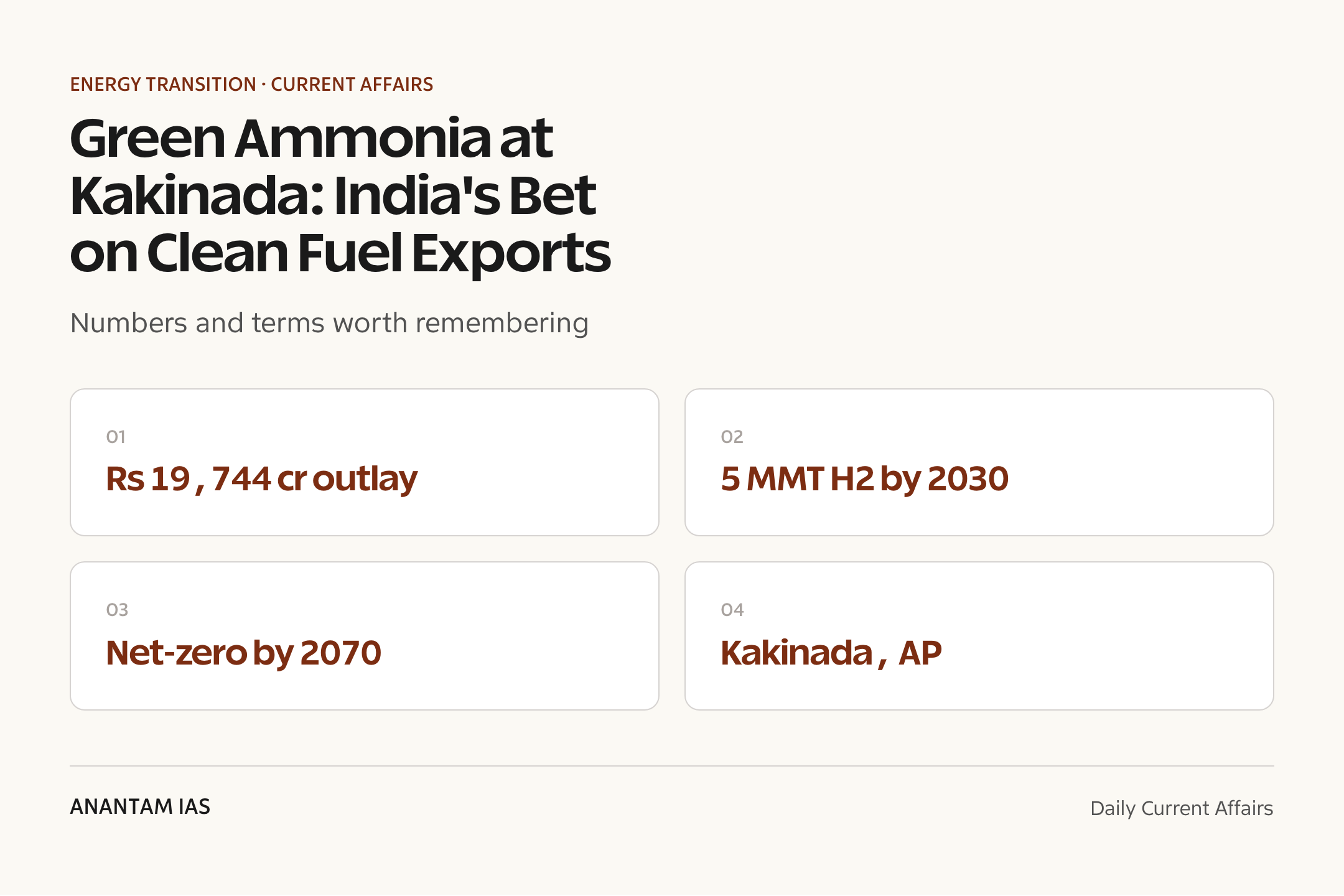
UPSC Relevance
Prelims Relevance
- National Green Hydrogen Mission — launched 2023, nodal ministry MNRE, outlay about Rs 19,744 crore.
- SIGHT — Strategic Interventions for Green Hydrogen Transition, the Mission’s incentive scheme.
- Green hydrogen — made by electrolysis of water using renewable electricity (zero carbon).
- Grey hydrogen — from natural gas / coal with no carbon capture; blue hydrogen — fossil-based with carbon capture.
- Green ammonia — NH3 synthesised from green hydrogen plus nitrogen via the Haber-Bosch process.
- Ammonia is a hydrogen carrier — liquefies at about -33 degrees C, far easier to ship than pure hydrogen.
- India’s targets — 5 MMT green hydrogen by 2030; net-zero by 2070.
- Kakinada is in East Godavari district, Andhra Pradesh, on the Bay of Bengal.
Mains Relevance
GS Paper 3
- Role of green hydrogen and green ammonia in decarbonising hard-to-abate sectors and securing energy.
- Renewable energy infrastructure, electrolyser manufacturing and the economics of clean-fuel exports.
GS Paper 2
- Centre-state coordination and federal incentives in delivering a flagship energy mission.
GS Paper 1
- Industrial location: why coastal Andhra Pradesh suits an export-oriented green-fuel complex.
Essay
- Can a developing economy lead the clean-energy transition while still meeting its development needs?
- Energy independence is the new measure of national strength.
Background and Context
What is green ammonia and why it matters
Green ammonia is the bridge molecule that turns clean electrons into a tradeable, storable clean fuel.
- Green hydrogen is produced by passing renewable electricity through water in an electrolyser, splitting it into hydrogen and oxygen with no carbon emissions.
- Green ammonia (NH3) combines that green hydrogen with nitrogen drawn from the air through the Haber-Bosch process.
- Three uses in one molecule — a fertiliser feedstock (urea, ammonium-based nutrients), a low-carbon marine fuel, and a hydrogen carrier for export.
- Ammonia liquefies at about -33 degrees C, so it ships in conventional tankers far more easily than pure hydrogen, which needs cryogenic -253 degrees C handling.
- It lets countries with abundant renewables ‘export sunshine and wind’ as a dense chemical fuel.
Green vs grey vs blue hydrogen
The colour code is really a carbon-intensity code; only green hydrogen carries no fossil baggage.
- Grey hydrogen — made from natural gas (steam methane reforming) or coal gasification; emits large volumes of CO2 and dominates today’s output.
- Blue hydrogen — the same fossil route but paired with carbon capture and storage, so emissions are partly trapped.
- Green hydrogen — electrolysis powered by solar, wind or hydro; near-zero carbon, the goal of India’s mission.
- India’s edge is cheap, plentiful renewable power, which can drive electrolysis costs down over the decade.
- Cost parity with grey hydrogen — closing the gap is the single biggest hurdle to scale.
National Green Hydrogen Mission and SIGHT
The Kakinada complex would draw on the policy and money put in place by the national mission.
- The National Green Hydrogen Mission was approved in 2023 with an outlay of about Rs 19,744 crore, steered by the Ministry of New and Renewable Energy.
- Headline targets — about 5 million tonnes of annual green-hydrogen production by 2030, with associated renewable and electrolyser build-out.
- SIGHT (Strategic Interventions for Green Hydrogen Transition) offers incentives for both electrolyser manufacturing and green-hydrogen production.
- Aims to cut fossil-fuel imports, build a domestic clean-tech industry and create skilled green jobs.
- Read more on India’s clean-energy push in our explainer on the National Green Hydrogen Mission.
Why Kakinada and Andhra Pradesh
Location is the whole bet — coastal Andhra Pradesh ties renewables to a port and to demand.
- Kakinada offers a deep-water port and an SEZ, so finished green ammonia can be loaded directly for export.
- Andhra Pradesh has strong solar and wind potential, supplying the renewable electricity electrolysers need.
- Proximity to fertiliser and refining demand gives an anchor domestic off-take market.
- State industrial policy and land are being aligned to attract developers and electrolyser supply chains.
- Coastal siting also eases imports of equipment and exports to Europe, Japan and South Korea.
Decarbonising hard-to-abate sectors
Some sectors cannot simply switch to electricity — they need a clean molecule, and that is the strategic prize.
- Fertilisers — green ammonia can replace fossil-based ammonia, cutting both emissions and the import bill.
- Shipping — ammonia is a leading candidate fuel for cutting maritime carbon under tightening global rules.
- Refining and steel — green hydrogen can displace grey hydrogen and coke in industrial processes.
- These sectors are ‘hard to abate’ because heat, chemistry or weight make direct electrification impractical.
- Compare the wider transition story in our note on India’s energy transition.
Hurdles and risks
The promise is large but the path is capital-heavy and technically demanding.
- High cost — green hydrogen still costs more than grey; viability hinges on falling renewable and electrolyser prices.
- Water and energy intensity — electrolysis needs large volumes of clean water and firm renewable supply.
- Safety — ammonia is toxic and corrosive, demanding strict handling, storage and transport norms.
- Demand certainty — bankable long-term export and domestic off-take contracts are essential.
- Infrastructure — pipelines, storage, port handling and a skilled workforce must scale together.
Way Forward
Drive down cost
- Scale electrolyser manufacturing under SIGHT and cut renewable tariffs to reach grey-hydrogen parity.
- Use viability-gap and demand-aggregation tools to de-risk first-mover projects.
Secure demand
- Set blending or purchase obligations for green ammonia in fertilisers and refining.
- Negotiate long-term export off-take with Japan, South Korea and the EU.
Build the ecosystem
- Develop port handling, storage and safety codes for ammonia at Kakinada.
- Invest in skilling, R&D and certification of green origin for credibility abroad.
Conclusion
The Kakinada green-ammonia complex captures a larger Indian wager — that the country can turn its renewable abundance into a clean-fuel industry that decarbonises at home and earns abroad.
Whether the bet pays off depends on driving down cost, locking in demand and building safe infrastructure. If it works, green ammonia could become to the energy transition what software once was to India’s services economy: a globally traded export born of a domestic strength.
UPSC Practice Questions
Prelims MCQ 1
With reference to green hydrogen and green ammonia, consider the following statements:
- Green hydrogen is produced by the electrolysis of water using renewable electricity.
- Green ammonia is synthesised by combining green hydrogen with nitrogen.
- Ammonia can serve as a carrier for transporting hydrogen over long distances.
How many of the above statements are correct?
(a) Only one (b) Only two (c) All three (d) None
Answer: (c) All three
Explanation:
Green hydrogen comes from renewable-powered electrolysis; green ammonia is green hydrogen plus nitrogen via Haber-Bosch; ammonia liquefies easily and is widely seen as a practical hydrogen carrier. All three are correct.
Prelims MCQ 2
The National Green Hydrogen Mission is administered by which Union ministry?
(a) Ministry of Power (b) Ministry of New and Renewable Energy (c) Ministry of Petroleum and Natural Gas (d) Ministry of Heavy Industries
Answer: (b) Ministry of New and Renewable Energy
Explanation:
The Mission, approved in 2023 with an outlay of about Rs 19,744 crore, is steered by the Ministry of New and Renewable Energy (MNRE), with SIGHT as its incentive scheme.
UPSC Mains Questions
- Green hydrogen and green ammonia are central to decarbonising India’s hard-to-abate sectors. Discuss their role in India’s energy transition and examine the challenges in scaling up domestic production. (250 words)
- Coastal complexes such as Kakinada aim to make India an exporter of clean fuels. Critically analyse the economic and strategic case for green-ammonia export hubs. (250 words)
- Examine how the National Green Hydrogen Mission seeks to balance India’s net-zero commitment with its energy-security and industrial-growth objectives. (150 words)
Sources: Ministry of New and Renewable Energy (MNRE) and Press Information Bureau (PIB).
Frequently Asked Questions
What is green ammonia?
Green ammonia is ammonia (NH3) made by combining green hydrogen with nitrogen from the air. Because the hydrogen comes from electrolysis powered by renewable energy, the whole process emits little or no carbon. It is used as a fertiliser feedstock, a low-carbon shipping fuel and a carrier for transporting hydrogen.
How is green hydrogen different from grey and blue hydrogen?
Grey hydrogen is made from natural gas or coal and emits a lot of carbon. Blue hydrogen uses the same fossil route but captures part of the emissions. Green hydrogen is produced by splitting water through electrolysis using renewable electricity, so it carries near-zero carbon emissions.
Why is Kakinada chosen for the project?
Kakinada in coastal Andhra Pradesh has a deep-water port and an SEZ, allowing green ammonia to be exported directly. The state also has strong solar and wind potential to power electrolysers, and lies close to fertiliser and refining demand, making it well suited for an export-oriented clean-fuel complex.
What is the National Green Hydrogen Mission?
Launched in 2023 with an outlay of about Rs 19,744 crore, the Mission is run by the Ministry of New and Renewable Energy. It aims for roughly five million tonnes of green hydrogen a year by 2030 and uses the SIGHT scheme to incentivise electrolyser manufacturing and green-hydrogen production.
Why is ammonia useful for transporting hydrogen?
Pure hydrogen is very light and must be cooled to around -253 degrees C to liquefy, making it costly to ship. Ammonia liquefies at about -33 degrees C and moves in conventional tankers. So hydrogen can be converted to ammonia, shipped, and then either used directly or converted back, making long-distance export practical.
What are the main challenges for green ammonia in India?
The biggest challenge is cost, as green hydrogen is still pricier than grey. Other hurdles include the large water and renewable-energy needs of electrolysis, the safe handling of toxic ammonia, securing long-term demand and export contracts, and building ports, storage, pipelines and a skilled workforce together at scale.
Source: https://anantamias.com/current-affairs/andhra-pradesh-green-ammonia-kakinada-2026/
Counting River Dolphins: India’s Second Nationwide Survey and Project Dolphin
Why in News?
India has launched its second nationwide riverine and estuarine dolphin survey, extending the methodology of the first comprehensive count completed in 2024. The exercise is coordinated by the Wildlife Institute of India (WII), Dehradun, under the umbrella of Project Dolphin and the National Mission for Clean Ganga.
The first survey put the population at about 6,327 river dolphins across the Ganga, Brahmaputra and their tributaries plus the Beas, establishing the first scientific baseline for the species and turning a once-data-poor animal into a measurable indicator of river health.
- Second cycle builds on the 2024 baseline of ~6,327 dolphins, the country’s first systematic estimate.
- Survey spans the Ganga and Brahmaputra basins across eight states, plus the lone Indus dolphin population in the Beas, Punjab.
- Run under Project Dolphin (announced 2020) with the Wildlife Institute of India as the technical lead.
- Uses standardised boat-based double-observer counts and emerging environmental DNA (eDNA) and acoustic methods.
- Feeds directly into the Namami Gange programme’s river-rejuvenation targets.
The development matters in the context of:
- The Gangetic dolphin is India’s National Aquatic Animal, notified in 2009, making its numbers a flagship measure of conservation success.
- As an apex predator and an indicator species, healthy dolphin counts signal a living, connected river; declines flag pollution, flow loss and overfishing.
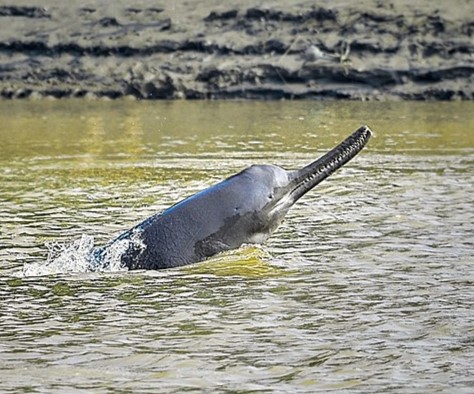
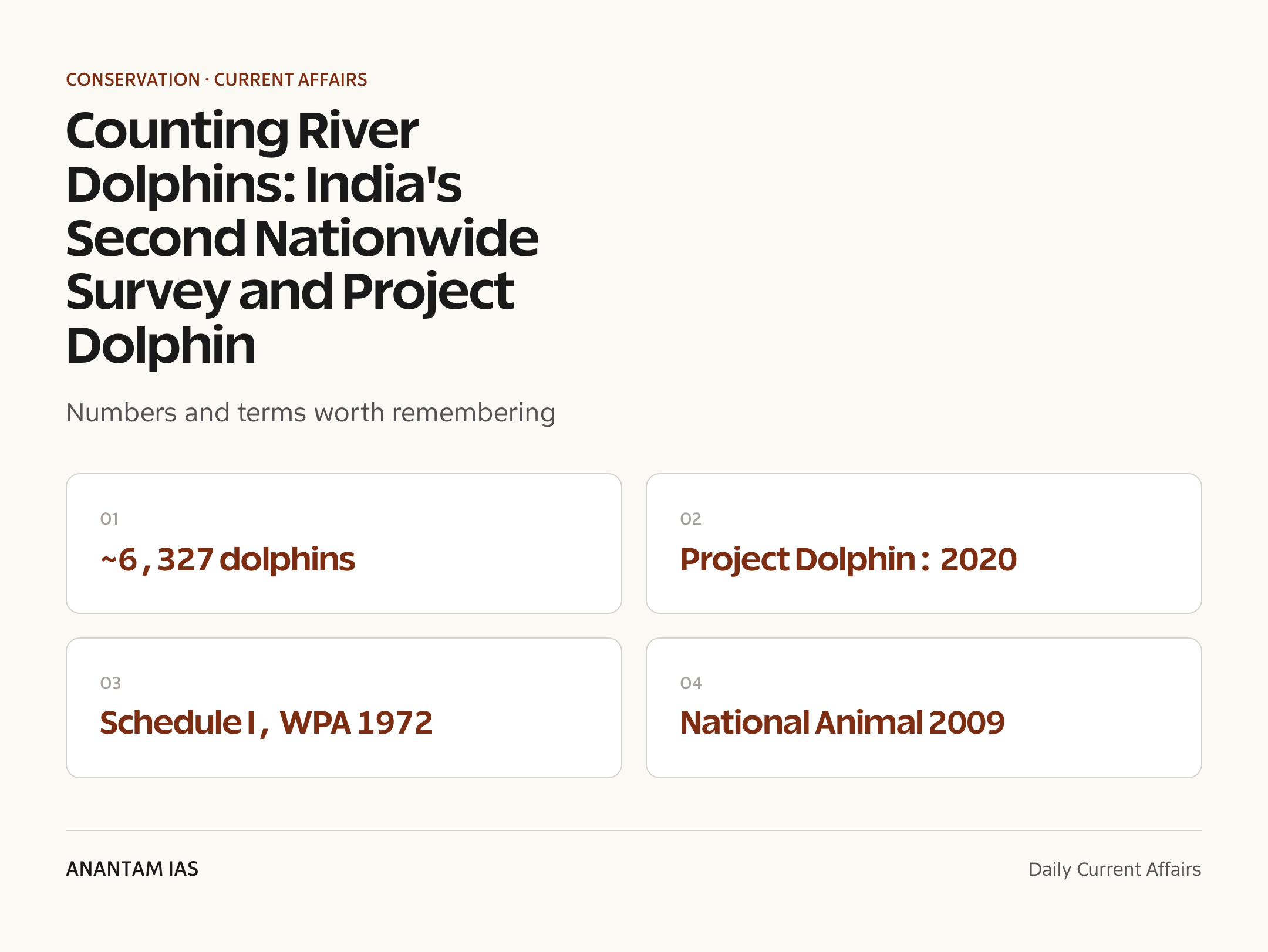
UPSC Relevance
Prelims Relevance
- Gangetic dolphin (Platanista gangetica) — India’s National Aquatic Animal (declared 2009).
- Project Dolphin launched 2020; nodal agency MoEFCC, technical lead Wildlife Institute of India.
- First nationwide count (2024) estimated ~6,327 river dolphins.
- Listed in Schedule I of the Wildlife (Protection) Act, 1972 — highest protection.
- IUCN Red List: Endangered; listed on CMS Appendix I and II and CITES Appendix I.
- Two subspecies: the Ganges river dolphin and the Indus river dolphin (bhulan), in the Beas, Punjab.
- Dolphins are functionally blind; they navigate and hunt by echolocation.
- Vikramshila Gangetic Dolphin Sanctuary (Bihar) is India’s only protected stretch dedicated to the species.
- National Ganga River Dolphin Day is observed on 5 October.
Mains Relevance
GS Paper 3
- Conservation of indicator and flagship species and the case for ecosystem-level river management.
- Balancing river infrastructure (dams, barrages, waterways) with aquatic-biodiversity protection.
GS Paper 2
- Government interventions (Project Dolphin, Namami Gange) and the role of specialised institutions like WII in evidence-based policy.
Essay
- What a river’s last sentinel tells us about our development model.
- Counting what we cannot afford to lose: data, conservation and the public good.
Background and Context
The species: a blind river sentinel
The Gangetic dolphin is uniquely adapted to murky, sediment-heavy rivers, which makes it both fascinating and fragile.
- Platanista gangetica is a freshwater cetacean found only in the Ganga, Brahmaputra and Meghna river systems across India, Nepal and Bangladesh (see our explainer on the river dolphins of India).
- It is effectively blind — its eyes lack a lens — and relies entirely on echolocation to navigate turbid water.
- It surfaces every few minutes to breathe, producing the characteristic exhalation that earns it the local name susu.
- Females are larger than males; the species breeds slowly, giving birth typically to a single calf every two to three years, which limits recovery speed.
- It sits at the top of the aquatic food chain, so its presence reflects abundant fish and a functioning river ecosystem.
Project Dolphin and the institutional architecture
The survey is the data backbone of a structured national programme rather than a one-off count.
- Project Dolphin was announced by the Prime Minister on 15 August 2020 and approved to conserve both riverine and oceanic dolphins.
- It is anchored in the Ministry of Environment, Forest and Climate Change (MoEFCC) and draws on the National Mission for Clean Ganga (NMCG).
- The Wildlife Institute of India (WII), an autonomous body under MoEFCC, provides the scientific design, training and population modelling.
- It mirrors the model of Project Tiger and Project Elephant — using a charismatic flagship to drive habitat-wide protection.
- Conservation funds also flow through the dedicated National Dolphin Research Centre (NDRC) at Patna, India’s first such facility.
How the count is done
Counting a fast, blink-and-miss animal in opaque water demands a careful, repeatable method.
- Surveyors use boat-based double-observer protocols, where two independent teams log sightings to correct for animals missed at the surface.
- Distance and GPS data feed statistical abundance models, producing population estimates with confidence bands rather than raw tallies.
- Newer cycles supplement visual counts with environmental DNA (eDNA) from water samples and passive acoustic monitoring of echolocation clicks.
- Standardising the method across the first and second surveys is what makes a trend — not just a snapshot — possible.
- Building local capacity is explicit: forest staff and researchers are trained so monitoring continues beyond the survey window.
The threats the numbers track
The pressures on the dolphin are the same pressures degrading India’s rivers, which is precisely why it works as an indicator.
- Accidental bycatch in fishing nets is the leading cause of death; dolphins drown when entangled.
- Dams and barrages fragment populations into isolated stretches, blocking movement and shrinking the gene pool.
- Reduced dry-season flow from abstraction for irrigation and water supply strands dolphins in shallow pools.
- Industrial and agricultural pollution — including heavy metals and pesticides — accumulates up the food chain in this apex predator.
- Underwater noise from vessels and dredging for inland waterways can disrupt the echolocation the animal depends on.
- Historic poaching for dolphin oil, used as fish bait, once drove sharp local declines.
Indus versus Gangetic: two cousins, two fates
India hosts both surviving South Asian river dolphin subspecies, and their contrasting status is itself a lesson.
- The Ganges river dolphin ranges widely across the Ganga-Brahmaputra system and holds the larger global population.
- The Indus river dolphin (bhulan) survives in India only in a short stretch of the Beas river in Punjab, with the bulk of its range in Pakistan.
- The Beas population is protected within the Beas Conservation Reserve, a transboundary conservation interest.
- Both were long treated as one species but are now recognised as distinct subspecies, sharpening the case for managing each population separately.
- The Indus dolphin’s near-extinction in fragmented canals is a cautionary preview of what unchecked barrages can do to the Gangetic stock.
Why an indicator species matters for policy
Conserving the dolphin is shorthand for conserving the whole river, which is the survey’s deeper value.
- An indicator species is one whose condition reveals the health of its wider ecosystem, much like a canary in a coal mine.
- Because the dolphin needs deep, connected, fish-rich water, a stable count certifies that Namami Gange rejuvenation is working on the ground.
- Tracking the same metric over time gives policymakers a measurable outcome, not just spending or activity reports.
- Protecting the dolphin’s habitat simultaneously secures fisheries, water quality and livelihoods for riverine communities.
- It anchors India’s commitments under the Convention on Migratory Species (CMS) and broader biodiversity goals.
Way Forward
Make monitoring continuous
- Move from periodic surveys to year-round monitoring using eDNA, acoustic sensors and trained local teams.
- Maintain a shared open database so trends, not isolated counts, drive decisions.
Fix the river, not just the dolphin
- Guarantee environmental flows (e-flows) below barrages so dolphin stretches never run dry.
- Mandate dolphin-safe fishing gear and net-free zones in core habitats, with compensation for affected fishers.
Engage communities and link missions
- Build community stewardship through eco-tourism and local ‘dolphin mitra’ volunteers.
- Tightly couple Project Dolphin targets with Namami Gange pollution-abatement milestones.
Conclusion
The second nationwide survey turns the river dolphin from a symbol into a yardstick. By repeating a standardised count, India can finally say whether its rivers are recovering or simply being managed on paper.
If the dolphin thrives, the Ganga and Brahmaputra are alive in the fullest sense — clean, flowing and fish-rich. Protecting this blind sentinel is, in the end, the most honest test of whether river-rejuvenation promises are being kept.
UPSC Practice Questions
Prelims MCQ 1
With reference to the Gangetic river dolphin, consider the following statements:
- It is designated as India’s National Aquatic Animal.
- It is listed in Schedule I of the Wildlife (Protection) Act, 1972.
- It primarily uses keen eyesight to hunt in clear waters.
How many of the above statements are correct?
(a) Only one (b) Only two (c) All three (d) None
Answer: (b) Only two
Explanation:
Statements 1 and 2 are correct — it was declared the National Aquatic Animal in 2009 and enjoys Schedule I protection. Statement 3 is wrong: the dolphin is effectively blind and hunts by echolocation in turbid water.
Prelims MCQ 2
Project Dolphin, launched in 2020, is implemented under the overall charge of which of the following?
(a) Ministry of Jal Shakti only (b) Ministry of Environment, Forest and Climate Change (c) Department of Fisheries (d) Indian Council of Agricultural Research
Answer: (b) Ministry of Environment, Forest and Climate Change
Explanation:
Project Dolphin is anchored in the MoEFCC, with the Wildlife Institute of India as technical lead, and draws on the National Mission for Clean Ganga under Jal Shakti for the Ganga component.
UPSC Mains Questions
- Indicator species can convert abstract conservation goals into measurable outcomes. Examine this proposition with reference to the Gangetic river dolphin and India’s river-rejuvenation programmes. (250 words)
- Riverine infrastructure such as dams, barrages and inland waterways often conflicts with aquatic biodiversity. Discuss the threats this poses to river dolphins and suggest a framework to reconcile the two. (250 words)
- What is Project Dolphin? Evaluate how a flagship-species approach, on the lines of Project Tiger, can strengthen ecosystem-wide conservation in India. (150 words)
Sources: Ministry of Environment, Forest and Climate Change (MoEFCC) and Wildlife Institute of India.
Frequently Asked Questions
Why is the Gangetic dolphin India’s National Aquatic Animal?
The Government of India declared the Gangetic dolphin the National Aquatic Animal in 2009 to highlight the urgent need to conserve it and the river systems it inhabits. As a top predator confined to the Ganga and Brahmaputra basins, its survival reflects the overall health of these rivers, making it a natural flagship for freshwater conservation.
What is Project Dolphin and when did it start?
Project Dolphin was announced on 15 August 2020 and approved as a national programme to conserve both riverine and oceanic dolphins. It is run by the Ministry of Environment, Forest and Climate Change, with the Wildlife Institute of India providing scientific support and the National Mission for Clean Ganga assisting on the Ganga stretch.
How many river dolphins are there in India?
India’s first comprehensive nationwide survey, completed in 2024, estimated about 6,327 river dolphins across the Ganga and Brahmaputra basins and the Beas. This figure is a scientific baseline rather than a final tally, which is why a second survey is now being carried out to measure how the population is changing over time.
Why are river dolphins called an indicator species?
An indicator species reveals the condition of its wider ecosystem. River dolphins need deep, connected, unpolluted and fish-rich water, so a stable or rising population signals that the river is healthy and that clean-up efforts like Namami Gange are working. A decline warns of pollution, reduced flow, overfishing or habitat fragmentation.
What are the main threats to river dolphins?
The biggest threat is accidental bycatch in fishing nets, which drowns the animals. Dams and barrages fragment populations, reduced dry-season flow strands them in shallow pools, and industrial and agricultural pollution accumulates in this apex predator. Underwater noise from boats and dredging can also disrupt the echolocation they rely on to navigate.
How is the Indus dolphin different from the Gangetic dolphin?
Both are subspecies of the South Asian river dolphin. The Gangetic dolphin ranges widely across the Ganga-Brahmaputra system, while the Indus dolphin, or bhulan, survives in India only in a short stretch of the Beas river in Punjab, protected within the Beas Conservation Reserve. Most of the Indus dolphin’s range lies in Pakistan.
Source: https://anantamias.com/current-affairs/national-dolphin-survey-project-dolphin-2026/
India as a Cooperative Powerhouse: The Sahkar Movement’s New Push
Why in News?
India is consolidating its position as the world’s largest cooperative ecosystem, with the Ministry of Cooperation driving a fresh wave of reforms under the banner of ‘Sahkar se Samriddhi’ (prosperity through cooperation). The push follows the UN International Year of Cooperatives 2025, which spotlighted cooperatives as engines of inclusive growth.
The country hosts over 8 lakh cooperative societies touching nearly every village, and the government is computerising about 63,000 Primary Agricultural Credit Societies (PACS), rewriting their model bye-laws to make them multipurpose, and floating new national-level cooperatives for organics, seeds and exports.
- India has the world’s largest cooperative movement — roughly 8 lakh-plus societies spanning credit, dairy, fertiliser, housing and fisheries.
- The Ministry of Cooperation, carved out in July 2021, anchors the reform agenda with the slogan ‘Sahkar se Samriddhi’.
- About 63,000 PACS are being onboarded onto a common ERP platform linked to NABARD and state cooperative banks.
- New model bye-laws let PACS run over 25 activities — from Common Service Centres (CSCs) and Jan Aushadhi Kendras to fuel outlets and water distribution.
- Three new national multi-state cooperatives for organic produce, seeds and exports aim to lift the primary sector’s value chain.
The development matters in the context of:
- The reforms sit on the durable syllabus theme of cooperative federalism and the constitutional status cooperatives gained through the 97th Constitutional Amendment (2011).
- Cooperatives are central to rural credit, the primary-sector economy and the goal of doubling farm incomes.
- The model is showcased by global brands like AMUL, born of the dairy cooperative revolution.
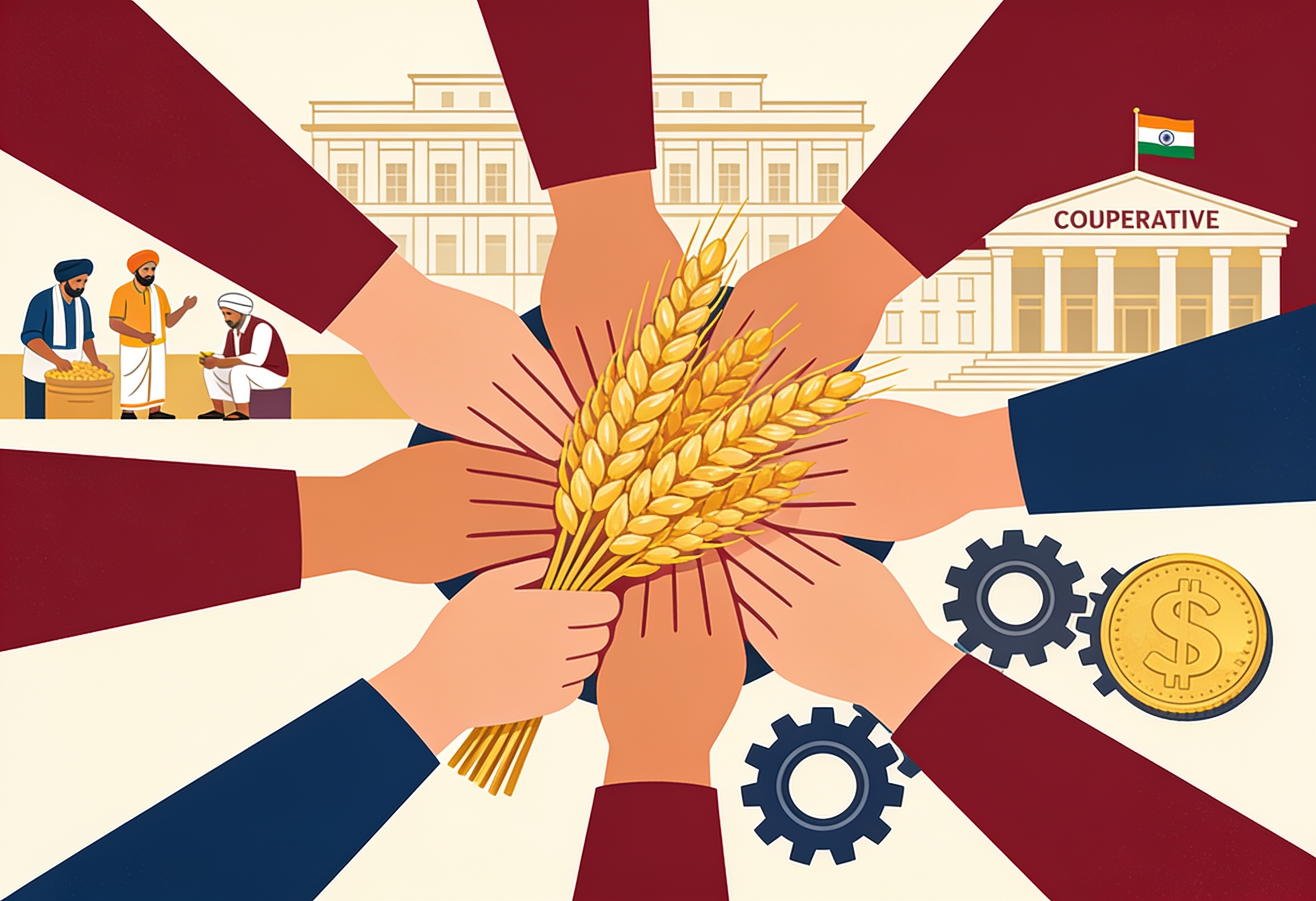
UPSC Relevance
Prelims Relevance
- Ministry of Cooperation — created July 2021, headed by the Union Cooperation Minister.
- 97th Constitutional Amendment Act, 2011 — added Part IXB and Article 43B (Directive Principle on cooperatives).
- Right to form cooperative societies is a Fundamental Right under Article 19(1)(c).
- PACS — Primary Agricultural Credit Societies, the village-level base of the three-tier short-term credit structure.
- Three-tier credit: PACS → District Central Cooperative Banks → State Cooperative Banks, refinanced by NABARD.
- Cooperatives fall under State List Entry 32; multi-state societies are governed by the Multi-State Cooperative Societies Act, 2002.
- AMUL follows the Anand Pattern; Operation Flood was led by the National Dairy Development Board (NDDB).
- UN International Year of Cooperatives 2025 — theme ‘Cooperatives Build a Better World’.
- New apex bodies: NCOL (organics), BBSSL (seeds) and the National Cooperative Exports body.
Mains Relevance
GS Paper 3
- Role of cooperatives in rural credit, the primary-sector economy and inclusive growth.
- Computerisation of PACS as a lever for financial inclusion and supply-chain efficiency.
GS Paper 2
- Cooperative federalism tensions: cooperatives on the State List versus a Union ministry steering reform.
Essay
- Cooperation over competition: can collective enterprise power inclusive development?
- From village society to global brand — the cooperative as a model of grassroots democracy.
Background and Context
What 'Sahkar se Samriddhi' means
The slogan frames cooperation as a route to shared prosperity, not just a credit mechanism.
- ‘Sahkar se Samriddhi’ is the guiding vision of the Ministry of Cooperation — strengthening cooperatives so growth reaches the last village.
- It targets the primary sector — farming, dairy, fisheries — where cooperatives already pool small producers into bargaining-strong collectives.
- The approach reframes cooperatives as multipurpose service hubs, building on the National Cooperative Policy 2025 rather than single-function lending.
- It builds directly on the visibility from the UN International Year of Cooperatives 2025.
The constitutional and institutional base
Cooperatives sit on a distinct constitutional footing built over decades.
- The 97th Constitutional Amendment Act, 2011 inserted Part IXB (Articles 243ZH–243ZT) and made the right to form societies part of Article 19(1)(c).
- It added Article 43B, a Directive Principle urging the State to promote voluntary, autonomous and democratic cooperatives.
- Cooperatives are a State subject (Entry 32, State List); the Multi-State Cooperative Societies Act, 2002 governs societies spanning states.
- The Ministry of Cooperation (2021) gave the sector a dedicated administrative home, separate from the Agriculture Ministry.
PACS computerisation — the digital backbone
The flagship reform is putting the village credit society online.
- About 63,000 PACS are being migrated to a common ERP software with a national portal and cloud backup.
- NABARD designed the platform; it links PACS to State Cooperative Banks and district banks for real-time accounting.
- Digitisation cuts leakages, speeds loan disbursal and makes audited data available for the first time at scale.
- It is the base layer for turning each PACS into a multipurpose, transparent service point.
Model bye-laws — PACS as village service hubs
New rules let a single society do far more than lend.
- The revised model bye-laws permit PACS to run over 25 business activities.
- A PACS can now host a Common Service Centre (CSC), a Jan Aushadhi Kendra (generic-medicine outlet), a fuel or LPG outlet and a water-distribution unit.
- PACS can serve as procurement and storage nodes and as nurseries for allied businesses.
- The aim is a viable, diversified society that stays solvent and serves the whole village economy.
New national cooperatives for value chains
Three apex bodies extend the model up the supply chain.
- National Cooperative Organics Limited (NCOL) aggregates, certifies and markets organic produce under a trusted brand.
- Bharatiya Beej Sahkari Samiti Limited (BBSSL) produces and distributes certified, traditional and climate-resilient seeds.
- A National Cooperative Exports body channels surplus from cooperatives into global markets.
- Together they let small producers capture more of the value chain, not just farm-gate prices.
Why the cooperative model matters
Cooperatives remain a uniquely Indian engine of grassroots enterprise.
- The cooperative movement touches credit, fertiliser (IFFCO, KRIBHCO), sugar, housing and fisheries — over 8 lakh societies in all.
- AMUL, built on the Anand Pattern and Operation Flood, made India the world’s largest milk producer and is the model success story.
- Cooperatives pool small, scattered producers into scale, giving them bargaining power against larger players.
- They embed economic democracy — one member, one vote — at the village level.
Challenges that persist
The movement carries structural weaknesses the reforms must address.
- Many cooperatives suffer political capture, dormant societies, weak audits and chronic NPAs.
- Regional skew: strong in Gujarat, Maharashtra and the south, thin in the east and north-east.
- Critics warn that a Union ministry steering a State-subject sector strains cooperative federalism.
- Professional management and member awareness remain uneven across the network.
Way Forward
Deepen and professionalise
- Complete PACS computerisation and extend it to dairy and fisheries cooperatives.
- Build professional management cadres and independent audit systems to curb capture and NPAs.
Balance and broaden
- Respect state autonomy so reform stays consultative, protecting cooperative federalism.
- Seed new societies in under-served eastern and north-eastern regions to close the regional gap.
Anchor the push in member education so the ‘one member, one vote’ spirit translates into active, accountable participation rather than dormant rolls.
Conclusion
India’s cooperative network is a quiet giant — over 8 lakh societies reaching where markets and the state often cannot. The Sahkar se Samriddhi agenda tries to modernise this base: digitising PACS, diversifying their business and building national value chains.
The real test is governance. If reforms professionalise management, protect state autonomy and revive dormant societies, cooperatives can become a durable engine of inclusive, primary-sector-led growth — turning a powerhouse of numbers into a powerhouse of outcomes.
UPSC Practice Questions
Prelims MCQ 1
With reference to cooperatives in India, consider the following statements:
- The 97th Constitutional Amendment Act, 2011 made the right to form cooperative societies a Fundamental Right.
- Cooperative societies operating within a single state fall under the State List.
- The Ministry of Cooperation was established as a separate ministry in 2021.
How many of the above statements are correct?
(a) Only one (b) Only two (c) All three (d) None
Answer: (c) All three
Explanation:
The 97th Amendment added cooperatives to Article 19(1)(c), inserted Part IXB and Article 43B. Cooperatives are State List Entry 32. The Ministry of Cooperation was carved out in July 2021. All three are correct.
Prelims MCQ 2
In the three-tier short-term cooperative credit structure, which institution refinances the system at the apex?
(a) Reserve Bank of India (b) NABARD (c) SIDBI (d) State Cooperative Banks
Answer: (b) NABARD
Explanation:
NABARD provides refinance to the cooperative credit structure (PACS → District Central Cooperative Banks → State Cooperative Banks). The RBI is the monetary authority, not the direct cooperative refinancer.
UPSC Mains Questions
- India runs the world’s largest cooperative movement yet its potential remains unevenly realised. Examine the structural challenges facing the cooperative sector and assess how recent reforms under the Ministry of Cooperation seek to address them. (250 words)
- “Cooperatives are a State subject, yet a Union ministry now steers their reform.” Discuss this tension in the light of cooperative federalism and the 97th Constitutional Amendment. (250 words)
- Computerisation of PACS is described as a backbone reform for rural India. Analyse how digitising primary credit societies can advance financial inclusion and supply-chain efficiency. (150 words)
Sources: PIB, Ministry of Cooperation and PIB.
Frequently Asked Questions
When was the Ministry of Cooperation created?
The Union Ministry of Cooperation was carved out as a separate ministry in July 2021. Earlier, cooperatives were handled within the Ministry of Agriculture. The new ministry gives the sector a dedicated administrative and policy home, anchoring reforms under the vision of ‘Sahkar se Samriddhi’, meaning prosperity through cooperation.
What does ‘Sahkar se Samriddhi’ mean?
‘Sahkar se Samriddhi’ translates as ‘prosperity through cooperation’. It is the guiding slogan of the Ministry of Cooperation, framing cooperative enterprise as a route to inclusive growth that reaches the last village. The idea is to strengthen and modernise cooperatives so small producers share in rising prosperity.
What is a PACS and why is its computerisation important?
A Primary Agricultural Credit Society (PACS) is the village-level base of the cooperative credit structure. Computerising about 63,000 PACS onto a common ERP platform, designed with NABARD, brings transparent accounting, faster loan disbursal, fewer leakages and reliable audited data, turning each society into a viable multipurpose service hub.
How did the 97th Constitutional Amendment change cooperatives?
The 97th Constitutional Amendment Act, 2011 made the right to form cooperative societies part of the Fundamental Right under Article 19(1)(c), added Part IXB on their governance, and inserted Article 43B as a Directive Principle urging the State to promote voluntary, autonomous and democratic cooperatives.
What are the new national cooperatives being set up?
Three apex multi-state cooperatives extend the model up the value chain: National Cooperative Organics Limited for organic produce, Bharatiya Beej Sahkari Samiti Limited for certified seeds, and a National Cooperative Exports body. Together they help small producers capture more of the supply chain and reach global markets.
Why is India called a cooperative powerhouse?
India hosts the world’s largest cooperative movement, with over 8 lakh societies spanning credit, dairy, fertiliser, sugar, housing and fisheries. Success stories like AMUL, built on the Anand Pattern, made India the top milk producer. The 2025 UN International Year of Cooperatives further spotlighted this scale.
Source: https://anantamias.com/current-affairs/india-global-cooperative-powerhouse-2026/
The High Seas Treaty (BBNJ): Governing Biodiversity Beyond National Borders
Why in News?
The BBNJ Agreement — the treaty on Biodiversity Beyond National Jurisdiction, widely called the High Seas Treaty — remains a landmark in global ocean governance, the first legally binding instrument to protect marine life in the two-thirds of the ocean that lies beyond any country’s control.
Adopted in 2023 as the third implementing agreement under the UN Convention on the Law of the Sea (UNCLOS), it needs 60 ratifications to enter into force; India has signed it, and the race to ratification keeps it firmly in focus for climate, biodiversity and maritime-strategy watchers.
- What it is: a legally binding treaty for the conservation and sustainable use of marine biodiversity in areas beyond national jurisdiction (ABNJ).
- Parent framework: the third implementing agreement under UNCLOS (after the 1994 Part XI and 1995 Fish Stocks agreements).
- Adoption: agreed at the UN in 2023 after nearly two decades of negotiation.
- Entry into force: requires 60 ratifications before it becomes operative.
- Coverage: applies to the high seas and the international seabed ‘Area’ — together about two-thirds of the ocean.
- India’s stand: India has signed the agreement, aligning it with the Kunming-Montreal 30×30 biodiversity target.
- Four pillars: marine protected areas, environmental impact assessments, marine genetic resources and benefit-sharing, and capacity building and technology transfer.
The development matters in the context of:
- Governance gap: until BBNJ, no single instrument could create protected areas or require impact assessments in the high seas, leaving a vast commons largely unregulated.
- 30×30 link: the treaty is the practical tool for extending the Kunming-Montreal goal of protecting 30% of land and sea by 2030 into international waters.
- Common heritage: it tests how the principle of the common heritage of mankind applies to living resources, not just seabed minerals.
- Equity stakes: developing states, including India, want fair sharing of benefits from marine genetic resources and real technology transfer, not just paper commitments.

UPSC Relevance
Prelims Relevance
- BBNJ Agreement as the third implementing agreement under UNCLOS.
- UNCLOS maritime zones: territorial sea (12 nm), contiguous zone (24 nm), EEZ (200 nm), continental shelf, high seas.
- Definition of areas beyond national jurisdiction (ABNJ) — the high seas plus the Area.
- The ‘Area’ as the seabed beyond national jurisdiction, and the common heritage of mankind principle.
- The International Seabed Authority (ISA) — mandate, headquarters at Kingston, Jamaica.
- The 60 ratifications threshold for the treaty to enter into force.
- The four pillars: MPAs, EIAs, marine genetic resources / benefit-sharing, capacity building and marine technology transfer.
- Link to the Kunming-Montreal Global Biodiversity Framework and the 30×30 target.
- The Convention on Biological Diversity (CBD) and the freedoms of the high seas (navigation, overflight, fishing, research).
- Difference between the high seas (water column) and the Area (seabed) in international law.
Mains Relevance
GS Paper 3 (Environment)
- Examine how the BBNJ Agreement closes the governance gap in protecting marine biodiversity in the high seas, and its links to the 30×30 target.
- Assess the challenges of designating and enforcing marine protected areas in areas beyond national jurisdiction.
GS Paper 2 (International Relations)
- Discuss the significance of the BBNJ Agreement for global ocean governance and India’s maritime and blue-economy interests.
- Evaluate the North-South tensions over marine genetic resources and benefit-sharing in negotiating the High Seas Treaty.
Essay
- A strong anchor for essays on the global commons, intergenerational equity and stewardship of shared resources.
- Useful for essays on multilateralism, North-South equity and governing what belongs to everyone and no one.
Background and Context
UNCLOS and the legal map of the ocean
To understand BBNJ you first need the zones that UNCLOS draws across the sea.
- UNCLOS: the 1982 UN Convention on the Law of the Sea is the ‘constitution of the oceans’, setting out rights and duties zone by zone.
- National zones: a coastal state controls a 12 nm territorial sea, a 24 nm contiguous zone, and resource rights in a 200 nm Exclusive Economic Zone (EEZ) plus its continental shelf.
- High seas: the water column beyond the EEZ, open to all states with freedoms of navigation, overflight, fishing and scientific research.
- The Area: the seabed and subsoil beyond national jurisdiction, declared the common heritage of mankind and managed by the ISA.
- ABNJ: the high seas and the Area together — the areas beyond national jurisdiction that BBNJ now addresses.
Why a new treaty was needed
UNCLOS framed the zones but left a yawning gap on protecting living biodiversity out there.
- Two-thirds of the ocean lies beyond national jurisdiction, yet no body could create marine protected areas there.
- Fragmented rules: sectoral bodies governed fishing, shipping or seabed mining separately, with no integrated tool for conservation.
- No EIA duty: there was no consistent requirement to assess the environmental impact of activities like deep-sea mining or bioprospecting.
- Genetic-resource vacuum: rules for accessing and sharing benefits from marine genetic resources were absent, raising equity concerns.
- Mandate: the UN General Assembly launched negotiations to fill this gap, concluding with adoption in 2023.
The four pillars of the BBNJ Agreement
The treaty rests on four interlocking elements, often called its package deal.
- Marine protected areas: a mechanism to establish area-based management tools, including MPAs, in the high seas to safeguard ecosystems.
- Environmental impact assessments: a duty to assess and disclose the likely impact of planned activities in ABNJ before they proceed.
- Marine genetic resources: rules for accessing genetic material from the high seas and for fair and equitable benefit-sharing, monetary and non-monetary.
- Capacity building and technology transfer: support so that developing states can participate in research, conservation and the blue economy.
Common heritage versus freedom of the high seas
BBNJ sits on a fault line between two competing legal traditions.
- Common heritage of mankind: a principle, applied to the seabed Area, that resources belong to all humanity and benefits must be shared.
- Freedom of the high seas: the older idea that the open ocean is free for all states to use, including fishing and research.
- The compromise: BBNJ blends both — keeping high-seas freedoms while layering on conservation duties and benefit-sharing for marine genetic resources.
- Institutional link: the seabed minerals of the Area stay with the ISA, while BBNJ focuses on living biodiversity in the water column and beyond.
Links to CBD, 30×30 and the climate agenda
The treaty is the missing ocean piece of the global biodiversity and climate framework.
- 30×30 target: the Kunming-Montreal Global Biodiversity Framework aims to protect 30% of land and sea by 2030 — unreachable at sea without BBNJ.
- CBD bridge: it extends the spirit of the Convention on Biological Diversity into waters the CBD itself does not directly govern.
- Carbon sink: the ocean absorbs heat and carbon, so protecting high-seas ecosystems is also a climate-resilience measure.
- Migratory species: whales, tuna, sharks and turtles cross jurisdictions, so connected high-seas MPAs are vital to their survival.
India's interests and the road to ratification
A landlocked-sounding treaty has direct stakes for a maritime nation like India.
- India has signed the agreement and frames it within its blue economy and ocean-science priorities under the Ministry of Earth Sciences.
- Equity push: India and other developing states want genuine benefit-sharing from marine genetic resources and real technology transfer.
- Deep Ocean Mission: India’s Deep Ocean Mission and ISA-linked exploration give it a direct interest in fair seabed and high-seas rules.
- Threshold race: the treaty needs 60 ratifications to enter into force, and domestic ratification remains the next step for signatory states.
Way Forward
Accelerate ratification and build institutions
- Reach the threshold: push the remaining ratifications past 60 so the treaty enters into force and its bodies can stand up.
- Operational machinery: establish the Conference of Parties, scientific and technical body, and a clearing-house for sharing data and genetic-resource information.
Make benefit-sharing and capacity real
- Fair sharing: design transparent rules for monetary and non-monetary benefits from marine genetic resources so developing states gain.
- Technology transfer: fund and deliver capacity building so countries like India can carry out high-seas research and conservation.
Enforce conservation effectively
- Connected MPAs: build networks of marine protected areas that track migratory species and ecosystems, not isolated patches.
- Monitoring: pair satellite surveillance and shared science with credible ocean-governance mechanisms to deter illegal and unassessed activity.
Conclusion
A commons finally governed: the BBNJ Agreement extends real, binding protection into the two-thirds of the ocean that long sat in a legal grey zone beyond any flag.
The balancing act: it threads the needle between the freedom of the high seas and the common heritage of mankind, layering conservation and equity onto an open ocean.
Why it matters for India: as a maritime power with deep-ocean and blue-economy ambitions, India’s interest lies in swift ratification, fair benefit-sharing and effective high-seas protection that serves both biodiversity and equity.
UPSC Practice Questions
Prelims MCQ 1
With reference to the BBNJ Agreement (High Seas Treaty), consider the following statements:
- It is an implementing agreement under the United Nations Convention on the Law of the Sea.
- It applies to marine areas within the Exclusive Economic Zones of coastal states.
- It requires 60 ratifications to enter into force.
How many of the above statements are correct?
(a) Only one (b) Only two (c) All three (d) None
Answer: (b) Only two
Explanation:
Statements 1 and 3 are correct: BBNJ is the third implementing agreement under UNCLOS and needs 60 ratifications to enter into force. Statement 2 is wrong — it governs areas beyond national jurisdiction (the high seas and the Area), not within EEZs.
Prelims MCQ 2
Which one of the following is the principle, under UNCLOS, that applies to the resources of the international seabed ‘Area’?
(a) Freedom of the high seas (b) Common heritage of mankind (c) Sovereign rights of the coastal state (d) Innocent passage
Answer: (b) Common heritage of mankind
Explanation:
Under UNCLOS, the seabed and subsoil beyond national jurisdiction — the ‘Area’ — are the common heritage of mankind, managed by the International Seabed Authority. Freedom of the high seas applies to the overlying water column, while sovereign rights and innocent passage relate to national zones.
UPSC Mains Questions
- The BBNJ Agreement has been called the missing ocean piece of the global biodiversity framework. Examine how it closes the governance gap in areas beyond national jurisdiction and its links to the 30×30 target.
- Discuss the tension between the freedom of the high seas and the common heritage of mankind in the negotiation of the High Seas Treaty. How does the agreement attempt to reconcile the two?
- Evaluate the significance of the BBNJ Agreement for India’s maritime, blue-economy and ocean-science interests, and the equity concerns it raises for developing states.
Sources: Ministry of Earth Sciences, Government of India and United Nations (Office of Legal Affairs / DOALOS).
Frequently Asked Questions
What is the BBNJ Agreement?
It is the treaty on Biodiversity Beyond National Jurisdiction, popularly called the High Seas Treaty. Adopted in 2023 under UNCLOS, it is the first legally binding instrument to conserve and sustainably use marine biodiversity in the high seas and the international seabed, which together cover about two-thirds of the ocean.
Why is it called the High Seas Treaty?
Because it governs the high seas and the seabed ‘Area’ — the parts of the ocean that lie beyond national jurisdiction, outside any country’s 200 nautical-mile Exclusive Economic Zone. These waters make up roughly two-thirds of the global ocean and had no integrated conservation framework before.
What are the four pillars of the treaty?
First, marine protected areas in the high seas. Second, mandatory environmental impact assessments for activities in international waters. Third, rules on marine genetic resources with fair and equitable benefit-sharing. Fourth, capacity building and marine technology transfer so developing states can take part.
When does the treaty enter into force?
It needs 60 ratifications to enter into force. Signing shows political intent, but a state is only bound once it ratifies domestically. Until 60 states ratify and deposit their instruments, the treaty’s institutions and obligations do not become operative.
How is it linked to the 30×30 target?
The Kunming-Montreal Global Biodiversity Framework sets a 30×30 goal — protecting 30% of land and sea by 2030. That ocean target is impossible without a tool to create protected areas in international waters, which is exactly what the BBNJ Agreement provides.
What is India’s position on the treaty?
India has signed the BBNJ Agreement and sees it as part of its blue-economy and ocean-science agenda. It presses for genuine benefit-sharing from marine genetic resources and real technology transfer for developing states, consistent with its Deep Ocean Mission and broader maritime interests.
Source: https://anantamias.com/current-affairs/bbnj-high-seas-treaty-2026/
India-UAE Pledge to Double Trade to $200 Billion: CEPA’s Next Phase
Why in News?
India and the United Arab Emirates (UAE) reaffirmed a shared target to roughly double non-oil bilateral trade to USD 200 billion, building on the Comprehensive Economic Partnership Agreement (CEPA) that entered into force in May 2022 — India’s first such pact with a Gulf state.
The pledge frames the CEPA’s next phase: scaling beyond crude and gold into manufactured goods, food, fintech and logistics, anchored by the Bharat Mart trade hub in Dubai and the India-Middle East-Europe Economic Corridor (IMEC).
- The headline ambition is a USD 200 billion non-oil trade goal, up from the roughly USD 100 billion baseline measured when CEPA was signed.
- CEPA eliminated or phased down tariffs on over 80% of tariff lines, covering goods, services, government procurement and digital trade.
- The UAE is among India’s top three trading partners and the largest in West Asia, and a leading destination for Indian exports.
- Cooperation spans Bharat Mart (a Dubai warehousing-and-showcase hub for Indian MSMEs), the UPI-RuPay fintech linkage, food corridors, IMEC, energy and defence.
The development matters in the context of:
- It matters because the UAE is a gateway re-export market connecting India to Africa, West Asia and Europe — a force-multiplier for Indian MSMEs.
- It matters because the Gulf hosts roughly 8.9 million Indians and is India’s single largest source of remittances, tying trade to diaspora welfare and energy security.
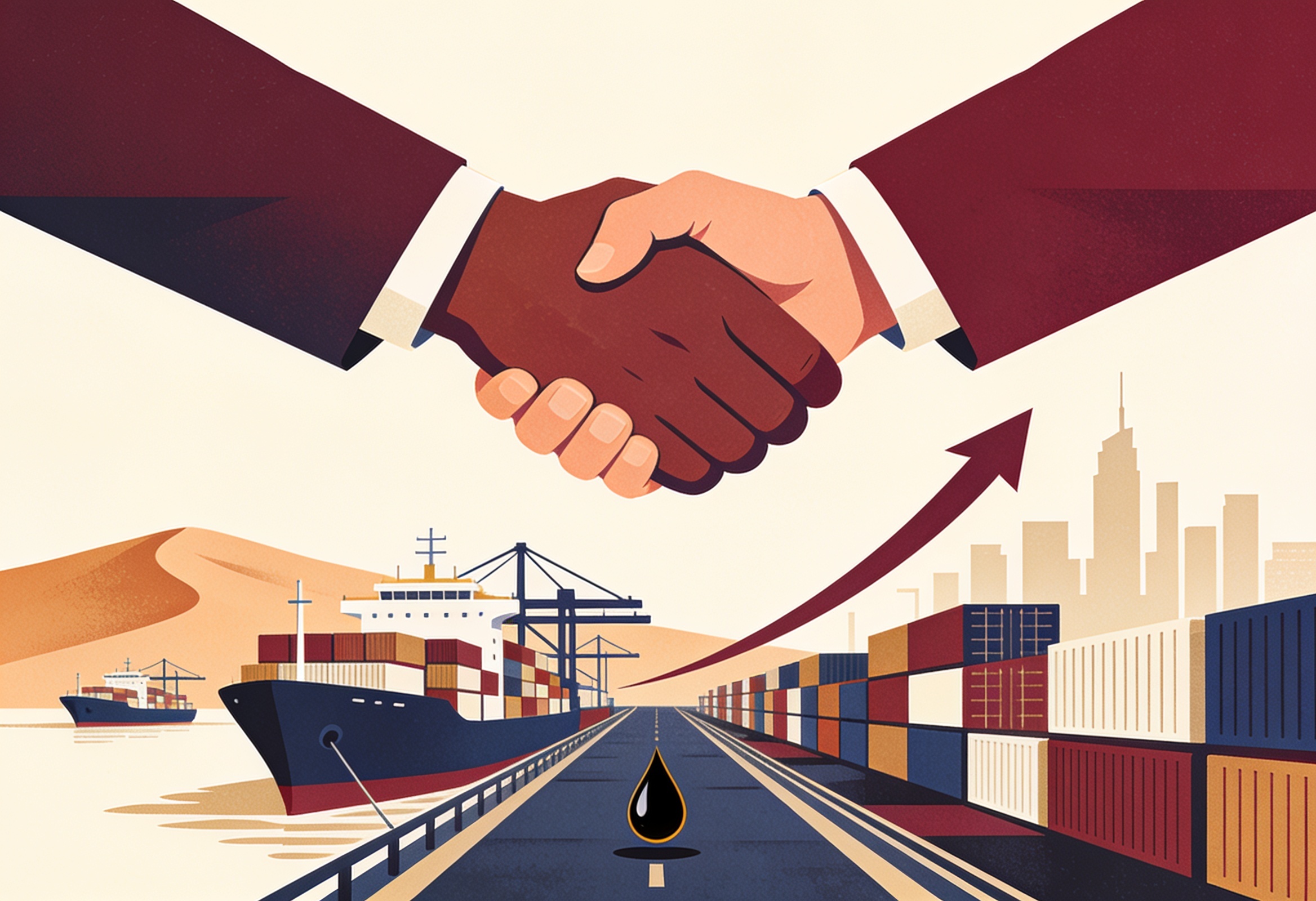
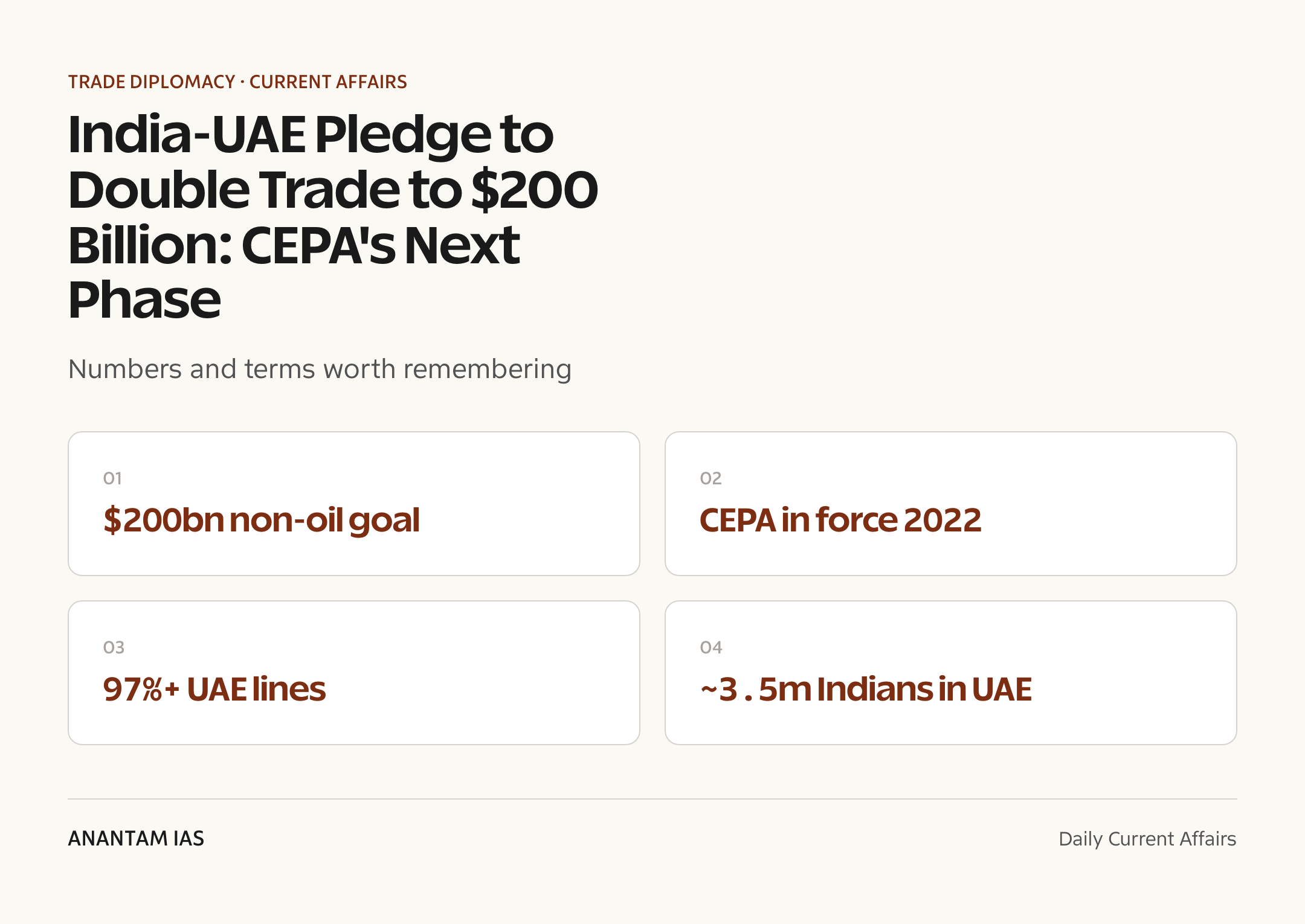
UPSC Relevance
Prelims Relevance
- CEPA — Comprehensive Economic Partnership Agreement; India-UAE pact in force May 2022.
- Distinguish FTA vs PTA vs CEPA vs CECA — depth of liberalisation and coverage of services/investment.
- IMEC — India-Middle East-Europe Economic Corridor, launched at the 2023 G20 Delhi Summit.
- I2U2 grouping — India, Israel, United States, United Arab Emirates.
- Bharat Mart — Indian trade and warehousing hub in Jebel Ali / Dubai.
- UPI-RuPay acceptance and the linkage with the UAE’s domestic card and instant-payment systems.
- UAE as India’s leading West Asia trade partner and a major crude oil and LPG supplier.
- Remittances — India is the world’s top recipient; the Gulf is a dominant source region.
- Non-oil trade as the metric used in the USD 200 billion target.
Mains Relevance
GS Paper 2
- India’s bilateral and regional engagement with West Asia / the Gulf and its strategic stakes.
- Trade agreements as instruments of foreign policy and the role of the diaspora in India-Gulf ties.
GS Paper 3
- Effects of CEPAs/FTAs on India’s external sector, MSME exports and energy security.
- Infrastructure-led connectivity (IMEC, trade hubs) and its bearing on supply-chain resilience.
Essay
- Trade as the quiet diplomacy that outlasts headlines.
- Connectivity corridors and the geo-economics of a multipolar world.
Background and Context
What the CEPA is and why it was a first
The 2022 agreement reset the economic baseline of a long-standing partnership.
- Negotiated in record time and signed in February 2022, the CEPA entered into force on 1 May 2022 — India’s first comprehensive trade pact with a Gulf country.
- It covers goods, services, rules of origin, government procurement, digital trade and dispute settlement, not tariffs alone — a deeper instrument than a plain free trade agreement.
- India offered preferential access on the bulk of UAE tariff lines; the UAE reciprocated on over 97% of its lines by value, opening sectors like gems, textiles, pharma and engineering goods.
- The deal set a declared aim of lifting bilateral trade well past the pre-pact level within five years — the springboard for the USD 200 billion non-oil ambition.
The USD 200 billion non-oil target
The new metric deliberately excludes crude to test the real diversification of trade.
- Total bilateral trade had hovered around USD 80-100 billion, heavily weighted by crude oil and gold.
- Pegging the goal to non-oil trade forces the pivot toward manufactures, food, electronics and services.
- Indian exports gaining ground include engineering goods, gems and jewellery, electronics, textiles and processed food.
- The target functions as a political signal as much as an economic one — a benchmark both governments can be held to.
The new architecture: Bharat Mart, fintech and food corridors
Physical and digital plumbing is being laid to make the headline number reachable.
- Bharat Mart — a Dubai warehousing-cum-showcase hub near Jebel Ali port — gives Indian MSMEs a permanent retail and re-export base into Africa and West Asia.
- The UPI-RuPay linkage extends India’s payment rails into the UAE, easing remittances, tourism spending and small-trade settlement.
- Food corridors position India as a food-security partner for the import-dependent Gulf, with the UAE investing in Indian agri-logistics and warehousing.
- Talks on settling more trade in local currencies (rupee-dirham) aim to cut dollar dependence and transaction costs.
IMEC and the wider connectivity play
The bilateral track sits inside a larger Indo-Gulf-Europe corridor.
- The India-Middle East-Europe Economic Corridor (IMEC), unveiled at the 2023 G20 Delhi Summit, routes goods and data from India through the UAE and Saudi Arabia to Europe.
- It pairs a ship-to-rail logistics spine with energy grids, green-hydrogen pipelines and undersea data cables.
- The UAE is the corridor’s first maritime node west of India, making the bilateral hub investments doubly strategic — see our note on the India-Middle East-Europe Economic Corridor.
- IMEC is widely read as a transparent, market-led alternative to other large connectivity initiatives in the region.
Energy, defence and the strategic frame
Trade rides on a deeper security and energy relationship.
- The UAE is a major supplier of crude oil and LPG and a partner in India’s strategic petroleum reserves.
- Cooperation is growing on clean energy, solar and green hydrogen, with sovereign-fund interest in Indian renewables.
- Defence ties feature joint exercises and the I2U2 (India, Israel, US, UAE) grouping linking food, water, energy and tech.
- The partnership is a pillar of India’s broader ‘Look West’ / West Asia policy.
Diaspora and remittances
People, not just cargo, bind the two economies.
- Roughly 3.5 million Indians live and work in the UAE — among the largest expatriate communities there.
- India is the world’s top recipient of remittances, and the Gulf is a dominant source region for these inflows — a recurring theme in India’s West Asia relations.
- The UPI-RuPay rollout directly lowers the cost of sending money home, raising effective household income.
- Diaspora welfare, fair-recruitment norms and social-security portability are recurring items on the bilateral agenda.
Risks and the critique
The ambition carries real watch-points India must manage.
- Trade-deficit and re-routing concerns — gold and jewellery flows under CEPA drew scrutiny over possible round-tripping and revenue leakage.
- Over-reliance on the Gulf for energy and remittances exposes India to regional instability and oil-price shocks.
- Non-tariff barriers, standards and rules-of-origin enforcement can blunt the headline tariff cuts.
- Geopolitical turbulence in West Asia can disrupt IMEC and shipping lanes, as past Red Sea disruptions showed.
Way Forward
Diversify the basket
- Push non-oil, value-added exports — electronics, pharma, processed food and services — over commodities.
- Use Bharat Mart to onboard MSMEs at scale and convert showroom presence into recurring re-exports.
Tighten safeguards
- Strengthen rules-of-origin checks and customs data-sharing to curb mis-declaration and round-tripping.
- Build a transparent CEPA review mechanism with periodic, published trade-impact assessments.
Operationalise the corridors
- Sequence IMEC investments with port, rail and digital-cable milestones to keep the project bankable.
- Deepen rupee-dirham settlement and the UPI-RuPay rollout to lower friction in everyday trade.
Conclusion
The USD 200 billion pledge is less a forecast than a compass. It commits both capitals to move trade up the value chain — away from crude and bullion and toward manufactures, food, fintech and logistics — with the CEPA as the legal scaffolding and Bharat Mart, IMEC and UPI-RuPay as the working parts.
If India can manage the risks of dependence and mis-routing while delivering on connectivity, the partnership becomes a template for how a CEPA can anchor energy security, diaspora welfare and supply-chain resilience at once — the kind of durable, multi-domain tie that outlives any single summit.
UPSC Practice Questions
Prelims MCQ 1
With reference to the India-UAE Comprehensive Economic Partnership Agreement (CEPA), consider the following statements:
- It was India’s first comprehensive trade agreement with a member of the Gulf Cooperation Council.
- It entered into force in May 2022.
- Its coverage is limited only to trade in goods and tariff concessions.
How many of the above statements are correct?
(a) Only one (b) Only two (c) All three (d) None
Answer: (b) Only two
Explanation:
Statements 1 and 2 are correct — the CEPA was India’s first such pact with a Gulf state and came into force on 1 May 2022. Statement 3 is wrong: it also covers services, government procurement, rules of origin and digital trade.
Prelims MCQ 2
The India-Middle East-Europe Economic Corridor (IMEC) was formally announced on the sidelines of which event?
(a) The 2022 Sharm el-Sheikh COP27 (b) The 2023 G20 Summit in New Delhi (c) The 2023 BRICS Summit in Johannesburg (d) The 2024 Quad Leaders’ Summit
Answer: (b) The 2023 G20 Summit in New Delhi
Explanation:
IMEC was unveiled via a Memorandum of Understanding on the sidelines of the G20 Summit hosted by India in New Delhi in September 2023, linking India through the UAE and Saudi Arabia to Europe.
UPSC Mains Questions
- The India-UAE CEPA is described as the template for India’s engagement with West Asia. Examine how the agreement advances India’s trade, energy and diaspora interests, and the risks it must manage. (250 words)
- Connectivity corridors are emerging as instruments of geo-economics. Discuss the strategic significance of the India-Middle East-Europe Economic Corridor (IMEC) for India, with reference to its bilateral and regional dimensions. (250 words)
- Free trade agreements can deepen dependence as much as they create opportunity. Critically evaluate this statement in the context of India’s economic partnership with the Gulf. (150 words)
Sources: Ministry of Commerce and Industry and Press Information Bureau.
Frequently Asked Questions
What is the India-UAE CEPA?
The Comprehensive Economic Partnership Agreement is a wide-ranging trade pact between India and the United Arab Emirates that entered into force on 1 May 2022. It was India’s first such agreement with a Gulf state, cutting tariffs on most goods and also covering services, government procurement, rules of origin and digital trade.
What does the USD 200 billion target mean?
Both governments have pledged to roughly double their non-oil bilateral trade to about USD 200 billion. The non-oil framing is deliberate — it excludes crude oil and pushes the relationship toward manufactures, food, electronics and services rather than commodities and bullion.
What is Bharat Mart?
Bharat Mart is an Indian trade and warehousing hub being developed near Jebel Ali port in Dubai. It gives Indian MSMEs a permanent showcase, storage and re-export base, helping them reach markets across West Asia, Africa and Europe through the UAE’s logistics network.
How does IMEC relate to India-UAE trade?
The India-Middle East-Europe Economic Corridor, announced at the 2023 G20 Delhi Summit, routes goods, energy and data from India through the UAE and Saudi Arabia to Europe. The UAE is the corridor’s first major maritime node west of India, which is why bilateral hub and port investments are strategically important.
Why are remittances central to the relationship?
Around 3.5 million Indians live and work in the UAE, and the Gulf is a dominant source of the remittances India receives — the largest such inflow of any country. The UPI-RuPay payment linkage lowers transfer costs, directly raising the value of money sent home.
What are the main risks in the partnership?
Key concerns include a widening trade deficit, possible mis-routing of gold and jewellery flows, heavy dependence on the Gulf for energy and remittances, and the exposure of corridors like IMEC to regional instability and shipping disruptions.
Source: https://anantamias.com/current-affairs/india-uae-trade-200-billion-2026/
The Responsible Nations Index: A New Lens on Global Responsibility
Why in News?
India has launched the Responsible Nations Index (RNI), a new assessment framework that ranks countries by their actual conduct as global citizens rather than by income or institutional checklists alone. The launch positions India as a norm-setter that authors its own metrics instead of only being measured by indices designed in the West.
The RNI scores nations across responsibility themes such as climate action and per-capita/historical emissions, equity, contribution to peace, debt sustainability, and development cooperation — reframing ‘responsibility’ around fairness to the developing world rather than compliance with a developed-world template.
- A made-in-India index that judges nations on responsible global conduct, not just GDP or governance optics.
- Core pillars span climate equity, peace and conflict footprint, debt sustainability, and development cooperation.
- Emphasises per-capita and historical emissions, embedding Common But Differentiated Responsibilities (CBDR) into the scoring.
- Advances India’s pitch as the Voice of the Global South and a credible alternative knowledge producer.
- Frames a direct critique of Western-authored indices seen as opaque, ideologically loaded, or biased against developing economies.
The development matters in the context of:
- Global rankings shape credit ratings, aid flows, FDI and diplomatic leverage — so who builds the index wields real power.
- It operationalises ‘Vasudhaiva Kutumbakam’ (the world is one family), the theme India carried through its G20 presidency.
- Lands amid India’s push for reformed multilateralism and a louder developing-world seat at global high tables.
UPSC Relevance
Prelims Relevance
- Responsible Nations Index (RNI) — purpose, broad parameters, India-led origin.
- Common But Differentiated Responsibilities (CBDR) — principle under the UNFCCC and Paris Agreement.
- Distinction between per-capita, absolute and historical (cumulative) emissions.
- Voice of the Global South Summit — India-hosted platform for developing nations.
- Vasudhaiva Kutumbakam — its appearance as India’s G20 theme.
- Major existing indices for comparison — Human Development Index (UNDP), SDG Index, Climate Change Performance Index.
- Soft power and ‘normative power’ as instruments of foreign policy.
- Difference between a composite index and a single-indicator ranking.
Mains Relevance
GS Paper 2
- India’s evolving role in shaping global norms and its bid for reformed multilateralism and Global-South leadership.
- Indices as instruments of foreign policy and soft power — agenda-setting through metrics rather than military or economic coercion.
- Effect of bilateral, regional and global groupings and agreements involving and affecting India’s interests.
GS Paper 3
- Climate-change negotiations through the lens of equity, CBDR and historical responsibility.
- Sustainable development metrics and the politics of measuring environmental and developmental performance.
Essay
- He who controls the measure controls the meaning — on who gets to define global ‘responsibility’.
- Justice without fairness is hollow: equity in the age of climate and debt.
Background and Context
What the Responsible Nations Index sets out to measure
The RNI is a composite framework that scores nations on how responsibly they act toward the planet and toward fellow nations, not on wealth alone.
- Bundles several responsibility themes into one comparable score, in the manner of a composite index (like the HDI).
- Climate responsibility — judged through per-capita and historical emissions, so heavy historical polluters cannot hide behind recent cuts.
- Equity — fairness in trade, technology access and the distribution of global burdens.
- Peace — a nation’s contribution to or disruption of global stability and conflict.
- Debt sustainability — responsible lending and the debt distress faced by developing borrowers.
- Development cooperation — aid, capacity-building and South-South partnership rather than extraction.
Why India is building its own index
The launch reflects a deliberate shift from being only measured by others to authoring the yardstick itself.
- Most influential rankings originate in the Global North or Western think-tanks, embedding their priorities and assumptions.
- India argues several indices are opaque in methodology, subjective in their proxies, and structurally unfavourable to developing economies.
- Authoring a credible index is an act of agenda-setting — it reframes what ‘good behaviour’ on the world stage even means.
- Reinforces India’s self-image as the Voice of the Global South and a bridge between developed and developing blocs.
- Sits alongside India’s call for reformed multilateralism and a fairer global governance architecture.
Climate equity and the CBDR backbone
By weighting per-capita and historical emissions, the RNI hard-codes the equity argument India has long pressed in climate talks.
- CBDR-RC (Common But Differentiated Responsibilities and Respective Capabilities) is a founding principle of the UNFCCC and the Paris Agreement.
- It holds that all nations share the climate burden, but those with greater historical emissions and capacity must do more.
- Ranking by per-capita rather than absolute emissions reframes which countries are the bigger per-head polluters.
- Historical (cumulative) emissions capture the carbon already in the atmosphere from early industrialisers.
- This counters narratives that judge developing nations purely on their current absolute output.
Index diplomacy and soft power
The RNI is an exercise in soft power — shaping global conversation through ideas and metrics, not coercion.
- Soft power is the ability to influence others through attraction, legitimacy and agenda-setting.
- Indices act as normative tools: they reward the behaviour they choose to measure and quietly penalise the rest.
- A widely-cited index gives India a recurring platform to frame debates on climate, debt and development.
- It complements India-led platforms such as the Voice of the Global South Summit and the International Solar Alliance.
- Builds on the goodwill of India’s G20 presidency and its ‘Vasudhaiva Kutumbakam’ framing.
How it compares with existing rankings
Several global indices already rate countries on slices of development and sustainability — the RNI distinguishes itself on framing and authorship.
- Human Development Index (UNDP) — health, education and income, but silent on a nation’s external conduct.
- SDG Index — tracks progress on the Sustainable Development Goals, largely an inward scorecard.
- Climate Change Performance Index — climate policy and emissions, but built by Western civil-society bodies.
- The RNI’s novelty is the ‘responsibility to others’ lens — peace, debt, cooperation — and its Global-South authorship.
- Its credibility will hinge on transparent methodology, verifiable data, and independence from political framing.
Criticisms and credibility risks
Any new index, especially a state-launched one, must guard against the very flaws it accuses others of.
- Perceived bias — a government-backed index risks being dismissed as self-serving unless governance is arm’s-length.
- Data quality — comparable, audited cross-country data on peace and cooperation is genuinely hard to assemble.
- Indicator selection — which themes are weighted, and how, embeds value judgments that critics will probe.
- Index fatigue — the global space is crowded; uptake by other governments and bodies is not guaranteed.
- Long-term influence depends on peer-reviewed transparency, not just diplomatic launch momentum.
Way Forward
Methodological credibility
- Publish a transparent, peer-reviewed methodology with open data sources and clear weightings.
- House the index in an arm’s-length body to insulate it from accusations of political framing.
Coalition-building
- Co-develop and validate the framework with Global-South partners and multilateral institutions to widen ownership.
- Anchor it to existing India-led platforms to give it a recurring institutional home and audience.
Sustained influence will come less from the launch and more from consistent annual releases, independent scrutiny, and demonstrable use of the rankings in real climate, debt and cooperation debates.
Conclusion
The Responsible Nations Index marks a shift from India being only a subject of global rankings to becoming an author of them. By re-centring the conversation on climate equity, peace, debt and cooperation, it embeds the developing world’s fairness concerns into the very act of measurement.
Its lasting value will rest on credibility, not optics. If the RNI stays transparent, evidence-driven and genuinely independent, it can mature into a durable instrument of India’s soft power and its push for reformed, more equitable multilateralism.
UPSC Practice Questions
Prelims MCQ 1
With reference to the principle of Common But Differentiated Responsibilities (CBDR), consider the following statements:
- It is a core principle under the UNFCCC and the Paris Agreement.
- It requires all countries to undertake identical, uniform emission-reduction commitments.
- It recognises the greater responsibility of nations with higher historical emissions and capacity.
How many of the above statements are correct?
(a) Only one (b) Only two (c) All three (d) None
Answer: (b) Only two
Explanation:
Statements 1 and 3 are correct. Statement 2 is wrong — CBDR explicitly rejects identical obligations, differentiating duties by historical contribution and respective capabilities.
Prelims MCQ 2
The ‘Responsible Nations Index’, launched by India, is best described as which of the following?
(a) A credit-rating system issued by the Reserve Bank of India (b) A composite index assessing countries on responsible global conduct such as climate equity, peace, debt sustainability and development cooperation (c) A United Nations treaty binding members to emission targets (d) A ranking of Indian states on environmental performance
Answer: (b) A composite index assessing countries on responsible global conduct such as climate equity, peace, debt sustainability and development cooperation
Explanation:
The RNI is an India-launched composite index ranking nations on their conduct as global citizens — climate equity, peace, debt and cooperation — not a credit rating, a treaty, or a state-level ranking.
UPSC Mains Questions
- Indices are increasingly instruments of foreign policy rather than neutral scorecards. In this context, examine the significance of India launching its own Responsible Nations Index for its Global-South leadership. (250 words)
- Discuss how the principles of climate equity and Common But Differentiated Responsibilities shape India’s stance in global climate negotiations, and how a responsibility-based index could advance that position. (250 words)
- ‘He who frames the metric frames the debate.’ Critically analyse the opportunities and credibility risks of state-launched global indices, with reference to the Responsible Nations Index. (150 words)
Sources: Ministry of External Affairs, Government of India and The Hindu.
Frequently Asked Questions
What is the Responsible Nations Index?
It is a composite index, launched by India, that ranks countries on how responsibly they act as global citizens. Instead of measuring wealth or governance checklists alone, it scores nations on themes such as climate action, equity, contribution to peace, debt sustainability, and development cooperation toward the developing world.
Why did India launch its own index?
Most influential global rankings originate in the West and embed its priorities. India argues several are opaque or biased against developing economies. By authoring its own credible index, India sets the agenda, reframes what ‘responsible’ conduct means, and strengthens its claim to be the Voice of the Global South.
How does the index treat climate responsibility?
It weights per-capita and historical (cumulative) emissions, not just current absolute output. This reflects the Common But Differentiated Responsibilities principle under the UNFCCC and Paris Agreement, ensuring early industrialisers who put most carbon into the atmosphere are judged on that historical burden rather than recent cuts alone.
How is the RNI different from the Human Development Index?
The HDI measures a country’s internal development — health, education and income. The Responsible Nations Index instead looks outward, at a nation’s conduct toward the rest of the world: its climate footprint, peace contribution, debt practices and cooperation. Its other distinction is its Global-South authorship rather than a Western origin.
What is index diplomacy?
Index diplomacy is the use of rankings and metrics as soft-power tools. Because indices reward the behaviour they choose to measure, the body that builds a widely-cited index gains agenda-setting power over global debates. Launching the RNI lets India shape conversations on climate, debt and development without coercion.
What are the main criticisms of such an index?
A government-backed index risks being seen as self-serving unless it is arm’s-length and transparent. Comparable cross-country data on peace and cooperation is hard to assemble, indicator weighting embeds value judgments, and the crowded ranking space makes uptake uncertain. Lasting credibility depends on peer-reviewed, independent methodology.
Source: https://anantamias.com/current-affairs/responsible-nations-index-2026/
Atal Pension Yojana Extension to 2030-31: Social Security for Informal Workers
The Union Cabinet approved continuation of Atal Pension Yojana and extended central funding support for promotional, development and gap-funding activities until 2030-31. The decision keeps India’s flagship pension scheme for informal workers on the policy table at a time when old-age security is becoming a sharper governance question.
For UPSC, APY is useful because it sits at the intersection of welfare design, financial inclusion, demographic transition and fiscal risk. It is not just a scheme to memorise. It is a test case for how India can build a pension floor for workers who do not have formal employer-backed retirement savings.
This article reads the January 2026 APY extension through a GS-II welfare and GS-III economy lens, with attention to design strengths, coverage gaps and the hard question of sustainable old-age income support.
Quick Facts
- Cabinet approval came in January 2026 for continuation and funding support until 2030-31.
- APY was launched on 9 May 2015 to provide old-age income security, especially to unorganised-sector workers.
- Subscribers receive a guaranteed monthly pension of Rs 1,000 to Rs 5,000 after the age of 60, depending on contribution.
- Official data cited over 8.66 crore subscribers as of 19 January 2026.
- The scheme is administered through banks and post offices with PFRDA oversight.
- It is part of the Jan Suraksha architecture alongside PMJJBY and PMSBY.
- Official source: Prime Minister's Office.
What Just Happened
The Cabinet decision continued the Atal Pension Yojana framework and approved support for promotion, development activities and gap funding until 2030-31. The government framed the move as part of its broader effort to deepen financial security among the unorganised workforce.
The timing matters because India is still a young country, but the absolute number of elderly citizens is rising fast. A pension architecture built only around formal employment will miss domestic workers, agricultural labourers, street vendors, gig workers, small traders and other self-employed workers.
APY’s design gives a defined benefit at retirement while requiring regular contributions during working age. The state does not replace household savings. It nudges and supports them through a regulated, low-ticket pension product.
Background and Historical Context
India’s pension system has long been fragmented. Government employees were covered by defined benefits earlier and then by the National Pension System. Formal private-sector workers may access EPFO. The large informal workforce, however, historically relied on family support, land, gold, small savings and community networks.
The National Pension System Lite and Swavalamban attempted to address this gap but could not produce mass traction. APY simplified the proposition by offering a guaranteed pension slab and using the bank-account infrastructure created by Jan Dhan.
The scheme reflects a larger welfare shift: from one-time subsidies to lifecycle social protection. Health insurance, accident insurance, life insurance and pensions are increasingly seen as part of a minimum protection floor.
Key Features of Atal Pension Yojana
The core policy architecture can be read through these features.
- Eligibility: Indian citizens in the eligible entry-age band with a savings bank or post-office account can subscribe, subject to scheme rules.
- Benefit structure: Pension slabs range from Rs 1,000 to Rs 5,000 per month after 60 years of age.
- Contribution logic: Younger entry lowers the monthly contribution burden and rewards early participation.
- Institutional anchor: Banks, post offices and PFRDA form the delivery and regulatory backbone.
- Target group: The main policy focus is workers outside formal pension coverage.
- Continuation support: The 2026 decision funds promotion and development so that enrolment does not stall after the first decade.
Why It Matters
This is a high-yield UPSC topic because it joins current news with durable syllabus themes.
- It gives GS-II material on welfare delivery and social justice for informal workers.
- It gives GS-III material on household savings, financial inclusion and fiscal sustainability.
- It connects to ageing, demographic dividend and the future burden of non-contributory welfare.
- It lets aspirants compare contributory and tax-funded social protection models.
Detailed Analysis: Social Security Lens
The design is administratively elegant. APY rides on bank accounts and auto-debit, which keeps transaction costs low. The guaranteed pension also makes the product easier to explain than market-linked retirement savings.
The adequacy question is real. A Rs 1,000-5,000 monthly pension is not enough for urban old-age expenses. APY should be treated as a floor, not a complete retirement solution.
Continuity matters more than enrolment. A pension scheme succeeds only when contributions remain active for decades. Dormancy, irregular income and migration can weaken APY unless banks, post offices and local institutions keep workers engaged.
Comparative Perspective
A comparison helps prevent the answer from becoming a one-dimensional news summary.
- NPS: market-linked, retirement-oriented and suitable for formal or higher-income contributors.
- EPFO: payroll-based and linked to formal employment.
- PM-SYM: designed for unorganised workers but with limited uptake compared with APY.
- APY: simpler, bank-led and built around guaranteed pension slabs.
Challenges
The policy or institutional promise runs into recurring constraints.
- Pension adequacy is low when compared with expected old-age living costs.
- Irregular incomes make auto-debit failures common among informal workers.
- Women workers, migrant workers and seasonal workers need more targeted enrolment support.
- Financial literacy remains a binding constraint in understanding long-term contribution products.
- A guaranteed pension creates long-term fiscal exposure if assumptions on returns and longevity change.
Prelims Pointers
- APY was launched in 2015.
- The scheme is regulated by PFRDA.
- It provides guaranteed pension slabs after the subscriber reaches 60 years.
- It is a contributory pension scheme, not a pure tax-funded pension.
- Banks and post offices are important enrolment channels.
- APY is part of India’s wider financial-inclusion architecture.
Mains Questions
- Atal Pension Yojana reflects a shift from welfare as relief to welfare as lifecycle risk management. Discuss. (GS Paper II, 250 words)
- Evaluate the role of contributory pension schemes in providing old-age security to India’s informal workforce. (GS Paper III, 250 words)
- What are the design limitations of APY? Suggest reforms to improve adequacy, continuity and inclusion. (GS Paper II, 150 words)
- Financial inclusion must move from account ownership to meaningful financial security. Examine with reference to APY. (GS Paper III, 250 words)
Way Forward
APY needs enrolment drives that are more worker-specific. Street vendors, gig workers, women self-help group members and migrant workers need different communication and contribution-support models.
Contribution flexibility would improve persistence. Informal workers often earn in bursts, so monthly auto-debit alone may not match their income pattern.
The larger goal should be a layered old-age security system: APY as a pension floor, health insurance for medical shocks, and targeted non-contributory assistance for the poorest elderly.
The examiner is unlikely to reward a bare fact dump here. The better answer connects the January 2026 event to institutional design, implementation capacity and India’s long-term development priorities.
Frequently Asked Questions
What did the Cabinet approve in January 2026?
It approved continuation of Atal Pension Yojana and extended funding support for promotional, development and gap-funding activities until 2030-31.
Who is APY mainly designed for?
It is mainly designed for workers outside formal pension coverage, especially unorganised-sector and self-employed workers.
What pension does APY provide?
Depending on contribution and entry age, APY provides a guaranteed monthly pension of Rs 1,000 to Rs 5,000 after the subscriber turns 60.
Which regulator is associated with APY?
The Pension Fund Regulatory and Development Authority is the key regulator for pension architecture, including APY.
Why is APY important for UPSC?
It links financial inclusion with social justice, ageing, informal employment and fiscal sustainability.
What is the main criticism of APY?
The guaranteed pension slabs are useful as a floor, but they may be inadequate for future old-age living costs.
Source: https://anantamias.com/current-affairs/atal-pension-yojana-extension-2030-31/
Inclusive Education Summit 2026: CWSN, Accessibility and NEP 2020
The Ministry of Education’s Inclusive Education Summit in January 2026 highlighted the schooling needs of children with disabilities and other disadvantaged learners. The event placed accessibility, assistive technology and teacher capacity in the spotlight.
For UPSC, inclusive education is not charity. It is a constitutional and developmental obligation linked to equality, dignity, human capital and the right to education.
This article explains the summit through the lens of CWSN inclusion, NEP 2020, RPwD Act and school-level implementation gaps.
Quick Facts
- The summit was held in January 2026 by the Ministry of Education.
- CWSN means Children With Special Needs.
- Inclusive education is linked to NEP 2020 and the Rights of Persons with Disabilities Act, 2016.
- Accessibility includes infrastructure, learning material, assistive devices and teacher support.
- Samagra Shiksha supports inclusive education interventions.
- Official source: PIB Ministry of Education release dated 21 January 2026.
- Official source: PIB, Ministry of Education.
What Just Happened
The summit brought policy attention to inclusive education and the practical barriers faced by children with disabilities.
The event highlighted the need for accessible schools, trained teachers, assistive technology and social acceptance.
For aspirants, this is a strong GS-II topic because it connects rights-based law with everyday delivery in classrooms.
Background and Historical Context
India’s disability-rights framework includes the RPwD Act, 2016, which expanded recognised disabilities and strengthened rights-based language.
The Right to Education Act and Samagra Shiksha provide school-level frameworks, while NEP 2020 emphasises equitable and inclusive education.
The challenge is implementation. A child may be enrolled but excluded if classrooms, transport, toilets, books, pedagogy and attitudes are inaccessible.
Key Features of Inclusive Education
The core policy architecture can be read through these features.
- Accessibility: ramps, toilets, transport, digital content and classroom design matter.
- Assistive technology: devices and software can support learning.
- Teacher capacity: teachers need training in inclusive pedagogy.
- Legal anchor: RPwD Act and RTE create rights-based obligations.
- Social inclusion: stigma and low expectations must be addressed.
- Data need: states need accurate CWSN identification and tracking.
Why It Matters
This is a high-yield UPSC topic because it joins current news with durable syllabus themes.
- It connects a January 2026 event with durable UPSC syllabus themes.
- It gives usable facts for Prelims and analytical hooks for Mains.
- It helps students move from news recall to policy reasoning.
- It can be linked with static concepts in polity, economy, governance, science, environment or society.
Detailed Analysis: Inclusive Education Lens
Enrolment is not inclusion. A child sitting in school but unable to access learning material is still excluded.
Universal design is better than afterthought accommodation. Schools should be built for diverse learners from the start.
Teacher training is the decisive variable. Inclusive education fails when responsibility is pushed only to special educators.
Comparative Perspective
A comparison helps prevent the answer from becoming a one-dimensional news summary.
- Special schools: separate settings for children with specific disabilities.
- Inclusive education: mainstream schools adapt to diverse learners.
- Integrated education: learners enter mainstream settings but support may remain limited.
- Universal design: designs systems usable by the widest range of learners.
Challenges
The policy or institutional promise runs into recurring constraints.
- Schools may lack ramps, accessible toilets and transport.
- Teacher training in inclusive pedagogy is limited.
- Assistive devices are often delayed or poorly maintained.
- Disability data can be incomplete.
- Stigma and low expectations reduce participation.
Prelims Pointers
- RPwD Act, 2016 expanded recognised disabilities.
- CWSN means Children With Special Needs.
- NEP 2020 emphasises equitable and inclusive education.
- Samagra Shiksha supports inclusive education.
- Universal Design for Learning is an approach to accessible pedagogy.
- Reasonable accommodation is a key disability-rights principle.
Mains Questions
- Inclusive education requires system redesign, not only special provisions. Discuss. (GS Paper II, 250 words)
- How does the RPwD Act strengthen the rights-based approach to education? (GS Paper II, 150 words)
- Enrolment without accessibility is not inclusion. Analyse. (GS Paper II, 250 words)
- What reforms are needed to make government schools disability-inclusive? (GS Paper II, 250 words)
Way Forward
States should audit school accessibility, train all teachers in inclusive pedagogy and integrate assistive technology procurement with classroom support.
CWSN data should track attendance, learning and transition, not merely enrolment.
For Mains, connect inclusion with dignity, equality, Article 21A, social justice and human capability.
The examiner is unlikely to reward a bare fact dump here. The better answer connects the January 2026 event to institutional design, implementation capacity and India’s long-term development priorities.
Frequently Asked Questions
What is inclusive education?
It means schools adapt so that children with disabilities and diverse needs can learn with others meaningfully.
What does CWSN mean?
Children With Special Needs.
Which law is important?
The Rights of Persons with Disabilities Act, 2016 is central.
How does NEP 2020 connect?
It emphasises equitable and inclusive education.
What is the main implementation gap?
Accessible infrastructure, trained teachers and assistive support remain uneven.
Why is this relevant for UPSC?
It links education, social justice, rights and governance delivery.
Source: https://anantamias.com/current-affairs/inclusive-education-summit-2026/
Removing a Judge: The Tough Law and Its Loophole
Why in News?
Debates over judicial conduct have again put the spotlight on how India actually removes a tainted judge — a process so demanding that it has never once succeeded. The procedure for the higher judiciary rests on Article 124(4) and Article 124(5) for the Supreme Court, extended to High Courts by Article 217(1)(b), and operationalised by the Judges (Inquiry) Act, 1968.
The headline fact is stark: not a single judge of the higher judiciary has been removed since the Constitution came into force. The closest case, that of Justice V. Ramaswami, collapsed on the floor of the Lok Sabha in 1993 despite an adverse inquiry finding.
- Removal needs a motion signed by 100 Lok Sabha or 50 Rajya Sabha members before it can even be admitted.
- The only constitutional grounds are “proved misbehaviour or incapacity” — there is no removal for ordinary error or unpopular judgments.
- Each House must pass the motion by a special majority — a majority of total membership and two-thirds of members present and voting.
- The Justice V. Ramaswami motion failed in 1993 when the ruling party abstained, leaving the two-thirds threshold unmet.
- There is no in-between sanction: anything short of removal falls to an informal in-house procedure with no statutory teeth.
The development matters in the context of:
- Matters because it sits at the core of the judicial independence versus accountability balance the Constitution tries to strike.
- Matters because the NJAC verdict (2015) reaffirmed judicial primacy in appointments, sharpening the question of who disciplines judges.
- Matters because a high removal bar protects judges from political reprisal but leaves lesser misconduct effectively unpunished.

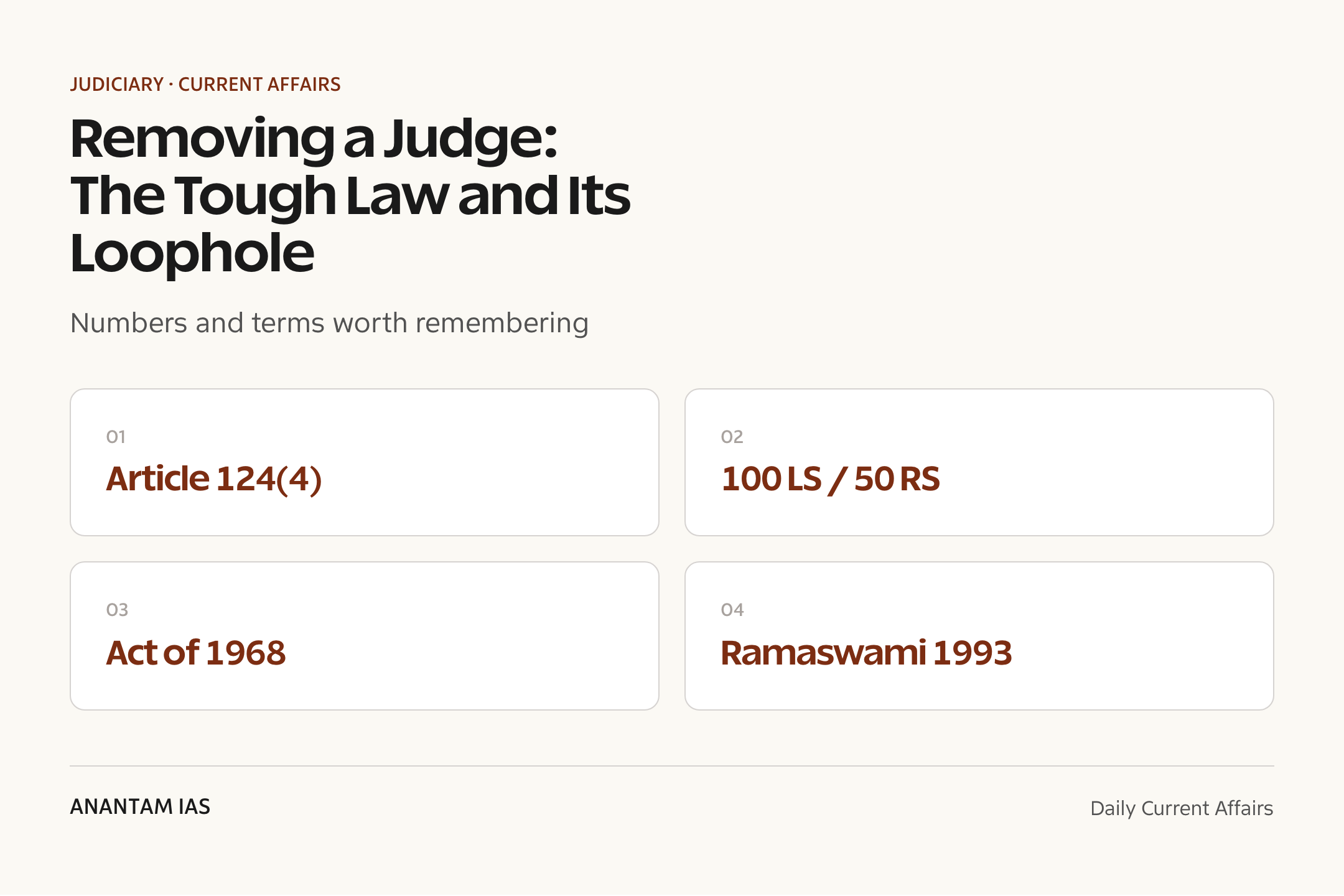
UPSC Relevance
Prelims Relevance
- Article 124(4) — grounds and procedure for removal of Supreme Court judges
- Article 124(5) — Parliament’s power to regulate the investigation procedure
- Article 217(1)(b) — removal of High Court judges by the same process
- Judges (Inquiry) Act, 1968 — three-member inquiry committee
- Motion threshold — 100 Lok Sabha / 50 Rajya Sabha members
- Special majority — total-membership majority + two-thirds present and voting
- “Proved misbehaviour or incapacity” — the only constitutional grounds
- Justice V. Ramaswami case (1993) — first and failed removal attempt
- In-house procedure — Supreme Court’s non-statutory mechanism (1999)
- NJAC struck down in 2015 — Article 124A held unconstitutional
Mains Relevance
GS Paper 2
- Examine whether the impeachment process for judges balances independence against accountability.
- Discuss the accountability gap below removal and the case for a graded sanctions framework.
GS Paper 2
- Evaluate the role of the collegium and the in-house procedure in maintaining judicial integrity.
Essay
- “Independence without accountability is a license; accountability without independence is a cage.”
- The unfinished architecture of judicial self-regulation in a constitutional democracy.
Background and Context
The constitutional design
The Constitution deliberately makes removal hard, treating security of tenure as a pillar of judicial independence.
- Article 124(4) says a Supreme Court judge can be removed only by a presidential order passed after an address by each House supported by a special majority, on grounds of “proved misbehaviour or incapacity”.
- Article 124(5) empowers Parliament to regulate by law the procedure for presentation of the address and for the investigation and proof of the misbehaviour or incapacity.
- Article 217(1)(b) applies the identical mechanism to judges of the High Courts — see our explainer on the removal of judges of the High Court and Supreme Court.
- The word “impeachment” is journalistic shorthand; the Constitution speaks of removal by address, distinct from the US-style impeachment of the President under Article 61.
- Security of tenure until 65 years (Supreme Court) and 62 years (High Courts), barring removal, shields judges from executive pressure.
How the machinery actually runs
The Judges (Inquiry) Act, 1968 turns the constitutional grounds into a multi-stage gauntlet.
- A removal motion must be signed by at least 100 members of the Lok Sabha or 50 members of the Rajya Sabha and submitted to the Speaker or Chairman.
- The presiding officer may admit or reject the motion; if admitted, a three-member committee is constituted to investigate.
- The committee comprises a Supreme Court judge, a Chief Justice of a High Court, and a distinguished jurist.
- Only if the committee finds the judge guilty does the motion go to a vote; each House must clear it by a special majority in the same session.
- On both Houses passing the address, the President issues the order of removal — the only formal trigger to end a sitting judge’s tenure.
Why it has never worked: the Ramaswami precedent
The single serious attempt exposed how political arithmetic, not proven facts, decides the outcome.
- Justice V. Ramaswami of the Supreme Court faced charges of financial impropriety from his time as Chief Justice of the Punjab and Haryana High Court.
- An inquiry committee under the 1968 Act found him guilty on several counts, the first such adverse finding against a sitting judge.
- When the motion reached the Lok Sabha in 1993, the ruling party abstained from voting on a legal-political reasoning.
- With abstentions counted against the threshold, the motion fell short of the required two-thirds of those present and voting and failed.
- Later attempts against other judges, including Justice Soumitra Sen (who resigned in 2011 before the Lok Sabha could vote), reinforced that resignation, not removal, ends such episodes.
The loophole: an accountability gap below removal
Because removal is the only constitutional sanction, lesser misconduct escapes any binding penalty.
- There is no mechanism short of removal — no censure, suspension, fine, or reprimand with statutory force — for conduct that is improper but not impeachable.
- The in-house procedure, adopted by the Supreme Court in 1999, lets the Chief Justice order a peer inquiry, but its findings carry no legal sanction and can at most recommend resignation or withdrawal of work.
- The high signature and majority thresholds make removal hostage to party strength and floor management rather than the merits of the charge.
- The lapsed Judicial Standards and Accountability Bill, 2010 sought a complaints mechanism and minor penalties but was never enacted.
- Critics argue this leaves a graded-sanctions vacuum: either the judge stays untouched or faces the near-impossible bar of removal.
Appointments, NJAC and the wider accountability debate
Who selects and who disciplines judges are two halves of the same independence question.
- The collegium system, evolved through the Second and Third Judges cases, gives the judiciary primacy over appointments and transfers; we trace the contest in Collegium vs NJAC.
- The National Judicial Appointments Commission (NJAC) and the 99th Constitutional Amendment were struck down by the Supreme Court in 2015 for breaching the basic-structure doctrine protecting judicial independence.
- With self-appointment entrenched, the absence of a robust removal-and-discipline channel draws sharper criticism of self-regulation without external check.
- The contempt of court power further insulates judges from public criticism, adding to the perception of an accountability deficit.
- Comparators like the UK’s Judicial Conduct Investigations Office and tiered-sanction models abroad are often cited in reform proposals.
Way Forward
Build a graded-sanctions framework
- Enact a statutory mechanism allowing minor penalties — warning, censure, withdrawal of judicial work — for misconduct below the removal threshold.
- Revive the substance of the lapsed Judicial Standards and Accountability Bill with a credible complaints process and timelines.
Strengthen and formalise internal review
- Give the in-house procedure statutory backing and transparency so its findings carry consequence.
- Adopt and publicise a binding code of judicial conduct across the higher judiciary.
Insulate the inquiry stage from political arithmetic by ensuring that an adverse finding under the Judges (Inquiry) Act carries clearer consequence, while protecting genuine independence from executive or legislative reprisal.
Conclusion
The removal process is a deliberate paradox: built to be almost impossible to use, so that a judge fears no reprisal for an unpopular but lawful verdict. That same design becomes a loophole when the only available sanction is the one nobody can realistically deploy.
Closing the gap is not about making removal easy — it is about adding graded, credible sanctions between a clean record and impeachment, so accountability does not collapse into all-or-nothing. The challenge is to discipline misconduct without denting the independence the Constitution guards.
UPSC Practice Questions
Prelims MCQ 1
With reference to the removal of a judge of the Supreme Court of India, consider the following statements:
- The only constitutional grounds are proved misbehaviour or incapacity.
- A removal motion in the Rajya Sabha requires the signatures of at least 50 members.
- Each House must pass the motion by a simple majority of members present and voting.
How many of the above statements are correct?
(a) Only one (b) Only two (c) All three (d) None
Answer: (b) Only two
Explanation:
Statements 1 and 2 are correct. Statement 3 is wrong: passage needs a special majority — a majority of the total membership of the House and at least two-thirds of members present and voting, not a simple majority.
Prelims MCQ 2
Which one of the following correctly describes the inquiry committee under the Judges (Inquiry) Act, 1968?
(a) The President, the Chief Justice of India and the Attorney General (b) A Supreme Court judge, a Chief Justice of a High Court and a distinguished jurist (c) The Speaker, the Chairman of the Rajya Sabha and a retired Chief Justice (d) Three members of the collegium nominated by the Chief Justice of India
Answer: (b) A Supreme Court judge, a Chief Justice of a High Court and a distinguished jurist
Explanation:
Under the 1968 Act, the three-member committee that investigates the charges comprises a sitting Supreme Court judge, a Chief Justice of a High Court and a distinguished jurist.
UPSC Mains Questions
- The Constitution makes the removal of a higher-judiciary judge almost impossible by design. Examine how this protects judicial independence yet creates an accountability gap, and suggest reforms short of diluting security of tenure. (250 words)
- “India’s judiciary appoints itself but cannot effectively discipline itself.” Critically analyse this statement in light of the collegium system, the NJAC verdict and the removal process under Article 124(4). (250 words)
- Discuss the adequacy of the in-house procedure and the Judges (Inquiry) Act, 1968 in addressing judicial misconduct that falls short of the removal threshold. (150 words)
Sources: Constitution of India; Judges (Inquiry) Act, 1968 and Supreme Court of India.
Frequently Asked Questions
What are the grounds to remove a judge?
The Constitution permits removal only on two grounds: proved misbehaviour or incapacity, under Article 124(4) for the Supreme Court and Article 217 for the High Courts. There is no removal for unpopular judgments, ordinary errors of law, or mere allegations. The misconduct must be formally proved through the statutory inquiry before Parliament can even vote on the address.
Has any Indian judge ever been removed?
No. Since the Constitution came into force, no judge of the higher judiciary has been removed. The nearest case was Justice V. Ramaswami in 1993, where an inquiry committee found him guilty but the Lok Sabha motion failed when the ruling party abstained. Others, such as Justice Soumitra Sen, resigned before a final vote, so removal has never actually been completed.
Is impeachment the right word for this process?
Not strictly. “Impeachment” is popular shorthand. The Constitution describes removal by an address of both Houses to the President, not impeachment in the US sense. True impeachment in India applies only to the President under Article 61. For judges, the correct term is removal under Article 124(4) read with the Judges (Inquiry) Act, 1968.
What majority is needed in Parliament?
Each House must pass the removal motion by a special majority in the same session — a majority of the total membership of that House and at least two-thirds of the members present and voting. The motion must also first be admitted, requiring signatures of 100 Lok Sabha or 50 Rajya Sabha members, making the overall threshold extremely demanding to meet.
What is the in-house procedure?
The in-house procedure is a non-statutory mechanism the Supreme Court adopted in 1999. It lets the Chief Justice order a peer inquiry into a judge’s conduct. But its findings carry no legal sanction; at most it can recommend that the judge resign or be denied judicial work. It fills part of the gap below removal, though without binding teeth.
Why is the removal process called a loophole?
Because removal is the only constitutional sanction, there is nothing in between a clean record and impeachment. Misconduct that is improper but not grave enough for removal escapes any binding penalty — no censure, fine, or suspension with statutory force. This all-or-nothing design, combined with high political thresholds, leaves an accountability gap critics call the loophole.
Source: https://anantamias.com/current-affairs/judicial-removal-impeachment-law-2026/
Greening the MSME Sector: A Roadmap for Low-Carbon Small Industry
Why in News?
Policy attention has sharpened on decarbonising India’s Micro, Small and Medium Enterprises (MSMEs) as the country balances its growth ambitions with the net-zero by 2070 pledge made at COP26. A green-transition roadmap for small industry now sits at the centre of the debate, because the sector is both an engine of jobs and a large, fragmented source of industrial emissions.
The Ministry of MSME and SIDBI have been pushing energy-efficiency, cleaner-process and green-finance instruments, even as the EU’s Carbon Border Adjustment Mechanism (CBAM) — entering its definitive phase from January 2026 — threatens the export competitiveness of carbon-intensive small exporters in steel, aluminium and similar lines.
- MSMEs contribute roughly 30% of India’s GDP and about 45% of exports, making their carbon footprint strategically important.
- The sector accounts for a large slice of industrial energy use and emissions, much of it in informal, fuel-inefficient units.
- The Udyam Registration portal has formalised crores of enterprises, creating a data base on which targeted green support can ride.
- The EU CBAM definitive regime begins in January 2026, putting an effective carbon price on imports of steel, aluminium, cement, fertiliser, hydrogen and electricity.
The development matters in the context of:
- In the context of climate finance, the cost of decarbonising small units is a recognised barrier that priority-sector lending and concessional credit are meant to address.
- In the context of just transition, MSMEs employ a vast informal workforce, so any low-carbon shift must protect livelihoods, not just cut emissions.
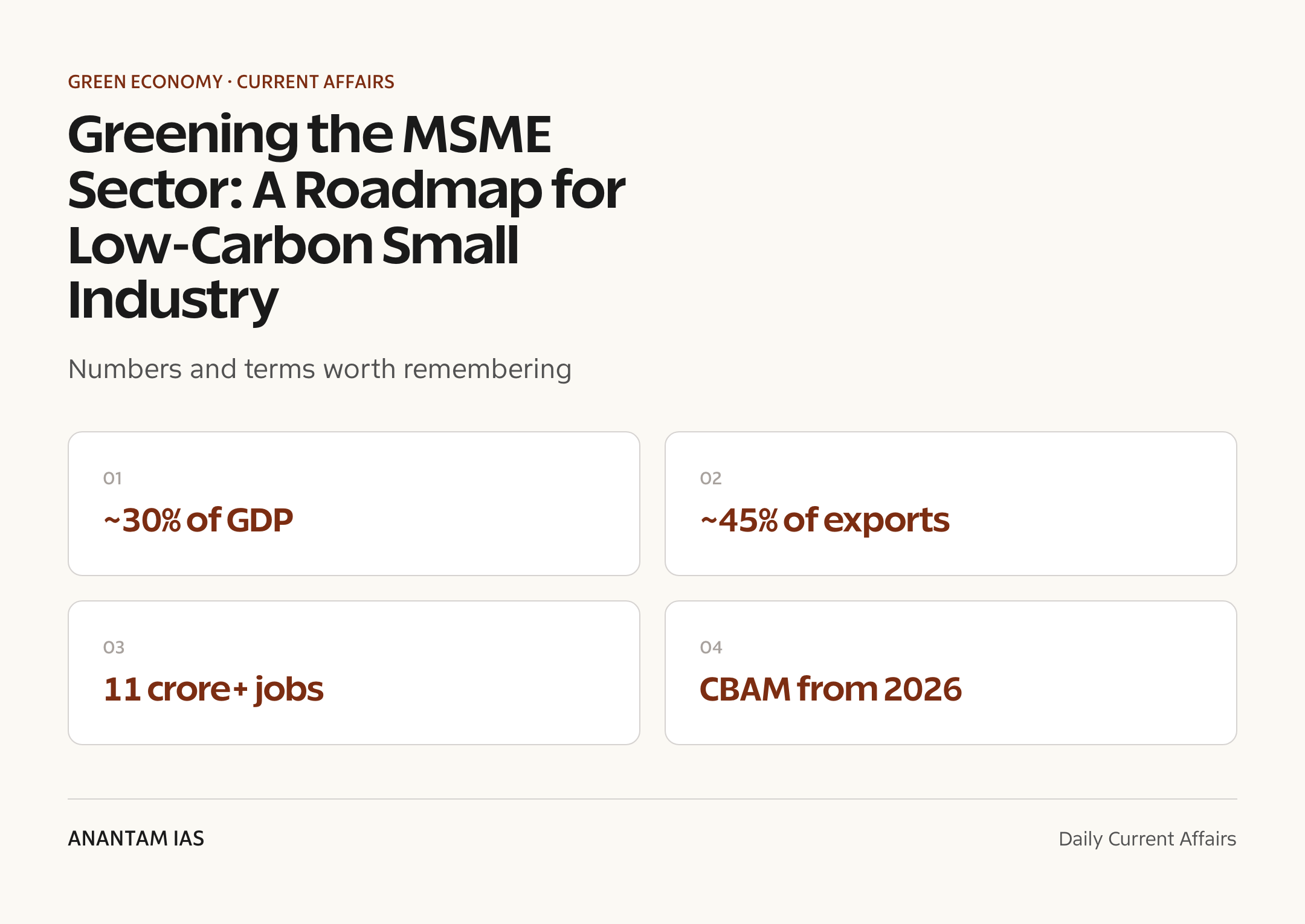
UPSC Relevance
Prelims Relevance
- MSME classification under the revised composite criteria (investment in plant/machinery + annual turnover).
- Udyam Registration — the online self-declaration portal that replaced Udyog Aadhaar.
- ZED (Zero Defect Zero Effect) certification scheme for MSMEs.
- SIDBI — Small Industries Development Bank of India and its green-financing lines.
- Priority Sector Lending (PSL) norms and the renewable-energy/MSME sub-targets.
- EU CBAM — Carbon Border Adjustment Mechanism: coverage sectors and timeline.
- Net-zero by 2070 and India’s COP26 ‘Panchamrit’ pledges.
- PAT (Perform, Achieve and Trade) scheme under the Energy Conservation Act.
- Carbon Credit Trading Scheme (CCTS) and the compliance/voluntary market design.
Mains Relevance
GS Paper 3
- Examine the role of MSMEs in India’s growth, employment and export performance, and the levers for their low-carbon transition.
- Discuss how green finance and energy-efficiency interventions can decarbonise small industry without eroding competitiveness.
GS Paper 2
- Assess the implications of the EU’s CBAM for India’s small exporters and the policy response options available to the government.
Essay
- Growth and green: can a developing economy decarbonise without slowing down?
- A just transition leaves no worker behind.
Background and Context
Why MSMEs are central to the economy
Small industry is disproportionately important to output, jobs and trade.
- MSMEs generate close to 30% of GDP and roughly 45% of India’s exports, spanning textiles, leather, engineering goods, food processing and chemicals.
- The sector employs over 11 crore people, second only to agriculture, with a heavy share of informal and women workers.
- Revised MSME classification uses a composite of investment and turnover; the Udyam portal has registered crores of units, widening the formal base (see our MSME Sector in India notes).
- Their geographic dispersion makes them vital for balanced regional development and rural-urban livelihoods.
The carbon and energy footprint
Fragmentation and old technology make small units energy-inefficient.
- MSMEs consume a large share of industrial energy, often via coal, diesel and biomass in furnaces, boilers and kilns.
- Energy-intensive clusters — foundries, forging, brick kilns, ceramics, glass and textiles — drive a sizeable part of sectoral emissions.
- Thin margins and limited access to capital lock units into obsolete, inefficient equipment.
- Weak metering and awareness mean many enterprises cannot even measure their own carbon footprint.
Levers of a green roadmap
Decarbonisation rests on efficiency, cleaner fuels and process change.
- Energy efficiency: efficient motors, variable-speed drives, waste-heat recovery and better furnace design cut both bills and emissions.
- Cleaner fuels and processes: switching from coal/diesel to natural gas, biomass pellets, solar thermal and rooftop solar.
- Cluster-based interventions: shared infrastructure, common facility centres and bulk procurement spread the cost of clean technology.
- Certification: the ZED (Zero Defect Zero Effect) scheme rewards quality plus environmental performance and opens export markets.
Financing the transition
Green finance is the binding constraint for capital-starved small firms.
- SIDBI runs dedicated energy-efficiency and green-financing lines, often blended with multilateral and climate funds.
- Priority Sector Lending (PSL) norms channel bank credit to MSMEs and renewable energy, lowering the cost of green loans.
- Instruments such as green bonds, partial risk guarantees and concessional credit de-risk lending to small units.
- Awareness and hand-holding — energy audits, detailed project reports and technical support — are as scarce as money itself.
CBAM and export competitiveness
Carbon-border measures turn decarbonisation into a trade survival issue.
- The EU CBAM definitive phase from January 2026 prices the embedded carbon in imports of steel, aluminium, cement, fertiliser, hydrogen and electricity.
- Small Indian exporters in covered lines face reporting burdens and a cost penalty unless they cut and verify their emissions.
- Compliance demands credible emissions measurement, reporting and verification (MRV) that most MSMEs currently lack.
- India’s own Carbon Credit Trading Scheme (CCTS) and a domestic carbon price could blunt CBAM’s bite if recognised.
A just and inclusive transition
The shift must safeguard the workers and informal units it touches.
- A vast informal workforce depends on small units, so abrupt change risks job and income loss — the core of a just transition.
- Skilling and reskilling for clean-technology operation must accompany any equipment upgrade.
- Support should be tiered by size — micro units need grants and hand-holding, not just loans.
- Equity demands that the cost of going green is not loaded onto the smallest, most vulnerable enterprises.
Way Forward
Build a low-carbon credit ecosystem
- Scale SIDBI green lines with simple, standardised products and faster approvals for micro units.
- Strengthen PSL targeting so green MSME loans carry lower rates and lighter collateral.
Cluster-first technology upgradation
- Fund common facility centres, shared solar and waste-heat systems in energy-intensive clusters.
- Pair upgrades with free energy audits and bankable detailed project reports.
Make units CBAM-ready
- Set up affordable MRV and carbon-accounting tools, with cluster-level verification support.
- Negotiate recognition of India’s CCTS carbon price within the CBAM framework.
Embed a just-transition lens throughout — tie every green-finance and technology scheme to skilling, livelihood protection and tiered support so micro enterprises and their workers are not left behind.
Conclusion
Greening the MSME sector is no longer optional. With small industry anchoring 30% of GDP, 45% of exports and crores of livelihoods, its carbon trajectory will shape both India’s net-zero by 2070 goal and the survival of its exporters under carbon-border regimes.
The roadmap is clear in outline — energy efficiency, cleaner fuels, green finance, cluster action and CBAM readiness — but its success turns on execution that is affordable, inclusive and built around a just transition for the smallest firms.
UPSC Practice Questions
Prelims MCQ 1
With reference to the green transition of India’s MSME sector, consider the following statements:
- MSMEs are classified using a composite criterion of investment in plant and machinery and annual turnover.
- SIDBI operates dedicated energy-efficiency and green-financing lines for small enterprises.
- The ZED scheme certifies MSMEs on quality and environmental performance.
How many of the above statements are correct?
(a) Only one (b) Only two (c) All three (d) None
Answer: (c) All three
Explanation:
MSMEs use the revised composite (investment + turnover) criteria; SIDBI runs green-finance lines; and ZED (Zero Defect Zero Effect) certifies on both quality and environment. All three statements are correct.
Prelims MCQ 2
The European Union’s Carbon Border Adjustment Mechanism (CBAM) in its initial coverage applies to imports of which of the following?
(a) Steel, aluminium, cement, fertiliser, hydrogen and electricity (b) Textiles, leather, footwear and handicrafts (c) Pharmaceuticals, software services and gems (d) Tea, coffee, spices and processed foods
Answer: (a) Steel, aluminium, cement, fertiliser, hydrogen and electricity
Explanation:
CBAM’s covered sectors are the carbon-intensive lines — iron and steel, aluminium, cement, fertilisers, hydrogen and electricity — where embedded emissions are priced at the EU border.
UPSC Mains Questions
- MSMEs are simultaneously the backbone of India’s employment and a significant source of industrial emissions. Examine the key levers of a low-carbon roadmap for the sector and the role of green finance in enabling it. (250 words)
- Carbon-border measures such as the EU’s CBAM convert decarbonisation into a question of export survival for small industry. Discuss the implications for India’s MSME exporters and suggest a policy response. (250 words)
- A green transition that ignores its workers is not sustainable. In the context of MSME decarbonisation, analyse how the principle of a just transition can be operationalised. (150 words)
Sources: Ministry of MSME, Government of India and SIDBI.
Frequently Asked Questions
What share of the economy do MSMEs account for?
Micro, Small and Medium Enterprises contribute roughly 30% of India’s GDP and about 45% of its exports, while employing over 11 crore people across manufacturing and services. This makes the sector second only to agriculture in jobs, and a strategically important target for any economy-wide low-carbon transition.
Why does the MSME sector need a green transition?
Small units are often energy-inefficient, relying on coal, diesel and biomass in old furnaces, boilers and kilns. They consume a large share of industrial energy and emissions. Decarbonising them is essential both for India’s net-zero by 2070 goal and to keep exporters competitive under emerging carbon-border rules abroad.
What is the EU CBAM and why does it matter for MSMEs?
The Carbon Border Adjustment Mechanism prices the embedded carbon in imports of steel, aluminium, cement, fertiliser, hydrogen and electricity entering the European Union. Its definitive phase begins in January 2026. Indian small exporters in these lines face reporting burdens and a cost penalty unless they measure, cut and verify their emissions.
How does green finance help small industry decarbonise?
Capital is the binding constraint for thin-margin small units. SIDBI runs dedicated energy-efficiency and green-financing lines, often blended with climate funds, while Priority Sector Lending norms channel cheaper bank credit. Instruments like green bonds and partial risk guarantees de-risk lending, and energy audits help units identify bankable upgrades.
What is the ZED certification scheme?
ZED stands for Zero Defect Zero Effect. It is a certification scheme for MSMEs that rewards both manufacturing quality and environmental performance — minimal defects in the product and minimal adverse effect on the environment. ZED-certified units gain access to incentives and improved standing in domestic and export markets.
What does a just transition mean for MSMEs?
A just transition ensures the shift to low-carbon production protects the vast informal workforce that depends on small units. It pairs technology upgrades with skilling and reskilling, offers tiered support so micro enterprises get grants rather than only loans, and ensures the cost of going green is not loaded onto the smallest, most vulnerable firms.
Source: https://anantamias.com/current-affairs/green-transition-msmes-roadmap-2026/
Parakram Diwas 2026 at Sri Vijaya Puram: Netaji, INA and Andaman Memory
Parakram Diwas 2026 marked Netaji Subhas Chandra Bose’s 129th birth anniversary with national commemorations at Sri Vijaya Puram in the Andaman and Nicobar Islands. The location mattered as much as the event.
For UPSC, this is not only a culture-calendar item. It opens a modern-history question about the Indian National Army, wartime nationalism, symbolic geography and how the state remembers freedom-struggle narratives outside the mainstream Congress framework.
This article reads Parakram Diwas 2026 through the Andaman lens: Netaji, the INA, colonial imprisonment, island memory and the politics of commemoration.
Quick Facts
- Parakram Diwas is observed on 23 January, Netaji Subhas Chandra Bose’s birth anniversary.
- The 2026 commemoration marked his 129th birth anniversary.
- The national event was held at Sri Vijaya Puram in the Andaman and Nicobar Islands.
- The event ran from 23 to 25 January 2026 across multiple iconic locations.
- A veteran of the INA, Madhavan Pillai, was felicitated at the event.
- Netaji Subhas Chandra Bose Island, formerly Ross Island, was part of the symbolic geography.
- Official source: PIB, Ministry of Culture.
What Just Happened
The Ministry of Culture organised Parakram Diwas commemorations in Sri Vijaya Puram, foregrounding Netaji’s connection with the Andaman and Nicobar Islands. The program included exhibitions, cultural events and tributes at historically significant locations.
The event location was deliberate. The Andaman Islands carry memories of the Cellular Jail, political imprisonment, anti-colonial sacrifice and the brief wartime symbolism of Azad Hind authority.
For aspirants, the news hook should be used to revise Netaji’s ideological journey, the INA’s military and political role, the impact of INA trials and the contribution of non-mainland spaces to India’s freedom struggle.
Background and Historical Context
Subhas Chandra Bose was elected Congress president in 1938 and 1939 but later broke with the Congress high command over strategy, pace of struggle and wartime politics. He formed the Forward Bloc before leaving India during World War II.
The Indian National Army, initially associated with Mohan Singh and later reorganised under Bose, sought to fight British rule with Japanese support. Bose’s Provisional Government of Azad Hind gave the INA a political frame beyond a military formation.
The Andaman and Nicobar Islands became symbolically important when Bose visited Port Blair in December 1943 and associated the islands with the names Shaheed and Swaraj. That memory continues to shape official commemorations.
Key Features of the 2026 Commemoration
The core policy architecture can be read through these features.
- Birth anniversary: 23 January was observed as Parakram Diwas.
- Island location: Sri Vijaya Puram placed the Andaman story at the centre.
- INA memory: the event linked Netaji with soldiers, veterans and wartime nationalism.
- Public history: exhibitions and cultural programs translated archival history for citizens.
- Symbolic geography: Netaji Subhas Chandra Bose Island and Cellular Jail remain central memory sites.
- Modern-history relevance: the event gives a news hook for revising INA and Bose for UPSC.
Why It Matters
This is a high-yield UPSC topic because it joins current news with durable syllabus themes.
- It gives GS-I Modern History material on Netaji, INA and freedom-struggle diversity.
- It connects commemoration with nation-building and public memory.
- It helps avoid reducing Netaji to one-line factual notes.
- It offers Essay material on memory, sacrifice and the many streams of nationalism.
Detailed Analysis: History and Culture Lens
Netaji remains a difficult figure to simplify. He was a radical nationalist, a mass leader, an organiser and a wartime strategist. Good UPSC answers recognise both his courage and the moral complexity of wartime alliances.
The INA’s direct military impact was limited, but its political impact was large. The Red Fort trials, public sympathy and unrest among armed forces contributed to the psychological erosion of British authority.
The Andaman setting widens the freedom-struggle map. Indian nationalism was not only built in Delhi, Bombay, Calcutta or Lahore. Penal colonies, islands, borderlands and diaspora networks also shaped resistance.
Comparative Perspective
A comparison helps prevent the answer from becoming a one-dimensional news summary.
- Gandhian nationalism: mass mobilisation, non-violence and moral politics.
- Revolutionary nationalism: armed struggle, secret societies and sacrifice.
- INA approach: military struggle combined with expatriate mobilisation and provisional government symbolism.
- Constitutional politics: negotiations, elections, legislatures and institution-building.
Challenges
The policy or institutional promise runs into recurring constraints.
- Commemoration can become symbolic without improving public understanding of historical complexity.
- Netaji’s wartime alliances require careful treatment, not hagiography or dismissal.
- Public history often underrepresents women, soldiers and diaspora contributors in the INA story.
- Regional and island histories need better integration into school and exam narratives.
- Memorialisation must preserve archives, sites and oral histories before they disappear.
Prelims Pointers
- Parakram Diwas is observed on 23 January.
- Netaji Subhas Chandra Bose was born in Cuttack in 1897.
- He was Congress president at Haripura in 1938 and Tripuri in 1939.
- Forward Bloc was founded by Bose in 1939.
- The Provisional Government of Azad Hind was formed in 1943.
- Cellular Jail in the Andaman Islands was a major colonial penal institution.
Mains Questions
- Assess the contribution of Subhas Chandra Bose and the INA to the final phase of India’s freedom struggle. (GS Paper I, 250 words)
- Public commemorations shape historical memory as much as textbooks do. Discuss with reference to Parakram Diwas. (GS Paper I, 150 words)
- The INA’s importance was more political than military. Critically examine. (GS Paper I, 250 words)
- Why should island and diaspora histories be integrated into the narrative of Indian nationalism? (GS Paper I, 250 words)
Way Forward
Parakram Diwas should be used to build better public history: digitised INA records, oral histories, museum pedagogy and translations of archival material into Indian languages.
UPSC aspirants should avoid a binary treatment of Netaji. The stronger answer explains his ideological differences with Congress leadership, his mass appeal, the INA’s symbolic power and the ethical complexity of wartime choices.
The Andaman focus is welcome because it moves the freedom-struggle narrative beyond mainland capitals and reminds students that geography can be an archive.
The examiner is unlikely to reward a bare fact dump here. The better answer connects the January 2026 event to institutional design, implementation capacity and India’s long-term development priorities.
Frequently Asked Questions
What is Parakram Diwas?
Parakram Diwas is observed on 23 January to mark the birth anniversary of Netaji Subhas Chandra Bose.
Why was Sri Vijaya Puram important in 2026?
The 2026 national commemoration was held there to foreground Netaji’s connection with the Andaman and Nicobar Islands.
What was the INA?
The Indian National Army was a military force of Indian soldiers and expatriates that sought to fight British rule during World War II.
Why is Netaji important for UPSC?
He connects Modern History with debates on nationalism, armed struggle, leadership, diaspora mobilisation and public memory.
What was the Provisional Government of Azad Hind?
It was a government-in-exile proclaimed under Bose’s leadership in 1943 to give political form to the INA struggle.
How should students write about Bose?
With balance: recognise courage, organisation and mass appeal, while also noting the complexity of wartime alliances.
Source: https://anantamias.com/current-affairs/parakram-diwas-2026-netaji-andaman/
ODOP Reforms 2026: District Products, Exports and Local Economic Development
The January 2026 ODOP update highlighted the One District One Product approach as a tool for local economic development, branding and market access. The policy idea is simple: identify what a district is good at and help it sell better.
For UPSC, ODOP is useful because it connects MSMEs, exports, handicrafts, agriculture processing, district planning and cooperative federalism.
This article explains ODOP as an economic-governance instrument and evaluates whether district-level branding can translate into jobs and exports.
Quick Facts
- ODOP stands for One District One Product.
- It identifies and promotes products with district-level strength.
- The approach supports branding, market access, value addition and exports.
- ODOP connects with Districts as Export Hubs and Vocal for Local.
- Products may include handicrafts, food processing, textiles, agriculture and local industry.
- Official source: PIB DPIIT release dated 23 January 2026.
- Official source: PIB, DPIIT.
What Just Happened
The official update highlighted ODOP reforms and the continuing push to strengthen district products.
The news matters because local products often fail not due to lack of skill, but because of weak packaging, finance, design, certification, logistics and market access.
For aspirants, ODOP is a good example of place-based economic development.
Background and Historical Context
The ODOP approach gained national visibility through state initiatives and central adoption as part of local-product promotion.
India’s districts often have clusters of skill, craft or agricultural specialisation, but producers remain fragmented and under-capitalised.
Districts as Export Hubs seeks to connect local products with export planning and trade facilitation.
Key Features of Local Economy
The core policy architecture can be read through these features.
- Product mapping: each district identifies priority products.
- Branding: local products receive a stronger market identity.
- Value addition: packaging, processing and design can raise incomes.
- Export linkage: district plans can connect producers with foreign markets.
- MSME support: credit, training and certification are critical.
- Federal role: district, state and Union agencies must coordinate.
Why It Matters
This is a high-yield UPSC topic because it joins current news with durable syllabus themes.
- It connects a January 2026 event with durable UPSC syllabus themes.
- It gives usable facts for Prelims and analytical hooks for Mains.
- It helps students move from news recall to policy reasoning.
- It can be linked with static concepts in polity, economy, governance, science, environment or society.
Detailed Analysis: Local Economy Lens
ODOP works when it solves business bottlenecks. Branding alone cannot compensate for poor quality control or working-capital shortages.
Cluster depth matters. Successful districts need common facilities, testing labs, design support and producer organisations.
Exports require compliance. Food safety, packaging, GI tagging, customs documentation and buyer reliability become decisive.
Comparative Perspective
A comparison helps prevent the answer from becoming a one-dimensional news summary.
- ODOP: district-product promotion and branding.
- GI tags: legal protection for geographical indications.
- Cluster development: common facilities and ecosystem support.
- Districts as Export Hubs: export planning and trade facilitation at district level.
Challenges
The policy or institutional promise runs into recurring constraints.
- Producer fragmentation weakens bargaining power.
- Quality control and certification can be expensive.
- Market access often depends on intermediaries.
- District officials may lack export expertise.
- Branding can become symbolic without logistics and finance.
Prelims Pointers
- ODOP stands for One District One Product.
- GI means Geographical Indication.
- Districts as Export Hubs links district products with export planning.
- DPIIT is linked to industrial promotion and internal trade.
- MSMEs are important for employment and exports.
- Value addition raises producer income beyond raw-product sale.
Mains Questions
- ODOP can support local economic development only if branding is backed by market access and value addition. Discuss. (GS Paper III, 250 words)
- How can Districts as Export Hubs improve India’s export diversification? (GS Paper III, 150 words)
- Evaluate the role of district administration in MSME and craft-sector development. (GS Paper II/III, 250 words)
- Place-based development can reduce regional imbalance. Analyse with reference to ODOP. (GS Paper III, 250 words)
Way Forward
ODOP should be paired with credit support, common facility centres, quality certification, e-commerce onboarding and export documentation handholding.
District product plans should track producer income, repeat buyers and jobs, not only exhibitions.
In Mains, use ODOP as a bridge between local economy and national export strategy.
The examiner is unlikely to reward a bare fact dump here. The better answer connects the January 2026 event to institutional design, implementation capacity and India’s long-term development priorities.
Frequently Asked Questions
What is ODOP?
One District One Product is an approach to promote one or more products linked to a district’s strengths.
Why is ODOP important?
It can improve branding, value addition, market access and local jobs.
How does it link to exports?
District products can be integrated with Districts as Export Hubs and trade facilitation.
What is the main limitation?
Branding is not enough without credit, quality control, logistics and buyer access.
Which sectors benefit?
Handicrafts, food processing, textiles, agriculture products and local manufacturing clusters.
What is the UPSC angle?
MSME development, exports, district planning, cooperative federalism and inclusive growth.
Source: https://anantamias.com/current-affairs/odop-reforms-2026/
CERT-In Cyber Defender Program 2026: India’s Frontline Cyber Capacity
A January 2026 official backgrounder on CERT-In’s frontline cyber-defender work highlighted India’s need for trained personnel who can detect, respond to and recover from cyber incidents across public and private systems.
For UPSC, the issue is urgent because cyber threats now affect banking, health, power grids, telecom, government portals, personal data and national security.
This article explains CERT-In’s cyber-defender role and situates it within India’s wider cyber-security architecture.
Quick Facts
- CERT-In is the Indian Computer Emergency Response Team.
- It is India’s national agency for cyber incident response under MeitY.
- Cyber defenders support detection, reporting, mitigation and coordination.
- Cybersecurity is linked to digital public infrastructure and critical information infrastructure.
- Digital arrest scams, ransomware and data breaches have made cyber capacity a public concern.
- Official source: PIB January 2026 backgrounder on CERT-In cyber defenders.
- Official source: PIB backgrounder.
What Just Happened
The official backgrounder emphasised frontline cyber-defender capacity and the role of CERT-In in incident response.
The update matters because India’s digital economy has expanded faster than its cyber-response workforce.
For aspirants, this topic connects internal security, digital governance, privacy and institutional design.
Background and Historical Context
CERT-In operates under the Information Technology Act framework and coordinates cyber-incident response, advisories and vulnerability information.
India’s critical information infrastructure is protected through NCIIPC, while I4C addresses cybercrime coordination under the Home Ministry.
The growing use of UPI, Aadhaar-linked services, cloud systems and public digital platforms raises the stakes of cyber resilience.
Key Features of Cyber Security
The core policy architecture can be read through these features.
- Incident response: CERT-In coordinates action after cyber incidents.
- Advisories: it issues alerts and vulnerability notes.
- Reporting: cyber incident reporting improves situational awareness.
- Capacity building: trained defenders are needed across sectors.
- Coordination: cyber response spans MeitY, MHA, RBI, sector regulators and states.
- Resilience: prevention, response and recovery must all be planned.
Why It Matters
This is a high-yield UPSC topic because it joins current news with durable syllabus themes.
- It connects a January 2026 event with durable UPSC syllabus themes.
- It gives usable facts for Prelims and analytical hooks for Mains.
- It helps students move from news recall to policy reasoning.
- It can be linked with static concepts in polity, economy, governance, science, environment or society.
Detailed Analysis: Cyber Security Lens
Cybersecurity is no longer a specialist issue. Every welfare database, payment system and hospital network now creates public risk.
Human capacity is the bottleneck. Tools matter, but trained analysts, auditors and incident responders decide whether systems recover quickly.
Fragmented jurisdiction is a challenge. Cybercrime, critical infrastructure, data protection and national security sit across different institutions.
Comparative Perspective
A comparison helps prevent the answer from becoming a one-dimensional news summary.
- CERT-In: national cyber incident response agency.
- NCIIPC: protects critical information infrastructure.
- I4C: coordinates cybercrime response and citizen reporting.
- RBI: regulates cyber resilience in financial entities.
Challenges
The policy or institutional promise runs into recurring constraints.
- Incident reporting by organisations can be delayed or incomplete.
- States lack uniform cyber-forensics capacity.
- Small businesses have weak cyber hygiene.
- Critical infrastructure uses legacy systems.
- Cyber workforce demand exceeds supply.
Prelims Pointers
- CERT-In stands for Indian Computer Emergency Response Team.
- It functions under MeitY.
- NCIIPC stands for National Critical Information Infrastructure Protection Centre.
- I4C stands for Indian Cyber Crime Coordination Centre.
- Ransomware encrypts data and demands payment.
- Cyber resilience includes prevention, detection, response and recovery.
Mains Questions
- Cybersecurity is now a core internal-security challenge for a digital welfare state. Discuss. (GS Paper III, 250 words)
- Explain the role of CERT-In in India’s cyber-security architecture. (GS Paper III, 150 words)
- Why is cyber workforce development critical for India’s digital economy? (GS Paper III, 250 words)
- Fragmented cyber governance can weaken incident response. Analyse. (GS Paper III, 250 words)
Way Forward
India needs sector-wise cyber drills, stronger state cyber labs, mandatory incident-response plans and cyber hygiene support for MSMEs.
CERT-In advisories should be paired with capacity building in public institutions and critical sectors.
For UPSC, connect cyber defenders with digital public infrastructure and citizen trust.
The examiner is unlikely to reward a bare fact dump here. The better answer connects the January 2026 event to institutional design, implementation capacity and India’s long-term development priorities.
Frequently Asked Questions
What is CERT-In?
CERT-In is India’s national computer emergency response team under MeitY.
What does CERT-In do?
It issues advisories, coordinates incident response and supports cyber-risk mitigation.
How is it different from I4C?
CERT-In focuses on cyber incidents and technical response, while I4C focuses on cybercrime coordination.
Why are cyber defenders important?
They detect, respond to and help recover from cyber attacks.
Which GS paper is relevant?
GS-III internal security and science and technology.
What is the main challenge?
Cyber workforce shortage and fragmented institutional response.
Source: https://anantamias.com/current-affairs/cert-in-cyber-defender-program-2026/
PM Vishwakarma Haat 2026: Artisans, Informal Skills and Market Access
PM Vishwakarma Haat 2026 brought artisan livelihoods, traditional skills and market access into the January current-affairs cycle. The event is linked to the larger PM Vishwakarma scheme for traditional craftspeople and informal skilled workers.
For UPSC, the topic matters because it connects social justice with the informal economy, skill recognition, credit, technology, dignity of labour and cultural continuity.
This article explains PM Vishwakarma Haat as a market-access intervention and evaluates the broader scheme through livelihood and inclusion lenses.
Quick Facts
- PM Vishwakarma supports traditional artisans and craftspeople.
- The scheme covers skill training, toolkit support, credit linkage and market access.
- PM Vishwakarma Haat gives artisans a platform to sell and showcase products.
- Target groups include traditional occupations such as carpenters, blacksmiths, potters, weavers and other craftspeople.
- The topic is relevant for GS-II welfare and GS-III informal economy.
- Official source: PIB January 2026 backgrounder.
- Official source: PIB backgrounder.
What Just Happened
The official update highlighted PM Vishwakarma Haat as a platform for artisans linked to the PM Vishwakarma scheme.
The policy idea is to move beyond training alone and connect craftspeople with buyers, branding and formal support.
For aspirants, the topic is a strong example of welfare that tries to preserve skills while improving incomes.
Background and Historical Context
Traditional artisans often work in household enterprises with limited capital, weak branding and dependence on intermediaries.
India’s informal economy holds deep skills but suffers from low productivity, poor market access and limited social protection.
PM Vishwakarma attempts to formalise support without forcing artisans into a purely factory-style development model.
Key Features of Artisan Economy
The core policy architecture can be read through these features.
- Skill recognition: traditional occupations are formally identified and supported.
- Training: artisans can access skill upgradation.
- Toolkit support: better tools can improve productivity and quality.
- Credit linkage: concessional loans support working capital.
- Market access: haats and platforms connect producers with buyers.
- Dignity: the scheme recognises hereditary and traditional skills as economic assets.
Why It Matters
This is a high-yield UPSC topic because it joins current news with durable syllabus themes.
- It connects a January 2026 event with durable UPSC syllabus themes.
- It gives usable facts for Prelims and analytical hooks for Mains.
- It helps students move from news recall to policy reasoning.
- It can be linked with static concepts in polity, economy, governance, science, environment or society.
Detailed Analysis: Artisan Economy Lens
The market-access layer is crucial. Training artisans without buyers produces frustration, not livelihood improvement.
Credit must match cash-flow realities. Artisans need small, flexible and low-friction finance.
Cultural preservation and income cannot be separated. Crafts survive when the craftsperson earns enough to continue.
Comparative Perspective
A comparison helps prevent the answer from becoming a one-dimensional news summary.
- PM Vishwakarma: targets traditional artisans and craftspeople.
- PMKVY: broader vocational skilling program.
- ODOP: district-product promotion and market identity.
- SFURTI: supports traditional-industry cluster development.
Challenges
The policy or institutional promise runs into recurring constraints.
- Artisans often depend on intermediaries for sales.
- Digital marketplaces can exclude those without literacy or logistics support.
- Credit uptake may be weak if paperwork is heavy.
- Younger generations may leave crafts if incomes remain low.
- Quality, design and packaging need continuous support.
Prelims Pointers
- PM Vishwakarma targets traditional artisans and craftspeople.
- Support includes training, toolkit, credit and market access.
- SFURTI supports traditional industry clusters.
- Informal workers often lack formal social security.
- Market access is a key livelihood constraint for artisans.
- Dignity of labour is a recurring welfare-governance theme.
Mains Questions
- Traditional skills need market access as much as welfare support. Discuss with reference to PM Vishwakarma. (GS Paper II/III, 250 words)
- How can India improve livelihoods in the informal artisan economy? (GS Paper III, 150 words)
- Skill preservation must be linked with income generation. Analyse. (GS Paper III, 250 words)
- Evaluate the role of credit, design and branding in artisan development. (GS Paper III, 250 words)
Way Forward
PM Vishwakarma should be integrated with ODOP, e-commerce, design schools, common facility centres and social-security programs.
Market events should track repeat orders and artisan income, not only footfall.
For UPSC, frame the scheme as livelihood policy plus cultural economy plus informal-sector formalisation.
The examiner is unlikely to reward a bare fact dump here. The better answer connects the January 2026 event to institutional design, implementation capacity and India’s long-term development priorities.
Frequently Asked Questions
What is PM Vishwakarma?
It is a scheme to support traditional artisans and craftspeople through training, tools, credit and market access.
What is PM Vishwakarma Haat?
It is a market-access and showcase platform for artisans.
Why is the scheme important?
It recognises traditional skills and tries to improve incomes in the informal economy.
Which GS papers are relevant?
GS-II welfare and GS-III economy.
What is the main challenge?
Sustained market access and income improvement.
How does ODOP connect?
ODOP can help brand and market district-level artisan and local products.
Source: https://anantamias.com/current-affairs/pm-vishwakarma-haat-2026/
Padma Awards 2026: Civilian Honours, Social Recognition and Republic Day Symbolism
The Padma Awards 2026 list announced on Republic Day eve included 131 awards: 5 Padma Vibhushan, 13 Padma Bhushan and 113 Padma Shri. The list included women awardees, foreign or diaspora awardees, posthumous honours and several figures from grassroots public service.
For UPSC, Padma Awards are not just a Prelims list. They raise a governance question: how does a republic publicly recognise excellence, service, knowledge, art, sport and social work without turning honours into patronage?
This article uses the 2026 Padma list to revise civilian honours, Article 18, the Balaji Raghavan case and the idea of people’s recognition in a democratic republic.
Quick Facts
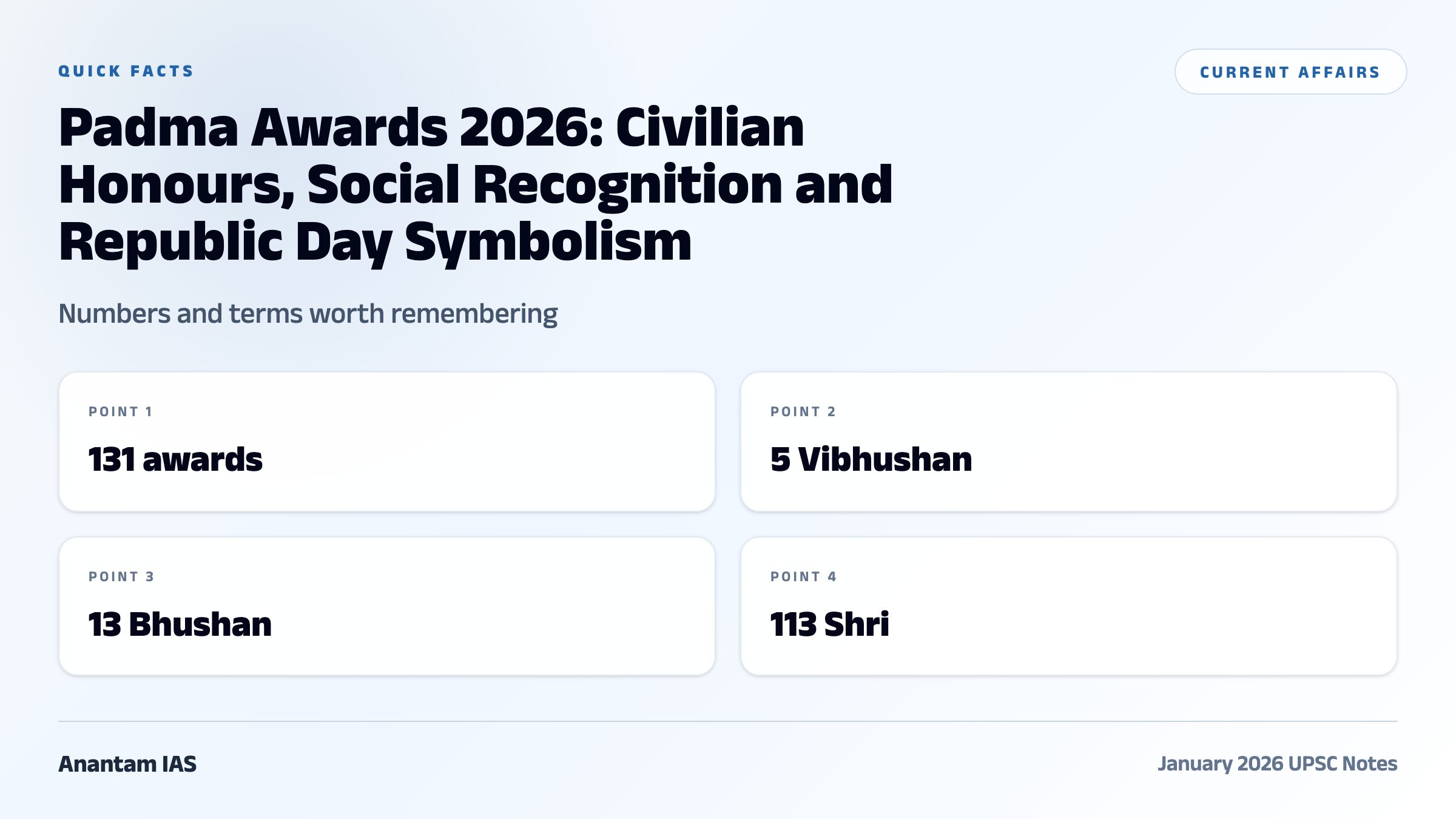
- Padma Awards 2026 included 131 awards, with two duo cases counted as one award each.
- The list had 5 Padma Vibhushan, 13 Padma Bhushan and 113 Padma Shri awards.
- It included 19 women awardees.
- It included 6 foreign, NRI, PIO or OCI awardees.
- It included 16 posthumous awardees.
- Padma Awards are announced on Republic Day eve and conferred by the President.
- Official source: PIB, Ministry of Home Affairs.
What Just Happened
The Ministry of Home Affairs released the 2026 Padma Awards list on the eve of Republic Day. The list covered public affairs, art, literature, education, science, engineering, medicine, sports, social work, trade and other fields.
The announcement followed the modern pattern of highlighting not only nationally famous names but also relatively lesser-known citizens whose work has produced social value.
For aspirants, the issue is worth studying beyond names. Padma Awards connect Article 18’s ban on titles, the Supreme Court’s interpretation of national honours and the state’s power to shape public recognition.
Background and Historical Context
Padma Awards were instituted in 1954. They sit below Bharat Ratna in India’s civilian honour system and are conferred in three categories: Padma Vibhushan, Padma Bhushan and Padma Shri.
Article 18 of the Constitution abolishes titles, except military and academic distinctions. This created a legal question: are civilian awards unconstitutional titles? The Supreme Court answered in Balaji Raghavan v Union of India that national awards are not titles if they are not used as prefixes or suffixes.
The awards have also been criticised for politicisation, lobbying and elite bias. Recent lists have tried to emphasise grassroots achievers, often described in public discourse as the people’s Padma approach.
Key Features of the Padma Awards System
The core policy architecture can be read through these features.
- Three categories: Padma Vibhushan, Padma Bhushan and Padma Shri.
- Selection: recommendations are considered by a Padma Awards Committee constituted by the Prime Minister.
- Conferment: the President presents the awards at Rashtrapati Bhavan.
- No title use: awardees cannot use Padma names as prefixes or suffixes.
- Fields: arts, public affairs, science, medicine, literature, education, sports, social work and more.
- Democratic shift: wider nominations and grassroots recognition have become more visible.
Why It Matters
This is a high-yield UPSC topic because it joins current news with durable syllabus themes.
- It gives Prelims facts on civilian awards and constitutional provisions.
- It gives GS-II material on state recognition, public ethics and institutional legitimacy.
- It gives GS-I culture content through awardee fields and traditions.
- It allows Essay reflection on excellence, service and recognition in a republic.
Detailed Analysis: Awards and Governance Lens
Honours are symbolic policy. A government cannot fund every form of public service equally, but it can signal what society should value. Awards shape public memory.
The constitutional limit matters. Article 18 prevents titles from recreating social hierarchy. Civilian honours are acceptable only when they remain recognition, not status markers.
The people’s Padma shift is useful but incomplete. Recognising unsung achievers improves legitimacy, but transparency, diversity and protection from lobbying must remain priorities.
Comparative Perspective
A comparison helps prevent the answer from becoming a one-dimensional news summary.
- Bharat Ratna: India’s highest civilian award for exceptional service or performance.
- Padma Vibhushan: exceptional and distinguished service.
- Padma Bhushan: distinguished service of high order.
- Padma Shri: distinguished service in any field.
Challenges
The policy or institutional promise runs into recurring constraints.
- Award selection can be perceived as political if criteria are not transparent.
- Grassroots awardees may receive symbolic recognition without institutional support for their work.
- Regional, gender and field representation need constant attention.
- Media coverage often focuses on celebrity names and misses social-work awardees.
- Use of awards for personal branding can weaken Article 18’s spirit.
Prelims Pointers
- Padma Awards were instituted in 1954.
- They are announced on the eve of Republic Day.
- The President confers the awards.
- Article 18 abolishes titles except military and academic distinctions.
- Balaji Raghavan v Union of India upheld national awards as constitutional if not used as titles.
- Padma awards cannot be used as prefixes or suffixes.
Mains Questions
- Civilian honours in a republic must recognise excellence without creating hierarchy. Discuss with reference to Article 18. (GS Paper II, 250 words)
- How can public awards be made more transparent, inclusive and socially meaningful? (GS Paper II, 150 words)
- The Padma Awards increasingly recognise grassroots achievers. What does this reveal about changing state-society relations? (GS Paper I, 250 words)
- Symbolic recognition is also a tool of governance. Critically examine. (GS Paper II, 250 words)
Way Forward
The Padma system should deepen public nominations, publish clearer selection principles and preserve the ban on title-like usage.
Award recognition can be linked with better documentation of social innovations, art forms, local knowledge and community service so that public memory does not end with the ceremony.
For UPSC, the smart answer is to move from list memorisation to constitutional reasoning: honours are legitimate only when they democratise recognition without creating hierarchy.
The examiner is unlikely to reward a bare fact dump here. The better answer connects the January 2026 event to institutional design, implementation capacity and India’s long-term development priorities.
Frequently Asked Questions
How many Padma Awards were announced in 2026?
The 2026 list included 131 awards, with two duo cases counted as one award each.
What are the three Padma categories?
Padma Vibhushan, Padma Bhushan and Padma Shri.
Are Padma Awards titles under Article 18?
No. The Supreme Court held in Balaji Raghavan that national awards are constitutional if they are not used as prefixes or suffixes.
Who confers Padma Awards?
The President of India confers them at Rashtrapati Bhavan.
Why are Padma Awards relevant for UPSC?
They connect polity, Article 18, public recognition, culture and governance.
Can an awardee write Padma Shri before their name?
No. Padma awards cannot be used as prefixes or suffixes.
Source: https://anantamias.com/current-affairs/padma-awards-2026-upsc-notes/
77th Republic Day 2026: ‘150 Years of Vande Mataram’ Theme, Tableaux and Symbolism
Introduction
The 77th Republic Day, observed on 26 January 2026, marks the seventy-sixth anniversary of the day the Constitution of India came into force in 1950 and the moment a colony formally completed its passage into a sovereign democratic republic. The Government of India has set the theme for the 2026 commemoration as “150 Years of Vande Mataram”, a tribute to the song Bankim Chandra Chatterjee composed in 1875 and embedded eight years later in his Bengali novel Anandamath. The choice of theme stitches together two anniversaries: the constitutional anniversary that produces the parade itself, and the cultural-political anniversary of a song that arguably did more than any speech to give the freedom movement a singable, reproducible emotional vocabulary. For the UPSC aspirant, the day opens onto Paper I modern Indian history and art and culture, Paper II constitutional adoption and the parliamentary calendar, and Paper IV ethics around symbols, dissent and inclusive nationalism, while supplying a dense corpus of Prelims-grade dates, names and articles.
The Republic Day parade down Kartavya Path — the renamed Rajpath — proceeds from Vijay Chowk to the Red Fort and is preceded by the President of India‘s ceremonial unfurling of the national flag, a 21-gun salute, and the playing of Jana Gana Mana. Tableaux from states, union territories and central ministries this year are choreographed around the Vande Mataram sesquicentennial, and the Beating Retreat ceremony on 29 January closes the four-day arc that begins on Republic Day eve. This article unpacks the day’s programme, the deep history of Vande Mataram from Anandamath through the 1937 Tagore-Nehru sub-committee compromise to its constitutional placement, the sociology of the tableaux, the comparative perspective against other republican national days, and the criticisms that have shadowed the song’s elevation into a national symbol.
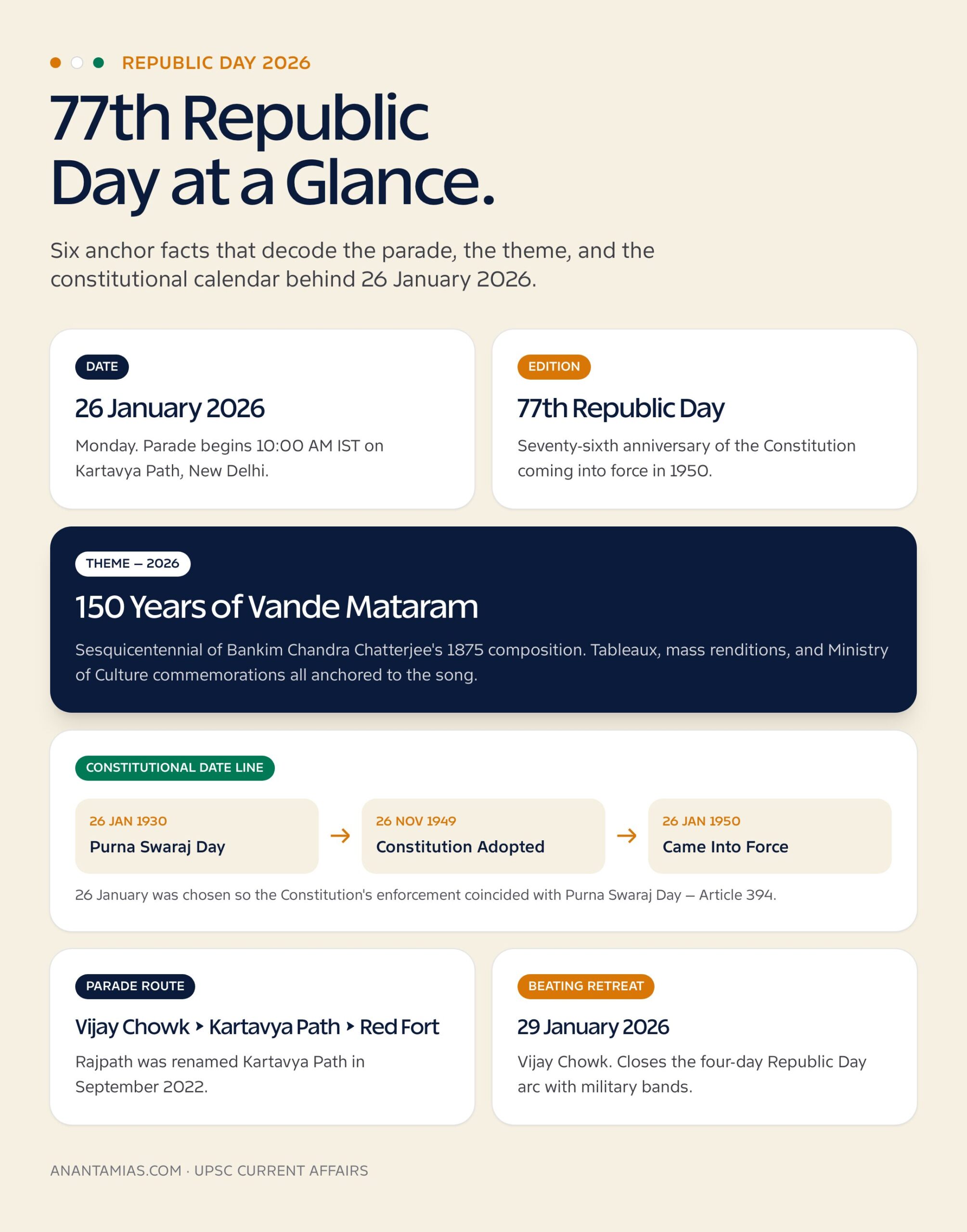
Quick Facts at a Glance
| Indicator | Value | Source |
|---|---|---|
| Republic Day 2026 — edition | 77th Republic Day | Ministry of Defence, Government of India |
| Date and venue of parade | 26 January 2026, Kartavya Path, New Delhi | Ministry of Defence, GoI |
| Theme, 2026 | “150 Years of Vande Mataram” | Ministry of Culture / PIB |
| Vande Mataram — year of composition | 1875 (by Bankim Chandra Chatterjee) | Sahitya Akademi; Anandamath, 1882 |
| Constitution adopted | 26 November 1949 (Constitution Day) | Constituent Assembly Debates, Vol. XII |
| Constitution came into force | 26 January 1950 | Article 394, Constitution of India |
| National Song — formal status conferred | 24 January 1950 (Constituent Assembly statement by Dr Rajendra Prasad) | Constituent Assembly Debates, 24 Jan 1950 |
| National Anthem | Jana Gana Mana (Rabindranath Tagore, 1911) | Constituent Assembly statement, 24 Jan 1950 |
| Chief Guests, Republic Day 2026 | António Costa (President of the European Council) and Ursula von der Leyen (President of the European Commission) — first-ever invitation of the EU’s top leadership as joint chief guests | Ministry of External Affairs / PIB |
| Beating Retreat ceremony | 29 January 2026, Vijay Chowk | Ministry of Defence, GoI |
Background and Historical Context
Vande Mataram was written by Bankim Chandra Chatterjee at Chinsurah in Bengal on 7 November 1875, six years before he wove it into the fabric of Anandamath, the 1882 novel set against the backdrop of the late-eighteenth-century Sannyasi Rebellion. The song’s first two stanzas — the portion that would later become the national song — are an invocation of the motherland in Sanskritised Bengali: “Vande Mataram, Sujalam, Suphalam, Malayaja sheetalam, Sasyashyamalam, Mataram”. The remaining stanzas personify the motherland progressively as the goddesses Durga, Lakshmi and Saraswati. This mythopoetic structure, which gave the song its emotional charge during the freedom movement, would later become the seed of the controversy that determined how much of it the Constituent Assembly was willing to canonise.
The song entered organised political life through the Indian National Congress. Rabindranath Tagore sang Vande Mataram at the 1896 Calcutta session of the Congress, and during the Swadeshi movement against the 1905 partition of Bengal it became, in the literal sense, the marching song of the protest — chanted at boycotts of British cloth, sung at processions, and printed at the masthead of nationalist newspapers. The British administration responded by criminalising its public chanting in parts of Bengal during the agitation, which only deepened its symbolic charge. By the time of the Non-Cooperation and Civil Disobedience movements, Vande Mataram and Bharat Mata ki Jai functioned as the two universally legible slogans of the freedom struggle, transcending region and party line.
The song’s status was formalised twice. First, on 26 January 1930, the Congress observed Purna Swaraj Day after the Lahore session of December 1929 had declared complete independence as the goal — and it is precisely this 1930 anchor that explains why the framers chose 26 January 1950 as the date for the Constitution to come into force, even though it had been adopted on 26 November 1949. Second, in 1937, a Congress sub-committee comprising Jawaharlal Nehru, Subhas Chandra Bose, Maulana Abul Kalam Azad and Acharya Narendra Deva — set up after objections from sections of the Muslim community to the song’s later stanzas — recommended that only the first two stanzas be sung at official Congress functions. Rabindranath Tagore was consulted by Nehru and gave his written opinion that the opening stanzas were unobjectionable while the later goddess imagery posed a genuine problem for non-Hindu Indians. This Tagore-Nehru compromise became the template that the Constituent Assembly inherited, and on 24 January 1950 President Dr Rajendra Prasad‘s statement to the House gave Vande Mataram the formal status of the National Song with “equal honour” to Jana Gana Mana, the National Anthem composed by Tagore in 1911 and first sung at the Calcutta session of the Congress in 1911.
Key Features of Republic Day 2026
Republic Day 2026 — Theme and Programme
The Ministry of Defence, which orchestrates the parade, has aligned the 2026 edition with the “150 Years of Vande Mataram” theme set by the Ministry of Culture, and the choreography of the day reflects the dovetailing. The day begins at Amar Jawan commemoration at the National War Memorial, followed by the President’s arrival at Vijay Chowk, the unfurling of the National Flag, the playing of Jana Gana Mana, a 21-gun salute rendered by the ceremonial battery using indigenous 105 mm Indian Field Guns, and the awarding of gallantry decorations including the Param Vir Chakra, Ashoka Chakra and Vir Chakra. The marching contingents from the three services, paramilitary forces, NCC and school bands proceed down Kartavya Path — renamed from Rajpath in September 2022 — past India Gate to terminate at the Red Fort. The flypast by the Indian Air Force closes the parade, and the day’s events end with the At Home reception at Rashtrapati Bhavan.
150 Years of Vande Mataram — The Song’s Journey
The sesquicentennial commemorates a song that travelled from a literary exercise to a political weapon to a constitutional symbol in the span of seventy-five years. Bankim Chandra Chatterjee composed it on 7 November 1875, published it in the magazine Bangadarshan and embedded it in Anandamath in 1882. The song was first set to music by Jadunath Bhattacharya; the version most commonly sung today draws on the rendition popularised by Rabindranath Tagore‘s 1896 performance at the Calcutta Congress and the later orchestration by Pandit Vishnu Digambar Paluskar. The Ministry of Culture’s commemorative programme for 2025-26 includes mass renditions in schools, a digitisation project for early manuscripts and gramophone recordings, exhibitions at the National Archives and the Indira Gandhi National Centre for the Arts, and a sustained campaign on Doordarshan and All India Radio tracing the song’s biography from Chinsurah to the Constituent Assembly.
National Song vs National Anthem — The Constitutional Distinction
The Indian Republic gives Jana Gana Mana the status of National Anthem and Vande Mataram the status of National Song, and the two statuses are not legally identical. Jana Gana Mana, written by Rabindranath Tagore in 1911 and first sung at the Calcutta session of the Congress on 27 December 1911, was adopted as the National Anthem by the Constituent Assembly on 24 January 1950; its rendition is regulated by the Prevention of Insults to National Honour Act, 1971, and Article 51A(a) makes respect for the Anthem and the Constitution a fundamental duty. Vande Mataram, by contrast, has no separate statute governing its rendition. The Supreme Court in Bijoe Emmanuel v. State of Kerala (1986) held that no citizen can be compelled to sing the National Anthem, and successive courts have extended that reasoning to Vande Mataram, treating respectful silence as constitutionally protected.
Tableaux — A Choreography of Federal India
The jhanki or tableau procession is the parade’s most-watched element and its most political. Each year, the Ministry of Defence invites proposals from states, union territories and central ministries; an expert committee comprising members from the worlds of art, architecture, choreography, music and sculpture screens the entries through several rounds before approving the final list of about fifteen state and ten ministry tableaux. For 2026 the brief is to interpret the Vande Mataram sesquicentennial through state-specific cultural idioms — West Bengal on Bankim Chandra and the Bengal Renaissance, Maharashtra on Tilak’s Kesari and the song’s role in the Bal-Lal-Pal phase, Tamil Nadu on Subramania Bharati‘s Tamil rendering, Punjab on the Ghadar movement, and so on. The tableaux are at once federalism made visible and a federally curated narrative, and the screening process — periodically the source of state-level grievance about exclusions — is itself a window onto how the centre frames the national story.
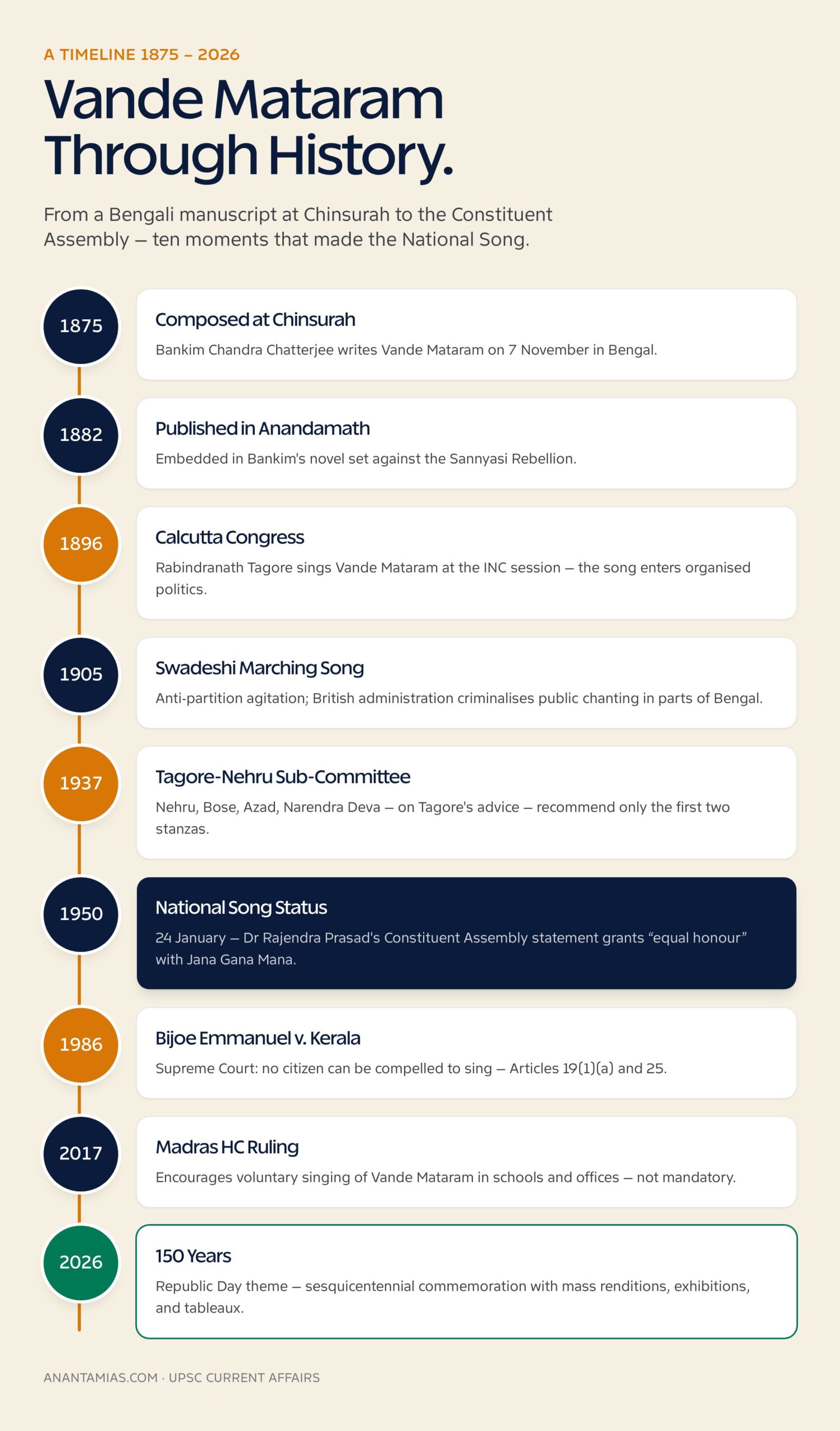
Significance for UPSC and General Knowledge
- Direct GS-I syllabus hit on modern Indian history — the freedom struggle, Bengal Renaissance, Swadeshi movement, and the role of cultural nationalism.
- GS-I Art and Culture overlap on Bankim Chandra Chatterjee, Bengali literature, Tagore, and the musical history of Indian classical and devotional traditions.
- GS-II anchor on the constitutional adoption sequence, Article 394, Article 51A fundamental duties, and Constituent Assembly procedure.
- Prelims static fodder on dates (1875, 1882, 1896, 1930, 1937, 1949, 1950, 1971, 1986), articles, named acts and named personalities.
- Essay paper data bank on themes such as Indian symbols, plural nationalism, the meaning of citizenship, and constitutional patriotism.
- GS-IV ethics linkage on tolerance, dissent, the Bijoe Emmanuel jurisprudence, and the ethics of compelled speech.
- Interview-stage current affairs material on national symbols, the chief guest tradition as instrument of foreign policy, and tableaux federalism.
Detailed Analysis: Republic Day as Constitutional Pageantry and Public Memory
To read Republic Day as merely a parade is to miss what the day is doing. The parade is the operative ritual of constitutional patriotism — a phrase the political theorist Rajeev Bhargava has used to describe the form of belonging that a republic of strangers can plausibly demand of its citizens. Where the United States invokes a founding revolution and France invokes the storming of a prison, India invokes the coming-into-force of a written document. The choice of 26 January 1950 as that date was deliberate: the Constituent Assembly had adopted the Constitution on 26 November 1949, but waited two months so that the date of operation would coincide with Purna Swaraj Day, observed since 1930 to mark the Lahore Congress’s resolution of complete independence. The parade therefore folds three temporalities: the 1929-30 declaration, the 1949-50 enactment, and the present-tense rehearsal of the republic’s military, federal and cultural strength.
The chief guest tradition is the parade’s foreign-policy instrument. The first Republic Day in 1950 hosted President Sukarno of Indonesia — a deliberate Asian-solidarity signal at a moment when both states were finding their feet. Since then, the choice of chief guest has functioned as a one-day-a-year strategic communique, telegraphing where the host country wishes to anchor its diplomacy in the year ahead. The list below condenses the recent decade and the strategic logic behind each invitation.
| Year | Chief Guest | Strategic Significance |
|---|---|---|
| 2016 | President Francois Hollande, France | Defence partnership, Rafale negotiations, climate compact post-Paris |
| 2017 | Crown Prince Mohammed bin Zayed, UAE | Gulf strategic partnership, energy security, Indian diaspora |
| 2018 | Ten ASEAN heads of state/government | 25 years of India-ASEAN dialogue partnership; Act East flagship |
| 2019 | President Cyril Ramaphosa, South Africa | BRICS, IBSA, and 150 years of Mahatma Gandhi |
| 2020 | President Jair Bolsonaro, Brazil | BRICS, agribusiness, ethanol cooperation |
| 2021 | None (COVID-19; UK PM Boris Johnson’s invitation cancelled) | Pandemic-era scaled-down parade, no foreign chief guest |
| 2022 | None (COVID-19 third wave; Central Asian republics invitation deferred) | Pandemic; first virtual India-Central Asia Summit instead |
| 2023 | President Abdel Fattah el-Sisi, Egypt | Egypt’s G20 invitee status, Suez logistics, IMEC precursor |
| 2024 | President Emmanuel Macron, France | Strategic partnership 25 years; Indo-Pacific, defence industrial cooperation |
| 2025 | President Prabowo Subianto, Indonesia | 75 years of India-Indonesia diplomatic relations; Indo-Pacific |
| 2026 | António Costa (President, European Council) & Ursula von der Leyen (President, European Commission), European Union | First-ever EU joint leadership invitation; signal on India-EU strategic partnership and FTA negotiations |
What the table reveals is the consistency of a doctrine rather than the caprice of a guest list. France appears twice in a decade (2016, 2024), Indonesia bookends the period (2025, with Sukarno in 1950), and the ASEAN bloc invitation in 2018 was the largest single diplomatic statement embedded in the parade in recent memory. The chief guest is, in effect, the country with whom India most wishes to be photographed at the start of the calendar year — a soft-power complement to the harder choreography of joint exercises, summits and trade negotiations that follow through the rest of it.
The military dimension of the parade is its most visible, but the analytical interest lies in what is being signalled. The display of indigenous platforms — the Tejas light combat aircraft in flypast, the Pinaka multi-barrel rocket launcher, the Akash air defence system, the Arjun main battle tank, the Dhanush howitzer, the BrahMos cruise missile, the K-9 Vajra self-propelled artillery and, in recent years, indigenous unmanned systems — is a public audit of the Atmanirbhar Bharat defence-industrial push. The all-women contingents, expanded steadily since 2015 and centre-stage from 2024, are themselves a deliberate statement, as is the steady increase in the share of marching contingents drawn from the Central Armed Police Forces and the National Disaster Response Force. The semiotics is layered: a state announcing what kind of state it intends to be.
The cultural choreography is at least as deliberate. The tableaux on Kartavya Path — fifteen or so from states, ten or so from ministries — are screened over four to five rounds by an expert committee, with an explicit brief tying them to the year’s theme. The 2024 parade carried the theme of “Viksit Bharat”; 2025 commemorated the diamond jubilee of the Constitution under the theme “Swarnim Bharat: Virasat aur Vikas”; the 2026 brief on “150 Years of Vande Mataram” places states in the position of interpreting a single literary-political text through their own regional cultural grammar. This is what the political scientist Sunil Khilnani has called the “idea of India” performed annually — a federation telling itself a single story in twenty-five different accents.
The closing element of the four-day arc is the Beating Retreat on the evening of 29 January at Vijay Chowk. Its origins are explicitly British military — a ceremony marking the end of a day’s hostilities, with troops returning to camp at sundown — but the Indian adaptation has become a showcase for indigenous military music and bagpipe bands of the three services, the police and CAPFs. The 2022 edition controversially dropped “Abide With Me”, a hymn that had been a staple since the 1950s and a Mahatma Gandhi favourite, in favour of “Aye Mere Watan Ke Logo”. The decision drew critique from cultural commentators including historian Mukul Kesavan, who treated it as a needless break with a syncretic tradition. That episode is itself instructive: the parade and its companion ceremonies are layered with choices that look ceremonial but encode substantive contests about what the republic is, has been and is becoming.
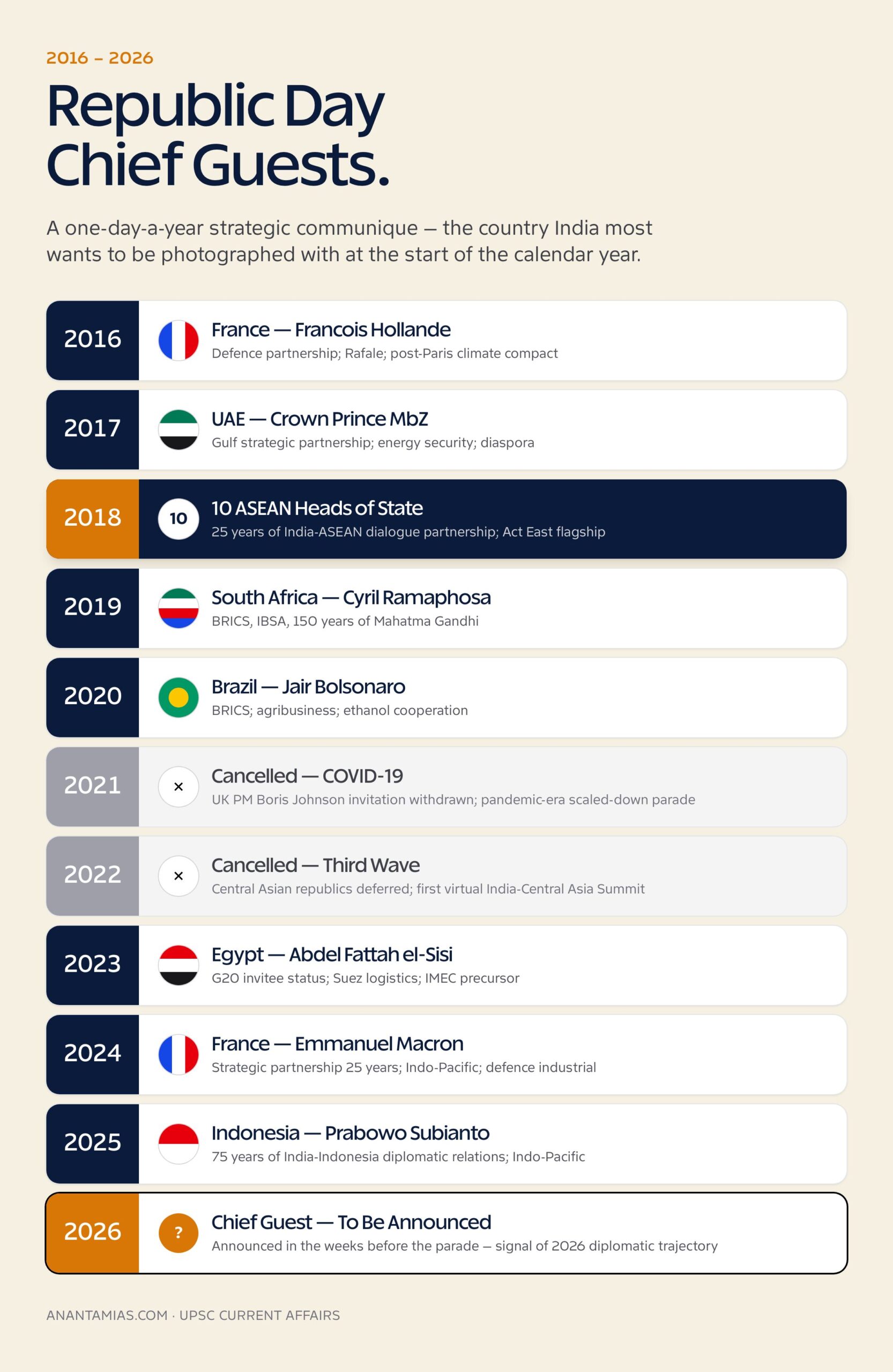
Comparative Perspective
Most modern republics anchor a national day on either an event of constitutional founding or a moment of revolution. The choice of anchor encodes the kind of polity each republic wants to remember itself as. India’s anchor is constitutional adoption; France’s is the storming of the Bastille; the United States’s is the Declaration of Independence; Singapore’s is independence from Malaysia. The format that follows the anchor is similarly distinctive: India and France both use a military parade; the United States privileges a fireworks-and-civic-celebration model with no central state ceremony; Singapore stages a stadium-based National Day Parade that has become an exercise in choreographed civic pageantry.
| Country / Day | Anchor Event | Format and Focus |
|---|---|---|
| India — Republic Day, 26 January | Constitution came into force, 1950 (and Purna Swaraj Day, 1930) | Military parade on Kartavya Path; foreign chief guest; state tableaux; flypast; Beating Retreat on 29 January |
| France — Bastille Day, 14 July | Storming of the Bastille, 1789 | Military parade down the Champs-Elysees reviewed by the President; flypast by the Patrouille de France; foreign troop contingents in some years |
| United States — Independence Day, 4 July | Declaration of Independence, 1776 | Decentralised civic celebrations; fireworks; parades organised at city level; no central military parade tradition |
| Singapore — National Day, 9 August | Independence from Malaysia, 1965 | National Day Parade alternating between the Padang and the National Stadium; mass display, military and civic, with strong choreographed civic component |
The structural insight is that India’s Republic Day is institutionally closer to Bastille Day than to the American Fourth of July: both are state-led, military-anchored, capital-centric, and explicitly international in their guest choreography. Where India differs is in the sheer prominence of state tableaux as a federal performance — neither the French nor the Singaporean parades give comparable annual visibility to sub-national units. That federal layer is one of the underrecognised strengths of the Indian format: every year, on national television, fifteen states get to tell the country who they are.
Challenges and Criticisms
The Vande Mataram question has shadowed the song since the 1930s and has not gone away. The objections have moved through three registers. The first is theological: the later stanzas of the song personify the motherland as the goddesses Durga, Lakshmi and Saraswati, and sections of the Indian Muslim community, drawing on a strict reading of monotheistic doctrine that rejects the worship of any entity beside God, have argued from the early twentieth century that the song’s full text is incompatible with Islamic practice. The Muslim League articulated this position formally in the 1930s, and it was specifically to address this concern that the 1937 Congress sub-committee chaired by Jawaharlal Nehru with Subhas Chandra Bose, Maulana Azad and Acharya Narendra Deva, after consultation with Rabindranath Tagore, recommended that only the first two stanzas be sung at official Congress functions. The Constituent Assembly inherited that compromise: the National Song status conferred on 24 January 1950 applied to the song’s first two stanzas alone.
The second register is constitutional. Granville Austin, in The Indian Constitution: Cornerstone of a Nation, treated the Constituent Assembly’s parallel placement of Jana Gana Mana and Vande Mataram as a deliberate act of accommodation rather than ranking — both were given “equal honour” precisely because either alone would have been read by some constituency as exclusion of the other. The contemporary jurisprudence has hardened around this accommodation. The Supreme Court in Bijoe Emmanuel v. State of Kerala (1986), on a challenge by Jehovah’s Witness students who declined to sing the anthem, held that respectful standing in silence does not constitute disrespect, and that compelled singing violates Article 19(1)(a)‘s freedom of speech and Article 25‘s freedom of conscience. The Court has consistently extended that reasoning to Vande Mataram, including in the Shyam Narayan Chouksey proceedings of 2016-18, where the original direction making the National Anthem mandatory in cinemas was modified in 2018 to make it optional.
The third register is sociological. Political theorists including Rajeev Bhargava have argued that a plural republic should distinguish between symbols of sovereignty (which the state may lawfully require respect for) and symbols of cultural-religious affiliation (which require voluntary embrace, not legal mandate). The recurring controversies — orders by individual high courts, executive instructions in particular states requiring schools to sing Vande Mataram, episodic public demands that public servants demonstrate the song aloud — sit precisely on the line that the 1937 sub-committee, the 1950 Assembly statement and the 1986 Bijoe Emmanuel reasoning all sought to draw. The 2026 commemoration, framed around the song’s sesquicentennial, will be judged not by the scale of its events but by whether it can stage that celebration without retracing those fault lines — without, in other words, turning a song that was once the universally legible chant of an anti-colonial movement into a litmus test of belonging in the republic the movement built.

Prelims Pointers
- 26 January 2026 marks the 77th Republic Day of India.
- Theme of Republic Day 2026: “150 Years of Vande Mataram”.
- Vande Mataram was composed by Bankim Chandra Chatterjee on 7 November 1875 at Chinsurah, Bengal.
- The song was first published in the magazine Bangadarshan and embedded in the novel Anandamath (1882).
- Vande Mataram was first sung at the 1896 Calcutta session of the Indian National Congress by Rabindranath Tagore.
- The 1937 Congress sub-committee on Vande Mataram comprised Jawaharlal Nehru, Subhas Chandra Bose, Maulana Azad and Acharya Narendra Deva.
- The Constitution of India was adopted on 26 November 1949 (Constitution Day) and came into force on 26 January 1950 under Article 394.
- 26 January was chosen because it was Purna Swaraj Day, observed since 1930 after the Lahore Congress resolution of December 1929.
- On 24 January 1950, President Dr Rajendra Prasad’s statement gave Vande Mataram National Song status with “equal honour” to Jana Gana Mana.
- Jana Gana Mana, the National Anthem, was composed by Rabindranath Tagore in 1911 and first sung at the Calcutta Congress on 27 December 1911.
- Article 51A(a) makes respect for the National Anthem and the Constitution a fundamental duty.
- The Prevention of Insults to National Honour Act was enacted in 1971.
- Bijoe Emmanuel v. State of Kerala (1986) held that no one can be compelled to sing the National Anthem.
- Rajpath was renamed Kartavya Path in September 2022.
- Beating Retreat is held annually on 29 January at Vijay Chowk; the chief guest of the 1950 Republic Day was President Sukarno of Indonesia.
Mains Practice Questions
- “The choice of 26 January 1950 as the date the Constitution came into force was an act of memory as much as of law.” Discuss with reference to the Lahore Congress, Purna Swaraj Day and the Constituent Assembly’s working calendar. (15 marks)
- Trace the journey of Vande Mataram from Bankim Chandra Chatterjee’s 1875 composition to its formal status as the National Song in 1950. What does this trajectory tell us about the relationship between literature and political mobilisation in colonial India? (15 marks)
- Examine the constitutional and judicial distinction between the National Anthem and the National Song. How has the Supreme Court reconciled symbols of sovereignty with the freedoms guaranteed under Articles 19(1)(a) and 25? (10 marks)
- The 1937 Congress sub-committee on Vande Mataram produced a compromise that the Constituent Assembly later codified. Critically evaluate this compromise as an early instance of accommodative secularism. (15 marks)
- Republic Day tableaux are a federal performance as much as a cultural display. Discuss with examples how the screening process and thematic choices shape the annual narration of Indian federalism. (10 marks)
- Compare India’s Republic Day with Bastille Day in France and Independence Day in the United States. What does the Indian format reveal about its conception of constitutional patriotism? (15 marks)
- “The Republic Day chief guest is a one-day-a-year strategic communique.” Examine this proposition with reference to the choices made over the past decade. (10 marks)
- Discuss the role of Rabindranath Tagore in the making of independent India’s national symbols, including the National Anthem and the framing of the Vande Mataram compromise. (15 marks)
Conclusion
What the 77th Republic Day reveals, read alongside the Vande Mataram sesquicentennial, is the layered work that a national day has to do in a plural republic. The parade is the visible part — marching contingents, indigenous platforms, the flypast, the tableaux, the chief guest seated to the President’s left. The invisible part is the decision-architecture behind the spectacle: which song is sung, in how many stanzas, by whom, with what statutory backing, with which dissents constitutionally protected, and which states get to tell their version of the year’s theme on a national stage. The 2026 commemoration foregrounds a song that travelled from Chinsurah in 1875 to Anandamath in 1882, to the 1896 Calcutta Congress, to the 1905 Swadeshi streets, to the 1937 sub-committee compromise, to the Constituent Assembly statement of 24 January 1950, and into the Bijoe Emmanuel jurisprudence of 1986 — a single object refracting through every consequential moment of the republic’s making.
For the year ahead, three watchpoints follow from the day. The first is the texture of the commemorative programme — whether the Ministry of Culture’s events stay anchored to the song’s first two stanzas, the portion that the 1937-1950 sequence canonised, or whether the sesquicentennial frame is used to revisit the boundary the framers set. The second is the pattern of state participation in the 2026 tableaux: which states make the cut, whose proposals are returned, and which regional readings of Vande Mataram are foregrounded. The third is what the 2026 chief-guest choice itself signals: by inviting António Costa, President of the European Council, and Ursula von der Leyen, President of the European Commission, as joint chief guests — the first time the EU’s top leadership has been hosted in this capacity — the Modi government has placed the India-EU strategic partnership, including the long-pending Free Trade Agreement and the technology and security tracks, at the centre of the year’s diplomatic calendar.
For the aspirant, the line worth carrying into the answer booklet is that the Indian Republic is the rare modern polity that anchors its national day on a constitutional document rather than a battle — and that the 2026 theme reminds us the document was preceded by a song.
Frequently Asked Questions
Who was the chief guest at Republic Day 2026?
Republic Day 2026 had two joint chief guests for the first time in the parade’s history: António Costa, President of the European Council, and Ursula von der Leyen, President of the European Commission. The invitation reflected the deepening India-EU strategic partnership and the conclusion of the India-EU FTA shortly afterwards.
What was the theme of Republic Day 2026?
The 77th Republic Day was themed 150 Years of Vande Mataram, marking the 1875 composition of the song by Bankim Chandra Chatterjee. The Kartavya Path tableaux from states and ministries reflected the song’s history, the freedom struggle, and India’s constitutional adoption of it as the national song with status equal to the national anthem.
Why is Republic Day celebrated on 26 January?
26 January marks two events: the Indian National Congress declared Purna Swaraj on 26 January 1930 in Lahore, and the Constitution of India came into force on 26 January 1950. The framers chose the date to commemorate the Purna Swaraj resolution. The Constitution had been adopted earlier on 26 November 1949.
Who composed Vande Mataram?
Vande Mataram was composed by Bankim Chandra Chatterjee at Chinsurah, Bengal, on 7 November 1875. It was first published in his Bengali novel Anandamath in 1882. Rabindranath Tagore set the song to music and sang it at the 1896 Calcutta session of the Indian National Congress.
Is Vande Mataram the national anthem of India?
No. Jana Gana Mana is the national anthem, adopted by the Constituent Assembly on 24 January 1950. Vande Mataram is the national song with equal status, also formally recognised by the Constituent Assembly the same day. The 1937 Tagore-Nehru sub-committee had recommended that only the first two stanzas be officially used.
What is the Bijoe Emmanuel verdict?
Bijoe Emmanuel v. State of Kerala (1986) is a Supreme Court verdict holding that no person can be compelled to sing the national anthem if it offends their religious belief. The Court held that respectful silence does not violate the Prevention of Insults to National Honour Act 1971. The same reasoning extends to the national song.
How does Republic Day differ from Independence Day?
Independence Day on 15 August commemorates India’s freedom from British rule in 1947 — the Prime Minister hoists the flag at the Red Fort. Republic Day on 26 January marks the Constitution coming into force in 1950 — the President takes the salute at the Kartavya Path parade. The first is national, the second is constitutional.
Why is Republic Day important for UPSC?
Republic Day is high-yield for GS-I Modern History and GS-II Polity: it tests the Purna Swaraj resolution (1930), the Constitution-making process, the national symbols (anthem, song, emblem), and the federal pageantry of the parade. Art and Culture questions often trace Vande Mataram’s literary origins; Prelims tests dates, names and articles.
Source: https://anantamias.com/current-affairs/77th-republic-day-2026-vande-mataram/
India-EU Free Trade Agreement Concluded 2026: The ‘Mother of All Trade Deals’ Decoded
Introduction
The India-European Union Free Trade Agreement, concluded on 27 January 2026—a day after the 77th Republic Day at which Antonio Costa, President of the European Council, and Ursula von der Leyen, President of the European Commission, served as joint chief guests—closes a negotiating cycle that began in 2007, collapsed in 2013, and was relaunched in June 2022. Anchored institutionally in the India-EU Strategic Partnership of 2004 and operationalised through the Connectivity Partnership (2021) and the Trade and Technology Council (TTC) set up in 2023, the FTA is, in the language of the Ministry of External Affairs (MEA), the most consequential preferential trade arrangement India has ever entered. For UPSC aspirants, it cuts simultaneously through GS-II (bilateral and regional groupings, effect of policies of developed countries on India), GS-III (effects of liberalisation on the economy, indigenisation of technology) and the Economy module of Prelims, where the EU’s status as a customs union and India’s FTA portfolio are recurrent test points.
The headline numbers anchor the deal’s scale: bilateral merchandise trade with the EU stood at roughly €124 billion in 2024, making the bloc India’s largest trading partner ahead of the United States and China when the EU is treated as a single jurisdiction; services trade adds another €59.8 billion in 2024 (with EU exports of €26 billion and imports of €33.8 billion); and EU foreign direct investment stock in India crosses €100 billion cumulatively. This article telegraphs the deal in seven moves—quick facts, historical context, key features across goods, services, investment and IP, the strategic logic of India’s wider FTA pivot since 2022, comparative perspective with the EU’s other Asian deals, the criticisms still on the table from think-tanks and domestic constituencies, and finally the Prelims and Mains scaffolding aspirants need.

Quick Facts at a Glance
| Indicator | Value | Source |
|---|---|---|
| Date of conclusion | 27 January 2026 (post-Republic Day summit) | MEA, Joint Statement |
| EU side signatories | Antonio Costa (European Council), Ursula von der Leyen (European Commission) | European Commission press release |
| India side | Prime Minister Narendra Modi; Commerce Minister Piyush Goyal | PIB, MEA |
| EU-India merchandise trade (2024) | ~€124 billion | Eurostat / European Commission |
| Year FTA negotiations launched | 2007 | European Commission DG TRADE |
| Year talks paused | 2013 (over auto tariffs, dairy, wines) | ICRIER working papers |
| Year talks resumed | June 2022 (Modi-von der Leyen Delhi summit) | MEA |
| India FTAs concluded since 2022 | 4 major: UAE CEPA (2022), Australia ECTA (2022), EFTA TEPA (2024), UK CETA (signed 24 July 2025) | Department of Commerce, GoI |
Background and Historical Context
The diplomatic architecture between New Delhi and Brussels was scaffolded long before the trade file. The India-EU Strategic Partnership, declared at the 5th India-EU Summit at The Hague in 2004, made India the EU’s sixth strategic partner globally and the first in South Asia, distinguishing the relationship from Brussels’ transactional engagement with most developing economies. A Joint Action Plan in 2005 and its 2008 revision broadened cooperation into security, energy and research, but the centrepiece was always meant to be a Broad-based Trade and Investment Agreement (BTIA), as the FTA was then known. Negotiations on the BTIA were launched at the New Delhi Summit in June 2007 and ran for sixteen rounds before stalling around 2013. The deal-breakers, as ICRIER and CUTS International documented at the time, were familiar: EU demands for tariff cuts on automobiles, wines and spirits, and dairy; Indian resistance on data adequacy, services Mode 4 movement of professionals, and public procurement.
The intervening decade was used to build confidence outside the trade file. The EU-India Connectivity Partnership, adopted at the Porto Summit in May 2021, framed digital, energy, transport and people-to-people connectivity as a counter to Beijing’s Belt and Road Initiative—language the European External Action Service deployed openly. Two years later, in April 2023, the two sides launched the India-EU Trade and Technology Council (TTC) in Brussels, only the second such mechanism the EU has set up after the one with the United States. The TTC’s three working groups—on strategic technologies including AI and semiconductors, on green and clean energy tech, and on trade, investment and resilient value chains—were explicitly designed by Commission Vice-President Margrethe Vestager as a confidence-building runway for the FTA itself.
The political reset came in June 2022 when Prime Minister Modi and President von der Leyen formally relaunched the FTA, alongside parallel tracks on investment protection and geographical indications. The decision in mid-2025 to invite the EU Council and Commission Presidents jointly as chief guests for the 77th Republic Day—the first time a non-state collective entity received that protocol—was read in Brussels as a calculated political signal that closure was imminent. The conclusion on 27 January 2026, the morning after the parade, lands within the negotiating mandate Brussels gave the Commission in 2022 and meets von der Leyen’s stated goal of closing the deal before the end of her second mandate.
Key Features of the India-EU FTA
Goods, Tariffs and Sensitive Sectors
On goods, the FTA delivers tariff elimination on 86 per cent of India’s tariff lines (covering ~93 per cent of trade by value) and on over 90 per cent of EU tariff lines (~91 per cent by value), phased over up to ten years, with most reductions front-loaded within five to seven years of entry into force. India secured carve-outs on dairy—where the National Dairy Development Board (NDDB) had warned of livelihood shock to 80 million milk-producing households—keeping ad valorem duties on cheese, butter and skimmed milk powder largely intact. Automobiles, the single largest sticking point in 2013, were resolved through a tariff rate quota mechanism: a graduated reduction on completely-built units of internal combustion engine vehicles to a long-term floor, with steeper cuts for electric vehicles to align with India’s EV30@30 goals. Wines and spirits see phased duty reduction, addressing a long-standing French and Italian demand. Indian textiles, leather, marine products and pharmaceutical generics gain duty-free access to the EU market, the gain corridor most flagged by the Federation of Indian Export Organisations (FIEO).
Services, Mode 4 and Data Adequacy
The services chapter is where India extracted its most politically valuable concessions. Improved access for contractual service suppliers and independent professionals under WTO Mode 4—covering IT, engineering, architecture, accounting and management consultancy—addresses a recurring grievance of NASSCOM dating to the original BTIA round. The agreement contains a mutual recognition framework for professional qualifications in select sectors, to be operationalised by sector-specific committees. Critically, the EU and India committed to a data adequacy dialogue on a defined timeline, though full adequacy under GDPR Article 45 is sequenced separately from the FTA itself—no adequacy decision was issued contemporaneously with the agreement, and the Commission’s formal assessment of India’s Digital Personal Data Protection Act, 2023 remains pending, with broad governmental exemptions and the absence of an independent Data Protection Authority flagged as outstanding obstacles. Financial services, telecommunications and maritime transport see standstill commitments preventing future regulatory backsliding.
Investment Protection and IP
Investment is handled through a parallel Investment Protection Agreement (IPA), separated from the FTA in line with the EU’s post-Lisbon Treaty practice since the 2017 Singapore opinion of the Court of Justice. The IPA introduces a permanent Investment Court System (ICS) with a tribunal and an appellate mechanism, replacing the discredited ad hoc ISDS panels India exited from after the 2016 Model BIT. On intellectual property, the EU dropped maximalist demands on data exclusivity for pharmaceuticals and on patent term extension that had been deal-breakers in 2013, preserving India’s generics ecosystem and Section 3(d) of the Patents Act, 1970. Trade secret protection, plant variety provisions consistent with India’s PPV&FR Act, 2001, and copyright enforcement are upgraded to TRIPS-plus levels in narrowly defined areas.
Geographical Indications and Government Procurement
The FTA’s GI annex protects an initial list of European GIs—including Champagne, Parma ham, Feta and Roquefort—and an Indian list covering iconic registrations such as Darjeeling tea, Basmati rice, Alphonso mango, Tirupati laddu and Pochampally Ikat, among others; the precise numerical breakdown of each side’s protected list will be confirmed only when the legal text is published. The asymmetry that India had resisted in 2013—the EU’s GI list dwarfing India’s—was bridged through a phased schedule and a coexistence clause for prior trademarks. Government procurement, where India had refused central, state and PSU coverage, was addressed through a plurilateral-style sub-central carve-out: only specified central ministries above a threshold value are opened, with state-level procurement and Make-in-India price preferences fully ring-fenced. The chapter is non-GPA, meaning India does not accede to the WTO Government Procurement Agreement.

Significance for UPSC and General Knowledge
- Marks the largest FTA ever concluded by India by trade volume, surpassing the UK CETA and UAE CEPA in covered merchandise value.
- Operationalises the India-EU Strategic Partnership of 2004 in its trade dimension, completing a 22-year diplomatic arc.
- Reinforces India’s pivot from multilateral WTO Doha pessimism to bilateral and plurilateral preferential agreements.
- Strengthens the Indo-Pacific economic architecture by anchoring Europe’s largest economy bloc to a Quad-aligned democracy.
- Tests India’s preparedness for WTO-plus disciplines in labour, environment and digital trade, areas it has resisted at Geneva.
- Activates the Investment Court System as a new template for India’s post-2016 Model BIT investment treaty practice.
- Acts as a de-risking instrument against China-centric supply chains, aligned with the EU’s 2023 Economic Security Strategy.
Detailed Analysis: India’s FTA Strategy and the EU as a Strategic Anchor
The conclusion of the India-EU FTA is best read not as a discrete diplomatic event but as the capstone of a deliberate FTA pivot India executed between 2022 and 2026. The pivot itself is the inverse of the policy India ran from 2009 to 2019, when the country was negotiating the Regional Comprehensive Economic Partnership (RCEP) alongside fifteen Asia-Pacific economies. Its withdrawal from RCEP at the Bangkok Summit in November 2019—on grounds of inadequate protection against Chinese import surges, unresolved services and Mode 4 access, and inverted duty structures—left India outside the largest preferential trade bloc in its neighbourhood. The strategic problem this created was acute: India risked becoming a preferential trade orphan as ASEAN, China, Japan, Korea, Australia and New Zealand integrated their tariff schedules from 2022 onwards.
The response, architected by the Department of Commerce under successive Commerce Ministers from Piyush Goyal onwards, was a sequenced bilateral push. The India-UAE Comprehensive Economic Partnership Agreement (CEPA), concluded in February and entering into force in May 2022, was the proof-of-concept—negotiated in 88 days, covering 80 per cent of tariff lines on day one, and weaponising the Gulf trade corridor. The India-Australia Economic Cooperation and Trade Agreement (ECTA) followed in April 2022 and entered into force in December 2022, opening the Australian market to Indian textiles and IT services. The India-EFTA Trade and Economic Partnership Agreement (TEPA), signed in March 2024 with Switzerland, Norway, Iceland and Liechtenstein, was the first in which India secured a binding investment commitment—USD 100 billion in EFTA-origin FDI over fifteen years and one million jobs. The India-UK Comprehensive Economic and Trade Agreement (CETA), concluded in 2025, normalised market access with India’s largest pre-Brexit European partner.
| FTA | Year | Scope | Tariff Coverage (approx.) |
|---|---|---|---|
| India-UAE CEPA | 2022 | Goods, services, investment, digital trade | ~80% on day one, 90%+ over 10 years |
| India-Australia ECTA | 2022 | Goods, services (interim, pending CECA) | ~85% Indian lines, ~96% Australian lines |
| India-EFTA TEPA | 2024 | Goods, services, IP, investment commitment | India: 82.7% lines (95.3% by value); EFTA: 92.2% lines (99.6% by value) |
| India-UK CETA | 2025 | Goods, services, investment, GI, IP | India: ~90% lines; UK: 100% lines over 7 years (99.6% of Indian exports by value) |
| India-EU FTA | 2026 | Goods, services, IPA (separate), GI, sustainability | India: 86% lines (~93% by value); EU: over 90% lines (~91% by value) |
The EU FTA differs from its predecessors on three counts that matter for UPSC analysis. First, its scale: the EU bloc accounts for more bilateral trade than the UAE, Australia, EFTA and the UK combined, making it a system-shaping deal rather than a niche corridor agreement. Second, its regulatory depth: the EU exports its standards through trade agreements—what Columbia’s Anu Bradford labelled the Brussels Effect in her 2020 book—and the FTA’s chapters on sustainability, labour, digital trade and IP align large parts of Indian commercial regulation with EU norms. This is a double-edged outcome: it lowers compliance friction for Indian exporters but constrains policy space domestically. Third, its geopolitical content: the FTA sits inside a triangulation with the EU-Indo-Pacific Strategy of 2021, the Global Gateway initiative launched in December 2021 as a €300 billion infrastructure response to BRI, and the India-Middle East-Europe Economic Corridor (IMEC) announced at the G20 New Delhi Summit in September 2023.
The Carbon Border Adjustment Mechanism (CBAM), which entered its definitive period on 1 January 2026, is the elephant in the room. CBAM imposes a carbon price on imports of cement, iron and steel, aluminium, fertilisers, electricity and hydrogen—precisely the sectors where India runs trade surpluses with the EU. The FTA does not exempt Indian exports from CBAM, since CBAM is a unilateral EU climate measure, but the agreement establishes a cooperation framework on carbon pricing and a fast-track mutual recognition pathway for Indian carbon credits, addressing concerns that ICRIER and CSE (Centre for Science and Environment) had flagged about an estimated USD 8 billion annual hit to Indian exports. The deal also creates a sustainability chapter with binding commitments on the Paris Agreement and core ILO conventions, but with consultative—not sanctions-based—dispute settlement, a compromise India insisted on after observing the contested EU-Vietnam labour disputes.
Strategically, the FTA’s most enduring effect may be on the rupee-denominated trade ecosystem. The agreement contains a side instrument committing both parties to explore local-currency invoicing and direct euro-rupee settlement through the RBI’s Special Rupee Vostro Account (SRVA) framework, alongside the broader push since 2022 to build local-currency settlement corridors with partner central banks. For India, this is part of the de-dollarisation push the Reserve Bank of India has executed cautiously since 2022. For the EU, it advances the international role of the euro, a Commission priority since the 2018 communication.

Comparative Perspective
Set against the EU’s other recent Asian deals, the India FTA is unusual in both its long gestation and its shorter projected ratification path. The EU-Vietnam FTA (EVFTA), concluded in 2015, took until August 2020 to enter into force after parliamentary ratification by all member states. The EU-Japan Economic Partnership Agreement (EPA), signed in July 2018, entered into force in February 2019—the fastest of the EU’s modern FTAs. The EU-Mercosur agreement, politically concluded in 2019 and re-concluded in December 2024, has been bogged down for years in French agricultural opposition and Amazon deforestation concerns. The India-EU FTA’s two-track architecture (FTA on EU exclusive competence + IPA as a mixed agreement requiring national ratifications) is borrowed from the EU-Singapore precedent and is designed to allow the FTA itself to enter into force after European Parliament approval alone, while the IPA waits for all 27 member state parliaments.
| EU FTA Partner | Conclusion | Entry into Force | Time Lag |
|---|---|---|---|
| Japan | July 2018 | February 2019 | ~7 months |
| Vietnam | December 2015 (initialled); June 2019 (signed) | August 2020 | ~14 months from signing |
| Mercosur | June 2019 (political); December 2024 (re-concluded) | Pending ratification | 5+ years and counting |
| India | 27 January 2026 | Projected early 2027 (FTA track, pending Council and European Parliament approval) | ~12 months (projected) |
Challenges and Criticisms
The deal is not uncontested. CUTS International, in a January 2026 brief co-authored by Pradeep Mehta, warned that the dairy carve-out is partial and that even token EU access to processed dairy could destabilise the cooperative model that Operation Flood built since 1970. The Society of Indian Automobile Manufacturers (SIAM) has flagged that phased CBU duty cuts will compress margins for Indian-assembled European brands and disadvantage indigenous OEMs such as Tata Motors and Mahindra in the premium segment, even as it accelerates EV adoption. Sandra Polaski, the former US Deputy Undersecretary of Labour now at the Boston University Global Development Policy Center, has argued in a comparative paper that the FTA’s sustainability chapter—being consultative rather than enforceable—replicates the weakness that has rendered EU labour clauses with Korea and Vietnam largely paper tigers.
The data adequacy question remains the largest unresolved policy file. Without an adequacy decision under GDPR Article 45, Indian IT services exporters continue to rely on Standard Contractual Clauses, raising compliance costs that NASSCOM estimates at 1.5-2 per cent of EU-origin revenue. The Commission’s 2024 review of India’s Digital Personal Data Protection Act, 2023 flagged the broad governmental exemptions and the absence of an independent Data Protection Authority as adequacy obstacles. Whether the FTA’s data dialogue track delivers adequacy within the implementation period or merely sequences it indefinitely will determine if Indian services exporters genuinely capture the deal’s services chapter gains.
Ratification risk is real. The IPA must clear 27 national parliaments and several regional ones—including the Belgian Walloon Parliament, which famously held up CETA with Canada in 2016. French and Italian agricultural lobbies, despite the GI gains, may resist over the dairy carve-out’s reciprocity. ORF (Observer Research Foundation) analyst Harsh V. Pant has cautioned that the political mood in Europe—Brexit aftershocks, far-right gains in Germany and France, Hungary’s veto practice—makes any mixed-competence ratification a multi-year obstacle course. The FTA-only track is more secure but covers a narrower set of disciplines.

Prelims Pointers
- India-EU Strategic Partnership declared at the 5th India-EU Summit, The Hague, 2004.
- BTIA / FTA negotiations launched at the New Delhi Summit, June 2007.
- Negotiations paused in 2013, resumed in June 2022.
- EU is India’s largest trading partner (treating EU as single bloc); merchandise trade ~€124 billion in 2024.
- Connectivity Partnership adopted at Porto Summit, May 2021.
- India-EU Trade and Technology Council (TTC) launched in April 2023—second TTC by EU after the US TTC.
- Joint Republic Day chief guests 2026: Antonio Costa (European Council President) and Ursula von der Leyen (European Commission President).
- Investment Court System (ICS) replaces ad-hoc ISDS in the parallel Investment Protection Agreement.
- Carbon Border Adjustment Mechanism (CBAM) entered definitive phase on 1 January 2026—not exempted by FTA but cooperation framework added.
- Global Gateway launched December 2021, €300 billion EU infrastructure initiative.
- IMEC announced at G20 New Delhi Summit, September 2023.
- India FTAs concluded since 2022: UAE CEPA (2022), Australia ECTA (2022), EFTA TEPA (2024), UK CETA (2025), EU FTA (2026).
- India withdrew from RCEP at the Bangkok Summit, November 2019.
- India’s Model BIT adopted in 2016, reset post-Vodafone and White Industries arbitrations.
- GI examples protected: Darjeeling tea, Basmati rice, Alphonso mango, Tirupati laddu, Pochampally Ikat (India); Champagne, Parma ham, Feta, Roquefort (EU).
Mains Practice Questions
- The India-EU Free Trade Agreement concluded in January 2026 marks the closure of a 19-year negotiating cycle. Critically examine the strategic and economic considerations that drove its conclusion. (GS-II / GS-III, 250 words)
- “India’s FTA pivot since 2022 represents a strategic recalibration after the RCEP withdrawal of 2019.” Discuss with reference to the UAE CEPA, EFTA TEPA, UK CETA and EU FTA. (GS-III, 250 words)
- Analyse how the Carbon Border Adjustment Mechanism (CBAM) interacts with the India-EU FTA. Does the agreement adequately insulate Indian exporters from EU climate-linked trade measures? (GS-III, 250 words)
- Evaluate the implications of the Investment Court System introduced in the India-EU Investment Protection Agreement for India’s post-2016 Model BIT framework. (GS-II / GS-III, 150 words)
- “The Brussels Effect makes EU FTAs both an opportunity and a constraint for partner countries.” Examine in the context of regulatory alignment imposed by the India-EU FTA. (GS-II, 250 words)
- The conclusion of the India-EU FTA reflects geopolitical de-risking against China-centric supply chains. Discuss the role of the Indo-Pacific Strategy, Global Gateway and IMEC in this triangulation. (GS-II, 250 words)
- Sensitive sectors—dairy, automobiles, public procurement, data adequacy—shaped the contours of the India-EU FTA. Critically assess the trade-offs accepted by India. (GS-III, 250 words)
- Compare the entry-into-force trajectories of the EU’s FTAs with Japan, Vietnam and Mercosur, and assess the ratification risk for the India-EU agreement. (GS-II, 150 words)
Conclusion
The conclusion of the India-EU Free Trade Agreement on 27 January 2026 is, on the most parsimonious reading, a closure of unfinished business: a deal launched in 2007, abandoned in 2013, and revived in 2022 has finally crossed the political threshold. On a more ambitious reading, however, the FTA is a hinge between two phases of India’s external economic policy. The first phase, defined by post-1991 multilateralism and ASEAN-centric regionalism, ended at Bangkok in 2019 with the RCEP walk-out. The second phase, the bilateral-and-bloc strategy, has unfolded through CEPA, ECTA, TEPA, CETA and now the EU FTA—each progressively deeper in regulatory coverage and each progressively more aligned with India’s Atmanirbhar Bharat domestic posture rather than against it.
For the European Union, the deal answers a question Brussels has wrestled with since the 2021 Indo-Pacific Strategy: how to convert geopolitical alignment with India into commercial substance without forcing Delhi into a binary choice between Brussels and Beijing. The FTA’s separation of the trade and investment tracks, its consultative sustainability chapter, its non-GPA procurement architecture and its CBAM cooperation framework are all design choices that respect Indian policy space while extending European regulatory reach. The Brussels Effect operates here through alignment, not coercion.
For UPSC aspirants, three durable takeaways survive the news cycle. First, the FTA is a case study in strategic patience—how diplomatic capital invested in a Strategic Partnership in 2004 compounds across two decades. Second, it illustrates the indivisibility of trade and geopolitics in a fragmenting world economy, where CBAM, IMEC, Global Gateway and TTC are all instruments of the same de-risking grammar. Third, it stress-tests India’s institutional capacity to absorb deep regulatory disciplines—on data, sustainability, IP and investment—without surrendering policy autonomy. Whether the deal becomes the “mother of all trade deals” Commerce Minister Goyal described it as, or merely a well-architected regulatory bridge, will depend on what happens between conclusion and entry into force—the next eighteen months are where the agreement will be made or unmade.
Frequently Asked Questions
When was the India-EU Free Trade Agreement concluded, and who led the two sides?
It was concluded on 27 January 2026, the morning after the 77th Republic Day parade at which Antonio Costa, President of the European Council, and Ursula von der Leyen, President of the European Commission, served as joint chief guests. India was represented by Prime Minister Narendra Modi and Commerce Minister Piyush Goyal. The signing closes a negotiating cycle that began as the Broad-based Trade and Investment Agreement at the New Delhi Summit in June 2007, ran sixteen rounds before stalling in 2013, and was relaunched in June 2022.
How much of each side’s tariffs does the India-EU FTA actually eliminate?
India eliminates duties on 86 per cent of its tariff lines, covering roughly 93 per cent of trade by value, while the EU eliminates duties on over 90 per cent of its lines, covering about 91 per cent by value. The phase-out runs up to ten years, with most reductions front-loaded within five to seven years of entry into force. On the gain side, Indian textiles, leather, marine products and pharmaceutical generics get duty-free access to the EU market, the corridor most flagged by the Federation of Indian Export Organisations.
Did India have to open up dairy, automobiles and wines under the deal?
Dairy was largely carved out. Duties on cheese, butter and skimmed milk powder stay largely intact after the National Dairy Development Board warned of livelihood shock to 80 million milk-producing households. Automobiles, the single largest sticking point in 2013, were settled through a tariff rate quota: a graduated cut on completely-built internal combustion engine units down to a long-term floor, with steeper cuts for electric vehicles. Wines and spirits see phased duty reduction, which answers a long-standing French and Italian demand.
Does the FTA protect Indian exporters from the EU’s carbon border tax?
No. The agreement does not exempt Indian exports from the Carbon Border Adjustment Mechanism, because CBAM is a unilateral EU climate measure rather than a bilateral concession, and it entered its definitive period on 1 January 2026. CBAM prices imports of cement, iron and steel, aluminium, fertilisers, electricity and hydrogen, exactly the sectors where India runs trade surpluses with the EU. What the FTA adds is a cooperation framework on carbon pricing and a fast-track mutual recognition pathway for Indian carbon credits, responding to the roughly USD 8 billion annual hit to Indian exports that ICRIER and the Centre for Science and Environment had estimated.
Did India get an EU data adequacy decision along with the FTA?
No. The two sides committed only to a data adequacy dialogue on a defined timeline, and full adequacy under Article 45 of the GDPR is sequenced separately from the trade agreement. No adequacy decision was issued alongside the FTA, and the European Commission’s assessment of India’s Digital Personal Data Protection Act, 2023 is still pending, with broad governmental exemptions and the absence of an independent Data Protection Authority named as the outstanding obstacles. Until that changes, Indian IT services exporters keep relying on Standard Contractual Clauses, which NASSCOM puts at a compliance cost of 1.5 to 2 per cent of EU-origin revenue.
What is the Investment Court System, and why is investment kept out of the FTA text?
Investment sits in a parallel Investment Protection Agreement rather than inside the FTA, following EU practice after the Court of Justice’s 2017 Singapore opinion. That IPA sets up a permanent Investment Court System with a standing tribunal and an appellate mechanism, replacing the ad hoc investor-state panels India moved away from after its 2016 Model BIT. On intellectual property the EU dropped its 2013-era demands for pharmaceutical data exclusivity and patent term extension, which preserves India’s generics ecosystem and Section 3(d) of the Patents Act, 1970.
Which geographical indications are protected, and did India open government procurement?
The GI annex protects European names such as Champagne, Parma ham, Feta and Roquefort alongside Indian registrations including Darjeeling tea, Basmati rice, Alphonso mango, Tirupati laddu and Pochampally Ikat, with a coexistence clause for prior trademarks; the exact number on each list will only be confirmed when the legal text is published. On procurement, India opened only specified central ministries above a threshold value. State-level procurement and Make-in-India price preferences are fully ring-fenced, and the chapter is non-GPA, so India does not accede to the WTO Government Procurement Agreement.
When will the India-EU FTA enter into force, and what could delay it?
The FTA track is projected to enter into force in early 2027, roughly twelve months after conclusion, once the Council and the European Parliament approve it. That speed comes from a two-track design borrowed from the EU-Singapore precedent: the FTA rests on EU exclusive competence, while the Investment Protection Agreement is a mixed agreement needing ratification by all 27 member state parliaments and several regional ones, including the Belgian Walloon Parliament that held up CETA with Canada in 2016. Observer Research Foundation analyst Harsh V. Pant has cautioned that the current European political mood makes any mixed-competence ratification a multi-year obstacle course.
Source: https://anantamias.com/current-affairs/india-eu-fta-concluded-2026/
Budget Session 2026 and President’s Address: Article 87, Parliament and Policy Signals
Budget Session 2026 opened with the President’s Address to both Houses of Parliament on 28 January. The address is constitutionally significant because it frames the government’s policy agenda at the start of the first session of the year.
For UPSC, this is a classic polity topic with a current hook. Students should connect the event with Article 87, parliamentary procedure, Motion of Thanks, Budget process and executive accountability.
This article explains the constitutional and exam relevance of the President’s Address and Budget Session procedure.
Quick Facts
- The President addresses both Houses at the commencement of the first session each year.
- Article 87 of the Constitution provides for the special address.
- The address outlines the government’s policy agenda.
- Parliament discusses it through the Motion of Thanks.
- Budget Session also includes presentation and discussion of the Union Budget.
- Official source: President’s Address text dated 28 January 2026.
- Official source: President of India.
What Just Happened
The President addressed both Houses of Parliament at the opening of Budget Session 2026.
The address set out the government’s policy claims and priorities before the Budget and parliamentary debate.
For aspirants, the news should trigger revision of the President’s constitutional role in a parliamentary system.
Background and Historical Context
India’s President is the constitutional head of the Union, while real executive power is exercised by the Council of Ministers headed by the Prime Minister.
The President’s Address is prepared by the government and read by the President. It is therefore an executive policy statement delivered through a constitutional office.
The Motion of Thanks allows Parliament to debate the address. Amendments can become politically significant because they test the government’s majority and accountability.
Key Features of Parliament
The core policy architecture can be read through these features.
- Article 87: provides for the special address to both Houses.
- Policy statement: the address reflects the government’s agenda.
- Motion of Thanks: Parliament debates and votes on the address.
- Budget link: the session also handles financial business.
- Accountability: opposition uses the debate to scrutinise government claims.
- Constitutional symbolism: the President represents the Union while acting on ministerial advice.
Why It Matters
This is a high-yield UPSC topic because it joins current news with durable syllabus themes.
- It connects a January 2026 event with durable UPSC syllabus themes.
- It gives usable facts for Prelims and analytical hooks for Mains.
- It helps students move from news recall to policy reasoning.
- It can be linked with static concepts in polity, economy, governance, science, environment or society.
Detailed Analysis: Parliament Lens
The President’s Address is ceremonial but not empty. Its text becomes the government’s official policy narrative for parliamentary debate.
The Motion of Thanks is a control mechanism. It gives MPs a structured opportunity to challenge policy claims across sectors.
Budget Session tests parliamentary time management. Financial scrutiny often suffers when disruptions reduce debate on demands for grants.
Comparative Perspective
A comparison helps prevent the answer from becoming a one-dimensional news summary.
- Article 87 Address: policy statement at the first session of the year and after general elections.
- Budget Speech: Finance Minister’s fiscal and taxation statement.
- Economic Survey: Ministry of Finance’s analytical review of the economy.
- Motion of Thanks: parliamentary debate on the President’s Address.
Challenges
The policy or institutional promise runs into recurring constraints.
- Frequent disruptions can reduce scrutiny.
- Guillotine of demands for grants can limit detailed financial debate.
- The address may become politically celebratory rather than analytically accountable.
- Parliamentary committees need stronger follow-up on policy promises.
- Citizens often confuse the President’s personal views with the government’s policy text.
Prelims Pointers
- Article 87 deals with the President’s special address.
- The President addresses both Houses at the start of the first session each year.
- The Motion of Thanks is moved after the address.
- The Annual Financial Statement is under Article 112.
- Demands for grants are voted by the Lok Sabha.
- Rajya Sabha can discuss but not vote on demands for grants.
Mains Questions
- The President’s Address is a constitutional form through which executive policy enters parliamentary scrutiny. Discuss. (GS Paper II, 250 words)
- Explain the significance of the Motion of Thanks in parliamentary accountability. (GS Paper II, 150 words)
- Budget Session is central to legislative control over public finance. Analyse the challenges in India. (GS Paper II, 250 words)
- Distinguish between the Economic Survey, Budget Speech and President’s Address. (GS Paper II/III, 150 words)
Way Forward
Parliament should protect time for debate on the President’s Address, Budget and demands for grants.
Committee scrutiny and public dashboards can help track whether policy claims made in the address are implemented.
For Prelims, remember the Article numbers. For Mains, explain the accountability logic.
The examiner is unlikely to reward a bare fact dump here. The better answer connects the January 2026 event to institutional design, implementation capacity and India’s long-term development priorities.
Frequently Asked Questions
Which Article deals with the President’s Address?
Article 87 of the Constitution.
Who writes the President’s Address?
It is prepared by the government and delivered by the President.
What is the Motion of Thanks?
It is the parliamentary motion through which both Houses discuss the President’s Address.
How is it different from the Budget?
The address is a policy statement, while the Budget sets financial proposals.
Which Article covers the Annual Financial Statement?
Article 112.
Why is this important for UPSC?
It connects constitutional procedure with parliamentary accountability.
Source: https://anantamias.com/current-affairs/budget-session-2026-president-address/
Solid Waste Management Rules 2026: A Reset for Urban Waste Governance
Why in News?
The Ministry of Environment, Forest and Climate Change (MoEFCC) has notified the Solid Waste Management Rules 2026 under the Environment (Protection) Act, 1986, replacing the decade-old SWM Rules 2016. The reset tightens segregation, expands Extended Producer Responsibility (EPR) and sets time-bound processing and scientific-landfill targets for urban local bodies (ULBs).
The new rules dovetail with the Swachh Bharat Mission-Urban 2.0 push on garbage-free cities and the government’s circular economy agenda, treating waste as a recoverable resource rather than a disposal problem.
- Mandate source segregation into three streams — wet (biodegradable), dry (recyclable) and domestic hazardous/sanitary waste.
- Extend EPR obligations onto producers, importers and brand-owners for packaging and harder-to-recycle waste streams.
- Set time-bound targets for 100% scientific processing of fresh waste and remediation of legacy dumpsites via biomining and bio-capping.
- Sharpen duties of bulk waste generators — bodies generating above the notified threshold must process wet waste on-site.
- Align city sanitation with SBM-Urban 2.0 star-rating and the Garbage-Free City certification system.
The development matters in the context of:
- India’s cities generate roughly 1.7 lakh tonnes of municipal solid waste a day, and a large share is still dumped unscientifically.
- The SWM Rules 2016 were never fully enforced — segregation at source and landfill remediation lagged across most ULBs.
- Mounting legacy waste at sites like Delhi’s Ghazipur and Bhalswa made dumpsite remediation a political and public-health priority.
UPSC Relevance
Prelims Relevance
- Solid Waste Management Rules 2026 notified under the Environment (Protection) Act, 1986 — a Central rule-making power.
- SWM Rules 2016 superseded the Municipal Solid Wastes (Management and Handling) Rules, 2000.
- Extended Producer Responsibility (EPR) — producer/brand-owner bears post-consumer waste responsibility.
- Central Pollution Control Board (CPCB) — statutory body under the Water Act 1974, the apex monitoring authority.
- Waste-to-energy (WtE) — incineration/RDF and biomethanation routes for non-recyclable residue.
- Biomining and bio-capping — techniques used to remediate legacy waste dumpsites.
- Swachh Bharat Mission-Urban 2.0 — aims at garbage-free cities; launched 2021.
- 74th Constitutional Amendment Act, 1992 — sanitation/solid waste is a Twelfth Schedule function of urban local bodies.
Mains Relevance
GS Paper 3
- Examine how the SWM Rules 2026 advance a circular economy by treating waste as a resource.
- Assess Extended Producer Responsibility as an instrument for managing packaging and plastic waste.
GS Paper 2
- Evaluate the capacity of urban local bodies under the 74th Amendment to deliver time-bound waste targets.
Essay
- Waste is not what we discard but what we have failed to value — the circular economy as a development idea.
- Clean cities, the unfinished promise of urbanisation.
Background and Context
From 2016 to 2026: what the reset changes
The 2026 rules keep the architecture of the 2016 regime but close its biggest enforcement gaps.
- Reaffirm and tighten source segregation into wet, dry and domestic hazardous/sanitary streams, with collection penalties for mixed waste.
- Convert aspirational 2016 timelines into time-bound, monitorable targets for processing and dumpsite remediation.
- Broaden EPR beyond plastics toward packaging, multi-layered and harder-to-recover materials.
- Strengthen reporting and audit duties so CPCB and state boards can track ULB performance.
Duties of generators and urban local bodies
The rules distribute clear obligations across households, bulk generators and the municipal machinery.
- Households must hand over segregated waste; no co-mingling at the doorstep.
- Bulk waste generators — large housing societies, hotels, hospitals, campuses above a notified threshold — must compost or process wet waste on-site.
- Urban local bodies handle door-to-door collection, secondary transport, processing infrastructure and scientific landfilling.
- Sanitation is a Twelfth Schedule subject under the 74th Amendment, so the rules effectively operationalise a constitutional municipal function.
EPR and the circular-economy logic
Extended Producer Responsibility shifts the cost of end-of-life waste onto those who put products on the market.
- EPR makes producers, importers and brand-owners responsible for collecting back and recycling post-consumer packaging.
- It feeds the circular economy goal of designing out waste and keeping materials in use.
- Recovered dry waste re-enters manufacturing as recyclate, cutting demand for virgin material.
- Better source segregation raises the quality and value of the recyclable stream.
Processing, waste-to-energy and scientific landfills
The rules push residue up the waste hierarchy and shrink the role of open dumping.
- Wet waste is routed to composting and biomethanation; dry waste to material-recovery facilities.
- Non-recyclable, high-calorific residue can go to waste-to-energy plants or be processed as refuse-derived fuel.
- Only inert, non-processable residue should reach a scientific landfill — engineered with liners and leachate control.
- CPCB sets standards and monitors emissions, leachate and processing compliance.
Legacy waste, dumpsites and remediation
Decades of unscientific dumping created mountains of legacy waste that the rules want cleared on a deadline.
- Legacy waste at old dumpsites is to be remediated through biomining — excavating, screening and recovering material — and bio-capping.
- Remediation reclaims valuable urban land and cuts methane and fire hazards.
- Funding and execution are tied to Swachh Bharat Mission-Urban 2.0 support to states and ULBs.
- Iconic sites such as Delhi’s Ghazipur and Bhalswa are the test cases for the new timelines.
Convergence with SBM-Urban 2.0 and the law
The rules sit inside a wider statutory and mission framework rather than standing alone.
- Notified under the Environment (Protection) Act, 1986, giving them pan-India statutory force.
- Operationally tied to SBM-Urban 2.0 outcomes — Garbage-Free City star ratings and the Swachh Survekshan survey.
- Reinforce the role of state pollution control boards and CPCB in monitoring and enforcement.
- Complement the separate Plastic Waste and E-Waste Management Rules within India’s waste-governance stack.
Way Forward
Make segregation stick
- Pair penalties for mixed waste with reliable separate collection, so citizens trust that sorted waste stays sorted.
- Run sustained behaviour-change and ward-level monitoring rather than one-off campaigns.
Fund and build ULB capacity
- Strengthen municipal finances and technical staffing so urban local bodies can actually meet time-bound targets.
- Use viability-gap funding and user charges to sustain processing plants beyond the grant period.
Close the loop on EPR
- Build transparent, audited EPR registries so producer credits map to real recycling, not paper compliance.
- Integrate the informal waste-picker economy with dignity, training and fair prices.
Conclusion
The Solid Waste Management Rules 2026 matter less for inventing new ideas than for converting the half-kept promises of 2016 into deadlines, duties and audited targets. Their real test is enforcement at the ward and dumpsite level, not the elegance of the notification.
If segregation, EPR and dumpsite remediation move together — and if cash-strapped urban local bodies get the money and people to deliver — the rules could turn India’s waste burden into a genuine circular economy opportunity. If not, they risk joining the long list of well-drafted environmental rules that the country never fully implemented.
UPSC Practice Questions
Prelims MCQ 1
With reference to the Solid Waste Management Rules 2026, consider the following statements:
- They are notified under the Environment (Protection) Act, 1986.
- They mandate segregation of waste at source into wet, dry and domestic hazardous streams.
- They abolish the principle of Extended Producer Responsibility introduced earlier.
How many of the above statements are correct?
(a) Only one (b) Only two (c) All three (d) None
Answer: (b) Only two
Explanation:
Statements 1 and 2 are correct — the rules are issued under the EPA 1986 and require three-way source segregation. Statement 3 is wrong: the rules expand, not abolish, Extended Producer Responsibility.
Prelims MCQ 2
In the context of municipal waste governance in India, the recovery of material from old dumpsites by excavating and screening accumulated legacy waste is best described as:
(a) Biomethanation (b) Biomining (c) Incineration (d) Leachate treatment
Answer: (b) Biomining
Explanation:
Biomining excavates and screens legacy waste to recover recyclables, soil and combustible fractions, reclaiming the dumpsite land. Biomethanation digests wet waste, while incineration burns residue for energy.
UPSC Mains Questions
- The Solid Waste Management Rules 2026 reframe municipal waste as a resource rather than a disposal problem. Examine how the rules advance a circular economy and the institutional bottlenecks that could hold them back.
- Extended Producer Responsibility shifts the burden of post-consumer waste onto producers. Critically evaluate its design and enforcement challenges in the Indian context.
- Sanitation and solid-waste management are constitutional functions of urban local bodies. Discuss why time-bound waste targets remain hard to deliver and suggest a way forward.
Sources: Ministry of Environment, Forest and Climate Change and Central Pollution Control Board.
Frequently Asked Questions
What are the Solid Waste Management Rules 2026?
They are central rules notified under the Environment (Protection) Act, 1986 that overhaul the 2016 framework for managing municipal solid waste. They tighten source segregation, expand Extended Producer Responsibility, and set time-bound targets for waste processing and scientific landfilling across India’s urban local bodies.
How do the 2026 rules differ from the SWM Rules 2016?
The 2016 rules introduced source segregation and EPR but were weakly enforced. The 2026 reset keeps that architecture while converting aspirational timelines into monitorable, time-bound targets, broadening EPR to more waste streams, and sharpening the duties of bulk generators and municipalities.
What is Extended Producer Responsibility in this context?
Extended Producer Responsibility, or EPR, makes producers, importers and brand-owners responsible for collecting back and recycling the post-consumer waste their products generate, especially packaging. It internalises the cost of waste and supports a circular economy by keeping materials in productive use.
What is the three-way segregation the rules require?
Households and generators must separate waste into three streams: wet or biodegradable waste for composting and biomethanation, dry recyclable waste for material recovery, and domestic hazardous and sanitary waste for safe handling. Mixed waste defeats downstream processing and attracts penalties.
How do the rules deal with legacy waste at old dumpsites?
They require remediation of legacy waste through biomining and bio-capping, where accumulated waste is excavated, screened and recovered, reclaiming land and cutting methane and fire risks. This work is tied to support under the Swachh Bharat Mission-Urban 2.0.
How are the rules linked to Swachh Bharat Mission-Urban 2.0?
The rules provide the statutory backbone for SBM-Urban 2.0’s garbage-free city goal. Compliance feeds into the Garbage-Free City star ratings and the Swachh Survekshan survey, while the mission channels funds and technical support to states and urban local bodies for processing and remediation.
Source: https://anantamias.com/current-affairs/solid-waste-management-rules-2026/
The New Aadhaar App: Face Authentication, Consent and Digital Identity
Why in News?
The Unique Identification Authority of India (UIDAI) has rolled out a redesigned Aadhaar app that turns the 12-digit number into a fully digital, on-phone identity, replacing the practice of sharing printed copies of the Aadhaar letter for routine verification.
The headline feature is face authentication paired with a scannable QR code: a person can verify identity in seconds and share only the specific fields a checker needs, all gated by an explicit on-device consent step.
- App enables QR-based offline verification — the verifier scans a code instead of photographing or photocopying the Aadhaar letter.
- Face authentication on the phone confirms the holder is present, reducing reliance on fingerprint or OTP for in-person checks.
- Selective disclosure lets a user share only name and photo (or only age band) rather than the full demographic record.
- Aim, per UIDAI, is to cut physical-Aadhaar misuse and speed up offline KYC at hotels, airports, shops and counters.
- The redesign sits on top of the existing Aadhaar Act, 2016 framework and the Digital Personal Data Protection (DPDP) Act, 2023 obligations on consent and data minimisation.
The development matters in the context of:
- Why this matters in the context of digital public infrastructure (DPI): Aadhaar is the identity layer of India’s JAM trinity and the new app re-engineers how that layer is presented and consented to.
- Why this matters in the context of privacy: the Puttaswamy (2017–2018) jurisprudence set limits on Aadhaar use that any new feature must respect.
- Why this matters in the context of data protection: consent architecture and selective disclosure are the operational test of the DPDP Act, 2023 principle of data minimisation.

UPSC Relevance
Prelims Relevance
- UIDAI is a statutory body under the Aadhaar Act, 2016, attached to the Ministry of Electronics and Information Technology (MeitY).
- Aadhaar is a 12-digit random number; it is proof of identity, not of citizenship.
- Puttaswamy v. Union of India (2017) recognised the right to privacy as part of Article 21; the 2018 Aadhaar verdict upheld the Act with limits.
- Section 7 of the Aadhaar Act allows Aadhaar for subsidies, benefits and services funded from the Consolidated Fund of India.
- The 2018 verdict struck down Section 57, restricting Aadhaar use by private entities without a backing law.
- DPDP Act, 2023 rests on consent, purpose limitation and the role of the Data Principal and Data Fiduciary.
- JAM trinity = Jan Dhan accounts + Aadhaar + Mobile, the backbone of Direct Benefit Transfer (DBT).
- Offline verification modes already include the QR code on the Aadhaar letter and masked Aadhaar; the app extends this on-device.
- Face authentication is an additional UIDAI modality alongside fingerprint, iris and OTP.
Mains Relevance
GS Paper 2
- Role of digital public infrastructure and identity in welfare delivery and governance reform.
- Tension between state-led identity systems and the fundamental right to privacy after Puttaswamy.
GS Paper 3
- Data protection, consent architecture and cyber-security implications of a phone-resident national ID.
- Use of biometrics and face recognition in citizen-facing services: benefits and risks.
GS Paper 2
- Citizens’ charters of accountability and transparency for bodies like UIDAI handling sensitive data.
Essay
- Convenience versus consent: who owns my identity in a digital republic?
- Technology as an enabler of inclusion and a vector of surveillance.
Background and Context
What changed in the new app
The redesign shifts Aadhaar from a paper letter to a consent-gated digital wallet on the phone.
- Identity lives on the device; verification happens by QR scan rather than by handing over a photocopy.
- Face authentication ties the live holder to the record, useful where fingerprint readers or network OTP are impractical.
- Selective disclosure means a hotel or shop can receive only the fields it needs — say name and photo — not the full demographic set.
- Every share is preceded by an explicit consent prompt, logging that the holder authorised that specific disclosure.
- UIDAI frames the goal as cutting physical-Aadhaar misuse — forged copies, retained photocopies and casual data leakage at counters.
The statutory backbone: Aadhaar Act and UIDAI
The app does not create new powers; it operates inside the existing 2016 statute.
- The Aadhaar Act, 2016 gives UIDAI statutory status and governs enrolment, authentication and the protection of the Central Identities Data Repository (CIDR).
- Section 7 anchors Aadhaar to subsidies and services drawn from the Consolidated Fund of India.
- UIDAI functions under MeitY and is responsible for security of biometric and demographic data.
- Authentication today already supports fingerprint, iris, OTP and face; the app makes the face mode citizen-facing and offline-friendly.
Privacy and the Puttaswamy limits
Any expansion of Aadhaar’s reach is read against the Supreme Court’s privacy jurisprudence.
- Justice K.S. Puttaswamy v. Union of India (2017) held that the right to privacy is intrinsic to Article 21.
- The 2018 Constitution-bench verdict upheld the Aadhaar Act but read it down — proportionality and a legitimate state aim are required.
- The court struck down Section 57, barring private companies from demanding Aadhaar absent a specific law.
- A consent-led, minimal-disclosure design is, in effect, the architecture Puttaswamy’s proportionality test invites.
- Mission creep — quietly widening the fields verifiers can pull — remains the live constitutional risk.
Data protection under the DPDP Act, 2023
The new features map directly onto the obligations the data-protection law imposes.
- The Digital Personal Data Protection Act, 2023 makes consent the default basis for processing personal data.
- Principles of purpose limitation and data minimisation are exactly what selective disclosure operationalises.
- The holder is a Data Principal; verifiers act as Data Fiduciaries accountable for what they collect and retain.
- A verifier that scans a QR and keeps only the consented fields should, in principle, hold far less than one that photographs a full Aadhaar letter.
- The Data Protection Board envisaged under the Act is the grievance and enforcement channel if disclosure rules are breached.
Aadhaar in the JAM trinity and DPI stack
Identity is one rail of India’s wider digital public infrastructure.
- The JAM trinity — Jan Dhan, Aadhaar, Mobile — powers Direct Benefit Transfer and has cut leakage in welfare delivery, anchoring India’s digital public infrastructure.
- Aadhaar is the identity layer that sits alongside payments (UPI) and data-sharing (Account Aggregator) in the DPI stack.
- A cleaner, consent-driven verification flow strengthens trust in this stack as services digitise.
- Offline modes matter for inclusion where connectivity is weak, so face-plus-QR can reach beyond OTP-dependent users.
Concerns and the criticism
Convenience invites its own risks that the design must answer.
- Face recognition carries error and bias risks; a false match or mismatch can wrongly deny or grant access.
- On-device identity raises device security and lost-phone questions that the app’s safeguards must cover.
- A friction-free share button can normalise over-collection unless verifiers are audited for what they actually request.
- Exclusion persists — those without smartphones, or with biometrics that fail to read, still need a non-digital fallback.
- Centralised identity remains a high-value cyber-security target; breach impact scales with adoption.
Way Forward
Consent and minimisation by design
- Default every share to the fewest fields a use-case needs, with clear logs the holder can review.
- Audit Data Fiduciaries for over-collection and enforce purpose limitation under the DPDP Act.
Guardrails for biometrics
- Publish face-authentication accuracy and bias metrics, and keep a robust non-biometric fallback to prevent exclusion.
- Mandate a manual verification route so a failed face match never becomes a denial of service or benefit.
Operationalise the Data Protection Board quickly so citizens have a real grievance forum, and run public-awareness drives so users understand consent, selective disclosure and how to revoke a share.
Conclusion
The redesigned Aadhaar app is less a new power than a new presentation layer — it tries to make identity verification convenient while honouring the consent and minimisation logic that the DPDP Act, 2023 and the Puttaswamy judgments demand.
Whether it earns trust will turn on the details: transparent biometric accuracy, audited verifiers, a working grievance board and a fallback for those the technology leaves behind. Done well, it is a model for citizen-controlled digital identity; done carelessly, it risks the very mission creep the courts warned against.
UPSC Practice Questions
Prelims MCQ 1
With reference to the Aadhaar framework in India, consider the following statements:
- UIDAI is a statutory body established under the Aadhaar Act, 2016.
- Aadhaar is proof of Indian citizenship.
- The Supreme Court in the 2018 verdict struck down Section 57, which had allowed private entities to seek Aadhaar.
How many of the above statements are correct?
(a) Only one (b) Only two (c) All three (d) None
Answer: (b) Only two
Explanation:
Statements 1 and 3 are correct: UIDAI is statutory under the 2016 Act and the 2018 verdict struck down Section 57. Statement 2 is wrong — Aadhaar is proof of identity, not citizenship.
Prelims MCQ 2
The right to privacy was recognised as a fundamental right intrinsic to Article 21 in which case?
(a) Kesavananda Bharati v. State of Kerala (b) Justice K.S. Puttaswamy v. Union of India (2017) (c) Maneka Gandhi v. Union of India (d) Minerva Mills v. Union of India
Answer: (b) Justice K.S. Puttaswamy v. Union of India (2017)
Explanation:
The 2017 nine-judge Puttaswamy bench unanimously held that the right to privacy is intrinsic to the right to life and liberty under Article 21.
UPSC Mains Questions
- India’s new Aadhaar app introduces face authentication, consent-gated sharing and selective disclosure of identity data. Examine how these features address — and where they fall short of — the principles laid down in the Puttaswamy judgments and the DPDP Act, 2023. (250 words)
- Digital public infrastructure has transformed welfare delivery in India but also concentrated sensitive personal data. Critically evaluate the governance and data-protection safeguards needed for a phone-resident national identity system. (250 words)
- Discuss the trade-off between convenience and consent in state-led digital identity systems, with reference to the design of the redesigned Aadhaar app. (150 words)
Sources: UIDAI, Ministry of Electronics and Information Technology and Press Information Bureau.
Frequently Asked Questions
What is new in the redesigned Aadhaar app?
The app turns the 12-digit Aadhaar into a fully digital, on-phone identity. Its headline features are face authentication, a scannable QR code for offline verification, and selective disclosure — letting a person share only the specific fields a verifier needs, each behind an explicit consent prompt, instead of handing over a printed photocopy.
How does selective disclosure protect privacy?
Selective disclosure lets the holder reveal only what a given check requires — say name and photo, or just an age band — rather than the full demographic record. This operationalises the data-minimisation and purpose-limitation principles of the DPDP Act, 2023, so a hotel or shop ends up holding far less personal data than when it photographs an entire Aadhaar letter.
Is the new app legally backed?
Yes. It operates within the existing Aadhaar Act, 2016, which gives UIDAI its statutory status, and must comply with the consent and accountability obligations of the Digital Personal Data Protection Act, 2023. It adds no new statutory power; it changes how identity is presented and consented to.
How does this relate to the Puttaswamy judgment?
The 2017 Puttaswamy verdict held privacy to be a fundamental right under Article 21, and the 2018 verdict upheld Aadhaar with proportionality limits while striking down Section 57. A consent-led, minimal-disclosure design is broadly the architecture that the court’s proportionality test invites, though mission creep remains a risk to watch.
What are the main concerns with face authentication?
Face recognition can produce false matches or mismatches and may carry bias, risking wrongful denial or access. On-device identity also raises device-security and lost-phone questions, and there is a risk of normalising over-collection. A robust non-biometric fallback is essential so a failed face match never becomes a denial of a service or benefit.
Where does Aadhaar fit in the JAM trinity?
Aadhaar is the identity rail of the JAM trinity — Jan Dhan accounts, Aadhaar and Mobile — that underpins Direct Benefit Transfer and has reduced leakage in welfare delivery. In the wider digital public infrastructure stack it sits alongside UPI for payments and the Account Aggregator for data sharing, acting as the trusted identity layer.
Source: https://anantamias.com/current-affairs/new-aadhaar-app-digital-identity-2026/
Economic Survey 2025-26: Growth, Inflation and Jobs Signals for UPSC
Economic Survey 2025-26 placed India in a strong but not effortless macroeconomic position. The official brief projected 7.4 percent real GDP growth for FY26, a 6.8-7.2 percent band for FY27, unusually soft CPI inflation, record GST collections, resilient services exports and a large foreign exchange buffer.
The useful UPSC lesson is not that the economy is simply doing well. The Survey is a map of tradeoffs: high growth with uneven job quality, stable inflation with food-price vulnerability, service-sector strength with manufacturing ambitions, and fiscal consolidation with rising demand for public investment.
This article reads Economic Survey 2025-26 the way an examiner is likely to read it: as official evidence for GS-III economy answers, not as a memorisation sheet of isolated numbers.
Quick Facts
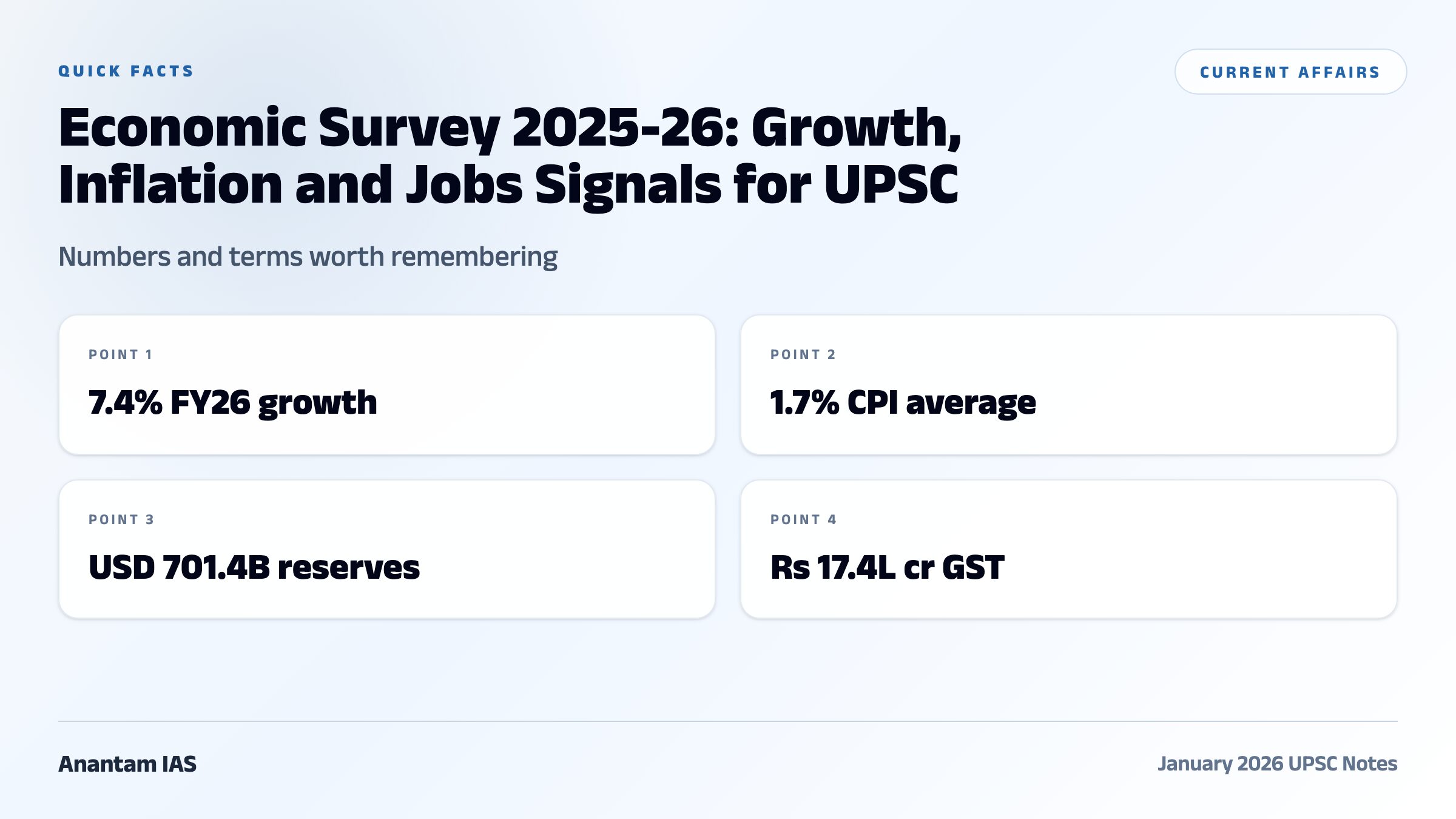
- Real GDP growth for FY26 was estimated at 7.4 percent, with FY27 projected in the 6.8-7.2 percent range.
- Average CPI inflation for FY26 was placed at 1.7 percent in the official brief.
- Services contributed about 56.4 percent of GVA, confirming the sector’s central role in Indian growth.
- Goods and services exports stood at USD 825.3 billion in FY25, with services cushioning merchandise weakness.
- Foreign exchange reserves touched USD 701.4 billion as of 3 October 2025.
- Gross GST collections reached Rs 17.4 lakh crore during April-November 2025, up 9.1 percent year on year.
- The e-Shram database crossed 31 crore registered unorganised workers.
- Official source: PIB, Ministry of Finance.
What Just Happened
The Ministry of Finance released the Economic Survey 2025-26 backgrounder at the start of the Union Budget cycle. The Survey framed the economy through growth resilience, external-sector buffers, digital public infrastructure, labour-market formalisation and the need to keep reforms moving despite global uncertainty.
The headline 7.4 percent GDP estimate matters because it arrives in a world of weak global demand, tariff stress and volatile capital flows. India’s official growth story now rests on domestic consumption, public capital expenditure, services exports and a still-cautious private investment cycle.
The Survey also gave UPSC candidates a clean set of official numbers for Mains answers. Growth, inflation, exports, GST, foreign exchange reserves and labour registration are not just statistics. They are evidence that can anchor answers on macro stability, inclusive growth, fiscal capacity and employment.
Background and Historical Context
The Economic Survey is prepared by the Economic Division of the Department of Economic Affairs under the Ministry of Finance. It is not a constitutional requirement like the Annual Financial Statement under Article 112. Its value lies in analysis: it explains the government’s reading of the economy before the Budget sets the fiscal path.
Since 1950-51, Economic Surveys have evolved from descriptive statistical volumes into policy arguments. Recent editions have placed more weight on digital public infrastructure, formalisation, climate transition, supply-chain resilience and the role of states in growth.
For UPSC, the Survey is a primary source because it combines data with policy framing. A candidate who quotes the Survey well usually writes more precise answers than one who only uses generic economy notes.
Key Features of Economic Survey 2025-26
The core policy architecture can be read through these features.
- Growth resilience: India remained one of the fastest growing major economies, but the Survey did not treat high growth as automatic.
- Soft inflation: CPI moderation created policy space, while food and fuel risks remained important.
- Services strength: IT, professional services, financial services and tourism continued to stabilise exports.
- Fiscal capacity: Higher GST collections signalled stronger tax compliance and better revenue buoyancy.
- External buffers: High forex reserves reduced vulnerability to sudden capital outflows.
- Labour formalisation: e-Shram and payroll datasets provided a wider, though still incomplete, view of work.
Why It Matters
This is a high-yield UPSC topic because it joins current news with durable syllabus themes.
- It gives official numbers for GS-III answers on growth, inflation, employment and external sector.
- It links current data to static topics such as fiscal policy, monetary policy, tax buoyancy and demographic dividend.
- It helps Prelims by refreshing terms such as GDP, GVA, CPI, forex reserves, GST buoyancy and current account.
- It gives Essay material on development models, jobs, technology and inclusive growth.
Detailed Analysis: Macroeconomy Lens
The growth number hides a composition question. A 7 percent-plus economy can still disappoint if growth is concentrated in capital-intensive sectors. The Survey’s services story is strong, but the employment challenge needs manufacturing, construction, logistics, care work and MSME productivity to carry more weight.
Low inflation should not be read as a permanent win. A year of soft CPI creates relief for households and the RBI, but India’s inflation structure is still food-sensitive. Climate shocks, global fuel prices and supply-chain disruptions can quickly change the picture.
Public finance is the quiet hinge. GST collections and digital compliance widen fiscal room, but India still has to choose carefully between welfare commitments, capex, interest payments and state-level fiscal pressures. That is the exact tension UPSC often tests.
Comparative Perspective
A comparison helps prevent the answer from becoming a one-dimensional news summary.
- China: growth is more manufacturing-led and export-heavy, but it now faces a property-sector drag and demographic stress.
- Vietnam: export manufacturing has risen sharply, but the economy is more exposed to external demand cycles.
- United States: services and innovation dominate, but inflation management and public debt remain central concerns.
- India: the distinctive challenge is to convert service-led growth and digital infrastructure into broad-based jobs.
Challenges
The policy or institutional promise runs into recurring constraints.
- Private investment has not yet become broad-based enough to replace the public capex impulse.
- Merchandise exports remain exposed to tariff shocks, weak global demand and shipping disruptions.
- Quality employment is still the binding constraint behind the demographic dividend.
- State finances can limit health, education and urban-infrastructure spending.
- Climate shocks can disturb food inflation and rural incomes even when headline inflation looks benign.
Prelims Pointers
- Economic Survey is prepared by the Department of Economic Affairs, Ministry of Finance.
- The Annual Financial Statement is mandated by Article 112 of the Constitution.
- GDP measures value added within the domestic territory; GNP adjusts for net factor income from abroad.
- CPI is the main inflation index used by the RBI for monetary-policy targeting.
- GST buoyancy compares tax growth with nominal GDP growth.
- Foreign exchange reserves include foreign currency assets, gold, SDRs and the reserve tranche position at the IMF.
Mains Questions
- Economic Survey 2025-26 presents India as a resilient growth economy. Discuss the conditions under which this resilience can translate into inclusive employment. (GS Paper III, 250 words)
- Examine the role of GST revenue buoyancy in strengthening India’s fiscal capacity. What are its limits? (GS Paper III, 150 words)
- Low inflation is necessary but not sufficient for macroeconomic stability. Analyse with reference to India’s food-price structure. (GS Paper III, 250 words)
- Service-sector strength has become India’s comparative advantage. Can it substitute for manufacturing-led job creation? Critically examine. (GS Paper III, 250 words)
Way Forward
India’s next macroeconomic task is to make growth more employment-dense. That means pushing labour-intensive manufacturing, urban services, logistics, tourism, care-sector jobs and MSME technology adoption together.
Inflation management needs more than monetary policy. Storage, cold chains, climate-resilient agriculture, market intelligence and faster import-export decisions matter as much as interest rates when food inflation rises.
The Survey’s optimism is useful only if it becomes reform discipline. The examiner will reward candidates who quote the 7.4 percent growth estimate but then test it against jobs, exports, fiscal constraints and climate risk.
The examiner is unlikely to reward a bare fact dump here. The better answer connects the January 2026 event to institutional design, implementation capacity and India’s long-term development priorities.
Frequently Asked Questions
What is the Economic Survey?
It is the Ministry of Finance’s annual analytical review of the economy, normally presented around the Union Budget. It is not mandated by the Constitution, but it is one of India’s most important official policy documents.
What GDP growth did Economic Survey 2025-26 estimate for FY26?
The official PIB brief placed FY26 real GDP growth at 7.4 percent and projected FY27 growth in the 6.8-7.2 percent range.
Why is the Economic Survey important for UPSC?
It gives primary-source data and policy framing for GS-III economy answers, Prelims concepts and Essay arguments on growth, welfare, jobs and fiscal policy.
Which ministry prepares the Economic Survey?
The Economic Division of the Department of Economic Affairs in the Ministry of Finance prepares it under the guidance of the Chief Economic Adviser.
How should aspirants use Survey data?
Use only high-yield numbers and connect them to themes: employment, inflation, exports, fiscal capacity, welfare and climate resilience.
Is the Economic Survey the same as the Budget?
No. The Survey analyses the economy. The Budget, including the Annual Financial Statement, sets receipts, expenditure, taxation and fiscal policy.
Source: https://anantamias.com/current-affairs/economic-survey-2025-26-india/
IndiaAI Impact Summit 2026: Global South, AI Governance and Digital Public Infrastructure
IndiaAI Impact Summit 2026 entered the January current-affairs cycle as the government positioned India to host a major global AI conversation with a Global South lens. The framing matters because AI governance is increasingly geopolitical.
For UPSC, the topic connects science and technology with international relations, digital public infrastructure, data governance, ethics, compute access and development equity.
This article explains why IndiaAI Impact Summit matters for AI governance and how India can use its DPI experience in global technology diplomacy.
Quick Facts
- IndiaAI Impact Summit 2026 was positioned as a global AI forum hosted by India.
- The summit carries a Global South and impact-oriented framing.
- It is linked to India’s wider IndiaAI Mission ecosystem.
- Key themes include responsible AI, inclusion, compute, datasets, innovation and public-interest AI.
- Digital public infrastructure is central to India’s technology diplomacy.
- Official source: PIB MeitY release dated 30 January 2026.
- Official source: PIB, Ministry of Electronics and IT.
What Just Happened
The government highlighted global participation and the impact agenda for IndiaAI Impact Summit 2026.
The event signals India’s attempt to shape AI governance debates beyond the US-China-Europe triangle.
For aspirants, this is a useful IR-plus-technology topic because it shows how standards, compute and ethics are becoming diplomatic issues.
Background and Historical Context
Global AI governance is being shaped through national regulations, safety summits, model-evaluation debates, data governance and compute-access questions.
India has built a strong global narrative around digital public infrastructure through Aadhaar, UPI, DigiLocker and India Stack-style platforms.
The Global South faces AI adoption constraints: limited compute, language diversity, data gaps, weaker regulation and fear of technological dependence.
Key Features of Global AI Governance
The core policy architecture can be read through these features.
- Global South lens: AI governance must include developing-country priorities.
- Impact focus: AI for health, education, agriculture and public services matters.
- DPI diplomacy: India can link AI with trusted digital public infrastructure.
- Responsible AI: safety, fairness and accountability remain central.
- Compute access: developing countries need affordable AI infrastructure.
- Standards debate: global rules can shape market access and sovereignty.
Why It Matters
This is a high-yield UPSC topic because it joins current news with durable syllabus themes.
- It connects a January 2026 event with durable UPSC syllabus themes.
- It gives usable facts for Prelims and analytical hooks for Mains.
- It helps students move from news recall to policy reasoning.
- It can be linked with static concepts in polity, economy, governance, science, environment or society.
Detailed Analysis: Global AI Governance Lens
AI governance is now foreign policy. Standards, data flows, chips and model access all affect strategic autonomy.
India’s comparative advantage is public-interest technology. DPI gives India a credible voice on inclusion, but AI systems require stronger safeguards.
The Global South frame is useful but demanding. India must offer practical cooperation, not only rhetoric: datasets, language models, capacity building and open tools.
Comparative Perspective
A comparison helps prevent the answer from becoming a one-dimensional news summary.
- EU AI Act: risk-based regulation and rights-focused compliance.
- US approach: innovation-led with executive and sectoral safeguards.
- China: state-guided AI development and content controls.
- India: DPI-linked, development-focused and still evolving regulatory architecture.
Challenges
The policy or institutional promise runs into recurring constraints.
- India must balance innovation with regulation.
- Compute access remains costly.
- Indian-language AI quality is uneven.
- Data protection and consent systems must mature.
- Global standards may be shaped by countries with more market and compute power.
Prelims Pointers
- IndiaAI Mission supports India’s AI ecosystem.
- DPI means Digital Public Infrastructure.
- Responsible AI includes fairness, transparency, accountability, privacy and safety.
- The Global South refers broadly to developing countries in global governance debates.
- Compute capacity is essential for training and deploying large AI systems.
- AI governance includes law, standards, ethics and institutional oversight.
Mains Questions
- AI governance has become an important dimension of India’s technology diplomacy. Discuss. (GS Paper II/III, 250 words)
- How can India use its digital public infrastructure experience in Global South cooperation on AI? (GS Paper II, 250 words)
- Responsible AI requires inclusion as well as safety. Analyse from the perspective of developing countries. (GS Paper III, 250 words)
- Compare India’s emerging AI governance approach with the EU’s risk-based model. (GS Paper III, 150 words)
Way Forward
India should use the summit to build practical coalitions on Indian-language AI, public datasets, compute access, AI safety evaluation and AI for public services.
Domestic governance must keep pace. India cannot lead globally if privacy, accountability and procurement safeguards remain weak at home.
For UPSC, this is a premium example of technology becoming diplomacy.
The examiner is unlikely to reward a bare fact dump here. The better answer connects the January 2026 event to institutional design, implementation capacity and India’s long-term development priorities.
Frequently Asked Questions
What is IndiaAI Impact Summit 2026?
It is a global AI forum hosted by India with an impact and Global South-oriented framing.
Why does it matter for UPSC?
It connects AI governance with international relations, digital public infrastructure and development.
What is DPI?
Digital Public Infrastructure refers to shared digital systems such as identity, payments and data-exchange rails.
What is responsible AI?
AI that is fair, safe, transparent, accountable and respectful of rights.
Why is the Global South angle important?
Developing countries face different constraints in compute, data, language and capacity.
What is the main challenge for India?
Balancing innovation, inclusion, regulation and global leadership.
Source: https://anantamias.com/current-affairs/indiaai-impact-summit-2026-global-south/
India’s New CPI Series: Why the Base-Year Revision Matters
Why in News?
The Ministry of Statistics and Programme Implementation (MoSPI), through the National Statistical Office (NSO), has moved to roll out a revised Consumer Price Index (CPI) series, replacing the long-standing 2012 base year and re-weighting the consumption basket on fresher household-spending data.
The headline change is a lower weight for food in the basket, drawn from the Household Consumption Expenditure Survey (HCES) 2022-24, which alters how India’s official retail inflation, the RBI’s inflation-targeting anchor, is computed.
- NSO revises the CPI base year from 2012 to a recent year, the routine periodic exercise to keep the index representative.
- Basket weights are re-derived from the HCES 2022-24, the first large consumption survey released after a long gap.
- The food and beverages weight, near 46% in the 2012 series, is set lower as spending shifts toward services and discretionary items.
- Retail inflation is the flexible inflation-targeting anchor; the Monetary Policy Committee (MPC) reads CPI against the 4% (+/-2%) band.
The development matters in the context of:
- A rebasing matters because an outdated basket overstates the role of items families no longer spend on, distorting the measured cost of living.
- Because CPI drives monetary policy, dearness allowance and index-linked contracts, even a small re-weighting ripples across the economy.

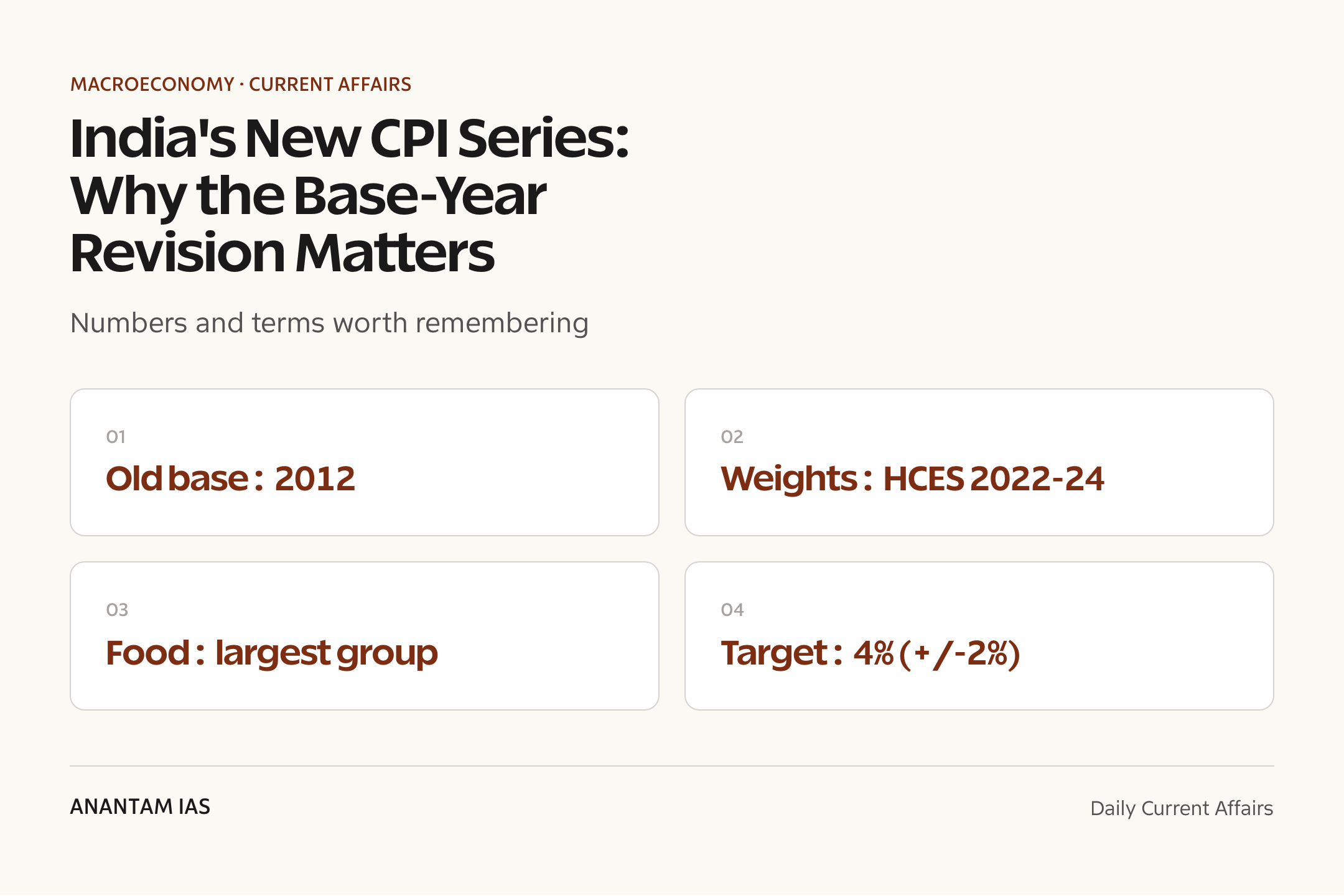
UPSC Relevance
Prelims Relevance
- CPI compiled by NSO/MoSPI; WPI compiled by the Office of the Economic Adviser, DPIIT
- CPI base year being moved from 2012; weights from HCES
- CPI-Combined (rural+urban) is the headline inflation measure used by the RBI
- CFPI = Consumer Food Price Index; food and beverages is the single largest CPI group
- Flexible Inflation Targeting adopted via the amended RBI Act, 1934; target 4% with a 2-6% band
- MPC is a six-member committee chaired by the RBI Governor
- Base effect: how a high or low year-ago index inflates or deflates current inflation
- WPI excludes services; CPI captures the retail consumption basket including services
Mains Relevance
GS Paper 3
- Why periodic rebasing of price indices is essential for credible inflation measurement and policy.
- How a lower food weight changes headline-inflation dynamics and the RBI’s monetary-policy reaction.
GS Paper 2
- Role of statistical institutions (MoSPI, NSO) and data quality in evidence-based governance.
Essay
- Numbers we live by: how the statistics a state measures shape the choices it makes.
Background and Context
What the CPI is and who builds it
The Consumer Price Index tracks the average change in retail prices of a fixed basket of goods and services bought by households.
- Compiled by the National Statistical Office (NSO) under MoSPI, released monthly; see our explainer on the Consumer Price Index in India.
- CPI-Combined blends rural and urban indices and is the headline retail inflation figure cited in policy.
- Distinct from the Wholesale Price Index (WPI), which tracks producer-level prices, excludes services and is maintained by the Office of the Economic Adviser.
- Inflation is the year-on-year percentage change in the index, not the index level itself.
Why a base year, and why revise it
Every index is anchored to a base year whose basket and weights represent typical household spending at that time.
- The current series uses 2012 as the base; consumption patterns have shifted markedly since.
- Over time families spend relatively less on food and more on transport, health, education and communication.
- A stale basket misweights items, so the index drifts from the real cost of living, the classic case for rebasing.
- Global statistical practice recommends rebasing roughly every five to ten years to keep an index representative.
The HCES 2022-24 reweighting
The new weights are derived from the Household Consumption Expenditure Survey, the survey that maps where the rupee actually goes.
- The HCES 2022-24 is the first comprehensive consumption survey released after a long hiatus, giving fresh expenditure shares.
- It records a falling share of spending on food, especially cereals, and a rising share on services and processed items.
- These shares become the new CPI weights, so the basket reflects 2020s consumption rather than 2012 habits.
- A lower food weight means food-price swings move headline inflation less than before.
Food weight, CFPI and the base effect
Food has long dominated India’s CPI, which is why a re-weighting here is consequential.
- The Consumer Food Price Index (CFPI) isolates food inflation; food and beverages was the largest single group in the 2012 basket.
- A reduced food weight dampens the sensitivity of headline CPI to volatile vegetable and pulse prices.
- The base effect can also shift on rebasing: comparing prices against a different base year changes the arithmetic of measured inflation.
- Lower food weight does not lower actual food prices; it changes how much those prices count in the aggregate.
Link to inflation targeting and the MPC
The CPI is not just a statistic; it is the legal anchor of India’s monetary policy.
- Under the amended RBI Act, 1934, the government sets a flexible inflation-targeting goal of 4% CPI inflation within a 2-6% band.
- The Monetary Policy Committee (MPC), chaired by the RBI Governor, sets the repo rate by reading CPI against that target.
- A re-weighted CPI can print a different headline number for the same underlying prices, nudging how the MPC judges whether inflation is on target.
- The RBI has flagged that it will study continuity between old and new series so policy signals stay comparable.
Wider stakes of the number
Because so much is indexed to CPI, the revision reaches well beyond the central bank.
- Dearness allowance for government employees and pensioners is linked to CPI movements.
- Wage settlements, rent escalations and many index-linked contracts reference retail inflation.
- Real interest rates, real wages and poverty-line calculations all depend on a credible price index.
- Better weights improve the accuracy of these downstream calculations across the economy.
Caveats and continuity concerns
A cleaner basket is welcome, but a series break creates analytical challenges.
- A new base year breaks the continuous time series, complicating long-run comparisons of inflation.
- Analysts watch for splicing and back-series so old and new numbers can be read together.
- Transparency on methodology and weights is essential for the index to retain market and public trust.
- Survey design and data quality from the HCES directly shape how representative the new basket is.
Way Forward
Methodological transparency
- Publish the full revised weighting diagram and a clear back-series so users can splice old and new data.
- Document the survey methodology behind the HCES shares to pre-empt credibility questions.
Policy continuity
- Let the MPC communicate how the rebased series maps to the 4% target so rate signals stay clear.
- Run old and new series in parallel for a transition window to ease interpretation.
Modernising the statistical machine
- Move toward more frequent consumption surveys and faster price collection, including scanner and digital-transaction data.
- Strengthen institutional independence and timeliness of the NSO to sustain data confidence.
Conclusion
Rebasing the CPI is routine statistical hygiene, but its timing and a lower food weight make this revision unusually consequential. The number that emerges feeds straight into the RBI’s inflation-targeting framework, so even small re-weightings shift how policy reads the economy.
The deeper lesson is that measurement is governance. A representative basket, built on a credible consumption survey and communicated transparently, lets the central bank, employers and households make sounder decisions about the real cost of living.
UPSC Practice Questions
Prelims MCQ 1
With reference to India’s Consumer Price Index (CPI), consider the following statements:
- The CPI is compiled by the National Statistical Office under MoSPI.
- The food and beverages group has been the largest single component of the CPI basket.
- CPI tracks only goods and excludes services from its basket.
How many of the above statements are correct?
(a) Only one (b) Only two (c) All three (d) None
Answer: (b) Only two
Explanation:
Statements 1 and 2 are correct: NSO/MoSPI compiles the CPI, and food and beverages is its largest group. Statement 3 is wrong, CPI covers services such as transport, health and education, unlike WPI which excludes services.
Prelims MCQ 2
The flexible inflation-targeting framework, under which the RBI aims for 4% CPI inflation within a band, derives its legal basis from which one of the following?
(a) The amended Reserve Bank of India Act, 1934 (b) The Banking Regulation Act, 1949 (c) The FRBM Act, 2003 (d) The Companies Act, 2013
Answer: (a) The amended Reserve Bank of India Act, 1934
Explanation:
The flexible inflation-targeting mandate and the 4% target with a 2-6% band were institutionalised through amendments to the RBI Act, 1934, which also created the Monetary Policy Committee.
UPSC Mains Questions
- Periodic rebasing of price indices is essential for credible inflation measurement. Examine how revising the CPI base year and re-weighting its basket on fresh consumption-survey data affects the accuracy of measured retail inflation in India.
- A lower food weight in the new CPI series changes the dynamics of headline inflation and the RBI’s monetary-policy response. Critically analyse the implications for India’s flexible inflation-targeting framework.
- Discuss the role of robust statistical institutions and timely consumption surveys in evidence-based economic governance, with reference to the CPI revision.
Sources: MoSPI, National Statistical Office (NSO) and Reserve Bank of India.
Frequently Asked Questions
What is the Consumer Price Index (CPI)?
The CPI measures the average change over time in the retail prices of a fixed basket of goods and services that households buy. Compiled monthly by the National Statistical Office under MoSPI, its year-on-year change is India’s headline retail inflation rate and the anchor for monetary policy.
Why is the CPI base year being revised?
Consumption patterns change over time, so a basket weighted to 2012 spending no longer reflects how households spend today. Rebasing refreshes the basket and weights using newer survey data, keeping the index representative of the actual cost of living and improving the accuracy of measured inflation.
What data is used to set the new CPI weights?
The new weights are derived from the Household Consumption Expenditure Survey (HCES) 2022-24, a large official survey of where households actually spend. It captures a falling share of spending on food and a rising share on services and discretionary items, which then become the index weights.
Why does a lower food weight matter?
Food was the largest group in the old CPI basket, so volatile vegetable and pulse prices moved headline inflation sharply. A lower food weight means food-price swings count for less in the aggregate, dampening their effect on headline CPI, though actual food prices themselves are unchanged.
How does the CPI affect RBI monetary policy?
Under the amended RBI Act, 1934, the RBI follows flexible inflation targeting, aiming for 4% CPI inflation within a 2-6% band. The Monetary Policy Committee reads the CPI against this target to set the repo rate, so a re-weighted index can shift how policy judges whether inflation is on track.
How is the CPI different from the WPI?
The CPI tracks retail prices paid by consumers and includes services such as transport, health and education. The Wholesale Price Index tracks producer or wholesale-level prices, excludes services, and is maintained by the Office of the Economic Adviser. The RBI targets CPI, not WPI.
Source: https://anantamias.com/current-affairs/new-cpi-series-base-year-2026/
Right to Menstrual Health: Toward a Constitutional Guarantee
Why in News?
A growing line of judicial reasoning and policy debate has begun to frame menstrual health not as a private inconvenience but as a constitutional entitlement flowing from the Article 21 right to life, dignity and health, read with Article 15(3) which permits special provisions for women and children.
The Supreme Court of India directed the Union and the States to frame a uniform national menstrual-hygiene policy for school-going girls, covering access to products, disposal infrastructure and awareness, pushing the issue from welfare scheme to enforceable right.
- The Court treated menstrual hygiene as part of the guarantees of health, dignity and education, not optional charity.
- It sought a national policy on menstrual-hygiene management (MHM) for adolescent girls across government and aided schools.
- Directions touched separate functional toilets, sanitary-pad access and safe disposal, linking the issue to school retention.
- The debate widened to menstrual leave, free product access and de-stigmatisation in workplaces and public institutions.
The development matters in the context of:
- This matters because roughly one in five adolescent girls is reported to drop out of school around menarche, tying menstruation to the right to education under Article 21A.
- It sits at the intersection of reproductive health, gender equity and the directive-principles vision of a welfare state.
- It also engages India’s commitments under the Sustainable Development Goals 3 (health), 5 (gender equality) and 6 (water and sanitation).
UPSC Relevance
Prelims Relevance
- Article 21 — right to life, expanded to include health and human dignity
- Article 15(3) — special provisions for women and children
- Article 21A and the link between menstruation and school dropout
- Menstrual Hygiene Scheme (2011) under the National Health Mission
- Swachh Bharat Mission and school sanitation / separate toilets
- Pradhan Mantri Bhartiya Janaushadhi Pariyojana — low-cost ‘Suvidha’ sanitary pads
- RMNCH+A framework and the adolescent-health programme RKSK
- SDGs 3, 5 and 6 and their relevance to menstrual health
- Difference between menstrual hygiene management and menstrual health (a wider WHO concept)
Mains Relevance
GS Paper 2
- How the judiciary has read socio-economic entitlements like menstrual health into Article 21, and the limits of such judicial direction.
- Welfare schemes versus rights: assessing the Menstrual Hygiene Scheme and product-access programmes against an enforceable-right standard.
GS Paper 1
- Menstrual stigma as a marker of gender inequality and a barrier to women’s participation in education and the workforce.
Essay
- Dignity is not a privilege: making the invisible needs of women a public concern.
- A society is judged by how it treats its most ordinary biological realities.
Background and Context
The constitutional foundation
The case for a right to menstrual health is built on rights the Constitution already guarantees, not a new fundamental right.
- Article 21 has been read by courts to include the right to life, the right to health and to live with human dignity (a line running from Francis Coralie Mullin onward).
- Article 15(3) expressly allows the State to make special provisions for women and children, giving constitutional cover to targeted menstrual schemes.
- Article 21A guarantees free and compulsory education up to 14; menstruation-linked dropout directly undercuts this promise.
- Article 47, a Directive Principle, casts a duty on the State to raise nutrition and public health — the policy backbone for menstrual welfare.
From scheme to right — the policy ladder
India already runs a stack of programmes; the shift is from discretionary welfare to a justiciable guarantee.
- The Menstrual Hygiene Scheme (2011) under the National Health Mission subsidises sanitary napkins for rural adolescent girls through ASHA workers.
- Swachh Bharat Mission built school toilets and pushed separate, functional toilets for girls as a retention measure.
- Pradhan Mantri Bhartiya Janaushadhi Pariyojana sells ‘Suvidha’ pads at a low fixed price through Janaushadhi Kendras.
- Adolescent care also flows through the RKSK programme and the wider RMNCH+A strategy under the Ministry of Health.
The gaps the right is meant to close
Access, disposal, affordability and stigma remain uneven, which is why courts treat the issue as unfinished.
- Disposal infrastructure — incinerators and safe waste handling — lags far behind product distribution, raising health and environmental costs.
- Affordability and continuity of supply varies; stock-outs in schools and kendras blunt the schemes’ reach.
- Stigma and silence keep many girls from seeking facilities, so infrastructure alone does not guarantee use.
- Data and standards differ across States, which is why the Court pressed for one national policy baseline.
The contested frontier — menstrual leave
Beyond schools, the debate has moved to the workplace, where opinion is genuinely divided.
- Some States and employers have introduced menstrual leave, framing it as dignity and health support.
- Critics warn it can become a pretext for workplace discrimination in hiring and pay, harming the very group it protects.
- A middle view favours flexible leave and facilities over a separate mandatory category, keeping the choice with the worker.
- Courts have so far been cautious about a blanket judicial mandate, treating leave as a policy question for the legislature.
Menstrual hygiene versus menstrual health
The vocabulary itself is shifting, and that shift carries the rights argument.
- Menstrual hygiene management (MHM) focuses narrowly on products, water and disposal.
- Menstrual health, as framed by the WHO, is broader — covering information, care, a supportive environment and freedom from coercion or stigma.
- The wider framing maps neatly onto Article 21‘s dignity standard, strengthening the constitutional claim.
- It also reframes the issue as one of autonomy and equality, not merely sanitation.
The global benchmark
India’s move sits within a recognisable international trend that examiners may ask you to compare.
- Scotland became the first country to make period products legally free for all who need them.
- Several countries have cut or removed the ‘tampon tax’, treating products as essentials, not luxuries.
- The SDGs bind menstrual health to gender equality (5) and water-sanitation (6), giving India a reporting yardstick.
- UN bodies increasingly classify menstrual health as a human-rights issue, mirroring India’s Article-21 reasoning.
Way Forward
Codify a national baseline
- Frame the national menstrual-hygiene policy the Court sought, with enforceable minimum standards for schools and public institutions.
- Tie disbursal to outcomes — functional toilets, stock continuity and disposal — not just product counts.
Close the disposal and supply gap
- Invest in safe disposal (incinerators, biodegradable products) alongside distribution.
- Strengthen Janaushadhi and NHM supply chains to end stock-outs in rural areas.
Treat stigma as policy, not afterthought
- Embed menstrual health education for all genders in the school curriculum to break silence.
- Approach menstrual leave through flexible, non-stigmatising design that protects against workplace discrimination.
Conclusion
Reading menstrual health into Article 21 reframes a routine biological reality as a question of dignity, equality and the right to education. It pushes the State from charitable distribution toward an enforceable guarantee, with the schools where girls drop out as the first test of intent.
The hard work now lies in execution — disposal, supply continuity, education and sensitively designed workplace policy. A right is only as real as the toilet that works and the silence that breaks; the constitutional promise will be measured there, not in the judgment alone.
UPSC Practice Questions
Prelims MCQ 1
With reference to the constitutional basis for menstrual health in India, consider the following statements:
- The right to health has been read by courts into the right to life under Article 21.
- Article 15(3) permits the State to make special provisions for women and children.
- The right to menstrual health is enumerated as a distinct fundamental right in Part III of the Constitution.
How many of the above statements are correct?
(a) Only one (b) Only two (c) All three (d) None
Answer: (b) Only two
Explanation:
Statements 1 and 2 are correct — courts have read health and dignity into Article 21, and Article 15(3) allows special provisions for women and children. Statement 3 is wrong: there is no separately enumerated fundamental right to menstrual health; the claim is derived from Article 21 read with 15(3).
Prelims MCQ 2
Under which scheme are low-cost ‘Suvidha’ sanitary napkins made available through dedicated outlets?
(a) Menstrual Hygiene Scheme (b) Swachh Bharat Mission (c) Pradhan Mantri Bhartiya Janaushadhi Pariyojana (d) Rashtriya Kishor Swasthya Karyakram
Answer: (c) Pradhan Mantri Bhartiya Janaushadhi Pariyojana
Explanation:
‘Suvidha’ biodegradable sanitary napkins are sold at a low fixed price through Janaushadhi Kendras under the PM Bhartiya Janaushadhi Pariyojana. The Menstrual Hygiene Scheme (2011) subsidises napkins for rural adolescent girls via the NHM but is a separate programme.
UPSC Mains Questions
- Indian courts have progressively read socio-economic entitlements into the right to life under Article 21. Examine this trend with reference to menstrual health, and discuss the limits of securing such rights through judicial direction. (250 words)
- “Menstrual health is a question of dignity and equality, not merely sanitation.” Critically evaluate India’s policy framework for menstrual health and suggest measures to make it a substantive guarantee. (250 words)
- Discuss whether mandatory menstrual leave advances or undermines gender equity in the workplace, and recommend a balanced policy approach. (150 words)
Sources: Supreme Court of India and Ministry of Health and Family Welfare.
Frequently Asked Questions
Is there a fundamental right to menstrual health in India?
There is no separately enumerated fundamental right to menstrual health. Courts derive it from the right to life under Article 21, which has been read to include health and human dignity, combined with Article 15(3) that allows special provisions for women and children. So it is a derived, judicially recognised entitlement rather than a distinct named right in Part III.
What did the Supreme Court direct on menstrual hygiene?
The Supreme Court asked the Union and the States to frame a uniform national menstrual-hygiene policy for school-going girls. The directions covered access to sanitary products, separate functional toilets and safe disposal infrastructure, treating these as part of the rights to health, dignity and education rather than as optional welfare measures.
Which schemes support menstrual hygiene in India?
Key programmes include the Menstrual Hygiene Scheme (2011) under the National Health Mission, which subsidises napkins for rural adolescent girls, the Swachh Bharat Mission for school sanitation and separate toilets, and the Pradhan Mantri Bhartiya Janaushadhi Pariyojana, which sells low-cost ‘Suvidha’ pads. Adolescent care also flows through the RKSK programme.
How does menstrual health link to school dropout?
Inadequate toilets, products and information lead many adolescent girls to miss classes or leave school around menarche. Because Article 21A guarantees free and compulsory education up to 14, this dropout connects menstrual health directly to the right to education, which is why courts and policymakers treat schools as the first place to act.
Why is menstrual leave a contested issue?
Supporters see paid menstrual leave as dignity and health support. Critics fear it may be used as a pretext to discriminate against women in hiring and pay, harming the group it aims to help. A middle path favours flexible leave and better facilities over a separate mandatory category, and courts have largely left it to the legislature as a policy choice.
How does this connect to the Sustainable Development Goals?
Menstrual health sits across three SDGs: Goal 3 on good health and well-being, Goal 5 on gender equality, and Goal 6 on clean water and sanitation. Framing menstruation as a health and equality issue, rather than just sanitation, aligns India’s domestic policy with its international reporting commitments under the 2030 Agenda.
Source: https://anantamias.com/current-affairs/right-to-menstrual-health-2026/
Khelo India Mission Announced in Union Budget 2026-27
Why in News?
On 1 February 2026, Khelo India Mission Announced in Union Budget 2026-27 emerged as an important current-affairs theme through an official communication linked to Press Information Bureau. For UPSC aspirants, the topic is valuable not only because it marks a specific event, but because it opens a wider window into how policy, institutions, and development processes are evolving in India.
The official anchor for the topic is Khelo India Mission Announced in Union Budget 2026-27. That matters because serious preparation requires moving beyond headlines and asking three connected questions: what happened, why now, and what deeper historical, economic, political, or governance trend this event reflects.
UPSC Relevance
- Prelims: welfare programmes, social campaigns, education, employment, and target groups in policy
- Mains: GS II on social justice, education, livelihoods, and human development
- Khelo India Mission was proposed to nurture sporting talent over the next decade
- A dedicated sports goods initiative was announced to promote manufacturing, research,
- The budget linked sports policy with youth development, jobs, and industrial capacity
What Happened?
The Union Budget 2026–27 marks a significant step towards strengthening India's sports ecosystem, with emphasis on talent development, infrastructure creation, manufacturing, and employment generation. The Khelo India Mission was announced by Union Minister of Finance and Corporate Affairs Nirmala Sitharaman while presenting the Budget in Parliament.
Highlighting the growing importance of sports as a development sector, the Finance Minister stated: “Sports provides employment, skills, and numerous job opportunities. Building on the Khelo India programme's approach to nurturing sporting talent, I propose to launch the Khelo India Mission to transform the sports sector over the next decade.”

Read together, the event can be understood through three immediate takeaways: Khelo India Mission was proposed to nurture sporting talent over the next decade, A dedicated sports goods initiative was announced to promote manufacturing, research, and innovation, and The budget linked sports policy with youth development, jobs, and industrial capacity. These are the factual anchors, but the real UPSC value lies in connecting those facts with the broader story behind them.
Why it Matters
For UPSC, the significance of this topic lies in the fact that it sits at the intersection of current developments and structural change. Whether one looks at it from the lens of governance, economy, diplomacy, social policy, or strategic planning, the topic shows how day-to-day announcements often reveal larger shifts in India's state capacity and developmental priorities.
In answer writing, this makes the topic especially useful. It can serve as a factual illustration in Prelims preparation and as a layered example in Mains where the examiner expects candidates to connect institutions, outcomes, and wider policy direction.
What You Must Learn
Bottom Line
Khelo India Mission Announced in Union Budget 2026-27 is important because it allows aspirants to move from a narrow event-based reading of current affairs to a broader understanding of how history, institutions, economy, politics, and governance intersect in contemporary India.
Use the topic to connect welfare or education developments with long-term capability creation.
Related Current Affairs
- Pariksha Pe Charcha 2026 Keeps Exam Stress and Student Well-Being in Focus
- One Health Workshop Reinforces Integrated Public Health Thinking
- Ashtalakshmi Vision and Youth Exchange Reinforce National Integration in the Northeast
Exam Oriented Questions
Why is this topic in the news?
It is in the news because an official development related to **Khelo India Mission Announced in Union Budget 2026-27** was recorded on 1 February 2026.
Which official institution or source is associated with this topic?
The topic is anchored in an official source associated with **Press Information Bureau**, and aspirants should remember the source title **Khelo India Mission Announced in Union Budget 2026-27**.
What is the core issue involved here?
The core issue revolves around khelo india mission was proposed to nurture sporting talent over the next decade, along with its wider institutional and policy implications.
How is this topic relevant for UPSC Prelims?
It is relevant for Prelims because it covers welfare programmes, social campaigns, education, employment, and target groups in policy.
How is this topic relevant for UPSC Mains?
It is relevant for Mains because it can be used in GS II on social justice, education, livelihoods, and human development.
What wider context should aspirants connect with this topic?
Aspirants should connect this event with the wider context of historically, india's social policy has expanded through a mix of welfare provision, institution-building, and behavioural change campaigns.
Does this topic have an economic, political, or social angle?
Yes. Economically, investments in education, livelihoods, and social protection affect productivity, labour force participation, and long-term human capital. Politically, social-sector measures matter because they shape legitimacy, inclusion, and the lived relationship between citizen and state.
How can this topic be used in answer writing?
It can be used as a recent example to strengthen analytical arguments, especially where the question asks how policy intent translates into institutional or developmental outcomes.
What factual points should be revised first?
Revise the event date, the official source, and these quick points: Khelo India Mission was proposed to nurture sporting talent over the next decade, A dedicated sports goods initiative was announced to promote manufacturing, research, and innovation, The budget linked sports policy with youth development, jobs, and industrial capacity.
What is the one-line exam takeaway?
Khelo India Mission Announced in Union Budget 2026-27 is important because it combines current relevance with a larger story about institutions, development, and public policy.
Source: https://anantamias.com/current-affairs/khelo-india-mission-announced-in-union-budget-2026-27/
Union Budget 2026-27 Pushes a Services-Led Education-to-Employment Agenda
Why in News?
On 1 February 2026, Union Budget 2026-27 Pushes a Services-Led Education-to-Employment Agenda emerged as an important current-affairs theme through an official communication linked to Press Information Bureau. For UPSC aspirants, the topic is valuable not only because it marks a specific event, but because it opens a wider window into how policy, institutions, and development processes are evolving in India.
The official anchor for the topic is Union Budget 2026-27 Pushes a Services-Led Education-to-Employment Agenda. That matters because serious preparation requires moving beyond headlines and asking three connected questions: what happened, why now, and what deeper historical, economic, political, or governance trend this event reflects.
UPSC Relevance
- Prelims: budgets, sectors, institutions, reports, trade and investment measures, and growth-linked facts
- Mains: GS III on economic growth, industrial policy, public finance, and external sector issues
- The budget proposed a high-powered standing committee on education, employment, and
- It linked service-sector growth with jobs, exports, and emerging technology adaptation
- The proposal connected skilling, universities, and industrial corridors within a Viksit
What Happened?
The budget proposed a high-powered standing committee on education, employment, and enterprise
It linked service-sector growth with jobs, exports, and emerging technology adaptation
Read together, the event can be understood through three immediate takeaways: The budget proposed a high-powered standing committee on education, employment, and enterprise, It linked service-sector growth with jobs, exports, and emerging technology adaptation, and The proposal connected skilling, universities, and industrial corridors within a Viksit Bharat framework. These are the factual anchors, but the real UPSC value lies in connecting those facts with the broader story behind them.
Why it Matters
For UPSC, the significance of this topic lies in the fact that it sits at the intersection of current developments and structural change. Whether one looks at it from the lens of governance, economy, diplomacy, social policy, or strategic planning, the topic shows how day-to-day announcements often reveal larger shifts in India's state capacity and developmental priorities.
In answer writing, this makes the topic especially useful. It can serve as a factual illustration in Prelims preparation and as a layered example in Mains where the examiner expects candidates to connect institutions, outcomes, and wider policy direction.
What You Must Learn
Bottom Line
Union Budget 2026-27 Pushes a Services-Led Education-to-Employment Agenda is important because it allows aspirants to move from a narrow event-based reading of current affairs to a broader understanding of how history, institutions, economy, politics, and governance intersect in contemporary India.
Use the topic to show how policy announcements interact with production, investment, and macroeconomic structure.
Related Current Affairs
- Budget Focus on Strategic and Frontier Manufacturing Signals a New Industrial Push
- Trade Watch Quarterly Offers a Fresh Snapshot of India's External Trade
- PLI Support for Food Processing Reinforces Value Addition in Agriculture
Exam Oriented Questions
Why is this topic in the news?
It is in the news because an official development related to **Union Budget 2026-27 Pushes a Services-Led Education-to-Employment Agenda** was recorded on 1 February 2026.
Which official institution or source is associated with this topic?
The topic is anchored in an official source associated with **Press Information Bureau**, and aspirants should remember the source title **Union Budget 2026-27 Pushes a Services-Led Education-to-Employment Agenda**.
What is the core issue involved here?
The core issue revolves around the budget proposed a high-powered standing committee on education, employment, and enterprise, along with its wider institutional and policy implications.
How is this topic relevant for UPSC Prelims?
It is relevant for Prelims because it covers budgets, sectors, institutions, reports, trade and investment measures, and growth-linked facts.
How is this topic relevant for UPSC Mains?
It is relevant for Mains because it can be used in GS III on economic growth, industrial policy, public finance, and external sector issues.
What wider context should aspirants connect with this topic?
Aspirants should connect this event with the wider context of historically, india's policy debates have repeatedly turned on the relationship between state support, private investment, and productive capacity.
Does this topic have an economic, political, or social angle?
Yes. Economically, developments in this area matter because they influence competitiveness, jobs, fiscal space, and the wider investment climate. Politically and institutionally, such developments show how the state tries to balance growth ambition with regulation, inclusion, and long-term strategic autonomy.
How can this topic be used in answer writing?
It can be used as a recent example to strengthen analytical arguments, especially where the question asks how policy intent translates into institutional or developmental outcomes.
What factual points should be revised first?
Revise the event date, the official source, and these quick points: The budget proposed a high-powered standing committee on education, employment, and enterprise, It linked service-sector growth with jobs, exports, and emerging technology adaptation, The proposal connected skilling, universities, and industrial corridors within a Viksit Bharat framework.
What is the one-line exam takeaway?
Union Budget 2026-27 Pushes a Services-Led Education-to-Employment Agenda is important because it combines current relevance with a larger story about institutions, development, and public policy.
Budget Focus on Strategic and Frontier Manufacturing Signals a New Industrial Push
Why in News?
On 1 February 2026, Budget Focus on Strategic and Frontier Manufacturing Signals a New Industrial Push emerged as an important current-affairs theme through an official communication linked to Press Information Bureau. For UPSC aspirants, the topic is valuable not only because it marks a specific event, but because it opens a wider window into how policy, institutions, and development processes are evolving in India.
The official anchor for the topic is Budget Focus on Strategic and Frontier Manufacturing Signals a New Industrial Push. That matters because serious preparation requires moving beyond headlines and asking three connected questions: what happened, why now, and what deeper historical, economic, political, or governance trend this event reflects.
UPSC Relevance
- Prelims: budgets, sectors, institutions, reports, trade and investment measures, and growth-linked facts
- Mains: GS III on economic growth, industrial policy, public finance, and external sector issues
- The budget emphasised scaling up manufacturing in seven strategic and frontier sectors
- It tied industrial policy to semiconductors, biopharma, rare earths, and capital goods
- The wider goal was to deepen domestic capability and reduce strategic dependence
What Happened?
The Union Budget 2026-27 lays emphasis on Scaling up manufacturing in 7 strategic and frontier sectors. While presenting the Union Budget 2026-27 in Parliament today, Union Minister of Finance & Corporate Affairs Smt Nirmala Sitharaman said that the proposed interventions forms part of six areas under ‘First Kartavya’ in the Budget.
To develop India as a global Biopharma manufacturing hub, the Budget proposes Biopharma SHAKTI with an outlay of ₹ 10,000 crores over the next 5 years. This will build the ecosystem for domestic production of biologics and biosimilars.
Read together, the event can be understood through three immediate takeaways: The budget emphasised scaling up manufacturing in seven strategic and frontier sectors, It tied industrial policy to semiconductors, biopharma, rare earths, and capital goods, and The wider goal was to deepen domestic capability and reduce strategic dependence. These are the factual anchors, but the real UPSC value lies in connecting those facts with the broader story behind them.
Why it Matters
For UPSC, the significance of this topic lies in the fact that it sits at the intersection of current developments and structural change. Whether one looks at it from the lens of governance, economy, diplomacy, social policy, or strategic planning, the topic shows how day-to-day announcements often reveal larger shifts in India's state capacity and developmental priorities.
In answer writing, this makes the topic especially useful. It can serve as a factual illustration in Prelims preparation and as a layered example in Mains where the examiner expects candidates to connect institutions, outcomes, and wider policy direction.
What You Must Learn
Bottom Line
Budget Focus on Strategic and Frontier Manufacturing Signals a New Industrial Push is important because it allows aspirants to move from a narrow event-based reading of current affairs to a broader understanding of how history, institutions, economy, politics, and governance intersect in contemporary India.
Use the topic to show how policy announcements interact with production, investment, and macroeconomic structure.
Related Current Affairs
- Union Budget 2026-27 Pushes a Services-Led Education-to-Employment Agenda
- Trade Watch Quarterly Offers a Fresh Snapshot of India's External Trade
- PLI Support for Food Processing Reinforces Value Addition in Agriculture
Exam Oriented Questions
Why is this topic in the news?
It is in the news because an official development related to **Budget Focus on Strategic and Frontier Manufacturing Signals a New Industrial Push** was recorded on 1 February 2026.
Which official institution or source is associated with this topic?
The topic is anchored in an official source associated with **Press Information Bureau**, and aspirants should remember the source title **Budget Focus on Strategic and Frontier Manufacturing Signals a New Industrial Push**.
What is the core issue involved here?
The core issue revolves around the budget emphasised scaling up manufacturing in seven strategic and frontier sectors, along with its wider institutional and policy implications.
How is this topic relevant for UPSC Prelims?
It is relevant for Prelims because it covers budgets, sectors, institutions, reports, trade and investment measures, and growth-linked facts.
How is this topic relevant for UPSC Mains?
It is relevant for Mains because it can be used in GS III on economic growth, industrial policy, public finance, and external sector issues.
What wider context should aspirants connect with this topic?
Aspirants should connect this event with the wider context of historically, india's policy debates have repeatedly turned on the relationship between state support, private investment, and productive capacity.
Does this topic have an economic, political, or social angle?
Yes. Economically, developments in this area matter because they influence competitiveness, jobs, fiscal space, and the wider investment climate. Politically and institutionally, such developments show how the state tries to balance growth ambition with regulation, inclusion, and long-term strategic autonomy.
How can this topic be used in answer writing?
It can be used as a recent example to strengthen analytical arguments, especially where the question asks how policy intent translates into institutional or developmental outcomes.
What factual points should be revised first?
Revise the event date, the official source, and these quick points: The budget emphasised scaling up manufacturing in seven strategic and frontier sectors, It tied industrial policy to semiconductors, biopharma, rare earths, and capital goods, The wider goal was to deepen domestic capability and reduce strategic dependence.
What is the one-line exam takeaway?
Budget Focus on Strategic and Frontier Manufacturing Signals a New Industrial Push is important because it combines current relevance with a larger story about institutions, development, and public policy.
National Youth Parliament Scheme Portal Gets an Upgrade
Why in News?
On 2 February 2026, National Youth Parliament Scheme Portal Gets an Upgrade emerged as an important current-affairs theme through an official communication linked to Press Information Bureau. For UPSC aspirants, the topic is valuable not only because it marks a specific event, but because it opens a wider window into how policy, institutions, and development processes are evolving in India.
The official anchor for the topic is Ministry of Parliamentary Affairs unveiled upgraded version of National Youth Parliament Scheme web portal. That matters because serious preparation requires moving beyond headlines and asking three connected questions: what happened, why now, and what deeper historical, economic, political, or governance trend this event reflects.
UPSC Relevance
- Prelims: institutions, administrative mechanisms, schemes, regulations, and delivery platforms
- Mains: GS II on governance, reforms, public administration, and institutional capacity
- The Ministry of Parliamentary Affairs has unveiled an upgraded version of the National
- Unlike the previous version, which was limited to students of recognized educational
- The details of participation and the conduct of the youth parliament session are as
What Happened?
The Ministry of Parliamentary Affairs has unveiled an upgraded version of the National Youth Parliament Scheme (NYPS) web portal, known as NYPS 2.0 to expand the Youth Parliament Programme and to ensure wider participation of students, including from remote and rural areas. Unlike the previous version, which was limited to students of recognized educational institutions only, NYPS 2.0 is open to all the educational institutions, groups and even individual citizens across the country regardless of gender, caste, creed, religion, race, region, place etc.
The details of participation and the conduct of the youth parliament session are as follows- *YPS- Youth Parliament Sittings For inclusivity and awareness regarding NYPS 2.0, the Ministry has written to all State Governments, Union Territory Administrations; Legislatures of States/UTs; various educational boards (CBSE, CISCE), and also a publicity video is broadcast from time to time on Sansad TV. This information was given by the Minister of State of Parliamentary Affairs, Dr.
Read together, the event can be understood through three immediate takeaways: The Ministry of Parliamentary Affairs has unveiled an upgraded version of the National Youth Parliament Scheme (NYPS) web portal, known as NYPS 2.0 to expand the Youth Parliament Programme and to ensure wider participation of students, including from remote and rural areas., Unlike the previous version, which was limited to students of recognized educational institutions only, NYPS 2.0 is open to all the educational institutions, groups and even individual citizens across the country regardless of gender, caste, creed, religion, race, region, place etc., and The details of participation and the conduct of the youth parliament session are as follows- *YPS- Youth Parliament Sittings For inclusivity and awareness regarding NYPS 2.0, the Ministry has written to all State Governments, Union Territory Administrations; Legislatures of States/UTs; various educational boards (CBSE, CISCE), and also a publicity video is broadcast from time to time on Sansad TV.. These are the factual anchors, but the real UPSC value lies in connecting those facts with the broader story behind them.
Why it Matters
For UPSC, the significance of this topic lies in the fact that it sits at the intersection of current developments and structural change. Whether one looks at it from the lens of governance, economy, diplomacy, social policy, or strategic planning, the topic shows how day-to-day announcements often reveal larger shifts in India's state capacity and developmental priorities.
In answer writing, this makes the topic especially useful. It can serve as a factual illustration in Prelims preparation and as a layered example in Mains where the examiner expects candidates to connect institutions, outcomes, and wider policy direction.
What You Must Learn
Bottom Line
National Youth Parliament Scheme Portal Gets an Upgrade is important because it allows aspirants to move from a narrow event-based reading of current affairs to a broader understanding of how history, institutions, economy, politics, and governance intersect in contemporary India.
Use the topic to highlight the importance of institutions, procedural reform, and administrative accountability.
Related Current Affairs
- Toy Quality Enforcement Shows Why Consumer Regulation Matters
- Penalty on Misleading Coaching Advertisement Keeps Consumer Protection in the Education Market in Focus
- UPSC Expands Accessibility Through Centre-of-Choice Safeguards for PwBD Candidates
Exam Oriented Questions
Why is this topic in the news?
It is in the news because an official development related to **National Youth Parliament Scheme Portal Gets an Upgrade** was recorded on 2 February 2026.
Which official institution or source is associated with this topic?
The topic is anchored in an official source associated with **Press Information Bureau**, and aspirants should remember the source title **Ministry of Parliamentary Affairs unveiled upgraded version of National Youth Parliament Scheme web portal**.
What is the core issue involved here?
The core issue revolves around the ministry of parliamentary affairs has unveiled an upgraded version of the national youth parliament scheme (nyps) web portal, known as nyps 2.0 to expand the youth parliament programme and to ensure wider participation of students, including from remote and rural areas, along with its wider institutional and policy implications.
How is this topic relevant for UPSC Prelims?
It is relevant for Prelims because it covers institutions, administrative mechanisms, schemes, regulations, and delivery platforms.
How is this topic relevant for UPSC Mains?
It is relevant for Mains because it can be used in GS II on governance, reforms, public administration, and institutional capacity.
What wider context should aspirants connect with this topic?
Aspirants should connect this event with the wider context of historically, many of india's reform efforts have succeeded or failed depending on the quality of institutional design and administrative follow-through.
Does this topic have an economic, political, or social angle?
Yes. Economically and socially, governance reforms matter because they determine how effectively public resources translate into outcomes on the ground. Politically, such developments illustrate the constant negotiation between central direction, state-level implementation, and citizen expectations.
How can this topic be used in answer writing?
It can be used as a recent example to strengthen analytical arguments, especially where the question asks how policy intent translates into institutional or developmental outcomes.
What factual points should be revised first?
Revise the event date, the official source, and these quick points: The Ministry of Parliamentary Affairs has unveiled an upgraded version of the National Youth Parliament Scheme (NYPS) web portal, known as NYPS 2.0 to expand the Youth Parliament Programme and to ensure wider participation of students, including from remote and rural areas., Unlike the previous version, which was limited to students of recognized educational institutions only, NYPS 2.0 is open to all the educational institutions, groups and even individual citizens across the country regardless of gender, caste, creed, religion, race, region, place etc., The details of participation and the conduct of the youth parliament session are as follows- *YPS- Youth Parliament Sittings For inclusivity and awareness regarding NYPS 2.0, the Ministry has written to all State Governments, Union Territory Administrations; Legislatures of States/UTs; various educational boards (CBSE, CISCE), and also a publicity video is broadcast from time to time on Sansad TV..
What is the one-line exam takeaway?
National Youth Parliament Scheme Portal Gets an Upgrade is important because it combines current relevance with a larger story about institutions, development, and public policy.
Source: https://anantamias.com/current-affairs/national-youth-parliament-scheme-portal-gets-an-upgrade/
Transforming India into a Global Biopharma Hub
Why in News?
On 2 February 2026, Transforming India into a Global Biopharma Hub emerged as an important current-affairs theme through an official communication linked to Press Information Bureau. For UPSC aspirants, the topic is valuable not only because it marks a specific event, but because it opens a wider window into how policy, institutions, and development processes are evolving in India.
The official anchor for the topic is Transforming India into a Global Biopharma Hub. That matters because serious preparation requires moving beyond headlines and asking three connected questions: what happened, why now, and what deeper historical, economic, political, or governance trend this event reflects.
UPSC Relevance
- Prelims: technologies, missions, innovation institutions, AI initiatives, and scientific applications
- Mains: GS III on science and technology, innovation policy, digital public capacity, and future industries
- Biopharma SHAKTI proposed an outlay of Rs 10,000 crore over five years
- The initiative aimed to expand biologics and biosimilars production capacity
- It linked public health needs with high-value manufacturing and research ecosystems
What Happened?
Biopharma SHAKTI proposed an outlay of Rs 10,000 crore over five years
The initiative aimed to expand biologics and biosimilars production capacity
Read together, the event can be understood through three immediate takeaways: Biopharma SHAKTI proposed an outlay of Rs 10,000 crore over five years, The initiative aimed to expand biologics and biosimilars production capacity, and It linked public health needs with high-value manufacturing and research ecosystems. These are the factual anchors, but the real UPSC value lies in connecting those facts with the broader story behind them.
Why it Matters
For UPSC, the significance of this topic lies in the fact that it sits at the intersection of current developments and structural change. Whether one looks at it from the lens of governance, economy, diplomacy, social policy, or strategic planning, the topic shows how day-to-day announcements often reveal larger shifts in India's state capacity and developmental priorities.
In answer writing, this makes the topic especially useful. It can serve as a factual illustration in Prelims preparation and as a layered example in Mains where the examiner expects candidates to connect institutions, outcomes, and wider policy direction.
What You Must Learn
Bottom Line
Transforming India into a Global Biopharma Hub is important because it allows aspirants to move from a narrow event-based reading of current affairs to a broader understanding of how history, institutions, economy, politics, and governance intersect in contemporary India.
Use the topic to show how innovation is becoming central to governance, growth, and strategic policy.
Related Current Affairs
- IndiaAI Mission Launches a Nationwide Campaign on Responsible AI Use
- National Defence Industries Conclave Highlights Self-Reliance
- AI-Based Local Monsoon Forecasting Supports Kharif Planning
Exam Oriented Questions
Why is this topic in the news?
It is in the news because an official development related to **Transforming India into a Global Biopharma Hub** was recorded on 2 February 2026.
Which official institution or source is associated with this topic?
The topic is anchored in an official source associated with **Press Information Bureau**, and aspirants should remember the source title **Transforming India into a Global Biopharma Hub**.
What is the core issue involved here?
The core issue revolves around biopharma shakti proposed an outlay of rs 10,000 crore over five years, along with its wider institutional and policy implications.
How is this topic relevant for UPSC Prelims?
It is relevant for Prelims because it covers technologies, missions, innovation institutions, AI initiatives, and scientific applications.
How is this topic relevant for UPSC Mains?
It is relevant for Mains because it can be used in GS III on science and technology, innovation policy, digital public capacity, and future industries.
What wider context should aspirants connect with this topic?
Aspirants should connect this event with the wider context of historically, technology policy in india has moved from state-led scientific capacity building to a more networked model involving startups, private industry, and global partnerships.
Does this topic have an economic, political, or social angle?
Yes. Economically, frontier technologies now influence productivity, industrial upgrading, public service delivery, and employment patterns. Politically and socially, science and technology issues matter because they raise questions of access, regulation, ethics, and national capability.
How can this topic be used in answer writing?
It can be used as a recent example to strengthen analytical arguments, especially where the question asks how policy intent translates into institutional or developmental outcomes.
What factual points should be revised first?
Revise the event date, the official source, and these quick points: Biopharma SHAKTI proposed an outlay of Rs 10,000 crore over five years, The initiative aimed to expand biologics and biosimilars production capacity, It linked public health needs with high-value manufacturing and research ecosystems.
What is the one-line exam takeaway?
Transforming India into a Global Biopharma Hub is important because it combines current relevance with a larger story about institutions, development, and public policy.
Source: https://anantamias.com/current-affairs/transforming-india-into-a-global-biopharma-hub/
Employment Generation for Youth Remains Central to the Policy Debate
Why in News?
On 2 February 2026, Employment Generation for Youth Remains Central to the Policy Debate emerged as an important current-affairs theme through an official communication linked to Press Information Bureau. For UPSC aspirants, the topic is valuable not only because it marks a specific event, but because it opens a wider window into how policy, institutions, and development processes are evolving in India.
The official anchor for the topic is EMPLOYMENT GENERATION FOR THE YOUTH. That matters because serious preparation requires moving beyond headlines and asking three connected questions: what happened, why now, and what deeper historical, economic, political, or governance trend this event reflects.
UPSC Relevance
- Prelims: welfare programmes, social campaigns, education, employment, and target groups in policy
- Mains: GS II on social justice, education, livelihoods, and human development
- The data on Employment and Unemployment is collected through Periodic Labour Force
- The survey period is July to June every year.
- As per the latest available Annual PLFS Reports, the estimated Worker Population Ratio
What Happened?
The data on Employment and Unemployment is collected through Periodic Labour Force Survey (PLFS) which is conducted by the Ministry of Statistics and Programme Implementation (MoSPI) since 2017-18. The survey period is July to June every year.
As per the latest available Annual PLFS Reports, the estimated Worker Population Ratio (WPR) on usual status for age 15 years and above has increased from 46.8% in 2017-18 to 58.2% in 2023-24, indicating that the WPR i.e., employment has increasing trend. Employment generation coupled with improving employability is a priority of the Government.
Read together, the event can be understood through three immediate takeaways: The data on Employment and Unemployment is collected through Periodic Labour Force Survey (PLFS) which is conducted by the Ministry of Statistics and Programme Implementation (MoSPI) since 2017-18., The survey period is July to June every year., and As per the latest available Annual PLFS Reports, the estimated Worker Population Ratio (WPR) on usual status for age 15 years and above has increased from 46.8% in 2017-18 to 58.2% in 2023-24, indicating that the WPR i.e., employment has increasing trend.. These are the factual anchors, but the real UPSC value lies in connecting those facts with the broader story behind them.
Why it Matters
For UPSC, the significance of this topic lies in the fact that it sits at the intersection of current developments and structural change. Whether one looks at it from the lens of governance, economy, diplomacy, social policy, or strategic planning, the topic shows how day-to-day announcements often reveal larger shifts in India's state capacity and developmental priorities.
In answer writing, this makes the topic especially useful. It can serve as a factual illustration in Prelims preparation and as a layered example in Mains where the examiner expects candidates to connect institutions, outcomes, and wider policy direction.
What You Must Learn
Bottom Line
Employment Generation for Youth Remains Central to the Policy Debate is important because it allows aspirants to move from a narrow event-based reading of current affairs to a broader understanding of how history, institutions, economy, politics, and governance intersect in contemporary India.
Use the topic to connect welfare or education developments with long-term capability creation.
Related Current Affairs
- Pariksha Pe Charcha 2026 Keeps Exam Stress and Student Well-Being in Focus
- Khelo India Mission Announced in Union Budget 2026-27
- One Health Workshop Reinforces Integrated Public Health Thinking
Exam Oriented Questions
Why is this topic in the news?
It is in the news because an official development related to **Employment Generation for Youth Remains Central to the Policy Debate** was recorded on 2 February 2026.
Which official institution or source is associated with this topic?
The topic is anchored in an official source associated with **Press Information Bureau**, and aspirants should remember the source title **EMPLOYMENT GENERATION FOR THE YOUTH**.
What is the core issue involved here?
The core issue revolves around the data on employment and unemployment is collected through periodic labour force survey (plfs) which is conducted by the ministry of statistics and programme implementation (mospi) since 2017-18, along with its wider institutional and policy implications.
How is this topic relevant for UPSC Prelims?
It is relevant for Prelims because it covers welfare programmes, social campaigns, education, employment, and target groups in policy.
How is this topic relevant for UPSC Mains?
It is relevant for Mains because it can be used in GS II on social justice, education, livelihoods, and human development.
What wider context should aspirants connect with this topic?
Aspirants should connect this event with the wider context of historically, india's social policy has expanded through a mix of welfare provision, institution-building, and behavioural change campaigns.
Does this topic have an economic, political, or social angle?
Yes. Economically, investments in education, livelihoods, and social protection affect productivity, labour force participation, and long-term human capital. Politically, social-sector measures matter because they shape legitimacy, inclusion, and the lived relationship between citizen and state.
How can this topic be used in answer writing?
It can be used as a recent example to strengthen analytical arguments, especially where the question asks how policy intent translates into institutional or developmental outcomes.
What factual points should be revised first?
Revise the event date, the official source, and these quick points: The data on Employment and Unemployment is collected through Periodic Labour Force Survey (PLFS) which is conducted by the Ministry of Statistics and Programme Implementation (MoSPI) since 2017-18., The survey period is July to June every year., As per the latest available Annual PLFS Reports, the estimated Worker Population Ratio (WPR) on usual status for age 15 years and above has increased from 46.8% in 2017-18 to 58.2% in 2023-24, indicating that the WPR i.e., employment has increasing trend..
What is the one-line exam takeaway?
Employment Generation for Youth Remains Central to the Policy Debate is important because it combines current relevance with a larger story about institutions, development, and public policy.
AIM SUMVAAD Highlights the Strength of India’s Incubation Ecosystem
Why in News?
On 3 February 2026, AIM SUMVAAD Highlights the Strength of India’s Incubation Ecosystem emerged as an important current-affairs theme through an official communication linked to NITI Aayog. For UPSC aspirants, the topic is valuable not only because it marks a specific event, but because it opens a wider window into how policy, institutions, and development processes are evolving in India.
The official anchor for the topic is Atal Innovation Mission Hosts AIM SUMVAAD, India’s Flagship Conclave for the National Incubation Ecosystem. That matters because serious preparation requires moving beyond headlines and asking three connected questions: what happened, why now, and what deeper historical, economic, political, or governance trend this event reflects.
UPSC Relevance
- Prelims: technologies, missions, innovation institutions, AI initiatives, and scientific applications
- Mains: GS III on science and technology, innovation policy, digital public capacity, and future industries
- The Atal Innovation Mission (AIM) , under NITI Aayog , Government of India, today
- The conclave brought together representatives from over 100 Atal Incubation Centres
- Ajay Sood, Principal Scientific Adviser to the Government of India, Shri Suman Bery,
What Happened?
The Atal Innovation Mission (AIM) , under NITI Aayog , Government of India, today organised AIM SUMVAAD , its flagship annual incubator conclave, at the Dr Ambedkar International Centre, New Delhi. The conclave brought together representatives from over 100 Atal Incubation Centres (AICs) and Atal Community Innovation Centres (ACICs), along with senior policymakers, industry leaders, investors, entrepreneurs, CSR heads, mentors, and ecosystem stakeholders from across the country.
Ajay Sood, Principal Scientific Adviser to the Government of India, Shri Suman Bery, Vice Chairperson, NITI Aayog; Shri B. Gokhale, Secretary, Department of Biotechnology; Ms Angela Lusigi, Resident Representative, UNDP India; and Shri Deepak Bagla, Mission Director, Atal Innovation Mission.
Read together, the event can be understood through three immediate takeaways: The Atal Innovation Mission (AIM) , under NITI Aayog , Government of India, today organised AIM SUMVAAD , its flagship annual incubator conclave, at the Dr Ambedkar International Centre, New Delhi., The conclave brought together representatives from over 100 Atal Incubation Centres (AICs) and Atal Community Innovation Centres (ACICs), along with senior policymakers, industry leaders, investors, entrepreneurs, CSR heads, mentors, and ecosystem stakeholders from across the country., and Ajay Sood, Principal Scientific Adviser to the Government of India, Shri Suman Bery, Vice Chairperson, NITI Aayog; Shri B.. These are the factual anchors, but the real UPSC value lies in connecting those facts with the broader story behind them.
Why it Matters
For UPSC, the significance of this topic lies in the fact that it sits at the intersection of current developments and structural change. Whether one looks at it from the lens of governance, economy, diplomacy, social policy, or strategic planning, the topic shows how day-to-day announcements often reveal larger shifts in India's state capacity and developmental priorities.
In answer writing, this makes the topic especially useful. It can serve as a factual illustration in Prelims preparation and as a layered example in Mains where the examiner expects candidates to connect institutions, outcomes, and wider policy direction.
What You Must Learn
Bottom Line
AIM SUMVAAD Highlights the Strength of India's Incubation Ecosystem is important because it allows aspirants to move from a narrow event-based reading of current affairs to a broader understanding of how history, institutions, economy, politics, and governance intersect in contemporary India.
Use the topic to show how innovation is becoming central to governance, growth, and strategic policy.
Related Current Affairs
- IndiaAI Mission Launches a Nationwide Campaign on Responsible AI Use
- National Defence Industries Conclave Highlights Self-Reliance
- AI-Based Local Monsoon Forecasting Supports Kharif Planning
Exam Oriented Questions
Why is this topic in the news?
It is in the news because an official development related to **AIM SUMVAAD Highlights the Strength of India's Incubation Ecosystem** was recorded on 3 February 2026.
Which official institution or source is associated with this topic?
The topic is anchored in an official source associated with **NITI Aayog**, and aspirants should remember the source title **Atal Innovation Mission Hosts AIM SUMVAAD, India’s Flagship Conclave for the National Incubation Ecosystem**.
What is the core issue involved here?
The core issue revolves around the atal innovation mission (aim) , under niti aayog , government of india, today organised aim sumvaad , its flagship annual incubator conclave, at the dr ambedkar international centre, new delhi, along with its wider institutional and policy implications.
How is this topic relevant for UPSC Prelims?
It is relevant for Prelims because it covers technologies, missions, innovation institutions, AI initiatives, and scientific applications.
How is this topic relevant for UPSC Mains?
It is relevant for Mains because it can be used in GS III on science and technology, innovation policy, digital public capacity, and future industries.
What wider context should aspirants connect with this topic?
Aspirants should connect this event with the wider context of historically, technology policy in india has moved from state-led scientific capacity building to a more networked model involving startups, private industry, and global partnerships.
Does this topic have an economic, political, or social angle?
Yes. Economically, frontier technologies now influence productivity, industrial upgrading, public service delivery, and employment patterns. Politically and socially, science and technology issues matter because they raise questions of access, regulation, ethics, and national capability.
How can this topic be used in answer writing?
It can be used as a recent example to strengthen analytical arguments, especially where the question asks how policy intent translates into institutional or developmental outcomes.
What factual points should be revised first?
Revise the event date, the official source, and these quick points: The Atal Innovation Mission (AIM) , under NITI Aayog , Government of India, today organised AIM SUMVAAD , its flagship annual incubator conclave, at the Dr Ambedkar International Centre, New Delhi., The conclave brought together representatives from over 100 Atal Incubation Centres (AICs) and Atal Community Innovation Centres (ACICs), along with senior policymakers, industry leaders, investors, entrepreneurs, CSR heads, mentors, and ecosystem stakeholders from across the country., Ajay Sood, Principal Scientific Adviser to the Government of India, Shri Suman Bery, Vice Chairperson, NITI Aayog; Shri B..
What is the one-line exam takeaway?
AIM SUMVAAD Highlights the Strength of India's Incubation Ecosystem is important because it combines current relevance with a larger story about institutions, development, and public policy.
India Steps Up Exploration, Mining and Value Addition of Rare-Earth Minerals
Why in News?
On 3 February 2026, India Steps Up Exploration, Mining and Value Addition of Rare-Earth Minerals emerged as an important current-affairs theme through an official communication linked to Press Information Bureau. For UPSC aspirants, the topic is valuable not only because it marks a specific event, but because it opens a wider window into how policy, institutions, and development processes are evolving in India.
The official anchor for the topic is India Steps Up Exploration, Mining and Value Addition of Rare-Earth Minerals. That matters because serious preparation requires moving beyond headlines and asking three connected questions: what happened, why now, and what deeper historical, economic, political, or governance trend this event reflects.
UPSC Relevance
- Prelims: budgets, sectors, institutions, reports, trade and investment measures, and growth-linked facts
- Mains: GS III on economic growth, industrial policy, public finance, and external sector issues
- In a written reply in the Rajya Sabha today, the Minister of Coal and Mines, Shri G.
- Kishan Reddy, stated that Atomic Minerals Directorate for Exploration and Research
- As on 28.01.2026, the rare earth minerals resources estimated by AMD include: (i) 136
What Happened?
In a written reply in the Rajya Sabha today, the Minister of Coal and Mines, Shri G. Kishan Reddy, stated that Atomic Minerals Directorate for Exploration and Research (AMD), a constituent unit of DAE, is carrying out exploration and augmentation of minerals of rare earth group elements along the coastal and inland placer sands as well as in hard rock terrains in several potential geological domains of the country.
As on 28.01.2026, the rare earth minerals resources estimated by AMD include: (i) 136 deposits of Beach Sand Minerals containing 13.15 million tonnes (Mt) of monazite (a mineral of Thorium and Rare Earths) occurring in the coastal beach, teri / red sands and inland alluvium in parts of Tamil Nadu, Kerala, Andhra Pradesh, Odisha, Maharashtra, Gujarat, Jharkhand and West Bengal. These deposits contain approximately 7.23 Mt in-situ Rare Earth Oxide (eq.) resources.
Read together, the event can be understood through three immediate takeaways: In a written reply in the Rajya Sabha today, the Minister of Coal and Mines, Shri G., Kishan Reddy, stated that Atomic Minerals Directorate for Exploration and Research (AMD), a constituent unit of DAE, is carrying out exploration and augmentation of minerals of rare earth group elements along the coastal and inland placer sands as well as in hard rock terrains in several potential geological domains of the country., and As on 28.01.2026, the rare earth minerals resources estimated by AMD include: (i) 136 deposits of Beach Sand Minerals containing 13.15 million tonnes (Mt) of monazite (a mineral of Thorium and Rare Earths) occurring in the coastal beach, teri / red sands and inland alluvium in parts of Tamil Nadu, Kerala, Andhra Pradesh, Odisha, Maharashtra, Gujarat, Jharkhand and West Bengal.. These are the factual anchors, but the real UPSC value lies in connecting those facts with the broader story behind them.
Why it Matters
For UPSC, the significance of this topic lies in the fact that it sits at the intersection of current developments and structural change. Whether one looks at it from the lens of governance, economy, diplomacy, social policy, or strategic planning, the topic shows how day-to-day announcements often reveal larger shifts in India's state capacity and developmental priorities.
In answer writing, this makes the topic especially useful. It can serve as a factual illustration in Prelims preparation and as a layered example in Mains where the examiner expects candidates to connect institutions, outcomes, and wider policy direction.
What You Must Learn
Bottom Line
India Steps Up Exploration, Mining and Value Addition of Rare-Earth Minerals is important because it allows aspirants to move from a narrow event-based reading of current affairs to a broader understanding of how history, institutions, economy, politics, and governance intersect in contemporary India.
Use the topic to show how policy announcements interact with production, investment, and macroeconomic structure.
Related Current Affairs
- Trade Watch Quarterly Offers a Fresh Snapshot of India's External Trade
- Union Budget 2026-27 Pushes a Services-Led Education-to-Employment Agenda
- PLI Support for Food Processing Reinforces Value Addition in Agriculture
Exam Oriented Questions
Why is this topic in the news?
It is in the news because an official development related to **India Steps Up Exploration, Mining and Value Addition of Rare-Earth Minerals** was recorded on 3 February 2026.
Which official institution or source is associated with this topic?
The topic is anchored in an official source associated with **Press Information Bureau**, and aspirants should remember the source title **India Steps Up Exploration, Mining and Value Addition of Rare-Earth Minerals**.
What is the core issue involved here?
The core issue revolves around in a written reply in the rajya sabha today, the minister of coal and mines, shri g, along with its wider institutional and policy implications.
How is this topic relevant for UPSC Prelims?
It is relevant for Prelims because it covers budgets, sectors, institutions, reports, trade and investment measures, and growth-linked facts.
How is this topic relevant for UPSC Mains?
It is relevant for Mains because it can be used in GS III on economic growth, industrial policy, public finance, and external sector issues.
What wider context should aspirants connect with this topic?
Aspirants should connect this event with the wider context of historically, india's policy debates have repeatedly turned on the relationship between state support, private investment, and productive capacity.
Does this topic have an economic, political, or social angle?
Yes. Economically, developments in this area matter because they influence competitiveness, jobs, fiscal space, and the wider investment climate. Politically and institutionally, such developments show how the state tries to balance growth ambition with regulation, inclusion, and long-term strategic autonomy.
How can this topic be used in answer writing?
It can be used as a recent example to strengthen analytical arguments, especially where the question asks how policy intent translates into institutional or developmental outcomes.
What factual points should be revised first?
Revise the event date, the official source, and these quick points: In a written reply in the Rajya Sabha today, the Minister of Coal and Mines, Shri G., Kishan Reddy, stated that Atomic Minerals Directorate for Exploration and Research (AMD), a constituent unit of DAE, is carrying out exploration and augmentation of minerals of rare earth group elements along the coastal and inland placer sands as well as in hard rock terrains in several potential geological domains of the country., As on 28.01.2026, the rare earth minerals resources estimated by AMD include: (i) 136 deposits of Beach Sand Minerals containing 13.15 million tonnes (Mt) of monazite (a mineral of Thorium and Rare Earths) occurring in the coastal beach, teri / red sands and inland alluvium in parts of Tamil Nadu, Kerala, Andhra Pradesh, Odisha, Maharashtra, Gujarat, Jharkhand and West Bengal..
What is the one-line exam takeaway?
India Steps Up Exploration, Mining and Value Addition of Rare-Earth Minerals is important because it combines current relevance with a larger story about institutions, development, and public policy.
PM Surya Ghar Milestone Reflects the Growing Political Economy of Rooftop Solar
Why in News?
On 3 February 2026, PM Surya Ghar Milestone Reflects the Growing Political Economy of Rooftop Solar emerged as an important current-affairs theme through an official communication linked to Ministry of New and Renewable Energy. For UPSC aspirants, the topic is valuable not only because it marks a specific event, but because it opens a wider window into how policy, institutions, and development processes are evolving in India.
The official anchor for the topic is Over 26 Lakh Households Benefited Under PM Surya Ghar: Muft Bijli Yojana as of December 2025. That matters because serious preparation requires moving beyond headlines and asking three connected questions: what happened, why now, and what deeper historical, economic, political, or governance trend this event reflects.
UPSC Relevance
- Prelims: renewable-energy terms, climate cooperation mechanisms, institutions, and ecological concepts
- Mains: GS III on climate action, sustainability, energy transition, and environmental governance
- PM Surya Ghar: Muft Bijli Yojana (PMSG: MBY) is a demand driven scheme wherein all
- Since the launch of the scheme in February, 2024, a total of 20,85,514 RTS systems have
- The state/UT-wise detail of progress made under the scheme, in the order of number of
What Happened?
PM Surya Ghar: Muft Bijli Yojana (PMSG: MBY) is a demand driven scheme wherein all residential consumers in the country having grid connected electricity connection of the local DISCOM can avail the benefits of the scheme, for installation of rooftop solar (RTS) systems, by applying on the National Portal of the scheme. Since the launch of the scheme in February, 2024, a total of 20,85,514 RTS systems have been installed across the country, benefitting 26,14,446 households with disbursement of Rs 14,771.82 crore as Central Financial Assistance (CFA) till December 2025.
The state/UT-wise detail of progress made under the scheme, in the order of number of RTS systems installed, is given in Annexure. Under the PMSG: MBY, it has been estimated that RTS installation in 1 crore households may produce renewable electricity of 1,000 billion units, which may result in reduction of 720 million ton of CO 2 eq emission during the 25 years of lifetime of the RTS systems.
Read together, the event can be understood through three immediate takeaways: PM Surya Ghar: Muft Bijli Yojana (PMSG: MBY) is a demand driven scheme wherein all residential consumers in the country having grid connected electricity connection of the local DISCOM can avail the benefits of the scheme, for installation of rooftop solar (RTS) systems, by applying on the National Portal of the scheme., Since the launch of the scheme in February, 2024, a total of 20,85,514 RTS systems have been installed across the country, benefitting 26,14,446 households with disbursement of Rs 14,771.82 crore as Central Financial Assistance (CFA) till December 2025., and The state/UT-wise detail of progress made under the scheme, in the order of number of RTS systems installed, is given in Annexure.. These are the factual anchors, but the real UPSC value lies in connecting those facts with the broader story behind them.
Why it Matters
For UPSC, the significance of this topic lies in the fact that it sits at the intersection of current developments and structural change. Whether one looks at it from the lens of governance, economy, diplomacy, social policy, or strategic planning, the topic shows how day-to-day announcements often reveal larger shifts in India's state capacity and developmental priorities.
In answer writing, this makes the topic especially useful. It can serve as a factual illustration in Prelims preparation and as a layered example in Mains where the examiner expects candidates to connect institutions, outcomes, and wider policy direction.
What You Must Learn
Bottom Line
PM Surya Ghar Milestone Reflects the Growing Political Economy of Rooftop Solar is important because it allows aspirants to move from a narrow event-based reading of current affairs to a broader understanding of how history, institutions, economy, politics, and governance intersect in contemporary India.
Use the topic to link climate goals with energy security, industry, and technological transition.
Related Current Affairs
- GRAP Revocation Reflects Improved Air Quality Conditions
- NITI Aayog's Viksit Bharat and Net Zero Scenarios Add Long-Term Policy Perspective
- Standards for Green Ammonia and Green Methanol Gain Attention
Exam Oriented Questions
Why is this topic in the news?
It is in the news because an official development related to **PM Surya Ghar Milestone Reflects the Growing Political Economy of Rooftop Solar** was recorded on 3 February 2026.
Which official institution or source is associated with this topic?
The topic is anchored in an official source associated with **Ministry of New and Renewable Energy**, and aspirants should remember the source title **Over 26 Lakh Households Benefited Under PM Surya Ghar: Muft Bijli Yojana as of December 2025**.
What is the core issue involved here?
The core issue revolves around pm surya ghar: muft bijli yojana (pmsg: mby) is a demand driven scheme wherein all residential consumers in the country having grid connected electricity connection of the local discom can avail the benefits of the scheme, for installation of rooftop solar (rts) systems, by applying on the national portal of the scheme, along with its wider institutional and policy implications.
How is this topic relevant for UPSC Prelims?
It is relevant for Prelims because it covers renewable-energy terms, climate cooperation mechanisms, institutions, and ecological concepts.
How is this topic relevant for UPSC Mains?
It is relevant for Mains because it can be used in GS III on climate action, sustainability, energy transition, and environmental governance.
What wider context should aspirants connect with this topic?
Aspirants should connect this event with the wider context of historically, india's environmental choices have involved balancing developmental urgency with ecological stewardship.
Does this topic have an economic, political, or social angle?
Yes. Economically, clean energy and sustainability now shape industrial competitiveness, energy security, and long-term resilience. Politically, these developments matter because climate governance is increasingly tied to global negotiations, domestic regulation, and distributive justice.
How can this topic be used in answer writing?
It can be used as a recent example to strengthen analytical arguments, especially where the question asks how policy intent translates into institutional or developmental outcomes.
What factual points should be revised first?
Revise the event date, the official source, and these quick points: PM Surya Ghar: Muft Bijli Yojana (PMSG: MBY) is a demand driven scheme wherein all residential consumers in the country having grid connected electricity connection of the local DISCOM can avail the benefits of the scheme, for installation of rooftop solar (RTS) systems, by applying on the National Portal of the scheme., Since the launch of the scheme in February, 2024, a total of 20,85,514 RTS systems have been installed across the country, benefitting 26,14,446 households with disbursement of Rs 14,771.82 crore as Central Financial Assistance (CFA) till December 2025., The state/UT-wise detail of progress made under the scheme, in the order of number of RTS systems installed, is given in Annexure..
What is the one-line exam takeaway?
PM Surya Ghar Milestone Reflects the Growing Political Economy of Rooftop Solar is important because it combines current relevance with a larger story about institutions, development, and public policy.
Development Projects at Rairangpur Reflect the Importance of Regional Infrastructure
Why in News?
On 4 February 2026, Development Projects at Rairangpur Reflect the Importance of Regional Infrastructure emerged as an important current-affairs theme through an official communication linked to Press Information Bureau. For UPSC aspirants, the topic is valuable not only because it marks a specific event, but because it opens a wider window into how policy, institutions, and development processes are evolving in India.
The official anchor for the topic is Development Projects at Rairangpur Reflect the Importance of Regional Infrastructure. That matters because serious preparation requires moving beyond headlines and asking three connected questions: what happened, why now, and what deeper historical, economic, political, or governance trend this event reflects.
UPSC Relevance
- Prelims: projects, corridors, airports, metro systems, regulators, and regional connectivity facts
- Mains: GS III on infrastructure, logistics, urban development, and regional integration
- The President inaugurated and laid foundation stones for multiple projects in Odisha
- Regional infrastructure was framed as a tool for public access and local development
- Such projects show how state presence is experienced through roads, institutions, and
What Happened?
JavaScript must be enabled in order for you to use the Site in standard view. However, it seems JavaScript is either disabled or not supported by your browser.
To use standard view, enable JavaScript by changing your browser options. Site is hosted by National Informatics Centre (NIC).
Read together, the event can be understood through three immediate takeaways: The President inaugurated and laid foundation stones for multiple projects in Odisha, Regional infrastructure was framed as a tool for public access and local development, and Such projects show how state presence is experienced through roads, institutions, and services. These are the factual anchors, but the real UPSC value lies in connecting those facts with the broader story behind them.
Why it Matters
For UPSC, the significance of this topic lies in the fact that it sits at the intersection of current developments and structural change. Whether one looks at it from the lens of governance, economy, diplomacy, social policy, or strategic planning, the topic shows how day-to-day announcements often reveal larger shifts in India's state capacity and developmental priorities.
In answer writing, this makes the topic especially useful. It can serve as a factual illustration in Prelims preparation and as a layered example in Mains where the examiner expects candidates to connect institutions, outcomes, and wider policy direction.
What You Must Learn
Bottom Line
Development Projects at Rairangpur Reflect the Importance of Regional Infrastructure is important because it allows aspirants to move from a narrow event-based reading of current affairs to a broader understanding of how history, institutions, economy, politics, and governance intersect in contemporary India.
Use the topic to explain how physical connectivity influences regional growth and state capacity.
Related Current Affairs
- Noida Metro Extension Shows How Urban Mobility is Becoming a Governance Priority
- Passenger Facilitation Measures Gain Attention in Civil Aviation
- Special Civil Aviation Measures Keep Riyadh Connectivity Stable
Exam Oriented Questions
Why is this topic in the news?
It is in the news because an official development related to **Development Projects at Rairangpur Reflect the Importance of Regional Infrastructure** was recorded on 4 February 2026.
Which official institution or source is associated with this topic?
The topic is anchored in an official source associated with **Press Information Bureau**, and aspirants should remember the source title **Development Projects at Rairangpur Reflect the Importance of Regional Infrastructure**.
What is the core issue involved here?
The core issue revolves around the president inaugurated and laid foundation stones for multiple projects in odisha, along with its wider institutional and policy implications.
How is this topic relevant for UPSC Prelims?
It is relevant for Prelims because it covers projects, corridors, airports, metro systems, regulators, and regional connectivity facts.
How is this topic relevant for UPSC Mains?
It is relevant for Mains because it can be used in GS III on infrastructure, logistics, urban development, and regional integration.
What wider context should aspirants connect with this topic?
Aspirants should connect this event with the wider context of historically, infrastructure has been one of the clearest ways in which the indian state translates developmental intent into visible public outcomes.
Does this topic have an economic, political, or social angle?
Yes. Economically, better connectivity changes logistics costs, market access, labour mobility, and the geography of growth. Politically, infrastructure projects also reflect state capacity, regional prioritisation, and the promise of balanced development.
How can this topic be used in answer writing?
It can be used as a recent example to strengthen analytical arguments, especially where the question asks how policy intent translates into institutional or developmental outcomes.
What factual points should be revised first?
Revise the event date, the official source, and these quick points: The President inaugurated and laid foundation stones for multiple projects in Odisha, Regional infrastructure was framed as a tool for public access and local development, Such projects show how state presence is experienced through roads, institutions, and services.
What is the one-line exam takeaway?
Development Projects at Rairangpur Reflect the Importance of Regional Infrastructure is important because it combines current relevance with a larger story about institutions, development, and public policy.
NMDC’s Record Performance Highlights the Role of Mining in Industrial Expansion
Why in News?
On 4 February 2026, NMDC's Record Performance Highlights the Role of Mining in Industrial Expansion emerged as an important current-affairs theme through an official communication linked to Press Information Bureau. For UPSC aspirants, the topic is valuable not only because it marks a specific event, but because it opens a wider window into how policy, institutions, and development processes are evolving in India.
The official anchor for the topic is NMDC Records Highest-Ever Production, Sales and Financial Performance in 9 Months of FY26. That matters because serious preparation requires moving beyond headlines and asking three connected questions: what happened, why now, and what deeper historical, economic, political, or governance trend this event reflects.
UPSC Relevance
- Prelims: budgets, sectors, institutions, reports, trade and investment measures, and growth-linked facts
- Mains: GS III on economic growth, industrial policy, public finance, and external sector issues
- NMDC, India’s largest iron ore producer, delivered a stellar performance, registering
- The Responsible Miner reported its best-ever January production and sales, reinforcing
- The company produced 5.56 Million Ton (MT) of iron ore and sold 4.79 MT, reflecting a
What Happened?
NMDC, India’s largest iron ore producer, delivered a stellar performance, registering robust growth across volumes and financials in 9 months of FY26. The Responsible Miner reported its best-ever January production and sales, reinforcing its operational momentum.
The company produced 5.56 Million Ton (MT) of iron ore and sold 4.79 MT, reflecting a strong year-on-year growth of 9% in production and 7% in sales over the corresponding period last year. The company’s cumulative performance up to January 2026 further highlights this upward trajectory.

Read together, the event can be understood through three immediate takeaways: NMDC, India’s largest iron ore producer, delivered a stellar performance, registering robust growth across volumes and financials in 9 months of FY26., The Responsible Miner reported its best-ever January production and sales, reinforcing its operational momentum., and The company produced 5.56 Million Ton (MT) of iron ore and sold 4.79 MT, reflecting a strong year-on-year growth of 9% in production and 7% in sales over the corresponding period last year.. These are the factual anchors, but the real UPSC value lies in connecting those facts with the broader story behind them.
Why it Matters
For UPSC, the significance of this topic lies in the fact that it sits at the intersection of current developments and structural change. Whether one looks at it from the lens of governance, economy, diplomacy, social policy, or strategic planning, the topic shows how day-to-day announcements often reveal larger shifts in India's state capacity and developmental priorities.
In answer writing, this makes the topic especially useful. It can serve as a factual illustration in Prelims preparation and as a layered example in Mains where the examiner expects candidates to connect institutions, outcomes, and wider policy direction.
What You Must Learn
Bottom Line
NMDC's Record Performance Highlights the Role of Mining in Industrial Expansion is important because it allows aspirants to move from a narrow event-based reading of current affairs to a broader understanding of how history, institutions, economy, politics, and governance intersect in contemporary India.
Use the topic to show how policy announcements interact with production, investment, and macroeconomic structure.
Related Current Affairs
- Trade Watch Quarterly Offers a Fresh Snapshot of India's External Trade
- Union Budget 2026-27 Pushes a Services-Led Education-to-Employment Agenda
- PLI Support for Food Processing Reinforces Value Addition in Agriculture
Exam Oriented Questions
Why is this topic in the news?
It is in the news because an official development related to **NMDC's Record Performance Highlights the Role of Mining in Industrial Expansion** was recorded on 4 February 2026.
Which official institution or source is associated with this topic?
The topic is anchored in an official source associated with **Press Information Bureau**, and aspirants should remember the source title **NMDC Records Highest-Ever Production, Sales and Financial Performance in 9 Months of FY26**.
What is the core issue involved here?
The core issue revolves around nmdc, india’s largest iron ore producer, delivered a stellar performance, registering robust growth across volumes and financials in 9 months of fy26, along with its wider institutional and policy implications.
How is this topic relevant for UPSC Prelims?
It is relevant for Prelims because it covers budgets, sectors, institutions, reports, trade and investment measures, and growth-linked facts.
How is this topic relevant for UPSC Mains?
It is relevant for Mains because it can be used in GS III on economic growth, industrial policy, public finance, and external sector issues.
What wider context should aspirants connect with this topic?
Aspirants should connect this event with the wider context of historically, india's policy debates have repeatedly turned on the relationship between state support, private investment, and productive capacity.
Does this topic have an economic, political, or social angle?
Yes. Economically, developments in this area matter because they influence competitiveness, jobs, fiscal space, and the wider investment climate. Politically and institutionally, such developments show how the state tries to balance growth ambition with regulation, inclusion, and long-term strategic autonomy.
How can this topic be used in answer writing?
It can be used as a recent example to strengthen analytical arguments, especially where the question asks how policy intent translates into institutional or developmental outcomes.
What factual points should be revised first?
Revise the event date, the official source, and these quick points: NMDC, India’s largest iron ore producer, delivered a stellar performance, registering robust growth across volumes and financials in 9 months of FY26., The Responsible Miner reported its best-ever January production and sales, reinforcing its operational momentum., The company produced 5.56 Million Ton (MT) of iron ore and sold 4.79 MT, reflecting a strong year-on-year growth of 9% in production and 7% in sales over the corresponding period last year..
What is the one-line exam takeaway?
NMDC's Record Performance Highlights the Role of Mining in Industrial Expansion is important because it combines current relevance with a larger story about institutions, development, and public policy.
Training on Companies Act, Competition Law and IBC Underscores Regulatory Capacity Building
Why in News?
On 4 February 2026, Training on Companies Act, Competition Law and IBC Underscores Regulatory Capacity Building emerged as an important current-affairs theme through an official communication linked to Ministry of Civil Aviation. For UPSC aspirants, the topic is valuable not only because it marks a specific event, but because it opens a wider window into how policy, institutions, and development processes are evolving in India.
The official anchor for the topic is IICA Organises Specialised Training Program on Companies Act, Competition Law & Insolvency and Bankruptcy Code for IES, ITS officers. That matters because serious preparation requires moving beyond headlines and asking three connected questions: what happened, why now, and what deeper historical, economic, political, or governance trend this event reflects.
UPSC Relevance
- Prelims: institutions, administrative mechanisms, schemes, regulations, and delivery platforms
- Mains: GS II on governance, reforms, public administration, and institutional capacity
- The Indian Institute of Corporate Affairs (IICA) under Ministry of Corporate Affairs has
- The programme aims to sensitise officer trainees to key areas such as the Companies Act,
- The initiative is aimed at providing participants with practical exposure to the
What Happened?
The Indian Institute of Corporate Affairs (IICA) under Ministry of Corporate Affairs has organised a Specialised Training Program on Companies Act, Competition Law, and Insolvency and Bankruptcy Code for 21 officers of the Indian Economic Service (IES) and Indian Trade Service (ITS) from February 02–06, 2026, at its campus in IMT Manesar to strengthen their understanding of corporate regulatory frameworks and governance practices. The programme aims to sensitise officer trainees to key areas such as the Companies Act, Competition Law, Corporate Finance, and Insolvency Law, aligning the curriculum with their professional roles and responsibilities.
The initiative is aimed at providing participants with practical exposure to the governance of corporate affairs while enhancing their regulatory and policy perspectives. Through the programme, officers will gain deeper insights into management of company affairs; powers, functions, and investigation procedures of the Competition Commission of India (CCI); economics and law-making; the Insolvency and Bankruptcy Code (IBC) as an evolving economic law; regulatory governance; anti-competitive agreements; abuse of dominance; corporate finance; debt and default; data-based decision-making; drafting and legislative intent; the Corporate Insolvency Resolution Process (CIRP); regulatory practices; and the roles of the National Company Law Tribunal (NCLT) and the National Company Law Appellate Tribunal (NCLAT).
Read together, the event can be understood through three immediate takeaways: The Indian Institute of Corporate Affairs (IICA) under Ministry of Corporate Affairs has organised a Specialised Training Program on Companies Act, Competition Law, and Insolvency and Bankruptcy Code for 21 officers of the Indian Economic Service (IES) and Indian Trade Service (ITS) from February 02–06, 2026, at its campus in IMT Manesar to strengthen their understanding of corporate regulatory frameworks and governance practices., The programme aims to sensitise officer trainees to key areas such as the Companies Act, Competition Law, Corporate Finance, and Insolvency Law, aligning the curriculum with their professional roles and responsibilities., and The initiative is aimed at providing participants with practical exposure to the governance of corporate affairs while enhancing their regulatory and policy perspectives.. These are the factual anchors, but the real UPSC value lies in connecting those facts with the broader story behind them.
Why it Matters
For UPSC, the significance of this topic lies in the fact that it sits at the intersection of current developments and structural change. Whether one looks at it from the lens of governance, economy, diplomacy, social policy, or strategic planning, the topic shows how day-to-day announcements often reveal larger shifts in India's state capacity and developmental priorities.
In answer writing, this makes the topic especially useful. It can serve as a factual illustration in Prelims preparation and as a layered example in Mains where the examiner expects candidates to connect institutions, outcomes, and wider policy direction.
What You Must Learn
Bottom Line
Training on Companies Act, Competition Law and IBC Underscores Regulatory Capacity Building is important because it allows aspirants to move from a narrow event-based reading of current affairs to a broader understanding of how history, institutions, economy, politics, and governance intersect in contemporary India.
Use the topic to highlight the importance of institutions, procedural reform, and administrative accountability.
Related Current Affairs
- PM-KISAN Installment Underscores Direct Benefit Transfers in Agriculture
- Toy Quality Enforcement Shows Why Consumer Regulation Matters
- Penalty on Misleading Coaching Advertisement Keeps Consumer Protection in the Education Market in Focus
Exam Oriented Questions
Why is this topic in the news?
It is in the news because an official development related to **Training on Companies Act, Competition Law and IBC Underscores Regulatory Capacity Building** was recorded on 4 February 2026.
Which official institution or source is associated with this topic?
The topic is anchored in an official source associated with **Ministry of Civil Aviation**, and aspirants should remember the source title **IICA Organises Specialised Training Program on Companies Act, Competition Law & Insolvency and Bankruptcy Code for IES, ITS officers**.
What is the core issue involved here?
The core issue revolves around the indian institute of corporate affairs (iica) under ministry of corporate affairs has organised a specialised training program on companies act, competition law, and insolvency and bankruptcy code for 21 officers of the indian economic service (ies) and indian trade service (its) from february 02–06, 2026, at its campus in imt manesar to strengthen their understanding of corporate regulatory frameworks and governance practices, along with its wider institutional and policy implications.
How is this topic relevant for UPSC Prelims?
It is relevant for Prelims because it covers institutions, administrative mechanisms, schemes, regulations, and delivery platforms.
How is this topic relevant for UPSC Mains?
It is relevant for Mains because it can be used in GS II on governance, reforms, public administration, and institutional capacity.
What wider context should aspirants connect with this topic?
Aspirants should connect this event with the wider context of historically, many of india's reform efforts have succeeded or failed depending on the quality of institutional design and administrative follow-through.
Does this topic have an economic, political, or social angle?
Yes. Economically and socially, governance reforms matter because they determine how effectively public resources translate into outcomes on the ground. Politically, such developments illustrate the constant negotiation between central direction, state-level implementation, and citizen expectations.
How can this topic be used in answer writing?
It can be used as a recent example to strengthen analytical arguments, especially where the question asks how policy intent translates into institutional or developmental outcomes.
What factual points should be revised first?
Revise the event date, the official source, and these quick points: The Indian Institute of Corporate Affairs (IICA) under Ministry of Corporate Affairs has organised a Specialised Training Program on Companies Act, Competition Law, and Insolvency and Bankruptcy Code for 21 officers of the Indian Economic Service (IES) and Indian Trade Service (ITS) from February 02–06, 2026, at its campus in IMT Manesar to strengthen their understanding of corporate regulatory frameworks and governance practices., The programme aims to sensitise officer trainees to key areas such as the Companies Act, Competition Law, Corporate Finance, and Insolvency Law, aligning the curriculum with their professional roles and responsibilities., The initiative is aimed at providing participants with practical exposure to the governance of corporate affairs while enhancing their regulatory and policy perspectives..
What is the one-line exam takeaway?
Training on Companies Act, Competition Law and IBC Underscores Regulatory Capacity Building is important because it combines current relevance with a larger story about institutions, development, and public policy.
Pariksha Pe Charcha 2026 Keeps Exam Stress and Student Well-Being in Focus
Why in News?
On 5 February 2026, Pariksha Pe Charcha 2026 Keeps Exam Stress and Student Well-Being in Focus emerged as an important current-affairs theme through an official communication linked to Ministry of Education. For UPSC aspirants, the topic is valuable not only because it marks a specific event, but because it opens a wider window into how policy, institutions, and development processes are evolving in India.
The official anchor for the topic is 9th edition of Pariksha Pe Charcha to be held on 6th February 2026. That matters because serious preparation requires moving beyond headlines and asking three connected questions: what happened, why now, and what deeper historical, economic, political, or governance trend this event reflects.
UPSC Relevance
- Prelims: welfare programmes, social campaigns, education, employment, and target groups in policy
- Mains: GS II on social justice, education, livelihoods, and human development
- The Prime Minister, Shri Narendra Modi’s unique interactive program with students,
- The event will be telecast on the Prime Minister Shri Narendra Modi’s YouTube channel,
- Additionally, the following OTT platforms, such as WAVES OTT, Amazon Prime Video, Jio,
What Happened?
The Prime Minister, Shri Narendra Modi’s unique interactive program with students, Pariksha Pe Charcha (PPC), is back with its 9th edition on Friday, 6th February 2026 at 10 am to discuss exam stress and celebrate examinations as an Utsav and an integral part of life. The event will be telecast on the Prime Minister Shri Narendra Modi’s YouTube channel, Doordarshan (DD), and the Ministry of Education’s social media platforms.
Additionally, the following OTT platforms, such as WAVES OTT, Amazon Prime Video, Jio, ZEE5, Sony LIV, and Spotify (audio platform), will stream Pariksha Pe Charcha live. In alignment with NEP 2020, the PPC concept is aimed at reshaping the examination experience of students by fostering confidence, positivity, and holistic well-being, and celebrating the exam season as a Utsav.

Read together, the event can be understood through three immediate takeaways: The Prime Minister, Shri Narendra Modi’s unique interactive program with students, Pariksha Pe Charcha (PPC), is back with its 9th edition on Friday, 6th February 2026 at 10 am to discuss exam stress and celebrate examinations as an Utsav and an integral part of life., The event will be telecast on the Prime Minister Shri Narendra Modi’s YouTube channel, Doordarshan (DD), and the Ministry of Education’s social media platforms., and Additionally, the following OTT platforms, such as WAVES OTT, Amazon Prime Video, Jio, ZEE5, Sony LIV, and Spotify (audio platform), will stream Pariksha Pe Charcha live.. These are the factual anchors, but the real UPSC value lies in connecting those facts with the broader story behind them.
Why it Matters
For UPSC, the significance of this topic lies in the fact that it sits at the intersection of current developments and structural change. Whether one looks at it from the lens of governance, economy, diplomacy, social policy, or strategic planning, the topic shows how day-to-day announcements often reveal larger shifts in India's state capacity and developmental priorities.
In answer writing, this makes the topic especially useful. It can serve as a factual illustration in Prelims preparation and as a layered example in Mains where the examiner expects candidates to connect institutions, outcomes, and wider policy direction.
What You Must Learn
Bottom Line
Pariksha Pe Charcha 2026 Keeps Exam Stress and Student Well-Being in Focus is important because it allows aspirants to move from a narrow event-based reading of current affairs to a broader understanding of how history, institutions, economy, politics, and governance intersect in contemporary India.
Use the topic to connect welfare or education developments with long-term capability creation.
Related Current Affairs
- Khelo India Mission Announced in Union Budget 2026-27
- One Health Workshop Reinforces Integrated Public Health Thinking
- Ashtalakshmi Vision and Youth Exchange Reinforce National Integration in the Northeast
Exam Oriented Questions
Why is this topic in the news?
It is in the news because an official development related to **Pariksha Pe Charcha 2026 Keeps Exam Stress and Student Well-Being in Focus** was recorded on 5 February 2026.
Which official institution or source is associated with this topic?
The topic is anchored in an official source associated with **Ministry of Education**, and aspirants should remember the source title **9th edition of Pariksha Pe Charcha to be held on 6th February 2026**.
What is the core issue involved here?
The core issue revolves around the prime minister, shri narendra modi’s unique interactive program with students, pariksha pe charcha (ppc), is back with its 9th edition on friday, 6th february 2026 at 10 am to discuss exam stress and celebrate examinations as an utsav and an integral part of life, along with its wider institutional and policy implications.
How is this topic relevant for UPSC Prelims?
It is relevant for Prelims because it covers welfare programmes, social campaigns, education, employment, and target groups in policy.
How is this topic relevant for UPSC Mains?
It is relevant for Mains because it can be used in GS II on social justice, education, livelihoods, and human development.
What wider context should aspirants connect with this topic?
Aspirants should connect this event with the wider context of historically, india's social policy has expanded through a mix of welfare provision, institution-building, and behavioural change campaigns.
Does this topic have an economic, political, or social angle?
Yes. Economically, investments in education, livelihoods, and social protection affect productivity, labour force participation, and long-term human capital. Politically, social-sector measures matter because they shape legitimacy, inclusion, and the lived relationship between citizen and state.
How can this topic be used in answer writing?
It can be used as a recent example to strengthen analytical arguments, especially where the question asks how policy intent translates into institutional or developmental outcomes.
What factual points should be revised first?
Revise the event date, the official source, and these quick points: The Prime Minister, Shri Narendra Modi’s unique interactive program with students, Pariksha Pe Charcha (PPC), is back with its 9th edition on Friday, 6th February 2026 at 10 am to discuss exam stress and celebrate examinations as an Utsav and an integral part of life., The event will be telecast on the Prime Minister Shri Narendra Modi’s YouTube channel, Doordarshan (DD), and the Ministry of Education’s social media platforms., Additionally, the following OTT platforms, such as WAVES OTT, Amazon Prime Video, Jio, ZEE5, Sony LIV, and Spotify (audio platform), will stream Pariksha Pe Charcha live..
What is the one-line exam takeaway?
Pariksha Pe Charcha 2026 Keeps Exam Stress and Student Well-Being in Focus is important because it combines current relevance with a larger story about institutions, development, and public policy.
UPSC Expands Accessibility Through Centre-of-Choice Safeguards for PwBD Candidates
Why in News?
On 5 February 2026, UPSC Expands Accessibility Through Centre-of-Choice Safeguards for PwBD Candidates emerged as an important current-affairs theme through an official communication linked to Press Information Bureau. For UPSC aspirants, the topic is valuable not only because it marks a specific event, but because it opens a wider window into how policy, institutions, and development processes are evolving in India.
The official anchor for the topic is UPSC Enhances Accessibility with ‘Centre of Choice’ Safeguards for PwBD Candidates. That matters because serious preparation requires moving beyond headlines and asking three connected questions: what happened, why now, and what deeper historical, economic, political, or governance trend this event reflects.
UPSC Relevance
- Prelims: institutions, administrative mechanisms, schemes, regulations, and delivery platforms
- Mains: GS II on governance, reforms, public administration, and institutional capacity
- The Union Public Service Commission (UPSC) has launched a series of technological
- The notifications for 2026 announce a total of 933 vacancies under the Civil Services
- As part of its ongoing efforts to improve efficiency, transparency, and candidate
What Happened?
The Union Public Service Commission (UPSC) has launched a series of technological interventions for the Civil Services Examination (CSE) 2026 and the Indian Forest Service Examination (IFoS) 2026, with a focus on enhancing candidate accessibility and strengthening examination security. The notifications for 2026 announce a total of 933 vacancies under the Civil Services Examination and 80 vacancies under the Indian Forest Service Examination.
As part of its ongoing efforts to improve efficiency, transparency, and candidate convenience, the Commission has introduced a revamped Online Application Portal for the submission of applications and conduct of examinations. The redesigned portal aims to reinforce integrity across various stages of the examination process while simplifying the application experience for candidates.
Read together, the event can be understood through three immediate takeaways: The Union Public Service Commission (UPSC) has launched a series of technological interventions for the Civil Services Examination (CSE) 2026 and the Indian Forest Service Examination (IFoS) 2026, with a focus on enhancing candidate accessibility and strengthening examination security., The notifications for 2026 announce a total of 933 vacancies under the Civil Services Examination and 80 vacancies under the Indian Forest Service Examination., and As part of its ongoing efforts to improve efficiency, transparency, and candidate convenience, the Commission has introduced a revamped Online Application Portal for the submission of applications and conduct of examinations.. These are the factual anchors, but the real UPSC value lies in connecting those facts with the broader story behind them.
Why it Matters
For UPSC, the significance of this topic lies in the fact that it sits at the intersection of current developments and structural change. Whether one looks at it from the lens of governance, economy, diplomacy, social policy, or strategic planning, the topic shows how day-to-day announcements often reveal larger shifts in India's state capacity and developmental priorities.
In answer writing, this makes the topic especially useful. It can serve as a factual illustration in Prelims preparation and as a layered example in Mains where the examiner expects candidates to connect institutions, outcomes, and wider policy direction.
What You Must Learn
Bottom Line
UPSC Expands Accessibility Through Centre-of-Choice Safeguards for PwBD Candidates is important because it allows aspirants to move from a narrow event-based reading of current affairs to a broader understanding of how history, institutions, economy, politics, and governance intersect in contemporary India.
Use the topic to highlight the importance of institutions, procedural reform, and administrative accountability.
Related Current Affairs
- UPSC Extends Call Centre Operations to Improve Candidate Support
- Toy Quality Enforcement Shows Why Consumer Regulation Matters
- Penalty on Misleading Coaching Advertisement Keeps Consumer Protection in the Education Market in Focus
Exam Oriented Questions
Why is this topic in the news?
It is in the news because an official development related to **UPSC Expands Accessibility Through Centre-of-Choice Safeguards for PwBD Candidates** was recorded on 5 February 2026.
Which official institution or source is associated with this topic?
The topic is anchored in an official source associated with **Press Information Bureau**, and aspirants should remember the source title **UPSC Enhances Accessibility with ‘Centre of Choice’ Safeguards for PwBD Candidates**.
What is the core issue involved here?
The core issue revolves around the union public service commission (upsc) has launched a series of technological interventions for the civil services examination (cse) 2026 and the indian forest service examination (ifos) 2026, with a focus on enhancing candidate accessibility and strengthening examination security, along with its wider institutional and policy implications.
How is this topic relevant for UPSC Prelims?
It is relevant for Prelims because it covers institutions, administrative mechanisms, schemes, regulations, and delivery platforms.
How is this topic relevant for UPSC Mains?
It is relevant for Mains because it can be used in GS II on governance, reforms, public administration, and institutional capacity.
What wider context should aspirants connect with this topic?
Aspirants should connect this event with the wider context of historically, many of india's reform efforts have succeeded or failed depending on the quality of institutional design and administrative follow-through.
Does this topic have an economic, political, or social angle?
Yes. Economically and socially, governance reforms matter because they determine how effectively public resources translate into outcomes on the ground. Politically, such developments illustrate the constant negotiation between central direction, state-level implementation, and citizen expectations.
How can this topic be used in answer writing?
It can be used as a recent example to strengthen analytical arguments, especially where the question asks how policy intent translates into institutional or developmental outcomes.
What factual points should be revised first?
Revise the event date, the official source, and these quick points: The Union Public Service Commission (UPSC) has launched a series of technological interventions for the Civil Services Examination (CSE) 2026 and the Indian Forest Service Examination (IFoS) 2026, with a focus on enhancing candidate accessibility and strengthening examination security., The notifications for 2026 announce a total of 933 vacancies under the Civil Services Examination and 80 vacancies under the Indian Forest Service Examination., As part of its ongoing efforts to improve efficiency, transparency, and candidate convenience, the Commission has introduced a revamped Online Application Portal for the submission of applications and conduct of examinations..
What is the one-line exam takeaway?
UPSC Expands Accessibility Through Centre-of-Choice Safeguards for PwBD Candidates is important because it combines current relevance with a larger story about institutions, development, and public policy.
National Career Service Platform Shows the State’s Employment-Matching Ambition
Why in News?
On 5 February 2026, National Career Service Platform Shows the State's Employment-Matching Ambition emerged as an important current-affairs theme through an official communication linked to Press Information Bureau. For UPSC aspirants, the topic is valuable not only because it marks a specific event, but because it opens a wider window into how policy, institutions, and development processes are evolving in India.
The official anchor for the topic is NCS PLATFORM AND EMPLOYMENT FACILITATION. That matters because serious preparation requires moving beyond headlines and asking three connected questions: what happened, why now, and what deeper historical, economic, political, or governance trend this event reflects.
UPSC Relevance
- Prelims: welfare programmes, social campaigns, education, employment, and target groups in policy
- Mains: GS II on social justice, education, livelihoods, and human development
- The National Career Service (NCS) Portal is a one-stop solution for providing career
- through a digital platform [ www.ncs.gov.in ] to all stakeholders across the country.
- As on 20.01.2026, more than 78.86 lakh jobseekers and more than 12.36 lakh employers are
What Happened?
The National Career Service (NCS) Portal is a one-stop solution for providing career related services including jobs from private and government sectors, information on online & offline job fairs, job search & matching, career counselling, vocational guidance, information on skill development courses, skill/training programmes etc. through a digital platform [ www.ncs.gov.in ] to all stakeholders across the country.
As on 20.01.2026, more than 78.86 lakh jobseekers and more than 12.36 lakh employers are registered on NCS portal during the FY 2025-26. Further, more than 3.43 crore vacancies have been mobilised on NCS Portal during the FY 2025-26.
Read together, the event can be understood through three immediate takeaways: The National Career Service (NCS) Portal is a one-stop solution for providing career related services including jobs from private and government sectors, information on online & offline job fairs, job search & matching, career counselling, vocational guidance, information on skill development courses, skill/training programmes etc., through a digital platform [ www.ncs.gov.in ] to all stakeholders across the country., and As on 20.01.2026, more than 78.86 lakh jobseekers and more than 12.36 lakh employers are registered on NCS portal during the FY 2025-26.. These are the factual anchors, but the real UPSC value lies in connecting those facts with the broader story behind them.
Why it Matters
For UPSC, the significance of this topic lies in the fact that it sits at the intersection of current developments and structural change. Whether one looks at it from the lens of governance, economy, diplomacy, social policy, or strategic planning, the topic shows how day-to-day announcements often reveal larger shifts in India's state capacity and developmental priorities.
In answer writing, this makes the topic especially useful. It can serve as a factual illustration in Prelims preparation and as a layered example in Mains where the examiner expects candidates to connect institutions, outcomes, and wider policy direction.
What You Must Learn
Bottom Line
National Career Service Platform Shows the State's Employment-Matching Ambition is important because it allows aspirants to move from a narrow event-based reading of current affairs to a broader understanding of how history, institutions, economy, politics, and governance intersect in contemporary India.
Use the topic to connect welfare or education developments with long-term capability creation.
Related Current Affairs
- Pariksha Pe Charcha 2026 Keeps Exam Stress and Student Well-Being in Focus
- Khelo India Mission Announced in Union Budget 2026-27
- One Health Workshop Reinforces Integrated Public Health Thinking
Exam Oriented Questions
Why is this topic in the news?
It is in the news because an official development related to **National Career Service Platform Shows the State's Employment-Matching Ambition** was recorded on 5 February 2026.
Which official institution or source is associated with this topic?
The topic is anchored in an official source associated with **Press Information Bureau**, and aspirants should remember the source title **NCS PLATFORM AND EMPLOYMENT FACILITATION**.
What is the core issue involved here?
The core issue revolves around the national career service (ncs) portal is a one-stop solution for providing career related services including jobs from private and government sectors, information on online & offline job fairs, job search & matching, career counselling, vocational guidance, information on skill development courses, skill/training programmes etc, along with its wider institutional and policy implications.
How is this topic relevant for UPSC Prelims?
It is relevant for Prelims because it covers welfare programmes, social campaigns, education, employment, and target groups in policy.
How is this topic relevant for UPSC Mains?
It is relevant for Mains because it can be used in GS II on social justice, education, livelihoods, and human development.
What wider context should aspirants connect with this topic?
Aspirants should connect this event with the wider context of historically, india's social policy has expanded through a mix of welfare provision, institution-building, and behavioural change campaigns.
Does this topic have an economic, political, or social angle?
Yes. Economically, investments in education, livelihoods, and social protection affect productivity, labour force participation, and long-term human capital. Politically, social-sector measures matter because they shape legitimacy, inclusion, and the lived relationship between citizen and state.
How can this topic be used in answer writing?
It can be used as a recent example to strengthen analytical arguments, especially where the question asks how policy intent translates into institutional or developmental outcomes.
What factual points should be revised first?
Revise the event date, the official source, and these quick points: The National Career Service (NCS) Portal is a one-stop solution for providing career related services including jobs from private and government sectors, information on online & offline job fairs, job search & matching, career counselling, vocational guidance, information on skill development courses, skill/training programmes etc., through a digital platform [ www.ncs.gov.in ] to all stakeholders across the country., As on 20.01.2026, more than 78.86 lakh jobseekers and more than 12.36 lakh employers are registered on NCS portal during the FY 2025-26..
What is the one-line exam takeaway?
National Career Service Platform Shows the State's Employment-Matching Ambition is important because it combines current relevance with a larger story about institutions, development, and public policy.
Black Swan Summit India 2026 Positions Odisha in the AI and FinTech Conversation
Why in News?
On 6 February 2026, Black Swan Summit India 2026 Positions Odisha in the AI and FinTech Conversation emerged as an important current-affairs theme through an official communication linked to Press Information Bureau. For UPSC aspirants, the topic is valuable not only because it marks a specific event, but because it opens a wider window into how policy, institutions, and development processes are evolving in India.
The official anchor for the topic is Black Swan Summit India 2026 Positions Odisha in the AI and FinTech Conversation. That matters because serious preparation requires moving beyond headlines and asking three connected questions: what happened, why now, and what deeper historical, economic, political, or governance trend this event reflects.
UPSC Relevance
- Prelims: technologies, missions, innovation institutions, AI initiatives, and scientific applications
- Mains: GS III on science and technology, innovation policy, digital public capacity, and future industries
- The summit highlighted AI, FinTech, digital public infrastructure, and investment
- Odisha projected itself as a future-ready hub for technology-led growth
- The event tied digital ambition to jobs, talent development, and investment attraction
What Happened?
The inaugural Black Swan Summit India 2026 concluded in Bhubaneswar in the presence of the Hon’ble President of India, Smt. Droupadi Murmu , as Chief Guest and under the leadership of the Hon’ble Chief Minister of Odisha, Shri Mohan Charan Majhi .
The Summit was organised by the Government of Odisha under the BharatNetra initiative , in partnership with the Singapore-headquartered Global Finance & Technology Network (GFTN) , to highlight the digital and financial transformation underway in Odisha through the development of a future-ready workforce, a world-class FinTech hub and Global Capability Centres. Over two days, the Summit brought together nearly 1,500 delegates from 24 countries and close to 100 speakers from five continents , including senior government leaders, global financial institutions, technology innovators, investors, students and entrepreneurs.

Read together, the event can be understood through three immediate takeaways: The summit highlighted AI, FinTech, digital public infrastructure, and investment, Odisha projected itself as a future-ready hub for technology-led growth, and The event tied digital ambition to jobs, talent development, and investment attraction. These are the factual anchors, but the real UPSC value lies in connecting those facts with the broader story behind them.
Why it Matters
For UPSC, the significance of this topic lies in the fact that it sits at the intersection of current developments and structural change. Whether one looks at it from the lens of governance, economy, diplomacy, social policy, or strategic planning, the topic shows how day-to-day announcements often reveal larger shifts in India's state capacity and developmental priorities.
In answer writing, this makes the topic especially useful. It can serve as a factual illustration in Prelims preparation and as a layered example in Mains where the examiner expects candidates to connect institutions, outcomes, and wider policy direction.
What You Must Learn
Bottom Line
Black Swan Summit India 2026 Positions Odisha in the AI and FinTech Conversation is important because it allows aspirants to move from a narrow event-based reading of current affairs to a broader understanding of how history, institutions, economy, politics, and governance intersect in contemporary India.
Use the topic to show how innovation is becoming central to governance, growth, and strategic policy.
Related Current Affairs
- IndiaAI Mission Launches a Nationwide Campaign on Responsible AI Use
- National Defence Industries Conclave Highlights Self-Reliance
- AI-Based Local Monsoon Forecasting Supports Kharif Planning
Exam Oriented Questions
Why is this topic in the news?
It is in the news because an official development related to **Black Swan Summit India 2026 Positions Odisha in the AI and FinTech Conversation** was recorded on 6 February 2026.
Which official institution or source is associated with this topic?
The topic is anchored in an official source associated with **Press Information Bureau**, and aspirants should remember the source title **Black Swan Summit India 2026 Positions Odisha in the AI and FinTech Conversation**.
What is the core issue involved here?
The core issue revolves around the summit highlighted ai, fintech, digital public infrastructure, and investment, along with its wider institutional and policy implications.
How is this topic relevant for UPSC Prelims?
It is relevant for Prelims because it covers technologies, missions, innovation institutions, AI initiatives, and scientific applications.
How is this topic relevant for UPSC Mains?
It is relevant for Mains because it can be used in GS III on science and technology, innovation policy, digital public capacity, and future industries.
What wider context should aspirants connect with this topic?
Aspirants should connect this event with the wider context of historically, technology policy in india has moved from state-led scientific capacity building to a more networked model involving startups, private industry, and global partnerships.
Does this topic have an economic, political, or social angle?
Yes. Economically, frontier technologies now influence productivity, industrial upgrading, public service delivery, and employment patterns. Politically and socially, science and technology issues matter because they raise questions of access, regulation, ethics, and national capability.
How can this topic be used in answer writing?
It can be used as a recent example to strengthen analytical arguments, especially where the question asks how policy intent translates into institutional or developmental outcomes.
What factual points should be revised first?
Revise the event date, the official source, and these quick points: The summit highlighted AI, FinTech, digital public infrastructure, and investment, Odisha projected itself as a future-ready hub for technology-led growth, The event tied digital ambition to jobs, talent development, and investment attraction.
What is the one-line exam takeaway?
Black Swan Summit India 2026 Positions Odisha in the AI and FinTech Conversation is important because it combines current relevance with a larger story about institutions, development, and public policy.
PLI Support for Food Processing Reinforces Value Addition in Agriculture
Why in News?
On 6 February 2026, PLI Support for Food Processing Reinforces Value Addition in Agriculture emerged as an important current-affairs theme through an official communication linked to Press Information Bureau. For UPSC aspirants, the topic is valuable not only because it marks a specific event, but because it opens a wider window into how policy, institutions, and development processes are evolving in India.
The official anchor for the topic is Production linked Incentive Scheme for Food Processing Industries. That matters because serious preparation requires moving beyond headlines and asking three connected questions: what happened, why now, and what deeper historical, economic, political, or governance trend this event reflects.
UPSC Relevance
- Prelims: budgets, sectors, institutions, reports, trade and investment measures, and growth-linked facts
- Mains: GS III on economic growth, industrial policy, public finance, and external sector issues
- A total of 169 applications has been approved under various categories of the Production
- 9207 Crore has been made by the approved applicants as on date.
- The total incentive disbursed to eligible beneficiaries under the scheme as on date is
What Happened?
A total of 169 applications has been approved under various categories of the Production Linked Incentive scheme for Food Processing Industries (PLISFPI) implemented by Ministry of Food Processing Industries (MoFPI) across the country. 9207 Crore has been made by the approved applicants as on date.
The total incentive disbursed to eligible beneficiaries under the scheme as on date is about ₹2,162.55 crore. Further, around 35 lakh metric tonnes per annum of processing and preservation capacity have been created under the scheme.
Read together, the event can be understood through three immediate takeaways: A total of 169 applications has been approved under various categories of the Production Linked Incentive scheme for Food Processing Industries (PLISFPI) implemented by Ministry of Food Processing Industries (MoFPI) across the country., 9207 Crore has been made by the approved applicants as on date., and The total incentive disbursed to eligible beneficiaries under the scheme as on date is about ₹2,162.55 crore.. These are the factual anchors, but the real UPSC value lies in connecting those facts with the broader story behind them.
Why it Matters
For UPSC, the significance of this topic lies in the fact that it sits at the intersection of current developments and structural change. Whether one looks at it from the lens of governance, economy, diplomacy, social policy, or strategic planning, the topic shows how day-to-day announcements often reveal larger shifts in India's state capacity and developmental priorities.
In answer writing, this makes the topic especially useful. It can serve as a factual illustration in Prelims preparation and as a layered example in Mains where the examiner expects candidates to connect institutions, outcomes, and wider policy direction.
What You Must Learn
Bottom Line
PLI Support for Food Processing Reinforces Value Addition in Agriculture is important because it allows aspirants to move from a narrow event-based reading of current affairs to a broader understanding of how history, institutions, economy, politics, and governance intersect in contemporary India.
Use the topic to show how policy announcements interact with production, investment, and macroeconomic structure.
Related Current Affairs
- PLI 1.2 for Specialty Steel Strengthens the Industrial Policy Toolkit
- Trade Watch Quarterly Offers a Fresh Snapshot of India's External Trade
- Union Budget 2026-27 Pushes a Services-Led Education-to-Employment Agenda
Exam Oriented Questions
Why is this topic in the news?
It is in the news because an official development related to **PLI Support for Food Processing Reinforces Value Addition in Agriculture** was recorded on 6 February 2026.
Which official institution or source is associated with this topic?
The topic is anchored in an official source associated with **Press Information Bureau**, and aspirants should remember the source title **Production linked Incentive Scheme for Food Processing Industries**.
What is the core issue involved here?
The core issue revolves around a total of 169 applications has been approved under various categories of the production linked incentive scheme for food processing industries (plisfpi) implemented by ministry of food processing industries (mofpi) across the country, along with its wider institutional and policy implications.
How is this topic relevant for UPSC Prelims?
It is relevant for Prelims because it covers budgets, sectors, institutions, reports, trade and investment measures, and growth-linked facts.
How is this topic relevant for UPSC Mains?
It is relevant for Mains because it can be used in GS III on economic growth, industrial policy, public finance, and external sector issues.
What wider context should aspirants connect with this topic?
Aspirants should connect this event with the wider context of historically, india's policy debates have repeatedly turned on the relationship between state support, private investment, and productive capacity.
Does this topic have an economic, political, or social angle?
Yes. Economically, developments in this area matter because they influence competitiveness, jobs, fiscal space, and the wider investment climate. Politically and institutionally, such developments show how the state tries to balance growth ambition with regulation, inclusion, and long-term strategic autonomy.
How can this topic be used in answer writing?
It can be used as a recent example to strengthen analytical arguments, especially where the question asks how policy intent translates into institutional or developmental outcomes.
What factual points should be revised first?
Revise the event date, the official source, and these quick points: A total of 169 applications has been approved under various categories of the Production Linked Incentive scheme for Food Processing Industries (PLISFPI) implemented by Ministry of Food Processing Industries (MoFPI) across the country., 9207 Crore has been made by the approved applicants as on date., The total incentive disbursed to eligible beneficiaries under the scheme as on date is about ₹2,162.55 crore..
What is the one-line exam takeaway?
PLI Support for Food Processing Reinforces Value Addition in Agriculture is important because it combines current relevance with a larger story about institutions, development, and public policy.
Interim India-US Trade Agreement Framework Signals Fresh Trade Momentum
Why in News?
On 7 February 2026, Interim India-US Trade Agreement Framework Signals Fresh Trade Momentum emerged as an important current-affairs theme through an official communication linked to Prime Minister's Office. For UPSC aspirants, the topic is valuable not only because it marks a specific event, but because it opens a wider window into how policy, institutions, and development processes are evolving in India.
The official anchor for the topic is Interim India-US Trade Agreement Framework Signals Fresh Trade Momentum. That matters because serious preparation requires moving beyond headlines and asking three connected questions: what happened, why now, and what deeper historical, economic, political, or governance trend this event reflects.
UPSC Relevance
- Prelims: countries, joint statements, high-level visits, agreements, and strategic locations
- Mains: GS II on bilateral relations, diplomacy, strategic partnerships, and foreign policy signalling
- The Prime Minister welcomed a framework for an interim trade agreement with the United
- The development was linked to Make in India, employment, and trusted supply chains
- Trade diplomacy was presented as part of a wider strategic and technology partnership
What Happened?
The Prime Minister, Narendra Modi, today welcomed the agreement on a framework for an Interim Trade Agreement between India and the United States, terming it great news for both nations. The Prime Minister thanked Donald Trump for his personal commitment to strengthening ties between the two countries and said the framework reflects the growing depth, trust and dynamism of the India-US partnership.
The Prime Minister noted that the agreement will strengthen ‘Make in India’ by opening new opportunities for farmers, entrepreneurs, MSMEs, start-up innovators and fishermen, while generating large-scale employment for women and youth. He further said that the framework will deepen investment and technology partnerships, strengthen resilient and trusted supply chains, and contribute to global growth.
Read together, the event can be understood through three immediate takeaways: The Prime Minister welcomed a framework for an interim trade agreement with the United States, The development was linked to Make in India, employment, and trusted supply chains, and Trade diplomacy was presented as part of a wider strategic and technology partnership. These are the factual anchors, but the real UPSC value lies in connecting those facts with the broader story behind them.
Why it Matters
For UPSC, the significance of this topic lies in the fact that it sits at the intersection of current developments and structural change. Whether one looks at it from the lens of governance, economy, diplomacy, social policy, or strategic planning, the topic shows how day-to-day announcements often reveal larger shifts in India's state capacity and developmental priorities.
In answer writing, this makes the topic especially useful. It can serve as a factual illustration in Prelims preparation and as a layered example in Mains where the examiner expects candidates to connect institutions, outcomes, and wider policy direction.
What You Must Learn
Bottom Line
Interim India-US Trade Agreement Framework Signals Fresh Trade Momentum is important because it allows aspirants to move from a narrow event-based reading of current affairs to a broader understanding of how history, institutions, economy, politics, and governance intersect in contemporary India.
Use the topic to show how diplomacy now blends trade, security, technology, and mobility.
Related Current Affairs
- Official Outcomes of the Prime Minister's Malaysia Visit Broaden Southeast Asia Engagement
- Departure Statement Before Malaysia Visit Highlights India's Act East Priorities
- Visit Information on the Canada-India Summit
Exam Oriented Questions
Why is this topic in the news?
It is in the news because an official development related to **Interim India-US Trade Agreement Framework Signals Fresh Trade Momentum** was recorded on 7 February 2026.
Which official institution or source is associated with this topic?
The topic is anchored in an official source associated with **Prime Minister's Office**, and aspirants should remember the source title **Interim India-US Trade Agreement Framework Signals Fresh Trade Momentum**.
What is the core issue involved here?
The core issue revolves around the prime minister welcomed a framework for an interim trade agreement with the united states, along with its wider institutional and policy implications.
How is this topic relevant for UPSC Prelims?
It is relevant for Prelims because it covers countries, joint statements, high-level visits, agreements, and strategic locations.
How is this topic relevant for UPSC Mains?
It is relevant for Mains because it can be used in GS II on bilateral relations, diplomacy, strategic partnerships, and foreign policy signalling.
What wider context should aspirants connect with this topic?
Aspirants should connect this event with the wider context of historically, indian foreign policy has drawn strength from combining civilisational links with contemporary strategic interests.
Does this topic have an economic, political, or social angle?
Yes. Economically and strategically, external partnerships now shape trade, technology access, investment flows, mobility, and supply-chain resilience. Politically, these developments reveal how diplomacy increasingly overlaps with domestic priorities such as jobs, innovation, and national security.
How can this topic be used in answer writing?
It can be used as a recent example to strengthen analytical arguments, especially where the question asks how policy intent translates into institutional or developmental outcomes.
What factual points should be revised first?
Revise the event date, the official source, and these quick points: The Prime Minister welcomed a framework for an interim trade agreement with the United States, The development was linked to Make in India, employment, and trusted supply chains, Trade diplomacy was presented as part of a wider strategic and technology partnership.
What is the one-line exam takeaway?
Interim India-US Trade Agreement Framework Signals Fresh Trade Momentum is important because it combines current relevance with a larger story about institutions, development, and public policy.
UPSC Extends Call Centre Operations to Improve Candidate Support
Why in News?
On 7 February 2026, UPSC Extends Call Centre Operations to Improve Candidate Support emerged as an important current-affairs theme through an official communication linked to Press Information Bureau. For UPSC aspirants, the topic is valuable not only because it marks a specific event, but because it opens a wider window into how policy, institutions, and development processes are evolving in India.
The official anchor for the topic is UPSC Extends Call Centre Operations to Ensure Greater Ease and Convenience for Students. That matters because serious preparation requires moving beyond headlines and asking three connected questions: what happened, why now, and what deeper historical, economic, political, or governance trend this event reflects.
UPSC Relevance
- Prelims: institutions, administrative mechanisms, schemes, regulations, and delivery platforms
- Mains: GS II on governance, reforms, public administration, and institutional capacity
- The Union Public Service Commission has extended the operational hours of its call
- The call centre will remain operational on all days, including Saturdays, Sundays, and
- It will function in two shifts, from 7:00 am to 9:00 pm, enabling candidates to seek
What Happened?
The Union Public Service Commission has extended the operational hours of its call centre to provide enhanced support and guidance to aspirants, ensuring greater ease and convenience during the ongoing application process. The call centre will remain operational on all days, including Saturdays, Sundays, and holidays, till the submission of application forms for the Civil Services Examination (CSE) 2026 and the Indian Forest Service (IFoS) Examination 2026.
It will function in two shifts, from 7:00 am to 9:00 pm, enabling candidates to seek assistance beyond regular working hours. In addition, the strength of the call centre has been doubled to significantly reduce waiting time for applicants seeking inputs or guidance related to the application process and examination-related queries.
Read together, the event can be understood through three immediate takeaways: The Union Public Service Commission has extended the operational hours of its call centre to provide enhanced support and guidance to aspirants, ensuring greater ease and convenience during the ongoing application process., The call centre will remain operational on all days, including Saturdays, Sundays, and holidays, till the submission of application forms for the Civil Services Examination (CSE) 2026 and the Indian Forest Service (IFoS) Examination 2026., and It will function in two shifts, from 7:00 am to 9:00 pm, enabling candidates to seek assistance beyond regular working hours.. These are the factual anchors, but the real UPSC value lies in connecting those facts with the broader story behind them.
Why it Matters
For UPSC, the significance of this topic lies in the fact that it sits at the intersection of current developments and structural change. Whether one looks at it from the lens of governance, economy, diplomacy, social policy, or strategic planning, the topic shows how day-to-day announcements often reveal larger shifts in India's state capacity and developmental priorities.
In answer writing, this makes the topic especially useful. It can serve as a factual illustration in Prelims preparation and as a layered example in Mains where the examiner expects candidates to connect institutions, outcomes, and wider policy direction.
What You Must Learn
Bottom Line
UPSC Extends Call Centre Operations to Improve Candidate Support is important because it allows aspirants to move from a narrow event-based reading of current affairs to a broader understanding of how history, institutions, economy, politics, and governance intersect in contemporary India.
Use the topic to highlight the importance of institutions, procedural reform, and administrative accountability.
Related Current Affairs
- UPSC Expands Accessibility Through Centre-of-Choice Safeguards for PwBD Candidates
- Toy Quality Enforcement Shows Why Consumer Regulation Matters
- Penalty on Misleading Coaching Advertisement Keeps Consumer Protection in the Education Market in Focus
Exam Oriented Questions
Why is this topic in the news?
It is in the news because an official development related to **UPSC Extends Call Centre Operations to Improve Candidate Support** was recorded on 7 February 2026.
Which official institution or source is associated with this topic?
The topic is anchored in an official source associated with **Press Information Bureau**, and aspirants should remember the source title **UPSC Extends Call Centre Operations to Ensure Greater Ease and Convenience for Students**.
What is the core issue involved here?
The core issue revolves around the union public service commission has extended the operational hours of its call centre to provide enhanced support and guidance to aspirants, ensuring greater ease and convenience during the ongoing application process, along with its wider institutional and policy implications.
How is this topic relevant for UPSC Prelims?
It is relevant for Prelims because it covers institutions, administrative mechanisms, schemes, regulations, and delivery platforms.
How is this topic relevant for UPSC Mains?
It is relevant for Mains because it can be used in GS II on governance, reforms, public administration, and institutional capacity.
What wider context should aspirants connect with this topic?
Aspirants should connect this event with the wider context of historically, many of india's reform efforts have succeeded or failed depending on the quality of institutional design and administrative follow-through.
Does this topic have an economic, political, or social angle?
Yes. Economically and socially, governance reforms matter because they determine how effectively public resources translate into outcomes on the ground. Politically, such developments illustrate the constant negotiation between central direction, state-level implementation, and citizen expectations.
How can this topic be used in answer writing?
It can be used as a recent example to strengthen analytical arguments, especially where the question asks how policy intent translates into institutional or developmental outcomes.
What factual points should be revised first?
Revise the event date, the official source, and these quick points: The Union Public Service Commission has extended the operational hours of its call centre to provide enhanced support and guidance to aspirants, ensuring greater ease and convenience during the ongoing application process., The call centre will remain operational on all days, including Saturdays, Sundays, and holidays, till the submission of application forms for the Civil Services Examination (CSE) 2026 and the Indian Forest Service (IFoS) Examination 2026., It will function in two shifts, from 7:00 am to 9:00 pm, enabling candidates to seek assistance beyond regular working hours..
What is the one-line exam takeaway?
UPSC Extends Call Centre Operations to Improve Candidate Support is important because it combines current relevance with a larger story about institutions, development, and public policy.
Departure Statement Before Malaysia Visit Highlights India’s Act East Priorities
Why in News?
On 7 February 2026, Departure Statement Before Malaysia Visit Highlights India's Act East Priorities emerged as an important current-affairs theme through an official communication linked to Prime Minister's Office. For UPSC aspirants, the topic is valuable not only because it marks a specific event, but because it opens a wider window into how policy, institutions, and development processes are evolving in India.
The official anchor for the topic is Departure Statement Before Malaysia Visit Highlights India's Act East Priorities. That matters because serious preparation requires moving beyond headlines and asking three connected questions: what happened, why now, and what deeper historical, economic, political, or governance trend this event reflects.
UPSC Relevance
- Prelims: countries, joint statements, high-level visits, agreements, and strategic locations
- Mains: GS II on bilateral relations, diplomacy, strategic partnerships, and foreign policy signalling
- PM’s departure statement ahead of his visit to Malaysia I am embarking on an Official
- The historic ties between India and Malaysia have seen steadfast progress in recent years.
- I look forward to my discussions with Prime Minister Anwar Ibrahim, and further
What Happened?
PM’s departure statement ahead of his visit to Malaysia I am embarking on an Official Visit to Malaysia at the invitation of my friend, Prime Minister Anwar Ibrahim today. The historic ties between India and Malaysia have seen steadfast progress in recent years.
I look forward to my discussions with Prime Minister Anwar Ibrahim, and further enhancing our Comprehensive Strategic Partnership. We will aim to deepen our defence and security ties, enhance our economic and innovation partnership, and expand our collaboration into new domains.
Read together, the event can be understood through three immediate takeaways: PM’s departure statement ahead of his visit to Malaysia I am embarking on an Official Visit to Malaysia at the invitation of my friend, Prime Minister Anwar Ibrahim today., The historic ties between India and Malaysia have seen steadfast progress in recent years., and I look forward to my discussions with Prime Minister Anwar Ibrahim, and further enhancing our Comprehensive Strategic Partnership.. These are the factual anchors, but the real UPSC value lies in connecting those facts with the broader story behind them.
Why it Matters
For UPSC, the significance of this topic lies in the fact that it sits at the intersection of current developments and structural change. Whether one looks at it from the lens of governance, economy, diplomacy, social policy, or strategic planning, the topic shows how day-to-day announcements often reveal larger shifts in India's state capacity and developmental priorities.
In answer writing, this makes the topic especially useful. It can serve as a factual illustration in Prelims preparation and as a layered example in Mains where the examiner expects candidates to connect institutions, outcomes, and wider policy direction.
What You Must Learn
Bottom Line
Departure Statement Before Malaysia Visit Highlights India's Act East Priorities is important because it allows aspirants to move from a narrow event-based reading of current affairs to a broader understanding of how history, institutions, economy, politics, and governance intersect in contemporary India.
Use the topic to show how diplomacy now blends trade, security, technology, and mobility.
Related Current Affairs
- India-Malaysia Joint Statement Connects Civilizational Ties with Strategic Cooperation
- Official Outcomes of the Prime Minister's Malaysia Visit Broaden Southeast Asia Engagement
- Interim India-US Trade Agreement Framework Signals Fresh Trade Momentum
Exam Oriented Questions
Why is this topic in the news?
It is in the news because an official development related to **Departure Statement Before Malaysia Visit Highlights India's Act East Priorities** was recorded on 7 February 2026.
Which official institution or source is associated with this topic?
The topic is anchored in an official source associated with **Prime Minister's Office**, and aspirants should remember the source title **Departure Statement Before Malaysia Visit Highlights India's Act East Priorities**.
What is the core issue involved here?
The core issue revolves around pm’s departure statement ahead of his visit to malaysia i am embarking on an official visit to malaysia at the invitation of my friend, prime minister anwar ibrahim today, along with its wider institutional and policy implications.
How is this topic relevant for UPSC Prelims?
It is relevant for Prelims because it covers countries, joint statements, high-level visits, agreements, and strategic locations.
How is this topic relevant for UPSC Mains?
It is relevant for Mains because it can be used in GS II on bilateral relations, diplomacy, strategic partnerships, and foreign policy signalling.
What wider context should aspirants connect with this topic?
Aspirants should connect this event with the wider context of historically, indian foreign policy has drawn strength from combining civilisational links with contemporary strategic interests.
Does this topic have an economic, political, or social angle?
Yes. Economically and strategically, external partnerships now shape trade, technology access, investment flows, mobility, and supply-chain resilience. Politically, these developments reveal how diplomacy increasingly overlaps with domestic priorities such as jobs, innovation, and national security.
How can this topic be used in answer writing?
It can be used as a recent example to strengthen analytical arguments, especially where the question asks how policy intent translates into institutional or developmental outcomes.
What factual points should be revised first?
Revise the event date, the official source, and these quick points: PM’s departure statement ahead of his visit to Malaysia I am embarking on an Official Visit to Malaysia at the invitation of my friend, Prime Minister Anwar Ibrahim today., The historic ties between India and Malaysia have seen steadfast progress in recent years., I look forward to my discussions with Prime Minister Anwar Ibrahim, and further enhancing our Comprehensive Strategic Partnership..
What is the one-line exam takeaway?
Departure Statement Before Malaysia Visit Highlights India's Act East Priorities is important because it combines current relevance with a larger story about institutions, development, and public policy.
Official Outcomes of the Prime Minister’s Malaysia Visit Broaden Southeast Asia Engagement
Why in News?
On 8 February 2026, Official Outcomes of the Prime Minister's Malaysia Visit Broaden Southeast Asia Engagement emerged as an important current-affairs theme through an official communication linked to Press Information Bureau. For UPSC aspirants, the topic is valuable not only because it marks a specific event, but because it opens a wider window into how policy, institutions, and development processes are evolving in India.
The official anchor for the topic is Official Outcomes of the Prime Minister's Malaysia Visit Broaden Southeast Asia Engagement. That matters because serious preparation requires moving beyond headlines and asking three connected questions: what happened, why now, and what deeper historical, economic, political, or governance trend this event reflects.
UPSC Relevance
- Prelims: countries, joint statements, high-level visits, agreements, and strategic locations
- Mains: GS II on bilateral relations, diplomacy, strategic partnerships, and foreign policy signalling
- The visit produced multiple formal outcomes and bilateral documents between India and
- The agenda covered disaster management, anti-corruption cooperation, and institutional
- Malaysia remained significant for India's Act East and Indo-Pacific strategy
What Happened?
The visit produced multiple formal outcomes and bilateral documents between India and Malaysia
The agenda covered disaster management, anti-corruption cooperation, and institutional coordination
Read together, the event can be understood through three immediate takeaways: The visit produced multiple formal outcomes and bilateral documents between India and Malaysia, The agenda covered disaster management, anti-corruption cooperation, and institutional coordination, and Malaysia remained significant for India's Act East and Indo-Pacific strategy. These are the factual anchors, but the real UPSC value lies in connecting those facts with the broader story behind them.
Why it Matters
For UPSC, the significance of this topic lies in the fact that it sits at the intersection of current developments and structural change. Whether one looks at it from the lens of governance, economy, diplomacy, social policy, or strategic planning, the topic shows how day-to-day announcements often reveal larger shifts in India's state capacity and developmental priorities.
In answer writing, this makes the topic especially useful. It can serve as a factual illustration in Prelims preparation and as a layered example in Mains where the examiner expects candidates to connect institutions, outcomes, and wider policy direction.
What You Must Learn
Bottom Line
Official Outcomes of the Prime Minister's Malaysia Visit Broaden Southeast Asia Engagement is important because it allows aspirants to move from a narrow event-based reading of current affairs to a broader understanding of how history, institutions, economy, politics, and governance intersect in contemporary India.
Use the topic to show how diplomacy now blends trade, security, technology, and mobility.
Related Current Affairs
- Key Outcomes of the Prime Minister's Visit to Israel
- Departure Statement Before Malaysia Visit Highlights India's Act East Priorities
- India-Malaysia Joint Statement Connects Civilizational Ties with Strategic Cooperation
Exam Oriented Questions
Why is this topic in the news?
It is in the news because an official development related to **Official Outcomes of the Prime Minister's Malaysia Visit Broaden Southeast Asia Engagement** was recorded on 8 February 2026.
Which official institution or source is associated with this topic?
The topic is anchored in an official source associated with **Press Information Bureau**, and aspirants should remember the source title **Official Outcomes of the Prime Minister's Malaysia Visit Broaden Southeast Asia Engagement**.
What is the core issue involved here?
The core issue revolves around the visit produced multiple formal outcomes and bilateral documents between india and malaysia, along with its wider institutional and policy implications.
How is this topic relevant for UPSC Prelims?
It is relevant for Prelims because it covers countries, joint statements, high-level visits, agreements, and strategic locations.
How is this topic relevant for UPSC Mains?
It is relevant for Mains because it can be used in GS II on bilateral relations, diplomacy, strategic partnerships, and foreign policy signalling.
What wider context should aspirants connect with this topic?
Aspirants should connect this event with the wider context of historically, indian foreign policy has drawn strength from combining civilisational links with contemporary strategic interests.
Does this topic have an economic, political, or social angle?
Yes. Economically and strategically, external partnerships now shape trade, technology access, investment flows, mobility, and supply-chain resilience. Politically, these developments reveal how diplomacy increasingly overlaps with domestic priorities such as jobs, innovation, and national security.
How can this topic be used in answer writing?
It can be used as a recent example to strengthen analytical arguments, especially where the question asks how policy intent translates into institutional or developmental outcomes.
What factual points should be revised first?
Revise the event date, the official source, and these quick points: The visit produced multiple formal outcomes and bilateral documents between India and Malaysia, The agenda covered disaster management, anti-corruption cooperation, and institutional coordination, Malaysia remained significant for India's Act East and Indo-Pacific strategy.
What is the one-line exam takeaway?
Official Outcomes of the Prime Minister's Malaysia Visit Broaden Southeast Asia Engagement is important because it combines current relevance with a larger story about institutions, development, and public policy.
India-Malaysia Joint Statement Connects Civilizational Ties with Strategic Cooperation
Why in News?
On 8 February 2026, India-Malaysia Joint Statement Connects Civilizational Ties with Strategic Cooperation emerged as an important current-affairs theme through an official communication linked to Prime Minister's Office. For UPSC aspirants, the topic is valuable not only because it marks a specific event, but because it opens a wider window into how policy, institutions, and development processes are evolving in India.
The official anchor for the topic is India-Malaysia Joint Statement Connects Civilizational Ties with Strategic Cooperation. That matters because serious preparation requires moving beyond headlines and asking three connected questions: what happened, why now, and what deeper historical, economic, political, or governance trend this event reflects.
UPSC Relevance
- Prelims: countries, joint statements, high-level visits, agreements, and strategic locations
- Mains: GS II on bilateral relations, diplomacy, strategic partnerships, and foreign policy signalling
- India – Malaysia Joint Statement on the occasion of the Official visit by PM of India to
- The visit reflected the deep-rooted friendship and enduring people-to-people ties, based
- It reaffirmed the shared commitment of the two Leaders to further consolidate and expand
What Happened?
India – Malaysia Joint Statement on the occasion of the Official visit by PM of India to Malaysia At the invitation of Prime Minister of Malaysia, His Excellency, Dato’ Seri Anwar Ibrahim, His Excellency, Shri Narendra Modi, Prime Minister of the Republic of India, undertook an official visit to Malaysia from 7 to 8 February 2026. The visit reflected the deep-rooted friendship and enduring people-to-people ties, based on civilizational connections between the two countries.
It reaffirmed the shared commitment of the two Leaders to further consolidate and expand the India–Malaysia Comprehensive Strategic Partnership. Since the establishment of diplomatic relations in 1957, Malaysia and India have built a partnership based on mutual respect and shared values, which was elevated to a Comprehensive Strategic Partnership (CSP) in August 2024.
Read together, the event can be understood through three immediate takeaways: India – Malaysia Joint Statement on the occasion of the Official visit by PM of India to Malaysia At the invitation of Prime Minister of Malaysia, His Excellency, Dato’ Seri Anwar Ibrahim, His Excellency, Shri Narendra Modi, Prime Minister of the Republic of India, undertook an official visit to Malaysia from 7 to 8 February 2026., The visit reflected the deep-rooted friendship and enduring people-to-people ties, based on civilizational connections between the two countries., and It reaffirmed the shared commitment of the two Leaders to further consolidate and expand the India–Malaysia Comprehensive Strategic Partnership.. These are the factual anchors, but the real UPSC value lies in connecting those facts with the broader story behind them.
Why it Matters
For UPSC, the significance of this topic lies in the fact that it sits at the intersection of current developments and structural change. Whether one looks at it from the lens of governance, economy, diplomacy, social policy, or strategic planning, the topic shows how day-to-day announcements often reveal larger shifts in India's state capacity and developmental priorities.
In answer writing, this makes the topic especially useful. It can serve as a factual illustration in Prelims preparation and as a layered example in Mains where the examiner expects candidates to connect institutions, outcomes, and wider policy direction.
What You Must Learn
Bottom Line
India-Malaysia Joint Statement Connects Civilizational Ties with Strategic Cooperation is important because it allows aspirants to move from a narrow event-based reading of current affairs to a broader understanding of how history, institutions, economy, politics, and governance intersect in contemporary India.
Use the topic to show how diplomacy now blends trade, security, technology, and mobility.
Related Current Affairs
- Departure Statement Before Malaysia Visit Highlights India's Act East Priorities
- Official Outcomes of the Prime Minister's Malaysia Visit Broaden Southeast Asia Engagement
- Interim India-US Trade Agreement Framework Signals Fresh Trade Momentum
Exam Oriented Questions
Why is this topic in the news?
It is in the news because an official development related to **India-Malaysia Joint Statement Connects Civilizational Ties with Strategic Cooperation** was recorded on 8 February 2026.
Which official institution or source is associated with this topic?
The topic is anchored in an official source associated with **Prime Minister's Office**, and aspirants should remember the source title **India-Malaysia Joint Statement Connects Civilizational Ties with Strategic Cooperation**.
What is the core issue involved here?
The core issue revolves around india – malaysia joint statement on the occasion of the official visit by pm of india to malaysia at the invitation of prime minister of malaysia, his excellency, dato’ seri anwar ibrahim, his excellency, shri narendra modi, prime minister of the republic of india, undertook an official visit to malaysia from 7 to 8 february 2026, along with its wider institutional and policy implications.
How is this topic relevant for UPSC Prelims?
It is relevant for Prelims because it covers countries, joint statements, high-level visits, agreements, and strategic locations.
How is this topic relevant for UPSC Mains?
It is relevant for Mains because it can be used in GS II on bilateral relations, diplomacy, strategic partnerships, and foreign policy signalling.
What wider context should aspirants connect with this topic?
Aspirants should connect this event with the wider context of historically, indian foreign policy has drawn strength from combining civilisational links with contemporary strategic interests.
Does this topic have an economic, political, or social angle?
Yes. Economically and strategically, external partnerships now shape trade, technology access, investment flows, mobility, and supply-chain resilience. Politically, these developments reveal how diplomacy increasingly overlaps with domestic priorities such as jobs, innovation, and national security.
How can this topic be used in answer writing?
It can be used as a recent example to strengthen analytical arguments, especially where the question asks how policy intent translates into institutional or developmental outcomes.
What factual points should be revised first?
Revise the event date, the official source, and these quick points: India – Malaysia Joint Statement on the occasion of the Official visit by PM of India to Malaysia At the invitation of Prime Minister of Malaysia, His Excellency, Dato’ Seri Anwar Ibrahim, His Excellency, Shri Narendra Modi, Prime Minister of the Republic of India, undertook an official visit to Malaysia from 7 to 8 February 2026., The visit reflected the deep-rooted friendship and enduring people-to-people ties, based on civilizational connections between the two countries., It reaffirmed the shared commitment of the two Leaders to further consolidate and expand the India–Malaysia Comprehensive Strategic Partnership..
What is the one-line exam takeaway?
India-Malaysia Joint Statement Connects Civilizational Ties with Strategic Cooperation is important because it combines current relevance with a larger story about institutions, development, and public policy.
Forced Landing Near Belgavi Airport Highlights the Importance of Aviation Safety Protocols
Why in News?
On 8 February 2026, Forced Landing Near Belgavi Airport Highlights the Importance of Aviation Safety Protocols emerged as an important current-affairs theme through an official communication linked to Ministry of Civil Aviation. For UPSC aspirants, the topic is valuable not only because it marks a specific event, but because it opens a wider window into how policy, institutions, and development processes are evolving in India.
The official anchor for the topic is Forced Landing of M/s Redbird Flight Training Academy PVT LTD training aircraft near Belgavi Airport. That matters because serious preparation requires moving beyond headlines and asking three connected questions: what happened, why now, and what deeper historical, economic, political, or governance trend this event reflects.
UPSC Relevance
- Prelims: projects, corridors, airports, metro systems, regulators, and regional connectivity facts
- Mains: GS III on infrastructure, logistics, urban development, and regional integration
- M/s Redbird Flight Training Academy, Cessna 172 aircraft, VT-EUC while operating a cross
- The site of forced landing is 50 to 70 km.
- There were 02 persons on board i.e., a Flight Instructor and a trainee pilot.
What Happened?
M/s Redbird Flight Training Academy, Cessna 172 aircraft, VT-EUC while operating a cross country flight on sector “Kalaburagi to Belagavi” was involved in forced landing in an open field near Vijayapura today due to suspected fuel starvation experienced by the aircraft. The site of forced landing is 50 to 70 km.
There were 02 persons on board i.e., a Flight Instructor and a trainee pilot. Both the occupants of the aircraft are safe.

Read together, the event can be understood through three immediate takeaways: M/s Redbird Flight Training Academy, Cessna 172 aircraft, VT-EUC while operating a cross country flight on sector “Kalaburagi to Belagavi” was involved in forced landing in an open field near Vijayapura today due to suspected fuel starvation experienced by the aircraft., The site of forced landing is 50 to 70 km., and There were 02 persons on board i.e., a Flight Instructor and a trainee pilot.. These are the factual anchors, but the real UPSC value lies in connecting those facts with the broader story behind them.
Why it Matters
For UPSC, the significance of this topic lies in the fact that it sits at the intersection of current developments and structural change. Whether one looks at it from the lens of governance, economy, diplomacy, social policy, or strategic planning, the topic shows how day-to-day announcements often reveal larger shifts in India's state capacity and developmental priorities.
In answer writing, this makes the topic especially useful. It can serve as a factual illustration in Prelims preparation and as a layered example in Mains where the examiner expects candidates to connect institutions, outcomes, and wider policy direction.
What You Must Learn
Bottom Line
Forced Landing Near Belgavi Airport Highlights the Importance of Aviation Safety Protocols is important because it allows aspirants to move from a narrow event-based reading of current affairs to a broader understanding of how history, institutions, economy, politics, and governance intersect in contemporary India.
Use the topic to explain how physical connectivity influences regional growth and state capacity.
Related Current Affairs
- Baramati Learjet Investigation Update Highlights the Importance of Credible Accident Inquiry
- Noida Metro Extension Shows How Urban Mobility is Becoming a Governance Priority
- Passenger Facilitation Measures Gain Attention in Civil Aviation
Exam Oriented Questions
Why is this topic in the news?
It is in the news because an official development related to **Forced Landing Near Belgavi Airport Highlights the Importance of Aviation Safety Protocols** was recorded on 8 February 2026.
Which official institution or source is associated with this topic?
The topic is anchored in an official source associated with **Ministry of Civil Aviation**, and aspirants should remember the source title **Forced Landing of M/s Redbird Flight Training Academy PVT LTD training aircraft near Belgavi Airport**.
What is the core issue involved here?
The core issue revolves around m/s redbird flight training academy, cessna 172 aircraft, vt-euc while operating a cross country flight on sector “kalaburagi to belagavi” was involved in forced landing in an open field near vijayapura today due to suspected fuel starvation experienced by the aircraft, along with its wider institutional and policy implications.
How is this topic relevant for UPSC Prelims?
It is relevant for Prelims because it covers projects, corridors, airports, metro systems, regulators, and regional connectivity facts.
How is this topic relevant for UPSC Mains?
It is relevant for Mains because it can be used in GS III on infrastructure, logistics, urban development, and regional integration.
What wider context should aspirants connect with this topic?
Aspirants should connect this event with the wider context of historically, infrastructure has been one of the clearest ways in which the indian state translates developmental intent into visible public outcomes.
Does this topic have an economic, political, or social angle?
Yes. Economically, better connectivity changes logistics costs, market access, labour mobility, and the geography of growth. Politically, infrastructure projects also reflect state capacity, regional prioritisation, and the promise of balanced development.
How can this topic be used in answer writing?
It can be used as a recent example to strengthen analytical arguments, especially where the question asks how policy intent translates into institutional or developmental outcomes.
What factual points should be revised first?
Revise the event date, the official source, and these quick points: M/s Redbird Flight Training Academy, Cessna 172 aircraft, VT-EUC while operating a cross country flight on sector “Kalaburagi to Belagavi” was involved in forced landing in an open field near Vijayapura today due to suspected fuel starvation experienced by the aircraft., The site of forced landing is 50 to 70 km., There were 02 persons on board i.e., a Flight Instructor and a trainee pilot..
What is the one-line exam takeaway?
Forced Landing Near Belgavi Airport Highlights the Importance of Aviation Safety Protocols is important because it combines current relevance with a larger story about institutions, development, and public policy.
NITI Aayog’s Viksit Bharat and Net Zero Scenarios Add Long-Term Policy Perspective
Why in News?
On 9 February 2026, NITI Aayog‘s Viksit Bharat and Net Zero Scenarios Add Long-Term Policy Perspective emerged as an important current-affairs theme through an official communication linked to NITI Aayog. For UPSC aspirants, the topic is valuable not only because it marks a specific event, but because it opens a wider window into how policy, institutions, and development processes are evolving in India.
The official anchor for the topic is NITI Aayog Releases Study Reports on Scenarios Towards Viksit Bharat and Net Zero. That matters because serious preparation requires moving beyond headlines and asking three connected questions: what happened, why now, and what deeper historical, economic, political, or governance trend this event reflects.
UPSC Relevance
- Prelims: renewable-energy terms, climate cooperation mechanisms, institutions, and ecological concepts
- Mains: GS III on climate action, sustainability, energy transition, and environmental governance
- NITI Aayog is releasing eleven study reports on Scenarios towards Viksit Bharat and Net
- The first set of three reports were released on the afternoon of 9 th February 2026 at
- The eleven reports detail the findings of India’s first government-led, multi-sectoral,
What Happened?
NITI Aayog is releasing eleven study reports on Scenarios towards Viksit Bharat and Net Zero on the 9 th and 10 th of February 2026. The first set of three reports were released on the afternoon of 9 th February 2026 at an event held at the Ambedkar International Centre, New Delhi.
The eleven reports detail the findings of India’s first government-led, multi-sectoral, integrated study to assess development scenarios that deliver on the Hon’ble Prime Minister’s vision Viksit Bharat 2047 while simultaneously reducing net green-house gas (GHG) emissions to zero by 2070. NITI Aayog’s study entails a scenario-based analytic modelling exercise that integrates economic growth, India’s development priorities, and climate commitments.
Read together, the event can be understood through three immediate takeaways: NITI Aayog is releasing eleven study reports on Scenarios towards Viksit Bharat and Net Zero on the 9 th and 10 th of February 2026., The first set of three reports were released on the afternoon of 9 th February 2026 at an event held at the Ambedkar International Centre, New Delhi., and The eleven reports detail the findings of India’s first government-led, multi-sectoral, integrated study to assess development scenarios that deliver on the Hon’ble Prime Minister’s vision Viksit Bharat 2047 while simultaneously reducing net green-house gas (GHG) emissions to zero by 2070.. These are the factual anchors, but the real UPSC value lies in connecting those facts with the broader story behind them.
Why it Matters
For UPSC, the significance of this topic lies in the fact that it sits at the intersection of current developments and structural change. Whether one looks at it from the lens of governance, economy, diplomacy, social policy, or strategic planning, the topic shows how day-to-day announcements often reveal larger shifts in India's state capacity and developmental priorities.
In answer writing, this makes the topic especially useful. It can serve as a factual illustration in Prelims preparation and as a layered example in Mains where the examiner expects candidates to connect institutions, outcomes, and wider policy direction.
What You Must Learn
Bottom Line
NITI Aayog's Viksit Bharat and Net Zero Scenarios Add Long-Term Policy Perspective is important because it allows aspirants to move from a narrow event-based reading of current affairs to a broader understanding of how history, institutions, economy, politics, and governance intersect in contemporary India.
Use the topic to link climate goals with energy security, industry, and technological transition.
Related Current Affairs
- Standards for Green Ammonia and Green Methanol Gain Attention
- PM Surya Ghar Milestone Reflects the Growing Political Economy of Rooftop Solar
- Floating Solar Consultation Highlights the Policy Challenge of New Renewable Frontiers
Exam Oriented Questions
Why is this topic in the news?
It is in the news because an official development related to **NITI Aayog's Viksit Bharat and Net Zero Scenarios Add Long-Term Policy Perspective** was recorded on 9 February 2026.
Which official institution or source is associated with this topic?
The topic is anchored in an official source associated with **NITI Aayog**, and aspirants should remember the source title **NITI Aayog Releases Study Reports on Scenarios Towards Viksit Bharat and Net Zero**.
What is the core issue involved here?
The core issue revolves around niti aayog is releasing eleven study reports on scenarios towards viksit bharat and net zero on the 9 th and 10 th of february 2026, along with its wider institutional and policy implications.
How is this topic relevant for UPSC Prelims?
It is relevant for Prelims because it covers renewable-energy terms, climate cooperation mechanisms, institutions, and ecological concepts.
How is this topic relevant for UPSC Mains?
It is relevant for Mains because it can be used in GS III on climate action, sustainability, energy transition, and environmental governance.
What wider context should aspirants connect with this topic?
Aspirants should connect this event with the wider context of historically, india's environmental choices have involved balancing developmental urgency with ecological stewardship.
Does this topic have an economic, political, or social angle?
Yes. Economically, clean energy and sustainability now shape industrial competitiveness, energy security, and long-term resilience. Politically, these developments matter because climate governance is increasingly tied to global negotiations, domestic regulation, and distributive justice.
How can this topic be used in answer writing?
It can be used as a recent example to strengthen analytical arguments, especially where the question asks how policy intent translates into institutional or developmental outcomes.
What factual points should be revised first?
Revise the event date, the official source, and these quick points: NITI Aayog is releasing eleven study reports on Scenarios towards Viksit Bharat and Net Zero on the 9 th and 10 th of February 2026., The first set of three reports were released on the afternoon of 9 th February 2026 at an event held at the Ambedkar International Centre, New Delhi., The eleven reports detail the findings of India’s first government-led, multi-sectoral, integrated study to assess development scenarios that deliver on the Hon’ble Prime Minister’s vision Viksit Bharat 2047 while simultaneously reducing net green-house gas (GHG) emissions to zero by 2070..
What is the one-line exam takeaway?
NITI Aayog's Viksit Bharat and Net Zero Scenarios Add Long-Term Policy Perspective is important because it combines current relevance with a larger story about institutions, development, and public policy.
PLI 1.2 for Specialty Steel Strengthens the Industrial Policy Toolkit
Why in News?
On 9 February 2026, PLI 1.2 for Specialty Steel Strengthens the Industrial Policy Toolkit emerged as an important current-affairs theme through an official communication linked to Press Information Bureau. For UPSC aspirants, the topic is valuable not only because it marks a specific event, but because it opens a wider window into how policy, institutions, and development processes are evolving in India.
The official anchor for the topic is H.D. Kumaraswamy launches PLI 1.2: Major Push to India’s Specialty Steel Ecosystem. That matters because serious preparation requires moving beyond headlines and asking three connected questions: what happened, why now, and what deeper historical, economic, political, or governance trend this event reflects.
UPSC Relevance
- Prelims: budgets, sectors, institutions, reports, trade and investment measures, and growth-linked facts
- Mains: GS III on economic growth, industrial policy, public finance, and external sector issues
- The Government of India launched Production Linked Incentive (PLI) Scheme 1.2 for
- The launch, held at Vigyan Bhawan in New Delhi, also witnessed the signing of Memoranda
- Addressing the gathering after the MoU signing ceremony, Union Minister for Steel and
What Happened?
The Government of India launched Production Linked Incentive (PLI) Scheme 1.2 for Specialty Steel, marking a significant milestone in the country’s efforts to strengthen high-value manufacturing and reduce import dependence in critical steel grades. The launch, held at Vigyan Bhawan in New Delhi, also witnessed the signing of Memoranda of Understanding (MoUs) with participating industry players, reflecting robust industry confidence in India’s long-term growth prospects.
Addressing the gathering after the MoU signing ceremony, Union Minister for Steel and Heavy Industries H. Kumaraswamy underscored that PLI 1.2 is a decisive step towards building a resilient and globally competitive specialty steel ecosystem, fully aligned with the vision of Hon’ble Prime Minister Shri Narendra Modi.
Read together, the event can be understood through three immediate takeaways: The Government of India launched Production Linked Incentive (PLI) Scheme 1.2 for Specialty Steel, marking a significant milestone in the country’s efforts to strengthen high-value manufacturing and reduce import dependence in critical steel grades., The launch, held at Vigyan Bhawan in New Delhi, also witnessed the signing of Memoranda of Understanding (MoUs) with participating industry players, reflecting robust industry confidence in India’s long-term growth prospects., and Addressing the gathering after the MoU signing ceremony, Union Minister for Steel and Heavy Industries H.. These are the factual anchors, but the real UPSC value lies in connecting those facts with the broader story behind them.
Why it Matters
For UPSC, the significance of this topic lies in the fact that it sits at the intersection of current developments and structural change. Whether one looks at it from the lens of governance, economy, diplomacy, social policy, or strategic planning, the topic shows how day-to-day announcements often reveal larger shifts in India's state capacity and developmental priorities.
In answer writing, this makes the topic especially useful. It can serve as a factual illustration in Prelims preparation and as a layered example in Mains where the examiner expects candidates to connect institutions, outcomes, and wider policy direction.
What You Must Learn
Bottom Line
PLI 1.2 for Specialty Steel Strengthens the Industrial Policy Toolkit is important because it allows aspirants to move from a narrow event-based reading of current affairs to a broader understanding of how history, institutions, economy, politics, and governance intersect in contemporary India.
Use the topic to show how policy announcements interact with production, investment, and macroeconomic structure.
Related Current Affairs
- PLI Support for Food Processing Reinforces Value Addition in Agriculture
- Trade Watch Quarterly Offers a Fresh Snapshot of India's External Trade
- Union Budget 2026-27 Pushes a Services-Led Education-to-Employment Agenda
Exam Oriented Questions
Why is this topic in the news?
It is in the news because an official development related to **PLI 1.2 for Specialty Steel Strengthens the Industrial Policy Toolkit** was recorded on 9 February 2026.
Which official institution or source is associated with this topic?
The topic is anchored in an official source associated with **Press Information Bureau**, and aspirants should remember the source title **H.D. Kumaraswamy launches PLI 1.2: Major Push to India’s Specialty Steel Ecosystem**.
What is the core issue involved here?
The core issue revolves around the government of india launched production linked incentive (pli) scheme 1.2 for specialty steel, marking a significant milestone in the country’s efforts to strengthen high-value manufacturing and reduce import dependence in critical steel grades, along with its wider institutional and policy implications.
How is this topic relevant for UPSC Prelims?
It is relevant for Prelims because it covers budgets, sectors, institutions, reports, trade and investment measures, and growth-linked facts.
How is this topic relevant for UPSC Mains?
It is relevant for Mains because it can be used in GS III on economic growth, industrial policy, public finance, and external sector issues.
What wider context should aspirants connect with this topic?
Aspirants should connect this event with the wider context of historically, india's policy debates have repeatedly turned on the relationship between state support, private investment, and productive capacity.
Does this topic have an economic, political, or social angle?
Yes. Economically, developments in this area matter because they influence competitiveness, jobs, fiscal space, and the wider investment climate. Politically and institutionally, such developments show how the state tries to balance growth ambition with regulation, inclusion, and long-term strategic autonomy.
How can this topic be used in answer writing?
It can be used as a recent example to strengthen analytical arguments, especially where the question asks how policy intent translates into institutional or developmental outcomes.
What factual points should be revised first?
Revise the event date, the official source, and these quick points: The Government of India launched Production Linked Incentive (PLI) Scheme 1.2 for Specialty Steel, marking a significant milestone in the country’s efforts to strengthen high-value manufacturing and reduce import dependence in critical steel grades., The launch, held at Vigyan Bhawan in New Delhi, also witnessed the signing of Memoranda of Understanding (MoUs) with participating industry players, reflecting robust industry confidence in India’s long-term growth prospects., Addressing the gathering after the MoU signing ceremony, Union Minister for Steel and Heavy Industries H..
What is the one-line exam takeaway?
PLI 1.2 for Specialty Steel Strengthens the Industrial Policy Toolkit is important because it combines current relevance with a larger story about institutions, development, and public policy.
PM SVANidhi Review Keeps Urban Informal Livelihoods in Focus
Why in News?
On 9 February 2026, PM SVANidhi Review Keeps Urban Informal Livelihoods in Focus emerged as an important current-affairs theme through an official communication linked to Press Information Bureau. For UPSC aspirants, the topic is valuable not only because it marks a specific event, but because it opens a wider window into how policy, institutions, and development processes are evolving in India.
The official anchor for the topic is IMPROVEMENT UNDER PM SVANIDHI SCHEME. That matters because serious preparation requires moving beyond headlines and asking three connected questions: what happened, why now, and what deeper historical, economic, political, or governance trend this event reflects.
UPSC Relevance
- Prelims: welfare programmes, social campaigns, education, employment, and target groups in policy
- Mains: GS II on social justice, education, livelihoods, and human development
- PM SVANidhi scheme provides working capital term loans to urban street vendors in three
- Upon successful repayment of first and second tranches, the street vendor becomes
- This staggered lending structure prevents over-indebtedness and encourages sustainable
What Happened?
PM SVANidhi scheme provides working capital term loans to urban street vendors in three tranches. Upon successful repayment of first and second tranches, the street vendor becomes eligible to avail second and third tranche loans respectively.
This staggered lending structure prevents over-indebtedness and encourages sustainable repayment behaviour. In addition, UPI-linked RuPay Credit Cards have been introduced in the restructured PM SVANidhi scheme for street vendors who have successfully repaid the second tranche loan enabling them to meet immediate financial and business needs.
Read together, the event can be understood through three immediate takeaways: PM SVANidhi scheme provides working capital term loans to urban street vendors in three tranches., Upon successful repayment of first and second tranches, the street vendor becomes eligible to avail second and third tranche loans respectively., and This staggered lending structure prevents over-indebtedness and encourages sustainable repayment behaviour.. These are the factual anchors, but the real UPSC value lies in connecting those facts with the broader story behind them.
Why it Matters
For UPSC, the significance of this topic lies in the fact that it sits at the intersection of current developments and structural change. Whether one looks at it from the lens of governance, economy, diplomacy, social policy, or strategic planning, the topic shows how day-to-day announcements often reveal larger shifts in India's state capacity and developmental priorities.
In answer writing, this makes the topic especially useful. It can serve as a factual illustration in Prelims preparation and as a layered example in Mains where the examiner expects candidates to connect institutions, outcomes, and wider policy direction.
What You Must Learn
Bottom Line
PM SVANidhi Review Keeps Urban Informal Livelihoods in Focus is important because it allows aspirants to move from a narrow event-based reading of current affairs to a broader understanding of how history, institutions, economy, politics, and governance intersect in contemporary India.
Use the topic to connect welfare or education developments with long-term capability creation.
Related Current Affairs
- Pariksha Pe Charcha 2026 Keeps Exam Stress and Student Well-Being in Focus
- Khelo India Mission Announced in Union Budget 2026-27
- One Health Workshop Reinforces Integrated Public Health Thinking
Exam Oriented Questions
Why is this topic in the news?
It is in the news because an official development related to **PM SVANidhi Review Keeps Urban Informal Livelihoods in Focus** was recorded on 9 February 2026.
Which official institution or source is associated with this topic?
The topic is anchored in an official source associated with **Press Information Bureau**, and aspirants should remember the source title **IMPROVEMENT UNDER PM SVANIDHI SCHEME**.
What is the core issue involved here?
The core issue revolves around pm svanidhi scheme provides working capital term loans to urban street vendors in three tranches, along with its wider institutional and policy implications.
How is this topic relevant for UPSC Prelims?
It is relevant for Prelims because it covers welfare programmes, social campaigns, education, employment, and target groups in policy.
How is this topic relevant for UPSC Mains?
It is relevant for Mains because it can be used in GS II on social justice, education, livelihoods, and human development.
What wider context should aspirants connect with this topic?
Aspirants should connect this event with the wider context of historically, india's social policy has expanded through a mix of welfare provision, institution-building, and behavioural change campaigns.
Does this topic have an economic, political, or social angle?
Yes. Economically, investments in education, livelihoods, and social protection affect productivity, labour force participation, and long-term human capital. Politically, social-sector measures matter because they shape legitimacy, inclusion, and the lived relationship between citizen and state.
How can this topic be used in answer writing?
It can be used as a recent example to strengthen analytical arguments, especially where the question asks how policy intent translates into institutional or developmental outcomes.
What factual points should be revised first?
Revise the event date, the official source, and these quick points: PM SVANidhi scheme provides working capital term loans to urban street vendors in three tranches., Upon successful repayment of first and second tranches, the street vendor becomes eligible to avail second and third tranche loans respectively., This staggered lending structure prevents over-indebtedness and encourages sustainable repayment behaviour..
What is the one-line exam takeaway?
PM SVANidhi Review Keeps Urban Informal Livelihoods in Focus is important because it combines current relevance with a larger story about institutions, development, and public policy.
Source: https://anantamias.com/current-affairs/pm-svanidhi-review-keeps-urban-informal-livelihoods-in-focus/
National Task Force on Student Mental Health Expands the Education Reform Conversation
Why in News?
On 10 February 2026, National Task Force on Student Mental Health Expands the Education Reform Conversation emerged as an important current-affairs theme through an official communication linked to Ministry of Education. For UPSC aspirants, the topic is valuable not only because it marks a specific event, but because it opens a wider window into how policy, institutions, and development processes are evolving in India.
The official anchor for the topic is National task force on student mental health conducts surveys, field visits and consultations across the country. That matters because serious preparation requires moving beyond headlines and asking three connected questions: what happened, why now, and what deeper historical, economic, political, or governance trend this event reflects.
UPSC Relevance
- Prelims: welfare programmes, social campaigns, education, employment, and target groups in policy
- Mains: GS II on social justice, education, livelihoods, and human development
- National Task Force (NTF) undertakes a comprehensive national effort to address the
- The NTF launched five nationwide online surveys in August 2025, covering
- The response has been extensive and nationally representative
What Happened?
The National Task Force (NTF), constituted by the Hon’ble Supreme Court of India on 24 March 2025, is undertaking a comprehensive national effort to address the rising incidence of student suicides and to strengthen mental health and well-being systems across higher educational institutions (HEIs) in the country. The NTF launched five nationwide online surveys in August 2025, covering: In addition, all Higher Educational Institutions were encouraged to submit institutional-level data through a separate survey.
The response has been extensive and nationally representative: Responses were received from all States and Union Territories, ensuring wide national participation. To deepen engagement beyond survey inputs, the NTF has conducted field visits to 29 HEIs across 9 States, gaining insights into diverse institutional and regional contexts.
Read together, the event can be understood through three immediate takeaways: The National Task Force (NTF), constituted by the Hon’ble Supreme Court of India on 24 March 2025, is undertaking a comprehensive national effort to address the rising incidence of student suicides and to strengthen mental health and well-being systems across higher educational institutions (HEIs) in the country., The NTF launched five nationwide online surveys in August 2025, covering: In addition, all Higher Educational Institutions were encouraged to submit institutional-level data through a separate survey., and The response has been extensive and nationally representative: Responses were received from all States and Union Territories, ensuring wide national participation.. These are the factual anchors, but the real UPSC value lies in connecting those facts with the broader story behind them.
Why it Matters
For UPSC, the significance of this topic lies in the fact that it sits at the intersection of current developments and structural change. Whether one looks at it from the lens of governance, economy, diplomacy, social policy, or strategic planning, the topic shows how day-to-day announcements often reveal larger shifts in India's state capacity and developmental priorities.
In answer writing, this makes the topic especially useful. It can serve as a factual illustration in Prelims preparation and as a layered example in Mains where the examiner expects candidates to connect institutions, outcomes, and wider policy direction.
What You Must Learn
Bottom Line
National Task Force on Student Mental Health Expands the Education Reform Conversation is important because it allows aspirants to move from a narrow event-based reading of current affairs to a broader understanding of how history, institutions, economy, politics, and governance intersect in contemporary India.
Use the topic to connect welfare or education developments with long-term capability creation.
Related Current Affairs
- Pariksha Pe Charcha 2026 Keeps Exam Stress and Student Well-Being in Focus
- Khelo India Mission Announced in Union Budget 2026-27
- One Health Workshop Reinforces Integrated Public Health Thinking
Exam Oriented Questions
Why is this topic in the news?
It is in the news because an official development related to **National Task Force on Student Mental Health Expands the Education Reform Conversation** was recorded on 10 February 2026.
Which official institution or source is associated with this topic?
The topic is anchored in an official source associated with **Ministry of Education**, and aspirants should remember the source title **National task force on student mental health conducts surveys, field visits and consultations across the country**.
What is the core issue involved here?
The core issue revolves around the national task force (ntf), constituted by the hon’ble supreme court of india on 24 march 2025, is undertaking a comprehensive national effort to address the rising incidence of student suicides and to strengthen mental health and well-being systems across higher educational institutions (heis) in the country, along with its wider institutional and policy implications.
How is this topic relevant for UPSC Prelims?
It is relevant for Prelims because it covers welfare programmes, social campaigns, education, employment, and target groups in policy.
How is this topic relevant for UPSC Mains?
It is relevant for Mains because it can be used in GS II on social justice, education, livelihoods, and human development.
What wider context should aspirants connect with this topic?
Aspirants should connect this event with the wider context of historically, india's social policy has expanded through a mix of welfare provision, institution-building, and behavioural change campaigns.
Does this topic have an economic, political, or social angle?
Yes. Economically, investments in education, livelihoods, and social protection affect productivity, labour force participation, and long-term human capital. Politically, social-sector measures matter because they shape legitimacy, inclusion, and the lived relationship between citizen and state.
How can this topic be used in answer writing?
It can be used as a recent example to strengthen analytical arguments, especially where the question asks how policy intent translates into institutional or developmental outcomes.
What factual points should be revised first?
Revise the event date, the official source, and these quick points: The National Task Force (NTF), constituted by the Hon’ble Supreme Court of India on 24 March 2025, is undertaking a comprehensive national effort to address the rising incidence of student suicides and to strengthen mental health and well-being systems across higher educational institutions (HEIs) in the country., The NTF launched five nationwide online surveys in August 2025, covering: In addition, all Higher Educational Institutions were encouraged to submit institutional-level data through a separate survey., The response has been extensive and nationally representative: Responses were received from all States and Union Territories, ensuring wide national participation..
What is the one-line exam takeaway?
National Task Force on Student Mental Health Expands the Education Reform Conversation is important because it combines current relevance with a larger story about institutions, development, and public policy.
CSR Filings Offer a Window into Corporate Social Investment Trends
Why in News?
On 10 February 2026, CSR Filings Offer a Window into Corporate Social Investment Trends emerged as an important current-affairs theme through an official communication linked to Press Information Bureau. For UPSC aspirants, the topic is valuable not only because it marks a specific event, but because it opens a wider window into how policy, institutions, and development processes are evolving in India.
The official anchor for the topic is Annual filings by companies on development CSR expenditure totals over 1,44,159 crores in last five FYs (2019-20 to 2023-24). That matters because serious preparation requires moving beyond headlines and asking three connected questions: what happened, why now, and what deeper historical, economic, political, or governance trend this event reflects.
UPSC Relevance
- Prelims: institutions, administrative mechanisms, schemes, regulations, and delivery platforms
- Mains: GS II on governance, reforms, public administration, and institutional capacity
- Government maintains a central database of Corporate Social Responsibility (CSR)
- All data related to CSR expenditure filed by companies in MCA21 registry including
- As per provisions of the Companies Act, 2013, CSR is a Board driven process and the
What Happened?
Government maintains a central database of Corporate Social Responsibility (CSR) expenditure reported by the companies in the MCA 21 registry. All data related to CSR expenditure filed by companies in MCA21 registry including state-wise, year-wise, company-wise and project-wise is available in public domain at www.csr.gov.in.
As per provisions of the Companies Act, 2013, CSR is a Board driven process and the Board of the company is empowered to plan, decide, execute and monitor CSR activities of the company. The existing legal provisions regarding formation of CSR committee, formulation of CSR policy, Annual Action Plan on CSR, certification of CSR expenditure by Chief Financial Officer (CFO) and audit of CSR expenditure by statutory auditors, etc., are the mechanisms to ensure transparency and accountability.

Read together, the event can be understood through three immediate takeaways: Government maintains a central database of Corporate Social Responsibility (CSR) expenditure reported by the companies in the MCA 21 registry., All data related to CSR expenditure filed by companies in MCA21 registry including state-wise, year-wise, company-wise and project-wise is available in public domain at www.csr.gov.in., and As per provisions of the Companies Act, 2013, CSR is a Board driven process and the Board of the company is empowered to plan, decide, execute and monitor CSR activities of the company.. These are the factual anchors, but the real UPSC value lies in connecting those facts with the broader story behind them.
Why it Matters
For UPSC, the significance of this topic lies in the fact that it sits at the intersection of current developments and structural change. Whether one looks at it from the lens of governance, economy, diplomacy, social policy, or strategic planning, the topic shows how day-to-day announcements often reveal larger shifts in India's state capacity and developmental priorities.
In answer writing, this makes the topic especially useful. It can serve as a factual illustration in Prelims preparation and as a layered example in Mains where the examiner expects candidates to connect institutions, outcomes, and wider policy direction.
What You Must Learn
Bottom Line
CSR Filings Offer a Window into Corporate Social Investment Trends is important because it allows aspirants to move from a narrow event-based reading of current affairs to a broader understanding of how history, institutions, economy, politics, and governance intersect in contemporary India.
Use the topic to highlight the importance of institutions, procedural reform, and administrative accountability.
Related Current Affairs
- Toy Quality Enforcement Shows Why Consumer Regulation Matters
- Penalty on Misleading Coaching Advertisement Keeps Consumer Protection in the Education Market in Focus
- UPSC Expands Accessibility Through Centre-of-Choice Safeguards for PwBD Candidates
Exam Oriented Questions
Why is this topic in the news?
It is in the news because an official development related to **CSR Filings Offer a Window into Corporate Social Investment Trends** was recorded on 10 February 2026.
Which official institution or source is associated with this topic?
The topic is anchored in an official source associated with **Press Information Bureau**, and aspirants should remember the source title **Annual filings by companies on development CSR expenditure totals over 1,44,159 crores in last five FYs (2019-20 to 2023-24)**.
What is the core issue involved here?
The core issue revolves around government maintains a central database of corporate social responsibility (csr) expenditure reported by the companies in the mca 21 registry, along with its wider institutional and policy implications.
How is this topic relevant for UPSC Prelims?
It is relevant for Prelims because it covers institutions, administrative mechanisms, schemes, regulations, and delivery platforms.
How is this topic relevant for UPSC Mains?
It is relevant for Mains because it can be used in GS II on governance, reforms, public administration, and institutional capacity.
What wider context should aspirants connect with this topic?
Aspirants should connect this event with the wider context of historically, many of india's reform efforts have succeeded or failed depending on the quality of institutional design and administrative follow-through.
Does this topic have an economic, political, or social angle?
Yes. Economically and socially, governance reforms matter because they determine how effectively public resources translate into outcomes on the ground. Politically, such developments illustrate the constant negotiation between central direction, state-level implementation, and citizen expectations.
How can this topic be used in answer writing?
It can be used as a recent example to strengthen analytical arguments, especially where the question asks how policy intent translates into institutional or developmental outcomes.
What factual points should be revised first?
Revise the event date, the official source, and these quick points: Government maintains a central database of Corporate Social Responsibility (CSR) expenditure reported by the companies in the MCA 21 registry., All data related to CSR expenditure filed by companies in MCA21 registry including state-wise, year-wise, company-wise and project-wise is available in public domain at www.csr.gov.in., As per provisions of the Companies Act, 2013, CSR is a Board driven process and the Board of the company is empowered to plan, decide, execute and monitor CSR activities of the company..
What is the one-line exam takeaway?
CSR Filings Offer a Window into Corporate Social Investment Trends is important because it combines current relevance with a larger story about institutions, development, and public policy.
MCA21 Helpdesk Performance Matters for Ease of Doing Business
Why in News?
On 10 February 2026, MCA21 Helpdesk Performance Matters for Ease of Doing Business emerged as an important current-affairs theme through an official communication linked to Press Information Bureau. For UPSC aspirants, the topic is valuable not only because it marks a specific event, but because it opens a wider window into how policy, institutions, and development processes are evolving in India.
The official anchor for the topic is Helpdesk mechanism to address grievances of MCA21 portal with high successful resolution ratio. That matters because serious preparation requires moving beyond headlines and asking three connected questions: what happened, why now, and what deeper historical, economic, political, or governance trend this event reflects.
UPSC Relevance
- Prelims: institutions, administrative mechanisms, schemes, regulations, and delivery platforms
- Mains: GS II on governance, reforms, public administration, and institutional capacity
- Version-3 of MCA21 (MCA21 V3) has been launched to promote Ease of Doing Business,
- Through MCA21 V3, functionalities like Web filings, LLP Module, Company module,
- All filings are now being made through V3.
What Happened?
Version-3 of MCA21 (MCA21 V3) has been launched to promote Ease of Doing Business, strengthen compliance and enhance transparency. Through MCA21 V3, functionalities like Web filings, LLP Module, Company module, e-Enforcement, e-Adjudication, e-Consultation, e-Book Learning Management System have already been implemented.
All filings are now being made through V3. During the last three years forms which have been filed on the MCA21 V3 portal are: A helpdesk mechanism to address grievances related to the MCA21 portal has been established.
Read together, the event can be understood through three immediate takeaways: Version-3 of MCA21 (MCA21 V3) has been launched to promote Ease of Doing Business, strengthen compliance and enhance transparency., Through MCA21 V3, functionalities like Web filings, LLP Module, Company module, e-Enforcement, e-Adjudication, e-Consultation, e-Book Learning Management System have already been implemented., and All filings are now being made through V3.. These are the factual anchors, but the real UPSC value lies in connecting those facts with the broader story behind them.
Why it Matters
For UPSC, the significance of this topic lies in the fact that it sits at the intersection of current developments and structural change. Whether one looks at it from the lens of governance, economy, diplomacy, social policy, or strategic planning, the topic shows how day-to-day announcements often reveal larger shifts in India's state capacity and developmental priorities.
In answer writing, this makes the topic especially useful. It can serve as a factual illustration in Prelims preparation and as a layered example in Mains where the examiner expects candidates to connect institutions, outcomes, and wider policy direction.
What You Must Learn
Bottom Line
MCA21 Helpdesk Performance Matters for Ease of Doing Business is important because it allows aspirants to move from a narrow event-based reading of current affairs to a broader understanding of how history, institutions, economy, politics, and governance intersect in contemporary India.
Use the topic to highlight the importance of institutions, procedural reform, and administrative accountability.
Related Current Affairs
- Toy Quality Enforcement Shows Why Consumer Regulation Matters
- Penalty on Misleading Coaching Advertisement Keeps Consumer Protection in the Education Market in Focus
- UPSC Expands Accessibility Through Centre-of-Choice Safeguards for PwBD Candidates
Exam Oriented Questions
Why is this topic in the news?
It is in the news because an official development related to **MCA21 Helpdesk Performance Matters for Ease of Doing Business** was recorded on 10 February 2026.
Which official institution or source is associated with this topic?
The topic is anchored in an official source associated with **Press Information Bureau**, and aspirants should remember the source title **Helpdesk mechanism to address grievances of MCA21 portal with high successful resolution ratio**.
What is the core issue involved here?
The core issue revolves around version-3 of mca21 (mca21 v3) has been launched to promote ease of doing business, strengthen compliance and enhance transparency, along with its wider institutional and policy implications.
How is this topic relevant for UPSC Prelims?
It is relevant for Prelims because it covers institutions, administrative mechanisms, schemes, regulations, and delivery platforms.
How is this topic relevant for UPSC Mains?
It is relevant for Mains because it can be used in GS II on governance, reforms, public administration, and institutional capacity.
What wider context should aspirants connect with this topic?
Aspirants should connect this event with the wider context of historically, many of india's reform efforts have succeeded or failed depending on the quality of institutional design and administrative follow-through.
Does this topic have an economic, political, or social angle?
Yes. Economically and socially, governance reforms matter because they determine how effectively public resources translate into outcomes on the ground. Politically, such developments illustrate the constant negotiation between central direction, state-level implementation, and citizen expectations.
How can this topic be used in answer writing?
It can be used as a recent example to strengthen analytical arguments, especially where the question asks how policy intent translates into institutional or developmental outcomes.
What factual points should be revised first?
Revise the event date, the official source, and these quick points: Version-3 of MCA21 (MCA21 V3) has been launched to promote Ease of Doing Business, strengthen compliance and enhance transparency., Through MCA21 V3, functionalities like Web filings, LLP Module, Company module, e-Enforcement, e-Adjudication, e-Consultation, e-Book Learning Management System have already been implemented., All filings are now being made through V3..
What is the one-line exam takeaway?
MCA21 Helpdesk Performance Matters for Ease of Doing Business is important because it combines current relevance with a larger story about institutions, development, and public policy.
AI in Education Roundtable Brings Startups into Policy Dialogue
Why in News?
On 11 February 2026, AI in Education Roundtable Brings Startups into Policy Dialogue emerged as an important current-affairs theme through an official communication linked to Ministry of Education. For UPSC aspirants, the topic is valuable not only because it marks a specific event, but because it opens a wider window into how policy, institutions, and development processes are evolving in India.
The official anchor for the topic is Shri Dharmendra Pradhan chairs roundtable with Founders of 10 new-age Indian Startups who use AI in Education, in New Delhi. That matters because serious preparation requires moving beyond headlines and asking three connected questions: what happened, why now, and what deeper historical, economic, political, or governance trend this event reflects.
UPSC Relevance
- Prelims: technologies, missions, innovation institutions, AI initiatives, and scientific applications
- Mains: GS III on science and technology, innovation policy, digital public capacity, and future industries
- Union Minister for Education, Shri Dharmendra Pradhan, chaired a roundtable with
- The event was also graced by Shri Sukanta Majumdar, MoS for Education and Development of
- The Roundtable brought together policymakers, academic leaders, and emerging technology
What Happened?
Union Minister for Education, Shri Dharmendra Pradhan, chaired a roundtable with Founders of 10 new-age Indian Startups who use AI in education , at IIT Delhi today. The event was also graced by Shri Sukanta Majumdar, MoS for Education and Development of North Eastern Region, and Shri Jayant Chaudhary, MoS for Education and Skill Development and Entrepreneurship (IC).
The Roundtable brought together policymakers, academic leaders, and emerging technology entrepreneurs to discuss how AI can be leveraged to transform India’s education system, aligning with the objectives of the National Education Policy (NEP) 2020. This is part of a series of initiatives by the Ministry of Education to harness the potential of Artificial Intelligence (AI).
Read together, the event can be understood through three immediate takeaways: Union Minister for Education, Shri Dharmendra Pradhan, chaired a roundtable with Founders of 10 new-age Indian Startups who use AI in education , at IIT Delhi today., The event was also graced by Shri Sukanta Majumdar, MoS for Education and Development of North Eastern Region, and Shri Jayant Chaudhary, MoS for Education and Skill Development and Entrepreneurship (IC)., and The Roundtable brought together policymakers, academic leaders, and emerging technology entrepreneurs to discuss how AI can be leveraged to transform India’s education system, aligning with the objectives of the National Education Policy (NEP) 2020.. These are the factual anchors, but the real UPSC value lies in connecting those facts with the broader story behind them.
Why it Matters
For UPSC, the significance of this topic lies in the fact that it sits at the intersection of current developments and structural change. Whether one looks at it from the lens of governance, economy, diplomacy, social policy, or strategic planning, the topic shows how day-to-day announcements often reveal larger shifts in India's state capacity and developmental priorities.
In answer writing, this makes the topic especially useful. It can serve as a factual illustration in Prelims preparation and as a layered example in Mains where the examiner expects candidates to connect institutions, outcomes, and wider policy direction.
What You Must Learn
Bottom Line
AI in Education Roundtable Brings Startups into Policy Dialogue is important because it allows aspirants to move from a narrow event-based reading of current affairs to a broader understanding of how history, institutions, economy, politics, and governance intersect in contemporary India.
Use the topic to show how innovation is becoming central to governance, growth, and strategic policy.
Related Current Affairs
- IndiaAI Mission Launches a Nationwide Campaign on Responsible AI Use
- National Defence Industries Conclave Highlights Self-Reliance
- AI-Based Local Monsoon Forecasting Supports Kharif Planning
Exam Oriented Questions
Why is this topic in the news?
It is in the news because an official development related to **AI in Education Roundtable Brings Startups into Policy Dialogue** was recorded on 11 February 2026.
Which official institution or source is associated with this topic?
The topic is anchored in an official source associated with **Ministry of Education**, and aspirants should remember the source title **Shri Dharmendra Pradhan chairs roundtable with Founders of 10 new-age Indian Startups who use AI in Education, in New Delhi**.
What is the core issue involved here?
The core issue revolves around union minister for education, shri dharmendra pradhan, chaired a roundtable with founders of 10 new-age indian startups who use ai in education , at iit delhi today, along with its wider institutional and policy implications.
How is this topic relevant for UPSC Prelims?
It is relevant for Prelims because it covers technologies, missions, innovation institutions, AI initiatives, and scientific applications.
How is this topic relevant for UPSC Mains?
It is relevant for Mains because it can be used in GS III on science and technology, innovation policy, digital public capacity, and future industries.
What wider context should aspirants connect with this topic?
Aspirants should connect this event with the wider context of historically, technology policy in india has moved from state-led scientific capacity building to a more networked model involving startups, private industry, and global partnerships.
Does this topic have an economic, political, or social angle?
Yes. Economically, frontier technologies now influence productivity, industrial upgrading, public service delivery, and employment patterns. Politically and socially, science and technology issues matter because they raise questions of access, regulation, ethics, and national capability.
How can this topic be used in answer writing?
It can be used as a recent example to strengthen analytical arguments, especially where the question asks how policy intent translates into institutional or developmental outcomes.
What factual points should be revised first?
Revise the event date, the official source, and these quick points: Union Minister for Education, Shri Dharmendra Pradhan, chaired a roundtable with Founders of 10 new-age Indian Startups who use AI in education , at IIT Delhi today., The event was also graced by Shri Sukanta Majumdar, MoS for Education and Development of North Eastern Region, and Shri Jayant Chaudhary, MoS for Education and Skill Development and Entrepreneurship (IC)., The Roundtable brought together policymakers, academic leaders, and emerging technology entrepreneurs to discuss how AI can be leveraged to transform India’s education system, aligning with the objectives of the National Education Policy (NEP) 2020..
What is the one-line exam takeaway?
AI in Education Roundtable Brings Startups into Policy Dialogue is important because it combines current relevance with a larger story about institutions, development, and public policy.
EVM-VVPAT Awareness Campaign Reflects the Institutional Side of Electoral Trust
Why in News?
On 11 February 2026, EVM-VVPAT Awareness Campaign Reflects the Institutional Side of Electoral Trust emerged as an important current-affairs theme through an official communication linked to Press Information Bureau. For UPSC aspirants, the topic is valuable not only because it marks a specific event, but because it opens a wider window into how policy, institutions, and development processes are evolving in India.
The official anchor for the topic is ECI organises EVM/VVPAT Awareness Campaign in Poll-bound States. That matters because serious preparation requires moving beyond headlines and asking three connected questions: what happened, why now, and what deeper historical, economic, political, or governance trend this event reflects.
UPSC Relevance
- Prelims: institutions, administrative mechanisms, schemes, regulations, and delivery platforms
- Mains: GS II on governance, reforms, public administration, and institutional capacity
- The official focus was ECI organises EVM/VVPAT Awareness Campaign in Poll-bound States.
- The development took place on 11 February 2026.
- The issue is useful for UPSC because it links current events to broader public policy
What Happened?
The official focus was ECI organises EVM/VVPAT Awareness Campaign in Poll-bound States.
The development took place on 11 February 2026.
Read together, the event can be understood through three immediate takeaways: The official focus was ECI organises EVM/VVPAT Awareness Campaign in Poll-bound States., The development took place on 11 February 2026., and The issue is useful for UPSC because it links current events to broader public policy themes.. These are the factual anchors, but the real UPSC value lies in connecting those facts with the broader story behind them.
Why it Matters
For UPSC, the significance of this topic lies in the fact that it sits at the intersection of current developments and structural change. Whether one looks at it from the lens of governance, economy, diplomacy, social policy, or strategic planning, the topic shows how day-to-day announcements often reveal larger shifts in India's state capacity and developmental priorities.
In answer writing, this makes the topic especially useful. It can serve as a factual illustration in Prelims preparation and as a layered example in Mains where the examiner expects candidates to connect institutions, outcomes, and wider policy direction.
What You Must Learn
Bottom Line
EVM-VVPAT Awareness Campaign Reflects the Institutional Side of Electoral Trust is important because it allows aspirants to move from a narrow event-based reading of current affairs to a broader understanding of how history, institutions, economy, politics, and governance intersect in contemporary India.
Use the topic to highlight the importance of institutions, procedural reform, and administrative accountability.
Related Current Affairs
- Election Coordination Conference Reflects the Federal Nature of India's Electoral Machinery
- ECI and State Election Commissions Resolve to Strengthen Electoral Coordination
- Safer Internet Day Campaign Shows the Scale of India's Digital Citizenship Challenge
Exam Oriented Questions
Why is this topic in the news?
It is in the news because an official development related to **EVM-VVPAT Awareness Campaign Reflects the Institutional Side of Electoral Trust** was recorded on 11 February 2026.
Which official institution or source is associated with this topic?
The topic is anchored in an official source associated with **Press Information Bureau**, and aspirants should remember the source title **ECI organises EVM/VVPAT Awareness Campaign in Poll-bound States**.
What is the core issue involved here?
The core issue revolves around the official focus was eci organises evm/vvpat awareness campaign in poll-bound states, along with its wider institutional and policy implications.
How is this topic relevant for UPSC Prelims?
It is relevant for Prelims because it covers institutions, administrative mechanisms, schemes, regulations, and delivery platforms.
How is this topic relevant for UPSC Mains?
It is relevant for Mains because it can be used in GS II on governance, reforms, public administration, and institutional capacity.
What wider context should aspirants connect with this topic?
Aspirants should connect this event with the wider context of historically, many of india's reform efforts have succeeded or failed depending on the quality of institutional design and administrative follow-through.
Does this topic have an economic, political, or social angle?
Yes. Economically and socially, governance reforms matter because they determine how effectively public resources translate into outcomes on the ground. Politically, such developments illustrate the constant negotiation between central direction, state-level implementation, and citizen expectations.
How can this topic be used in answer writing?
It can be used as a recent example to strengthen analytical arguments, especially where the question asks how policy intent translates into institutional or developmental outcomes.
What factual points should be revised first?
Revise the event date, the official source, and these quick points: The official focus was ECI organises EVM/VVPAT Awareness Campaign in Poll-bound States., The development took place on 11 February 2026., The issue is useful for UPSC because it links current events to broader public policy themes..
What is the one-line exam takeaway?
EVM-VVPAT Awareness Campaign Reflects the Institutional Side of Electoral Trust is important because it combines current relevance with a larger story about institutions, development, and public policy.
Safer Internet Day Campaign Shows the Scale of India’s Digital Citizenship Challenge
Why in News?
On 11 February 2026, Safer Internet Day Campaign Shows the Scale of India's Digital Citizenship Challenge emerged as an important current-affairs theme through an official communication linked to Press Information Bureau. For UPSC aspirants, the topic is valuable not only because it marks a specific event, but because it opens a wider window into how policy, institutions, and development processes are evolving in India.
The official anchor for the topic is MeitY Leads Nationwide Safer Internet Day Campaign, Reaches 9.78 Crore Citizens Across All 36 States and UTs. That matters because serious preparation requires moving beyond headlines and asking three connected questions: what happened, why now, and what deeper historical, economic, political, or governance trend this event reflects.
UPSC Relevance
- Prelims: institutions, administrative mechanisms, schemes, regulations, and delivery platforms
- Mains: GS II on governance, reforms, public administration, and institutional capacity
- The Ministry of Electronics and Information Technology (MeitY) observed Safer Internet
- Secretary, MeitY wrote directly to the Chief Secretaries of all States and UTs,
- The directives activated district administrations, schools, colleges, and government
What Happened?
The Ministry of Electronics and Information Technology (MeitY) observed Safer Internet Day on February 10, 2026, by leading a pan-India public awareness campaign under the overarching theme "Smart Tech, Safe Choices – Exploring the Safe and Responsible Use of AI." The campaign, organized under the Information Security Education and Awareness (ISEA) initiative, ran across all 36 States and Union Territories, reaching an estimated 9.78 crore citizens through public media, and generating 3.95 crore additional impressions across digital platforms. Secretary, MeitY wrote directly to the Chief Secretaries of all States and UTs, Secretaries of Union Ministries and Departments, and the Chairpersons and Commissioners of AICTE, CBSE, Kendriya Vidyalaya Sangathan, and Navodaya Vidyalaya Samiti.
The directives activated district administrations, schools, colleges, and government offices across the country, creating a cascading mobilization from the national level down to the Block and Gram Panchayat levels. A total of 2,859 offline awareness workshops were conducted across 634 districts, engaging 3,73,305 participants including students, educators, government officials, civil society representatives, and citizens.
Read together, the event can be understood through three immediate takeaways: The Ministry of Electronics and Information Technology (MeitY) observed Safer Internet Day on February 10, 2026, by leading a pan-India public awareness campaign under the overarching theme "Smart Tech, Safe Choices – Exploring the Safe and Responsible Use of AI." The campaign, organized under the Information Security Education and Awareness (ISEA) initiative, ran across all 36 States and Union Territories, reaching an estimated 9.78 crore citizens through public media, and generating 3.95 crore additional impressions across digital platforms., Secretary, MeitY wrote directly to the Chief Secretaries of all States and UTs, Secretaries of Union Ministries and Departments, and the Chairpersons and Commissioners of AICTE, CBSE, Kendriya Vidyalaya Sangathan, and Navodaya Vidyalaya Samiti., and The directives activated district administrations, schools, colleges, and government offices across the country, creating a cascading mobilization from the national level down to the Block and Gram Panchayat levels.. These are the factual anchors, but the real UPSC value lies in connecting those facts with the broader story behind them.
Why it Matters
For UPSC, the significance of this topic lies in the fact that it sits at the intersection of current developments and structural change. Whether one looks at it from the lens of governance, economy, diplomacy, social policy, or strategic planning, the topic shows how day-to-day announcements often reveal larger shifts in India's state capacity and developmental priorities.
In answer writing, this makes the topic especially useful. It can serve as a factual illustration in Prelims preparation and as a layered example in Mains where the examiner expects candidates to connect institutions, outcomes, and wider policy direction.
What You Must Learn
Bottom Line
Safer Internet Day Campaign Shows the Scale of India's Digital Citizenship Challenge is important because it allows aspirants to move from a narrow event-based reading of current affairs to a broader understanding of how history, institutions, economy, politics, and governance intersect in contemporary India.
Use the topic to highlight the importance of institutions, procedural reform, and administrative accountability.
Related Current Affairs
- EVM-VVPAT Awareness Campaign Reflects the Institutional Side of Electoral Trust
- Toy Quality Enforcement Shows Why Consumer Regulation Matters
- Penalty on Misleading Coaching Advertisement Keeps Consumer Protection in the Education Market in Focus
Exam Oriented Questions
Why is this topic in the news?
It is in the news because an official development related to **Safer Internet Day Campaign Shows the Scale of India's Digital Citizenship Challenge** was recorded on 11 February 2026.
Which official institution or source is associated with this topic?
The topic is anchored in an official source associated with **Press Information Bureau**, and aspirants should remember the source title **MeitY Leads Nationwide Safer Internet Day Campaign, Reaches 9.78 Crore Citizens Across All 36 States and UTs**.
What is the core issue involved here?
The core issue revolves around the ministry of electronics and information technology (meity) observed safer internet day on february 10, 2026, by leading a pan-india public awareness campaign under the overarching theme "smart tech, safe choices – exploring the safe and responsible use of ai." the campaign, organized under the information security education and awareness (isea) initiative, ran across all 36 states and union territories, reaching an estimated 9.78 crore citizens through public media, and generating 3.95 crore additional impressions across digital platforms, along with its wider institutional and policy implications.
How is this topic relevant for UPSC Prelims?
It is relevant for Prelims because it covers institutions, administrative mechanisms, schemes, regulations, and delivery platforms.
How is this topic relevant for UPSC Mains?
It is relevant for Mains because it can be used in GS II on governance, reforms, public administration, and institutional capacity.
What wider context should aspirants connect with this topic?
Aspirants should connect this event with the wider context of historically, many of india's reform efforts have succeeded or failed depending on the quality of institutional design and administrative follow-through.
Does this topic have an economic, political, or social angle?
Yes. Economically and socially, governance reforms matter because they determine how effectively public resources translate into outcomes on the ground. Politically, such developments illustrate the constant negotiation between central direction, state-level implementation, and citizen expectations.
How can this topic be used in answer writing?
It can be used as a recent example to strengthen analytical arguments, especially where the question asks how policy intent translates into institutional or developmental outcomes.
What factual points should be revised first?
Revise the event date, the official source, and these quick points: The Ministry of Electronics and Information Technology (MeitY) observed Safer Internet Day on February 10, 2026, by leading a pan-India public awareness campaign under the overarching theme "Smart Tech, Safe Choices – Exploring the Safe and Responsible Use of AI." The campaign, organized under the Information Security Education and Awareness (ISEA) initiative, ran across all 36 States and Union Territories, reaching an estimated 9.78 crore citizens through public media, and generating 3.95 crore additional impressions across digital platforms., Secretary, MeitY wrote directly to the Chief Secretaries of all States and UTs, Secretaries of Union Ministries and Departments, and the Chairpersons and Commissioners of AICTE, CBSE, Kendriya Vidyalaya Sangathan, and Navodaya Vidyalaya Samiti., The directives activated district administrations, schools, colleges, and government offices across the country, creating a cascading mobilization from the national level down to the Block and Gram Panchayat levels..
What is the one-line exam takeaway?
Safer Internet Day Campaign Shows the Scale of India's Digital Citizenship Challenge is important because it combines current relevance with a larger story about institutions, development, and public policy.
Bharat Bodhan AI Conclave 2026 Opens a New Conversation on EduAI
Why in News?
On 12 February 2026, Bharat Bodhan AI Conclave 2026 Opens a New Conversation on EduAI emerged as an important current-affairs theme through an official communication linked to Ministry of Education. For UPSC aspirants, the topic is valuable not only because it marks a specific event, but because it opens a wider window into how policy, institutions, and development processes are evolving in India.
The official anchor for the topic is Bharat Bodhan AI Conclave 2026 kicks off at Bharat Mandapam, sets Stage for nationwide EduAI collaboration. That matters because serious preparation requires moving beyond headlines and asking three connected questions: what happened, why now, and what deeper historical, economic, political, or governance trend this event reflects.
UPSC Relevance
- Prelims: technologies, missions, innovation institutions, AI initiatives, and scientific applications
- Mains: GS III on science and technology, innovation policy, digital public capacity, and future industries
- Union Minister for Education Shri Dharmendra Pradhan addresses the Bharat Bodhan AI
- The event was also graced by Shri Sukanta Majumdar, Minister of State for Education.
- During the event, Shri Pradhan launched the Bodhan AI Centre of Excellence.
What Happened?
Union Minister for Education Shri Dharmendra Pradhan addresses the Bharat Bodhan AI Conclave 2026 at Bharat Mandapam today. The event was also graced by Shri Sukanta Majumdar, Minister of State for Education.
During the event, Shri Pradhan launched the Bodhan AI Centre of Excellence. The Conclave marks a significant step in advancing the integration of Artificial Intelligence (AI) across India’s education ecosystem.

Read together, the event can be understood through three immediate takeaways: Union Minister for Education Shri Dharmendra Pradhan addresses the Bharat Bodhan AI Conclave 2026 at Bharat Mandapam today., The event was also graced by Shri Sukanta Majumdar, Minister of State for Education., and During the event, Shri Pradhan launched the Bodhan AI Centre of Excellence.. These are the factual anchors, but the real UPSC value lies in connecting those facts with the broader story behind them.
Why it Matters
For UPSC, the significance of this topic lies in the fact that it sits at the intersection of current developments and structural change. Whether one looks at it from the lens of governance, economy, diplomacy, social policy, or strategic planning, the topic shows how day-to-day announcements often reveal larger shifts in India's state capacity and developmental priorities.
In answer writing, this makes the topic especially useful. It can serve as a factual illustration in Prelims preparation and as a layered example in Mains where the examiner expects candidates to connect institutions, outcomes, and wider policy direction.
What You Must Learn
Bottom Line
Bharat Bodhan AI Conclave 2026 Opens a New Conversation on EduAI is important because it allows aspirants to move from a narrow event-based reading of current affairs to a broader understanding of how history, institutions, economy, politics, and governance intersect in contemporary India.
Use the topic to show how innovation is becoming central to governance, growth, and strategic policy.
Related Current Affairs
- Bharat Bodhan AI Conclave Closes with a Responsible AI Message for Education
- IndiaAI Mission Launches a Nationwide Campaign on Responsible AI Use
- National Defence Industries Conclave Highlights Self-Reliance
Exam Oriented Questions
Why is this topic in the news?
It is in the news because an official development related to **Bharat Bodhan AI Conclave 2026 Opens a New Conversation on EduAI** was recorded on 12 February 2026.
Which official institution or source is associated with this topic?
The topic is anchored in an official source associated with **Ministry of Education**, and aspirants should remember the source title **Bharat Bodhan AI Conclave 2026 kicks off at Bharat Mandapam, sets Stage for nationwide EduAI collaboration**.
What is the core issue involved here?
The core issue revolves around union minister for education shri dharmendra pradhan addresses the bharat bodhan ai conclave 2026 at bharat mandapam today, along with its wider institutional and policy implications.
How is this topic relevant for UPSC Prelims?
It is relevant for Prelims because it covers technologies, missions, innovation institutions, AI initiatives, and scientific applications.
How is this topic relevant for UPSC Mains?
It is relevant for Mains because it can be used in GS III on science and technology, innovation policy, digital public capacity, and future industries.
What wider context should aspirants connect with this topic?
Aspirants should connect this event with the wider context of historically, technology policy in india has moved from state-led scientific capacity building to a more networked model involving startups, private industry, and global partnerships.
Does this topic have an economic, political, or social angle?
Yes. Economically, frontier technologies now influence productivity, industrial upgrading, public service delivery, and employment patterns. Politically and socially, science and technology issues matter because they raise questions of access, regulation, ethics, and national capability.
How can this topic be used in answer writing?
It can be used as a recent example to strengthen analytical arguments, especially where the question asks how policy intent translates into institutional or developmental outcomes.
What factual points should be revised first?
Revise the event date, the official source, and these quick points: Union Minister for Education Shri Dharmendra Pradhan addresses the Bharat Bodhan AI Conclave 2026 at Bharat Mandapam today., The event was also graced by Shri Sukanta Majumdar, Minister of State for Education., During the event, Shri Pradhan launched the Bodhan AI Centre of Excellence..
What is the one-line exam takeaway?
Bharat Bodhan AI Conclave 2026 Opens a New Conversation on EduAI is important because it combines current relevance with a larger story about institutions, development, and public policy.
Vidyanjali’s Scale Highlights the Social Capital Around Schooling
Why in News?
On 12 February 2026, Vidyanjali's Scale Highlights the Social Capital Around Schooling emerged as an important current-affairs theme through an official communication linked to Ministry of Education. For UPSC aspirants, the topic is valuable not only because it marks a specific event, but because it opens a wider window into how policy, institutions, and development processes are evolving in India.
The official anchor for the topic is Vidyanjali onboards over 8.5 lakh schools and 5 lakh volunteers, informs Shri Jayant Chaudhary in Rajya Sabha. That matters because serious preparation requires moving beyond headlines and asking three connected questions: what happened, why now, and what deeper historical, economic, political, or governance trend this event reflects.
UPSC Relevance
- Prelims: welfare programmes, social campaigns, education, employment, and target groups in policy
- Mains: GS II on social justice, education, livelihoods, and human development
- Union Minister of State for Skill Development and Entrepreneurship (Independent Charge)
- Launched in September 2021 in alignment with the National Education Policy 2020,
- The platform connects volunteers, alumni, institutions, civil society organisations and
What Happened?
Union Minister of State for Skill Development and Entrepreneurship (Independent Charge) and Minister of State for Education, Shri Jayant Chaudhary, responding to a Starred Question in the Rajya Sabha today regarding the implementation of the Vidyanjali programme, informed the House about the progress achieved under the initiative, which aims to strengthen government schools through community and private sector participation, enabling greater support for students’ holistic development and improved learning outcomes. Launched in September 2021 in alignment with the National Education Policy 2020, Vidyanjali seeks to strengthen Government and Government aided schools through structured community participation.
The platform connects volunteers, alumni, institutions, civil society organisations and CSR partners directly with schools based on their identified needs. The Minister informed the House that since its launch in September 2021, Vidyanjali has onboarded nearly 8.5 lakh schools and more than 5 lakh volunteers across the country.
Read together, the event can be understood through three immediate takeaways: Union Minister of State for Skill Development and Entrepreneurship (Independent Charge) and Minister of State for Education, Shri Jayant Chaudhary, responding to a Starred Question in the Rajya Sabha today regarding the implementation of the Vidyanjali programme, informed the House about the progress achieved under the initiative, which aims to strengthen government schools through community and private sector participation, enabling greater support for students’ holistic development and improved learning outcomes., Launched in September 2021 in alignment with the National Education Policy 2020, Vidyanjali seeks to strengthen Government and Government aided schools through structured community participation., and The platform connects volunteers, alumni, institutions, civil society organisations and CSR partners directly with schools based on their identified needs.. These are the factual anchors, but the real UPSC value lies in connecting those facts with the broader story behind them.
Why it Matters
For UPSC, the significance of this topic lies in the fact that it sits at the intersection of current developments and structural change. Whether one looks at it from the lens of governance, economy, diplomacy, social policy, or strategic planning, the topic shows how day-to-day announcements often reveal larger shifts in India's state capacity and developmental priorities.
In answer writing, this makes the topic especially useful. It can serve as a factual illustration in Prelims preparation and as a layered example in Mains where the examiner expects candidates to connect institutions, outcomes, and wider policy direction.
What You Must Learn
Bottom Line
Vidyanjali's Scale Highlights the Social Capital Around Schooling is important because it allows aspirants to move from a narrow event-based reading of current affairs to a broader understanding of how history, institutions, economy, politics, and governance intersect in contemporary India.
Use the topic to connect welfare or education developments with long-term capability creation.
Related Current Affairs
- Mann Ki Baat Highlights Blend Technology, Culture and Civic Responsibility
- Pariksha Pe Charcha 2026 Keeps Exam Stress and Student Well-Being in Focus
- Khelo India Mission Announced in Union Budget 2026-27
Exam Oriented Questions
Why is this topic in the news?
It is in the news because an official development related to **Vidyanjali's Scale Highlights the Social Capital Around Schooling** was recorded on 12 February 2026.
Which official institution or source is associated with this topic?
The topic is anchored in an official source associated with **Ministry of Education**, and aspirants should remember the source title **Vidyanjali onboards over 8.5 lakh schools and 5 lakh volunteers, informs Shri Jayant Chaudhary in Rajya Sabha**.
What is the core issue involved here?
The core issue revolves around union minister of state for skill development and entrepreneurship (independent charge) and minister of state for education, shri jayant chaudhary, responding to a starred question in the rajya sabha today regarding the implementation of the vidyanjali programme, informed the house about the progress achieved under the initiative, which aims to strengthen government schools through community and private sector participation, enabling greater support for students’ holistic development and improved learning outcomes, along with its wider institutional and policy implications.
How is this topic relevant for UPSC Prelims?
It is relevant for Prelims because it covers welfare programmes, social campaigns, education, employment, and target groups in policy.
How is this topic relevant for UPSC Mains?
It is relevant for Mains because it can be used in GS II on social justice, education, livelihoods, and human development.
What wider context should aspirants connect with this topic?
Aspirants should connect this event with the wider context of historically, india's social policy has expanded through a mix of welfare provision, institution-building, and behavioural change campaigns.
Does this topic have an economic, political, or social angle?
Yes. Economically, investments in education, livelihoods, and social protection affect productivity, labour force participation, and long-term human capital. Politically, social-sector measures matter because they shape legitimacy, inclusion, and the lived relationship between citizen and state.
How can this topic be used in answer writing?
It can be used as a recent example to strengthen analytical arguments, especially where the question asks how policy intent translates into institutional or developmental outcomes.
What factual points should be revised first?
Revise the event date, the official source, and these quick points: Union Minister of State for Skill Development and Entrepreneurship (Independent Charge) and Minister of State for Education, Shri Jayant Chaudhary, responding to a Starred Question in the Rajya Sabha today regarding the implementation of the Vidyanjali programme, informed the House about the progress achieved under the initiative, which aims to strengthen government schools through community and private sector participation, enabling greater support for students’ holistic development and improved learning outcomes., Launched in September 2021 in alignment with the National Education Policy 2020, Vidyanjali seeks to strengthen Government and Government aided schools through structured community participation., The platform connects volunteers, alumni, institutions, civil society organisations and CSR partners directly with schools based on their identified needs..
What is the one-line exam takeaway?
Vidyanjali's Scale Highlights the Social Capital Around Schooling is important because it combines current relevance with a larger story about institutions, development, and public policy.
NITI Aayog’s Technology Services Roadmap Signals the Next Wave of Digital Competitiveness
Why in News?
On 12 February 2026, NITI Aayog‘s Technology Services Roadmap Signals the Next Wave of Digital Competitiveness emerged as an important current-affairs theme through an official communication linked to NITI Aayog. For UPSC aspirants, the topic is valuable not only because it marks a specific event, but because it opens a wider window into how policy, institutions, and development processes are evolving in India.
The official anchor for the topic is Technology Services – Reimagination Ahead roadmap released by the NITI Aayog’s Frontier Tech Hub. That matters because serious preparation requires moving beyond headlines and asking three connected questions: what happened, why now, and what deeper historical, economic, political, or governance trend this event reflects.
UPSC Relevance
- Prelims: technologies, missions, innovation institutions, AI initiatives, and scientific applications
- Mains: GS III on science and technology, innovation policy, digital public capacity, and future industries
- NITI Aayog’s Frontier Tech Hub has released a ten-year roadmap on ‘ Technology Services
- The roadmap was unveiled by Hon’ble Minister Shri Piyush Goyal, Minister of Commerce &
- Debjani Ghosh, Distinguished Fellow, NITI Aayog, and other distinguished guests and
What Happened?
NITI Aayog’s Frontier Tech Hub has released a ten-year roadmap on ‘ Technology Services – Reimagination Ahead ’, outlining how India’s ~$265B technology services sector can scale to $750–850B by 2035 while strengthening global competitiveness in the AI era and supporting the Viksit Bharat 2047 vision. The roadmap was unveiled by Hon’ble Minister Shri Piyush Goyal, Minister of Commerce & Industry, in the presence of Shri S Krishnan, Secretary MEITY, Ms.
Debjani Ghosh, Distinguished Fellow, NITI Aayog, and other distinguished guests and dignitaries. Industry leaders and development partners participated enthusiastically, underscoring a strong collective commitment to India's AI-driven future.
Read together, the event can be understood through three immediate takeaways: NITI Aayog’s Frontier Tech Hub has released a ten-year roadmap on ‘ Technology Services – Reimagination Ahead ’, outlining how India’s ~$265B technology services sector can scale to $750–850B by 2035 while strengthening global competitiveness in the AI era and supporting the Viksit Bharat 2047 vision., The roadmap was unveiled by Hon’ble Minister Shri Piyush Goyal, Minister of Commerce & Industry, in the presence of Shri S Krishnan, Secretary MEITY, Ms., and Debjani Ghosh, Distinguished Fellow, NITI Aayog, and other distinguished guests and dignitaries.. These are the factual anchors, but the real UPSC value lies in connecting those facts with the broader story behind them.
Why it Matters
For UPSC, the significance of this topic lies in the fact that it sits at the intersection of current developments and structural change. Whether one looks at it from the lens of governance, economy, diplomacy, social policy, or strategic planning, the topic shows how day-to-day announcements often reveal larger shifts in India's state capacity and developmental priorities.
In answer writing, this makes the topic especially useful. It can serve as a factual illustration in Prelims preparation and as a layered example in Mains where the examiner expects candidates to connect institutions, outcomes, and wider policy direction.
What You Must Learn
Bottom Line
NITI Aayog's Technology Services Roadmap Signals the Next Wave of Digital Competitiveness is important because it allows aspirants to move from a narrow event-based reading of current affairs to a broader understanding of how history, institutions, economy, politics, and governance intersect in contemporary India.
Use the topic to show how innovation is becoming central to governance, growth, and strategic policy.
Related Current Affairs
- IndiaAI Mission Launches a Nationwide Campaign on Responsible AI Use
- National Defence Industries Conclave Highlights Self-Reliance
- AI-Based Local Monsoon Forecasting Supports Kharif Planning
Exam Oriented Questions
Why is this topic in the news?
It is in the news because an official development related to **NITI Aayog's Technology Services Roadmap Signals the Next Wave of Digital Competitiveness** was recorded on 12 February 2026.
Which official institution or source is associated with this topic?
The topic is anchored in an official source associated with **NITI Aayog**, and aspirants should remember the source title **Technology Services – Reimagination Ahead roadmap released by the NITI Aayog’s Frontier Tech Hub**.
What is the core issue involved here?
The core issue revolves around niti aayog’s frontier tech hub has released a ten-year roadmap on ‘ technology services – reimagination ahead ’, outlining how india’s ~$265b technology services sector can scale to $750–850b by 2035 while strengthening global competitiveness in the ai era and supporting the viksit bharat 2047 vision, along with its wider institutional and policy implications.
How is this topic relevant for UPSC Prelims?
It is relevant for Prelims because it covers technologies, missions, innovation institutions, AI initiatives, and scientific applications.
How is this topic relevant for UPSC Mains?
It is relevant for Mains because it can be used in GS III on science and technology, innovation policy, digital public capacity, and future industries.
What wider context should aspirants connect with this topic?
Aspirants should connect this event with the wider context of historically, technology policy in india has moved from state-led scientific capacity building to a more networked model involving startups, private industry, and global partnerships.
Does this topic have an economic, political, or social angle?
Yes. Economically, frontier technologies now influence productivity, industrial upgrading, public service delivery, and employment patterns. Politically and socially, science and technology issues matter because they raise questions of access, regulation, ethics, and national capability.
How can this topic be used in answer writing?
It can be used as a recent example to strengthen analytical arguments, especially where the question asks how policy intent translates into institutional or developmental outcomes.
What factual points should be revised first?
Revise the event date, the official source, and these quick points: NITI Aayog’s Frontier Tech Hub has released a ten-year roadmap on ‘ Technology Services – Reimagination Ahead ’, outlining how India’s ~$265B technology services sector can scale to $750–850B by 2035 while strengthening global competitiveness in the AI era and supporting the Viksit Bharat 2047 vision., The roadmap was unveiled by Hon’ble Minister Shri Piyush Goyal, Minister of Commerce & Industry, in the presence of Shri S Krishnan, Secretary MEITY, Ms., Debjani Ghosh, Distinguished Fellow, NITI Aayog, and other distinguished guests and dignitaries..
What is the one-line exam takeaway?
NITI Aayog's Technology Services Roadmap Signals the Next Wave of Digital Competitiveness is important because it combines current relevance with a larger story about institutions, development, and public policy.
Trade Watch Quarterly Offers a Fresh Snapshot of India’s External Trade
Why in News?
On 13 February 2026, Trade Watch Quarterly Offers a Fresh Snapshot of India’s External Trade emerged as an important current-affairs theme through an official communication linked to NITI Aayog. For UPSC aspirants, the topic is valuable not only because it marks a specific event, but because it opens a wider window into how policy, institutions, and development processes are evolving in India.
The official anchor for the topic is NITI Aayog launches sixth edition of “Trade Watch Quarterly”. That matters because serious preparation requires moving beyond headlines and asking three connected questions: what happened, why now, and what deeper historical, economic, political, or governance trend this event reflects.
UPSC Relevance
- Prelims: budgets, sectors, institutions, reports, trade and investment measures, and growth-linked facts
- Mains: GS III on economic growth, industrial policy, public finance, and external sector issues
- Shri Suman Bery, Vice-Chairman, NITI Aayog , released the latest edition of the “ Trade
- It was released in the distinguished presence of the Member, NITI Aayog, Shri Arvind
- The publication provides a comprehensive assessment of global and domestic trade trends
What Happened?
Shri Suman Bery, Vice-Chairman, NITI Aayog , released the latest edition of the “ Trade Watch Quarterly ” publication for Quarter 2 of FY 25-26 (July-September 2025) on the 13th February 2026, in New Delhi. It was released in the distinguished presence of the Member, NITI Aayog, Shri Arvind Virmani and other senior officials.
The publication provides a comprehensive assessment of global and domestic trade trends at a time when global trade growth has moderated but remains positive, with services continuing to outperform goods and developing regions emerging as key drivers. In addition, the thematic section of this quarter’s edition focuses on India’s electronics trade, examining global demand patterns, India’s export footprint across mobile phones, consumer electronics, industrial electronics, and components, and participation in global electronics value chains.
Read together, the event can be understood through three immediate takeaways: Shri Suman Bery, Vice-Chairman, NITI Aayog , released the latest edition of the “ Trade Watch Quarterly ” publication for Quarter 2 of FY 25-26 (July-September 2025) on the 13th February 2026, in New Delhi., It was released in the distinguished presence of the Member, NITI Aayog, Shri Arvind Virmani and other senior officials., and The publication provides a comprehensive assessment of global and domestic trade trends at a time when global trade growth has moderated but remains positive, with services continuing to outperform goods and developing regions emerging as key drivers.. These are the factual anchors, but the real UPSC value lies in connecting those facts with the broader story behind them.
Why it Matters
For UPSC, the significance of this topic lies in the fact that it sits at the intersection of current developments and structural change. Whether one looks at it from the lens of governance, economy, diplomacy, social policy, or strategic planning, the topic shows how day-to-day announcements often reveal larger shifts in India's state capacity and developmental priorities.
In answer writing, this makes the topic especially useful. It can serve as a factual illustration in Prelims preparation and as a layered example in Mains where the examiner expects candidates to connect institutions, outcomes, and wider policy direction.
What You Must Learn
Bottom Line
Trade Watch Quarterly Offers a Fresh Snapshot of India's External Trade is important because it allows aspirants to move from a narrow event-based reading of current affairs to a broader understanding of how history, institutions, economy, politics, and governance intersect in contemporary India.
Use the topic to show how policy announcements interact with production, investment, and macroeconomic structure.
Related Current Affairs
- Union Budget 2026-27 Pushes a Services-Led Education-to-Employment Agenda
- PLI Support for Food Processing Reinforces Value Addition in Agriculture
- India Steps Up Exploration, Mining and Value Addition of Rare-Earth Minerals
Exam Oriented Questions
Why is this topic in the news?
It is in the news because an official development related to **Trade Watch Quarterly Offers a Fresh Snapshot of India's External Trade** was recorded on 13 February 2026.
Which official institution or source is associated with this topic?
The topic is anchored in an official source associated with **NITI Aayog**, and aspirants should remember the source title **NITI Aayog launches sixth edition of “Trade Watch Quarterly”**.
What is the core issue involved here?
The core issue revolves around shri suman bery, vice-chairman, niti aayog , released the latest edition of the “ trade watch quarterly ” publication for quarter 2 of fy 25-26 (july-september 2025) on the 13th february 2026, in new delhi, along with its wider institutional and policy implications.
How is this topic relevant for UPSC Prelims?
It is relevant for Prelims because it covers budgets, sectors, institutions, reports, trade and investment measures, and growth-linked facts.
How is this topic relevant for UPSC Mains?
It is relevant for Mains because it can be used in GS III on economic growth, industrial policy, public finance, and external sector issues.
What wider context should aspirants connect with this topic?
Aspirants should connect this event with the wider context of historically, india's policy debates have repeatedly turned on the relationship between state support, private investment, and productive capacity.
Does this topic have an economic, political, or social angle?
Yes. Economically, developments in this area matter because they influence competitiveness, jobs, fiscal space, and the wider investment climate. Politically and institutionally, such developments show how the state tries to balance growth ambition with regulation, inclusion, and long-term strategic autonomy.
How can this topic be used in answer writing?
It can be used as a recent example to strengthen analytical arguments, especially where the question asks how policy intent translates into institutional or developmental outcomes.
What factual points should be revised first?
Revise the event date, the official source, and these quick points: Shri Suman Bery, Vice-Chairman, NITI Aayog , released the latest edition of the “ Trade Watch Quarterly ” publication for Quarter 2 of FY 25-26 (July-September 2025) on the 13th February 2026, in New Delhi., It was released in the distinguished presence of the Member, NITI Aayog, Shri Arvind Virmani and other senior officials., The publication provides a comprehensive assessment of global and domestic trade trends at a time when global trade growth has moderated but remains positive, with services continuing to outperform goods and developing regions emerging as key drivers..
What is the one-line exam takeaway?
Trade Watch Quarterly Offers a Fresh Snapshot of India's External Trade is important because it combines current relevance with a larger story about institutions, development, and public policy.
Bharat Bodhan AI Conclave Closes with a Responsible AI Message for Education
Why in News?
On 13 February 2026, Bharat Bodhan AI Conclave Closes with a Responsible AI Message for Education emerged as an important current-affairs theme through an official communication linked to Ministry of Education. For UPSC aspirants, the topic is valuable not only because it marks a specific event, but because it opens a wider window into how policy, institutions, and development processes are evolving in India.
The official anchor for the topic is Bharat Bodhan AI Conclave 2026 concludes with shared resolve for responsible AI driven transformation in Education. That matters because serious preparation requires moving beyond headlines and asking three connected questions: what happened, why now, and what deeper historical, economic, political, or governance trend this event reflects.
UPSC Relevance
- Prelims: technologies, missions, innovation institutions, AI initiatives, and scientific applications
- Mains: GS III on science and technology, innovation policy, digital public capacity, and future industries
- The Bharat Bodhan AI Conclave 2026 , organised by the Ministry of Education , concluded
- On Day 2, the following two sessions were held: Day 2 – Session 1: Governance Platforms
- Manindra Aggarwal, Director, IIT Kanpur, the session highlighted that states are
What Happened?
The Bharat Bodhan AI Conclave 2026 , organised by the Ministry of Education , concluded in New Delhi today, reaffirming a collective commitment towards responsible AI-driven transformation of India’s education ecosystem. On Day 2, the following two sessions were held: Day 2 – Session 1: Governance Platforms & Scalable AI Systems Moderated by Prof.
Manindra Aggarwal, Director, IIT Kanpur, the session highlighted that states are shifting from monitoring to intervention-based governance using AI-enabled platforms. Dashboards are enabling real-time decision-making, and integrated student–teacher–school systems are replacing fragmented tools.
Read together, the event can be understood through three immediate takeaways: The Bharat Bodhan AI Conclave 2026 , organised by the Ministry of Education , concluded in New Delhi today, reaffirming a collective commitment towards responsible AI-driven transformation of India’s education ecosystem., On Day 2, the following two sessions were held: Day 2 – Session 1: Governance Platforms & Scalable AI Systems Moderated by Prof., and Manindra Aggarwal, Director, IIT Kanpur, the session highlighted that states are shifting from monitoring to intervention-based governance using AI-enabled platforms.. These are the factual anchors, but the real UPSC value lies in connecting those facts with the broader story behind them.
Why it Matters
For UPSC, the significance of this topic lies in the fact that it sits at the intersection of current developments and structural change. Whether one looks at it from the lens of governance, economy, diplomacy, social policy, or strategic planning, the topic shows how day-to-day announcements often reveal larger shifts in India's state capacity and developmental priorities.
In answer writing, this makes the topic especially useful. It can serve as a factual illustration in Prelims preparation and as a layered example in Mains where the examiner expects candidates to connect institutions, outcomes, and wider policy direction.
What You Must Learn
Bottom Line
Bharat Bodhan AI Conclave Closes with a Responsible AI Message for Education is important because it allows aspirants to move from a narrow event-based reading of current affairs to a broader understanding of how history, institutions, economy, politics, and governance intersect in contemporary India.
Use the topic to show how innovation is becoming central to governance, growth, and strategic policy.
Related Current Affairs
- IndiaAI Mission Launches a Nationwide Campaign on Responsible AI Use
- Bharat Bodhan AI Conclave 2026 Opens a New Conversation on EduAI
- National Defence Industries Conclave Highlights Self-Reliance
Exam Oriented Questions
Why is this topic in the news?
It is in the news because an official development related to **Bharat Bodhan AI Conclave Closes with a Responsible AI Message for Education** was recorded on 13 February 2026.
Which official institution or source is associated with this topic?
The topic is anchored in an official source associated with **Ministry of Education**, and aspirants should remember the source title **Bharat Bodhan AI Conclave 2026 concludes with shared resolve for responsible AI driven transformation in Education**.
What is the core issue involved here?
The core issue revolves around the bharat bodhan ai conclave 2026 , organised by the ministry of education , concluded in new delhi today, reaffirming a collective commitment towards responsible ai-driven transformation of india’s education ecosystem, along with its wider institutional and policy implications.
How is this topic relevant for UPSC Prelims?
It is relevant for Prelims because it covers technologies, missions, innovation institutions, AI initiatives, and scientific applications.
How is this topic relevant for UPSC Mains?
It is relevant for Mains because it can be used in GS III on science and technology, innovation policy, digital public capacity, and future industries.
What wider context should aspirants connect with this topic?
Aspirants should connect this event with the wider context of historically, technology policy in india has moved from state-led scientific capacity building to a more networked model involving startups, private industry, and global partnerships.
Does this topic have an economic, political, or social angle?
Yes. Economically, frontier technologies now influence productivity, industrial upgrading, public service delivery, and employment patterns. Politically and socially, science and technology issues matter because they raise questions of access, regulation, ethics, and national capability.
How can this topic be used in answer writing?
It can be used as a recent example to strengthen analytical arguments, especially where the question asks how policy intent translates into institutional or developmental outcomes.
What factual points should be revised first?
Revise the event date, the official source, and these quick points: The Bharat Bodhan AI Conclave 2026 , organised by the Ministry of Education , concluded in New Delhi today, reaffirming a collective commitment towards responsible AI-driven transformation of India’s education ecosystem., On Day 2, the following two sessions were held: Day 2 – Session 1: Governance Platforms & Scalable AI Systems Moderated by Prof., Manindra Aggarwal, Director, IIT Kanpur, the session highlighted that states are shifting from monitoring to intervention-based governance using AI-enabled platforms..
What is the one-line exam takeaway?
Bharat Bodhan AI Conclave Closes with a Responsible AI Message for Education is important because it combines current relevance with a larger story about institutions, development, and public policy.
District-Level SDG Workshop in Guwahati Brings Localisation Back into Focus
Why in News?
On 13 February 2026, District-Level SDG Workshop in Guwahati Brings Localisation Back into Focus emerged as an important current-affairs theme through an official communication linked to NITI Aayog. For UPSC aspirants, the topic is valuable not only because it marks a specific event, but because it opens a wider window into how policy, institutions, and development processes are evolving in India.
The official anchor for the topic is Regional Workshop on Enhancing District-Level SDG Outcomes under the State Support Mission (SSM) held in Guwahati, Assam. That matters because serious preparation requires moving beyond headlines and asking three connected questions: what happened, why now, and what deeper historical, economic, political, or governance trend this event reflects.
UPSC Relevance
- Prelims: institutions, administrative mechanisms, schemes, regulations, and delivery platforms
- Mains: GS II on governance, reforms, public administration, and institutional capacity
- The North-Eastern Region Workshop on Enhancing SDG Outcomes at the District Level,
- The workshop brought together over 120+ participants from across the eight North Eastern
- The workshop provided a focused platform to deliberate on strengthening district-led
What Happened?
The North-Eastern Region Workshop on Enhancing SDG Outcomes at the District Level, organised by NITI Aayog in collaboration with the Government of Assam and with technical support from UNDP India, was held on 12 February 2026 in Guwahati under the State Support Mission (SSM) of NITI Aayog. The workshop brought together over 120+ participants from across the eight North Eastern States, including Planning Secretaries, Deputy Commissioners/District Collectors, senior officials from State Governments and Union Ministries, representatives of the North Eastern Council (NEC), UN agencies, development partners, and civil society organisations.
The workshop provided a focused platform to deliberate on strengthening district-led planning, convergence, financing, and implementation of the Sustainable Development Goals (SDGs), with particular emphasis on translating evidence into actionable outcomes on the ground. The inaugural session was attended by Shri Charan Boro, Hon’ble Minister of Transport and Bodoland Welfare Department, Government of Assam; Dr.
Read together, the event can be understood through three immediate takeaways: The North-Eastern Region Workshop on Enhancing SDG Outcomes at the District Level, organised by NITI Aayog in collaboration with the Government of Assam and with technical support from UNDP India, was held on 12 February 2026 in Guwahati under the State Support Mission (SSM) of NITI Aayog., The workshop brought together over 120+ participants from across the eight North Eastern States, including Planning Secretaries, Deputy Commissioners/District Collectors, senior officials from State Governments and Union Ministries, representatives of the North Eastern Council (NEC), UN agencies, development partners, and civil society organisations., and The workshop provided a focused platform to deliberate on strengthening district-led planning, convergence, financing, and implementation of the Sustainable Development Goals (SDGs), with particular emphasis on translating evidence into actionable outcomes on the ground.. These are the factual anchors, but the real UPSC value lies in connecting those facts with the broader story behind them.
Why it Matters
For UPSC, the significance of this topic lies in the fact that it sits at the intersection of current developments and structural change. Whether one looks at it from the lens of governance, economy, diplomacy, social policy, or strategic planning, the topic shows how day-to-day announcements often reveal larger shifts in India's state capacity and developmental priorities.
In answer writing, this makes the topic especially useful. It can serve as a factual illustration in Prelims preparation and as a layered example in Mains where the examiner expects candidates to connect institutions, outcomes, and wider policy direction.
What You Must Learn
Bottom Line
District-Level SDG Workshop in Guwahati Brings Localisation Back into Focus is important because it allows aspirants to move from a narrow event-based reading of current affairs to a broader understanding of how history, institutions, economy, politics, and governance intersect in contemporary India.
Use the topic to highlight the importance of institutions, procedural reform, and administrative accountability.
Related Current Affairs
- Toy Quality Enforcement Shows Why Consumer Regulation Matters
- Penalty on Misleading Coaching Advertisement Keeps Consumer Protection in the Education Market in Focus
- UPSC Expands Accessibility Through Centre-of-Choice Safeguards for PwBD Candidates
Exam Oriented Questions
Why is this topic in the news?
It is in the news because an official development related to **District-Level SDG Workshop in Guwahati Brings Localisation Back into Focus** was recorded on 13 February 2026.
Which official institution or source is associated with this topic?
The topic is anchored in an official source associated with **NITI Aayog**, and aspirants should remember the source title **Regional Workshop on Enhancing District-Level SDG Outcomes under the State Support Mission (SSM) held in Guwahati, Assam**.
What is the core issue involved here?
The core issue revolves around the north-eastern region workshop on enhancing sdg outcomes at the district level, organised by niti aayog in collaboration with the government of assam and with technical support from undp india, was held on 12 february 2026 in guwahati under the state support mission (ssm) of niti aayog, along with its wider institutional and policy implications.
How is this topic relevant for UPSC Prelims?
It is relevant for Prelims because it covers institutions, administrative mechanisms, schemes, regulations, and delivery platforms.
How is this topic relevant for UPSC Mains?
It is relevant for Mains because it can be used in GS II on governance, reforms, public administration, and institutional capacity.
What wider context should aspirants connect with this topic?
Aspirants should connect this event with the wider context of historically, many of india's reform efforts have succeeded or failed depending on the quality of institutional design and administrative follow-through.
Does this topic have an economic, political, or social angle?
Yes. Economically and socially, governance reforms matter because they determine how effectively public resources translate into outcomes on the ground. Politically, such developments illustrate the constant negotiation between central direction, state-level implementation, and citizen expectations.
How can this topic be used in answer writing?
It can be used as a recent example to strengthen analytical arguments, especially where the question asks how policy intent translates into institutional or developmental outcomes.
What factual points should be revised first?
Revise the event date, the official source, and these quick points: The North-Eastern Region Workshop on Enhancing SDG Outcomes at the District Level, organised by NITI Aayog in collaboration with the Government of Assam and with technical support from UNDP India, was held on 12 February 2026 in Guwahati under the State Support Mission (SSM) of NITI Aayog., The workshop brought together over 120+ participants from across the eight North Eastern States, including Planning Secretaries, Deputy Commissioners/District Collectors, senior officials from State Governments and Union Ministries, representatives of the North Eastern Council (NEC), UN agencies, development partners, and civil society organisations., The workshop provided a focused platform to deliberate on strengthening district-led planning, convergence, financing, and implementation of the Sustainable Development Goals (SDGs), with particular emphasis on translating evidence into actionable outcomes on the ground..
What is the one-line exam takeaway?
District-Level SDG Workshop in Guwahati Brings Localisation Back into Focus is important because it combines current relevance with a larger story about institutions, development, and public policy.
Kumar Bhaskar Varma Setu Adds to Assam’s Connectivity Push
Why in News?
On 14 February 2026, Kumar Bhaskar Varma Setu Adds to Assam's Connectivity Push emerged as an important current-affairs theme through an official communication linked to Press Information Bureau. For UPSC aspirants, the topic is valuable not only because it marks a specific event, but because it opens a wider window into how policy, institutions, and development processes are evolving in India.
The official anchor for the topic is Kumar Bhaskar Varma Setu Adds to Assam's Connectivity Push. That matters because serious preparation requires moving beyond headlines and asking three connected questions: what happened, why now, and what deeper historical, economic, political, or governance trend this event reflects.
UPSC Relevance
- Prelims: projects, corridors, airports, metro systems, regulators, and regional connectivity facts
- Mains: GS III on infrastructure, logistics, urban development, and regional integration
- The bridge across the Brahmaputra was presented as a major infrastructure project for
- It was expected to improve connectivity, comfort, commerce, and access to Kamakhya
- Bridge building in the Northeast carries strategic and developmental value together
What Happened?
પ્રધાનમંત્રી શ્રી નરેન્દ્ર મોદીએ આજે આસામના ગુવાહાટીમાં બ્રહ્મપુત્રા નદી પર કુમાર ભાસ્કર વર્મા સેતુનું ઉદ્ઘાટન કર્યું. શ્રી મોદીએ જણાવ્યું હતું કે આ પુલ ગુવાહાટી અને તેની આસપાસના વિસ્તારો માટે એક મહત્વપૂર્ણ ઈન્ફ્રાસ્ટ્રક્ચર પ્રોજેક્ટ છે.
શ્રી મોદીએ ઉમેર્યું કે , " કનેક્ટિવિટી , સુવિધા અને વાણિજ્યમાં નોંધપાત્ર વધારો થશે. તે શ્રદ્ધાળુઓને વધુ સરળતા સાથે કામાખ્યા મંદિર જવા માટે સક્ષમ બનાવશે." પ્રધાનમંત્રીએ X પર પોસ્ટ કર્યું: " બ્રહ્મપુત્રા પરનો કુમાર ભાસ્કર વર્મા સેતુ ગુવાહાટી અને તેની આસપાસના વિસ્તારો માટે એક મહત્વપૂર્ણ ઈન્ફ્રાસ્ટ્રક્ચર પ્રોજેક્ટ છે.
Read together, the event can be understood through three immediate takeaways: The bridge across the Brahmaputra was presented as a major infrastructure project for Guwahati, It was expected to improve connectivity, comfort, commerce, and access to Kamakhya, and Bridge building in the Northeast carries strategic and developmental value together. These are the factual anchors, but the real UPSC value lies in connecting those facts with the broader story behind them.
Why it Matters
For UPSC, the significance of this topic lies in the fact that it sits at the intersection of current developments and structural change. Whether one looks at it from the lens of governance, economy, diplomacy, social policy, or strategic planning, the topic shows how day-to-day announcements often reveal larger shifts in India's state capacity and developmental priorities.
In answer writing, this makes the topic especially useful. It can serve as a factual illustration in Prelims preparation and as a layered example in Mains where the examiner expects candidates to connect institutions, outcomes, and wider policy direction.
What You Must Learn
Bottom Line
Kumar Bhaskar Varma Setu Adds to Assam's Connectivity Push is important because it allows aspirants to move from a narrow event-based reading of current affairs to a broader understanding of how history, institutions, economy, politics, and governance intersect in contemporary India.
Use the topic to explain how physical connectivity influences regional growth and state capacity.
Related Current Affairs
- Brahmaputra Inland Waterways Push in Dibrugarh
- Noida Metro Extension Shows How Urban Mobility is Becoming a Governance Priority
- Passenger Facilitation Measures Gain Attention in Civil Aviation
Exam Oriented Questions
Why is this topic in the news?
It is in the news because an official development related to **Kumar Bhaskar Varma Setu Adds to Assam's Connectivity Push** was recorded on 14 February 2026.
Which official institution or source is associated with this topic?
The topic is anchored in an official source associated with **Press Information Bureau**, and aspirants should remember the source title **Kumar Bhaskar Varma Setu Adds to Assam's Connectivity Push**.
What is the core issue involved here?
The core issue revolves around the bridge across the brahmaputra was presented as a major infrastructure project for guwahati, along with its wider institutional and policy implications.
How is this topic relevant for UPSC Prelims?
It is relevant for Prelims because it covers projects, corridors, airports, metro systems, regulators, and regional connectivity facts.
How is this topic relevant for UPSC Mains?
It is relevant for Mains because it can be used in GS III on infrastructure, logistics, urban development, and regional integration.
What wider context should aspirants connect with this topic?
Aspirants should connect this event with the wider context of historically, infrastructure has been one of the clearest ways in which the indian state translates developmental intent into visible public outcomes.
Does this topic have an economic, political, or social angle?
Yes. Economically, better connectivity changes logistics costs, market access, labour mobility, and the geography of growth. Politically, infrastructure projects also reflect state capacity, regional prioritisation, and the promise of balanced development.
How can this topic be used in answer writing?
It can be used as a recent example to strengthen analytical arguments, especially where the question asks how policy intent translates into institutional or developmental outcomes.
What factual points should be revised first?
Revise the event date, the official source, and these quick points: The bridge across the Brahmaputra was presented as a major infrastructure project for Guwahati, It was expected to improve connectivity, comfort, commerce, and access to Kamakhya, Bridge building in the Northeast carries strategic and developmental value together.
What is the one-line exam takeaway?
Kumar Bhaskar Varma Setu Adds to Assam's Connectivity Push is important because it combines current relevance with a larger story about institutions, development, and public policy.
Source: https://anantamias.com/current-affairs/kumar-bhaskar-varma-setu-adds-to-assam-s-connectivity-push/
Urban Challenge Fund Signals a Market-Led Turn in Urban Transformation
Why in News?
On 14 February 2026, Urban Challenge Fund Signals a Market-Led Turn in Urban Transformation emerged as an important current-affairs theme through an official communication linked to Press Information Bureau. For UPSC aspirants, the topic is valuable not only because it marks a specific event, but because it opens a wider window into how policy, institutions, and development processes are evolving in India.
The official anchor for the topic is Cabinet approves Rs. One Lakh Crore Urban Challenge Fund to Drive Market-Led Urban Transformation. That matters because serious preparation requires moving beyond headlines and asking three connected questions: what happened, why now, and what deeper historical, economic, political, or governance trend this event reflects.
UPSC Relevance
- Prelims: projects, corridors, airports, metro systems, regulators, and regional connectivity facts
- Mains: GS III on infrastructure, logistics, urban development, and regional integration
- The Union Cabinet chaired by the Prime Minister, Shri Narendra Modi, yesterday approved
- CA will cover 25% of the project cost, subject to raising minimum 50% of the project
- This will lead to a total investment of Rs.
What Happened?
The Union Cabinet chaired by the Prime Minister, Shri Narendra Modi, yesterday approved the launch of the Urban Challenge Fund (UCF) with a total Central Assistance (CA) of Rs. CA will cover 25% of the project cost, subject to raising minimum 50% of the project cost from market.
This will lead to a total investment of Rs. Four lakh crore in urban sector in next five years, marking a paradigm shift in India’s urban development approach from grant- based financing to market-linked, reform-driven and outcome-oriented infrastructure creation.
Read together, the event can be understood through three immediate takeaways: The Union Cabinet chaired by the Prime Minister, Shri Narendra Modi, yesterday approved the launch of the Urban Challenge Fund (UCF) with a total Central Assistance (CA) of Rs., CA will cover 25% of the project cost, subject to raising minimum 50% of the project cost from market., and This will lead to a total investment of Rs.. These are the factual anchors, but the real UPSC value lies in connecting those facts with the broader story behind them.
Why it Matters
For UPSC, the significance of this topic lies in the fact that it sits at the intersection of current developments and structural change. Whether one looks at it from the lens of governance, economy, diplomacy, social policy, or strategic planning, the topic shows how day-to-day announcements often reveal larger shifts in India's state capacity and developmental priorities.
In answer writing, this makes the topic especially useful. It can serve as a factual illustration in Prelims preparation and as a layered example in Mains where the examiner expects candidates to connect institutions, outcomes, and wider policy direction.
What You Must Learn
Bottom Line
Urban Challenge Fund Signals a Market-Led Turn in Urban Transformation is important because it allows aspirants to move from a narrow event-based reading of current affairs to a broader understanding of how history, institutions, economy, politics, and governance intersect in contemporary India.
Use the topic to explain how physical connectivity influences regional growth and state capacity.
Related Current Affairs
- Noida Metro Extension Shows How Urban Mobility is Becoming a Governance Priority
- Passenger Facilitation Measures Gain Attention in Civil Aviation
- Development Projects at Rairangpur Reflect the Importance of Regional Infrastructure
Exam Oriented Questions
Why is this topic in the news?
It is in the news because an official development related to **Urban Challenge Fund Signals a Market-Led Turn in Urban Transformation** was recorded on 14 February 2026.
Which official institution or source is associated with this topic?
The topic is anchored in an official source associated with **Press Information Bureau**, and aspirants should remember the source title **Cabinet approves Rs. One Lakh Crore Urban Challenge Fund to Drive Market-Led Urban Transformation**.
What is the core issue involved here?
The core issue revolves around the union cabinet chaired by the prime minister, shri narendra modi, yesterday approved the launch of the urban challenge fund (ucf) with a total central assistance (ca) of rs, along with its wider institutional and policy implications.
How is this topic relevant for UPSC Prelims?
It is relevant for Prelims because it covers projects, corridors, airports, metro systems, regulators, and regional connectivity facts.
How is this topic relevant for UPSC Mains?
It is relevant for Mains because it can be used in GS III on infrastructure, logistics, urban development, and regional integration.
What wider context should aspirants connect with this topic?
Aspirants should connect this event with the wider context of historically, infrastructure has been one of the clearest ways in which the indian state translates developmental intent into visible public outcomes.
Does this topic have an economic, political, or social angle?
Yes. Economically, better connectivity changes logistics costs, market access, labour mobility, and the geography of growth. Politically, infrastructure projects also reflect state capacity, regional prioritisation, and the promise of balanced development.
How can this topic be used in answer writing?
It can be used as a recent example to strengthen analytical arguments, especially where the question asks how policy intent translates into institutional or developmental outcomes.
What factual points should be revised first?
Revise the event date, the official source, and these quick points: The Union Cabinet chaired by the Prime Minister, Shri Narendra Modi, yesterday approved the launch of the Urban Challenge Fund (UCF) with a total Central Assistance (CA) of Rs., CA will cover 25% of the project cost, subject to raising minimum 50% of the project cost from market., This will lead to a total investment of Rs..
What is the one-line exam takeaway?
Urban Challenge Fund Signals a Market-Led Turn in Urban Transformation is important because it combines current relevance with a larger story about institutions, development, and public policy.
Noida Metro Extension Shows How Urban Mobility is Becoming a Governance Priority
Why in News?
On 14 February 2026, Noida Metro Extension Shows How Urban Mobility is Becoming a Governance Priority emerged as an important current-affairs theme through an official communication linked to Press Information Bureau. For UPSC aspirants, the topic is valuable not only because it marks a specific event, but because it opens a wider window into how policy, institutions, and development processes are evolving in India.
The official anchor for the topic is Cabinet approves extension corridor from Noida Sector 142 to Botanical Garden (Noida) for a length of 11.56 Km with 8 stations. That matters because serious preparation requires moving beyond headlines and asking three connected questions: what happened, why now, and what deeper historical, economic, political, or governance trend this event reflects.
UPSC Relevance
- Prelims: projects, corridors, airports, metro systems, regulators, and regional connectivity facts
- Mains: GS III on infrastructure, logistics, urban development, and regional integration
- The Union Cabinet chaired by the Prime Minister, Shri Narendra Modi, today yesterday the
- On operationalization of this corridor, Noida and Greater Noida city will have 61.62 Km
- Benefits and Bolstering Growth: The Extension Corridor from Noida Sector 142 to
What Happened?
The Union Cabinet chaired by the Prime Minister, Shri Narendra Modi, today yesterday the Extension Corridor from Noida Sector 142 to Botanical Garden (Noida) of Noida Metro Rail Project with corridor for a length of 11.56 Km with 8 elevated stations. On operationalization of this corridor, Noida and Greater Noida city will have 61.62 Km of active Metro Rail Network.
Benefits and Bolstering Growth: The Extension Corridor from Noida Sector 142 to Botanical Garden (Noida) of Noida Metro Rail Project represents a significant advancement in the city’s infrastructure development. This project acts as a major expansion of the Metro Rail Network in the city.
Read together, the event can be understood through three immediate takeaways: The Union Cabinet chaired by the Prime Minister, Shri Narendra Modi, today yesterday the Extension Corridor from Noida Sector 142 to Botanical Garden (Noida) of Noida Metro Rail Project with corridor for a length of 11.56 Km with 8 elevated stations., On operationalization of this corridor, Noida and Greater Noida city will have 61.62 Km of active Metro Rail Network., and Benefits and Bolstering Growth: The Extension Corridor from Noida Sector 142 to Botanical Garden (Noida) of Noida Metro Rail Project represents a significant advancement in the city’s infrastructure development.. These are the factual anchors, but the real UPSC value lies in connecting those facts with the broader story behind them.
Why it Matters
For UPSC, the significance of this topic lies in the fact that it sits at the intersection of current developments and structural change. Whether one looks at it from the lens of governance, economy, diplomacy, social policy, or strategic planning, the topic shows how day-to-day announcements often reveal larger shifts in India's state capacity and developmental priorities.
In answer writing, this makes the topic especially useful. It can serve as a factual illustration in Prelims preparation and as a layered example in Mains where the examiner expects candidates to connect institutions, outcomes, and wider policy direction.
What You Must Learn
Bottom Line
Noida Metro Extension Shows How Urban Mobility is Becoming a Governance Priority is important because it allows aspirants to move from a narrow event-based reading of current affairs to a broader understanding of how history, institutions, economy, politics, and governance intersect in contemporary India.
Use the topic to explain how physical connectivity influences regional growth and state capacity.
Related Current Affairs
- GIFT City to Shahpur Metro Extension Shows How Finance Hubs Need Mobility Infrastructure
- Passenger Facilitation Measures Gain Attention in Civil Aviation
- Development Projects at Rairangpur Reflect the Importance of Regional Infrastructure
Exam Oriented Questions
Why is this topic in the news?
It is in the news because an official development related to **Noida Metro Extension Shows How Urban Mobility is Becoming a Governance Priority** was recorded on 14 February 2026.
Which official institution or source is associated with this topic?
The topic is anchored in an official source associated with **Press Information Bureau**, and aspirants should remember the source title **Cabinet approves extension corridor from Noida Sector 142 to Botanical Garden (Noida) for a length of 11.56 Km with 8 stations**.
What is the core issue involved here?
The core issue revolves around the union cabinet chaired by the prime minister, shri narendra modi, today yesterday the extension corridor from noida sector 142 to botanical garden (noida) of noida metro rail project with corridor for a length of 11.56 km with 8 elevated stations, along with its wider institutional and policy implications.
How is this topic relevant for UPSC Prelims?
It is relevant for Prelims because it covers projects, corridors, airports, metro systems, regulators, and regional connectivity facts.
How is this topic relevant for UPSC Mains?
It is relevant for Mains because it can be used in GS III on infrastructure, logistics, urban development, and regional integration.
What wider context should aspirants connect with this topic?
Aspirants should connect this event with the wider context of historically, infrastructure has been one of the clearest ways in which the indian state translates developmental intent into visible public outcomes.
Does this topic have an economic, political, or social angle?
Yes. Economically, better connectivity changes logistics costs, market access, labour mobility, and the geography of growth. Politically, infrastructure projects also reflect state capacity, regional prioritisation, and the promise of balanced development.
How can this topic be used in answer writing?
It can be used as a recent example to strengthen analytical arguments, especially where the question asks how policy intent translates into institutional or developmental outcomes.
What factual points should be revised first?
Revise the event date, the official source, and these quick points: The Union Cabinet chaired by the Prime Minister, Shri Narendra Modi, today yesterday the Extension Corridor from Noida Sector 142 to Botanical Garden (Noida) of Noida Metro Rail Project with corridor for a length of 11.56 Km with 8 elevated stations., On operationalization of this corridor, Noida and Greater Noida city will have 61.62 Km of active Metro Rail Network., Benefits and Bolstering Growth: The Extension Corridor from Noida Sector 142 to Botanical Garden (Noida) of Noida Metro Rail Project represents a significant advancement in the city’s infrastructure development..
What is the one-line exam takeaway?
Noida Metro Extension Shows How Urban Mobility is Becoming a Governance Priority is important because it combines current relevance with a larger story about institutions, development, and public policy.
IndiaAI Mission Launches a Nationwide Campaign on Responsible AI Use
Why in News?
On 15 February 2026, IndiaAI Mission Launches a Nationwide Campaign on Responsible AI Use emerged as an important current-affairs theme through an official communication linked to Press Information Bureau. For UPSC aspirants, the topic is valuable not only because it marks a specific event, but because it opens a wider window into how policy, institutions, and development processes are evolving in India.
The official anchor for the topic is IndiaAI Mission Launches a Nationwide Campaign on Responsible AI Use. That matters because serious preparation requires moving beyond headlines and asking three connected questions: what happened, why now, and what deeper historical, economic, political, or governance trend this event reflects.
UPSC Relevance
- Prelims: technologies, missions, innovation institutions, AI initiatives, and scientific applications
- Mains: GS III on science and technology, innovation policy, digital public capacity, and future industries
- A nationwide campaign was launched to promote ethical, inclusive, and responsible AI use
- The campaign tied public awareness to the wider India AI Impact Summit moment
- Responsible AI was framed as a citizen issue, not only a developer issue
What Happened?
JavaScript must be enabled in order for you to use the Site in standard view. However, it seems JavaScript is either disabled or not supported by your browser.
To use standard view, enable JavaScript by changing your browser options. Site is hosted by National Informatics Centre (NIC).
Read together, the event can be understood through three immediate takeaways: A nationwide campaign was launched to promote ethical, inclusive, and responsible AI use, The campaign tied public awareness to the wider India AI Impact Summit moment, and Responsible AI was framed as a citizen issue, not only a developer issue. These are the factual anchors, but the real UPSC value lies in connecting those facts with the broader story behind them.
Why it Matters
For UPSC, the significance of this topic lies in the fact that it sits at the intersection of current developments and structural change. Whether one looks at it from the lens of governance, economy, diplomacy, social policy, or strategic planning, the topic shows how day-to-day announcements often reveal larger shifts in India's state capacity and developmental priorities.
In answer writing, this makes the topic especially useful. It can serve as a factual illustration in Prelims preparation and as a layered example in Mains where the examiner expects candidates to connect institutions, outcomes, and wider policy direction.
What You Must Learn
Bottom Line
IndiaAI Mission Launches a Nationwide Campaign on Responsible AI Use is important because it allows aspirants to move from a narrow event-based reading of current affairs to a broader understanding of how history, institutions, economy, politics, and governance intersect in contemporary India.
Use the topic to show how innovation is becoming central to governance, growth, and strategic policy.
Related Current Affairs
- Bharat Bodhan AI Conclave Closes with a Responsible AI Message for Education
- National Defence Industries Conclave Highlights Self-Reliance
- AI-Based Local Monsoon Forecasting Supports Kharif Planning
Exam Oriented Questions
Why is this topic in the news?
It is in the news because an official development related to **IndiaAI Mission Launches a Nationwide Campaign on Responsible AI Use** was recorded on 15 February 2026.
Which official institution or source is associated with this topic?
The topic is anchored in an official source associated with **Press Information Bureau**, and aspirants should remember the source title **IndiaAI Mission Launches a Nationwide Campaign on Responsible AI Use**.
What is the core issue involved here?
The core issue revolves around a nationwide campaign was launched to promote ethical, inclusive, and responsible ai use, along with its wider institutional and policy implications.
How is this topic relevant for UPSC Prelims?
It is relevant for Prelims because it covers technologies, missions, innovation institutions, AI initiatives, and scientific applications.
How is this topic relevant for UPSC Mains?
It is relevant for Mains because it can be used in GS III on science and technology, innovation policy, digital public capacity, and future industries.
What wider context should aspirants connect with this topic?
Aspirants should connect this event with the wider context of historically, technology policy in india has moved from state-led scientific capacity building to a more networked model involving startups, private industry, and global partnerships.
Does this topic have an economic, political, or social angle?
Yes. Economically, frontier technologies now influence productivity, industrial upgrading, public service delivery, and employment patterns. Politically and socially, science and technology issues matter because they raise questions of access, regulation, ethics, and national capability.
How can this topic be used in answer writing?
It can be used as a recent example to strengthen analytical arguments, especially where the question asks how policy intent translates into institutional or developmental outcomes.
What factual points should be revised first?
Revise the event date, the official source, and these quick points: A nationwide campaign was launched to promote ethical, inclusive, and responsible AI use, The campaign tied public awareness to the wider India AI Impact Summit moment, Responsible AI was framed as a citizen issue, not only a developer issue.
What is the one-line exam takeaway?
IndiaAI Mission Launches a Nationwide Campaign on Responsible AI Use is important because it combines current relevance with a larger story about institutions, development, and public policy.
CBDC-Based Digital Food Coupon Pilot Tests the Future of Welfare Delivery
Why in News?
On 15 February 2026, CBDC-Based Digital Food Coupon Pilot Tests the Future of Welfare Delivery emerged as an important current-affairs theme through an official communication linked to Press Information Bureau. For UPSC aspirants, the topic is valuable not only because it marks a specific event, but because it opens a wider window into how policy, institutions, and development processes are evolving in India.
The official anchor for the topic is Government of India launches CBDC-based Digital Food Coupon Pilot in Gujarat. That matters because serious preparation requires moving beyond headlines and asking three connected questions: what happened, why now, and what deeper historical, economic, political, or governance trend this event reflects.
UPSC Relevance
- Prelims: institutions, administrative mechanisms, schemes, regulations, and delivery platforms
- Mains: GS II on governance, reforms, public administration, and institutional capacity
- The Government of India has launched a Central Bank Digital Currency (CBDC)-based
- It was inaugurated by the Union Home Minister, Amit Shah in the presence of Union
- Pralhad Joshi and Hon’ble Chief Minister of Gujarat, Sh.
What Happened?
The Government of India has launched a Central Bank Digital Currency (CBDC)-based Digital Food Currency pilot in Gujarat. It was inaugurated by the Union Home Minister, Amit Shah in the presence of Union Minister for Consumer Affairs, Food and Public Distribution, Sh.
Pralhad Joshi and Hon’ble Chief Minister of Gujarat, Sh. Bhupendra Patel ; Minister of State for Consumer Affairs, Food and Public Distribution, Smt.
Read together, the event can be understood through three immediate takeaways: The Government of India has launched a Central Bank Digital Currency (CBDC)-based Digital Food Currency pilot in Gujarat., It was inaugurated by the Union Home Minister, Amit Shah in the presence of Union Minister for Consumer Affairs, Food and Public Distribution, Sh., and Pralhad Joshi and Hon’ble Chief Minister of Gujarat, Sh.. These are the factual anchors, but the real UPSC value lies in connecting those facts with the broader story behind them.
Why it Matters
For UPSC, the significance of this topic lies in the fact that it sits at the intersection of current developments and structural change. Whether one looks at it from the lens of governance, economy, diplomacy, social policy, or strategic planning, the topic shows how day-to-day announcements often reveal larger shifts in India's state capacity and developmental priorities.
In answer writing, this makes the topic especially useful. It can serve as a factual illustration in Prelims preparation and as a layered example in Mains where the examiner expects candidates to connect institutions, outcomes, and wider policy direction.
What You Must Learn
Bottom Line
CBDC-Based Digital Food Coupon Pilot Tests the Future of Welfare Delivery is important because it allows aspirants to move from a narrow event-based reading of current affairs to a broader understanding of how history, institutions, economy, politics, and governance intersect in contemporary India.
Use the topic to highlight the importance of institutions, procedural reform, and administrative accountability.
Related Current Affairs
- CBDC-Based Food Subsidy Pilot in Puducherry Extends the Experiment in Digital Welfare Delivery
- Toy Quality Enforcement Shows Why Consumer Regulation Matters
- Penalty on Misleading Coaching Advertisement Keeps Consumer Protection in the Education Market in Focus
Exam Oriented Questions
Why is this topic in the news?
It is in the news because an official development related to **CBDC-Based Digital Food Coupon Pilot Tests the Future of Welfare Delivery** was recorded on 15 February 2026.
Which official institution or source is associated with this topic?
The topic is anchored in an official source associated with **Press Information Bureau**, and aspirants should remember the source title **Government of India launches CBDC-based Digital Food Coupon Pilot in Gujarat**.
What is the core issue involved here?
The core issue revolves around the government of india has launched a central bank digital currency (cbdc)-based digital food currency pilot in gujarat, along with its wider institutional and policy implications.
How is this topic relevant for UPSC Prelims?
It is relevant for Prelims because it covers institutions, administrative mechanisms, schemes, regulations, and delivery platforms.
How is this topic relevant for UPSC Mains?
It is relevant for Mains because it can be used in GS II on governance, reforms, public administration, and institutional capacity.
What wider context should aspirants connect with this topic?
Aspirants should connect this event with the wider context of historically, many of india's reform efforts have succeeded or failed depending on the quality of institutional design and administrative follow-through.
Does this topic have an economic, political, or social angle?
Yes. Economically and socially, governance reforms matter because they determine how effectively public resources translate into outcomes on the ground. Politically, such developments illustrate the constant negotiation between central direction, state-level implementation, and citizen expectations.
How can this topic be used in answer writing?
It can be used as a recent example to strengthen analytical arguments, especially where the question asks how policy intent translates into institutional or developmental outcomes.
What factual points should be revised first?
Revise the event date, the official source, and these quick points: The Government of India has launched a Central Bank Digital Currency (CBDC)-based Digital Food Currency pilot in Gujarat., It was inaugurated by the Union Home Minister, Amit Shah in the presence of Union Minister for Consumer Affairs, Food and Public Distribution, Sh., Pralhad Joshi and Hon’ble Chief Minister of Gujarat, Sh..
What is the one-line exam takeaway?
CBDC-Based Digital Food Coupon Pilot Tests the Future of Welfare Delivery is important because it combines current relevance with a larger story about institutions, development, and public policy.
Consumer Rights Outreach to Gram Panchayats Brings Protection Closer to the Citizen
Why in News?
On 15 February 2026, Consumer Rights Outreach to Gram Panchayats Brings Protection Closer to the Citizen emerged as an important current-affairs theme through an official communication linked to Press Information Bureau. For UPSC aspirants, the topic is valuable not only because it marks a specific event, but because it opens a wider window into how policy, institutions, and development processes are evolving in India.
The official anchor for the topic is Consumer Rights Outreach Deepens as New Capacity-Building Series for Gram Panchayats is Launched. That matters because serious preparation requires moving beyond headlines and asking three connected questions: what happened, why now, and what deeper historical, economic, political, or governance trend this event reflects.
UPSC Relevance
- Prelims: institutions, administrative mechanisms, schemes, regulations, and delivery platforms
- Mains: GS II on governance, reforms, public administration, and institutional capacity
- Building on the success of its virtual capacity-building initiatives conducted during
- The series was inaugurated on February 13, 2026, in collaboration with the Ministry of
- The first interaction under the renewed initiative was held with the States of Bihar,
What Happened?
Building on the success of its virtual capacity-building initiatives conducted during 2024 and 2025, the Department of Consumer Affairs (DoCA) has launched the second series of its nationwide virtual capacity-building programme for Gram Panchayats across States and Union Territories. The series was inaugurated on February 13, 2026, in collaboration with the Ministry of Panchayati Raj, with the objective of deepening consumer awareness and strengthening protection mechanisms at the grassroots level.
The first interaction under the renewed initiative was held with the States of Bihar, Jharkhand, and Odisha. The session witnessed participation through 1,011 online links, reaching thousands of stakeholders at the Panchayat level.
Read together, the event can be understood through three immediate takeaways: Building on the success of its virtual capacity-building initiatives conducted during 2024 and 2025, the Department of Consumer Affairs (DoCA) has launched the second series of its nationwide virtual capacity-building programme for Gram Panchayats across States and Union Territories., The series was inaugurated on February 13, 2026, in collaboration with the Ministry of Panchayati Raj, with the objective of deepening consumer awareness and strengthening protection mechanisms at the grassroots level., and The first interaction under the renewed initiative was held with the States of Bihar, Jharkhand, and Odisha.. These are the factual anchors, but the real UPSC value lies in connecting those facts with the broader story behind them.
Why it Matters
For UPSC, the significance of this topic lies in the fact that it sits at the intersection of current developments and structural change. Whether one looks at it from the lens of governance, economy, diplomacy, social policy, or strategic planning, the topic shows how day-to-day announcements often reveal larger shifts in India's state capacity and developmental priorities.
In answer writing, this makes the topic especially useful. It can serve as a factual illustration in Prelims preparation and as a layered example in Mains where the examiner expects candidates to connect institutions, outcomes, and wider policy direction.
What You Must Learn
Bottom Line
Consumer Rights Outreach to Gram Panchayats Brings Protection Closer to the Citizen is important because it allows aspirants to move from a narrow event-based reading of current affairs to a broader understanding of how history, institutions, economy, politics, and governance intersect in contemporary India.
Use the topic to highlight the importance of institutions, procedural reform, and administrative accountability.
Related Current Affairs
- Penalty on Misleading Coaching Advertisement Keeps Consumer Protection in the Education Market in Focus
- Toy Quality Enforcement Shows Why Consumer Regulation Matters
- UPSC Expands Accessibility Through Centre-of-Choice Safeguards for PwBD Candidates
Exam Oriented Questions
Why is this topic in the news?
It is in the news because an official development related to **Consumer Rights Outreach to Gram Panchayats Brings Protection Closer to the Citizen** was recorded on 15 February 2026.
Which official institution or source is associated with this topic?
The topic is anchored in an official source associated with **Press Information Bureau**, and aspirants should remember the source title **Consumer Rights Outreach Deepens as New Capacity-Building Series for Gram Panchayats is Launched**.
What is the core issue involved here?
The core issue revolves around building on the success of its virtual capacity-building initiatives conducted during 2024 and 2025, the department of consumer affairs (doca) has launched the second series of its nationwide virtual capacity-building programme for gram panchayats across states and union territories, along with its wider institutional and policy implications.
How is this topic relevant for UPSC Prelims?
It is relevant for Prelims because it covers institutions, administrative mechanisms, schemes, regulations, and delivery platforms.
How is this topic relevant for UPSC Mains?
It is relevant for Mains because it can be used in GS II on governance, reforms, public administration, and institutional capacity.
What wider context should aspirants connect with this topic?
Aspirants should connect this event with the wider context of historically, many of india's reform efforts have succeeded or failed depending on the quality of institutional design and administrative follow-through.
Does this topic have an economic, political, or social angle?
Yes. Economically and socially, governance reforms matter because they determine how effectively public resources translate into outcomes on the ground. Politically, such developments illustrate the constant negotiation between central direction, state-level implementation, and citizen expectations.
How can this topic be used in answer writing?
It can be used as a recent example to strengthen analytical arguments, especially where the question asks how policy intent translates into institutional or developmental outcomes.
What factual points should be revised first?
Revise the event date, the official source, and these quick points: Building on the success of its virtual capacity-building initiatives conducted during 2024 and 2025, the Department of Consumer Affairs (DoCA) has launched the second series of its nationwide virtual capacity-building programme for Gram Panchayats across States and Union Territories., The series was inaugurated on February 13, 2026, in collaboration with the Ministry of Panchayati Raj, with the objective of deepening consumer awareness and strengthening protection mechanisms at the grassroots level., The first interaction under the renewed initiative was held with the States of Bihar, Jharkhand, and Odisha..
What is the one-line exam takeaway?
Consumer Rights Outreach to Gram Panchayats Brings Protection Closer to the Citizen is important because it combines current relevance with a larger story about institutions, development, and public policy.
Education Ministry Brings Frontier AI into the Policy Mainstream
Why in News?
On 16 February 2026, Education Ministry Brings Frontier AI into the Policy Mainstream emerged as an important current-affairs theme through an official communication linked to Ministry of Education. For UPSC aspirants, the topic is valuable not only because it marks a specific event, but because it opens a wider window into how policy, institutions, and development processes are evolving in India.
The official anchor for the topic is Ministry of Education to host session on “Pushing the Frontier of AI in India” at India AI Impact Summit 2026. That matters because serious preparation requires moving beyond headlines and asking three connected questions: what happened, why now, and what deeper historical, economic, political, or governance trend this event reflects.
UPSC Relevance
- Prelims: technologies, missions, innovation institutions, AI initiatives, and scientific applications
- Mains: GS III on science and technology, innovation policy, digital public capacity, and future industries
- The Ministry of Education is organising a special session titled “Ministry of Education
- This session forms part of the Ministry’s approach to integrating AI across the
- Over the last decade, the Ministry of Education has progressively laid the foundations
What Happened?
The Ministry of Education is organising a special session titled “Ministry of Education – Pushing the Frontier of AI in India” on 17th February, 2026 at Bharat Mandapam, Delhi The session will be attended by the Union Minister of Education, Shri Dharmendra Pradhan, and the Minister of State for Education & Skill Development & Entrepreneurship (IC), Shri Jayant Chaudhary, marking another significant milestone in the Ministry’s continued efforts to leverage the transformative potential of Artificial Intelligence in education. This session forms part of the Ministry’s approach to integrating AI across the education ecosystem, aligned with the vision of the National Education Policy (NEP) 2020 and the national goals of Viksit Bharat 2047.
Over the last decade, the Ministry of Education has progressively laid the foundations for AI-enabled education through national digital platforms, policy frameworks, institutional reforms, and large-scale capacity building initiatives spanning school education, higher education, skilling, and advanced research and innovation ecosystems. Following last year’s Budget announcement, the Government has established a Centre of Excellence in AI for Education at IIT Madras.
Read together, the event can be understood through three immediate takeaways: The Ministry of Education is organising a special session titled “Ministry of Education – Pushing the Frontier of AI in India” on 17th February, 2026 at Bharat Mandapam, Delhi The session will be attended by the Union Minister of Education, Shri Dharmendra Pradhan, and the Minister of State for Education & Skill Development & Entrepreneurship (IC), Shri Jayant Chaudhary, marking another significant milestone in the Ministry’s continued efforts to leverage the transformative potential of Artificial Intelligence in education., This session forms part of the Ministry’s approach to integrating AI across the education ecosystem, aligned with the vision of the National Education Policy (NEP) 2020 and the national goals of Viksit Bharat 2047., and Over the last decade, the Ministry of Education has progressively laid the foundations for AI-enabled education through national digital platforms, policy frameworks, institutional reforms, and large-scale capacity building initiatives spanning school education, higher education, skilling, and advanced research and innovation ecosystems.. These are the factual anchors, but the real UPSC value lies in connecting those facts with the broader story behind them.
Why it Matters
For UPSC, the significance of this topic lies in the fact that it sits at the intersection of current developments and structural change. Whether one looks at it from the lens of governance, economy, diplomacy, social policy, or strategic planning, the topic shows how day-to-day announcements often reveal larger shifts in India's state capacity and developmental priorities.
In answer writing, this makes the topic especially useful. It can serve as a factual illustration in Prelims preparation and as a layered example in Mains where the examiner expects candidates to connect institutions, outcomes, and wider policy direction.
What You Must Learn
Bottom Line
Education Ministry Brings Frontier AI into the Policy Mainstream is important because it allows aspirants to move from a narrow event-based reading of current affairs to a broader understanding of how history, institutions, economy, politics, and governance intersect in contemporary India.
Use the topic to show how innovation is becoming central to governance, growth, and strategic policy.
Related Current Affairs
- Steel Ministry's AI Invitation Shows How Legacy Industries Are Recasting Innovation
- IndiaAI Mission Launches a Nationwide Campaign on Responsible AI Use
- National Defence Industries Conclave Highlights Self-Reliance
Exam Oriented Questions
Why is this topic in the news?
It is in the news because an official development related to **Education Ministry Brings Frontier AI into the Policy Mainstream** was recorded on 16 February 2026.
Which official institution or source is associated with this topic?
The topic is anchored in an official source associated with **Ministry of Education**, and aspirants should remember the source title **Ministry of Education to host session on “Pushing the Frontier of AI in India” at India AI Impact Summit 2026**.
What is the core issue involved here?
The core issue revolves around the ministry of education is organising a special session titled “ministry of education – pushing the frontier of ai in india” on 17th february, 2026 at bharat mandapam, delhi the session will be attended by the union minister of education, shri dharmendra pradhan, and the minister of state for education & skill development & entrepreneurship (ic), shri jayant chaudhary, marking another significant milestone in the ministry’s continued efforts to leverage the transformative potential of artificial intelligence in education, along with its wider institutional and policy implications.
How is this topic relevant for UPSC Prelims?
It is relevant for Prelims because it covers technologies, missions, innovation institutions, AI initiatives, and scientific applications.
How is this topic relevant for UPSC Mains?
It is relevant for Mains because it can be used in GS III on science and technology, innovation policy, digital public capacity, and future industries.
What wider context should aspirants connect with this topic?
Aspirants should connect this event with the wider context of historically, technology policy in india has moved from state-led scientific capacity building to a more networked model involving startups, private industry, and global partnerships.
Does this topic have an economic, political, or social angle?
Yes. Economically, frontier technologies now influence productivity, industrial upgrading, public service delivery, and employment patterns. Politically and socially, science and technology issues matter because they raise questions of access, regulation, ethics, and national capability.
How can this topic be used in answer writing?
It can be used as a recent example to strengthen analytical arguments, especially where the question asks how policy intent translates into institutional or developmental outcomes.
What factual points should be revised first?
Revise the event date, the official source, and these quick points: The Ministry of Education is organising a special session titled “Ministry of Education – Pushing the Frontier of AI in India” on 17th February, 2026 at Bharat Mandapam, Delhi The session will be attended by the Union Minister of Education, Shri Dharmendra Pradhan, and the Minister of State for Education & Skill Development & Entrepreneurship (IC), Shri Jayant Chaudhary, marking another significant milestone in the Ministry’s continued efforts to leverage the transformative potential of Artificial Intelligence in education., This session forms part of the Ministry’s approach to integrating AI across the education ecosystem, aligned with the vision of the National Education Policy (NEP) 2020 and the national goals of Viksit Bharat 2047., Over the last decade, the Ministry of Education has progressively laid the foundations for AI-enabled education through national digital platforms, policy frameworks, institutional reforms, and large-scale capacity building initiatives spanning school education, higher education, skilling, and advanced research and innovation ecosystems..
What is the one-line exam takeaway?
Education Ministry Brings Frontier AI into the Policy Mainstream is important because it combines current relevance with a larger story about institutions, development, and public policy.
Green Steel Chintan Shivir Reflects the Climate Turn in Industrial Policy
Why in News?
On 16 February 2026, Green Steel Chintan Shivir Reflects the Climate Turn in Industrial Policy emerged as an important current-affairs theme through an official communication linked to Press Information Bureau. For UPSC aspirants, the topic is valuable not only because it marks a specific event, but because it opens a wider window into how policy, institutions, and development processes are evolving in India.
The official anchor for the topic is Ministry of Steel organizes Chintan Shivir at Mandi Gobindgarh to deliberate on Green Steel with a focus on Secondary Steel Sector. That matters because serious preparation requires moving beyond headlines and asking three connected questions: what happened, why now, and what deeper historical, economic, political, or governance trend this event reflects.
UPSC Relevance
- Prelims: renewable-energy terms, climate cooperation mechanisms, institutions, and ecological concepts
- Mains: GS III on climate action, sustainability, energy transition, and environmental governance
- A one-day Chintan Shivir was conducted at National Institute of Secondary Steel
- The event was inaugurated by Shri Sandeep Poundrik, Secretary, Ministry of Steel,
- In his address, Shri Sandeep Poundrik, Secretary (Steel) highlighted the importance of
What Happened?
A one-day Chintan Shivir was conducted at National Institute of Secondary Steel Technology (NISST), Mandi Gobindgarh, initiating the deliberations on green steel Production in the country. The event was inaugurated by Shri Sandeep Poundrik, Secretary, Ministry of Steel, Additional Secretary & Financial Advisor, Joint Secretary and other officials of the Ministry of Steel, CPSEs, technical experts, Industry associations and representatives from secondary sector participated in the event.
In his address, Shri Sandeep Poundrik, Secretary (Steel) highlighted the importance of secondary steel sector which contributes almost 47% of total steel production in India. India is the only country where the production, consumption and installed capacity is on increasing trend each year with annual growth of 8-10%.
Read together, the event can be understood through three immediate takeaways: A one-day Chintan Shivir was conducted at National Institute of Secondary Steel Technology (NISST), Mandi Gobindgarh, initiating the deliberations on green steel Production in the country., The event was inaugurated by Shri Sandeep Poundrik, Secretary, Ministry of Steel, Additional Secretary & Financial Advisor, Joint Secretary and other officials of the Ministry of Steel, CPSEs, technical experts, Industry associations and representatives from secondary sector participated in the event., and In his address, Shri Sandeep Poundrik, Secretary (Steel) highlighted the importance of secondary steel sector which contributes almost 47% of total steel production in India.. These are the factual anchors, but the real UPSC value lies in connecting those facts with the broader story behind them.
Why it Matters
For UPSC, the significance of this topic lies in the fact that it sits at the intersection of current developments and structural change. Whether one looks at it from the lens of governance, economy, diplomacy, social policy, or strategic planning, the topic shows how day-to-day announcements often reveal larger shifts in India's state capacity and developmental priorities.
In answer writing, this makes the topic especially useful. It can serve as a factual illustration in Prelims preparation and as a layered example in Mains where the examiner expects candidates to connect institutions, outcomes, and wider policy direction.
What You Must Learn
Bottom Line
Green Steel Chintan Shivir Reflects the Climate Turn in Industrial Policy is important because it allows aspirants to move from a narrow event-based reading of current affairs to a broader understanding of how history, institutions, economy, politics, and governance intersect in contemporary India.
Use the topic to link climate goals with energy security, industry, and technological transition.
Related Current Affairs
- NITI Aayog's Viksit Bharat and Net Zero Scenarios Add Long-Term Policy Perspective
- Standards for Green Ammonia and Green Methanol Gain Attention
- PM Surya Ghar Milestone Reflects the Growing Political Economy of Rooftop Solar
Exam Oriented Questions
Why is this topic in the news?
It is in the news because an official development related to **Green Steel Chintan Shivir Reflects the Climate Turn in Industrial Policy** was recorded on 16 February 2026.
Which official institution or source is associated with this topic?
The topic is anchored in an official source associated with **Press Information Bureau**, and aspirants should remember the source title **Ministry of Steel organizes Chintan Shivir at Mandi Gobindgarh to deliberate on Green Steel with a focus on Secondary Steel Sector**.
What is the core issue involved here?
The core issue revolves around a one-day chintan shivir was conducted at national institute of secondary steel technology (nisst), mandi gobindgarh, initiating the deliberations on green steel production in the country, along with its wider institutional and policy implications.
How is this topic relevant for UPSC Prelims?
It is relevant for Prelims because it covers renewable-energy terms, climate cooperation mechanisms, institutions, and ecological concepts.
How is this topic relevant for UPSC Mains?
It is relevant for Mains because it can be used in GS III on climate action, sustainability, energy transition, and environmental governance.
What wider context should aspirants connect with this topic?
Aspirants should connect this event with the wider context of historically, india's environmental choices have involved balancing developmental urgency with ecological stewardship.
Does this topic have an economic, political, or social angle?
Yes. Economically, clean energy and sustainability now shape industrial competitiveness, energy security, and long-term resilience. Politically, these developments matter because climate governance is increasingly tied to global negotiations, domestic regulation, and distributive justice.
How can this topic be used in answer writing?
It can be used as a recent example to strengthen analytical arguments, especially where the question asks how policy intent translates into institutional or developmental outcomes.
What factual points should be revised first?
Revise the event date, the official source, and these quick points: A one-day Chintan Shivir was conducted at National Institute of Secondary Steel Technology (NISST), Mandi Gobindgarh, initiating the deliberations on green steel Production in the country., The event was inaugurated by Shri Sandeep Poundrik, Secretary, Ministry of Steel, Additional Secretary & Financial Advisor, Joint Secretary and other officials of the Ministry of Steel, CPSEs, technical experts, Industry associations and representatives from secondary sector participated in the event., In his address, Shri Sandeep Poundrik, Secretary (Steel) highlighted the importance of secondary steel sector which contributes almost 47% of total steel production in India..
What is the one-line exam takeaway?
Green Steel Chintan Shivir Reflects the Climate Turn in Industrial Policy is important because it combines current relevance with a larger story about institutions, development, and public policy.
Toy Quality Enforcement Shows Why Consumer Regulation Matters
Why in News?
On 16 February 2026, Toy Quality Enforcement Shows Why Consumer Regulation Matters emerged as an important current-affairs theme through an official communication linked to Press Information Bureau. For UPSC aspirants, the topic is valuable not only because it marks a specific event, but because it opens a wider window into how policy, institutions, and development processes are evolving in India.
The official anchor for the topic is CCPA takes action against E-commerce entities for selling toys that violates mandatory Toys (Quality Control) Order, 2020.. That matters because serious preparation requires moving beyond headlines and asking three connected questions: what happened, why now, and what deeper historical, economic, political, or governance trend this event reflects.
UPSC Relevance
- Prelims: institutions, administrative mechanisms, schemes, regulations, and delivery platforms
- Mains: GS II on governance, reforms, public administration, and institutional capacity
- The Central Consumer Protection Authority (CCPA) has taken strict action against
- In this regard, the CCPA has imposed a penalty of ₹5,00,000 (Rupees Five Lakh) on
- The Central Consumer Protection Authority (CCPA), led by Chief Commissioner Mrs.
What Happened?
The Central Consumer Protection Authority (CCPA) has taken strict action against e-commerce entities and sellers for the sale of toys in violation of the mandatory Toys (Quality Control) Order, 2020 and prescribed Bureau of Indian Standards (BIS) standards. In this regard, the CCPA has imposed a penalty of ₹5,00,000 (Rupees Five Lakh) on Snapdeal (Ace Vector Limited) for engaging in unfair trade practices and misleading advertisements by facilitating the sale of non-BIS compliant toys on its platform, in violation of consumer rights.
The Central Consumer Protection Authority (CCPA), led by Chief Commissioner Mrs. Anupam Mishra, has issued a final order against Snapdeal (Ace Vector Limited) for the sale of toys that fail to conform to mandatory BIS Standards.

Read together, the event can be understood through three immediate takeaways: The Central Consumer Protection Authority (CCPA) has taken strict action against e-commerce entities and sellers for the sale of toys in violation of the mandatory Toys (Quality Control) Order, 2020 and prescribed Bureau of Indian Standards (BIS) standards., In this regard, the CCPA has imposed a penalty of ₹5,00,000 (Rupees Five Lakh) on Snapdeal (Ace Vector Limited) for engaging in unfair trade practices and misleading advertisements by facilitating the sale of non-BIS compliant toys on its platform, in violation of consumer rights., and The Central Consumer Protection Authority (CCPA), led by Chief Commissioner Mrs.. These are the factual anchors, but the real UPSC value lies in connecting those facts with the broader story behind them.
Why it Matters
For UPSC, the significance of this topic lies in the fact that it sits at the intersection of current developments and structural change. Whether one looks at it from the lens of governance, economy, diplomacy, social policy, or strategic planning, the topic shows how day-to-day announcements often reveal larger shifts in India's state capacity and developmental priorities.
In answer writing, this makes the topic especially useful. It can serve as a factual illustration in Prelims preparation and as a layered example in Mains where the examiner expects candidates to connect institutions, outcomes, and wider policy direction.
What You Must Learn
Bottom Line
Toy Quality Enforcement Shows Why Consumer Regulation Matters is important because it allows aspirants to move from a narrow event-based reading of current affairs to a broader understanding of how history, institutions, economy, politics, and governance intersect in contemporary India.
Use the topic to highlight the importance of institutions, procedural reform, and administrative accountability.
Related Current Affairs
- Penalty on Misleading Coaching Advertisement Keeps Consumer Protection in the Education Market in Focus
- UPSC Expands Accessibility Through Centre-of-Choice Safeguards for PwBD Candidates
- Tirupati's Waste Story Shows Why Urban Sanitation Must Also Be a Circular Economy Story
Exam Oriented Questions
Why is this topic in the news?
It is in the news because an official development related to **Toy Quality Enforcement Shows Why Consumer Regulation Matters** was recorded on 16 February 2026.
Which official institution or source is associated with this topic?
The topic is anchored in an official source associated with **Press Information Bureau**, and aspirants should remember the source title **CCPA takes action against E-commerce entities for selling toys that violates mandatory Toys (Quality Control) Order, 2020.**.
What is the core issue involved here?
The core issue revolves around the central consumer protection authority (ccpa) has taken strict action against e-commerce entities and sellers for the sale of toys in violation of the mandatory toys (quality control) order, 2020 and prescribed bureau of indian standards (bis) standards, along with its wider institutional and policy implications.
How is this topic relevant for UPSC Prelims?
It is relevant for Prelims because it covers institutions, administrative mechanisms, schemes, regulations, and delivery platforms.
How is this topic relevant for UPSC Mains?
It is relevant for Mains because it can be used in GS II on governance, reforms, public administration, and institutional capacity.
What wider context should aspirants connect with this topic?
Aspirants should connect this event with the wider context of historically, many of india's reform efforts have succeeded or failed depending on the quality of institutional design and administrative follow-through.
Does this topic have an economic, political, or social angle?
Yes. Economically and socially, governance reforms matter because they determine how effectively public resources translate into outcomes on the ground. Politically, such developments illustrate the constant negotiation between central direction, state-level implementation, and citizen expectations.
How can this topic be used in answer writing?
It can be used as a recent example to strengthen analytical arguments, especially where the question asks how policy intent translates into institutional or developmental outcomes.
What factual points should be revised first?
Revise the event date, the official source, and these quick points: The Central Consumer Protection Authority (CCPA) has taken strict action against e-commerce entities and sellers for the sale of toys in violation of the mandatory Toys (Quality Control) Order, 2020 and prescribed Bureau of Indian Standards (BIS) standards., In this regard, the CCPA has imposed a penalty of ₹5,00,000 (Rupees Five Lakh) on Snapdeal (Ace Vector Limited) for engaging in unfair trade practices and misleading advertisements by facilitating the sale of non-BIS compliant toys on its platform, in violation of consumer rights., The Central Consumer Protection Authority (CCPA), led by Chief Commissioner Mrs..
What is the one-line exam takeaway?
Toy Quality Enforcement Shows Why Consumer Regulation Matters is important because it combines current relevance with a larger story about institutions, development, and public policy.
Refurbished medical devices: Why India is set to see a slugfest between global and domestic manufacturers
Why in News
- India reviewing import policy on refurbished medical devices.
- Conflict between domestic manufacturers and multinational suppliers.
- Absence of clear regulatory standards under Medical Devices Rules 2017.
UPSC Relevance:
- GS1 (Health), GS2 (Good Governance), GS3 (Health Infrastructure)
What are Refurbished Medical Devices?
Refurbished (pre-owned) medical devices are previously used equipment restored to functional condition and resold at lower cost. In India, the issue has gained prominence after the drug regulator Central Drugs Standard Control Organisation (CDSCO) restricted imports pending a policy framework. The debate reflects a broader tension between affordable healthcare access, patient safety, domestic industrial growth, and environmental sustainability.
Regulatory Challenges in India
1. Absence of Legal Definition
Indian law does not clearly classify refurbished medical devices as a distinct category. They fall ambiguously between “new devices” and “used equipment.”
2. Institutional Overlap
- Health regulator (CDSCO) focuses on safety and efficacy.
- Environment authorities regulate used equipment imports as e-waste.
This Leads to conflicting permissions and enforcement gaps.
3. Lack of Refurbishment Standards
- India does not yet have uniform national standards regarding how refurbished devices should be tested, calibrated, certified, labeled, or tracked.
- Without such standards, it is difficult to ensure that refurbished devices are safe and reliable.
4. Weak Post-Market Surveillance
India’s systems for monitoring device performance and recalling faulty devices are still developing. If a refurbished device fails or produces incorrect results, it may not be traced quickly
Opportunities and Risks for India’s Healthcare Economy
Opportunities
- 30–70% cheaper than new devices → lowers hospital capital costs.
- Expands diagnostic services in tier-2/3 cities.
- Enables private hospitals to offer affordable imaging.
- Supports universal health coverage goals.
Risks
- Potential diagnostic inaccuracies and failures.
- Shorter lifespan → higher long-term maintenance cost.
- Ethical concern: poorer patients receive older technology.
- Dependence on imported second-hand technology.
Refurbished devices improve affordability but may compromise quality if unregulated.
Impact on Domestic Manufacturing and Atmanirbhar Bharat
India’s medical device sector is still developing and relies heavily on imports of high-end equipment.
Negative Impacts of Imports
- Cheaper refurbished imports undercut domestic manufacturers.
- Reduces demand for locally produced devices.
- Discourages investment in R&D and innovation.
- Creates perception of India as secondary market for old tech.
Some Positive Effects
- Temporary technology access gap-filling.
- Exposure to advanced technologies and maintenance skills.
- Potential development of domestic refurbishment industry.
Unrestricted imports could slow India’s med-tech self-reliance goals.
Role in Circular Economy
Refurbished medical devices support the principles of a circular economy because they extend the usable life of products instead of discarding them after initial use. This reduces the demand for new raw materials and lowers electronic waste generation. Since medical devices contain valuable metals and components, refurbishment can conserve resources and reduce environmental impact.
Environmental Concerns
- End-of-life disposal risks bio-hazard waste.
- Poor dismantling infrastructure in India.
- Import of near-obsolete devices increases waste burden.
Should India allow refurbished medical devices?
Arguments Supporting Allowance
- Expands healthcare access in underserved regions.
- Makes advanced diagnostics affordable.
- Reduces inequality between urban and rural hospitals.
- Ethical duty to maximise access with limited resources.
Arguments Opposing
- Patients may receive inferior or outdated technology.
- Informed consent rarely ensured.
- Safety risks disproportionately affect poorer patients.
- Violates principle of equitable quality healthcare.
Allow only certified refurbished devices meeting safety and performance standards.
Core Policy Dilemma
The refurbished device debate reflects competing national goals:
- Affordable healthcare
- Patient safety
- Domestic industry protection
- Environmental sustainability
- Trade openness
Way Forward: Balanced Regulatory Framework
1. Legal Recognition
Create a separate category: “refurbished medical device.”
2. Certification System
Allow only Original Equipment Manufacturer OEM-certified or accredited refurbishment.
3. Safety Standards
Mandatory:
- performance testing
- calibration
- residual life declaration
- refurbishment history
4. Import Controls
Permit imports only for:
- devices not manufactured domestically
- specified age and condition limits
5. Traceability & Liability
- A national traceability and recall system should be established so that faulty devices can be tracked
6. Domestic Industry Support
- incentives for indigenous manufacturing
- promote Indian refurbishment sector
7. Environmental Safeguards
- Environmental regulations should ensure safe disposal and recycling at the end of device life.
Conclusion
The refurbished medical devices debate in India illustrates the complex interplay between healthcare affordability, patient safety, industrial policy, and sustainability. While refurbished devices can expand access and support circular economy goals, unregulated imports risk safety lapses and undermine domestic manufacturing. India therefore needs a calibrated regulatory framework that permits certified refurbished devices while safeguarding patients and promoting indigenous med-tech capability.
Mains Practice Questions:
- Discuss the regulatory challenges associated with refurbished medical devices in India. Suggest a suitable policy framework.
- Examine the role of refurbished medical devices in promoting a circular economy while addressing concerns of medical e-waste and sustainability.
AI-Preneurs of India Showcase a Purpose-Driven Startup Ecosystem
Why in News?
On 17 February 2026, AI-Preneurs of India Showcase a Purpose-Driven Startup Ecosystem emerged as an important current-affairs theme through an official communication linked to NITI Aayog. For UPSC aspirants, the topic is valuable not only because it marks a specific event, but because it opens a wider window into how policy, institutions, and development processes are evolving in India.
The official anchor for the topic is Atal Innovation Mission launches ‘AI-Preneurs of India’ at India AI Impact Summit 2026, showcasing India’s purpose driven AI Ecosystem. That matters because serious preparation requires moving beyond headlines and asking three connected questions: what happened, why now, and what deeper historical, economic, political, or governance trend this event reflects.
UPSC Relevance
- Prelims: technologies, missions, innovation institutions, AI initiatives, and scientific applications
- Mains: GS III on science and technology, innovation policy, digital public capacity, and future industries
- Reaffirming India’s emergence as a global leader in responsible and inclusive artificial
- The book was unveiled at the India AI Impact Summit at Bharat Mandapam, New Delhi,
- AI-Preneurs of India features startups working across 30+ sector domains, including
What Happened?
Reaffirming India’s emergence as a global leader in responsible and inclusive artificial intelligence, Atal Innovation Mission, under NITI Aayog, today launched AI-Preneurs of India, a flagship coffee table book chronicling the journeys of 45 pioneering AI startups shaping solutions for real-world challenges. The book was unveiled at the India AI Impact Summit at Bharat Mandapam, New Delhi, marking the 7th edition of AIM’s Innovations For You coffee table series and reinforcing AIM’s leadership in building India’s deep-tech and AI startup ecosystem.
AI-Preneurs of India features startups working across 30+ sector domains, including healthcare, education, sustainability, mobility, sports analytics, deep tech, and social impact. Drawing from a nationwide network of Atal Incubation Centres (AICs), the book reflects the geographic and thematic diversity of India’s AI innovation landscape, extending far beyond traditional technology hubs.
Read together, the event can be understood through three immediate takeaways: Reaffirming India’s emergence as a global leader in responsible and inclusive artificial intelligence, Atal Innovation Mission, under NITI Aayog, today launched AI-Preneurs of India, a flagship coffee table book chronicling the journeys of 45 pioneering AI startups shaping solutions for real-world challenges., The book was unveiled at the India AI Impact Summit at Bharat Mandapam, New Delhi, marking the 7th edition of AIM’s Innovations For You coffee table series and reinforcing AIM’s leadership in building India’s deep-tech and AI startup ecosystem., and AI-Preneurs of India features startups working across 30+ sector domains, including healthcare, education, sustainability, mobility, sports analytics, deep tech, and social impact.. These are the factual anchors, but the real UPSC value lies in connecting those facts with the broader story behind them.
Why it Matters
For UPSC, the significance of this topic lies in the fact that it sits at the intersection of current developments and structural change. Whether one looks at it from the lens of governance, economy, diplomacy, social policy, or strategic planning, the topic shows how day-to-day announcements often reveal larger shifts in India's state capacity and developmental priorities.
In answer writing, this makes the topic especially useful. It can serve as a factual illustration in Prelims preparation and as a layered example in Mains where the examiner expects candidates to connect institutions, outcomes, and wider policy direction.
What You Must Learn
Bottom Line
AI-Preneurs of India Showcase a Purpose-Driven Startup Ecosystem is important because it allows aspirants to move from a narrow event-based reading of current affairs to a broader understanding of how history, institutions, economy, politics, and governance intersect in contemporary India.
Use the topic to show how innovation is becoming central to governance, growth, and strategic policy.
Related Current Affairs
- IndiaAI Mission Launches a Nationwide Campaign on Responsible AI Use
- National Defence Industries Conclave Highlights Self-Reliance
- AI-Based Local Monsoon Forecasting Supports Kharif Planning
Exam Oriented Questions
Why is this topic in the news?
It is in the news because an official development related to **AI-Preneurs of India Showcase a Purpose-Driven Startup Ecosystem** was recorded on 17 February 2026.
Which official institution or source is associated with this topic?
The topic is anchored in an official source associated with **NITI Aayog**, and aspirants should remember the source title **Atal Innovation Mission launches ‘AI-Preneurs of India’ at India AI Impact Summit 2026, showcasing India’s purpose driven AI Ecosystem**.
What is the core issue involved here?
The core issue revolves around reaffirming india’s emergence as a global leader in responsible and inclusive artificial intelligence, atal innovation mission, under niti aayog, today launched ai-preneurs of india, a flagship coffee table book chronicling the journeys of 45 pioneering ai startups shaping solutions for real-world challenges, along with its wider institutional and policy implications.
How is this topic relevant for UPSC Prelims?
It is relevant for Prelims because it covers technologies, missions, innovation institutions, AI initiatives, and scientific applications.
How is this topic relevant for UPSC Mains?
It is relevant for Mains because it can be used in GS III on science and technology, innovation policy, digital public capacity, and future industries.
What wider context should aspirants connect with this topic?
Aspirants should connect this event with the wider context of historically, technology policy in india has moved from state-led scientific capacity building to a more networked model involving startups, private industry, and global partnerships.
Does this topic have an economic, political, or social angle?
Yes. Economically, frontier technologies now influence productivity, industrial upgrading, public service delivery, and employment patterns. Politically and socially, science and technology issues matter because they raise questions of access, regulation, ethics, and national capability.
How can this topic be used in answer writing?
It can be used as a recent example to strengthen analytical arguments, especially where the question asks how policy intent translates into institutional or developmental outcomes.
What factual points should be revised first?
Revise the event date, the official source, and these quick points: Reaffirming India’s emergence as a global leader in responsible and inclusive artificial intelligence, Atal Innovation Mission, under NITI Aayog, today launched AI-Preneurs of India, a flagship coffee table book chronicling the journeys of 45 pioneering AI startups shaping solutions for real-world challenges., The book was unveiled at the India AI Impact Summit at Bharat Mandapam, New Delhi, marking the 7th edition of AIM’s Innovations For You coffee table series and reinforcing AIM’s leadership in building India’s deep-tech and AI startup ecosystem., AI-Preneurs of India features startups working across 30+ sector domains, including healthcare, education, sustainability, mobility, sports analytics, deep tech, and social impact..
What is the one-line exam takeaway?
AI-Preneurs of India Showcase a Purpose-Driven Startup Ecosystem is important because it combines current relevance with a larger story about institutions, development, and public policy.
Steel Ministry’s AI Invitation Shows How Legacy Industries Are Recasting Innovation
Why in News?
On 17 February 2026, Steel Ministry's AI Invitation Shows How Legacy Industries Are Recasting Innovation emerged as an important current-affairs theme through an official communication linked to Press Information Bureau. For UPSC aspirants, the topic is valuable not only because it marks a specific event, but because it opens a wider window into how policy, institutions, and development processes are evolving in India.
The official anchor for the topic is Ministry of Steel Invites AI Startups to collaborate in developing real and deployable innovations for the steel industry at India AI Impact Summit 2026. That matters because serious preparation requires moving beyond headlines and asking three connected questions: what happened, why now, and what deeper historical, economic, political, or governance trend this event reflects.
UPSC Relevance
- Prelims: technologies, missions, innovation institutions, AI initiatives, and scientific applications
- Mains: GS III on science and technology, innovation policy, digital public capacity, and future industries
- The Ministry of Steel, along with its Central Public Sector Enterprises (CPSEs), is
- The Ministry has set up a dedicated stall at the Summit to present key problem
- The initiative aims to invite Artificial Intelligence (AI) start-ups and innovators to
What Happened?
The Ministry of Steel, along with its Central Public Sector Enterprises (CPSEs), is participating in the India AI Impact Summit 2026 being held from 16–20 February 2026 at Bharat Mandapam, New Delhi. The Ministry has set up a dedicated stall at the Summit to present key problem statements from the mining and steel sectors.
The initiative aims to invite Artificial Intelligence (AI) start-ups and innovators to develop practical and effective solutions to enhance efficiency, productivity, sustainability and safety across the steel value chain. This initiative aligns with the Hon’ble Prime Minister’s vision of harnessing Artificial Intelligence to accelerate India’s industrial transformation, strengthen technological leadership and foster innovation-led growth.
Read together, the event can be understood through three immediate takeaways: The Ministry of Steel, along with its Central Public Sector Enterprises (CPSEs), is participating in the India AI Impact Summit 2026 being held from 16–20 February 2026 at Bharat Mandapam, New Delhi., The Ministry has set up a dedicated stall at the Summit to present key problem statements from the mining and steel sectors., and The initiative aims to invite Artificial Intelligence (AI) start-ups and innovators to develop practical and effective solutions to enhance efficiency, productivity, sustainability and safety across the steel value chain.. These are the factual anchors, but the real UPSC value lies in connecting those facts with the broader story behind them.
Why it Matters
For UPSC, the significance of this topic lies in the fact that it sits at the intersection of current developments and structural change. Whether one looks at it from the lens of governance, economy, diplomacy, social policy, or strategic planning, the topic shows how day-to-day announcements often reveal larger shifts in India's state capacity and developmental priorities.
In answer writing, this makes the topic especially useful. It can serve as a factual illustration in Prelims preparation and as a layered example in Mains where the examiner expects candidates to connect institutions, outcomes, and wider policy direction.
What You Must Learn
Bottom Line
Steel Ministry's AI Invitation Shows How Legacy Industries Are Recasting Innovation is important because it allows aspirants to move from a narrow event-based reading of current affairs to a broader understanding of how history, institutions, economy, politics, and governance intersect in contemporary India.
Use the topic to show how innovation is becoming central to governance, growth, and strategic policy.
Related Current Affairs
- Education Ministry Brings Frontier AI into the Policy Mainstream
- IndiaAI Mission Launches a Nationwide Campaign on Responsible AI Use
- National Defence Industries Conclave Highlights Self-Reliance
Exam Oriented Questions
Why is this topic in the news?
It is in the news because an official development related to **Steel Ministry's AI Invitation Shows How Legacy Industries Are Recasting Innovation** was recorded on 17 February 2026.
Which official institution or source is associated with this topic?
The topic is anchored in an official source associated with **Press Information Bureau**, and aspirants should remember the source title **Ministry of Steel Invites AI Startups to collaborate in developing real and deployable innovations for the steel industry at India AI Impact Summit 2026**.
What is the core issue involved here?
The core issue revolves around the ministry of steel, along with its central public sector enterprises (cpses), is participating in the india ai impact summit 2026 being held from 16–20 february 2026 at bharat mandapam, new delhi, along with its wider institutional and policy implications.
How is this topic relevant for UPSC Prelims?
It is relevant for Prelims because it covers technologies, missions, innovation institutions, AI initiatives, and scientific applications.
How is this topic relevant for UPSC Mains?
It is relevant for Mains because it can be used in GS III on science and technology, innovation policy, digital public capacity, and future industries.
What wider context should aspirants connect with this topic?
Aspirants should connect this event with the wider context of historically, technology policy in india has moved from state-led scientific capacity building to a more networked model involving startups, private industry, and global partnerships.
Does this topic have an economic, political, or social angle?
Yes. Economically, frontier technologies now influence productivity, industrial upgrading, public service delivery, and employment patterns. Politically and socially, science and technology issues matter because they raise questions of access, regulation, ethics, and national capability.
How can this topic be used in answer writing?
It can be used as a recent example to strengthen analytical arguments, especially where the question asks how policy intent translates into institutional or developmental outcomes.
What factual points should be revised first?
Revise the event date, the official source, and these quick points: The Ministry of Steel, along with its Central Public Sector Enterprises (CPSEs), is participating in the India AI Impact Summit 2026 being held from 16–20 February 2026 at Bharat Mandapam, New Delhi., The Ministry has set up a dedicated stall at the Summit to present key problem statements from the mining and steel sectors., The initiative aims to invite Artificial Intelligence (AI) start-ups and innovators to develop practical and effective solutions to enhance efficiency, productivity, sustainability and safety across the steel value chain..
What is the one-line exam takeaway?
Steel Ministry's AI Invitation Shows How Legacy Industries Are Recasting Innovation is important because it combines current relevance with a larger story about institutions, development, and public policy.
Tele-Law Workshop in Srinagar Connects Legal Access with Regional Inclusion
Why in News?
On 17 February 2026, Tele-Law Workshop in Srinagar Connects Legal Access with Regional Inclusion emerged as an important current-affairs theme through an official communication linked to Press Information Bureau. For UPSC aspirants, the topic is valuable not only because it marks a specific event, but because it opens a wider window into how policy, institutions, and development processes are evolving in India.
The official anchor for the topic is Regional event cum workshop organized under Tele-Law Initiative of DISHA in Srinagar, Jammu &Kashmir. That matters because serious preparation requires moving beyond headlines and asking three connected questions: what happened, why now, and what deeper historical, economic, political, or governance trend this event reflects.
UPSC Relevance
- Prelims: institutions, administrative mechanisms, schemes, regulations, and delivery platforms
- Mains: GS II on governance, reforms, public administration, and institutional capacity
- A Regional Event-cum-Workshop under the Tele-Law Initiative of the DISHA (Designing
- on 17-02-2026 at the Sher-i-Kashmir International Convention Centre (SKICC), Srinagar,
- The workshop was convened as part of the Department’s ongoing efforts to strengthen
What Happened?
A Regional Event-cum-Workshop under the Tele-Law Initiative of the DISHA (Designing Innovative Solutions for Holistic Access to Justice) Scheme was successfully organised today i.e. on 17-02-2026 at the Sher-i-Kashmir International Convention Centre (SKICC), Srinagar, by the Department of Justice, Ministry of Law and Justice, Government of India.
The workshop was convened as part of the Department’s ongoing efforts to strengthen access to justice through technology-enabled services and to foster informed deliberations among key stakeholders, CSCSs, Law schools, including judicial officers, advocates, administrators, field functionaries, students, and civil society representatives. The event was graced by Shri Arjun Ram Meghwal, Union Minister of State (Independent Charge) for Law and Justice and MoS for Parliamentary Affairs, as the Chief Guest, along with Hon’ble Chief Minister of Union Territory of Jammu & Kashmir, Hon’ble Shri Omar Abdullah, and Hon’ble Chief Justice of the High Court of Jammu & Kashmir and Ladakh, Shri Arun Palli.
Read together, the event can be understood through three immediate takeaways: A Regional Event-cum-Workshop under the Tele-Law Initiative of the DISHA (Designing Innovative Solutions for Holistic Access to Justice) Scheme was successfully organised today i.e., on 17-02-2026 at the Sher-i-Kashmir International Convention Centre (SKICC), Srinagar, by the Department of Justice, Ministry of Law and Justice, Government of India., and The workshop was convened as part of the Department’s ongoing efforts to strengthen access to justice through technology-enabled services and to foster informed deliberations among key stakeholders, CSCSs, Law schools, including judicial officers, advocates, administrators, field functionaries, students, and civil society representatives.. These are the factual anchors, but the real UPSC value lies in connecting those facts with the broader story behind them.
Why it Matters
For UPSC, the significance of this topic lies in the fact that it sits at the intersection of current developments and structural change. Whether one looks at it from the lens of governance, economy, diplomacy, social policy, or strategic planning, the topic shows how day-to-day announcements often reveal larger shifts in India's state capacity and developmental priorities.
In answer writing, this makes the topic especially useful. It can serve as a factual illustration in Prelims preparation and as a layered example in Mains where the examiner expects candidates to connect institutions, outcomes, and wider policy direction.
What You Must Learn
Bottom Line
Tele-Law Workshop in Srinagar Connects Legal Access with Regional Inclusion is important because it allows aspirants to move from a narrow event-based reading of current affairs to a broader understanding of how history, institutions, economy, politics, and governance intersect in contemporary India.
Use the topic to highlight the importance of institutions, procedural reform, and administrative accountability.
Related Current Affairs
- Toy Quality Enforcement Shows Why Consumer Regulation Matters
- Penalty on Misleading Coaching Advertisement Keeps Consumer Protection in the Education Market in Focus
- UPSC Expands Accessibility Through Centre-of-Choice Safeguards for PwBD Candidates
Exam Oriented Questions
Why is this topic in the news?
It is in the news because an official development related to **Tele-Law Workshop in Srinagar Connects Legal Access with Regional Inclusion** was recorded on 17 February 2026.
Which official institution or source is associated with this topic?
The topic is anchored in an official source associated with **Press Information Bureau**, and aspirants should remember the source title **Regional event cum workshop organized under Tele-Law Initiative of DISHA in Srinagar, Jammu &Kashmir**.
What is the core issue involved here?
The core issue revolves around a regional event-cum-workshop under the tele-law initiative of the disha (designing innovative solutions for holistic access to justice) scheme was successfully organised today i.e, along with its wider institutional and policy implications.
How is this topic relevant for UPSC Prelims?
It is relevant for Prelims because it covers institutions, administrative mechanisms, schemes, regulations, and delivery platforms.
How is this topic relevant for UPSC Mains?
It is relevant for Mains because it can be used in GS II on governance, reforms, public administration, and institutional capacity.
What wider context should aspirants connect with this topic?
Aspirants should connect this event with the wider context of historically, many of india's reform efforts have succeeded or failed depending on the quality of institutional design and administrative follow-through.
Does this topic have an economic, political, or social angle?
Yes. Economically and socially, governance reforms matter because they determine how effectively public resources translate into outcomes on the ground. Politically, such developments illustrate the constant negotiation between central direction, state-level implementation, and citizen expectations.
How can this topic be used in answer writing?
It can be used as a recent example to strengthen analytical arguments, especially where the question asks how policy intent translates into institutional or developmental outcomes.
What factual points should be revised first?
Revise the event date, the official source, and these quick points: A Regional Event-cum-Workshop under the Tele-Law Initiative of the DISHA (Designing Innovative Solutions for Holistic Access to Justice) Scheme was successfully organised today i.e., on 17-02-2026 at the Sher-i-Kashmir International Convention Centre (SKICC), Srinagar, by the Department of Justice, Ministry of Law and Justice, Government of India., The workshop was convened as part of the Department’s ongoing efforts to strengthen access to justice through technology-enabled services and to foster informed deliberations among key stakeholders, CSCSs, Law schools, including judicial officers, advocates, administrators, field functionaries, students, and civil society representatives..
What is the one-line exam takeaway?
Tele-Law Workshop in Srinagar Connects Legal Access with Regional Inclusion is important because it combines current relevance with a larger story about institutions, development, and public policy.
Cabinet approves Rs 1 lakh crore Urban Challenge Fund to force cities to ‘earn’ their own growth
Why in News
The Union Cabinet has approved the Urban Challenge Fund (UCF) to support major urban infrastructure projects across India. The fund was announced in the Union Budget 2025–26 to promote:
- Cities as economic growth centres
- Redevelopment of old and congested urban areas
- Improvement in water and sanitation services
The scheme is important because it marks a shift in India’s urban policy. Earlier, most urban schemes depended mainly on government grants. Under UCF, cities will now be encouraged to raise funds from market sources like municipal bonds, loans, and public-private partnerships.
Thus, the Urban Challenge Fund represents a new approach to urban development that is market-linked, reform-based, and focused on measurable outcomes.
UPSC Relevance:
- GS I – Urbanisation
Urban Challenge Fund (UCF): Overview
Urban Challenge Fund (UCF) is a Centrally Sponsored Scheme of the Ministry of Housing and Urban Affairs aimed at catalysing large-scale private and market investment in urban infrastructure.
- Central corpus: Rs 1 lakh crore
- Period: FY 2025–26 to 2030–31 (extendable to 2033–34)
- Catalytic investment target: ~Rs 4 lakh crore
- Objective: Support bankable, transformative urban projects through competitive challenge-based funding
Core idea: Public funds act as a lever, not the main financier, to crowd-in market capital.
Funding pattern:
- 25% Centre
- ≥50% market sources (bonds/PPP/loans)
- 25% State/ULB/others
Three focus areas:
- Cities as Growth Hubs
- Creative Redevelopment
- Water & Sanitation
Key Features of Urban Challenge Fund
- Challenge-based selection: Cities compete based on reforms and project quality
- Reform-linked funding: Governance, finance, and digital reforms required
- Bankable projects only: Must generate revenue or attract investment
- Coverage: Large cities, capitals, industrial cities, Tier-II/III focus. Projects must not overlap with schemes like: AMRUT 2.0 SBM-Urban 2.0
- Support for small towns: ₹5,000 crore credit guarantee fund
- Essence: Market-driven, reform-based urban infrastructure financing scheme
Need for UCF: Why India Needs a New Urban Financing Model
1. Cities as engines of economic growth
- Urban land: ~3% of area
- GDP contribution: 60–70%
- Top 15 cities: ~30% of GDP
- ~90% of FDI flows to cities
Urban growth is therefore central to India’s goal of becoming a developed economy by 2047.
2. Massive infrastructure financing gap
- Required annual urban investment: Rs 4.6 lakh crore
- Current spending: ~Rs 1.3 lakh crore
- Deficit: ~70%
Public finance alone cannot meet this demand → need for market-based financing.
3. Weak municipal finances
Indian city governments (municipalities) have very little money of their own.
- They control less than 1% of India’s total tax revenue, even though cities generate most of the GDP.
- Their main local tax — property tax — brings only about 0.2% of GDP, which is very low compared to about 1.1% in developed (OECD) countries.
Because of this weak financial base, municipalities struggle to:
- build infrastructure
- maintain services
- borrow from banks or markets
So, the Urban Challenge Fund (UCF) tries to solve this problem by:
- making cities more creditworthy
- helping cities raise money from markets (bonds, loans, PPPs)
- improving their financial systems and transparency
Significance of Urban Challenge Fund
1. Addresses core urban financing crisis
Creates leverage:
Rs 1 lakh crore → Rs 4 lakh crore investment.
2. Strengthens municipal finance ecosystem
Promotes:
- Municipal bonds, PPP culture, Credit rating discipline
3. Promotes balanced urbanisation
Focus on:
- Tier-II/III cities
- NE/hilly regions
- Industrial towns
Reduces megacity pressure.
4. Supports climate-resilient urbanisation
The Urban Challenge Fund promotes projects that help cities handle climate risks like heat, floods, water scarcity, and pollution.
Examples:
- Transit-Oriented Development (TOD):
Compact, mixed-use areas near public transport → fewer cars → lower emissions and pollution.- Transit-Oriented Development (TOD) means planning cities so that people can live, work, and shop close to public transport like metro stations or bus corridors.
- Waste remediation:
Cleaning old garbage dumps and improving waste processing → less land, water, and air pollution. - Water reuse:
Treating and reusing wastewater → saves freshwater and reduces water scarcity. - Flood management:
Better drains, stormwater systems, and water-absorbing spaces → reduces urban flooding.
Overall effect: Cities become cleaner, cooler, and safer against climate impacts.
This approach matches global goals like Sustainable Development Goal 11, which aims to make cities inclusive, safe, resilient, and sustainable.
5. Improves urban productivity
Better transport and infrastructure make people and businesses more efficient → cities produce more → economy grows.
Urbanisation Challenges in India
1. Infrastructure & housing deficit
- 600 million urban population by 2031
- 10 million housing shortage
- 65 million slum residents
2. Environmental stress
- Severe air pollution
- Water scarcity (demand 2× supply by 2030)
- 150,000 tonnes daily waste
3. Mobility & climate risks
- 50% congestion in major cities
- Urban heat islands
- Urban flooding
4. Governance & fiscal weakness
- Multi-agency fragmentation: Many authorities manage a city → poor coordination and delays
- Weak property tax: Cities collect very little local tax → lack of funds
- Poor planning capacity: Shortage of skilled planners → weak urban planning
UCF addresses these structural issues through finance + reform.
Complementarity with Existing Schemes
| Scheme | Focus | UCF Role |
| AMRUT | Basic services | Advanced infrastructure |
| SBM-U | Sanitation | Waste & water systems upgrade |
| Smart Cities | Pilot innovation | Scale financing |
| PMAY-U | Housing | Urban ecosystem |
| PM Gati Shakti | Planning | Urban project integration |
UCF = next-generation urban financing platform.
Global Relevance
The Urban Challenge Fund follows ideas and practices used worldwide for sustainable and modern urban development.
SDG-11 (Sustainable Cities):
UCF supports clean, safe, and resilient cities — same goal as the UN city development agenda (Sustainable Development Goal 11).
Climate-resilient infrastructure:
Focus on flood control, water management, and green planning — global climate-smart city approach.
Market-based urban finance:
Cities raise money from bonds, loans, PPPs — common in developed countries.
Municipal bond ecosystem:
Strengthening city borrowing systems like in US/Europe where cities finance infrastructure through bonds.
Challenges in Implementation
- Weak municipal capacity
- Limited creditworthiness of ULBs
- Political resistance to reforms
- Land acquisition hurdles
- PPP execution risks
- Uneven state cooperation
- Project preparation quality
Way forward
1. Strengthen municipal finance
Cities need stable revenue to provide services and build infrastructure.
- Property tax reform
Update property values regularly, improve collection systems, reduce exemptions → increases local government revenue. - GIS mapping
Use Geographic Information Systems to map all properties and utilities → identifies unregistered properties and improves tax coverage. - User charges
Charge reasonable fees for services (water supply, waste collection, parking) → ensures cost recovery and reduces dependence on grants.
Goal: financially self-reliant municipalities.
2. Build urban planning capacity
Many cities lack trained planners and institutions.
- Urban Planning Service
Create a dedicated professional cadre (like IAS for administration) specializing in city planning, land use, transport, housing, environment. - National planning institutions
Strengthen or create institutes to train planners, research urban policy, and support cities with technical expertise.
Goal: skilled manpower for planned urban growth.
3. Deepen municipal bond markets
Cities can raise funds directly from investors instead of relying only on government.
- Credit enhancement
Government or agencies guarantee part of repayment → lowers risk → attracts investors. - Pooled financing
Smaller municipalities combine projects into one bond issue → improves creditworthiness and reduces costs. - Risk guarantees
Mechanisms to protect investors against default risk → builds trust in municipal bonds.
Goal: long-term infrastructure financing for cities.
4. Integrated urban planning
Plan cities holistically instead of sector-wise.
Use:
- TOD (Transit-Oriented Development)
High-density housing and jobs near public transport corridors → reduces congestion and pollution. - Sponge city design
Urban design that absorbs rainwater using permeable surfaces, wetlands, lakes → prevents flooding and recharges groundwater. - Blue-green infrastructure
Network of water bodies (blue) + parks/green spaces → climate resilience, cooling, biodiversity.
Goal: sustainable, climate-resilient cities.
5. Governance reforms
Urban governance in many countries is fragmented and opaque.
- Clear agency roles
Define responsibilities of municipalities, development authorities, utilities → avoids overlap and delays. - Citizen participation
Ward committees, public consultations, participatory budgeting → better accountability and local solutions. - Digital transparency
Online budgets, tenders, service tracking dashboards → reduces corruption and improves service delivery.
Goal: accountable and efficient urban governance.
Conclusion
The Urban Challenge Fund marks a decisive shift in India’s urban policy from grant-driven urbanisation to market-enabled city building. By leveraging private capital, enforcing reforms, and promoting bankable infrastructure, UCF can transform Indian cities into productive, resilient, and globally competitive growth hubs. Its success will determine whether India can sustainably manage its urban transition and realise its developed-nation vision by 2047.
Practice Mains Questions
1) “Urban Challenge Fund represents a paradigm shift in India’s urban governance and financing.” Discuss.
2) Evaluate the role of market-based financing in addressing India’s urban infrastructure deficit
India-UK Offshore Wind Taskforce Deepens Clean Energy Cooperation
Why in News?
On 18 February 2026, India-UK Offshore Wind Taskforce Deepens Clean Energy Cooperation emerged as an important current-affairs theme through an official communication linked to Ministry of New and Renewable Energy. For UPSC aspirants, the topic is valuable not only because it marks a specific event, but because it opens a wider window into how policy, institutions, and development processes are evolving in India.
The official anchor for the topic is India–UK Offshore Wind Taskforce Launched; Shri Pralhad Joshi Calls It a ‘Trustforce’ for Accelerating Strategic Clean Energy Cooperation. That matters because serious preparation requires moving beyond headlines and asking three connected questions: what happened, why now, and what deeper historical, economic, political, or governance trend this event reflects.
UPSC Relevance
- Prelims: renewable-energy terms, climate cooperation mechanisms, institutions, and ecological concepts
- Mains: GS III on climate action, sustainability, energy transition, and environmental governance
- Union Minister of New and Renewable Energy Shri Pralhad Joshi today addressed the launch
- David Lammy and British High Commissioner to India Ms.
- Calling the Taskforce a “Trustforce,” Shri Joshi said it reflects the confidence that
What Happened?
Union Minister of New and Renewable Energy Shri Pralhad Joshi today addressed the launch of the India–UK Offshore Wind Taskforce in the presence of the Rt Hon Deputy Prime Minister of the United Kingdom Mr. David Lammy and British High Commissioner to India Ms.
Calling the Taskforce a “Trustforce,” Shri Joshi said it reflects the confidence that India and the United Kingdom can work together to address real execution challenges. He urged that the platform deliver time-bound workstreams, measurable milestones and visible progress, converting global lessons into solutions tailored to Indian conditions.
Read together, the event can be understood through three immediate takeaways: Union Minister of New and Renewable Energy Shri Pralhad Joshi today addressed the launch of the India–UK Offshore Wind Taskforce in the presence of the Rt Hon Deputy Prime Minister of the United Kingdom Mr., David Lammy and British High Commissioner to India Ms., and Calling the Taskforce a “Trustforce,” Shri Joshi said it reflects the confidence that India and the United Kingdom can work together to address real execution challenges.. These are the factual anchors, but the real UPSC value lies in connecting those facts with the broader story behind them.
Why it Matters
For UPSC, the significance of this topic lies in the fact that it sits at the intersection of current developments and structural change. Whether one looks at it from the lens of governance, economy, diplomacy, social policy, or strategic planning, the topic shows how day-to-day announcements often reveal larger shifts in India's state capacity and developmental priorities.
In answer writing, this makes the topic especially useful. It can serve as a factual illustration in Prelims preparation and as a layered example in Mains where the examiner expects candidates to connect institutions, outcomes, and wider policy direction.
What You Must Learn
Bottom Line
India-UK Offshore Wind Taskforce Deepens Clean Energy Cooperation is important because it allows aspirants to move from a narrow event-based reading of current affairs to a broader understanding of how history, institutions, economy, politics, and governance intersect in contemporary India.
Use the topic to link climate goals with energy security, industry, and technological transition.
Related Current Affairs
- NITI Aayog's Viksit Bharat and Net Zero Scenarios Add Long-Term Policy Perspective
- Standards for Green Ammonia and Green Methanol Gain Attention
- PM Surya Ghar Milestone Reflects the Growing Political Economy of Rooftop Solar
Exam Oriented Questions
Why is this topic in the news?
It is in the news because an official development related to **India-UK Offshore Wind Taskforce Deepens Clean Energy Cooperation** was recorded on 18 February 2026.
Which official institution or source is associated with this topic?
The topic is anchored in an official source associated with **Ministry of New and Renewable Energy**, and aspirants should remember the source title **India–UK Offshore Wind Taskforce Launched; Shri Pralhad Joshi Calls It a ‘Trustforce’ for Accelerating Strategic Clean Energy Cooperation**.
What is the core issue involved here?
The core issue revolves around union minister of new and renewable energy shri pralhad joshi today addressed the launch of the india–uk offshore wind taskforce in the presence of the rt hon deputy prime minister of the united kingdom mr, along with its wider institutional and policy implications.
How is this topic relevant for UPSC Prelims?
It is relevant for Prelims because it covers renewable-energy terms, climate cooperation mechanisms, institutions, and ecological concepts.
How is this topic relevant for UPSC Mains?
It is relevant for Mains because it can be used in GS III on climate action, sustainability, energy transition, and environmental governance.
What wider context should aspirants connect with this topic?
Aspirants should connect this event with the wider context of historically, india's environmental choices have involved balancing developmental urgency with ecological stewardship.
Does this topic have an economic, political, or social angle?
Yes. Economically, clean energy and sustainability now shape industrial competitiveness, energy security, and long-term resilience. Politically, these developments matter because climate governance is increasingly tied to global negotiations, domestic regulation, and distributive justice.
How can this topic be used in answer writing?
It can be used as a recent example to strengthen analytical arguments, especially where the question asks how policy intent translates into institutional or developmental outcomes.
What factual points should be revised first?
Revise the event date, the official source, and these quick points: Union Minister of New and Renewable Energy Shri Pralhad Joshi today addressed the launch of the India–UK Offshore Wind Taskforce in the presence of the Rt Hon Deputy Prime Minister of the United Kingdom Mr., David Lammy and British High Commissioner to India Ms., Calling the Taskforce a “Trustforce,” Shri Joshi said it reflects the confidence that India and the United Kingdom can work together to address real execution challenges..
What is the one-line exam takeaway?
India-UK Offshore Wind Taskforce Deepens Clean Energy Cooperation is important because it combines current relevance with a larger story about institutions, development, and public policy.
Lakhpati Didi Push Shows the Political Economy of Women’s Self-Help Groups
Why in News?
On 18 February 2026, Lakhpati Didi Push Shows the Political Economy of Women's Self-Help Groups emerged as an important current-affairs theme through an official communication linked to Ministry of Rural Development. For UPSC aspirants, the topic is valuable not only because it marks a specific event, but because it opens a wider window into how policy, institutions, and development processes are evolving in India.
The official anchor for the topic is Union Minister Shri Shivraj Singh Chouhan issues instructions on war footing to achieve target of 6 crore ‘Lakhpati Didis’. That matters because serious preparation requires moving beyond headlines and asking three connected questions: what happened, why now, and what deeper historical, economic, political, or governance trend this event reflects.
UPSC Relevance
- Prelims: welfare programmes, social campaigns, education, employment, and target groups in policy
- Mains: GS II on social justice, education, livelihoods, and human development
- Union Minister for Rural Development and Agriculture & Farmers’ Welfare, Shri Shivraj
- During the meeting, the Union Minister sought a detailed briefing from senior officials
- Expressing satisfaction over the overall performance of the mission, Shri Chouhan
What Happened?
Union Minister for Rural Development and Agriculture & Farmers’ Welfare, Shri Shivraj Singh Chouhan on Wednesday chaired a review meeting of the Deendayal Antyodaya Yojana – National Rural Livelihoods Mission (DAY–NRLM) at Krishi Bhavan in New Delhi, where officials of the Ministry of Rural Development presented updates on the implementation and progress of the mission. During the meeting, the Union Minister sought a detailed briefing from senior officials of the Ministry on the latest progress of the scheme.
Expressing satisfaction over the overall performance of the mission, Shri Chouhan directed officials to formulate a special, focused strategy and work on a war footing to achieve the revised target of creating 6 crore ‘Lakhpati Didis’. The Union Minister underlined that achieving the ambitious goal of 6 crore ‘Lakhpati Didis’ would require connecting at least 10 crore women to the various financial inclusion initiatives of the Ministry of Rural Development.
Read together, the event can be understood through three immediate takeaways: Union Minister for Rural Development and Agriculture & Farmers’ Welfare, Shri Shivraj Singh Chouhan on Wednesday chaired a review meeting of the Deendayal Antyodaya Yojana – National Rural Livelihoods Mission (DAY–NRLM) at Krishi Bhavan in New Delhi, where officials of the Ministry of Rural Development presented updates on the implementation and progress of the mission., During the meeting, the Union Minister sought a detailed briefing from senior officials of the Ministry on the latest progress of the scheme., and Expressing satisfaction over the overall performance of the mission, Shri Chouhan directed officials to formulate a special, focused strategy and work on a war footing to achieve the revised target of creating 6 crore ‘Lakhpati Didis’.. These are the factual anchors, but the real UPSC value lies in connecting those facts with the broader story behind them.
Why it Matters
For UPSC, the significance of this topic lies in the fact that it sits at the intersection of current developments and structural change. Whether one looks at it from the lens of governance, economy, diplomacy, social policy, or strategic planning, the topic shows how day-to-day announcements often reveal larger shifts in India's state capacity and developmental priorities.
In answer writing, this makes the topic especially useful. It can serve as a factual illustration in Prelims preparation and as a layered example in Mains where the examiner expects candidates to connect institutions, outcomes, and wider policy direction.
What You Must Learn
Bottom Line
Lakhpati Didi Push Shows the Political Economy of Women's Self-Help Groups is important because it allows aspirants to move from a narrow event-based reading of current affairs to a broader understanding of how history, institutions, economy, politics, and governance intersect in contemporary India.
Use the topic to connect welfare or education developments with long-term capability creation.
Related Current Affairs
- Pariksha Pe Charcha 2026 Keeps Exam Stress and Student Well-Being in Focus
- Khelo India Mission Announced in Union Budget 2026-27
- One Health Workshop Reinforces Integrated Public Health Thinking
Exam Oriented Questions
Why is this topic in the news?
It is in the news because an official development related to **Lakhpati Didi Push Shows the Political Economy of Women's Self-Help Groups** was recorded on 18 February 2026.
Which official institution or source is associated with this topic?
The topic is anchored in an official source associated with **Ministry of Rural Development**, and aspirants should remember the source title **Union Minister Shri Shivraj Singh Chouhan issues instructions on war footing to achieve target of 6 crore ‘Lakhpati Didis’**.
What is the core issue involved here?
The core issue revolves around union minister for rural development and agriculture & farmers’ welfare, shri shivraj singh chouhan on wednesday chaired a review meeting of the deendayal antyodaya yojana – national rural livelihoods mission (day–nrlm) at krishi bhavan in new delhi, where officials of the ministry of rural development presented updates on the implementation and progress of the mission, along with its wider institutional and policy implications.
How is this topic relevant for UPSC Prelims?
It is relevant for Prelims because it covers welfare programmes, social campaigns, education, employment, and target groups in policy.
How is this topic relevant for UPSC Mains?
It is relevant for Mains because it can be used in GS II on social justice, education, livelihoods, and human development.
What wider context should aspirants connect with this topic?
Aspirants should connect this event with the wider context of historically, india's social policy has expanded through a mix of welfare provision, institution-building, and behavioural change campaigns.
Does this topic have an economic, political, or social angle?
Yes. Economically, investments in education, livelihoods, and social protection affect productivity, labour force participation, and long-term human capital. Politically, social-sector measures matter because they shape legitimacy, inclusion, and the lived relationship between citizen and state.
How can this topic be used in answer writing?
It can be used as a recent example to strengthen analytical arguments, especially where the question asks how policy intent translates into institutional or developmental outcomes.
What factual points should be revised first?
Revise the event date, the official source, and these quick points: Union Minister for Rural Development and Agriculture & Farmers’ Welfare, Shri Shivraj Singh Chouhan on Wednesday chaired a review meeting of the Deendayal Antyodaya Yojana – National Rural Livelihoods Mission (DAY–NRLM) at Krishi Bhavan in New Delhi, where officials of the Ministry of Rural Development presented updates on the implementation and progress of the mission., During the meeting, the Union Minister sought a detailed briefing from senior officials of the Ministry on the latest progress of the scheme., Expressing satisfaction over the overall performance of the mission, Shri Chouhan directed officials to formulate a special, focused strategy and work on a war footing to achieve the revised target of creating 6 crore ‘Lakhpati Didis’..
What is the one-line exam takeaway?
Lakhpati Didi Push Shows the Political Economy of Women's Self-Help Groups is important because it combines current relevance with a larger story about institutions, development, and public policy.
Municipal Bonds Dialogue Revives the Question of Urban Finance Reform
Why in News?
On 18 February 2026, Municipal Bonds Dialogue Revives the Question of Urban Finance Reform emerged as an important current-affairs theme through an official communication linked to Press Information Bureau. For UPSC aspirants, the topic is valuable not only because it marks a specific event, but because it opens a wider window into how policy, institutions, and development processes are evolving in India.
The official anchor for the topic is MoHUA Organises Stakeholder Dialogue on Municipal Bonds to Strengthen Urban Financing. That matters because serious preparation requires moving beyond headlines and asking three connected questions: what happened, why now, and what deeper historical, economic, political, or governance trend this event reflects.
UPSC Relevance
- Prelims: budgets, sectors, institutions, reports, trade and investment measures, and growth-linked facts
- Mains: GS III on economic growth, industrial policy, public finance, and external sector issues
- The Ministry of Housing and Urban Affairs (MoHUA) today organised a high-level
- The session brought together senior officials from the Government of India, market
- Secretary, MoHUA, Shri Srinivas Katikithala outlined the Government of India’s vision
What Happened?
The Ministry of Housing and Urban Affairs (MoHUA) today organised a high-level consultation titled “Municipal Bonds Unpacked – A Dialogue with the Intermediaries” to deliberate on strategies for deepening the municipal bond market and strengthening alternative sources of financing for Urban Local Bodies (ULBs). The session brought together senior officials from the Government of India, market regulators, credit rating agencies, transaction advisers and domain experts to exchange views on enhancing the ecosystem for municipal bond issuances and enabling cities to access capital markets in a sustainable and structured manner.
Secretary, MoHUA, Shri Srinivas Katikithala outlined the Government of India’s vision for empowering cities through innovative financing mechanisms and emphasised the importance of municipal bonds as a key instrument for supporting urban infrastructure development and improving service delivery. Thara presented the experience of municipal bond issuances by ULBs so far and highlighted the need for continued capacity building, improved financial management, and strengthening of institutional frameworks to enable more cities to tap the bond market.
Read together, the event can be understood through three immediate takeaways: The Ministry of Housing and Urban Affairs (MoHUA) today organised a high-level consultation titled “Municipal Bonds Unpacked – A Dialogue with the Intermediaries” to deliberate on strategies for deepening the municipal bond market and strengthening alternative sources of financing for Urban Local Bodies (ULBs)., The session brought together senior officials from the Government of India, market regulators, credit rating agencies, transaction advisers and domain experts to exchange views on enhancing the ecosystem for municipal bond issuances and enabling cities to access capital markets in a sustainable and structured manner., and Secretary, MoHUA, Shri Srinivas Katikithala outlined the Government of India’s vision for empowering cities through innovative financing mechanisms and emphasised the importance of municipal bonds as a key instrument for supporting urban infrastructure development and improving service delivery.. These are the factual anchors, but the real UPSC value lies in connecting those facts with the broader story behind them.
Why it Matters
For UPSC, the significance of this topic lies in the fact that it sits at the intersection of current developments and structural change. Whether one looks at it from the lens of governance, economy, diplomacy, social policy, or strategic planning, the topic shows how day-to-day announcements often reveal larger shifts in India's state capacity and developmental priorities.
In answer writing, this makes the topic especially useful. It can serve as a factual illustration in Prelims preparation and as a layered example in Mains where the examiner expects candidates to connect institutions, outcomes, and wider policy direction.
What You Must Learn
Bottom Line
Municipal Bonds Dialogue Revives the Question of Urban Finance Reform is important because it allows aspirants to move from a narrow event-based reading of current affairs to a broader understanding of how history, institutions, economy, politics, and governance intersect in contemporary India.
Use the topic to show how policy announcements interact with production, investment, and macroeconomic structure.
Related Current Affairs
- Trade Watch Quarterly Offers a Fresh Snapshot of India's External Trade
- Union Budget 2026-27 Pushes a Services-Led Education-to-Employment Agenda
- PLI Support for Food Processing Reinforces Value Addition in Agriculture
Exam Oriented Questions
Why is this topic in the news?
It is in the news because an official development related to **Municipal Bonds Dialogue Revives the Question of Urban Finance Reform** was recorded on 18 February 2026.
Which official institution or source is associated with this topic?
The topic is anchored in an official source associated with **Press Information Bureau**, and aspirants should remember the source title **MoHUA Organises Stakeholder Dialogue on Municipal Bonds to Strengthen Urban Financing**.
What is the core issue involved here?
The core issue revolves around the ministry of housing and urban affairs (mohua) today organised a high-level consultation titled “municipal bonds unpacked – a dialogue with the intermediaries” to deliberate on strategies for deepening the municipal bond market and strengthening alternative sources of financing for urban local bodies (ulbs), along with its wider institutional and policy implications.
How is this topic relevant for UPSC Prelims?
It is relevant for Prelims because it covers budgets, sectors, institutions, reports, trade and investment measures, and growth-linked facts.
How is this topic relevant for UPSC Mains?
It is relevant for Mains because it can be used in GS III on economic growth, industrial policy, public finance, and external sector issues.
What wider context should aspirants connect with this topic?
Aspirants should connect this event with the wider context of historically, india's policy debates have repeatedly turned on the relationship between state support, private investment, and productive capacity.
Does this topic have an economic, political, or social angle?
Yes. Economically, developments in this area matter because they influence competitiveness, jobs, fiscal space, and the wider investment climate. Politically and institutionally, such developments show how the state tries to balance growth ambition with regulation, inclusion, and long-term strategic autonomy.
How can this topic be used in answer writing?
It can be used as a recent example to strengthen analytical arguments, especially where the question asks how policy intent translates into institutional or developmental outcomes.
What factual points should be revised first?
Revise the event date, the official source, and these quick points: The Ministry of Housing and Urban Affairs (MoHUA) today organised a high-level consultation titled “Municipal Bonds Unpacked – A Dialogue with the Intermediaries” to deliberate on strategies for deepening the municipal bond market and strengthening alternative sources of financing for Urban Local Bodies (ULBs)., The session brought together senior officials from the Government of India, market regulators, credit rating agencies, transaction advisers and domain experts to exchange views on enhancing the ecosystem for municipal bond issuances and enabling cities to access capital markets in a sustainable and structured manner., Secretary, MoHUA, Shri Srinivas Katikithala outlined the Government of India’s vision for empowering cities through innovative financing mechanisms and emphasised the importance of municipal bonds as a key instrument for supporting urban infrastructure development and improving service delivery..
What is the one-line exam takeaway?
Municipal Bonds Dialogue Revives the Question of Urban Finance Reform is important because it combines current relevance with a larger story about institutions, development, and public policy.
PM RAHAT Scheme (Road Accident Victim Hospitalization and Assured Treatment)
Why in News:
- The Government of India approved and announced its launch in February 2026.
- It was among the first policy decisions signed by the Prime Minister after moving to “Seva Teerth” (new PM office/residence).
UPSC Relevance: GS1 (Health), GS2 (Good Governance)
What is PM RAHAT?
PM RAHAT is a national scheme to ensure cashless emergency treatment for road accident victims up to Rs 1.5 lakh, with a coordinated digital and institutional response system.
Aim: No accident victim should die due to lack of timely treatment or money.
Core Objectives
- Life-saving golden hour treatment
- Cashless hospital care
- Nationwide emergency response integration
- Assured hospital reimbursement
- Support for Good Samaritans
Key Features
1. Integration with ERSS-112
Linked to the national emergency helpline 112 under the Emergency Response Support System (ERSS).
Process
- Victim / bystander calls 112
- System locates nearest empanelled hospital
- Ambulance dispatched
- Hospital alerted
2. Universal Cashless Treatment
- Up to Rs 1.5 lakh per accident victim
- Applicable on all categories of roads
- National highways
- State highways
- Rural roads
- Urban roads
Note: It is not limited to highways (earlier schemes were).
3. Digital Platform Integration
PM RAHAT integrates two key platforms:
- Ministry of Road Transport and Highways eDAR
- Electronic Detailed Accident Report
- Accident data & liability details
- National Health Authority TMS 2.0
- Hospital claims processing system
4. Assured Payment to Hospitals
Reimbursement via Motor Vehicle Accident Fund (MVAF).
Payment sources
- If vehicle insured: Paid by General Insurance Companies (pool contribution)
- If uninsured / hit-and-run: Paid by Government of India budget
5. Good Samaritan Support
Anyone helping victim can:
- Call 112
- Get victim treated cashlessly
- No financial burden
6. District-level Grievance System
- Complaints handled by District Road Safety Committee, Chaired by District Collector / DM
- Grievance officer appointed locally.
Why PM RAHAT is Important
Road Safety Crisis in India
- ~1.7 lakh road deaths/year
- Many deaths due to delayed treatment
- Hospitals refuse victims without payment assurance
PM RAHAT solves:
- Treatment delay
- Payment uncertainty
- Data fragmentation
- Emergency coordination gaps
Way Forward
- Strict digital audit mechanisms
- Standard trauma pricing norms
- Dedicated trauma centers in district hospitals
- Public awareness campaign
- Insurance compliance enforcement
Conclusion
PM RAHAT represents a shift from infrastructure-centric road safety policy to a human-centric survival model, operationalizing Article 21 in real-time emergency governance.
If effectively implemented, it can transform India’s trauma care ecosystem and significantly reduce preventable road fatalities.
Inside Meghalaya’s rat-hole mines: 25 dead, a race against time, and a disaster long foretold
Why in News:
A devastating accident occurred in an illegal rat-hole coal mine in East Jaintia Hills, Meghalaya, resulting in the deaths of at least 25 miners. The tragedy has exposed persistent dangers in unregulated coal extraction in the region — despite long-standing bans and legal interventions.
UPSC Relevance: GSII Governance, GSIII Environment and Ecology
What Is Rat-Hole Mining?
Rat-hole mining refers to a primitive form of coal extraction involving narrow, horizontal tunnels branching from small vertical shafts — often only 2–3 feet wide and less than 4 feet high. Workers crawl inside these tunnels to extract coal from thin seams in hilly terrain.
There are two main variants:
- Side-cutting mining – horizontal channels dug into hill slopes
- Box-cutting mining – a vertical “box” or opening drilled deep, with horizontal rat-holes branching out.
- Why in Meghalaya?
- This method is used because Meghalaya’s coal seams (layers) are thin, making mechanized mining economically difficult.
Why Rathole Mining Continues?
1. Socio-Economic Dependence
- Rathole mining is a major source of income for thousands of local families.
- High poverty levels and a lack of alternative livelihoods force local populations to depend on mining for survival.
2. Governance and Regulatory Lapses
- Despite bans, illegal mining thrives because surveillance and enforcement are weak.
- Court-appointed panels have repeatedly flagged administrative and police inaction.
3. Legal and Constitutional Complexities
- Under the Sixth Schedule of the Indian Constitution, tribal communities in Meghalaya have autonomous control over their land and minerals.
- This private ownership complicates the application of national mining and environmental laws.
4. High Market Demand
- There is a persistent demand for cheap coal from local industries and for trade with neighbouring countries like Bangladesh, which further incentivises illegal extraction
What are the Impacts of Rathole Mining?
1. Environmental Impacts
- Water Pollution (Acid Mine Drainage): Sulfur-bearing minerals in coal react with water and oxygen to create sulfuric acid, which leaches heavy metals (Iron, Manganese, Aluminium) into water bodies.
- Dead Rivers: Major rivers like the Kopili, Lukha, and Myntdu have become too acidic to sustain aquatic life.
- Infrastructure Damage: Acidic water is so corrosive that it destroyed turbines at the Kopili Hydroelectric Project.
- Land Degradation and Deforestation: Large-scale clearing of forests for mine access leads to topsoil erosion and renders land infertile. Unclosed mine pits cause land subsidence and structural damage to buildings.
- Air Pollution: It release fine particulate matter and toxic gases, severely impacting the health of local tribal communities.
2. Health and Safety Hazards
- Fatal Accidents: The narrow, unscientific tunnels lack structural support and ventilation.
- Flooding: Frequent flooding during the monsoon traps and kills miners, such as the 2018 Ksan disaster and a 2026 explosion
- Occupational Diseases: Prolonged exposure to coal dust without protective gear leads to “Black Lung” disease (Pneumoconiosis) and silicosis.
- Asphyxiation: Lack of oxygen and the presence of toxic gases like methane or carbon monoxide frequently cause suffocation in deep tunnels.
3. Socio-Economic Impacts
- Child Labour: Due to the narrowness of the tunnels (3–4 feet high), children are often trafficked or employed because they can navigate the spaces more easily.
- Exploitation of Migrants: Most workers are vulnerable migrant labourers from Assam, Jharkhand, and Nepal who work without formal contracts or social security.
- Loss of Traditional Livelihoods: While mining provides “quick cash,” the resulting pollution has destroyed local agriculture and fisheries, forcing long-term economic dependence on illegal mining.
- Revenue Loss: Illegal operations bypass formal taxation, causing significant losses to the state exchequer
Actions taken against Rat-hole Mining:
National Green Tribunal (NGT) Ban (2014): The NGT officially banned rat-hole mining in 2014, citing it as “unscientific” and highlighting the severe environmental damage and frequent loss of lives.
Supreme Court Validation (2019): The Supreme Court of India upheld the ban in 2019, ruling that the practice violates the Mines and Minerals (Development and Regulation) Act, 1957.
Justice BP Katakey Committee: Appointed by the Meghalaya High Court, this committee monitors illegal mining and has recently flagged widespread violations in districts like East Jaintia Hills.
- Assam’s Standard Operating Procedure (SOP): The Assam government recently evolved a Standard Operating Procedure to seal illegal rat-hole mines, resulting in the closure of over 245 sites so far.
- Surveillance Technology: Both Central and State governments are increasingly deploying drone surveillance and satellite imagery to detect illegal activity in remote areas.
Shift to Scientific Mining: The Meghalaya government is promoting “scientific mining” models that comply with safety and environmental standards, though these require consolidating small land holdings.
Alternative Livelihoods: To reduce dependency, the government is exploring schemes like MGNREGA and promoting alternative sectors such as pineapple cultivation and eco-tourism.
Financial Penalties: The Supreme Court previously ordered the Meghalaya government to deposit ₹100 crore with the Central Pollution Control Board for failing to curb illegal mining.
What should be done?
1. Stronger Enforcement
- Laws already exist: NGT ban (2014), Supreme Court orders, MMDR Act
- The real failure is implementation
- What is needed:
- Regular inspections of mining areas
- Use of satellite imagery, drones, GIS mapping to detect illegal mines
- Accountability of district officials and police
Stop illegal mining not on paper, but on the ground.
2. Livelihood Alternatives
- Many locals depend on coal mining because:
- Limited industries
- Remote terrain
- Few job options
- If mining is stopped without alternatives, people will continue illegally
Possible alternatives:
- Skill development (construction, tourism, forestry)
- Agro-based livelihoods
- MGNREGA and local infrastructure projects
- Eco-tourism in Meghalaya
Don’t just ban — replace unsafe livelihoods with safer ones.
3. Technology Adoption
- Rat-hole mining exists because coal seams are thin
- But science-based small-scale mining technologies can still be developed
Examples:
- Controlled small-bore mining
- Better ventilation and support structures
- Use of safety equipment and sensors
Move from primitive to safe and scientific mining, where mining is unavoidable.
4. Community Engagement
- In Meghalaya, land is often community-owned (Sixth Schedule areas)
- Without involving local tribes, enforcement fails
What engagement means:
- Consulting village councils (Dorbars)
- Awareness about environmental and safety risks
- Community monitoring of illegal mines
Policies must work with communities, not against them.
5. Better Disaster Preparedness
- Accidents are frequent → floods, cave-ins, gas explosions
- Current response is slow and reactive
Needed:
- Trained mine rescue teams
- Early warning systems
- Emergency protocols
- Medical and disaster infrastructure in mining districts
Reduce deaths even if accidents occur.
Conclusion
The Meghalaya rat-hole mining tragedy highlights the urgent need for a holistic policy approach combining strict enforcement of mining laws, provision of alternative livelihoods, adoption of safe mining technologies, community participation, and robust disaster preparedness mechanisms to ensure sustainable development without compromising human lives.
Practice Mains Questions
- Despite a ban by the National Green Tribunal in 2014, rathole mining continues in parts of Northeast India. Examine the reasons for continued illegal mining and suggest policy measures for effective enforcement.
- You are a district magistrate in a coal-rich district where rathole mining provides livelihood to thousands but poses severe risks to workers and the environment.
(a) Identify the ethical dilemmas involved.
(b) Suggest a balanced course of action.
Practice MCQ:
Which of the following are major environmental impacts of rat-hole mining?
- Acid mine drainage
- Deforestation
- Groundwater contamination
Select the correct answer using the code below:
a) 1 and 2 only
b) 2 and 3 only
c) 1 and 3 only
d) 1, 2 and 3
Answer: d)
Rethinking battery strategy in India: the case for sodium-ion technology
Why in News:
Sodium-ion battery technology is in the news due to growing policy focus on alternative battery chemistries to reduce India’s dependence on lithium-ion batteries and strengthen energy security.
UPSC Relevance: GSIII Science and Technology
Why batteries are everywhere now
Batteries power everything from personal devices (phones, laptops, wearables) to EVs, power tools, grid-scale energy storage, and increasingly household appliances. This “battery saturation” makes energy storage essential for economic growth, energy security, and shifting to clean energy.
Lithium-ion dominance and its problems
Lithium-ion batteries lead globally thanks to:
- Store a lot of energy for their weight (high energy density)
- Last many charge cycles
- Lose little charge when idle
- Became much cheaper due to mass production
However, lithium-ion has structural issues:
- Relies on critical minerals (lithium, cobalt, nickel, graphite).
- Supply is concentrated in a few countries (e.g., mining/refining often in China, Australia, etc.), creating risks of shortages, price swings, and geopolitical tensions.
- As demand surges (for EVs, storage), these vulnerabilities worsen.
India’s situation
India has pushed domestic manufacturing via the Production Linked Incentive (PLI) scheme for Advanced Chemistry Cells (launched 2021). About 40–50 GWh capacity allocated, but progress is slow:
- Only ~1–2 GWh commissioned by late 2025 (mostly by Ola Electric, with others like Reliance delayed).
- Upstream supply chain (raw materials, processing, cathodes/anodes/separators) is underdeveloped.
- India has limited viable lithium reserves and heavy import dependence.
This makes diversification urgent—hence the focus on alternatives like sodium-ion.
Sodium-ion batteries: Key advantages
Sodium-ion batteries replace lithium with sodium (abundant, cheap, from sources like salt/soda ash).
Energy density comparison:
- Sodium is heavier/larger ions → inherently lower specific energy (Wh/kg) than lithium-ion.
- But the gap narrows with smart design optimizations (lighter other components, better cathodes like layered transition-metal oxides).
- Commercial sodium-ion now approaches LFP (lithium iron phosphate, a common safe/cheap lithium variant) levels—around 160–175 Wh/kg in leading.
- Some sodium-ion chemistries already approach LFP lithium batteries (used widely in EVs)
Important comparison:
- Sodium-ion ≈ LFP lithium-ion
- Sodium-ion ≠ high-end NMC lithium batteries (used in premium EVs)
- So sodium-ion won’t replace all lithium batteries — but it’s good enough for many applications.
Safety: a major advantage
This is one of sodium-ion’s biggest strengths.
Lithium-ion problems
- Can overheat and catch fire (thermal runaway)
- Classified as dangerous goods
- Must be shipped partially charged (≤30%)
- Strict, expensive transport rules
Why sodium-ion is safer
- Much lower heat during failure
- Can be stored and shipped at zero charge
- Uses aluminium instead of copper, avoiding dangerous reactions
This means:
- Cheaper logistics
- Easier storage
- Safer manufacturing and transport
Manufacturing: easier than expected
Good news for industry:
- Sodium-ion batteries can be made using existing lithium-ion factories
- Only small modifications are needed
Main difference:
- Sodium-ion is more sensitive to moisture
- Needs better vacuum drying (slightly higher cost)
But this issue is expected to shrink with better manufacturing tech.
Materials: the real game-changer
Sodium-ion batteries:
- Use sodium, which is abundant and widely available
- Can avoid critical minerals altogether
- Use aluminium instead of copper (cheaper, lighter, plentiful)
For India, this means:
- Less exposure to global commodity shocks
- Stronger supply-chain independence
- Lower long-term costs
Is sodium-ion actually real or just experimental?
It’s already happening:
- ~70 GWh capacity operational globally (2025)
- Expected to reach ~400 GWh by 2030
- Likely to be cheaper than lithium-ion by 2035
For India, sodium-ion offers energy security, reduced import reliance, and leverage of domestic resources (e.g., salt, iron, manganese).
What India should do (policy recommendations)
Policy & regulation
- Include sodium-ion in incentives like PLI
- Update safety and certification standards
- Design battery plants to support both lithium and sodium
EV industry
- Encourage EV makers to approve sodium-ion battery versions
- Allow quick switching if lithium prices spike
Public funding
- Stationary storage (solar + batteries)
- Support R&D and pilot projects
- Focus on:
- Grid storage
- Two-wheelers & three-wheelers
Practice MCQ:
Consider the following statements regarding sodium-ion batteries:
- Sodium-ion batteries are considered safer than lithium-ion batteries because they have a lower risk of thermal runaway.
- Sodium-ion batteries have a higher energy density than lithium-ion batteries due to sodium’s lower atomic mass.
- Sodium-ion batteries use copper as a current collector, similar to lithium-ion batteries.
Which of the above statements is/are correct?
a) 1 only
b) 1 and 2 only
c) 1 and 3 only
d) 1, 2, and 3
Answer: a) 1 only
Vibrant Villages Programme-II Expands the Development-Security Approach to Border Areas
Why in News?
On 19 February 2026, Vibrant Villages Programme-II Expands the Development-Security Approach to Border Areas emerged as an important current-affairs theme through an official communication linked to Press Information Bureau. For UPSC aspirants, the topic is valuable not only because it marks a specific event, but because it opens a wider window into how policy, institutions, and development processes are evolving in India.
The official anchor for the topic is Vibrant Villages Programme-II Expands the Development-Security Approach to Border Areas. That matters because serious preparation requires moving beyond headlines and asking three connected questions: what happened, why now, and what deeper historical, economic, political, or governance trend this event reflects.
UPSC Relevance
- Prelims: border-area initiatives, strategic regions, development-security linkages, and institutional mechanisms
- Mains: GS III on border management, internal security, and development as a stabilising strategy
- VVP-II carried a large outlay across several states and union territories
- The programme linked resilient border communities with national security objectives
- Border development was framed as both inclusion policy and strategic policy
What Happened?
Union Home Minister and Minister of Cooperation Shri Amit Shah will launch the Vibrant Villages Programme–II (VVP–II) in Assam tomorrow, marking a significant milestone in the ongoing efforts to strengthen border villages and promote inclusive development in border areas. The programme will be formally launched at Nathanpur village in Cachar district on Friday, 20th February, 2026.
Vibrant Villages Programme–II is designed to ensure comprehensive and sustainable development of border villages through a saturation-based and convergence-driven approach. It focuses on improving essential infrastructure, enhancing access to basic services, and creating sustainable livelihood opportunities, thereby fostering secure, resilient and prosperous border communities in alignment with the vision of Viksit Bharat @2047.
Read together, the event can be understood through three immediate takeaways: VVP-II carried a large outlay across several states and union territories, The programme linked resilient border communities with national security objectives, and Border development was framed as both inclusion policy and strategic policy. These are the factual anchors, but the real UPSC value lies in connecting those facts with the broader story behind them.
Why it Matters
For UPSC, the significance of this topic lies in the fact that it sits at the intersection of current developments and structural change. Whether one looks at it from the lens of governance, economy, diplomacy, social policy, or strategic planning, the topic shows how day-to-day announcements often reveal larger shifts in India's state capacity and developmental priorities.
In answer writing, this makes the topic especially useful. It can serve as a factual illustration in Prelims preparation and as a layered example in Mains where the examiner expects candidates to connect institutions, outcomes, and wider policy direction.
What You Must Learn
Bottom Line
Vibrant Villages Programme-II Expands the Development-Security Approach to Border Areas is important because it allows aspirants to move from a narrow event-based reading of current affairs to a broader understanding of how history, institutions, economy, politics, and governance intersect in contemporary India.
Use the topic to show how development, communication, and service delivery reinforce security goals.
Related Current Affairs
- IndiaAI Mission Launches a Nationwide Campaign on Responsible AI Use
- Toy Quality Enforcement Shows Why Consumer Regulation Matters
- National Defence Industries Conclave Highlights Self-Reliance
Exam Oriented Questions
Why is this topic in the news?
It is in the news because an official development related to **Vibrant Villages Programme-II Expands the Development-Security Approach to Border Areas** was recorded on 19 February 2026.
Which official institution or source is associated with this topic?
The topic is anchored in an official source associated with **Press Information Bureau**, and aspirants should remember the source title **Vibrant Villages Programme-II Expands the Development-Security Approach to Border Areas**.
What is the core issue involved here?
The core issue revolves around vvp-ii carried a large outlay across several states and union territories, along with its wider institutional and policy implications.
How is this topic relevant for UPSC Prelims?
It is relevant for Prelims because it covers border-area initiatives, strategic regions, development-security linkages, and institutional mechanisms.
How is this topic relevant for UPSC Mains?
It is relevant for Mains because it can be used in GS III on border management, internal security, and development as a stabilising strategy.
What wider context should aspirants connect with this topic?
Aspirants should connect this event with the wider context of historically, the indian state has learned that security in frontier regions cannot be sustained by force alone; it also depends on development and local confidence.
Does this topic have an economic, political, or social angle?
Yes. Economically and socially, better services and opportunities in border regions reduce vulnerability and strengthen state presence. Politically, such developments reveal how security policy increasingly includes infrastructure, welfare, communication, and institutional reach.
How can this topic be used in answer writing?
It can be used as a recent example to strengthen analytical arguments, especially where the question asks how policy intent translates into institutional or developmental outcomes.
What factual points should be revised first?
Revise the event date, the official source, and these quick points: VVP-II carried a large outlay across several states and union territories, The programme linked resilient border communities with national security objectives, Border development was framed as both inclusion policy and strategic policy.
What is the one-line exam takeaway?
Vibrant Villages Programme-II Expands the Development-Security Approach to Border Areas is important because it combines current relevance with a larger story about institutions, development, and public policy.
Baramati Learjet Investigation Update Highlights the Importance of Credible Accident Inquiry
Why in News?
On 19 February 2026, Baramati Learjet Investigation Update Highlights the Importance of Credible Accident Inquiry emerged as an important current-affairs theme through an official communication linked to Ministry of Civil Aviation. For UPSC aspirants, the topic is valuable not only because it marks a specific event, but because it opens a wider window into how policy, institutions, and development processes are evolving in India.
The official anchor for the topic is Update on investigation into Learjet 45 (VT-SSK) accident at Baramati. That matters because serious preparation requires moving beyond headlines and asking three connected questions: what happened, why now, and what deeper historical, economic, political, or governance trend this event reflects.
UPSC Relevance
- Prelims: projects, corridors, airports, metro systems, regulators, and regional connectivity facts
- Mains: GS III on infrastructure, logistics, urban development, and regional integration
- In continuation of earlier releases dated 17 February 2026, the Ministry of Civil
- The aircraft was equipped with two independent flight recorders.
- The Digital Flight Data Recorder (DFDR), manufactured by L3 Communications, has been
What Happened?
In continuation of earlier releases dated 17 February 2026, the Ministry of Civil Aviation (MoCA) reiterates that the investigation into the Learjet 45 (VT-SSK) accident at Baramati on 28 January 2026 is being conducted by the Aircraft Accident Investigation Bureau (AAIB) strictly in accordance with the Aircraft (Investigation of Accidents and Incidents) Rules, 2025 and the Standards and Recommended Practices contained (SARP) in ICAO Annex 13. The aircraft was equipped with two independent flight recorders.
The Digital Flight Data Recorder (DFDR), manufactured by L3 Communications, has been successfully downloaded at AAIB’s facility in New Delhi. The Cockpit Voice Recorder (CVR) sustained thermal damage.
Read together, the event can be understood through three immediate takeaways: In continuation of earlier releases dated 17 February 2026, the Ministry of Civil Aviation (MoCA) reiterates that the investigation into the Learjet 45 (VT-SSK) accident at Baramati on 28 January 2026 is being conducted by the Aircraft Accident Investigation Bureau (AAIB) strictly in accordance with the Aircraft (Investigation of Accidents and Incidents) Rules, 2025 and the Standards and Recommended Practices contained (SARP) in ICAO Annex 13., The aircraft was equipped with two independent flight recorders., and The Digital Flight Data Recorder (DFDR), manufactured by L3 Communications, has been successfully downloaded at AAIB’s facility in New Delhi.. These are the factual anchors, but the real UPSC value lies in connecting those facts with the broader story behind them.
Why it Matters
For UPSC, the significance of this topic lies in the fact that it sits at the intersection of current developments and structural change. Whether one looks at it from the lens of governance, economy, diplomacy, social policy, or strategic planning, the topic shows how day-to-day announcements often reveal larger shifts in India's state capacity and developmental priorities.
In answer writing, this makes the topic especially useful. It can serve as a factual illustration in Prelims preparation and as a layered example in Mains where the examiner expects candidates to connect institutions, outcomes, and wider policy direction.
What You Must Learn
Bottom Line
Baramati Learjet Investigation Update Highlights the Importance of Credible Accident Inquiry is important because it allows aspirants to move from a narrow event-based reading of current affairs to a broader understanding of how history, institutions, economy, politics, and governance intersect in contemporary India.
Use the topic to explain how physical connectivity influences regional growth and state capacity.
Related Current Affairs
- Forced Landing Near Belgavi Airport Highlights the Importance of Aviation Safety Protocols
- Noida Metro Extension Shows How Urban Mobility is Becoming a Governance Priority
- Passenger Facilitation Measures Gain Attention in Civil Aviation
Exam Oriented Questions
Why is this topic in the news?
It is in the news because an official development related to **Baramati Learjet Investigation Update Highlights the Importance of Credible Accident Inquiry** was recorded on 19 February 2026.
Which official institution or source is associated with this topic?
The topic is anchored in an official source associated with **Ministry of Civil Aviation**, and aspirants should remember the source title **Update on investigation into Learjet 45 (VT-SSK) accident at Baramati**.
What is the core issue involved here?
The core issue revolves around in continuation of earlier releases dated 17 february 2026, the ministry of civil aviation (moca) reiterates that the investigation into the learjet 45 (vt-ssk) accident at baramati on 28 january 2026 is being conducted by the aircraft accident investigation bureau (aaib) strictly in accordance with the aircraft (investigation of accidents and incidents) rules, 2025 and the standards and recommended practices contained (sarp) in icao annex 13, along with its wider institutional and policy implications.
How is this topic relevant for UPSC Prelims?
It is relevant for Prelims because it covers projects, corridors, airports, metro systems, regulators, and regional connectivity facts.
How is this topic relevant for UPSC Mains?
It is relevant for Mains because it can be used in GS III on infrastructure, logistics, urban development, and regional integration.
What wider context should aspirants connect with this topic?
Aspirants should connect this event with the wider context of historically, infrastructure has been one of the clearest ways in which the indian state translates developmental intent into visible public outcomes.
Does this topic have an economic, political, or social angle?
Yes. Economically, better connectivity changes logistics costs, market access, labour mobility, and the geography of growth. Politically, infrastructure projects also reflect state capacity, regional prioritisation, and the promise of balanced development.
How can this topic be used in answer writing?
It can be used as a recent example to strengthen analytical arguments, especially where the question asks how policy intent translates into institutional or developmental outcomes.
What factual points should be revised first?
Revise the event date, the official source, and these quick points: In continuation of earlier releases dated 17 February 2026, the Ministry of Civil Aviation (MoCA) reiterates that the investigation into the Learjet 45 (VT-SSK) accident at Baramati on 28 January 2026 is being conducted by the Aircraft Accident Investigation Bureau (AAIB) strictly in accordance with the Aircraft (Investigation of Accidents and Incidents) Rules, 2025 and the Standards and Recommended Practices contained (SARP) in ICAO Annex 13., The aircraft was equipped with two independent flight recorders., The Digital Flight Data Recorder (DFDR), manufactured by L3 Communications, has been successfully downloaded at AAIB’s facility in New Delhi..
What is the one-line exam takeaway?
Baramati Learjet Investigation Update Highlights the Importance of Credible Accident Inquiry is important because it combines current relevance with a larger story about institutions, development, and public policy.
NIGRANI App and Haj Tech Stack Show Administrative Modernisation in Minority Affairs
Why in News?
On 19 February 2026, NIGRANI App and Haj Tech Stack Show Administrative Modernisation in Minority Affairs emerged as an important current-affairs theme through an official communication linked to Press Information Bureau. For UPSC aspirants, the topic is valuable not only because it marks a specific event, but because it opens a wider window into how policy, institutions, and development processes are evolving in India.
The official anchor for the topic is Union Minister of Minority Affairs & Parliamentary Affairs Shri Kiren Rijiju launches NIGRANI App, Haj Wrist band and AI Chatbots of Ministry during formal inauguration of Chintan Shivir today. That matters because serious preparation requires moving beyond headlines and asking three connected questions: what happened, why now, and what deeper historical, economic, political, or governance trend this event reflects.
UPSC Relevance
- Prelims: institutions, administrative mechanisms, schemes, regulations, and delivery platforms
- Mains: GS II on governance, reforms, public administration, and institutional capacity
- Ministry of Minority Affairs concluded two-day National ‘Chintan Shivir’ at Nalanda
- Ministry showcased its key achievements through its key schemes like PMJVK, PMVIKAS,
- Union Minister of Minority Affairs Shri Kiren Rijiju launched NIGRANI App under PMJVK
What Happened?
Ministry of Minority Affairs concluded two-day National ‘Chintan Shivir’ at Nalanda University, Rajgir, Bihar, bringing together Union & State Ministers, senior officials, and domain experts to deliberate on a policy-driven roadmap for minority welfare and socio-economic empowerment. Ministry showcased its key achievements through its key schemes like PMJVK, PMVIKAS, NMDFC, UMEED Central Portal, Haj Modernization and digital initiatives and its vision to achieve Prime Minister's goal of Viksit Bharat @2047.
Union Minister of Minority Affairs Shri Kiren Rijiju launched NIGRANI App under PMJVK Scheme which contributes in bridging infrastructural gaps across India. He also launched Haj Wrist Band and AI Chatbots of Ministry of Minority Affairs.
Read together, the event can be understood through three immediate takeaways: Ministry of Minority Affairs concluded two-day National ‘Chintan Shivir’ at Nalanda University, Rajgir, Bihar, bringing together Union & State Ministers, senior officials, and domain experts to deliberate on a policy-driven roadmap for minority welfare and socio-economic empowerment., Ministry showcased its key achievements through its key schemes like PMJVK, PMVIKAS, NMDFC, UMEED Central Portal, Haj Modernization and digital initiatives and its vision to achieve Prime Minister's goal of Viksit Bharat @2047., and Union Minister of Minority Affairs Shri Kiren Rijiju launched NIGRANI App under PMJVK Scheme which contributes in bridging infrastructural gaps across India.. These are the factual anchors, but the real UPSC value lies in connecting those facts with the broader story behind them.
Why it Matters
For UPSC, the significance of this topic lies in the fact that it sits at the intersection of current developments and structural change. Whether one looks at it from the lens of governance, economy, diplomacy, social policy, or strategic planning, the topic shows how day-to-day announcements often reveal larger shifts in India's state capacity and developmental priorities.
In answer writing, this makes the topic especially useful. It can serve as a factual illustration in Prelims preparation and as a layered example in Mains where the examiner expects candidates to connect institutions, outcomes, and wider policy direction.
What You Must Learn
Bottom Line
NIGRANI App and Haj Tech Stack Show Administrative Modernisation in Minority Affairs is important because it allows aspirants to move from a narrow event-based reading of current affairs to a broader understanding of how history, institutions, economy, politics, and governance intersect in contemporary India.
Use the topic to highlight the importance of institutions, procedural reform, and administrative accountability.
Related Current Affairs
- Toy Quality Enforcement Shows Why Consumer Regulation Matters
- Penalty on Misleading Coaching Advertisement Keeps Consumer Protection in the Education Market in Focus
- UPSC Expands Accessibility Through Centre-of-Choice Safeguards for PwBD Candidates
Exam Oriented Questions
Why is this topic in the news?
It is in the news because an official development related to **NIGRANI App and Haj Tech Stack Show Administrative Modernisation in Minority Affairs** was recorded on 19 February 2026.
Which official institution or source is associated with this topic?
The topic is anchored in an official source associated with **Press Information Bureau**, and aspirants should remember the source title **Union Minister of Minority Affairs & Parliamentary Affairs Shri Kiren Rijiju launches NIGRANI App, Haj Wrist band and AI Chatbots of Ministry during formal inauguration of Chintan Shivir today**.
What is the core issue involved here?
The core issue revolves around ministry of minority affairs concluded two-day national ‘chintan shivir’ at nalanda university, rajgir, bihar, bringing together union & state ministers, senior officials, and domain experts to deliberate on a policy-driven roadmap for minority welfare and socio-economic empowerment, along with its wider institutional and policy implications.
How is this topic relevant for UPSC Prelims?
It is relevant for Prelims because it covers institutions, administrative mechanisms, schemes, regulations, and delivery platforms.
How is this topic relevant for UPSC Mains?
It is relevant for Mains because it can be used in GS II on governance, reforms, public administration, and institutional capacity.
What wider context should aspirants connect with this topic?
Aspirants should connect this event with the wider context of historically, many of india's reform efforts have succeeded or failed depending on the quality of institutional design and administrative follow-through.
Does this topic have an economic, political, or social angle?
Yes. Economically and socially, governance reforms matter because they determine how effectively public resources translate into outcomes on the ground. Politically, such developments illustrate the constant negotiation between central direction, state-level implementation, and citizen expectations.
How can this topic be used in answer writing?
It can be used as a recent example to strengthen analytical arguments, especially where the question asks how policy intent translates into institutional or developmental outcomes.
What factual points should be revised first?
Revise the event date, the official source, and these quick points: Ministry of Minority Affairs concluded two-day National ‘Chintan Shivir’ at Nalanda University, Rajgir, Bihar, bringing together Union & State Ministers, senior officials, and domain experts to deliberate on a policy-driven roadmap for minority welfare and socio-economic empowerment., Ministry showcased its key achievements through its key schemes like PMJVK, PMVIKAS, NMDFC, UMEED Central Portal, Haj Modernization and digital initiatives and its vision to achieve Prime Minister's goal of Viksit Bharat @2047., Union Minister of Minority Affairs Shri Kiren Rijiju launched NIGRANI App under PMJVK Scheme which contributes in bridging infrastructural gaps across India..
What is the one-line exam takeaway?
NIGRANI App and Haj Tech Stack Show Administrative Modernisation in Minority Affairs is important because it combines current relevance with a larger story about institutions, development, and public policy.
NITI Aayog Calls for Revitalising India’s Apprenticeship Ecosystem
Why in News?
On 20 February 2026, NITI Aayog Calls for Revitalising India’s Apprenticeship Ecosystem emerged as an important current-affairs theme through an official communication linked to NITI Aayog. For UPSC aspirants, the topic is valuable not only because it marks a specific event, but because it opens a wider window into how policy, institutions, and development processes are evolving in India.
The official anchor for the topic is NITI Aayog Releases Report on ‘Revitalizing Apprenticeship Ecosystem: Insights, Challenges, Recommendations and Best Practices. That matters because serious preparation requires moving beyond headlines and asking three connected questions: what happened, why now, and what deeper historical, economic, political, or governance trend this event reflects.
UPSC Relevance
- Prelims: institutions, administrative mechanisms, schemes, regulations, and delivery platforms
- Mains: GS II on governance, reforms, public administration, and institutional capacity
- NITI Aayog today launched a policy report titled “Revitalizing Apprenticeship Ecosystem:
- Arvind Virmani, Member (Skill Development, Labour & Employment), NITI Aayog and Sh.
- The report presents a comprehensive analysis of India’s apprenticeship landscape.
What Happened?
NITI Aayog today launched a policy report titled “Revitalizing Apprenticeship Ecosystem: Insights, Challenges, Recommendations and Best Practices.” The report was released by Dr. Arvind Virmani, Member (Skill Development, Labour & Employment), NITI Aayog and Sh.
The report presents a comprehensive analysis of India’s apprenticeship landscape. It provides critical insights, identifies challenges, and outlines actionable recommendations to strengthen the apprenticeship system as a cornerstone of India’s skilling and employment strategy.
Read together, the event can be understood through three immediate takeaways: NITI Aayog today launched a policy report titled “Revitalizing Apprenticeship Ecosystem: Insights, Challenges, Recommendations and Best Practices.” The report was released by Dr., Arvind Virmani, Member (Skill Development, Labour & Employment), NITI Aayog and Sh., and The report presents a comprehensive analysis of India’s apprenticeship landscape.. These are the factual anchors, but the real UPSC value lies in connecting those facts with the broader story behind them.
Why it Matters
For UPSC, the significance of this topic lies in the fact that it sits at the intersection of current developments and structural change. Whether one looks at it from the lens of governance, economy, diplomacy, social policy, or strategic planning, the topic shows how day-to-day announcements often reveal larger shifts in India's state capacity and developmental priorities.
In answer writing, this makes the topic especially useful. It can serve as a factual illustration in Prelims preparation and as a layered example in Mains where the examiner expects candidates to connect institutions, outcomes, and wider policy direction.
What You Must Learn
Bottom Line
NITI Aayog Calls for Revitalising India's Apprenticeship Ecosystem is important because it allows aspirants to move from a narrow event-based reading of current affairs to a broader understanding of how history, institutions, economy, politics, and governance intersect in contemporary India.
Use the topic to highlight the importance of institutions, procedural reform, and administrative accountability.
Related Current Affairs
- NITI Aayog and JICA Deepen SDG Cooperation
- Toy Quality Enforcement Shows Why Consumer Regulation Matters
- Penalty on Misleading Coaching Advertisement Keeps Consumer Protection in the Education Market in Focus
Exam Oriented Questions
Why is this topic in the news?
It is in the news because an official development related to **NITI Aayog Calls for Revitalising India's Apprenticeship Ecosystem** was recorded on 20 February 2026.
Which official institution or source is associated with this topic?
The topic is anchored in an official source associated with **NITI Aayog**, and aspirants should remember the source title **NITI Aayog Releases Report on ‘Revitalizing Apprenticeship Ecosystem: Insights, Challenges, Recommendations and Best Practices**.
What is the core issue involved here?
The core issue revolves around niti aayog today launched a policy report titled “revitalizing apprenticeship ecosystem: insights, challenges, recommendations and best practices.” the report was released by dr, along with its wider institutional and policy implications.
How is this topic relevant for UPSC Prelims?
It is relevant for Prelims because it covers institutions, administrative mechanisms, schemes, regulations, and delivery platforms.
How is this topic relevant for UPSC Mains?
It is relevant for Mains because it can be used in GS II on governance, reforms, public administration, and institutional capacity.
What wider context should aspirants connect with this topic?
Aspirants should connect this event with the wider context of historically, many of india's reform efforts have succeeded or failed depending on the quality of institutional design and administrative follow-through.
Does this topic have an economic, political, or social angle?
Yes. Economically and socially, governance reforms matter because they determine how effectively public resources translate into outcomes on the ground. Politically, such developments illustrate the constant negotiation between central direction, state-level implementation, and citizen expectations.
How can this topic be used in answer writing?
It can be used as a recent example to strengthen analytical arguments, especially where the question asks how policy intent translates into institutional or developmental outcomes.
What factual points should be revised first?
Revise the event date, the official source, and these quick points: NITI Aayog today launched a policy report titled “Revitalizing Apprenticeship Ecosystem: Insights, Challenges, Recommendations and Best Practices.” The report was released by Dr., Arvind Virmani, Member (Skill Development, Labour & Employment), NITI Aayog and Sh., The report presents a comprehensive analysis of India’s apprenticeship landscape..
What is the one-line exam takeaway?
NITI Aayog Calls for Revitalising India's Apprenticeship Ecosystem is important because it combines current relevance with a larger story about institutions, development, and public policy.
Floating Solar Consultation Highlights the Policy Challenge of New Renewable Frontiers
Why in News?
On 20 February 2026, Floating Solar Consultation Highlights the Policy Challenge of New Renewable Frontiers emerged as an important current-affairs theme through an official communication linked to Ministry of New and Renewable Energy. For UPSC aspirants, the topic is valuable not only because it marks a specific event, but because it opens a wider window into how policy, institutions, and development processes are evolving in India.
The official anchor for the topic is MNRE Holds Stakeholder Consultation on Draft Floating Solar Potential Assessment and Draft Policy Framework. That matters because serious preparation requires moving beyond headlines and asking three connected questions: what happened, why now, and what deeper historical, economic, political, or governance trend this event reflects.
UPSC Relevance
- Prelims: renewable-energy terms, climate cooperation mechanisms, institutions, and ecological concepts
- Mains: GS III on climate action, sustainability, energy transition, and environmental governance
- Union Ministry of New and Renewable Energy (MNRE) organized a Stakeholder Consultation
- Subramanyam, Joint Secretary (JS), MNRE to discuss the draft Floating Solar PV (FSPV)
- Considering the prevailing land constraints faced in Renewable Energy (RE) projects,
What Happened?
Union Ministry of New and Renewable Energy (MNRE) organized a Stakeholder Consultation Workshop on 20-02-2026 under the Chairmanship of Shri. Subramanyam, Joint Secretary (JS), MNRE to discuss the draft Floating Solar PV (FSPV) Potential Assessment Report and the draft Floating solar policy prepared by National Institute of Solar Energy (NISE) & IIT Roorkee, respectively.
Considering the prevailing land constraints faced in Renewable Energy (RE) projects, FSPV has emerged as an alternate avenue. However, only around 700 MW of FSPV projects has been commissioned in India, so far.

Read together, the event can be understood through three immediate takeaways: Union Ministry of New and Renewable Energy (MNRE) organized a Stakeholder Consultation Workshop on 20-02-2026 under the Chairmanship of Shri., Subramanyam, Joint Secretary (JS), MNRE to discuss the draft Floating Solar PV (FSPV) Potential Assessment Report and the draft Floating solar policy prepared by National Institute of Solar Energy (NISE) & IIT Roorkee, respectively., and Considering the prevailing land constraints faced in Renewable Energy (RE) projects, FSPV has emerged as an alternate avenue.. These are the factual anchors, but the real UPSC value lies in connecting those facts with the broader story behind them.
Why it Matters
For UPSC, the significance of this topic lies in the fact that it sits at the intersection of current developments and structural change. Whether one looks at it from the lens of governance, economy, diplomacy, social policy, or strategic planning, the topic shows how day-to-day announcements often reveal larger shifts in India's state capacity and developmental priorities.
In answer writing, this makes the topic especially useful. It can serve as a factual illustration in Prelims preparation and as a layered example in Mains where the examiner expects candidates to connect institutions, outcomes, and wider policy direction.
What You Must Learn
Bottom Line
Floating Solar Consultation Highlights the Policy Challenge of New Renewable Frontiers is important because it allows aspirants to move from a narrow event-based reading of current affairs to a broader understanding of how history, institutions, economy, politics, and governance intersect in contemporary India.
Use the topic to link climate goals with energy security, industry, and technological transition.
Related Current Affairs
- NITI Aayog's Viksit Bharat and Net Zero Scenarios Add Long-Term Policy Perspective
- Standards for Green Ammonia and Green Methanol Gain Attention
- PM Surya Ghar Milestone Reflects the Growing Political Economy of Rooftop Solar
Exam Oriented Questions
Why is this topic in the news?
It is in the news because an official development related to **Floating Solar Consultation Highlights the Policy Challenge of New Renewable Frontiers** was recorded on 20 February 2026.
Which official institution or source is associated with this topic?
The topic is anchored in an official source associated with **Ministry of New and Renewable Energy**, and aspirants should remember the source title **MNRE Holds Stakeholder Consultation on Draft Floating Solar Potential Assessment and Draft Policy Framework**.
What is the core issue involved here?
The core issue revolves around union ministry of new and renewable energy (mnre) organized a stakeholder consultation workshop on 20-02-2026 under the chairmanship of shri, along with its wider institutional and policy implications.
How is this topic relevant for UPSC Prelims?
It is relevant for Prelims because it covers renewable-energy terms, climate cooperation mechanisms, institutions, and ecological concepts.
How is this topic relevant for UPSC Mains?
It is relevant for Mains because it can be used in GS III on climate action, sustainability, energy transition, and environmental governance.
What wider context should aspirants connect with this topic?
Aspirants should connect this event with the wider context of historically, india's environmental choices have involved balancing developmental urgency with ecological stewardship.
Does this topic have an economic, political, or social angle?
Yes. Economically, clean energy and sustainability now shape industrial competitiveness, energy security, and long-term resilience. Politically, these developments matter because climate governance is increasingly tied to global negotiations, domestic regulation, and distributive justice.
How can this topic be used in answer writing?
It can be used as a recent example to strengthen analytical arguments, especially where the question asks how policy intent translates into institutional or developmental outcomes.
What factual points should be revised first?
Revise the event date, the official source, and these quick points: Union Ministry of New and Renewable Energy (MNRE) organized a Stakeholder Consultation Workshop on 20-02-2026 under the Chairmanship of Shri., Subramanyam, Joint Secretary (JS), MNRE to discuss the draft Floating Solar PV (FSPV) Potential Assessment Report and the draft Floating solar policy prepared by National Institute of Solar Energy (NISE) & IIT Roorkee, respectively., Considering the prevailing land constraints faced in Renewable Energy (RE) projects, FSPV has emerged as an alternate avenue..
What is the one-line exam takeaway?
Floating Solar Consultation Highlights the Policy Challenge of New Renewable Frontiers is important because it combines current relevance with a larger story about institutions, development, and public policy.
Tirupati’s Waste Story Shows Why Urban Sanitation Must Also Be a Circular Economy Story
Why in News?
On 20 February 2026, Tirupati's Waste Story Shows Why Urban Sanitation Must Also Be a Circular Economy Story emerged as an important current-affairs theme through an official communication linked to Press Information Bureau. For UPSC aspirants, the topic is valuable not only because it marks a specific event, but because it opens a wider window into how policy, institutions, and development processes are evolving in India.
The official anchor for the topic is Tirupati’s Trash Turns Trendsetter. That matters because serious preparation requires moving beyond headlines and asking three connected questions: what happened, why now, and what deeper historical, economic, political, or governance trend this event reflects.
UPSC Relevance
- Prelims: institutions, administrative mechanisms, schemes, regulations, and delivery platforms
- Mains: GS II on governance, reforms, public administration, and institutional capacity
- Under Swachh Bharat Mission-Urban 2.0, Tirupati Municipal Corporation has scripted an
- Guided by the belief of Swachh Aadat se Swachh Bharat, the initiative blends swachhata,
- At the heart of this initiative is the concept of upcycling – transforming discarded
What Happened?
Under Swachh Bharat Mission-Urban 2.0, Tirupati Municipal Corporation has scripted an inspiring story of circular economy through its Comprehensive Upcycling Initiative, where waste doesn’t end its journey, it begins a new one. Guided by the belief of Swachh Aadat se Swachh Bharat, the initiative blends swachhata, compassion, and creativity to build a clean and green city.
At the heart of this initiative is the concept of upcycling – transforming discarded materials into products of higher value instead of sending them to landfills. To make this vision practical and participatory, Tirupati introduced specially designed upcycling drop boxes, seamlessly linked with permanent RRR Centres.
Read together, the event can be understood through three immediate takeaways: Under Swachh Bharat Mission-Urban 2.0, Tirupati Municipal Corporation has scripted an inspiring story of circular economy through its Comprehensive Upcycling Initiative, where waste doesn’t end its journey, it begins a new one., Guided by the belief of Swachh Aadat se Swachh Bharat, the initiative blends swachhata, compassion, and creativity to build a clean and green city., and At the heart of this initiative is the concept of upcycling – transforming discarded materials into products of higher value instead of sending them to landfills.. These are the factual anchors, but the real UPSC value lies in connecting those facts with the broader story behind them.
Why it Matters
For UPSC, the significance of this topic lies in the fact that it sits at the intersection of current developments and structural change. Whether one looks at it from the lens of governance, economy, diplomacy, social policy, or strategic planning, the topic shows how day-to-day announcements often reveal larger shifts in India's state capacity and developmental priorities.
In answer writing, this makes the topic especially useful. It can serve as a factual illustration in Prelims preparation and as a layered example in Mains where the examiner expects candidates to connect institutions, outcomes, and wider policy direction.
What You Must Learn
Bottom Line
Tirupati's Waste Story Shows Why Urban Sanitation Must Also Be a Circular Economy Story is important because it allows aspirants to move from a narrow event-based reading of current affairs to a broader understanding of how history, institutions, economy, politics, and governance intersect in contemporary India.
Use the topic to highlight the importance of institutions, procedural reform, and administrative accountability.
Related Current Affairs
- Toy Quality Enforcement Shows Why Consumer Regulation Matters
- Penalty on Misleading Coaching Advertisement Keeps Consumer Protection in the Education Market in Focus
- UPSC Expands Accessibility Through Centre-of-Choice Safeguards for PwBD Candidates
Exam Oriented Questions
Why is this topic in the news?
It is in the news because an official development related to **Tirupati's Waste Story Shows Why Urban Sanitation Must Also Be a Circular Economy Story** was recorded on 20 February 2026.
Which official institution or source is associated with this topic?
The topic is anchored in an official source associated with **Press Information Bureau**, and aspirants should remember the source title **Tirupati’s Trash Turns Trendsetter**.
What is the core issue involved here?
The core issue revolves around under swachh bharat mission-urban 2.0, tirupati municipal corporation has scripted an inspiring story of circular economy through its comprehensive upcycling initiative, where waste doesn’t end its journey, it begins a new one, along with its wider institutional and policy implications.
How is this topic relevant for UPSC Prelims?
It is relevant for Prelims because it covers institutions, administrative mechanisms, schemes, regulations, and delivery platforms.
How is this topic relevant for UPSC Mains?
It is relevant for Mains because it can be used in GS II on governance, reforms, public administration, and institutional capacity.
What wider context should aspirants connect with this topic?
Aspirants should connect this event with the wider context of historically, many of india's reform efforts have succeeded or failed depending on the quality of institutional design and administrative follow-through.
Does this topic have an economic, political, or social angle?
Yes. Economically and socially, governance reforms matter because they determine how effectively public resources translate into outcomes on the ground. Politically, such developments illustrate the constant negotiation between central direction, state-level implementation, and citizen expectations.
How can this topic be used in answer writing?
It can be used as a recent example to strengthen analytical arguments, especially where the question asks how policy intent translates into institutional or developmental outcomes.
What factual points should be revised first?
Revise the event date, the official source, and these quick points: Under Swachh Bharat Mission-Urban 2.0, Tirupati Municipal Corporation has scripted an inspiring story of circular economy through its Comprehensive Upcycling Initiative, where waste doesn’t end its journey, it begins a new one., Guided by the belief of Swachh Aadat se Swachh Bharat, the initiative blends swachhata, compassion, and creativity to build a clean and green city., At the heart of this initiative is the concept of upcycling – transforming discarded materials into products of higher value instead of sending them to landfills..
What is the one-line exam takeaway?
Tirupati's Waste Story Shows Why Urban Sanitation Must Also Be a Circular Economy Story is important because it combines current relevance with a larger story about institutions, development, and public policy.
A social media ban will not save our children
Why in News:
Following a recent tragedy involving death of 3 minor girls in Ghaziabad, renewed demands have emerged in India to ban social media for children, amid global moves by countries such as Australia and Spain to restrict under-16 access to social media platforms.
UPSC Relevance: GS-I Society and Social Issues, GS-II Governance, GS-III Technology Regulation
Background:
The tragic suicide of three minor sisters in Ghaziabad, Uttar Pradesh, by jumping from the ninth floor of their residential has once again spotlighted the perils of excessive digital engagement among adolescents. Preliminary police investigations point to addiction to a Korean task-based online game, obsession with Korean culture (K-dramas, K-pop, cartoons), school dropout since 2020, parental restrictions (confiscation and sale of phones), family conflicts, and a suicide note (“Sorry papa”) along with diary entries expressing deep attachment to Korean elements. This incident has fueled demands for a blanket ban on social media/gaming for minors under 16, inspired by models like Australia’s Online Safety Amendment Act (effective December 10, 2025), which prohibits under-16s from holding accounts on major platforms (Instagram, TikTok, YouTube, X, Snapchat, etc.) with mandatory age verification and hefty fines.
Evidence Linking Social Media/Screen Addiction to Adolescent Mental Health
- Global meta-analyses and systematic reviews establish small but consistent associations between heavy/problematic social media use and increased risks of anxiety, depression, self-harm, body image dissatisfaction, and suicidality, particularly among girls (due to cyberbullying, FOMO, and social comparison).
- In India, local studies indicate stronger correlations, exacerbated by academic pressure, family dynamics, and socio-cultural stressors.
Limitations of Existing Research
- Majority of studies are conducted in Western contexts
- Correlation does not imply causation
- Mental health outcomes are influenced by:
- Family environment
- Socio-economic stress
- Gender norms
- Access to support systems
Evidence warrants caution and regulation, not moral panic or prohibition.
Moral Panic and the Global Turn to Bans
Sociologist Stanley Cohen’s theory of “moral panic” explains how societies, when confronted with unresolved structural problems, identify “folk devils” and respond with symbolic crackdowns.
Global Examples
- Australia (2024): Blanket ban on social media accounts for under-16s with mandatory age verification
- Spain (2026 proposal): Criminal liability for algorithmic amplification of harmful content
In India, calls for similar bans (e.g., private member’s bill, celebrity endorsements like Sonu Sood) reflect this pattern, prioritizing “doing something” over nuanced solutions.
While emotionally appealing, such measures risk oversimplifying the problem and exporting unsuitable solutions to the Indian context.
Why Blanket Bans Are Unsuitable for India?
Blanket age-based prohibitions face severe challenges in India’s unique socio-economic, technological, and democratic landscape:
- Technical Enforceability and Unintended Consequences Adolescents often outpace regulators in digital literacy. Strict age-gating in other jurisdictions has led to widespread VPN use, fake declarations, and migration to unregulated/dark web spaces, heightening risks of grooming, extremism, and unmoderated harm. Enforcement via platforms risks inefficacy without addressing root algorithmic designs.
- Privacy and Surveillance Risks Mandatory age verification, potentially linked to Aadhaar/government IDs, could create a mass surveillance framework, violating the right to privacy under Article 21 (Justice K.S. Puttaswamy v. Union of India, 2017). Child protection cannot justify normalizing digital authoritarianism.
- Ignoring Positive Roles and Lived Realities For marginalized adolescents (rural, urban slums, LGBTQ+ adolescents, differently-abled), platforms serve as lifelines for peer support, self-expression, education, and community access. Bans overlook these developmental benefits, treating youth as passive subjects rather than rights-holders (UNCRC Article 12: right to participation).
- Exacerbating Gender and Socio-Economic Inequalities NSSO data reveals a stark digital gender gap: ~33% of women have ever used the internet vs. ~57% of men, worse in rural/patriarchal settings. Bans could prompt families to confiscate devices entirely from girls (viewed suspiciously), widening exclusion from online learning, economic opportunities, and social mobility – undermining “Digital India” and SDGs 5 (Gender Equality) & 10 (Reduced Inequalities).
- Democratic Deficit in Policymaking Policies for youth routinely exclude youth voices, violating participatory governance. The Digital Personal Data Protection Act, 2023’s flawed consent mechanisms illustrate exclusionary pitfalls (false declarations or digital denial).

Alternative Regulatory Path: From Censorship to Accountability
India must shift from over-reliance on blunt censorship (IT Act, 2000 notice-and-takedown regime) to sophisticated, enforceable tools confronting Big Tech’s economic and algorithmic power:
- Legally Enforceable Duty of Care for platforms towards minors, including algorithmic transparency, reduced harmful amplification, and child-safety-by-design.
- Robust Digital Competition Law to curb engagement-maximizing monopolies prioritizing profit over well-being.
- Meaningful Penalties for non-compliance, enforced by an independent, expert regulator (insulated from political influence, akin to TRAI model) rather than bureaucracy-heavy MeitY.
- India-Specific Evidence Generation through public-funded longitudinal research (class, caste, gender, region), with youth as active participants in design and evaluation.
- Consistent Regulation Across Technologies :
- Why Regulation Must Also Address Artificial Intelligence
- Emerging Concerns
- Adolescents increasingly use AI chatbots for:
- Emotional support
- Mental health advice
- Early research indicates:
- Cognitive dependency
- Reduced critical thinking
- Child Safety Failures in AI
- Reports of inappropriate interactions with minors
- Alleged links to self-harm and emotional harm
- Selective moral outrage – social media is demonised while AI remains under-regulated.
Conclusion
The Ghaziabad tragedy underscores urgent needs for adolescent mental health safeguards amid digital proliferation, but blanket bans offer illusory control at prohibitive costs – rights erosion, deepened inequalities, enforcement failure, and democratic exclusion. As media scholar Neil Postman noted, being “pro” or “anti” technology is futile; the task is cultivating a healthy media ecology balancing innovation, accountability, protection, and rights.
In a constitutional democracy like India (Articles 14 equality, 21 life/privacy, 39(f) child opportunities), policy must prioritize evidence-led, inclusive, youth-centered regulation over outrage-driven prohibition. This nuanced path – tougher but sustainable – aligns with child rights, equity, and sustainable digital development
Source: https://anantamias.com/current-affairs/a-social-media-ban-will-not-save-our-children/
Inclusive Voice Technologies Report Brings Multilingual AI into Public Policy
Why in News?
On 21 February 2026, Inclusive Voice Technologies Report Brings Multilingual AI into Public Policy emerged as an important current-affairs theme through an official communication linked to Press Information Bureau. For UPSC aspirants, the topic is valuable not only because it marks a specific event, but because it opens a wider window into how policy, institutions, and development processes are evolving in India.
The official anchor for the topic is Inclusive Voice Technologies Report Brings Multilingual AI into Public Policy. That matters because serious preparation requires moving beyond headlines and asking three connected questions: what happened, why now, and what deeper historical, economic, political, or governance trend this event reflects.
UPSC Relevance
- Prelims: technologies, missions, innovation institutions, AI initiatives, and scientific applications
- Mains: GS III on science and technology, innovation policy, digital public capacity, and future industries
- A policy report and toolkit on inclusive voice technologies in India were released
- Voice interfaces were framed as tools for multilingual digital inclusion
- The issue linked AI innovation with public access and the digital economy
What Happened?
భారతదేశంలో డిజిటల్ సమ్మిళితత్వానికి స్వర సాంకేతికతలు (వాయిస్ టెక్నాలజీ) మూలస్తంభాలుగా మారుతున్నాయి. కోట్లాది మంది ప్రజలు ప్రభుత్వ సేవలు, సమాచారం, డిజిటల్ ఆర్థిక వ్యవస్థను పొందే విధానాన్ని ఇవి తీర్చిదిద్దుతున్నాయి.
ఈ నేపథ్యంలో 2026 ఫిబ్రవరి 20న 'ఇండియా ఏఐ సదస్సు ఎక్స్పో 2026'లో స్వర సాంకేతికతలపై కొత్త 'విధాన నివేదిక', 'డెవలపర్స్ టూల్కిట్'ను ఆవిష్కరించారు. పారదర్శక, సమ్మిళిత, బాధ్యతాయుతమైన స్వర సాంకేతికతలకు మద్దతు ఇచ్చేలా ఒక విధానపరమైన ఆచరణాత్మక ఫ్రేమ్వర్క్ను రూపొందించడం ఈ నివేదిక ప్రధాన లక్ష్యం.
Read together, the event can be understood through three immediate takeaways: A policy report and toolkit on inclusive voice technologies in India were released, Voice interfaces were framed as tools for multilingual digital inclusion, and The issue linked AI innovation with public access and the digital economy. These are the factual anchors, but the real UPSC value lies in connecting those facts with the broader story behind them.
Why it Matters
For UPSC, the significance of this topic lies in the fact that it sits at the intersection of current developments and structural change. Whether one looks at it from the lens of governance, economy, diplomacy, social policy, or strategic planning, the topic shows how day-to-day announcements often reveal larger shifts in India's state capacity and developmental priorities.
In answer writing, this makes the topic especially useful. It can serve as a factual illustration in Prelims preparation and as a layered example in Mains where the examiner expects candidates to connect institutions, outcomes, and wider policy direction.
What You Must Learn
Bottom Line
Inclusive Voice Technologies Report Brings Multilingual AI into Public Policy is important because it allows aspirants to move from a narrow event-based reading of current affairs to a broader understanding of how history, institutions, economy, politics, and governance intersect in contemporary India.
Use the topic to show how innovation is becoming central to governance, growth, and strategic policy.
Related Current Affairs
- IndiaAI Mission Launches a Nationwide Campaign on Responsible AI Use
- National Defence Industries Conclave Highlights Self-Reliance
- AI-Based Local Monsoon Forecasting Supports Kharif Planning
Exam Oriented Questions
Why is this topic in the news?
It is in the news because an official development related to **Inclusive Voice Technologies Report Brings Multilingual AI into Public Policy** was recorded on 21 February 2026.
Which official institution or source is associated with this topic?
The topic is anchored in an official source associated with **Press Information Bureau**, and aspirants should remember the source title **Inclusive Voice Technologies Report Brings Multilingual AI into Public Policy**.
What is the core issue involved here?
The core issue revolves around a policy report and toolkit on inclusive voice technologies in india were released, along with its wider institutional and policy implications.
How is this topic relevant for UPSC Prelims?
It is relevant for Prelims because it covers technologies, missions, innovation institutions, AI initiatives, and scientific applications.
How is this topic relevant for UPSC Mains?
It is relevant for Mains because it can be used in GS III on science and technology, innovation policy, digital public capacity, and future industries.
What wider context should aspirants connect with this topic?
Aspirants should connect this event with the wider context of historically, technology policy in india has moved from state-led scientific capacity building to a more networked model involving startups, private industry, and global partnerships.
Does this topic have an economic, political, or social angle?
Yes. Economically, frontier technologies now influence productivity, industrial upgrading, public service delivery, and employment patterns. Politically and socially, science and technology issues matter because they raise questions of access, regulation, ethics, and national capability.
How can this topic be used in answer writing?
It can be used as a recent example to strengthen analytical arguments, especially where the question asks how policy intent translates into institutional or developmental outcomes.
What factual points should be revised first?
Revise the event date, the official source, and these quick points: A policy report and toolkit on inclusive voice technologies in India were released, Voice interfaces were framed as tools for multilingual digital inclusion, The issue linked AI innovation with public access and the digital economy.
What is the one-line exam takeaway?
Inclusive Voice Technologies Report Brings Multilingual AI into Public Policy is important because it combines current relevance with a larger story about institutions, development, and public policy.
India-Brazil Steel Supply Chain MoU Reflects the Strategic Turn in Mineral Cooperation
Why in News?
On 21 February 2026, India-Brazil Steel Supply Chain MoU Reflects the Strategic Turn in Mineral Cooperation emerged as an important current-affairs theme through an official communication linked to Press Information Bureau. For UPSC aspirants, the topic is valuable not only because it marks a specific event, but because it opens a wider window into how policy, institutions, and development processes are evolving in India.
The official anchor for the topic is India and Brazil sign MoU to strengthen and secure steel supply chain. That matters because serious preparation requires moving beyond headlines and asking three connected questions: what happened, why now, and what deeper historical, economic, political, or governance trend this event reflects.
UPSC Relevance
- Prelims: countries, joint statements, high-level visits, agreements, and strategic locations
- Mains: GS II on bilateral relations, diplomacy, strategic partnerships, and foreign policy signalling
- The Ministry of Steel, Government of India and the Ministry of Mines and Energy of the
- The MoU was exchanged in the presence of Shri Narendra Modi, Prime Minister of India and
- Luiz Inácio Lula da Silva, President of Brazil at Hyderabad House, New Delhi.
What Happened?
The Ministry of Steel, Government of India and the Ministry of Mines and Energy of the Federative Republic of Brazil today signed a Memorandum of Understanding (MoU) to enhance cooperation in the field of mining and minerals required for the steel sector. The MoU was exchanged in the presence of Shri Narendra Modi, Prime Minister of India and H.E.
Luiz Inácio Lula da Silva, President of Brazil at Hyderabad House, New Delhi. The MoU provides an institutional framework for strengthening bilateral cooperation across the steel value chain, with a focus on promoting reliable and sustainable development of key raw materials required for steel production.
Read together, the event can be understood through three immediate takeaways: The Ministry of Steel, Government of India and the Ministry of Mines and Energy of the Federative Republic of Brazil today signed a Memorandum of Understanding (MoU) to enhance cooperation in the field of mining and minerals required for the steel sector., The MoU was exchanged in the presence of Shri Narendra Modi, Prime Minister of India and H.E., and Luiz Inácio Lula da Silva, President of Brazil at Hyderabad House, New Delhi.. These are the factual anchors, but the real UPSC value lies in connecting those facts with the broader story behind them.
Why it Matters
For UPSC, the significance of this topic lies in the fact that it sits at the intersection of current developments and structural change. Whether one looks at it from the lens of governance, economy, diplomacy, social policy, or strategic planning, the topic shows how day-to-day announcements often reveal larger shifts in India's state capacity and developmental priorities.
In answer writing, this makes the topic especially useful. It can serve as a factual illustration in Prelims preparation and as a layered example in Mains where the examiner expects candidates to connect institutions, outcomes, and wider policy direction.
What You Must Learn
Bottom Line
India-Brazil Steel Supply Chain MoU Reflects the Strategic Turn in Mineral Cooperation is important because it allows aspirants to move from a narrow event-based reading of current affairs to a broader understanding of how history, institutions, economy, politics, and governance intersect in contemporary India.
Use the topic to show how diplomacy now blends trade, security, technology, and mobility.
Related Current Affairs
- Official Outcomes of the Prime Minister's Malaysia Visit Broaden Southeast Asia Engagement
- Departure Statement Before Malaysia Visit Highlights India's Act East Priorities
- Interim India-US Trade Agreement Framework Signals Fresh Trade Momentum
Exam Oriented Questions
Why is this topic in the news?
It is in the news because an official development related to **India-Brazil Steel Supply Chain MoU Reflects the Strategic Turn in Mineral Cooperation** was recorded on 21 February 2026.
Which official institution or source is associated with this topic?
The topic is anchored in an official source associated with **Press Information Bureau**, and aspirants should remember the source title **India and Brazil sign MoU to strengthen and secure steel supply chain**.
What is the core issue involved here?
The core issue revolves around the ministry of steel, government of india and the ministry of mines and energy of the federative republic of brazil today signed a memorandum of understanding (mou) to enhance cooperation in the field of mining and minerals required for the steel sector, along with its wider institutional and policy implications.
How is this topic relevant for UPSC Prelims?
It is relevant for Prelims because it covers countries, joint statements, high-level visits, agreements, and strategic locations.
How is this topic relevant for UPSC Mains?
It is relevant for Mains because it can be used in GS II on bilateral relations, diplomacy, strategic partnerships, and foreign policy signalling.
What wider context should aspirants connect with this topic?
Aspirants should connect this event with the wider context of historically, indian foreign policy has drawn strength from combining civilisational links with contemporary strategic interests.
Does this topic have an economic, political, or social angle?
Yes. Economically and strategically, external partnerships now shape trade, technology access, investment flows, mobility, and supply-chain resilience. Politically, these developments reveal how diplomacy increasingly overlaps with domestic priorities such as jobs, innovation, and national security.
How can this topic be used in answer writing?
It can be used as a recent example to strengthen analytical arguments, especially where the question asks how policy intent translates into institutional or developmental outcomes.
What factual points should be revised first?
Revise the event date, the official source, and these quick points: The Ministry of Steel, Government of India and the Ministry of Mines and Energy of the Federative Republic of Brazil today signed a Memorandum of Understanding (MoU) to enhance cooperation in the field of mining and minerals required for the steel sector., The MoU was exchanged in the presence of Shri Narendra Modi, Prime Minister of India and H.E., Luiz Inácio Lula da Silva, President of Brazil at Hyderabad House, New Delhi..
What is the one-line exam takeaway?
India-Brazil Steel Supply Chain MoU Reflects the Strategic Turn in Mineral Cooperation is important because it combines current relevance with a larger story about institutions, development, and public policy.
GIFT-IFSC Governance Roadmap Shows the Institutional Ambition Behind Financial Centres
Why in News?
On 21 February 2026, GIFT-IFSC Governance Roadmap Shows the Institutional Ambition Behind Financial Centres emerged as an important current-affairs theme through an official communication linked to Ministry of Civil Aviation. For UPSC aspirants, the topic is valuable not only because it marks a specific event, but because it opens a wider window into how policy, institutions, and development processes are evolving in India.
The official anchor for the topic is IFSCA–IICA Unveil Strategic Roadmap to Institutionalize a Standardized Corporate Governance Ecosystem at GIFT-IFSC. That matters because serious preparation requires moving beyond headlines and asking three connected questions: what happened, why now, and what deeper historical, economic, political, or governance trend this event reflects.
UPSC Relevance
- Prelims: budgets, sectors, institutions, reports, trade and investment measures, and growth-linked facts
- Mains: GS III on economic growth, industrial policy, public finance, and external sector issues
- In a significant step towards strengthening India’s International Financial Services
- The MoU was formally signed on 20 February 2026 by Shri Gyaneshwar Kumar Singh, Director
- Rajaraman, Chairperson, IFSCA, in the presence of senior officials from both
What Happened?
In a significant step towards strengthening India’s International Financial Services ecosystem, the International Financial Services Centres Authority (IFSCA) and the Indian Institute of Corporate Affairs (IICA) signed a landmark Memorandum of Understanding (MoU) at the IFSCA Campus, GIFT City in Gujarat. The MoU was formally signed on 20 February 2026 by Shri Gyaneshwar Kumar Singh, Director General & Chief Executive Officer, IICA, and Shri K.
Rajaraman, Chairperson, IFSCA, in the presence of senior officials from both organisations and distinguished dignitaries. As the unified regulator of India’s International Financial Services Centre, IFSCA oversees a rapidly expanding ecosystem of financial institutions operating within the broader legal framework of the Companies Act, 2013, administered by the Ministry of Corporate Affairs, with specific regulatory exemptions applicable to entities operating in IFSC.
Read together, the event can be understood through three immediate takeaways: In a significant step towards strengthening India’s International Financial Services ecosystem, the International Financial Services Centres Authority (IFSCA) and the Indian Institute of Corporate Affairs (IICA) signed a landmark Memorandum of Understanding (MoU) at the IFSCA Campus, GIFT City in Gujarat., The MoU was formally signed on 20 February 2026 by Shri Gyaneshwar Kumar Singh, Director General & Chief Executive Officer, IICA, and Shri K., and Rajaraman, Chairperson, IFSCA, in the presence of senior officials from both organisations and distinguished dignitaries.. These are the factual anchors, but the real UPSC value lies in connecting those facts with the broader story behind them.
Why it Matters
For UPSC, the significance of this topic lies in the fact that it sits at the intersection of current developments and structural change. Whether one looks at it from the lens of governance, economy, diplomacy, social policy, or strategic planning, the topic shows how day-to-day announcements often reveal larger shifts in India's state capacity and developmental priorities.
In answer writing, this makes the topic especially useful. It can serve as a factual illustration in Prelims preparation and as a layered example in Mains where the examiner expects candidates to connect institutions, outcomes, and wider policy direction.
What You Must Learn
Bottom Line
GIFT-IFSC Governance Roadmap Shows the Institutional Ambition Behind Financial Centres is important because it allows aspirants to move from a narrow event-based reading of current affairs to a broader understanding of how history, institutions, economy, politics, and governance intersect in contemporary India.
Use the topic to show how policy announcements interact with production, investment, and macroeconomic structure.
Related Current Affairs
- Trade Watch Quarterly Offers a Fresh Snapshot of India's External Trade
- Union Budget 2026-27 Pushes a Services-Led Education-to-Employment Agenda
- PLI Support for Food Processing Reinforces Value Addition in Agriculture
Exam Oriented Questions
Why is this topic in the news?
It is in the news because an official development related to **GIFT-IFSC Governance Roadmap Shows the Institutional Ambition Behind Financial Centres** was recorded on 21 February 2026.
Which official institution or source is associated with this topic?
The topic is anchored in an official source associated with **Ministry of Civil Aviation**, and aspirants should remember the source title **IFSCA–IICA Unveil Strategic Roadmap to Institutionalize a Standardized Corporate Governance Ecosystem at GIFT-IFSC**.
What is the core issue involved here?
The core issue revolves around in a significant step towards strengthening india’s international financial services ecosystem, the international financial services centres authority (ifsca) and the indian institute of corporate affairs (iica) signed a landmark memorandum of understanding (mou) at the ifsca campus, gift city in gujarat, along with its wider institutional and policy implications.
How is this topic relevant for UPSC Prelims?
It is relevant for Prelims because it covers budgets, sectors, institutions, reports, trade and investment measures, and growth-linked facts.
How is this topic relevant for UPSC Mains?
It is relevant for Mains because it can be used in GS III on economic growth, industrial policy, public finance, and external sector issues.
What wider context should aspirants connect with this topic?
Aspirants should connect this event with the wider context of historically, india's policy debates have repeatedly turned on the relationship between state support, private investment, and productive capacity.
Does this topic have an economic, political, or social angle?
Yes. Economically, developments in this area matter because they influence competitiveness, jobs, fiscal space, and the wider investment climate. Politically and institutionally, such developments show how the state tries to balance growth ambition with regulation, inclusion, and long-term strategic autonomy.
How can this topic be used in answer writing?
It can be used as a recent example to strengthen analytical arguments, especially where the question asks how policy intent translates into institutional or developmental outcomes.
What factual points should be revised first?
Revise the event date, the official source, and these quick points: In a significant step towards strengthening India’s International Financial Services ecosystem, the International Financial Services Centres Authority (IFSCA) and the Indian Institute of Corporate Affairs (IICA) signed a landmark Memorandum of Understanding (MoU) at the IFSCA Campus, GIFT City in Gujarat., The MoU was formally signed on 20 February 2026 by Shri Gyaneshwar Kumar Singh, Director General & Chief Executive Officer, IICA, and Shri K., Rajaraman, Chairperson, IFSCA, in the presence of senior officials from both organisations and distinguished dignitaries..
What is the one-line exam takeaway?
GIFT-IFSC Governance Roadmap Shows the Institutional Ambition Behind Financial Centres is important because it combines current relevance with a larger story about institutions, development, and public policy.
India Reaffirms Strong Ties with Israel Ahead of the Prime Minister’s Visit
Why in News?
On 22 February 2026, India Reaffirms Strong Ties with Israel Ahead of the Prime Minister's Visit emerged as an important current-affairs theme through an official communication linked to Prime Minister's Office. For UPSC aspirants, the topic is valuable not only because it marks a specific event, but because it opens a wider window into how policy, institutions, and development processes are evolving in India.
The official anchor for the topic is India Reaffirms Strong Ties with Israel Ahead of the Prime Minister's Visit. That matters because serious preparation requires moving beyond headlines and asking three connected questions: what happened, why now, and what deeper historical, economic, political, or governance trend this event reflects.
UPSC Relevance
- Prelims: countries, joint statements, high-level visits, agreements, and strategic locations
- Mains: GS II on bilateral relations, diplomacy, strategic partnerships, and foreign policy signalling
- The Prime Minister highlighted the depth and diversity of India-Israel ties
- The relationship was framed around trust, innovation, and shared commitment to peace and
- The statement served as a diplomatic signal ahead of a high-level visit
What Happened?
The Prime Minister, Shri Narendra Modi has highlighted the deep and enduring friendship between India and Israel, highlighting the trust, innovation and shared commitment to peace and progress that define bilateral relations. Shri Modi expressed appreciation for the warm sentiments and fully agreed on the strength and diverse nature of India–Israel ties.
The Prime Minister noted that India deeply values its partnership with Israel, built on built on trust, innovation and a shared commitment to peace and progress. He further conveyed his anticipation for meaningful discussions during his forthcoming visit to Israel.

Read together, the event can be understood through three immediate takeaways: The Prime Minister highlighted the depth and diversity of India-Israel ties, The relationship was framed around trust, innovation, and shared commitment to peace and progress, and The statement served as a diplomatic signal ahead of a high-level visit. These are the factual anchors, but the real UPSC value lies in connecting those facts with the broader story behind them.
Why it Matters
For UPSC, the significance of this topic lies in the fact that it sits at the intersection of current developments and structural change. Whether one looks at it from the lens of governance, economy, diplomacy, social policy, or strategic planning, the topic shows how day-to-day announcements often reveal larger shifts in India's state capacity and developmental priorities.
In answer writing, this makes the topic especially useful. It can serve as a factual illustration in Prelims preparation and as a layered example in Mains where the examiner expects candidates to connect institutions, outcomes, and wider policy direction.
What You Must Learn
Bottom Line
India Reaffirms Strong Ties with Israel Ahead of the Prime Minister's Visit is important because it allows aspirants to move from a narrow event-based reading of current affairs to a broader understanding of how history, institutions, economy, politics, and governance intersect in contemporary India.
Use the topic to show how diplomacy now blends trade, security, technology, and mobility.
Related Current Affairs
- Official Outcomes of the Prime Minister's Malaysia Visit Broaden Southeast Asia Engagement
- Departure Statement Before Malaysia Visit Highlights India's Act East Priorities
- Interim India-US Trade Agreement Framework Signals Fresh Trade Momentum
Exam Oriented Questions
Why is this topic in the news?
It is in the news because an official development related to **India Reaffirms Strong Ties with Israel Ahead of the Prime Minister's Visit** was recorded on 22 February 2026.
Which official institution or source is associated with this topic?
The topic is anchored in an official source associated with **Prime Minister's Office**, and aspirants should remember the source title **India Reaffirms Strong Ties with Israel Ahead of the Prime Minister's Visit**.
What is the core issue involved here?
The core issue revolves around the prime minister highlighted the depth and diversity of india-israel ties, along with its wider institutional and policy implications.
How is this topic relevant for UPSC Prelims?
It is relevant for Prelims because it covers countries, joint statements, high-level visits, agreements, and strategic locations.
How is this topic relevant for UPSC Mains?
It is relevant for Mains because it can be used in GS II on bilateral relations, diplomacy, strategic partnerships, and foreign policy signalling.
What wider context should aspirants connect with this topic?
Aspirants should connect this event with the wider context of historically, indian foreign policy has drawn strength from combining civilisational links with contemporary strategic interests.
Does this topic have an economic, political, or social angle?
Yes. Economically and strategically, external partnerships now shape trade, technology access, investment flows, mobility, and supply-chain resilience. Politically, these developments reveal how diplomacy increasingly overlaps with domestic priorities such as jobs, innovation, and national security.
How can this topic be used in answer writing?
It can be used as a recent example to strengthen analytical arguments, especially where the question asks how policy intent translates into institutional or developmental outcomes.
What factual points should be revised first?
Revise the event date, the official source, and these quick points: The Prime Minister highlighted the depth and diversity of India-Israel ties, The relationship was framed around trust, innovation, and shared commitment to peace and progress, The statement served as a diplomatic signal ahead of a high-level visit.
What is the one-line exam takeaway?
India Reaffirms Strong Ties with Israel Ahead of the Prime Minister's Visit is important because it combines current relevance with a larger story about institutions, development, and public policy.
Namo Bharat RRTS and Meerut Metro Mark a New Phase in NCR Connectivity
Why in News?
On 22 February 2026, Namo Bharat RRTS and Meerut Metro Mark a New Phase in NCR Connectivity emerged as an important current-affairs theme through an official communication linked to Prime Minister's Office. For UPSC aspirants, the topic is valuable not only because it marks a specific event, but because it opens a wider window into how policy, institutions, and development processes are evolving in India.
The official anchor for the topic is Namo Bharat RRTS and Meerut Metro Mark a New Phase in NCR Connectivity. That matters because serious preparation requires moving beyond headlines and asking three connected questions: what happened, why now, and what deeper historical, economic, political, or governance trend this event reflects.
UPSC Relevance
- Prelims: projects, corridors, airports, metro systems, regulators, and regional connectivity facts
- Mains: GS III on infrastructure, logistics, urban development, and regional integration
- PM inaugurates India’s first Namo Bharat RRTS and dedicates Delhi–Meerut Namo Bharat
- The official source was Prime Minister's Office.
- The topic is useful for both factual recall and wider analytical discussion.
What Happened?
PM inaugurates India’s first Namo Bharat RRTS and dedicates Delhi–Meerut Namo Bharat Corridor to the Nation Today, Uttar Pradesh and the entire country are witnessing a new era of world-class infrastructure : PM The inauguration of the Meerut Metro, Namo Bharat train, and the new section of the Regional Rapid Transit System will make the lives of people in the NCR even simpler, smoother, and more convenient: PM Our work culture is such that once the foundation stone of a task is laid, day and night are merged to complete it, that is why now projects do not remain pending like before: PM Be it Namo Bharat or the metro service, I had the opportunity to lay the foundation stone for both, and today I have also been fortunate to inaugurate them: PM It is happening for the first time in the country that Namo Bharat and Metro rail will operate on the same station and on the same track: PM From the very same platform, one will be able to travel within the city, and from that same station, one can also commute directly to and from Delhi: PM Many developed countries of the world are today signing trade agreements with India: PM
The official source was Prime Minister's Office.
Read together, the event can be understood through three immediate takeaways: PM inaugurates India’s first Namo Bharat RRTS and dedicates Delhi–Meerut Namo Bharat Corridor to the Nation Today, Uttar Pradesh and the entire country are witnessing a new era of world-class infrastructure : PM The inauguration of the Meerut Metro, Namo Bharat train, and the new section of the Regional Rapid Transit System will make the lives of people in the NCR even simpler, smoother, and more convenient: PM Our work culture is such that once the foundation stone of a task is laid, day and night are merged to complete it, that is why now projects do not remain pending like before: PM Be it Namo Bharat or the metro service, I had the opportunity to lay the foundation stone for both, and today I have also been fortunate to inaugurate them: PM It is happening for the first time in the country that Namo Bharat and Metro rail will operate on the same station and on the same track: PM From the very same platform, one will be able to travel within the city, and from that same station, one can also commute directly to and from Delhi: PM Many developed countries of the world are today signing trade agreements with India: PM, The official source was Prime Minister's Office., and The topic is useful for both factual recall and wider analytical discussion.. These are the factual anchors, but the real UPSC value lies in connecting those facts with the broader story behind them.
Why it Matters
For UPSC, the significance of this topic lies in the fact that it sits at the intersection of current developments and structural change. Whether one looks at it from the lens of governance, economy, diplomacy, social policy, or strategic planning, the topic shows how day-to-day announcements often reveal larger shifts in India's state capacity and developmental priorities.
In answer writing, this makes the topic especially useful. It can serve as a factual illustration in Prelims preparation and as a layered example in Mains where the examiner expects candidates to connect institutions, outcomes, and wider policy direction.
What You Must Learn
Bottom Line
Namo Bharat RRTS and Meerut Metro Mark a New Phase in NCR Connectivity is important because it allows aspirants to move from a narrow event-based reading of current affairs to a broader understanding of how history, institutions, economy, politics, and governance intersect in contemporary India.
Use the topic to explain how physical connectivity influences regional growth and state capacity.
Related Current Affairs
- Noida Metro Extension Shows How Urban Mobility is Becoming a Governance Priority
- Passenger Facilitation Measures Gain Attention in Civil Aviation
- Development Projects at Rairangpur Reflect the Importance of Regional Infrastructure
Exam Oriented Questions
Why is this topic in the news?
It is in the news because an official development related to **Namo Bharat RRTS and Meerut Metro Mark a New Phase in NCR Connectivity** was recorded on 22 February 2026.
Which official institution or source is associated with this topic?
The topic is anchored in an official source associated with **Prime Minister's Office**, and aspirants should remember the source title **Namo Bharat RRTS and Meerut Metro Mark a New Phase in NCR Connectivity**.
What is the core issue involved here?
The core issue revolves around pm inaugurates india’s first namo bharat rrts and dedicates delhi–meerut namo bharat corridor to the nation today, uttar pradesh and the entire country are witnessing a new era of world-class infrastructure : pm the inauguration of the meerut metro, namo bharat train, and the new section of the regional rapid transit system will make the lives of people in the ncr even simpler, smoother, and more convenient: pm our work culture is such that once the foundation stone of a task is laid, day and night are merged to complete it, that is why now projects do not remain pending like before: pm be it namo bharat or the metro service, i had the opportunity to lay the foundation stone for both, and today i have also been fortunate to inaugurate them: pm it is happening for the first time in the country that namo bharat and metro rail will operate on the same station and on the same track: pm from the very same platform, one will be able to travel within the city, and from that same station, one can also commute directly to and from delhi: pm many developed countries of the world are today signing trade agreements with india: pm, along with its wider institutional and policy implications.
How is this topic relevant for UPSC Prelims?
It is relevant for Prelims because it covers projects, corridors, airports, metro systems, regulators, and regional connectivity facts.
How is this topic relevant for UPSC Mains?
It is relevant for Mains because it can be used in GS III on infrastructure, logistics, urban development, and regional integration.
What wider context should aspirants connect with this topic?
Aspirants should connect this event with the wider context of historically, infrastructure has been one of the clearest ways in which the indian state translates developmental intent into visible public outcomes.
Does this topic have an economic, political, or social angle?
Yes. Economically, better connectivity changes logistics costs, market access, labour mobility, and the geography of growth. Politically, infrastructure projects also reflect state capacity, regional prioritisation, and the promise of balanced development.
How can this topic be used in answer writing?
It can be used as a recent example to strengthen analytical arguments, especially where the question asks how policy intent translates into institutional or developmental outcomes.
What factual points should be revised first?
Revise the event date, the official source, and these quick points: PM inaugurates India’s first Namo Bharat RRTS and dedicates Delhi–Meerut Namo Bharat Corridor to the Nation Today, Uttar Pradesh and the entire country are witnessing a new era of world-class infrastructure : PM The inauguration of the Meerut Metro, Namo Bharat train, and the new section of the Regional Rapid Transit System will make the lives of people in the NCR even simpler, smoother, and more convenient: PM Our work culture is such that once the foundation stone of a task is laid, day and night are merged to complete it, that is why now projects do not remain pending like before: PM Be it Namo Bharat or the metro service, I had the opportunity to lay the foundation stone for both, and today I have also been fortunate to inaugurate them: PM It is happening for the first time in the country that Namo Bharat and Metro rail will operate on the same station and on the same track: PM From the very same platform, one will be able to travel within the city, and from that same station, one can also commute directly to and from Delhi: PM Many developed countries of the world are today signing trade agreements with India: PM, The official source was Prime Minister's Office., The topic is useful for both factual recall and wider analytical discussion..
What is the one-line exam takeaway?
Namo Bharat RRTS and Meerut Metro Mark a New Phase in NCR Connectivity is important because it combines current relevance with a larger story about institutions, development, and public policy.
Mann Ki Baat Highlights Blend Technology, Culture and Civic Responsibility
Why in News?
On 22 February 2026, Mann Ki Baat Highlights Blend Technology, Culture and Civic Responsibility emerged as an important current-affairs theme through an official communication linked to Prime Minister's Office. For UPSC aspirants, the topic is valuable not only because it marks a specific event, but because it opens a wider window into how policy, institutions, and development processes are evolving in India.
The official anchor for the topic is Mann Ki Baat Highlights Blend Technology, Culture and Civic Responsibility. That matters because serious preparation requires moving beyond headlines and asking three connected questions: what happened, why now, and what deeper historical, economic, political, or governance trend this event reflects.
UPSC Relevance
- Prelims: welfare programmes, social campaigns, education, employment, and target groups in policy
- Mains: GS II on social justice, education, livelihoods, and human development
- The Prime Minister, Shri Narendra Modi has shared highlights of his address in the 131st
- In a series of X posts, Shri Modi said; “The AI Impact Summit showcased the prowess of
- India will keep making strides in this world in the times to come.
What Happened?
The Prime Minister, Shri Narendra Modi has shared highlights of his address in the 131st Episode of ‘Mann Ki Baat’. In a series of X posts, Shri Modi said; “The AI Impact Summit showcased the prowess of 1.4 billion Indians.
India will keep making strides in this world in the times to come. Also shared 2 aspects that caught the attention of world leaders.
Read together, the event can be understood through three immediate takeaways: The Prime Minister, Shri Narendra Modi has shared highlights of his address in the 131st Episode of ‘Mann Ki Baat’., In a series of X posts, Shri Modi said; “The AI Impact Summit showcased the prowess of 1.4 billion Indians., and India will keep making strides in this world in the times to come.. These are the factual anchors, but the real UPSC value lies in connecting those facts with the broader story behind them.
Why it Matters
For UPSC, the significance of this topic lies in the fact that it sits at the intersection of current developments and structural change. Whether one looks at it from the lens of governance, economy, diplomacy, social policy, or strategic planning, the topic shows how day-to-day announcements often reveal larger shifts in India's state capacity and developmental priorities.
In answer writing, this makes the topic especially useful. It can serve as a factual illustration in Prelims preparation and as a layered example in Mains where the examiner expects candidates to connect institutions, outcomes, and wider policy direction.
What You Must Learn
Bottom Line
Mann Ki Baat Highlights Blend Technology, Culture and Civic Responsibility is important because it allows aspirants to move from a narrow event-based reading of current affairs to a broader understanding of how history, institutions, economy, politics, and governance intersect in contemporary India.
Use the topic to connect welfare or education developments with long-term capability creation.
Related Current Affairs
- Vidyanjali's Scale Highlights the Social Capital Around Schooling
- Pariksha Pe Charcha 2026 Keeps Exam Stress and Student Well-Being in Focus
- Khelo India Mission Announced in Union Budget 2026-27
Exam Oriented Questions
Why is this topic in the news?
It is in the news because an official development related to **Mann Ki Baat Highlights Blend Technology, Culture and Civic Responsibility** was recorded on 22 February 2026.
Which official institution or source is associated with this topic?
The topic is anchored in an official source associated with **Prime Minister's Office**, and aspirants should remember the source title **Mann Ki Baat Highlights Blend Technology, Culture and Civic Responsibility**.
What is the core issue involved here?
The core issue revolves around the prime minister, shri narendra modi has shared highlights of his address in the 131st episode of ‘mann ki baat’, along with its wider institutional and policy implications.
How is this topic relevant for UPSC Prelims?
It is relevant for Prelims because it covers welfare programmes, social campaigns, education, employment, and target groups in policy.
How is this topic relevant for UPSC Mains?
It is relevant for Mains because it can be used in GS II on social justice, education, livelihoods, and human development.
What wider context should aspirants connect with this topic?
Aspirants should connect this event with the wider context of historically, india's social policy has expanded through a mix of welfare provision, institution-building, and behavioural change campaigns.
Does this topic have an economic, political, or social angle?
Yes. Economically, investments in education, livelihoods, and social protection affect productivity, labour force participation, and long-term human capital. Politically, social-sector measures matter because they shape legitimacy, inclusion, and the lived relationship between citizen and state.
How can this topic be used in answer writing?
It can be used as a recent example to strengthen analytical arguments, especially where the question asks how policy intent translates into institutional or developmental outcomes.
What factual points should be revised first?
Revise the event date, the official source, and these quick points: The Prime Minister, Shri Narendra Modi has shared highlights of his address in the 131st Episode of ‘Mann Ki Baat’., In a series of X posts, Shri Modi said; “The AI Impact Summit showcased the prowess of 1.4 billion Indians., India will keep making strides in this world in the times to come..
What is the one-line exam takeaway?
Mann Ki Baat Highlights Blend Technology, Culture and Civic Responsibility is important because it combines current relevance with a larger story about institutions, development, and public policy.
National Monetisation Pipeline 2.0 Revives the Debate on Asset-Led Infrastructure Financing
Why in News?
On 23 February 2026, National Monetisation Pipeline 2.0 Revives the Debate on Asset-Led Infrastructure Financing emerged as an important current-affairs theme through an official communication linked to NITI Aayog. For UPSC aspirants, the topic is valuable not only because it marks a specific event, but because it opens a wider window into how policy, institutions, and development processes are evolving in India.
The official anchor for the topic is Union Finance Minister Smt. Nirmala Sitharaman launches National Monetisation Pipeline 2.0 (NMP 2.0). That matters because serious preparation requires moving beyond headlines and asking three connected questions: what happened, why now, and what deeper historical, economic, political, or governance trend this event reflects.
UPSC Relevance
- Prelims: budgets, sectors, institutions, reports, trade and investment measures, and growth-linked facts
- Mains: GS III on economic growth, industrial policy, public finance, and external sector issues
- Union Minister for Finance and Corporate Affairs Smt.
- Nirmala Sitharaman today launched the second phase of asset monetisation pipeline of
- The second phase of the pipeline has been developed by NITI Aayog, in consultation with
What Happened?
Union Minister for Finance and Corporate Affairs Smt. Nirmala Sitharaman today launched the second phase of asset monetisation pipeline of Central ministries and public sector entities – ‘National Monetisation Pipeline 2.0 (NMP 2.0)’.
The second phase of the pipeline has been developed by NITI Aayog, in consultation with infrastructure line ministries, based on the mandate for ‘Asset Monetisation Plan 2025-30’ as announced in the Union Budget 2025-26. The NMP 2.0 estimates aggregate monetisation potential of ₹16.72 lakh crore, including private sector investment of ₹5.8 lakh crore under asset monetisation pipeline of Central ministries and public sector entities, over the five-year period from FY 2026 to FY 2030.
Read together, the event can be understood through three immediate takeaways: Union Minister for Finance and Corporate Affairs Smt., Nirmala Sitharaman today launched the second phase of asset monetisation pipeline of Central ministries and public sector entities – ‘National Monetisation Pipeline 2.0 (NMP 2.0)’., and The second phase of the pipeline has been developed by NITI Aayog, in consultation with infrastructure line ministries, based on the mandate for ‘Asset Monetisation Plan 2025-30’ as announced in the Union Budget 2025-26.. These are the factual anchors, but the real UPSC value lies in connecting those facts with the broader story behind them.
Why it Matters
For UPSC, the significance of this topic lies in the fact that it sits at the intersection of current developments and structural change. Whether one looks at it from the lens of governance, economy, diplomacy, social policy, or strategic planning, the topic shows how day-to-day announcements often reveal larger shifts in India's state capacity and developmental priorities.
In answer writing, this makes the topic especially useful. It can serve as a factual illustration in Prelims preparation and as a layered example in Mains where the examiner expects candidates to connect institutions, outcomes, and wider policy direction.
What You Must Learn
Bottom Line
National Monetisation Pipeline 2.0 Revives the Debate on Asset-Led Infrastructure Financing is important because it allows aspirants to move from a narrow event-based reading of current affairs to a broader understanding of how history, institutions, economy, politics, and governance intersect in contemporary India.
Use the topic to show how policy announcements interact with production, investment, and macroeconomic structure.
Related Current Affairs
- Trade Watch Quarterly Offers a Fresh Snapshot of India's External Trade
- Union Budget 2026-27 Pushes a Services-Led Education-to-Employment Agenda
- PLI Support for Food Processing Reinforces Value Addition in Agriculture
Exam Oriented Questions
Why is this topic in the news?
It is in the news because an official development related to **National Monetisation Pipeline 2.0 Revives the Debate on Asset-Led Infrastructure Financing** was recorded on 23 February 2026.
Which official institution or source is associated with this topic?
The topic is anchored in an official source associated with **NITI Aayog**, and aspirants should remember the source title **Union Finance Minister Smt. Nirmala Sitharaman launches National Monetisation Pipeline 2.0 (NMP 2.0)**.
What is the core issue involved here?
The core issue revolves around union minister for finance and corporate affairs smt, along with its wider institutional and policy implications.
How is this topic relevant for UPSC Prelims?
It is relevant for Prelims because it covers budgets, sectors, institutions, reports, trade and investment measures, and growth-linked facts.
How is this topic relevant for UPSC Mains?
It is relevant for Mains because it can be used in GS III on economic growth, industrial policy, public finance, and external sector issues.
What wider context should aspirants connect with this topic?
Aspirants should connect this event with the wider context of historically, india's policy debates have repeatedly turned on the relationship between state support, private investment, and productive capacity.
Does this topic have an economic, political, or social angle?
Yes. Economically, developments in this area matter because they influence competitiveness, jobs, fiscal space, and the wider investment climate. Politically and institutionally, such developments show how the state tries to balance growth ambition with regulation, inclusion, and long-term strategic autonomy.
How can this topic be used in answer writing?
It can be used as a recent example to strengthen analytical arguments, especially where the question asks how policy intent translates into institutional or developmental outcomes.
What factual points should be revised first?
Revise the event date, the official source, and these quick points: Union Minister for Finance and Corporate Affairs Smt., Nirmala Sitharaman today launched the second phase of asset monetisation pipeline of Central ministries and public sector entities – ‘National Monetisation Pipeline 2.0 (NMP 2.0)’., The second phase of the pipeline has been developed by NITI Aayog, in consultation with infrastructure line ministries, based on the mandate for ‘Asset Monetisation Plan 2025-30’ as announced in the Union Budget 2025-26..
What is the one-line exam takeaway?
National Monetisation Pipeline 2.0 Revives the Debate on Asset-Led Infrastructure Financing is important because it combines current relevance with a larger story about institutions, development, and public policy.
Penalty on Misleading Coaching Advertisement Keeps Consumer Protection in the Education Market in Focus
Why in News?
On 23 February 2026, Penalty on Misleading Coaching Advertisement Keeps Consumer Protection in the Education Market in Focus emerged as an important current-affairs theme through an official communication linked to Press Information Bureau. For UPSC aspirants, the topic is valuable not only because it marks a specific event, but because it opens a wider window into how policy, institutions, and development processes are evolving in India.
The official anchor for the topic is CCPA Imposes ?15 Lakh Penalty on Coaching Institute for Misleading Advertisement. That matters because serious preparation requires moving beyond headlines and asking three connected questions: what happened, why now, and what deeper historical, economic, political, or governance trend this event reflects.
UPSC Relevance
- Prelims: institutions, administrative mechanisms, schemes, regulations, and delivery platforms
- Mains: GS II on governance, reforms, public administration, and institutional capacity
- The Central Consumer Protection Authority (CCPA) has passed a final order imposing a
- The Authority observed that the Institute deliberately concealed important information
- The Institute published the following claims on its official website, along with the
What Happened?
The Central Consumer Protection Authority (CCPA) has passed a final order imposing a penalty of ₹15 lakh on Vajirao and Reddy Institute for issuing misleading advertisements in relation to the Civil Services Examination (CSE), 2023. The Authority observed that the Institute deliberately concealed important information in its advertisements, namely, the specific course(s) opted for by the successful candidates.
The Institute published the following claims on its official website, along with the names and photographs of successful candidates of UPSC CSE 2023, soon after the declaration of the results on 16.04.2024: The CCPA noted that the Institute published the above claims while simultaneously advertising various courses offered by it on its official website, namely: GS/Complete Course/Foundation Course, Pre-Foundation Course, Weekend Course, Optional Subject Course, and GS Pre-cum-Mains Course. These representations created a misleading impression among consumers that all the successful candidates had enrolled in these regular courses advertised by the Institute.
Read together, the event can be understood through three immediate takeaways: The Central Consumer Protection Authority (CCPA) has passed a final order imposing a penalty of ₹15 lakh on Vajirao and Reddy Institute for issuing misleading advertisements in relation to the Civil Services Examination (CSE), 2023., The Authority observed that the Institute deliberately concealed important information in its advertisements, namely, the specific course(s) opted for by the successful candidates., and The Institute published the following claims on its official website, along with the names and photographs of successful candidates of UPSC CSE 2023, soon after the declaration of the results on 16.04.2024: The CCPA noted that the Institute published the above claims while simultaneously advertising various courses offered by it on its official website, namely: GS/Complete Course/Foundation Course, Pre-Foundation Course, Weekend Course, Optional Subject Course, and GS Pre-cum-Mains Course.. These are the factual anchors, but the real UPSC value lies in connecting those facts with the broader story behind them.
Why it Matters
For UPSC, the significance of this topic lies in the fact that it sits at the intersection of current developments and structural change. Whether one looks at it from the lens of governance, economy, diplomacy, social policy, or strategic planning, the topic shows how day-to-day announcements often reveal larger shifts in India's state capacity and developmental priorities.
In answer writing, this makes the topic especially useful. It can serve as a factual illustration in Prelims preparation and as a layered example in Mains where the examiner expects candidates to connect institutions, outcomes, and wider policy direction.
What You Must Learn
Bottom Line
Penalty on Misleading Coaching Advertisement Keeps Consumer Protection in the Education Market in Focus is important because it allows aspirants to move from a narrow event-based reading of current affairs to a broader understanding of how history, institutions, economy, politics, and governance intersect in contemporary India.
Use the topic to highlight the importance of institutions, procedural reform, and administrative accountability.
Related Current Affairs
- Consumer Rights Outreach to Gram Panchayats Brings Protection Closer to the Citizen
- Toy Quality Enforcement Shows Why Consumer Regulation Matters
- UPSC Expands Accessibility Through Centre-of-Choice Safeguards for PwBD Candidates
Exam Oriented Questions
Why is this topic in the news?
It is in the news because an official development related to **Penalty on Misleading Coaching Advertisement Keeps Consumer Protection in the Education Market in Focus** was recorded on 23 February 2026.
Which official institution or source is associated with this topic?
The topic is anchored in an official source associated with **Press Information Bureau**, and aspirants should remember the source title **CCPA Imposes ?15 Lakh Penalty on Coaching Institute for Misleading Advertisement**.
What is the core issue involved here?
The core issue revolves around the central consumer protection authority (ccpa) has passed a final order imposing a penalty of ₹15 lakh on vajirao and reddy institute for issuing misleading advertisements in relation to the civil services examination (cse), 2023, along with its wider institutional and policy implications.
How is this topic relevant for UPSC Prelims?
It is relevant for Prelims because it covers institutions, administrative mechanisms, schemes, regulations, and delivery platforms.
How is this topic relevant for UPSC Mains?
It is relevant for Mains because it can be used in GS II on governance, reforms, public administration, and institutional capacity.
What wider context should aspirants connect with this topic?
Aspirants should connect this event with the wider context of historically, many of india's reform efforts have succeeded or failed depending on the quality of institutional design and administrative follow-through.
Does this topic have an economic, political, or social angle?
Yes. Economically and socially, governance reforms matter because they determine how effectively public resources translate into outcomes on the ground. Politically, such developments illustrate the constant negotiation between central direction, state-level implementation, and citizen expectations.
How can this topic be used in answer writing?
It can be used as a recent example to strengthen analytical arguments, especially where the question asks how policy intent translates into institutional or developmental outcomes.
What factual points should be revised first?
Revise the event date, the official source, and these quick points: The Central Consumer Protection Authority (CCPA) has passed a final order imposing a penalty of ₹15 lakh on Vajirao and Reddy Institute for issuing misleading advertisements in relation to the Civil Services Examination (CSE), 2023., The Authority observed that the Institute deliberately concealed important information in its advertisements, namely, the specific course(s) opted for by the successful candidates., The Institute published the following claims on its official website, along with the names and photographs of successful candidates of UPSC CSE 2023, soon after the declaration of the results on 16.04.2024: The CCPA noted that the Institute published the above claims while simultaneously advertising various courses offered by it on its official website, namely: GS/Complete Course/Foundation Course, Pre-Foundation Course, Weekend Course, Optional Subject Course, and GS Pre-cum-Mains Course..
What is the one-line exam takeaway?
Penalty on Misleading Coaching Advertisement Keeps Consumer Protection in the Education Market in Focus is important because it combines current relevance with a larger story about institutions, development, and public policy.
A temporary relief from bonded labour
Why in News
Despite five decades since the enactment of the Bonded Labour System (Abolition) Act, 1976, recent reports from Odisha show that many rescued bonded labourers are slipping back into bondage. This is largely due to delays in rehabilitation assistance and the persistence of poverty and distress migration. The situation highlights gaps between legal abolition and ground realities.

UPSC Relevance: GS II: Governance, Social Justice & GS III: Economy
Context: Bonded Labour in Odisha
Western Odisha districts such as Nuapada, Bolangir and Kalahandi experience large-scale seasonal distress migration. Due to limited local employment and chronic poverty, workers migrate to brick kilns in southern Indian states like Telangana, Andhra Pradesh and Tamil Nadu.
What is Bonded Labour
Bonded labour refers to a system in which a person is forced to work to repay a debt or advance under coercive and exploitative conditions. The worker typically has restricted freedom, receives little or no wages and may remain trapped for long periods, sometimes across generations.
India legally abolished bonded labour through the Bonded Labour System (Abolition) Act, 1976. The Act:
- Abolishes all forms of bonded labour
- Cancels bonded debts
- Makes enforcement of bonded labour a punishable offence
- Automatically frees bonded labourers from obligations
Odisha Case Study
In western Odisha, migration to brick kilns follows a recurring pattern. Contractors provide advances to poor families, after which entire households migrate for seasonal work. Wages are adjusted against the debt, often leaving little cash income. Because local employment opportunities remain scarce, the debt-bondage cycle continues year after year.
Government interventions include rescue and repatriation of labourers, migration registration systems and awareness camps about rights. However, many workers return to bondage the next season because their livelihood insecurity remains unresolved. This demonstrates that bonded labour is a structural socio-economic issue rather than an isolated criminal practice.
The Odisha government has also introduced livelihood programmes such as the DALKHAI initiative to reduce distress migration by creating local employment and reducing dependence on brick-kiln work.
Judicial Activism & The “Interpreted” Definition
The Supreme Court has expanded the definition of Bonded Labour through landmark cases. You should cite these to gain extra marks:
- PUDR vs. Union of India (Asiad Workers Case, 1982): The SC held that anyone forced to work for less than the Minimum Wage is technically a “bonded labourer,” as economic compulsion constitutes “force” under Article 23.
- Bandhua Mukti Morcha vs. Union of India (1984): Directed the government to identify, release, and rehabilitate labourers, stating that “Right to Life” (Art. 21) includes the right to live with human dignity, free from bondage.
The Gender & Caste Intersectionality
Gender: Women in brick kilns face “double bondage”—laboring to pay off the family debt while being subjected to sexual exploitation and lack of menstrual hygiene/maternal health facilities
Caste: Over 80% of bonded labourers belong to SC/ST communities. It is not just an economic issue but a systemic social hierarchy issue.
Why Government Interventions Provide Only “Temporary Relief”
Rescue operations free workers from immediate exploitation and awareness campaigns inform them about rights. Migration registration helps authorities track vulnerable workers. However, these measures do not eliminate the economic compulsion to migrate. Workers often return to the same contractors in subsequent seasons due to lack of income sources.
Additionally, prosecution of employers remains weak, reducing deterrence. Rehabilitation funds and compensation are frequently delayed, leaving freed labourers without support. Since structural drivers like poverty, landlessness and debt remain unchanged, bonded labour reappears after rescue.
Constitutional and Legal Framework
Fundamental Rights
- Article 21 guarantees the right to life with dignity.
- Article 23 prohibits forced labour and human trafficking.
- Article 24 prohibits child labour in hazardous occupations.
Major Laws
- Bonded Labour System (Abolition) Act, 1976
- Inter-State Migrant Workmen Act, 1979
- Minimum Wages Act
- Child Labour (Prohibition and Regulation) Act
- SC/ST (Prevention of Atrocities) Act
Together, these laws aim to protect vulnerable workers from coercion and exploitation.
Government Schemes Relevant to Bonded Labour
Rehabilitation Scheme
The Central Sector Scheme for Rehabilitation of Bonded Labourers (2016) provides:
- Rs 1–3 lakh compensation depending on vulnerability
- Immediate relief of ₹20,000 after rescue
- District Magistrate responsible for implementation
However, delays and inadequate livelihood support reduce its effectiveness.
Migration and Livelihood Schemes
- MGNREGA for rural wage employment
- National Rural Livelihood Mission (SHGs)
- Skill India programmes
- State migration support centres
The main challenge is poor convergence between these schemes and bonded labour rehabilitation.
International Framework
India is committed to eliminating forced labour under:
- ILO Forced Labour Convention
- ILO Abolition of Forced Labour Convention
- Sustainable Development Goal 8.7 (ending modern slavery and forced labour)
Challenges Associated with Elimination of Bonded Labour
a) Identification Challenges
- Bonded labour is often disguised within informal labour arrangements such as advances and seasonal contracts.
- Workers themselves may not recognise their situation as illegal bondage.
- Officials often lack training to identify coercive labour relations, especially when workers migrate outside their home districts.
- As a result, many cases remain unreported.
b) Economic and Structural Challenges
- Chronic poverty, landlessness and lack of rural employment push households into debt dependence.
- Many bonded labourers belong to SC/ST communities with limited assets and social protection.
- Agrarian distress and drought-prone regions intensify vulnerability.
- The dominance of informal labour markets further enables exploitation.
- These factors create a cycle: poverty leads to migration, migration leads to debt, and debt leads to bondage.
c) Migration-Related Challenges
- Interstate migration complicates monitoring and rescue operations.
- Workers often lack formal contracts or registration, and social protection benefits such as PDS or welfare schemes are not portable across states.
- Recruitment through contractors obscures employer responsibility.
- Language differences and unfamiliar legal systems further isolate migrant labourers.
d) Weak Law Enforcement
- Conviction rates under bonded labour laws remain very low.
- Employers and contractors may have local influence or political connections.
- Cases are often registered under minor labour violations instead of bonded labour provisions.
- Poor coordination between source and destination states weakens accountability.
- Consequently, deterrence against bonded labour remains limited.
e) Rehabilitation Failures
- Freed labourers frequently face delays in receiving compensation.
- Rehabilitation often focuses on one-time cash assistance without long-term livelihood support.
- Social stigma and exclusion hinder reintegration.
- Without sustainable income, many rescued workers fall back into debt and bondage.
- Thus, rehabilitation does not break the cycle.
f) Administrative and Governance Issues
- District vigilance committees responsible for monitoring bonded labour are often inactive.
- District Magistrates face multiple responsibilities and limited resources.
- Reliable data on bonded labour is scarce, hindering targeted policy action.
- Labour inspection capacity is inadequate, and schemes addressing migration, livelihoods and rehabilitation remain fragmented.
Solutions and Way Forward
a) Prevention (Addressing Root Causes)
- Creating sustainable rural livelihoods through agriculture diversification, rural industries and skill development can reduce migration pressures.
- Ensuring land and forest rights for tribal communities and improving access to institutional credit can reduce dependence on exploitative advances.
- Strengthening MGNREGA and local employment programmes is essential.
b) Protection During Migration
- Mandatory registration of migrant workers and interstate agreements between labour departments can improve monitoring.
- Portability of PDS, health insurance and welfare benefits ensures social security in destination states.
- Migration support centres and labour helplines can provide assistance and grievance redressal.
c) Enforcement Reforms
- Strict prosecution of employers under the Bonded Labour Act is necessary to create deterrence.
- Dedicated labour courts and stronger labour inspection systems can improve enforcement.
- Regulation of labour contractors and better interstate coordination can reduce exploitation.
d) Rehabilitation Reform
- Compensation must be timely and linked with livelihood packages such as skill training, land allotment, giving a cow or employment support.
- Social reintegration programmes and long-term monitoring are needed to prevent re-bondage.
- Rehabilitation should shift from one-time cash to sustainable economic empowerment.
e) Governance Reforms
- District vigilance committees must be activated with community participation and NGO involvement.
- Data systems mapping migration and bonded labour prevalence should be developed.
- Convergence between rehabilitation, livelihood and migration schemes must be institutionalised.
f) Social Measures
- Community vigilance groups, self-help groups and micro-credit networks can reduce dependence on contractors.
- Education and skill development enhance labour mobility and bargaining power.
- Awareness campaigns can change social acceptance of bonded labour.
g) The Technological Dimension (New Trend)
- Digital Surveillance: Some contractors now use mobile-based tracking or retain Aadhaar cards/Bank passbooks of laborers to prevent them from fleeing, creating a “Digital Shackle.”
- Solution: Use the e-Shram Portal for “One Nation One Ration Card” (ONORC) to ensure portability of benefits, reducing dependence on contractors for food.
h) Linkage with Organized Crime
- Bonded labor is increasingly seen as a form of Human Trafficking. A major shift toward the Trafficking in Persons (Prevention, Care and Rehabilitation) Bill, which seeks to treat “forced labor” as a heinous crime.
i) Replicating Best Practices
- Migration tracking systems in Odisha, NGO-led rescue networks in Tamil Nadu, community vigilance committees in Rajasthan and skill-based rehabilitation models across states provide replicable approaches for nationwide adoption.
Conclusion:
The continued existence of bonded labour in Odisha shows that legal abolition alone is insufficient when poverty, distress migration and weak rehabilitation persist. Despite the Bonded Labour System (Abolition) Act, 1976, delayed compensation, lack of livelihoods and poor enforcement push rescued workers back into bondage. Ending bonded labour therefore requires not only strict law enforcement but also sustainable rural employment, migrant protection and effective rehabilitation to address its structural causes.
Source: https://anantamias.com/current-affairs/a-temporary-relief-from-bonded-labour/
Agni-III Missile Test: Strategic Significance for India
Why in News
India successfully test-fired the Agni-III intermediate-range ballistic missile from the Integrated Test Range, Chandipur (Odisha), under the supervision of the Strategic Forces Command (SFC) as part of a routine training exercise to validate operational readiness.
- Strategic Forces Command (SFC) is the tri-services command of India responsible for the management, control and operational deployment of India’s nuclear weapons and strategic missile forces
UPSC Relevance: GS III Science and Technology, Indigenous Technology
About Agni-III Missile:
- Type: Intermediate-Range Ballistic Missile (IRBM)
- Range: Over 3,000 km
- Fuel: Two-stage, solid-fuelled
- Payload: Capable of carrying conventional and nuclear warheads
- Developer: Defence Research and Development Organisation (DRDO)
- Operational Status: Inducted into Strategic Forces Command in 2011
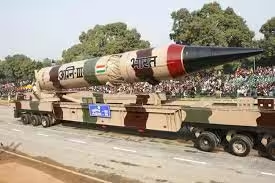
Key Features
Solid-fuel propulsion:
- Faster launch readiness
- Lower maintenance
- Higher survivability compared to liquid-fuel missiles
Two-stage configuration:
- Enhances range and payload capability
High accuracy and reliability:
- Suitable for strategic deterrence missions
Strategic Importance of the Test
1. Strengthening Credible Minimum Deterrence
- Agni-III is a core pillar of India’s nuclear deterrence posture
- Supports India’s doctrine of:
- No First Use (NFU)
- Credible Minimum Deterrence
Ensures ability to inflict unacceptable damage in case of nuclear aggression
2. Operational Readiness of Strategic Forces Command
- Test conducted as a training exercise
- Validates:
- Missile handling procedures
- Command-and-control systems
- Coordination between DRDO and SFC
Enhances second-strike capability
3. Regional Strategic Balance
- Range covers key strategic regions, contributing to deterrence stability
- Acts as a counterbalance in a complex regional security environment
Reinforces India’s status as a responsible nuclear power
4. Indigenous Defence Capability
- Highlights DRDO’s mastery in solid propulsion, guidance, re-entry technology, and composite materials.
- Reduces import dependence; aligns with Make in India and self-reliance goals in strategic systems. Aligns with Atmanirbhar Bharat in defence manufacturing
Integrated Test Range (ITR), Chandipur
- Located in Balasore district, Odisha (off the Bay of Bengal coast).
- India’s primary facility for testing ballistic missiles, cruise missiles (e.g., BrahMos), anti-ballistic missile systems (e.g., Prithvi Air Defence), and other strategic weapons.
- Equipped with advanced tracking radars, telemetry, electro-optical systems, and mission control centres → Essential for validating missile performance over long ranges.
Practice Question:
With reference to the Agni-III missile, consider the following statements:
- It is a two-stage, solid-fuelled ballistic missile.
- It has a strike range of more than 3,000 km.
- It is capable of carrying both conventional and nuclear warheads.
- It is operated by the Defence Research and Development Organisation (DRDO).
Which of the statements given above are correct?
(a) 1, 2 and 3 only
(b) 1 and 4 only
(c) 2 and 3 only
(d) 1, 2, 3 and 4
Answer: (a) 1, 2 and 3
Source: https://anantamias.com/current-affairs/agni-iii-missile-test-strategic-significance-for-india/
PMAY-Urban 2.0 Review Shows the Continuing Centrality of Housing Policy
Why in News?
On 23 February 2026, PMAY-Urban 2.0 Review Shows the Continuing Centrality of Housing Policy emerged as an important current-affairs theme through an official communication linked to Press Information Bureau. For UPSC aspirants, the topic is valuable not only because it marks a specific event, but because it opens a wider window into how policy, institutions, and development processes are evolving in India.
The official anchor for the topic is Secretary, MoHUA chairs 6th meeting of Central Sanctioning and Monitoring Committee under PMAY-Urban 2.0. That matters because serious preparation requires moving beyond headlines and asking three connected questions: what happened, why now, and what deeper historical, economic, political, or governance trend this event reflects.
UPSC Relevance
- Prelims: welfare programmes, social campaigns, education, employment, and target groups in policy
- Mains: GS II on social justice, education, livelihoods, and human development
- A total of 2.88 lakh houses has been sanctioned under the Pradhan Mantri Awas Yojana –
- The meeting was attended by Shri Kuldip Narayan, Joint Secretary & Mission Director
- With the latest approval of 2,87,618 houses under PMAY-U 2.0, the total number of
What Happened?
A total of 2.88 lakh houses has been sanctioned under the Pradhan Mantri Awas Yojana – Urban 2.0 (PMAY-U 2.0) during the 6 th meeting of Central Sanctioning and Monitoring Committee (CSMC), held on 23 rd February 2026 under the chairmanship of Shri Srinivas Katikithala, Secretary, Ministry of Housing and Urban Affairs (MoHUA), in New Delhi. The meeting was attended by Shri Kuldip Narayan, Joint Secretary & Mission Director (JS&MD), Housing for All (HFA) and senior officials from the Ministry, along with PMAY-U Mission Directors from different States/UTs.
With the latest approval of 2,87,618 houses under PMAY-U 2.0, the total number of sanctioned houses under the Scheme is now over 13.61 lakh, reflecting the Government’s continued commitment to ensure access to dignified and affordable housing for urban families belonging to Economically Weaker Section (EWS), Low Income Group (LIG) and Middle-Income Group (MIG). The newly sanctioned houses have been approved in 16 States/UTs, namely Andhra Pradesh, Arunachal Pradesh, Chhattisgarh, Gujarat, Jammu & Kashmir, Punjab, Puducherry, Rajasthan, Tamil Nadu, Telangana, Maharashtra, Madhya Pradesh, Nagaland, Odisha, Uttar Pradesh and West Bengal under different verticals of PMAY-U 2.0 such as the Beneficiary Led Construction (BLC) – 1.66 lakh houses, Affordable Housing in Partnership (AHP) – 1.09 lakh houses and Affordable Rental Housing (ARH) – 12,846 houses.
Read together, the event can be understood through three immediate takeaways: A total of 2.88 lakh houses has been sanctioned under the Pradhan Mantri Awas Yojana – Urban 2.0 (PMAY-U 2.0) during the 6 th meeting of Central Sanctioning and Monitoring Committee (CSMC), held on 23 rd February 2026 under the chairmanship of Shri Srinivas Katikithala, Secretary, Ministry of Housing and Urban Affairs (MoHUA), in New Delhi., The meeting was attended by Shri Kuldip Narayan, Joint Secretary & Mission Director (JS&MD), Housing for All (HFA) and senior officials from the Ministry, along with PMAY-U Mission Directors from different States/UTs., and With the latest approval of 2,87,618 houses under PMAY-U 2.0, the total number of sanctioned houses under the Scheme is now over 13.61 lakh, reflecting the Government’s continued commitment to ensure access to dignified and affordable housing for urban families belonging to Economically Weaker Section (EWS), Low Income Group (LIG) and Middle-Income Group (MIG).. These are the factual anchors, but the real UPSC value lies in connecting those facts with the broader story behind them.
Why it Matters
For UPSC, the significance of this topic lies in the fact that it sits at the intersection of current developments and structural change. Whether one looks at it from the lens of governance, economy, diplomacy, social policy, or strategic planning, the topic shows how day-to-day announcements often reveal larger shifts in India's state capacity and developmental priorities.
In answer writing, this makes the topic especially useful. It can serve as a factual illustration in Prelims preparation and as a layered example in Mains where the examiner expects candidates to connect institutions, outcomes, and wider policy direction.
What You Must Learn
Bottom Line
PMAY-Urban 2.0 Review Shows the Continuing Centrality of Housing Policy is important because it allows aspirants to move from a narrow event-based reading of current affairs to a broader understanding of how history, institutions, economy, politics, and governance intersect in contemporary India.
Use the topic to connect welfare or education developments with long-term capability creation.
Related Current Affairs
- Pariksha Pe Charcha 2026 Keeps Exam Stress and Student Well-Being in Focus
- Khelo India Mission Announced in Union Budget 2026-27
- One Health Workshop Reinforces Integrated Public Health Thinking
Exam Oriented Questions
Why is this topic in the news?
It is in the news because an official development related to **PMAY-Urban 2.0 Review Shows the Continuing Centrality of Housing Policy** was recorded on 23 February 2026.
Which official institution or source is associated with this topic?
The topic is anchored in an official source associated with **Press Information Bureau**, and aspirants should remember the source title **Secretary, MoHUA chairs 6th meeting of Central Sanctioning and Monitoring Committee under PMAY-Urban 2.0**.
What is the core issue involved here?
The core issue revolves around a total of 2.88 lakh houses has been sanctioned under the pradhan mantri awas yojana – urban 2.0 (pmay-u 2.0) during the 6 th meeting of central sanctioning and monitoring committee (csmc), held on 23 rd february 2026 under the chairmanship of shri srinivas katikithala, secretary, ministry of housing and urban affairs (mohua), in new delhi, along with its wider institutional and policy implications.
How is this topic relevant for UPSC Prelims?
It is relevant for Prelims because it covers welfare programmes, social campaigns, education, employment, and target groups in policy.
How is this topic relevant for UPSC Mains?
It is relevant for Mains because it can be used in GS II on social justice, education, livelihoods, and human development.
What wider context should aspirants connect with this topic?
Aspirants should connect this event with the wider context of historically, india's social policy has expanded through a mix of welfare provision, institution-building, and behavioural change campaigns.
Does this topic have an economic, political, or social angle?
Yes. Economically, investments in education, livelihoods, and social protection affect productivity, labour force participation, and long-term human capital. Politically, social-sector measures matter because they shape legitimacy, inclusion, and the lived relationship between citizen and state.
How can this topic be used in answer writing?
It can be used as a recent example to strengthen analytical arguments, especially where the question asks how policy intent translates into institutional or developmental outcomes.
What factual points should be revised first?
Revise the event date, the official source, and these quick points: A total of 2.88 lakh houses has been sanctioned under the Pradhan Mantri Awas Yojana – Urban 2.0 (PMAY-U 2.0) during the 6 th meeting of Central Sanctioning and Monitoring Committee (CSMC), held on 23 rd February 2026 under the chairmanship of Shri Srinivas Katikithala, Secretary, Ministry of Housing and Urban Affairs (MoHUA), in New Delhi., The meeting was attended by Shri Kuldip Narayan, Joint Secretary & Mission Director (JS&MD), Housing for All (HFA) and senior officials from the Ministry, along with PMAY-U Mission Directors from different States/UTs., With the latest approval of 2,87,618 houses under PMAY-U 2.0, the total number of sanctioned houses under the Scheme is now over 13.61 lakh, reflecting the Government’s continued commitment to ensure access to dignified and affordable housing for urban families belonging to Economically Weaker Section (EWS), Low Income Group (LIG) and Middle-Income Group (MIG)..
What is the one-line exam takeaway?
PMAY-Urban 2.0 Review Shows the Continuing Centrality of Housing Policy is important because it combines current relevance with a larger story about institutions, development, and public policy.
Cabinet Approval for Srinagar Airport Expansion Signals a Strategic Connectivity Push
Why in News?
On 24 February 2026, Cabinet Approval for Srinagar Airport Expansion Signals a Strategic Connectivity Push emerged as an important current-affairs theme through an official communication linked to Ministry of Civil Aviation. For UPSC aspirants, the topic is valuable not only because it marks a specific event, but because it opens a wider window into how policy, institutions, and development processes are evolving in India.
The official anchor for the topic is Minister for Civil Aviation Shri Kinjarapu Ram Mohan Naidu Welcomes Cabinet Approval for Expansion of Srinagar International Airport. That matters because serious preparation requires moving beyond headlines and asking three connected questions: what happened, why now, and what deeper historical, economic, political, or governance trend this event reflects.
UPSC Relevance
- Prelims: projects, corridors, airports, metro systems, regulators, and regional connectivity facts
- Mains: GS III on infrastructure, logistics, urban development, and regional integration
- Minister for Civil Aviation, Shri Kinjarapu Ram Mohan Naidu, has welcomed the approval
- The project, to be implemented by the Airports Authority of India (AAI), marks a
- Under the visionary leadership of Prime Minister Shri Narendra Modi, the Government
What Happened?
Minister for Civil Aviation, Shri Kinjarapu Ram Mohan Naidu, has welcomed the approval of the Cabinet Committee on Economic Affairs for the ₹1,677 crore expansion of the Civil Enclave at Srinagar International Airport. The project, to be implemented by the Airports Authority of India (AAI), marks a historic milestone in strengthening aviation infrastructure and accelerating inclusive development in Jammu & Kashmir.
Under the visionary leadership of Prime Minister Shri Narendra Modi, the Government remains committed to transforming regional connectivity and unlocking the immense economic potential of the Union Territory. Srinagar International Airport currently handles approximately 44.7 lakh passengers annually (FY 2024–25), nearly 28,500 aircraft movements, and around 10,000 metric tonnes of cargo.
Read together, the event can be understood through three immediate takeaways: Minister for Civil Aviation, Shri Kinjarapu Ram Mohan Naidu, has welcomed the approval of the Cabinet Committee on Economic Affairs for the ₹1,677 crore expansion of the Civil Enclave at Srinagar International Airport., The project, to be implemented by the Airports Authority of India (AAI), marks a historic milestone in strengthening aviation infrastructure and accelerating inclusive development in Jammu & Kashmir., and Under the visionary leadership of Prime Minister Shri Narendra Modi, the Government remains committed to transforming regional connectivity and unlocking the immense economic potential of the Union Territory.. These are the factual anchors, but the real UPSC value lies in connecting those facts with the broader story behind them.
Why it Matters
For UPSC, the significance of this topic lies in the fact that it sits at the intersection of current developments and structural change. Whether one looks at it from the lens of governance, economy, diplomacy, social policy, or strategic planning, the topic shows how day-to-day announcements often reveal larger shifts in India's state capacity and developmental priorities.
In answer writing, this makes the topic especially useful. It can serve as a factual illustration in Prelims preparation and as a layered example in Mains where the examiner expects candidates to connect institutions, outcomes, and wider policy direction.
What You Must Learn
Bottom Line
Cabinet Approval for Srinagar Airport Expansion Signals a Strategic Connectivity Push is important because it allows aspirants to move from a narrow event-based reading of current affairs to a broader understanding of how history, institutions, economy, politics, and governance intersect in contemporary India.
Use the topic to explain how physical connectivity influences regional growth and state capacity.
Related Current Affairs
- Noida Metro Extension Shows How Urban Mobility is Becoming a Governance Priority
- Passenger Facilitation Measures Gain Attention in Civil Aviation
- Development Projects at Rairangpur Reflect the Importance of Regional Infrastructure
Exam Oriented Questions
Why is this topic in the news?
It is in the news because an official development related to **Cabinet Approval for Srinagar Airport Expansion Signals a Strategic Connectivity Push** was recorded on 24 February 2026.
Which official institution or source is associated with this topic?
The topic is anchored in an official source associated with **Ministry of Civil Aviation**, and aspirants should remember the source title **Minister for Civil Aviation Shri Kinjarapu Ram Mohan Naidu Welcomes Cabinet Approval for Expansion of Srinagar International Airport**.
What is the core issue involved here?
The core issue revolves around minister for civil aviation, shri kinjarapu ram mohan naidu, has welcomed the approval of the cabinet committee on economic affairs for the ₹1,677 crore expansion of the civil enclave at srinagar international airport, along with its wider institutional and policy implications.
How is this topic relevant for UPSC Prelims?
It is relevant for Prelims because it covers projects, corridors, airports, metro systems, regulators, and regional connectivity facts.
How is this topic relevant for UPSC Mains?
It is relevant for Mains because it can be used in GS III on infrastructure, logistics, urban development, and regional integration.
What wider context should aspirants connect with this topic?
Aspirants should connect this event with the wider context of historically, infrastructure has been one of the clearest ways in which the indian state translates developmental intent into visible public outcomes.
Does this topic have an economic, political, or social angle?
Yes. Economically, better connectivity changes logistics costs, market access, labour mobility, and the geography of growth. Politically, infrastructure projects also reflect state capacity, regional prioritisation, and the promise of balanced development.
How can this topic be used in answer writing?
It can be used as a recent example to strengthen analytical arguments, especially where the question asks how policy intent translates into institutional or developmental outcomes.
What factual points should be revised first?
Revise the event date, the official source, and these quick points: Minister for Civil Aviation, Shri Kinjarapu Ram Mohan Naidu, has welcomed the approval of the Cabinet Committee on Economic Affairs for the ₹1,677 crore expansion of the Civil Enclave at Srinagar International Airport., The project, to be implemented by the Airports Authority of India (AAI), marks a historic milestone in strengthening aviation infrastructure and accelerating inclusive development in Jammu & Kashmir., Under the visionary leadership of Prime Minister Shri Narendra Modi, the Government remains committed to transforming regional connectivity and unlocking the immense economic potential of the Union Territory..
What is the one-line exam takeaway?
Cabinet Approval for Srinagar Airport Expansion Signals a Strategic Connectivity Push is important because it combines current relevance with a larger story about institutions, development, and public policy.
Election Coordination Conference Reflects the Federal Nature of India’s Electoral Machinery
Why in News?
On 24 February 2026, Election Coordination Conference Reflects the Federal Nature of India's Electoral Machinery emerged as an important current-affairs theme through an official communication linked to Press Information Bureau. For UPSC aspirants, the topic is valuable not only because it marks a specific event, but because it opens a wider window into how policy, institutions, and development processes are evolving in India.
The official anchor for the topic is National Round Table Conference of ECI and State Election Commissioners, 2026 concludes in New Delhi. That matters because serious preparation requires moving beyond headlines and asking three connected questions: what happened, why now, and what deeper historical, economic, political, or governance trend this event reflects.
UPSC Relevance
- Prelims: institutions, administrative mechanisms, schemes, regulations, and delivery platforms
- Mains: GS II on governance, reforms, public administration, and institutional capacity
- thematic sessions and bilateral meetings, and the formal adoption of the Delhi
- National Round Table Conference of the Election Commission of India & State Election
- The development is relevant for UPSC because it connects to larger issues reflected in
What Happened?
thematic sessions and bilateral meetings, and the formal adoption of the Delhi Declaration 2026. National Round Table Conference of the Election Commission of India & State Election Commissioners
National Round Table Conference of the Election Commission of India & State Election Commissioners
Read together, the event can be understood through three immediate takeaways: thematic sessions and bilateral meetings, and the formal adoption of the Delhi Declaration 2026., National Round Table Conference of the Election Commission of India & State Election Commissioners, and The development is relevant for UPSC because it connects to larger issues reflected in election coordination conference reflects the federal nature of india's electoral machinery.. These are the factual anchors, but the real UPSC value lies in connecting those facts with the broader story behind them.
Why it Matters
For UPSC, the significance of this topic lies in the fact that it sits at the intersection of current developments and structural change. Whether one looks at it from the lens of governance, economy, diplomacy, social policy, or strategic planning, the topic shows how day-to-day announcements often reveal larger shifts in India's state capacity and developmental priorities.
In answer writing, this makes the topic especially useful. It can serve as a factual illustration in Prelims preparation and as a layered example in Mains where the examiner expects candidates to connect institutions, outcomes, and wider policy direction.
What You Must Learn
Bottom Line
Election Coordination Conference Reflects the Federal Nature of India's Electoral Machinery is important because it allows aspirants to move from a narrow event-based reading of current affairs to a broader understanding of how history, institutions, economy, politics, and governance intersect in contemporary India.
Use the topic to highlight the importance of institutions, procedural reform, and administrative accountability.
Related Current Affairs
- EVM-VVPAT Awareness Campaign Reflects the Institutional Side of Electoral Trust
- ECI and State Election Commissions Resolve to Strengthen Electoral Coordination
- Toy Quality Enforcement Shows Why Consumer Regulation Matters
Exam Oriented Questions
Why is this topic in the news?
It is in the news because an official development related to **Election Coordination Conference Reflects the Federal Nature of India's Electoral Machinery** was recorded on 24 February 2026.
Which official institution or source is associated with this topic?
The topic is anchored in an official source associated with **Press Information Bureau**, and aspirants should remember the source title **National Round Table Conference of ECI and State Election Commissioners, 2026 concludes in New Delhi**.
What is the core issue involved here?
The core issue revolves around thematic sessions and bilateral meetings, and the formal adoption of the delhi declaration 2026, along with its wider institutional and policy implications.
How is this topic relevant for UPSC Prelims?
It is relevant for Prelims because it covers institutions, administrative mechanisms, schemes, regulations, and delivery platforms.
How is this topic relevant for UPSC Mains?
It is relevant for Mains because it can be used in GS II on governance, reforms, public administration, and institutional capacity.
What wider context should aspirants connect with this topic?
Aspirants should connect this event with the wider context of historically, many of india's reform efforts have succeeded or failed depending on the quality of institutional design and administrative follow-through.
Does this topic have an economic, political, or social angle?
Yes. Economically and socially, governance reforms matter because they determine how effectively public resources translate into outcomes on the ground. Politically, such developments illustrate the constant negotiation between central direction, state-level implementation, and citizen expectations.
How can this topic be used in answer writing?
It can be used as a recent example to strengthen analytical arguments, especially where the question asks how policy intent translates into institutional or developmental outcomes.
What factual points should be revised first?
Revise the event date, the official source, and these quick points: thematic sessions and bilateral meetings, and the formal adoption of the Delhi Declaration 2026., National Round Table Conference of the Election Commission of India & State Election Commissioners, The development is relevant for UPSC because it connects to larger issues reflected in election coordination conference reflects the federal nature of india's electoral machinery..
What is the one-line exam takeaway?
Election Coordination Conference Reflects the Federal Nature of India's Electoral Machinery is important because it combines current relevance with a larger story about institutions, development, and public policy.
GIFT City to Shahpur Metro Extension Shows How Finance Hubs Need Mobility Infrastructure
Why in News?
On 24 February 2026, GIFT City to Shahpur Metro Extension Shows How Finance Hubs Need Mobility Infrastructure emerged as an important current-affairs theme through an official communication linked to Press Information Bureau. For UPSC aspirants, the topic is valuable not only because it marks a specific event, but because it opens a wider window into how policy, institutions, and development processes are evolving in India.
The official anchor for the topic is Cabinet approves extension of existing North-South corridor from GIFT City to Shahpur of Gujarat Metro Rail Corporation Limited (GMRC). That matters because serious preparation requires moving beyond headlines and asking three connected questions: what happened, why now, and what deeper historical, economic, political, or governance trend this event reflects.
UPSC Relevance
- Prelims: projects, corridors, airports, metro systems, regulators, and regional connectivity facts
- Mains: GS III on infrastructure, logistics, urban development, and regional integration
- The Union Cabinet chaired by the Prime Minister, Shri Narendra Modi, today approved the
- The project is scheduled to be completed in approximately four years.
- The estimated cost of the project is Rs.1,067.35 crore.
What Happened?
The Union Cabinet chaired by the Prime Minister, Shri Narendra Modi, today approved the extension, from GIFT City to Shahpur, will be 3.33 kilometers long and include three elevated stations. The project is scheduled to be completed in approximately four years.
The estimated cost of the project is Rs.1,067.35 crore. This extended corridor is expected to benefit approximately 23,702 passengers in 2029 and approximately 58,059 passengers in 2041.
Read together, the event can be understood through three immediate takeaways: The Union Cabinet chaired by the Prime Minister, Shri Narendra Modi, today approved the extension, from GIFT City to Shahpur, will be 3.33 kilometers long and include three elevated stations., The project is scheduled to be completed in approximately four years., and The estimated cost of the project is Rs.1,067.35 crore.. These are the factual anchors, but the real UPSC value lies in connecting those facts with the broader story behind them.
Why it Matters
For UPSC, the significance of this topic lies in the fact that it sits at the intersection of current developments and structural change. Whether one looks at it from the lens of governance, economy, diplomacy, social policy, or strategic planning, the topic shows how day-to-day announcements often reveal larger shifts in India's state capacity and developmental priorities.
In answer writing, this makes the topic especially useful. It can serve as a factual illustration in Prelims preparation and as a layered example in Mains where the examiner expects candidates to connect institutions, outcomes, and wider policy direction.
What You Must Learn
Bottom Line
GIFT City to Shahpur Metro Extension Shows How Finance Hubs Need Mobility Infrastructure is important because it allows aspirants to move from a narrow event-based reading of current affairs to a broader understanding of how history, institutions, economy, politics, and governance intersect in contemporary India.
Use the topic to explain how physical connectivity influences regional growth and state capacity.
Related Current Affairs
- Noida Metro Extension Shows How Urban Mobility is Becoming a Governance Priority
- Passenger Facilitation Measures Gain Attention in Civil Aviation
- Development Projects at Rairangpur Reflect the Importance of Regional Infrastructure
Exam Oriented Questions
Why is this topic in the news?
It is in the news because an official development related to **GIFT City to Shahpur Metro Extension Shows How Finance Hubs Need Mobility Infrastructure** was recorded on 24 February 2026.
Which official institution or source is associated with this topic?
The topic is anchored in an official source associated with **Press Information Bureau**, and aspirants should remember the source title **Cabinet approves extension of existing North-South corridor from GIFT City to Shahpur of Gujarat Metro Rail Corporation Limited (GMRC)**.
What is the core issue involved here?
The core issue revolves around the union cabinet chaired by the prime minister, shri narendra modi, today approved the extension, from gift city to shahpur, will be 3.33 kilometers long and include three elevated stations, along with its wider institutional and policy implications.
How is this topic relevant for UPSC Prelims?
It is relevant for Prelims because it covers projects, corridors, airports, metro systems, regulators, and regional connectivity facts.
How is this topic relevant for UPSC Mains?
It is relevant for Mains because it can be used in GS III on infrastructure, logistics, urban development, and regional integration.
What wider context should aspirants connect with this topic?
Aspirants should connect this event with the wider context of historically, infrastructure has been one of the clearest ways in which the indian state translates developmental intent into visible public outcomes.
Does this topic have an economic, political, or social angle?
Yes. Economically, better connectivity changes logistics costs, market access, labour mobility, and the geography of growth. Politically, infrastructure projects also reflect state capacity, regional prioritisation, and the promise of balanced development.
How can this topic be used in answer writing?
It can be used as a recent example to strengthen analytical arguments, especially where the question asks how policy intent translates into institutional or developmental outcomes.
What factual points should be revised first?
Revise the event date, the official source, and these quick points: The Union Cabinet chaired by the Prime Minister, Shri Narendra Modi, today approved the extension, from GIFT City to Shahpur, will be 3.33 kilometers long and include three elevated stations., The project is scheduled to be completed in approximately four years., The estimated cost of the project is Rs.1,067.35 crore..
What is the one-line exam takeaway?
GIFT City to Shahpur Metro Extension Shows How Finance Hubs Need Mobility Infrastructure is important because it combines current relevance with a larger story about institutions, development, and public policy.
Can India’s power system keep up with the explosion in data centres?
Why in News:
- At the India AI Impact Summit (2026), senior officials from Grid India warned that AI data centres may alter grid planning due to their large, dynamic power demand.
- Discussions have intensified around renewable integration, storage, and the possible role of nuclear energy in powering hyperscale AI infrastructure.
UPSC Relevance:
GS III – Infrastructure, Energy, Environment, Science & Technology
Introduction
Artificial Intelligence (AI) is emerging as a foundational technology for economic growth, governance, healthcare, logistics, and defence. However, AI systems depend on energy-intensive data centres that operate 24/7 and require continuous electricity and cooling.
India, while aspiring to become a global AI hub, has also committed to achieving Net Zero emissions by 2070. This raises a critical policy question:
- Can India expand AI infrastructure without undermining its climate commitments and grid stability?
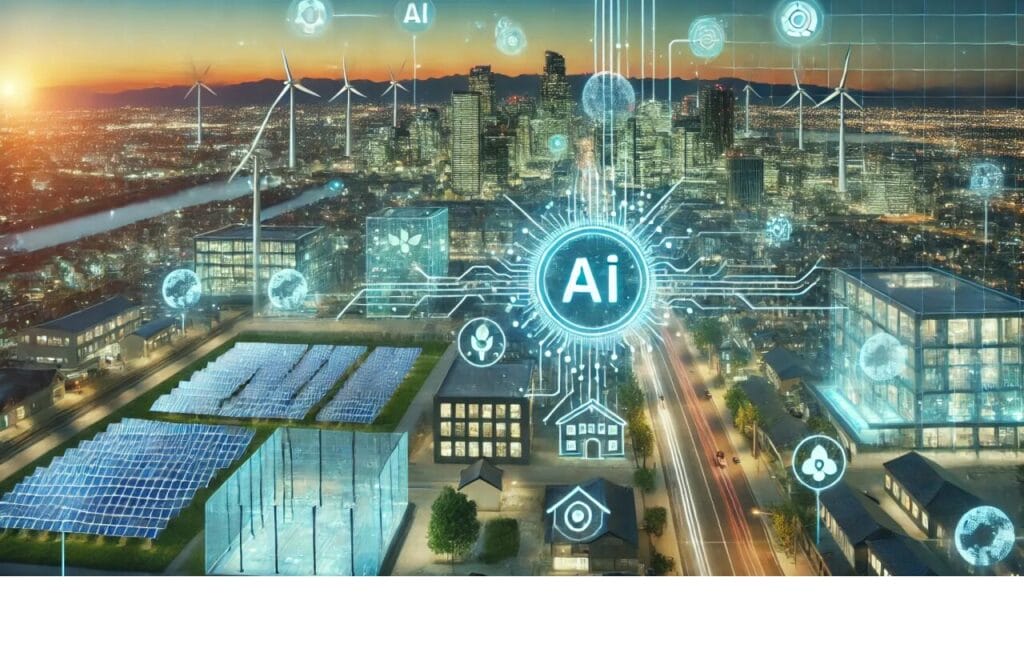
Why is AI Increasing Energy Demand in India?
AI workloads, especially those using advanced GPUs, are significantly more energy-intensive than conventional cloud computing.
Growth Indicators:
- Installed data centre capacity:
- ~520 MW (2020)
- ~1.2–1.5 GW (2025)
- 6–10 GW projected by 2030
- Electricity demand from data centres could increase from ~0.5 GW today to ~7 GW by 2030.
- Water consumption estimated at ~150 billion litres in 2024.
Why Energy Demand is High:
- 24/7 operations
- High-performance computing
- Cooling requirements in tropical climate
- Backup and redundancy systems
Thus, AI is not merely a digital phenomenon; it is an infrastructure and energy challenge.
How Do Data Centres Affect Grid Stability?
According to Grid India, AI data centres are:
- Large transmission-level loads
- Highly concentrated geographically
- Variable and “spiky” in demand
- Capable of sudden grid isolation (“silent exit”)
Grid Risks:
- Disturbance due to sudden load withdrawal.
- Increased reserve and balancing requirements.
- Stress on transmission infrastructure.
- Need for higher-quality, uninterrupted power.
Traditional grid planning, designed for gradual industrial demand growth, must now adapt to hyperscale AI loads.
What are the Environmental Concerns?
(A) Carbon Emissions Risk
India’s renewable energy capacity has expanded significantly, yet renewables are intermittent.
AI data centres require:
- Firm, baseload electricity.
- High reliability.
If powered by fossil fuels, they could:
- Lock India into carbon-intensive pathways.
- Increase emissions trajectory.
- Complicate Net Zero 2070 target.
(B) Water Stress
Cooling infrastructure consumes enormous quantities of water.
Concerns:
- Major data centre hubs (Mumbai, Chennai, Hyderabad, Bengaluru) are water-stressed.
- Trade-off between air cooling (energy-intensive) and water cooling (water-intensive).
Thus, AI growth intersects with urban water governance.
What are the Policy Gaps in India?
Despite rapid expansion, regulatory preparedness remains limited.
Key Gaps:
- No mandatory environmental disclosure
- No compulsory reporting of:
- Power Use Efficiency (PUE)
- Water Use Efficiency (WUE)
- Carbon intensity
- No compulsory reporting of:
- Fragmented policy framework
- 15 states have data centre policies.
- Only a few incorporate sustainability norms.
- No binding national AI-energy framework.
- Lack of strategic siting policy
- No national plan for data centre zoning aligned with:
- Renewable energy corridors
- Water availability
- Grid readiness
- No national plan for data centre zoning aligned with:
- Grid code limitations
- Standards not yet fully evolved for inverter-based hyperscale loads.
Institutions like the Central Electricity Authority and the Bureau of Energy Efficiency will need to play a stronger regulatory role.
Is the AI vs Climate Debate a False Binary?
The debate is often framed as:
Either pursue AI growth
Or protect climate commitments
However, this framing is flawed.
Why It Is a False Binary:
- AI can improve renewable forecasting.
- AI enhances grid optimisation.
- AI supports energy efficiency.
- AI aids predictive maintenance.
Thus, AI can be both:
- An energy consumer.
- A climate solution enabler.
The challenge is governance design, not technological inevitability.
What Lessons Can India Learn from Global Experiences?
Several countries have faced AI-induced grid stress:
| Country | Response |
| Ireland | Data centres ~20% of electricity; stricter grid rules |
| USA | Co-location with gas plants |
| Singapore | Temporary pause on new data centre approvals |
| Netherlands | Restrictions on hyperscale centres |
Lessons:
- Unplanned expansion leads to fossil lock-in.
- Grid congestion increases consumer tariffs.
- Regulatory delays create policy uncertainty.
India must plan before capacity multiplies.
What Policy Measures Can Align AI Growth with Climate Goals?
(1) Mandatory Efficiency Standards
- Introduce star rating systems for data centres.
- Set benchmarks for energy and water efficiency.
- Mandatory sustainability disclosure.
(2) Renewable + Storage Integration
- Co-location with solar/wind.
- Long-duration storage (battery + pumped hydro).
- Round-the-clock green power contracts.
- Strengthening open access mechanisms.
(3) Grid Modernisation
- Upgrading transmission infrastructure.
- Updating grid codes for dynamic loads.
- Mandating on-site backup and storage.
- Resource adequacy planning.
(4) Strategic Location Planning
- Pre-identified national data centre zones.
- Avoidance of water-stressed areas.
- Alignment with renewable-rich regions.
(5) Role of Nuclear Energy
To achieve Net Zero, modelling suggests India may require large-scale nuclear expansion.
Advantages:
- Low-carbon baseload power.
- Suitable for hyperscale operations.
Challenges:
- High capital cost.
- Long gestation period.
- Social licence and safety concerns.
Therefore, nuclear should complement — not replace — renewables and storage.
How Can Demand-Side Efficiency Reduce Energy Burden?
Energy efficiency must also come from:
- Optimised AI model design.
- Use of heterogeneous computing (not all tasks need high-power GPUs).
- Advanced semiconductor innovations.
- Reduced data movement architectures.
The objective should shift from:
Maximising compute power
to
Maximising social impact per unit of energy consumed.
Conclusion
AI-driven data centres represent a structural transformation in India’s power system.
If poorly planned:
- They risk increasing emissions.
- They may strain grids and water systems.
- They could undermine Net Zero goals.
If strategically integrated:
- They can accelerate renewable adoption.
- Improve grid efficiency.
- Strengthen India’s digital competitiveness sustainably.
Thus, the real policy challenge is not choosing between AI and climate action, but designing an integrated AI–energy governance framework. India’s success will depend on foresight, regulatory clarity, infrastructure planning, and technological optimisation.
Practice Questions
- “Artificial Intelligence is as much an energy challenge as it is a technological revolution.” Discuss in the Indian context.
- Examine the implications of rapid data centre expansion on India’s power sector and climate commitments.
INDIA’S FIRST NATIONAL ANTI-TERROR POLICY: PRAHAAR (2026)
Why in News
In February 2026, the Union Ministry of Home Affairs released India’s first comprehensive counter-terror doctrine titled PRAHAAR. It lays down a National Counter Terrorism Policy and Strategy framework to address evolving security threats.
UPSC Relevance:
GS III – Internal Security, Counter Terrorism
CONTEXT
India has faced multiple forms of terrorism over the decades:
- Cross-border sponsored terrorism.
- Radicalisation and sleeper cell networks.
- Left Wing Extremism.
- Technology-enabled and cyber-driven attacks.
After the weakening of traditional terror networks, the threat has shifted towards hybrid, decentralised and technology-intensive models. The policy recognises this transformation.
GUIDING PRINCIPLES OF PRAHAAR
1. Terrorism Not Linked to Religion or Ethnicity
The policy clearly states that terrorism is not associated with any particular religion, nationality or civilisation. This ensures alignment with constitutional values of secularism and equality.
2. Zero Tolerance Approach
All terrorist acts, financing channels, support systems and safe havens are to be criminalised and dismantled.
3. Whole-of-Government and Whole-of-Society Approach
Counter-terror efforts involve central agencies, state police, intelligence bodies, financial regulators, community leaders and civil society organisations.
NATURE OF THREATS IDENTIFIED
1. Cross-Border Sponsored Terrorism
The policy acknowledges sustained attempts by handlers operating from across India’s borders to recruit, finance and guide attacks through local modules.
Modern tools such as drones and encrypted communications are increasingly being used to smuggle arms and coordinate attacks.
2. Global Terror Networks
India remains a target of international terror organisations such as:
- Al-Qaeda
- Islamic State (ISIS)
These organisations attempt to radicalise individuals through online propaganda, sleeper cells and transnational ideological networks.
3. Cyber Terrorism and Digital Threats
Terrorist actors and hostile nation-states are increasingly targeting India’s digital infrastructure.
Cyber-attacks aim to disrupt essential services such as power grids, railways, aviation, banking and defence systems.
Digital anonymity through encryption, dark web platforms and cryptocurrency wallets makes detection and attribution difficult.
4. Critical Infrastructure Threats
India faces threats across:
- Land: Infiltration, insurgency and sleeper cells.
- Water: Attacks on ports, shipping routes and maritime infrastructure.
- Air: Aviation sabotage and drone-based weapon delivery.
The policy emphasises protection of strategic sectors including defence, space and atomic energy installations.
5. CBRNED Risks
CBRNED refers to threats involving:
- Chemical agents
- Biological agents
- Radiological materials
- Nuclear substances
- Explosives
- Digital sabotage
The misuse of these materials by state or non-state actors could cause mass casualties and long-term disruption.
TECHNOLOGY AND HYBRID WARFARE
The policy recognises that terrorism is no longer confined to physical violence. It now includes:
- Use of drones for arms supply and reconnaissance.
- Social media platforms for recruitment and propaganda.
- Instant messaging apps with strong encryption for operational planning.
- Organised criminal networks for logistics and funding.
This indicates convergence between terrorism, organised crime and cyber warfare.
INSTITUTIONAL AND LEGAL MECHANISMS
1. Role of Investigative Agencies
The National Investigation Agency (NIA) plays a central coordinating role in terrorism-related investigations.
After major incidents, coordination meetings with state anti-terror units are conducted to standardise responses.
2. Uniform Anti-Terror Structure Across States
The policy proposes standardised procedures and coordination mechanisms so that responses to terror threats are consistent across states.
This reduces jurisdictional delays and ensures synergy between agencies.
3. Strengthening Prosecution
Legal experts are to be associated from the FIR stage itself.
Early legal scrutiny ensures that evidence collection and documentation are strong enough to sustain convictions in court.
DERADICALISATION AND PREVENTIVE STRATEGY
1. Graded Response to Radicalisation
Individuals identified as vulnerable to extremist ideologies undergo monitoring, counselling or legal action depending on the severity of radicalisation.
2. Community Engagement
Moderate religious leaders, NGOs and community elders are engaged to counter extremist narratives and promote peaceful discourse.
3. Youth Engagement
Youth are constructively engaged through educational and social initiatives to prevent alienation and vulnerability to recruitment.
4. Prison De-radicalisation
Prison authorities are instructed to prevent hardened extremists from influencing vulnerable inmates.
Structured de-radicalisation programmes are implemented within correctional institutions.
INTERNATIONAL COOPERATION
Terrorism is transnational in nature. The policy emphasises:
- Intelligence sharing with friendly nations.
- Financial tracking to prevent terror financing.
- Regional and multilateral cooperation to curb safe havens abroad.
National action is considered effective only when complemented by international coordination.
LINKAGES WITH EXISTING LEGAL FRAMEWORK
PRAHAAR operates alongside:
- Unlawful Activities (Prevention) Act (UAPA)
- NIA Act
- Information Technology Act
- National Policy on Left Wing Extremism (2015)
The new policy provides strategic coherence to these scattered measures.
SIGNIFICANCE OF PRAHAAR
- It marks a doctrinal shift from reactive response to preventive and ecosystem-based counter-terrorism.
- It recognises the merging of cyber warfare and conventional terrorism.
- It institutionalises coordination between Centre and States.
- It integrates legal, social, technological and diplomatic dimensions into a unified framework.
CONCLUSION
The PRAHAAR policy represents a comprehensive evolution in India’s counter-terror strategy. By addressing cross-border terrorism, cyber threats, radicalisation and transnational networks within a unified framework, it seeks to dismantle not only terror incidents but the entire ecosystem that sustains them. Its long-term success will depend on institutional coordination, technological preparedness, legal robustness and sustained community engagement.
Practice Question
- Terrorism in India has evolved from cross-border infiltration to hybrid and digital threats.”
In this context, analyze how PRAHAAR addresses emerging dimensions of terrorism. - Discuss the challenges in implementing a centralized anti-terror framework in a federal polity like India. How can PRAHAAR overcome these constraints?
Source: https://anantamias.com/current-affairs/indias-first-national-anti-terror-policy-prahaar-2026/
ECI and State Election Commissions Resolve to Strengthen Electoral Coordination
Why in News?
On 25 February 2026, ECI and State Election Commissions Resolve to Strengthen Electoral Coordination emerged as an important current-affairs theme through an official communication linked to Press Information Bureau. For UPSC aspirants, the topic is valuable not only because it marks a specific event, but because it opens a wider window into how policy, institutions, and development processes are evolving in India.
The official anchor for the topic is ECI and SECs resolve to work together to further national and constitutional interest at the National Round Table Conference of ECI and State Election Commissioners. That matters because serious preparation requires moving beyond headlines and asking three connected questions: what happened, why now, and what deeper historical, economic, political, or governance trend this event reflects.
UPSC Relevance
- Prelims: institutions, administrative mechanisms, schemes, regulations, and delivery platforms
- Mains: GS II on governance, reforms, public administration, and institutional capacity
- English Releases Election Commission 25-February, 2026 16:18 IST <div class="contentdiv"
- The official source was Press Information Bureau.
- The topic is useful for both factual recall and wider analytical discussion.
What Happened?
English Releases Election Commission 25-February, 2026 16:18 IST <div class=”contentdiv” style=”font-size: 100%; box-shadow: 0 4px 10px 0 rgba(0,0,0,0.2), 0 4px 20px 0 rgba(0,0,0,0.19); padding: 40px; padding-top: 10px”> ECI and SECs resolve to work together to further national and constitutional interest at the National Round Table Conference of ECI and State Election Commissioners The National Round Table Conference of Election Commission of India (ECI) and State Election Commissioners (SECs) organized by ECI concluded yesterday (Tuesday, February 24, 2026) at Bharat Mandapam, New Delhi State Election Commissions of 30 States participated in the National Round Table Conference chaired by Chief Election Commissioner Shri Gyanesh Kumar in the presence of Election Commissioners Dr The State Election Commissioners widely appreciated National Round Table Conference, which was held successfully after a gap of 27 years ECI and the SECs resolved to conduct the National Round Table Conference on an annual basis Under the leadership of CEC Shri Gyanesh Kumar, all SECs resolved to adopt the National Declaration 2026 and affirmed that the preparation of pure electoral rolls are the bedrock of democracy and that transparent and efficient conduct of elections further strengthens democratic institutions In national and constitutional interest, ECI proposed to work out mutually acceptable mechanisms and legally viable frameworks with all SECs across the country to synergise election-related processes including the sharing of ECINET, EVMs, Electoral Rolls and the world-class training infrastructure at India International Institute of Democracy and Election Management (IIIDEM)
The official source was Press Information Bureau.
Read together, the event can be understood through three immediate takeaways: English Releases Election Commission 25-February, 2026 16:18 IST <div class=”contentdiv” style=”font-size: 100%; box-shadow: 0 4px 10px 0 rgba(0,0,0,0.2), 0 4px 20px 0 rgba(0,0,0,0.19); padding: 40px; padding-top: 10px”> ECI and SECs resolve to work together to further national and constitutional interest at the National Round Table Conference of ECI and State Election Commissioners The National Round Table Conference of Election Commission of India (ECI) and State Election Commissioners (SECs) organized by ECI concluded yesterday (Tuesday, February 24, 2026) at Bharat Mandapam, New Delhi State Election Commissions of 30 States participated in the National Round Table Conference chaired by Chief Election Commissioner Shri Gyanesh Kumar in the presence of Election Commissioners Dr The State Election Commissioners widely appreciated National Round Table Conference, which was held successfully after a gap of 27 years ECI and the SECs resolved to conduct the National Round Table Conference on an annual basis Under the leadership of CEC Shri Gyanesh Kumar, all SECs resolved to adopt the National Declaration 2026 and affirmed that the preparation of pure electoral rolls are the bedrock of democracy and that transparent and efficient conduct of elections further strengthens democratic institutions In national and constitutional interest, ECI proposed to work out mutually acceptable mechanisms and legally viable frameworks with all SECs across the country to synergise election-related processes including the sharing of ECINET, EVMs, Electoral Rolls and the world-class training infrastructure at India International Institute of Democracy and Election Management (IIIDEM), The official source was Press Information Bureau., and The topic is useful for both factual recall and wider analytical discussion.. These are the factual anchors, but the real UPSC value lies in connecting those facts with the broader story behind them.
Why it Matters
For UPSC, the significance of this topic lies in the fact that it sits at the intersection of current developments and structural change. Whether one looks at it from the lens of governance, economy, diplomacy, social policy, or strategic planning, the topic shows how day-to-day announcements often reveal larger shifts in India's state capacity and developmental priorities.
In answer writing, this makes the topic especially useful. It can serve as a factual illustration in Prelims preparation and as a layered example in Mains where the examiner expects candidates to connect institutions, outcomes, and wider policy direction.
What You Must Learn
Bottom Line
ECI and State Election Commissions Resolve to Strengthen Electoral Coordination is important because it allows aspirants to move from a narrow event-based reading of current affairs to a broader understanding of how history, institutions, economy, politics, and governance intersect in contemporary India.
Use the topic to highlight the importance of institutions, procedural reform, and administrative accountability.
Related Current Affairs
- EVM-VVPAT Awareness Campaign Reflects the Institutional Side of Electoral Trust
- Election Coordination Conference Reflects the Federal Nature of India's Electoral Machinery
- Toy Quality Enforcement Shows Why Consumer Regulation Matters
Exam Oriented Questions
Why is this topic in the news?
It is in the news because an official development related to **ECI and State Election Commissions Resolve to Strengthen Electoral Coordination** was recorded on 25 February 2026.
Which official institution or source is associated with this topic?
The topic is anchored in an official source associated with **Press Information Bureau**, and aspirants should remember the source title **ECI and SECs resolve to work together to further national and constitutional interest at the National Round Table Conference of ECI and State Election Commissioners**.
What is the core issue involved here?
The core issue revolves around english releases election commission 25-february, 2026 16:18 ist <div class="contentdiv" style="font-size: 100%; box-shadow: 0 4px 10px 0 rgba(0,0,0,0.2), 0 4px 20px 0 rgba(0,0,0,0.19); padding: 40px; padding-top: 10px"> eci and secs resolve to work together to further national and constitutional interest at the national round table conference of eci and state election commissioners the national round table conference of election commission of india (eci) and state election commissioners (secs) organized by eci concluded yesterday (tuesday, february 24, 2026) at bharat mandapam, new delhi state election commissions of 30 states participated in the national round table conference chaired by chief election commissioner shri gyanesh kumar in the presence of election commissioners dr the state election commissioners widely appreciated national round table conference, which was held successfully after a gap of 27 years eci and the secs resolved to conduct the national round table conference on an annual basis under the leadership of cec shri gyanesh kumar, all secs resolved to adopt the national declaration 2026 and affirmed that the preparation of pure electoral rolls are the bedrock of democracy and that transparent and efficient conduct of elections further strengthens democratic institutions in national and constitutional interest, eci proposed to work out mutually acceptable mechanisms and legally viable frameworks with all secs across the country to synergise election-related processes including the sharing of ecinet, evms, electoral rolls and the world-class training infrastructure at india international institute of democracy and election management (iiidem), along with its wider institutional and policy implications.
How is this topic relevant for UPSC Prelims?
It is relevant for Prelims because it covers institutions, administrative mechanisms, schemes, regulations, and delivery platforms.
How is this topic relevant for UPSC Mains?
It is relevant for Mains because it can be used in GS II on governance, reforms, public administration, and institutional capacity.
What wider context should aspirants connect with this topic?
Aspirants should connect this event with the wider context of historically, many of india's reform efforts have succeeded or failed depending on the quality of institutional design and administrative follow-through.
Does this topic have an economic, political, or social angle?
Yes. Economically and socially, governance reforms matter because they determine how effectively public resources translate into outcomes on the ground. Politically, such developments illustrate the constant negotiation between central direction, state-level implementation, and citizen expectations.
How can this topic be used in answer writing?
It can be used as a recent example to strengthen analytical arguments, especially where the question asks how policy intent translates into institutional or developmental outcomes.
What factual points should be revised first?
Revise the event date, the official source, and these quick points: English Releases Election Commission 25-February, 2026 16:18 IST <div class="contentdiv" style="font-size: 100%; box-shadow: 0 4px 10px 0 rgba(0,0,0,0.2), 0 4px 20px 0 rgba(0,0,0,0.19); padding: 40px; padding-top: 10px"> ECI and SECs resolve to work together to further national and constitutional interest at the National Round Table Conference of ECI and State Election Commissioners The National Round Table Conference of Election Commission of India (ECI) and State Election Commissioners (SECs) organized by ECI concluded yesterday (Tuesday, February 24, 2026) at Bharat Mandapam, New Delhi State Election Commissions of 30 States participated in the National Round Table Conference chaired by Chief Election Commissioner Shri Gyanesh Kumar in the presence of Election Commissioners Dr The State Election Commissioners widely appreciated National Round Table Conference, which was held successfully after a gap of 27 years ECI and the SECs resolved to conduct the National Round Table Conference on an annual basis Under the leadership of CEC Shri Gyanesh Kumar, all SECs resolved to adopt the National Declaration 2026 and affirmed that the preparation of pure electoral rolls are the bedrock of democracy and that transparent and efficient conduct of elections further strengthens democratic institutions In national and constitutional interest, ECI proposed to work out mutually acceptable mechanisms and legally viable frameworks with all SECs across the country to synergise election-related processes including the sharing of ECINET, EVMs, Electoral Rolls and the world-class training infrastructure at India International Institute of Democracy and Election Management (IIIDEM), The official source was Press Information Bureau., The topic is useful for both factual recall and wider analytical discussion..
What is the one-line exam takeaway?
ECI and State Election Commissions Resolve to Strengthen Electoral Coordination is important because it combines current relevance with a larger story about institutions, development, and public policy.
CBDC-Based Food Subsidy Pilot in Puducherry Extends the Experiment in Digital Welfare Delivery
Why in News?
On 25 February 2026, CBDC-Based Food Subsidy Pilot in Puducherry Extends the Experiment in Digital Welfare Delivery emerged as an important current-affairs theme through an official communication linked to Press Information Bureau. For UPSC aspirants, the topic is valuable not only because it marks a specific event, but because it opens a wider window into how policy, institutions, and development processes are evolving in India.
The official anchor for the topic is CBDC-Based Food Subsidy Distribution Pilot under PMGKAY to be Launched in Puducherry. That matters because serious preparation requires moving beyond headlines and asking three connected questions: what happened, why now, and what deeper historical, economic, political, or governance trend this event reflects.
UPSC Relevance
- Prelims: institutions, administrative mechanisms, schemes, regulations, and delivery platforms
- Mains: GS II on governance, reforms, public administration, and institutional capacity
- In a major step towards strengthening India’s digital public infrastructure and
- The pilot will be inaugurated by the Hon’ble Union Minister for Consumer Affairs, Food
- Kailashnathan; Chief Minister of Puducherry, Shri N.
What Happened?
In a major step towards strengthening India’s digital public infrastructure and enhancing transparency in subsidy delivery, the Government of India will launch a Central Bank Digital Currency (CBDC)-based Food Subsidy Distribution Pilot under the Pradhan Mantri Garib Kalyan Anna Yojana (PMGKAY) in the Union Territory of Puducherry on 26th February 2026. The pilot will be inaugurated by the Hon’ble Union Minister for Consumer Affairs, Food and Public Distribution, Shri Pralhad Joshi, in the presence of the Lieutenant Governor of Puducherry, Shri K.
Kailashnathan; Chief Minister of Puducherry, Shri N. The digital rupee or e-rupee is a tokenised digital version of the Indian rupee, issued by the Reserve Bank of India (RBI) as a Central Bank Digital Currency (CBDC).
Read together, the event can be understood through three immediate takeaways: In a major step towards strengthening India’s digital public infrastructure and enhancing transparency in subsidy delivery, the Government of India will launch a Central Bank Digital Currency (CBDC)-based Food Subsidy Distribution Pilot under the Pradhan Mantri Garib Kalyan Anna Yojana (PMGKAY) in the Union Territory of Puducherry on 26th February 2026., The pilot will be inaugurated by the Hon’ble Union Minister for Consumer Affairs, Food and Public Distribution, Shri Pralhad Joshi, in the presence of the Lieutenant Governor of Puducherry, Shri K., and Kailashnathan; Chief Minister of Puducherry, Shri N.. These are the factual anchors, but the real UPSC value lies in connecting those facts with the broader story behind them.
Why it Matters
For UPSC, the significance of this topic lies in the fact that it sits at the intersection of current developments and structural change. Whether one looks at it from the lens of governance, economy, diplomacy, social policy, or strategic planning, the topic shows how day-to-day announcements often reveal larger shifts in India's state capacity and developmental priorities.
In answer writing, this makes the topic especially useful. It can serve as a factual illustration in Prelims preparation and as a layered example in Mains where the examiner expects candidates to connect institutions, outcomes, and wider policy direction.
What You Must Learn
Bottom Line
CBDC-Based Food Subsidy Pilot in Puducherry Extends the Experiment in Digital Welfare Delivery is important because it allows aspirants to move from a narrow event-based reading of current affairs to a broader understanding of how history, institutions, economy, politics, and governance intersect in contemporary India.
Use the topic to highlight the importance of institutions, procedural reform, and administrative accountability.
Related Current Affairs
- CBDC-Based Digital Food Coupon Pilot Tests the Future of Welfare Delivery
- Toy Quality Enforcement Shows Why Consumer Regulation Matters
- Penalty on Misleading Coaching Advertisement Keeps Consumer Protection in the Education Market in Focus
Exam Oriented Questions
Why is this topic in the news?
It is in the news because an official development related to **CBDC-Based Food Subsidy Pilot in Puducherry Extends the Experiment in Digital Welfare Delivery** was recorded on 25 February 2026.
Which official institution or source is associated with this topic?
The topic is anchored in an official source associated with **Press Information Bureau**, and aspirants should remember the source title **CBDC-Based Food Subsidy Distribution Pilot under PMGKAY to be Launched in Puducherry**.
What is the core issue involved here?
The core issue revolves around in a major step towards strengthening india’s digital public infrastructure and enhancing transparency in subsidy delivery, the government of india will launch a central bank digital currency (cbdc)-based food subsidy distribution pilot under the pradhan mantri garib kalyan anna yojana (pmgkay) in the union territory of puducherry on 26th february 2026, along with its wider institutional and policy implications.
How is this topic relevant for UPSC Prelims?
It is relevant for Prelims because it covers institutions, administrative mechanisms, schemes, regulations, and delivery platforms.
How is this topic relevant for UPSC Mains?
It is relevant for Mains because it can be used in GS II on governance, reforms, public administration, and institutional capacity.
What wider context should aspirants connect with this topic?
Aspirants should connect this event with the wider context of historically, many of india's reform efforts have succeeded or failed depending on the quality of institutional design and administrative follow-through.
Does this topic have an economic, political, or social angle?
Yes. Economically and socially, governance reforms matter because they determine how effectively public resources translate into outcomes on the ground. Politically, such developments illustrate the constant negotiation between central direction, state-level implementation, and citizen expectations.
How can this topic be used in answer writing?
It can be used as a recent example to strengthen analytical arguments, especially where the question asks how policy intent translates into institutional or developmental outcomes.
What factual points should be revised first?
Revise the event date, the official source, and these quick points: In a major step towards strengthening India’s digital public infrastructure and enhancing transparency in subsidy delivery, the Government of India will launch a Central Bank Digital Currency (CBDC)-based Food Subsidy Distribution Pilot under the Pradhan Mantri Garib Kalyan Anna Yojana (PMGKAY) in the Union Territory of Puducherry on 26th February 2026., The pilot will be inaugurated by the Hon’ble Union Minister for Consumer Affairs, Food and Public Distribution, Shri Pralhad Joshi, in the presence of the Lieutenant Governor of Puducherry, Shri K., Kailashnathan; Chief Minister of Puducherry, Shri N..
What is the one-line exam takeaway?
CBDC-Based Food Subsidy Pilot in Puducherry Extends the Experiment in Digital Welfare Delivery is important because it combines current relevance with a larger story about institutions, development, and public policy.
India seeks to join IEA
Why in News?
India, currently an Associate Member (since 2017), formally applied for full membership in October 2023. At the IEA Ministerial Meeting in Paris (February 2026), member nations acknowledged India’s pivotal role in global energy and moved closer to a formal invitation.
UPSC Relevance: GS II – International Relations and GSIII – Energy Security & Environment
What is the International Energy Agency (IEA)
- Origin: Established in 1974 (post-1973 oil crisis) under the framework of the OECD.
- Mandate: Originally focused on oil supply security; now covers “3Es”: Energy Security, Economic Development, and Environmental Protection.
- Headquarters: Paris, France.

Why Does India Want Full Membership?
- From Rule-Taker to Rule-Maker: As an Associate Member, India has no voting rights. Full membership gives India a seat at the high table where global energy policies and “collective stock releases” are decided.
- Energy Security: Access to a coordinated response mechanism during global supply shocks (like the Russia-Ukraine conflict).
- Climate Leadership: Integration with IEA’s data and expertise helps India lead initiatives like Mission LiFE and the International Solar Alliance (ISA).
As of February 2026:
- Full Members: 33 countries (all OECD members; Colombia recently became the 33rd).
- Association Countries (non-OECD partners with deeper cooperation but no voting rights): 13 (including India since 2017).
- Accession Countries (in process for full membership): Several, like Brazil starting the process.
What are the Legal and Strategic Hurdles India is facing:
India’s path to full membership isn’t a simple “yes.” It faces two primary “gates”:
A. The OECD Requirement (The Legal Gate)
Historically, IEA membership is restricted to OECD members (the “Rich Nations’ Club”). India is not an OECD member and has no immediate plans to join.
- The Conflict: To admit India, the IEA must amend its founding charter (the International Energy Program Agreement).
- Significance: This would be a historic shift, moving the IEA from an OECD-centric body to a truly global one.
B. Strategic Oil Reserves (The Technical Gate)
Full members must maintain emergency oil stocks equivalent to 90 days of net imports.
- India’s Current Status: India’s Strategic Petroleum Reserves (SPR) plus oil company stocks currently cover roughly 66–70 days.
- The Gap: Meeting the 90-day mandate requires massive investment in underground salt caverns and storage infrastructure.
Significance for India (if full membership achieved):
- Strategic: Voting rights and influence in global energy governance; better alignment with India’s energy security, diversification, and Just Energy Transition goals.
- Economic/Technological: Deeper access to advanced technologies, best practices in efficiency, renewables, critical minerals, and investment frameworks. Attract FDI, best practices for grid integration and storage.
- Geopolitical: Enhances India’s voice in forums beyond traditional groupings; bridges developed-developing world divides on energy/climate.
- Energy Security: Access to emergency oil-sharing; better forecasting via IEA data/models.
- Clean Transition: Strengthened collaboration on renewables, efficiency, batteries, critical minerals — supporting India’s ambitious RE and EV goals. Supports India’s net-zero 2070 goal.
What are the Challenges/Implications:
- Compliance burdens (oil reserves, demand restraint) may divert resources from domestic priorities.
- Pressure to accelerate coal phase-down, potentially conflicting with energy access and affordability.
- Geopolitical balancing amid diversified partnerships (Russia, OPEC, etc.).
Comparison: IEA vs OPEC
| Feature | IEA | OPEC |
| Nature | Consumer nations | Producer nations |
| Founded | 1974 | 1960 |
| Goal | Energy security & transition | Oil price stability |
| India | Invited member | Not member |
Conclusion:
India’s quest for full membership of the International Energy Agency reflects the broader transformation underway in global energy governance. As energy demand and transition challenges increasingly shift toward emerging economies, institutions created in a different geopolitical era must evolve to remain representative and effective. India’s inclusion would not only strengthen its own energy security and clean-energy transition but also embed the developmental concerns of the Global South within global energy decision-making. At the same time, the complex accession process underscores the need to reconcile institutional norms with changing economic realities. Ultimately, India–IEA convergence symbolises the move toward a more inclusive, balanced and development-sensitive global energy architecture suited to the 21st century.
Source: https://anantamias.com/current-affairs/india-seeks-to-join-iea/
Why has eastern Nagaland got autonomy?
Why in News?
- Eastern Nagaland is in the news due to the creation of the Frontier Nagaland Territorial Authority (FNTA) in February 2026, granting autonomy to six eastern districts after long-standing statehood demands by the Eastern Nagaland Peoples’ Organisation.
UPSC Relevance:
GS II: Federalism, GS III: Inclusive development, Internal security
The Tripartite Agreement ( Feb 2026)
The Government of India, the Government of Nagaland, and the Eastern Nagaland People’s Organisation (ENPO) signed a pact to create the Frontier Nagaland Territorial Authority (FNTA).
This body grants a high degree of devolutionary autonomy to six eastern districts: Mon, Tuensang, Longleng, Kiphire, Noklak, and Shamator.

Why has it got Autonomy?
- Historical Neglect: Unlike Western Nagaland, which was administered by the British, the Eastern areas remained “unadministered” frontier tracts until 1947. This created a lasting developmental gap.
- Developmental Deficit: The ENPO (representing 8 tribes) argues that the region has been neglected in terms of infrastructure, education, and health compared to the rest of the state.
- Political Representation: Although the region accounts for nearly 30% of Nagaland’s population, there is a perceived dominance of Western Naga tribes in state politics and government jobs.
- Strategic Buffer: The region borders Myanmar. Ensuring stability here is a national security priority to prevent the area from becoming a safe haven for insurgent groups or a corridor for illegal activities.
Key Features of the FNTA
The FNTA is a unique constitutional experiment. It is not a separate state, nor is it strictly a “Sixth Schedule” council. It is a “State-within-a-State” model.
| Feature | Details |
| Jurisdiction | 6 Districts (Mon, Tuensang, Longleng, Kiphire, Noklak, Shamator). |
| Legislative Power | Authority over 46 subjects (Land, Agriculture, Rural Development, etc.). |
| Administrative | A Mini-Secretariat in the region headed by a senior officer (ACS/Principal Secretary rank). |
| Financial | Direct funding from the Ministry of Home Affairs (MHA) for initial setup and proportionate budget allocation. |
| Constitutional | Article 371(A) remains untouched; customary laws and Naga identity are fully preserved. |
Significance in Asymmetric Federalism
- Accommodation without Bifurcation: It satisfies regional identity and developmental needs without the administrative and political cost of creating a new state.
- Devolution of Power: By granting authority over 46 subjects and financial autonomy, it shifts the focus from “Kohima-centric” governance to local empowerment.
- Constitutional Innovation: It uses the flexibility of Article 371(A) to create a new tier of governance, proving that the Indian Constitution can adapt to unique ethnic and geographical demands.
Impact on Internal Security
- Buffer Zone Stability: Eastern Nagaland’s proximity to the porous Myanmar border makes its stability crucial. A satisfied local population acts as a “human shield” against cross-border insurgency.
- Strengthening Village Guards: The agreement includes modernizing the Village Guards, which are essential for grassroots security and intelligence.
- Ending Insurgency Narratives: By addressing the “neglect” narrative, the state weakens the recruitment base for splinter insurgent groups.
Conclusion:
While the FNTA is a significant step, its success depends on the sincerity of implementation and the avoidance of administrative overlaps between the FNTA and the Kohima government. If successful, it could serve as a “template” for resolving similar ethnic demands in states like Manipur (Kuki-Zo areas).
Source: https://anantamias.com/current-affairs/why-has-eastern-nagaland-got-autonomy/
Ashtalakshmi Vision and Youth Exchange Reinforce National Integration in the Northeast
Why in News?
On 25 February 2026, Ashtalakshmi Vision and Youth Exchange Reinforce National Integration in the Northeast emerged as an important current-affairs theme through an official communication linked to Press Information Bureau. For UPSC aspirants, the topic is valuable not only because it marks a specific event, but because it opens a wider window into how policy, institutions, and development processes are evolving in India.
The official anchor for the topic is Advancing the Prime Minister’s Vision of ‘Ashtalakshmi’ and National Integration. That matters because serious preparation requires moving beyond headlines and asking three connected questions: what happened, why now, and what deeper historical, economic, political, or governance trend this event reflects.
UPSC Relevance
- Prelims: welfare programmes, social campaigns, education, employment, and target groups in policy
- Mains: GS II on social justice, education, livelihoods, and human development
- The Union Minister of Communications and Development of North Eastern Region (DoNER),
- Scindia, on Wednesday, virtually interacted with the 12th batch of students
- The session was attended by the Secretary, MDoNER, Joint Secretary, MDoNER, and other
What Happened?
The Union Minister of Communications and Development of North Eastern Region (DoNER), Shri Jyotiraditya M. Scindia, on Wednesday, virtually interacted with the 12th batch of students participating in the Ashtalakshmi Darshan Youth Exchange Programme, being held at Rajiv Gandhi University, Arunachal Padesh, from 18th February to 3rd March, 2026.
The session was attended by the Secretary, MDoNER, Joint Secretary, MDoNER, and other senior officials of the Ministry of Development of North Eastern Region (MDoNER) and the North Eastern Council (NEC). The Ashtalakshmi Darshan is a flagship Youth Exchange Programme organized and funded by MDoNER to deepen national integration and strengthen bonds among young people from diverse regions of the country.
Read together, the event can be understood through three immediate takeaways: The Union Minister of Communications and Development of North Eastern Region (DoNER), Shri Jyotiraditya M., Scindia, on Wednesday, virtually interacted with the 12th batch of students participating in the Ashtalakshmi Darshan Youth Exchange Programme, being held at Rajiv Gandhi University, Arunachal Padesh, from 18th February to 3rd March, 2026., and The session was attended by the Secretary, MDoNER, Joint Secretary, MDoNER, and other senior officials of the Ministry of Development of North Eastern Region (MDoNER) and the North Eastern Council (NEC).. These are the factual anchors, but the real UPSC value lies in connecting those facts with the broader story behind them.
Why it Matters
For UPSC, the significance of this topic lies in the fact that it sits at the intersection of current developments and structural change. Whether one looks at it from the lens of governance, economy, diplomacy, social policy, or strategic planning, the topic shows how day-to-day announcements often reveal larger shifts in India's state capacity and developmental priorities.
In answer writing, this makes the topic especially useful. It can serve as a factual illustration in Prelims preparation and as a layered example in Mains where the examiner expects candidates to connect institutions, outcomes, and wider policy direction.
What You Must Learn
Bottom Line
Ashtalakshmi Vision and Youth Exchange Reinforce National Integration in the Northeast is important because it allows aspirants to move from a narrow event-based reading of current affairs to a broader understanding of how history, institutions, economy, politics, and governance intersect in contemporary India.
Use the topic to connect welfare or education developments with long-term capability creation.
Related Current Affairs
- Pariksha Pe Charcha 2026 Keeps Exam Stress and Student Well-Being in Focus
- Khelo India Mission Announced in Union Budget 2026-27
- One Health Workshop Reinforces Integrated Public Health Thinking
Exam Oriented Questions
Why is this topic in the news?
It is in the news because an official development related to **Ashtalakshmi Vision and Youth Exchange Reinforce National Integration in the Northeast** was recorded on 25 February 2026.
Which official institution or source is associated with this topic?
The topic is anchored in an official source associated with **Press Information Bureau**, and aspirants should remember the source title **Advancing the Prime Minister’s Vision of ‘Ashtalakshmi’ and National Integration**.
What is the core issue involved here?
The core issue revolves around the union minister of communications and development of north eastern region (doner), shri jyotiraditya m, along with its wider institutional and policy implications.
How is this topic relevant for UPSC Prelims?
It is relevant for Prelims because it covers welfare programmes, social campaigns, education, employment, and target groups in policy.
How is this topic relevant for UPSC Mains?
It is relevant for Mains because it can be used in GS II on social justice, education, livelihoods, and human development.
What wider context should aspirants connect with this topic?
Aspirants should connect this event with the wider context of historically, india's social policy has expanded through a mix of welfare provision, institution-building, and behavioural change campaigns.
Does this topic have an economic, political, or social angle?
Yes. Economically, investments in education, livelihoods, and social protection affect productivity, labour force participation, and long-term human capital. Politically, social-sector measures matter because they shape legitimacy, inclusion, and the lived relationship between citizen and state.
How can this topic be used in answer writing?
It can be used as a recent example to strengthen analytical arguments, especially where the question asks how policy intent translates into institutional or developmental outcomes.
What factual points should be revised first?
Revise the event date, the official source, and these quick points: The Union Minister of Communications and Development of North Eastern Region (DoNER), Shri Jyotiraditya M., Scindia, on Wednesday, virtually interacted with the 12th batch of students participating in the Ashtalakshmi Darshan Youth Exchange Programme, being held at Rajiv Gandhi University, Arunachal Padesh, from 18th February to 3rd March, 2026., The session was attended by the Secretary, MDoNER, Joint Secretary, MDoNER, and other senior officials of the Ministry of Development of North Eastern Region (MDoNER) and the North Eastern Council (NEC)..
What is the one-line exam takeaway?
Ashtalakshmi Vision and Youth Exchange Reinforce National Integration in the Northeast is important because it combines current relevance with a larger story about institutions, development, and public policy.
India-Israel Joint Statement
Why in News?
On 26 February 2026, Ministry of External Affairs put India-Israel Joint Statement in the spotlight through an official communication. The development is relevant because it speaks directly to themes that UPSC regularly tests in both factual and analytical form.
The official source, titled India – Israel Joint Statement (February 26, 2026), helps place the issue in a wider policy context. For aspirants, the topic is useful not only for remembering the headline event but also for connecting it to governance, economy, diplomacy, infrastructure, environment, or social policy as required.
UPSC Relevance
- Prelims: countries, summits, joint statements, institutions, agreements, and locations in news
- Mains: GS II on bilateral relations, strategic partnerships, and foreign policy
- India-Israel strategic ties
- West Asia diplomacy
- Security and technology cooperation
What Happened?
A Special Strategic Partnership for Peace, Innovation, and Prosperity 1. Recognising the warmth, goodwill, and deep strategic partnership between India and Israel, the Prime Minister Shri Narendra Modi made a state visit to Israel from 25 to 26 February 2026 on the invitation of Mr.
Benjamin Netanyahu, Prime Minster of the State of Israel. The Prime Minister was accompanied by a high-level delegation comprised of senior ministers and officials.
Why it Matters
For UPSC, the bigger takeaway is that one diplomatic development often reveals the wider direction of India's external engagement, strategic priorities, and response to geopolitical change. In exam terms, this topic can strengthen both short factual notes and longer answer-writing examples.
What You Must Learn
Bottom Line
India-Israel Joint Statement is relevant because it combines immediate current-affairs value with wider exam utility. For UPSC, the bigger takeaway is that one diplomatic development often reveals the wider direction of India's external engagement, strategic priorities, and response to geopolitical change.
The development is useful for GS II answers on bilateral ties, strategic autonomy, and India's neighbourhood or extended neighbourhood diplomacy.
Exam Oriented Questions
Why is this topic in the news?
It is in the news because an official development linked to india-israel joint statement was recorded on 26 February 2026.
Which official source is associated with this development?
The primary official source is Ministry of External Affairs, and aspirants should revise the linked release or official document.
What is the core issue involved in this topic?
The core issue involves india-israel strategic ties and its policy significance.
How is this topic relevant for UPSC Prelims?
It is useful for Prelims because it involves factual details such as institutions, initiatives, locations, or technical terms that can be directly asked.
How is this topic relevant for UPSC Mains?
It is useful for Mains because it can be linked to broader themes such as governance, economy, foreign policy, infrastructure, environment, or social inclusion.
Which broader policy area does this topic touch?
It touches foreign policy, strategic partnerships, and India's positioning in the international system.
What should aspirants remember first from this topic?
Aspirants should first remember the event date, the official institution involved, and the headline takeaway from india-israel joint statement.
How can this topic be used in answer writing?
It can be used as a recent example to support analytical points in GS answers, especially when explaining implementation, strategic relevance, or policy direction.
What factual areas should be revised from this topic?
Revise the institution involved, the exact development, and these quick points: India-Israel strategic ties, West Asia diplomacy, Security and technology cooperation.
What is the one-line exam takeaway?
India-Israel Joint Statement shows how a current event can combine factual recall with wider analytical value for both Prelims and Mains.
Source: https://anantamias.com/current-affairs/india-israel-joint-statement/
Key Outcomes of the Prime Minister’s Visit to Israel
Why in News?
On 26 February 2026, Ministry of External Affairs put Key Outcomes of the Prime Minister's Visit to Israel in the spotlight through an official communication. The development is relevant because it speaks directly to themes that UPSC regularly tests in both factual and analytical form.
The official source, titled List of Outcomes: Visit of Prime Minister to Israel (February 25 – 26, 2026), helps place the issue in a wider policy context. For aspirants, the topic is useful not only for remembering the headline event but also for connecting it to governance, economy, diplomacy, infrastructure, environment, or social policy as required.
UPSC Relevance
- Prelims: countries, summits, joint statements, institutions, agreements, and locations in news
- Mains: GS II on bilateral relations, strategic partnerships, and foreign policy
- Visit outcomes announced on 26 February 2026
- Focus on defence, technology, and economic cooperation
- Useful for IR revision
What Happened?
Elevation of relationship to Special Strategic Partnership 2. JCM on Science and Technology elevated to Ministerial level 3.
Initiative to collaborate in Critical and Emerging Technologies led by National Security Advisors 4. 20 Joint Fellowships in Agricultural Research 7.
Why it Matters
For UPSC, the bigger takeaway is that one diplomatic development often reveals the wider direction of India's external engagement, strategic priorities, and response to geopolitical change. In exam terms, this topic can strengthen both short factual notes and longer answer-writing examples.
What You Must Learn
Bottom Line
Key Outcomes of the Prime Minister's Visit to Israel is relevant because it combines immediate current-affairs value with wider exam utility. For UPSC, the bigger takeaway is that one diplomatic development often reveals the wider direction of India's external engagement, strategic priorities, and response to geopolitical change.
The development is useful for GS II answers on bilateral ties, strategic autonomy, and India's neighbourhood or extended neighbourhood diplomacy.
Exam Oriented Questions
Why is this topic in the news?
It is in the news because an official development linked to key outcomes of the prime minister's visit to israel was recorded on 26 February 2026.
Which official source is associated with this development?
The primary official source is Ministry of External Affairs, and aspirants should revise the linked release or official document.
What is the core issue involved in this topic?
The core issue involves visit outcomes announced on 26 february 2026 and its policy significance.
How is this topic relevant for UPSC Prelims?
It is useful for Prelims because it involves factual details such as institutions, initiatives, locations, or technical terms that can be directly asked.
How is this topic relevant for UPSC Mains?
It is useful for Mains because it can be linked to broader themes such as governance, economy, foreign policy, infrastructure, environment, or social inclusion.
Which broader policy area does this topic touch?
It touches foreign policy, strategic partnerships, and India's positioning in the international system.
What should aspirants remember first from this topic?
Aspirants should first remember the event date, the official institution involved, and the headline takeaway from key outcomes of the prime minister's visit to israel.
How can this topic be used in answer writing?
It can be used as a recent example to support analytical points in GS answers, especially when explaining implementation, strategic relevance, or policy direction.
What factual areas should be revised from this topic?
Revise the institution involved, the exact development, and these quick points: Visit outcomes announced on 26 February 2026, Focus on defence, technology, and economic cooperation, Useful for IR revision.
What is the one-line exam takeaway?
Key Outcomes of the Prime Minister's Visit to Israel shows how a current event can combine factual recall with wider analytical value for both Prelims and Mains.
Source: https://anantamias.com/current-affairs/key-outcomes-of-the-prime-minister-s-visit-to-israel/
India set to launch free nationwide HPV vaccination for adolescent girls
Why in News:
The Indian government is set to launch a nationwide HPV (Human Papillomavirus) vaccination campaign, initially targeting girls of 14 years old, to combat cervical cancer. This initiative marks a significant step towards public health and cancer prevention in India.
UPSC Relevance:
GS-I Social Issues, GS-II Health

What Is HPV?
Human Papillomavirus (HPV) is a group of viruses — several strains of which are classified as high-risk because they can cause cervical cancer, as well as other cancers (e.g., vulvar, vaginal, anal). Persistent infection with HPV types 16 and 18 accounts for the majority of cervical cancer cases in India and globally.
What is cervical cancer and why does it matter?
Cervical cancer is a major public health issue in India:
- It’s the second most common cancer among Indian women.
- About 80,000 new cases and over 42,000 deaths are reported annually in the country.
- India accounts for roughly one-third of global cervical cancer cases.
HPV is a sexually transmitted virus, but infection doesn’t always lead to cancer. With vaccination and screening, most cases are preventable.
What Is the Indian Government Doing?
In February-March 2026, the Union Government of India is rolling out a nationwide HPV vaccination campaign with the goal of cutting cervical cancer cases in future generations.
Key Features of the Programme
- Target Group:
- Adolescent girls aged 14 years will be eligible for vaccination during the initial phase.
- In subsequent discussions at state levels, some areas may extend campaigns to slightly broader age groups (e.g., 9-14), but the national push focuses on 14-year-olds.
- Vaccine Used:
- Gardasil-4 (quadrivalent HPV vaccine) protecting against HPV types 6, 11, 16 and 18 is being used.
- Types 16 and 18 are most commonly linked to cervical cancer, while 6 and 11 cause warts.
- Schedule:
- A single-dose schedule is being followed for this campaign — based on WHO recommendations showing that one dose offers durable protection in the recommended age group.
- Cost and Access:
- The vaccine is free and voluntary for eligible girls at government health facilities like primary centres, district hospitals, and Ayushman Arogya Mandirs.
- Registration and scheduling can be done via the U-WIN portal (similar to the COVID-19 CoWIN system).
- Partnership:
- The vaccine doses are being supplied under collaboration with Gavi, the Vaccine Alliance.
- Gavi, the Vaccine Alliance is a massive public-private global health partnership created in 2000 to improve access to new and underused vaccines for children living in the world’s poorest countries
- The vaccine doses are being supplied under collaboration with Gavi, the Vaccine Alliance.
Why a Single Dose?
The World Health Organization (WHO) updated its guidance to allow single-dose HPV vaccination for ages 9-20, based on evidence that it provides protection comparable to multiple doses in these age groups.
This approach:
- Improves coverage and logistics (especially in a large country like India).
- Reduces costs and drop-outs from multi-dose schedules.
- Increases the feasibility of vaccinating millions of eligible girls in schools and health centres.
How does HPV vaccination help in cervical cancer prevention?
HPV vaccination is considered one of the most effective preventive interventions ever developed for cancer. Global studies show 93–100% effectiveness in preventing cervical lesions caused by vaccine-covered HPV types.
If high coverage is achieved:
- Future cervical cancer incidence could decline dramatically.
- Related hospitalisations and deaths would fall significantly.
Why must HPV vaccination be complemented with cervical cancer screening?
- Vaccination does not eliminate the need for cervical cancer screening (e.g., Pap smear tests), especially for older women who missed vaccination.
- Screening detects early changes before they become cancerous.
This two-pronged strategy (vaccination + screening) is central to cancer control. (General public health principle)
Preventive Health Focus in line with global goals:
The initiative underscores India’s shift toward preventive healthcare, aligning with global goals (like UN SDG 3 on good health and well-being) and the WHO global strategy to eliminate cervical cancer.
WHO’s Global Strategy (90-70-90 Targets by 2030):
- 90% of girls fully vaccinated with the HPV vaccine by 15 years of age.
- 70% of women screened with a high-performance test by 35, and again by 45 years of age.
- 90% of women with pre-cancer treated and 90% of women with invasive cancer managed.
What are the key challenges in implementing a nationwide HPV vaccination drive in India?
While the drive marks a major milestone, some challenges remain:
- Awareness and acceptance: Misconceptions about HPV and vaccination can affect uptake in socially conservative contexts.
- Cold chain and logistics: Ensuring vaccine integrity across remote areas requires strong infrastructure.
- Integration with existing health programmes: The campaign is not yet fully integrated into the Universal Immunisation Programme; linking with adolescent health programmes is essential for sustainability.
There have also been discussions about integrating the indigenous CERVAVAC vaccine developed by Serum Institute of India into national programmes, subject to global approvals and further evidence.
Socio-Economic Factors Contributing to High Burden:
- Lack of Awareness: Low awareness about cervical cancer, its causes, prevention, and treatment, especially in rural areas.
- Limited Screening: Inadequate access to and uptake of regular cervical cancer screening (Pap tests, HPV DNA tests) in many parts of India.
- Reproductive Health Taboos: Stigma and discomfort surrounding discussions about sexual and reproductive health prevent women from seeking timely medical advice.
- Healthcare Access: Disparities in healthcare access, particularly for women in remote or socio-economically disadvantaged regions.
- Late Presentation: Many cases are diagnosed at advanced stages, leading to poor prognosis
Way forward for successful implementation of India’s HPV vaccination drive
India’s nationwide HPV vaccination initiative is a transformative step toward cervical cancer elimination. However, sustained success requires a multi-dimensional strategy.
1. Integrate HPV vaccination into the Universal Immunization Programme (UIP)
Institutionalising HPV vaccination within the UIP will ensure:
- Stable financing and procurement
- Routine delivery through existing immunisation infrastructure
- Long-term sustainability beyond campaign mode
2. Expand coverage to the full WHO-recommended age group
While the current focus is on 14-year-old girls, India should progressively cover 9–14 years (and eventually both genders), in line with World Health Organization recommendations for maximum herd protection.
3. Promote indigenous vaccine adoption and self-reliance
Scaling up domestic production of vaccines such as CERVAVAC by Serum Institute of India can:
- Reduce costs
- Ensure supply security
- Strengthen India’s vaccine diplomacy and health sovereignty
4. Strengthen awareness and community engagement
Targeted Information, Education, and Communication (IEC) campaigns involving:
- Schools and teachers
- ASHA and Anganwadi workers
- Women’s self-help groups
can address myths linking HPV vaccination to sexual behaviour and improve acceptance.
5. Integrate vaccination with cervical cancer screening programmes
A life-course approach should combine:
- Adolescent HPV vaccination
- Adult screening (Pap smear / HPV testing)
- Early treatment services
This aligns with WHO’s 90-70-90 cervical cancer elimination strategy.
6. Strengthen digital tracking and follow-up systems
Using platforms like U-WIN for:
- Beneficiary identification
- Coverage monitoring
- Adverse event tracking
will improve programme efficiency and accountability.
7. Ensure equity and last-mile delivery
Special strategies are needed for:
- Rural and tribal populations
- School drop-out girls
- Urban slums
Mobile vaccination teams and school-based campaigns can improve reach
8. Move toward gender-neutral HPV vaccination in the long term
Currently the programme prioritises girls due to the direct burden of cervical cancer. However, vaccinating boys can:
- Reduce HPV transmission and create herd immunity
- Prevent HPV-related cancers in males
- Accelerate cervical cancer elimination
Example: Australia extended HPV vaccination it to boys in 2013. India may progressively expand coverage to boys as resources and vaccine supply increase.
9. Adopt decentralised implementation using successful state models
India can draw lessons from Sikkim, the first state to implement universal HPV vaccination with high coverage.
Key lessons include:
- Strong political commitment
- School-based delivery systems
- Community awareness campaigns
- Robust monitoring
Scaling nationally requires state-specific strategies, recognising variations in health infrastructure and socio-cultural contexts across states.
Conclusion:
If India integrates HPV vaccination into routine immunisation, expands coverage, promotes indigenous vaccines, and combines it with screening and awareness, the country can substantially reduce cervical cancer burden and move toward elimination in line with global health targets.
Second Advance Estimates of GDP 2025-26
Why in News?
The National Statistical Office released the Second Advance Estimates of national income for 2025-26 on 27 February 2026. The release is important because it did two things together: it revised the growth outlook for FY26 upward to 7.6% and it also shifted India to a new GDP series with 2022-23 as the base year.
For UPSC preparation, this is more than a routine data release. Advance estimates shape policy debate, fiscal planning, RBI assessment, and the broader discussion on how India measures structural change in the economy.

UPSC Relevance
- GS III: Indian Economy, growth measurement, national income accounting, macroeconomic indicators
- Prelims: GDP, GVA, base year, advance estimates, NSO
- Essay / Interview: Growth quality, statistical reforms, consumption versus investment, fiscal policy
What are the Key Numbers?
| Indicator | Estimate / Observation |
|---|---|
| Real GDP growth in FY26 | 7.6% |
| Q3 FY26 real GDP growth | 7.8% |
| Earlier first advance estimate | 7.4% |
| New GDP base year | 2022-23 |
| PFCE share in nominal GDP | 56.7% |
The revision matters because it signals that the economy performed better than what the first estimate had indicated. Reports following the release noted stronger support from manufacturing, services, private consumption, and investment demand.
What Exactly are Advance Estimates?
Advance estimates are early official projections of output for the current financial year, prepared before the full annual data become available.
They are released in stages:
- First Advance Estimates provide an early macro picture.
- Second Advance Estimates use more complete information from agriculture, industry, services, government accounts, and expenditure indicators.
- These are followed later by provisional and revised estimates.
In practical terms, second advance estimates are the government's best pre-final snapshot of how the economy performed in the year.
Why is the Base Year Change Important?
GDP is measured in constant prices using a base year so that economists can separate real growth from price change. India has now shifted from the old 2011-12 base to a 2022-23 base year.
This matters for three reasons:
- The newer base better reflects the current structure of the economy.
- It captures changes in consumption, services, digital activity, and production patterns more accurately.
- It updates the statistical framework and improves comparability with recent surveys and sectoral datasets.
A base-year revision does not mean the economy suddenly became larger overnight. It means the measurement system has been updated to reflect present-day realities more faithfully.
What Drove the FY26 Estimate?
The broad takeaway from coverage around the release was that the FY26 estimate was supported by:
- Private Final Consumption Expenditure (PFCE) recovering more strongly
- Manufacturing and services showing better momentum
- Investment activity staying supportive
- Better alignment of the revised national accounts methodology with current economic conditions
The rise in PFCE’s share in nominal GDP to 56.7% is especially important because private consumption remains the single biggest demand component in the Indian economy.
GDP vs GVA: Why UPSC Students Should Care
Students often confuse GDP and GVA.
- GDP measures the total value of final goods and services produced in the economy.
- GVA measures value added by producers before product taxes and subsidies are adjusted.
The relationship is:
GDP = GVA + Taxes on products - Subsidies on products
In exam answers, quoting both helps because GDP shows the economy from the expenditure/output side, while GVA helps in sectoral interpretation.
Why is this Release Important for Policy?
The second advance estimates are used by multiple institutions:
- Union government: for fiscal projections and budget assumptions
- RBI: for monetary-policy assessment and demand outlook
- Businesses: for investment and sectoral planning
- Researchers: for judging whether growth is broad-based or uneven
Because the FY26 estimate rose to 7.6%, the release strengthens the narrative that India continues to remain one of the faster-growing major economies. At the same time, the data also push policymakers to ask a harder question: is growth becoming deeper, more employment-intensive, and more balanced across sectors and regions?
Exam Takeaways
- The Second Advance Estimates were released on 27 February 2026.
- India moved to a new GDP series with 2022-23 as the base year.
- Real GDP growth for FY26 was estimated at 7.6%.
- Q3 FY26 growth was estimated at 7.8%.
- Consumption demand remained central, with PFCE share at 56.7% of nominal GDP.
Bottom Line
This current-affairs topic is not just about one growth number. It combines national income accounting, statistical reform, and macro-policy interpretation in one issue. That makes it a strong GS III topic and a useful example for answers on growth, development measurement, and fiscal-monetary coordination.
Exam Oriented Questions
What are the Second Advance Estimates of GDP?
They are the National Statistical Office's updated pre-final estimates of economic growth for the current financial year, prepared using more complete data than the first advance estimates.
When were the Second Advance Estimates for 2025-26 released?
The Second Advance Estimates for 2025-26 were released on 27 February 2026.
What real GDP growth was estimated for FY26?
Real GDP growth for 2025-26 was estimated at 7.6%, which was higher than the earlier first advance estimate.
What was the estimated GDP growth in Q3 of FY26?
The estimate for the third quarter of FY26 placed real GDP growth at 7.8%.
Why is the base year important in GDP calculation?
The base year is used to measure output at constant prices so that real growth can be separated from inflation and structural updates can be incorporated into national accounts.
What is the new base year in the revised GDP series?
India shifted to a new GDP series with 2022-23 as the base year.
What is the difference between GDP and GVA?
GDP measures the value of final goods and services in the economy, while GVA measures value added by producers before product taxes and subsidies are adjusted.
Why are advance estimates important for policymakers?
Advance estimates influence budget assumptions, monetary-policy assessments, fiscal planning, and private-sector expectations about growth conditions.
What does a rise in PFCE indicate?
A rise in Private Final Consumption Expenditure suggests stronger household demand, which is important because consumption is the largest component of aggregate demand in India.
Why is this topic important for UPSC preparation?
It combines current data, macroeconomic concepts, and statistical methodology, making it useful for GS III, Prelims, essays, and interview discussions on growth and measurement.
Source: https://anantamias.com/current-affairs/second-advance-estimates-of-gdp-2025-26/
Brahmaputra Inland Waterways Push in Dibrugarh
Why in News?
On 27 February 2026, Ministry of Ports, Shipping and Waterways put Brahmaputra Inland Waterways Push in Dibrugarh in the spotlight through an official communication. The development is relevant because it speaks directly to themes that UPSC regularly tests in both factual and analytical form.
The official source, titled Sarbananda Sonowal Inaugurates Three Projects to Bolster Inland Waterways on Brahmaputra (NW 2) in Dibrugarh, helps place the issue in a wider policy context. For aspirants, the topic is useful not only for remembering the headline event but also for connecting it to governance, economy, diplomacy, infrastructure, environment, or social policy as required.
UPSC Relevance
- Prelims: projects, corridors, airports, waterways, logistics institutions, and regulatory bodies
- Mains: GS III on infrastructure, transport, growth, and regional development
- River-based logistics in Assam
- Inland waterways as multimodal infrastructure
- Regional trade and connectivity
What Happened?
Union Minister of Ports, Shipping and Waterways (MoPSW), Sarbananda Sonowal , inaugurated three major inland waterways infrastructure projects in Dibrug arh on National Waterway-2 (River Brahmaputra), underscoring what he described as a balanced approach of “Vikas and Virasat” under Prime Minister Narendra Modi’s leadership. The projects include the Customs and Immigration Complex at Bogibeel, the Customs and Immigration Complex at Dhubri, and the renovated Heritage Building of the Inland Waterways Authority of India (IWAI) at Dibrugarh.
The programme, held at Chowkidingee Field, was attended by Assam Power Minister Prasanta Phukan, Public Works Minister Jogen Mohan, Industries and Commerce Minister Bimal Borah . MP Rameswar Teli , MLAs Terash Gowalla, Chakradhar Gogoi, Binod Hazarika, Ponakan Baruah, Taranga Gogoi, Sanjoy Kishan, and Bhaskar Sharma were also present, along with Vijay Kumar , IAS, Secretary, MoPSW and Sunil Paliwal , Chairman, IWAI, among other senior officials of the Ministry and IWAI.
Why it Matters
For UPSC, the event matters because infrastructure announcements are rarely just engineering stories; they reshape mobility, economic geography, logistics, and state capacity. In exam terms, this topic can strengthen both short factual notes and longer answer-writing examples.
What You Must Learn
Bottom Line
Brahmaputra Inland Waterways Push in Dibrugarh is relevant because it combines immediate current-affairs value with wider exam utility. For UPSC, the event matters because infrastructure announcements are rarely just engineering stories; they reshape mobility, economic geography, logistics, and state capacity.
This issue shows why infrastructure is treated as a force multiplier for growth, logistics, and regional integration.
Exam Oriented Questions
Why is this topic in the news?
It is in the news because an official development linked to brahmaputra inland waterways push in dibrugarh was recorded on 27 February 2026.
Which official source is associated with this development?
The primary official source is Ministry of Ports, Shipping and Waterways, and aspirants should revise the linked release or official document.
What is the core issue involved in this topic?
The core issue involves river-based logistics in assam and its policy significance.
How is this topic relevant for UPSC Prelims?
It is useful for Prelims because it involves factual details such as institutions, initiatives, locations, or technical terms that can be directly asked.
How is this topic relevant for UPSC Mains?
It is useful for Mains because it can be linked to broader themes such as governance, economy, foreign policy, infrastructure, environment, or social inclusion.
Which broader policy area does this topic touch?
It touches transport, logistics, connectivity, regional development, and state capacity.
What should aspirants remember first from this topic?
Aspirants should first remember the event date, the official institution involved, and the headline takeaway from brahmaputra inland waterways push in dibrugarh.
How can this topic be used in answer writing?
It can be used as a recent example to support analytical points in GS answers, especially when explaining implementation, strategic relevance, or policy direction.
What factual areas should be revised from this topic?
Revise the institution involved, the exact development, and these quick points: River-based logistics in Assam, Inland waterways as multimodal infrastructure, Regional trade and connectivity.
What is the one-line exam takeaway?
Brahmaputra Inland Waterways Push in Dibrugarh shows how a current event can combine factual recall with wider analytical value for both Prelims and Mains.
Source: https://anantamias.com/current-affairs/brahmaputra-inland-waterways-push-in-dibrugarh/
Prime Minister of Canada Visits India
Why in News?
On 27 February 2026, Ministry of External Affairs put Prime Minister of Canada Visits India in the spotlight through an official communication. The development is relevant because it speaks directly to themes that UPSC regularly tests in both factual and analytical form.
The official source, titled Official visit of H.E. The Rt. Honourable Mark Carney, Prime Minister of Canada and Madame Diana Fox Carney to India (February 27-March 02, 2026), helps place the issue in a wider policy context. For aspirants, the topic is useful not only for remembering the headline event but also for connecting it to governance, economy, diplomacy, infrastructure, environment, or social policy as required.
UPSC Relevance
- Prelims: countries, summits, joint statements, institutions, agreements, and locations in news
- Mains: GS II on bilateral relations, strategic partnerships, and foreign policy
- India-Canada high-level engagement
- Bilateral agenda in trade and mobility
- Diplomatic reset value
What Happened?
As on 27 February, 2026 1200 hrs
Friday, 27 February 2026 1515 hrs Arrive Mumbai Venue: Chhatrapati Shivaji Maharaj International Airport Photo Op: Official Only Saturday, 28 February 2026 Programme in Mumbai Sunday, 01 March 2026 1900 hrs Arrive Delhi Venue: AFS Palam Photo Op: Official Only Monday, 02 March 2026 0900 hrs Meeting with Dr. Jaishankar, External Affairs Minister Venue: Hotel The Leela Palace Photo Op: Official Only 1030 hrs Meeting with Prime Minister Venue: Hyderabad House Photo Op: AV Media 1140 hrs Exchange of MoUs followed by Press Statements Venue: Hyderabad House Photo Op: AV Media 1350 hrs India-Canada CEOs’ Forum Venue: Bharat Mandapam Photo Op: Official Only 1800 hrs Departure *Please refer to MEA’s media advisory on accreditation for the events at Hyderabad House: https://docs.google.com/forms/d/e/1FAIpQLSe-8pxrkU6d90gwmYLk6kVpJ5INiqQToacV1DIvIWNmdhNIcQ/viewform?usp=dialog Note: 1.
Press Statements at Hyderabad House to be available live at Ministry of External Affairs’ official YouTube channel at https://www.youtube.com/user/MEAIndia 2. Photographs from the visit to be available on the official Flicker account of Ministry of External Affairs at https://www.flickr.com/photos/meaindia
Copyright © 2026 Ministry of External Affairs, Government of India.
Why it Matters
For UPSC, the bigger takeaway is that one diplomatic development often reveals the wider direction of India's external engagement, strategic priorities, and response to geopolitical change. In exam terms, this topic can strengthen both short factual notes and longer answer-writing examples.
What You Must Learn
Bottom Line
Prime Minister of Canada Visits India is relevant because it combines immediate current-affairs value with wider exam utility. For UPSC, the bigger takeaway is that one diplomatic development often reveals the wider direction of India's external engagement, strategic priorities, and response to geopolitical change.
The development is useful for GS II answers on bilateral ties, strategic autonomy, and India's neighbourhood or extended neighbourhood diplomacy.
Exam Oriented Questions
Why is this topic in the news?
It is in the news because an official development linked to prime minister of canada visits india was recorded on 27 February 2026.
Which official source is associated with this development?
The primary official source is Ministry of External Affairs, and aspirants should revise the linked release or official document.
What is the core issue involved in this topic?
The core issue involves india-canada high-level engagement and its policy significance.
How is this topic relevant for UPSC Prelims?
It is useful for Prelims because it involves factual details such as institutions, initiatives, locations, or technical terms that can be directly asked.
How is this topic relevant for UPSC Mains?
It is useful for Mains because it can be linked to broader themes such as governance, economy, foreign policy, infrastructure, environment, or social inclusion.
Which broader policy area does this topic touch?
It touches foreign policy, strategic partnerships, and India's positioning in the international system.
What should aspirants remember first from this topic?
Aspirants should first remember the event date, the official institution involved, and the headline takeaway from prime minister of canada visits india.
How can this topic be used in answer writing?
It can be used as a recent example to support analytical points in GS answers, especially when explaining implementation, strategic relevance, or policy direction.
What factual areas should be revised from this topic?
Revise the institution involved, the exact development, and these quick points: India-Canada high-level engagement, Bilateral agenda in trade and mobility, Diplomatic reset value.
What is the one-line exam takeaway?
Prime Minister of Canada Visits India shows how a current event can combine factual recall with wider analytical value for both Prelims and Mains.
Source: https://anantamias.com/current-affairs/prime-minister-of-canada-visits-india/
India Reviews Air Connectivity with the Middle East
Why in News?
On 28 February 2026, Ministry of Civil Aviation put India Reviews Air Connectivity with the Middle East in the spotlight through an official communication. The development is relevant because it speaks directly to themes that UPSC regularly tests in both factual and analytical form.
The official source, titled MoCA Reviews Aviation Preparedness in View of Emerging Situation in the Middle East, helps place the issue in a wider policy context. For aspirants, the topic is useful not only for remembering the headline event but also for connecting it to governance, economy, diplomacy, infrastructure, environment, or social policy as required.
UPSC Relevance
- Prelims: projects, corridors, airports, waterways, logistics institutions, and regulatory bodies
- Mains: GS III on infrastructure, transport, growth, and regional development
- Civil aviation preparedness
- Passenger and airline contingency planning
- Impact of geopolitical tensions on connectivity
What Happened?
In view of the evolving situation in the Middle East and its potential impact on international air operations, the Hon’ble Minister of Civil Aviation has undertaken a comprehensive review of preparedness and response measures with all concerned stakeholders. A high-level meeting through a video conference was convened with Secretary, Ministry of Civil Aviation and other senior officials of the Ministry, the Airports Authority of India (AAI), the Directorate General of Civil Aviation (DGCA), airline operators, and major airport operators across the country.
The review focused on ensuring passenger safety, operational continuity and real-time coordination in light of multiple airspace restrictions and NOTAMs issued in parts of the region. Indian carriers operating international services have been advised to continuously monitor airspace advisories, NOTAMs, and route restrictions issued by the concerned authorities.
Why it Matters
For UPSC, the event matters because infrastructure announcements are rarely just engineering stories; they reshape mobility, economic geography, logistics, and state capacity. In exam terms, this topic can strengthen both short factual notes and longer answer-writing examples.
What You Must Learn
Bottom Line
India Reviews Air Connectivity with the Middle East is relevant because it combines immediate current-affairs value with wider exam utility. For UPSC, the event matters because infrastructure announcements are rarely just engineering stories; they reshape mobility, economic geography, logistics, and state capacity.
This issue shows why infrastructure is treated as a force multiplier for growth, logistics, and regional integration.
Exam Oriented Questions
Why is this topic in the news?
It is in the news because an official development linked to india reviews air connectivity with the middle east was recorded on 28 February 2026.
Which official source is associated with this development?
The primary official source is Ministry of Civil Aviation, and aspirants should revise the linked release or official document.
What is the core issue involved in this topic?
The core issue involves civil aviation preparedness and its policy significance.
How is this topic relevant for UPSC Prelims?
It is useful for Prelims because it involves factual details such as institutions, initiatives, locations, or technical terms that can be directly asked.
How is this topic relevant for UPSC Mains?
It is useful for Mains because it can be linked to broader themes such as governance, economy, foreign policy, infrastructure, environment, or social inclusion.
Which broader policy area does this topic touch?
It touches transport, logistics, connectivity, regional development, and state capacity.
What should aspirants remember first from this topic?
Aspirants should first remember the event date, the official institution involved, and the headline takeaway from india reviews air connectivity with the middle east.
How can this topic be used in answer writing?
It can be used as a recent example to support analytical points in GS answers, especially when explaining implementation, strategic relevance, or policy direction.
What factual areas should be revised from this topic?
Revise the institution involved, the exact development, and these quick points: Civil aviation preparedness, Passenger and airline contingency planning, Impact of geopolitical tensions on connectivity.
What is the one-line exam takeaway?
India Reviews Air Connectivity with the Middle East shows how a current event can combine factual recall with wider analytical value for both Prelims and Mains.
Source: https://anantamias.com/current-affairs/india-reviews-air-connectivity-with-the-middle-east/
National Conference on UDISE+ Strengthens School Data Systems
Why in News?
On 28 February 2026, Ministry of Education put National Conference on UDISE+ Strengthens School Data Systems in the spotlight through an official communication. The development is relevant because it speaks directly to themes that UPSC regularly tests in both factual and analytical form.
The official source, titled Department of School Education and Literacy organised National Conference on UDISE+ from 27th February to 28th February, 2026 in Bhubaneswar, Odisha, helps place the issue in a wider policy context. For aspirants, the topic is useful not only for remembering the headline event but also for connecting it to governance, economy, diplomacy, infrastructure, environment, or social policy as required.
UPSC Relevance
- Prelims: institutions, reports, schemes, and administrative mechanisms
- Mains: GS II on governance, delivery, and public policy
- School education data architecture
- Evidence-based policy making
- Education governance and monitoring
What Happened?
Department of School Education & Literacy (DoSEL), Ministry of Education (MoE) along with the Department of School and Mass Education, Government of Odisha co-hosted a two days’ workshop on Unified District Information System for Education Plus (UDISE+) in Bhubaneswar, Odisha which commenced on 27 th February 2026, bringing together senior officials from DoSEL, Education Boards across India and key education departments and organisations to deliberate on strengthening data-driven educational governance. Inaugurating the conference, Shri Dheeraj Sahu, Additional Secretary, Ministry of Education, Government of India, emphasized the critical role of reliable and timely educational data in ensuring transparency and accountability.
He deliberated on widening the horizon of UDISE+ by tracking the learning outcome of the students as well as dropped out students through APAAR id. He also urged the States/districts to analyse the reasons of dropping out of students from School ecosystem.

Why it Matters
For UPSC, the event matters because governance topics are best understood through the institutions involved, the target group, and the quality of implementation. In exam terms, this topic can strengthen both short factual notes and longer answer-writing examples.
What You Must Learn
Bottom Line
National Conference on UDISE+ Strengthens School Data Systems is relevant because it combines immediate current-affairs value with wider exam utility. For UPSC, the event matters because governance topics are best understood through the institutions involved, the target group, and the quality of implementation.
The issue is relevant for GS II because it shows how governance reforms depend on institutional design, coordination, and citizen-facing delivery.
Exam Oriented Questions
Why is this topic in the news?
It is in the news because an official development linked to national conference on udise+ strengthens school data systems was recorded on 28 February 2026.
Which official source is associated with this development?
The primary official source is Ministry of Education, and aspirants should revise the linked release or official document.
What is the core issue involved in this topic?
The core issue involves school education data architecture and its policy significance.
How is this topic relevant for UPSC Prelims?
It is useful for Prelims because it involves factual details such as institutions, initiatives, locations, or technical terms that can be directly asked.
How is this topic relevant for UPSC Mains?
It is useful for Mains because it can be linked to broader themes such as governance, economy, foreign policy, infrastructure, environment, or social inclusion.
Which broader policy area does this topic touch?
It touches public policy, implementation systems, institutions, and administrative reform.
What should aspirants remember first from this topic?
Aspirants should first remember the event date, the official institution involved, and the headline takeaway from national conference on udise+ strengthens school data systems.
How can this topic be used in answer writing?
It can be used as a recent example to support analytical points in GS answers, especially when explaining implementation, strategic relevance, or policy direction.
What factual areas should be revised from this topic?
Revise the institution involved, the exact development, and these quick points: School education data architecture, Evidence-based policy making, Education governance and monitoring.
What is the one-line exam takeaway?
National Conference on UDISE+ Strengthens School Data Systems shows how a current event can combine factual recall with wider analytical value for both Prelims and Mains.
Source: https://anantamias.com/current-affairs/national-conference-on-udise-strengthens-school-data-systems/
Frontier Tech 50 Workshop Highlights Emerging Innovation
Why in News?
On 28 February 2026, NITI Aayog put Frontier Tech 50 Workshop Highlights Emerging Innovation in the spotlight through an official communication. The development is relevant because it speaks directly to themes that UPSC regularly tests in both factual and analytical form.
The official source, titled NITI Aayog Convenes Frontier 50 Workshop: Advancing Intelligent Governance in Aspirational Blocks, helps place the issue in a wider policy context. For aspirants, the topic is useful not only for remembering the headline event but also for connecting it to governance, economy, diplomacy, infrastructure, environment, or social policy as required.
UPSC Relevance
- Prelims: technologies, institutions, initiatives, and applications
- Mains: GS III on innovation, strategic technologies, and state capacity
- Emerging technologies and startups
- Innovation ecosystem support
- Future-facing policy relevance
What Happened?
NITI Aayog convened the Frontier 50 Workshop on 27th February 2026, under the Aspirational Districts and Blocks Programme (ADP/ABP), marking a strategic shift from digital governance to intelligent AI-enabled governance in public policy. The workshop was graced by Ms Nidhi Chhibber, CEO NITI Aayog, Prof Abhay Karandikar, Secretary Department of Science and Technology and Ms Debjani Ghosh, Distinguished Fellow and Chief Architect NITI Frontier Technology and Shri Rohit Kumar, Additional Secretary and Mission Director, Aspirational Districts and Blocks Programme, NITI Aayog, in the presence of senior Officers from the Central Government, State Governments and District Magistrates.
Deliberations focused on operationalising Frontier Technologies across 50 Aspirational Blocks as real-world impact sandboxes. The ADP/ABP newsletter Aspirational Times was released during the Workshop.
Why it Matters
For UPSC, the event matters because science and technology topics increasingly move from laboratories into governance, strategic policy, and everyday life. In exam terms, this topic can strengthen both short factual notes and longer answer-writing examples.
What You Must Learn
Bottom Line
Frontier Tech 50 Workshop Highlights Emerging Innovation is relevant because it combines immediate current-affairs value with wider exam utility. For UPSC, the event matters because science and technology topics increasingly move from laboratories into governance, strategic policy, and everyday life.
The development is relevant for GS III answers on innovation, strategic technologies, and technology-led public policy.
Exam Oriented Questions
Why is this topic in the news?
It is in the news because an official development linked to frontier tech 50 workshop highlights emerging innovation was recorded on 28 February 2026.
Which official source is associated with this development?
The primary official source is NITI Aayog, and aspirants should revise the linked release or official document.
What is the core issue involved in this topic?
The core issue involves emerging technologies and startups and its policy significance.
How is this topic relevant for UPSC Prelims?
It is useful for Prelims because it involves factual details such as institutions, initiatives, locations, or technical terms that can be directly asked.
How is this topic relevant for UPSC Mains?
It is useful for Mains because it can be linked to broader themes such as governance, economy, foreign policy, infrastructure, environment, or social inclusion.
Which broader policy area does this topic touch?
It touches innovation policy, strategic technology, forecasting, or technology-led governance.
What should aspirants remember first from this topic?
Aspirants should first remember the event date, the official institution involved, and the headline takeaway from frontier tech 50 workshop highlights emerging innovation.
How can this topic be used in answer writing?
It can be used as a recent example to support analytical points in GS answers, especially when explaining implementation, strategic relevance, or policy direction.
What factual areas should be revised from this topic?
Revise the institution involved, the exact development, and these quick points: Emerging technologies and startups, Innovation ecosystem support, Future-facing policy relevance.
What is the one-line exam takeaway?
Frontier Tech 50 Workshop Highlights Emerging Innovation shows how a current event can combine factual recall with wider analytical value for both Prelims and Mains.
Source: https://anantamias.com/current-affairs/frontier-tech-50-workshop-highlights-emerging-innovation/
Canada Visit Signals a Wider Diplomatic Reset
Why in News?
On 1 March 2026, Ministry of External Affairs put Canada Visit Signals a Wider Diplomatic Reset in the spotlight through an official communication. The development is relevant because it speaks directly to themes that UPSC regularly tests in both factual and analytical form.
The official source, titled Visit of the Prime Minister of Canada to India (February 27 – March 02, 2026), helps place the issue in a wider policy context. For aspirants, the topic is useful not only for remembering the headline event but also for connecting it to governance, economy, diplomacy, infrastructure, environment, or social policy as required.

UPSC Relevance
- Prelims: countries, summits, joint statements, institutions, agreements, and locations in news
- Mains: GS II on bilateral relations, strategic partnerships, and foreign policy
What Happened?
Copyright © 2026 Ministry of External Affairs, Government of India. Website content managed by XPD Division, Ministry of External Affairs; Designed & developed by M/s Silver Touch Technologies Limited; Hosted by National Informatics Centre.
Visitors: 238219045 Page last updated on: 2/3/2026
Working hours at Headquarters 9:00 A.M.
Prelims Focus
- Event date: 1 March 2026
- Primary source: Ministry of External Affairs
- Ministry of External Affairs
- Visit of the Prime Minister of Canada to India (February 27 – March 02, 2026)
- High-level engagement across 27 February to 2 March 2026
- Trade, mobility, and strategic dialogue
Mains Focus
- The development is useful for GS II answers on bilateral ties, strategic autonomy, and India's neighbourhood or extended neighbourhood diplomacy.
- It shows how diplomacy now combines security, trade, technology, and people-to-people linkages.
- The topic also offers answer-writing value on India's effort to diversify partnerships in a volatile global environment.
- A strong mains answer should link immediate outcomes with India's longer-term foreign policy objectives.
Why it Matters
For UPSC, the bigger takeaway is that one diplomatic development often reveals the wider direction of India's external engagement, strategic priorities, and response to geopolitical change. In exam terms, this topic can strengthen both short factual notes and longer answer-writing examples.
Exam Takeaways
- The event belongs to 1 March 2026 and should be linked to that day's current-affairs revision.
- The official source was Ministry of External Affairs.
- High-level engagement across 27 February to 2 March 2026
- Trade, mobility, and strategic dialogue
- Useful for bilateral relations answers
Bottom Line
Canada Visit Signals a Wider Diplomatic Reset is relevant because it combines immediate current-affairs value with wider exam utility. For UPSC, the bigger takeaway is that one diplomatic development often reveals the wider direction of India's external engagement, strategic priorities, and response to geopolitical change.
Exam Oriented Questions
Why is this topic in the news?
It is in the news because an official development linked to canada visit signals a wider diplomatic reset was recorded on 1 March 2026.
Which official source is associated with this development?
The primary official source is Ministry of External Affairs, and aspirants should revise the linked release or official document.
What is the core issue involved in this topic?
The core issue involves high-level engagement across 27 february to 2 march 2026 and its policy significance.
How is this topic relevant for UPSC Prelims?
It is useful for Prelims because it involves factual details such as institutions, initiatives, locations, or technical terms that can be directly asked.
How is this topic relevant for UPSC Mains?
It is useful for Mains because it can be linked to broader themes such as governance, economy, foreign policy, infrastructure, environment, or social inclusion.
Which broader policy area does this topic touch?
It touches foreign policy, strategic partnerships, and India's positioning in the international system.
What should aspirants remember first from this topic?
Aspirants should first remember the event date, the official institution involved, and the headline takeaway from canada visit signals a wider diplomatic reset.
How can this topic be used in answer writing?
It can be used as a recent example to support analytical points in GS answers, especially when explaining implementation, strategic relevance, or policy direction.
What factual areas should be revised from this topic?
Revise the institution involved, the exact development, and these quick points: High-level engagement across 27 February to 2 March 2026, Trade, mobility, and strategic dialogue, Useful for bilateral relations answers.
What is the one-line exam takeaway?
Canada Visit Signals a Wider Diplomatic Reset shows how a current event can combine factual recall with wider analytical value for both Prelims and Mains.
Source: https://anantamias.com/current-affairs/canada-visit-signals-a-wider-diplomatic-reset/
Agenda of the India-Canada Official Visit
Why in News?
On 1 March 2026, Ministry of External Affairs put Agenda of the India-Canada Official Visit in the spotlight through an official communication. The development is relevant because it speaks directly to themes that UPSC regularly tests in both factual and analytical form.
The official source, titled Media Advisory for accreditation of Media Outlets for the upcoming visit of H.E. The Rt. Honourable Mark Carney, Prime Minister of Canada to India (27th February to 02nd March, 2026), helps place the issue in a wider policy context. For aspirants, the topic is useful not only for remembering the headline event but also for connecting it to governance, economy, diplomacy, infrastructure, environment, or social policy as required.

UPSC Relevance
- Prelims: countries, summits, joint statements, institutions, agreements, and locations in news
- Mains: GS II on bilateral relations, strategic partnerships, and foreign policy
What Happened?
Honourable Mark Carney, Prime Minister of Canada to India (27th February to 02nd March, 2026), XP Division will be carrying out an accreditation process for engagements at Hyderabad House. For the engagement at Hyderabad House, Media outlets are requested to kindly fill up the below google sheet by 1200 hrs on 28 February, 2026: https://docs.google.com/forms/d/e/1FAIpQLSe-8pxrkU6d90gwmYLk6kVpJ5INiqQToacV1DIvIWNmdhNIcQ/viewform?usp=publish-editor 3.
Due to high demand, XP Division will be restricting numbers inside Hyderabad House and preference will be given to wire services to ensure all outlets have access to visuals. Photographs and videos from Hyderabad House will be available on the social media handles (Flickr and Youtube) of the Ministry of External Affairs and can be used for reporting with attribution to the Ministry.
Prelims Focus
- Event date: 1 March 2026
- Primary source: Ministry of External Affairs
- Ministry of External Affairs
- Media Advisory for accreditation of Media Outlets for the upcoming visit of H.E. The Rt. Honourable Mark Carney, Prime Minister of Canada to India (27th February to 02nd March, 2026)
- Official-visit architecture
- Diplomatic signalling before summit outcomes
Mains Focus
- The development is useful for GS II answers on bilateral ties, strategic autonomy, and India's neighbourhood or extended neighbourhood diplomacy.
- It shows how diplomacy now combines security, trade, technology, and people-to-people linkages.
- The topic also offers answer-writing value on India's effort to diversify partnerships in a volatile global environment.
- A strong mains answer should link immediate outcomes with India's longer-term foreign policy objectives.
Why it Matters
For UPSC, the bigger takeaway is that one diplomatic development often reveals the wider direction of India's external engagement, strategic priorities, and response to geopolitical change. In exam terms, this topic can strengthen both short factual notes and longer answer-writing examples.
Exam Takeaways
- The event belongs to 1 March 2026 and should be linked to that day's current-affairs revision.
- The official source was Ministry of External Affairs.
- Official-visit architecture
- Diplomatic signalling before summit outcomes
- Context for India-Canada ties
Bottom Line
Agenda of the India-Canada Official Visit is relevant because it combines immediate current-affairs value with wider exam utility. For UPSC, the bigger takeaway is that one diplomatic development often reveals the wider direction of India's external engagement, strategic priorities, and response to geopolitical change.
Exam Oriented Questions
Why is this topic in the news?
It is in the news because an official development linked to agenda of the india-canada official visit was recorded on 1 March 2026.
Which official source is associated with this development?
The primary official source is Ministry of External Affairs, and aspirants should revise the linked release or official document.
What is the core issue involved in this topic?
The core issue involves official-visit architecture and its policy significance.
How is this topic relevant for UPSC Prelims?
It is useful for Prelims because it involves factual details such as institutions, initiatives, locations, or technical terms that can be directly asked.
How is this topic relevant for UPSC Mains?
It is useful for Mains because it can be linked to broader themes such as governance, economy, foreign policy, infrastructure, environment, or social inclusion.
Which broader policy area does this topic touch?
It touches foreign policy, strategic partnerships, and India's positioning in the international system.
What should aspirants remember first from this topic?
Aspirants should first remember the event date, the official institution involved, and the headline takeaway from agenda of the india-canada official visit.
How can this topic be used in answer writing?
It can be used as a recent example to support analytical points in GS answers, especially when explaining implementation, strategic relevance, or policy direction.
What factual areas should be revised from this topic?
Revise the institution involved, the exact development, and these quick points: Official-visit architecture, Diplomatic signalling before summit outcomes, Context for India-Canada ties.
What is the one-line exam takeaway?
Agenda of the India-Canada Official Visit shows how a current event can combine factual recall with wider analytical value for both Prelims and Mains.
Source: https://anantamias.com/current-affairs/agenda-of-the-india-canada-official-visit/
Visit Information on the Canada-India Summit
Why in News?
On 1 March 2026, Official source put Visit Information on the Canada-India Summit in the spotlight through an official communication. The development is relevant because it speaks directly to themes that UPSC regularly tests in both factual and analytical form.
The official source, titled Visit Information on the Canada-India Summit, helps place the issue in a wider policy context. For aspirants, the topic is useful not only for remembering the headline event but also for connecting it to governance, economy, diplomacy, infrastructure, environment, or social policy as required.

UPSC Relevance
- Prelims: countries, summits, joint statements, institutions, agreements, and locations in news
- Mains: GS II on bilateral relations, strategic partnerships, and foreign policy
What Happened?
Bilateral/Multilateral Documents
Copyright © 2026 Ministry of External Affairs, Government of India. Website content managed by XPD Division, Ministry of External Affairs; Designed & developed by M/s Silver Touch Technologies Limited; Hosted by National Informatics Centre.
Visitors: 238219077 Page last updated on: 26/2/2026
Working hours at Headquarters 9:00 A.M.
Prelims Focus
- Event date: 1 March 2026
- Primary source: Official source
- Official source
- Visit Information on the Canada-India Summit
- Summit framing and purpose
- Useful context for IR preparation
Mains Focus
- The development is useful for GS II answers on bilateral ties, strategic autonomy, and India's neighbourhood or extended neighbourhood diplomacy.
- It shows how diplomacy now combines security, trade, technology, and people-to-people linkages.
- The topic also offers answer-writing value on India's effort to diversify partnerships in a volatile global environment.
- A strong mains answer should link immediate outcomes with India's longer-term foreign policy objectives.
Why it Matters
For UPSC, the bigger takeaway is that one diplomatic development often reveals the wider direction of India's external engagement, strategic priorities, and response to geopolitical change. In exam terms, this topic can strengthen both short factual notes and longer answer-writing examples.
Exam Takeaways
- The event belongs to 1 March 2026 and should be linked to that day's current-affairs revision.
- The official source was Official source.
- Summit framing and purpose
- Useful context for IR preparation
- Visit spans multiple policy sectors
Bottom Line
Visit Information on the Canada-India Summit is relevant because it combines immediate current-affairs value with wider exam utility. For UPSC, the bigger takeaway is that one diplomatic development often reveals the wider direction of India's external engagement, strategic priorities, and response to geopolitical change.
Exam Oriented Questions
Why is this topic in the news?
It is in the news because an official development linked to visit information on the canada-india summit was recorded on 1 March 2026.
Which official source is associated with this development?
The primary official source is Official source, and aspirants should revise the linked release or official document.
What is the core issue involved in this topic?
The core issue involves summit framing and purpose and its policy significance.
How is this topic relevant for UPSC Prelims?
It is useful for Prelims because it involves factual details such as institutions, initiatives, locations, or technical terms that can be directly asked.
How is this topic relevant for UPSC Mains?
It is useful for Mains because it can be linked to broader themes such as governance, economy, foreign policy, infrastructure, environment, or social inclusion.
Which broader policy area does this topic touch?
It touches foreign policy, strategic partnerships, and India's positioning in the international system.
What should aspirants remember first from this topic?
Aspirants should first remember the event date, the official institution involved, and the headline takeaway from visit information on the canada-india summit.
How can this topic be used in answer writing?
It can be used as a recent example to support analytical points in GS answers, especially when explaining implementation, strategic relevance, or policy direction.
What factual areas should be revised from this topic?
Revise the institution involved, the exact development, and these quick points: Summit framing and purpose, Useful context for IR preparation, Visit spans multiple policy sectors.
What is the one-line exam takeaway?
Visit Information on the Canada-India Summit shows how a current event can combine factual recall with wider analytical value for both Prelims and Mains.
Source: https://anantamias.com/current-affairs/visit-information-on-the-canada-india-summit/
NITI Aayog and JICA Deepen SDG Cooperation
Why in News?
On 2 March 2026, NITI Aayog put NITI Aayog and JICA Deepen SDG Cooperation in the spotlight through an official communication. The development is relevant because it speaks directly to themes that UPSC regularly tests in both factual and analytical form.
The official source, titled NITI Aayog and JICA Sign Record of Discussions for Phase II of Japan – India Cooperative Actions towards SDGs in Aspirational Districts and Blocks, helps place the issue in a wider policy context. For aspirants, the topic is useful not only for remembering the headline event but also for connecting it to governance, economy, diplomacy, infrastructure, environment, or social policy as required.

UPSC Relevance
- Prelims: institutions, reports, schemes, and administrative mechanisms
- Mains: GS II on governance, delivery, and public policy
What Happened?
In a significant step towards strengthening India–Japan development cooperation, NITI Aayog and the Japan International Cooperation Agency (JICA) today signed the Record of Discussions (RoD) for the “Project for Promotion of the Program for Japan – India Cooperative Actions Towards Sustainable Development Goals – Phase II” in presence of Shri Rohit Kumar, Additional Secretary and Mission Director, Aspirational Districts and Blocks Programme, NITI Aayog and Takeuchi Takuro, Chief Representative, JICA India. This collaboration reaffirms the strong India–Japan development partnership and advances joint efforts toward achieving the Sustainable Development Goals (SDGs), particularly in Aspirational Districts (ADs) and Aspirational Blocks (ABs).
Shri Rohit Kumar noted that the partnership brings together institutional strengths, shared knowledge and on-ground experience to accelerate inclusive development in underserved regions. The project under ADP and ABP aims to strengthen policy frameworks and implementation systems across six themes—Global Partnership, Health & Nutrition, Education, Agriculture & Water Resources, Financial Inclusion & Skill Development and Basic Infrastructure.
Prelims Focus
- Event date: 2 March 2026
- Primary source: NITI Aayog
- NITI Aayog
- NITI Aayog and JICA Sign Record of Discussions for Phase II of Japan – India Cooperative Actions towards SDGs in Aspirational Districts and Blocks
- SDG implementation support
- International development cooperation
Mains Focus
- The issue is relevant for GS II because it shows how governance reforms depend on institutional design, coordination, and citizen-facing delivery.
- It can be used to discuss accountability, policy implementation, and administrative responsiveness.
- The topic also has value in linking central initiatives with state-level outcomes and local institutions.
- A balanced answer should mention capacity constraints along with reform gains.
Why it Matters
For UPSC, the event matters because governance topics are best understood through the institutions involved, the target group, and the quality of implementation. In exam terms, this topic can strengthen both short factual notes and longer answer-writing examples.
Exam Takeaways
- The event belongs to 2 March 2026 and should be linked to that day's current-affairs revision.
- The official source was NITI Aayog.
- SDG implementation support
- International development cooperation
- Policy planning and state capacity
Bottom Line
NITI Aayog and JICA Deepen SDG Cooperation is relevant because it combines immediate current-affairs value with wider exam utility. For UPSC, the event matters because governance topics are best understood through the institutions involved, the target group, and the quality of implementation.
Exam Oriented Questions
Why is this topic in the news?
It is in the news because an official development linked to niti aayog and jica deepen sdg cooperation was recorded on 2 March 2026.
Which official source is associated with this development?
The primary official source is NITI Aayog, and aspirants should revise the linked release or official document.
What is the core issue involved in this topic?
The core issue involves sdg implementation support and its policy significance.
How is this topic relevant for UPSC Prelims?
It is useful for Prelims because it involves factual details such as institutions, initiatives, locations, or technical terms that can be directly asked.
How is this topic relevant for UPSC Mains?
It is useful for Mains because it can be linked to broader themes such as governance, economy, foreign policy, infrastructure, environment, or social inclusion.
Which broader policy area does this topic touch?
It touches public policy, implementation systems, institutions, and administrative reform.
What should aspirants remember first from this topic?
Aspirants should first remember the event date, the official institution involved, and the headline takeaway from niti aayog and jica deepen sdg cooperation.
How can this topic be used in answer writing?
It can be used as a recent example to support analytical points in GS answers, especially when explaining implementation, strategic relevance, or policy direction.
What factual areas should be revised from this topic?
Revise the institution involved, the exact development, and these quick points: SDG implementation support, International development cooperation, Policy planning and state capacity.
What is the one-line exam takeaway?
NITI Aayog and JICA Deepen SDG Cooperation shows how a current event can combine factual recall with wider analytical value for both Prelims and Mains.
Source: https://anantamias.com/current-affairs/niti-aayog-and-jica-deepen-sdg-cooperation/
Why the closure of Strait of Hormuz is causing fears about elevating crude oil prices
Why in news
Recent escalation in the Middle East conflict involving the US, Israel, and Iran has sharply increased risks to marine traffic through Hormuz:
- Iran reportedly shut or threatened to close traffic through the strait in retaliation to US-Israel strikes.
- Multiple oil tankers have been attacked or damaged near the strait, leading to safety fears and anchoring of ships outside the waterway.
- Heightened naval activity and risk warnings have disrupted normal shipping patterns.
Tanker movements are halted or rerouted, and war risk insurance premiums have spiked.
UPSC Relevance:
GS-II: International Relations, GS-III: Indian Economy – Energy Security, Internal Security & Maritime Security
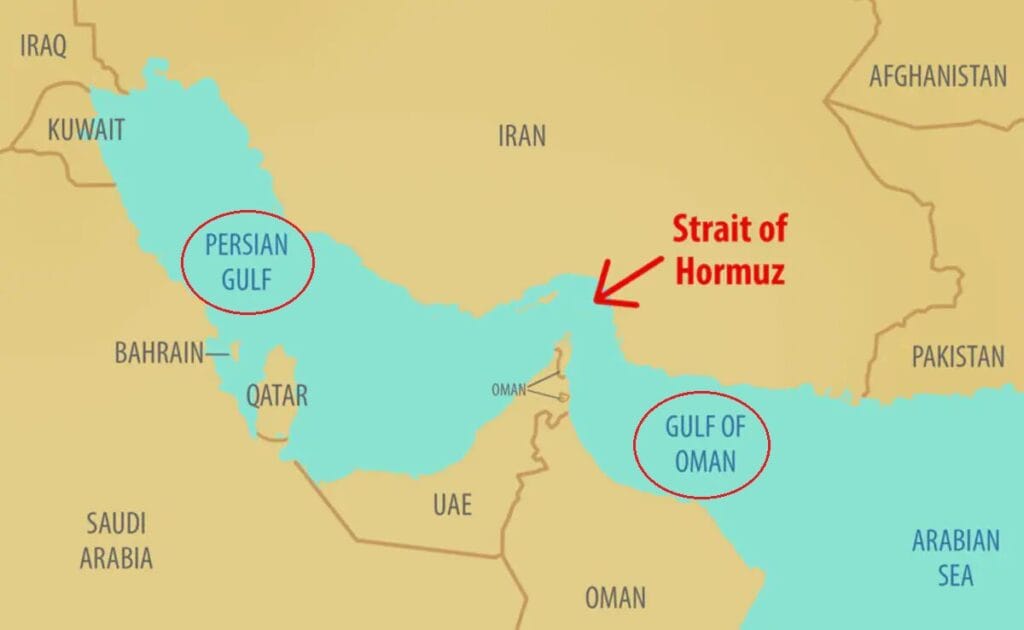
What is the Strait of Hormuz?
The Strait of Hormuz is a narrow sea passage between the Persian Gulf and the Gulf of Oman/Arabian Sea.
- It is about 33 km wide at its narrowest, but extremely significant — nearly 20% of the world’s crude oil and major volumes of LNG pass through it daily.
- It’s a maritime chokepoint — meaning a narrow route where global energy flow can be seriously affected by disruptions.
- Multiple Gulf producers (Saudi Arabia, UAE, Kuwait, Qatar, Iraq) depend on it to export energy.
- Indian imports are part of this traffic.
India’s energy profile
India is a major net energy importer:
- ~90% of crude oil and a significant share of LNG are imported.
- India’s oil consumption is about 5.5 million barrels per day and it relies heavily on Middle Eastern supplies.
Key dependencies via Hormuz
- Crude oil: ~35-50% of India’s crude imports flow through the Strait.
- LPG: Around 80-85% of imported LPG (cooking gas) passes via Hormuz.
- LNG: Over half of LNG imports route through the strait.
Note: LPG vulnerability is often higher than crude because India has limited strategic LPG reserves.
Immediate impacts of the disruption
Even if physical supplies haven’t stopped yet, the market reaction and economic effects are real:
A. Price effects
- Crude oil prices have jumped (with Brent crude touching multi-month highs).
- A spike in oil prices increases India’s import bill sharply – roughly ₹13,000 crore increase in import bill for every $1 rise in crude.
- LPG and LNG prices are sensitive due to high Gulf dependence.
B. Supply chain stress
- Insurance costs and freight rates increase because tankers avoid high-risk zones.
- Some shipping lines have delayed or rerouted cargoes, causing logistics delays.
C. Financial markets & macro
- Indian stock markets fell due to risk appetite deterioration.
- Rupee weakens under higher import costs and inflation pressure.
Can India face actual supply shortages?
Short-term:
- Government says even if flows are disrupted, India has crude stocks sufficient for ~10 days and fuel stocks for ~5-7 days.
- Strategic reserves can cushion for a short period.
Medium-term:
- India could recalibrate sourcing — increasing imports from Russia, Africa, Americas to reduce reliance on Hormuz.
But shipments of LPG remain more vulnerable because of limited stockpiles and high Gulf dependence.
Strategic and policy implications for India
A. Energy security strategy
- Diversification of suppliers: India has been shifting some purchases to Russia, the US, West Africa, and Latin America to reduce Gulf dependence.
- Strategic Petroleum Reserves (SPR): Maintain buffer stocks to guard against short-term supply shocks.
B. Infrastructure and alternative routes
- India may use pipelines bypassing Hormuz (like Saudi Eastern pipelines to Red Sea, UAE’s pipeline to Fujairah) to import oil without transiting the strait.
These alternative routes, while useful, may have limited capacity.
C. Foreign policy and strategic autonomy
- India aims to balance relations with Middle Eastern suppliers, the US, and major powers while protecting its energy interests.
- Maintaining neutral diplomatic posture reduces direct exposure in regional conflicts.
D. Economic impact
- Imported inflation can feed into fuel and transport costs, affecting inflation, current account deficit, and fiscal balances.
Long-term lessons for India
1. Importance of chokepoints
Strait of Hormuz illustrates how geopolitical conflicts can threaten global trade and energy security through maritime chokepoints.
2. Energy security = national security
For a net importer like India, stability of energy supply corridors is critical; disruption affects economic growth, inflation, and diplomacy.
3. Inter-linkage with global geopolitics
Energy security cannot be viewed in isolation — conflicts in West Asia have direct macro, social, and energy implications for India.
Conclusion
The Strait of Hormuz is a vital global energy artery, critical to India because a significant portion of its crude, LPG, and LNG imports pass through it. Recent Middle East conflicts threatening or disrupting traffic have raised energy security concerns — reflected in rising oil prices, higher freight/insurance costs, financial market stress, and inflation potential. India’s response involves strategic reserves, supply diversification, alternative import routes, and careful foreign policy navigation to ensure stability.
Practice Questions:
The Strait of Hormuz connects:
(a) Red Sea and Arabian Sea
(b) Persian Gulf and Gulf of Oman
(c) Mediterranean Sea and Red Sea
(d) Black Sea and Mediterranean Sea
Answer: (b)
Practice Mains Question:
Evaluate the implications of disruption in the Strait of Hormuz for India’s energy security.
Centre’s revenue focus has shifted from selling PSUs to earning more from them, data shows
Why in news
The launch of National Monetisation Pipeline (NMP) 2.0 and declining emphasis on strategic disinvestment in recent budgets indicate a shift in India’s public sector reform strategy from privatisation to asset monetisation and dividend-based revenue generation.
UPSC Relevance:
GS-III: Public Sector & Fiscal Policy Infrastructure
Background:
In 2020–21, the Government of India announced a strong push toward privatisation and strategic disinvestment of Public Sector Enterprises (PSEs). The government clearly stated that it would exit non-strategic sectors and reduce its role in business activities.
However, in recent years, the government’s approach has changed. Instead of selling public sector companies outright, the focus has shifted toward:
- Leasing public assets to private players (asset monetisation)
- Increasing dividend income from public sector companies
The launch of the National Monetisation Pipeline (NMP) 2.0 confirms this policy shift.
This indicates that India’s public sector reform strategy is evolving from “ownership transfer” to “value extraction without ownership transfer.”
What is Disinvestment?
Disinvestment means the government sells a part of its ownership in a public sector enterprise.
For example, if the government owns 100% of a company and sells 20% to private investors, it is called disinvestment.
Disinvestment can be of two types:
- Minority disinvestment – Government sells some shares but keeps management control.
- Strategic disinvestment – Government sells majority stake and transfers management control to private players.
Strategic disinvestment is equivalent to privatisation.
Evolution of Disinvestment Policy in India
Phase 1: Early Reforms after 1991
- After economic liberalisation in 1991, India faced a severe fiscal crisis. The government started selling small portions of shares in public sector companies to raise revenue.
- During this period:
• The government did not transfer management control.
• The main objective was to raise funds to reduce fiscal deficit.
• Public sector companies continued to remain under government control. - Thus, this phase was cautious and revenue-oriented.
Phase 2: Strategic Disinvestment (1999–2004)
- During this period, the government became more aggressive and started selling majority stakes in certain public sector enterprises.
- In some companies, management control was transferred to private players.
- The objective shifted from merely raising revenue to improving efficiency by bringing in private management.
- However, this approach faced political resistance and was later slowed down.
Phase 3: Slowdown Period (2004–2014)
- During this period, there was limited enthusiasm for privatisation.
- The government mainly focused on minority stake sales rather than strategic disinvestment.
- Public sector enterprises were viewed as instruments of social and developmental policy, not merely commercial entities.
Phase 4: Renewed Privatisation Push (2020–21)
- In 2020, the government announced a clear policy direction:
- “Government has no business to be in business.”
- Under the Public Sector Enterprises Policy (2021), the government declared that:
- It will exit non-strategic sectors.
- In strategic sectors, only a minimum number of public sector enterprises will remain.
- Strategic disinvestment will be encouraged where private sector capacity exists.
- This appeared to be a strong move toward privatisation.
Why Did Privatisation Slow Down?
Despite strong announcements, actual disinvestment revenues started declining.
Disinvestment proceeds were:
• ₹35,294 crore in 2022–23
• ₹16,507 crore in 2023–24
• ₹10,163 crore in 2024–25
• ₹15,562 crore (so far) in 2025–26
There are several reasons for this slowdown.
- First, many public sector enterprises have large employee numbers and legacy liabilities. Private investors are hesitant to take over such companies.
- Second, some enterprises are loss-making and structurally inefficient, making them unattractive.
- Third, privatisation often faces political opposition and labour resistance.
- Fourth, market conditions and global economic slowdown reduced investor appetite.
Because of these constraints, large-scale strategic disinvestment became difficult.
Increasing Focus on Dividend Income
As privatisation slowed, the government began focusing on extracting higher dividends from public sector companies.
The Department of Investment and Public Asset Management (DIPAM) issued guidelines asking CPSEs to:
• Pay higher dividends.
• Use excess cash reserves efficiently.
• Balance capital expenditure with profitability.
As a result, dividend income increased significantly.
Dividend receipts rose from ₹39,750 crore in 2020–21 to ₹74,128 crore in 2024–25.
In fact, dividend income is now much higher than disinvestment proceeds.
This indicates that the government prefers steady annual income rather than one-time asset sales.
Asset Monetisation: The New Strategy of the Govt
Instead of selling companies, the government now focuses on leasing public infrastructure assets.
This approach is called asset monetisation.
In 2021, the government launched the National Monetisation Pipeline (NMP).
The key principle of NMP is:
Ownership of assets remains with the government, but private players are allowed to operate them for a fixed period in return for payment.
Examples of assets under monetisation:
• Highways
• Railway freight corridors
• Airports
• Power transmission lines
• Telecom towers
The first phase (2021–25) had a target of ₹6 lakh crore, and around 90% of the target was achieved.
Now, NMP 2.0 (2025–30) has been launched with a target of ₹16.72 lakh crore, which shows massive expansion.
Why Is the Government Preferring Monetisation?
There are several reasons.
- First, monetisation generates revenue without selling ownership. This reduces political opposition.
- Second, it improves utilisation of underused or idle public assets.
- Third, it attracts private sector efficiency while keeping public ownership intact.
- Fourth, it provides relatively predictable fiscal revenue.
Thus, monetisation is politically easier than privatisation.
What Are the Risks?
Although monetisation and dividend extraction provide revenue, they have limitations.
- Excessive dividend extraction may reduce the reinvestment capacity of public sector companies. If companies distribute too much profit, they may not have enough funds for modernization and expansion.
- Asset monetisation does not solve structural inefficiencies in management. Leasing an asset does not reform corporate governance.
- There is also policy inconsistency. A shift from aggressive privatisation to monetisation may create uncertainty among investors about long-term reform direction.
- Finally, monetisation revenues depend on economic conditions and private sector interest. They are not guaranteed.
What is the Bigger Economic Interpretation?
This shift shows that India is not fully adopting a neoliberal privatisation model.
Instead, India is following a hybrid model where:
• The government retains ownership.
• The private sector participates in operations.
• The state continues to play a strategic role.
This reflects pragmatic state capitalism rather than complete withdrawal of the state from business.
Way Forward: Reforming Public Sector Strategy in a Balanced Manner
The shift toward asset monetisation and dividend extraction cannot be the final reform model. A calibrated and sustainable approach is required.
1️. Adopt a Balanced Reform Strategy
India should not abandon privatisation completely. Instead:
- Strategic disinvestment should continue in loss-making and non-strategic sectors.
- Monetisation should be used for brownfield infrastructure assets.
- Strategic sectors (defence, energy security, critical infrastructure) may retain calibrated government presence.
A mix is better than an ideological extreme.
2️. Ensure Sustainable Dividend Policy
While higher dividends provide fiscal comfort, excessive extraction can:
- Reduce internal capital formation
- Weaken long-term competitiveness of CPSEs
- Force companies to borrow for expansion
Therefore:
Dividend policy must balance fiscal needs with reinvestment capacity.
3️. Strengthen Corporate Governance of CPSEs
Monetisation alone does not solve structural inefficiencies.
Reforms needed:
- Professional boards
- Reduced political interference
- Performance-linked incentives
- Greater managerial autonomy
Without governance reform, financial engineering will not improve productivity.
4️. Improve Transparency in Asset Monetisation
For NMP 2.0 to succeed:
- Transparent bidding processes
- Strong regulatory oversight
- Clear concession agreements
- Risk-sharing mechanisms
This ensures credibility and sustained investor participation.
5️. Provide Policy Stability
- Frequent shifts from privatisation → monetisation → dividend focus may create investor uncertainty.
- Government should articulate a long-term, predictable public sector roadmap.
- Policy credibility is as important as policy design.
Conclusion
India’s evolving public sector reform strategy reflects pragmatic adaptation to fiscal realities, political constraints, and market conditions. While asset monetisation and dividend extraction provide steady revenue without triggering political resistance, they cannot substitute for deeper structural reforms. Sustainable public sector transformation requires a calibrated blend of selective privatisation, efficient asset monetisation, and robust corporate governance reforms. Ultimately, the objective should not merely be revenue maximisation, but the creation of productive, competitive, and strategically aligned public enterprises that contribute to long-term economic growth.
Practice Questions:
With reference to Disinvestment in India, consider the following statements:
- Strategic disinvestment involves transfer of management control to private players.
- Minority disinvestment always results in loss of government ownership.
- Disinvestment receipts are classified as capital receipts in the Union Budget.
Which of the statements given above is/are correct?
(a) 1 and 3 only
(b) 1 only
(c) 2 and 3 only
(d) 1, 2 and 3
Answer: (a) 1 and 3 only
With reference to Asset Monetisation, consider the following statements:
- It involves permanent transfer of ownership of public assets.
- It is primarily applicable to brownfield infrastructure assets.
- It generates recurring revenue for the government.
Which of the statements given above is/are correct?
(a) 2 and 3 only
(b) 1 and 2 only
(c) 1 and 3 only
(d) 1, 2 and 3
Answer: (a) 2 and 3 only
Mains question:
Critically analyse the evolution of India’s disinvestment policy and examine whether the current shift towards asset monetisation represents a structural reform or fiscal adjustment.
India Says Energy Supplies Remain Robust Amid West Asia Tensions
Why in News?
On 3 March 2026, Ministry of Petroleum and Natural Gas put India Says Energy Supplies Remain Robust Amid West Asia Tensions in the spotlight through an official communication. The development is relevant because it speaks directly to themes that UPSC regularly tests in both factual and analytical form.
The official source, titled India Fully Prepared Amid Evolving Situation in the Middle East – Energy Supplies Robust, helps place the issue in a wider policy context. For aspirants, the topic is useful not only for remembering the headline event but also for connecting it to governance, economy, diplomacy, infrastructure, environment, or social policy as required.

UPSC Relevance
- Prelims: indices, institutions, agreements, sectors, and key data points
- Mains: GS III on growth, trade, inflation, energy, and economic policy
What Happened?
Following the outbreak of hostilities in the Middle East and the evolving global energy situation, Shri Hardeep Singh Puri, Minister of Petroleum & Natural Gas, briefed the media on the country’s preparedness in the current circumstances. It was informed that India is the third largest importer, fourth largest refiner, and fifth largest exporter of petroleum products globally.
The country is well stocked with crude oil and inventories of key petroleum products including petrol, diesel and ATF to deal with short-term disruptions arising from the Middle East. It was further apprised that in the last few years, India has ensured both availability and affordability of energy for its population by diversifying its sources.
Prelims Focus
- Event date: 3 March 2026
- Primary source: Ministry of Petroleum and Natural Gas
- Ministry of Petroleum and Natural Gas
- India Fully Prepared Amid Evolving Situation in the Middle East – Energy Supplies Robust
- Energy security under geopolitical stress
- Supply continuity and price stability
Mains Focus
- The development shows how policy, regulation, and macro data shape growth prospects and state capacity.
- It can be used in GS III answers on economic management, infrastructure finance, or sectoral reforms.
- The issue also helps connect headline announcements with implementation challenges on the ground.
- A balanced answer should mention both opportunity creation and the need for institutional follow-through.
Why it Matters
For UPSC, the larger value lies in understanding how the announcement affects growth, investment, markets, production systems, or the broader policy environment rather than treating it as a stand-alone news event. In exam terms, this topic can strengthen both short factual notes and longer answer-writing examples.
Exam Takeaways
- The event belongs to 3 March 2026 and should be linked to that day's current-affairs revision.
- The official source was Ministry of Petroleum and Natural Gas.
- Energy security under geopolitical stress
- Supply continuity and price stability
- GS III economy and energy linkages
Bottom Line
India Says Energy Supplies Remain Robust Amid West Asia Tensions is relevant because it combines immediate current-affairs value with wider exam utility. For UPSC, the larger value lies in understanding how the announcement affects growth, investment, markets, production systems, or the broader policy environment rather than treating it as a stand-alone news event.
Exam Oriented Questions
Why is this topic in the news?
It is in the news because an official development linked to india says energy supplies remain robust amid west asia tensions was recorded on 3 March 2026.
Which official source is associated with this development?
The primary official source is Ministry of Petroleum and Natural Gas, and aspirants should revise the linked release or official document.
What is the core issue involved in this topic?
The core issue involves energy security under geopolitical stress and its policy significance.
How is this topic relevant for UPSC Prelims?
It is useful for Prelims because it involves factual details such as institutions, initiatives, locations, or technical terms that can be directly asked.
How is this topic relevant for UPSC Mains?
It is useful for Mains because it can be linked to broader themes such as governance, economy, foreign policy, infrastructure, environment, or social inclusion.
Which broader policy area does this topic touch?
It touches the economic policy area, especially growth, trade, inflation, energy, or sectoral competitiveness.
What should aspirants remember first from this topic?
Aspirants should first remember the event date, the official institution involved, and the headline takeaway from india says energy supplies remain robust amid west asia tensions.
How can this topic be used in answer writing?
It can be used as a recent example to support analytical points in GS answers, especially when explaining implementation, strategic relevance, or policy direction.
What factual areas should be revised from this topic?
Revise the institution involved, the exact development, and these quick points: Energy security under geopolitical stress, Supply continuity and price stability, GS III economy and energy linkages.
What is the one-line exam takeaway?
India Says Energy Supplies Remain Robust Amid West Asia Tensions shows how a current event can combine factual recall with wider analytical value for both Prelims and Mains.
Bhubaneswar Ring Road Project Moves Ahead
Why in News?
On 3 March 2026, Ministry of Road Transport and Highways put Bhubaneswar Ring Road Project Moves Ahead in the spotlight through an official communication. The development is relevant because it speaks directly to themes that UPSC regularly tests in both factual and analytical form.
The official source, titled NHAI Awards Contract for Construction of Bhubaneswar Capital Region Ring Road Project, helps place the issue in a wider policy context. For aspirants, the topic is useful not only for remembering the headline event but also for connecting it to governance, economy, diplomacy, infrastructure, environment, or social policy as required.

UPSC Relevance
- Prelims: projects, corridors, airports, waterways, logistics institutions, and regulatory bodies
- Mains: GS III on infrastructure, transport, growth, and regional development
What Happened?
NHAI has issued a Letter of Award (LOA) for the construction of the six-lane access-controlled Greenfield Capital Region Ring Road (Bhubaneswar Bypass) Project in Odisha. The project involves the development of a 111 km long Ring Road from Rameshwar to Tangi in three packages under the Hybrid Annuity Mode (HAM).
The project is expected to be completed in about 30 months from the date of commencement. Package–I of the project has been awarded to M/s Patel Infrastructure Limited for the construction of a 40 km long six-lane section with paved shoulders from Rameshwar to Bilipada in Odisha.
Prelims Focus
- Event date: 3 March 2026
- Primary source: Ministry of Road Transport and Highways
- Ministry of Road Transport and Highways
- NHAI Awards Contract for Construction of Bhubaneswar Capital Region Ring Road Project
- Urban decongestion and regional connectivity
- Road logistics and economic geography
Mains Focus
- This issue shows why infrastructure is treated as a force multiplier for growth, logistics, and regional integration.
- It is relevant for GS III answers on multimodal connectivity, PPPs, urbanisation, and productivity gains.
- The topic also underlines the importance of regulation, last-mile delivery, and coordination across levels of government.
- A good mains answer should assess both capacity creation and the challenge of inclusive access.
Why it Matters
For UPSC, the event matters because infrastructure announcements are rarely just engineering stories; they reshape mobility, economic geography, logistics, and state capacity. In exam terms, this topic can strengthen both short factual notes and longer answer-writing examples.
Exam Takeaways
- The event belongs to 3 March 2026 and should be linked to that day's current-affairs revision.
- The official source was Ministry of Road Transport and Highways.
- Urban decongestion and regional connectivity
- Road logistics and economic geography
- NHAI-led infrastructure expansion
Bottom Line
Bhubaneswar Ring Road Project Moves Ahead is relevant because it combines immediate current-affairs value with wider exam utility. For UPSC, the event matters because infrastructure announcements are rarely just engineering stories; they reshape mobility, economic geography, logistics, and state capacity.
Exam Oriented Questions
Why is this topic in the news?
It is in the news because an official development linked to bhubaneswar ring road project moves ahead was recorded on 3 March 2026.
Which official source is associated with this development?
The primary official source is Ministry of Road Transport and Highways, and aspirants should revise the linked release or official document.
What is the core issue involved in this topic?
The core issue involves urban decongestion and regional connectivity and its policy significance.
How is this topic relevant for UPSC Prelims?
It is useful for Prelims because it involves factual details such as institutions, initiatives, locations, or technical terms that can be directly asked.
How is this topic relevant for UPSC Mains?
It is useful for Mains because it can be linked to broader themes such as governance, economy, foreign policy, infrastructure, environment, or social inclusion.
Which broader policy area does this topic touch?
It touches transport, logistics, connectivity, regional development, and state capacity.
What should aspirants remember first from this topic?
Aspirants should first remember the event date, the official institution involved, and the headline takeaway from bhubaneswar ring road project moves ahead.
How can this topic be used in answer writing?
It can be used as a recent example to support analytical points in GS answers, especially when explaining implementation, strategic relevance, or policy direction.
What factual areas should be revised from this topic?
Revise the institution involved, the exact development, and these quick points: Urban decongestion and regional connectivity, Road logistics and economic geography, NHAI-led infrastructure expansion.
What is the one-line exam takeaway?
Bhubaneswar Ring Road Project Moves Ahead shows how a current event can combine factual recall with wider analytical value for both Prelims and Mains.
Source: https://anantamias.com/current-affairs/bhubaneswar-ring-road-project-moves-ahead/
Ports Ministry Steps Up Persian Gulf Maritime Monitoring
Why in News?
On 3 March 2026, Ministry of Ports, Shipping and Waterways put Ports Ministry Steps Up Persian Gulf Maritime Monitoring in the spotlight through an official communication. The development is relevant because it speaks directly to themes that UPSC regularly tests in both factual and analytical form.
The official source, titled Shipping Ministry Reviews Maritime Situation in Persian Gulf; Enhanced Monitoring to Safeguard Indian Vessels & Seafarers, helps place the issue in a wider policy context. For aspirants, the topic is useful not only for remembering the headline event but also for connecting it to governance, economy, diplomacy, infrastructure, environment, or social policy as required.

UPSC Relevance
- Prelims: projects, corridors, airports, waterways, logistics institutions, and regulatory bodies
- Mains: GS III on infrastructure, transport, growth, and regional development
What Happened?
The Ministry of Ports, Shipping and Waterways (MoPSW) is closely monitoring the evolving maritime security situation in the Persian Gulf and has strengthened precautionary measures to safeguard Indian-flagged vessels and Indian seafarers operating in the region. Union Minister for Ports, Shipping and Waterways (MoPSW), Sarbananda Sonowal chaired a review meeting today to assess the prevailing security environment in the Persian Gulf and examine its implications for Indian maritime assets and personnel.
During the meeting, the Director General of Shipping briefed the minister on the prevailing situation in the region and on current status of Indian Flag Ships and Indian seafarers in the region. Speaking after the meeting, the Union Minister Sarbananda Sonowal said, “We are closely monitoring the evolving situation and have activated all necessary precautionary, monitoring and coordination mechanisms to ensure the safety and welfare of our seafarers and the security of our maritime assets.
Prelims Focus
- Event date: 3 March 2026
- Primary source: Ministry of Ports, Shipping and Waterways
- Ministry of Ports, Shipping and Waterways
- Shipping Ministry Reviews Maritime Situation in Persian Gulf; Enhanced Monitoring to Safeguard Indian Vessels & Seafarers
- Shipping risk management
- Maritime trade routes
Mains Focus
- This issue shows why infrastructure is treated as a force multiplier for growth, logistics, and regional integration.
- It is relevant for GS III answers on multimodal connectivity, PPPs, urbanisation, and productivity gains.
- The topic also underlines the importance of regulation, last-mile delivery, and coordination across levels of government.
- A good mains answer should assess both capacity creation and the challenge of inclusive access.
Why it Matters
For UPSC, the event matters because infrastructure announcements are rarely just engineering stories; they reshape mobility, economic geography, logistics, and state capacity. In exam terms, this topic can strengthen both short factual notes and longer answer-writing examples.
Exam Takeaways
- The event belongs to 3 March 2026 and should be linked to that day's current-affairs revision.
- The official source was Ministry of Ports, Shipping and Waterways.
- Shipping risk management
- Maritime trade routes
- Geopolitics and logistics
Bottom Line
Ports Ministry Steps Up Persian Gulf Maritime Monitoring is relevant because it combines immediate current-affairs value with wider exam utility. For UPSC, the event matters because infrastructure announcements are rarely just engineering stories; they reshape mobility, economic geography, logistics, and state capacity.
Exam Oriented Questions
Why is this topic in the news?
It is in the news because an official development linked to ports ministry steps up persian gulf maritime monitoring was recorded on 3 March 2026.
Which official source is associated with this development?
The primary official source is Ministry of Ports, Shipping and Waterways, and aspirants should revise the linked release or official document.
What is the core issue involved in this topic?
The core issue involves shipping risk management and its policy significance.
How is this topic relevant for UPSC Prelims?
It is useful for Prelims because it involves factual details such as institutions, initiatives, locations, or technical terms that can be directly asked.
How is this topic relevant for UPSC Mains?
It is useful for Mains because it can be linked to broader themes such as governance, economy, foreign policy, infrastructure, environment, or social inclusion.
Which broader policy area does this topic touch?
It touches transport, logistics, connectivity, regional development, and state capacity.
What should aspirants remember first from this topic?
Aspirants should first remember the event date, the official institution involved, and the headline takeaway from ports ministry steps up persian gulf maritime monitoring.
How can this topic be used in answer writing?
It can be used as a recent example to support analytical points in GS answers, especially when explaining implementation, strategic relevance, or policy direction.
What factual areas should be revised from this topic?
Revise the institution involved, the exact development, and these quick points: Shipping risk management, Maritime trade routes, Geopolitics and logistics.
What is the one-line exam takeaway?
Ports Ministry Steps Up Persian Gulf Maritime Monitoring shows how a current event can combine factual recall with wider analytical value for both Prelims and Mains.
Source: https://anantamias.com/current-affairs/ports-ministry-steps-up-persian-gulf-maritime-monitoring/
President of Finland Begins State Visit to India
Why in News?
On 4 March 2026, Ministry of External Affairs put President of Finland Begins State Visit to India in the spotlight through an official communication. The development is relevant because it speaks directly to themes that UPSC regularly tests in both factual and analytical form.
The official source, titled State Visit of H.E. Dr. Alexander Stubb, President of the Republic of Finland to India (04- 07 March, 2026), helps place the issue in a wider policy context. For aspirants, the topic is useful not only for remembering the headline event but also for connecting it to governance, economy, diplomacy, infrastructure, environment, or social policy as required.

UPSC Relevance
- Prelims: countries, summits, joint statements, institutions, agreements, and locations in news
- Mains: GS II on bilateral relations, strategic partnerships, and foreign policy
What Happened?
As on 03 March 2026 at 1130 hrs
Wednesday, 04 March 2026 0605 hrs Arrive Delhi Venue: IGIA T-3 Photo Op: Official Only 0640 hrs Guard of Honour Venue: AFS Palam Photo Op: Official Only Thursday, 05 March 2026 0930 hrs Call by Dr. Jaishankar, External Affairs Minister Venue: Hotel Taj Palace Photo Op: Official Only 1110 hrs Wreath Laying Venue: Rajghat Photo Op: AV Media 1130 hrs Meeting with Hon’ble Prime Minister Venue: Hyderabad House Photo Op: AV Media 1255 hrs Exchange of MoUs followed by Press Statements Venue: Hyderabad House Photo Op: All Media 1530 hrs Call by Hon’ble Vice President Venue: Hotel Taj Palace Photo Op: Official Only 1615 hrs Meeting with the Hon’ble President Venue: Rashtrapati Bhavan Photo Op: Official only 1800 hrs Inaugural Session of the Raisina Dialogue Venue: Hotel Taj Palace Photo Op: Official Only Friday, 06 March 2026 1400 hrs Emplane for Mumbai Programme in Mumbai Saturday, 07 March 2026 Programme in Mumbai 1920 hrs Departure * Media to arrive one hour before event.
Entry on the basis of PIB Card. Note: Mobile phones are not allowed inside Rashtrapati Bhavan premises.
Prelims Focus
- Event date: 4 March 2026
- Primary source: Ministry of External Affairs
- Ministry of External Affairs
- State Visit of H.E. Dr. Alexander Stubb, President of the Republic of Finland to India (04- 07 March, 2026)
- High-level Nordic partnership
- Technology and sustainability agenda
Mains Focus
- The development is useful for GS II answers on bilateral ties, strategic autonomy, and India's neighbourhood or extended neighbourhood diplomacy.
- It shows how diplomacy now combines security, trade, technology, and people-to-people linkages.
- The topic also offers answer-writing value on India's effort to diversify partnerships in a volatile global environment.
- A strong mains answer should link immediate outcomes with India's longer-term foreign policy objectives.
Why it Matters
For UPSC, the bigger takeaway is that one diplomatic development often reveals the wider direction of India's external engagement, strategic priorities, and response to geopolitical change. In exam terms, this topic can strengthen both short factual notes and longer answer-writing examples.
Exam Takeaways
- The event belongs to 4 March 2026 and should be linked to that day's current-affairs revision.
- The official source was Ministry of External Affairs.
- High-level Nordic partnership
- Technology and sustainability agenda
- Useful for India-Europe ties
Bottom Line
President of Finland Begins State Visit to India is relevant because it combines immediate current-affairs value with wider exam utility. For UPSC, the bigger takeaway is that one diplomatic development often reveals the wider direction of India's external engagement, strategic priorities, and response to geopolitical change.
Exam Oriented Questions
Why is this topic in the news?
It is in the news because an official development linked to president of finland begins state visit to india was recorded on 4 March 2026.
Which official source is associated with this development?
The primary official source is Ministry of External Affairs, and aspirants should revise the linked release or official document.
What is the core issue involved in this topic?
The core issue involves high-level nordic partnership and its policy significance.
How is this topic relevant for UPSC Prelims?
It is useful for Prelims because it involves factual details such as institutions, initiatives, locations, or technical terms that can be directly asked.
How is this topic relevant for UPSC Mains?
It is useful for Mains because it can be linked to broader themes such as governance, economy, foreign policy, infrastructure, environment, or social inclusion.
Which broader policy area does this topic touch?
It touches foreign policy, strategic partnerships, and India's positioning in the international system.
What should aspirants remember first from this topic?
Aspirants should first remember the event date, the official institution involved, and the headline takeaway from president of finland begins state visit to india.
How can this topic be used in answer writing?
It can be used as a recent example to support analytical points in GS answers, especially when explaining implementation, strategic relevance, or policy direction.
What factual areas should be revised from this topic?
Revise the institution involved, the exact development, and these quick points: High-level Nordic partnership, Technology and sustainability agenda, Useful for India-Europe ties.
What is the one-line exam takeaway?
President of Finland Begins State Visit to India shows how a current event can combine factual recall with wider analytical value for both Prelims and Mains.
Source: https://anantamias.com/current-affairs/president-of-finland-begins-state-visit-to-india/
Jaishankar’s Myanmar Remarks Highlight Cultural Diplomacy
Why in News?
On 4 March 2026, Ministry of External Affairs put Jaishankar's Myanmar Remarks Highlight Cultural Diplomacy in the spotlight through an official communication. The development is relevant because it speaks directly to themes that UPSC regularly tests in both factual and analytical form.
The official source, titled Remarks by EAM Dr. S. Jaishankar on the occasion of the inauguration of the Sarsobeikman Literary Centre Building, Myanmar (March 04, 2026), helps place the issue in a wider policy context. For aspirants, the topic is useful not only for remembering the headline event but also for connecting it to governance, economy, diplomacy, infrastructure, environment, or social policy as required.

UPSC Relevance
- Prelims: countries, summits, joint statements, institutions, agreements, and locations in news
- Mains: GS II on bilateral relations, strategic partnerships, and foreign policy
What Happened?
Excellencies, Ladies and Gentlemen, Namaskar and Mingalaba! It is my honour to join the inauguration of the Sarsobeikman Literary Centre, a Government of India – assisted project, located in the heart of Yangon.
This centre, a symbol of our close bilateral ties will preserve Myanmar’s literature and foster creative writing. India and Myanmar have been bound together for centuries by spirituality, kinship and geography, as well as by language and literature.
Prelims Focus
- Event date: 4 March 2026
- Primary source: Ministry of External Affairs
- Ministry of External Affairs
- Remarks by EAM Dr. S. Jaishankar on the occasion of the inauguration of the Sarsobeikman Literary Centre Building, Myanmar (March 04, 2026)
- Cultural diplomacy in the neighbourhood
- India-Myanmar engagement
Mains Focus
- The development is useful for GS II answers on bilateral ties, strategic autonomy, and India's neighbourhood or extended neighbourhood diplomacy.
- It shows how diplomacy now combines security, trade, technology, and people-to-people linkages.
- The topic also offers answer-writing value on India's effort to diversify partnerships in a volatile global environment.
- A strong mains answer should link immediate outcomes with India's longer-term foreign policy objectives.
Why it Matters
For UPSC, the bigger takeaway is that one diplomatic development often reveals the wider direction of India's external engagement, strategic priorities, and response to geopolitical change. In exam terms, this topic can strengthen both short factual notes and longer answer-writing examples.
Exam Takeaways
- The event belongs to 4 March 2026 and should be linked to that day's current-affairs revision.
- The official source was Ministry of External Affairs.
- Cultural diplomacy in the neighbourhood
- India-Myanmar engagement
- Soft power in foreign policy
Bottom Line
Jaishankar's Myanmar Remarks Highlight Cultural Diplomacy is relevant because it combines immediate current-affairs value with wider exam utility. For UPSC, the bigger takeaway is that one diplomatic development often reveals the wider direction of India's external engagement, strategic priorities, and response to geopolitical change.
Exam Oriented Questions
Why is this topic in the news?
It is in the news because an official development linked to jaishankar's myanmar remarks highlight cultural diplomacy was recorded on 4 March 2026.
Which official source is associated with this development?
The primary official source is Ministry of External Affairs, and aspirants should revise the linked release or official document.
What is the core issue involved in this topic?
The core issue involves cultural diplomacy in the neighbourhood and its policy significance.
How is this topic relevant for UPSC Prelims?
It is useful for Prelims because it involves factual details such as institutions, initiatives, locations, or technical terms that can be directly asked.
How is this topic relevant for UPSC Mains?
It is useful for Mains because it can be linked to broader themes such as governance, economy, foreign policy, infrastructure, environment, or social inclusion.
Which broader policy area does this topic touch?
It touches foreign policy, strategic partnerships, and India's positioning in the international system.
What should aspirants remember first from this topic?
Aspirants should first remember the event date, the official institution involved, and the headline takeaway from jaishankar's myanmar remarks highlight cultural diplomacy.
How can this topic be used in answer writing?
It can be used as a recent example to support analytical points in GS answers, especially when explaining implementation, strategic relevance, or policy direction.
What factual areas should be revised from this topic?
Revise the institution involved, the exact development, and these quick points: Cultural diplomacy in the neighbourhood, India-Myanmar engagement, Soft power in foreign policy.
What is the one-line exam takeaway?
Jaishankar's Myanmar Remarks Highlight Cultural Diplomacy shows how a current event can combine factual recall with wider analytical value for both Prelims and Mains.
Source: https://anantamias.com/current-affairs/jaishankar-s-myanmar-remarks-highlight-cultural-diplomacy/
Will purging reference to judicial corruption from NCERT textbooks solve the real problem?
Why in News?
Recently, concerns have been raised regarding allegations of misconduct and lack of transparency in judicial appointments and functioning of the higher judiciary.
Also the recent controversy surrounding the Class 8 NCERT Social Science textbook, which included an explicit chapter on judicial corruption and case pendency.
- The NCERT textbook cited ~81,000 pending cases in the Supreme Court, 62.40 lakh in High Courts, and 4.70 crore in district courts. It also quoted former CJI B R Gavai (July 2025): ‘Instances of corruption and misconduct within the judiciary had a negative impact on public confidence.’
- CJI Surya Kant took suo motu cognizance, stating the textbook content was an attempt to ‘defame and scandalize the judiciary’
- NCERT issued a public apology and withdrew the book from its website before formal hearing
- Government indicated content should have covered all three organs — not singled out the judiciary.
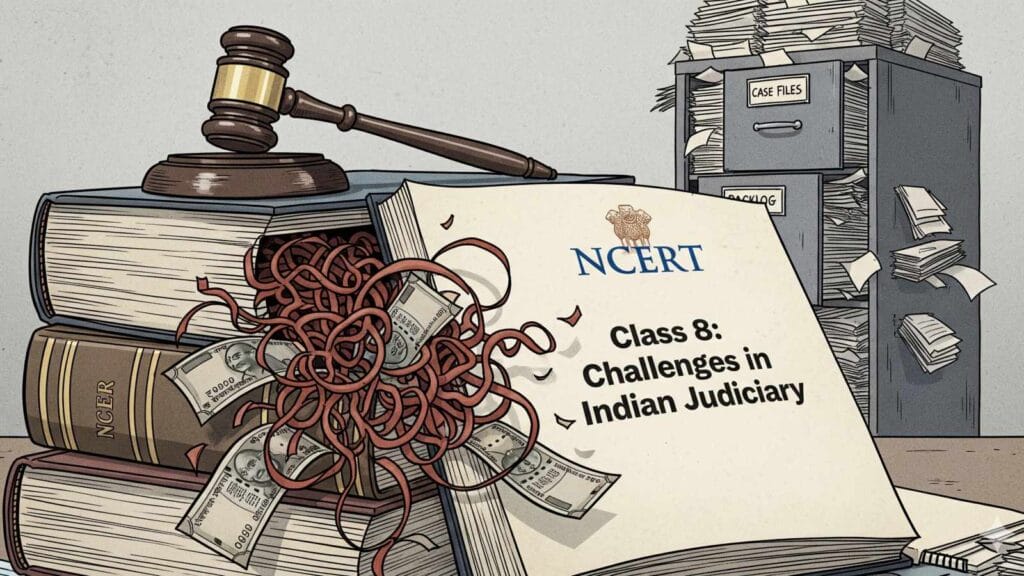
UPSC Relevance:
GS-II: Judiciary, Judicial Reforms, Governance.
The Justice Yashwant Varma Case (2025)
Earlier in 2025, the Supreme Court Collegium unanimously decided to transfer Delhi High Court Judge Justice Yashwant Varma back to the Allahabad High Court — the court from which he was elevated — following allegations that a large sum of cash was recovered from his residence after a fire.
- This was a rare instance of the Collegium acting swiftly on perceived misconduct
- No formal impeachment was initiated; the matter was handled through administrative transfer — highlighting limitations of the existing accountability framework
The Justice Swaminathan Motion (2025)
- 107 MPs signed a removal motion against Justice Swaminathan in 2025
- The Speaker refused admission, meaning charges were never formally investigated — exposing the arbitrary power of the Presiding Officer at the threshold stage
What is Judicial Corruption?
Judicial corruption refers to misuse of judicial office for private gain. It may include:
- Accepting bribes to influence judgments
- Nepotism or favoritism in appointments
- Conflict of interest in cases
- Undue post-retirement benefits influencing conduct
- Manipulation of case listing or allocation
It undermines public trust in the judiciary — the final guardian of the Constitution.
Types of Judicial Corruption
1. Adjudicatory Corruption
- Judges improperly deciding cases under influence of bribes, political pressure, or personal interest
- Bench hunting — litigants or lawyers engineering which judge hears their case
- Selective grant of stay orders or bail for extraneous considerations
2. Administrative Corruption
- Registry corruption: Court clerks and middlemen accepting bribes for case listings, adjournments
- Manipulation of records: Tampering with court orders, dates, or documentation
- Late 2025: A High Court in North India suspended several registry staff after a money-for-listing expose
3. Nepotism & Structural Bias
- Uncle Judge Syndrome: Lawyers related to judges appearing before their relatives
- Judges presiding over cases where they have direct or indirect conflict of interest
- Favouring known individuals in court appointments and administrative positions
4. Post-Retirement Sinecures
- Retired judges accepting Rajya Sabha seats, Governorships, Tribunal chairmanships shortly after retirement
- This creates an incentive to deliver favourable verdicts to the government before retirement
- Violates the spirit of judicial independence even if not technically corrupt
5. Contempt as a Shield
- The threat of contempt of court discourages honest criticism, whistleblowing, or accountability reporting
- The NCERT textbook controversy itself illustrates how educational content on judicial challenges can be treated as ‘scandalizing the court’
Why is Judicial Integrity Crucial in India?
India follows the principle of separation of powers under the Constitution. The judiciary acts as:
- Guardian of Fundamental Rights
- Interpreter of the Constitution
- Arbiter between Centre and States
- Check on Executive and Legislature
Judgments such as Kesavananda Bharati v. State of Kerala established the Basic Structure Doctrine, placing the judiciary at the core of constitutional protection.
If judicial integrity weakens, the entire constitutional structure is threatened.
Causes of Judicial Corruption
| Category | Specific Cause |
| Structural | Absence of transparent complaint and investigation mechanism |
| Institutional | Opaque Collegium system — no external oversight of judge appointments |
| Workload-driven | 5.2 crore pending cases create pressure and incentive for ‘speed money’ |
| Legal vacuum | No enacted Judicial Accountability law; the Judicial Standards and Accountability Bill lapsed |
| Contempt shield | Fear of contempt deters public from reporting corruption |
| Post-retirement lure | Government patronage post-retirement compromises independence |
| Registry opacity | Court administration not subject to RTI in most states |
Constitutional Provisions Related to Judicial Accountability
Constitutional Provisions
- Article 124(4): Removal of SC judges only through impeachment by Parliament — requires special majority and Presidential order
- Article 217(1)(b): Removal of HC judges by Presidential order on address by Parliament — same procedure
- Article 121: Judges’ conduct cannot be discussed in Parliament except on a substantive motion for removal
- Article 129 & 215: SC and HCs are courts of record — powers of contempt
- The Judges (Inquiry) Act, 1968 governs the impeachment investigation process
What are the flaws in the Impeachment Process
| Stage | Issue |
| Signing: 100 MPs (LS) / 50 MPs (RS) | High threshold keeps most complaints from even initiating |
| Admission by Speaker/Chairman | Presiding officer has absolute discretion — no reasons required for rejection (Justice Swaminathan case, 2025) |
| 3-member inquiry committee | Composition: SC judge, HC CJ, eminent jurist — no independent external body |
| Special majority vote | Political considerations often override judicial misconduct evidence |
| Presidential order | Final stage subject to political dynamics |
Major Issues in Judicial Accountability
1. Opaque Appointment Process
The Collegium System, evolved through the Supreme Court Advocates-on-Record Association v. Union of India, gives primacy to judiciary in appointments.
While it protects independence, criticisms include:
- Lack of transparency
- No recorded reasons for selection/rejection
- Allegations of “judicial nepotism”
The attempt to replace it through the National Judicial Appointments Commission Act was struck down in Supreme Court Advocates-on-Record Association v. Union of India, citing violation of Basic Structure.
This revived debate: How to balance independence with accountability?
2. Weak Internal Disciplinary Mechanisms
The “in-house procedure” for dealing with judicial misconduct lacks:
- Statutory backing
- Transparency
- Public reporting
Outcomes are rarely disclosed.
3. Difficulty of Impeachment
Impeachment is highly political and requires:
- Special majority in both Houses of Parliament
Historically, impeachment attempts (e.g., Justice V. Ramaswami case) have failed due to political considerations.
Thus, accountability becomes practically impossible unless there is overwhelming consensus.
4. Post-Retirement Appointments
Frequent appointments of retired judges to:
- Tribunals
- Commissions
- Governorships
Raise concerns about possible “future rewards” influencing present decisions.
Impact of Judicial Corruption
Judicial corruption affects:
- Rule of Law – Equality before law becomes compromised.
- Economic Growth – Investors lose confidence in contract enforcement.
- Democratic Legitimacy – Judiciary is last resort for citizens.
- Human Rights – Vulnerable groups suffer when justice is biased.
For a country like India, where pendency already exceeds crores of cases, trust deficit can be disastrous.
Comparative Perspective
Countries like:
- United Kingdom – Judicial Appointments Commission (independent body)
- United States – Senate confirmation process
Though not perfect, they institutionalize transparency to a greater extent.
India’s challenge is designing a model that protects independence while ensuring accountability.
What Reforms Are Needed?
A. Institutional Reforms
- Enact Judicial Standards and Accountability Law: Create a permanent, statutory National Judicial Oversight Committee with external members
- Amend Judges (Inquiry) Act: Define ‘misbehaviour’ clearly; impose timelines on the Presiding Officer’s admission decision; make rejection of motion judicially reviewable
- Redefine Contempt: Narrow the definition of ‘scandalizing the court’ — bona fide public interest criticism should be excluded
- Independent Judicial Secretariat: A dedicated body to handle grievances, separate from the CJI’s office
B. Transparency Reforms
- Mandatory asset disclosure by all judges — publicly accessible
- Live-streaming of court proceedings (being expanded since 2021) — increases transparency and reduces scope for behind-the-scenes manipulation
- RTI applicability to court registries — currently resisted
- Publish outcomes of In-House Procedure investigations — even in anonymized form — to rebuild public trust
C. Structural Reforms
- Fast-track case resolution: Reduce the backlog that creates incentive for ‘speed money’ — fill 5,300+ judicial vacancies
- Technology deployment: AI-based case listing (removing human discretion in bench/date assignment), digital record-keeping
- Cooling-off period: Mandatory 2-year bar on post-retirement government appointments for judges
- Financial independence: Judges’ salaries should be charged to Consolidated Fund (SC judges already are) — all judges including district judiciary should have complete financial security
D. Civic Education
- Ironically, the NCERT controversy itself shows the need for civic education — citizens unaware of accountability mechanisms cannot demand them
- Judicial literacy programs explaining how to file complaints through CPGRAMS and In-House Procedure
- Balance transparency with institutional respect — content should be factual, comparative (covering all organs), and constructive
Conclusion: Balancing Judicial Independence and Accountability
Judicial independence is part of Basic Structure (Kesavananda case). However, independence does not mean absence of accountability.
The real constitutional question is:
“How to ensure accountability without compromising independence?”
Judicial corruption strikes at the heart of constitutional democracy. In a country where courts are the ultimate protector of rights, even a perception of corruption can erode public faith.
Reforms must aim at:
- Transparency
- Institutional accountability
- Ethical standards
- Protection of independence
Strengthening judicial credibility is not weakening the judiciary — it is reinforcing the foundations of the Republic.
Key terms
| Term | Meaning |
| Uncle Judge Syndrome | Lawyers related to judges appearing in their relatives’ courts — structural conflict of interest |
| Bench Hunting | Engineering which judge hears a case through registry manipulation |
| In-House Procedure (1999) | Internal complaint mechanism with no statutory backing or public disclosure |
| Judges (Inquiry) Act, 1968 | Governs impeachment process; widely considered outdated |
| NJAC (2014) | National Judicial Appointments Commission — struck down in 2015 as threat to independence |
| Restatement of Values of Judicial Life (1997) | SC’s self-adopted ethical code — not legally enforceable |
| CPGRAMS | Centralised Public Grievance Redress and Monitoring System — official complaint channel for judicial grievances |
| WJP Rule of Law Index | India ranks ~77-79/142 (2025); below median on ‘Absence of Corruption in Judiciary’ |
India-Finland Strategic Partnership in Digitalization and Sustainability
Why in News?
During the state visit of the President of Finland to India from 4 to 7 March 2026, India and Finland elevated their bilateral relationship to a Strategic Partnership in Digitalization and Sustainability. The joint statement issued on 5 March 2026 makes the development important for both GS II (International Relations) and GS III (Science and Technology / Environment / Economy).
This is not a routine diplomatic upgrade. The partnership links foreign policy with emerging technology, trusted digital systems, clean energy, and industrial collaboration.

UPSC Relevance
- GS II: India's relations with Europe, strategic partnerships, diplomacy
- GS III: 6G, semiconductors, AI, green hydrogen, circular economy, sustainability
- Prelims: Finland, Bharat 6G Alliance, digital public infrastructure, strategic partnership
What Happened?
India and Finland agreed to deepen cooperation in two broad pillars:
- Digitalization
- Sustainability
The joint statement explicitly says the relationship is being elevated to a Strategic Partnership in Digitalization and Sustainability. That phrase is the most important factual takeaway for exams.
Why Finland Matters for India
Finland may not be India's largest trade partner, but it is highly relevant in sectors that matter for the future:
- telecom and 6G research
- electronics and semiconductor-linked innovation
- AI, high-performance computing, and digital systems
- clean technology, smart grids, and sustainability solutions
In other words, Finland is a technology-intensive partner whose strengths match India's interest in becoming a trusted digital, manufacturing, and green-transition economy.
Key Digital Outcomes
The digital chapter of the joint statement is especially important.
| Area | What was highlighted? |
|---|---|
| Digital transformation | Identified as a priority area for stronger cooperation |
| Emerging technologies | 5G, 6G, AI, high-performance computing, quantum computing |
| Digital public infrastructure | India shared its experience, including UPI |
| Institutional follow-up | Decision to establish a Joint Working Group on Digitalization |
| RDI collaboration | Joint calls involving India's DST and Business Finland |
Two details stand out for UPSC:
- The statement referred to joint RDI funding initiatives involving Indian and Finnish companies and research organizations in semiconductors, 6G, and energy systems.
- It also highlighted the cooperation framework between the Bharat 6G Alliance and the University of Oulu in Finland.
That makes this topic useful in answers on how India is building international technology partnerships beyond traditional defence or trade diplomacy.
Technology and Innovation Takeaways
The statement also referenced:
- collaboration on AI
- discussions on high-performance computing
- cooperation potential in space technology
This is important because India's external partnerships are increasingly being shaped by the logic of trusted technology ecosystems. Instead of treating diplomacy and industrial policy separately, current affairs like this show how both are now interlinked.
Sustainability Pillar
The second major pillar was sustainability. India and Finland underlined cooperation in:
- low-carbon transition
- energy efficiency
- biofuels
- smart grids
- green hydrogen
- circular economy
- water management
The two sides also welcomed the establishment of a Joint Working Group on Sustainability.
From a UPSC angle, this matters because sustainability is not being discussed only as climate diplomacy. It is being framed as a field for industrial collaboration, energy transition, innovation, and resilient infrastructure.
Trade, Investment and Startups
The leaders also called attention to:
- the goal of doubling bilateral trade by 2030
- stronger business-to-business engagement
- startup linkages such as the Indo-Finland Startup Corridor
This gives the partnership an economic foundation. Strategic partnerships become meaningful only when backed by institutional, technological, and commercial mechanisms. The India-Finland case checks all three.
Why is this Important for India?
For India, the partnership is useful in several ways:
- It expands technology cooperation with a high-trust European partner.
- It supports India's ambitions in next-generation telecom and semiconductor-linked innovation.
- It connects foreign policy with green growth and industrial modernization.
- It strengthens India's engagement with Europe beyond the larger powers alone.
It also reflects a broader trend: India's external relations are increasingly focused on technology, supply chains, digital standards, and clean-energy ecosystems.
Exam Takeaways
- India and Finland elevated ties to a Strategic Partnership in Digitalization and Sustainability on 5 March 2026.
- The digital pillar covers 5G, 6G, AI, high-performance computing, quantum computing, semiconductors, and digital public infrastructure.
- The sustainability pillar covers green hydrogen, smart grids, circular economy, biofuels, and energy efficiency.
- Two institutional mechanisms were emphasized:
- Joint Working Group on Digitalization
- Joint Working Group on Sustainability
- The statement also noted the aim of doubling bilateral trade by 2030.
Bottom Line
This is a strong model of new-age diplomacy. It shows how international relations now increasingly revolve around technology partnerships, resilient value chains, clean energy, and innovation ecosystems. For UPSC answers, it can be used as a current example of how India is combining foreign policy, economic strategy, and technology policy in one partnership.
Exam Oriented Questions
What happened during the Finland President’s March 2026 visit to India?
India and Finland elevated their bilateral relationship to a Strategic Partnership in Digitalization and Sustainability during the state visit.
On which date was the India-Finland joint statement issued?
The joint statement was issued on 5 March 2026.
Why is Finland important for India’s technology diplomacy?
Finland is relevant because of its strengths in telecom research, digital systems, innovation, and sustainability-oriented technologies.
What are the main pillars of the new India-Finland strategic partnership?
The two main pillars are digitalization and sustainability.
Which technologies were specifically highlighted in the joint statement?
The statement highlighted 5G, 6G, artificial intelligence, high-performance computing, quantum computing, and semiconductors.
What is the role of the Bharat 6G Alliance in this partnership?
The statement noted cooperation involving the Bharat 6G Alliance and the University of Oulu, reflecting a concrete area of advanced telecom collaboration.
What sustainability areas were emphasized by India and Finland?
The partnership emphasized green hydrogen, smart grids, energy efficiency, biofuels, circular economy, and low-carbon transition.
What institutional follow-up mechanisms were proposed?
The two sides proposed a Joint Working Group on Digitalization and a Joint Working Group on Sustainability.
Why is this topic important for GS II and GS III?
It connects international relations with emerging technologies, industrial policy, and green transition, making it relevant to both papers.
How can this topic be used in a UPSC answer?
It can be used as a recent example of issue-based diplomacy where India links foreign policy with trusted technology ecosystems and sustainable development goals.
Source: https://anantamias.com/current-affairs/india-finland-strategic-partnership-march-2026/
Eighth Central Pay Commission Invites Representations
Why in News?
On 5 March 2026, Ministry of Finance put Eighth Central Pay Commission Invites Representations in the spotlight through an official communication. The development is relevant because it speaks directly to themes that UPSC regularly tests in both factual and analytical form.
The official source, titled 8th Central Pay Commission Invites Representations from Stakeholders, helps place the issue in a wider policy context. For aspirants, the topic is useful not only for remembering the headline event but also for connecting it to governance, economy, diplomacy, infrastructure, environment, or social policy as required.

UPSC Relevance
- Prelims: institutions, reports, schemes, and administrative mechanisms
- Mains: GS II on governance, delivery, and public policy
What Happened?
The Eighth Central Pay Commission has provided an online structured format for inviting Memorandum/Representations from Associations/Unions of serving employees/pensioners, organizations/institutions as well as from employees, pensioners and interested individuals on its website( 8cpc.gov.in ). Submissions would be received upto 30th April, 2026.
The structured format for submitting memorandum is also available at the MyGov.in portal ( innovateindia.mygov.in ). The Commission has requested stakeholders to make submissions on the above portal only.
Prelims Focus
- Event date: 5 March 2026
- Primary source: Ministry of Finance
- Ministry of Finance
- 8th Central Pay Commission Invites Representations from Stakeholders
- Administrative reform and public expenditure relevance
- Implications for government employees
Mains Focus
- The issue is relevant for GS II because it shows how governance reforms depend on institutional design, coordination, and citizen-facing delivery.
- It can be used to discuss accountability, policy implementation, and administrative responsiveness.
- The topic also has value in linking central initiatives with state-level outcomes and local institutions.
- A balanced answer should mention capacity constraints along with reform gains.
Why it Matters
For UPSC, the event matters because governance topics are best understood through the institutions involved, the target group, and the quality of implementation. In exam terms, this topic can strengthen both short factual notes and longer answer-writing examples.
Exam Takeaways
- The event belongs to 5 March 2026 and should be linked to that day's current-affairs revision.
- The official source was Ministry of Finance.
- Administrative reform and public expenditure relevance
- Implications for government employees
- Commission-based policy processes
Bottom Line
Eighth Central Pay Commission Invites Representations is relevant because it combines immediate current-affairs value with wider exam utility. For UPSC, the event matters because governance topics are best understood through the institutions involved, the target group, and the quality of implementation.
Exam Oriented Questions
Why is this topic in the news?
It is in the news because an official development linked to eighth central pay commission invites representations was recorded on 5 March 2026.
Which official source is associated with this development?
The primary official source is Ministry of Finance, and aspirants should revise the linked release or official document.
What is the core issue involved in this topic?
The core issue involves administrative reform and public expenditure relevance and its policy significance.
How is this topic relevant for UPSC Prelims?
It is useful for Prelims because it involves factual details such as institutions, initiatives, locations, or technical terms that can be directly asked.
How is this topic relevant for UPSC Mains?
It is useful for Mains because it can be linked to broader themes such as governance, economy, foreign policy, infrastructure, environment, or social inclusion.
Which broader policy area does this topic touch?
It touches public policy, implementation systems, institutions, and administrative reform.
What should aspirants remember first from this topic?
Aspirants should first remember the event date, the official institution involved, and the headline takeaway from eighth central pay commission invites representations.
How can this topic be used in answer writing?
It can be used as a recent example to support analytical points in GS answers, especially when explaining implementation, strategic relevance, or policy direction.
What factual areas should be revised from this topic?
Revise the institution involved, the exact development, and these quick points: Administrative reform and public expenditure relevance, Implications for government employees, Commission-based policy processes.
What is the one-line exam takeaway?
Eighth Central Pay Commission Invites Representations shows how a current event can combine factual recall with wider analytical value for both Prelims and Mains.
Source: https://anantamias.com/current-affairs/eighth-central-pay-commission-invites-representations/
Supreme Court to look into feasibility of NAT for blood transfusion
Why in News:
The Supreme Court took up a PIL seeking mandatory NAT screening for all blood donations in India, after multiple children contracted HIV through transfusions, raising serious blood safety concerns nationwide. The PIL argues that the Right to Safe Blood is a fundamental right under Article 21 of the Constitution.
UPSC Relevance:
GS-I: Social Justice – Helath Issues, GS-II: Fundamental Rights, Polity, Judiciary, GS-III: Science and Technology
Introduction
Blood transfusion is an essential medical intervention used in surgeries, trauma care, maternal health emergencies, cancer treatment and management of chronic diseases such as thalassemia. However, transfusion of infected blood can transmit serious infections like Human Immunodeficiency Virus, Hepatitis B, and Hepatitis C. These are known as Transfusion Transmitted Infections (TTIs) and represent a major public health concern.
To enhance the safety of blood transfusion and reduce the risk of TTIs, advanced screening technologies have been developed. One of the most important among them is Nucleic Acid Testing (NAT), a molecular diagnostic technique that detects viral genetic material in donated blood.
What is Nucleic Acid Testing (NAT)?
Nucleic Acid Testing is a modern laboratory technique used to detect the genetic material (DNA or RNA) of viruses in donated blood. Unlike conventional blood screening methods that detect antibodies or antigens produced by the body in response to infection, NAT directly identifies the nucleic acids of pathogens present in the blood sample.
Because viral genetic material appears in the bloodstream soon after infection, NAT enables much earlier detection of infections, thereby preventing infected blood from entering the transfusion system.
This technology represents a major advancement in blood screening and has significantly improved transfusion safety in many countries.
How NAT Works
The NAT process involves several molecular diagnostic steps.
First, a blood sample is collected from the donor and prepared in a laboratory setting. The next step involves extracting viral genetic material (DNA or RNA) from the sample. Once the genetic material is isolated, it is amplified using molecular techniques so that even very small quantities of viral nucleic acid can be detected.
One of the most widely used techniques for amplification is Polymerase Chain Reaction, which multiplies the viral genetic material to detectable levels.
If the amplification process detects viral nucleic acids associated with infections such as HIV, Hepatitis B or Hepatitis C, the blood unit is rejected and not used for transfusion.
Through this method, NAT is able to identify infections even when the virus is present in extremely small quantities.
Reduction of the “Window Period”
A major advantage of NAT is its ability to reduce the window period, which refers to the time between a person becoming infected and the infection becoming detectable through laboratory tests.
Traditional serological tests such as ELISA detect antibodies or antigens produced by the immune system. However, the immune system requires time to produce detectable levels of antibodies. During this early phase, infected blood may appear negative in conventional screening tests, even though the virus is present and capable of transmission.
NAT detects the virus itself rather than the immune response, thereby significantly shortening the window period.
For example, in HIV infections, traditional antibody tests may detect infection after about three weeks, whereas NAT can detect it in roughly ten to twelve days. Similarly, for Hepatitis B and Hepatitis C, NAT reduces the detection time considerably compared to conventional screening methods.
| Infection | Detection by ELISA | Detection by NAT |
| HIV | ~22 days | ~10–12 days |
| Hepatitis B | ~59 days | ~20–25 days |
| Hepatitis C | ~70 days | ~7–10 days |
By shortening this window period, NAT substantially lowers the risk of transfusion-transmitted infections.
NAT vs ELISA:
| Feature | ELISA (Old Method) | NAT (New Method) |
| What it detects | Antibodies/Antigens (body’s reaction) | Virus’s own DNA/RNA |
| Window Period | 55–60 days | 7–10 days |
| Sensitivity | Moderate | Extremely High |
| Cost | Low | Higher |
| Availability in India | Widespread | Sporadic/Limited |
Currently, many blood banks in India primarily use Enzyme-Linked Immunosorbent Assay (ELISA) tests, which are less expensive but comparatively less sensitive during early infection stages.
Advantages of NAT in Blood Transfusion Safety
NAT has several advantages that make it an important tool in ensuring the safety of blood transfusion systems.
- It enables earlier detection of viral infections, which prevents contaminated blood from being used in transfusions. This significantly reduces the risk of transmission of HIV, Hepatitis B and Hepatitis C through blood transfusion.
- NAT is highly sensitive and specific. It can detect very small amounts of viral genetic material, making it more reliable than traditional antibody-based screening methods.
- The technique improves overall quality and safety standards in blood banks, strengthening the healthcare system and increasing public confidence in blood transfusion services.
- NAT can potentially help in detecting emerging infectious diseases at an earlier stage because it identifies the genetic material of pathogens rather than relying on immune responses.
Importance of NAT for Public Health in India
Ensuring a safe blood supply is a major public health priority in India. The country requires millions of units of blood every year for surgeries, road accident victims, maternal healthcare, cancer treatment and management of blood disorders.
India also faces a significant burden of blood-borne infections such as Human Immunodeficiency Virus, Hepatitis B, and Hepatitis C. Even a single infected blood unit can transmit disease to the recipient, making effective screening essential.
The adoption of NAT has several important public health implications.
- It helps in preventing transfusion-transmitted infections, thereby reducing the spread of life-threatening diseases through medical procedures.
- It protects vulnerable groups such as thalassemia patients, cancer patients, and individuals who require frequent blood transfusions.
- Improved screening technologies strengthen the credibility and reliability of the healthcare system, increasing public trust in blood donation and transfusion services.
- NAT contributes to the broader goal of controlling blood-borne infections at the national level.
India’s blood transfusion services are regulated and guided by institutions such as the National AIDS Control Organisation and the National Blood Transfusion Council, which work to improve blood safety and screening standards across the country.
Importance of NAT in Public Health
1. Prevention of Transfusion-Transmitted Infections (TTIs)
NAT can detect viruses earlier than conventional tests, reducing the risk of infected blood entering the transfusion system.
2. Protection of Vulnerable Patients
Patients requiring frequent transfusions such as thalassemia patients, cancer patients, and surgical patients are especially vulnerable to infections.
3. Strengthening Blood Safety Systems
Advanced screening technologies increase trust in the healthcare system and improve overall blood safety.
4. Early Detection of Emerging Infections
Molecular techniques like NAT can potentially detect emerging pathogens faster than antibody-based tests.
Current Status of NAT in India
In India, most blood banks continue to rely primarily on serological screening methods, particularly ELISA tests, for detecting HIV, Hepatitis B and Hepatitis C.
Although NAT has been introduced in several large hospitals and advanced blood banks, it has not yet been implemented universally across the country. As a result, the level of blood screening varies between different regions and institutions.
The adoption of NAT is gradually increasing, especially in major urban healthcare facilities, but its nationwide implementation remains limited.
Challenges in the Adoption of NAT
1. High Cost
NAT testing is significantly more expensive than conventional tests such as ELISA. This increases the cost of blood screening for hospitals and blood banks.
2. Infrastructure Requirements
The test requires advanced molecular laboratories with specialized equipment.
3. Skilled Personnel
Highly trained technicians are required to perform molecular diagnostics.
4. Uneven Distribution of Facilities
Large urban hospitals may have NAT facilities, but many rural blood banks lack access.
5. Lack of Mandatory Policy
NAT is not uniformly mandatory across all blood banks in India.
Government Initiatives
India has made efforts to strengthen blood safety through programs led by the National AIDS Control Organisation and the National Blood Transfusion Council.
Some states and large hospitals have started adopting NAT to enhance blood safety standards.
Policy Measures and Way Forward
To improve blood safety and expand the use of NAT, several policy measures can be adopted.
1. Gradual Nationwide Implementation
The government could introduce NAT in a phased manner, starting with high-volume blood banks.
2. Public Funding Support
Subsidies or financial assistance can help smaller blood banks adopt NAT technology.
3. Regional NAT Testing Centres
Instead of installing NAT machines in every blood bank, regional centers can test samples from multiple facilities.
4. Capacity Building
Training programs should be introduced for laboratory technicians.
5. Strengthening Regulation
Making NAT mandatory in stages can standardize blood screening practices across the country.
Conclusion
Nucleic Acid Testing represents a significant advancement in ensuring the safety of blood transfusion systems. By detecting the genetic material of viruses at a very early stage of infection, NAT reduces the window period and minimizes the risk of transfusion-transmitted infections.
For a country like India with high demand for blood transfusions and a significant burden of blood-borne diseases, wider adoption of NAT can play a crucial role in improving public health outcomes. With appropriate policy support, investment in infrastructure, and development of skilled personnel, NAT can become an integral component of India’s blood safety framework and contribute to a safer and more reliable healthcare system.
Aerodrome License Granted to Noida International Airport
Why in News?
On 6 March 2026, the Directorate General of Civil Aviation (DGCA) granted the aerodrome licence for Noida International Airport (NIA) at Jewar in Gautam Budh Nagar, Uttar Pradesh. This is a major milestone because it moves the project closer to operational readiness and highlights India's larger push to expand aviation infrastructure.
For UPSC, this topic is relevant not only as a current event but also as an example of infrastructure growth, PPP-based development, logistics planning, and regional economic integration.

UPSC Relevance
- GS III: Infrastructure, transport, logistics, aviation sector, PPP model
- Prelims: DGCA, aerodrome licence, greenfield airport, UDAN, Jewar
- Essay / Interview: Regional connectivity, airport-led development, multimodal logistics
What Happened?
The official PIB release said the DGCA granted the aerodrome licence to Yamuna International Airport Private Limited (YIAPL) for Noida International Airport.
YIAPL is a wholly owned subsidiary of Zurich Airport International AG and is developing the airport under a Public-Private Partnership (PPP) model with the Government of Uttar Pradesh and the Government of India.
The concession period began on 1 October 2021 and runs for 40 years.
Key Technical Features
| Feature | Detail |
|---|---|
| Airport location | Jewar, Gautam Budh Nagar, Uttar Pradesh |
| Licence authority | DGCA |
| Project developer | YIAPL |
| Model | PPP |
| Concession period | 40 years from 1 October 2021 |
| Runway | 3900 m x 45 m |
| Operation type | Public use, all-weather |
| Navigation support | ILS and AGL systems |
| Fire category | ARFF Category 9 |
The airport has parking stands for 24 Code C and 2 Code D/F aircraft, and the release noted that the facility can handle wide-body aircraft such as the Boeing 777-300ER.
Why is an Aerodrome Licence Important?
An aerodrome licence is not the same as the inauguration of an airport. It is a regulatory approval that confirms the aerodrome meets prescribed standards for safe public-use operations.
In exam language, this means:
- the airport has crossed a major safety and compliance milestone
- it is closer to full operations
- the event reflects the role of the DGCA as aviation regulator
Phased Development Plan
The PIB release also gives important capacity numbers:
- In Phase 1, with one runway and one terminal, the airport will handle around 12 million passengers annually.
- After all four phases are completed, the airport is expected to handle up to 70 million passengers per year.
- The project also includes a multi-modal cargo hub.
These figures make the airport significant not just as a regional terminal but as a long-term logistics and connectivity project for the National Capital Region (NCR) and western Uttar Pradesh.
Why is Noida International Airport Important?
The importance of the project can be understood at three levels.
1. Regional Connectivity
Jewar airport is expected to improve access for western Uttar Pradesh, parts of Rajasthan, Haryana, and the NCR. That can reduce pressure on existing airport infrastructure and improve passenger convenience.
2. Economic Development
Large airport projects often create a wider ecosystem around them:
- logistics and warehousing
- hospitality and tourism
- industrial corridors
- employment generation
- urban expansion
Because this project also includes a cargo component, it can support trade and supply-chain efficiency in the region.
3. Strategic Infrastructure Expansion
The release places the project within India's wider aviation expansion. It notes that the number of operational airports has increased from 74 in 2014 to 164 now, and it refers to a long-term vision of developing over 400 airports by 2047.
That makes the Noida airport story part of a larger national infrastructure narrative rather than an isolated airport event.
Link with UDAN and the Aviation Push
The official statement also connects the airport's development with a broader aviation strategy that includes:
- new greenfield airports
- upgrades of brownfield airports
- strengthening of regional airstrips
- initiatives such as UDAN
So while Jewar itself is a major large-scale airport project, it also fits into India's wider effort to make aviation a stronger pillar of mobility, economic growth, and national integration.
Exam Takeaways
- Date: 6 March 2026
- Regulator: DGCA
- Location: Jewar, Gautam Budh Nagar, Uttar Pradesh
- Developer: YIAPL, subsidiary of Zurich Airport International AG
- Model: PPP
- Phase 1 capacity: about 12 million passengers annually
- Ultimate capacity: about 70 million passengers annually
- Long-term significance: aviation hub, cargo gateway, NCR decongestion, regional development
Bottom Line
The aerodrome licence for Noida International Airport is a classic GS III current-affairs topic. It combines regulation, PPP infrastructure, airport capacity creation, multimodal logistics, and regional development. In a UPSC answer, it can be used as a fresh example of how India is building next-generation transport infrastructure to support both growth and connectivity.
Exam Oriented Questions
What is the recent development related to Noida International Airport?
The DGCA granted the aerodrome licence to Noida International Airport on 6 March 2026.
Where is Noida International Airport located?
It is located at Jewar in Gautam Budh Nagar district of Uttar Pradesh.
Which body granted the aerodrome licence?
The aerodrome licence was granted by the Directorate General of Civil Aviation.
What is an aerodrome licence?
An aerodrome licence is a regulatory approval that certifies an airport for safe public-use operations under the prescribed standards.
Who is developing Noida International Airport?
The airport is being developed by Yamuna International Airport Private Limited, a wholly owned subsidiary of Zurich Airport International AG.
Under which model is the airport being developed?
The project is being developed under the Public-Private Partnership model.
What is the passenger capacity planned in Phase 1?
In the first phase, the airport is expected to handle around 12 million passengers annually.
What is the long-term capacity target of the airport?
After all four phases are completed, the airport is expected to handle up to 70 million passengers per year.
Why is Noida International Airport important for the NCR?
It is expected to improve regional connectivity, reduce pressure on existing airport infrastructure, and support logistics and economic growth in the wider NCR region.
Why is this topic important for UPSC?
It is relevant because it links infrastructure development, aviation regulation, PPP models, logistics planning, and regional economic development in one current-affairs issue.
Source: https://anantamias.com/current-affairs/noida-international-airport-aerodrome-license/
India ranks second globally for children who are overweight and living with obesity: report
Why in News:
The World Obesity Atlas 2026, released by the World Obesity Federation on World Obesity Day (March 4), revealed that India now ranks second globally in the number of overweight and obese children, behind only
UPSC Relevance:
GS:I Health, Society, GS-II: Health, GS-III: Economy
China. Childhood obesity in India is rising at an average rate of 5 percent annually, making it one of the fastest-growing trends globally. This is not merely a health statistic — it is a direct threat to India’s most celebrated asset: its young demographic.
What is the Scale of the Crisis
According to the World Obesity Atlas 2026, 14.921 million children aged 5–9 years and more than 26.402 million children aged 10–19 in India were overweight or obese in 2025, placing the total at over 41 million school-age children. India now has more overweight and obese children than the United States, the United Kingdom, and Japan combined.
What are the Root Causes?
1. Dietary Transition and Ultra-Processed Food Rapid urbanisation has transformed eating habits. Children aged 6–10 are increasingly consuming sugary drinks and ultra-processed foods, while only 35.5 percent of school-age children have access to regulated school meals. Aggressive marketing of junk food targeting children has accelerated this shift.
2. Sedentary Lifestyles 74 percent of adolescents aged 11–17 fail to meet recommended physical activity levels. Increased screen time, shrinking urban play spaces, and pressure-heavy academic schedules leave little room for physical activity.
3. Maternal Health as a Predisposing Factor Approximately 32.6 percent of infants experience sub-optimal breastfeeding, which can influence metabolic health later in life. Around 13.4 percent of women of reproductive age have a high BMI, and 4.2 percent live with type 2 diabetes, both of which increase the likelihood of obesity in their children.
4. Rapid and Uneven Nutrition Transition Unlike some high-income countries where obesity developed gradually, India is experiencing a rapid nutrition transition driven by urbanisation, dietary shifts, and sedentary lifestyles.
Threat to Demographic Dividend
- India’s demographic dividend — the economic advantage of a young working-age population — rests on the assumption that its youth are healthy and productive. Obesity-related costs in India were estimated at nearly $29 billion, or 1 percent of India’s GDP in 2019. By 2060, this figure is projected to reach $839 billion — 2.5 percent of GDP — unless urgent measures are taken. A workforce burdened with chronic diseases from childhood cannot drive the economic growth India aspires to.
- Unhealthy diets are now the leading contributor to India’s disease burden, accounting for 56 percent of it. The demographic dividend risks becoming a demographic liability if this trajectory continues unchecked.
India stands at a crossroads. Its youth bulge is its greatest asset, but obesity threatens to convert this advantage into a public health emergency. Immediate, multi-sectoral policy action — spanning schools, food regulation, urban planning, and maternal health — is the only path to protecting the promise of India’s demographic future.
What is a ‘double burden of malnutrition?
Historically, India focused primarily on tackling undernutrition and food insecurity. However, the country now faces a double burden of malnutrition, where undernutrition persists while overnutrition rises rapidly. According to UNICEF, India is beginning to face the triple burden of malnutrition — stunting and wasting, micronutrient deficiencies, and obesity — often coexisting in the same family or even the same person.
The Double Burden Explained
India paradoxically leads the world in both stunted children and now obese children. NFHS data shows that overweight and obesity among adolescent boys increased by 288 percent between 2005–06 and 2019–21. Among women, prevalence rose 91 percent in the same period. Meanwhile, millions of children in rural India remain undernourished. This is not a contradiction — it is the direct result of a rapid, poorly managed economic transition.
Future Disease Burden
- From 2025 to 2040 in India, BMI-attributed hypertension is projected to rise from 2.99 million to 4.21 million children; hyperglycaemia from 1.39 million to 1.91 million; high triglycerides from 4.39 million to 6.07 million; and metabolic dysfunction-associated steatotic liver disease (MASLD) from 8.39 million to 11.88 million.
- By 2040, the report projects that 20 million Indian children will be living with obesity, and a total of 56 million will be overweight or obese. This implies that India’s healthcare system must simultaneously treat diseases of poverty (TB, anaemia, stunting) and diseases of excess (diabetes, cardiovascular disease, fatty liver) — a dual burden most health systems are unprepared for.
What are Policy Measures to be taken?
Regulatory Interventions:
- Implement taxes on sugar-sweetened beverages (SSBs) as recommended globally. Countries like Mexico and the UK have shown measurable success with SSB taxes in reducing consumption among children.
- Mandate front-of-pack warning labels on ultra-processed foods, similar to Chile’s black warning labels.
- Restrict advertising of unhealthy foods to children across digital and television platforms.
School-Based Interventions:
- Strengthen the Mid-Day Meal Scheme to include nutritional quality standards, not just caloric sufficiency.
- Make physical education a mandatory, assessed subject — not an elective or afterthought.
- Ensure that school meal access reaches beyond the current 35.5 percent of school-age children.
Maternal and Early Life Interventions:
- Expand breastfeeding support programmes under POSHAN Abhiyan to address the 32.6 percent sub-optimal breastfeeding rate.
- Integrate BMI monitoring and dietary counselling for women of reproductive age in Anganwadi services.
Existing Schemes and Their Gaps:
India already has the Fit India Movement, Eat Right India, and POSHAN Abhiyan 2.0. However, these remain fragmented and insufficiently funded. A unified National Childhood Obesity Prevention Mission with time-bound targets and measurable outcomes is urgently needed.
India’s double burden of malnutrition demands a double-pronged response — one that does not abandon the fight against undernutrition while simultaneously building robust defences against the rising tide of obesity. A healthier child today is a more productive citizen tomorrow.
Role of urbanisation, food systems, and lifestyle changes in driving childhood obesity in India.
Urbanisation as a Double-Edged Sword
- India’s rapid urbanisation has improved incomes but simultaneously degraded the food environment.
- Urban India now suffers from what nutritionists call “food swamps” — neighbourhoods saturated with fast food outlets and packaged food vendors but lacking affordable fresh produce markets.
- Simultaneously, urban planning prioritises roads over parks and pedestrian pathways, structurally eliminating physical activity from daily life.
- Experts note that urbanisation, increased consumption of high-calorie processed foods, and sedentary behaviours are contributing to shifting weight patterns among young Indians.
- More children are spending significant time on screens, with less engagement in physical exercise, factors that exacerbate weight gain.
The Broken Food System
- India’s food processing industry, growing at over 10 percent annually, has created an abundance of cheap, calorie-dense, nutrient-poor foods. Unhealthy diets are now the leading contributor to India’s disease burden, accounting for 56 percent of it.
- The Food Safety and Standards Authority of India (FSSAI) has proposed front-of-pack labelling, but implementation remains incomplete. There are no mandatory restrictions on marketing junk food to children during primetime television or on digital platforms — precisely the spaces where Indian children spend their time.
The Screen-Sedentary Nexus
- The convergence of affordable smartphones, cheap data, and an education system that shifted heavily online post-COVID has fundamentally altered how Indian children spend their time.
- 74 percent of adolescents aged 11–17 fail to meet the recommended physical activity levels. Structured sports in schools are rare, and unstructured outdoor play — once the norm in Indian childhood — has been displaced by screens in both urban and semi-urban settings.
What are the Structural Reforms Needed
In Urban Planning:
- Mandate the inclusion of parks, playgrounds, and pedestrian walkways in all new urban developments under the Smart Cities Mission.
- Incentivise “active school commutes” — safe walking and cycling routes to schools.
In Food Regulation:
- Enact a comprehensive Children’s Food Advertising Code restricting marketing of high-fat, high-sugar, high-salt (HFSS) products to children under 16.
- Expand the FSSAI’s Eat Right Campus initiative to all government schools and universities.
- Levy a graduated SSB tax and redirect revenues to school nutrition and physical activity programmes.
In Health Systems:
- Integrate routine BMI tracking into the school health programme under Ayushman Arogya Mandir.
- Train ASHA workers and ANMs to counsel families on childhood nutrition at the community level.
In Education:
- Reform curricula to include nutrition literacy as a life skill from Class 1 onwards.
- Implement early screening and intervention to identify at-risk children and provide appropriate healthcare support.
Conclusion
The World Obesity Federation’s Chief Executive has stressed that policies to create healthy environments — whether children are at home, school, or out — must be implemented without delay, citing evidence that taxes on sugary drinks and limits on advertising unhealthy food to children work, alongside greater access to physical activity. India must move from isolated awareness campaigns to structural, legally backed reforms that reshape the environment in which its children grow up. The stakes — 41 million children and counting — could not be higher.
Practice Quesstions:
- India ranks second globally in childhood obesity. Examine the causes behind this crisis and its implications for India’s demographic dividend.
- “India faces a ‘double burden of malnutrition.’ In light of the World Obesity Atlas 2026, analyse this paradox and suggest a comprehensive policy response.”
India submits 7th biodiversity report, but will it meet its 2030 targets?
Why in News:
India recently submitted its Seventh National Report to the Convention on Biological Diversity, highlighting the country’s progress in biodiversity conservation and implementation of global biodiversity commitments.
UPSC Relevance:
GS-III: Environment and Ecology
Introduction
Biodiversity refers to the variety of life on Earth, including plants, animals, microorganisms and ecosystems. Rapid environmental degradation, habitat destruction and climate change have led to an alarming decline in biodiversity worldwide. To address this global challenge, countries adopted the Convention on Biological Diversity (CBD) during the United Nations Conference on Environment and Development.
Convention on Biological Diversity (CBD)
The CBD is a legally binding international treaty aimed at conserving biological diversity and promoting sustainable use of biological resources. It came into force in 1993 and has nearly universal participation among countries.
Objectives of the CBD
The Convention has three main objectives:
- Conservation of biological diversity
Protecting ecosystems, species and genetic diversity. - Sustainable use of biodiversity
Ensuring biological resources are used in a way that does not lead to long-term decline. - Fair and equitable sharing of benefits
Ensuring benefits from the use of genetic resources are shared fairly with countries and communities providing those resources.
These objectives recognize that biodiversity conservation must go hand in hand with sustainable development and community participation.
National Reporting under the CBD
Under the CBD framework, member countries are required to periodically submit National Reports. These reports provide detailed information on:
- Measures taken to conserve biodiversity
- Progress in implementing national biodiversity strategies
- Achievements and challenges in meeting global biodiversity targets
- Future policy directions
National reports help the international community assess global progress and strengthen cooperation among countries.
India’s Seventh National Report
India’s Seventh National Report provides a comprehensive overview of the country’s biodiversity conservation efforts and policy initiatives.
India is one of the world’s megadiverse countries, hosting a large proportion of global biodiversity despite occupying only a small percentage of the Earth’s land area. The report highlights India’s actions in protecting ecosystems, conserving wildlife and promoting sustainable resource management.
Key Highlights and Findings of India’s 7th CBD Report:
- Aligned Biodiversity Action Plan: India has successfully updated its National Biodiversity Strategy and Action Plan (NBSAP), aligning its 23 National Biodiversity Targets (NBTs) with the 2030 global goals.
- Targets “On Track” (NBT1 & NBT2): The report highlights that only 2 targets NBT1 (Land/Sea Use Planning) and NBT2 (Ecosystem Restoration) are on track.
a) Forest Cover: Forest and tree cover reached 25.17% of India’s total geographical area.
b) Restoration: Approximately 24.1 million hectares of land have been restored or placed under restoration. - Species Recovery & Conservation: Success in flagship species conservation is highlighted, with tiger populations reaching 3,167, along with stable numbers for Asiatic lions and one-horned rhinos.
- Carbon Sequestration: The report notes a, increase in forest carbon stock by 81.5 million tonnes, aiding climate mitigation goals.
- Digital Governance: The launch of PARIVESH 2.0 is cited as a key tool for streamlining environmental clearances and integrating biodiversity data.
- Challenges Identified: Although policy alignment is strong, the report indicates that more than 90% of the national targets need faster implementation to meet the 2030 deadline.
Significance of the Seventh National Report
India’s submission of the Seventh National Report is significant for several reasons.
- It demonstrates the country’s commitment to international environmental agreements and global biodiversity governance.
- It provides transparency and accountability by presenting measurable progress and policy actions.
- It contributes to global knowledge sharing on biodiversity conservation strategies and best practices.
- The report helps identify policy gaps and guides future action toward achieving global biodiversity targets.
Link with Global Biodiversity Framework
India’s Seventh National Report is significant because it is the first comprehensive progress assessment after the adoption of the Kunming‑Montreal Global Biodiversity Framework (KMGBF) in 2022.
The framework sets 23 global biodiversity targets to be achieved by 2030, including:
- Conserving 30% of global land and marine areas (30×30 target)
- Restoring degraded ecosystems
- Reducing pollution
- Controlling invasive alien species
- Halting human-induced species extinction
India’s report evaluates progress against 23 National Biodiversity Targets aligned with these global goals.
Updated National Biodiversity Strategy:
India has updated its National Biodiversity Strategy and Action Plan (NBSAP) to fully align with the KMGBF.
Overall Progress Towards 2030 Targets
The report suggests:
- Only two targets (NBT1 – land/sea planning and NBT2 – ecosystem restoration) are clearly on track.
- For most other targets, progress is still policy-focused rather than outcome-based.
- Significant work remains to meet 2030 biodiversity commitments.
The submission of the Seventh National Report to the Convention on Biological Diversity reflects India’s active engagement in global biodiversity conservation. By documenting its achievements, challenges and policy initiatives, India contributes to the collective global effort to protect biodiversity and promote sustainable development.
India’s Biodiversity Significance
India occupies only about 2.4% of the world’s land area but supports a disproportionately large share of global biodiversity.
The country is home to thousands of plant and animal species and includes several biodiversity hotspots such as the Himalayas, Western Ghats and Indo-Burma region. This richness makes biodiversity conservation a critical national priority.
Major Biodiversity Conservation Initiatives
Legal Framework
India’s biodiversity governance is anchored in the Biological Diversity Act, 2002, which aims to conserve biological diversity, promote sustainable use of its components and ensure equitable benefit sharing.
The implementation of this law is supported by the National Biodiversity Authority, along with State Biodiversity Boards and local Biodiversity Management Committees.
Protected Area Network
India has developed a vast network of protected areas including national parks, wildlife sanctuaries, conservation reserves and biosphere reserves. These areas protect critical habitats and endangered species.
Species Conservation Programs
India has launched several flagship conservation programs focusing on endangered wildlife species, including tigers, elephants, rhinos and lions.
Community-Based Conservation
Local communities and indigenous groups play a crucial role in biodiversity conservation. Initiatives such as People’s Biodiversity Registers help document traditional knowledge and promote community participation in resource management.
Ecosystem Restoration
Programs such as afforestation, watershed development and restoration of degraded landscapes aim to improve ecosystem health and biodiversity.
What are the Challenges in Biodiversity Conservation?
Despite progress, India faces several challenges in protecting biodiversity.
Rapid urbanization, infrastructure development and deforestation continue to threaten natural habitats. Climate change is also altering ecosystems and affecting species distribution. Pollution, invasive species and illegal wildlife trade further contribute to biodiversity loss.
Another challenge is balancing economic development with ecological sustainability, especially in rapidly developing regions.
Future Strategies and Way Forward
To strengthen biodiversity conservation, India needs to adopt a multi-dimensional approach.
- First, ecosystem-based conservation strategies should be integrated into national development planning.
- Second, stronger monitoring systems and scientific research are required to track biodiversity changes.
- Third, greater involvement of local communities and indigenous knowledge systems should be encouraged.
- Fourth, international cooperation under frameworks such as the CBD should be strengthened to address global biodiversity challenges.
- Finally, awareness programs and environmental education can promote public participation in biodiversity conservation.
Conclusion
India’s Seventh National Report under the Convention on Biological Diversity highlights the country’s commitment to protecting its rich biological heritage. While significant progress has been made in conservation policies and programs, continued efforts are necessary to address emerging challenges and ensure that biodiversity is preserved for future generations.
Raisina Dialogue – 2026
Why in News?
The 11th edition of the Raisina Dialogue (March 5–7, 2026) is being held in New Delhi. It brings together global leaders, policymakers, military officials, and technology experts to discuss emerging geopolitical, technological, and economic challenges.
The event is organised by the Observer Research Foundation in partnership with India’s Ministry of External Affairs.
UPSC Relevance:
GS-II International Relations, Internal Security
What is the Raisina Dialogue?
The Raisina Dialogue is India’s flagship global conference on geopolitics and geo-economics.
It serves as a platform for discussions on:
- Global security
- International relations
- Technology governance
- Economic cooperation
- Climate change
- Strategic competition
It is often compared with the Munich Security Conference in terms of global influence.
The dialogue reflects India’s growing role in shaping global policy debates.
Origins and Evolution
The Raisina Dialogue began in 2016 as an initiative to create an international strategic platform hosted in India.
Key objectives include:
- Promoting India’s strategic thinking
- Creating dialogue between governments, academia, and industry
- Providing a platform for Global South voices
- Discussing emerging geopolitical trends
Over time, it has evolved into one of the world’s major strategic forums.
Theme of Raisina Dialogue 2026
The theme for 2026 is:
“Samskara: Assertion, Accommodation, Advancement”
The theme reflects three aspects of global politics:
| Concept | Meaning |
| Assertion | Countries asserting national interests |
| Accommodation | Need for cooperation and compromise |
| Advancement | Progress through technology and economic growth |
Major Participants
The 2026 edition includes leaders and ministers from several countries from Europe, the Indian Ocean region, and South Asia reflects India’s diplomatic outreach.
Key Themes Discussed in 2026 Dialogue
Technopolar World Order
- Global power is increasingly shaped by control over technologies such as artificial intelligence, semiconductors, and digital infrastructure.
Strategic Competition and Security
- Discussions focused on tensions in the Taiwan Strait and the evolving role of the North Atlantic Treaty Organization amid changing global security commitments.
Digital Governance
- India highlighted its Digital Public Infrastructure (DPI) model such as Aadhaar and Unified Payments Interface to promote digital inclusion.
Climate Geopolitics
- Focus on climate finance, energy transition, and protecting green investments from geopolitical tensions.
Emerging Technologies and Security Risks
- Debate on risks related to artificial intelligence, cyber threats, autonomous systems, and digital sovereignty.
Global Economic Resilience
- Discussions on supply-chain security, economic coercion, strategic minerals, and semiconductor dependence.
Maritime Security
- Concerns about security in the Indian Ocean and Red Sea, including threats to shipping routes and undersea communication cables.
Global Connectivity Initiatives
- Focus on infrastructure projects like the India-Middle East-Europe Economic Corridor aimed at improving trade and connectivity
Importance of Raisina Dialogue for India
1. Enhances India’s Strategic Influence
It positions India as a global convening power in diplomacy and security debates.
2. Strengthens Global South Voice
India presents itself as a bridge between developed countries and developing nations.
3. Promotes India’s Development Model
India showcases initiatives such as:
- Digital Public Infrastructure
- Renewable energy leadership
- Development partnerships
4. Supports India’s Long-Term Vision
The dialogue aligns with India’s development goal of Viksit Bharat 2047.
Criticisms / Challenges
Limited Policy Outcomes: Although the dialogue generates rich discussions on global issues, critics argue that it has limited direct impact on policy formulation or implementation.
Elite-Dominated Platform: The participation is largely restricted to diplomats, policymakers, and think-tank experts, leading to concerns that grassroots perspectives and civil society voices remain underrepresented.
Implementation Gap: Ideas and proposals discussed at the forum often lack institutional mechanisms to ensure follow-up actions or measurable outcomes.
Strategic Signalling over Substance: Some analysts believe the event functions more as a diplomatic signalling platform rather than a forum producing concrete solutions to global challenges.
Geopolitical Polarisation: In an increasingly divided global order, consensus on critical issues such as technology governance, climate finance, and security cooperation remains difficult.
Conclusion
The Raisina Dialogue has emerged as India’s premier strategic forum, reflecting the country’s growing role in global governance. By bringing together leaders, experts, and policymakers, it contributes to shaping discussions on technology, security, and economic resilience in an increasingly complex world order.
Practice Mains Questions
- Technological disruptions are reshaping global geopolitics. Examine in the context of discussions at the Raisina Dialogue.
- The Raisina Dialogue reflects India’s growing role as a global convening power. Discuss.
Source: https://anantamias.com/current-affairs/raisina-dialogue-2026/
India and the UK Advance Green Hydrogen Standards Cooperation
Why in News?
On 7 March 2026, Ministry of New and Renewable Energy put India and the UK Advance Green Hydrogen Standards Cooperation in the spotlight through an official communication. The development is relevant because it speaks directly to themes that UPSC regularly tests in both factual and analytical form.
The official source, titled Government announces standards of Green Ammonia and Green Methanol for India to accelerate trade of Green Hydrogen derivatives, helps place the issue in a wider policy context. For aspirants, the topic is useful not only for remembering the headline event but also for connecting it to governance, economy, diplomacy, infrastructure, environment, or social policy as required.

UPSC Relevance
- Prelims: species, conventions, climate terms, standards, and institutions
- Mains: GS III on conservation, climate policy, and sustainability
What Happened?
In a significant move for the advancement of the National Green Hydrogen Mission , the Government of India notified the Green Ammonia and Green Methanol Standards for India on 27 th February 2026. The standards issued by the Ministry of New and Renewable Energy (MNRE), outlines the emission thresholds and eligibility conditions that must be compiled in order for ammonia & methanol produced to be classified as ‘Green’, i.e., produced using Green Hydrogen derived from renewable sources.
Green Ammonia Standard for India – Green Ammonia shall have a total non-biogenic greenhouse gas emission , arising from Green Hydrogen production, ammonia synthesis, purification, compression, and on-site storage, of not more than 0.38 kg CO₂ equivalent per kg of ammonia (kg CO₂ eq/kg NH₃) , calculated as an average over the preceding 12-month period. Green Methanol standard for India – Green Methanol shall have a total non-biogenic greenhouse gas emission , arising from Green Hydrogen production, methanol synthesis, purification, and on-site storage, of not more than 0.44 kg CO₂ equivalent per kg of methanol (kg CO₂ eq/kg CH₃OH) , calculated as an average over the preceding 12-month period.
Prelims Focus
- Event date: 7 March 2026
- Primary source: Ministry of New and Renewable Energy
- Ministry of New and Renewable Energy
- Government announces standards of Green Ammonia and Green Methanol for India to accelerate trade of Green Hydrogen derivatives
- Clean-energy standard setting
- Industrial decarbonisation
Mains Focus
- The issue is useful for GS III answers on conservation, climate governance, and sustainable development.
- It highlights how environmental goals increasingly intersect with livelihoods, technology, and federal cooperation.
- The topic also helps in linking international commitments with domestic implementation.
- A balanced answer should note ecological urgency along with enforcement and funding constraints.
Why it Matters
For UPSC, the larger value lies in connecting the immediate conservation or climate event with long-term ecological security, institutions, and sustainable development choices. In exam terms, this topic can strengthen both short factual notes and longer answer-writing examples.
Exam Takeaways
- The event belongs to 7 March 2026 and should be linked to that day's current-affairs revision.
- The official source was Ministry of New and Renewable Energy.
- Clean-energy standard setting
- Industrial decarbonisation
- International cooperation in energy transition
Bottom Line
India and the UK Advance Green Hydrogen Standards Cooperation is relevant because it combines immediate current-affairs value with wider exam utility. For UPSC, the larger value lies in connecting the immediate conservation or climate event with long-term ecological security, institutions, and sustainable development choices.
Exam Oriented Questions
Why is this topic in the news?
It is in the news because an official development linked to india and the uk advance green hydrogen standards cooperation was recorded on 7 March 2026.
Which official source is associated with this development?
The primary official source is Ministry of New and Renewable Energy, and aspirants should revise the linked release or official document.
What is the core issue involved in this topic?
The core issue involves clean-energy standard setting and its policy significance.
How is this topic relevant for UPSC Prelims?
It is useful for Prelims because it involves factual details such as institutions, initiatives, locations, or technical terms that can be directly asked.
How is this topic relevant for UPSC Mains?
It is useful for Mains because it can be linked to broader themes such as governance, economy, foreign policy, infrastructure, environment, or social inclusion.
Which broader policy area does this topic touch?
It touches conservation, climate action, sustainability, and ecological governance.
What should aspirants remember first from this topic?
Aspirants should first remember the event date, the official institution involved, and the headline takeaway from india and the uk advance green hydrogen standards cooperation.
How can this topic be used in answer writing?
It can be used as a recent example to support analytical points in GS answers, especially when explaining implementation, strategic relevance, or policy direction.
What factual areas should be revised from this topic?
Revise the institution involved, the exact development, and these quick points: Clean-energy standard setting, Industrial decarbonisation, International cooperation in energy transition.
What is the one-line exam takeaway?
India and the UK Advance Green Hydrogen Standards Cooperation shows how a current event can combine factual recall with wider analytical value for both Prelims and Mains.
Standards for Green Ammonia and Green Methanol Gain Attention
Why in News?
On 7 March 2026, Ministry of New and Renewable Energy put Standards for Green Ammonia and Green Methanol Gain Attention in the spotlight through an official communication. The development is relevant because it speaks directly to themes that UPSC regularly tests in both factual and analytical form.
The official source, titled Government announces standards of Green Ammonia and Green Methanol for India to accelerate trade of Green Hydrogen derivatives, helps place the issue in a wider policy context. For aspirants, the topic is useful not only for remembering the headline event but also for connecting it to governance, economy, diplomacy, infrastructure, environment, or social policy as required.

UPSC Relevance
- Prelims: species, conventions, climate terms, standards, and institutions
- Mains: GS III on conservation, climate policy, and sustainability
What Happened?
In a significant move for the advancement of the National Green Hydrogen Mission , the Government of India notified the Green Ammonia and Green Methanol Standards for India on 27 th February 2026. The standards issued by the Ministry of New and Renewable Energy (MNRE), outlines the emission thresholds and eligibility conditions that must be compiled in order for ammonia & methanol produced to be classified as ‘Green’, i.e., produced using Green Hydrogen derived from renewable sources.
Green Ammonia Standard for India – Green Ammonia shall have a total non-biogenic greenhouse gas emission , arising from Green Hydrogen production, ammonia synthesis, purification, compression, and on-site storage, of not more than 0.38 kg CO₂ equivalent per kg of ammonia (kg CO₂ eq/kg NH₃) , calculated as an average over the preceding 12-month period. Green Methanol standard for India – Green Methanol shall have a total non-biogenic greenhouse gas emission , arising from Green Hydrogen production, methanol synthesis, purification, and on-site storage, of not more than 0.44 kg CO₂ equivalent per kg of methanol (kg CO₂ eq/kg CH₃OH) , calculated as an average over the preceding 12-month period.
Prelims Focus
- Event date: 7 March 2026
- Primary source: Ministry of New and Renewable Energy
- Ministry of New and Renewable Energy
- Government announces standards of Green Ammonia and Green Methanol for India to accelerate trade of Green Hydrogen derivatives
- Alternative fuels and hard-to-abate sectors
- Green industrial policy
Mains Focus
- The issue is useful for GS III answers on conservation, climate governance, and sustainable development.
- It highlights how environmental goals increasingly intersect with livelihoods, technology, and federal cooperation.
- The topic also helps in linking international commitments with domestic implementation.
- A balanced answer should note ecological urgency along with enforcement and funding constraints.
Why it Matters
For UPSC, the larger value lies in connecting the immediate conservation or climate event with long-term ecological security, institutions, and sustainable development choices. In exam terms, this topic can strengthen both short factual notes and longer answer-writing examples.
Exam Takeaways
- The event belongs to 7 March 2026 and should be linked to that day's current-affairs revision.
- The official source was Ministry of New and Renewable Energy.
- Alternative fuels and hard-to-abate sectors
- Green industrial policy
- Future fuels for shipping and industry
Bottom Line
Standards for Green Ammonia and Green Methanol Gain Attention is relevant because it combines immediate current-affairs value with wider exam utility. For UPSC, the larger value lies in connecting the immediate conservation or climate event with long-term ecological security, institutions, and sustainable development choices.
Exam Oriented Questions
Why is this topic in the news?
It is in the news because an official development linked to standards for green ammonia and green methanol gain attention was recorded on 7 March 2026.
Which official source is associated with this development?
The primary official source is Ministry of New and Renewable Energy, and aspirants should revise the linked release or official document.
What is the core issue involved in this topic?
The core issue involves alternative fuels and hard-to-abate sectors and its policy significance.
How is this topic relevant for UPSC Prelims?
It is useful for Prelims because it involves factual details such as institutions, initiatives, locations, or technical terms that can be directly asked.
How is this topic relevant for UPSC Mains?
It is useful for Mains because it can be linked to broader themes such as governance, economy, foreign policy, infrastructure, environment, or social inclusion.
Which broader policy area does this topic touch?
It touches conservation, climate action, sustainability, and ecological governance.
What should aspirants remember first from this topic?
Aspirants should first remember the event date, the official institution involved, and the headline takeaway from standards for green ammonia and green methanol gain attention.
How can this topic be used in answer writing?
It can be used as a recent example to support analytical points in GS answers, especially when explaining implementation, strategic relevance, or policy direction.
What factual areas should be revised from this topic?
Revise the institution involved, the exact development, and these quick points: Alternative fuels and hard-to-abate sectors, Green industrial policy, Future fuels for shipping and industry.
What is the one-line exam takeaway?
Standards for Green Ammonia and Green Methanol Gain Attention shows how a current event can combine factual recall with wider analytical value for both Prelims and Mains.
Post-Budget Webinar Focuses on Employment and Education Delivery
Why in News?
On 8 March 2026, Ministry of Education put Post-Budget Webinar Focuses on Employment and Education Delivery in the spotlight through an official communication. The development is relevant because it speaks directly to themes that UPSC regularly tests in both factual and analytical form.
The official source, titled Prime Minister Shri Narendra Modi to address Post Budget Webinar on the theme “Sabka Saath Sabka Vikas-Fulfilling Aspirations of People” on 9th March, helps place the issue in a wider policy context. For aspirants, the topic is useful not only for remembering the headline event but also for connecting it to governance, economy, diplomacy, infrastructure, environment, or social policy as required.

UPSC Relevance
- Prelims: institutions, reports, schemes, and administrative mechanisms
- Mains: GS II on governance, delivery, and public policy
What Happened?
Prime Minister Shri Narendra Modi will address the Post Budget Webinar on the theme “Sabka Saath Sabka Vikas – Fulfilling Aspirations of People” on 9th March 2026 at 10:15 AM via video conferencing . The discussions will focus on translating the Union Budget’s strategic reforms into actionable and outcome-oriented frameworks through consultation with ministries, academia, industry, civil society and implementation partners .
The discussions will emphasize future-ready curricula, skilling pathways and innovation ecosystems , while strengthening education-to-employment linkages and expanding workforce capabilities , aligned with the vision of Viksit Bharat @2047 . Breakout Session 4, led by the Ministry of Education, will focus on flagship reforms including the Education to Employment & Enterprise Standing Committee, AVGC Content Creator Labs, creation of University Townships, Girls’ Hostels for STEM, the National Telescope Scheme, and Divyang Kaushal Yojana, which collectively address human capital formation, digital creativity, gender inclusion, frontier science, and disability-inclusive growth.
Prelims Focus
- Event date: 8 March 2026
- Primary source: Ministry of Education
- Ministry of Education
- Prime Minister Shri Narendra Modi to address Post Budget Webinar on the theme “Sabka Saath Sabka Vikas-Fulfilling Aspirations of People” on 9th March
- Budget implementation follow-up
- Education and employment linkages
Mains Focus
- The issue is relevant for GS II because it shows how governance reforms depend on institutional design, coordination, and citizen-facing delivery.
- It can be used to discuss accountability, policy implementation, and administrative responsiveness.
- The topic also has value in linking central initiatives with state-level outcomes and local institutions.
- A balanced answer should mention capacity constraints along with reform gains.
Why it Matters
For UPSC, the event matters because governance topics are best understood through the institutions involved, the target group, and the quality of implementation. In exam terms, this topic can strengthen both short factual notes and longer answer-writing examples.
Exam Takeaways
- The event belongs to 8 March 2026 and should be linked to that day's current-affairs revision.
- The official source was Ministry of Education.
- Budget implementation follow-up
- Education and employment linkages
- Delivery-oriented governance
Bottom Line
Post-Budget Webinar Focuses on Employment and Education Delivery is relevant because it combines immediate current-affairs value with wider exam utility. For UPSC, the event matters because governance topics are best understood through the institutions involved, the target group, and the quality of implementation.
Exam Oriented Questions
Why is this topic in the news?
It is in the news because an official development linked to post-budget webinar focuses on employment and education delivery was recorded on 8 March 2026.
Which official source is associated with this development?
The primary official source is Ministry of Education, and aspirants should revise the linked release or official document.
What is the core issue involved in this topic?
The core issue involves budget implementation follow-up and its policy significance.
How is this topic relevant for UPSC Prelims?
It is useful for Prelims because it involves factual details such as institutions, initiatives, locations, or technical terms that can be directly asked.
How is this topic relevant for UPSC Mains?
It is useful for Mains because it can be linked to broader themes such as governance, economy, foreign policy, infrastructure, environment, or social inclusion.
Which broader policy area does this topic touch?
It touches public policy, implementation systems, institutions, and administrative reform.
What should aspirants remember first from this topic?
Aspirants should first remember the event date, the official institution involved, and the headline takeaway from post-budget webinar focuses on employment and education delivery.
How can this topic be used in answer writing?
It can be used as a recent example to support analytical points in GS answers, especially when explaining implementation, strategic relevance, or policy direction.
What factual areas should be revised from this topic?
Revise the institution involved, the exact development, and these quick points: Budget implementation follow-up, Education and employment linkages, Delivery-oriented governance.
What is the one-line exam takeaway?
Post-Budget Webinar Focuses on Employment and Education Delivery shows how a current event can combine factual recall with wider analytical value for both Prelims and Mains.
FIT India Pink Cyclothon Celebrates Women’s Participation in Fitness
Why in News?
On 8 March 2026, Official source put FIT India Pink Cyclothon Celebrates Women's Participation in Fitness in the spotlight through an official communication. The development is relevant because it speaks directly to themes that UPSC regularly tests in both factual and analytical form.
The official source, titled FIT India Pink Cyclothon Celebrates Women's Participation in Fitness, helps place the issue in a wider policy context. For aspirants, the topic is useful not only for remembering the headline event but also for connecting it to governance, economy, diplomacy, infrastructure, environment, or social policy as required.

UPSC Relevance
- Prelims: schemes, target groups, campaigns, and institutions
- Mains: GS II on inclusion, welfare, gender, youth, and human development
What Happened?
Union Minister of Youth Affairs & Sports Dr. Mansukh Mandaviya participated in the FIT INDIA Pink Cyclothon in Kolkata today to celebrate International Women’s Day, promoting women’s fitness and cycling.
The nationwide Sunday on Cycle initiative continued to draw enthusiastic participation from citizens, reinforcing the message of fitness, sustainability, and community engagement. Addressing participants, the Minister encouraged people to adopt cycling as a simple yet impactful way to maintain a healthy lifestyle while contributing to a cleaner environment.
Prelims Focus
- Event date: 8 March 2026
- Primary source: Official source
- Official source
- FIT India Pink Cyclothon Celebrates Women's Participation in Fitness
- Women's participation in sports
- Fit India movement
Mains Focus
- The issue is useful for GS II answers on inclusion, empowerment, and state support for vulnerable groups.
- It highlights the importance of participation, access, and institutional delivery in social policy.
- The topic also helps relate welfare goals to broader developmental outcomes such as health, education, and dignity.
- A good mains answer should combine policy intent with implementation realities.
Why it Matters
For UPSC, the event matters because social-sector measures are important not only for welfare outcomes but also for questions of equity, participation, and state legitimacy. In exam terms, this topic can strengthen both short factual notes and longer answer-writing examples.
Exam Takeaways
- The event belongs to 8 March 2026 and should be linked to that day's current-affairs revision.
- The official source was Official source.
- Women's participation in sports
- Fit India movement
- Public campaigns and behavioural change
Bottom Line
FIT India Pink Cyclothon Celebrates Women's Participation in Fitness is relevant because it combines immediate current-affairs value with wider exam utility. For UPSC, the event matters because social-sector measures are important not only for welfare outcomes but also for questions of equity, participation, and state legitimacy.
Exam Oriented Questions
Why is this topic in the news?
It is in the news because an official development linked to fit india pink cyclothon celebrates women's participation in fitness was recorded on 8 March 2026.
Which official source is associated with this development?
The primary official source is Official source, and aspirants should revise the linked release or official document.
What is the core issue involved in this topic?
The core issue involves women's participation in sports and its policy significance.
How is this topic relevant for UPSC Prelims?
It is useful for Prelims because it involves factual details such as institutions, initiatives, locations, or technical terms that can be directly asked.
How is this topic relevant for UPSC Mains?
It is useful for Mains because it can be linked to broader themes such as governance, economy, foreign policy, infrastructure, environment, or social inclusion.
Which broader policy area does this topic touch?
It touches inclusion, gender, youth, welfare delivery, and human development.
What should aspirants remember first from this topic?
Aspirants should first remember the event date, the official institution involved, and the headline takeaway from fit india pink cyclothon celebrates women's participation in fitness.
How can this topic be used in answer writing?
It can be used as a recent example to support analytical points in GS answers, especially when explaining implementation, strategic relevance, or policy direction.
What factual areas should be revised from this topic?
Revise the institution involved, the exact development, and these quick points: Women's participation in sports, Fit India movement, Public campaigns and behavioural change.
What is the one-line exam takeaway?
FIT India Pink Cyclothon Celebrates Women's Participation in Fitness shows how a current event can combine factual recall with wider analytical value for both Prelims and Mains.
MY Bharat Youth Convention in Kolkata Mobilises Young Volunteers
Why in News?
On 8 March 2026, Official source put MY Bharat Youth Convention in Kolkata Mobilises Young Volunteers in the spotlight through an official communication. The development is relevant because it speaks directly to themes that UPSC regularly tests in both factual and analytical form.
The official source, titled MY Bharat Youth Convention in Kolkata Mobilises Young Volunteers, helps place the issue in a wider policy context. For aspirants, the topic is useful not only for remembering the headline event but also for connecting it to governance, economy, diplomacy, infrastructure, environment, or social policy as required.

UPSC Relevance
- Prelims: schemes, target groups, campaigns, and institutions
- Mains: GS II on inclusion, welfare, gender, youth, and human development
What Happened?
The MY Bharat State Office, West Bengal organised a State Level Youth Convention at the Eastern Zonal Cultural Centre, Salt Lake, bringing together around 850 young leaders, volunteers and youth club members from across the state. The convention aimed to inspire youth participation in nation-building, strengthen leadership among young people and encourage active engagement in community development initiatives.
Participants included members of MY Bharat Youth Clubs, newly selected volunteers and youth who had taken part in the Future Leader Bootcamp. The programme was attended by Shri Bhupender Yadav, Union Minister for Environment, Forest and Climate Change, and Shri Mansukh Mandaviya, Union Minister of Labour and Employment and Youth Affairs and Sports.
Prelims Focus
- Event date: 8 March 2026
- Primary source: Official source
- Official source
- MY Bharat Youth Convention in Kolkata Mobilises Young Volunteers
- Youth participation in nation-building
- Volunteer platforms and civic leadership
Mains Focus
- The issue is useful for GS II answers on inclusion, empowerment, and state support for vulnerable groups.
- It highlights the importance of participation, access, and institutional delivery in social policy.
- The topic also helps relate welfare goals to broader developmental outcomes such as health, education, and dignity.
- A good mains answer should combine policy intent with implementation realities.
Why it Matters
For UPSC, the event matters because social-sector measures are important not only for welfare outcomes but also for questions of equity, participation, and state legitimacy. In exam terms, this topic can strengthen both short factual notes and longer answer-writing examples.
Exam Takeaways
- The event belongs to 8 March 2026 and should be linked to that day's current-affairs revision.
- The official source was Official source.
- Youth participation in nation-building
- Volunteer platforms and civic leadership
- Viksit Bharat framing
Bottom Line
MY Bharat Youth Convention in Kolkata Mobilises Young Volunteers is relevant because it combines immediate current-affairs value with wider exam utility. For UPSC, the event matters because social-sector measures are important not only for welfare outcomes but also for questions of equity, participation, and state legitimacy.
Exam Oriented Questions
Why is this topic in the news?
It is in the news because an official development linked to my bharat youth convention in kolkata mobilises young volunteers was recorded on 8 March 2026.
Which official source is associated with this development?
The primary official source is Official source, and aspirants should revise the linked release or official document.
What is the core issue involved in this topic?
The core issue involves youth participation in nation-building and its policy significance.
How is this topic relevant for UPSC Prelims?
It is useful for Prelims because it involves factual details such as institutions, initiatives, locations, or technical terms that can be directly asked.
How is this topic relevant for UPSC Mains?
It is useful for Mains because it can be linked to broader themes such as governance, economy, foreign policy, infrastructure, environment, or social inclusion.
Which broader policy area does this topic touch?
It touches inclusion, gender, youth, welfare delivery, and human development.
What should aspirants remember first from this topic?
Aspirants should first remember the event date, the official institution involved, and the headline takeaway from my bharat youth convention in kolkata mobilises young volunteers.
How can this topic be used in answer writing?
It can be used as a recent example to support analytical points in GS answers, especially when explaining implementation, strategic relevance, or policy direction.
What factual areas should be revised from this topic?
Revise the institution involved, the exact development, and these quick points: Youth participation in nation-building, Volunteer platforms and civic leadership, Viksit Bharat framing.
What is the one-line exam takeaway?
MY Bharat Youth Convention in Kolkata Mobilises Young Volunteers shows how a current event can combine factual recall with wider analytical value for both Prelims and Mains.
AI in Education: Building India’s Talent Pipeline for Global Leadership
Why in news?
Artificial Intelligence in education has recently been in the news due to the expansion of the IndiaAI Mission and government initiatives aimed at integrating AI into school education, higher education, and workforce skilling to prepare India for the Fourth Industrial Revolution.
UPSC Relevance:
GS-II Social Justice, Education, Inclusion, GS-III Science & Technology
Introduction
Artificial Intelligence (AI) is rapidly transforming economies, labour markets, and governance systems across the world. In the context of education, AI has the potential to revolutionise how knowledge is delivered, accessed, and applied. For a country like India—home to one of the largest education systems in the world with over 1.5 billion learners across schools, universities, and skill institutions—AI represents both an opportunity and a necessity.
The emergence of the Fourth Industrial Revolution (4IR), driven by artificial intelligence, big data, robotics, and automation, is fundamentally altering labour markets. According to the World Economic Forum’s Future of Jobs Report, nearly 85 million jobs may be displaced globally due to automation, while 97 million new roles may emerge. This transition requires countries to rapidly upgrade their education and skilling systems.
Recognising this transformation, India has begun integrating AI into education through policy reforms such as the National Education Policy (NEP) 2020, the IndiaAI Mission, digital learning platforms, and large-scale skilling initiatives. The goal is not merely technological adoption but the creation of a future-ready workforce aligned with the vision of Viksit Bharat 2047.
How AI is Transforming India’s Education System?
Artificial intelligence is fundamentally reshaping the structure, delivery, and accessibility of education in India.
Personalised Learning and Adaptive Education
- Traditional education systems often follow a uniform approach that may not cater to diverse learning abilities. AI-powered adaptive learning platforms analyse students’ performance data and customise educational content according to individual needs.
- Such systems identify knowledge gaps, recommend personalised exercises, and adapt teaching methods based on learning patterns. This allows students to progress at their own pace and improves comprehension levels.
- AI-driven educational platforms used by institutions and EdTech companies provide real-time feedback and performance analytics, enabling both students and teachers to make informed learning decisions.
Teacher Augmentation and Efficiency
Artificial intelligence is not intended to replace teachers but to enhance their effectiveness.
AI tools assist teachers by:
- Automating administrative tasks such as attendance tracking and grading.
- Analysing classroom performance data.
- Identifying students who require additional academic support.
By reducing routine workload, teachers can focus more on mentoring, conceptual clarity, and higher-order learning.
Multilingual and Inclusive Education
- India’s linguistic diversity has historically created barriers in educational access. AI-based translation systems are now being used to translate textbooks and learning materials into multiple Indian languages.
- For instance, AI tools are being used to translate foundational school textbooks into 22 Indian languages, making education accessible to students studying in regional mediums.
- Similarly, AI-enabled tools such as text-to-speech systems assist visually impaired students, while specialised applications help detect learning disabilities like dyslexia or autism at early stages.
Thus, AI has the potential to make education more inclusive and accessible.
Expansion of Digital Learning Ecosystems
AI-driven digital platforms have significantly expanded access to quality education.
- Platforms such as SWAYAM offer massive open online courses (MOOCs) from premier institutions like IITs and IISc, enabling millions of students to access high-quality education regardless of their location.
- Similarly, the DIKSHA platform provides digital resources for teachers and students across the country.
- SOAR Initiative: The Ministry of Skill Development and Entrepreneurship launched SOAR (Skilling for AI Readiness) to build AI awareness and skills for classes 6–12 students and educators. Program includes three 15-hour student modules and one 45-hour “AI for Educators” teacher module
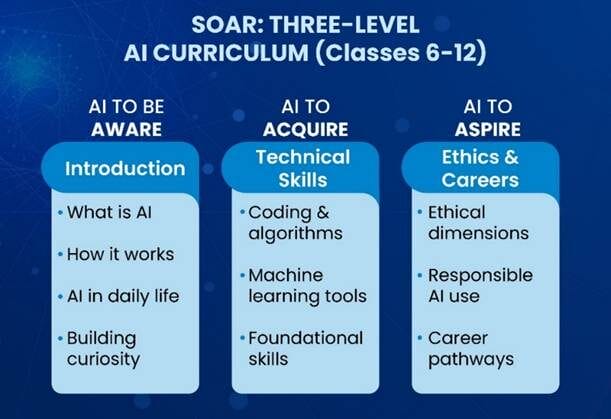
These platforms allow India to scale educational delivery in a cost-effective manner, which is essential for a large population.
Government Policy Framework Driving AI in Education
India’s AI-driven education transformation is supported by several policy initiatives and institutional reforms.
(a) National Education Policy (NEP) 2020
NEP 2020 represents India’s most significant education reform in over three decades. It emphasises the integration of emerging technologies such as artificial intelligence, coding, and data science into the education system.
Key provisions include:
- Introducing coding and computational thinking from Class VI.
- Promoting multidisciplinary education, allowing students to combine technology with social sciences and humanities.
- Expanding vocational education to bridge the gap between academic learning and industry requirements.
- Creating flexible higher education pathways through a four-year multidisciplinary undergraduate programme.
The policy aims to develop creativity, critical thinking, and problem-solving skills rather than rote learning.
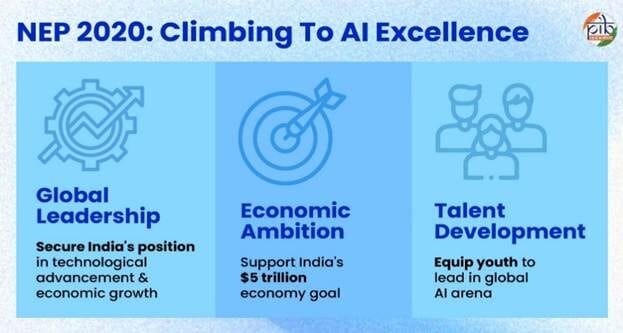
(b) IndiaAI Mission
To strengthen India’s AI ecosystem, the government launched the IndiaAI Mission with an allocation of ₹10,371.92 crore over five years.
The mission focuses on:
- Building national AI compute infrastructure.
- Developing large datasets for AI training.
- Supporting AI startups and innovation ecosystems.
- Expanding AI education and skilling programs.
The initiative also emphasises the development of Safe and Trusted AI, ensuring responsible technological deployment.
(c) Integration of AI in School Education
India has begun introducing AI education at an early stage in schools.
The Central Board of Secondary Education has introduced AI as:
- A 15-hour skill module from Class VI
- An optional subject in Classes IX–XII
Such early exposure ensures that students develop familiarity with emerging technologies before entering higher education or the workforce.
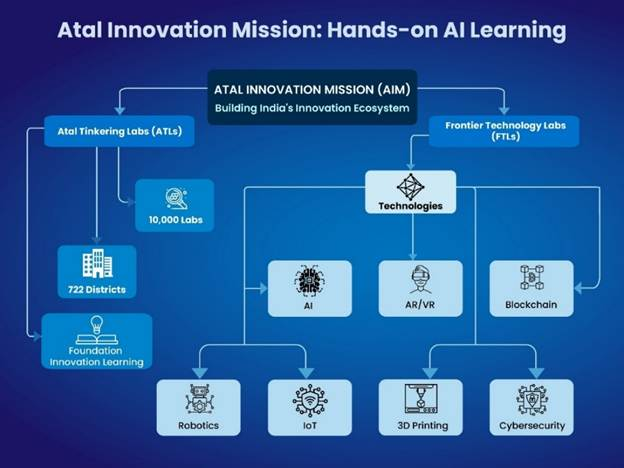
(d) AI in Higher Education
AI is increasingly being incorporated into university curricula.
The University Grants Commission (UGC) has introduced courses related to artificial intelligence, machine learning, big data, and data analytics across higher education programs.
Additionally, institutions such as IITs and research universities are conducting advanced research on AI technologies.
This integration strengthens India’s innovation capacity and research output in emerging technologies.
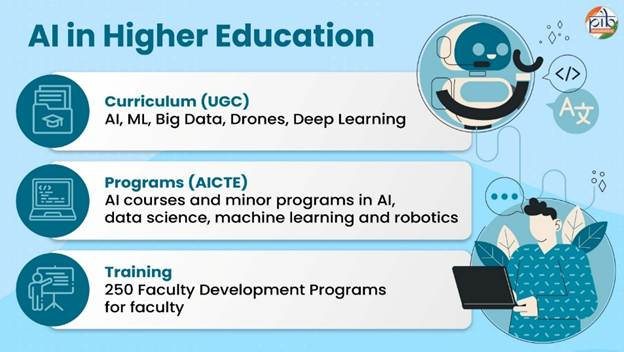
Workforce Skilling and Capacity Building
India faces a significant skill gap in the field of artificial intelligence.
Industry estimates suggest that India will require over 12.5 lakh AI professionals by 2027, while the current workforce is approximately half that number.
To address this gap, the government has launched several skilling initiatives.
(a) FutureSkills PRIME
- FutureSkills PRIME is a joint initiative of the government and industry bodies aimed at building expertise in emerging technologies such as AI, cloud computing, and big data.
- Millions of learners have enrolled in these courses, making it one of the largest digital skilling programs in the region.
(b) Pradhan Mantri Kaushal Vikas Yojana (PMKVY 4.0)
- PMKVY 4.0 integrates training programs in artificial intelligence and emerging technologies.
- The program also includes initiatives to increase participation of women in technology sectors, addressing gender disparities in AI employment.
(c) YUVA AI Initiative
- The YUVA AI initiative aims to provide foundational AI knowledge to citizens across age groups, thereby expanding AI literacy beyond formal education institutions.
(d) Skill Development in Industrial Training Institutes
- Collaborations between government agencies and technology companies are introducing AI training modules in Industrial Training Institutes (ITIs), ensuring that technical and vocational students also benefit from AI education.
Democratisation of AI in Education
While AI offers transformative potential, its benefits must reach all sections of society.
Bridging Socio-Economic Inequalities
- Access to AI education often depends on economic resources. Private AI training programs can be expensive, making them inaccessible to many students.
- Government initiatives providing free online courses and digital learning resources aim to reduce this inequality.
Gender Inclusion
- Women represent a relatively small proportion of the AI workforce in India. Special programs targeting women and girls in technology aim to improve gender representation.
- Scholarships, training programs, and mentoring initiatives are being introduced to encourage female participation in STEM education.
Rural and Regional Inclusion
- AI talent and educational infrastructure are concentrated in major urban centres such as Bengaluru, Hyderabad, and Delhi.
- Government initiatives such as BharatNet aim to expand broadband connectivity to rural areas, enabling students from smaller towns and villages to access digital learning platforms.
- Common Service Centres in villages also function as digital education hubs.
Ethical and Governance Challenges of AI in Education
Despite its advantages, AI also raises several ethical concerns that require careful governance.
Data Privacy
- Digital learning platforms collect large amounts of personal data from students, including minors. Without strong data protection safeguards, such information could be misused.
- India’s Digital Personal Data Protection Act, 2023 provides a framework for protecting personal data, including additional safeguards for children.
Algorithmic Bias
- AI systems trained on biased data may reinforce social inequalities related to caste, gender, or socio-economic status.
- Ensuring fairness in algorithm design is therefore essential.
Surveillance Concerns
- AI-enabled monitoring tools used during online examinations or digital classrooms may lead to excessive surveillance and invasion of privacy.
- Balancing technological efficiency with individual rights is therefore important.
Teacher Deskilling
- Overreliance on automated tools may reduce teachers’ professional autonomy and decision-making authority.
- AI systems must therefore be designed to support rather than replace human judgment.
Governance Framework for Responsible AI in Education
To address these challenges, India must develop a robust governance framework.
Key elements include:
- Independent regulatory oversight for AI tools used in education.
- Mandatory audits of algorithms to detect bias.
- Strong data protection safeguards for student data.
- Transparent AI systems that provide explainable outcomes.
- Ethical training programs for educators and developers.
These measures would ensure that AI technologies operate within the framework of constitutional values such as equality, dignity, and justice.
India’s Potential as a Global AI Leader
India has significant structural advantages in becoming a major global player in artificial intelligence.
Strengths
- Large youth population and demographic dividend.
- Significant number of STEM graduates.
- Growing digital economy and startup ecosystem.
- Vast domestic data resources.
- Strong IT services industry.
These factors position India well to develop and deploy AI technologies.
What ae the Structural Challenges
However, several constraints limit India’s global AI competitiveness.
Limited R&D Investment
- India spends less than one percent of its GDP on research and development, significantly lower than many developed economies.
Compute Infrastructure Gap
- Advanced AI development requires high-performance computing infrastructure such as GPUs, where India currently lags behind major AI powers.
Brain Drain
- Many highly skilled AI researchers migrate abroad for better research opportunities and resources.
Digital Divide
- Significant disparities in internet access and digital infrastructure remain between urban and rural areas.
Strategic Opportunities for India
India can leverage several opportunities to strengthen its AI leadership.
These include:
- Developing AI solutions tailored for developing countries.
- Building language models for Indian languages.
- Strengthening public digital infrastructure.
- Expanding AI research funding.
- Encouraging global partnerships in semiconductor and AI technology.
By focusing on inclusive innovation, India can position itself as a leader in ethical and human-centric AI development.
Skilling in AI
To equip India’s workforce with AI and digital capabilities, the government has launched comprehensive skilling initiatives spanning students, industrial trainees, professionals, and government officials. These programs combine foundational AI literacy with advanced technical training
| Programme | Implementing Agency | Target/Scale | Key Features |
| Pradhan Mantri Kaushal Vikas Yojana (PMKVY) 4.0 | Ministry of Skill Development and Entrepreneurship (MSDE) | 36,584 trained in AI (as on June 30, 2025); 45% women | Short-Term Training (STT) and Recognition of Prior Learning (RPL); AI Career for Women Initiative launched in April 2025 (targeting 8,000 girls over 2 years) |
| SkillSaksham Program | MSDE + Microsoft (MoU Aug 2024) | 200 Industrial Training Institutes (ITIs); 10,000+ candidates targeted; 8,500+ already trained | 1,200 hours AI training + 400 hours Advanced AI in ~15 National Skill Training Institutes (NSTIs) under Craftsmen Training Scheme (CTS) |
| iGOT Karmayogi Bharat Platform | Mission Karmayogi | Government officials | Digital learning platform offering courses in AI, data analytics, and digital transformation |
| FutureSkills PRIME | Government + NASSCOM | 16.29 lakh+ enrolled/trained | 500+ courses, 2,000+ digital fluency pathways in AI, Big Data, Cloud Computing; aligned with National Occupational Standards (NOS) and National Skills Qualification Framework (NSQF) |
| YUVA AI For All | IndiaAI Mission | Target: 1 crore citizens | Free, self-paced foundational AI course (4–4.5 hours) for students, youth, professionals, parents, senior citizens |
Way Forward
To fully harness the benefits of AI in education, India must focus on several priorities.
- First, digital infrastructure such as broadband connectivity must be expanded to ensure equitable access to digital learning resources.
- Second, teacher training programs should be strengthened to build AI literacy among educators.
- Third, AI tools should be developed in multiple Indian languages to ensure broader accessibility.
- Fourth, collaboration between academia, industry, and government should be enhanced to align educational outcomes with labour market requirements.
- Finally, ethical governance mechanisms must be established to protect data privacy, prevent algorithmic discrimination, and ensure transparency in AI systems.
Conclusion
Artificial Intelligence represents one of the most transformative technological forces of the twenty-first century. For India, integrating AI into the education system is essential to prepare its youth for a rapidly changing global economy.
Through initiatives such as NEP 2020, the IndiaAI Mission, digital learning platforms, and large-scale skilling programs, India has begun laying the foundations for an AI-enabled education ecosystem.
However, the ultimate success of this transformation will depend on bridging the digital divide, strengthening research capabilities, ensuring ethical governance, and expanding access to all sections of society.
If implemented effectively, AI can become a powerful instrument not only for economic growth but also for social inclusion—helping India realise its aspiration of becoming a knowledge-driven and developed nation by 2047.
Civil Aviation Ministry Monitors West Asia Airspace Closely
Why in News?
On 9 March 2026, Ministry of Civil Aviation put Civil Aviation Ministry Monitors West Asia Airspace Closely in the spotlight through an official communication. The development is relevant because it speaks directly to themes that UPSC regularly tests in both factual and analytical form.
The official source, titled West Asia Airspace Situation – Indian carriers plan 50 flights today, helps place the issue in a wider policy context. For aspirants, the topic is useful not only for remembering the headline event but also for connecting it to governance, economy, diplomacy, infrastructure, environment, or social policy as required.

UPSC Relevance
- Prelims: projects, corridors, airports, waterways, logistics institutions, and regulatory bodies
- Mains: GS III on infrastructure, transport, growth, and regional development
What Happened?
The Ministry of Civil Aviation is closely monitoring the evolving situation in the West Asia affecting air travel between India and the West Asia region. Airlines are undertaking necessary operational adjustments in view of the prevailing conditions to ensure passenger safety and orderly conduct of flight operations.
Passenger movement data for 07 th March, 2026 shows that a total of 51 inbound flights operated by Indian carriers arrived in India from the region carrying 8,175 passengers. For 08 th March 2026, Indian carriers – Air India.
Prelims Focus
- Event date: 9 March 2026
- Primary source: Ministry of Civil Aviation
- Ministry of Civil Aviation
- West Asia Airspace Situation – Indian carriers plan 50 flights today
- Civil aviation sector
- Aviation contingency planning
Mains Focus
- This issue shows why infrastructure is treated as a force multiplier for growth, logistics, and regional integration.
- It is relevant for GS III answers on multimodal connectivity, PPPs, urbanisation, and productivity gains.
- The topic also underlines the importance of regulation, last-mile delivery, and coordination across levels of government.
- A good mains answer should assess both capacity creation and the challenge of inclusive access.
Why it Matters
For UPSC, the event matters because infrastructure announcements are rarely just engineering stories; they reshape mobility, economic geography, logistics, and state capacity. In exam terms, this topic can strengthen both short factual notes and longer answer-writing examples.
Exam Takeaways
- The event belongs to 9 March 2026 and should be linked to that day's current-affairs revision.
- The official source was Ministry of Civil Aviation.
- Aviation contingency planning
- Passenger safety and route management
- Geopolitics affecting transport
Bottom Line
Civil Aviation Ministry Monitors West Asia Airspace Closely is relevant because it combines immediate current-affairs value with wider exam utility. For UPSC, the event matters because infrastructure announcements are rarely just engineering stories; they reshape mobility, economic geography, logistics, and state capacity.
Exam Oriented Questions
Why is this topic in the news?
It is in the news because an official development linked to civil aviation ministry monitors west asia airspace closely was recorded on 9 March 2026.
Which official source is associated with this development?
The primary official source is Ministry of Civil Aviation, and aspirants should revise the linked release or official document.
What is the core issue involved in this topic?
The core issue involves aviation contingency planning and its policy significance.
How is this topic relevant for UPSC Prelims?
It is useful for Prelims because it involves factual details such as institutions, initiatives, locations, or technical terms that can be directly asked.
How is this topic relevant for UPSC Mains?
It is useful for Mains because it can be linked to broader themes such as governance, economy, foreign policy, infrastructure, environment, or social inclusion.
Which broader policy area does this topic touch?
It touches transport, logistics, connectivity, regional development, and state capacity.
What should aspirants remember first from this topic?
Aspirants should first remember the event date, the official institution involved, and the headline takeaway from civil aviation ministry monitors west asia airspace closely.
How can this topic be used in answer writing?
It can be used as a recent example to support analytical points in GS answers, especially when explaining implementation, strategic relevance, or policy direction.
What factual areas should be revised from this topic?
Revise the institution involved, the exact development, and these quick points: Aviation contingency planning, Passenger safety and route management, Geopolitics affecting transport.
What is the one-line exam takeaway?
Civil Aviation Ministry Monitors West Asia Airspace Closely shows how a current event can combine factual recall with wider analytical value for both Prelims and Mains.
Source: https://anantamias.com/current-affairs/civil-aviation-ministry-monitors-west-asia-airspace-closely/
India Weighs How FTAs Can Support the Pharma Sector
Why in News?
On 9 March 2026, Ministry of Commerce and Industry put India Weighs How FTAs Can Support the Pharma Sector in the spotlight through an official communication. The development is relevant because it speaks directly to themes that UPSC regularly tests in both factual and analytical form.
The official source, titled FTAs Opening New Opportunities for Pharma, Healthcare and MedTech Sectors: Union Minister of Commerce & Industry Shri Piyush Goyal, helps place the issue in a wider policy context. For aspirants, the topic is useful not only for remembering the headline event but also for connecting it to governance, economy, diplomacy, infrastructure, environment, or social policy as required.

UPSC Relevance
- Prelims: indices, institutions, agreements, sectors, and key data points
- Mains: GS III on growth, trade, inflation, energy, and economic policy
What Happened?
Union Minister of Commerce & Industry Piyush Goyal today said that India’s Free Trade Agreements (FTAs) are opening new opportunities for the pharmaceutical, healthcare and medical technology sectors, while enabling the country to strengthen its position in global trade. Addressing the Post Budget Webinar 2026 on Sabka Sath Sabka Vikas: Fulfilling Aspiration of People in New Delhi, Shri Goyal said that under the leadership of Prime Minister Narendra Modi, India has signed a total of nine Free Trade Agreements in the last three to three-and-a-half years, of which five have been concluded in the past 12 months.
As a result, nearly two-thirds of global trade is now open to India. He noted that these agreements provide India with preferential access compared to many other countries, with lower duties and expanded market opportunities, thereby opening new avenues to enhance trade.
Prelims Focus
- Event date: 9 March 2026
- Primary source: Ministry of Commerce and Industry
- Ministry of Commerce and Industry
- FTAs Opening New Opportunities for Pharma, Healthcare and MedTech Sectors: Union Minister of Commerce & Industry Shri Piyush Goyal
- Trade agreements and sectoral competitiveness
- Pharmaceutical exports
Mains Focus
- The development shows how policy, regulation, and macro data shape growth prospects and state capacity.
- It can be used in GS III answers on economic management, infrastructure finance, or sectoral reforms.
- The issue also helps connect headline announcements with implementation challenges on the ground.
- A balanced answer should mention both opportunity creation and the need for institutional follow-through.
Why it Matters
For UPSC, the larger value lies in understanding how the announcement affects growth, investment, markets, production systems, or the broader policy environment rather than treating it as a stand-alone news event. In exam terms, this topic can strengthen both short factual notes and longer answer-writing examples.
Exam Takeaways
- The event belongs to 9 March 2026 and should be linked to that day's current-affairs revision.
- The official source was Ministry of Commerce and Industry.
- Trade agreements and sectoral competitiveness
- Pharmaceutical exports
- Industrial policy angle
Bottom Line
India Weighs How FTAs Can Support the Pharma Sector is relevant because it combines immediate current-affairs value with wider exam utility. For UPSC, the larger value lies in understanding how the announcement affects growth, investment, markets, production systems, or the broader policy environment rather than treating it as a stand-alone news event.
Exam Oriented Questions
Why is this topic in the news?
It is in the news because an official development linked to india weighs how ftas can support the pharma sector was recorded on 9 March 2026.
Which official source is associated with this development?
The primary official source is Ministry of Commerce and Industry, and aspirants should revise the linked release or official document.
What is the core issue involved in this topic?
The core issue involves trade agreements and sectoral competitiveness and its policy significance.
How is this topic relevant for UPSC Prelims?
It is useful for Prelims because it involves factual details such as institutions, initiatives, locations, or technical terms that can be directly asked.
How is this topic relevant for UPSC Mains?
It is useful for Mains because it can be linked to broader themes such as governance, economy, foreign policy, infrastructure, environment, or social inclusion.
Which broader policy area does this topic touch?
It touches the economic policy area, especially growth, trade, inflation, energy, or sectoral competitiveness.
What should aspirants remember first from this topic?
Aspirants should first remember the event date, the official institution involved, and the headline takeaway from india weighs how ftas can support the pharma sector.
How can this topic be used in answer writing?
It can be used as a recent example to support analytical points in GS answers, especially when explaining implementation, strategic relevance, or policy direction.
What factual areas should be revised from this topic?
Revise the institution involved, the exact development, and these quick points: Trade agreements and sectoral competitiveness, Pharmaceutical exports, Industrial policy angle.
What is the one-line exam takeaway?
India Weighs How FTAs Can Support the Pharma Sector shows how a current event can combine factual recall with wider analytical value for both Prelims and Mains.
Source: https://anantamias.com/current-affairs/india-weighs-how-ftas-can-support-the-pharma-sector/
Madurai Airport Gets International Status
Why in News?
On 10 March 2026, Ministry of Civil Aviation put Madurai Airport Gets International Status in the spotlight through an official communication. The development is relevant because it speaks directly to themes that UPSC regularly tests in both factual and analytical form.
The official source, titled Cabinet approves Declaration of Madurai Airport, Tamil Nadu, as an International Airport, helps place the issue in a wider policy context. For aspirants, the topic is useful not only for remembering the headline event but also for connecting it to governance, economy, diplomacy, infrastructure, environment, or social policy as required.

UPSC Relevance
- Prelims: projects, corridors, airports, waterways, logistics institutions, and regulatory bodies
- Mains: GS III on infrastructure, transport, growth, and regional development
What Happened?
The Union Cabinet chaired by the Prime Minister Shri Narendra Modi today has approved declaration of Madurai Airport, Tamil Nadu, as an International Airport. Madurai Airport, located in the Temple City of Madurai, Tamil Nadu, is one of the oldest airports in the State.
It serves as a crucial gateway to Southern Tamil Nadu and plays a pivotal role in promoting tourism and pilgrimage, thereby contributing to the overall growth of the region. Elevating Madurai Airport to International Status would enhance regional connectivity, promote trade, and drive economic development in the region.
Prelims Focus
- Event date: 10 March 2026
- Primary source: Ministry of Civil Aviation
- Ministry of Civil Aviation
- Cabinet approves Declaration of Madurai Airport, Tamil Nadu, as an International Airport
- Civil aviation sector
- Regional air connectivity
Mains Focus
- This issue shows why infrastructure is treated as a force multiplier for growth, logistics, and regional integration.
- It is relevant for GS III answers on multimodal connectivity, PPPs, urbanisation, and productivity gains.
- The topic also underlines the importance of regulation, last-mile delivery, and coordination across levels of government.
- A good mains answer should assess both capacity creation and the challenge of inclusive access.
Why it Matters
For UPSC, the event matters because infrastructure announcements are rarely just engineering stories; they reshape mobility, economic geography, logistics, and state capacity. In exam terms, this topic can strengthen both short factual notes and longer answer-writing examples.
Exam Takeaways
- The event belongs to 10 March 2026 and should be linked to that day's current-affairs revision.
- The official source was Ministry of Civil Aviation.
- Regional air connectivity
- Tourism and trade potential
- Airport-led development
Bottom Line
Madurai Airport Gets International Status is relevant because it combines immediate current-affairs value with wider exam utility. For UPSC, the event matters because infrastructure announcements are rarely just engineering stories; they reshape mobility, economic geography, logistics, and state capacity.
Exam Oriented Questions
Why is this topic in the news?
It is in the news because an official development linked to madurai airport gets international status was recorded on 10 March 2026.
Which official source is associated with this development?
The primary official source is Ministry of Civil Aviation, and aspirants should revise the linked release or official document.
What is the core issue involved in this topic?
The core issue involves regional air connectivity and its policy significance.
How is this topic relevant for UPSC Prelims?
It is useful for Prelims because it involves factual details such as institutions, initiatives, locations, or technical terms that can be directly asked.
How is this topic relevant for UPSC Mains?
It is useful for Mains because it can be linked to broader themes such as governance, economy, foreign policy, infrastructure, environment, or social inclusion.
Which broader policy area does this topic touch?
It touches transport, logistics, connectivity, regional development, and state capacity.
What should aspirants remember first from this topic?
Aspirants should first remember the event date, the official institution involved, and the headline takeaway from madurai airport gets international status.
How can this topic be used in answer writing?
It can be used as a recent example to support analytical points in GS answers, especially when explaining implementation, strategic relevance, or policy direction.
What factual areas should be revised from this topic?
Revise the institution involved, the exact development, and these quick points: Regional air connectivity, Tourism and trade potential, Airport-led development.
What is the one-line exam takeaway?
Madurai Airport Gets International Status shows how a current event can combine factual recall with wider analytical value for both Prelims and Mains.
Source: https://anantamias.com/current-affairs/madurai-airport-gets-international-status/
Two Years of the EFTA-India TEPA Revisited
Why in News?
On 10 March 2026, Ministry of Commerce and Industry put Two Years of the EFTA-India TEPA Revisited in the spotlight through an official communication. The development is relevant because it speaks directly to themes that UPSC regularly tests in both factual and analytical form.
The official source, titled India–EFTA TEPA Marks Two Years, Strengthening Trade, Investment and Technology Collaboration, helps place the issue in a wider policy context. For aspirants, the topic is useful not only for remembering the headline event but also for connecting it to governance, economy, diplomacy, infrastructure, environment, or social policy as required.

UPSC Relevance
- Prelims: indices, institutions, agreements, sectors, and key data points
- Mains: GS III on growth, trade, inflation, energy, and economic policy
What Happened?
Two years since the signing of the Trade and Economic Partnership Agreement between India and the member States of the European Free Trade Association, Iceland, Liechtenstein, Norway and Switzerland, the partnership has moved from negotiation to implementation with effect from 1 October 2025. The Agreement brings together India and a group of advanced European economies in a framework that supports trade, investment, services, technology collaboration and long-term industrial growth.
The Prime Minister Shri Narendra Modi has said: “Over the last few years, we have built a strategic and purposeful network of Free Trade Agreements. We now have FTAs with 38 partner nations, an unprecedented milestone in India’s trade history.
Prelims Focus
- Event date: 10 March 2026
- Primary source: Ministry of Commerce and Industry
- Ministry of Commerce and Industry
- India–EFTA TEPA Marks Two Years, Strengthening Trade, Investment and Technology Collaboration
- Trade architecture and market access
- European economic engagement
Mains Focus
- The development shows how policy, regulation, and macro data shape growth prospects and state capacity.
- It can be used in GS III answers on economic management, infrastructure finance, or sectoral reforms.
- The issue also helps connect headline announcements with implementation challenges on the ground.
- A balanced answer should mention both opportunity creation and the need for institutional follow-through.
Why it Matters
For UPSC, the larger value lies in understanding how the announcement affects growth, investment, markets, production systems, or the broader policy environment rather than treating it as a stand-alone news event. In exam terms, this topic can strengthen both short factual notes and longer answer-writing examples.
Exam Takeaways
- The event belongs to 10 March 2026 and should be linked to that day's current-affairs revision.
- The official source was Ministry of Commerce and Industry.
- Trade architecture and market access
- European economic engagement
- Policy continuity in FTAs
Bottom Line
Two Years of the EFTA-India TEPA Revisited is relevant because it combines immediate current-affairs value with wider exam utility. For UPSC, the larger value lies in understanding how the announcement affects growth, investment, markets, production systems, or the broader policy environment rather than treating it as a stand-alone news event.
Exam Oriented Questions
Why is this topic in the news?
It is in the news because an official development linked to two years of the efta-india tepa revisited was recorded on 10 March 2026.
Which official source is associated with this development?
The primary official source is Ministry of Commerce and Industry, and aspirants should revise the linked release or official document.
What is the core issue involved in this topic?
The core issue involves trade architecture and market access and its policy significance.
How is this topic relevant for UPSC Prelims?
It is useful for Prelims because it involves factual details such as institutions, initiatives, locations, or technical terms that can be directly asked.
How is this topic relevant for UPSC Mains?
It is useful for Mains because it can be linked to broader themes such as governance, economy, foreign policy, infrastructure, environment, or social inclusion.
Which broader policy area does this topic touch?
It touches the economic policy area, especially growth, trade, inflation, energy, or sectoral competitiveness.
What should aspirants remember first from this topic?
Aspirants should first remember the event date, the official institution involved, and the headline takeaway from two years of the efta-india tepa revisited.
How can this topic be used in answer writing?
It can be used as a recent example to support analytical points in GS answers, especially when explaining implementation, strategic relevance, or policy direction.
What factual areas should be revised from this topic?
Revise the institution involved, the exact development, and these quick points: Trade architecture and market access, European economic engagement, Policy continuity in FTAs.
What is the one-line exam takeaway?
Two Years of the EFTA-India TEPA Revisited shows how a current event can combine factual recall with wider analytical value for both Prelims and Mains.
Source: https://anantamias.com/current-affairs/two-years-of-the-efta-india-tepa-revisited/
India Pushes Agricultural and Processed Food Exports
Why in News?
On 10 March 2026, Ministry of Commerce and Industry put India Pushes Agricultural and Processed Food Exports in the spotlight through an official communication. The development is relevant because it speaks directly to themes that UPSC regularly tests in both factual and analytical form.
The official source, titled Union Minister of Commerce & Industry Shri Piyush Goyal calls for stronger collaboration to position India as global leader in agricultural and processed food exports, helps place the issue in a wider policy context. For aspirants, the topic is useful not only for remembering the headline event but also for connecting it to governance, economy, diplomacy, infrastructure, environment, or social policy as required.

UPSC Relevance
- Prelims: indices, institutions, agreements, sectors, and key data points
- Mains: GS III on growth, trade, inflation, energy, and economic policy
What Happened?
Union Minister of Commerce & Industry Shri Piyush Goyal today called upon stakeholders from the food, agriculture and hospitality sectors to work collectively towards making India the world’s largest exporter of agricultural and processed foods, highlighting the vast opportunities created by India’s expanding trade agreements and the growing global demand for Indian products. Addressing the gathering at the inauguration of the 40th edition of AAHAR – The International Food & Hospitality Fair in New Delhi today, Shri Goyal said that India’s exports of food and agricultural products—including farm produce and fisheries—have reached nearly ₹5 lakh crore (over USD 55 billion) annually, making the country the seventh largest exporter of agricultural produce in the world.
He noted that over the past eleven years, from 2014 to 2025, India’s agri and food exports have witnessed significant growth. Exports of processed foods have increased fourfold, fruit and pulses exports have tripled, processed vegetable exports have quadrupled, cocoa exports have tripled, and cereal exports have doubled.
Prelims Focus
- Event date: 10 March 2026
- Primary source: Ministry of Commerce and Industry
- Ministry of Commerce and Industry
- Union Minister of Commerce & Industry Shri Piyush Goyal calls for stronger collaboration to position India as global leader in agricultural and processed food exports
- Agricultural exports and value addition
- Processed food as trade opportunity
Mains Focus
- The development shows how policy, regulation, and macro data shape growth prospects and state capacity.
- It can be used in GS III answers on economic management, infrastructure finance, or sectoral reforms.
- The issue also helps connect headline announcements with implementation challenges on the ground.
- A balanced answer should mention both opportunity creation and the need for institutional follow-through.
Why it Matters
For UPSC, the larger value lies in understanding how the announcement affects growth, investment, markets, production systems, or the broader policy environment rather than treating it as a stand-alone news event. In exam terms, this topic can strengthen both short factual notes and longer answer-writing examples.
Exam Takeaways
- The event belongs to 10 March 2026 and should be linked to that day's current-affairs revision.
- The official source was Ministry of Commerce and Industry.
- Agricultural exports and value addition
- Processed food as trade opportunity
- Agri-trade competitiveness
Bottom Line
India Pushes Agricultural and Processed Food Exports is relevant because it combines immediate current-affairs value with wider exam utility. For UPSC, the larger value lies in understanding how the announcement affects growth, investment, markets, production systems, or the broader policy environment rather than treating it as a stand-alone news event.
Exam Oriented Questions
Why is this topic in the news?
It is in the news because an official development linked to india pushes agricultural and processed food exports was recorded on 10 March 2026.
Which official source is associated with this development?
The primary official source is Ministry of Commerce and Industry, and aspirants should revise the linked release or official document.
What is the core issue involved in this topic?
The core issue involves agricultural exports and value addition and its policy significance.
How is this topic relevant for UPSC Prelims?
It is useful for Prelims because it involves factual details such as institutions, initiatives, locations, or technical terms that can be directly asked.
How is this topic relevant for UPSC Mains?
It is useful for Mains because it can be linked to broader themes such as governance, economy, foreign policy, infrastructure, environment, or social inclusion.
Which broader policy area does this topic touch?
It touches the economic policy area, especially growth, trade, inflation, energy, or sectoral competitiveness.
What should aspirants remember first from this topic?
Aspirants should first remember the event date, the official institution involved, and the headline takeaway from india pushes agricultural and processed food exports.
How can this topic be used in answer writing?
It can be used as a recent example to support analytical points in GS answers, especially when explaining implementation, strategic relevance, or policy direction.
What factual areas should be revised from this topic?
Revise the institution involved, the exact development, and these quick points: Agricultural exports and value addition, Processed food as trade opportunity, Agri-trade competitiveness.
What is the one-line exam takeaway?
India Pushes Agricultural and Processed Food Exports shows how a current event can combine factual recall with wider analytical value for both Prelims and Mains.
Source: https://anantamias.com/current-affairs/india-pushes-agricultural-and-processed-food-exports/
DPIIT and Voltas Sign MoU for Industry Collaboration
Why in News?
On 11 March 2026, Ministry of Commerce and Industry put DPIIT and Voltas Sign MoU for Industry Collaboration in the spotlight through an official communication. The development is relevant because it speaks directly to themes that UPSC regularly tests in both factual and analytical form.
The official source, titled DPIIT Signs MoU with Voltas Limited to Support Industry–Start-up Collaboration in Cooling and Smart Appliance Technologies, helps place the issue in a wider policy context. For aspirants, the topic is useful not only for remembering the headline event but also for connecting it to governance, economy, diplomacy, infrastructure, environment, or social policy as required.

UPSC Relevance
- Prelims: indices, institutions, agreements, sectors, and key data points
- Mains: GS III on growth, trade, inflation, energy, and economic policy
What Happened?
The Department for Promotion of Industry and Internal Trade (DPIIT), Ministry of Commerce and Industry, has signed a Memorandum of Understanding (MoU) with Voltas Limited, a Tata Enterprise, to facilitate industry–start-up collaboration in the cooling and smart appliance ecosystem. The collaboration seeks to engage start-ups working on technologies across areas such as heating, ventilation and air conditioning (HVAC), advanced control systems, power electronics, artificial intelligence and machine learning-based diagnostics, IoT-enabled smart appliances, and digitalisation in manufacturing and service operations.
As part of the initiative, the Startup India initiative under DPIIT and Voltas Limited will explore organising innovation challenges under the Bharat Start-up Grand Challenge and conducting hackathons focused on industry-related problem statements. Speaking on the occasion, Joint Secretary, DPIIT, Shri Sanjiv said the collaboration is in line with the Government’s efforts to facilitate greater engagement between industry and start-ups, particularly in emerging technology areas and advanced manufacturing sectors.
Prelims Focus
- Event date: 11 March 2026
- Primary source: Ministry of Commerce and Industry
- Ministry of Commerce and Industry
- DPIIT Signs MoU with Voltas Limited to Support Industry–Start-up Collaboration in Cooling and Smart Appliance Technologies
- Industry-government partnership
- Manufacturing ecosystem support
Mains Focus
- The development shows how policy, regulation, and macro data shape growth prospects and state capacity.
- It can be used in GS III answers on economic management, infrastructure finance, or sectoral reforms.
- The issue also helps connect headline announcements with implementation challenges on the ground.
- A balanced answer should mention both opportunity creation and the need for institutional follow-through.
Why it Matters
For UPSC, the larger value lies in understanding how the announcement affects growth, investment, markets, production systems, or the broader policy environment rather than treating it as a stand-alone news event. In exam terms, this topic can strengthen both short factual notes and longer answer-writing examples.
Exam Takeaways
- The event belongs to 11 March 2026 and should be linked to that day's current-affairs revision.
- The official source was Ministry of Commerce and Industry.
- Industry-government partnership
- Manufacturing ecosystem support
- Industrial policy relevance
Bottom Line
DPIIT and Voltas Sign MoU for Industry Collaboration is relevant because it combines immediate current-affairs value with wider exam utility. For UPSC, the larger value lies in understanding how the announcement affects growth, investment, markets, production systems, or the broader policy environment rather than treating it as a stand-alone news event.
Exam Oriented Questions
Why is this topic in the news?
It is in the news because an official development linked to dpiit and voltas sign mou for industry collaboration was recorded on 11 March 2026.
Which official source is associated with this development?
The primary official source is Ministry of Commerce and Industry, and aspirants should revise the linked release or official document.
What is the core issue involved in this topic?
The core issue involves industry-government partnership and its policy significance.
How is this topic relevant for UPSC Prelims?
It is useful for Prelims because it involves factual details such as institutions, initiatives, locations, or technical terms that can be directly asked.
How is this topic relevant for UPSC Mains?
It is useful for Mains because it can be linked to broader themes such as governance, economy, foreign policy, infrastructure, environment, or social inclusion.
Which broader policy area does this topic touch?
It touches the economic policy area, especially growth, trade, inflation, energy, or sectoral competitiveness.
What should aspirants remember first from this topic?
Aspirants should first remember the event date, the official institution involved, and the headline takeaway from dpiit and voltas sign mou for industry collaboration.
How can this topic be used in answer writing?
It can be used as a recent example to support analytical points in GS answers, especially when explaining implementation, strategic relevance, or policy direction.
What factual areas should be revised from this topic?
Revise the institution involved, the exact development, and these quick points: Industry-government partnership, Manufacturing ecosystem support, Industrial policy relevance.
What is the one-line exam takeaway?
DPIIT and Voltas Sign MoU for Industry Collaboration shows how a current event can combine factual recall with wider analytical value for both Prelims and Mains.
Source: https://anantamias.com/current-affairs/dpiit-and-voltas-sign-mou-for-industry-collaboration/
APEDA Uses AAHAR Platform to Promote Agri Exports
Why in News?
On 11 March 2026, Ministry of Commerce and Industry put APEDA Uses AAHAR Platform to Promote Agri Exports in the spotlight through an official communication. The development is relevant because it speaks directly to themes that UPSC regularly tests in both factual and analytical form.
The official source, titled APEDA Showcases India’s Agri and Processed Food Export Strength at AAHAR 2026, helps place the issue in a wider policy context. For aspirants, the topic is useful not only for remembering the headline event but also for connecting it to governance, economy, diplomacy, infrastructure, environment, or social policy as required.

UPSC Relevance
- Prelims: indices, institutions, agreements, sectors, and key data points
- Mains: GS III on growth, trade, inflation, energy, and economic policy
What Happened?
The Agricultural and Processed Food Products Export Development Authority (APEDA), under the Ministry of Commerce & Industry, participated in the 40th edition of AAHAR 2026 held from 10–14 March 2026 at Bharat Mandapam, New Delhi. APEDA presented a pavilion highlighting India’s agricultural and processed food export capabilities, bringing together exporters, State representatives and industry stakeholders on a common platform.
The 40th edition of AAHAR – The International Food & Hospitality Fair was inaugurated by Union Minister of Commerce and Industry Shri Piyush Goyal. Organised by the India Trade Promotion Organisation (ITPO), the landmark edition of the event features Italy as the Country Partner.
Prelims Focus
- Event date: 11 March 2026
- Primary source: Ministry of Commerce and Industry
- Ministry of Commerce and Industry
- APEDA Showcases India’s Agri and Processed Food Export Strength at AAHAR 2026
- Agri-export branding and market access
- Value addition and food processing
Mains Focus
- The development shows how policy, regulation, and macro data shape growth prospects and state capacity.
- It can be used in GS III answers on economic management, infrastructure finance, or sectoral reforms.
- The issue also helps connect headline announcements with implementation challenges on the ground.
- A balanced answer should mention both opportunity creation and the need for institutional follow-through.
Why it Matters
For UPSC, the larger value lies in understanding how the announcement affects growth, investment, markets, production systems, or the broader policy environment rather than treating it as a stand-alone news event. In exam terms, this topic can strengthen both short factual notes and longer answer-writing examples.
Exam Takeaways
- The event belongs to 11 March 2026 and should be linked to that day's current-affairs revision.
- The official source was Ministry of Commerce and Industry.
- Agri-export branding and market access
- Value addition and food processing
- Trade promotion institutions
Bottom Line
APEDA Uses AAHAR Platform to Promote Agri Exports is relevant because it combines immediate current-affairs value with wider exam utility. For UPSC, the larger value lies in understanding how the announcement affects growth, investment, markets, production systems, or the broader policy environment rather than treating it as a stand-alone news event.
Exam Oriented Questions
Why is this topic in the news?
It is in the news because an official development linked to apeda uses aahar platform to promote agri exports was recorded on 11 March 2026.
Which official source is associated with this development?
The primary official source is Ministry of Commerce and Industry, and aspirants should revise the linked release or official document.
What is the core issue involved in this topic?
The core issue involves agri-export branding and market access and its policy significance.
How is this topic relevant for UPSC Prelims?
It is useful for Prelims because it involves factual details such as institutions, initiatives, locations, or technical terms that can be directly asked.
How is this topic relevant for UPSC Mains?
It is useful for Mains because it can be linked to broader themes such as governance, economy, foreign policy, infrastructure, environment, or social inclusion.
Which broader policy area does this topic touch?
It touches the economic policy area, especially growth, trade, inflation, energy, or sectoral competitiveness.
What should aspirants remember first from this topic?
Aspirants should first remember the event date, the official institution involved, and the headline takeaway from apeda uses aahar platform to promote agri exports.
How can this topic be used in answer writing?
It can be used as a recent example to support analytical points in GS answers, especially when explaining implementation, strategic relevance, or policy direction.
What factual areas should be revised from this topic?
Revise the institution involved, the exact development, and these quick points: Agri-export branding and market access, Value addition and food processing, Trade promotion institutions.
What is the one-line exam takeaway?
APEDA Uses AAHAR Platform to Promote Agri Exports shows how a current event can combine factual recall with wider analytical value for both Prelims and Mains.
Source: https://anantamias.com/current-affairs/apeda-uses-aahar-platform-to-promote-agri-exports/
Global Oil Coordination Gains Importance in a Fragile Market
Why in News?
On 11 March 2026, Ministry of Petroleum and Natural Gas put Global Oil Coordination Gains Importance in a Fragile Market in the spotlight through an official communication. The development is relevant because it speaks directly to themes that UPSC regularly tests in both factual and analytical form.
The official source, titled Government of India welcomes IEA decision to release emergency oil stocks amid prevailing supply disruptions, helps place the issue in a wider policy context. For aspirants, the topic is useful not only for remembering the headline event but also for connecting it to governance, economy, diplomacy, infrastructure, environment, or social policy as required.

UPSC Relevance
- Prelims: indices, institutions, agreements, sectors, and key data points
- Mains: GS III on growth, trade, inflation, energy, and economic policy
What Happened?
India, as an Associate Member of the International Energy Agency (IEA) and an active participant in international energy cooperation, welcomes the IEA’s decision to release emergency oil stocks amid the prevailing supply disruptions. The Government of India is closely monitoring the evolving situation in global energy markets, particularly in the Middle East.
India stands ready to take appropriate measures, as necessary, to support global market stability in alignment with the efforts of the International Energy Agency.
Prelims Focus
- Event date: 11 March 2026
- Primary source: Ministry of Petroleum and Natural Gas
- Ministry of Petroleum and Natural Gas
- Government of India welcomes IEA decision to release emergency oil stocks amid prevailing supply disruptions
- Energy shocks and emergency reserves
- Global coordination and domestic preparedness
Mains Focus
- The development shows how policy, regulation, and macro data shape growth prospects and state capacity.
- It can be used in GS III answers on economic management, infrastructure finance, or sectoral reforms.
- The issue also helps connect headline announcements with implementation challenges on the ground.
- A balanced answer should mention both opportunity creation and the need for institutional follow-through.
Why it Matters
For UPSC, the larger value lies in understanding how the announcement affects growth, investment, markets, production systems, or the broader policy environment rather than treating it as a stand-alone news event. In exam terms, this topic can strengthen both short factual notes and longer answer-writing examples.
Exam Takeaways
- The event belongs to 11 March 2026 and should be linked to that day's current-affairs revision.
- The official source was Ministry of Petroleum and Natural Gas.
- Energy shocks and emergency reserves
- Global coordination and domestic preparedness
- Oil market stability
Bottom Line
Global Oil Coordination Gains Importance in a Fragile Market is relevant because it combines immediate current-affairs value with wider exam utility. For UPSC, the larger value lies in understanding how the announcement affects growth, investment, markets, production systems, or the broader policy environment rather than treating it as a stand-alone news event.
Exam Oriented Questions
Why is this topic in the news?
It is in the news because an official development linked to global oil coordination gains importance in a fragile market was recorded on 11 March 2026.
Which official source is associated with this development?
The primary official source is Ministry of Petroleum and Natural Gas, and aspirants should revise the linked release or official document.
What is the core issue involved in this topic?
The core issue involves energy shocks and emergency reserves and its policy significance.
How is this topic relevant for UPSC Prelims?
It is useful for Prelims because it involves factual details such as institutions, initiatives, locations, or technical terms that can be directly asked.
How is this topic relevant for UPSC Mains?
It is useful for Mains because it can be linked to broader themes such as governance, economy, foreign policy, infrastructure, environment, or social inclusion.
Which broader policy area does this topic touch?
It touches the economic policy area, especially growth, trade, inflation, energy, or sectoral competitiveness.
What should aspirants remember first from this topic?
Aspirants should first remember the event date, the official institution involved, and the headline takeaway from global oil coordination gains importance in a fragile market.
How can this topic be used in answer writing?
It can be used as a recent example to support analytical points in GS answers, especially when explaining implementation, strategic relevance, or policy direction.
What factual areas should be revised from this topic?
Revise the institution involved, the exact development, and these quick points: Energy shocks and emergency reserves, Global coordination and domestic preparedness, Oil market stability.
What is the one-line exam takeaway?
Global Oil Coordination Gains Importance in a Fragile Market shows how a current event can combine factual recall with wider analytical value for both Prelims and Mains.
Source: https://anantamias.com/current-affairs/global-oil-coordination-gains-importance-in-a-fragile-market/
PM-KISAN Installment Underscores Direct Benefit Transfers in Agriculture
Why in News?
On 12 March 2026, Ministry of Agriculture and Farmers Welfare put PM-KISAN Installment Underscores Direct Benefit Transfers in Agriculture in the spotlight through an official communication. The development is relevant because it speaks directly to themes that UPSC regularly tests in both factual and analytical form.
The official source, titled Prime Minister Shri Narendra Modi will release the 22nd installment of Pradhan Mantri Kisan Samman Nidhi tomorrow, providing direct benefit of ?18,640 crore to 9.32 crore farmers, helps place the issue in a wider policy context. For aspirants, the topic is useful not only for remembering the headline event but also for connecting it to governance, economy, diplomacy, infrastructure, environment, or social policy as required.

UPSC Relevance
- Prelims: institutions, reports, schemes, and administrative mechanisms
- Mains: GS II on governance, delivery, and public policy
What Happened?
Union Minister of Agriculture & Farmers’ Welfare and Rural Development, Shri Shivraj Singh Chouhan addressed journalists at his residence today. In his address, he stated that in a major step towards unprecedented progress in the agriculture sector and farmers’ welfare by the Government of India, Prime Minister Shri Narendra Modi will tomorrow, on 13 th March, at a programme organised in Guwahati, Assam, transfer ₹18,640 crore directly into the accounts of 9.32 crore farmers of the country as the 22 nd installment of the Pradhan Mantri Kisan Samman Nidhi (PM-Kisan) scheme.
Union Minister Shri Shivraj Singh informed that under the Pradhan Mantri Kisan Samman Nidhi scheme, more than ₹4,09,000 crore has been distributed so far through DBT. Especially, more than 2.15 crore women farmers are also included in it.
Prelims Focus
- Event date: 12 March 2026
- Primary source: Ministry of Agriculture and Farmers Welfare
- Ministry of Agriculture and Farmers Welfare
- Prime Minister Shri Narendra Modi will release the 22nd installment of Pradhan Mantri Kisan Samman Nidhi tomorrow, providing direct benefit of ?18,640 crore to 9.32 crore farmers
- DBT architecture in farm support
- Income support and delivery systems
Mains Focus
- The issue is relevant for GS II because it shows how governance reforms depend on institutional design, coordination, and citizen-facing delivery.
- It can be used to discuss accountability, policy implementation, and administrative responsiveness.
- The topic also has value in linking central initiatives with state-level outcomes and local institutions.
- A balanced answer should mention capacity constraints along with reform gains.
Why it Matters
For UPSC, the event matters because governance topics are best understood through the institutions involved, the target group, and the quality of implementation. In exam terms, this topic can strengthen both short factual notes and longer answer-writing examples.
Exam Takeaways
- The event belongs to 12 March 2026 and should be linked to that day's current-affairs revision.
- The official source was Ministry of Agriculture and Farmers Welfare.
- DBT architecture in farm support
- Income support and delivery systems
- Important scheme for Prelims
Bottom Line
PM-KISAN Installment Underscores Direct Benefit Transfers in Agriculture is relevant because it combines immediate current-affairs value with wider exam utility. For UPSC, the event matters because governance topics are best understood through the institutions involved, the target group, and the quality of implementation.
Exam Oriented Questions
Why is this topic in the news?
It is in the news because an official development linked to pm-kisan installment underscores direct benefit transfers in agriculture was recorded on 12 March 2026.
Which official source is associated with this development?
The primary official source is Ministry of Agriculture and Farmers Welfare, and aspirants should revise the linked release or official document.
What is the core issue involved in this topic?
The core issue involves dbt architecture in farm support and its policy significance.
How is this topic relevant for UPSC Prelims?
It is useful for Prelims because it involves factual details such as institutions, initiatives, locations, or technical terms that can be directly asked.
How is this topic relevant for UPSC Mains?
It is useful for Mains because it can be linked to broader themes such as governance, economy, foreign policy, infrastructure, environment, or social inclusion.
Which broader policy area does this topic touch?
It touches public policy, implementation systems, institutions, and administrative reform.
What should aspirants remember first from this topic?
Aspirants should first remember the event date, the official institution involved, and the headline takeaway from pm-kisan installment underscores direct benefit transfers in agriculture.
How can this topic be used in answer writing?
It can be used as a recent example to support analytical points in GS answers, especially when explaining implementation, strategic relevance, or policy direction.
What factual areas should be revised from this topic?
Revise the institution involved, the exact development, and these quick points: DBT architecture in farm support, Income support and delivery systems, Important scheme for Prelims.
What is the one-line exam takeaway?
PM-KISAN Installment Underscores Direct Benefit Transfers in Agriculture shows how a current event can combine factual recall with wider analytical value for both Prelims and Mains.
Special Civil Aviation Measures Keep Riyadh Connectivity Stable
Why in News?
On 12 March 2026, Ministry of Civil Aviation put Special Civil Aviation Measures Keep Riyadh Connectivity Stable in the spotlight through an official communication. The development is relevant because it speaks directly to themes that UPSC regularly tests in both factual and analytical form.
The official source, titled MoCA closely monitoring air travel situation in West Asia: Indian carriers resume flights to Riyadh, helps place the issue in a wider policy context. For aspirants, the topic is useful not only for remembering the headline event but also for connecting it to governance, economy, diplomacy, infrastructure, environment, or social policy as required.

UPSC Relevance
- Prelims: projects, corridors, airports, waterways, logistics institutions, and regulatory bodies
- Mains: GS III on infrastructure, transport, growth, and regional development
What Happened?
The Ministry of Civil Aviation is closely monitoring the evolving situation in the West Asia region and its impact on air travel between India and countries in the region. Airlines are undertaking necessary operational adjustments in view of the prevailing conditions to ensure passenger safety and the orderly conduct of flight operations.
In this context, flight operations by Indian carriers to/from Riyadh have resumed from 12 March 2026. On the first day of resumption, three services are being operated to Mumbai by Air India and IndiGo, and one service to Calicut by Air India Express, thereby restoring important air connectivity between India and Riyadh, Saudi Arabia.
Prelims Focus
- Event date: 12 March 2026
- Primary source: Ministry of Civil Aviation
- Ministry of Civil Aviation
- MoCA closely monitoring air travel situation in West Asia: Indian carriers resume flights to Riyadh
- Civil aviation sector
- Overseas travel connectivity
Mains Focus
- This issue shows why infrastructure is treated as a force multiplier for growth, logistics, and regional integration.
- It is relevant for GS III answers on multimodal connectivity, PPPs, urbanisation, and productivity gains.
- The topic also underlines the importance of regulation, last-mile delivery, and coordination across levels of government.
- A good mains answer should assess both capacity creation and the challenge of inclusive access.
Why it Matters
For UPSC, the event matters because infrastructure announcements are rarely just engineering stories; they reshape mobility, economic geography, logistics, and state capacity. In exam terms, this topic can strengthen both short factual notes and longer answer-writing examples.
Exam Takeaways
- The event belongs to 12 March 2026 and should be linked to that day's current-affairs revision.
- The official source was Ministry of Civil Aviation.
- Overseas travel connectivity
- Air route management under stress
- Operational preparedness
Bottom Line
Special Civil Aviation Measures Keep Riyadh Connectivity Stable is relevant because it combines immediate current-affairs value with wider exam utility. For UPSC, the event matters because infrastructure announcements are rarely just engineering stories; they reshape mobility, economic geography, logistics, and state capacity.
Exam Oriented Questions
Why is this topic in the news?
It is in the news because an official development linked to special civil aviation measures keep riyadh connectivity stable was recorded on 12 March 2026.
Which official source is associated with this development?
The primary official source is Ministry of Civil Aviation, and aspirants should revise the linked release or official document.
What is the core issue involved in this topic?
The core issue involves overseas travel connectivity and its policy significance.
How is this topic relevant for UPSC Prelims?
It is useful for Prelims because it involves factual details such as institutions, initiatives, locations, or technical terms that can be directly asked.
How is this topic relevant for UPSC Mains?
It is useful for Mains because it can be linked to broader themes such as governance, economy, foreign policy, infrastructure, environment, or social inclusion.
Which broader policy area does this topic touch?
It touches transport, logistics, connectivity, regional development, and state capacity.
What should aspirants remember first from this topic?
Aspirants should first remember the event date, the official institution involved, and the headline takeaway from special civil aviation measures keep riyadh connectivity stable.
How can this topic be used in answer writing?
It can be used as a recent example to support analytical points in GS answers, especially when explaining implementation, strategic relevance, or policy direction.
What factual areas should be revised from this topic?
Revise the institution involved, the exact development, and these quick points: Overseas travel connectivity, Air route management under stress, Operational preparedness.
What is the one-line exam takeaway?
Special Civil Aviation Measures Keep Riyadh Connectivity Stable shows how a current event can combine factual recall with wider analytical value for both Prelims and Mains.
President Murmu Opens Global Conference on Women in Agri-Food Systems
Why in News?
On 12 March 2026, Ministry of Agriculture and Farmers Welfare put President Murmu Opens Global Conference on Women in Agri-Food Systems in the spotlight through an official communication. The development is relevant because it speaks directly to themes that UPSC regularly tests in both factual and analytical form.
The official source, titled President Smt. Droupadi Murmu Inaugurates Global Conference on Women in Agri-Food Systems, Spotlighting Women as Drivers of Agricultural Transformation, helps place the issue in a wider policy context. For aspirants, the topic is useful not only for remembering the headline event but also for connecting it to governance, economy, diplomacy, infrastructure, environment, or social policy as required.

UPSC Relevance
- Prelims: schemes, target groups, campaigns, and institutions
- Mains: GS II on inclusion, welfare, gender, youth, and human development
What Happened?
In a significant global initiative to recognise and strengthen the transformative role of women in agriculture, the Global Conference on Women in Agri-Food Systems (GCWAS–2026) was inaugurated today by the President of India, Smt. Droupadi Murmu, at the Bharat Ratna C.
Subramaniam Hall, ICAR Convention Centre, NASC Complex, New Delhi. Shri Shivraj Singh Chouhan, Union Minister of Agriculture & Farmers’ Welfare and Rural Development graced as the Guest of Honour.
Prelims Focus
- Event date: 12 March 2026
- Primary source: Ministry of Agriculture and Farmers Welfare
- Ministry of Agriculture and Farmers Welfare
- President Smt. Droupadi Murmu Inaugurates Global Conference on Women in Agri-Food Systems, Spotlighting Women as Drivers of Agricultural Transformation
- Conference or consultative platform
- Gender and agriculture
Mains Focus
- The issue is useful for GS II answers on inclusion, empowerment, and state support for vulnerable groups.
- It highlights the importance of participation, access, and institutional delivery in social policy.
- The topic also helps relate welfare goals to broader developmental outcomes such as health, education, and dignity.
- A good mains answer should combine policy intent with implementation realities.
Why it Matters
For UPSC, the event matters because social-sector measures are important not only for welfare outcomes but also for questions of equity, participation, and state legitimacy. In exam terms, this topic can strengthen both short factual notes and longer answer-writing examples.
Exam Takeaways
- The event belongs to 12 March 2026 and should be linked to that day's current-affairs revision.
- The official source was Ministry of Agriculture and Farmers Welfare.
- Gender and agriculture
- Women farmers and rural livelihoods
- Inclusive development lens
Bottom Line
President Murmu Opens Global Conference on Women in Agri-Food Systems is relevant because it combines immediate current-affairs value with wider exam utility. For UPSC, the event matters because social-sector measures are important not only for welfare outcomes but also for questions of equity, participation, and state legitimacy.
Exam Oriented Questions
Why is this topic in the news?
It is in the news because an official development linked to president murmu opens global conference on women in agri-food systems was recorded on 12 March 2026.
Which official source is associated with this development?
The primary official source is Ministry of Agriculture and Farmers Welfare, and aspirants should revise the linked release or official document.
What is the core issue involved in this topic?
The core issue involves gender and agriculture and its policy significance.
How is this topic relevant for UPSC Prelims?
It is useful for Prelims because it involves factual details such as institutions, initiatives, locations, or technical terms that can be directly asked.
How is this topic relevant for UPSC Mains?
It is useful for Mains because it can be linked to broader themes such as governance, economy, foreign policy, infrastructure, environment, or social inclusion.
Which broader policy area does this topic touch?
It touches inclusion, gender, youth, welfare delivery, and human development.
What should aspirants remember first from this topic?
Aspirants should first remember the event date, the official institution involved, and the headline takeaway from president murmu opens global conference on women in agri-food systems.
How can this topic be used in answer writing?
It can be used as a recent example to support analytical points in GS answers, especially when explaining implementation, strategic relevance, or policy direction.
What factual areas should be revised from this topic?
Revise the institution involved, the exact development, and these quick points: Gender and agriculture, Women farmers and rural livelihoods, Inclusive development lens.
What is the one-line exam takeaway?
President Murmu Opens Global Conference on Women in Agri-Food Systems shows how a current event can combine factual recall with wider analytical value for both Prelims and Mains.
Bharat-VISTAAR Platform Expands Agri Data and Market Access
Why in News?
On 13 March 2026, Ministry of Agriculture and Farmers Welfare put Bharat-VISTAAR Platform Expands Agri Data and Market Access in the spotlight through an official communication. The development is relevant because it speaks directly to themes that UPSC regularly tests in both factual and analytical form.
The official source, titled Rollout Of BHARAT-VISTAAR Platform, helps place the issue in a wider policy context. For aspirants, the topic is useful not only for remembering the headline event but also for connecting it to governance, economy, diplomacy, infrastructure, environment, or social policy as required.

UPSC Relevance
- Prelims: technologies, institutions, initiatives, and applications
- Mains: GS III on innovation, strategic technologies, and state capacity
What Happened?
Bharat-VISTAAR (Virtually Integrated System to Access Agricultural Resources),a multilingual Artificial intelligence (AI) powered tool, has been announced in the Union Budget 2026–27 with an total allocation of Rs. Accordingly, the Government of India has launched the Phase-1 version of Bharat-VISTAAR (Virtually Integrated System to Access Agricultural Resources) as a nationwide, AI-powered, voice-first, multilingual Digital Public Infrastructure platform.
It is conceived as an integrated and unified Digital Public Infrastructure platform designed to provide farmers with reliable, real-time, and location-specific personalized agricultural advisories while ensuring seamless access to a comprehensive range of allied agricultural and support services. The platform integrates data from various government digital ecosystems and scientific agricultural practices developed by the Indian Council of Agricultural Research (ICAR) and other sources to deliver personalised information/advisories on crop management, weather, market prices, pest and disease alerts, and soil health insights, in a phase-wise manner.
Prelims Focus
- Event date: 13 March 2026
- Primary source: Ministry of Agriculture and Farmers Welfare
- Ministry of Agriculture and Farmers Welfare
- Rollout Of BHARAT-VISTAAR Platform
- Digital agriculture platforms
- Farm-level data use
Mains Focus
- The development is relevant for GS III answers on innovation, strategic technologies, and technology-led public policy.
- It shows how science and technology initiatives increasingly affect resilience, productivity, and national capability.
- The topic offers good material to connect research outcomes with practical governance outcomes.
- A strong answer should mention both promise and the need for institutional scale-up.
Why it Matters
For UPSC, the event matters because science and technology topics increasingly move from laboratories into governance, strategic policy, and everyday life. In exam terms, this topic can strengthen both short factual notes and longer answer-writing examples.
Exam Takeaways
- The event belongs to 13 March 2026 and should be linked to that day's current-affairs revision.
- The official source was Ministry of Agriculture and Farmers Welfare.
- Digital agriculture platforms
- Farm-level data use
- Technology in extension and market linkages
Bottom Line
Bharat-VISTAAR Platform Expands Agri Data and Market Access is relevant because it combines immediate current-affairs value with wider exam utility. For UPSC, the event matters because science and technology topics increasingly move from laboratories into governance, strategic policy, and everyday life.
Exam Oriented Questions
Why is this topic in the news?
It is in the news because an official development linked to bharat-vistaar platform expands agri data and market access was recorded on 13 March 2026.
Which official source is associated with this development?
The primary official source is Ministry of Agriculture and Farmers Welfare, and aspirants should revise the linked release or official document.
What is the core issue involved in this topic?
The core issue involves digital agriculture platforms and its policy significance.
How is this topic relevant for UPSC Prelims?
It is useful for Prelims because it involves factual details such as institutions, initiatives, locations, or technical terms that can be directly asked.
How is this topic relevant for UPSC Mains?
It is useful for Mains because it can be linked to broader themes such as governance, economy, foreign policy, infrastructure, environment, or social inclusion.
Which broader policy area does this topic touch?
It touches innovation policy, strategic technology, forecasting, or technology-led governance.
What should aspirants remember first from this topic?
Aspirants should first remember the event date, the official institution involved, and the headline takeaway from bharat-vistaar platform expands agri data and market access.
How can this topic be used in answer writing?
It can be used as a recent example to support analytical points in GS answers, especially when explaining implementation, strategic relevance, or policy direction.
What factual areas should be revised from this topic?
Revise the institution involved, the exact development, and these quick points: Digital agriculture platforms, Farm-level data use, Technology in extension and market linkages.
What is the one-line exam takeaway?
Bharat-VISTAAR Platform Expands Agri Data and Market Access shows how a current event can combine factual recall with wider analytical value for both Prelims and Mains.
Source: https://anantamias.com/current-affairs/bharat-vistaar-platform-expands-agri-data-and-market-access/
APEDA Facilitates Joha Rice Export Promotion
Why in News?
On 13 March 2026, Ministry of Commerce and Industry put APEDA Facilitates Joha Rice Export Promotion in the spotlight through an official communication. The development is relevant because it speaks directly to themes that UPSC regularly tests in both factual and analytical form.
The official source, titled APEDA Facilitates First Export of GI-Tagged Joha Rice from Assam to the United Kingdom and Italy, helps place the issue in a wider policy context. For aspirants, the topic is useful not only for remembering the headline event but also for connecting it to governance, economy, diplomacy, infrastructure, environment, or social policy as required.

UPSC Relevance
- Prelims: indices, institutions, agreements, sectors, and key data points
- Mains: GS III on growth, trade, inflation, energy, and economic policy
What Happened?
The Agricultural and Processed Food Products Export Development Authority (APEDA), under the Ministry of Commerce & Industry, Government of India, facilitated the first export consignment of 25 metric tonnes of Geographical Indication (GI)-tagged Joha Rice from Assam to the United Kingdom and Italy. The consignment was dispatched on 12 March 2026 in collaboration with the Department of Agriculture, Government of Assam.
Joha rice, an indigenous aromatic variety from Assam, received the Geographical Indication (GI) tag in 2017. Known for its distinct fragrance, fine grain texture and rich taste, the rice is gaining recognition in premium domestic and international markets.
Prelims Focus
- Event date: 13 March 2026
- Primary source: Ministry of Commerce and Industry
- Ministry of Commerce and Industry
- APEDA Facilitates First Export of GI-Tagged Joha Rice from Assam to the United Kingdom and Italy
- GI and speciality rice exports
- Agri-trade diversification
Mains Focus
- The development shows how policy, regulation, and macro data shape growth prospects and state capacity.
- It can be used in GS III answers on economic management, infrastructure finance, or sectoral reforms.
- The issue also helps connect headline announcements with implementation challenges on the ground.
- A balanced answer should mention both opportunity creation and the need for institutional follow-through.
Why it Matters
For UPSC, the larger value lies in understanding how the announcement affects growth, investment, markets, production systems, or the broader policy environment rather than treating it as a stand-alone news event. In exam terms, this topic can strengthen both short factual notes and longer answer-writing examples.
Exam Takeaways
- The event belongs to 13 March 2026 and should be linked to that day's current-affairs revision.
- The official source was Ministry of Commerce and Industry.
- GI and speciality rice exports
- Agri-trade diversification
- Northeast India value chains
Bottom Line
APEDA Facilitates Joha Rice Export Promotion is relevant because it combines immediate current-affairs value with wider exam utility. For UPSC, the larger value lies in understanding how the announcement affects growth, investment, markets, production systems, or the broader policy environment rather than treating it as a stand-alone news event.
Exam Oriented Questions
Why is this topic in the news?
It is in the news because an official development linked to apeda facilitates joha rice export promotion was recorded on 13 March 2026.
Which official source is associated with this development?
The primary official source is Ministry of Commerce and Industry, and aspirants should revise the linked release or official document.
What is the core issue involved in this topic?
The core issue involves gi and speciality rice exports and its policy significance.
How is this topic relevant for UPSC Prelims?
It is useful for Prelims because it involves factual details such as institutions, initiatives, locations, or technical terms that can be directly asked.
How is this topic relevant for UPSC Mains?
It is useful for Mains because it can be linked to broader themes such as governance, economy, foreign policy, infrastructure, environment, or social inclusion.
Which broader policy area does this topic touch?
It touches the economic policy area, especially growth, trade, inflation, energy, or sectoral competitiveness.
What should aspirants remember first from this topic?
Aspirants should first remember the event date, the official institution involved, and the headline takeaway from apeda facilitates joha rice export promotion.
How can this topic be used in answer writing?
It can be used as a recent example to support analytical points in GS answers, especially when explaining implementation, strategic relevance, or policy direction.
What factual areas should be revised from this topic?
Revise the institution involved, the exact development, and these quick points: GI and speciality rice exports, Agri-trade diversification, Northeast India value chains.
What is the one-line exam takeaway?
APEDA Facilitates Joha Rice Export Promotion shows how a current event can combine factual recall with wider analytical value for both Prelims and Mains.
Source: https://anantamias.com/current-affairs/apeda-facilitates-joha-rice-export-promotion/
Great Indian Bustard Conservation Gets Fresh Attention
Why in News?
On 13 March 2026, Ministry of Environment, Forest and Climate Change put Great Indian Bustard Conservation Gets Fresh Attention in the spotlight through an official communication. The development is relevant because it speaks directly to themes that UPSC regularly tests in both factual and analytical form.
The official source, titled Project Great Indian Bustard Captive Breeding Programme enters 4th year with Two New Chicks, helps place the issue in a wider policy context. For aspirants, the topic is useful not only for remembering the headline event but also for connecting it to governance, economy, diplomacy, infrastructure, environment, or social policy as required.

UPSC Relevance
- Prelims: species, conventions, climate terms, standards, and institutions
- Mains: GS III on conservation, climate policy, and sustainability
What Happened?
Union Minister of Environment, Forest and Climate Change Shri Bhupender Yadav on Friday informed that Project Great Indian Bustard (GIB) has entered the fourth year of its captive breeding programme with the hatching of two new chicks at the Conservation Breeding Centre of Rajasthan this week, taking the tally of birds in captivity to 70. The Minister further said that under the environmentally-sensitive leadership of Prime Minister Shri Narendra Modi, the country is well on track to make the project a great success.
Shri Yadav shared this development in a post on social media platform X, describing it as another milestone achieved under Project GIB. The Minister said the two chicks hatched at the Conservation Breeding Centre in Rajasthan this week, one from natural mating and the other from artificial insemination.
Prelims Focus
- Event date: 13 March 2026
- Primary source: Ministry of Environment, Forest and Climate Change
- Ministry of Environment, Forest and Climate Change
- Project Great Indian Bustard Captive Breeding Programme enters 4th year with Two New Chicks
- Flagship species conservation
- Grassland ecology
Mains Focus
- The issue is useful for GS III answers on conservation, climate governance, and sustainable development.
- It highlights how environmental goals increasingly intersect with livelihoods, technology, and federal cooperation.
- The topic also helps in linking international commitments with domestic implementation.
- A balanced answer should note ecological urgency along with enforcement and funding constraints.
Why it Matters
For UPSC, the larger value lies in connecting the immediate conservation or climate event with long-term ecological security, institutions, and sustainable development choices. In exam terms, this topic can strengthen both short factual notes and longer answer-writing examples.
Exam Takeaways
- The event belongs to 13 March 2026 and should be linked to that day's current-affairs revision.
- The official source was Ministry of Environment, Forest and Climate Change.
- Flagship species conservation
- Grassland ecology
- Threatened species in news
Bottom Line
Great Indian Bustard Conservation Gets Fresh Attention is relevant because it combines immediate current-affairs value with wider exam utility. For UPSC, the larger value lies in connecting the immediate conservation or climate event with long-term ecological security, institutions, and sustainable development choices.
Exam Oriented Questions
Why is this topic in the news?
It is in the news because an official development linked to great indian bustard conservation gets fresh attention was recorded on 13 March 2026.
Which official source is associated with this development?
The primary official source is Ministry of Environment, Forest and Climate Change, and aspirants should revise the linked release or official document.
What is the core issue involved in this topic?
The core issue involves flagship species conservation and its policy significance.
How is this topic relevant for UPSC Prelims?
It is useful for Prelims because it involves factual details such as institutions, initiatives, locations, or technical terms that can be directly asked.
How is this topic relevant for UPSC Mains?
It is useful for Mains because it can be linked to broader themes such as governance, economy, foreign policy, infrastructure, environment, or social inclusion.
Which broader policy area does this topic touch?
It touches conservation, climate action, sustainability, and ecological governance.
What should aspirants remember first from this topic?
Aspirants should first remember the event date, the official institution involved, and the headline takeaway from great indian bustard conservation gets fresh attention.
How can this topic be used in answer writing?
It can be used as a recent example to support analytical points in GS answers, especially when explaining implementation, strategic relevance, or policy direction.
What factual areas should be revised from this topic?
Revise the institution involved, the exact development, and these quick points: Flagship species conservation, Grassland ecology, Threatened species in news.
What is the one-line exam takeaway?
Great Indian Bustard Conservation Gets Fresh Attention shows how a current event can combine factual recall with wider analytical value for both Prelims and Mains.
Source: https://anantamias.com/current-affairs/great-indian-bustard-conservation-gets-fresh-attention/
Captive Power Rule Amendment Aims to Ease Industrial Energy Access
Why in News?
On 14 March 2026, Ministry of Power put Captive Power Rule Amendment Aims to Ease Industrial Energy Access in the spotlight through an official communication. The development is relevant because it speaks directly to themes that UPSC regularly tests in both factual and analytical form.
The official source, titled Government amends Electricity Rules to strengthen captive power framework and support industrial competitiveness, helps place the issue in a wider policy context. For aspirants, the topic is useful not only for remembering the headline event but also for connecting it to governance, economy, diplomacy, infrastructure, environment, or social policy as required.

UPSC Relevance
- Prelims: indices, institutions, agreements, sectors, and key data points
- Mains: GS III on growth, trade, inflation, energy, and economic policy
What Happened?
Government of India has notified the Electricity (Amendment) Rules, 2026 , amending Rule 3 of the Electricity Rules, 2005 relating to Captive Generating Plants (CGPs) . The amendments aim to remove interpretational ambiguities, improve ease of doing business for industry, and align the captive generation framework with India’s energy transition and industrial growth objectives.
Captive power generation has been a key enabling provision under the Electricity Act, 2003. The National Electricity Policy, 2005 recognised captive generation as an important mechanism for ensuring reliable and cost-effective electricity supply to industry.
Prelims Focus
- Event date: 14 March 2026
- Primary source: Ministry of Power
- Ministry of Power
- Government amends Electricity Rules to strengthen captive power framework and support industrial competitiveness
- Industrial power supply reforms
- Energy cost competitiveness
Mains Focus
- The development shows how policy, regulation, and macro data shape growth prospects and state capacity.
- It can be used in GS III answers on economic management, infrastructure finance, or sectoral reforms.
- The issue also helps connect headline announcements with implementation challenges on the ground.
- A balanced answer should mention both opportunity creation and the need for institutional follow-through.
Why it Matters
For UPSC, the larger value lies in understanding how the announcement affects growth, investment, markets, production systems, or the broader policy environment rather than treating it as a stand-alone news event. In exam terms, this topic can strengthen both short factual notes and longer answer-writing examples.
Exam Takeaways
- The event belongs to 14 March 2026 and should be linked to that day's current-affairs revision.
- The official source was Ministry of Power.
- Industrial power supply reforms
- Energy cost competitiveness
- Electricity regulation relevance
Bottom Line
Captive Power Rule Amendment Aims to Ease Industrial Energy Access is relevant because it combines immediate current-affairs value with wider exam utility. For UPSC, the larger value lies in understanding how the announcement affects growth, investment, markets, production systems, or the broader policy environment rather than treating it as a stand-alone news event.
Exam Oriented Questions
Why is this topic in the news?
It is in the news because an official development linked to captive power rule amendment aims to ease industrial energy access was recorded on 14 March 2026.
Which official source is associated with this development?
The primary official source is Ministry of Power, and aspirants should revise the linked release or official document.
What is the core issue involved in this topic?
The core issue involves industrial power supply reforms and its policy significance.
How is this topic relevant for UPSC Prelims?
It is useful for Prelims because it involves factual details such as institutions, initiatives, locations, or technical terms that can be directly asked.
How is this topic relevant for UPSC Mains?
It is useful for Mains because it can be linked to broader themes such as governance, economy, foreign policy, infrastructure, environment, or social inclusion.
Which broader policy area does this topic touch?
It touches the economic policy area, especially growth, trade, inflation, energy, or sectoral competitiveness.
What should aspirants remember first from this topic?
Aspirants should first remember the event date, the official institution involved, and the headline takeaway from captive power rule amendment aims to ease industrial energy access.
How can this topic be used in answer writing?
It can be used as a recent example to support analytical points in GS answers, especially when explaining implementation, strategic relevance, or policy direction.
What factual areas should be revised from this topic?
Revise the institution involved, the exact development, and these quick points: Industrial power supply reforms, Energy cost competitiveness, Electricity regulation relevance.
What is the one-line exam takeaway?
Captive Power Rule Amendment Aims to Ease Industrial Energy Access shows how a current event can combine factual recall with wider analytical value for both Prelims and Mains.
Women’s political participation in India
Political participation refers to the involvement of citizens in political processes such as voting, contesting elections, joining political parties, influencing public policy, and participating in governance. In a democracy like India, equal political participation of women is essential for inclusive governance and gender equality.
Why in News?
Women’s political participation in India has recently come into focus due to debates on low representation of women in legislative bodies despite high voter participation. Reports and discussions around International Women’s Day and political reforms have highlighted that women constitute only around 10% of MPs and MLAs in India, indicating a major gender gap in political representation.
UPSC Relevance:
GS I: Indian Society, GS II: Social Justice, Women Empowerment, Governance
Current Status of women in political participation:
The Paradox of Progress: India presents a striking paradox — it is the world’s largest democracy and has had women in the highest offices (President, Prime Minister, Chief Ministers), yet it ranks poorly on gender representation.
Women constitute nearly half of India’s population, yet their representation in political institutions remains limited. For example:
- Women constitute around 14% of Members of Parliament in Lok Sabha.
- The average representation in State Legislative Assemblies is around 9%.
- Overall, only about 10% of MPs and MLAs are women in India.
- Reservation in Panchayati Raj institutions has significantly increased women’s participation, with many states providing 33–50% reservation.
However, in terms of voter participation, women have made significant progress. In the 2024 Lok Sabha elections, women voter turnout slightly exceeded men, indicating growing political awareness and engagement.
Thus, while women participate actively as voters, they remain underrepresented in political leadership and decision-making positions.
Global Context India slipped to 131st position in the Global Gender Gap Index 2025, with a parity score of just 64.1%, making it among the lowest-ranked countries even within South Asia. Bangladesh, by contrast, jumped 75 ranks to rank 24 globally
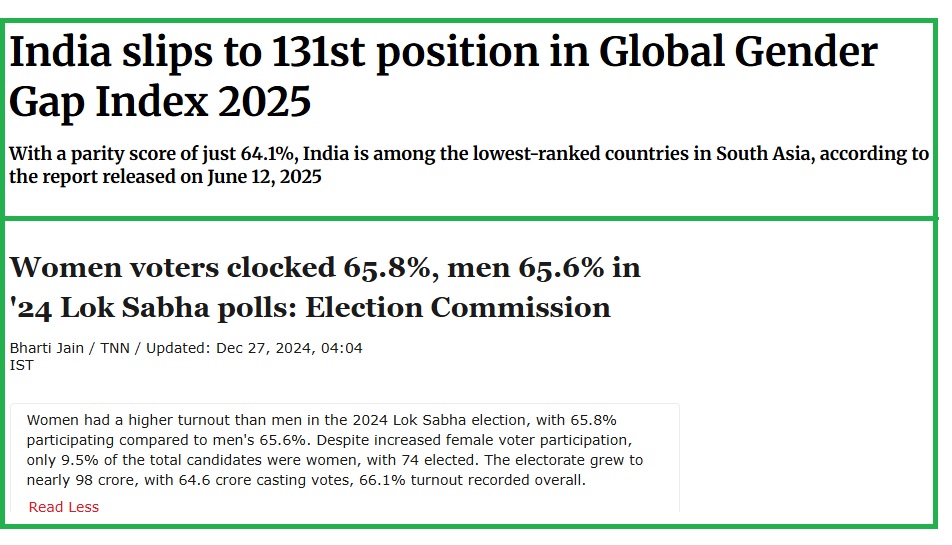
What are the Reasons for Low Representation?
1. Patriarchal Social Structure
Traditional gender norms restrict women’s participation in leadership roles.
2. Political Party Bias
Political parties often field fewer women candidates, limiting their opportunities.
3. Economic Constraints
Campaigning requires significant financial resources, which many women lack.
4. Lack of Political Networks
Women often have limited access to political mentorship and networks.
5. Violence and Safety Concerns
Harassment and violence in politics discourage women from contesting elections. Cyber-harassment and political violence deter women from public life.
6. Criminalization of Politics:
The prevalence of muscle and money power in elections discourages women from contesting.
Although women’s voter participation is rising, structural barriers still limit their representation in decision-making institutions. Comprehensive reforms are needed to achieve gender-balanced governance.
What are the Measures to Improve Participation?
1. Constitutional and Legal Measures
- The Constitution guarantees equality and non-discrimination on the basis of sex.
- The 73rd and 74th Constitutional Amendments introduced 33% reservation for women in Panchayats and Municipalities, which has significantly increased grassroots political participation.
2. Women’s Reservation in Parliament
The 106th Constitutional Amendment (2023) provides 33% reservation for women in the Lok Sabha and State Legislative Assemblies. This is expected to increase women’s representation in higher political institutions.
3. Capacity Building
- Training programmes for women leaders
- Support for women’s political wings in parties
- Greater media visibility
Why Women’s Political Participation is important?
Greater representation of women can:
1. Democratic Equality
Women constitute nearly half of India’s population; their representation is necessary for a truly representative democracy.
2. Better Policy Outcomes
Studies show that women leaders prioritize issues such as healthcare, education, and social welfare.
3. Gender-sensitive Governance
Women representatives are more likely to address gender-based discrimination and social issues.
4. Socio-economic Empowerment
Political participation enhances women’s status and decision-making power in society.
Way forward:
1. Implement 106th Constitutional Amendment:
Expedite implementation of the 106th Constitutional Amendment (Nari Shakti Vandan Adhiniyam, 2023) for 33% reservation in Parliament. Aligns with India’s international commitments under CEDAW (Convention on the Elimination of All Forms of Discrimination against Women) and the Beijing Declaration (1995), and with SDG 5 on gender equality.
- Limitations: Implementation is deferred until after the next census and delimitation exercise, effectively pushing it to 2029 or later.
2. Strenghten Women Leadership initiatives:
Strengthen the National Commission for Women (NCW) and leverage Self-Help Groups (SHGs) as leadership pipelines.
3. Election Commission Role:
Expand Election Commission initiatives like SVEEP (Systematic Voters’ Education and Electoral Participation) and Pink Booths (also known as Sakhi Polling Booths)to create safer electoral environments.
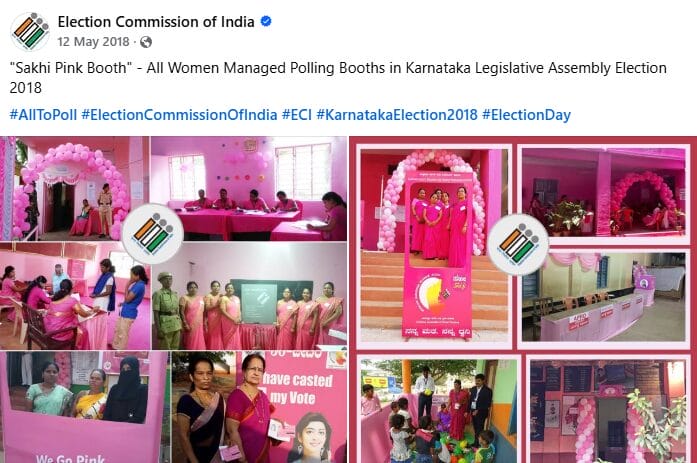
4. Political Party Reforms
Parties should allocate a minimum percentage of tickets to women candidates. Mandate political parties to field women in at least 33% of tickets through law.
5. Financial Support
Public funding mechanisms to support women candidates.
6. Social Awareness
Campaigns to challenge patriarchal attitudes and promote gender equality.
Conclusion
Despite constitutional guarantees and increasing voter participation, women remain significantly underrepresented in Indian politics. Effective implementation of reservation policies, political party reforms, and social transformation are necessary to ensure substantive political empowerment of women in India.
Practice Mains Questions
- Despite increasing voter turnout among women in India, their representation in political institutions remains low. Examine the reasons and suggest measures to improve women’s political participation.
- Women’s political participation is essential for inclusive and representative democracy. Discuss the importance of women’s representation in politics in the Indian context.
- Evaluate the role of constitutional provisions and reservation policies in promoting women’s political participation in India.
Source: https://anantamias.com/current-affairs/womens-political-participation-in-india/
A revision of GDP and its implications
Why in News
India’s Ministry of Statistics and Programme Implementation (MoSPI) released a new national accounts series with 2022–23 as the base year, replacing the earlier 2011–12 base year. The new series introduces updated data sources and improved statistical methods to measure economic growth more accurately.
UPSC Relevance:
GS III: Economy
What is GDP and Base Year?
GDP
Gross Domestic Product (GDP) is the total value of all final goods and services produced within a country during a given period.
Base Year
The base year is the reference year used to calculate real GDP (GDP at constant prices) by removing the effect of inflation.
Example
If base year = 2022-23, prices of that year are used to compare output in other years.
Why is base year revision done?
The base year is revised periodically to reflect structural shifts in the economy and to improve the accuracy of economic estimates. Such updates allow for methodological refinements and the integration of more comprehensive and reliable data sources.
The United Nations System of National Accounts (SNA 1993) recommends base-year updates every five years. India, which had historically revised roughly once per decade, is now committing to a more regular five-year cycle — a significant step towards aligning with global statistical best practices.
The last base year change was from 2004–05 to 2011–12 done in 2015.
Why was 2022–23 specifically chosen?
The year 2022–23 was chosen as the anchor because it represents the first stable post-COVID economic year — after the sharp contractions of 2019–21 and the recovery bounce of 2021–22. A stable, non-shock year is always preferred as the base.
Timeline of GDP Base Year in India
| Series | Base Year | Key Feature |
| Old series | 2004-05 | First major modern update |
| Previous series | 2011-12 | Introduced MCA-21 corporate database |
| New series | 2022-23 | Uses GST, digital data and improved methods |
Key methodological changes
1. Double deflation (biggest change)
The most important methodological change is the shift from the “single-deflator” method to the “double-deflation” method for calculating real Gross Value Added (GVA). In the old method, only output was adjusted for prices. Now, both output and intermediate inputs are separately deflated — making the measurement of real value addition far more precise.
Double deflation is being applied in sectors like manufacturing and agriculture. In other sectors, single extrapolation is being used. Deflators are being applied at a more detailed, granular level. These changes are expected to improve the accuracy and reliability of GDP deflators in the new series.
Real Value Added = Real Output – Real Intermediate Inputs
This improves accuracy especially in manufacturing where input prices and output prices move differently.
2. New data sources integrated
The revised series incorporates administrative datasets such as GST Network data and Public Financial Management System (PFMS) records.
| Data Source | Purpose |
| GST data | Business activity and value addition |
| e-Vahan | Automobile sector output |
| PFMS | Government expenditure |
| Corporate filings | Corporate sector performance |
| Household surveys | Consumption estimates |
These improve the coverage of the formal and informal economy.
3. Supply and Use Tables (SUT) framework
The new series provides a more accurate, consistent framework through the SUT structure, improving transparency and internal consistency across sectors.
| Supply Side | Use Side |
| Domestic production | Consumption |
| Imports | Investment |
| Exports |
This reduces statistical discrepancies.
4. Improved Measurement of the Informal Sector
Earlier approach
- Benchmarks from older surveys
New approach – New surveys incorporated
- Uses Annual Survey of Unincorporated Sector Enterprises (ASUSE)
- Combined with Periodic Labour Force Survey (PLFS) data
This allows annual estimates of the unorganised sector, instead of extrapolating old benchmarks.
5. Segregation of multi-activity enterprises
Enterprises engaged in multiple sectors are now separately classified, improving sectoral attribution.
Earlier method
- Entire company output assigned to dominant sector
New method
- Output allocated activity-wise based on revenue shares
Example
A company involved in manufacturing and services will now contribute to both sectors appropriately.
6. Improved Price Deflators
The new GDP estimates use more granular price indices (around 500–600 items from CPI and WPI) compared with around 180 earlier.
This improves inflation adjustment accuracy.
What do the new numbers say?
Absolute Size and Nominal Growth
- Smaller Denominator: The absolute nominal GDP for FY26 is now estimated at ₹345 lakh crore, roughly 3.3% lower than the previous estimate of ₹357 lakh crore.
- Historical Downward Revision: Nominal GDP levels for the past three years (FY24–FY26) were reduced by 3% to 4% compared to the old series.
- Nominal Growth Rate: Despite the lower base, nominal growth for FY26 is projected at 8.6%.
Real GDP Growth Revisions
The new series, based on 2022-23 prices, changed the growth trajectory as follows:
- FY24: Revised down to 7.2% from the earlier estimate of 9.2%.
- FY25: Revised up to 7.1% from the earlier 6.5%.
- FY26: Projected at 7.6%, higher than the 7.4% estimated under the old series.
The 2022–23 GDP has been revised to ₹261 lakh crore (from the previously reported ₹269 lakh crore), and FY 2025–26 GDP is estimated at ₹345 lakh crore (earlier ₹357 lakh crore). Per capita annual income is now ₹2,43,180 (earlier ₹2,51,393).
What are the Fiscal implications of these changes?
- Nominal GDP is now lower by 3–4%, even though real growth is higher. This creates a paradox with fiscal ratios:
- The fiscal deficit for FY26 is now estimated at 4.51% of GDP instead of 4.36%, even though the absolute deficit amount remains unchanged. Similarly, the debt-to-GDP ratio for FY27 is pegged at 57.5%, compared to the earlier target of 55.6%. This makes the government’s debt consolidation path toward its FY2031 target of reducing debt to 50% of GDP steeper.
- To achieve the targeted 4.3% fiscal deficit for 2026–27, the economy will now require a massive nominal growth rate of 13–14%, notably higher than the 10% assumption in Union Budget 2026–27, indicating the government may need to aggressively recalibrate its borrowing strategies.
- On the $5 trillion goal: GDP in FY 2025–26 stands at about $3.9 trillion at ₹88 per USD (earlier $4 trillion), indicating India is further from the $5 trillion target. India is expected to comfortably cross the $4 trillion mark during FY 2026–27.
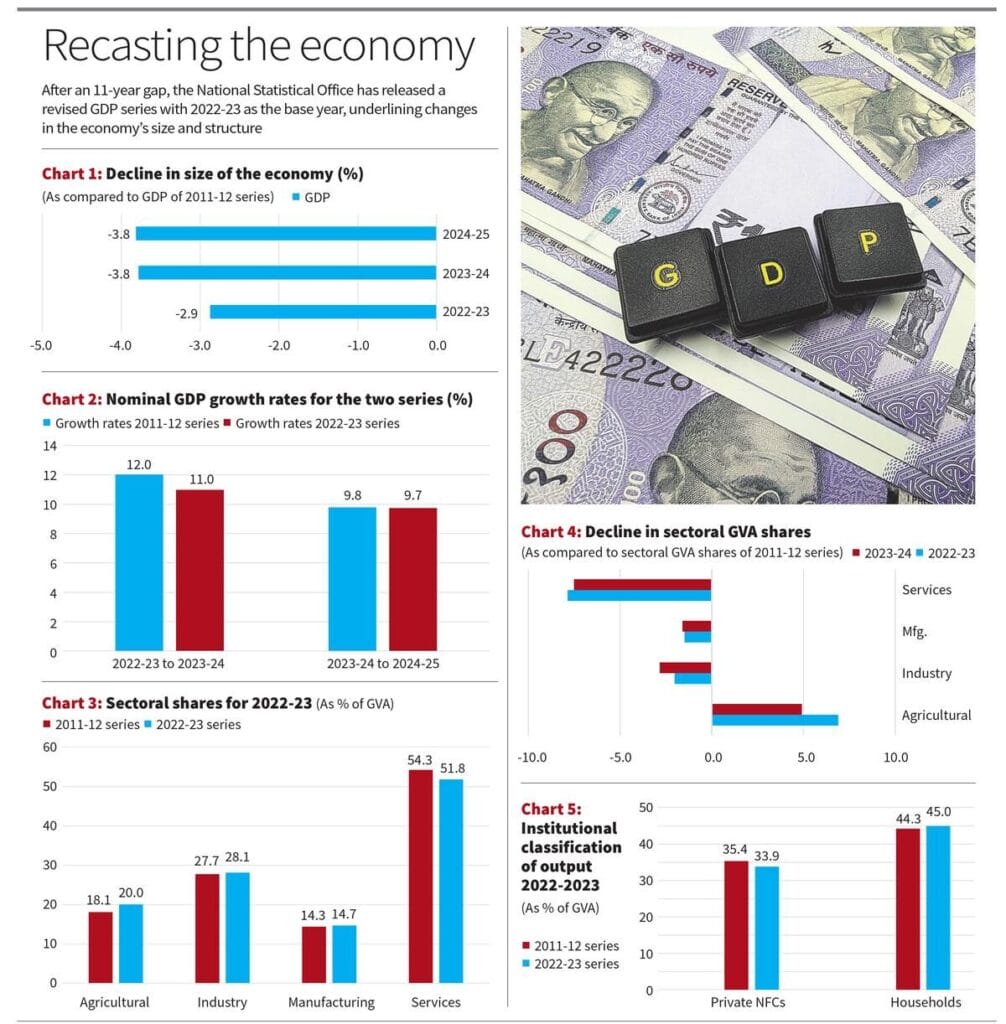
IMF context:
In November 2025, the IMF awarded India’s national accounts data a ‘C’ grade in its Data Adequacy for Surveillance (DAS) assessment. While India scored an ‘A’ for timeliness of data releases and a ‘B’ for granularity, its coverage quality — especially of the informal sector and use of outdated base-year data — drew sharp criticism. The new series directly addresses these concerns.
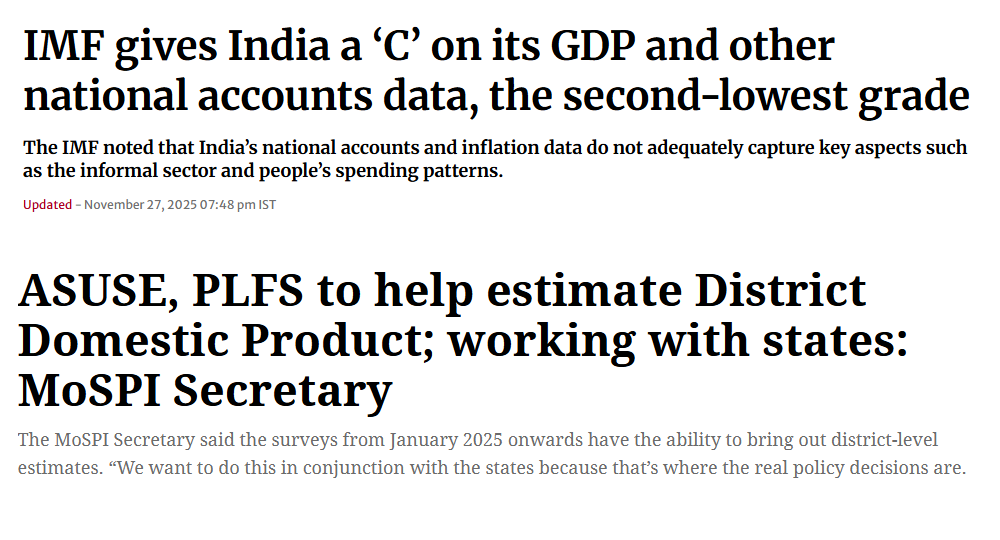
For how many year will the Back-series data be provided?
Back-series data is expected to be released by December 2026. As per the practice, in India, back-series estimates are recalculated using revised methodology of the new GDP series up to the previous base year. After that, the data is linked at a disaggregated level and extended back to 1950-51. However, the final method for preparing the back-series will be decided in consultation with the Advisory Committee set up to guide MoSPI.
Comparison with the international statistical standards:
India prepares GDP estimates according to the 2008 System of National Accounts (SNA 2008). The UN is now moving toward SNA 2025, and countries are expected to adopt it around 2029–30. India plans to adopt SNA 2025 in its next base year revision.
What are the Criticisms and Challenges?
- Heavy reliance on Ministry of Corporate Affairs data may overstate large firms’ performance while underestimating MSMEs that do not file timely returns.
- The WPI base year revision must also be completed swiftly to ensure that deflators used across all sectors represent current market realities.
- Administrative data (GST, corporate filings) may have reporting errors.
- Despite improvements, the unorganised sector is still difficult to measure accurately.
- New methodology makes comparison with older data difficult.
Conclusion
The new GDP series represents an important step toward modernising India’s statistical system, improving reliability of economic measurement and enabling better policy making, though continued improvements in data quality and transparency remain essential.
Practice MCQs:
With reference to the revised GDP series with 2022-23 as the base year, consider the following statements:
- The base year is used to remove the effect of inflation while calculating real GDP.
- India revises the GDP base year periodically to reflect structural changes in the economy.
- The base year revision directly changes the size of the population used for GDP calculation.
Which of the statements given above are correct?
A. 1 only
B. 1 and 2 only
C. 2 and 3 only
D. 1, 2 and 3
Answer: B
Which of the following data sources are used in the new GDP series with base year 2022-23?
- GST data
- Corporate filings database
- Periodic Labour Force Survey
- e-Vahan vehicle registration data
Select the correct answer using the code below.
A. 1 and 2 only
B. 1, 2 and 3 only
C. 1, 2 and 4 only
D. 1, 2, 3 and 4
Answer: D
Consider the following statements regarding Supply-Use Tables (SUT) used in national accounts:
- They help reduce statistical discrepancies in GDP estimation.
- They are used only for calculating agricultural GDP.
- They match production data with expenditure data in the economy.
Which of the statements given above are correct?
A. 1 only
B. 1 and 2 only
C. 2 and 3 only
D. 1, 2 and 3
Answer: C
The concept of double deflation, recently introduced in India’s revised GDP series, refers to:
A. Adjusting GDP for inflation using two different price indices
B. Separately deflating output and intermediate inputs to estimate real value added
C. Using both CPI and WPI simultaneously to estimate GDP
D. Removing inflation from both nominal GDP and per capita GDP
Answer: B
Which of the following indicators may be affected when nominal GDP estimates are revised?
- Fiscal deficit-to-GDP ratio
- Debt-to-GDP ratio
- Tax-to-GDP ratio
Select the correct answer using the code below.
A. 1 only
B. 1 and 2 only
C. 1, 2 and 3
D. 2 and 3 only
Answer: C
Which of the following best describes Gross Value Added (GVA)?
A. Total value of all goods produced in the economy
B. Value of output minus the value of intermediate inputs
C. GDP minus government expenditure
D. GDP adjusted for population
Answer: B
Source: https://anantamias.com/current-affairs/a-revision-of-gdp-and-its-implications/
Global Conference on Women in Agri-Food Systems Concludes
Why in News?
On 15 March 2026, Ministry of Agriculture and Farmers Welfare put Global Conference on Women in Agri-Food Systems Concludes in the spotlight through an official communication. The development is relevant because it speaks directly to themes that UPSC regularly tests in both factual and analytical form.
The official source, titled GCWAS-2026 Concludes with Renewed Global Commitment to Empower Women in Agri-Food Systems, helps place the issue in a wider policy context. For aspirants, the topic is useful not only for remembering the headline event but also for connecting it to governance, economy, diplomacy, infrastructure, environment, or social policy as required.

UPSC Relevance
- Prelims: schemes, target groups, campaigns, and institutions
- Mains: GS II on inclusion, welfare, gender, youth, and human development
What Happened?
The Global Conference on Women in Agri-Food Systems (GCWAS–2026) concluded on Saturday in New Delhi with a strong call for strengthening women’s leadership, participation, and innovation across agriculture and agri-food systems. The valedictory session marked the culmination of three days of global dialogue focused on advancing gender-responsive policies, inclusive innovations, and sustainable agricultural development.
Jat, Secretary, DARE and Director General, ICAR, as the Chief Guest. Other eminent dignitaries present at the valedictory session included Dr.
Prelims Focus
- Event date: 15 March 2026
- Primary source: Ministry of Agriculture and Farmers Welfare
- Ministry of Agriculture and Farmers Welfare
- GCWAS-2026 Concludes with Renewed Global Commitment to Empower Women in Agri-Food Systems
- Women farmers and institutional support
- Gender-responsive agriculture
Mains Focus
- The issue is useful for GS II answers on inclusion, empowerment, and state support for vulnerable groups.
- It highlights the importance of participation, access, and institutional delivery in social policy.
- The topic also helps relate welfare goals to broader developmental outcomes such as health, education, and dignity.
- A good mains answer should combine policy intent with implementation realities.
Why it Matters
For UPSC, the event matters because social-sector measures are important not only for welfare outcomes but also for questions of equity, participation, and state legitimacy. In exam terms, this topic can strengthen both short factual notes and longer answer-writing examples.
Exam Takeaways
- The event belongs to 15 March 2026 and should be linked to that day's current-affairs revision.
- The official source was Ministry of Agriculture and Farmers Welfare.
- Women farmers and institutional support
- Gender-responsive agriculture
- Rural livelihoods
Bottom Line
Global Conference on Women in Agri-Food Systems Concludes is relevant because it combines immediate current-affairs value with wider exam utility. For UPSC, the event matters because social-sector measures are important not only for welfare outcomes but also for questions of equity, participation, and state legitimacy.
Exam Oriented Questions
Why is this topic in the news?
It is in the news because an official development linked to global conference on women in agri-food systems concludes was recorded on 15 March 2026.
Which official source is associated with this development?
The primary official source is Ministry of Agriculture and Farmers Welfare, and aspirants should revise the linked release or official document.
What is the core issue involved in this topic?
The core issue involves women farmers and institutional support and its policy significance.
How is this topic relevant for UPSC Prelims?
It is useful for Prelims because it involves factual details such as institutions, initiatives, locations, or technical terms that can be directly asked.
How is this topic relevant for UPSC Mains?
It is useful for Mains because it can be linked to broader themes such as governance, economy, foreign policy, infrastructure, environment, or social inclusion.
Which broader policy area does this topic touch?
It touches inclusion, gender, youth, welfare delivery, and human development.
What should aspirants remember first from this topic?
Aspirants should first remember the event date, the official institution involved, and the headline takeaway from global conference on women in agri-food systems concludes.
How can this topic be used in answer writing?
It can be used as a recent example to support analytical points in GS answers, especially when explaining implementation, strategic relevance, or policy direction.
What factual areas should be revised from this topic?
Revise the institution involved, the exact development, and these quick points: Women farmers and institutional support, Gender-responsive agriculture, Rural livelihoods.
What is the one-line exam takeaway?
Global Conference on Women in Agri-Food Systems Concludes shows how a current event can combine factual recall with wider analytical value for both Prelims and Mains.
Source: https://anantamias.com/current-affairs/global-conference-on-women-in-agri-food-systems-concludes/
FASTag Annual Pass Revision Enters the Road-User Debate
Why in News?
On 15 March 2026, Ministry of Road Transport and Highways put FASTag Annual Pass Revision Enters the Road-User Debate in the spotlight through an official communication. The development is relevant because it speaks directly to themes that UPSC regularly tests in both factual and analytical form.
The official source, titled NHAI to Revise FASTag Annual Pass Fee from 1st April 2026 for FY 2026–27, helps place the issue in a wider policy context. For aspirants, the topic is useful not only for remembering the headline event but also for connecting it to governance, economy, diplomacy, infrastructure, environment, or social policy as required.

UPSC Relevance
- Prelims: projects, corridors, airports, waterways, logistics institutions, and regulatory bodies
- Mains: GS III on infrastructure, transport, growth, and regional development
What Happened?
National Highways Authority of India has announced the revision of the applicable fee for the FASTag Annual Pass from the current Rs. 3,075 for the Financial Year 2026–27 .
The increased fee will be applicable from 1st April 2026 . The revision in the fee has been carried out in accordance with the provisions of the National Highways Fee (Determination of Rates and Collection) Rules, 2008 .
Prelims Focus
- Event date: 15 March 2026
- Primary source: Ministry of Road Transport and Highways
- Ministry of Road Transport and Highways
- NHAI to Revise FASTag Annual Pass Fee from 1st April 2026 for FY 2026–27
- User charges and highway management
- Digital tolling systems
Mains Focus
- This issue shows why infrastructure is treated as a force multiplier for growth, logistics, and regional integration.
- It is relevant for GS III answers on multimodal connectivity, PPPs, urbanisation, and productivity gains.
- The topic also underlines the importance of regulation, last-mile delivery, and coordination across levels of government.
- A good mains answer should assess both capacity creation and the challenge of inclusive access.
Why it Matters
For UPSC, the event matters because infrastructure announcements are rarely just engineering stories; they reshape mobility, economic geography, logistics, and state capacity. In exam terms, this topic can strengthen both short factual notes and longer answer-writing examples.
Exam Takeaways
- The event belongs to 15 March 2026 and should be linked to that day's current-affairs revision.
- The official source was Ministry of Road Transport and Highways.
- User charges and highway management
- Digital tolling systems
- Transport governance
Bottom Line
FASTag Annual Pass Revision Enters the Road-User Debate is relevant because it combines immediate current-affairs value with wider exam utility. For UPSC, the event matters because infrastructure announcements are rarely just engineering stories; they reshape mobility, economic geography, logistics, and state capacity.
Exam Oriented Questions
Why is this topic in the news?
It is in the news because an official development linked to fastag annual pass revision enters the road-user debate was recorded on 15 March 2026.
Which official source is associated with this development?
The primary official source is Ministry of Road Transport and Highways, and aspirants should revise the linked release or official document.
What is the core issue involved in this topic?
The core issue involves user charges and highway management and its policy significance.
How is this topic relevant for UPSC Prelims?
It is useful for Prelims because it involves factual details such as institutions, initiatives, locations, or technical terms that can be directly asked.
How is this topic relevant for UPSC Mains?
It is useful for Mains because it can be linked to broader themes such as governance, economy, foreign policy, infrastructure, environment, or social inclusion.
Which broader policy area does this topic touch?
It touches transport, logistics, connectivity, regional development, and state capacity.
What should aspirants remember first from this topic?
Aspirants should first remember the event date, the official institution involved, and the headline takeaway from fastag annual pass revision enters the road-user debate.
How can this topic be used in answer writing?
It can be used as a recent example to support analytical points in GS answers, especially when explaining implementation, strategic relevance, or policy direction.
What factual areas should be revised from this topic?
Revise the institution involved, the exact development, and these quick points: User charges and highway management, Digital tolling systems, Transport governance.
What is the one-line exam takeaway?
FASTag Annual Pass Revision Enters the Road-User Debate shows how a current event can combine factual recall with wider analytical value for both Prelims and Mains.
Source: https://anantamias.com/current-affairs/fastag-annual-pass-revision-enters-the-road-user-debate/
Petroleum Ministry Tracks West Asia Risks and Supply Lines
Why in News?
On 15 March 2026, Ministry of Petroleum and Natural Gas put Petroleum Ministry Tracks West Asia Risks and Supply Lines in the spotlight through an official communication. The development is relevant because it speaks directly to themes that UPSC regularly tests in both factual and analytical form.
The official source, titled Updates on Key Sectors in View of Developments in West Asia, helps place the issue in a wider policy context. For aspirants, the topic is useful not only for remembering the headline event but also for connecting it to governance, economy, diplomacy, infrastructure, environment, or social policy as required.

UPSC Relevance
- Prelims: indices, institutions, agreements, sectors, and key data points
- Mains: GS III on growth, trade, inflation, energy, and economic policy
What Happened?
Updates on the preparedness and response measures being undertaken by the Government of India in view of the recent developments in West Asia are shared below. These relate to energy supply management, maritime operations, the welfare of Indian nationals in the region and public communication measures.
Energy Supply and Fuel Availability
Steps have been taken to ensure stable availability of petroleum products and LPG across the country. Necessary arrangements are in place to maintain regular supply and distribution.
Prelims Focus
- Event date: 15 March 2026
- Primary source: Ministry of Petroleum and Natural Gas
- Ministry of Petroleum and Natural Gas
- Updates on Key Sectors in View of Developments in West Asia
- Energy import dependence
- Strategic risk monitoring
Mains Focus
- The development shows how policy, regulation, and macro data shape growth prospects and state capacity.
- It can be used in GS III answers on economic management, infrastructure finance, or sectoral reforms.
- The issue also helps connect headline announcements with implementation challenges on the ground.
- A balanced answer should mention both opportunity creation and the need for institutional follow-through.
Why it Matters
For UPSC, the larger value lies in understanding how the announcement affects growth, investment, markets, production systems, or the broader policy environment rather than treating it as a stand-alone news event. In exam terms, this topic can strengthen both short factual notes and longer answer-writing examples.
Exam Takeaways
- The event belongs to 15 March 2026 and should be linked to that day's current-affairs revision.
- The official source was Ministry of Petroleum and Natural Gas.
- Energy import dependence
- Strategic risk monitoring
- Oil and gas security
Bottom Line
Petroleum Ministry Tracks West Asia Risks and Supply Lines is relevant because it combines immediate current-affairs value with wider exam utility. For UPSC, the larger value lies in understanding how the announcement affects growth, investment, markets, production systems, or the broader policy environment rather than treating it as a stand-alone news event.
Exam Oriented Questions
Why is this topic in the news?
It is in the news because an official development linked to petroleum ministry tracks west asia risks and supply lines was recorded on 15 March 2026.
Which official source is associated with this development?
The primary official source is Ministry of Petroleum and Natural Gas, and aspirants should revise the linked release or official document.
What is the core issue involved in this topic?
The core issue involves energy import dependence and its policy significance.
How is this topic relevant for UPSC Prelims?
It is useful for Prelims because it involves factual details such as institutions, initiatives, locations, or technical terms that can be directly asked.
How is this topic relevant for UPSC Mains?
It is useful for Mains because it can be linked to broader themes such as governance, economy, foreign policy, infrastructure, environment, or social inclusion.
Which broader policy area does this topic touch?
It touches the economic policy area, especially growth, trade, inflation, energy, or sectoral competitiveness.
What should aspirants remember first from this topic?
Aspirants should first remember the event date, the official institution involved, and the headline takeaway from petroleum ministry tracks west asia risks and supply lines.
How can this topic be used in answer writing?
It can be used as a recent example to support analytical points in GS answers, especially when explaining implementation, strategic relevance, or policy direction.
What factual areas should be revised from this topic?
Revise the institution involved, the exact development, and these quick points: Energy import dependence, Strategic risk monitoring, Oil and gas security.
What is the one-line exam takeaway?
Petroleum Ministry Tracks West Asia Risks and Supply Lines shows how a current event can combine factual recall with wider analytical value for both Prelims and Mains.
Source: https://anantamias.com/current-affairs/petroleum-ministry-tracks-west-asia-risks-and-supply-lines/
Merchandise Exports Data for April-February 2025-26 Offers a Trade Check
Why in News?
On 16 March 2026, Ministry of Commerce and Industry put Merchandise Exports Data for April-February 2025-26 Offers a Trade Check in the spotlight through an official communication. The development is relevant because it speaks directly to themes that UPSC regularly tests in both factual and analytical form.
The official source, titled The cumulative exports (merchandise & services) during April-February 2025-26 is estimated at US$ 790.86 Billion, as compared to US$ 747.58 Billion in April-February 2024-25, an estimated growth of 5.79%., helps place the issue in a wider policy context. For aspirants, the topic is useful not only for remembering the headline event but also for connecting it to governance, economy, diplomacy, infrastructure, environment, or social policy as required.

UPSC Relevance
- Prelims: indices, institutions, agreements, sectors, and key data points
- Mains: GS III on growth, trade, inflation, energy, and economic policy
What Happened?
Table 1: Trade during February 2026*
- Note: The latest data for services sector released by RBI is for January 2026. The data for February 2026 is an estimation.
(ii) Data for April-February 2024-25 and April-December 2025 has been revised on pro-rata basis using quarterly balance of payments data. Fig 1: Total Trade during February 2026*
Table 2: Trade during April-February 2025-26*
Fig 2: Total Trade during April-February 2025-26*
Fig 3: Merchandise Trade during February 2026
Fig 4: Merchandise Trade during April-February 2025-26
Table 3: Trade excluding Petroleum and Gems & Jewellery during February 2026
Prelims Focus
- Event date: 16 March 2026
- Primary source: Ministry of Commerce and Industry
- Ministry of Commerce and Industry
- The cumulative exports (merchandise & services) during April-February 2025-26 is estimated at US$ 790.86 Billion, as compared to US$ 747.58 Billion in April-February 2024-25, an estimated growth of 5.79%.
- External sector trends
- Export resilience and composition
Mains Focus
- The development shows how policy, regulation, and macro data shape growth prospects and state capacity.
- It can be used in GS III answers on economic management, infrastructure finance, or sectoral reforms.
- The issue also helps connect headline announcements with implementation challenges on the ground.
- A balanced answer should mention both opportunity creation and the need for institutional follow-through.
Why it Matters
For UPSC, the larger value lies in understanding how the announcement affects growth, investment, markets, production systems, or the broader policy environment rather than treating it as a stand-alone news event. In exam terms, this topic can strengthen both short factual notes and longer answer-writing examples.
Exam Takeaways
- The event belongs to 16 March 2026 and should be linked to that day's current-affairs revision.
- The official source was Ministry of Commerce and Industry.
- External sector trends
- Export resilience and composition
- Useful GS III data point
Bottom Line
Merchandise Exports Data for April-February 2025-26 Offers a Trade Check is relevant because it combines immediate current-affairs value with wider exam utility. For UPSC, the larger value lies in understanding how the announcement affects growth, investment, markets, production systems, or the broader policy environment rather than treating it as a stand-alone news event.
Exam Oriented Questions
Why is this topic in the news?
It is in the news because an official development linked to merchandise exports data for april-february 2025-26 offers a trade check was recorded on 16 March 2026.
Which official source is associated with this development?
The primary official source is Ministry of Commerce and Industry, and aspirants should revise the linked release or official document.
What is the core issue involved in this topic?
The core issue involves external sector trends and its policy significance.
How is this topic relevant for UPSC Prelims?
It is useful for Prelims because it involves factual details such as institutions, initiatives, locations, or technical terms that can be directly asked.
How is this topic relevant for UPSC Mains?
It is useful for Mains because it can be linked to broader themes such as governance, economy, foreign policy, infrastructure, environment, or social inclusion.
Which broader policy area does this topic touch?
It touches the economic policy area, especially growth, trade, inflation, energy, or sectoral competitiveness.
What should aspirants remember first from this topic?
Aspirants should first remember the event date, the official institution involved, and the headline takeaway from merchandise exports data for april-february 2025-26 offers a trade check.
How can this topic be used in answer writing?
It can be used as a recent example to support analytical points in GS answers, especially when explaining implementation, strategic relevance, or policy direction.
What factual areas should be revised from this topic?
Revise the institution involved, the exact development, and these quick points: External sector trends, Export resilience and composition, Useful GS III data point.
What is the one-line exam takeaway?
Merchandise Exports Data for April-February 2025-26 Offers a Trade Check shows how a current event can combine factual recall with wider analytical value for both Prelims and Mains.
Wholesale Price Index for February 2026 Updates the Inflation Picture
Why in News?
On 16 March 2026, Ministry of Commerce and Industry put Wholesale Price Index for February 2026 Updates the Inflation Picture in the spotlight through an official communication. The development is relevant because it speaks directly to themes that UPSC regularly tests in both factual and analytical form.
The official source, titled Index Numbers of Wholesale Price in India for the Month of February, 2026 (Base Year: 2011-12), helps place the issue in a wider policy context. For aspirants, the topic is useful not only for remembering the headline event but also for connecting it to governance, economy, diplomacy, infrastructure, environment, or social policy as required.

UPSC Relevance
- Prelims: indices, institutions, agreements, sectors, and key data points
- Mains: GS III on growth, trade, inflation, energy, and economic policy
What Happened?
The annual rate of inflation based on All India Wholesale Price Index (WPI) number is 2.13% (provisional) for the month of February, 2026 (over February, 2025). Positive rate of inflation in February, 2026 is primarily due to increase in prices of other manufacturing, manufacture of basic metals, non-food articles, food articles and textiles etc.
The index numbers and inflation rate for the last three months of all commodities and WPI components are given below:
Index Numbers and Annual Rate of Inflation (Y-o-Y in %) *
Note: F: Final, P: Provisional, *Annual rate of WPI inflation is calculated over the corresponding month of previous year
- The month over month change in WPI for the month of February, 2026 stood at 0.25 % as compared to January, 2026.
Prelims Focus
- Event date: 16 March 2026
- Primary source: Ministry of Commerce and Industry
- Ministry of Commerce and Industry
- Index Numbers of Wholesale Price in India for the Month of February, 2026 (Base Year: 2011-12)
- Inflation measurement
- Input cost pressures
Mains Focus
- The development shows how policy, regulation, and macro data shape growth prospects and state capacity.
- It can be used in GS III answers on economic management, infrastructure finance, or sectoral reforms.
- The issue also helps connect headline announcements with implementation challenges on the ground.
- A balanced answer should mention both opportunity creation and the need for institutional follow-through.
Why it Matters
For UPSC, the larger value lies in understanding how the announcement affects growth, investment, markets, production systems, or the broader policy environment rather than treating it as a stand-alone news event. In exam terms, this topic can strengthen both short factual notes and longer answer-writing examples.
Exam Takeaways
- The event belongs to 16 March 2026 and should be linked to that day's current-affairs revision.
- The official source was Ministry of Commerce and Industry.
- Inflation measurement
- Input cost pressures
- Difference between WPI and CPI
Bottom Line
Wholesale Price Index for February 2026 Updates the Inflation Picture is relevant because it combines immediate current-affairs value with wider exam utility. For UPSC, the larger value lies in understanding how the announcement affects growth, investment, markets, production systems, or the broader policy environment rather than treating it as a stand-alone news event.
Exam Oriented Questions
Why is this topic in the news?
It is in the news because an official development linked to wholesale price index for february 2026 updates the inflation picture was recorded on 16 March 2026.
Which official source is associated with this development?
The primary official source is Ministry of Commerce and Industry, and aspirants should revise the linked release or official document.
What is the core issue involved in this topic?
The core issue involves inflation measurement and its policy significance.
How is this topic relevant for UPSC Prelims?
It is useful for Prelims because it involves factual details such as institutions, initiatives, locations, or technical terms that can be directly asked.
How is this topic relevant for UPSC Mains?
It is useful for Mains because it can be linked to broader themes such as governance, economy, foreign policy, infrastructure, environment, or social inclusion.
Which broader policy area does this topic touch?
It touches the economic policy area, especially growth, trade, inflation, energy, or sectoral competitiveness.
What should aspirants remember first from this topic?
Aspirants should first remember the event date, the official institution involved, and the headline takeaway from wholesale price index for february 2026 updates the inflation picture.
How can this topic be used in answer writing?
It can be used as a recent example to support analytical points in GS answers, especially when explaining implementation, strategic relevance, or policy direction.
What factual areas should be revised from this topic?
Revise the institution involved, the exact development, and these quick points: Inflation measurement, Input cost pressures, Difference between WPI and CPI.
What is the one-line exam takeaway?
Wholesale Price Index for February 2026 Updates the Inflation Picture shows how a current event can combine factual recall with wider analytical value for both Prelims and Mains.
GRAP Revocation Reflects Improved Air Quality Conditions
Why in News?
On 16 March 2026, Ministry of Environment, Forest and Climate Change put GRAP Revocation Reflects Improved Air Quality Conditions in the spotlight through an official communication. The development is relevant because it speaks directly to themes that UPSC regularly tests in both factual and analytical form.
The official source, titled CAQM revokes GRAP Stage-I across Delhi-NCR as AQI improves to ‘Moderate’ category, helps place the issue in a wider policy context. For aspirants, the topic is useful not only for remembering the headline event but also for connecting it to governance, economy, diplomacy, infrastructure, environment, or social policy as required.

UPSC Relevance
- Prelims: species, conventions, climate terms, standards, and institutions
- Mains: GS III on conservation, climate policy, and sustainability
What Happened?
The Sub-Committee on Graded Response Action Plan (GRAP) of the Commission for Air Quality Management in NCR and Adjoining Areas (CAQM) on Monday revoked all actions under Stage-I of the extant schedule of GRAP across the entire National Capital Region (NCR) with immediate effect, following a significant improvement in Delhi’s air quality due to favourable meteorological conditions. Delhi’s daily average Air Quality Index (AQI) improved from 175 on 15.03.2026 to 119 on 16.03.2026, as per the AQI Bulletin provided by the Central Pollution Control Board (CPCB).
Taking note of the improvement, the CAQM Sub-Committee on GRAP met today to review the current air quality scenario in the region, along with forecasts for meteorological conditions and air quality index made available by IMD and IITM. CAQM Sub-Committee on GRAP revokes Stage-I of the extant schedule of #GRAP in the entire #NCR , with immediate effect.
Prelims Focus
- Event date: 16 March 2026
- Primary source: Ministry of Environment, Forest and Climate Change
- Ministry of Environment, Forest and Climate Change
- CAQM revokes GRAP Stage-I across Delhi-NCR as AQI improves to ‘Moderate’ category
- Air quality governance in NCR
- Emergency response frameworks
Mains Focus
- The issue is useful for GS III answers on conservation, climate governance, and sustainable development.
- It highlights how environmental goals increasingly intersect with livelihoods, technology, and federal cooperation.
- The topic also helps in linking international commitments with domestic implementation.
- A balanced answer should note ecological urgency along with enforcement and funding constraints.
Why it Matters
For UPSC, the larger value lies in connecting the immediate conservation or climate event with long-term ecological security, institutions, and sustainable development choices. In exam terms, this topic can strengthen both short factual notes and longer answer-writing examples.
Exam Takeaways
- The event belongs to 16 March 2026 and should be linked to that day's current-affairs revision.
- The official source was Ministry of Environment, Forest and Climate Change.
- Air quality governance in NCR
- Emergency response frameworks
- Environmental regulation and urban health
Bottom Line
GRAP Revocation Reflects Improved Air Quality Conditions is relevant because it combines immediate current-affairs value with wider exam utility. For UPSC, the larger value lies in connecting the immediate conservation or climate event with long-term ecological security, institutions, and sustainable development choices.
Exam Oriented Questions
Why is this topic in the news?
It is in the news because an official development linked to grap revocation reflects improved air quality conditions was recorded on 16 March 2026.
Which official source is associated with this development?
The primary official source is Ministry of Environment, Forest and Climate Change, and aspirants should revise the linked release or official document.
What is the core issue involved in this topic?
The core issue involves air quality governance in ncr and its policy significance.
How is this topic relevant for UPSC Prelims?
It is useful for Prelims because it involves factual details such as institutions, initiatives, locations, or technical terms that can be directly asked.
How is this topic relevant for UPSC Mains?
It is useful for Mains because it can be linked to broader themes such as governance, economy, foreign policy, infrastructure, environment, or social inclusion.
Which broader policy area does this topic touch?
It touches conservation, climate action, sustainability, and ecological governance.
What should aspirants remember first from this topic?
Aspirants should first remember the event date, the official institution involved, and the headline takeaway from grap revocation reflects improved air quality conditions.
How can this topic be used in answer writing?
It can be used as a recent example to support analytical points in GS answers, especially when explaining implementation, strategic relevance, or policy direction.
What factual areas should be revised from this topic?
Revise the institution involved, the exact development, and these quick points: Air quality governance in NCR, Emergency response frameworks, Environmental regulation and urban health.
What is the one-line exam takeaway?
GRAP Revocation Reflects Improved Air Quality Conditions shows how a current event can combine factual recall with wider analytical value for both Prelims and Mains.
Source: https://anantamias.com/current-affairs/grap-revocation-reflects-improved-air-quality-conditions/
Women Directors Lead a Growing Share of Indian Startups
Why in News?
On 17 March 2026, Ministry of Commerce and Industry put Women Directors Lead a Growing Share of Indian Startups in the spotlight through an official communication. The development is relevant because it speaks directly to themes that UPSC regularly tests in both factual and analytical form.
The official source, titled Over 1 Lakh Startups have at Least One-Woman Director/Partner Among 2.12 Lakh Recognised by DPIIT, helps place the issue in a wider policy context. For aspirants, the topic is useful not only for remembering the headline event but also for connecting it to governance, economy, diplomacy, infrastructure, environment, or social policy as required.

UPSC Relevance
- Prelims: indices, institutions, agreements, sectors, and key data points
- Mains: GS III on growth, trade, inflation, energy, and economic policy
What Happened?
Startup India initiative was launched on 16th January 2016, with an intent to build a strong ecosystem for nurturing innovation, startups and encouraging investments in the startup ecosystem of the country. As on 31st January 2026, a total of 2,12,283 entities have been recognised as startups by the Department for Promotion of Industry and Internal Trade (DPIIT).
Of the total entities recognised as startups, 1,02,054 entities have at least one-woman director/partner. As on 31st January 2026, a total of 2,12,283 entities have been recognised as startups by DPIIT.
Prelims Focus
- Event date: 17 March 2026
- Primary source: Ministry of Commerce and Industry
- Ministry of Commerce and Industry
- Over 1 Lakh Startups have at Least One-Woman Director/Partner Among 2.12 Lakh Recognised by DPIIT
- Women entrepreneurship and startups
- Inclusion in innovation ecosystems
Mains Focus
- The development shows how policy, regulation, and macro data shape growth prospects and state capacity.
- It can be used in GS III answers on economic management, infrastructure finance, or sectoral reforms.
- The issue also helps connect headline announcements with implementation challenges on the ground.
- A balanced answer should mention both opportunity creation and the need for institutional follow-through.
Why it Matters
For UPSC, the larger value lies in understanding how the announcement affects growth, investment, markets, production systems, or the broader policy environment rather than treating it as a stand-alone news event. In exam terms, this topic can strengthen both short factual notes and longer answer-writing examples.
Exam Takeaways
- The event belongs to 17 March 2026 and should be linked to that day's current-affairs revision.
- The official source was Ministry of Commerce and Industry.
- Women entrepreneurship and startups
- Inclusion in innovation ecosystems
- Enterprise development
Bottom Line
Women Directors Lead a Growing Share of Indian Startups is relevant because it combines immediate current-affairs value with wider exam utility. For UPSC, the larger value lies in understanding how the announcement affects growth, investment, markets, production systems, or the broader policy environment rather than treating it as a stand-alone news event.
Exam Oriented Questions
Why is this topic in the news?
It is in the news because an official development linked to women directors lead a growing share of indian startups was recorded on 17 March 2026.
Which official source is associated with this development?
The primary official source is Ministry of Commerce and Industry, and aspirants should revise the linked release or official document.
What is the core issue involved in this topic?
The core issue involves women entrepreneurship and startups and its policy significance.
How is this topic relevant for UPSC Prelims?
It is useful for Prelims because it involves factual details such as institutions, initiatives, locations, or technical terms that can be directly asked.
How is this topic relevant for UPSC Mains?
It is useful for Mains because it can be linked to broader themes such as governance, economy, foreign policy, infrastructure, environment, or social inclusion.
Which broader policy area does this topic touch?
It touches the economic policy area, especially growth, trade, inflation, energy, or sectoral competitiveness.
What should aspirants remember first from this topic?
Aspirants should first remember the event date, the official institution involved, and the headline takeaway from women directors lead a growing share of indian startups.
How can this topic be used in answer writing?
It can be used as a recent example to support analytical points in GS answers, especially when explaining implementation, strategic relevance, or policy direction.
What factual areas should be revised from this topic?
Revise the institution involved, the exact development, and these quick points: Women entrepreneurship and startups, Inclusion in innovation ecosystems, Enterprise development.
What is the one-line exam takeaway?
Women Directors Lead a Growing Share of Indian Startups shows how a current event can combine factual recall with wider analytical value for both Prelims and Mains.
Source: https://anantamias.com/current-affairs/women-directors-lead-a-growing-share-of-indian-startups/
National Defence Industries Conclave Highlights Self-Reliance
Why in News?
On 17 March 2026, Ministry of Defence put National Defence Industries Conclave Highlights Self-Reliance in the spotlight through an official communication. The development is relevant because it speaks directly to themes that UPSC regularly tests in both factual and analytical form.
The official source, titled Raksha Mantri to inaugurate DDP’s National Defence Industries Conclave 2026 on ‘Advanced Manufacturing Technologies’ in New Delhi, helps place the issue in a wider policy context. For aspirants, the topic is useful not only for remembering the headline event but also for connecting it to governance, economy, diplomacy, infrastructure, environment, or social policy as required.

UPSC Relevance
- Prelims: technologies, institutions, initiatives, and applications
- Mains: GS III on innovation, strategic technologies, and state capacity
What Happened?
The National Defence Industries Conclave (NDIC) 2026, organised by the Department of Defence Production (DDP) on the theme ‘Advanced Manufacturing Technologies’ , will be held at Manekshaw Centre, New Delhi on March 19-20, 2026. The two-day event will be inaugurated by Raksha Mantri Shri Rajnath Singh.
The conclave aims to strengthen the integration of Micro, Small & Medium Enterprises (MSMEs) to India’s defence manufacturing ecosystem while promoting the adoption of advanced technologies such as automation, artificial intelligence, robotics, additive manufacturing, digital twins and smart materials. The initiative aligns with the Government’s vision of Aatmanirbharta in defence, and seeks to enhance India’s technological capability and global competitiveness in defence production.
Prelims Focus
- Event date: 17 March 2026
- Primary source: Ministry of Defence
- Ministry of Defence
- Raksha Mantri to inaugurate DDP’s National Defence Industries Conclave 2026 on ‘Advanced Manufacturing Technologies’ in New Delhi
- Defence manufacturing and Atmanirbhar Bharat
- Industrial base and strategic capability
Mains Focus
- The development is relevant for GS III answers on innovation, strategic technologies, and technology-led public policy.
- It shows how science and technology initiatives increasingly affect resilience, productivity, and national capability.
- The topic offers good material to connect research outcomes with practical governance outcomes.
- A strong answer should mention both promise and the need for institutional scale-up.
Why it Matters
For UPSC, the event matters because science and technology topics increasingly move from laboratories into governance, strategic policy, and everyday life. In exam terms, this topic can strengthen both short factual notes and longer answer-writing examples.
Exam Takeaways
- The event belongs to 17 March 2026 and should be linked to that day's current-affairs revision.
- The official source was Ministry of Defence.
- Defence manufacturing and Atmanirbhar Bharat
- Industrial base and strategic capability
- GS III security relevance
Bottom Line
National Defence Industries Conclave Highlights Self-Reliance is relevant because it combines immediate current-affairs value with wider exam utility. For UPSC, the event matters because science and technology topics increasingly move from laboratories into governance, strategic policy, and everyday life.
Exam Oriented Questions
Why is this topic in the news?
It is in the news because an official development linked to national defence industries conclave highlights self-reliance was recorded on 17 March 2026.
Which official source is associated with this development?
The primary official source is Ministry of Defence, and aspirants should revise the linked release or official document.
What is the core issue involved in this topic?
The core issue involves defence manufacturing and atmanirbhar bharat and its policy significance.
How is this topic relevant for UPSC Prelims?
It is useful for Prelims because it involves factual details such as institutions, initiatives, locations, or technical terms that can be directly asked.
How is this topic relevant for UPSC Mains?
It is useful for Mains because it can be linked to broader themes such as governance, economy, foreign policy, infrastructure, environment, or social inclusion.
Which broader policy area does this topic touch?
It touches innovation policy, strategic technology, forecasting, or technology-led governance.
What should aspirants remember first from this topic?
Aspirants should first remember the event date, the official institution involved, and the headline takeaway from national defence industries conclave highlights self-reliance.
How can this topic be used in answer writing?
It can be used as a recent example to support analytical points in GS answers, especially when explaining implementation, strategic relevance, or policy direction.
What factual areas should be revised from this topic?
Revise the institution involved, the exact development, and these quick points: Defence manufacturing and Atmanirbhar Bharat, Industrial base and strategic capability, GS III security relevance.
What is the one-line exam takeaway?
National Defence Industries Conclave Highlights Self-Reliance shows how a current event can combine factual recall with wider analytical value for both Prelims and Mains.