The Online Gaming Rules 2026 came into force on May 1, 2026, and they redraw the regulatory map of one of India’s fastest growing digital sectors. The Ministry of Electronics and Information Technology notified the Promotion and Regulation of Online Gaming Rules, 2026 to operationalise the parent Online Gaming Act, 2025, and the rules do three things at once: they create a central regulator called the Online Gaming Authority of India (OGAI), they classify all online games into three buckets with sharply different treatment, and they prohibit online money gaming altogether.
That last piece is the headline. India’s real-money fantasy sports and rummy industry, which had grown into a multi-billion-dollar sector built on the legal distinction between games of skill and games of chance, has now been brought to a hard stop by central government rule rather than state-by-state legislation. The Online Gaming Rules 2026 do not just regulate. They restructure the market.
This explainer covers what the Online Gaming Rules 2026 actually contain, the legal history that produced them, the role of OGAI, the e-sports promotion track that runs in parallel, and where the constitutional fight is likely to go next.
Quick Facts at a Glance
- Notification: Promotion and Regulation of Online Gaming Rules, 2026, notified by MeitY in late April 2026.
- Effective date: May 1, 2026.
- Parent legislation: Online Gaming Act, 2025.
- Three game categories: e-sports, online social games, online money games.
- Online money games: prohibited.
- Online Gaming Authority of India (OGAI): central statutory regulator.
- Earlier framework: 2023 amendment to the IT Rules created Self-Regulatory Bodies (SRBs); the new rules replace that approach.
- Ministry of Youth Affairs and Sports recognized e-sports as a competitive sporting event in 2022.
- Constitutional anchor: Entry 31 of the Union List (broadcasting and communication) and Article 19(1)(g) (right to practice trade) are the two contested ends of the policy.
What Just Happened
The May 1 notification operationalises a regulatory framework that had been building since 2022. The 2023 IT Rules amendment had attempted to handle online gaming through self-regulatory bodies, but the SRB approach struggled. Industry-led bodies could not agree on a common rulebook for permissible money games, and several state governments enacted their own bans on real-money formats, creating a patchwork that the central government found unsustainable.
The Online Gaming Act, 2025 was the legislative response. It established statutory regulation in place of self-regulation, created the Online Gaming Authority of India, and authorised the central government to notify rules for the operation of online games. The Online Gaming Rules 2026 are those notification rules.
Three changes take effect immediately. First, every operator offering online games to Indian users must register with OGAI. Second, e-sports operators receive a clear definitional status and access to the e-sports promotion ecosystem coordinated with the Ministry of Youth Affairs and Sports. Third, online money gaming, defined to include any online game where users pay or stake money or money’s worth in the expectation of winning money or money’s worth, is prohibited.
Background and Historical Context
To understand the Online Gaming Rules 2026, you have to start with the games of skill versus chance line that Indian courts have been drawing for over six decades.
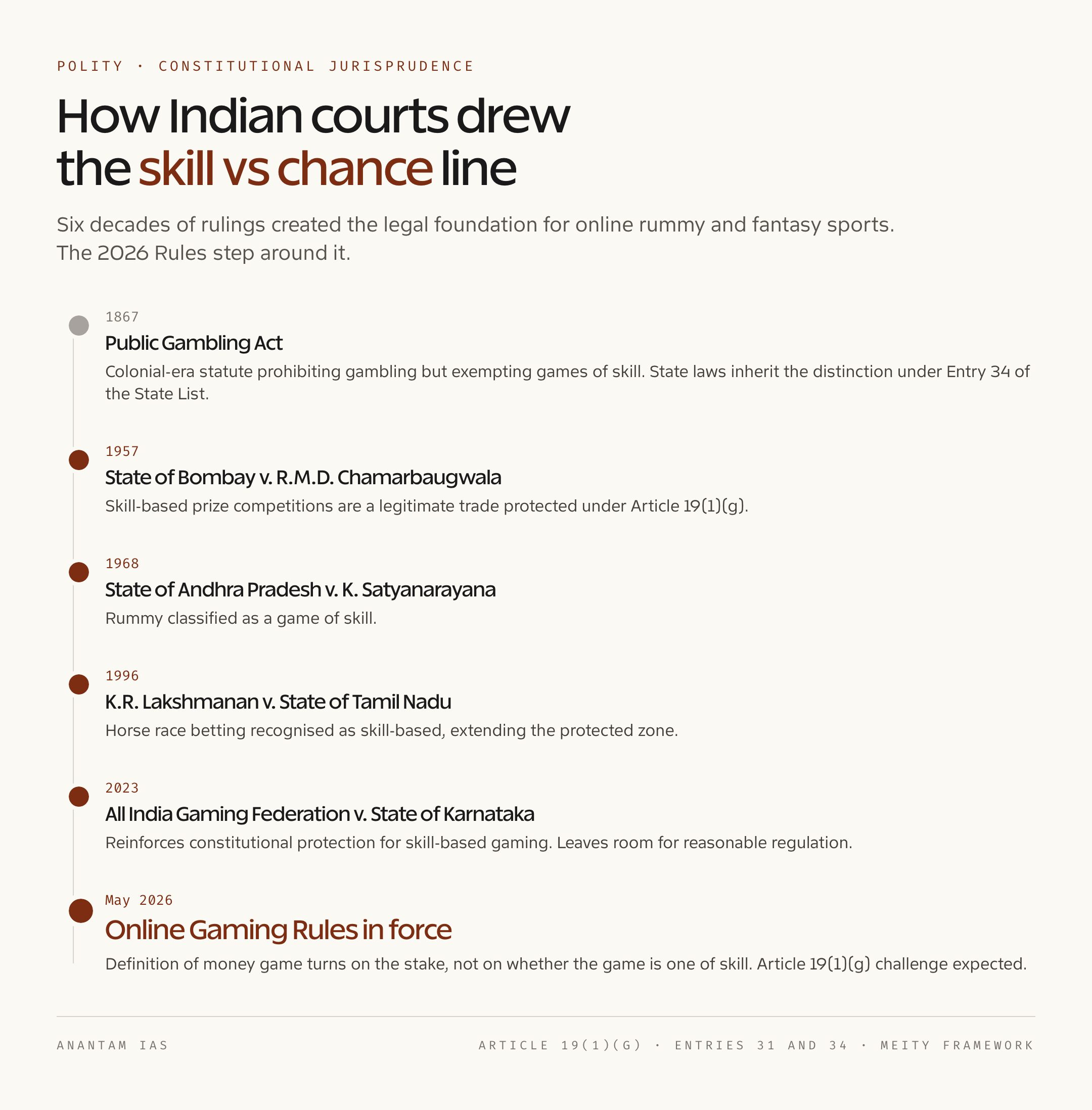
The Public Gambling Act, 1867 prohibited gambling but exempted games of skill. State governments, which have legislative competence over betting and gambling under Entry 34 of the State List, replicated this distinction. Most state laws prohibit gambling on games of chance while allowing games of skill.
The Supreme Court’s 1957 ruling in State of Bombay v. R.M.D. Chamarbaugwala held that prize competitions involving substantial skill were a legitimate trade protected under Article 19(1)(g). The 1968 ruling in State of Andhra Pradesh v. K. Satyanarayana classified rummy as a game of skill. The 1996 ruling in K.R. Lakshmanan v. State of Tamil Nadu classified horse race betting on the same basis.
These rulings created the legal foundation for fantasy sports, online rummy and online poker as legitimate businesses. Players paid entry fees, the platform took a service fee, and prize money was distributed based on outcomes. As long as the game was a “preponderantly skill” game, the activity was lawful.
Several states, beginning with Tamil Nadu, Andhra Pradesh and Karnataka, attempted to ban online rummy and fantasy sports anyway. High Courts in those states struck down some of the bans on Article 19(1)(g) grounds. The Supreme Court’s 2023 ruling in the All India Gaming Federation case, which addressed the Karnataka ban, reinforced the constitutional protection for skill-based gaming, while leaving room for reasonable regulation.
The 2023 IT Rules amendment tried to provide that reasonable regulation through industry SRBs. The framework collapsed under its own weight. The 2025 parent Act and the 2026 rules represent the central government’s attempt to cut through the state-by-state confusion with a single national framework.
For related reading, the explainer on the ban on real money gaming tracks the earlier policy moves, and the piece on civil vs criminal law is useful for the enforcement architecture that follows.
Key Provisions of the Online Gaming Rules 2026
The rules are organised around four pillars.
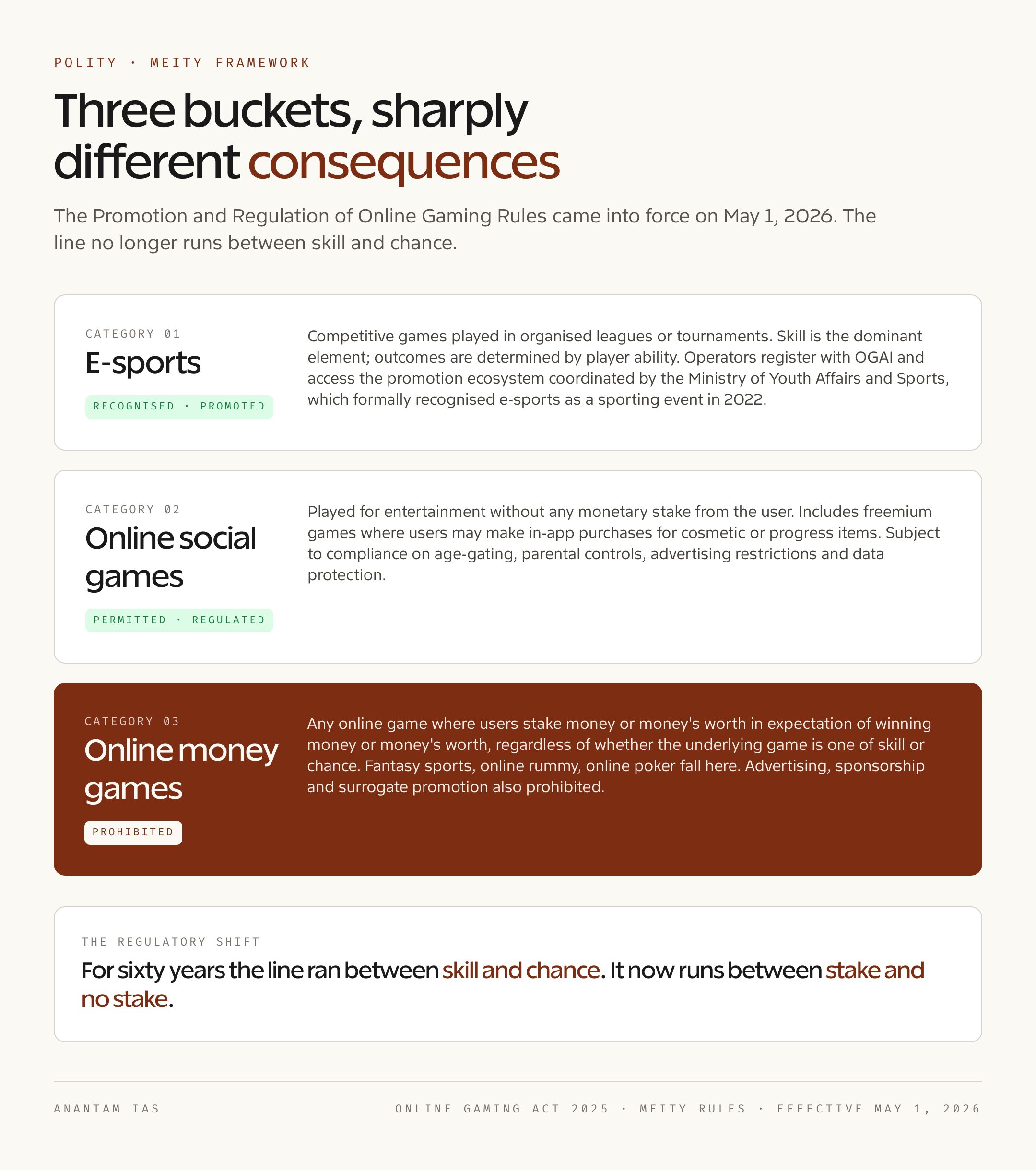
Categorisation. Online games are placed into three categories. E-sports are competitive games played in organized leagues or tournaments, with skill as the dominant element and outcomes determined by player ability. Online social games are games played for entertainment without any monetary stake from the user, including freemium games where users may make in-app purchases for cosmetic or progress items. Online money games are any online games where users stake money or money’s worth in the expectation of winning money or money’s worth, regardless of whether the underlying game is one of skill or chance.
Prohibition of online money gaming. Online money games, as defined, are prohibited. This brings fantasy sports, online rummy, online poker and similar platforms within the scope of the prohibition. The rules also prohibit advertising, sponsorship and surrogate promotion of online money games.
E-sports recognition and promotion. E-sports operators receive registration under OGAI with eligibility for the promotional ecosystem coordinated by the Ministry of Youth Affairs and Sports. The 2022 recognition of e-sports as a multi-sport event component now has a regulatory pathway.
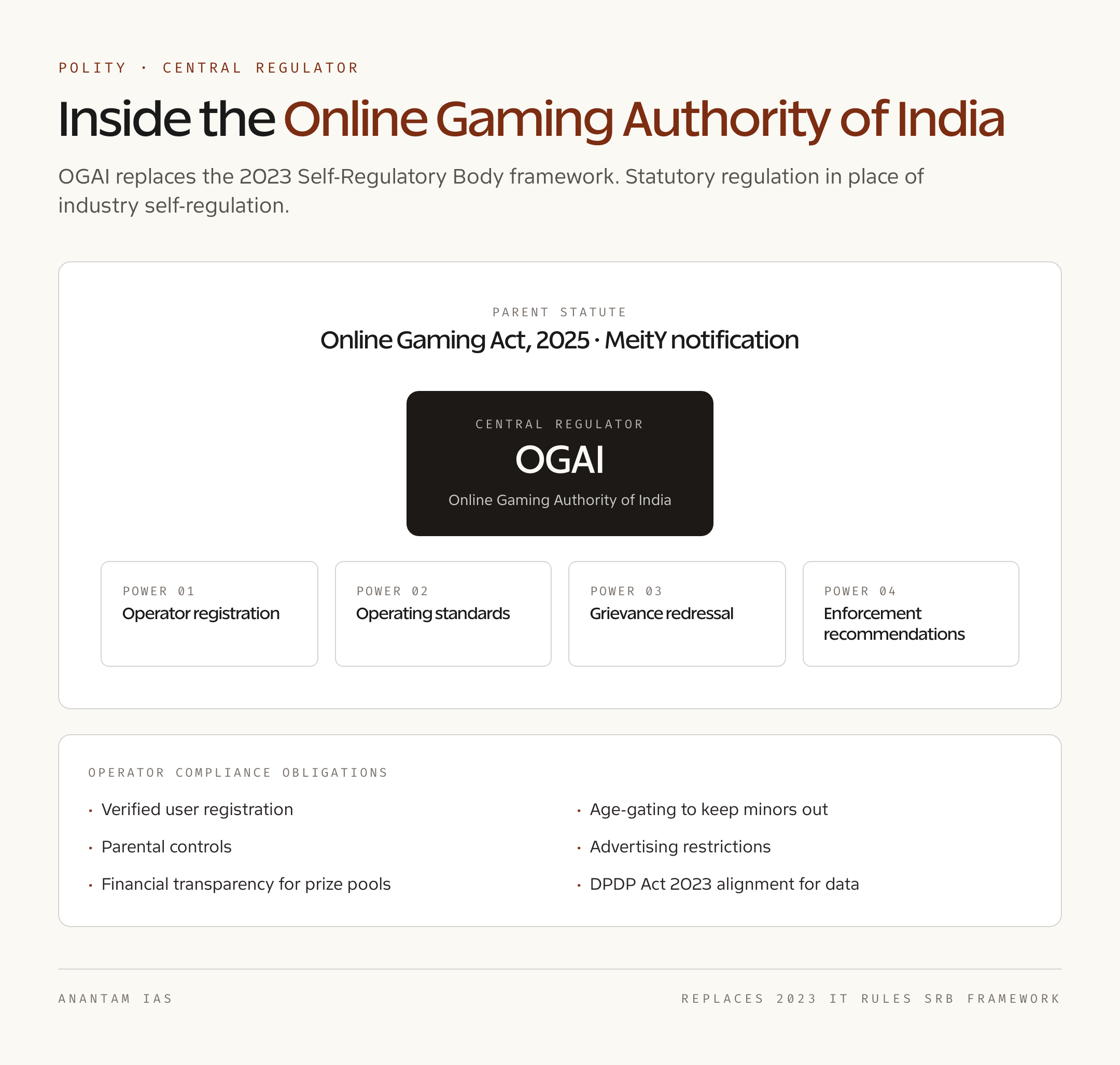
Online Gaming Authority of India. OGAI is the central regulator. It registers operators, frames operating standards, handles user grievances, and recommends enforcement action against non-compliant platforms. The rules also create a grievance redressal mechanism with timelines for complaint handling.
Compliance obligations include verified user registration, age-gating to keep minors out, parental controls, advertising restrictions, financial transparency for e-sports prize pools, and data protection alignment with the Digital Personal Data Protection Act, 2023.
Why the Online Gaming Rules 2026 Matter
The rules matter at three levels.
At the user level, they end ambiguity. Indian users who had been participating in fantasy sports and online rummy with the assumption of legal protection now have clarity that those activities are no longer permitted. The transition will be disruptive but the regulatory signal is unambiguous.
At the industry level, they restructure the market. Platforms operating online money games face a stark choice. Pivot to e-sports or online social formats, or exit. Significant capital had flowed into Indian gaming on the assumption of regulatory continuity. That assumption is now reset.
At the federal level, they assert central regulatory primacy in a domain where state governments had been making competing rules. The rules are framed under MeitY’s authority under the IT Act, with the Online Gaming Act 2025 supplying the additional statutory backbone. Constitutional challenges from states and from operators are likely.
Detailed Analysis: The Skill vs Chance Question
The Online Gaming Rules 2026 effectively render the skill versus chance distinction irrelevant for the prohibition of online money gaming. The definition of “online money game” turns on whether money is staked, not on whether the underlying game is one of skill.
This is a significant shift. For sixty years, the regulatory line had run between skill and chance. The skill side was legal. The chance side was not. The new framework moves the line. Now the line runs between staked play and unstaked play. Any online game with a money stake is on the prohibited side.
Industry will challenge this on Article 19(1)(g) grounds. The argument will be that prohibiting all staked online play, including games that the Supreme Court has historically recognised as games of skill, fails the proportionality test for restrictions on the right to trade. The government’s response will rest on public interest, addiction concerns, financial harm to vulnerable users, and the difficulty of regulating skill-based money games at scale.
The constitutional outcome is uncertain. What is clear is that the regulatory pendulum has swung firmly in one direction.
Comparative Perspective
Different jurisdictions handle online gaming differently. The United Kingdom regulates real money online gaming through the Gambling Commission with extensive licensing, advertising restrictions, and harm reduction obligations. Australia prohibits most online casino gaming for residents while allowing online sports betting. The United States operates state by state, with some states fully regulated and others completely prohibited. Singapore prohibits unregulated online gambling and operates a small set of licensed providers.
India’s framework, with its prohibition of online money gaming and parallel promotion of e-sports, sits closer to the prohibition end of the spectrum, with a developmental e-sports track running alongside.
Challenges and Critiques
The rules face four significant challenges.
Constitutional litigation. Operators of fantasy sports and online rummy platforms will challenge the rules under Article 19(1)(g). Some state governments may also challenge the assertion of central regulatory primacy.
Enforcement complexity. Online platforms operating from outside India will continue to be accessible to Indian users. Blocking such platforms will require coordinated action across MeitY, the Reserve Bank of India for payment processing, and Internet Service Providers. The 2023 SRB framework had similar enforcement gaps.
Migration risk. A prohibition without robust enforcement risks migrating users to grey-market platforms hosted outside Indian jurisdiction. Crypto-denominated betting platforms are a particular concern.
Economic transition. The Indian online gaming industry employs significant talent and contributes to GST collections. The transition to e-sports and online social formats will not absorb all of this capacity.
OGAI’s effectiveness will depend on how it handles each of these challenges in its first year.
UPSC Prelims Pointers
- Online Gaming Rules 2026 came into force on May 1, 2026.
- Notifying ministry: Ministry of Electronics and Information Technology (MeitY).
- Parent legislation: Online Gaming Act, 2025.
- Three categories: e-sports, online social games, online money games.
- Online money games: prohibited.
- Online Gaming Authority of India (OGAI): central statutory regulator.
- E-sports recognized as a competitive sporting event by Ministry of Youth Affairs and Sports in 2022.
- Public Gambling Act, 1867 is the colonial-era statute that exempted games of skill.
- Betting and gambling fall under Entry 34 of the State List.
- Communication and broadcasting fall under Entry 31 of the Union List.
- Article 19(1)(g) protects the right to practice any profession, occupation, trade or business.
Mains Practice Questions
- The Online Gaming Rules 2026 mark a shift from the skill-versus-chance regulatory framework that Indian courts have followed for decades. Critically examine the implications for Article 19(1)(g) jurisprudence. (GS Paper II, 15 marks)
- Discuss the federal dimensions of online gaming regulation in India. How do the Online Gaming Rules 2026 alter the centre-state balance? (GS Paper II, 10 marks)
- Examine the public health, financial harm and consumer protection rationales for prohibiting online money gaming. Are they sufficient to satisfy the proportionality test? (GS Paper II, 15 marks)
- The promotion of e-sports and the prohibition of online money gaming are running in parallel. Evaluate whether this dual-track approach is coherent. (GS Paper III, 10 marks)
Way Forward
The Online Gaming Rules 2026 are a structural reset. The next eighteen months will determine whether the reset works.
OGAI needs to staff up quickly with technical, legal and enforcement capacity. The registration system for operators must be operational without bottlenecks. E-sports promotion needs to deliver visible benefits so that the developmental track is more than rhetoric. And enforcement against offshore and grey-market platforms needs coordinated action across MeitY, RBI, and the ISP layer, because the prohibition is only as strong as its weakest enforcement gate.
Constitutional litigation is coming. The government will need to defend the proportionality of the prohibition with public interest data on financial harm, addiction prevalence and consumer protection failures from the unregulated period.
The policy choice has been made. India has moved from a skill-versus-chance framework to a stake-or-no-stake framework. The Online Gaming Rules 2026 are the rulebook for that new world. How well it is implemented will decide whether the choice produces the public interest outcomes the government has staked it on.
Frequently Asked Questions
What are the Online Gaming Rules 2026?
The Promotion and Regulation of Online Gaming Rules, 2026, notified by MeitY under the Online Gaming Act, 2025. They came into force on May 1, 2026, and create a central regulator, classify games into three categories and prohibit online money gaming.
What are the three categories of online games?
E-sports, online social games (no monetary stake), and online money games (any game with a monetary stake).
What is the Online Gaming Authority of India?
OGAI is the central statutory regulator established under the rules. It registers operators, sets standards, handles grievances and recommends enforcement.
Are fantasy sports still legal?
Online fantasy sports involving money stakes fall within the prohibited category of online money games. They are no longer permitted under the new rules.
What about online rummy and online poker?
Both are online money games under the new definition and are prohibited.
Are e-sports allowed?
Yes. E-sports are recognised, regulated and promoted. Operators must register with OGAI and meet operating standards.
Will state laws still apply?
The Online Gaming Rules 2026 operate at the central level. State laws on betting and gambling continue to operate, but central rules establish a national floor that is unlikely to be overridden by state action.
What about offshore gambling websites?
Access to offshore gambling and money gaming websites is prohibited for Indian users. Enforcement involves blocking by ISPs and payment restrictions through RBI guidelines.